
How to Stop Doing Everything for Everyone
Stop Being Available: How to Set Better Boundaries and Take Your Power Back
▶ Listen to the full episode More from The Mel Robbins Podcast
The brief
Pastor Dr. Eric Thomas and Mel Robbins show why the family caretaker is often its least healthy member, and how to step back without guilt. Thomas, drawing on his wife Dee Dee's multiple sclerosis diagnosis, offers a principles-over-feelings decision framework and a simple test: drop one task, see who steps up, then use the freed time for yourself.
There is a detail that recurs in family photo albums and nobody mentions until someone points it out: one person is reliably missing. They are the one holding the camera, smoothing collars, telling everyone to say cheese. On this episode of the Mel Robbins Podcast, pastor and educator Dr. Eric Thomas offers a harsher version of that same observation. In his own family, he says, the person who held everyone together, his wife Dee Dee, a registered nurse, turned out to be the one family member who was not as healthy as the rest of them (05:32).
Thomas tells Mel Robbins that his own career went from homelessness to a PhD in education from Michigan State University, his son went to work for Michigan State basketball coach Tom Izzo, and his daughter became a company's chief operating officer, all while Dee Dee quietly managed the bills, the health insurance, and, for years, his own credit card debt (11:23). He did not see any of this as a cost until he began listing, out loud, everyone's wish list in the family. Everybody's wish list had been taken care of but one person, he realized, and that was the person who had been helping all of them (04:56). That person had not asked for help to the degree she had given it.
Robbins frames this as a pattern that extends well beyond one marriage. Early in the conversation, she reads out a list, compiled by her own production team, of the small tasks that quietly consume a person's day: keeping a list of all the things that have to be done around the house, managing the kids' schedule, remembering two families' birthdays, writing a spouse's important text messages, making sure the refrigerator is stocked before an adult child comes home from college (09:49). None of these jobs is dramatic on its own. The exhaustion comes from carrying all of them at once, alone, with no one else tracking that the list even exists.
Thomas connects this invisible accounting to physical health. He describes sitting in a hospital after Dee Dee's multiple sclerosis diagnosis and asking himself what portion of her stress he was responsible for (14:01). This is not a clinical study, it is one man's reckoning, and the episode does not cite research linking caregiving stress to autoimmune disease. But the logic Thomas draws from it, that a body eventually bills the mind for debts it has been quietly covering, becomes the engine of everything that follows. If the caretaker's health is the thing being spent down, stopping is not selfish. It is maintenance.
Principles, Not Feelings
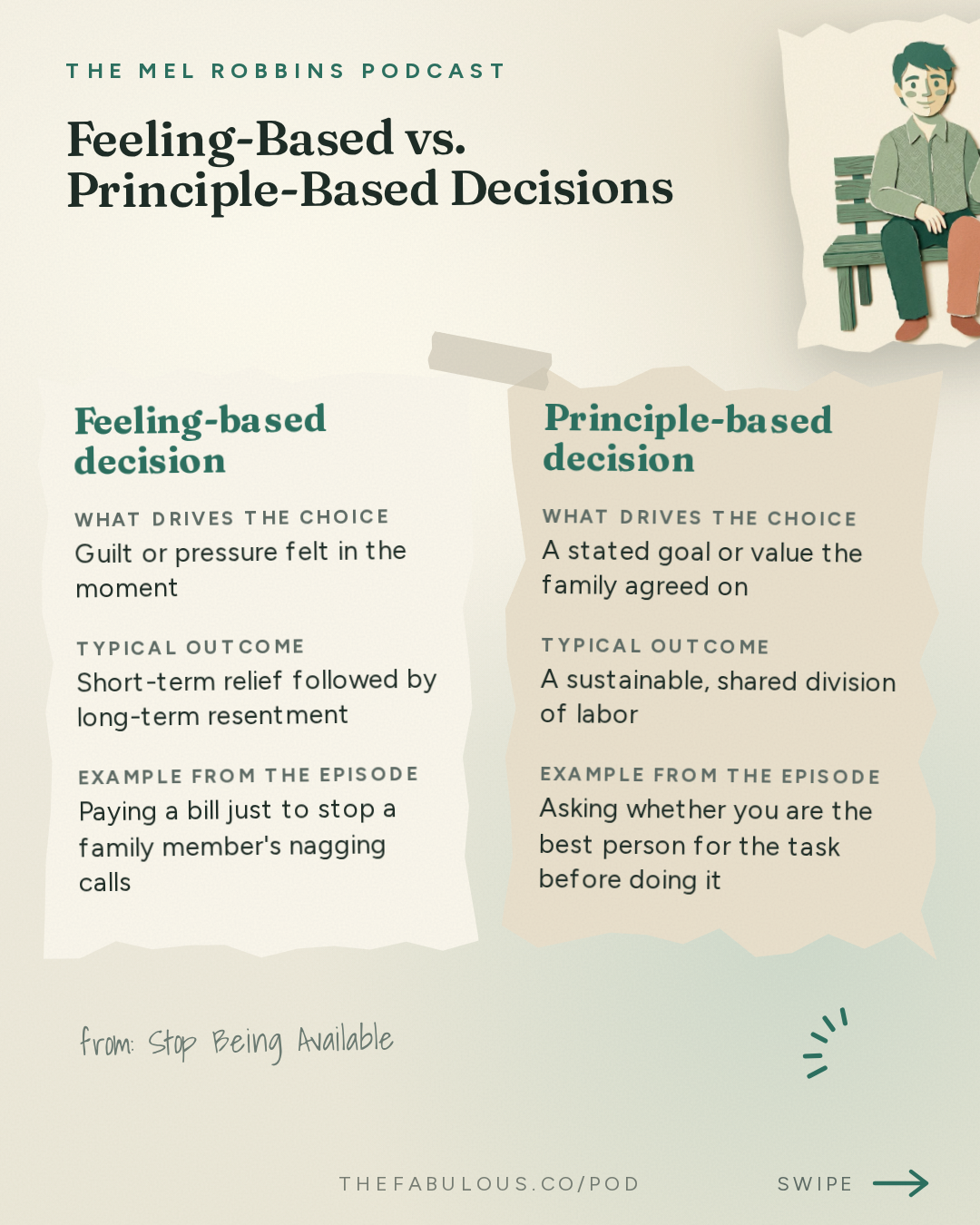
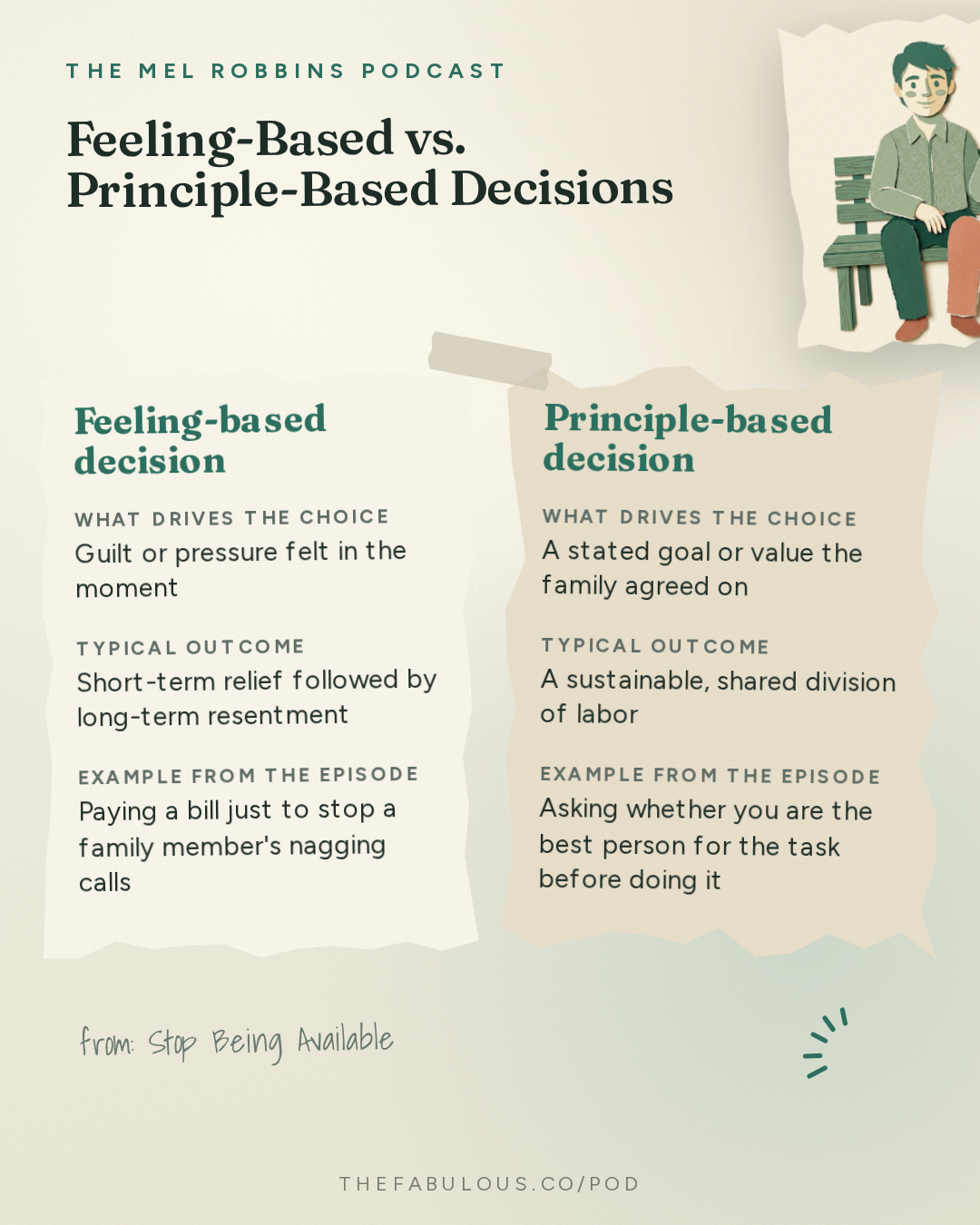
The hardest part of stopping, Thomas argues, is that most of these tasks are never decided, they are reacted to. He describes coaching his own mother through a decision about caring for her aging mother: should she bring her into her home, drop everything when she calls, manage her health alone? His advice was to separate the question from guilt. He had to get out of his feelings and into principles, he tells Robbins (24:46). A feeling says: if I do not answer, I am a bad daughter. A principle asks a narrower question: is this the best use of my time, and am I the best person for this job.
"It's not healthy to pour from an empty cup. You can try, but it's not. That cup should continue to be filled by who? The people you bless. So if you're helping people and it's not helping, then guess what you're doing? You're hurting." Dr. Eric Thomas, [25:47]
The same principle, Thomas says, should govern a marriage's vision. Too many couples never sit down to define what they are actually building, so every decision defaults to whoever feels the most guilt in the moment. Dee Dee's contribution to their marriage, he says, was insisting on the word "we." A career, a travel schedule, even a reputation such as Thomas's public identity as a motivational speaker, stopped being his alone to decide once she named it as a shared asset that affected her and their children too (28:27).
What Happens When the Ball Drops
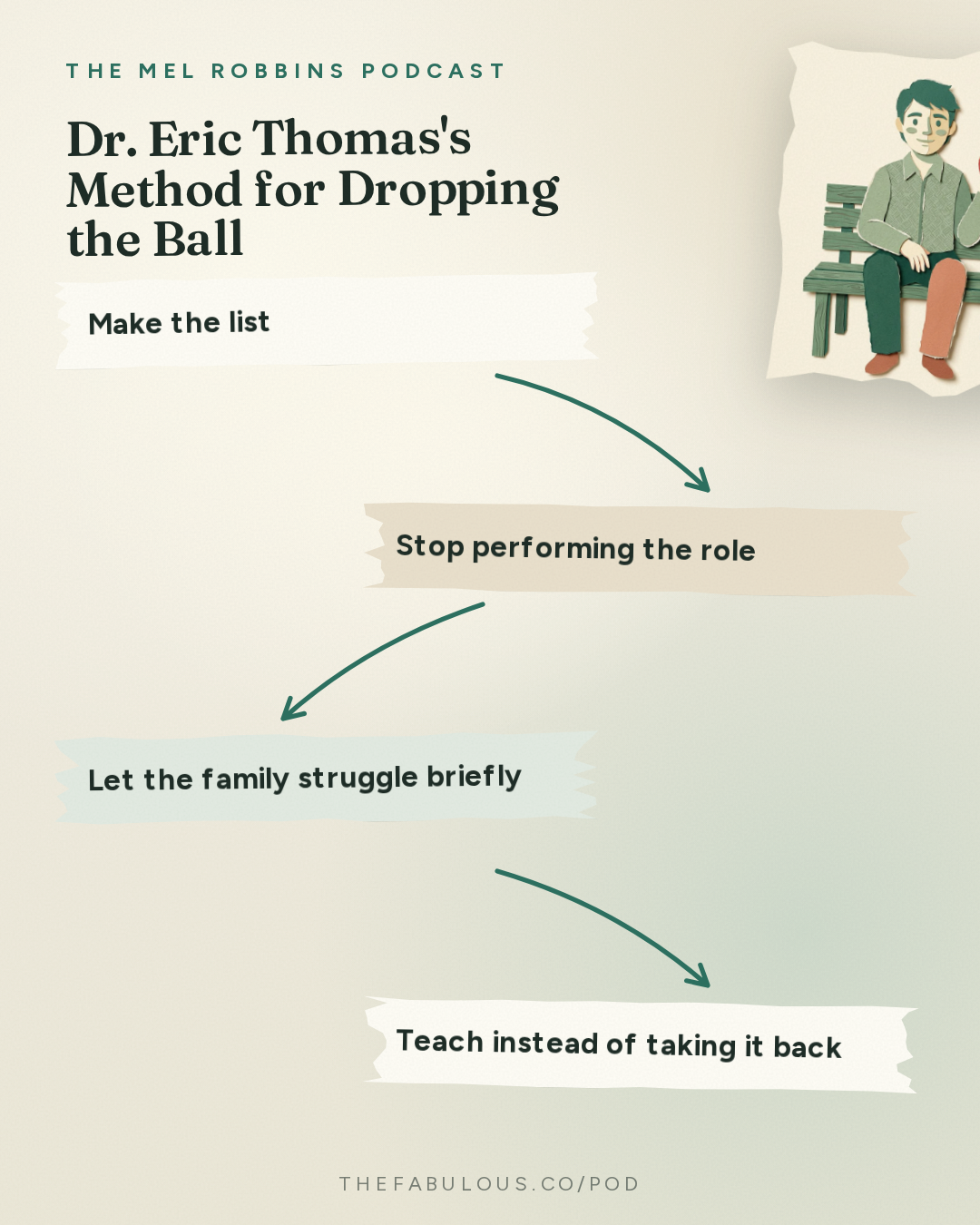
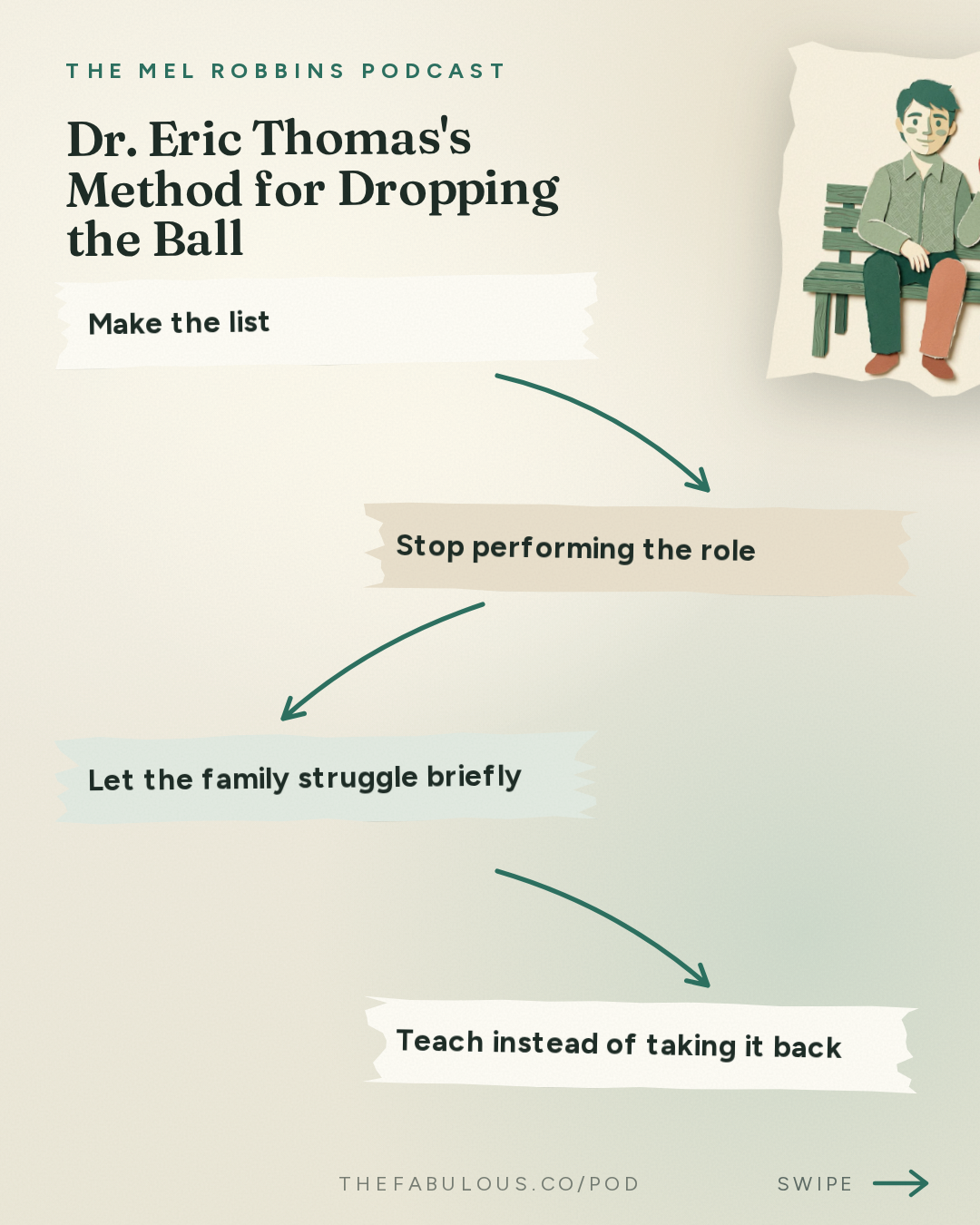
Robbins presses Thomas for tactics, not just philosophy, and the clearest one is almost mechanical: stop doing the task and see what happens. Thomas describes exactly this experiment inside his own house. When Dee Dee stopped doing the laundry, he had to learn it himself, asking her for two supervised sessions before he could do it alone; the result, he says, is that people at his church now comment on how good his clothes smell (40:18). When she stopped cooking, their son became the best cook in the house, skilled enough that his sister never had to learn at all (40:53). Nobody starved. Nobody's life fell apart. The tasks simply moved to someone with the capacity to learn them, which was only possible once Dee Dee stopped doing them well enough that no one else needed to.
This is the part of the advice that doubles as a small theory of family systems: a role that is still being performed cannot be handed off, because there is no vacancy. People cannot take the role when someone is still dominating it, Thomas says, so the first move is to get out of the role (19:20). Robbins calls this the moment most people resist hardest, because stepping back can feel like confirming they were never needed, when the opposite is usually closer to true. The family adapts because it has to, and the adaptation is itself proof of how much capacity had been going unused.
Thomas's own attachment to one task, making the Thanksgiving turkey every year, becomes his example of how identity sneaks into chores that were never actually requested. Nobody else made the turkey, only him, he says, before admitting that his own ego, not his family's expectations, kept him holding on to it long after it stopped being enjoyable (44:20). Robbins extends the idea: once a task becomes someone's unspoken identity, dropping it can feel like losing a piece of the self, even when it was the self that assigned the task in the first place.
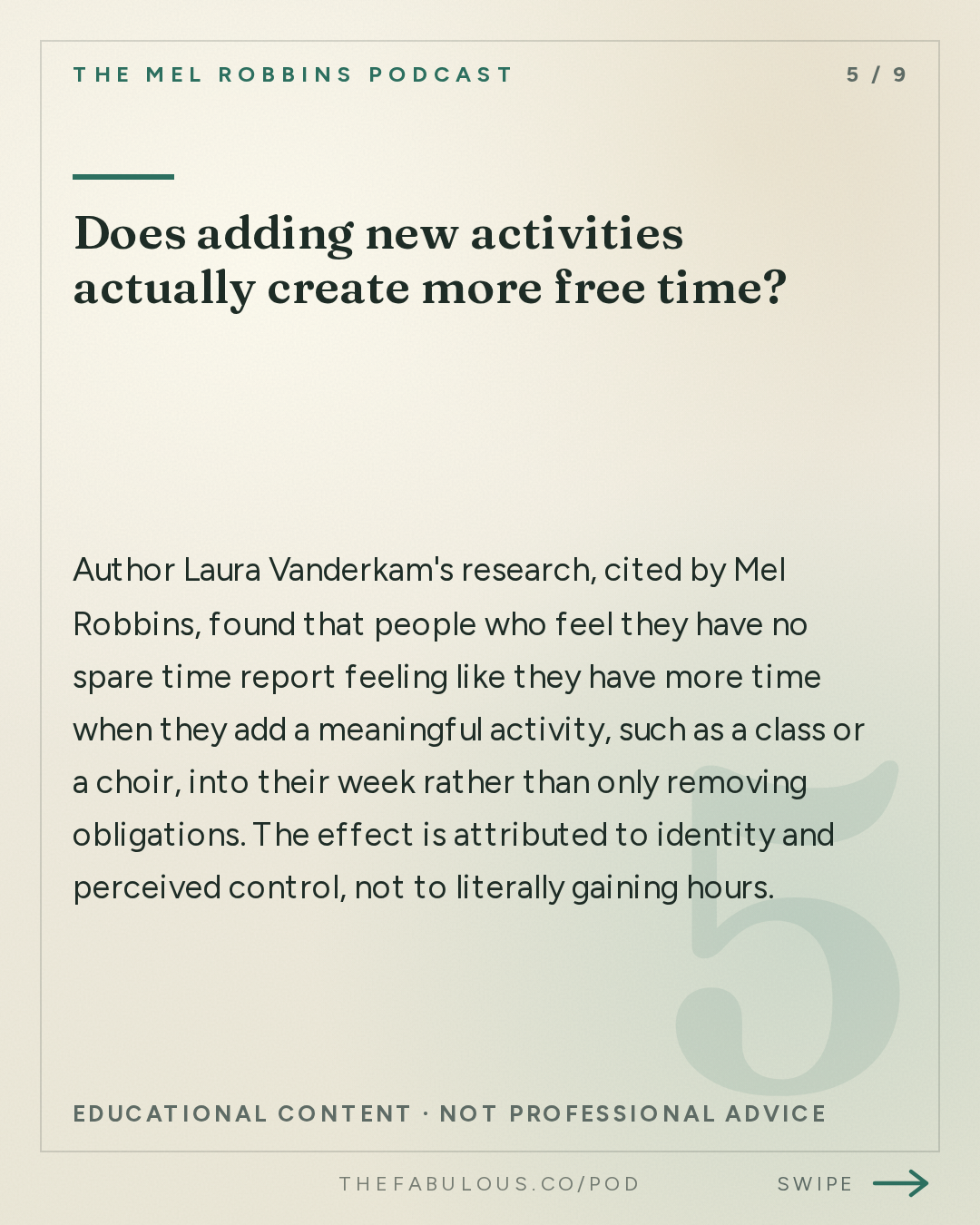
Letting go, both agree, frees up more than time. Robbins cites research by journalist and author Laura Vanderkam showing that people who feel they have no spare time actually feel like they gain time when they add something meaningful back into their week, a class, a choir, a hobby, rather than only subtracting obligations (36:47). The mechanism is less about the clock and more about identity: a life that is only chores feels both endless and empty, while a life that includes one thing done purely for joy reorganizes how the rest of the week is experienced.
The clearest marker that someone has taken on too much, in Thomas's framing, is resentment. Not sadness, not fatigue exactly, but a creeping anger at the very people being cared for (41:53). Robbins adds a diagnostic question of her own: did anyone actually ask for this? Dee Dee's answer, delivered to her husband directly, becomes one of the episode's sharpest lines.
"Some of the stuff that you're doing for our family, you made that up." Dee Dee Thomas, as recounted by Dr. Eric Thomas [50:02]
The line reframes the whole conversation. Much of the weight being carried was never actually requested. It was self-assigned, often out of love, sometimes out of guilt, and occasionally out of ego, the way Thomas's turkey was. Once a task is named as self-imposed rather than demanded, it becomes something that can be renegotiated rather than endured.
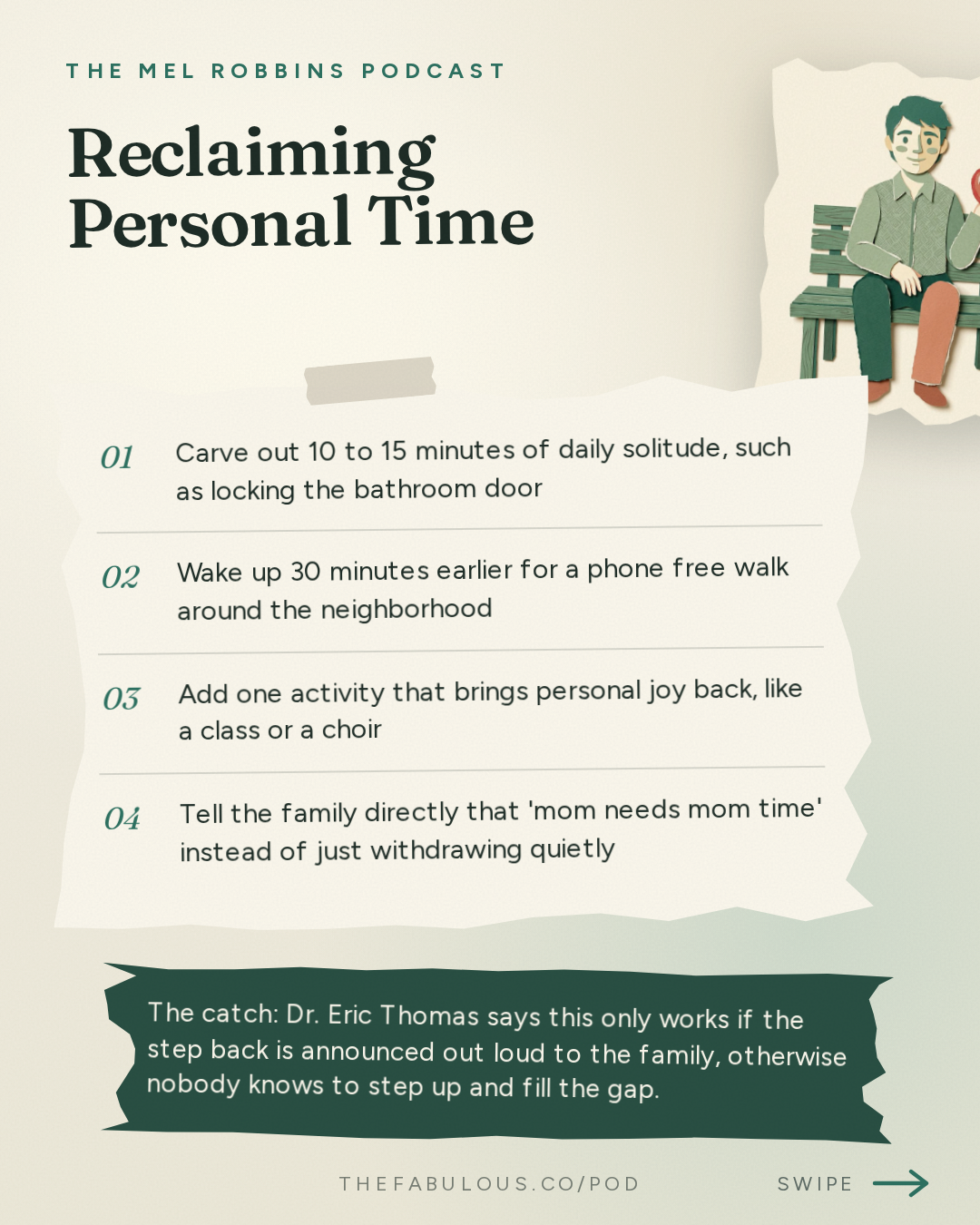
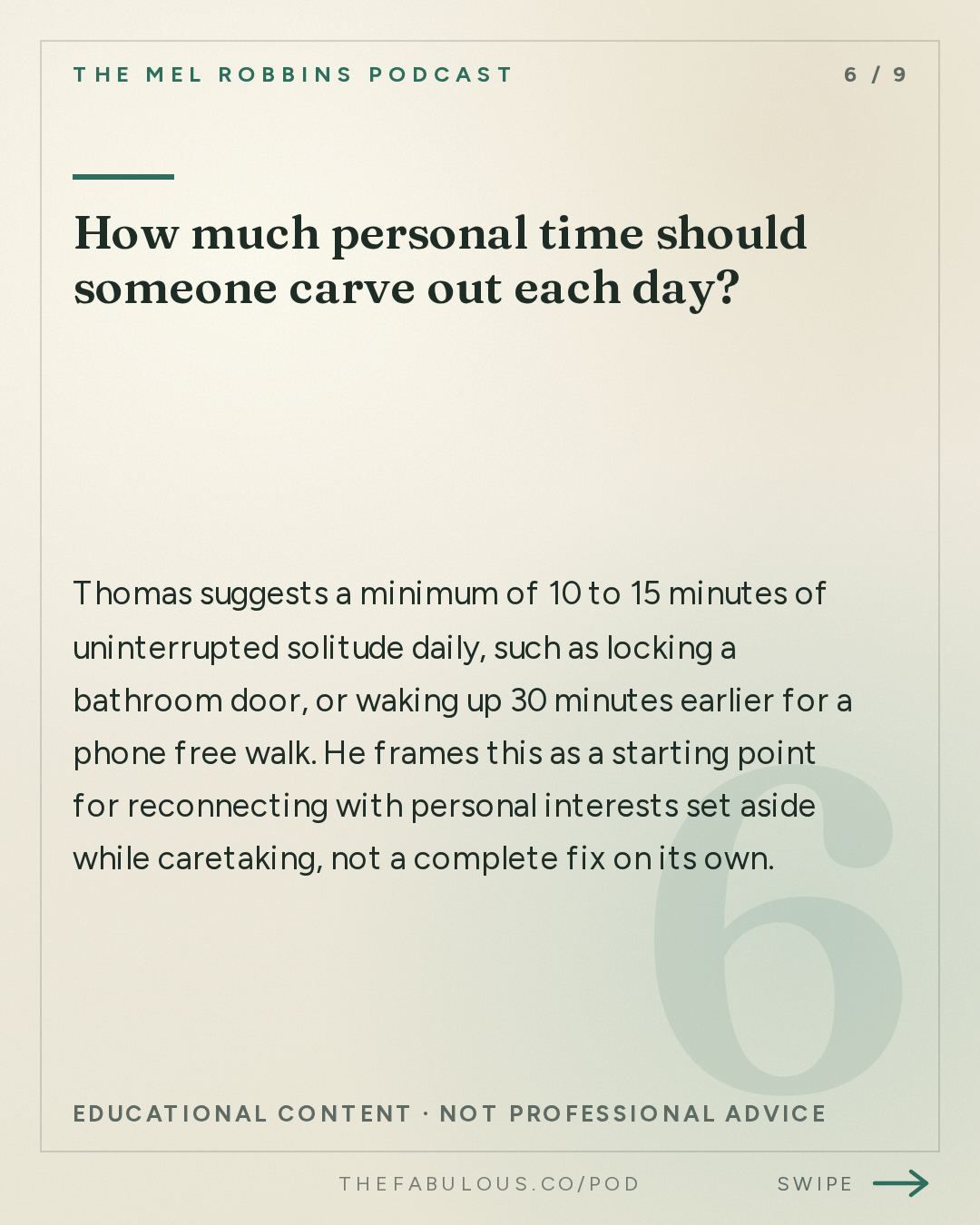
Thomas's closing advice avoids big gestures. Reclaim ten to fifteen minutes of solitude a day, lock a door if that is what it takes, or wake up thirty minutes earlier for a phone-free walk (31:23). Then say the retirement out loud: tell the family that "Supermom" is stepping down, because the role of indispensable caretaker is, as Thomas puts it, maybe the only job in American life with no retirement age (41:32). None of this requires a dramatic exit. It requires, first, writing down the list that nobody else can see, and second, trusting that the people who love someone would rather see them rested than see the laundry folded on time.
Thomas ends the conversation by assuming, for the sake of argument, a lifespan of ninety years (51:30), a reminder that the math of a life spent entirely on chores never balances. The episode's real proposal is modest: the measure of love in a household was never the length of one person's task list, and the fastest way to find out who else can carry a role is to stop carrying it alone.
Ask this episode anything
Pod's AI answers from the episode itself, with the minute mark so you can hear it yourself.
Or start with one of these
Ask this episode
Pod's AI listens to the whole episode to answer, and points you to the minute it comes from.
The rest of this answer, and any question after it
Answers come from the episode itself, never from a summary of it.
ContinueKey takeaways
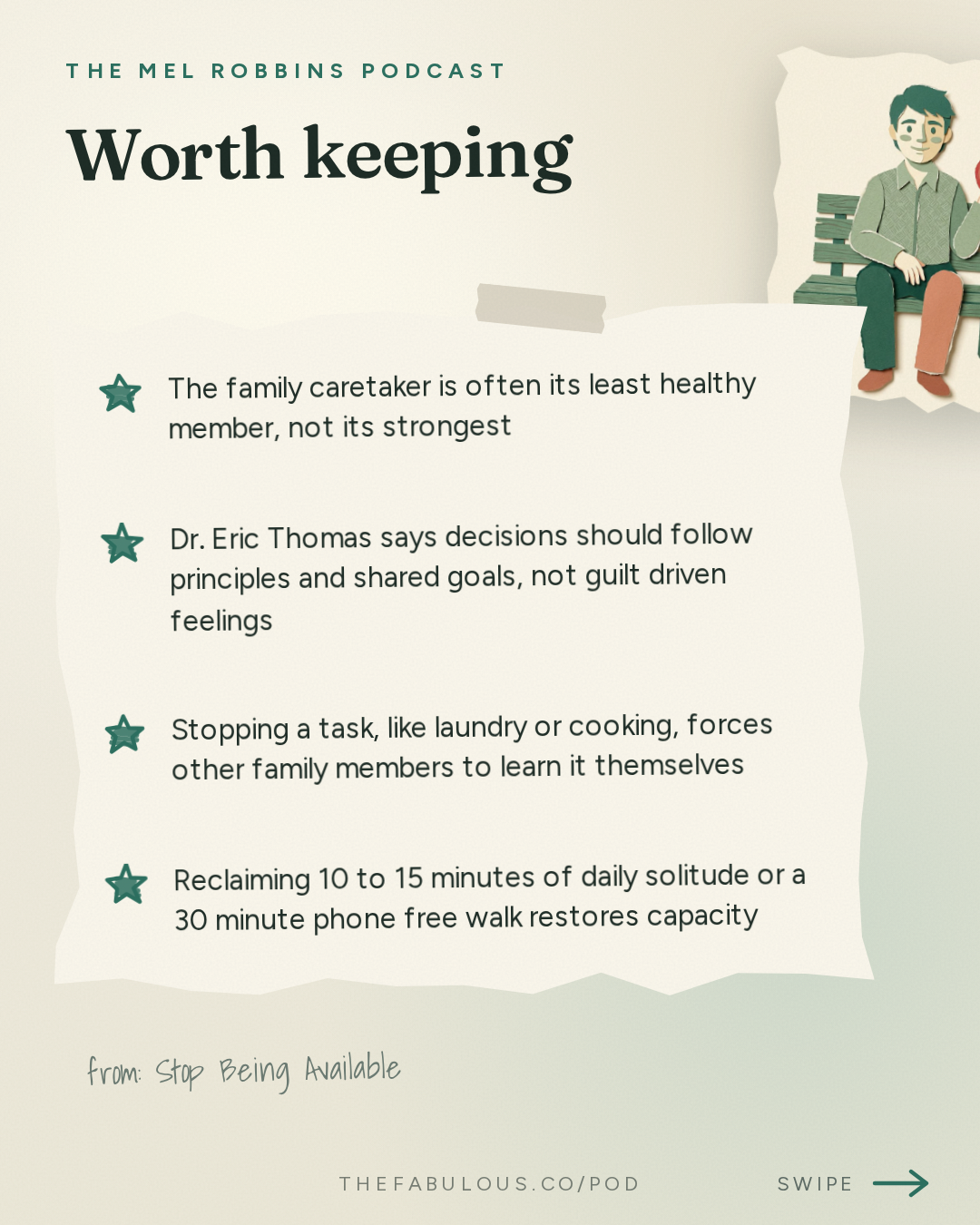
- The family caretaker is often its least healthy member, not its strongest
- Dr. Eric Thomas says decisions should follow principles and shared goals, not guilt driven feelings
- Stopping a task, like laundry or cooking, forces other family members to learn it themselves
- Reclaiming 10 to 15 minutes of daily solitude or a 30 minute phone free walk restores capacity
- Resentment toward loved ones signals that someone is carrying too much unrequested responsibility
The episode in cards

By the numbers
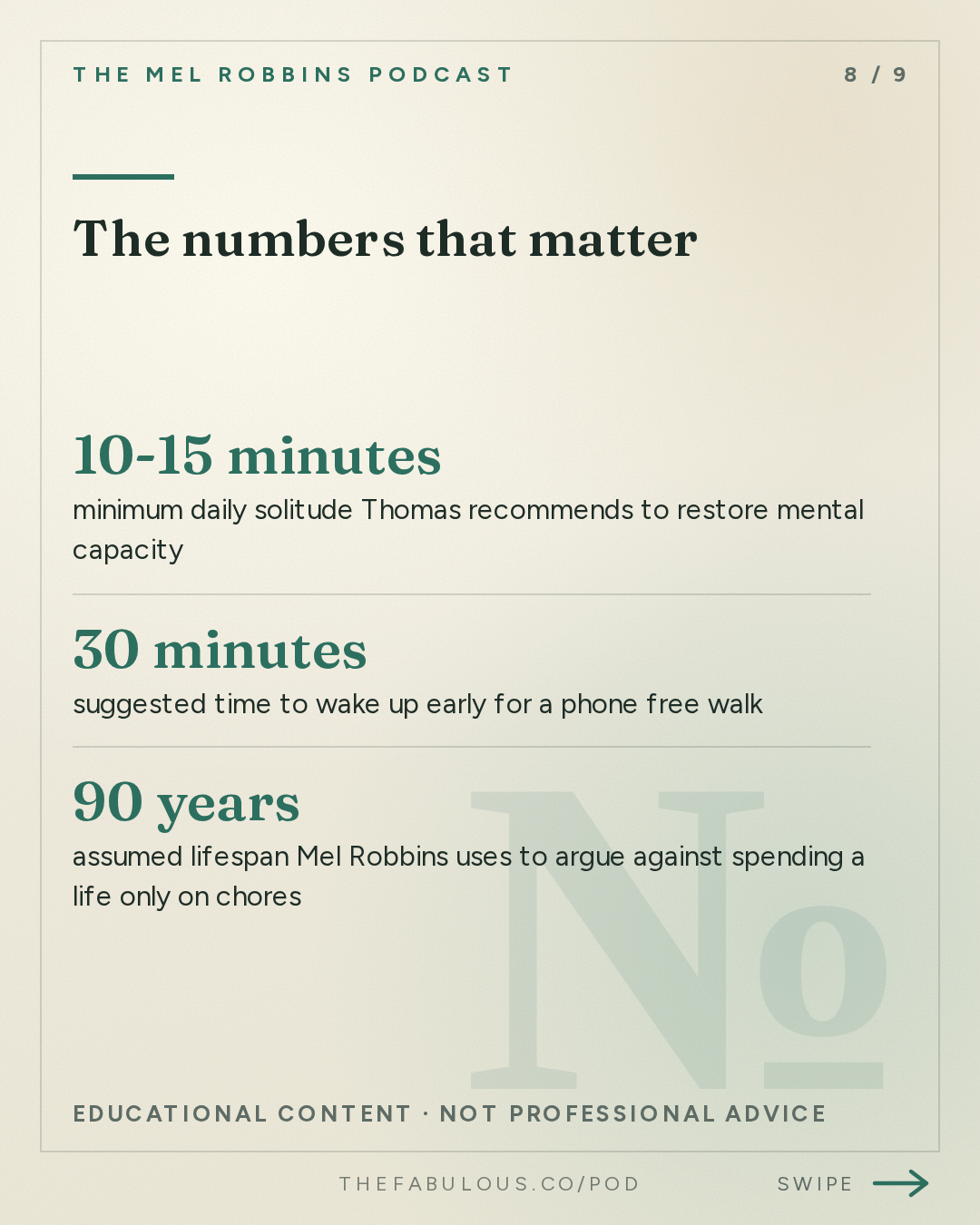
- 10-15 minutes minimum daily solitude Thomas recommends to restore mental capacity
- 30 minutes suggested time to wake up early for a phone free walk
- 90 years assumed lifespan Mel Robbins uses to argue against spending a life only on chores
In their words
“One of the most loving things you can do for your family and everyone around you is to love yourself enough to stop carrying everybody else's stuff, put it down, and start picking up the dreams that you left behind.”
“There is a time to be a blessing, but there's also a time to receive help and to be taken care of.”
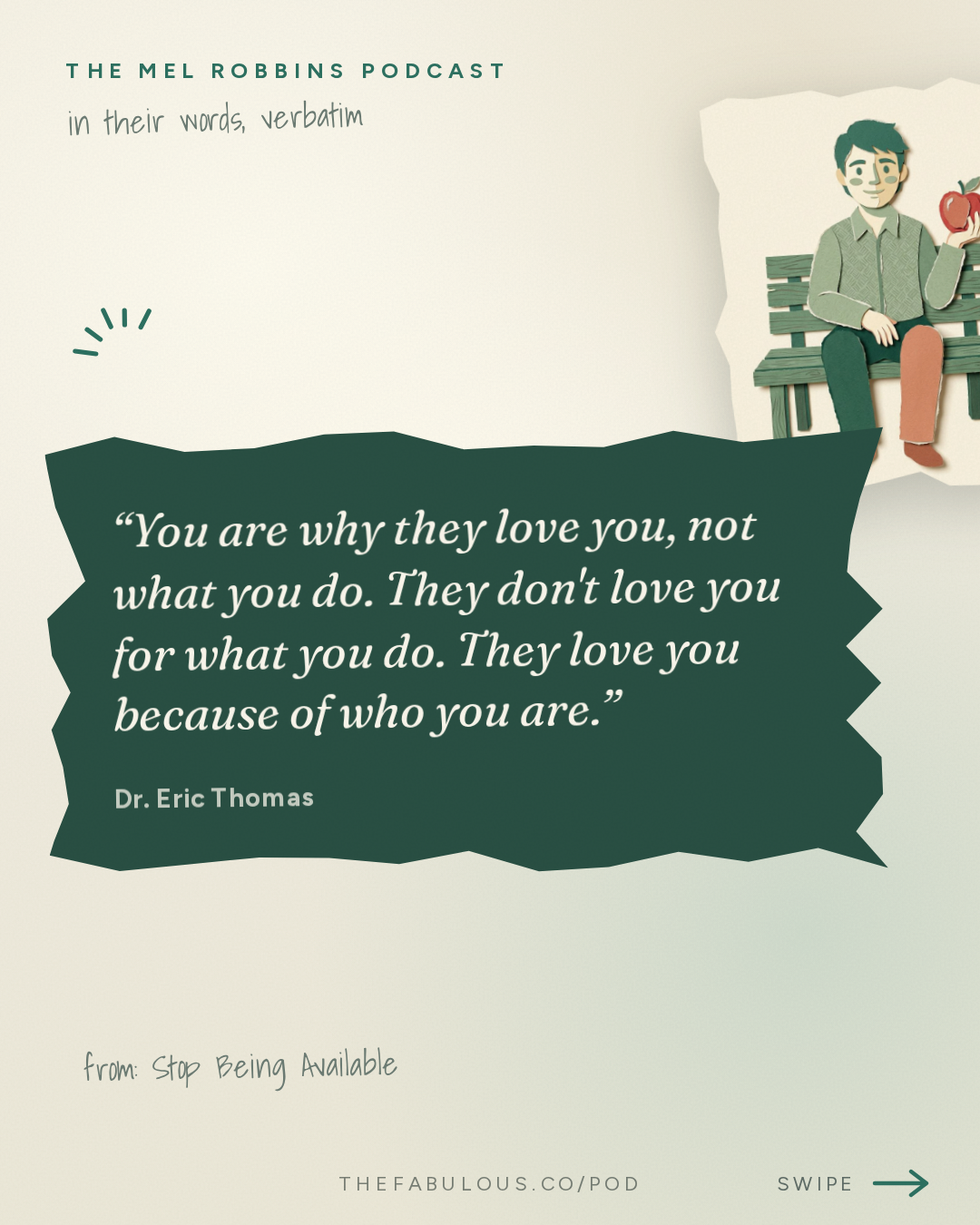
“You are why they love you, not what you do. They don't love you for what you do. They love you because of who you are.”
“Can I lower my standards a little so I can raise my standard of living?”
“Some of the stuff that you're doing for our family, you made that up.”
Protocols
-
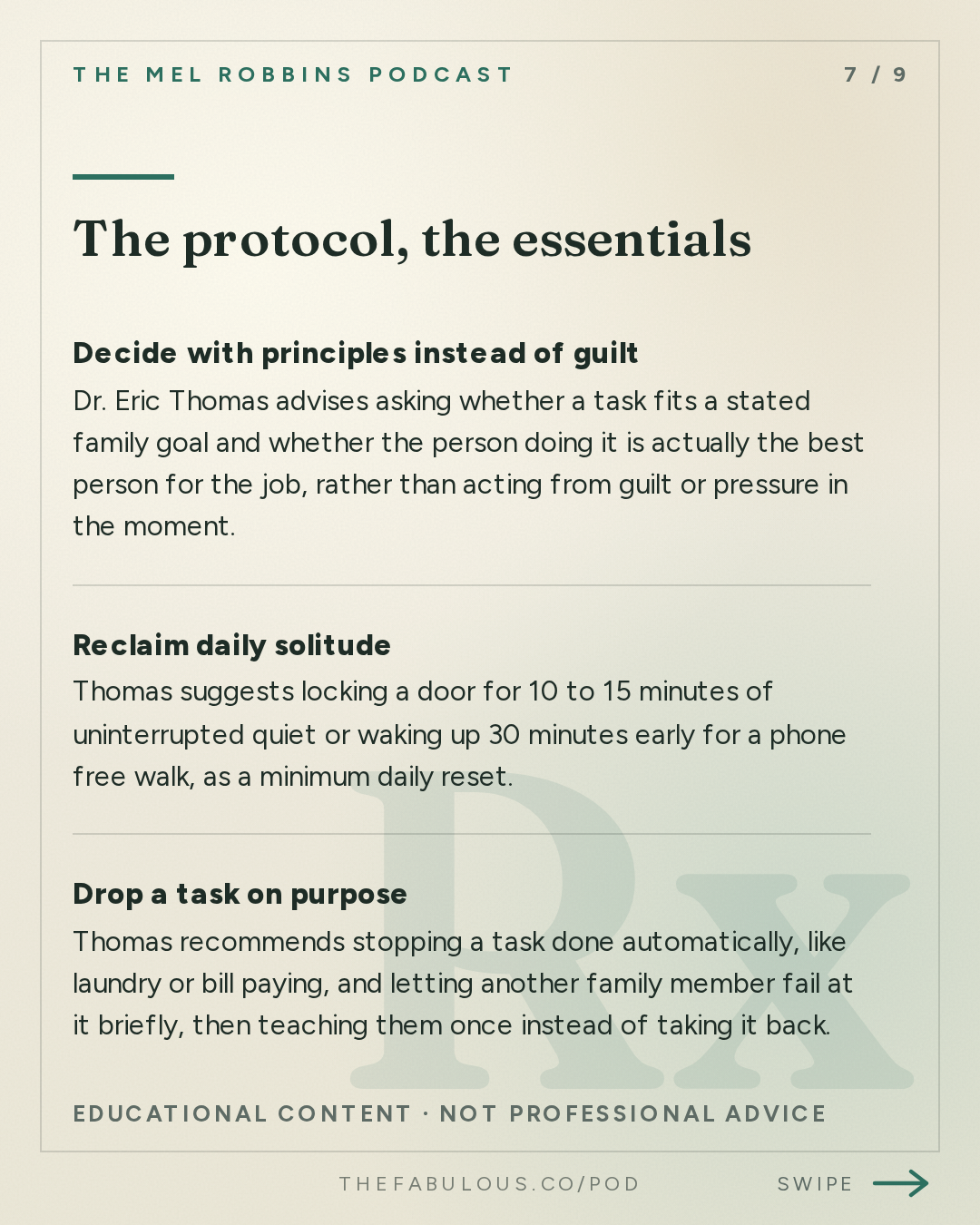
Decide with principles instead of guilt
Dr. Eric Thomas advises asking whether a task fits a stated family goal and whether the person doing it is actually the best person for the job, rather than acting from guilt or pressure in the moment.
Before taking on any new household or caregiving task
-
Reclaim daily solitude
Thomas suggests locking a door for 10 to 15 minutes of uninterrupted quiet or waking up 30 minutes early for a phone free walk, as a minimum daily reset.
Daily
-
Drop a task on purpose
Thomas recommends stopping a task done automatically, like laundry or bill paying, and letting another family member fail at it briefly, then teaching them once instead of taking it back.
Once per task, then sustained
-
Reclassify chores as shared, not gendered
Mel Robbins describes using a family group chat to assign tasks like feeding the dog or a grocery run to whoever is available, treating chores as household items rather than one person's job.
Ongoing, as needs come up
Questions this episode answers
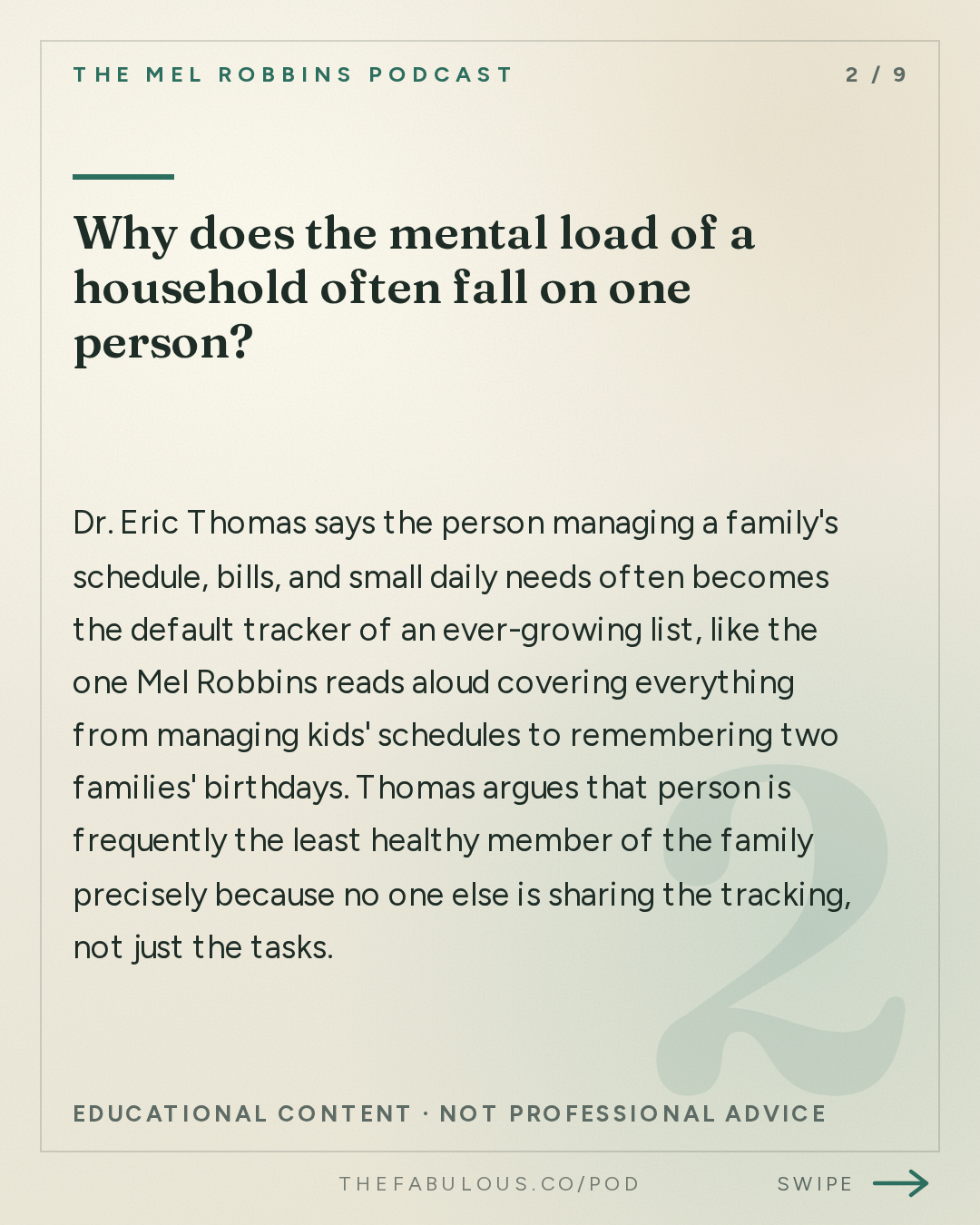
Why does the mental load of a household often fall on one person?
Dr. Eric Thomas says the person managing a family's schedule, bills, and small daily needs often becomes the default tracker of an ever-growing list, like the one Mel Robbins reads aloud covering everything from managing kids' schedules to remembering two families' birthdays (09:49). Thomas argues that person is frequently the least healthy member of the family precisely because no one else is sharing the tracking, not just the tasks (05:32).
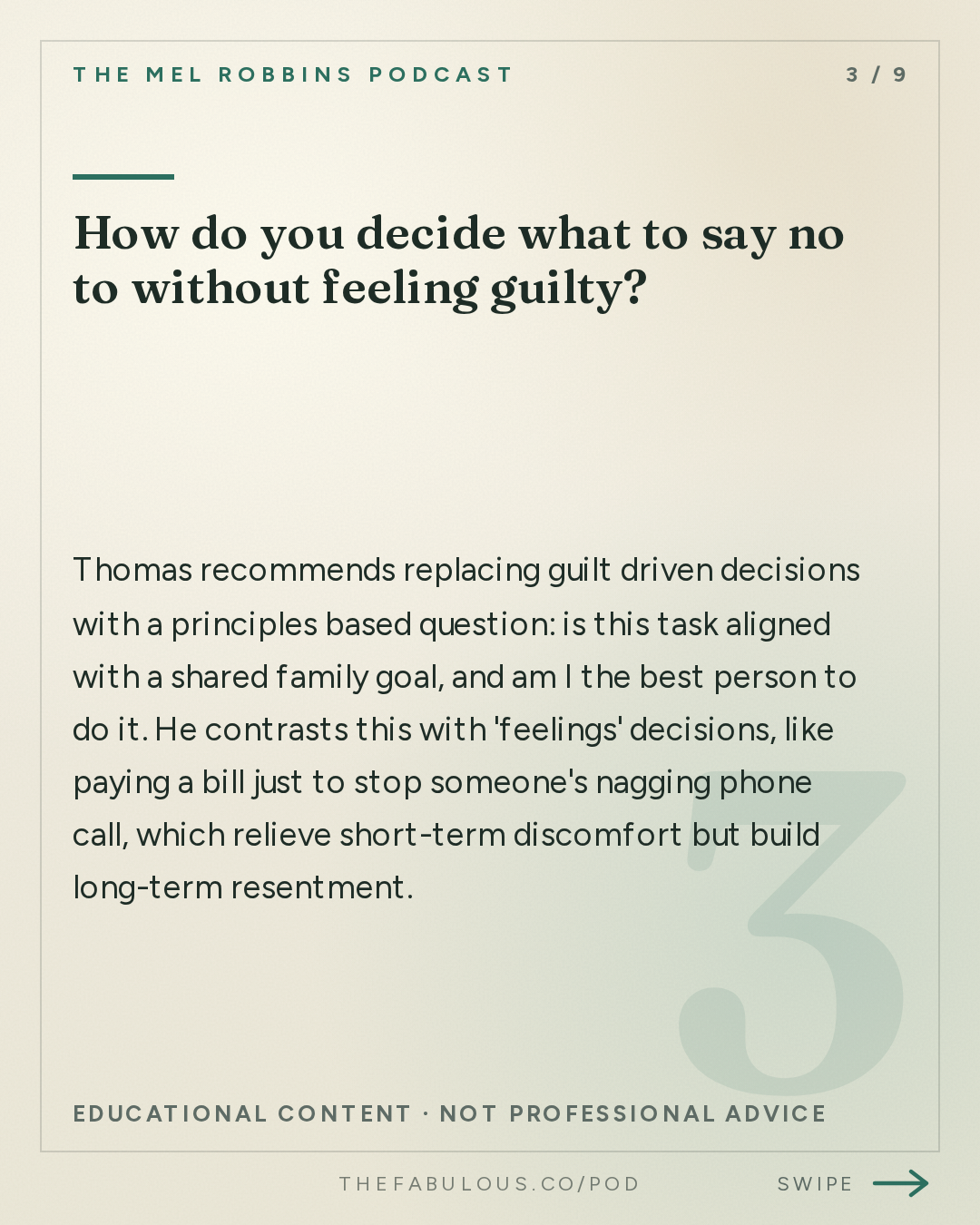
How do you decide what to say no to without feeling guilty?
Thomas recommends replacing guilt driven decisions with a principles based question: is this task aligned with a shared family goal, and am I the best person to do it (24:46). He contrasts this with 'feelings' decisions, like paying a bill just to stop someone's nagging phone call, which relieve short-term discomfort but build long-term resentment (25:47).
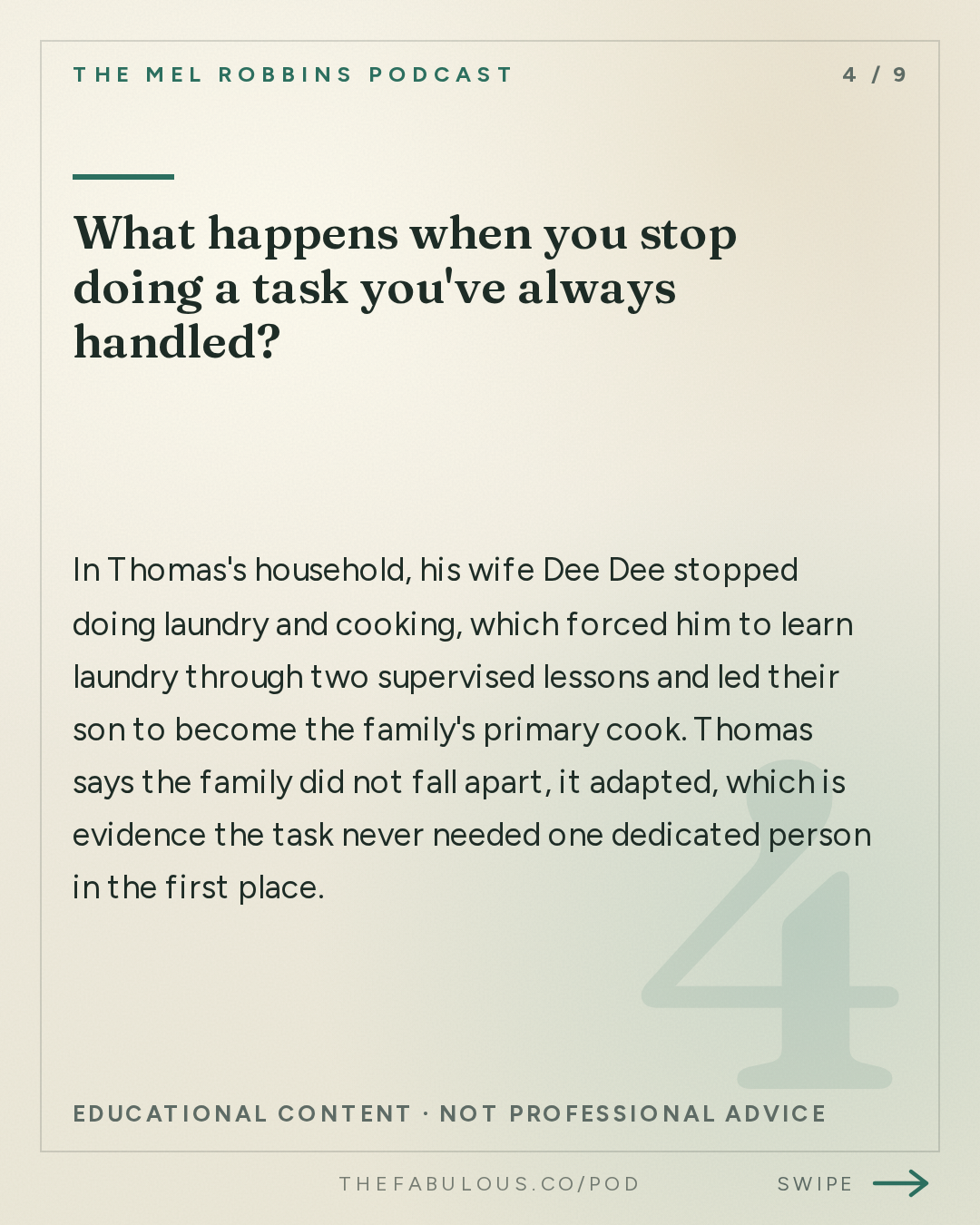
What happens when you stop doing a task you've always handled?
In Thomas's household, his wife Dee Dee stopped doing laundry and cooking, which forced him to learn laundry through two supervised lessons and led their son to become the family's primary cook (18:29, 40:36). Thomas says the family did not fall apart, it adapted, which is evidence the task never needed one dedicated person in the first place.
Does adding new activities actually create more free time?
Author Laura Vanderkam's research, cited by Mel Robbins, found that people who feel they have no spare time report feeling like they have more time when they add a meaningful activity, such as a class or a choir, into their week rather than only removing obligations (36:47). The effect is attributed to identity and perceived control, not to literally gaining hours.
How much personal time should someone carve out each day?
Thomas suggests a minimum of 10 to 15 minutes of uninterrupted solitude daily, such as locking a bathroom door, or waking up 30 minutes earlier for a phone free walk (31:23). He frames this as a starting point for reconnecting with personal interests set aside while caretaking, not a complete fix on its own.
What is a sign that someone is carrying too much responsibility for their family?
Thomas identifies resentment toward the very people being cared for as the clearest signal of overload (41:53). Mel Robbins adds that many of these self-imposed duties were never actually requested, illustrated by Dee Dee Thomas telling her husband, 'Some of the stuff that you're doing for our family, you made that up' (50:02).
The full read, in cards
Go deeper
- Laura Vanderkam's research on time perception — found that adding a meaningful, joyful activity to a busy week makes people feel like they have more time, not less
Mentioned
Dr. Eric Thomas · Mel Robbins · Dee Dee Thomas · Michigan State University · Laura Vanderkam · Coach Izzo · Multiple Sclerosis
More from this show and category
Eric Thomas's 52-Day Challenge, Explained
Motivational speaker Eric Thomas says anyone can reset their life in 52 days, the biblical time it took to rebuild Jerusalem's wall after 140 years in ruins. He used the method himself to lose weight, and coaches listeners to pick one embarrassing area of life, post a photo of their goal self, and start with 15 minutes a day.
Mel Robbins and Daughter on Parenting Mistakes
Mel Robbins and her daughter Sawyer Robbins grade Mel's parenting and unpack the Gottman Institute's "volcano and turtle" conflict pattern. They trace Mel's traumatic birth, clashing "practical solver" versus "deep listener" parenting roles, and a notepad trick that slows a flooded nervous system during fights.
Ed Mylett on Identity, Worry, and Reinvention
Ed Mylett, 55-year-old entrepreneur and podcast host, says identity works like a thermostat that quietly resets your life to a fixed setting no matter how good things get (28:27). He shows how writing down worries strips their power, why love outlasts fear as motivation, and why past failures qualify you to help others (42:25).
Mel Robbins' Relationship Advice for Young Adults
Mel Robbins tells her 27-year-old daughter that good relationships depend on timing and self-work, not just chemistry. Drawing on Gottman research, Jonathan Haidt, and Terry Real, she explains how to spot a wrong fit, why a single era matters, how to balance two ambitious partners, and why breakup recovery takes three months of restraint.
