
Ed Mylett on Identity, Worry, and Reinvention
It’s Not Too Late: The 5 Shifts That Will Change the Rest of Your Year with Ed Mylett
▶ Listen to the full episode More from The Mel Robbins Podcast
The brief
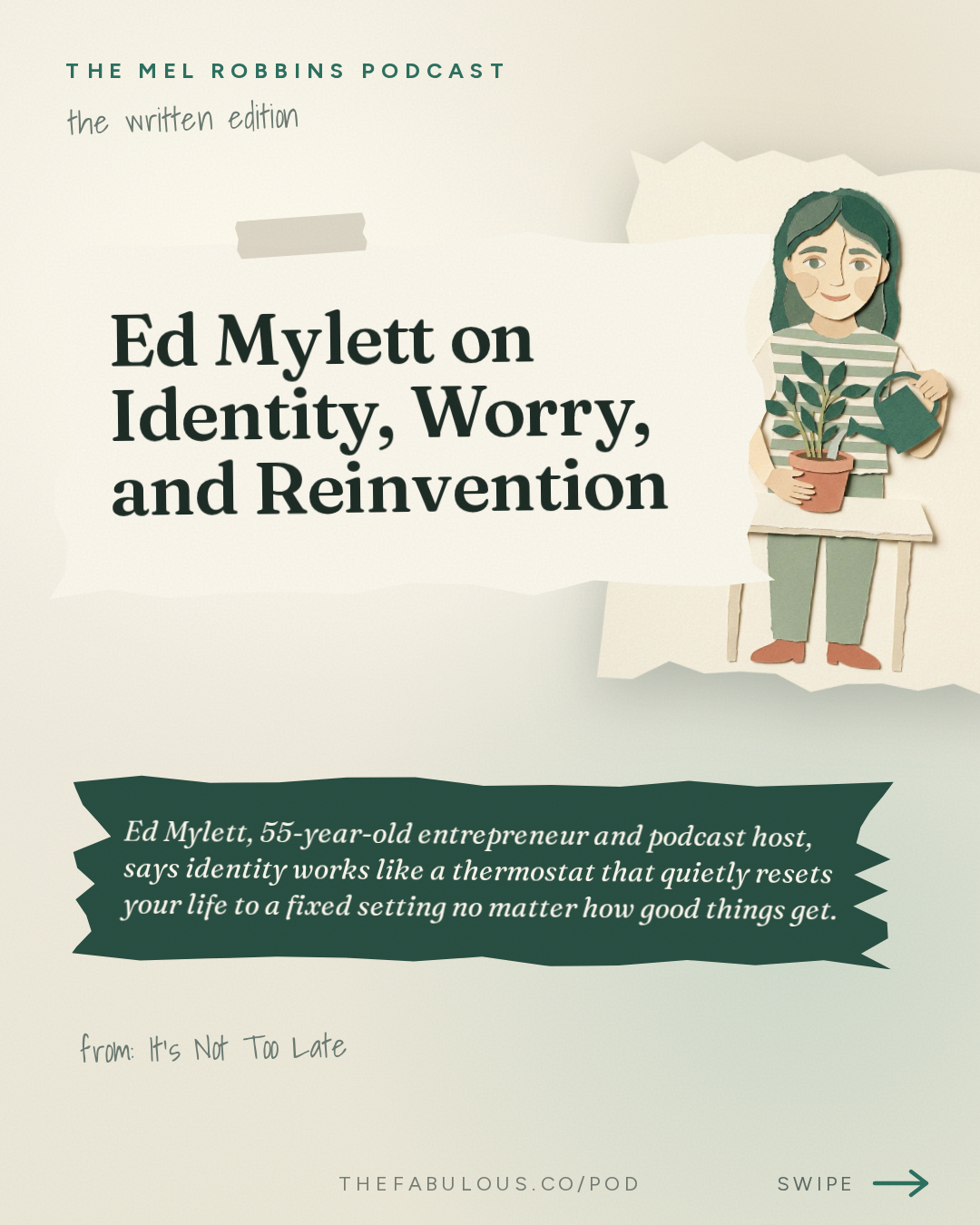
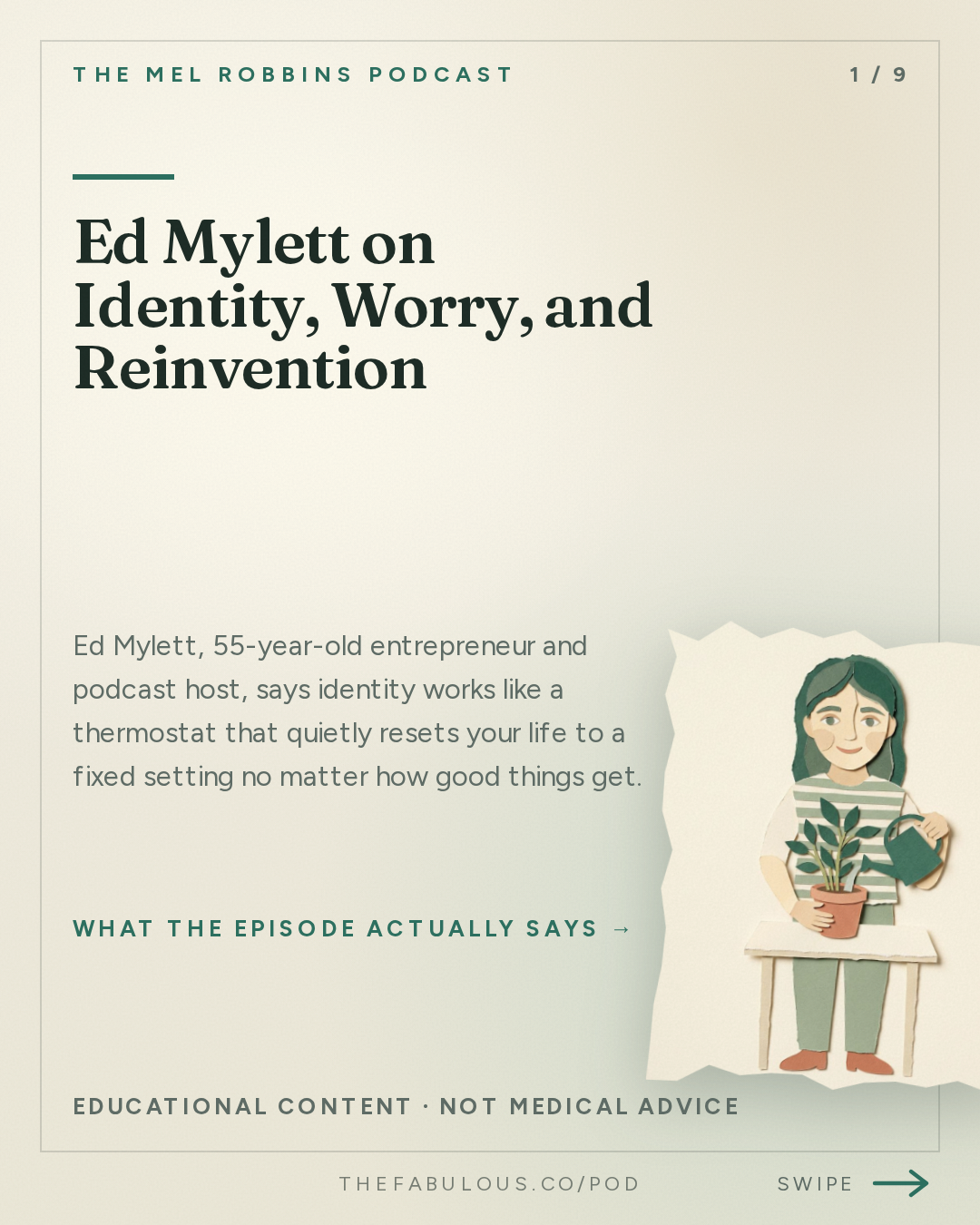
Ed Mylett, 55-year-old entrepreneur and podcast host, says identity works like a thermostat that quietly resets your life to a fixed setting no matter how good things get (28:27). He shows how writing down worries strips their power, why love outlasts fear as motivation, and why past failures qualify you to help others (42:25).
On an island Ed Mylett owns, there lived two bald eagles named Wilma and Fred. When Fred died, the woman from the local bird sanctuary told Mylett something odd: Wilma would probably die too, since eagles that lose a mate often follow soon after. Instead, about five weeks later, Mylett heard a strange banging against the rocks, like a woodpecker. He went to look. Wilma was slamming herself against stone, plucking out her own feathers (13:00). Within six months she had grown a new set, found a new mate, and raised three chicks on the island where she'd nearly died of grief.
Mylett tells this story, on a conversation with Mel Robbins, as a model for what he calls auditing a life. Not adding more, but tearing out what no longer fits. It is the quietest, strangest image in an episode built around a louder idea: that most of us are one decision away from a different life, and that the thing standing in the way isn't circumstance. It's a setting we can't see we've chosen.
Mylett, 55, is a motivational speaker, performance coach, and host of The Ed Mylett Show with fifteen million followers online (03:52). This conversation marks one of his first public interviews since recovering from two cardiac events roughly two and a half years ago (03:52, 16:11). He frames the whole hour as a report from the other side of a health scare, and the report is specific: the problem was never the stress of his schedule. It was something underneath it.
The Thermostat Nobody Notices
Mylett's central device is literal: he holds up a thermostat during the interview. A room set to 75 degrees stays 75 degrees whether it's 85 outside or 45. If the temperature drifts, the system kicks the air conditioning or heat on and drags it back (27:36, 28:27). He argues identity, the beliefs you hold about your own worth, works the same way. You can have a great month, a windfall, a breakthrough in fitness or love, but if your internal setting for "how good things are allowed to get" is low, you will unconsciously sabotage the gain until it matches the old number. "Next to God," he says, "the most powerful force in the world is to be consistent with the way you view you" (28:09).
This is not just a metaphor he likes. He applies it to himself with some precision. He says his own dominant emotions for most of his adult life were stress, worry, and anxiety, inherited, he believes, from watching his alcoholic father (30:21, 23:56). "I think with children, things are caught, not taught," he says of growing up with a parent who drank (23:56). The brain gravitates back to familiar emotional weather because familiarity is cheap, energetically (30:48). So a person can read every self-help book available and still end up back at the same emotional temperature, because no one adjusted the dial itself.
The practical result, in Mylett's account, is physical. He asks Robbins directly whether it's a coincidence that a man who worried constantly and carried unresolved insecurity had his heart give out in his early fifties (26:01). He doesn't claim a causal proof. He offers an observation: the body absorbs what the mind keeps rehearsing.
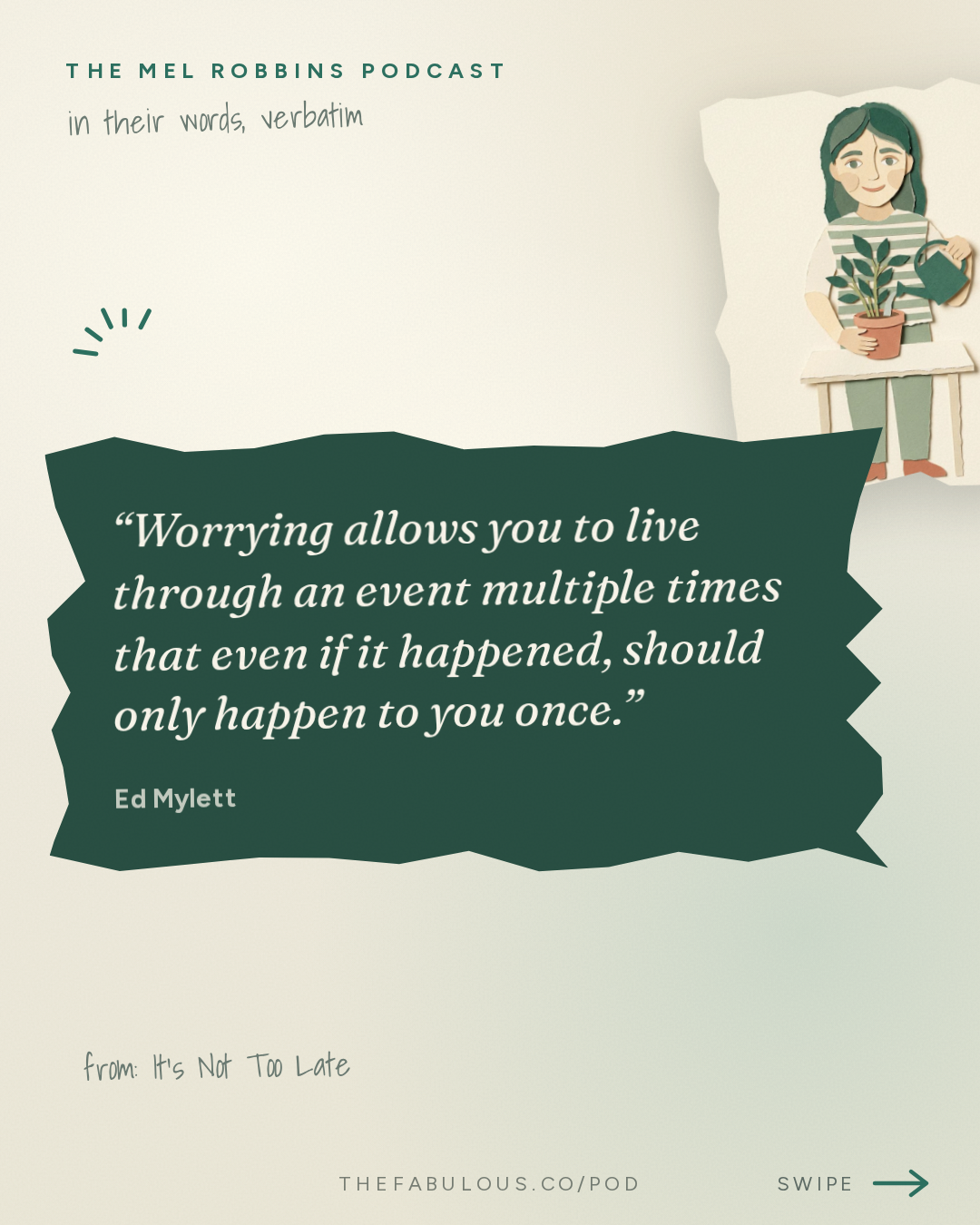
"Worrying allows you to live through an event multiple times that even if it happened, should only happen to you once." — Ed Mylett [25:20]
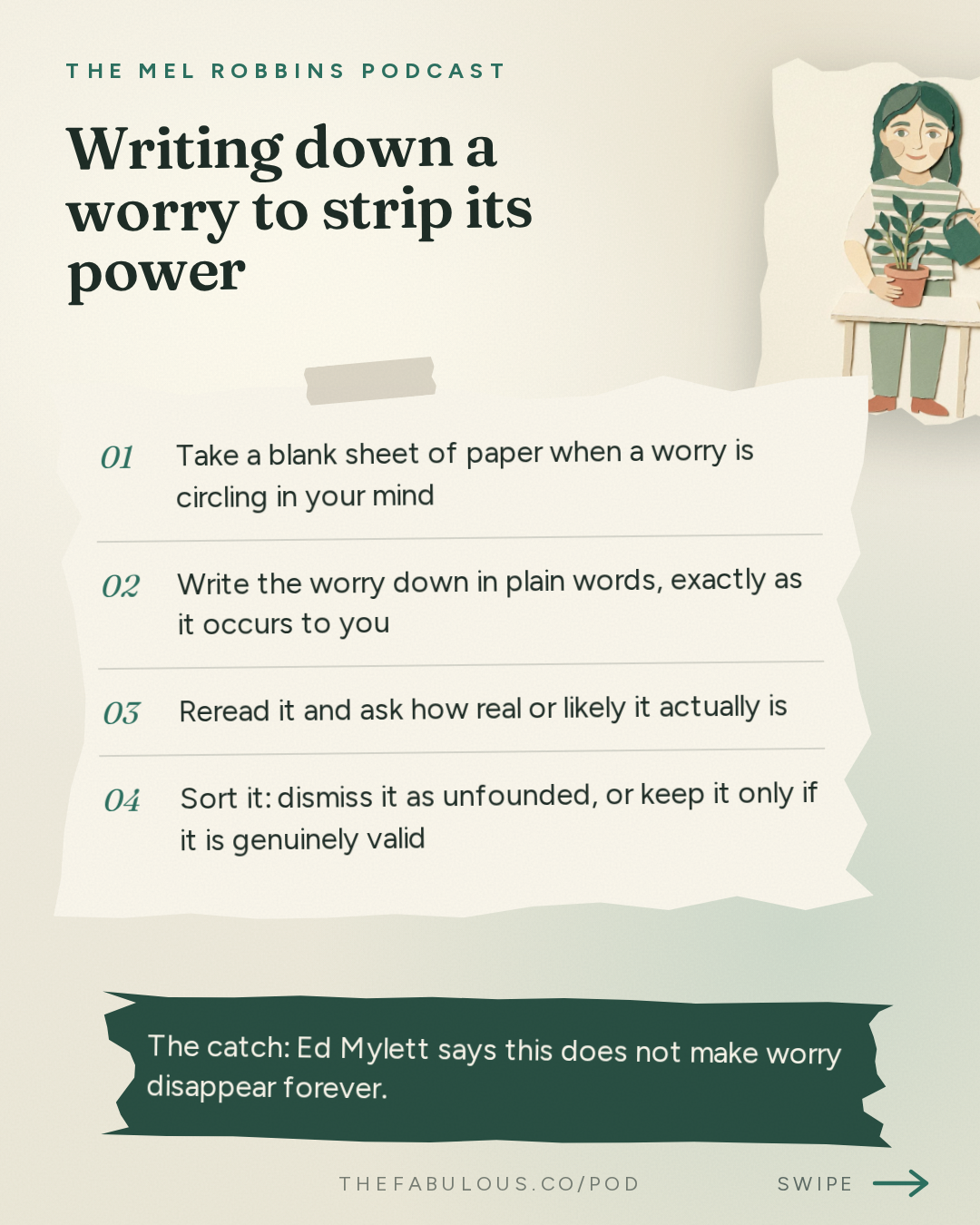
That line does a lot of work. Mylett's claim is that even the small fraction of worries that come true, he guesses around 1 to 5 percent, get lived through hundreds of times over before and after the fact, while the 95 to 99 percent that never happen still cost the same toll in the body (25:01, 25:20). The fix he offers is almost comically plain: write worries on paper. He says doing this separates the thought from the self. Once a fear is on a page instead of circling in the skull, it stops being "you" and becomes an object you can evaluate. He estimates that roughly 98 percent of what he writes down turns out to be, in his word, dumb (27:06).
The same stripping-down logic shows up when he describes cleaning out a closet after a recent move. Ninety percent of what was in there he hadn't worn in years, including sneakers he kept on the theory that he might someday need them (17:30). Clearing it out didn't just make space. It revealed how much smaller the useful part of his life already was, buried under stuff he was keeping out of habit rather than need. He applies the same test to thoughts, relationships, and commitments: what are you keeping only because you're used to it being there?
Qualified By What Went Wrong
The most personal stretch of the conversation concerns his father, who was violent and addicted through much of Mylett's childhood, and who eventually got sober after a man intervened on a night when police were searching for him because he intended to take his own life (37:22, 41:05). Mylett tracked that man down years later. The man's qualification for saving his father's life wasn´t a clean record. He had been a drunk, a drug addict, a liar, someone who had "lived in the shadows" and carried shame most of his life (41:54). And on the night he helped Mylett's father, he had been sober for exactly thirty-one days himself (42:50).
"You're most qualified in life to help the person you used to be." — Ed Mylett [42:25]
Mylett's father went on to help an estimated four thousand people get sober over the rest of his life (43:10). The point Mylett draws from this isn't an argument about addiction recovery specifically. It's a reframe of disqualification itself: the belief that your worst chapter permanently bars you from being useful to someone else is, in his telling, exactly backwards. The failure is the credential.
He pairs this with a story about the writer and speaker Wayne Dyer, author of self-help books that have sold an estimated forty million copies (45:27), whom Mylett met by chance on a beach in Hawaii at age 30. Dyer told him to stop drawing confidence from talent or performance and instead draw it from intention: the plain fact of meaning well (46:52). Mylett says this became a usable tool: before a speech or a hard meeting, he reminds himself that his intentions are good, rather than auditing whether he's smart enough or prepared enough. He also names, almost offhand, what he considers the single biggest lever on anyone's internal thermostat: who you spend time with. "If your five best friends eat really clean... you're probably gonna be a little bit more fit," he says, extending the logic to every domain, from money to peace of mind (53:24).
The emotional center of the episode, though, is a woman Mylett never spoke to. Waiting out a delayed flight about four years ago, he watched an airport cleaner in her late sixties wheeling a trash can, and found he couldn't look away (57:33). He built a quiet, imagined biography for her: a husband who left, children raised alone, a life of unseen effort that never matched the dreams she once had, and still, every day, she showed up. He calls her Griselda. He says he now writes letters, most mornings, to people like her, and to the people in his own life who did the same invisible holding-together work, including, he now realizes, his mother more than his father (60:30, 61:34).
The claim threading all of this together is not really about eagles, thermostats, or airport cleaners. It's that self-worth, in Mylett's account, tends to be conditional, something people grant themselves only when they're achieving or improving. His closing argument is that the measure people should use instead isn't the mistake list. It's whether someone is still standing after it.
"The highlight reel of your life is not your mistakes... it's the fact that you're still standing after they did." — Ed Mylett [64:43]
None of this is delivered as clinical research. Mylett is explicit that these are lessons pulled from a specific life: an alcoholic father, a island with two eagles, a cardiac scare that forced a slower pace. But the mechanism he describes, a fixed internal setting that resists even good news, is a useful name for something a lot of people notice in themselves without ever being able to say out loud: the strange discomfort of things going right.
Ask this episode anything
Pod's AI answers from the episode itself, with the minute mark so you can hear it yourself.
Or start with one of these
Ask this episode
Pod's AI listens to the whole episode to answer, and points you to the minute it comes from.
The rest of this answer, and any question after it
Answers come from the episode itself, never from a summary of it.
ContinueKey takeaways
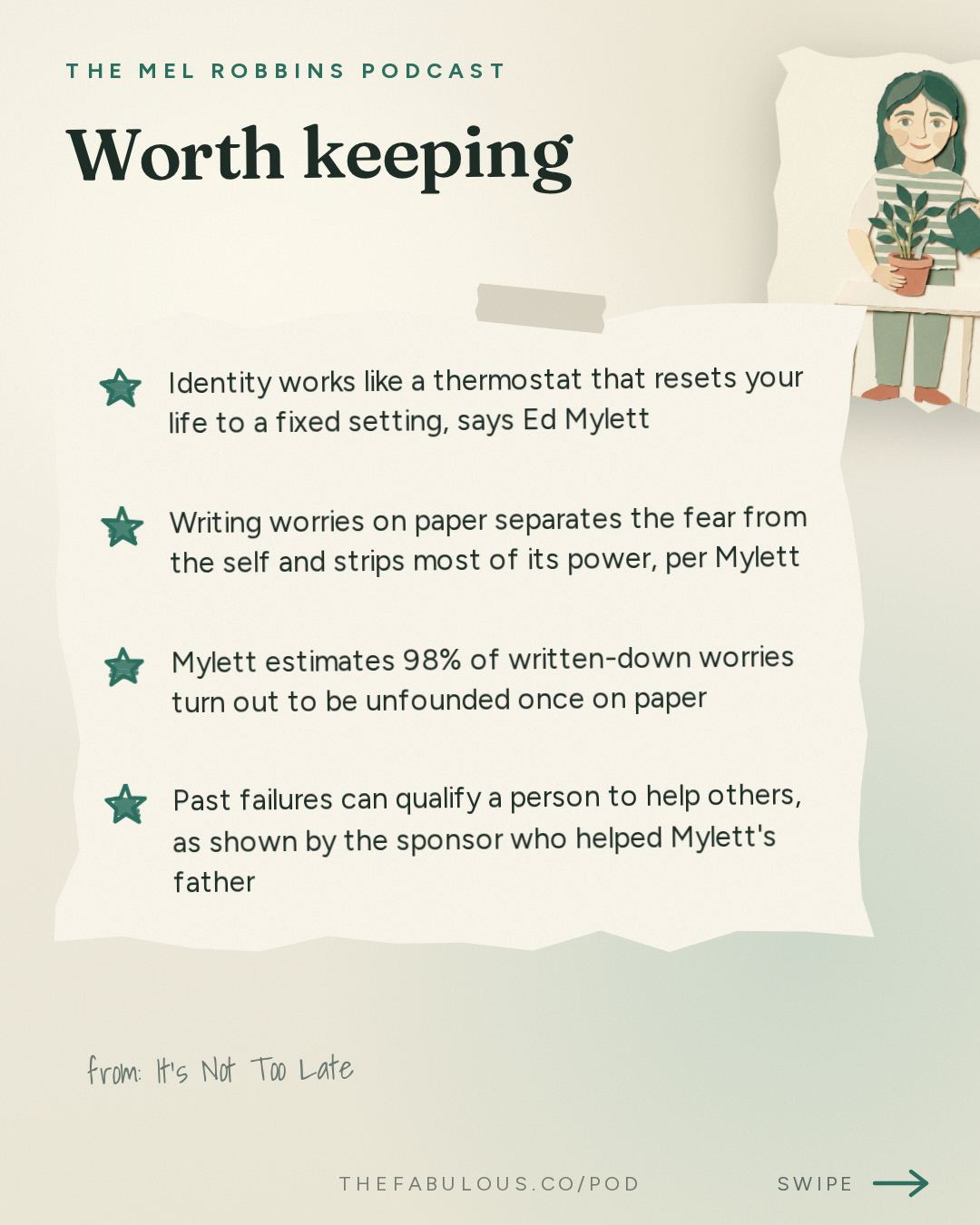
- Identity works like a thermostat that resets your life to a fixed setting, says Ed Mylett
- Writing worries on paper separates the fear from the self and strips most of its power, per Mylett
- Mylett estimates 98% of written-down worries turn out to be unfounded once on paper
- Past failures can qualify a person to help others, as shown by the sponsor who helped Mylett's father
- Mylett says the biggest lever on self-worth is who you spend time with, not willpower alone
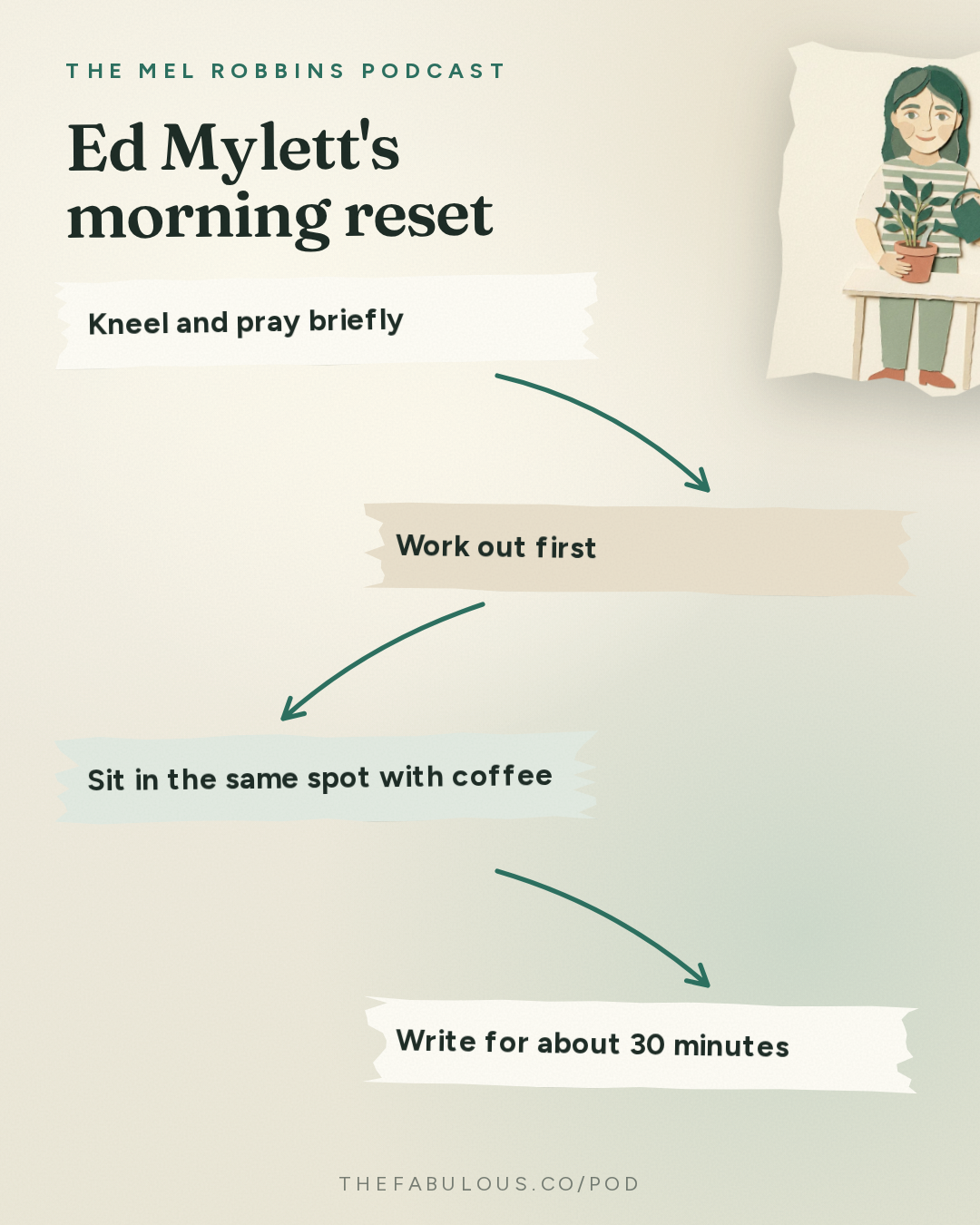
The episode in cards

By the numbers
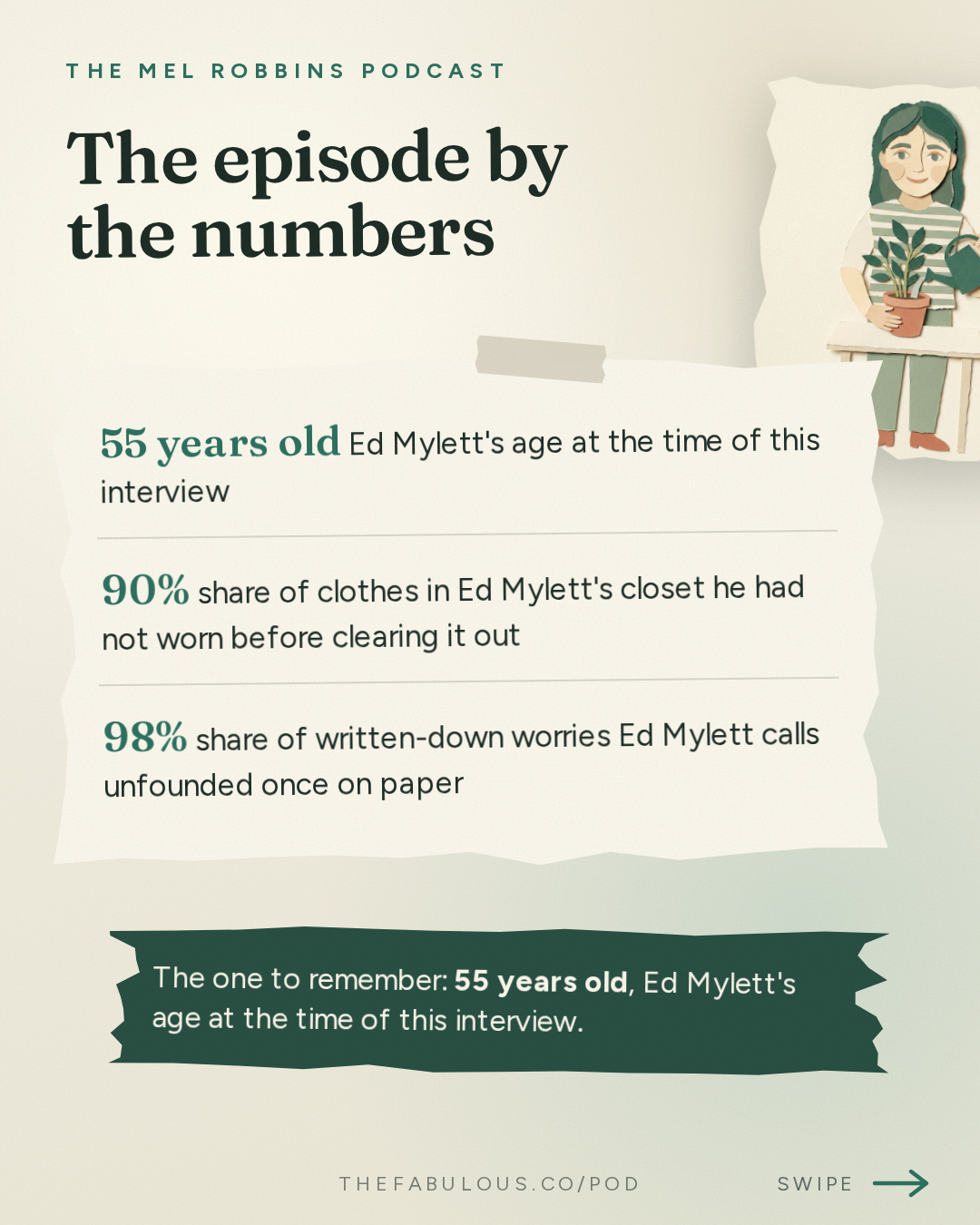
- 55 years old Ed Mylett's age at the time of this interview
- 90% share of clothes in Ed Mylett's closet he had not worn before clearing it out
- 98% share of written-down worries Ed Mylett calls unfounded once on paper
- 31 days how long the man who helped get Ed Mylett's father sober had himself been sober that night
In their words
“When you feel the most helpless, attempt to become the most helpful.”
“Worrying allows you to live through an event multiple times that even if it happened, should only happen to you once.”
“You're most qualified in life to help the person you used to be.”
Protocols
-
Write down every worry by hand
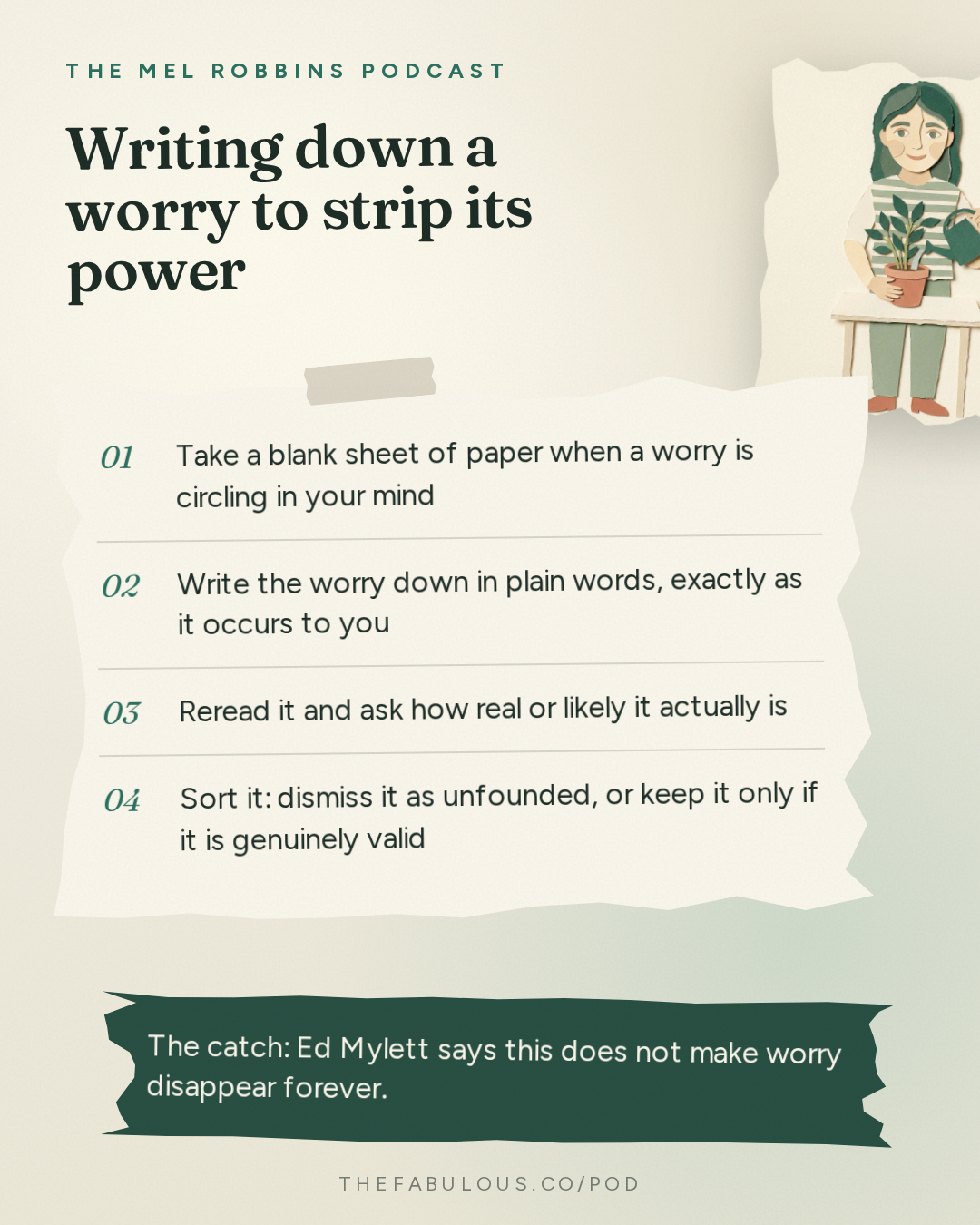
Ed Mylett takes a blank sheet of paper and writes down everything he is worried about, then rereads each item and rates how real or likely it actually is.
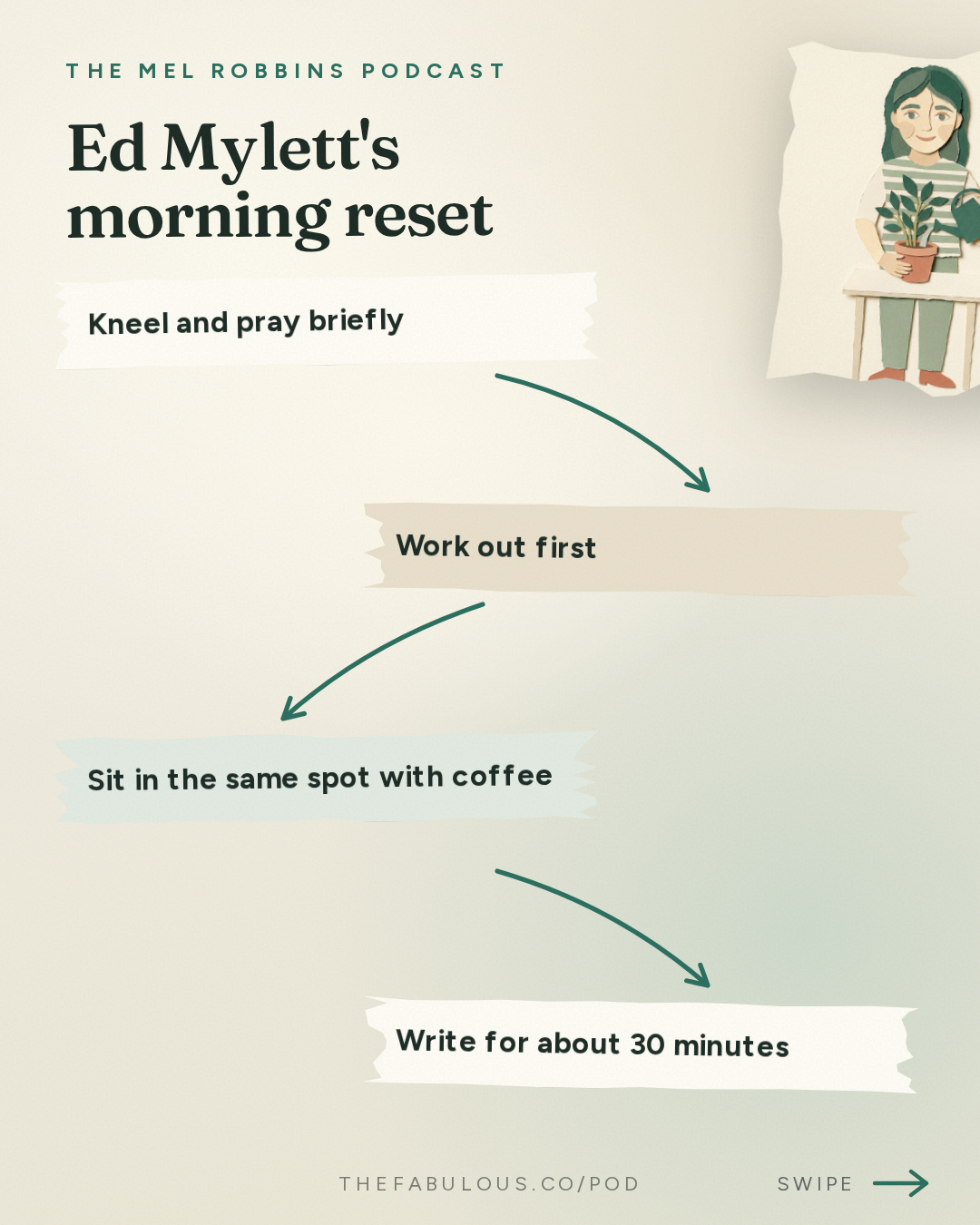
As needed, especially when worry is loudest, and as part of a daily 30-minute morning writing habit
-
Respond to helplessness by helping someone else
When Ed Mylett feels at his lowest, he shifts his attention off himself and does something small for another person, such as calling someone out of the blue or silently wishing a stranger well.
In low moments, as a deliberate reflex
-
Draw confidence from intention, not ability
Before a speech, meeting, or hard conversation, Ed Mylett reminds himself that his intention is to do good, rather than evaluating whether he is smart or skilled enough for the moment.
Before high-stakes interactions
-
Audit associations to shift your internal thermostat
Ed Mylett recommends examining who occupies your closest circle, since he considers associations the single biggest influence on whether a person's self-worth setting rises or stays low.
Ongoing, revisited during any life audit
Questions this episode answers
What is Ed Mylett's thermostat theory of identity?
Ed Mylett argues that identity functions like a thermostat set to a fixed number, for example 75 degrees, and that whatever happens externally, the mind quietly works to pull behavior and results back to that set point (28:27). He says this explains why people who improve their life suddenly often sabotage the gain until things return to the old baseline (29:23).
How does Ed Mylett say to stop worrying?
Mylett's method is to write every worry down on paper by hand, then reread and evaluate each one for how real it actually is (15:33). He says that in his own case, around 98 percent of worries turn out to be unfounded once separated from his mind and put on the page (27:06).
What happened to Ed Mylett's health before this interview?
Ed Mylett had two cardiac events roughly two and a half years before this conversation, which he describes as a forced wake-up call that pushed him to slow down and reevaluate his priorities (03:52, 16:11). This interview is one of his first public conversations since that recovery.
Who got Ed Mylett's father sober, and why does it matter?
A man in an anonymous recovery program intervened the night Ed Mylett's father intended to take his own life, and that man had himself been sober for only 31 days at the time (42:50, 41:05). Mylett uses this to argue that personal failure can qualify someone to help others, since his father went on to help an estimated 4,000 people get sober (43:10).
What does Ed Mylett mean by getting confidence from intention?
Mylett says a mentor, author Wayne Dyer, told him to base his confidence on the intention to do good rather than on talent or ability (46:52). Mylett says he now reminds himself before high-stakes moments that his intentions are good, which he finds steadier than relying on self-assessed competence.
The full read, in cards
Go deeper
- The Power of One More — Ed Mylett's bestselling book referenced for the story of his father's sobriety and the 'one more' philosophy
Mentioned
Ed Mylett · Mel Robbins · Wayne Dyer · The Power of One More · The Ed Mylett Show · The Boston Globe
More from this show and category
Mel Robbins' Relationship Advice for Young Adults
Mel Robbins tells her 27-year-old daughter that good relationships depend on timing and self-work, not just chemistry. Drawing on Gottman research, Jonathan Haidt, and Terry Real, she explains how to spot a wrong fit, why a single era matters, how to balance two ambitious partners, and why breakup recovery takes three months of restraint.
Mel Robbins' Relationship Advice for Young Adults
Mel Robbins and her 27-year-old daughter Sawyer sit down to answer real questions about dating, breakups, and ambition. Drawing on Gottman research, NYU psychologist Jonathan Haidt's findings on young men and dopamine, and therapist Terry Real's rule that partners can be right or connected but never both, Robbins argues most relationship trouble starts with an unhealed self, not a wrong partner.
How to Let Go of What No Longer Serves You
Mel Robbins uses a biological metaphor, trees pushing off leaves each fall, to argue that healthy relationships, jobs, and habits need a two-way flow of energy. When something only drains and never gives back, she says it is time to let it go, and she offers two daily tools: a 24-hour no-complaining challenge and a rule against trying to control other people.
5 Skin Habits From a Mayo Clinic Dermatologist
Mayo Clinic dermatologist Saranya Wyles argues skin is a check engine light for the whole body, not a beauty scorecard, and shares five pillars (sleep, diet, movement, stress, topicals) that measurably change how skin ages, from barrier recovery after sleep to facial volume loss on GLP-1 drugs.
