
How to Let Go of What No Longer Serves You
How to Let Go of What No Longer Serves You
▶ Listen to the full episode More from The Mel Robbins Podcast
The brief
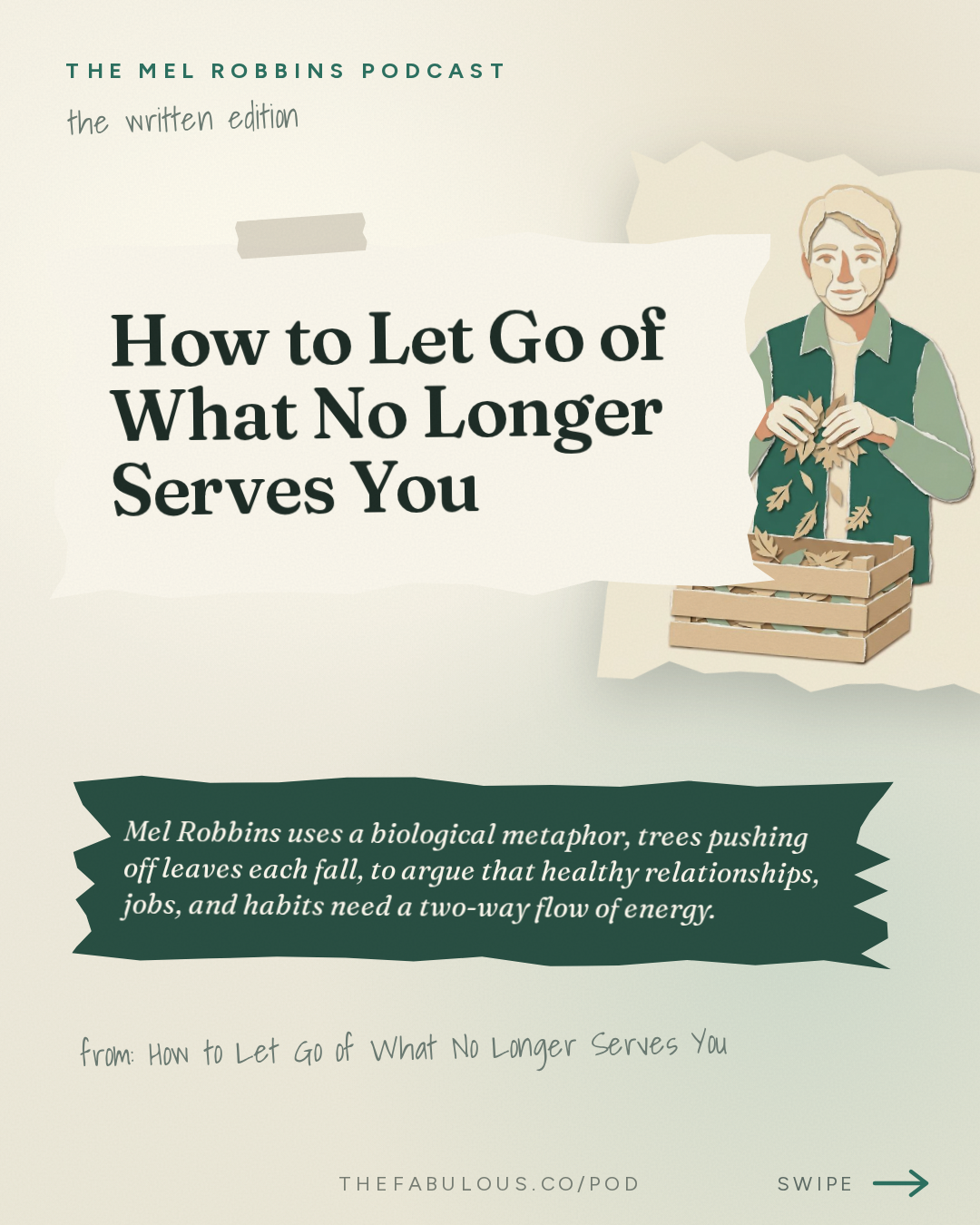
Mel Robbins uses a biological metaphor, trees pushing off leaves each fall, to argue that healthy relationships, jobs, and habits need a two-way flow of energy. When something only drains and never gives back, she says it is time to let it go, and she offers two daily tools: a 24-hour no-complaining challenge and a rule against trying to control other people.
A tree does not wait for its leaves to fall off. It pushes them. That small correction to a childhood lesson about photosynthesis is the spine of this episode, recorded by Mel Robbins while hiking Haystack Mountain in southern Vermont. The leaves turning gold and red around her on the trail are not drifting gently into retirement. They are being ejected, on purpose, because keeping them would kill the tree.
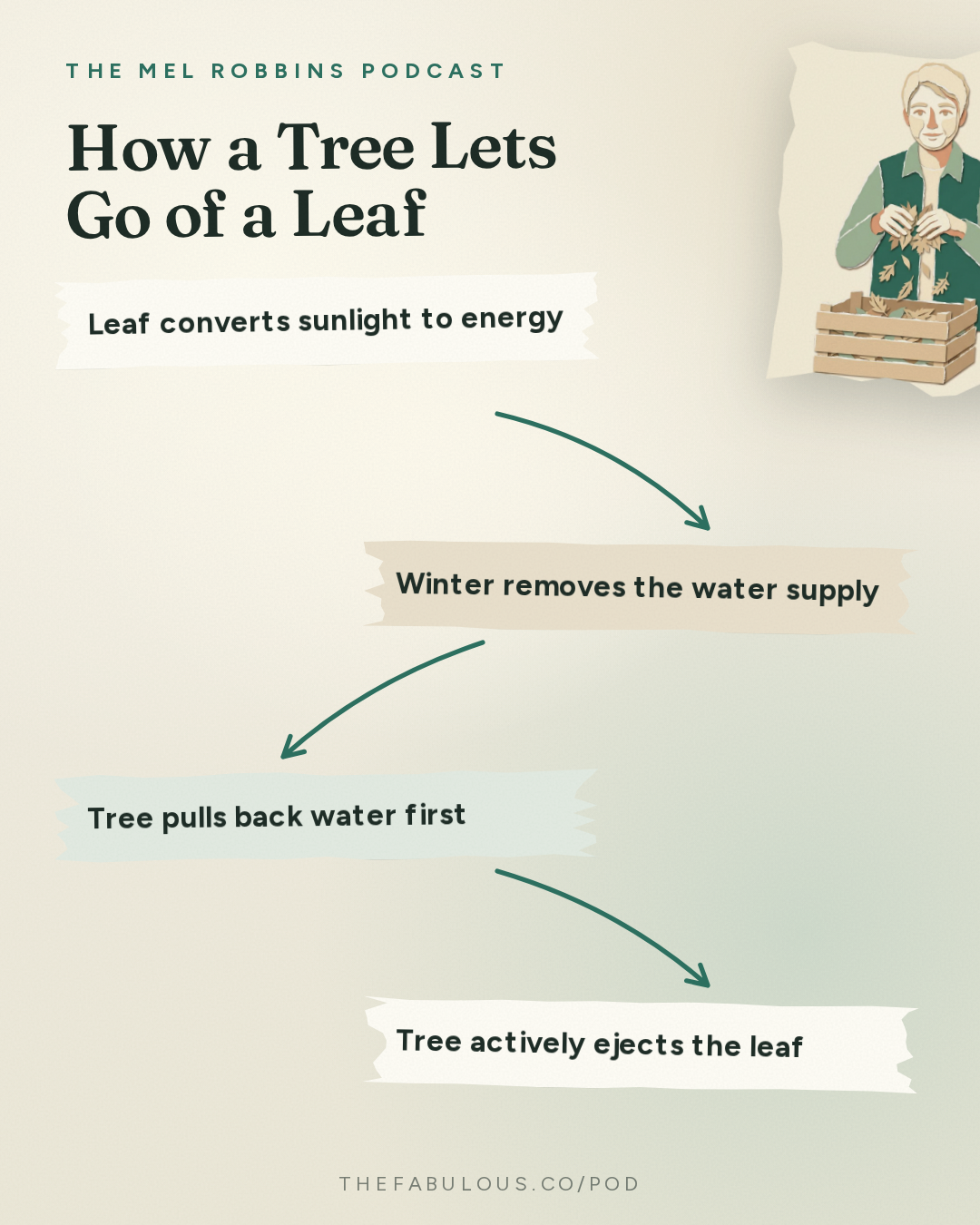
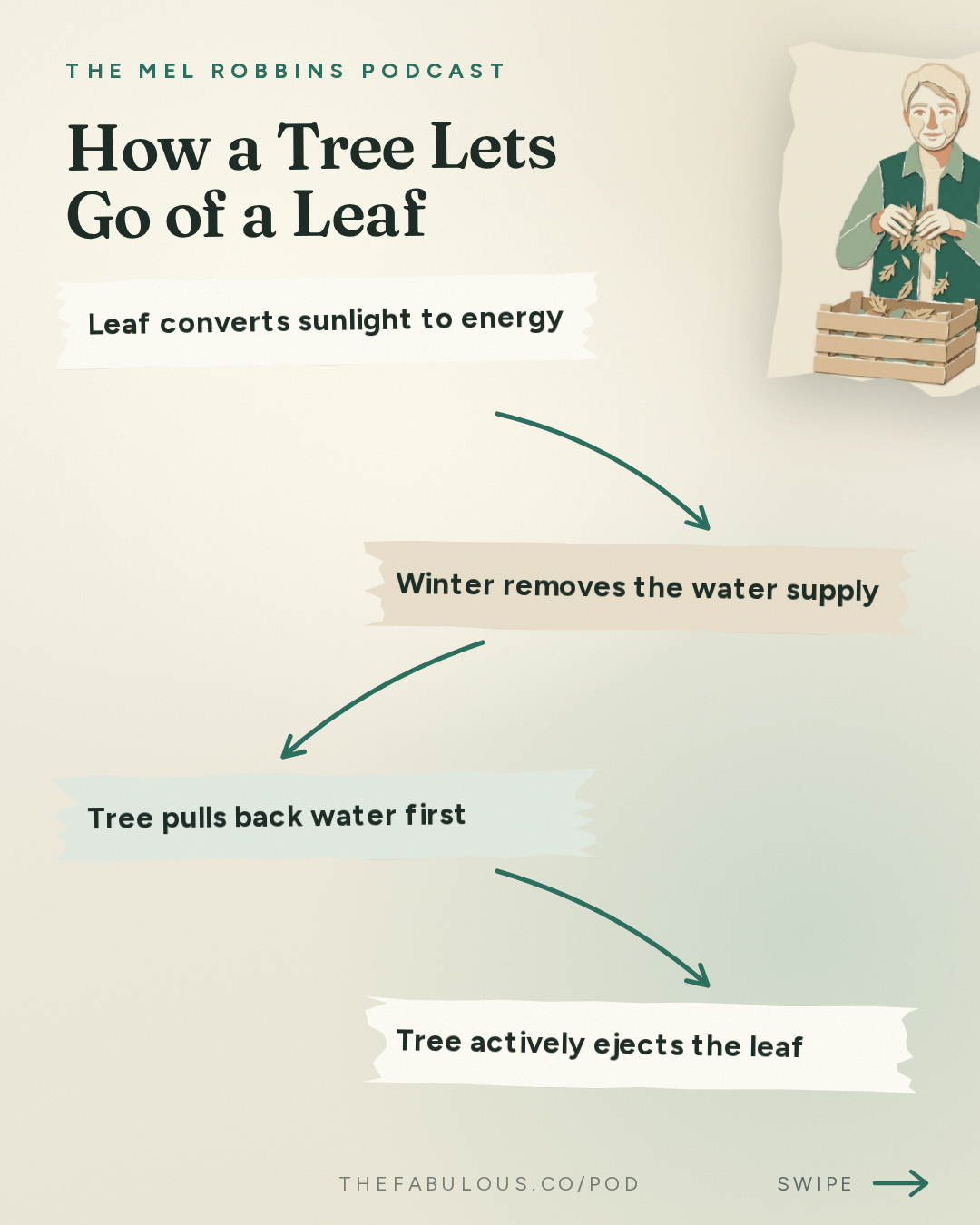
The mechanism is simple once Robbins lays it out. In spring and summer, a leaf's job is to take sunlight and turn it into energy for the tree. In return, the tree sends the leaf water (09:18). It is a trade, sunlight for water, and for months it works for both sides. But when winter comes and the ground freezes, there is no more water to send. A leaf left on the branch would keep demanding water the tree does not have, and it would drain the tree dry. So the tree pulls back first. It stops sending water to leaves that no longer serve a purpose (19:16), and then it does something more active than falling: it pushes the leaf off.
"The tree literally pushes them, ejects them, kicks them out of their life. Why? Because there is no reciprocal energy exchange that can happen during the winter." — Mel Robbins [10:24]
Robbins' point is not botany for its own sake. It is a test she wants listeners to run on their own lives: is this relationship, job, or habit still a trade, or has it become a one-way withdrawal? She calls this a reciprocal energy exchange, meaning that what a person puts into something and what comes back out should be roughly equal over time. When the exchange breaks down, when one side keeps giving and gets nothing back, she says it is time to let go (13:16).
"In order to grow, in order to be strong, to be the best you, you gotta surround yourself with relationships and work and projects and friendships where there is an equal reciprocal exchange." — Mel Robbins [12:09]
Why does this matter enough to build a whole episode around a tree? Because, Robbins argues, holding on does two kinds of damage at once. First, it drains the person directly: pouring energy into something that gives nothing back erodes happiness, vitality, and motivation (23:06). Second, and less obviously, it blocks new growth. As long as a person's time and attention are tied up in the old thing, there is no room, literally no space or energy, left over to build something new (23:36). The leaf has to fall before the branch can hold anything else.
How does a person know which category something falls into? Robbins' answer leans on a word she knows sounds soft: energy. She asks listeners to picture a fuel gauge, running from empty to full, and to check it honestly against whatever they are doing, whoever they are with, wherever they are living (24:37). She backs this up with an everyday example: a grumpy barista can sour a good mood in seconds, and a warm one can lift a bad day, because energy, in her telling, is contagious between people. She compares this signal to a compass needle.
"Energy never lies. It's like a compass. In fact, a compass runs on magnetic energy. That's why a compass always points true north. It never lies. Your energy doesn't lie either." — Mel Robbins [26:42]
Spotting the Drain
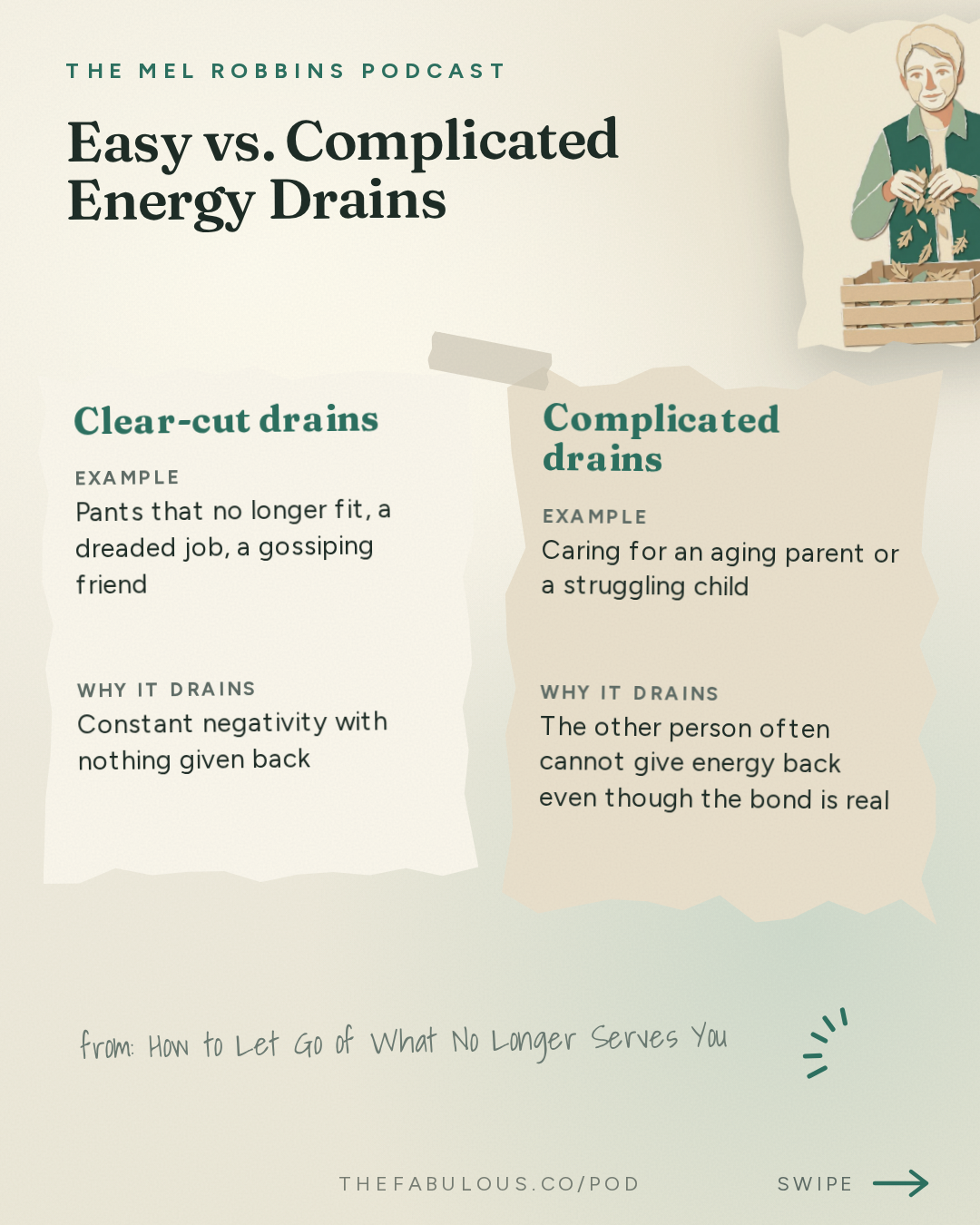
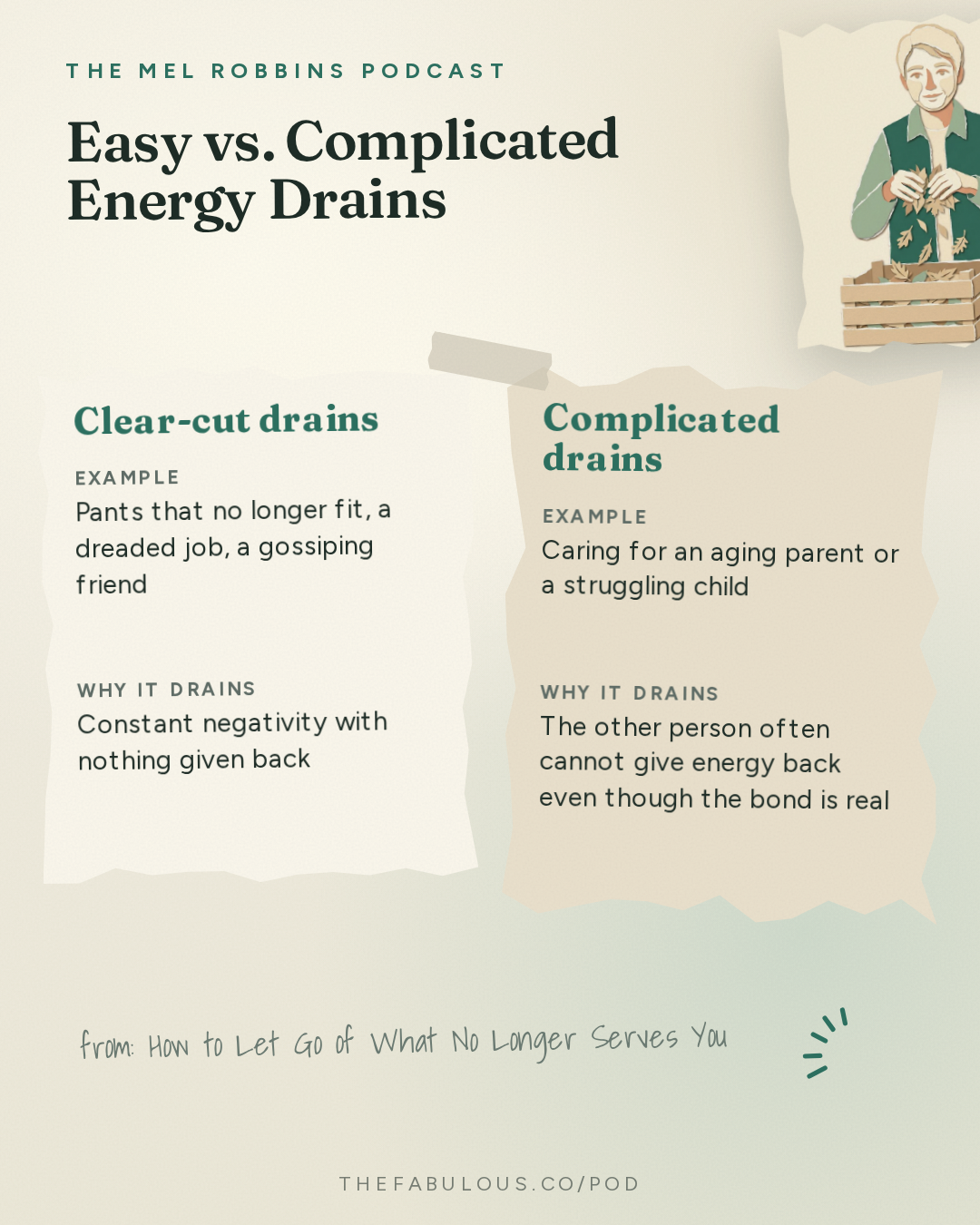
Robbins splits the problem of letting go into two tiers of difficulty. The easy tier covers the obvious energy sucks: jeans from a decade ago that still live in the closet, a job that produces a pit in the stomach every morning, a friend whose main activity is gossip (27:41). These are easy to diagnose because the negativity is constant and the return is close to zero. Her prescription is blunt: donate the pants, and if quitting the job outright is not realistic because bills need paying, spend 30 minutes every morning looking for a new one instead of complaining about the current one (30:47). The logic is that complaining and job-hunting draw from the same well of energy, so the choice is really about where that energy gets spent, not whether it gets spent.
She tells her own version of this mistake. At 30, after moving from New York to Boston, Robbins left a public defender job she loved for a seat at a large corporate law firm, mostly because she needed to pay bills and did not have a Massachusetts law license to keep doing defense work (31:34). She knew within days that the fit was wrong: a 45-minute commuter-rail ride every morning, an office on the 23rd floor, and a growing dread the closer the train got to Boston (32:38). Rather than redirect that dread into a job search, she sat with it for a year. The exit came only when she got pregnant and went on maternity leave, which gave her enough distance to see clearly that she could not go back. Her husband, Chris, then gave her a deadline: find a job paying at least $60,000 within the 12 weeks before her leave ended, because they had a mortgage and a new baby (34:52). She found one paying $55,000, decided it was close enough, took it, and quit the old job the next day (35:17). The story works as a cautionary tale against her own advice: she knew the exchange had broken down and still waited a year to act on it.
When It's Not So Easy
The second, harder tier is anything where guilt complicates the math: caring for an aging parent, supporting a child or partner through a mental health crisis, staying in a friendship with someone who is struggling (44:50). Here the other person often cannot give energy back, not because the relationship is broken but because they do not have it to give. Robbins' answer is not to leave these relationships, since she says the same reciprocal-exchange rule can be satisfied a different way: through values rather than through what the other person returns. Caring for a sick parent, she says, still produces a return, just not from the parent. It comes from the caregiver's own sense of being the kind of compassionate, reliable person they want to be (45:54). The same reasoning covers volunteering, which she calls reciprocal even though no money changes hands, because it returns a sense of meaning and connection (43:01), and it covers things she personally finds unpleasant, like exercising, which pay back in pride and clarity once the resistance is pushed through (44:28).
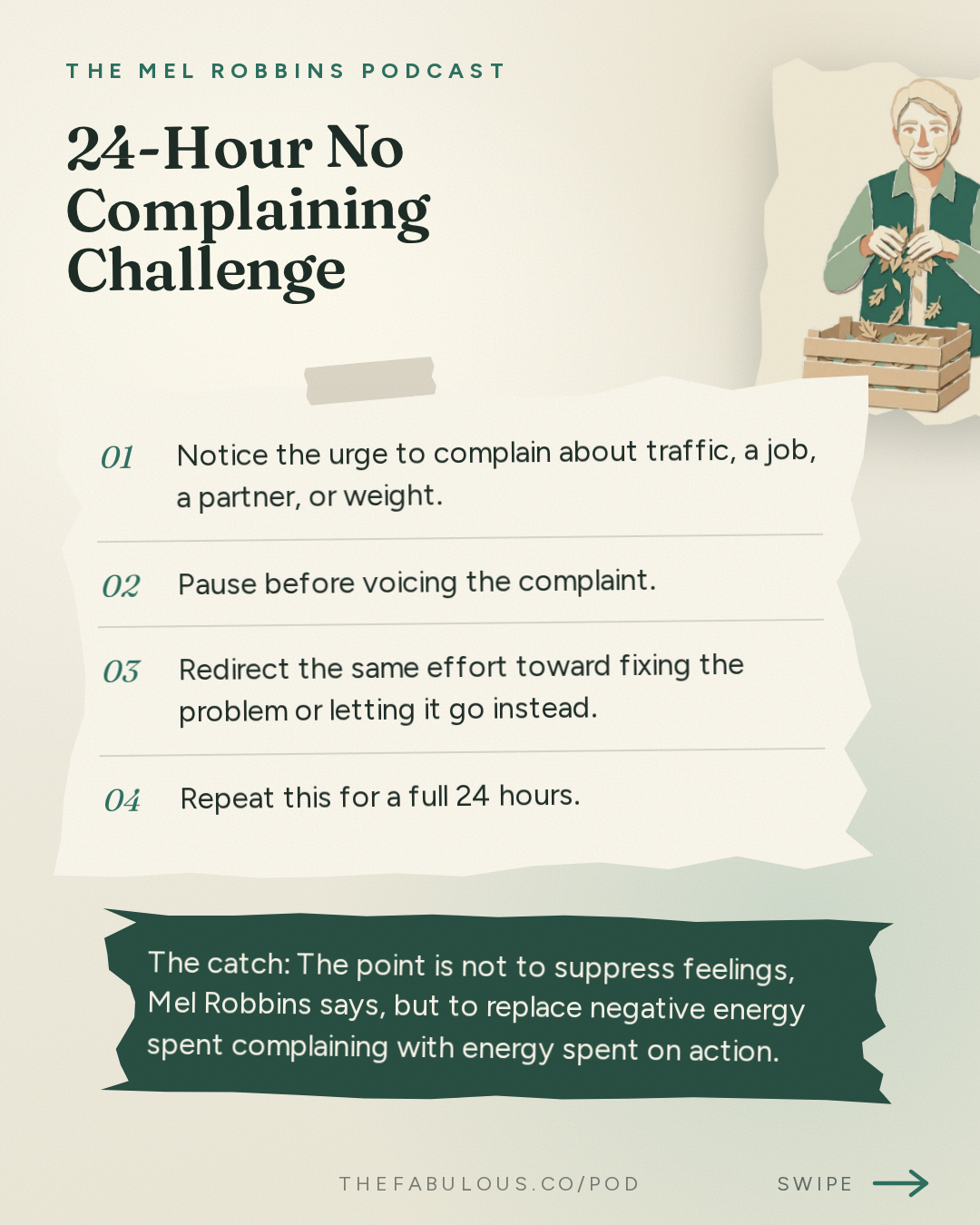
She closes with two rules meant to be tried immediately rather than studied. The first is a 24-hour no-complaining challenge: no griping about traffic, a job, a partner, or weight, for one full day, on the theory that complaining is pure energy outflow with no return and actively blocks the ability to act (49:37).
"Stop complaining about the things in your life. Because here's the truth, with a little bit of effort and a little better attitude... you can fricking change anything." — Mel Robbins [49:58]
The second rule addresses control rather than complaint: catching the impulse to change or manage another person, and redirecting that energy into listening and support instead, on the grounds that control blocks exactly the connection it is trying to force (51:54). Robbins frames both rules the same way she frames the whole episode: not as moral instructions but as energy management, a way of noticing where effort is leaking out unproductively and routing it somewhere it can come back. The leaf, after all, is not punished for falling. It simply stops being useful to hold onto, and the tree, not sentimentally but practically, lets it go so it can grow again in spring.
Ask this episode anything
Pod's AI answers from the episode itself, with the minute mark so you can hear it yourself.
Or start with one of these
Ask this episode
Pod's AI listens to the whole episode to answer, and points you to the minute it comes from.
The rest of this answer, and any question after it
Answers come from the episode itself, never from a summary of it.
ContinueKey takeaways
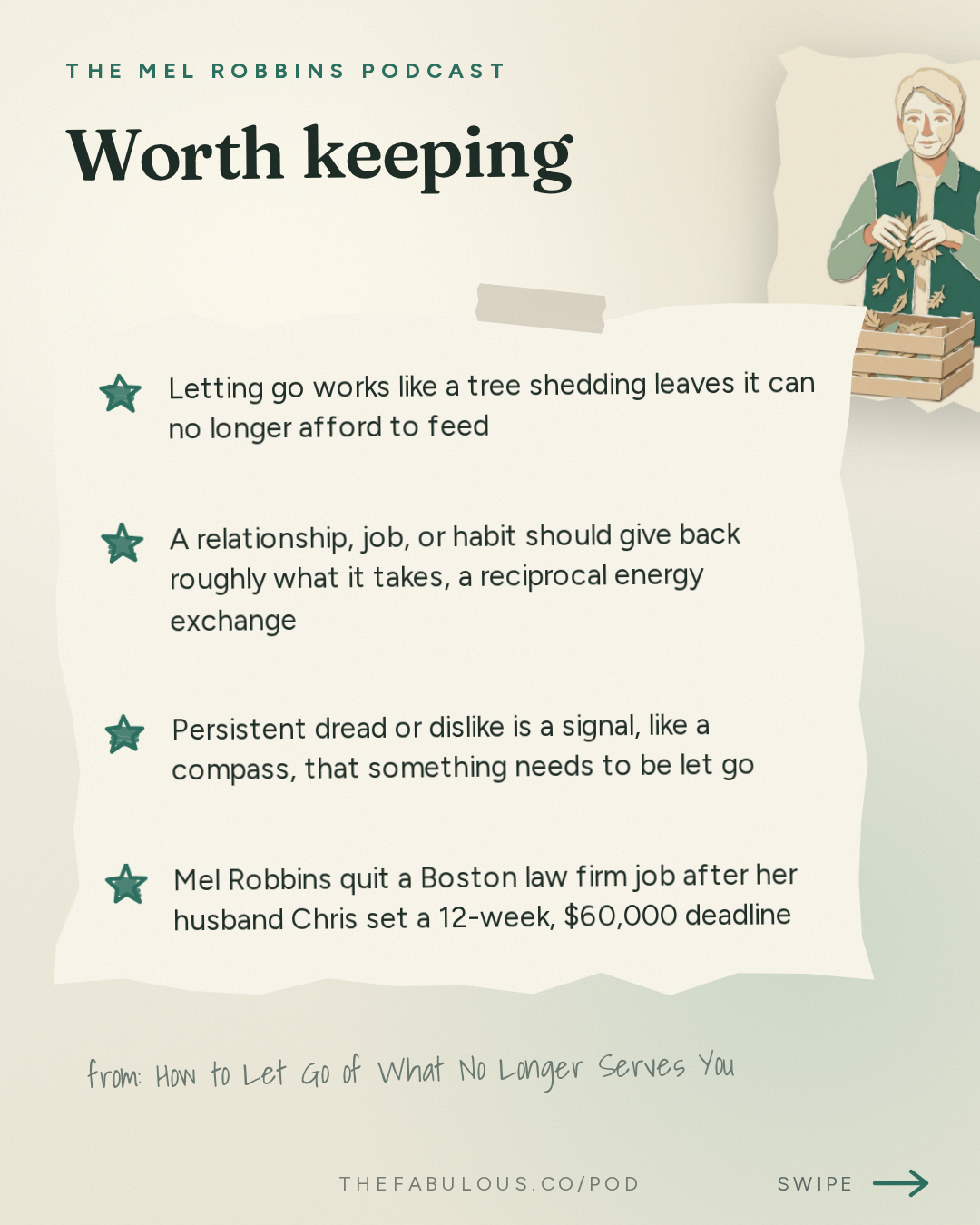
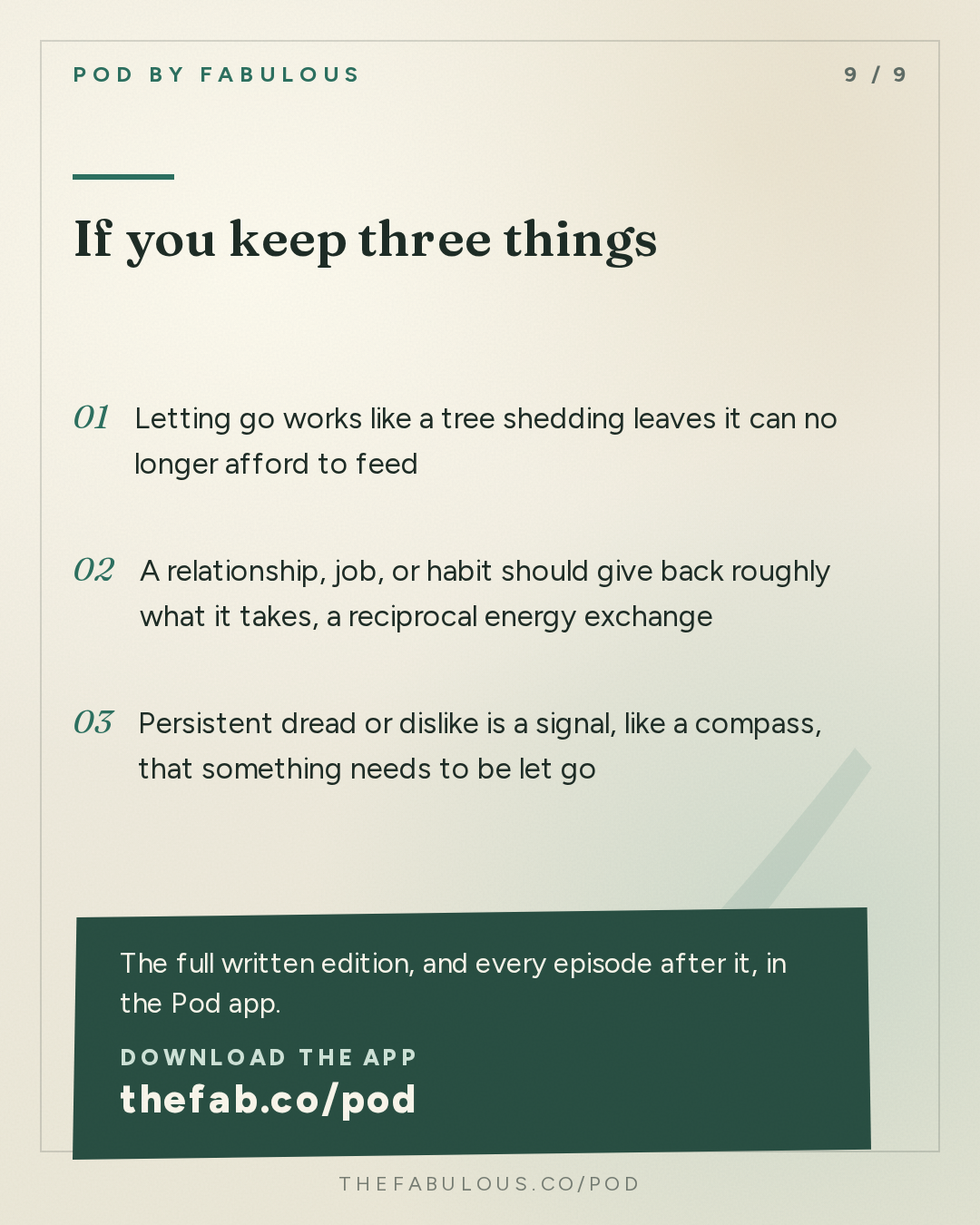
- Letting go works like a tree shedding leaves it can no longer afford to feed
- A relationship, job, or habit should give back roughly what it takes, a reciprocal energy exchange
- Persistent dread or dislike is a signal, like a compass, that something needs to be let go
- Mel Robbins quit a Boston law firm job after her husband Chris set a 12-week, $60,000 deadline
- A 24-hour no-complaining challenge and refusing to control others are two daily practices Robbins recommends
The episode in cards
By the numbers
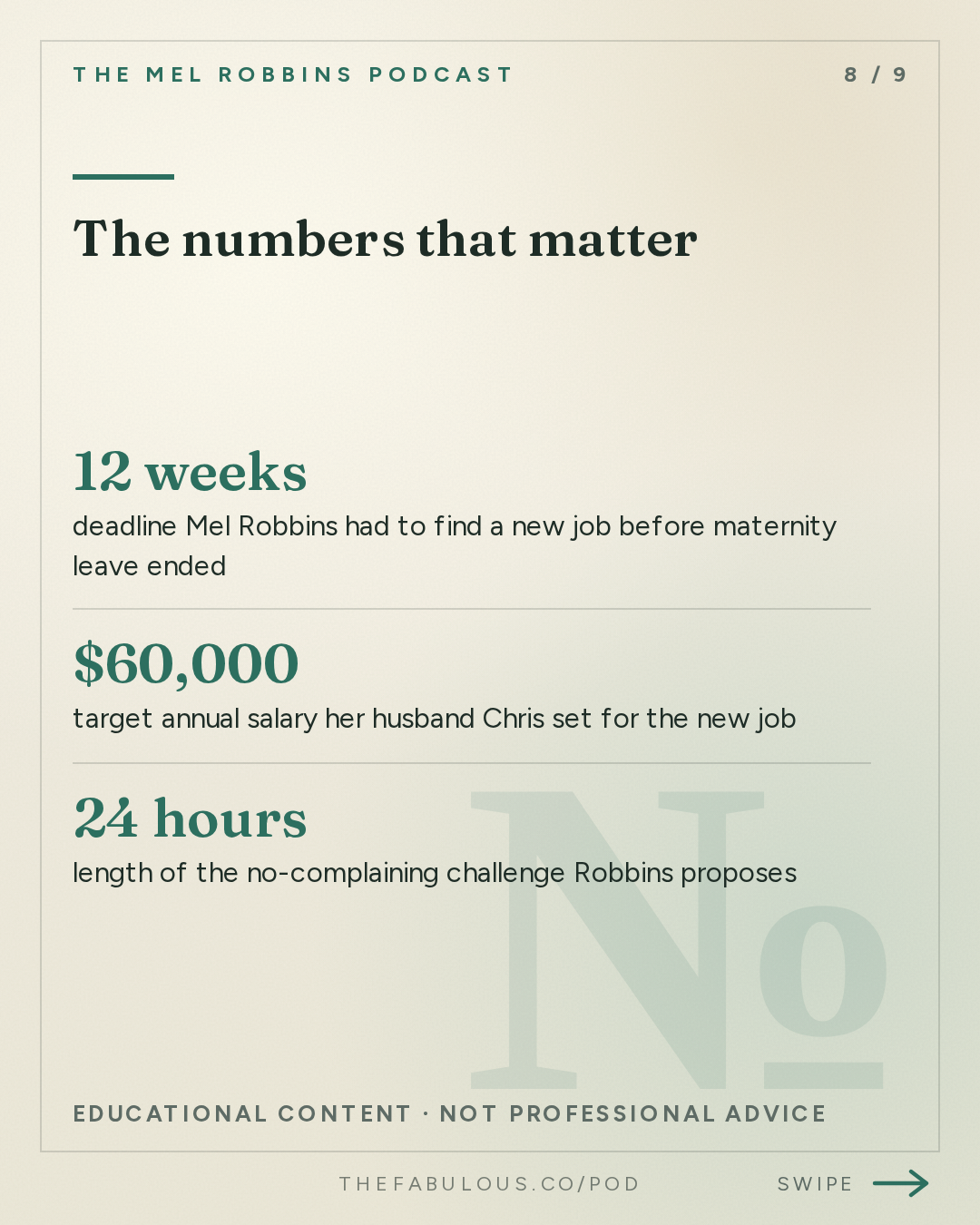
- 12 weeks deadline Mel Robbins had to find a new job before maternity leave ended
- $60,000 target annual salary her husband Chris set for the new job
- 24 hours length of the no-complaining challenge Robbins proposes
In their words
“The tree literally pushes them, ejects them, kicks them out of their life. Why? Because there is no reciprocal energy exchange that can happen during the winter.”
“In order to grow, in order to be strong, to be the best you, you gotta surround yourself with relationships and work and projects and friendships and habits where there is an equal reciprocal”
“Tells the truth. It's like a compass. In fact, a compass runs on magnetic energy. That's why a compass always points true north. It never lies. Your energy doesn't lie either”
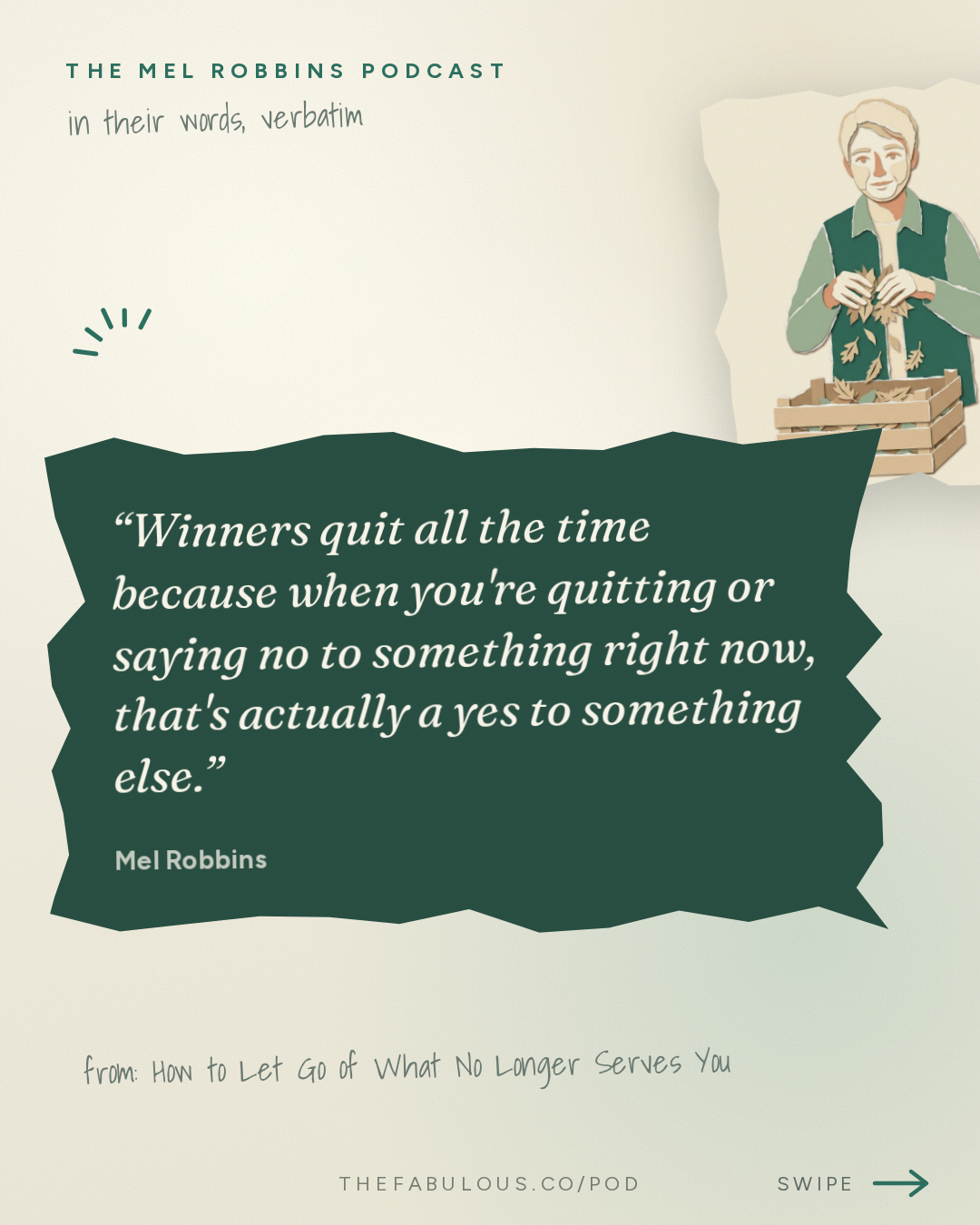
“Winners quit all the time because when you're quitting or saying no to something right now, that's actually a yes to something else.”
Protocols
-
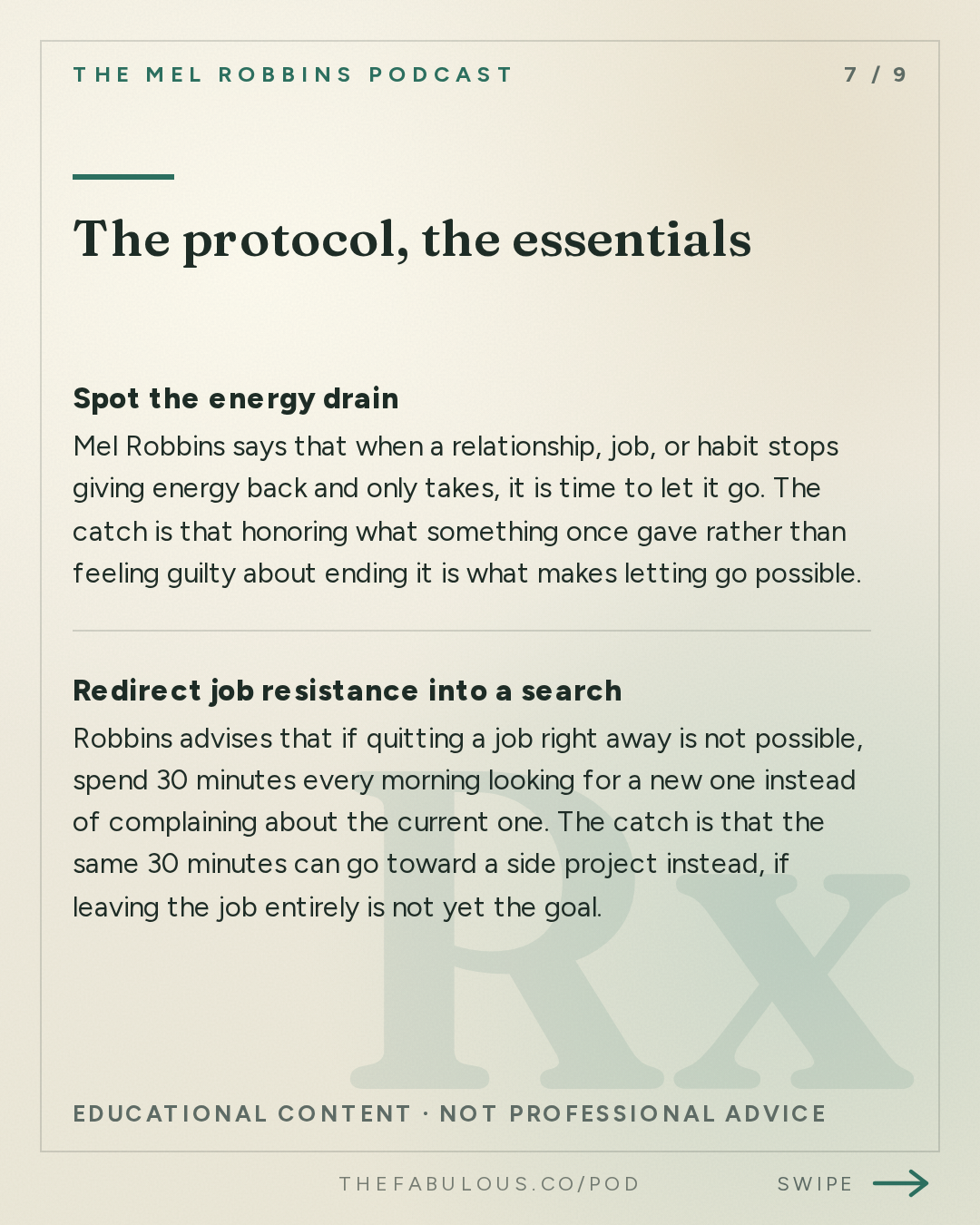
Spot the energy drain
Mel Robbins says that when a relationship, job, or habit stops giving energy back and only takes, it is time to let it go. The catch is that honoring what something once gave rather than feeling guilty about ending it is what makes letting go possible.
ongoing, whenever depletion is noticed
-
Redirect job resistance into a search
Robbins advises that if quitting a job right away is not possible, spend 30 minutes every morning looking for a new one instead of complaining about the current one. The catch is that the same 30 minutes can go toward a side project instead, if leaving the job entirely is not yet the goal.
daily, 30 minutes each morning
-
Tap values during draining caregiving
Robbins suggests that when caregiving for a sick parent or struggling family member drains energy with little given back, recall the values behind the effort, such as compassion, to build pride that substitutes for the energy the relationship cannot return. The catch is that this is a short-term lift, not a fix for a genuinely unsustainable situation.
as needed during difficult caregiving stretches
-
Try the 24-hour no-complaining challenge
Robbins challenges listeners to go 24 hours without complaining about anything in their life. The catch is that the goal is not to suppress feelings but to redirect that same effort toward fixing the problem or letting it go.
one 24-hour stretch, repeatable
-
Stop trying to control other people
Robbins says that catching the urge to control or change another person and redirecting that energy into listening and support restores connection. The catch is that even well-intentioned control blocks the exchange it is trying to create.
whenever the urge to control someone arises
Questions this episode answers
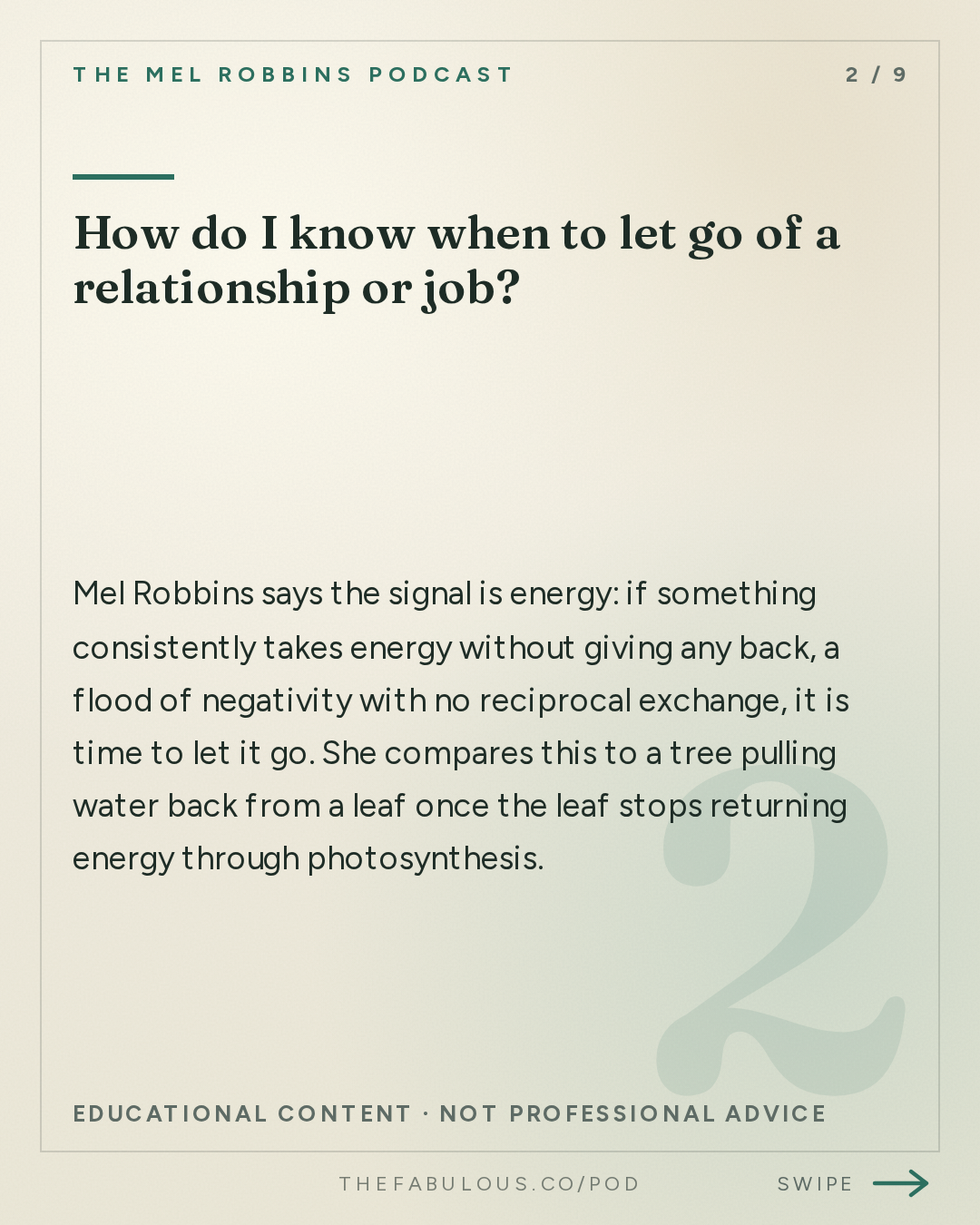
How do I know when to let go of a relationship or job?
Mel Robbins says the signal is energy: if something consistently takes energy without giving any back, a flood of negativity with no reciprocal exchange, it is time to let it go (13:16). She compares this to a tree pulling water back from a leaf once the leaf stops returning energy through photosynthesis (19:16).
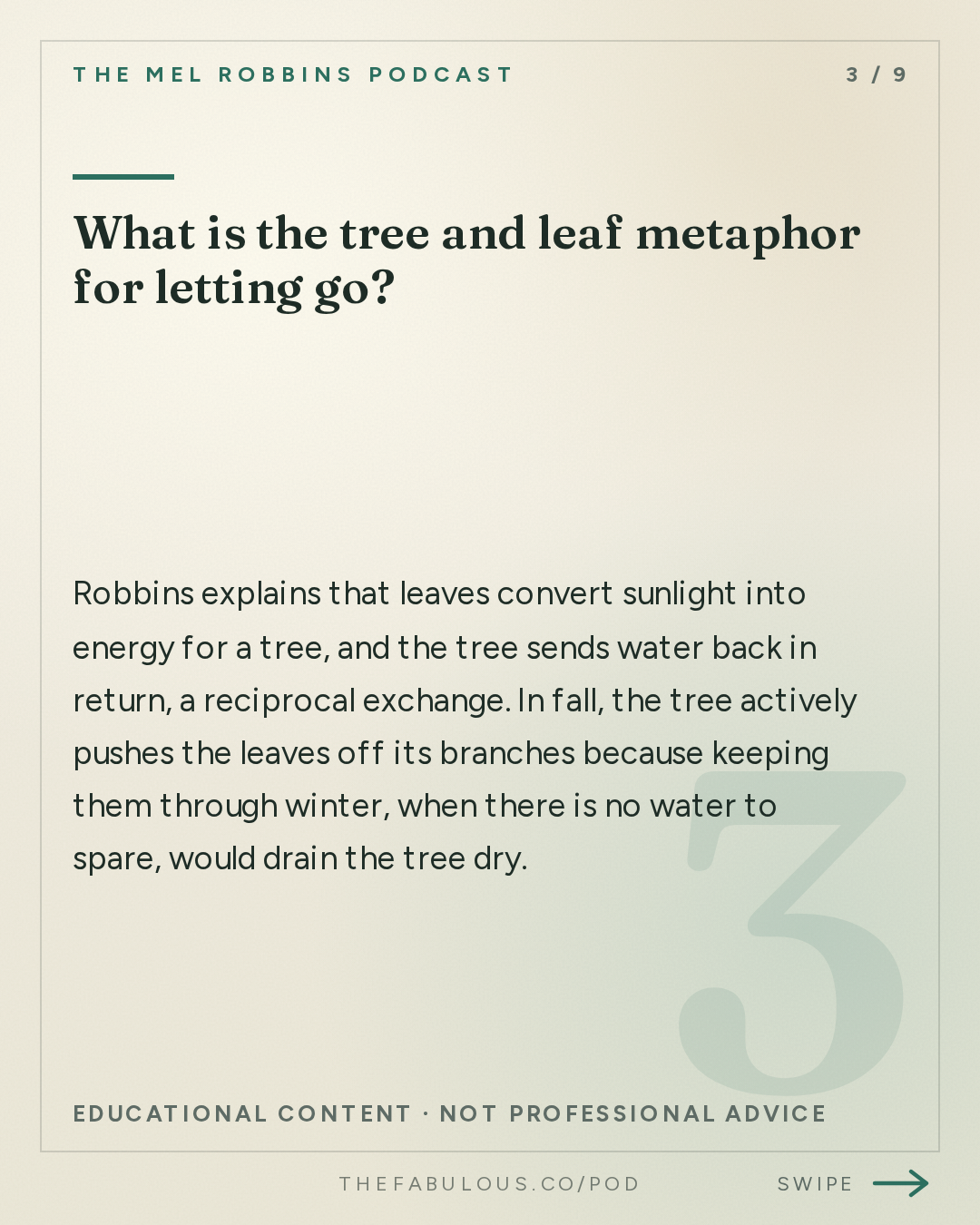
What is the tree and leaf metaphor for letting go?
Robbins explains that leaves convert sunlight into energy for a tree, and the tree sends water back in return, a reciprocal exchange (09:18). In fall, the tree actively pushes the leaves off its branches because keeping them through winter, when there is no water to spare, would drain the tree dry (10:24).
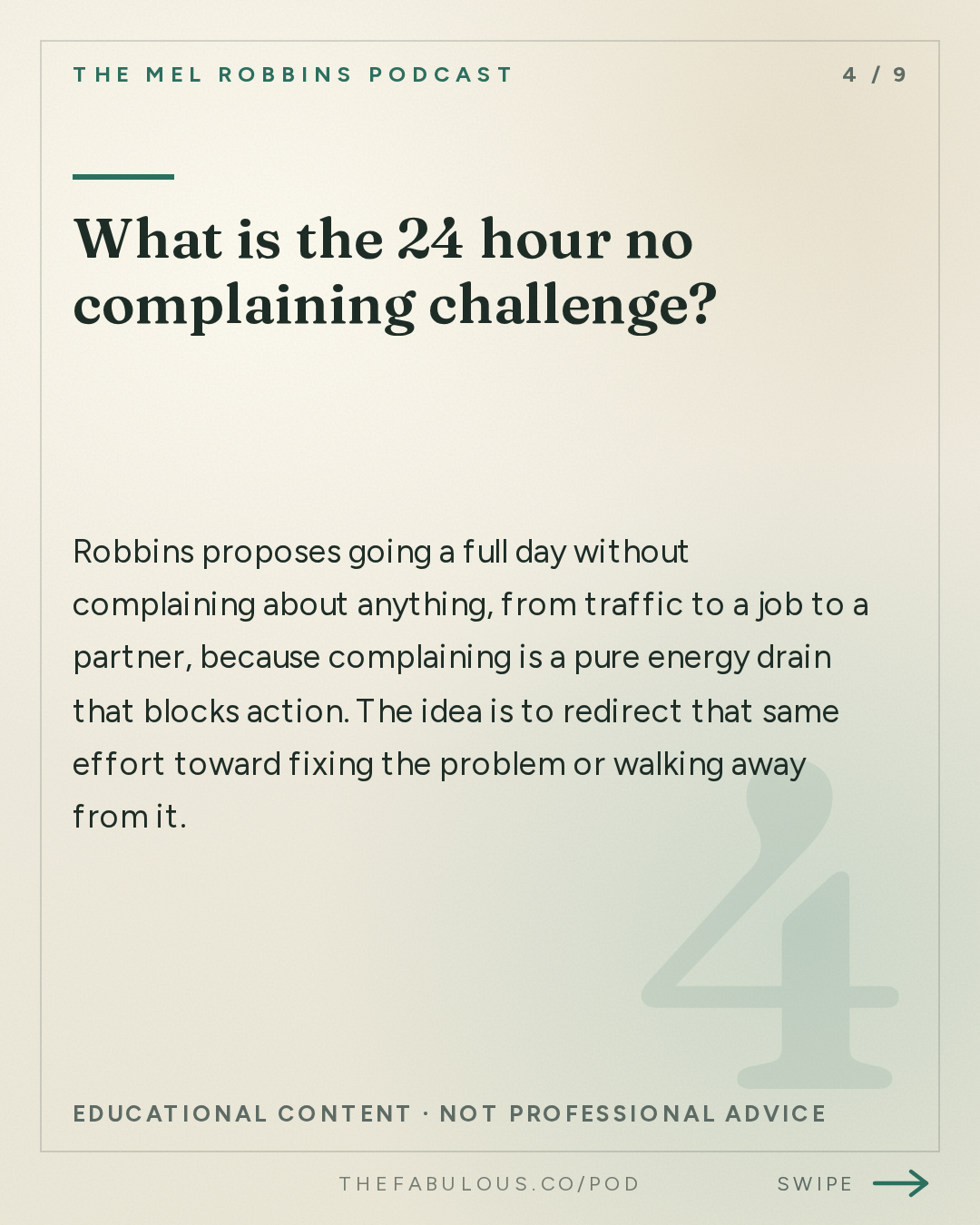
What is the 24 hour no complaining challenge?
Robbins proposes going a full day without complaining about anything, from traffic to a job to a partner, because complaining is a pure energy drain that blocks action (49:37). The idea is to redirect that same effort toward fixing the problem or walking away from it (50:49).
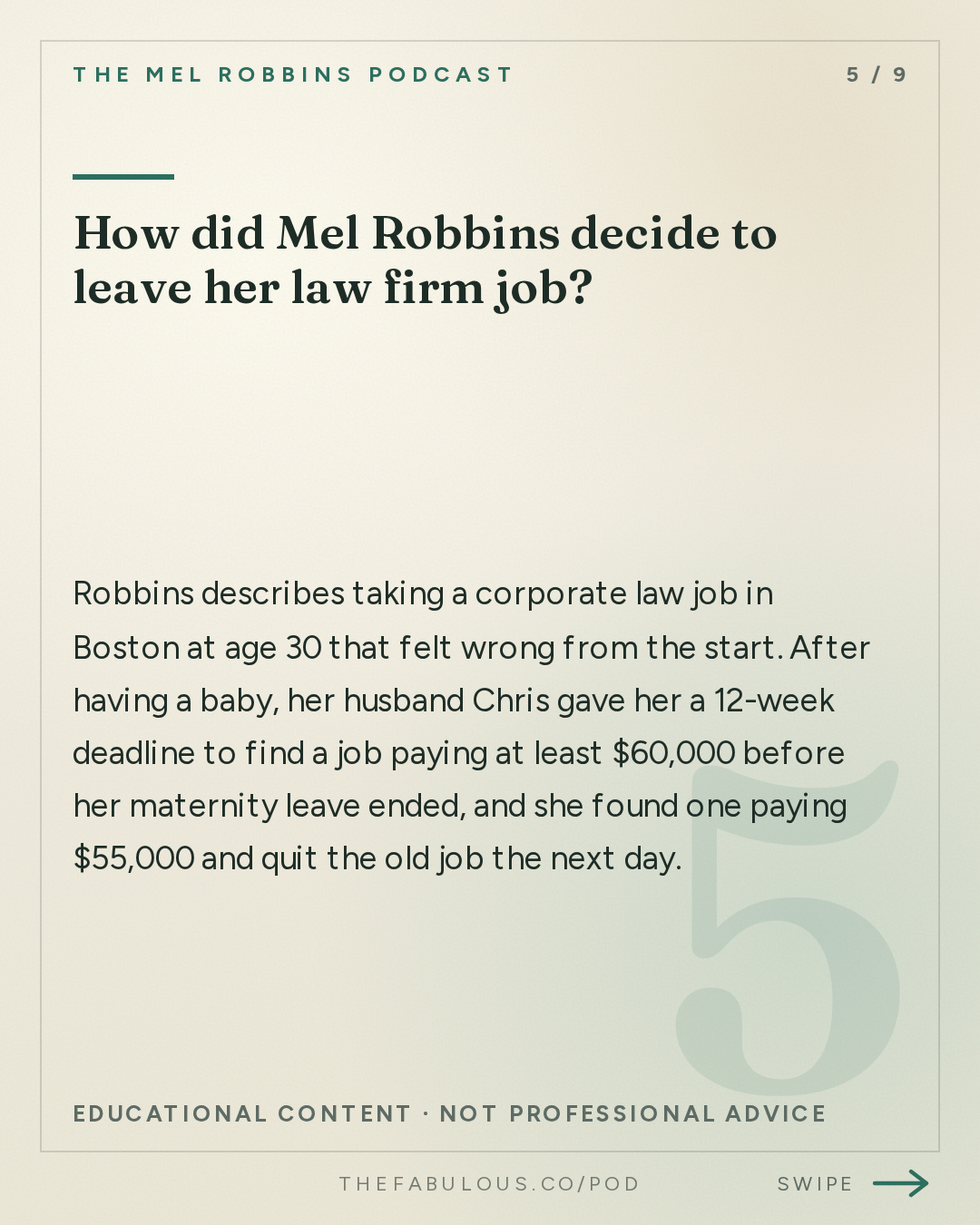
How did Mel Robbins decide to leave her law firm job?
Robbins describes taking a corporate law job in Boston at age 30 that felt wrong from the start (31:34). After having a baby, her husband Chris gave her a 12-week deadline to find a job paying at least $60,000 before her maternity leave ended, and she found one paying $55,000 and quit the old job the next day (34:52, 35:17).
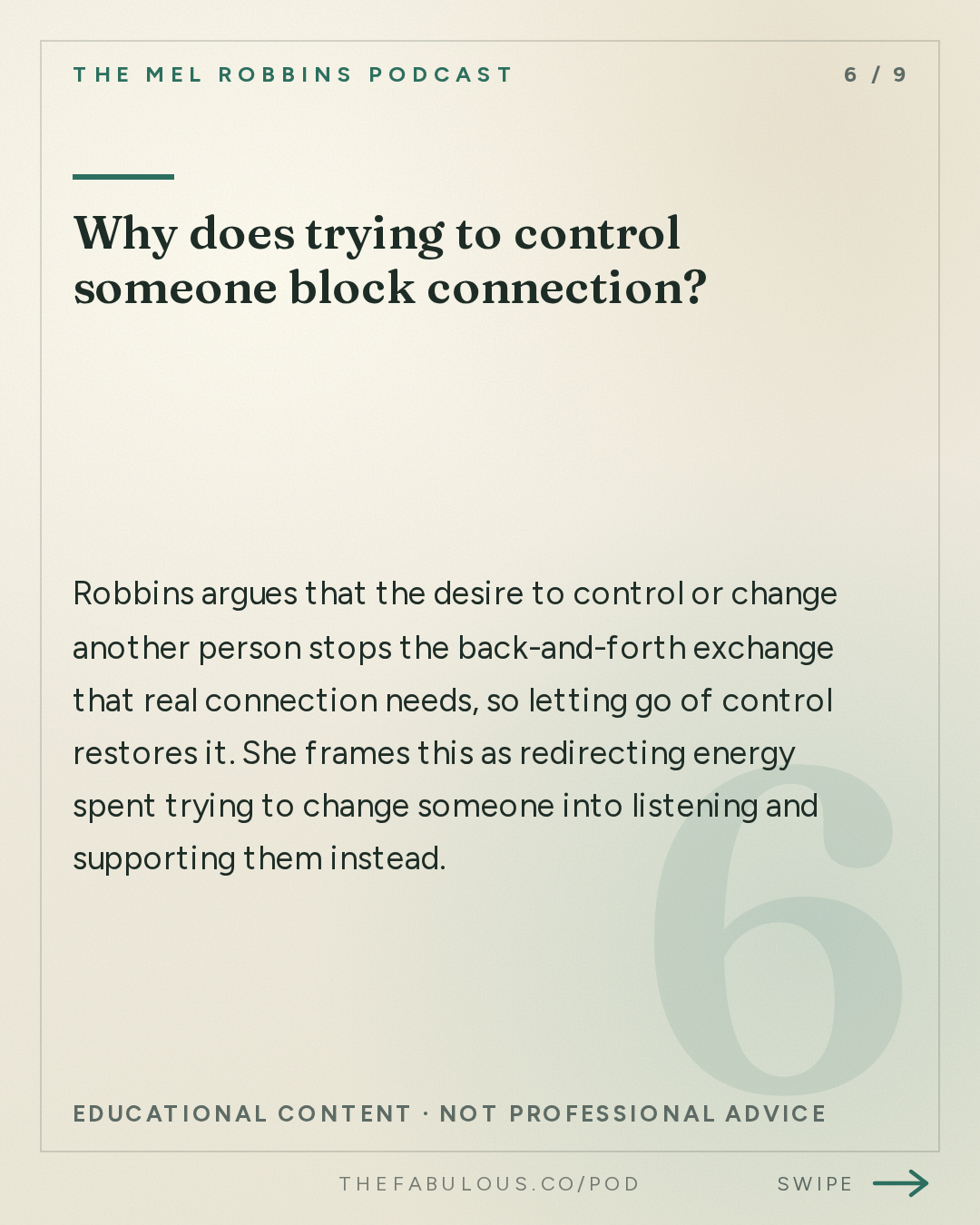
Why does trying to control someone block connection?
Robbins argues that the desire to control or change another person stops the back-and-forth exchange that real connection needs, so letting go of control restores it (51:54). She frames this as redirecting energy spent trying to change someone into listening and supporting them instead.
The full read, in cards
Go deeper
- Motivation Is Garbage (earlier Mel Robbins Podcast episode) — referenced for the idea that activation energy, not motivation, has to come first before a hard task gets easier
Mentioned
Mel Robbins · Chris Robbins · Cathy Heller · Vermont · Boston · Haystack Mountain
More from this show and category
5 Skin Habits From a Mayo Clinic Dermatologist
Mayo Clinic dermatologist Saranya Wyles argues skin is a check engine light for the whole body, not a beauty scorecard, and shares five pillars (sleep, diet, movement, stress, topicals) that measurably change how skin ages, from barrier recovery after sleep to facial volume loss on GLP-1 drugs.
The One Skill That Makes People Like You More
Mel Robbins says empathy means understanding, not mind-reading, and everyone gets nine daily chances to practice it (07:19). She outlines four habits: asking instead of guessing, sending small gestures called pebbling, offering concrete help without being asked, and waving first, drawing on research from Harvard, Stanford, and the University of Toronto.
Ina Garten's Advice for Career Reinvention
Ina Garten left a federal budget job at 30 to buy a 400-square-foot Hamptons food store that grossed just $87 on its first day, and calls her approach working scared. On Mel Robbins's podcast, the Barefoot Contessa founder explains why jumping in before you feel ready, reframing boring tasks, and running small experiments beat waiting for a perfect plan.
Dr. Lara Boyd on How to Rewire Your Brain
Neuroscientist Lara Boyd says experience, not any drug, is the brain's biggest driver of change. Her research shows plasticity peaks when a task is hard enough to succeed only half the time, and that sleep, exercise, and lower cortisol all expand the brain's capacity to rewire at any age.
