
Dr. Lara Boyd on How to Rewire Your Brain
#1 Neuroscientist: After Listening to This, Your Brain Will Not Be the Same
▶ Listen to the full episode More from The Mel Robbins Podcast
The brief
Neuroscientist Lara Boyd says experience, not any drug, is the brain's biggest driver of change. Her research shows plasticity peaks when a task is hard enough to succeed only half the time, and that sleep, exercise, and lower cortisol all expand the brain's capacity to rewire at any age.
In a lab at the University of British Columbia, a stroke patient reaches toward a falling asteroid. His hand, tracked by a sensor, becomes a tiny spaceship on a screen. If he catches the rock before it hits Earth, he scores points. It looks like a video game built for a dentist's waiting room. It is actually one of the more rigorous experiments in modern brain science. As the researchers make the game harder or easier, they scan the player's brain, and they find something that should reorder how anyone thinks about learning: the brain changes the most not when the game is easy, and not when it is nearly impossible, but when the player succeeds only about half the time (19:24).
The scientist behind that asteroid game is Dr. Lara Boyd, a neuroscientist and physical therapist who directs the Brain Behavior Laboratory at the University of British Columbia. Her TEDx talk on the brain's capacity to change has been viewed more than 45 million times (03:58). On Mel Robbins's podcast, Boyd lays out, in plain terms, what neuroplasticity actually is: brain change, full stop, happening from a person's first breath to their last (08:24). Her central claim is almost defiant in its simplicity.
"The single largest driver of change in our brain is our experience. There's no drug. There's no magic bullet. It's the experience you engage in." - Lara Boyd [05:52]
That claim carries a practical edge. If experience is the lever, then the kind of experience someone chooses, how engaged they are, how motivated, how hard they are working, determines how much their brain actually shifts. Boyd's imaging studies show that engaged, motivated effort lights up different brain networks than passive observation, and produces different long-term change (07:24). Watching is not the same as doing.
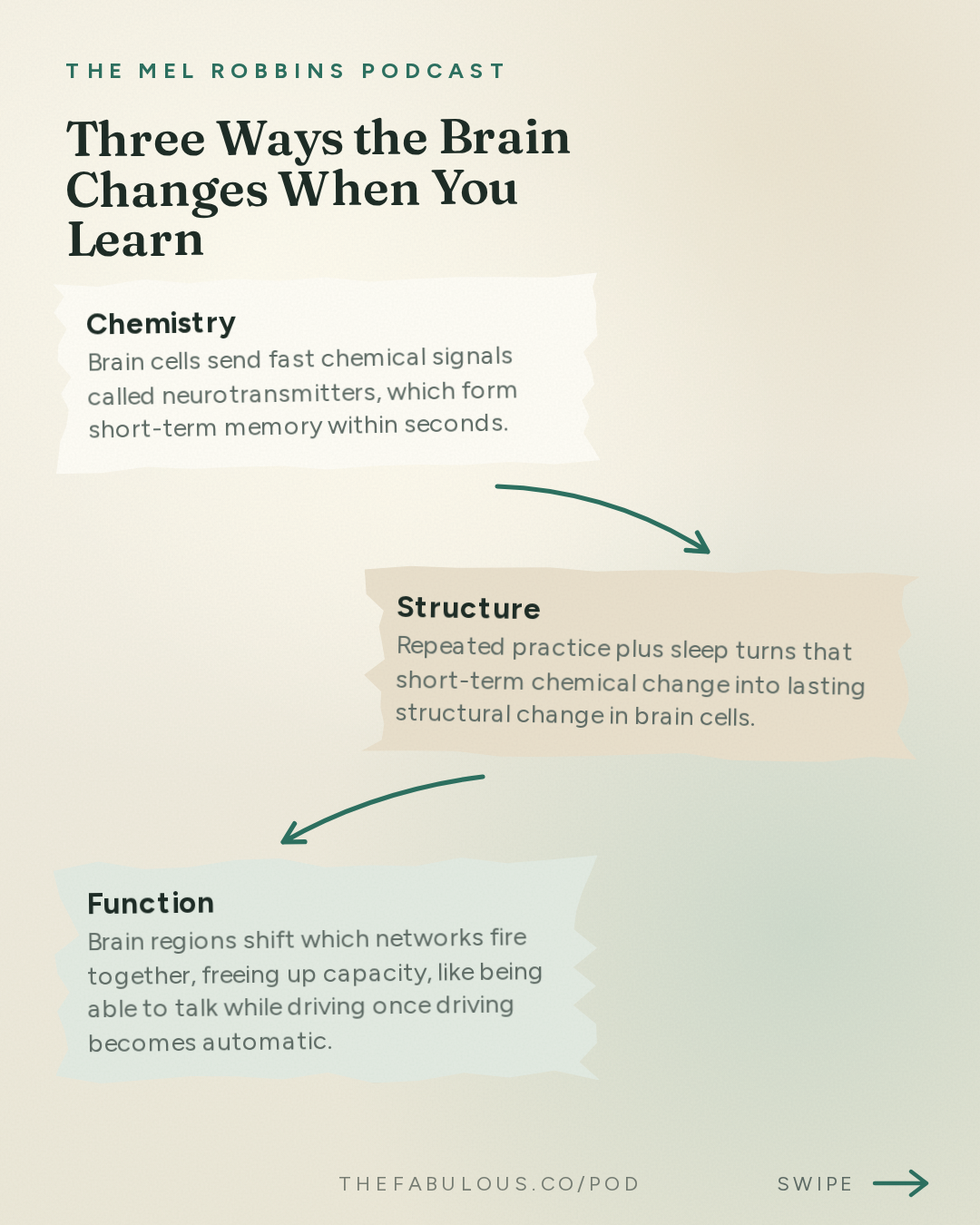
Underneath that idea sits a three-part mechanism. When a person learns something, their brain changes in three ways: chemistry, structure, and function (11:23). Chemistry comes first and comes fast: brain cells fire off neurotransmitters, tiny chemical signals, and that rapid signaling is the biological basis of short-term memory (11:53). Structure comes next, and it is slower. Turning a short-term memory into a lasting one requires both repeated practice and, critically, sleep (12:57). Function is the third layer: as a skill becomes automatic, the brain's networks reorganize so some regions can do more with less conscious effort. Boyd's go-to example is driving. A new driver devotes nearly all of their attention to the mechanics of the car. An experienced driver can hold a conversation, eat lunch, and still watch the road, because practice has freed up brain regions that used to be fully occupied (13:50).
This is also why struggle is not a warning sign. It is closer to a receipt. Boyd's lab has mapped what she calls the "sweet zone of difficulty": a task that is too easy produces no measurable brain change, because the brain can already do it, and a task that is too hard causes people to quit before any practice can accumulate (18:13). Real change clusters in the narrow band between those two states, where a person is failing often enough to be challenged and succeeding often enough to keep going, somewhere around a 50 to 60 percent success rate (19:24). For stroke patients relearning to move an arm, that same principle applies with higher stakes. Boyd's research has found a window of heightened plasticity lasting roughly 30 to 60 days after a stroke, when the brain is less inhibited and more capable of reorganizing itself (16:12). The window narrows after that, but it does not close. Continued, deliberate effort can hold it open longer (17:04).
Three Levers Anyone Can Pull
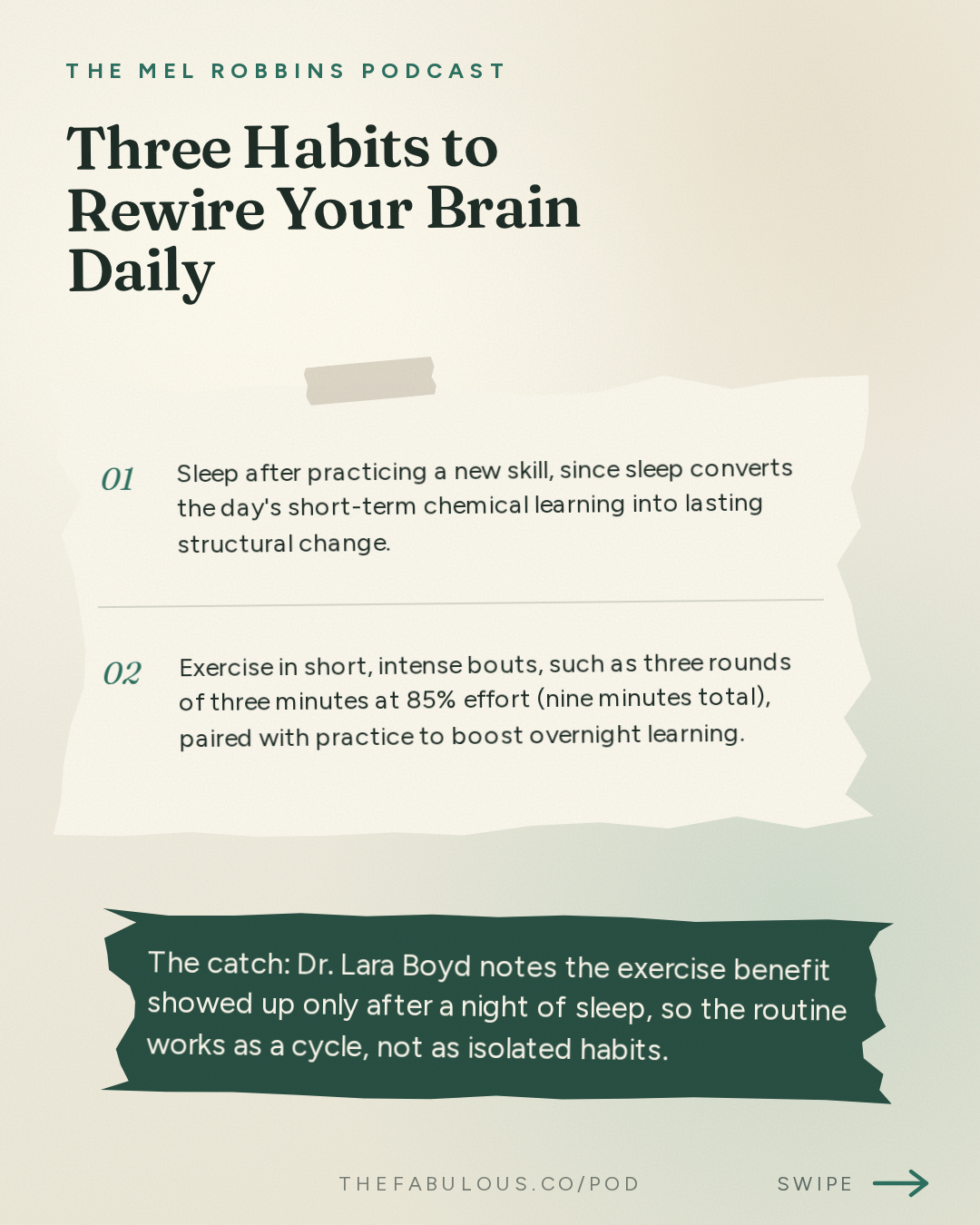
Asked for the simplest ways to support brain change, Boyd names three things: sleep, exercise, and anything that lowers stress (35:29). Sleep is not optional scaffolding around learning, it is part of the mechanism. The chemical change made during a day's practice has to be consolidated into structural change overnight, which is why Boyd tells her students bluntly that they cannot cram for an exam and expect to retain it (36:04). Exercise works through a different channel. Physical activity releases brain-derived neurotrophic factor, or BDNF, a molecule that makes the brain more receptive to reorganizing itself (42:15). In Boyd's lab, people, including stroke patients and participants in their eighties, do three rounds of three minutes at 85 percent of their maximum effort, nine minutes of high-intensity interval training in total, paired with a learning task (38:53). The exercise group did not outperform the rest group immediately. The difference showed up the next day: after sleep, the people who had exercised had improved significantly more than those who had only practiced (39:22). Separately, Boyd's University of British Columbia colleague Teresa Luambrose studied intense strength training in older women and found gains she had not even set out to measure: improved cognition, on top of better bone density and fewer falls (40:41).
Stress works against all of this. The stress hormone cortisol competes with the brain's own growth factors for the same cellular real estate, which is why a stressed brain is a less plastic one.
"Imagine you've got just a few parking spots in your brain, and if cortisol's parked in them, we can't get our trophic factors that allow brain change into that same spot." - Lara Boyd [42:59]
Boyd's lab tested this by scanning the brains of runners and yoga practitioners while exposing them to stressful scenarios. In the runners, the amygdala, the brain's threat-detection center, lit up on its own. In the yoga practitioners, people who attended only two or three classes a week, the amygdala activated too, but alongside other memory-related regions, which seemed to let them observe the stressful scene without being overtaken by it (44:02). A separate ongoing study in Boyd's lab has teachers practice a self-compassion technique called loving-kindness meditation for 30 days and has already found measurable drops in burnout alongside changes in brain measures (45:49).
Priming the Brain Before It Works
Some of the more surprising material in the conversation concerns mental rehearsal. Imagining a movement activates almost every brain region involved in actually performing it, with one exception: the motor command itself never fires (49:48). That is why elite athletes visualize races before running them. Boyd adds a detail that changes how the technique should be used: visualizing from inside the body, as if living the moment, produces better learning effects than watching oneself from the outside, like a spectator (50:40). The same logic extends to manifesting and to morning affirmations. Thinking through a desired outcome appears to trigger small releases of dopamine, the brain's reward chemical, which reinforces movement toward that goal, while also pushing down cortisol (52:35). Boyd calls this priming the brain, getting it into a state ready to absorb what comes next (53:23).
The conversation closes on a personal example. Robbins admits she has spent years telling herself a story that she cannot learn languages. Boyd, using a plastic brain model, points out that language regions, usually on the left side near the temple, get wired up early in childhood, which is part of why new languages feel so much harder to acquire as adults (67:12). Her prescription is not more vocabulary drills but full immersion: no English, speaking and hearing only the target language, because Robbins has already identified herself as an auditory learner (68:44). It is a small, specific illustration of the episode's larger argument: identify how your own brain actually learns, then build the hardest version of that experience you can tolerate.
Boyd ends with a phrase she says she thinks about often, the Latin motto of her university: tuum est, it is yours.
"You can build the brain you wanna have. Build the brain you want." - Lara Boyd [79:25]
It is a tidy close to an hour built on a less tidy idea: the brain does not wait for permission to change. It changes constantly, for better or worse, according to whatever a person feeds it. The only real choice is which experiences get to do the feeding.
Ask this episode anything
Pod's AI answers from the episode itself, with the minute mark so you can hear it yourself.
Or start with one of these
Ask this episode
Pod's AI listens to the whole episode to answer, and points you to the minute it comes from.
The rest of this answer, and any question after it
Answers come from the episode itself, never from a summary of it.
ContinueKey takeaways
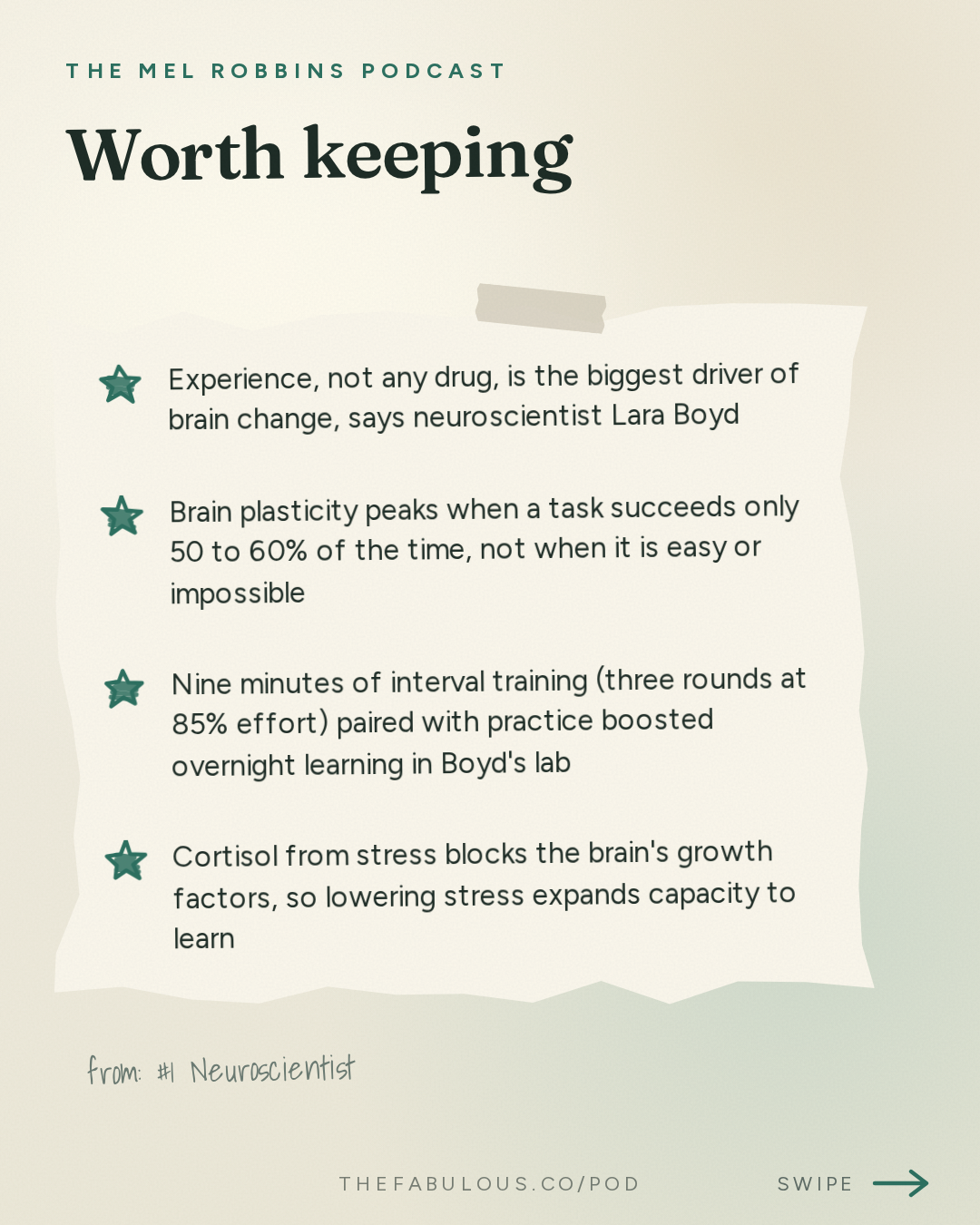
- Experience, not any drug, is the biggest driver of brain change, says neuroscientist Lara Boyd
- Brain plasticity peaks when a task succeeds only 50 to 60% of the time, not when it is easy or impossible
- Nine minutes of interval training (three rounds at 85% effort) paired with practice boosted overnight learning in Boyd's lab
- Cortisol from stress blocks the brain's growth factors, so lowering stress expands capacity to learn
- A 30 to 60 day window of heightened plasticity follows a stroke, though continued effort can extend it
The episode in cards

By the numbers
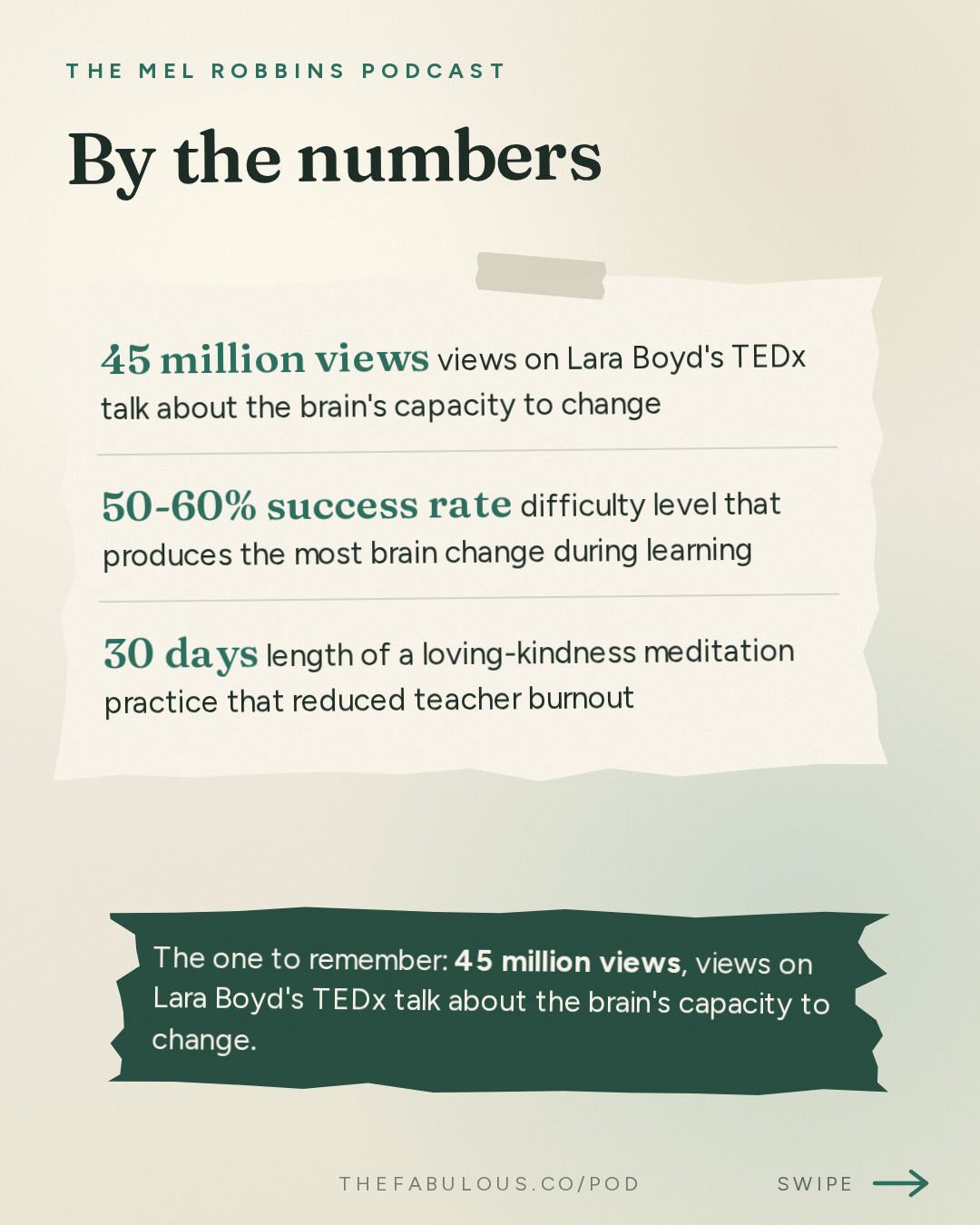
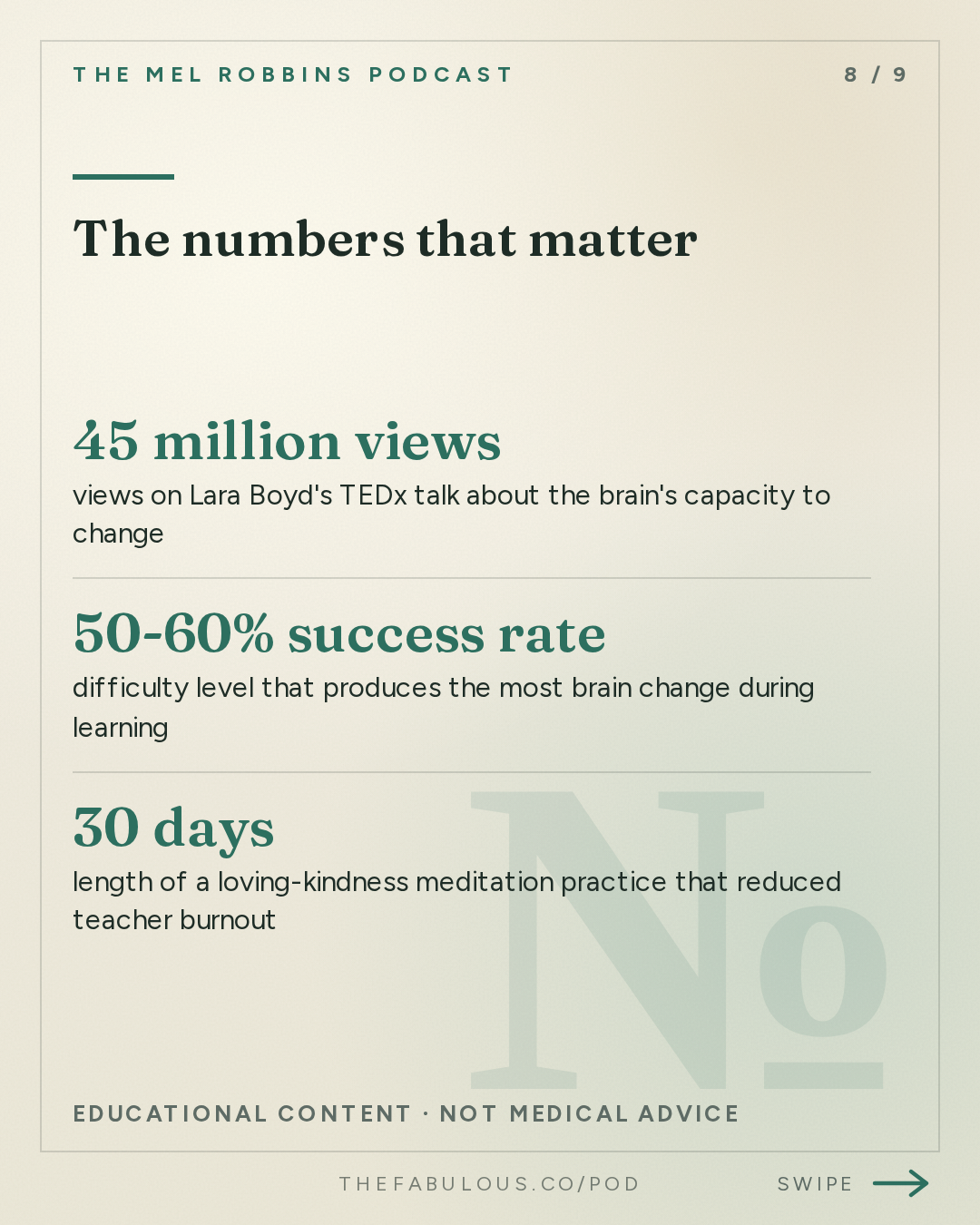
- 45 million views views on Lara Boyd's TEDx talk about the brain's capacity to change
- 50-60% success rate difficulty level that produces the most brain change during learning
- 30 days length of a loving-kindness meditation practice that reduced teacher burnout
In their words
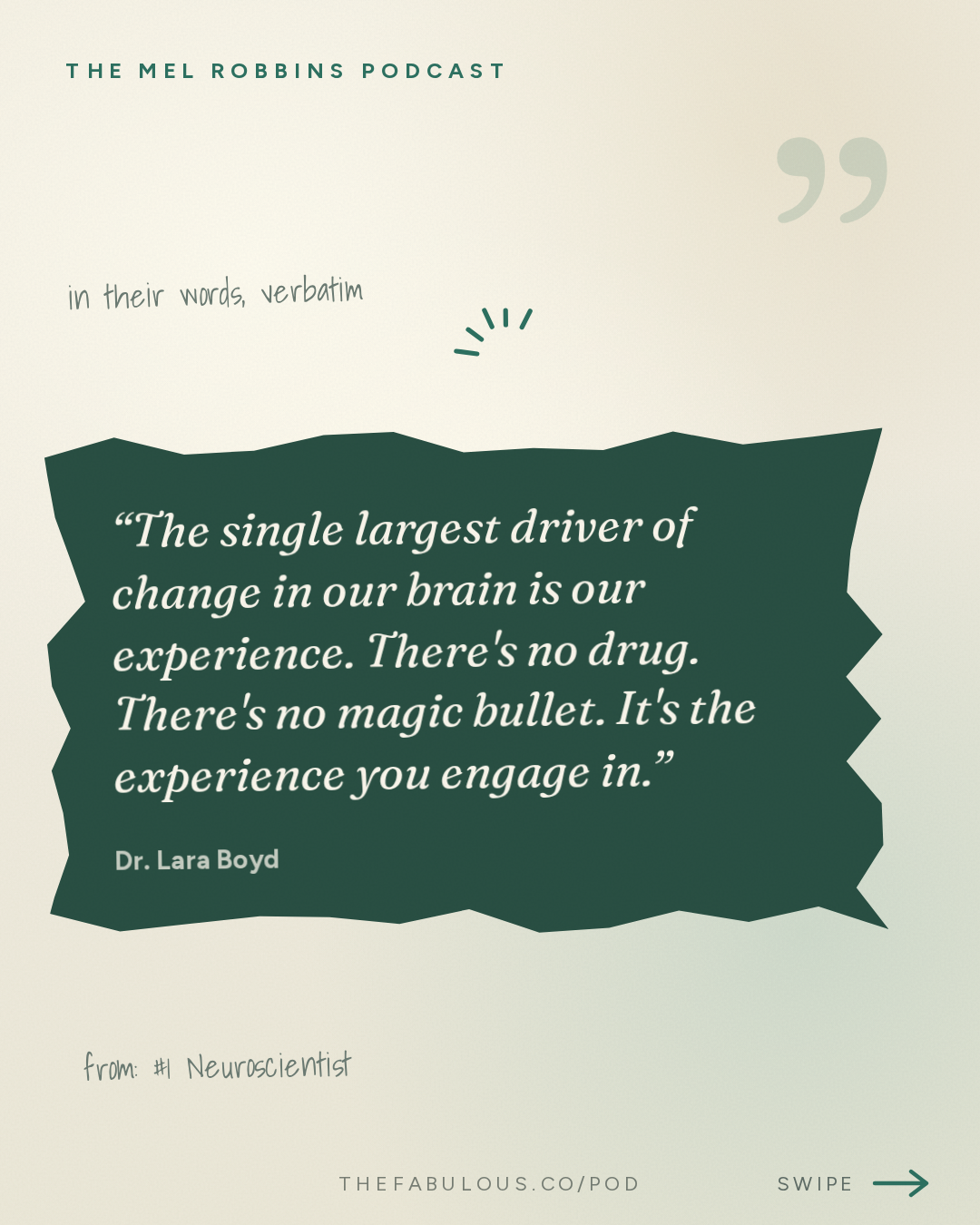
“The single largest driver of change in our brain is our experience. There's no drug. There's no magic bullet. It's the experience you engage in.”
“I hope you walk away knowing that all of those things, failure, struggle, difficulty, are actually very good for the brain, very healthy for the brain.”
“Imagine you've got just a few parking spots in your brain, and if cortisol's parked in them, we can't get our trophic factors that allow brain change into that same spot.”
“You can build the brain you wanna have. Hmm. Build the brain you want”
Protocols
-
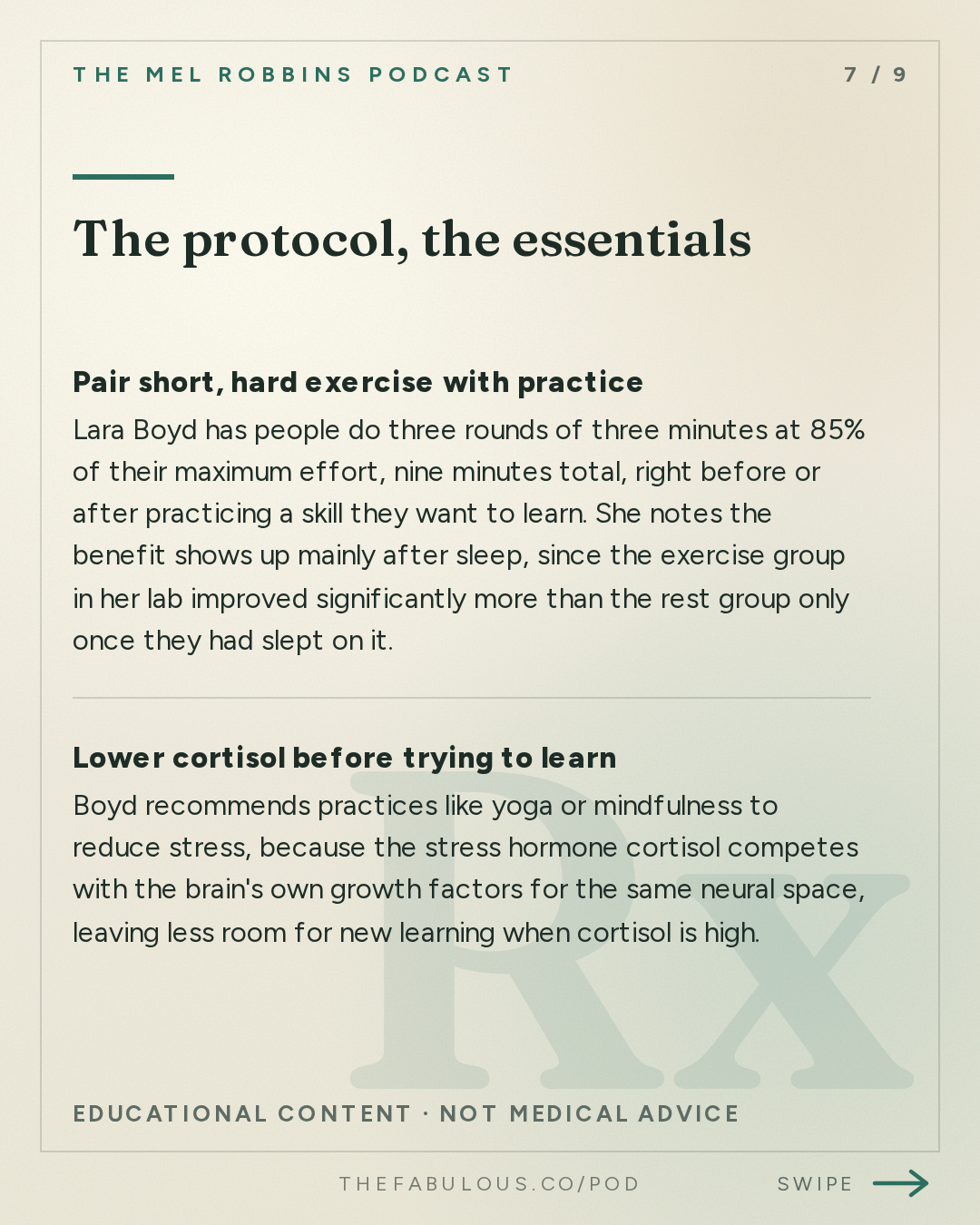
Pair short, hard exercise with practice
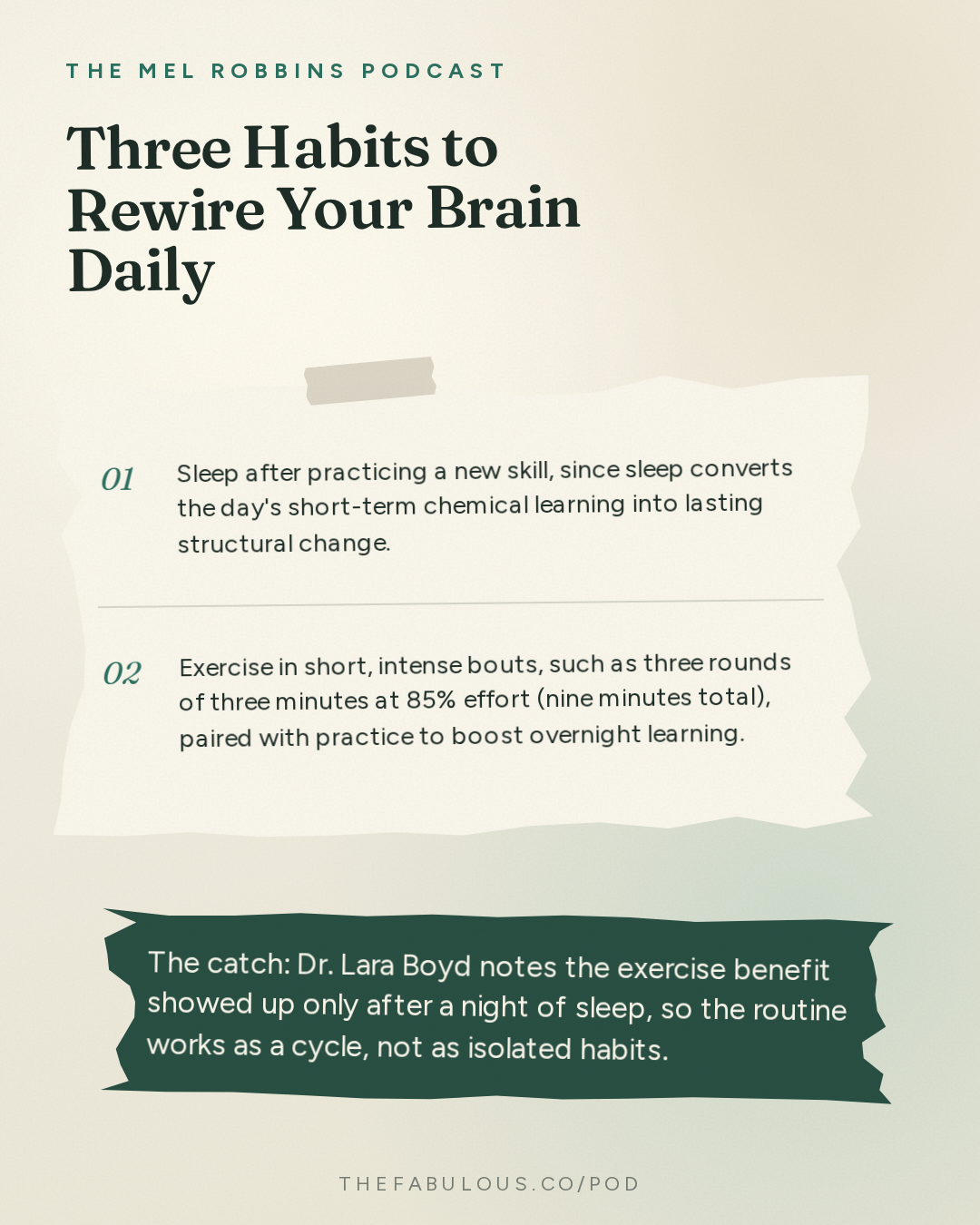
Lara Boyd has people do three rounds of three minutes at 85% of their maximum effort, nine minutes total, right before or after practicing a skill they want to learn. She notes the benefit shows up mainly after sleep, since the exercise group in her lab improved significantly more than the rest group only once they had slept on it.
before or after each practice session
-
Lower cortisol before trying to learn
Boyd recommends practices like yoga or mindfulness to reduce stress, because the stress hormone cortisol competes with the brain's own growth factors for the same neural space, leaving less room for new learning when cortisol is high.
ongoing, several times a week
-
Open the day with gratitude or a positive statement
Boyd suggests starting each day with a simple affirmation, such as 'today is going to be a good day,' because this lowers cortisol and triggers a small dopamine release that primes the brain to follow through on that intention.
every morning
-
Use full immersion to learn a language as an adult
Boyd advises an auditory learner like Mel Robbins to immerse herself fully in a language, hearing and speaking it with no English fallback, rather than relying on rote reading, since this mimics how children acquire language and can still rewire the brain's early-wired language circuits.
during a dedicated immersion period
Questions this episode answers
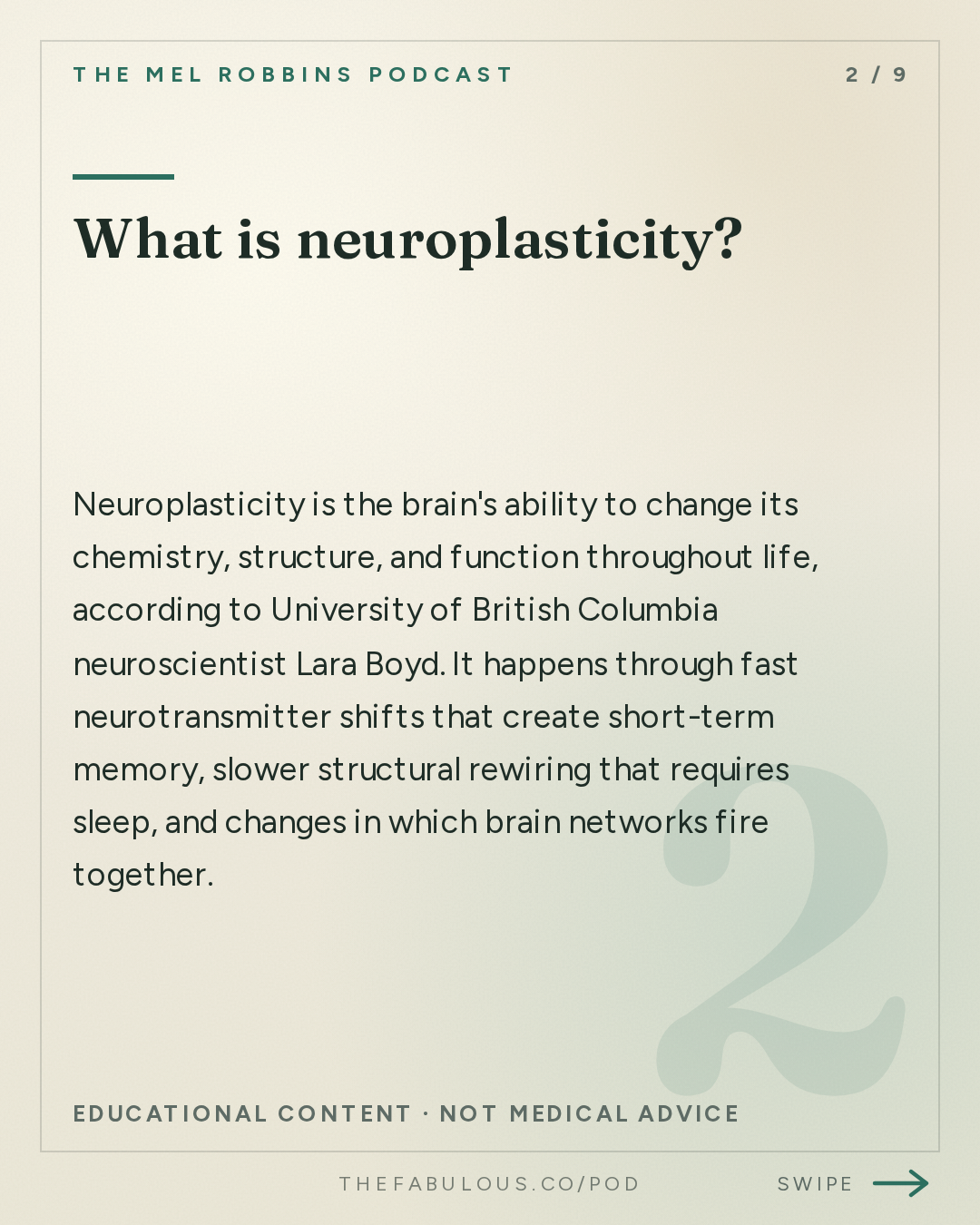
What is neuroplasticity?
Neuroplasticity is the brain's ability to change its chemistry, structure, and function throughout life, according to University of British Columbia neuroscientist Lara Boyd. It happens through fast neurotransmitter shifts that create short-term memory, slower structural rewiring that requires sleep, and changes in which brain networks fire together (11:23).
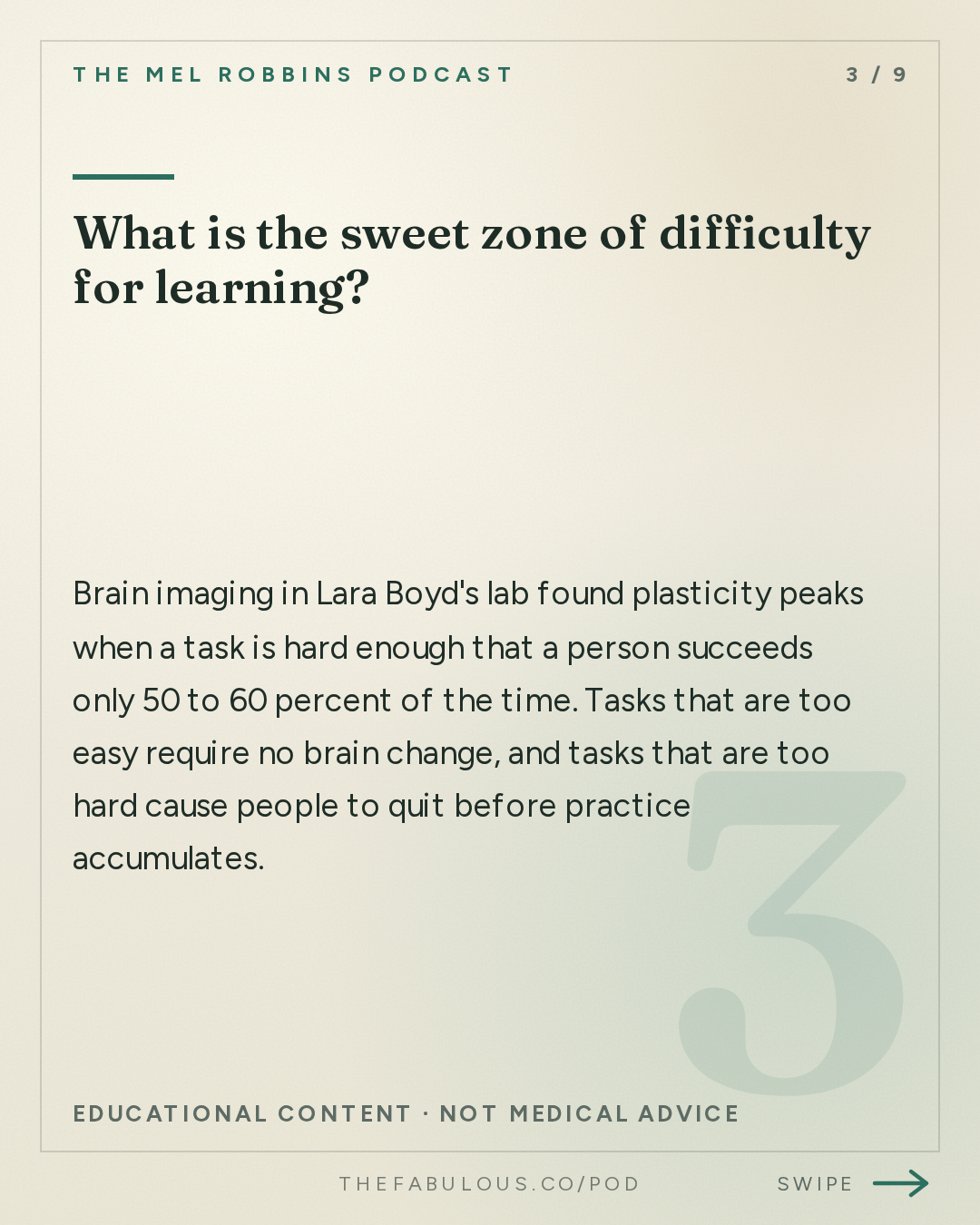
What is the sweet zone of difficulty for learning?
Brain imaging in Lara Boyd's lab found plasticity peaks when a task is hard enough that a person succeeds only 50 to 60 percent of the time (19:24). Tasks that are too easy require no brain change, and tasks that are too hard cause people to quit before practice accumulates (18:13).
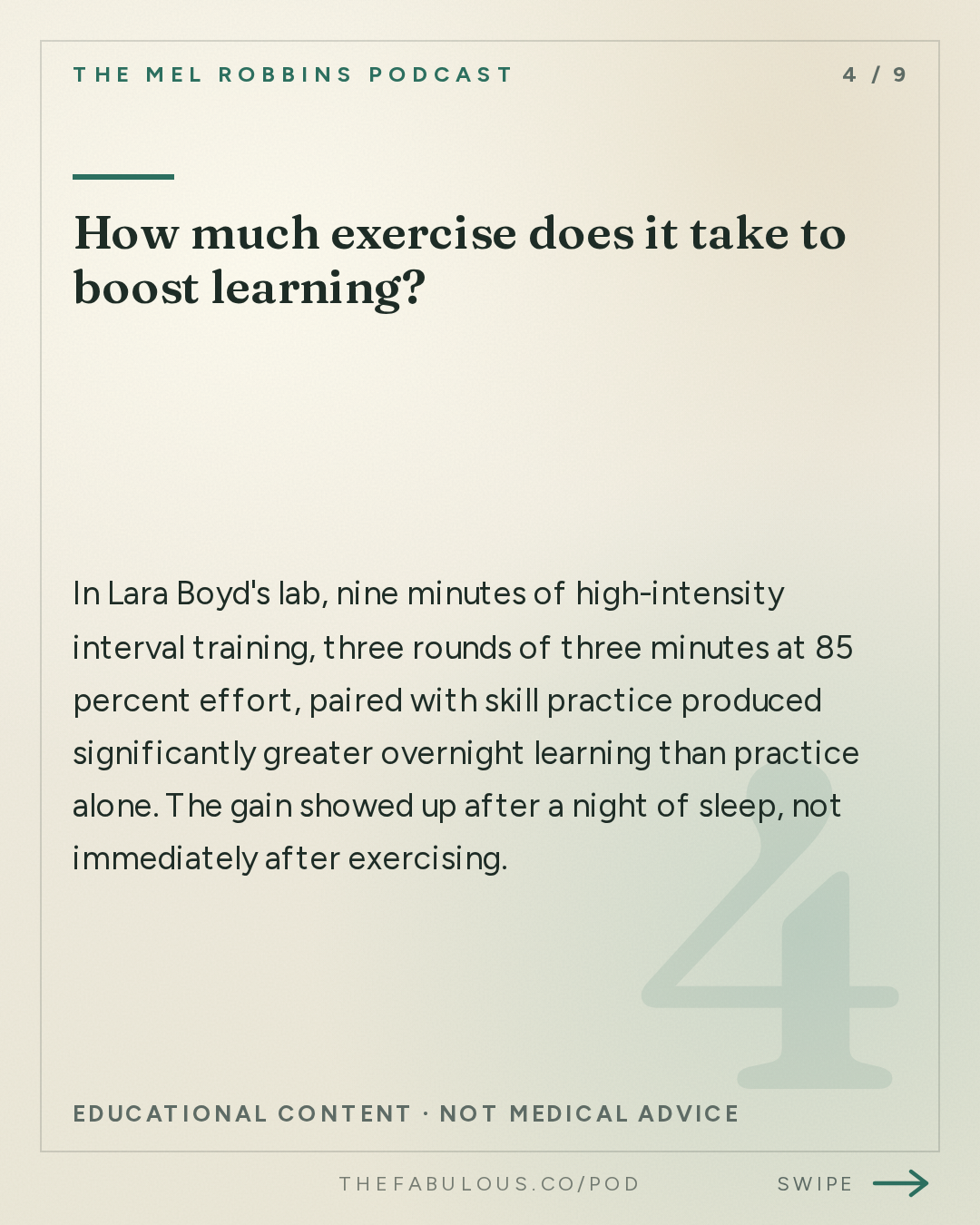
How much exercise does it take to boost learning?
In Lara Boyd's lab, nine minutes of high-intensity interval training, three rounds of three minutes at 85 percent effort, paired with skill practice produced significantly greater overnight learning than practice alone (38:53). The gain showed up after a night of sleep, not immediately after exercising (39:22).
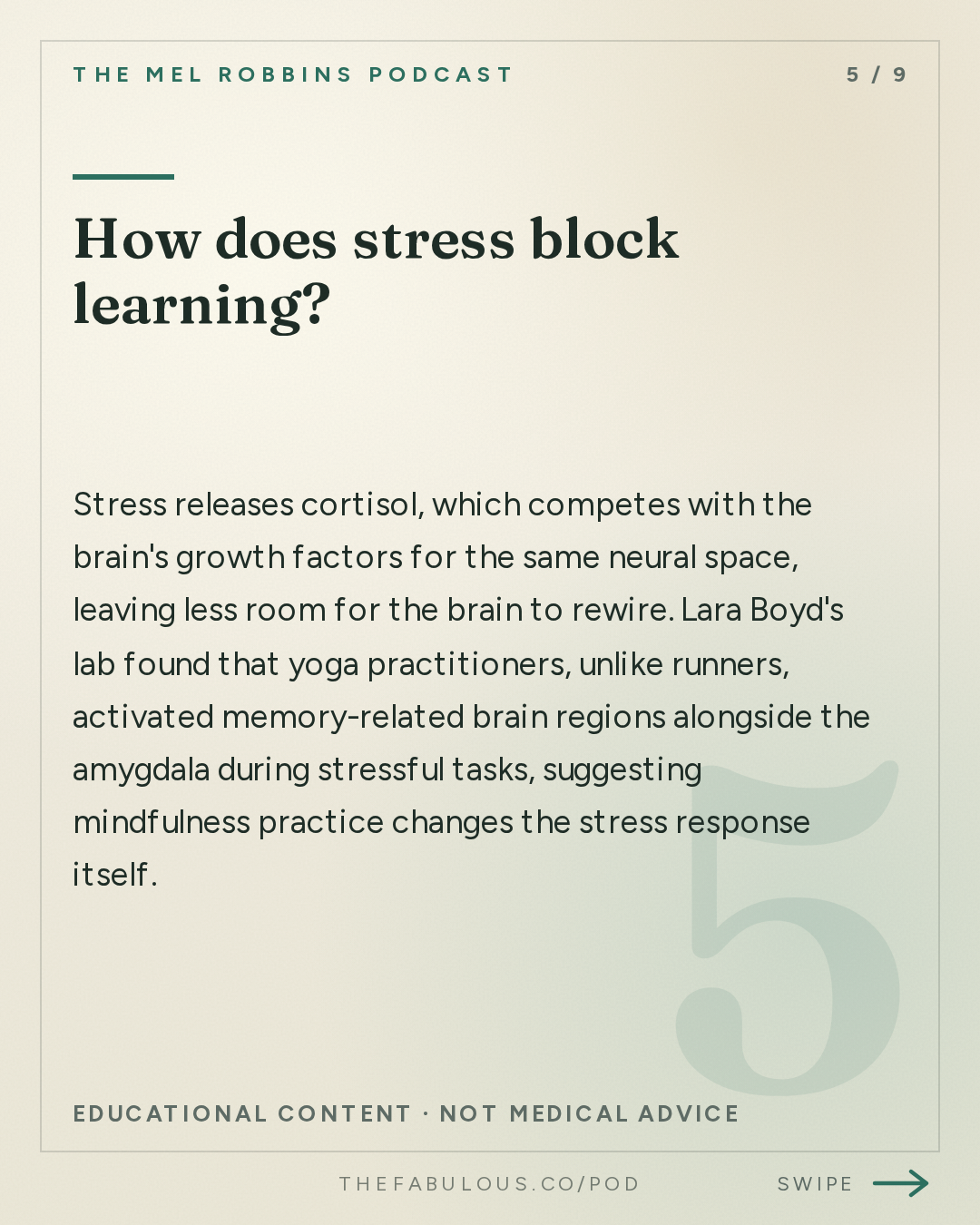
How does stress block learning?
Stress releases cortisol, which competes with the brain's growth factors for the same neural space, leaving less room for the brain to rewire (42:59). Lara Boyd's lab found that yoga practitioners, unlike runners, activated memory-related brain regions alongside the amygdala during stressful tasks, suggesting mindfulness practice changes the stress response itself (44:02).
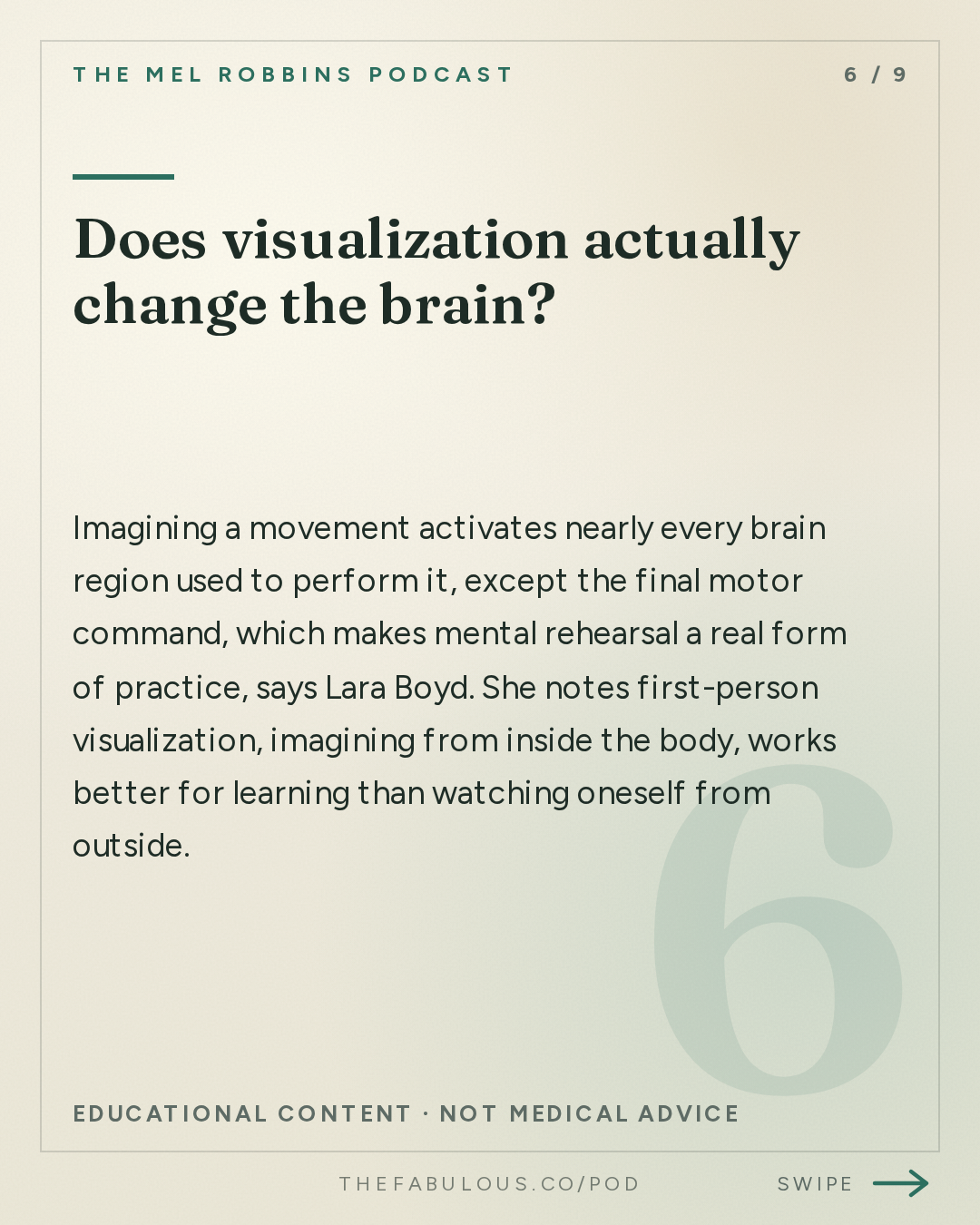
Does visualization actually change the brain?
Imagining a movement activates nearly every brain region used to perform it, except the final motor command, which makes mental rehearsal a real form of practice, says Lara Boyd (49:48). She notes first-person visualization, imagining from inside the body, works better for learning than watching oneself from outside (50:40).
The full read, in cards
Go deeper
- Lara Boyd TEDx Talk on brain plasticity — a talk on the brain's capacity to grow and change, viewed more than 45 million times
- Schoolchildren mindset study — teaching kids their brain changes when they learn raised their grades
- Asteroid-game stroke rehabilitation study — mapped the 'sweet zone of difficulty' where success rate around 50-60% produced the most structural brain change
- Yoga practitioners vs. runners stress imaging study — yoga practitioners recruited memory-related brain regions alongside the amygdala during stress, runners did not
- Teresa Luambrose strength training study — intense strength training improved cognition in older women beyond its physical benefits
- Loving-kindness meditation study with teachers — 30 days of practice reduced burnout and produced measurable brain change
Mentioned
Dr. Lara Boyd · Mel Robbins · University of British Columbia · Brain Behavior Laboratory · Teresa Luambrose · Malcolm Gladwell · Amygdala · Prefrontal cortex · Dopamine · Cortisol · BDNF
More from this show and category
How to Stop Being Overlooked at Work
Emory University marketing professor Marina Cooley argues that good work alone rarely gets noticed; in an attention economy of thousands of daily messages, people need a sticky personal brand and the habit of saying their achievements out loud. Her research shows what moves pay differs by gender, and simple scripts like asking a boss what success looks like outperform guessing.
Male Hormone Health: A Stanford Doctor's Guide
Stanford urologist Michael Eisenberg says male hormone health is a window into long-term health, not just sex or fertility. He covers testosterone's normal range, the lifestyle habits that raise or lower it, erectile dysfunction treatments, and why global sperm counts keep falling, with evidence that an active sex life and a steady partner both predict a longer life.
Mel Robbins' Best Life Advice for Listeners
Mel Robbins turns a full episode of listener questions into concrete rules: move once, eat more protein and fiber, and wait 30 days after a breakup. She covers passion as energy, the 90-second rule for emotional flooding, and a heart-versus-head framework for career and relationship decisions.
John Grisham's Morning Writing Routine Explained
John Grisham credits two unplanned "golden moments" for redirecting his path, first toward law school, then toward writing A Time to Kill and The Firm. He built his career on writing one page a day at 5 a.m. for 30 years, absorbed 28 rejections, and then watched a bootleg manuscript trigger a $600,000 film deal and 52 straight bestsellers.
