
Mel Robbins' Best Life Advice for Listeners
The Ultimate Life Advice: How to Get Motivated, Build Confidence & Create Better Relationships
▶ Listen to the full episode More from The Mel Robbins Podcast
The brief
Mel Robbins turns a full episode of listener questions into concrete rules: move once, eat more protein and fiber, and wait 30 days after a breakup. She covers passion as energy, the 90-second rule for emotional flooding, and a heart-versus-head framework for career and relationship decisions.
For a decade, self-help media has treated passion like a lost set of car keys: something hiding under a couch cushion of a life, waiting to be found. Mel Robbins spends part of this listener-question episode taking a crowbar to that metaphor. Passion, she says, is not an object. It is a feeling, and more specifically it is just another word for energy (20:30).
That reframing sets the tone for an episode built entirely from questions submitted through her newsletter, her website, and social media (03:42). There is no guest and no single thesis. Instead there is a stack of problems: a listener who wants to move away from her family and feels guilty about it, a reader who cannot find passion, someone who wants to know what diet actually works, a person who cannot think straight when upset, someone going through a breakup, another weighing a career change. Robbins answers them one after another, and the answers hold together because they share a habit of mind: treat the vague feeling as information, then build a small, repeatable action around it.
Take the moving question. A listener named Kelsey writes that she wants to leave home but the guilt of leaving her family is holding her back (04:56). Robbins' answer is blunt: move anyway, at least once in a lifetime, and understand that the guilt is proof the relationship matters (06:21). She offers her daughter Kendall as an example, who spent seven years in Los Angeles before deciding she had outgrown the city (07:12). The claim that changing geography can deepen family closeness, because distance interrupts the habit of taking people for granted, is an opinion rather than a study. But it is offered as a practical proposition: the guilt is not a stop sign, it is a signal of value.
"If you change nothing, nothing changes. But if you change where you live, everything changes, and a new part of you emerges in this new place." Mel Robbins [08:10]
The passion question gets similar treatment. Robbins' three-step fix: swap the word "passion" for "energy," list anything that reliably produces that feeling, such as dancing, gardening, or reading, then schedule one of those things into the coming week (20:53). She credits Wharton School behavioral scientist Katie Milpin with the finding behind step three: deliberately adding something enjoyable to an overwhelmed calendar increases a person's felt sense of control over time, because the choice signals that one's own preferences still count (24:18). It is a small mechanism, but it explains why advice to do less and advice to add one more thing are not actually in conflict.
Fuel before fitness
The nutrition segment produces the episode's most quotable line.
"You cannot out exercise a crappy diet. And for me, it was a huge wake-up call." Mel Robbins [32:14]
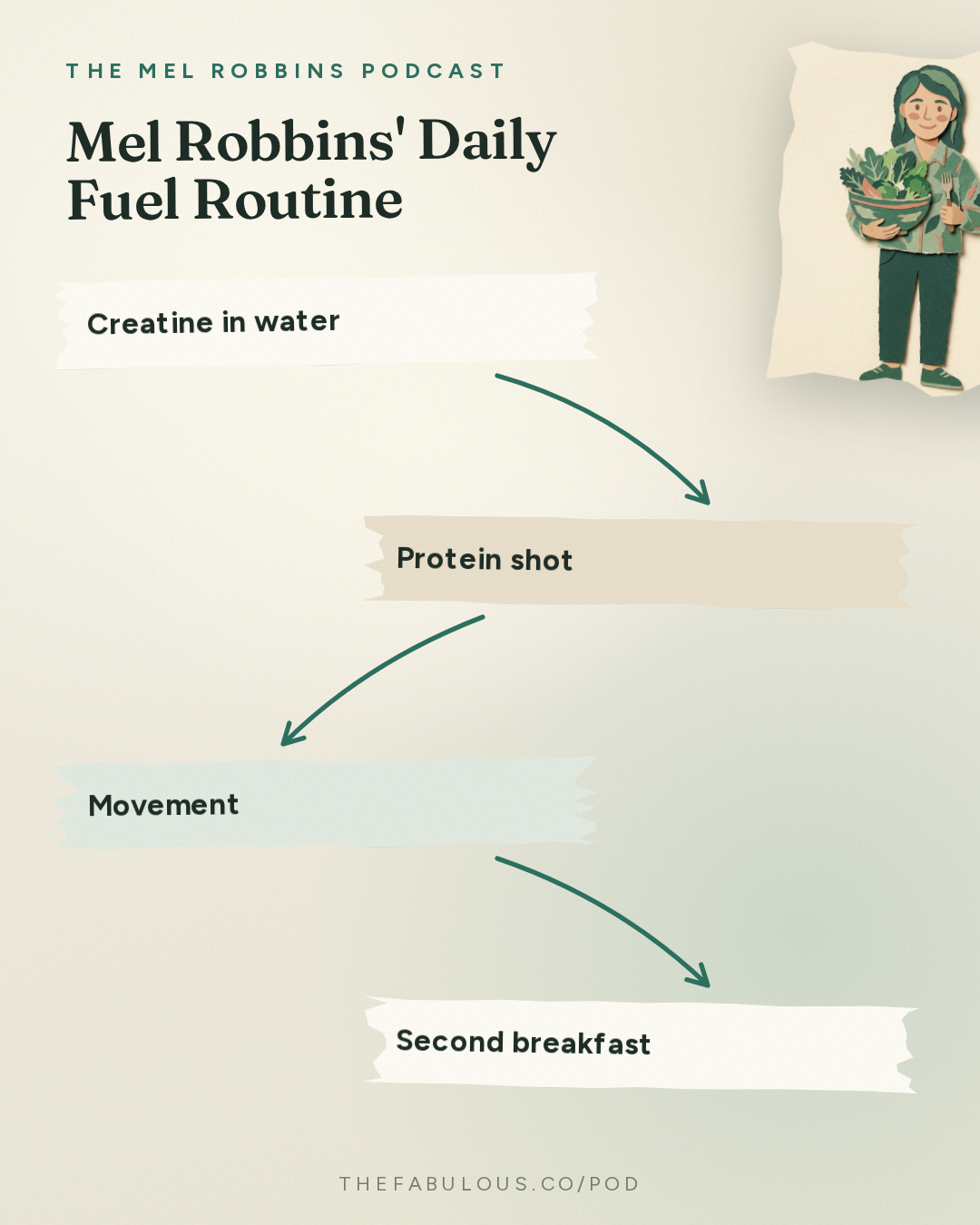
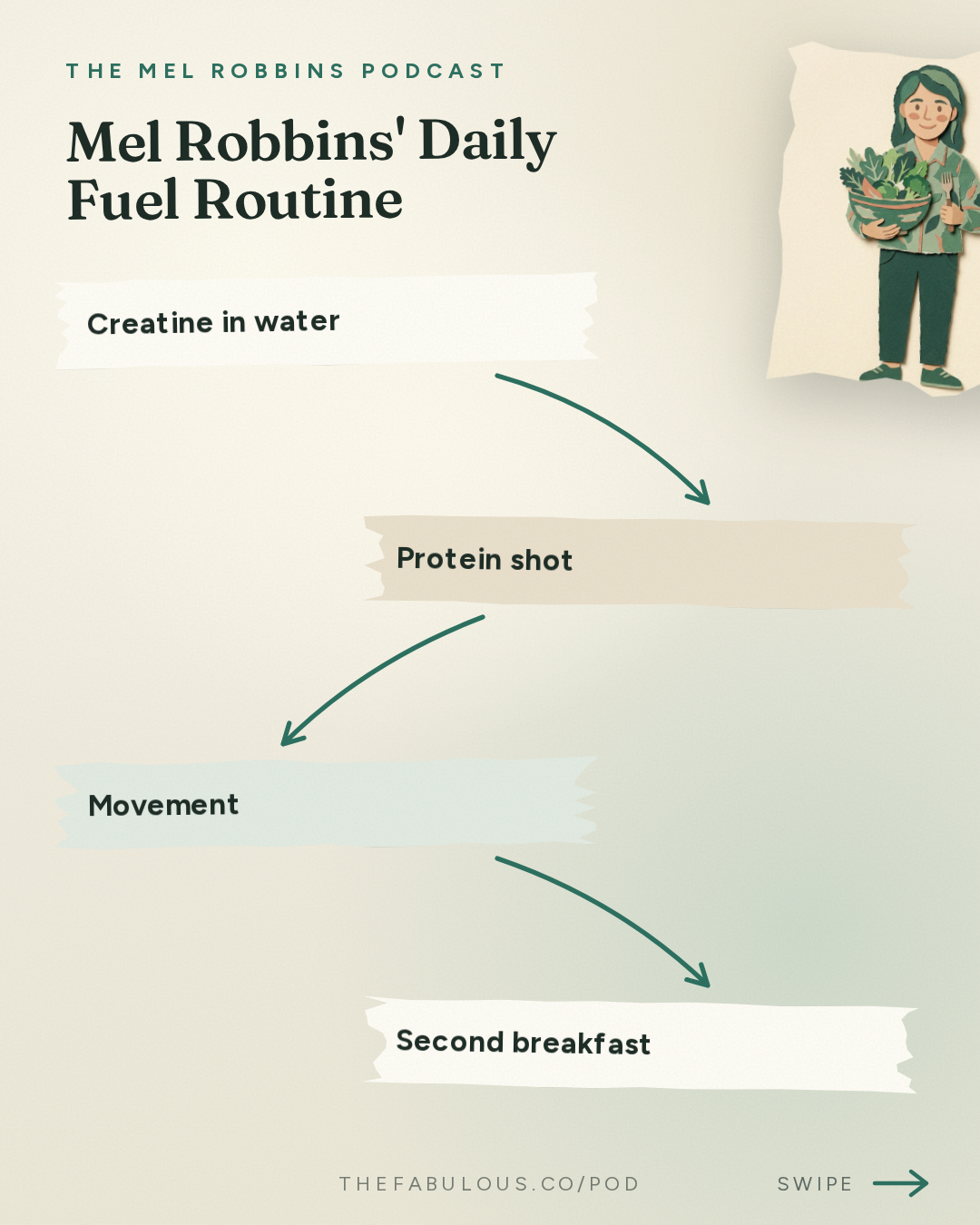
Robbins says the realization arrived at 55, around the time of menopause, when her body stopped responding the way it used to (32:56). Her fix became a daily routine: ten grams of creatine in water first thing, a 23-gram protein shot, and a target of 100 grams of protein and 30 grams of fiber across the day (33:57). She cites a figure that 95 percent of Americans fall short on fiber, attributed to recurring guest Dr. Amy Shaw (34:36). Three days a week she lifts heavy weights for 30 minutes, a habit she credits to researchers who have appeared on her show, including Stacy Sims, Gabrielle Lyons, Vonda Wright, and Eric Topol, all linked to the idea that resistance training matters for healthy aging (36:30). On other days she walks or hikes, and she delays her coffee by 90 minutes after waking (38:21).
The more interesting claim concerns motivation. Robbins says that for fifty years she exercised to be thin, under the belief that thinness signaled health and attractiveness to others (39:35). The shift that mattered was not a new workout plan but a new reason: exercising to feel strong and energetic rather than to look a certain way to other people (40:30). She points to research suggesting that when women reframe exercise as the one part of the day that belongs only to them, rather than an obligation, the behavior becomes easier to sustain (42:56). Whether a single study generalizes is unclear from the episode. What is clear is that Robbins treats intention, not willpower, as the lever.
What to do with a flooded brain
The emotional-regulation segment draws on Yale Center for Emotional Intelligence director Marc Brackett, a previous guest on the show. His claim, as Robbins relays it, is simple: a person cannot think logically while emotionally flooded, so the task is not to override the emotion but to work with it (44:24). The method has three steps. Notice that an emotional reaction is happening. Name the specific feeling, since scared and overwhelmed call for different responses (45:41). Then pause, letting the feeling rise and fall without acting on it, for as long as 90 seconds, a window tied to research on emotional dissipation (48:32).
The science behind the naming step, often called affect labeling, has been studied at UCLA for roughly two decades, Robbins says, and the finding is that labeling an emotion reduces activity in the brain's emotional centers (49:51). She links the idea to Viktor Frankl's observation, from his book "Man's Search for Meaning," that there is a gap between a stimulus and a response to it, and that emotional regulation is the work of widening that gap on purpose (49:26).
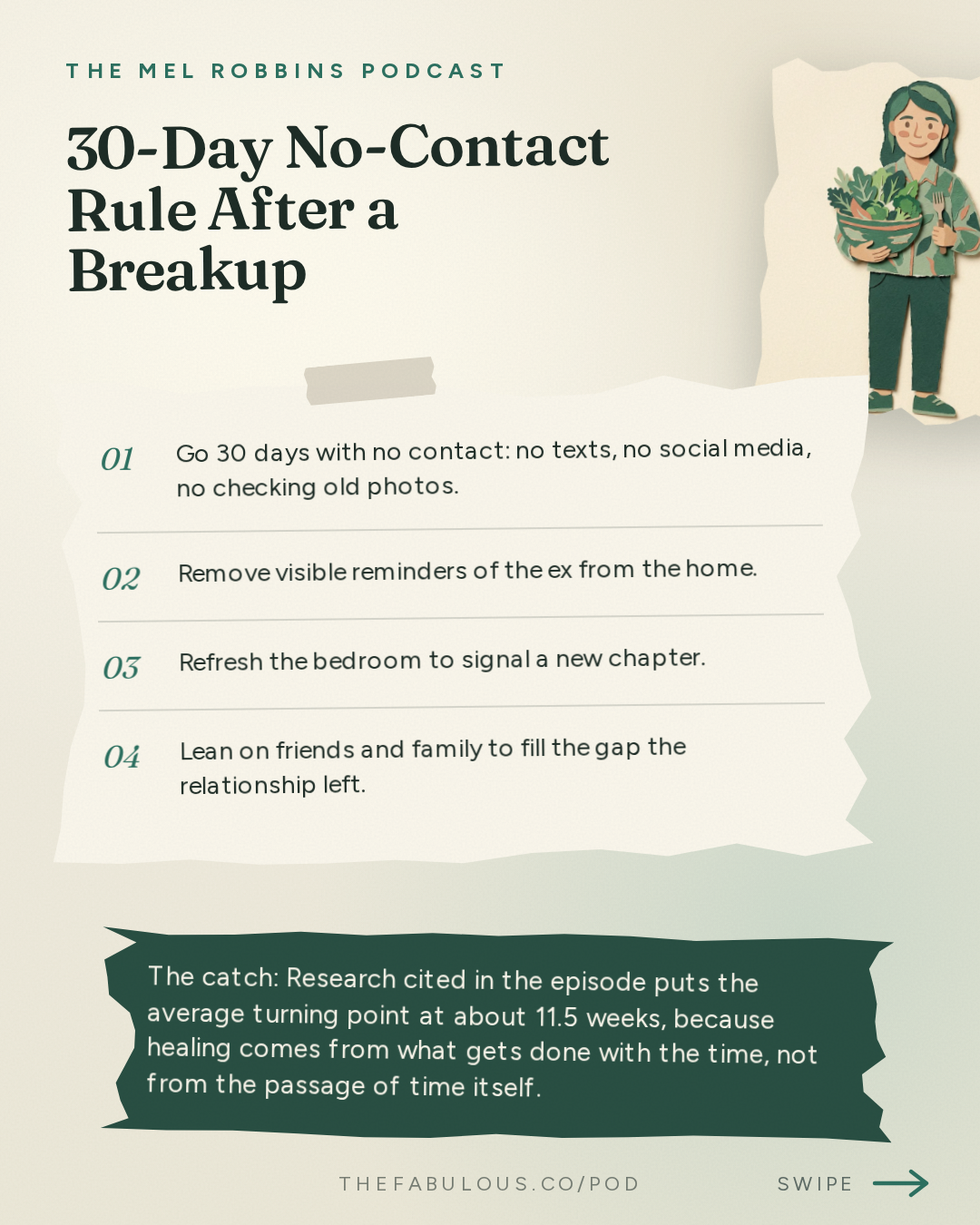
The breakup section applies the same logic to heartbreak. Robbins reframes a breakup as grief: the imagined future has ended, and the brain has to unlearn patterns built around another person's voice and presence (53:33). Her prescription is 30 days of no contact, which she compares to quitting a habit like smoking or drinking, where a single lapse reactivates the whole pattern (55:17). She adds that research puts the average turning point at around 11.5 weeks after a breakup, not because time itself heals but because of what gets done with that time (56:22).
"It's not time that heals, it's what you do with that time that matters." Mel Robbins [57:08]
The companion steps, drawn from her book "The Let Them Theory," are concrete: remove visible reminders of the ex, refresh the bedroom, lean on friends, fill the calendar, and take on a new challenge such as a race or a climb (57:41).
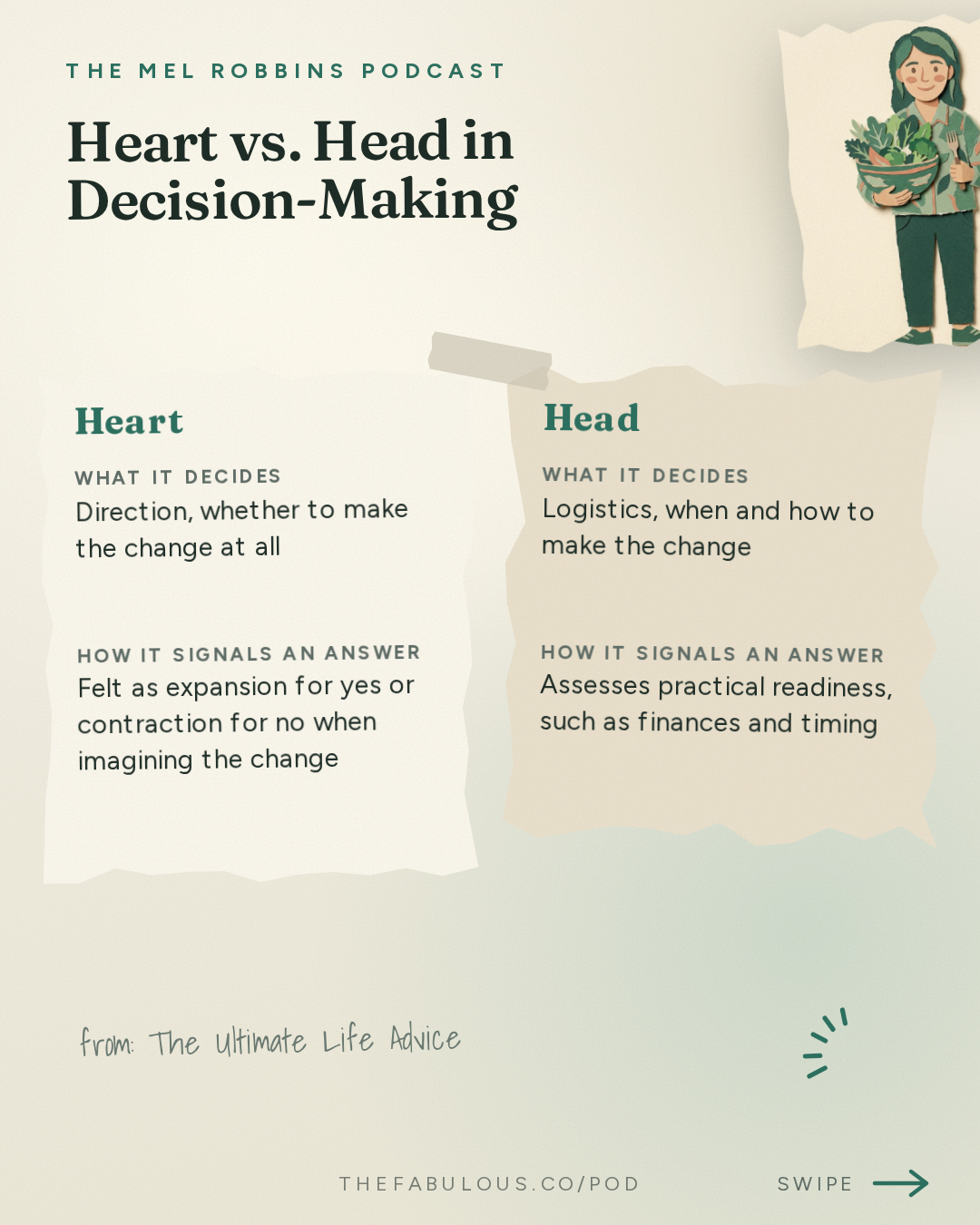
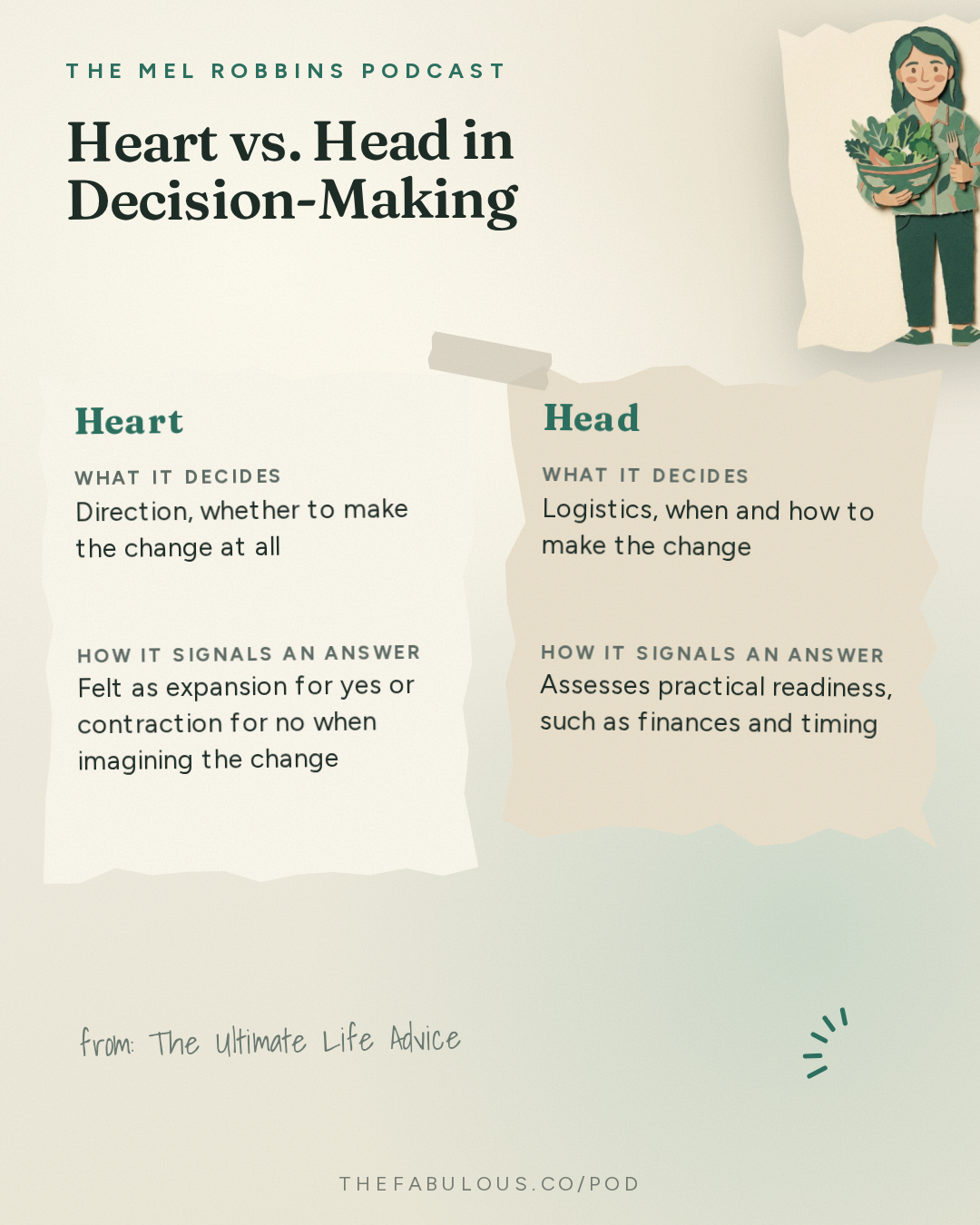
The episode's clearest decision-making tool appears in the career-change question. A listener says her heart wants a change but her head is unsure (61:16). Robbins separates the two faculties by function: the heart supplies direction, felt as expansion for yes or contraction for no, while the head supplies timing and method once the direction is settled (61:25).
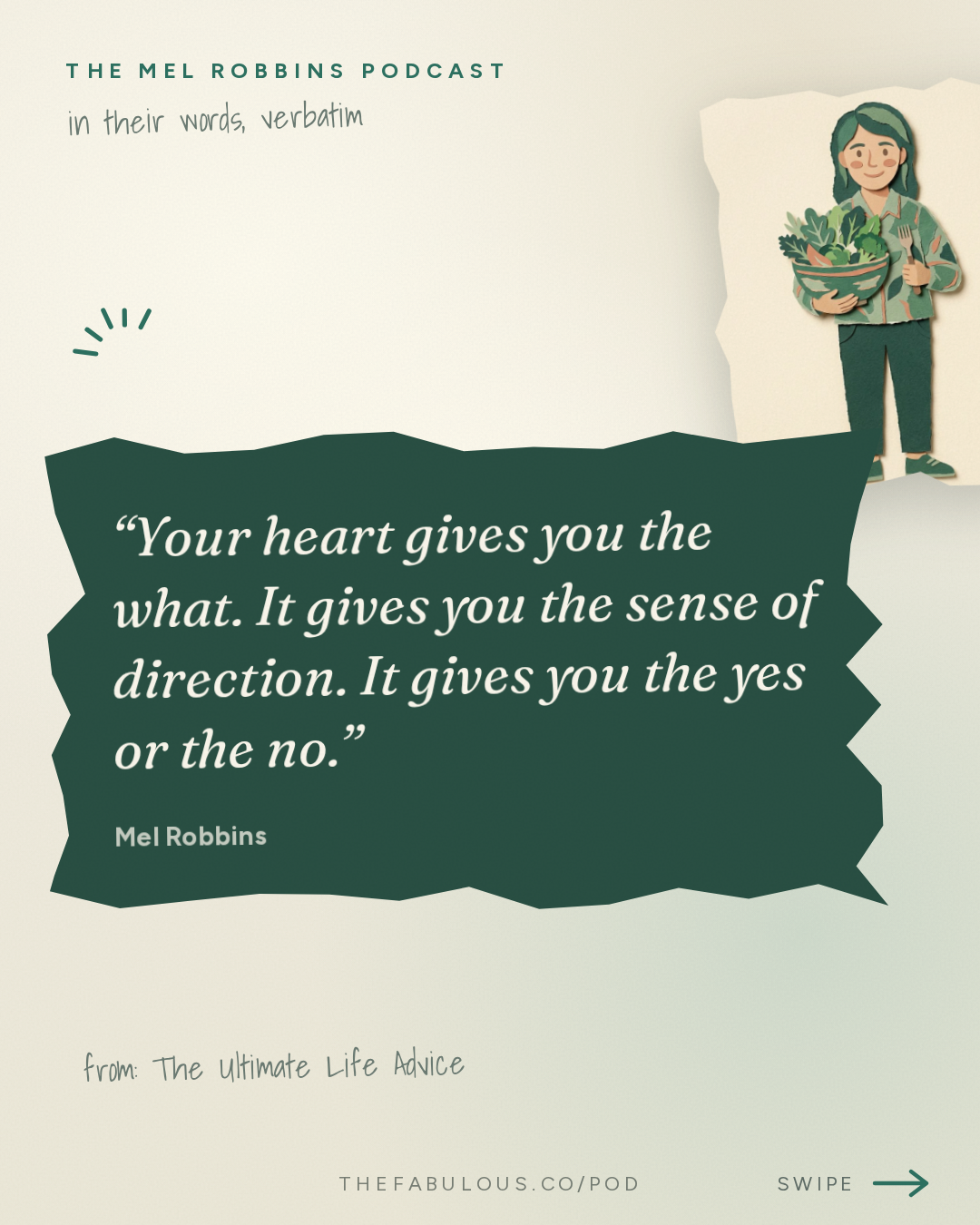
"Your heart gives you the what. It gives you the sense of direction. It gives you the yes or the no." Mel Robbins [61:32]
The bonus segment closes with a single habit called goal shielding: naming the one task that matters most today and protecting attention for it before anything else crowds in (68:51). Robbins cites a study in the Journal of Personality and Social Psychology linking single-goal focus to greater persistence and productivity (69:45). Her distinction between busy and productive, that doing many things is not the same as moving the important thing forward, is the plainest summary of the whole episode: across moving, eating, feeling, grieving, and deciding, the recurring move is to find the one true signal inside the noise and act on it.
Ask this episode anything
Pod's AI answers from the episode itself, with the minute mark so you can hear it yourself.
Or start with one of these
Ask this episode
Pod's AI listens to the whole episode to answer, and points you to the minute it comes from.
The rest of this answer, and any question after it
Answers come from the episode itself, never from a summary of it.
ContinueKey takeaways
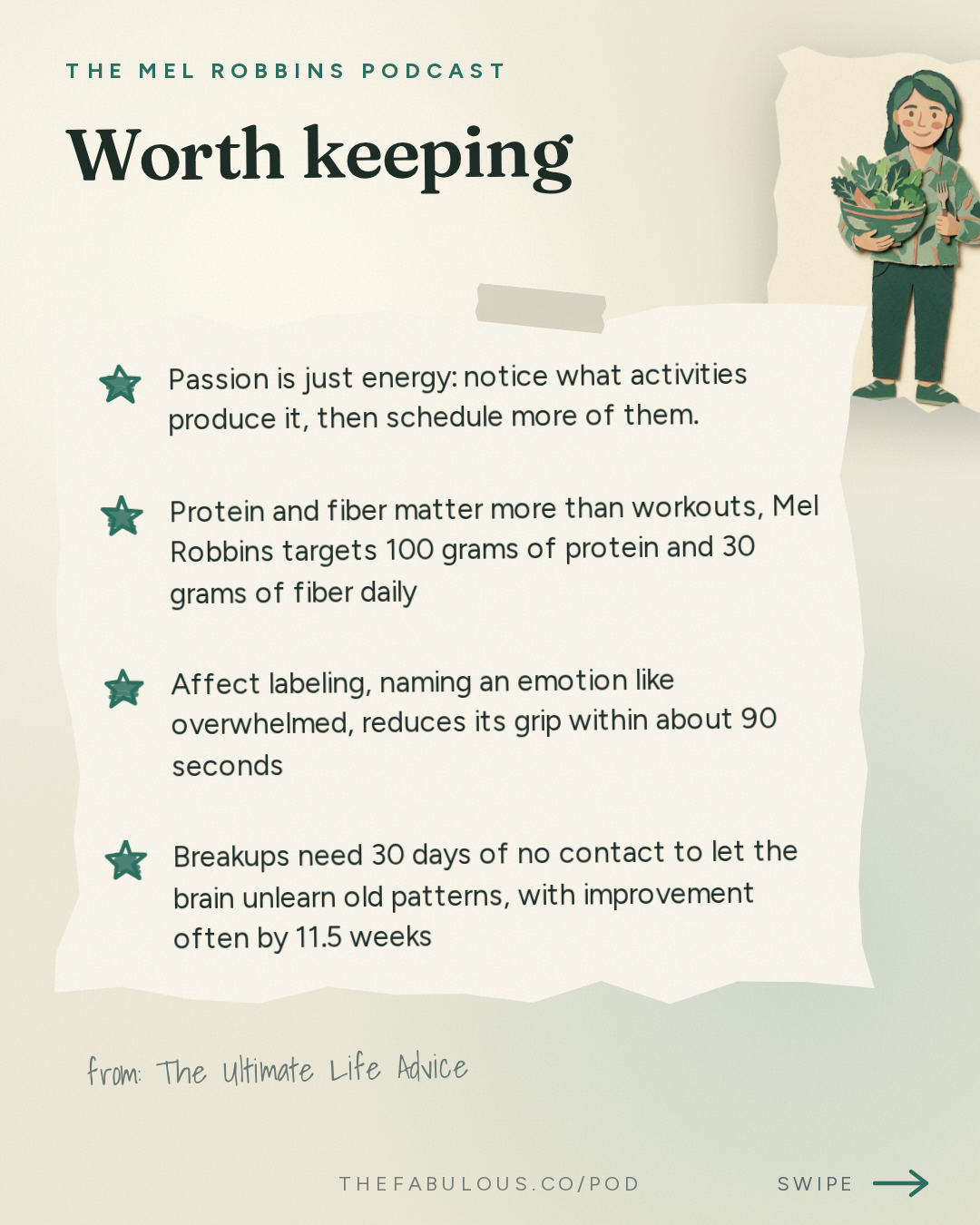
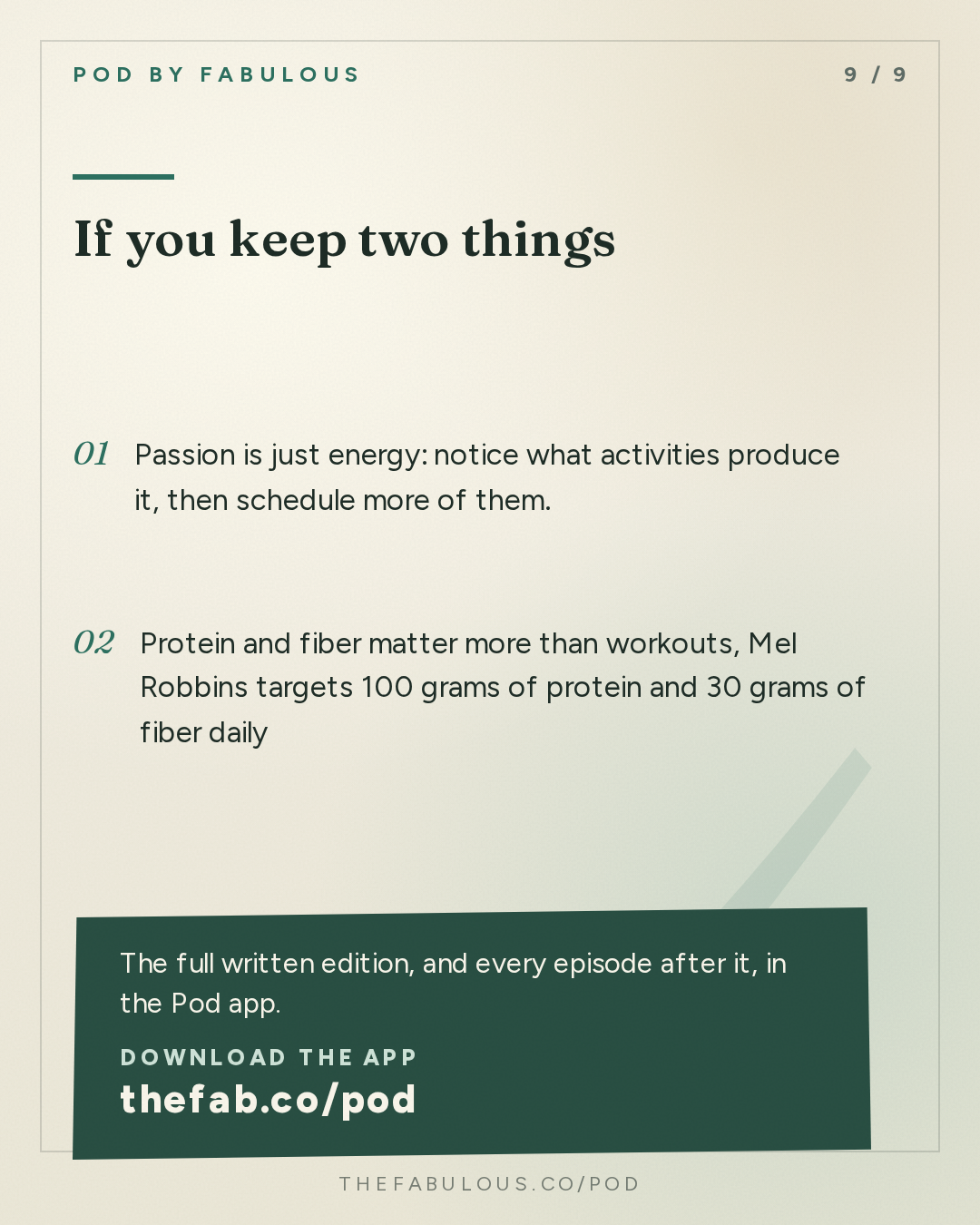
- Passion is just energy: notice what activities produce it, then schedule more of them.
- Protein and fiber matter more than workouts, Mel Robbins targets 100 grams of protein and 30 grams of fiber daily
- Affect labeling, naming an emotion like overwhelmed, reduces its grip within about 90 seconds
- Breakups need 30 days of no contact to let the brain unlearn old patterns, with improvement often by 11.5 weeks
- Goal shielding means picking one priority a day to protect attention from busywork
The episode in cards
By the numbers
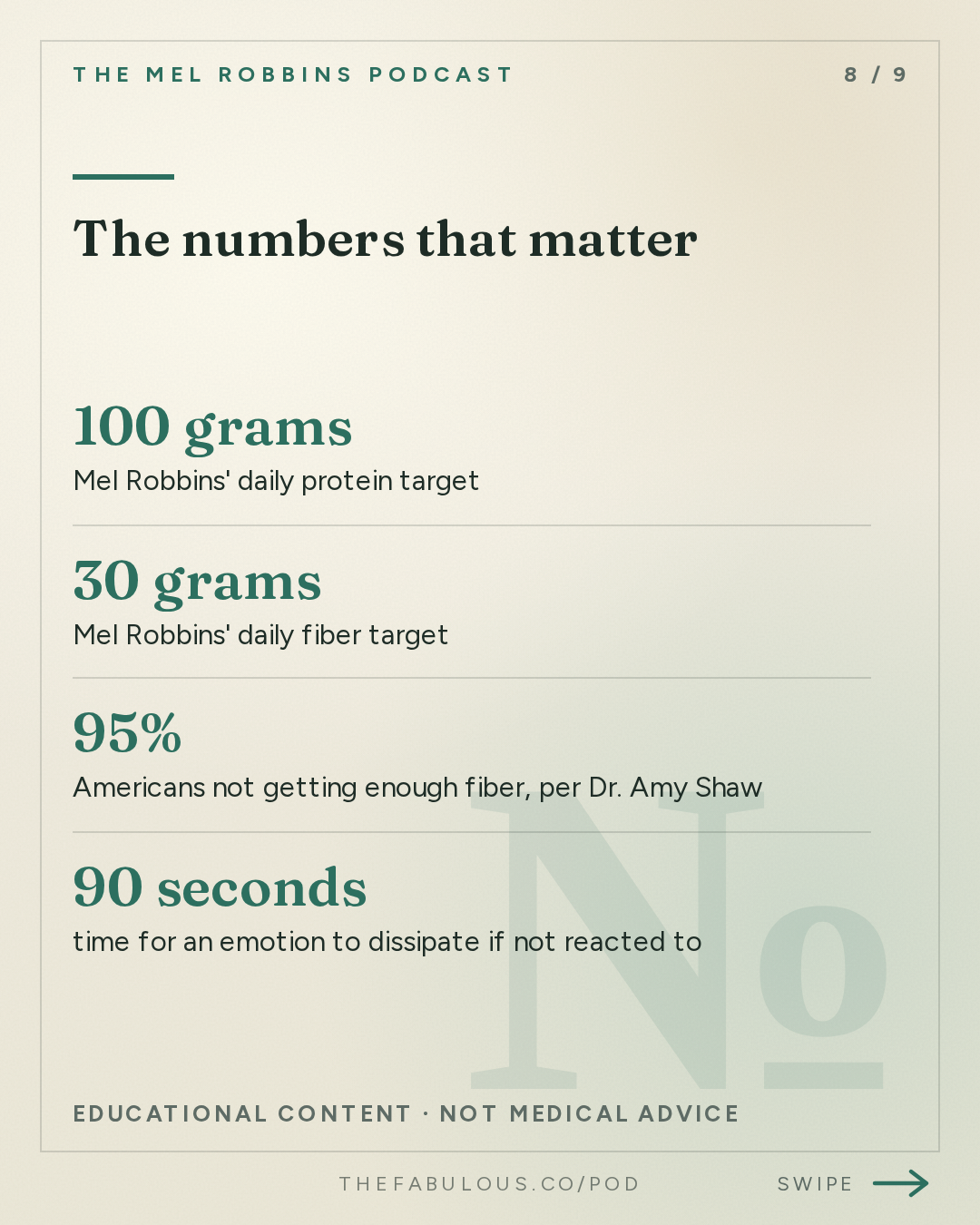
- 100 grams Mel Robbins' daily protein target
- 30 grams Mel Robbins' daily fiber target
- 95% Americans not getting enough fiber, per Dr. Amy Shaw
- 90 seconds time for an emotion to dissipate if not reacted to
- 30 days no-contact period Mel Robbins recommends after a breakup
In their words
“If you change nothing, nothing changes. But if you change where you live, everything changes, and a new part of you emerges in this new place.”
“You cannot out exercise a crappy diet. And for me, it was a huge wake-up call.”
“It's not time that heals, it's what you do with that time that matters.”
“Your heart gives you the what. It gives you the sense of direction. It gives you the yes or the no.”
Protocols
-
Hit daily protein and fiber targets
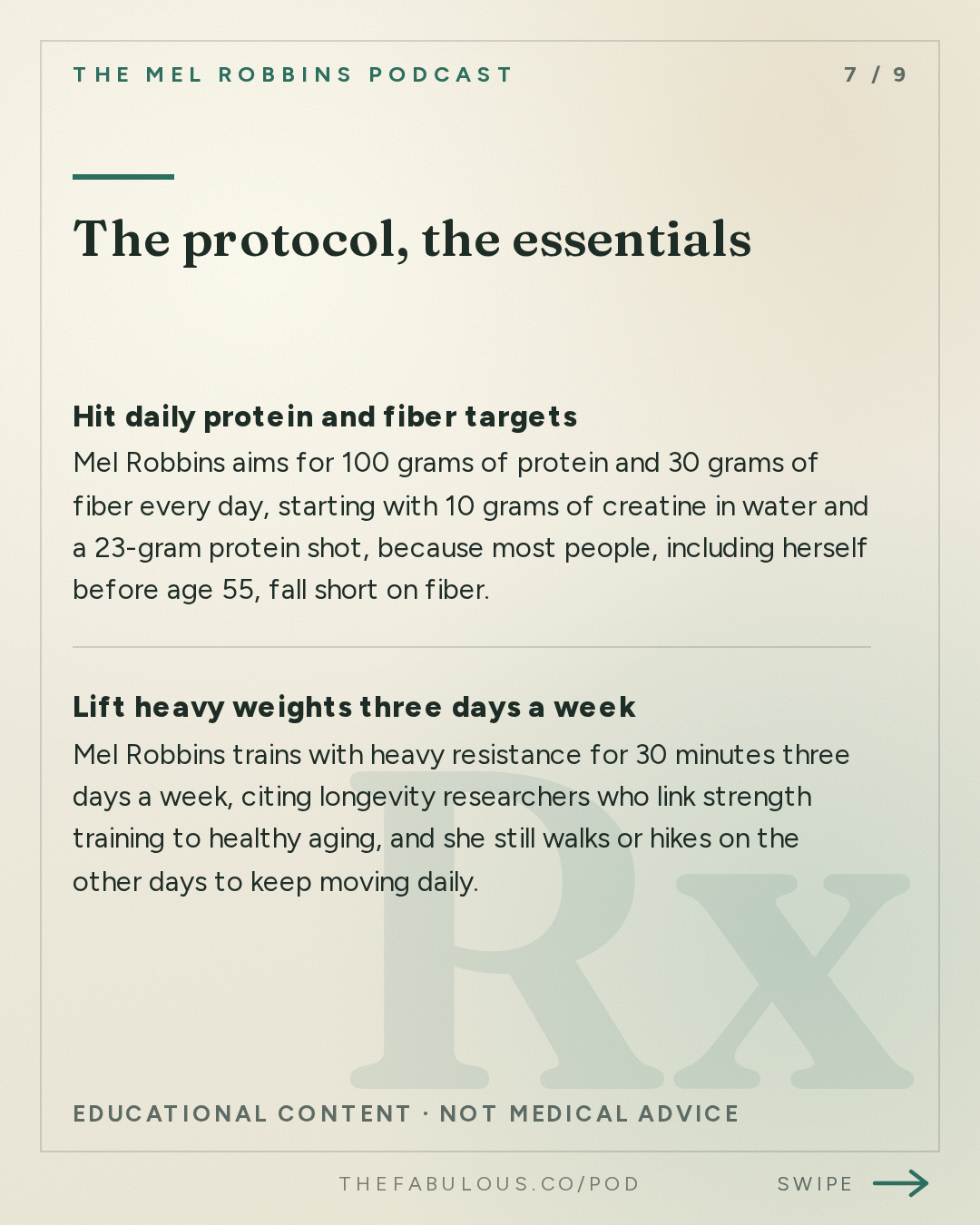
Mel Robbins aims for 100 grams of protein and 30 grams of fiber every day, starting with 10 grams of creatine in water and a 23-gram protein shot, because most people, including herself before age 55, fall short on fiber.
daily
-
Lift heavy weights three days a week
Mel Robbins trains with heavy resistance for 30 minutes three days a week, citing longevity researchers who link strength training to healthy aging, and she still walks or hikes on the other days to keep moving daily.
3 times per week
-
Label the emotion before reacting
Dr. Marc Brackett's framework, relayed by Mel Robbins, has a person notice the emotional reaction, name the specific feeling such as scared or overwhelmed, and pause for up to 90 seconds without responding, because affect labeling, studied at UCLA for about two decades, reduces activity in the brain's emotional center.
as needed, in the moment
-
Go 30 days with no contact after a breakup
Mel Robbins recommends cutting all contact, including texts, social media, and old photos, for 30 days after a breakup to let the brain unlearn old patterns, and she pairs this with removing visible reminders, refreshing the bedroom, filling the calendar, and picking a new challenge, noting that research shows people typically start feeling better around 11.5 weeks.
for the first 30 days
-
Use goal shielding against overwhelm
Mel Robbins has a person pick the one task that matters most for the day and protect attention for it before anything else, citing a Journal of Personality and Social Psychology study that found focusing on a single goal improves persistence and productivity.
daily
Questions this episode answers
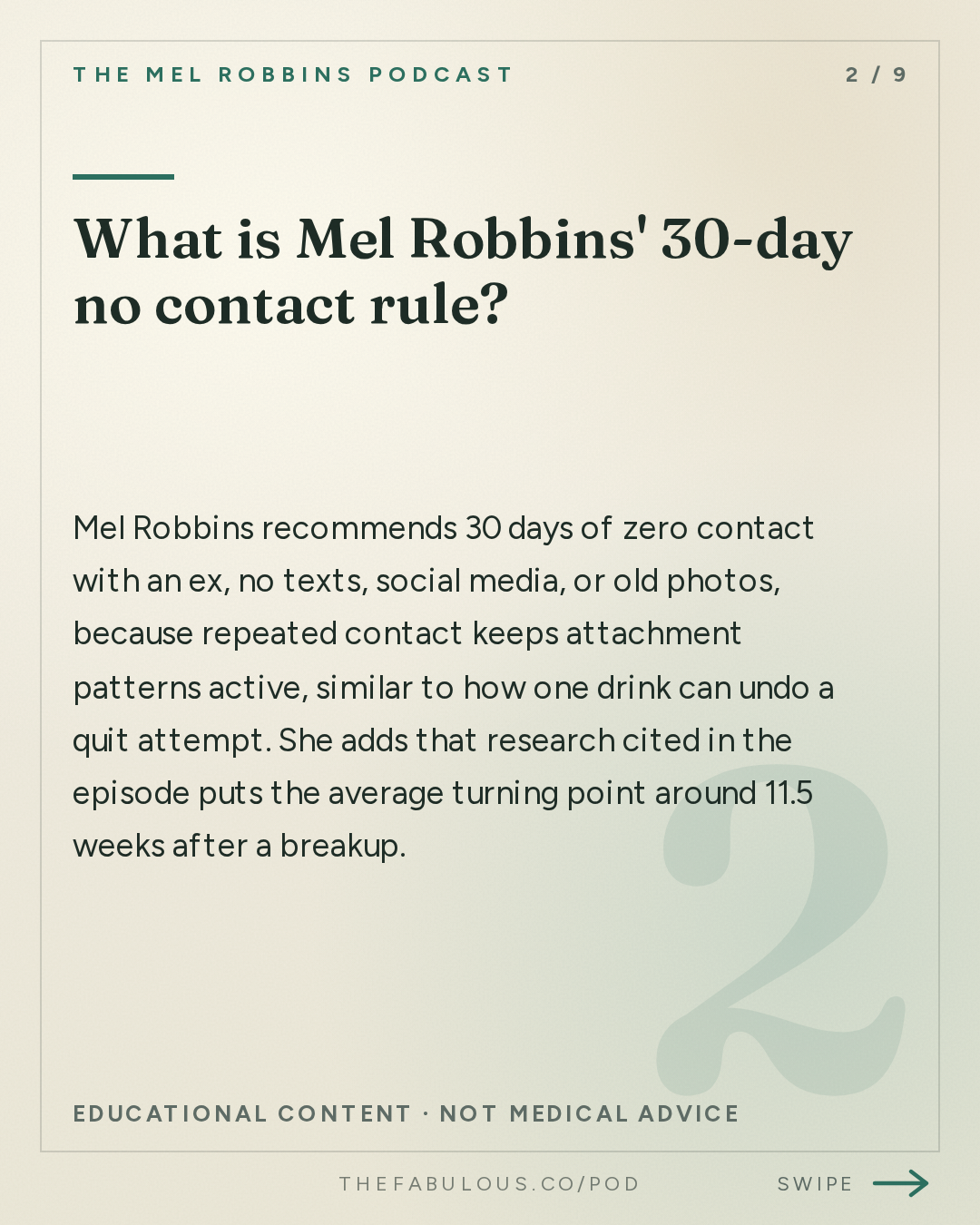
What is Mel Robbins' 30-day no contact rule?
Mel Robbins recommends 30 days of zero contact with an ex, no texts, social media, or old photos, because repeated contact keeps attachment patterns active, similar to how one drink can undo a quit attempt (55:17). She adds that research cited in the episode puts the average turning point around 11.5 weeks after a breakup (56:22).
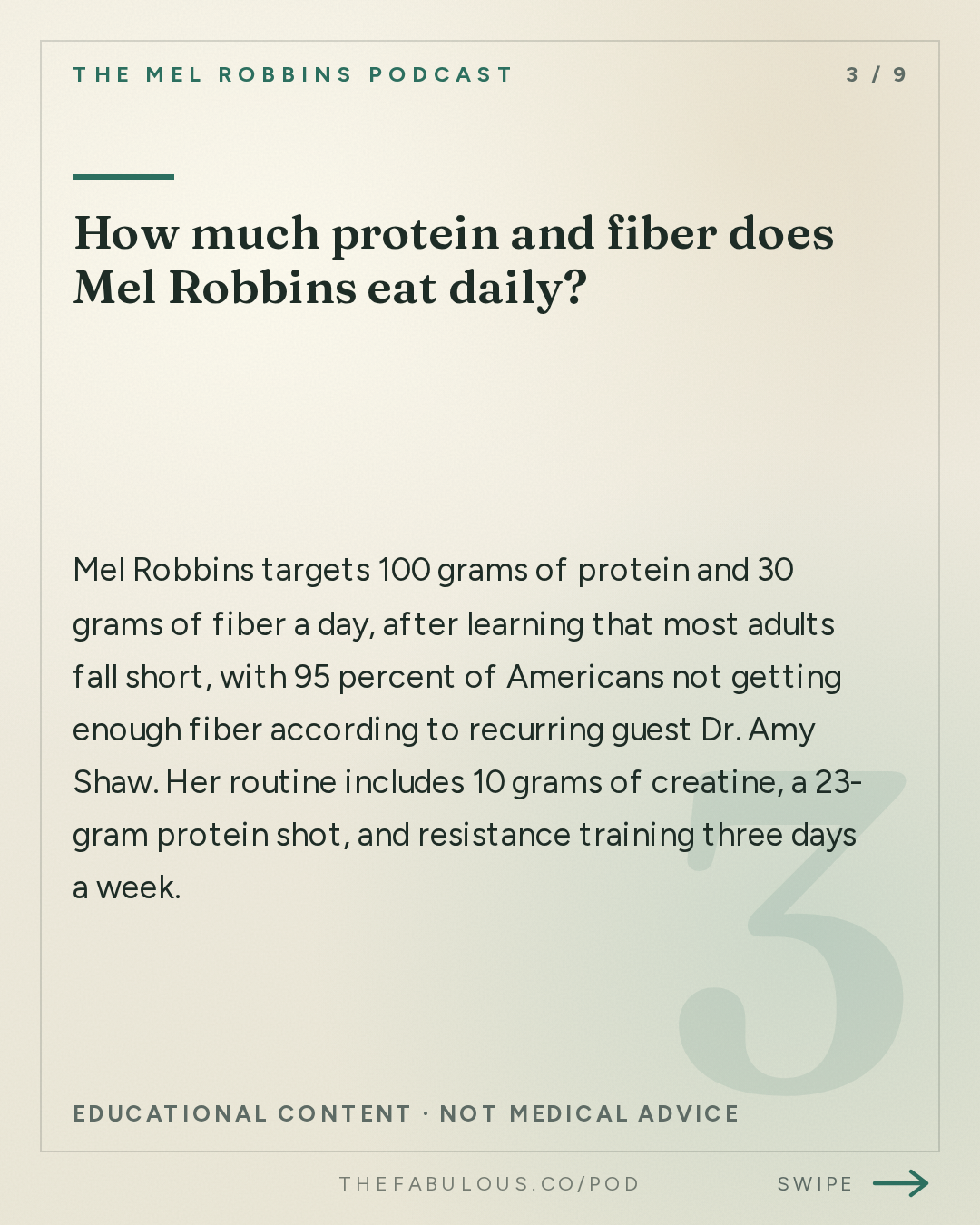
How much protein and fiber does Mel Robbins eat daily?
Mel Robbins targets 100 grams of protein and 30 grams of fiber a day, after learning that most adults fall short, with 95 percent of Americans not getting enough fiber according to recurring guest Dr. Amy Shaw (34:36). Her routine includes 10 grams of creatine, a 23-gram protein shot, and resistance training three days a week (34:53, 36:30).
What does Mel Robbins mean by passion is energy?
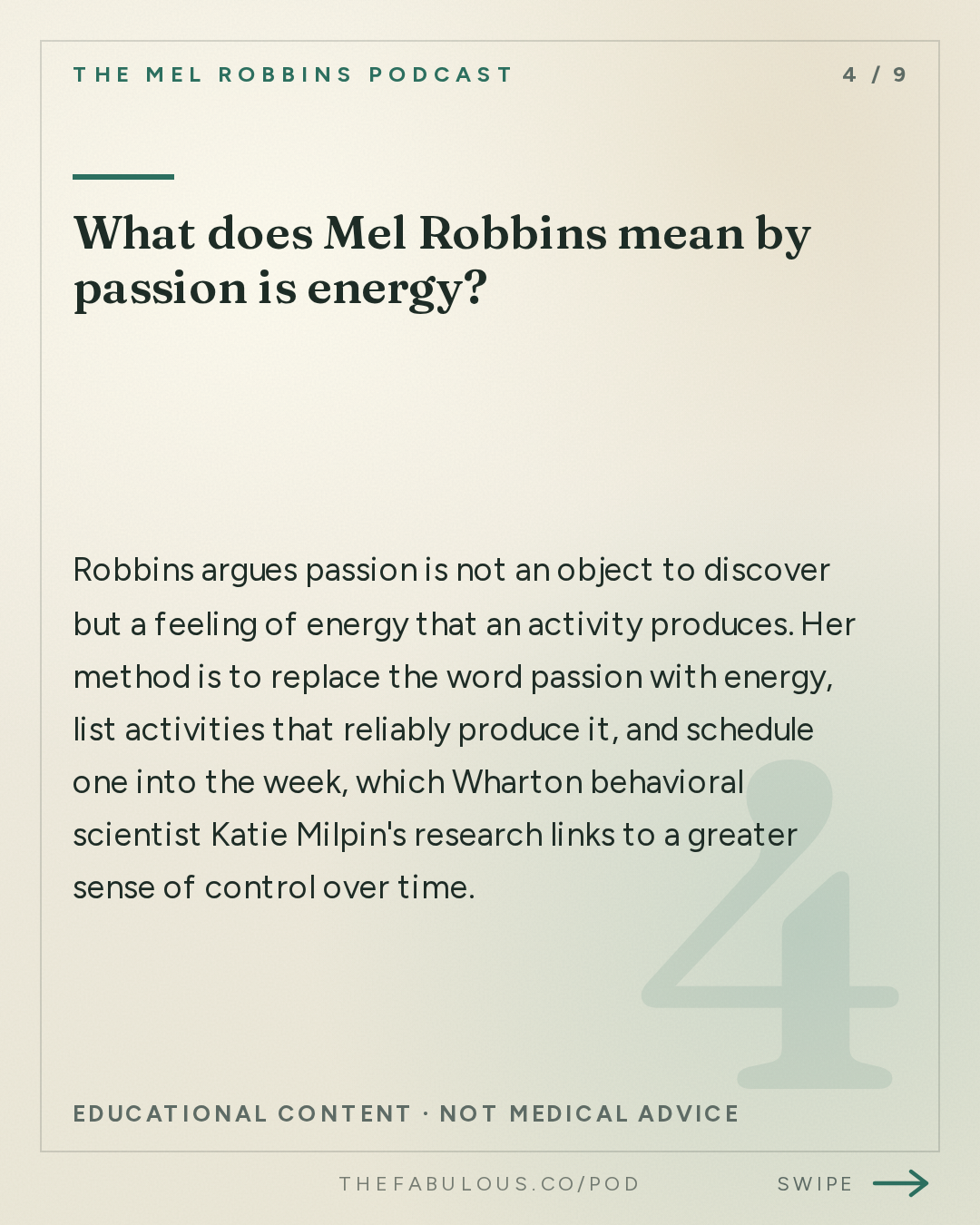
Robbins argues passion is not an object to discover but a feeling of energy that an activity produces (20:30). Her method is to replace the word passion with energy, list activities that reliably produce it, and schedule one into the week, which Wharton behavioral scientist Katie Milpin's research links to a greater sense of control over time (24:18).
What is the 90-second rule for emotions?
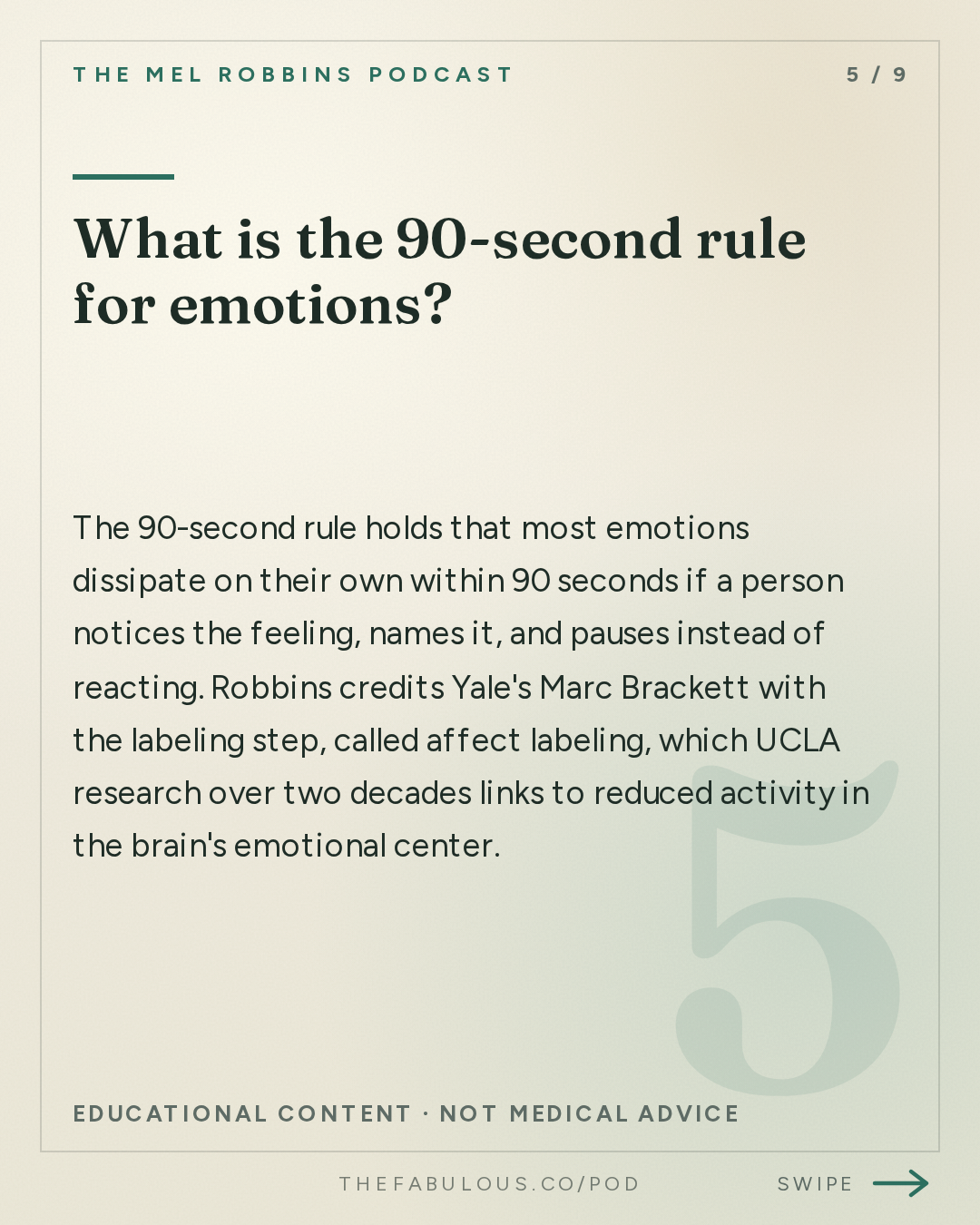
The 90-second rule holds that most emotions dissipate on their own within 90 seconds if a person notices the feeling, names it, and pauses instead of reacting (48:32). Robbins credits Yale's Marc Brackett with the labeling step, called affect labeling, which UCLA research over two decades links to reduced activity in the brain's emotional center (49:51).
How do you decide between your heart and your head?
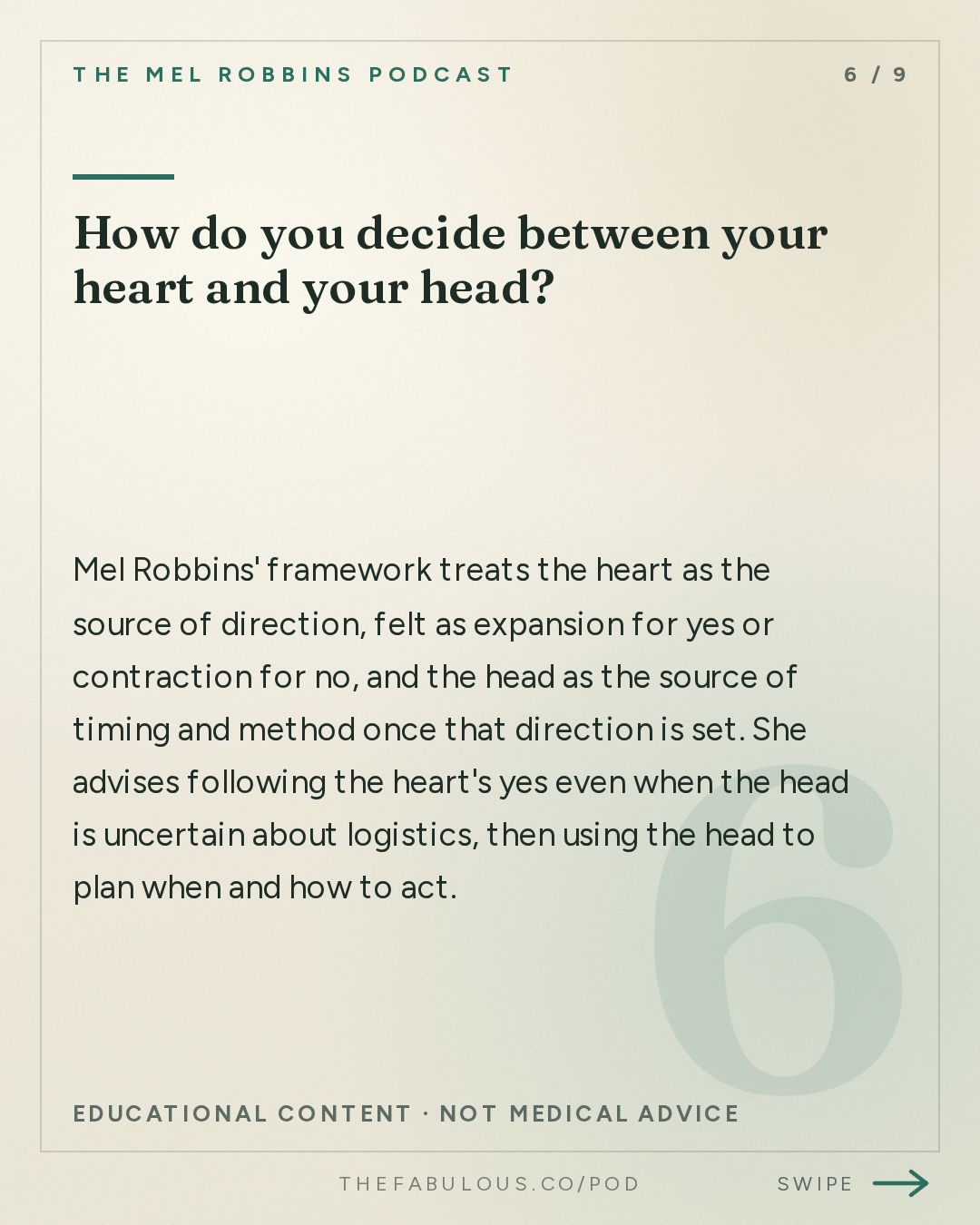
Mel Robbins' framework treats the heart as the source of direction, felt as expansion for yes or contraction for no, and the head as the source of timing and method once that direction is set (61:32). She advises following the heart's yes even when the head is uncertain about logistics, then using the head to plan when and how to act (65:16).
What is goal shielding?
Goal shielding means naming the single most important task for the day and protecting attention for it before less important demands take over (68:51). Robbins cites a Journal of Personality and Social Psychology study finding that focusing on one goal improves persistence and productivity, and she distinguishes being busy from being productive (69:45).
The full read, in cards
Go deeper
- Man's Search for Meaning — Viktor Frankl's idea of a gap between stimulus and response, which Robbins applies to emotional regulation
- The Let Them Theory — Mel Robbins' book, source of the 30-day no-contact breakup protocol and its follow-up steps
- Journal of Personality and Social Psychology study — found that focusing attention on one goal improves persistence and productivity
- UCLA affect-labeling research — two decades of work showing that labeling an emotion reduces activity in the brain's emotional center
- The French Illusion — John Grisham's new espionage novel about a kidnapped honeymoon couple in Paris
Mentioned
Kendall Robbins · Pierce Brown · Red Rising · Kristin Hannah · Firefly Lane · Virginia Evans · The Correspondent · John Grisham · The French Illusion · Sarah J. Maas · ACOTAR · Katie Milpin · Dr. Amy Shaw · Dr. Marc Brackett · Viktor Frankl · Pure Genius
More from this show and category
John Grisham's Morning Writing Routine Explained
John Grisham credits two unplanned "golden moments" for redirecting his path, first toward law school, then toward writing A Time to Kill and The Firm. He built his career on writing one page a day at 5 a.m. for 30 years, absorbed 28 rejections, and then watched a bootleg manuscript trigger a $600,000 film deal and 52 straight bestsellers.
How to Stop Living Paycheck to Paycheck
Vivian Tu, a former JP Morgan trader known online as your rich BFF, argues that living paycheck to paycheck is a system problem, not a willpower problem. She lays out a pay-yourself-first savings rule, the avalanche method for debt, a formula for calculating financial independence, and why automating money beats relying on discipline.
Body Language Tricks for Instant Confidence
Behavioral researcher Vanessa Van Edwards explains how tiny, testable body-language and language cues (ear-to-shoulder distance, hand steeples, priming words) shift how confident and likable people perceive us, and how an A-B-C-D task audit stops burnout by clarifying which work and relationships actually deserve energy.
Mel Robbins' Let Them Theory for Difficult People
Mel Robbins' Me, We, Them framework redirects relationship stress toward the one variable anyone can control: their own reaction. She names three habits that wreck relationships (expecting others to change, letting their behavior dictate your mood, assuming they 'should' know what you need) and offers a script from therapist Terry Real for saying the hard thing without blame.
