
An 89-Year-Old's Don't-Wait Life Advice
What Are You Doing With Your Life? An 89 Year Old’s Best Advice for You
▶ Listen to the full episode More from The Mel Robbins Podcast
The brief
Judy Robbins, Mel Robbins' 89-year-old mother-in-law, decided to backpack across Europe for a year starting at 90, inspired by a friend's sudden death at 62. The episode argues that waiting for comfort or permission is the real risk, since good health and time are not guaranteed, and that staying curious about others keeps a person interesting at any age.
Judy Robbins is eighty-nine years old, and she just decided to disappear for a year. Not quietly. She burst into her daughter-in-law's kitchen one morning, breathless with an idea: rent out the house, buy a backpack, and spend a year wandering Europe with her eighty-five-year-old partner, John (00:00). The plan would start the following August, right around her ninetieth birthday (05:45). It sounds like the setup for a feel-good anecdote. It is also, on this walk-and-talk episode of the Mel Robbins Podcast, something closer to an argument: a case for why nobody, at any age, should wait for the right time to live differently.
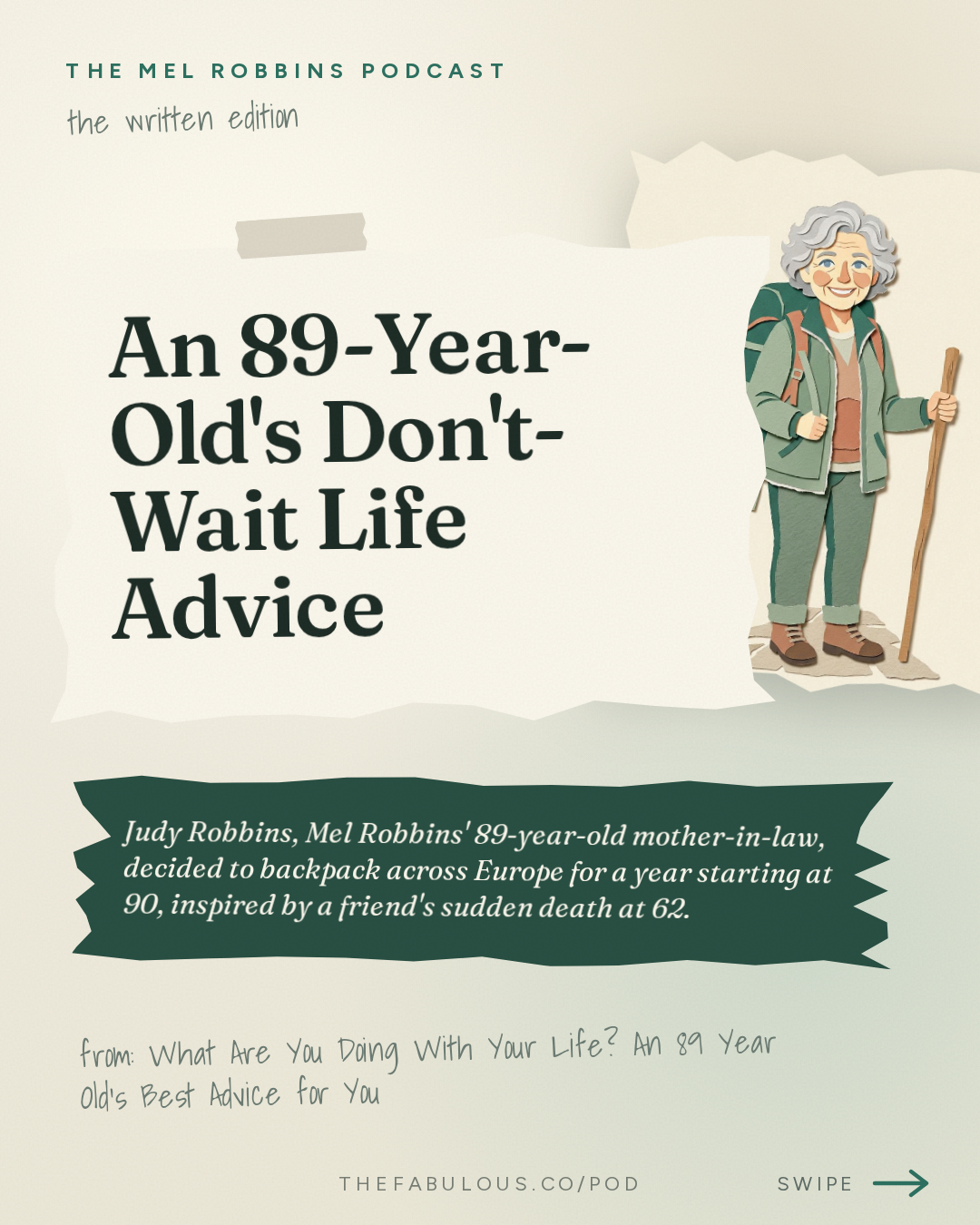
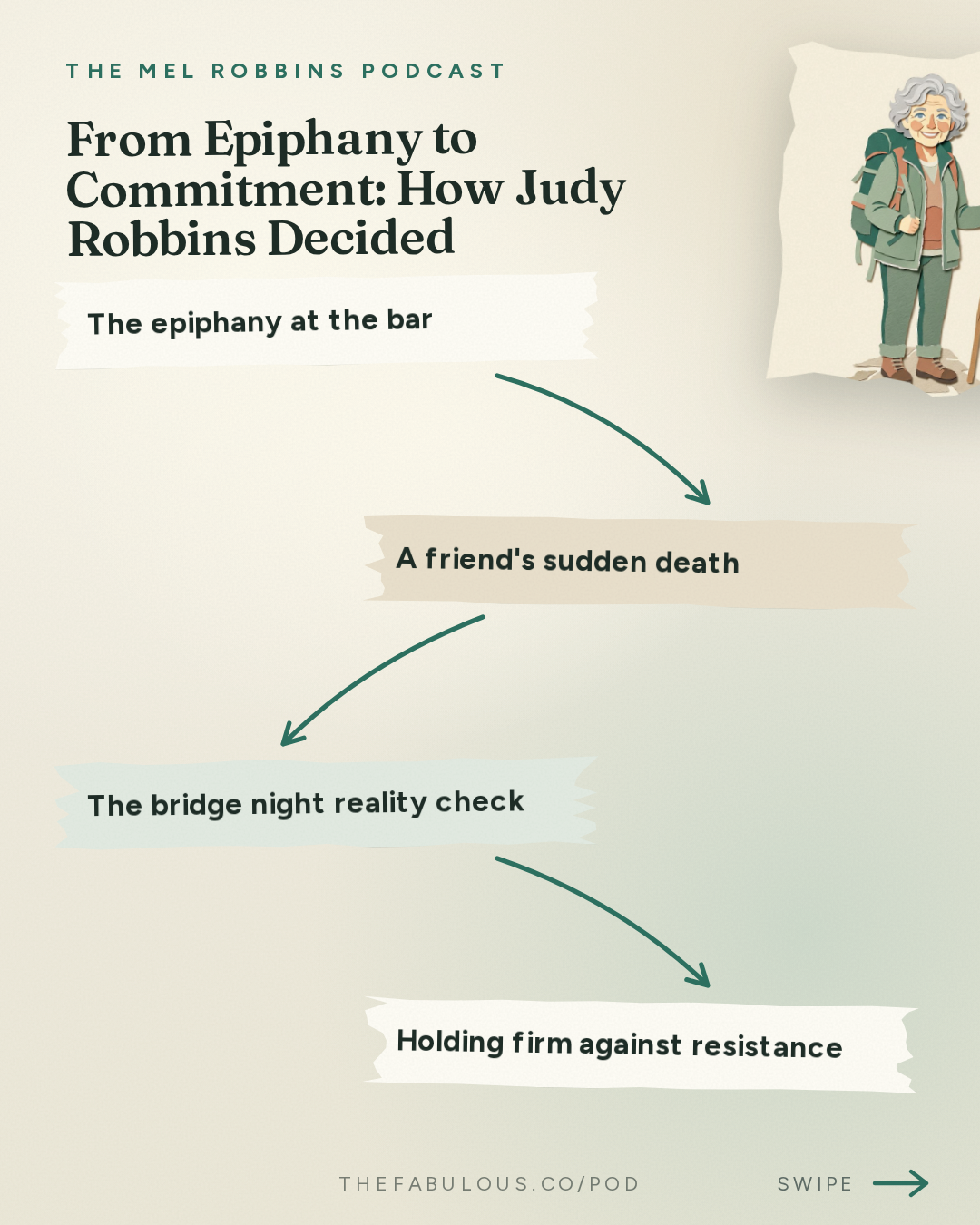
The idea arrived the way big ideas often do, half by accident. Judy and John had gone to a light show at St. Patrick's Cathedral in New York, eaten a cannabis gummy, and settled in afterward for a port at the St. Regis bar. That is when she turned to him and said it out loud: why not just go (04:52)? John, who Judy describes as the complete opposite kind of person from her, a news junkie who likes his life organized and his house looked after, responded by ordering another cocktail and telling her she was out of her mind (09:34, 22:47). Three days later, by Judy's account, he still thought she was crazy. She was not deterred. She had already started solving his objections one by one: rent the house, deal with the cat later, you're healthy enough now, so what exactly are you waiting for (23:12).
Then came the detail that turned a fun idea into something closer to urgency. A friend of the family, sixty-two years old, died in a car crash three weeks before this conversation (06:50). At a memorial held at the Battenkill River in Vermont, the woman's cousin told the story of her last night alive: she had been on the phone with him, and when the call wound down, they agreed to talk again tomorrow morning over coffee. Tomorrow morning came at six-thirty. She hit a truck and died (25:04). The cousin's takeaway, which Judy repeats twice during the walk, is blunt: don't wait to say I love you, don't wait to go to the restaurant, don't wait to take the trip.
Judy had already absorbed a quieter version of the same lesson a few weeks earlier, at her regular Wednesday night of duplicate bridge, a card game played in structured rounds with a fixed partner. She mentioned to the instructor that she'd looked around the table and realized that in five years, nobody in the room would still be there (17:09). He agreed. Bridge, he told her, is a dying game, because the generation behind hers isn't learning it. It's a small, almost funny data point, but it did real work in Judy's head. If her social world has a shelf life measured in a handful of years, then whatever she wants to do, she had better start now.
The Arithmetic of Running Out
Mel Robbins, host and Judy's daughter-in-law, pushes on this idea as they walk a familiar loop in Vermont with Mel's husband, Chris, and two dogs. Judy keeps a number in mind: she wants to live to ninety-eight, maybe a hundred if I had a mind, she says, meaning if her memory and judgment are still intact (20:32). She doesn't treat this as morbid. She treats it as useful. Having a target age, she argues, gives a person something to aim at instead of just letting the days pass.
"Why wait? What are we waiting for?" (Judy Robbins, [06:40])
That question becomes the engine of the conversation. Judy's case is simple: she and John are currently healthy enough to carry a backpack and get on a train without a cane or a walker, something she notes many of her friends now need (06:22). That window won't stay open forever. Waiting for next week, she argues, is really just a polite way of hoping the opportunity will still be there later, with no evidence that it will.
The conversation also drifts into money. Judy observes that many people her age refuse to spend savings on experiences because they feel obligated to preserve an inheritance for their children (33:14). She calls it an inherited habit, one she recognizes in herself from her own father, who could not keep the electricity on but would still buy silver the moment a client paid him (32:10). Mel pushes back gently: she doesn't expect an inheritance from her own parents, and she would rather see people spend on the life in front of them than leave money untouched for someone else's convenience (33:38).
To Be Interesting, Stay Interested
Midway through the walk, Judy brings up something Oprah said to Mel on an earlier episode: that everyone is here for a reason, and once a person figures out what that reason is, the job is to keep acting on it rather than rest on it (29:55). Judy decided her reasons are that she connects people and that she inspires them, and she takes the second one seriously enough to keep generating things worth being inspired by.
She connects this to older advice she once gave her son Chris, when he was eleven years old and sitting silently at a dinner table while adults talked around him. She told him then: if you're not interested in other people, you will not be an interesting person yourself (34:59).
"If you're not interested, you will not be interesting." (Judy Robbins, [35:05])
She sharpens this into an observation about why older people often get tuned out: it has less to do with age and more to do with talking mostly about childhood, career, and aches and pains instead of asking questions (35:29). The backpack trip, in this light, is also a supply run for interestingness: new countries and new people to bring home as stories, instead of another recap of the same complaints.
Mel's closing argument ties the walk together: the moment a person commits out loud to a decision, something shifts, from hunting for excuses to hunting for a workable path forward (38:13). Judy didn't wait until she had a fully worked-out plan before she said it to John at the bar. She said it first, half-formed, and has been solving the logistics ever since.
The episode ends with Mel turning to her own travel habits (41:36), a practical coda to an otherwise philosophical walk: pack for comfort, cancel the noise, carry a sentimental object, treat flight time as a private work block, and drink enough water. These are smaller stakes than Judy's plan, but they share the same spirit, which is deciding in advance how to make a chapter, even a six-hour one, worth having.
What makes the episode land is that nobody involved pretends this is easy. John still thinks his partner is out of her mind. Judy admits she hasn't fully convinced him. The trip might not happen exactly as planned, or at all. But the decision has already done its work. Judy walked into a kitchen and said the thing out loud, and once she said it, there was no quiet way back to bridge on Wednesdays and golf in the summer, at least not as the whole story.
Ask this episode anything
Pod's AI answers from the episode itself, with the minute mark so you can hear it yourself.
Or start with one of these
Ask this episode
Pod's AI listens to the whole episode to answer, and points you to the minute it comes from.
The rest of this answer, and any question after it
Answers come from the episode itself, never from a summary of it.
ContinueKey takeaways
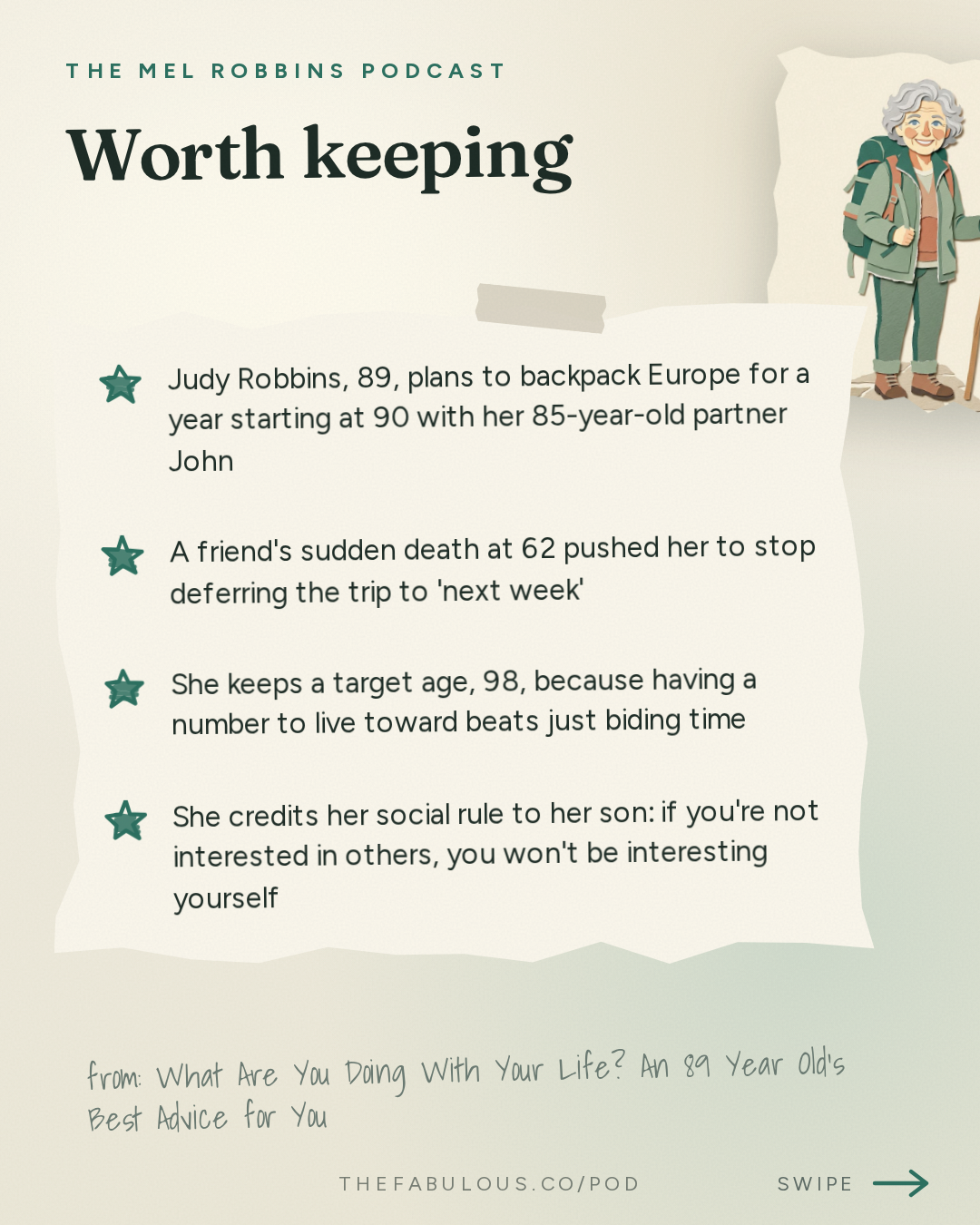
- Judy Robbins, 89, plans to backpack Europe for a year starting at 90 with her 85-year-old partner John
- A friend's sudden death at 62 pushed her to stop deferring the trip to 'next week'
- She keeps a target age, 98, because having a number to live toward beats just biding time
- She credits her social rule to her son: if you're not interested in others, you won't be interesting yourself
- Mel Robbins closes with her own five travel habits, from packing a pillow to using flight time as a work block
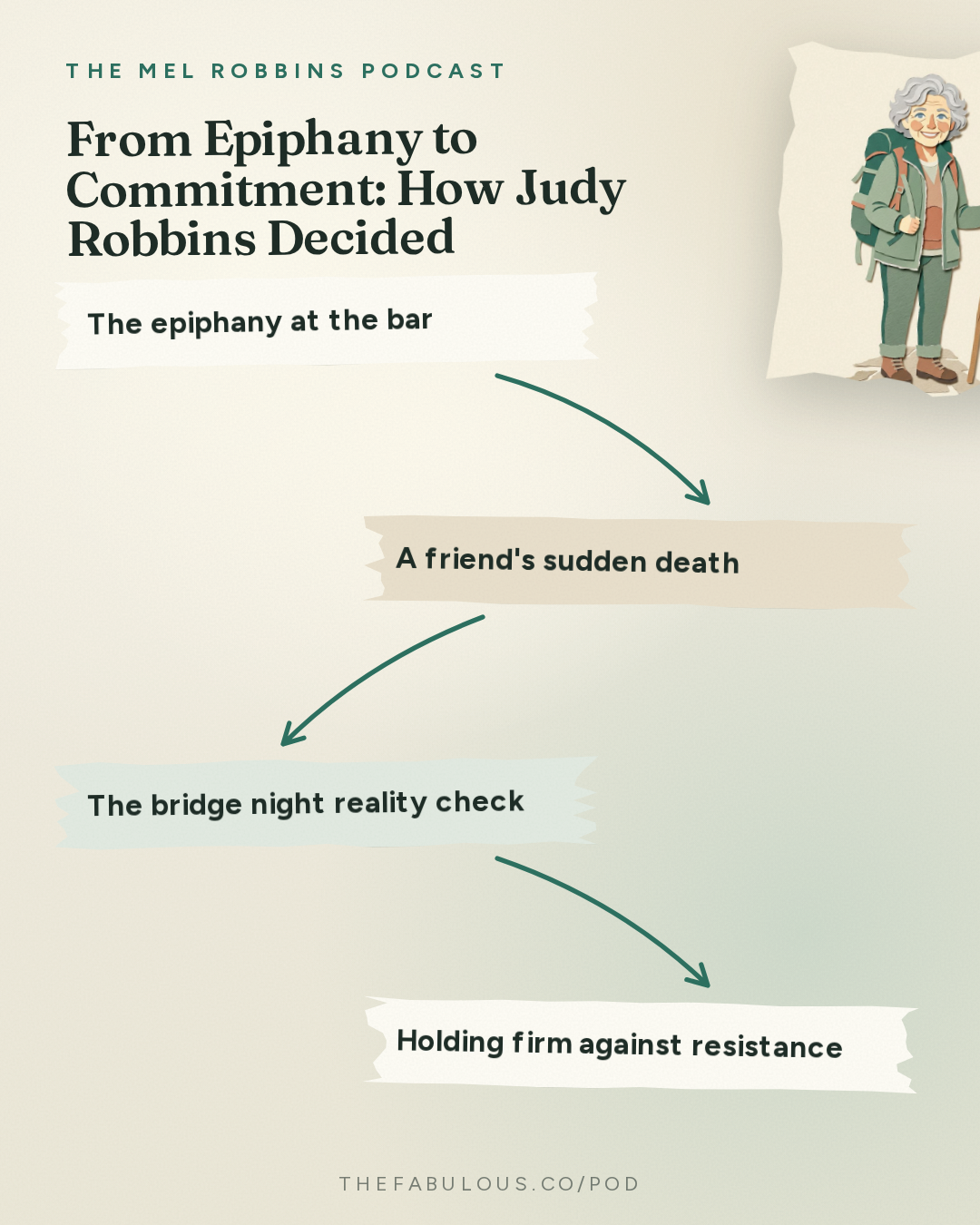
The episode in cards




By the numbers
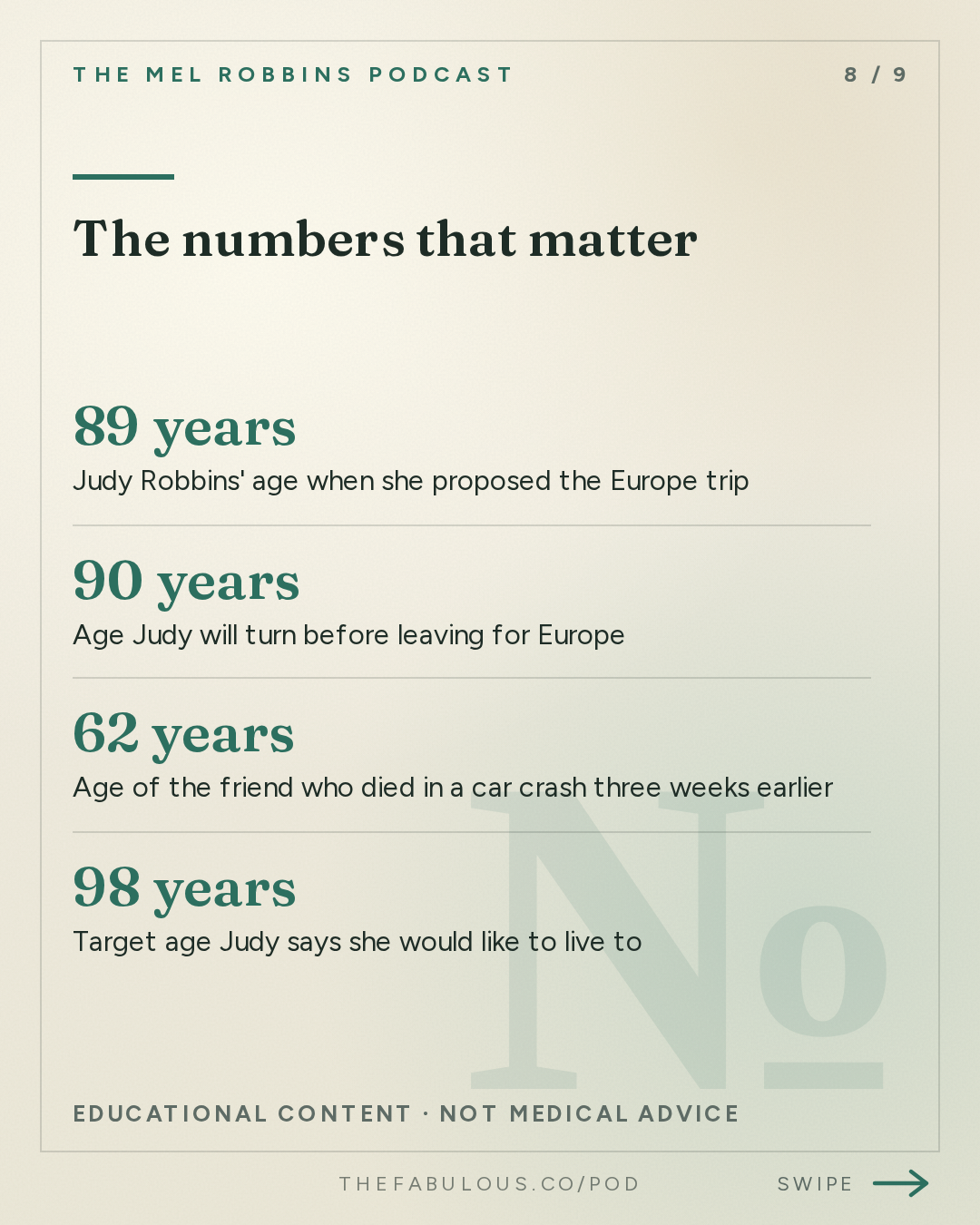
- 89 years Judy Robbins' age when she proposed the Europe trip
- 90 years Age Judy will turn before leaving for Europe
- 62 years Age of the friend who died in a car crash three weeks earlier
- 98 years Target age Judy says she would like to live to
- 156 days Days Mel Robbins traveled for work last year
In their words
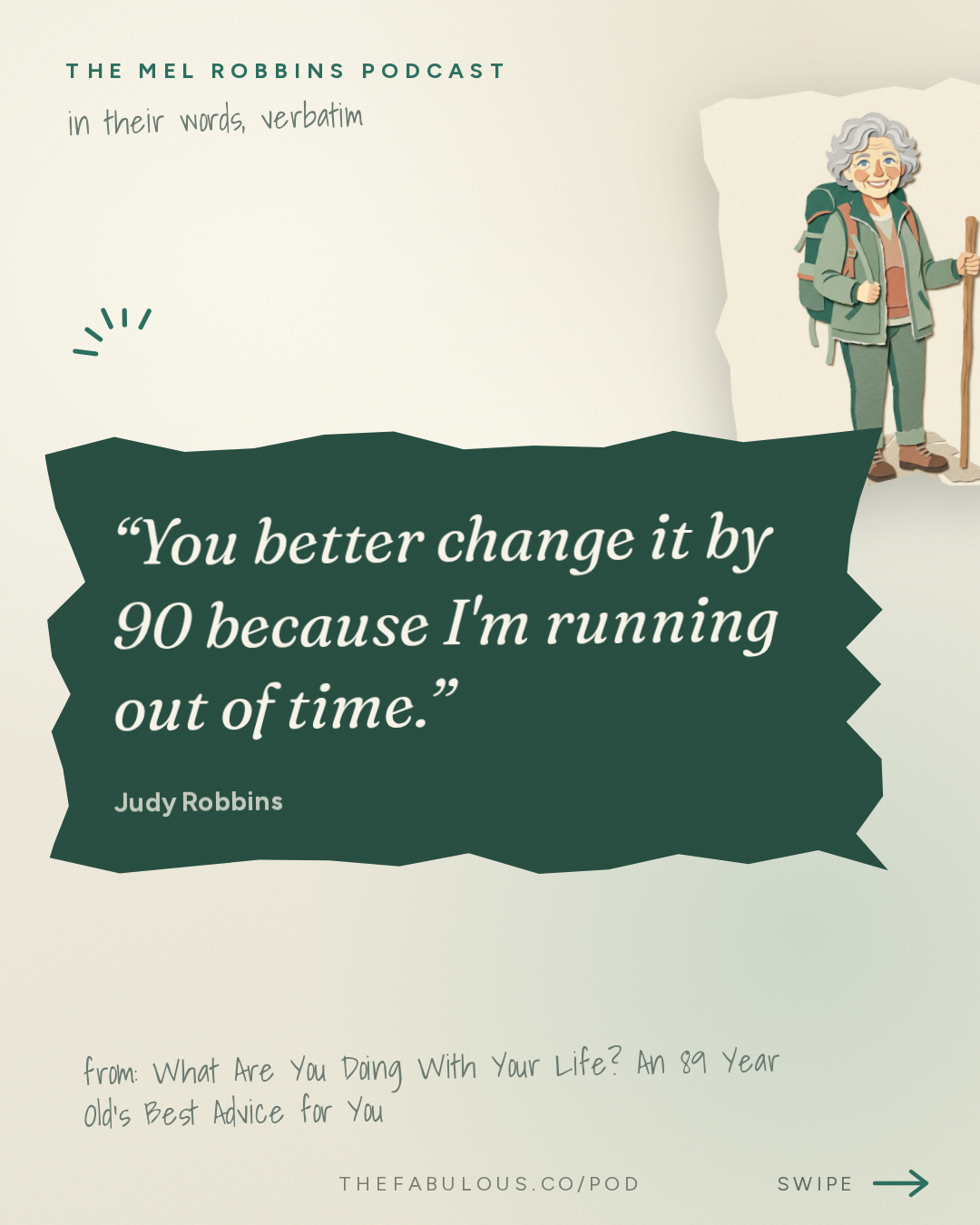
“You better change it by 90 because I'm running out of time.”
“Why wait? What are we waiting for?”
“If you're not interested, you will not be interesting.”
“A better life is not one that you create by waiting.”
Protocols
-
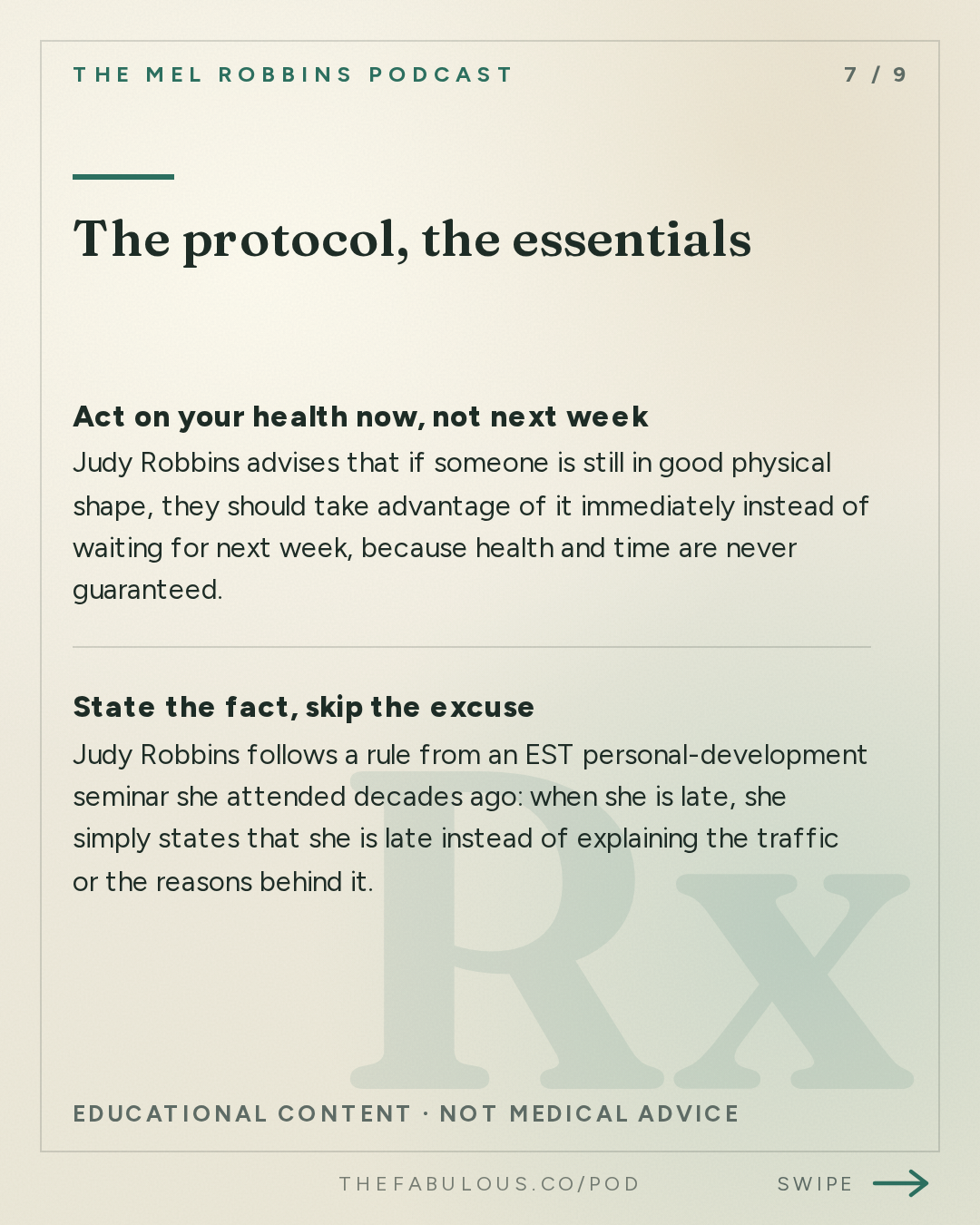
Act on your health now, not next week
Judy Robbins advises that if someone is still in good physical shape, they should take advantage of it immediately instead of waiting for next week, because health and time are never guaranteed.
As soon as the opportunity arises
-
State the fact, skip the excuse
Judy Robbins follows a rule from an EST personal-development seminar she attended decades ago: when she is late, she simply states that she is late instead of explaining the traffic or the reasons behind it.
Every time she is late
-
Pick a target age to live toward
Judy Robbins keeps a specific number in mind, currently 98 years old, because having a target age gives her something to look forward to instead of just letting time pass.
Ongoing, revisited each birthday
-
Pack for comfort on every flight
Mel Robbins packs slippers, cozy socks, and a pillow from her own bed on every flight, and she notes that most airlines do not count a personal pillow as a carry-on item, so it costs no extra luggage space.
Every flight
-
Turn flight time into a work block
Mel Robbins treats uninterrupted flight time as a private, high-focus window, using it to write her newsletter, sort photos, or work on creative projects because no one can interrupt her in the seat.
Every flight
Questions this episode answers
What did Mel Robbins' 89-year-old mother-in-law decide to do?
Judy Robbins, Mel Robbins' 89-year-old mother-in-law, decided to rent out her house and backpack across Europe for a year with her 85-year-old partner John, starting around her 90th birthday (05:45). The idea came to her after a light show at St. Patrick's Cathedral in New York, and she told John they should act while they're both still in good physical shape (06:40).
Why did a friend's death inspire the decision?
Judy Robbins says a close friend died in a car crash at age 62 three weeks before the episode, and at the memorial a cousin urged mourners not to wait to say 'I love you' or take the trip they always wanted (06:50). The friend had told someone 'we'll talk tomorrow' the night before the crash and never got the chance (25:04).
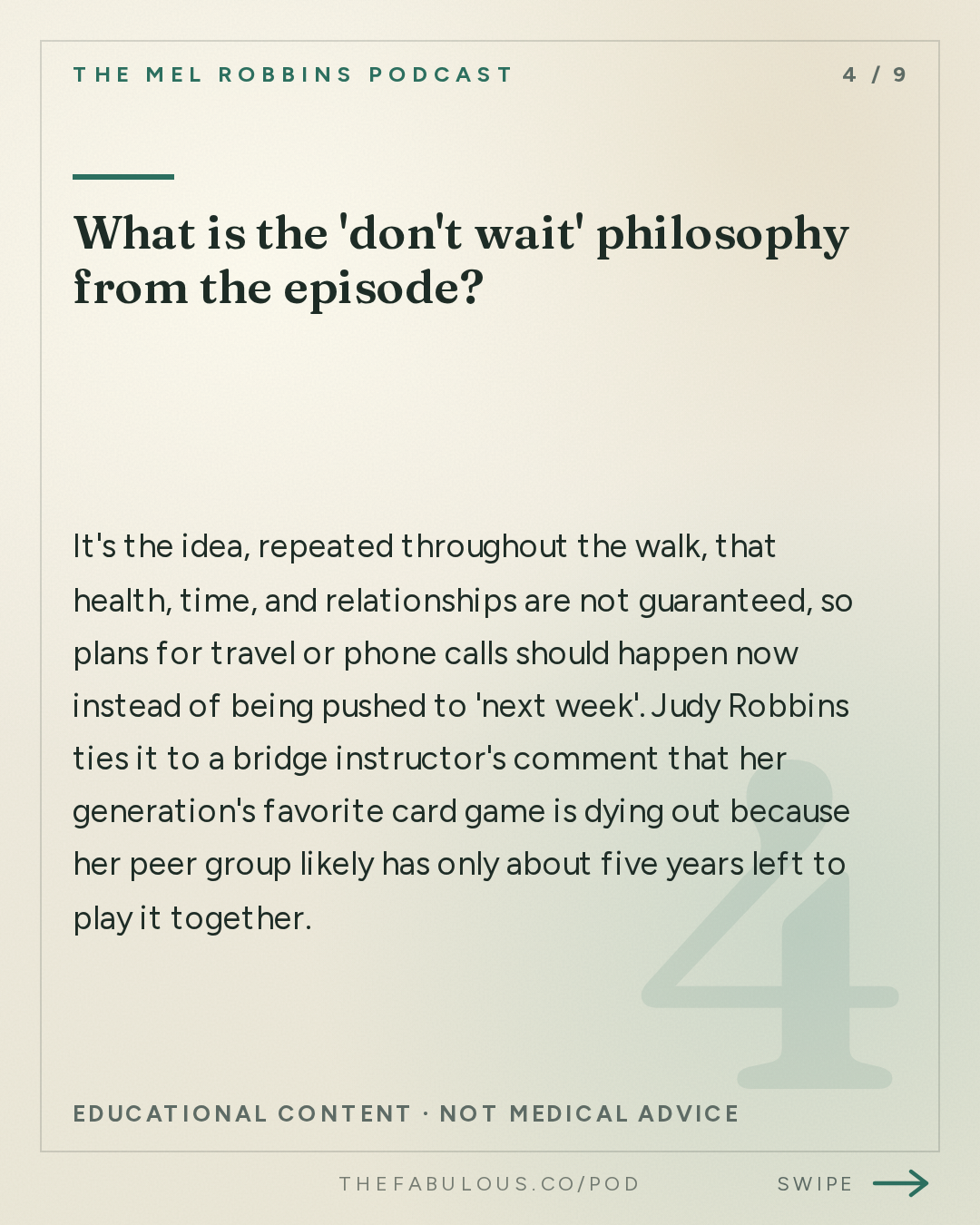
What is the 'don't wait' philosophy from the episode?
It's the idea, repeated throughout the walk, that health, time, and relationships are not guaranteed, so plans for travel or phone calls should happen now instead of being pushed to 'next week' (10:55). Judy Robbins ties it to a bridge instructor's comment that her generation's favorite card game is dying out because her peer group likely has only about five years left to play it together (17:09).
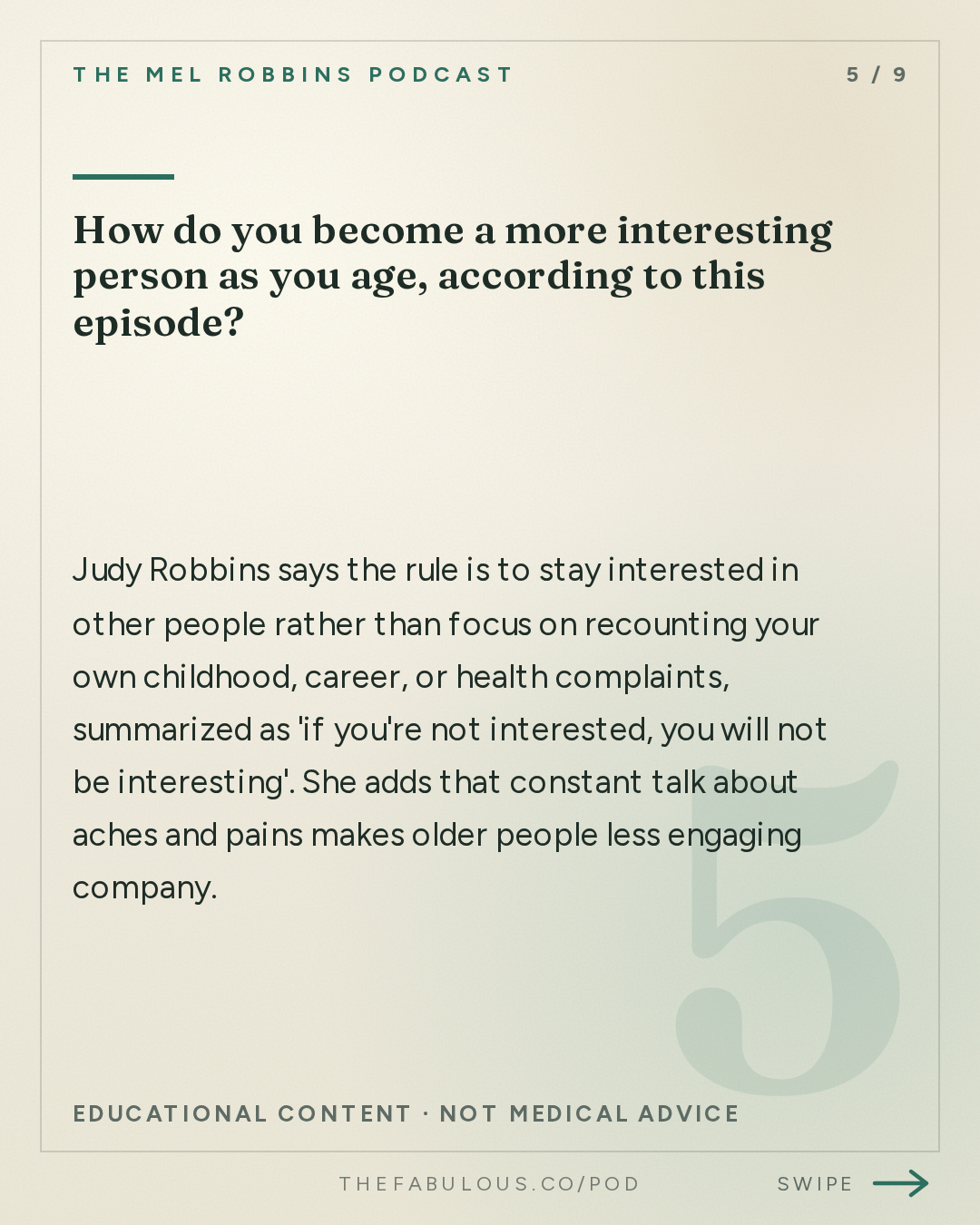
How do you become a more interesting person as you age, according to this episode?
Judy Robbins says the rule is to stay interested in other people rather than focus on recounting your own childhood, career, or health complaints, summarized as 'if you're not interested, you will not be interesting' (35:05). She adds that constant talk about aches and pains makes older people less engaging company (35:45).
What are Mel Robbins' five travel non-negotiables?
Mel Robbins lists five habits she follows on every flight: planning for comfort with slippers and a personal pillow, wearing noise-canceling headphones, carrying a sentimental good luck charm, treating flight time as a focused work block, and hydrating throughout the trip (41:36). She notes that most airlines don't count a personal pillow as a carry-on item (42:02).
The full read, in cards

Mentioned
Judy Robbins · Mel Robbins · St. Patrick's Cathedral · St. Regis · Oprah · John Grisham · Battenkill River · JetBlue · EST
More from this show and category
How to Stop Doing Everything for Everyone
Pastor Dr. Eric Thomas and Mel Robbins show why the family caretaker is often its least healthy member, and how to step back without guilt. Thomas, drawing on his wife Dee Dee's multiple sclerosis diagnosis, offers a principles-over-feelings decision framework and a simple test: drop one task, see who steps up, then use the freed time for yourself.
Eric Thomas's 52-Day Challenge, Explained
Motivational speaker Eric Thomas says anyone can reset their life in 52 days, the biblical time it took to rebuild Jerusalem's wall after 140 years in ruins. He used the method himself to lose weight, and coaches listeners to pick one embarrassing area of life, post a photo of their goal self, and start with 15 minutes a day.
Mel Robbins and Daughter on Parenting Mistakes
Mel Robbins and her daughter Sawyer Robbins grade Mel's parenting and unpack the Gottman Institute's "volcano and turtle" conflict pattern. They trace Mel's traumatic birth, clashing "practical solver" versus "deep listener" parenting roles, and a notepad trick that slows a flooded nervous system during fights.
Ed Mylett on Identity, Worry, and Reinvention
Ed Mylett, 55-year-old entrepreneur and podcast host, says identity works like a thermostat that quietly resets your life to a fixed setting no matter how good things get (28:27). He shows how writing down worries strips their power, why love outlasts fear as motivation, and why past failures qualify you to help others (42:25).
