
Mel Robbins and Daughter on Parenting Mistakes
How Did Your Parents Mess You Up? My Daughter Got Brutally Honest About What I Got Wrong
▶ Listen to the full episode More from The Mel Robbins Podcast
The brief
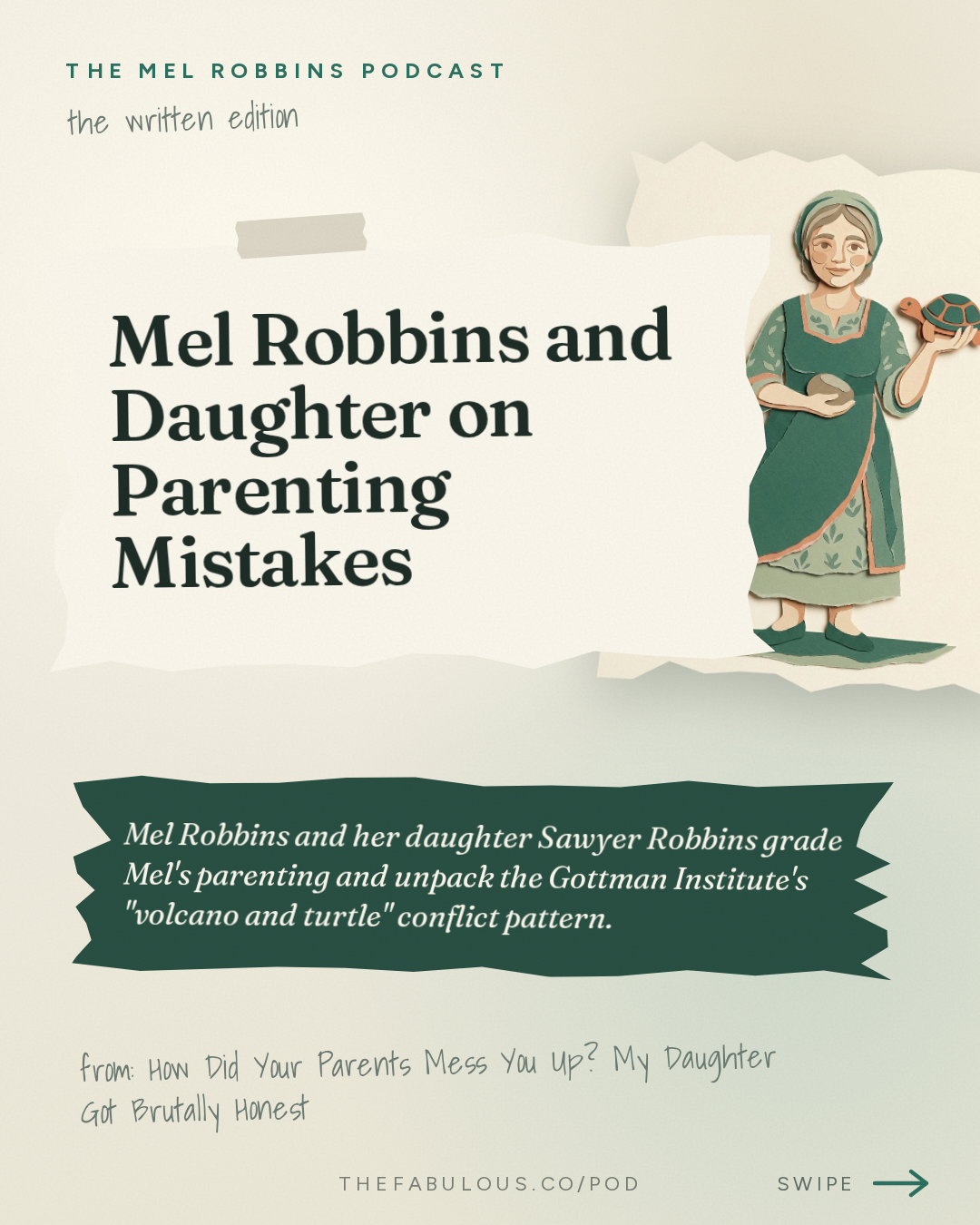
Mel Robbins and her daughter Sawyer Robbins grade Mel's parenting and unpack the Gottman Institute's "volcano and turtle" conflict pattern. They trace Mel's traumatic birth, clashing "practical solver" versus "deep listener" parenting roles, and a notepad trick that slows a flooded nervous system during fights.
A mother who has spent a decade telling strangers how to fix their lives sits down with her own daughter and asks to be graded. Mel Robbins, host of The Mel Robbins Podcast, poses the question to her eldest child, Sawyer Robbins, co-author with her of the book The Let Them Theory. Sawyer gives her a nine out of ten (03:44). It is a generous score, and also, it turns out, an opening. What follows is less an interview than an audit: two women with the same nervous system, tracing where it came from and what it cost.
The audit starts in a delivery room. Sawyer arrived two weeks late, by Pitocin induction, after three failed epidural attempts, and had to be vacuumed out (06:57). The placenta tore. Mel was wheeled into surgery and stayed there two and a half hours while her husband and her mother sat together in the delivery room, waiting (08:16). She does not remember her daughter being born. She remembers waking up gray, she says, the color of a dolphin (08:16). It is the kind of detail that explains, better than any statistic could, her next claim: that the body forgets the worst of childbirth on purpose.
"If women did not forget the pain of childbirth, none of us would have children. Not a second one." (09:35) - Mel RobbinsShe calls it a mechanism, something doctors could explain better than she can, but the function is obvious: amnesia as a condition of continuing the species.
The birth story is not just color. It sets up the episode's real argument, which is that a nervous system, the body's wiring for threat and calm, gets built before a child ever opens its eyes. Mel says the state of a mother carrying a child shapes how that child's nervous system works later (11:52), and she includes herself in the evidence. She describes being "extremely reactive," primed to amplify the moment someone's mood shifts (12:00). She had no tools for it in her twenties, she says, because therapy wasn't normal then and nobody could afford it anyway (12:23). So the reactivity got passed along, unfiltered, the way a cold gets passed along a dinner table.
The Volcano and the Turtle
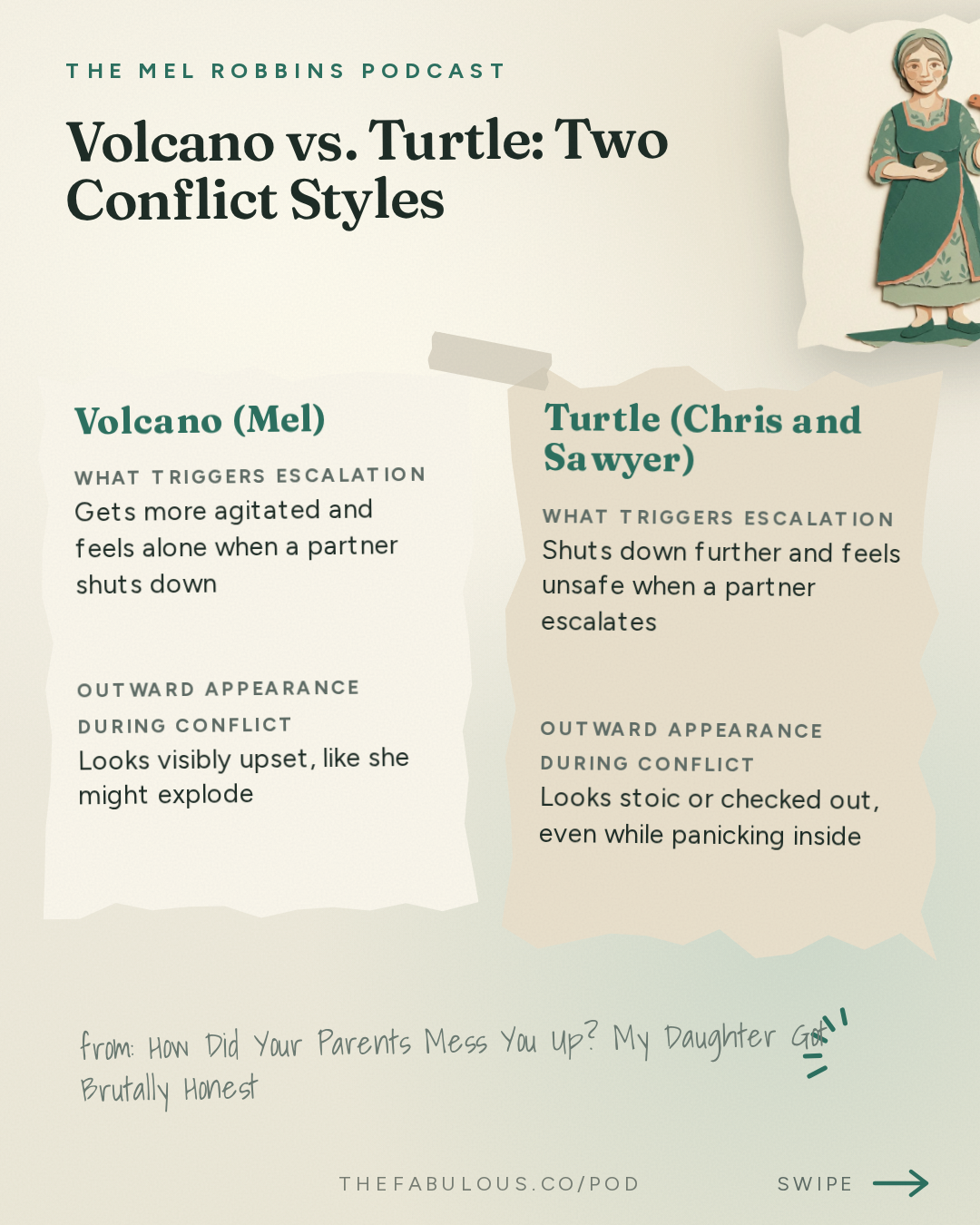
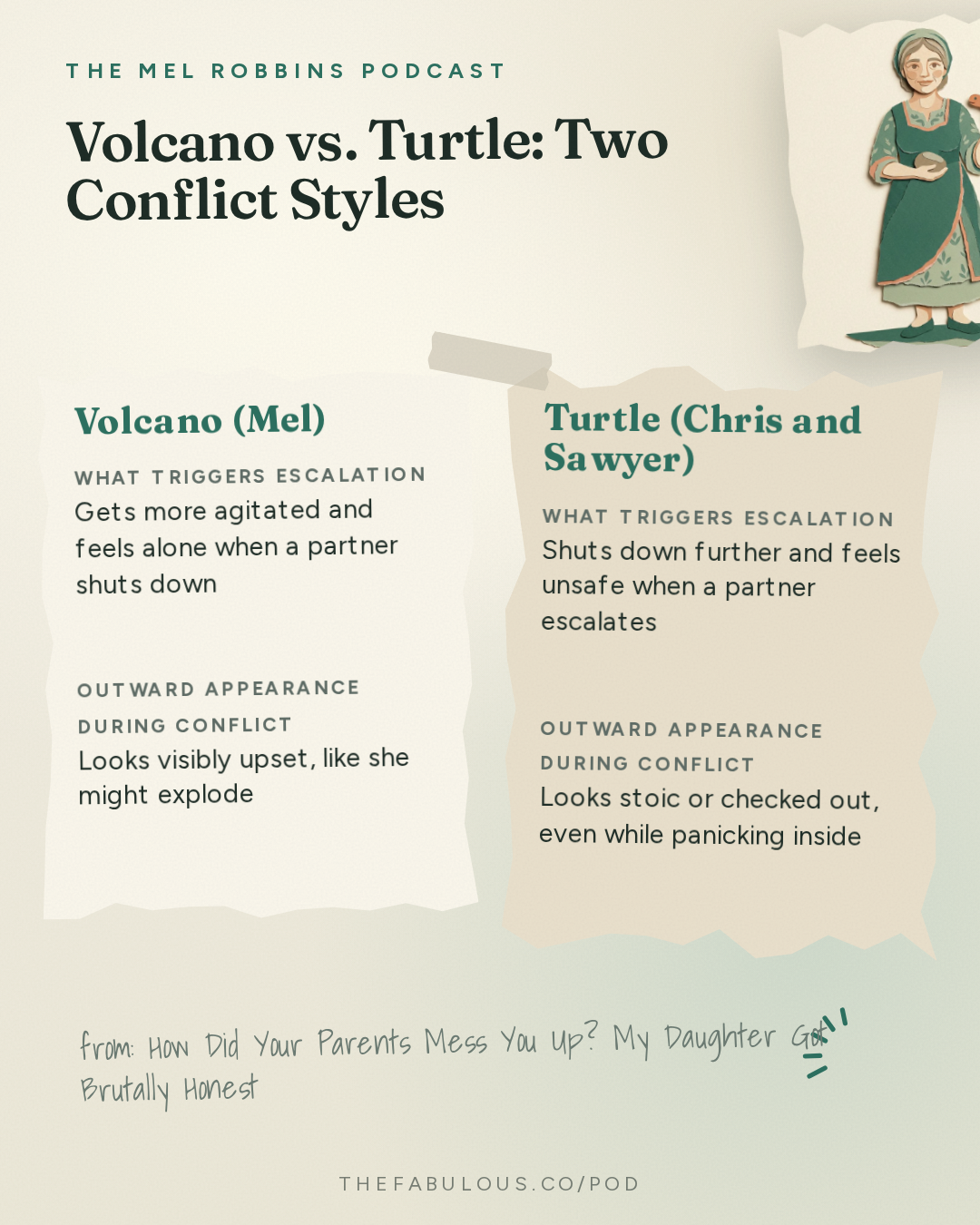
To describe how that reactivity plays out inside a marriage, Mel borrows a framework from the Gottman Institute, the relationship research organization run by psychologists John and Julie Gottman, who have studied couples for decades and have themselves been married forty years (16:43). The Gottmans describe two conflict styles: the volcano, who erupts, and the turtle, who shuts down and withdraws into a shell. Mel is a volcano. Her husband, Chris, and as it turns out her daughter Sawyer, are turtles. The two styles feed each other badly.
"If you're a person that's a volcano like me, and you get agitated, and you're dealing with somebody like you who shuts down, your shutdown makes me more agitated 'cause I feel more alone." (17:07) - Mel RobbinsShe and Chris have run this loop for thirty years (17:29). The turtle goes quiet to feel safe; the volcano reads the silence as abandonment and gets louder, which makes the turtle retreat further. Nobody is lying. Both people are regulating the only way they know how, and it still doesn't work.
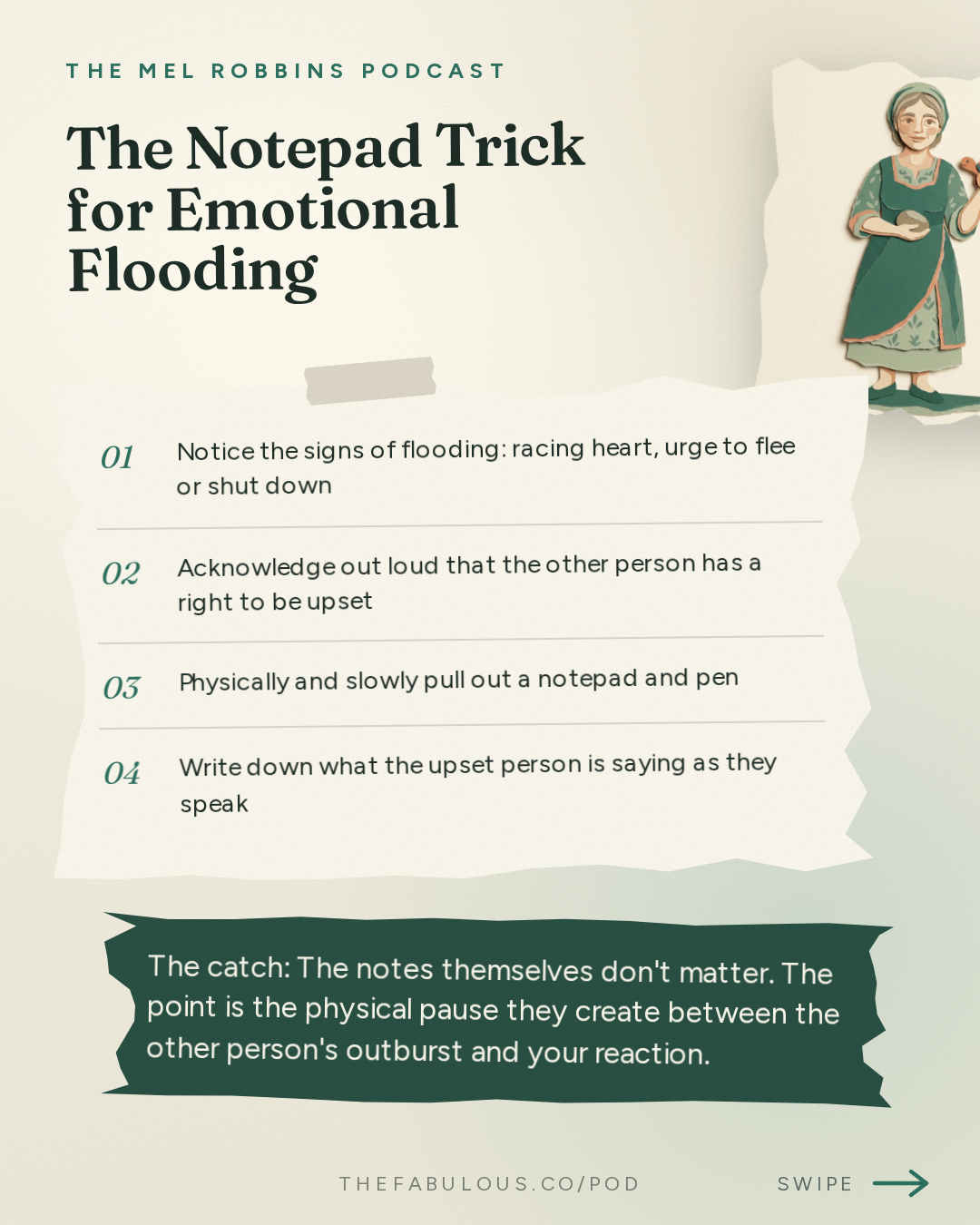
What breaks the loop, in the Gottmans' telling, is not a bigger conversation but a smaller physical one. John Gottman, a turtle himself, has a habit of pulling out a notepad mid-argument and writing down what his upset wife is saying (20:15). Mel explains why it works: it slows his heart rate, organizes his thoughts, and signals to the other person that they are being heard rather than ignored (20:44). The notepad is not really about notes. It is a deliberate pause wedged between a stimulus, the other person yelling, and a response, which gives a flooded brain, overwhelmed by stress chemicals, time to come back online (22:02). Sawyer recognizes herself in this immediately. She describes going silent under pressure not because she doesn't care but because her brain can't produce words fast enough to match what her body is feeling (13:46). The notepad trick, scaled down, is something she can use without actually carrying a notepad: find any small physical action that buys a few seconds before reacting.
Two Languages of Love
The second half of the conversation turns from conflict to affection, and it complicates the first half rather than resolving it. Sawyer tells her mother that she and her siblings sort their parents into roles. Mel is the fixer. Chris is the listener.
"You are a practical problem solver. I come to you for tasks... I go to Dad when we want to be heard, because we don't want a solution." (41:53) - Sawyer RobbinsMel's love, Sawyer explains, looked like solving problems and buying things, because that is how Mel's own mother showed love (40:48). Chris, who was the stay-at-home parent, showed love by being present and listening without trying to fix anything. The children learned, without anyone deciding it, which parent to bring which kind of need to. Mel admits this stings. She has absorbed it, she says, as evidence that her kids see Chris as the favorite and her as the monster (40:15). Sawyer pushes back gently: it isn't a ranking, it's a difference, and the two of them have simply never said so out loud to each other.
That gap, between feeling something and naming it, becomes the episode's practical takeaway. Sawyer mentions a habit her sister Kendall Robbins picked up from her own therapist: ask directly for what you need, before the mood takes over.
"Instead of coming down and being like, 'Hey, I need a hug,' or, 'I need to be alone right now'... we just repeat the pattern that we always do." (51:11) - Sawyer RobbinsThe family calls an unmanaged bad mood a tornado. Everyone braces for it, tries to fix the person in it, and then nobody acknowledges when it has passed, so the tension lingers past its own expiration date. Asking for a hug, or for an hour alone, or for help with a specific task, shortens the tornado and spares everyone the guesswork.
Underneath the role-sorting is something stranger that both women notice without fully explaining it: how fast a mood moves between a mother and a daughter. Sawyer describes feeling her mother's energy shift the instant Mel rolls her eyes, before a word is said (47:45). Mel calls it being "hardwired to each other's moods" (49:07), and links it to something larger: a generation of women with more agency than their mothers had, and also more to carry, financially and emotionally. Sawyer thinks this might explain why mother-daughter tension shows up in nearly every friendship she knows, while father relationships rarely come up the same way (46:44), and Mel agrees (48:36).
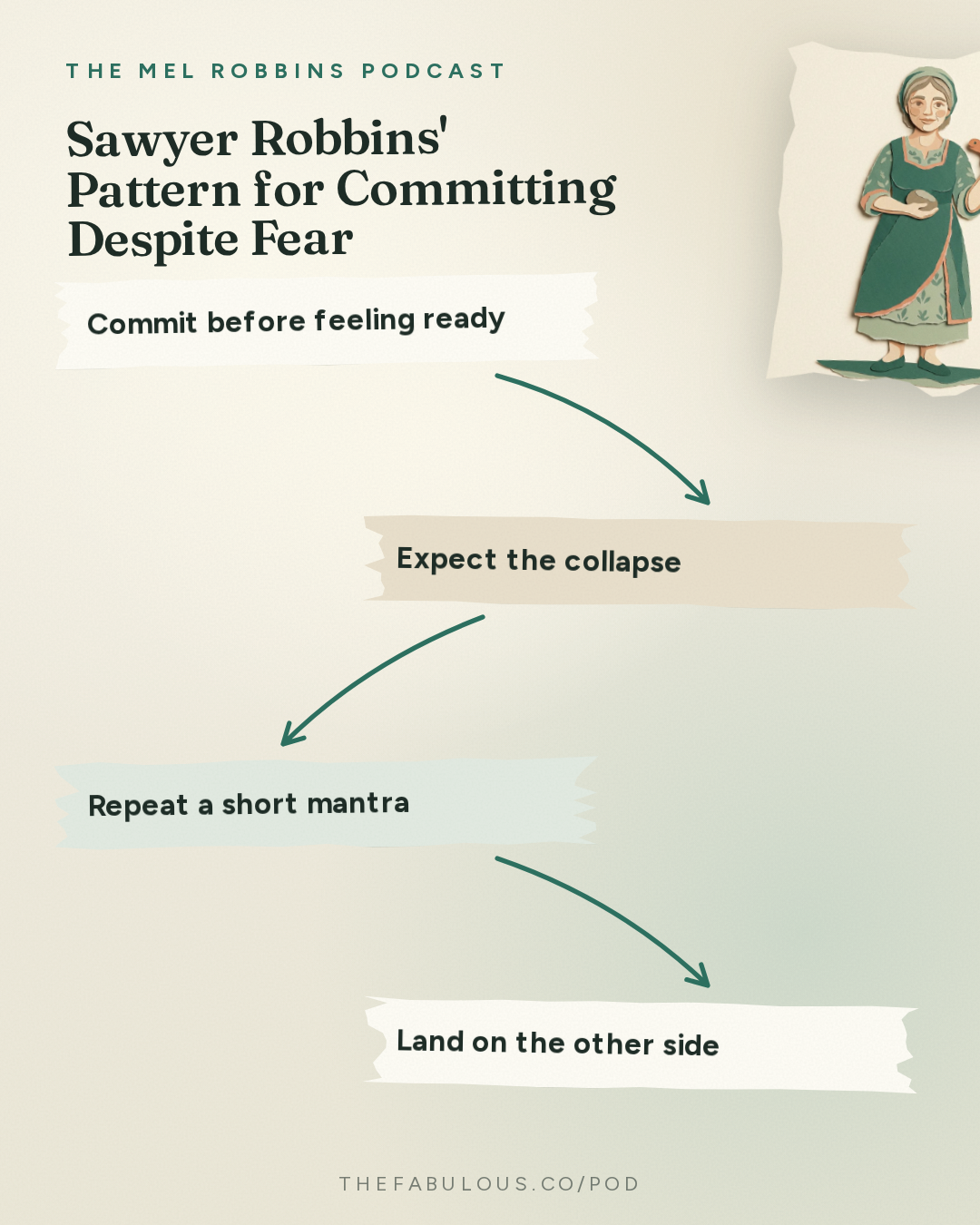
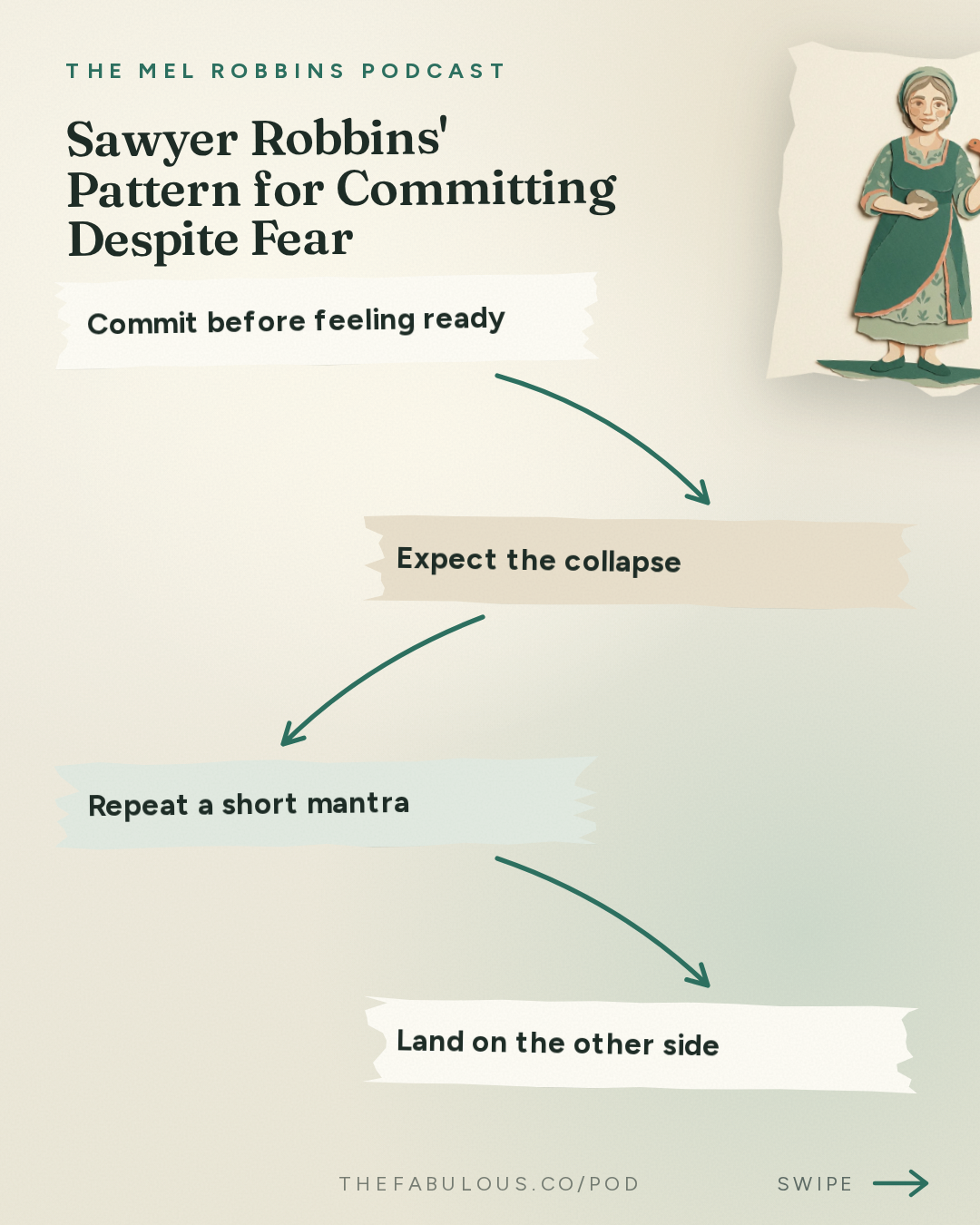
None of this resolves into a tidy lesson, and the episode is better for not pretending otherwise. Sawyer, twenty-seven years old at the time of the conversation (53:34), is still working out how to sit with fear before acting on it rather than after. She describes a pattern of committing to hard things, a trip to Cambodia at thirteen, a cross-country tour on stage, before she feels ready, and then falling apart for days once the decision is locked in (29:55).
"Bravery does not exist without fear. You have this ability, through the courage of your convictions, to commit, knowing that once you land in the seat, you're gonna hate it." (33:03) - Mel RobbinsThat line doubles as a description of the whole conversation. Mel and Sawyer don't arrive at a fixed version of each other. They commit to looking, knowing it will be uncomfortable, and they stay in the seat anyway.
Ask this episode anything
Pod's AI answers from the episode itself, with the minute mark so you can hear it yourself.
Or start with one of these
Ask this episode
Pod's AI listens to the whole episode to answer, and points you to the minute it comes from.
The rest of this answer, and any question after it
Answers come from the episode itself, never from a summary of it.
ContinueKey takeaways
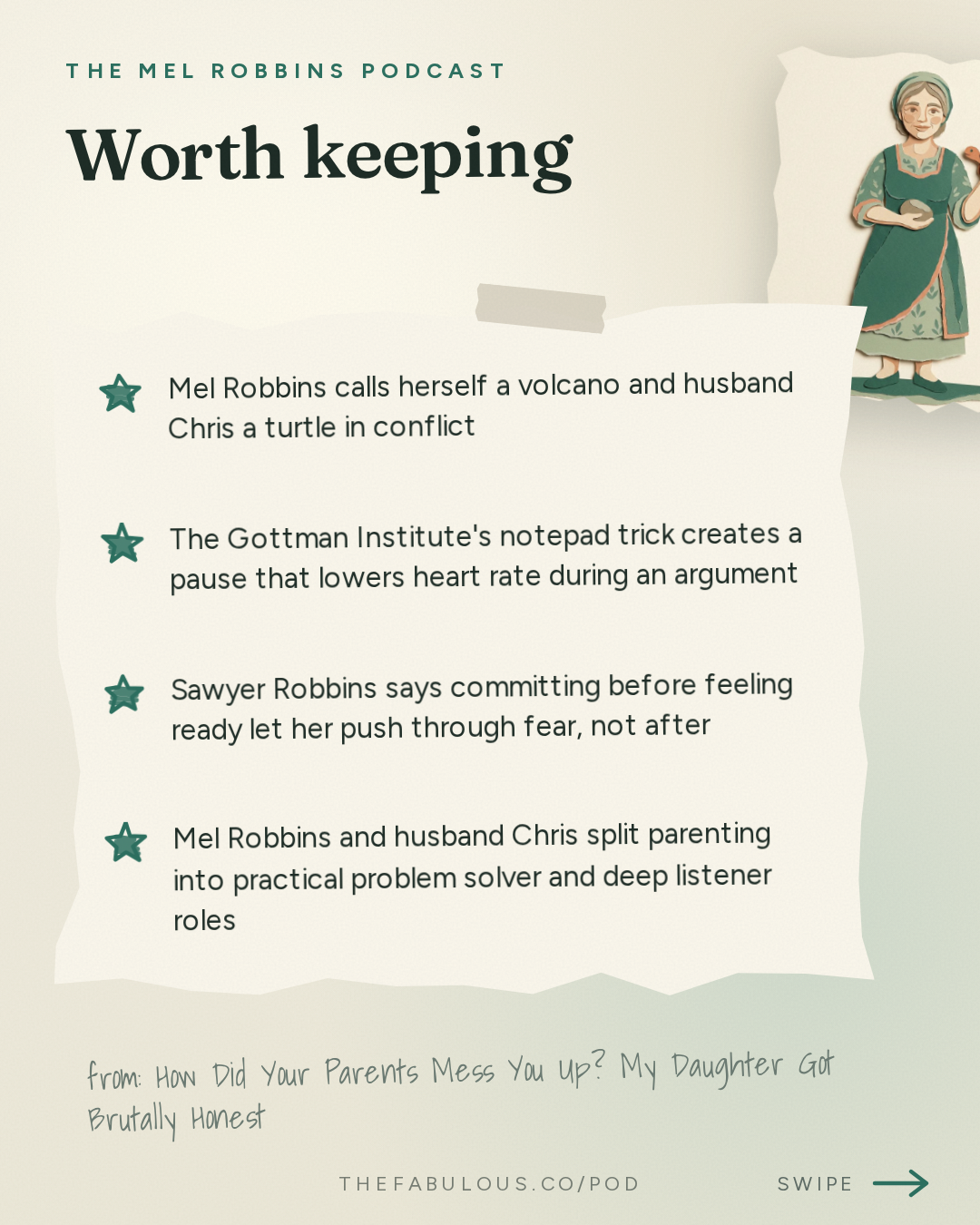
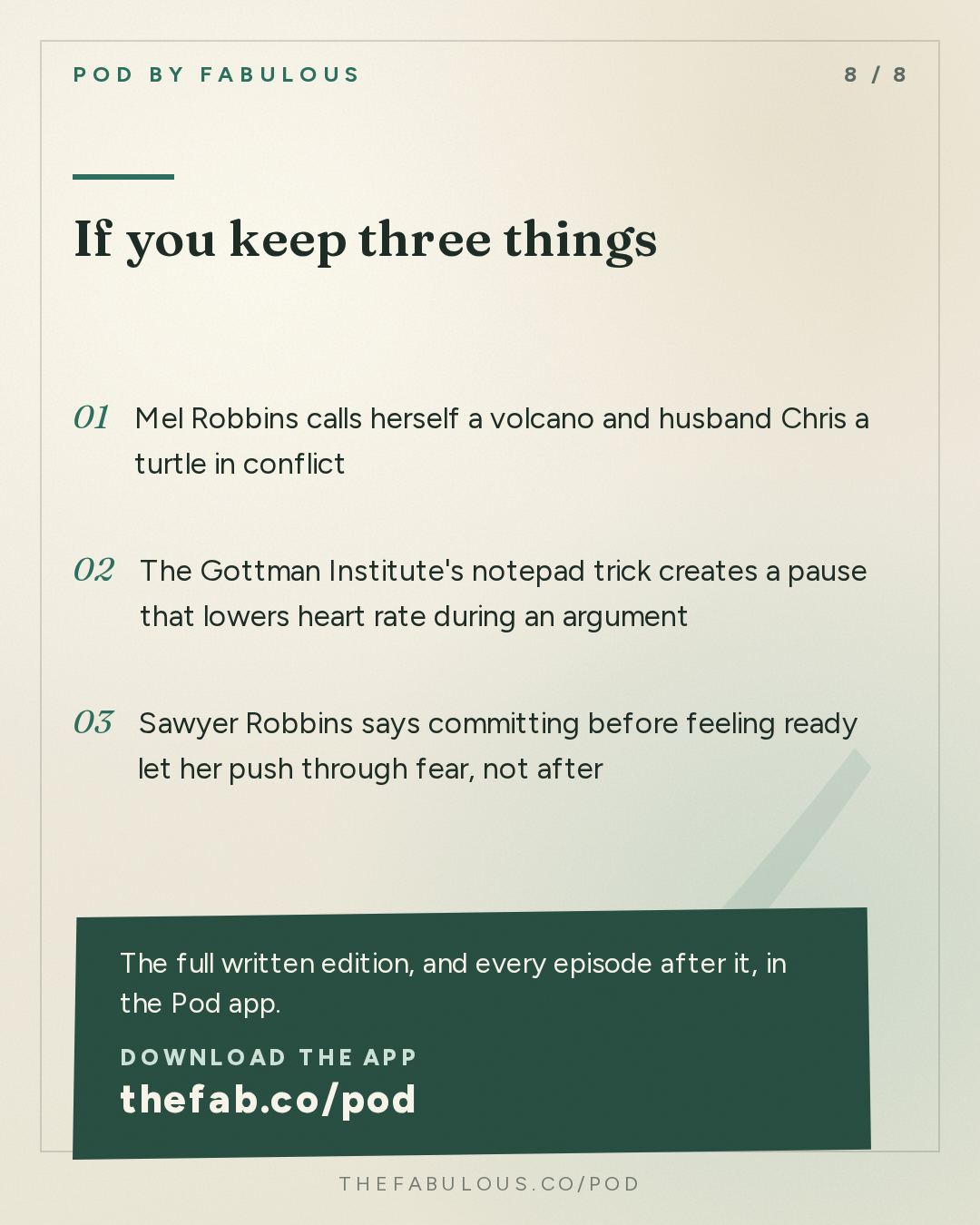
- Mel Robbins calls herself a volcano and husband Chris a turtle in conflict
- The Gottman Institute's notepad trick creates a pause that lowers heart rate during an argument
- Sawyer Robbins says committing before feeling ready let her push through fear, not after
- Mel Robbins and husband Chris split parenting into practical problem solver and deep listener roles
- Mel Robbins says deciding you no longer want to be reactive is the first step to change
The episode in cards
By the numbers
- 40 years length of John and Julie Gottman's marriage, cited as the basis for their conflict research
- 30 years how long Mel Robbins and her husband Chris have repeated the same volcano and turtle conflict pattern
In their words
“Learning from your mistakes, not stepping in and solving it, 'cause it robs you- Mm-hmm ... of”
“The state of your mother when you were inside of her has an enormous impact on the way that your nervous system works.”
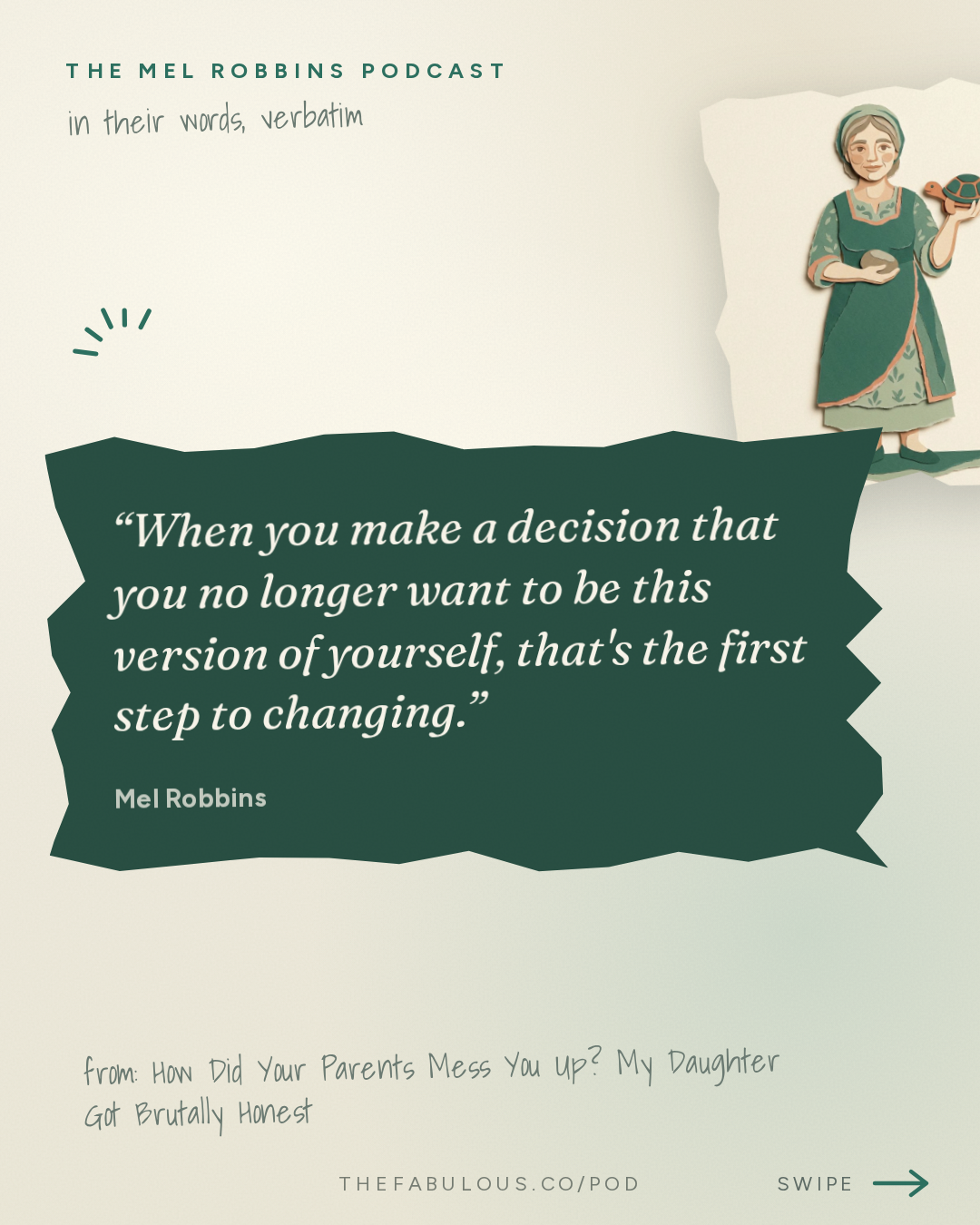
“When you make a decision that you no longer want to be this version of yourself, that's the first step to changing.”
Protocols
-
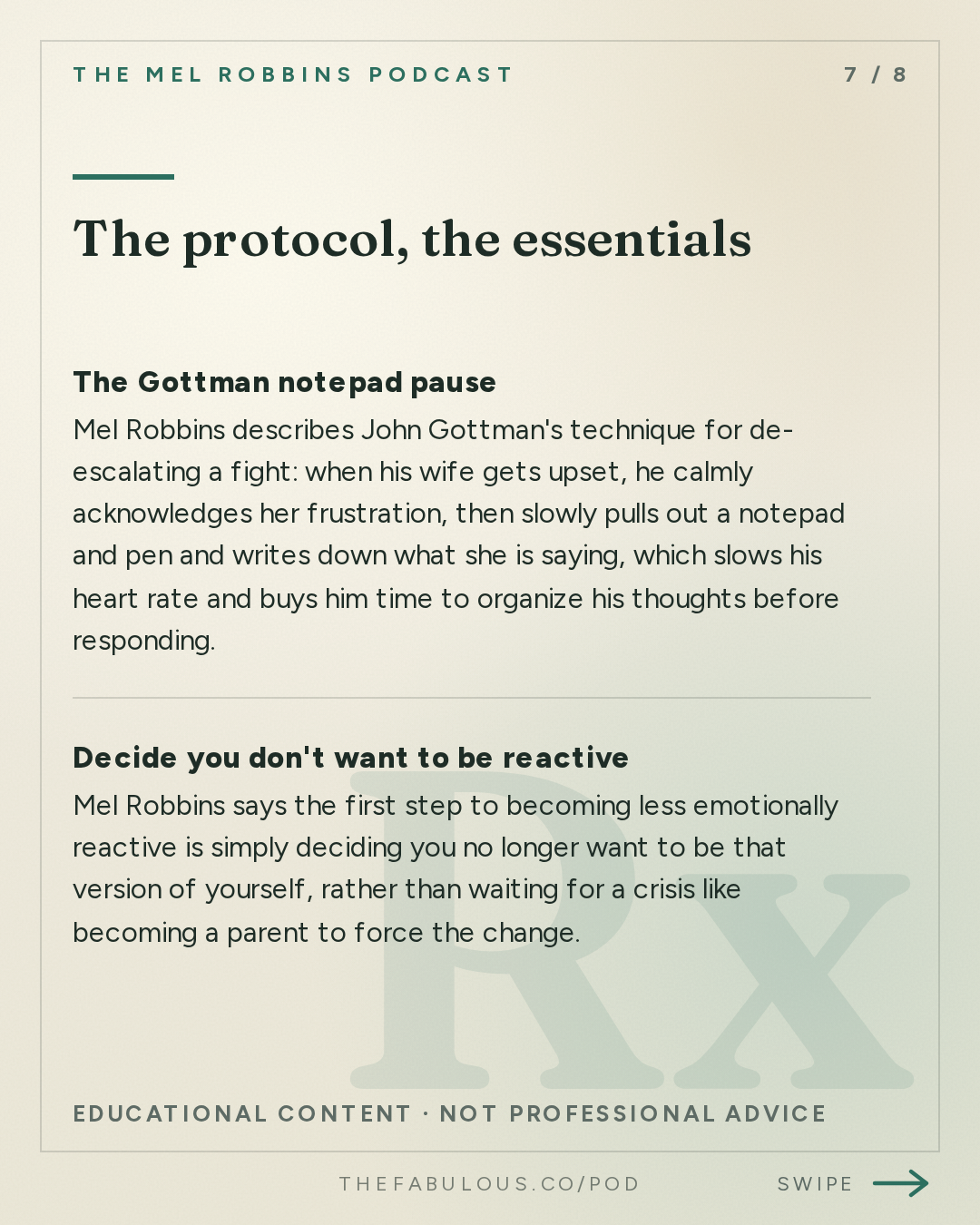
The Gottman notepad pause
Mel Robbins describes John Gottman's technique for de-escalating a fight: when his wife gets upset, he calmly acknowledges her frustration, then slowly pulls out a notepad and pen and writes down what she is saying, which slows his heart rate and buys him time to organize his thoughts before responding.
During moments of emotional flooding or conflict
-
Decide you don't want to be reactive
Mel Robbins says the first step to becoming less emotionally reactive is simply deciding you no longer want to be that version of yourself, rather than waiting for a crisis like becoming a parent to force the change.
Ongoing, starting now rather than at a future life milestone
-
Ask for what you need before venting
Sawyer Robbins recommends naming a specific need out loud, such as asking for a hug or for time alone, the moment a bad mood starts, instead of letting it build into an unspoken outburst that leaves family members guessing and walking on eggshells.
At the first sign of frustration or a bad mood
Questions this episode answers
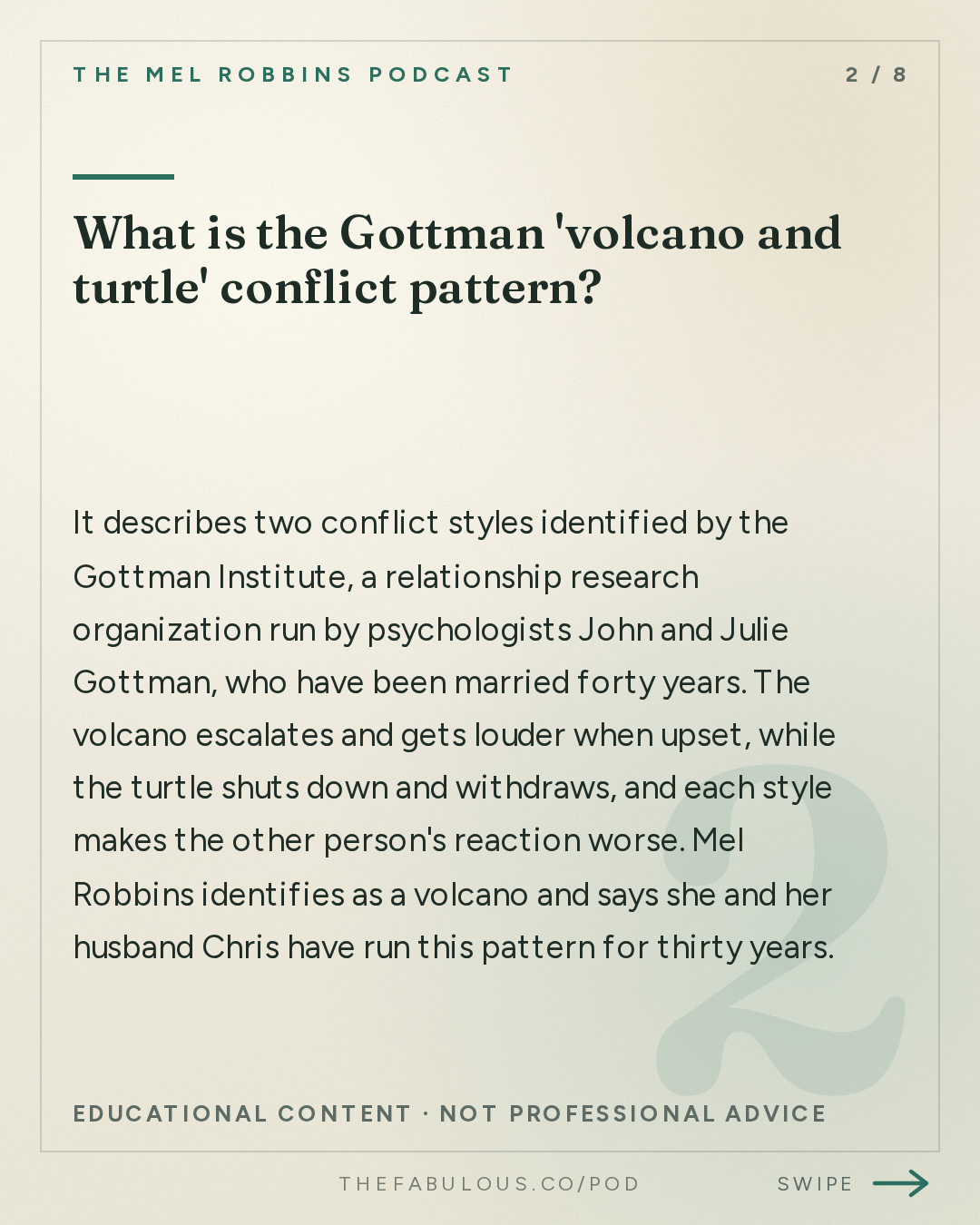
What is the Gottman 'volcano and turtle' conflict pattern?
It describes two conflict styles identified by the Gottman Institute, a relationship research organization run by psychologists John and Julie Gottman, who have been married forty years (16:43). The volcano escalates and gets louder when upset, while the turtle shuts down and withdraws, and each style makes the other person's reaction worse. Mel Robbins identifies as a volcano and says she and her husband Chris have run this pattern for thirty years (17:29).
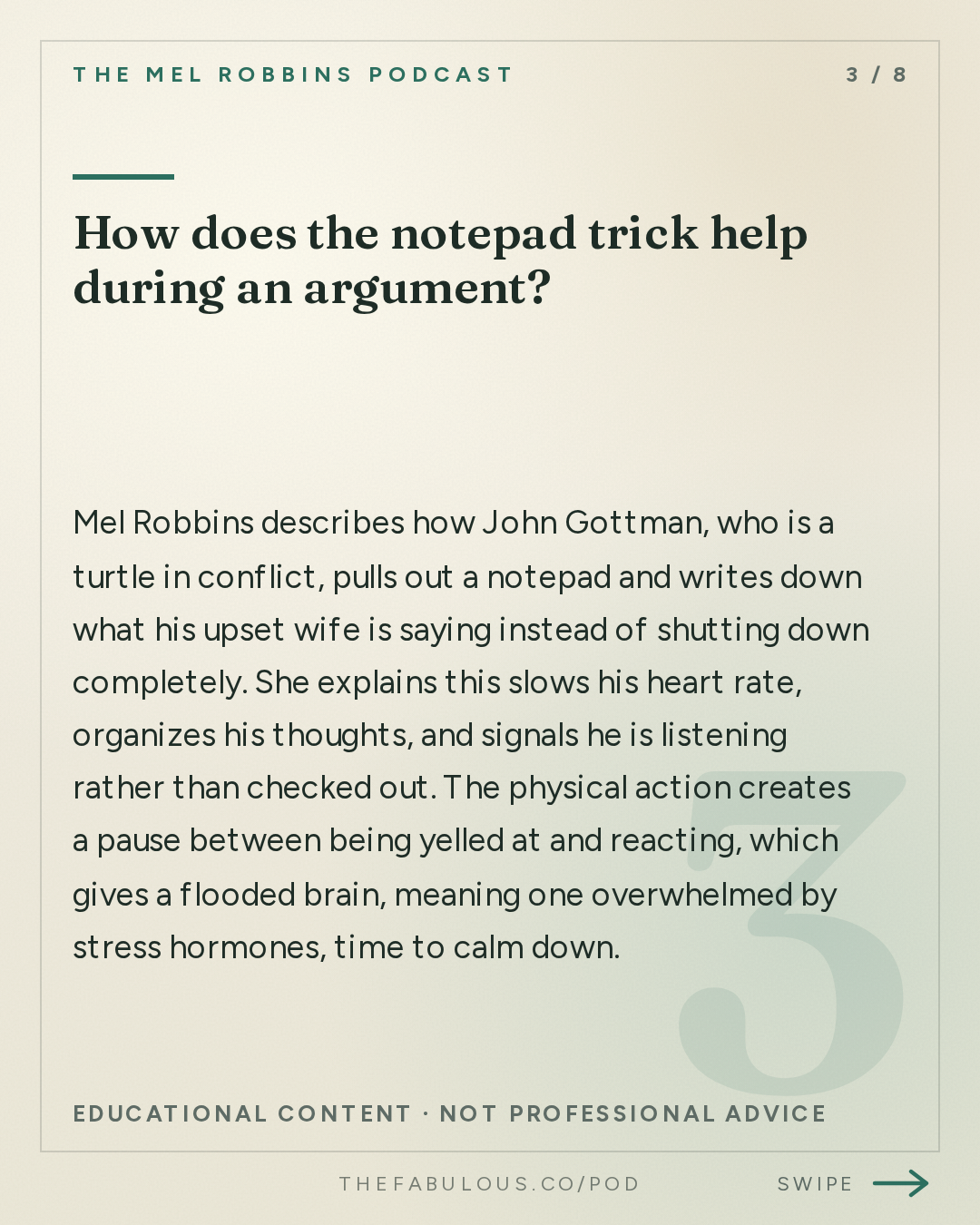
How does the notepad trick help during an argument?
Mel Robbins describes how John Gottman, who is a turtle in conflict, pulls out a notepad and writes down what his upset wife is saying instead of shutting down completely (20:15). She explains this slows his heart rate, organizes his thoughts, and signals he is listening rather than checked out (20:44). The physical action creates a pause between being yelled at and reacting, which gives a flooded brain, meaning one overwhelmed by stress hormones, time to calm down (22:02).
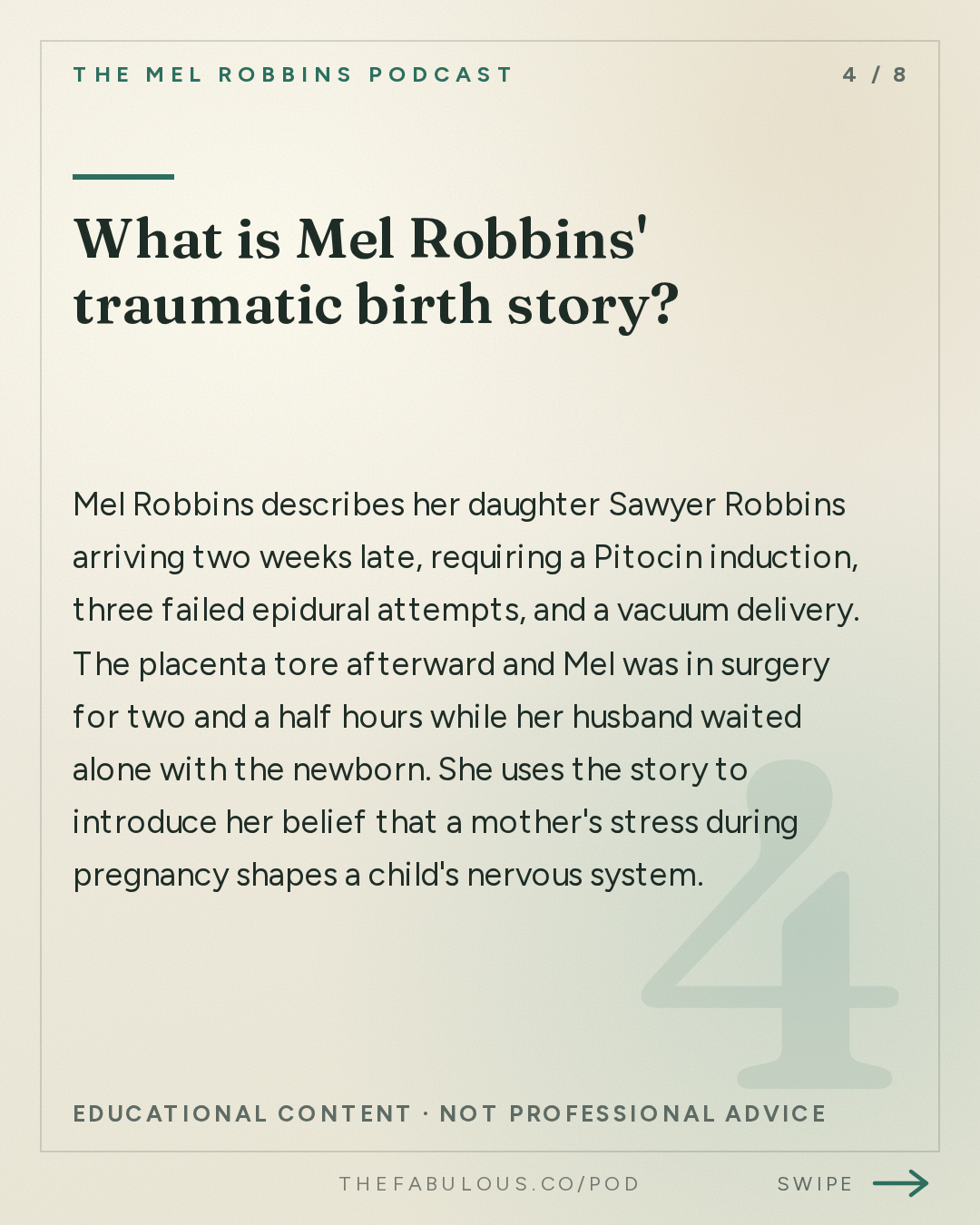
What is Mel Robbins' traumatic birth story?
Mel Robbins describes her daughter Sawyer Robbins arriving two weeks late, requiring a Pitocin induction, three failed epidural attempts, and a vacuum delivery (06:57). The placenta tore afterward and Mel was in surgery for two and a half hours while her husband waited alone with the newborn (07:25). She uses the story to introduce her belief that a mother's stress during pregnancy shapes a child's nervous system (11:52).
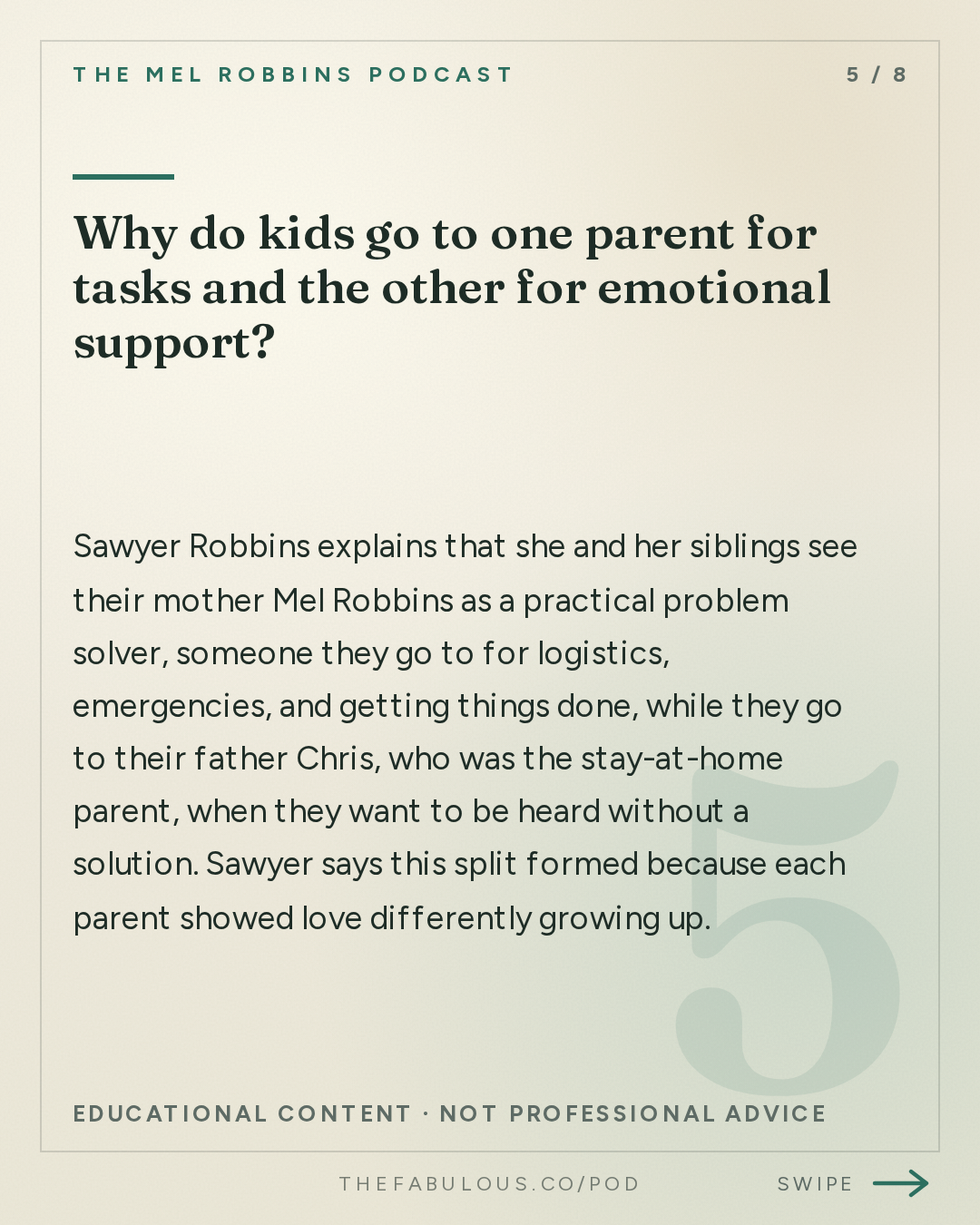
Why do kids go to one parent for tasks and the other for emotional support?
Sawyer Robbins explains that she and her siblings see their mother Mel Robbins as a practical problem solver, someone they go to for logistics, emergencies, and getting things done, while they go to their father Chris, who was the stay-at-home parent, when they want to be heard without a solution (41:53). Sawyer says this split formed because each parent showed love differently growing up (40:48).
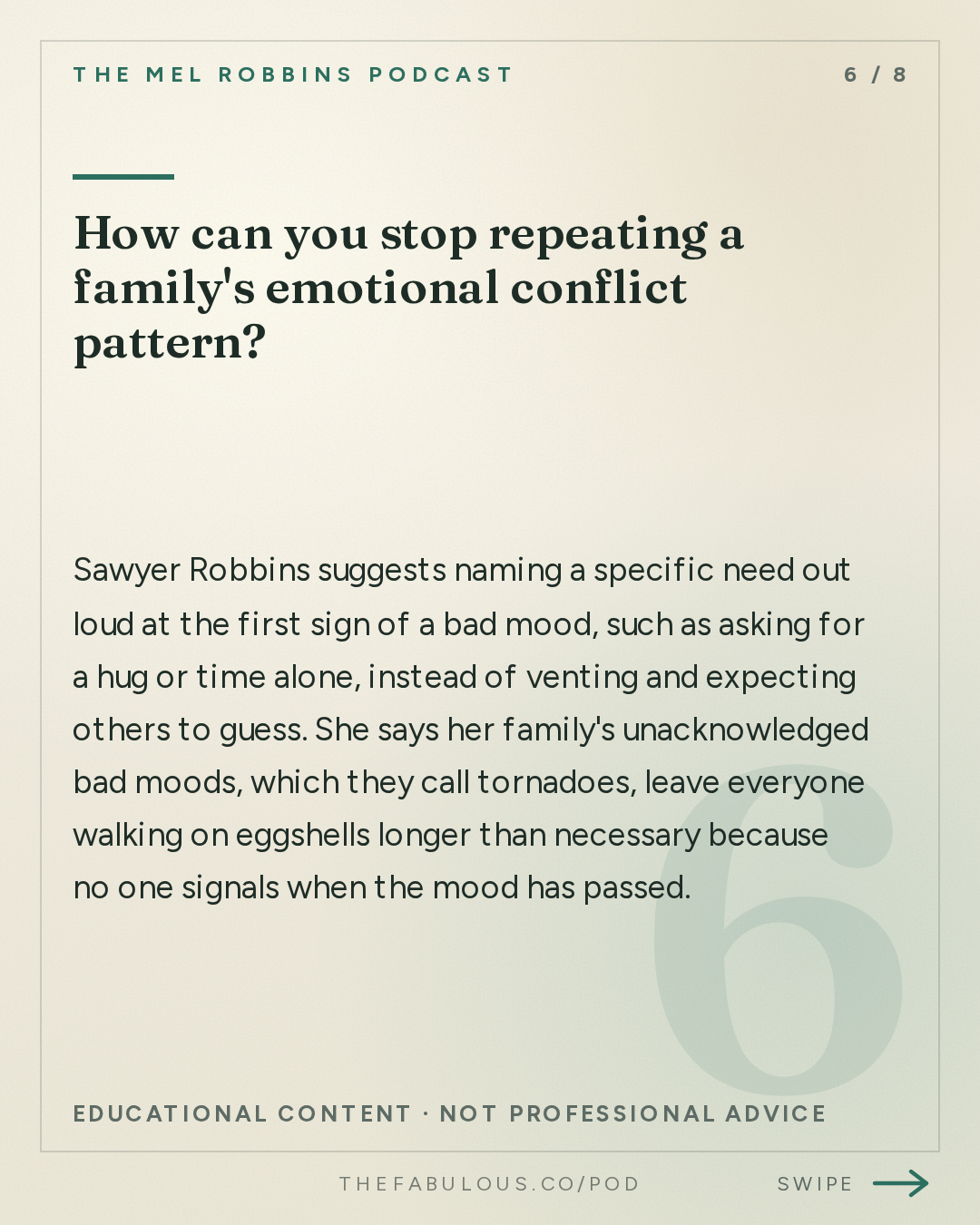
How can you stop repeating a family's emotional conflict pattern?
Sawyer Robbins suggests naming a specific need out loud at the first sign of a bad mood, such as asking for a hug or time alone, instead of venting and expecting others to guess (51:11). She says her family's unacknowledged bad moods, which they call tornadoes, leave everyone walking on eggshells longer than necessary because no one signals when the mood has passed (51:39).
The full read, in cards
Go deeper
- Gottman Institute research on conflict styles — identifies 'volcano' partners who escalate and 'turtle' partners who shut down during arguments
- The Let Them Theory — book co-authored by Mel Robbins and Sawyer Robbins, referenced as the premise of their joint podcast episodes
- The Obstacle Is the Way — Ryan Holiday's book, invoked by Sawyer Robbins to describe committing to hard experiences with no way out
Mentioned
Sawyer Robbins · Chris Robbins · Kendall Robbins · Oakley Robbins · JJ · Ryan Holiday · The Let Them Theory · Gottman Institute · Mass General Brigham
More from this show and category
Ed Mylett on Identity, Worry, and Reinvention
Ed Mylett, 55-year-old entrepreneur and podcast host, says identity works like a thermostat that quietly resets your life to a fixed setting no matter how good things get (28:27). He shows how writing down worries strips their power, why love outlasts fear as motivation, and why past failures qualify you to help others (42:25).
Mel Robbins' Relationship Advice for Young Adults
Mel Robbins tells her 27-year-old daughter that good relationships depend on timing and self-work, not just chemistry. Drawing on Gottman research, Jonathan Haidt, and Terry Real, she explains how to spot a wrong fit, why a single era matters, how to balance two ambitious partners, and why breakup recovery takes three months of restraint.
Mel Robbins' Relationship Advice for Young Adults
Mel Robbins and her 27-year-old daughter Sawyer sit down to answer real questions about dating, breakups, and ambition. Drawing on Gottman research, NYU psychologist Jonathan Haidt's findings on young men and dopamine, and therapist Terry Real's rule that partners can be right or connected but never both, Robbins argues most relationship trouble starts with an unhealed self, not a wrong partner.
How to Let Go of What No Longer Serves You
Mel Robbins uses a biological metaphor, trees pushing off leaves each fall, to argue that healthy relationships, jobs, and habits need a two-way flow of energy. When something only drains and never gives back, she says it is time to let it go, and she offers two daily tools: a 24-hour no-complaining challenge and a rule against trying to control other people.
