
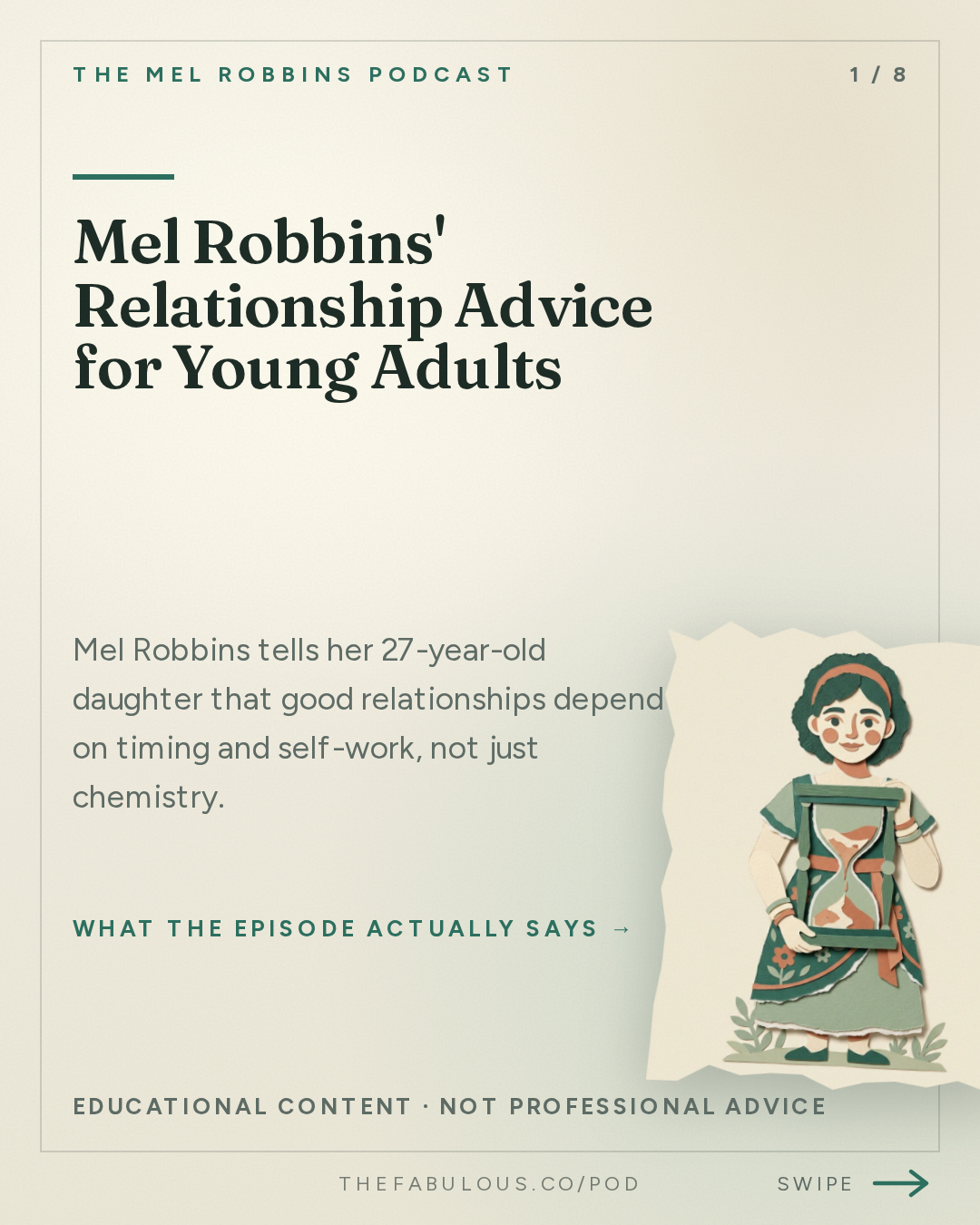
Mel Robbins' Relationship Advice for Young Adults
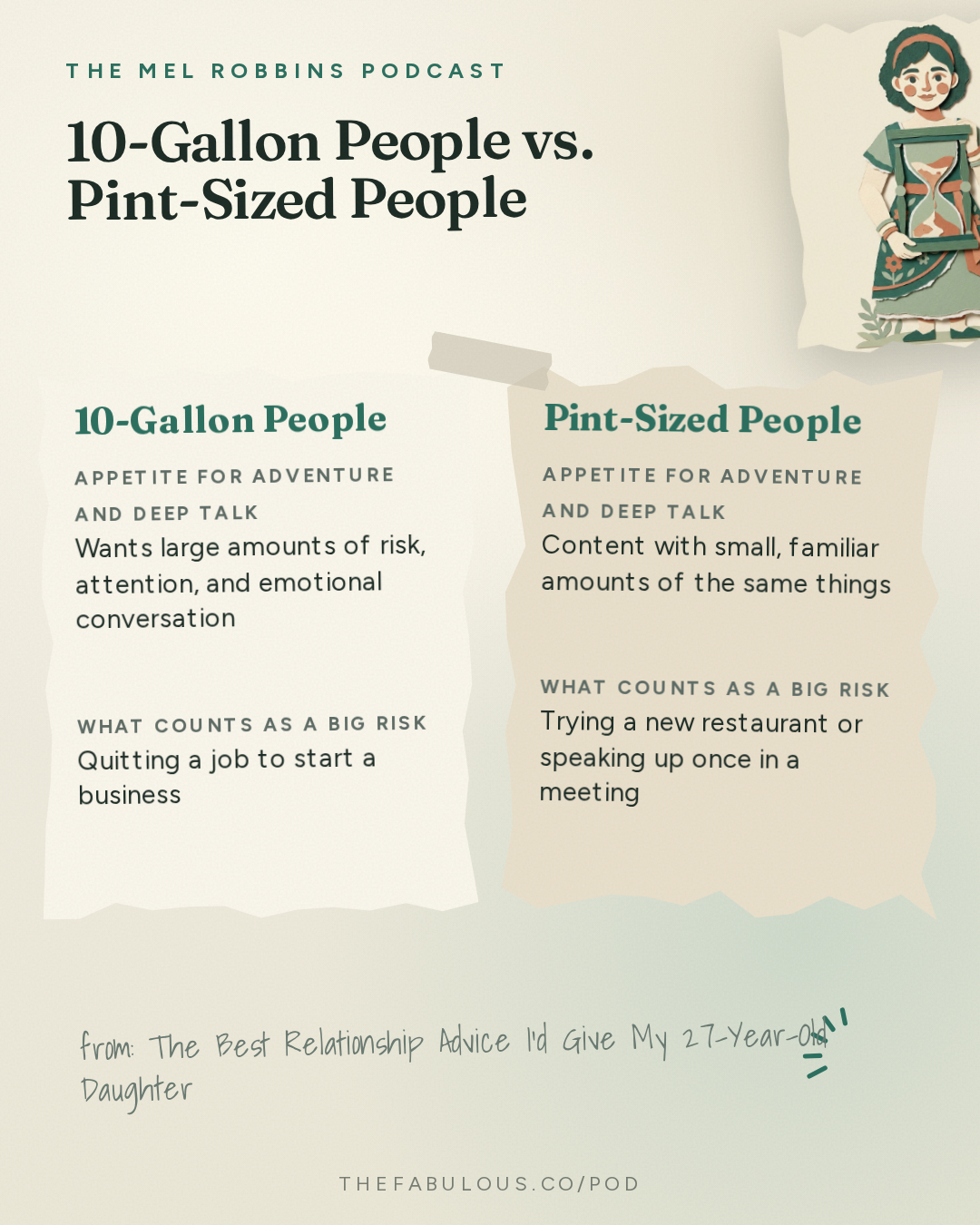
The Best Relationship Advice I’d Give My 27-Year-Old Daughter
▶ Listen to the full episode More from The Mel Robbins Podcast
The brief
Mel Robbins tells her 27-year-old daughter that good relationships depend on timing and self-work, not just chemistry. Drawing on Gottman research, Jonathan Haidt, and Terry Real, she explains how to spot a wrong fit, why a single era matters, how to balance two ambitious partners, and why breakup recovery takes three months of restraint.
There is a cat named Mr. Noodle asleep on Mel Robbins's lap, a clipboard of questions in her daughter's hands, and no script. Sawyer Robbins, 27, has spent weeks collecting questions about love from her sister, her friends, and strangers on the internet, and she has not shown her mother a single one in advance (00:24). What follows is not a lecture. It is closer to a cross-examination, thirty years of marriage and a lifetime of research getting asked, point blank, to prove themselves to the next generation.
The through-line that emerges is unfashionable: most of what wrecks a relationship was decided before two people ever met. It was decided by whether someone did the work of becoming a whole person first, and it keeps getting decided, conversation by conversation, by a much smaller choice than people think, the choice between winning an argument and staying close to the person they are arguing with.
The Tests of Fit
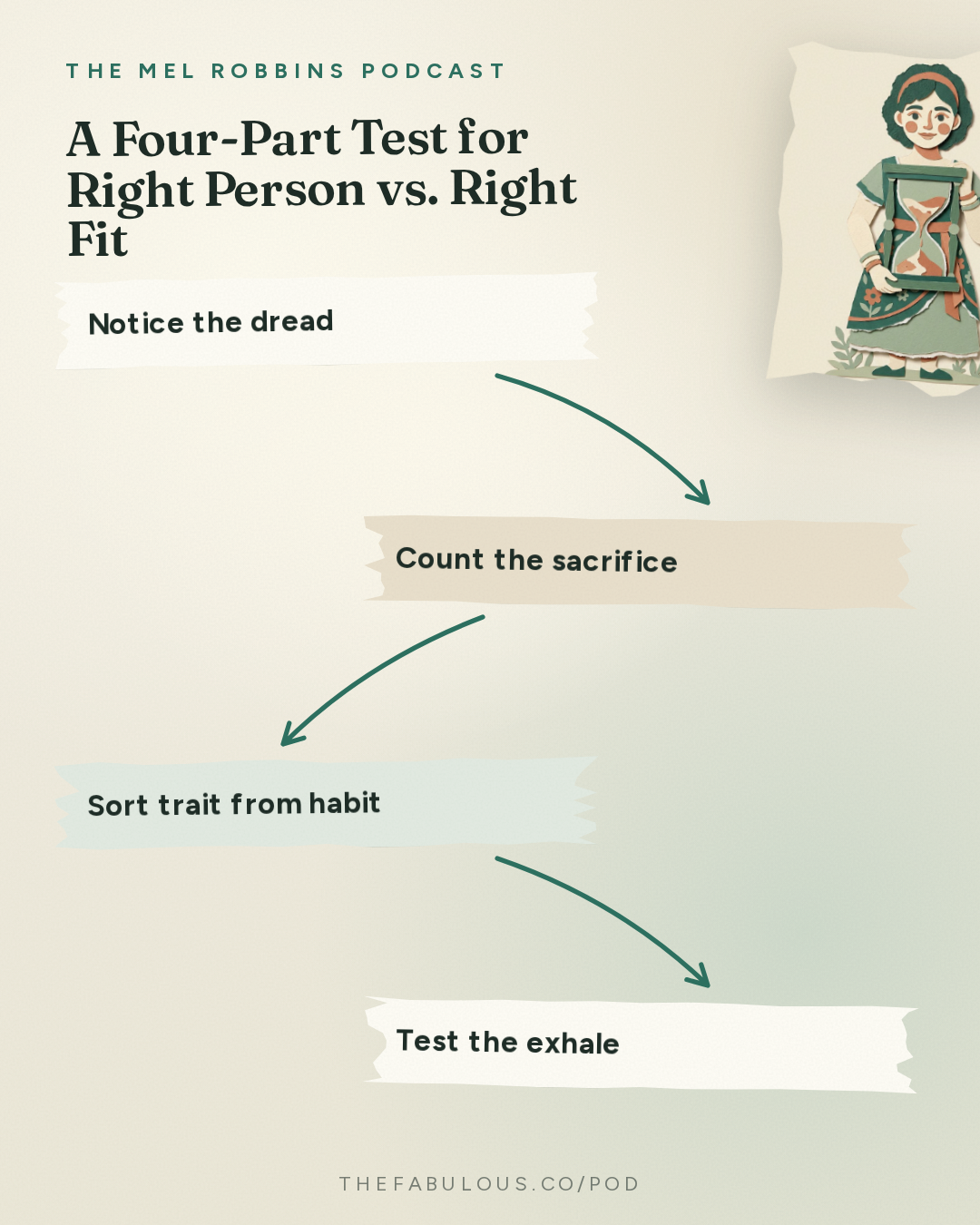
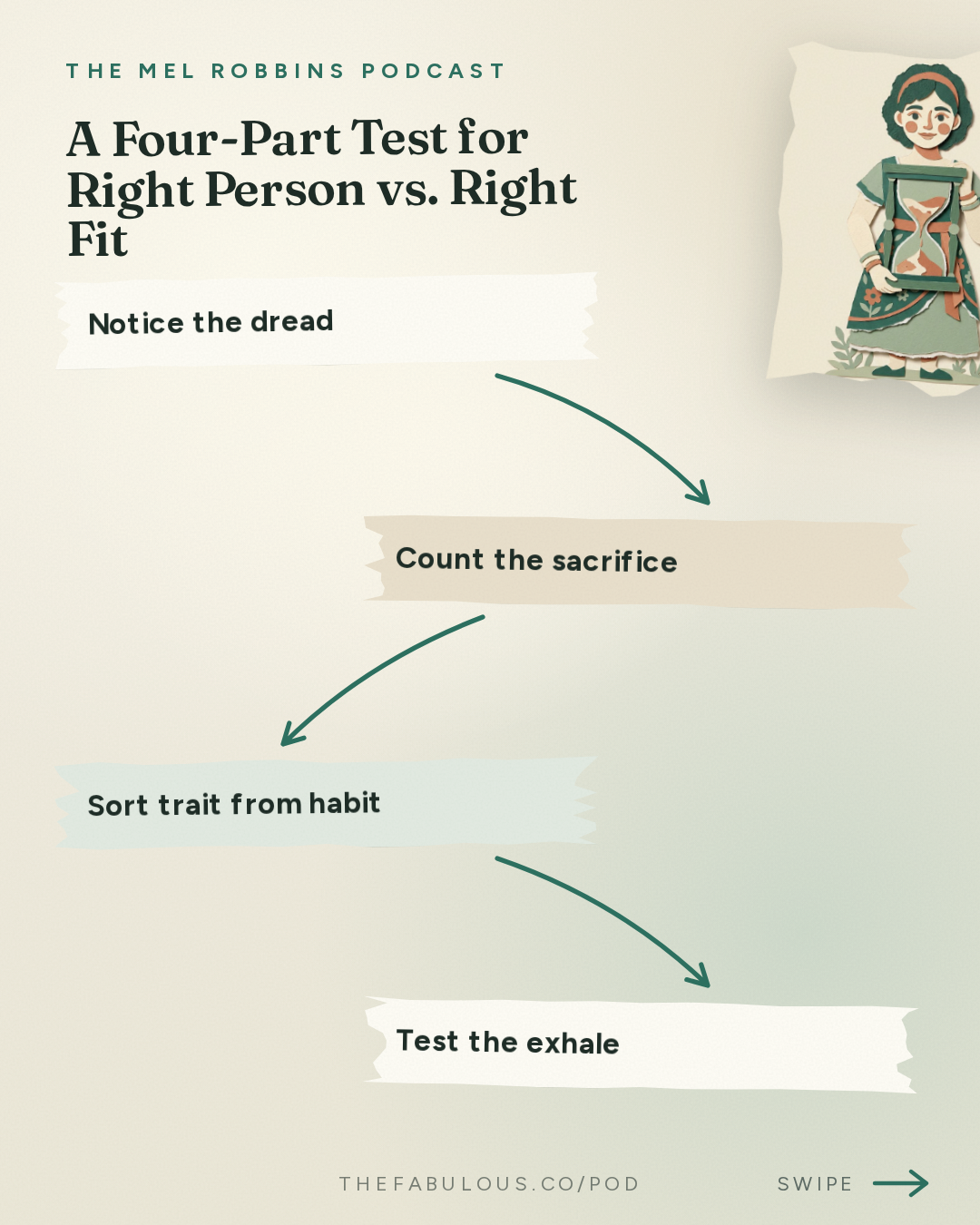
Robbins opens with a feeling she calls dread, a low hum of wrongness that persists even when the partner in question is kind, impressive, and easy to love on paper. She says she has felt it twice in her own life, with men she describes as genuinely extraordinary, and both times the problem was not them (05:08). "It's intoxicating when you are falling in love with somebody, and it seems to wipe away all your problems," she says, describing how new-relationship chemistry can mask unresolved issues in a person rather than solve them.
"It's intoxicating when you are falling in love with somebody, and it seems to wipe away all your problems." — Mel Robbins [06:40]
She offers three more concrete filters, credited to the marriage researchers John and Julie Gottman, who have studied couples for five decades (09:12). The first: if staying with someone requires giving up a dream or compromising a core value, the relationship will not hold, no matter how good the chemistry is. The second, and the one with the sharpest edge, is a statistic. The Gottmans have found that 69 percent of the things couples fight about are not solvable problems at all. They are fixed traits, permanent parts of a person's wiring that will outlast any amount of nagging (10:44). The question is not whether the annoyance will fade. It is whether someone can live inside it anyway.
That leads to a distinction Sawyer pushes her mother to sharpen: the difference between a skill and a trait. Learning to do dishes or split household labor is a skill, something anyone can pick up with practice, and Robbins is blunt that treating housework as a gendered favor rather than a basic adult competency is a losing argument for any relationship (13:49). But a lack of curiosity, unkindness, or indifference to the people around someone is not a skill gap. It is closer to a fixed trait, and trying to argue a person into caring about the world is a fight nobody wins (14:21). The simplest test she offers has nothing to do with romance novels or red flags. It is what happens at the end of a hard day, after a bad commute and an empty refrigerator, when the front door opens. Does the sight of this person produce a smile, an exhale, a sense of relief? If so, she says, that matters more than how attractive or wealthy anyone is, because bodies age and jobs disappear, but that exhale either exists or it does not (16:29).
What ties these filters together is self-honesty rather than compatibility math. Robbins argues that most people already know, deep down, when something is wrong, and spend months or years picking at a good partner rather than admit the problem sits closer to home (07:33).
That admission connects directly to her hardest piece of advice: some people cannot evaluate fit at all, because they have never been single long enough to know who they are without someone else in the picture. She calls this pattern overlapping, moving from one relationship to the next like a trapeze act, never fully letting go of one bar before grabbing the next (18:09). She says she did this from age 13 until she met her husband, and estimates it delayed her own healing by at least 15 years (19:25). Sawyer, by contrast, spent six years single during and after college, a stretch her mother now calls one of the best decisions of her daughter's life, and one she wishes she had made herself (20:11). The point is not moral. Robbins frames an unexamined relationship as a form of self-medication, a way of outsourcing the question of whether someone is okay to another person's attention. "You cannot outrun your past. You cannot outdate your bad habits in relationships, and you cannot marry yourself into healing," she says, a line that doubles as the thesis of the book she and Sawyer wrote together, The Let Them Theory (22:14).
The conversation then turns practical in a way most relationship advice avoids: money and ambition. When a listener asks how to keep a relationship equal while a partner pursues an all-consuming career, Robbins does not pretend the answer is balance. She says flatly that the less ambitious partner should expect to take a backseat during that period, and that the real task is not resentment management but figuring out a personal source of meaning that does not depend on the other person's momentum (28:00). She redefines ambition in passing, stripping it of its usual price tag: "Ambition doesn't have anything to do with money. Ambition is the drive that you have to create and experience things," she says, pointing to her own husband as someone deeply ambitious and almost entirely uninterested in income (29:33). Still, she does not dodge the harder truth underneath the question. The partner who earns more money typically ends up driving most of the couple's decisions, because money buys choices, which is part of why she has pushed both her daughters to build independent income rather than rely on a partner's (31:01).
On the particular agony of watching a partner struggle to find work, her advice leans on patience rather than fixing. She describes her own husband being laid off seven times in nine years, and says the only sustainable role for a supportive partner is to lend belief rather than apply pressure, since someone unemployed is already applying more pressure to themselves than anyone else could (35:17). She cites NYU psychologist Jonathan Haidt, author of The Anxious Generation, whose research suggests that heavy use of short-form video, gambling apps, and pornography disrupts the brain's reward system in ways that look identical to a lack of motivation (40:00). His proposed fix is almost absurdly simple: roughly two weeks without a phone is often enough to reset that system (42:01).
The Cost of Being Right
The back half of the conversation moves from strategy to repair. For someone who feels unchosen and invisible in the dating pool, Robbins resists the instinct to prescribe a dating app or a makeover, and instead argues that physical change precedes emotional change: "You change your mentality by changing your physicality," she says, framing a new gym habit or a dance class less as self-improvement than as evidence a person is choosing themselves while waiting to be chosen by someone else (52:42). For someone freshly out of a relationship, she is specific about timing. The breakup itself is not the hard part, she says. The three months immediately afterward are, and the single worst thing a person can do during that window is fill it with a rebound or with sex with the ex, because either one resets the grieving clock to day one (56:03).
It is Mel, not her daughter, who names the idea holding the whole episode together. She points back to couples therapist Terry Real, who has appeared on the podcast before, and his line about the real choice inside every disagreement.
"The most important thing to remember about relationships: you can be right or you can be connected. But you can't be both." — Terry Real, quoted by Mel Robbins [57:16]
Every piece of advice that came before, the dread, the sacrifice test, the single era, the money conversations, collapses into that one line. None of it is really about finding a flawless partner. It is about noticing, in the smaller moment of an argument over sweatpants on the couch or a surname on a marriage license, whether the goal is to win or to stay close. Robbins does not claim the second option is easy. She just insists it is the only one that leaves a marriage, or a daughter, better off thirty years in.
Ask this episode anything
Pod's AI answers from the episode itself, with the minute mark so you can hear it yourself.
Or start with one of these
Ask this episode
Pod's AI listens to the whole episode to answer, and points you to the minute it comes from.
The rest of this answer, and any question after it
Answers come from the episode itself, never from a summary of it.
ContinueKey takeaways
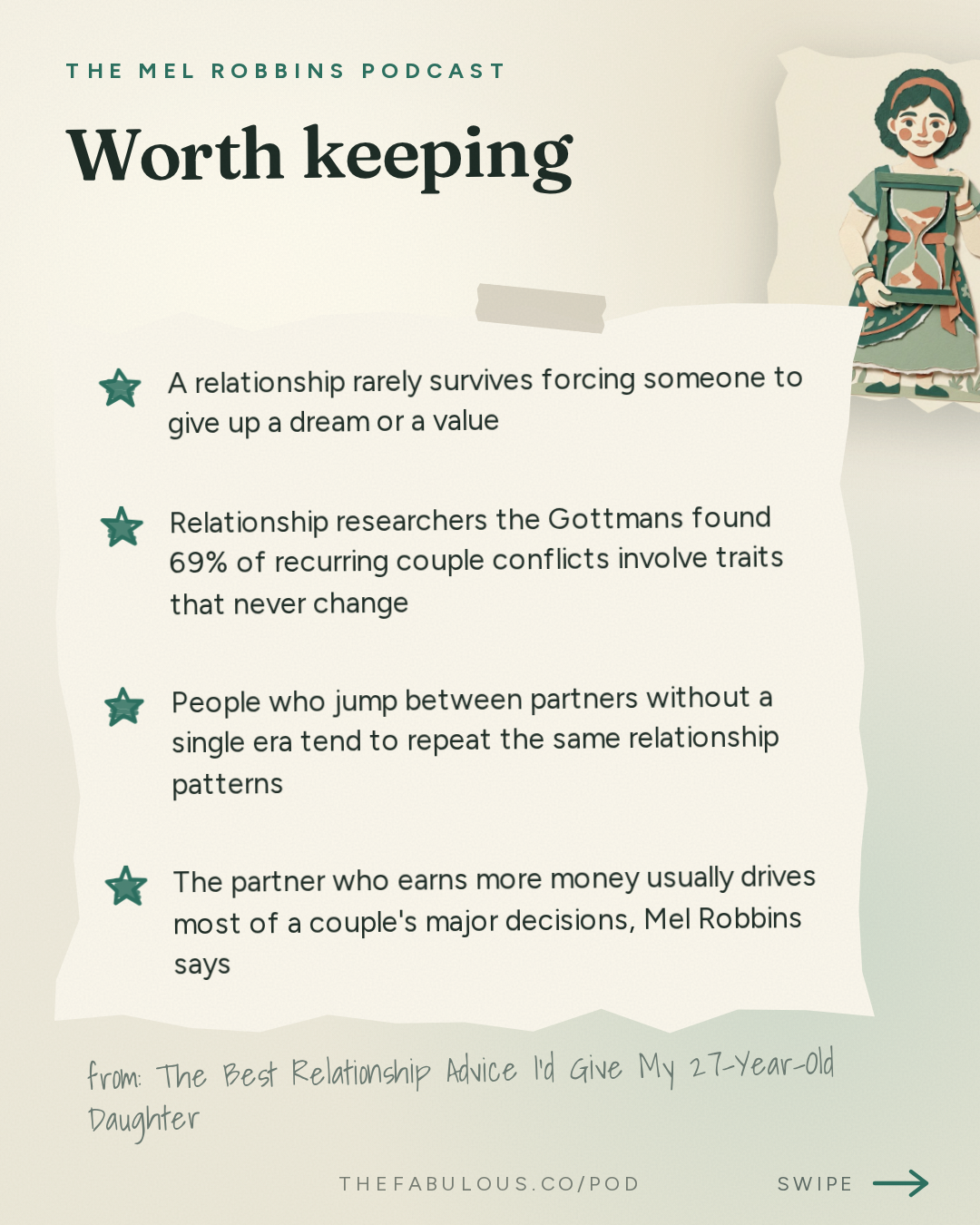
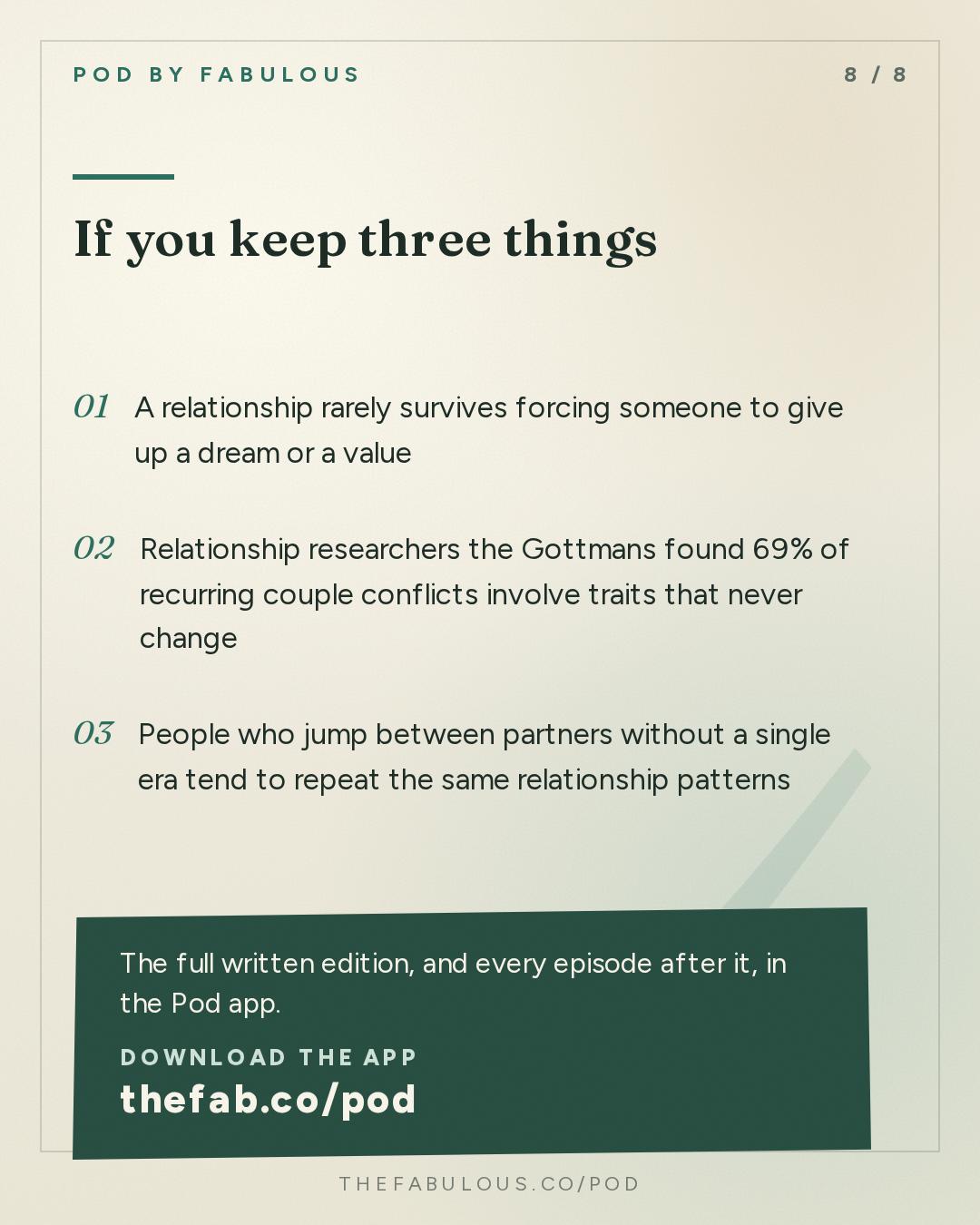
- A relationship rarely survives forcing someone to give up a dream or a value
- Relationship researchers the Gottmans found 69% of recurring couple conflicts involve traits that never change
- People who jump between partners without a single era tend to repeat the same relationship patterns
- The partner who earns more money usually drives most of a couple's major decisions, Mel Robbins says
- In conflict, a person can be right or connected but never both, says couples therapist Terry Real
The episode in cards
By the numbers
- 69% share of recurring couple conflicts that involve traits that never change
- 15 years delay in healing Mel Robbins says resulted from never being single
In their words
“It's intoxicating- Yeah ... when you are falling in love with somebody, and it seems to wipe away all your problems”
“You cannot outrun your past. You cannot outdate your bad habits in relationships, and you cannot marry yourself into healing.”
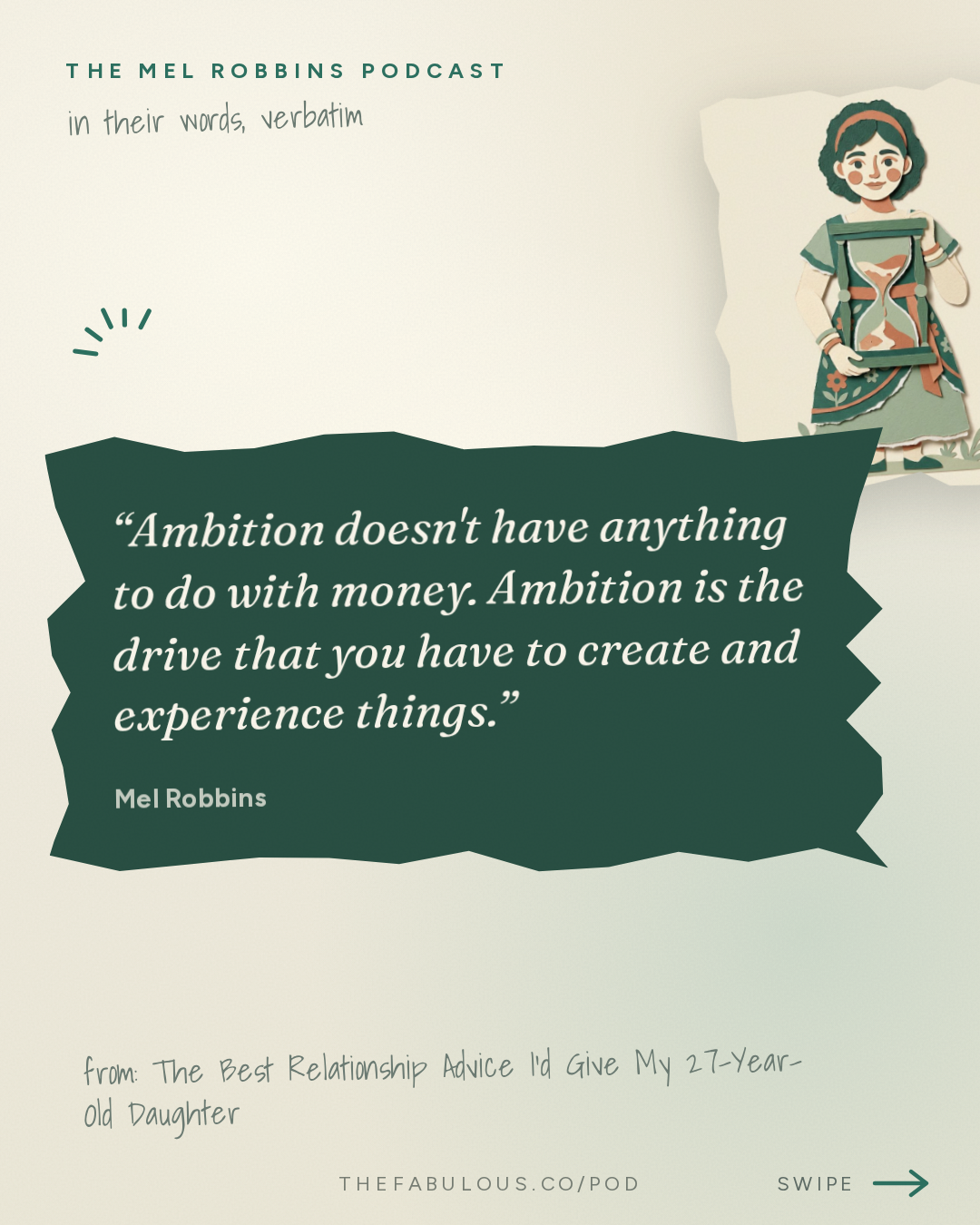
“Ambition doesn't have anything to do with money. Ambition is the drive that you have to create and experience things.”
“"The most important thing to remember about relationships, you can be right or you can be connected." Mm-hmm. "But you can't be”
Protocols
-
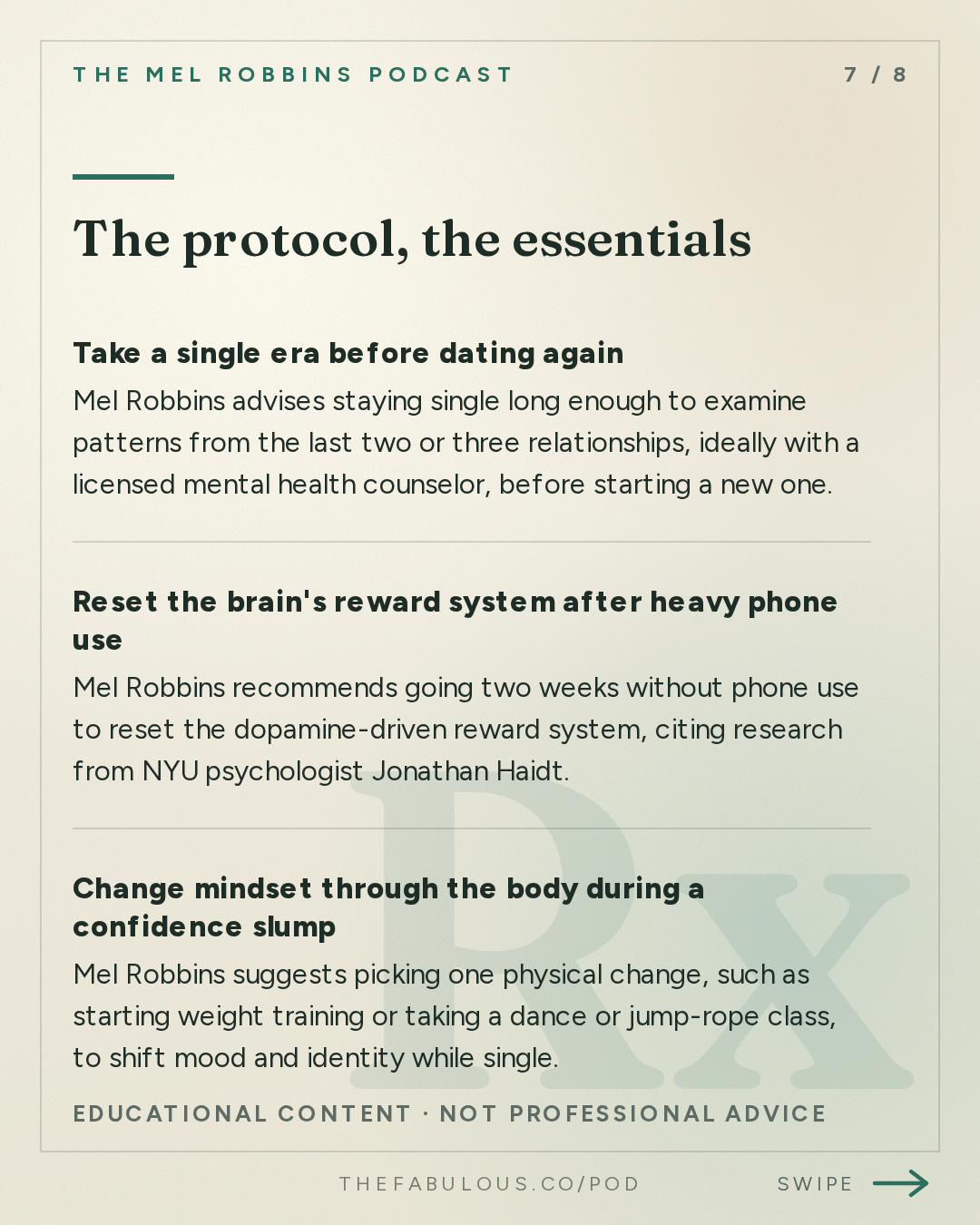
Take a single era before dating again
Mel Robbins advises staying single long enough to examine patterns from the last two or three relationships, ideally with a licensed mental health counselor, before starting a new one.
Once, for as long as it takes; Robbins cites her own six-year stretch as a model.
-
Reset the brain's reward system after heavy phone use
Mel Robbins recommends going two weeks without phone use to reset the dopamine-driven reward system, citing research from NYU psychologist Jonathan Haidt.
A two-week break, used when motivation and engagement drop off noticeably.
-
Change mindset through the body during a confidence slump
Mel Robbins suggests picking one physical change, such as starting weight training or taking a dance or jump-rope class, to shift mood and identity while single.
Ongoing, started immediately and sustained as a daily or weekly habit.
-
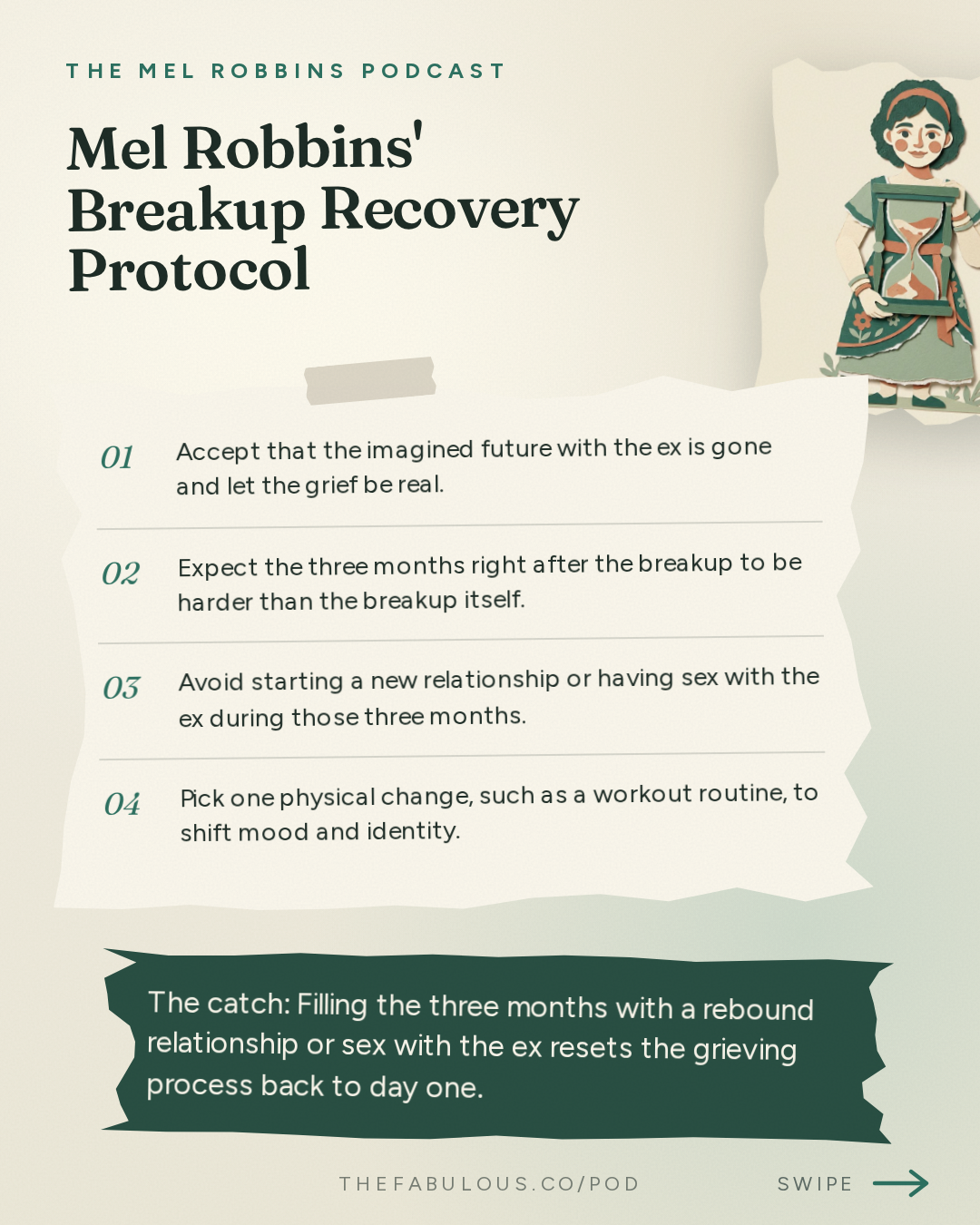
Hold a three-month no-contact window after a breakup
Mel Robbins advises against starting a new relationship or having sex with an ex during the three months after a breakup, since either one resets the grieving process back to day one.
For the first three months following the split.
Questions this episode answers
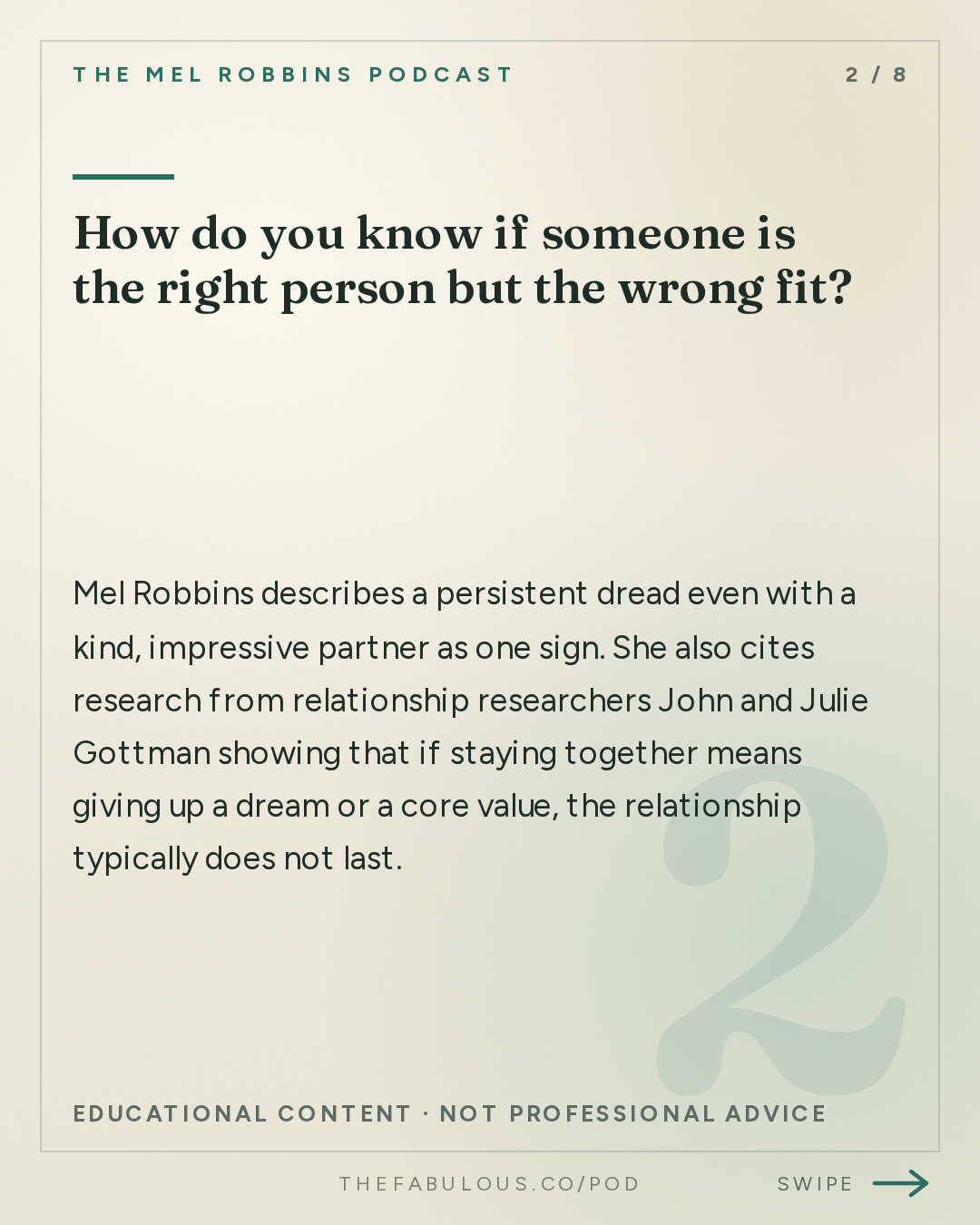
How do you know if someone is the right person but the wrong fit?
Mel Robbins describes a persistent dread even with a kind, impressive partner as one sign (05:08). She also cites research from relationship researchers John and Julie Gottman showing that if staying together means giving up a dream or a core value, the relationship typically does not last (09:12).
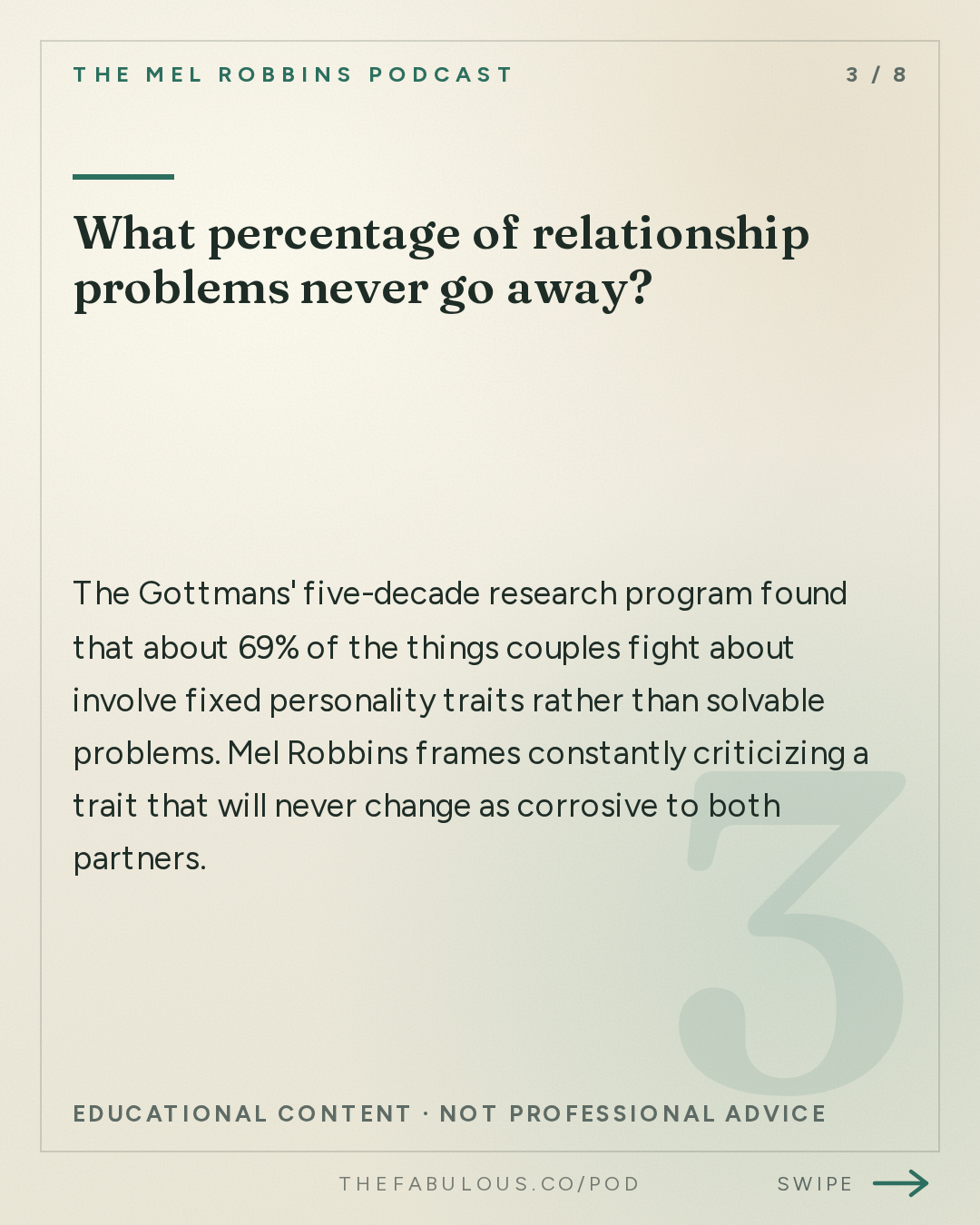
What percentage of relationship problems never go away?
The Gottmans' five-decade research program found that about 69% of the things couples fight about involve fixed personality traits rather than solvable problems (10:44). Mel Robbins frames constantly criticizing a trait that will never change as corrosive to both partners.
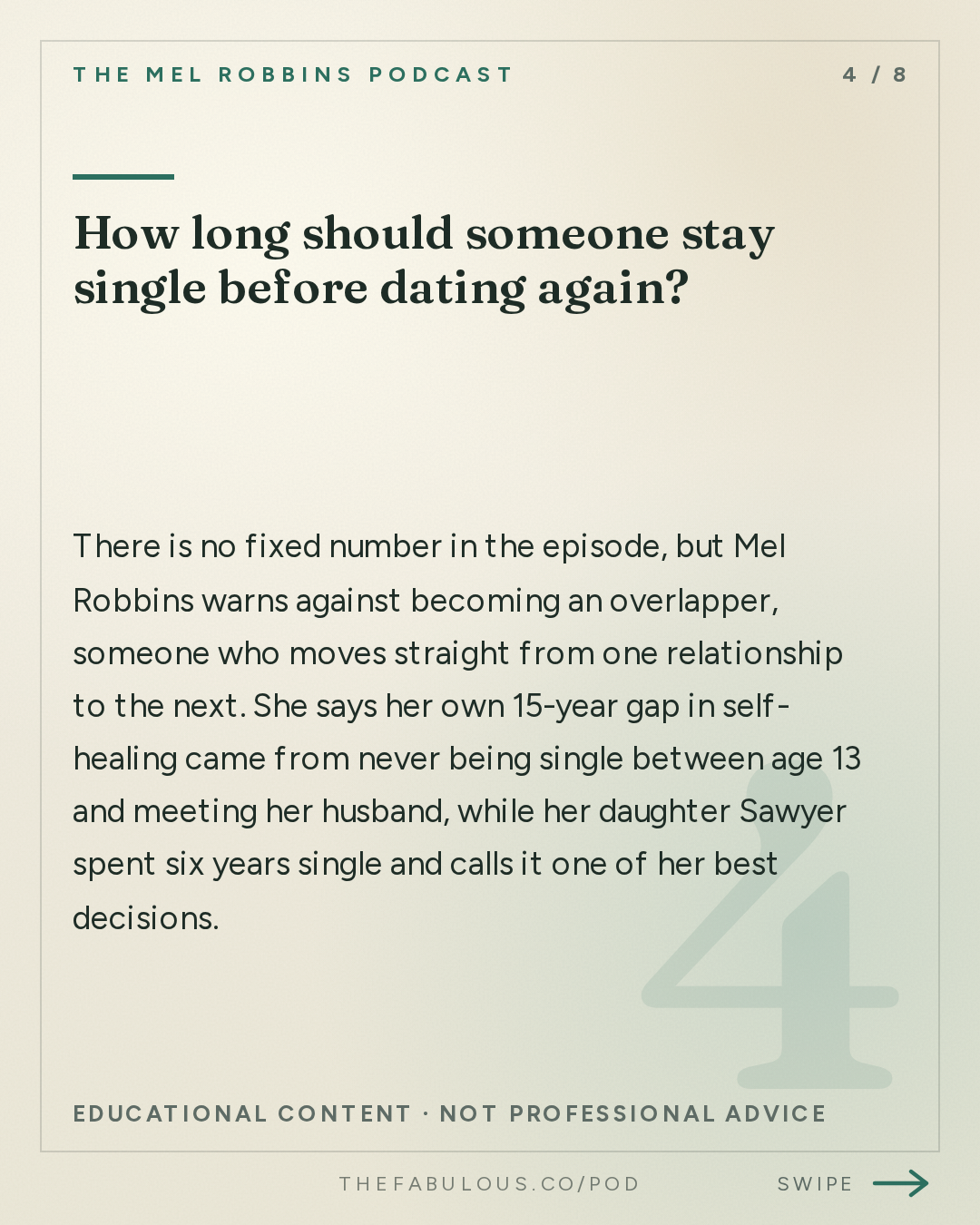
How long should someone stay single before dating again?
There is no fixed number in the episode, but Mel Robbins warns against becoming an overlapper, someone who moves straight from one relationship to the next (18:09). She says her own 15-year gap in self-healing came from never being single between age 13 and meeting her husband, while her daughter Sawyer spent six years single and calls it one of her best decisions (19:25).
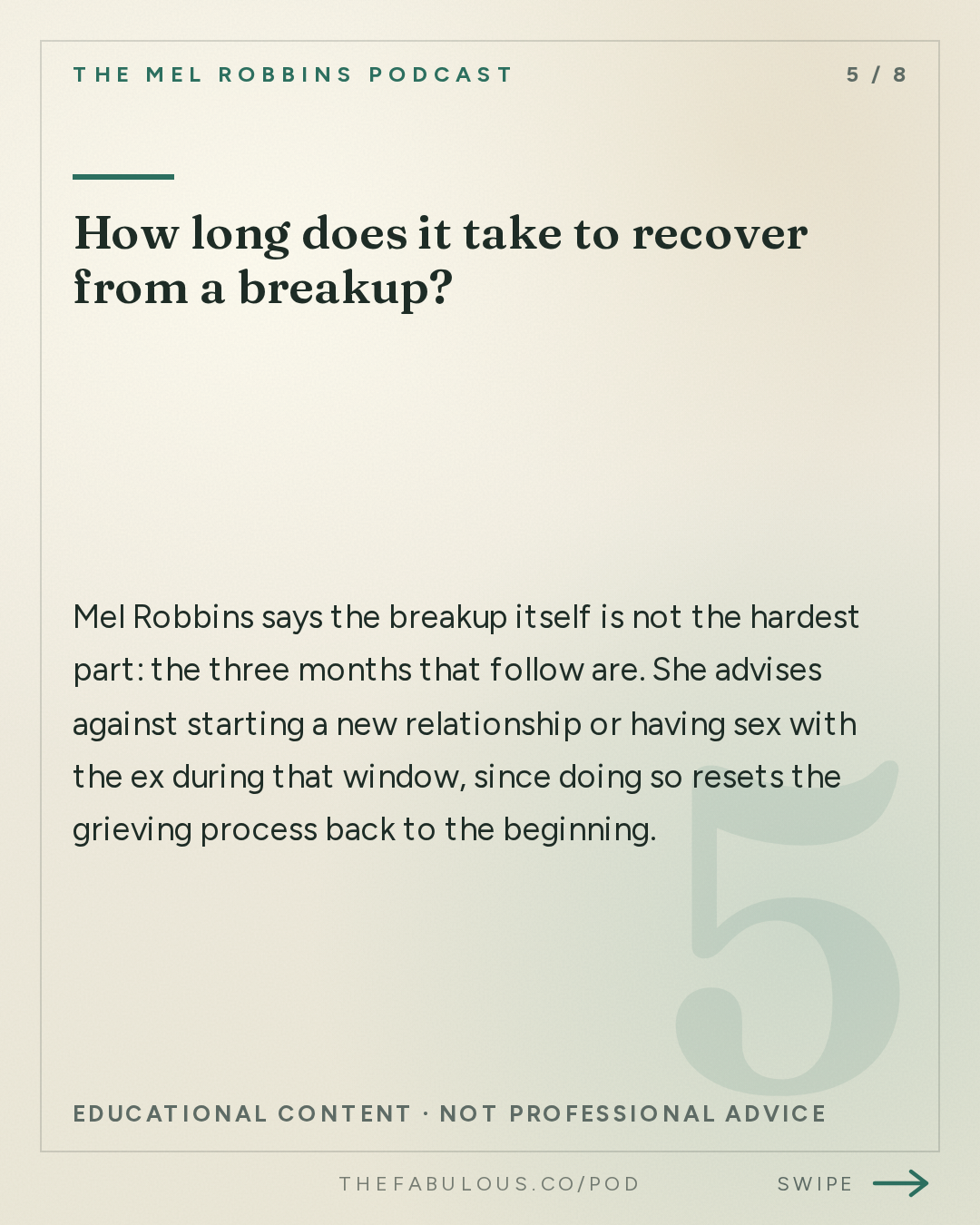
How long does it take to recover from a breakup?
Mel Robbins says the breakup itself is not the hardest part: the three months that follow are (56:03). She advises against starting a new relationship or having sex with the ex during that window, since doing so resets the grieving process back to the beginning.
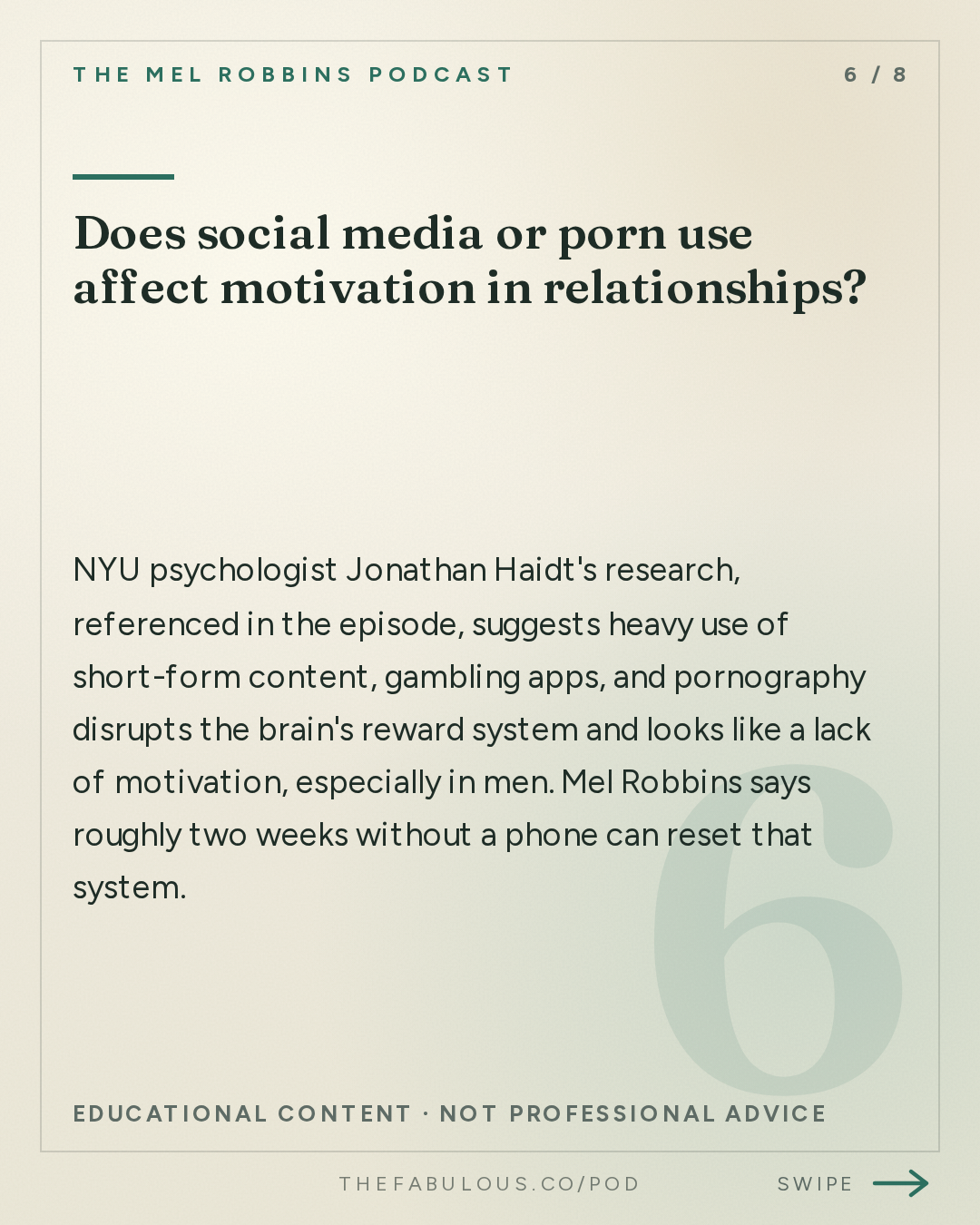
Does social media or porn use affect motivation in relationships?
NYU psychologist Jonathan Haidt's research, referenced in the episode, suggests heavy use of short-form content, gambling apps, and pornography disrupts the brain's reward system and looks like a lack of motivation, especially in men (40:00). Mel Robbins says roughly two weeks without a phone can reset that system (42:01).
The full read, in cards
Go deeper
- Gottman relationship research — Five decades of research by John and Julie Gottman finding that about 69% of recurring couple conflicts involve permanent personality traits
- The Anxious Generation — NYU psychologist Jonathan Haidt's research arguing that heavy use of short-form content, gambling, and porn disrupts the brain's reward system, especially in men
- The Let Them Theory — Mel Robbins and Sawyer Robbins' book exploring why skipping single time causes people to repeat relationship patterns
Mentioned
Mel Robbins · Sawyer Robbins · The Gottmans · James Sexton · The Let Them Theory · Jonathan Haidt · The Anxious Generation · Oprah Winfrey · T.D. Jakes · Terry Real · 75 Hard
More from this show and category
Ed Mylett on Identity, Worry, and Reinvention
Ed Mylett, 55-year-old entrepreneur and podcast host, says identity works like a thermostat that quietly resets your life to a fixed setting no matter how good things get (28:27). He shows how writing down worries strips their power, why love outlasts fear as motivation, and why past failures qualify you to help others (42:25).
Mel Robbins' Relationship Advice for Young Adults
Mel Robbins and her 27-year-old daughter Sawyer sit down to answer real questions about dating, breakups, and ambition. Drawing on Gottman research, NYU psychologist Jonathan Haidt's findings on young men and dopamine, and therapist Terry Real's rule that partners can be right or connected but never both, Robbins argues most relationship trouble starts with an unhealed self, not a wrong partner.
How to Let Go of What No Longer Serves You
Mel Robbins uses a biological metaphor, trees pushing off leaves each fall, to argue that healthy relationships, jobs, and habits need a two-way flow of energy. When something only drains and never gives back, she says it is time to let it go, and she offers two daily tools: a 24-hour no-complaining challenge and a rule against trying to control other people.
5 Skin Habits From a Mayo Clinic Dermatologist
Mayo Clinic dermatologist Saranya Wyles argues skin is a check engine light for the whole body, not a beauty scorecard, and shares five pillars (sleep, diet, movement, stress, topicals) that measurably change how skin ages, from barrier recovery after sleep to facial volume loss on GLP-1 drugs.
