
5 Skin Habits From a Mayo Clinic Dermatologist
Mayo Clinic Dermatologist: 5 Small Habits for Healthier, Younger, and Amazing Skin
▶ Listen to the full episode More from The Mel Robbins Podcast
The brief
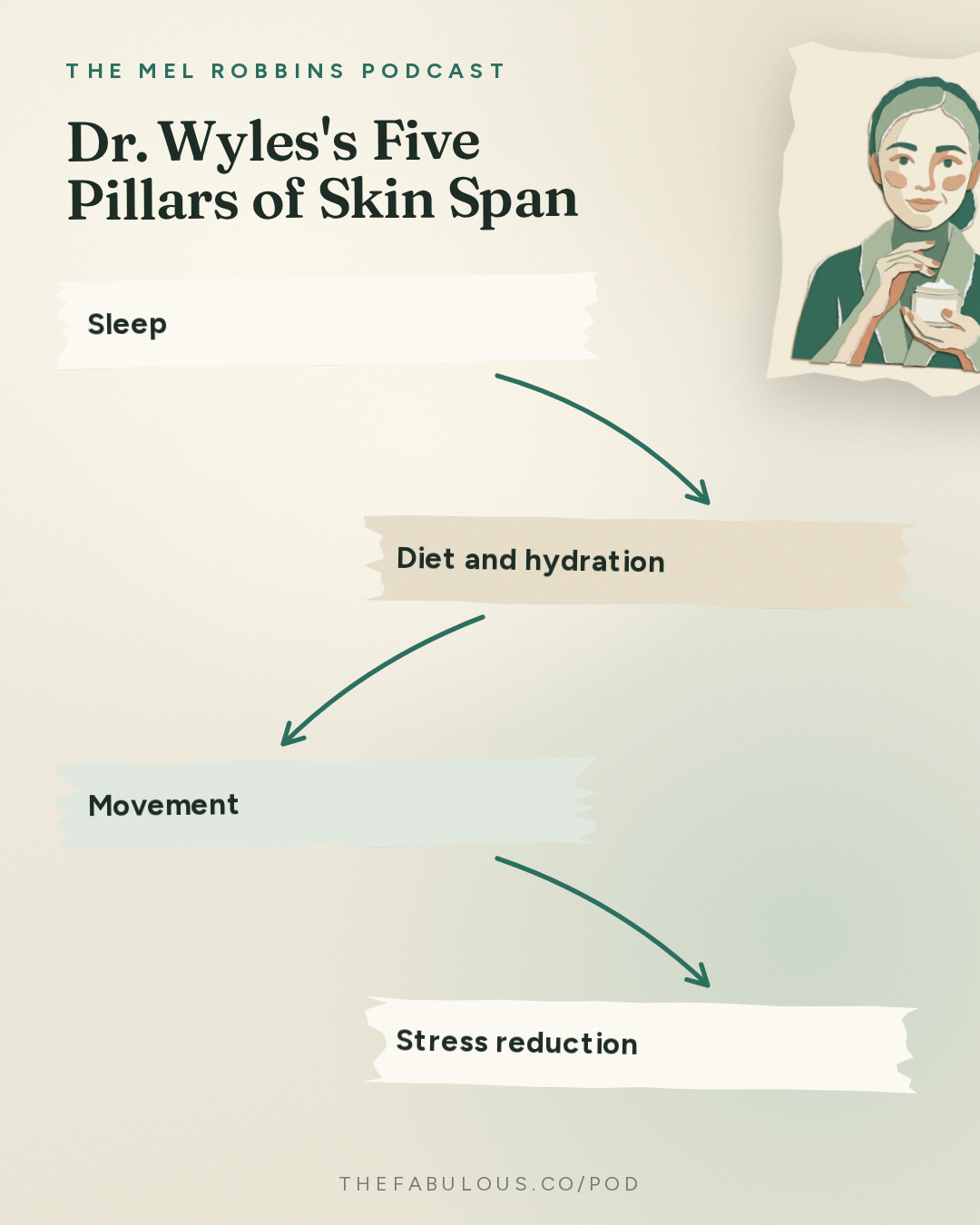
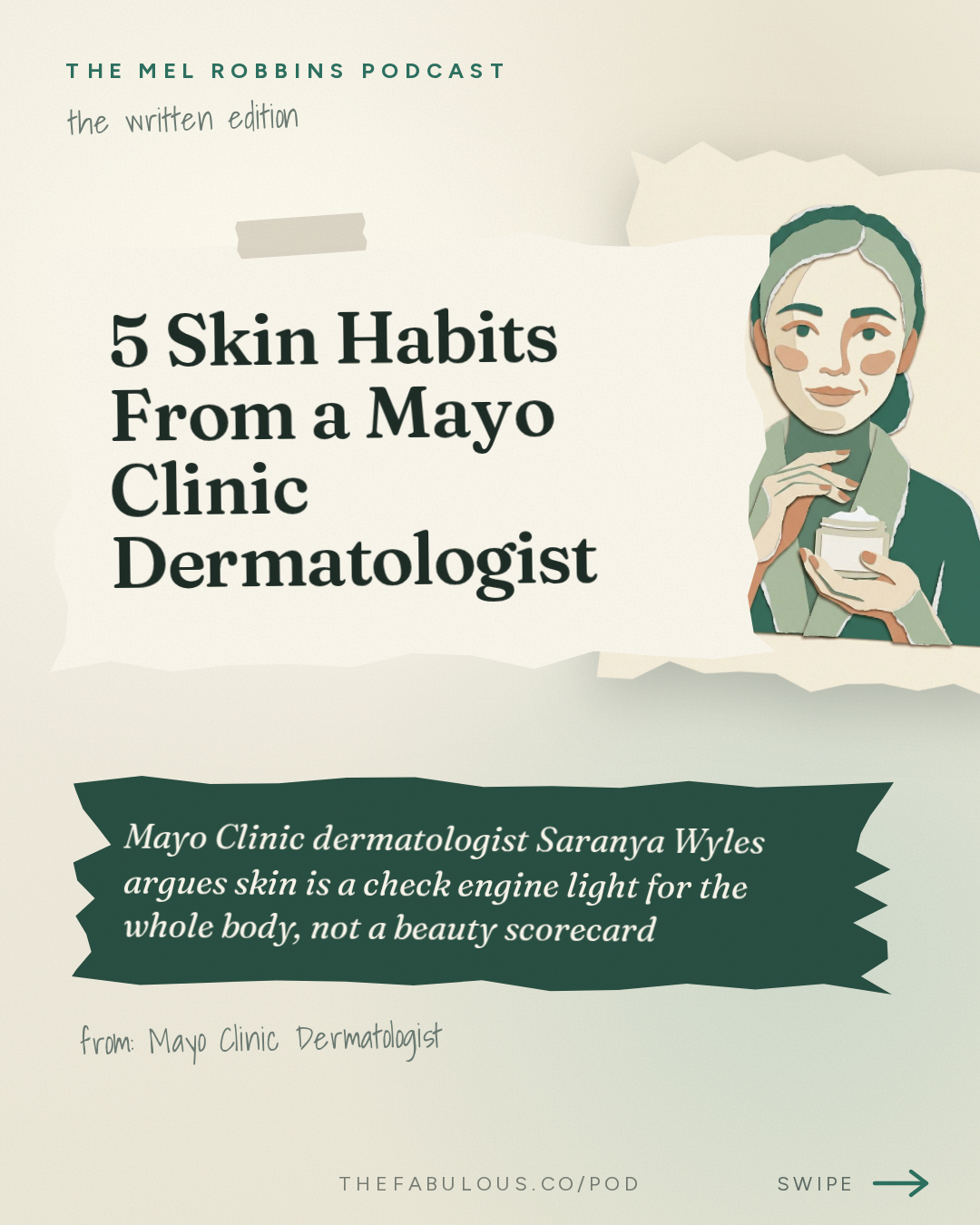
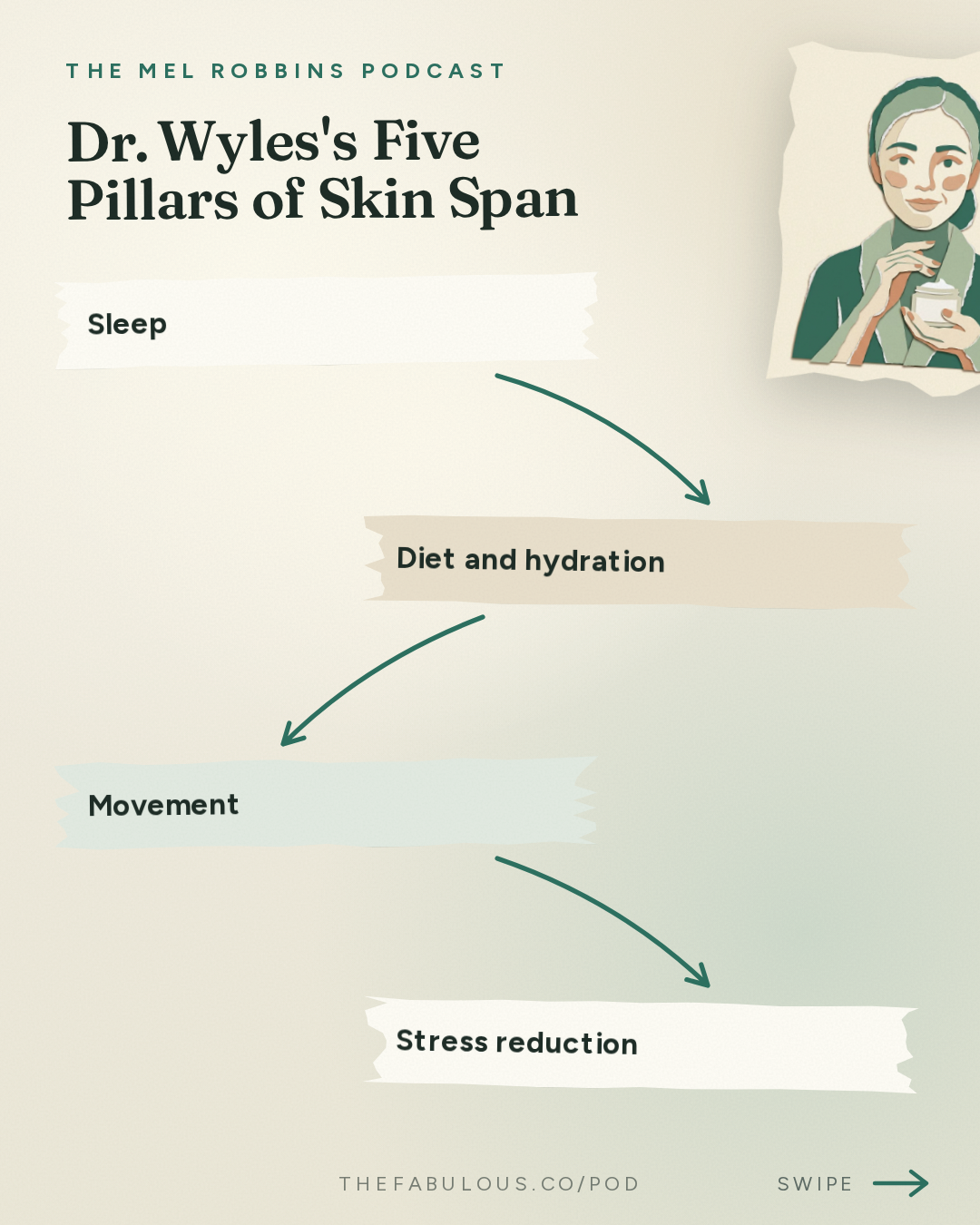
Mayo Clinic dermatologist Saranya Wyles argues skin is a check engine light for the whole body, not a beauty scorecard, and shares five pillars (sleep, diet, movement, stress, topicals) that measurably change how skin ages, from barrier recovery after sleep to facial volume loss on GLP-1 drugs.
A camera flashes. A machine built to look like a tanning bed scans every angle of a face, and seconds later a report card appears: spots, wrinkles, pore size, UV damage, brown spots, redness, and finally a single number, a calculated skin age. Mel Robbins, 57, watches hers come back as 61 (20:38). The moment is a little deflating and, as it turns out, exactly the point. The report is not a verdict. It is information, a readout of decades of sun, sleep, and stress that the skin has been quietly logging.
That is the argument Dr. Saranya Wyles has built a career on. She is a dermatologist and physician-scientist at the Mayo Clinic, where she runs the Regenerative Dermatology and Skin Aging Laboratory and also directs the Center for Aesthetic Medicine and Surgery (03:32). Her opening claim reframes the entire conversation around skin care.
"Your skin is more than a beauty scorecard. It is actually information. It's a two-way conduit between the outside world and the internal systemic health." — Saranya Wyles [05:18]
She calls it a check engine light. The "all of a sudden" brown spot or flush that seems to appear overnight has usually been brewing for months (06:11). And the stakes go beyond vanity: patients with moderate to severe psoriasis, an inflammatory skin condition, carry a sixfold higher 10-year risk of heart failure, heart attacks, and stroke (08:06). Skin, in other words, is not separate from the rest of the body. It is the organ most exposed to the outside world, and it reports back.
The Circadian Life of a Face
One of the more useful ideas in the conversation is that skin runs on a clock, with two distinct modes. During the day it plays defense, managing oil, water, and barrier function against sun, pollution, and daily wear. At night it switches to something closer to offense, meaning active repair and regeneration.
"At daytime, it goes into defense mode... at nighttime, it switches into offense, more like a repair regeneration." — Saranya Wyles [28:03]
The data behind this is concrete. People who sleep well show 30 percent better recovery of the epidermal barrier, the skin's outer protective layer, compared with poor sleepers (28:48). The reverse also holds: just two consecutive nights of three to four hours of sleep measurably disrupts the skin's barrier and hydration in middle-aged women (29:32). Skin does not need chronic sleep deprivation to suffer. Two bad nights are enough to show up on a tape-strip test.
Wyles's one concrete lever here is magnesium threonate, taken one to two hours before bed. She says it helps the nervous system wind down and, at the level of skin cells, supports genes that produce more hyaluronic acid and the matrix proteins that keep skin plump (33:02).
Diet works on skin through a related mechanism: sugar. Wyles describes a process called glycation, where sugar molecules bond permanently to collagen and elastin, the proteins that give skin its structure, stiffening and breaking them down over time.
"Glycation is how sugars stick together, so it's sticky sugars that happen in your skin... and the sugar sticks to something called collagen and elastin." — Saranya Wyles [36:46]
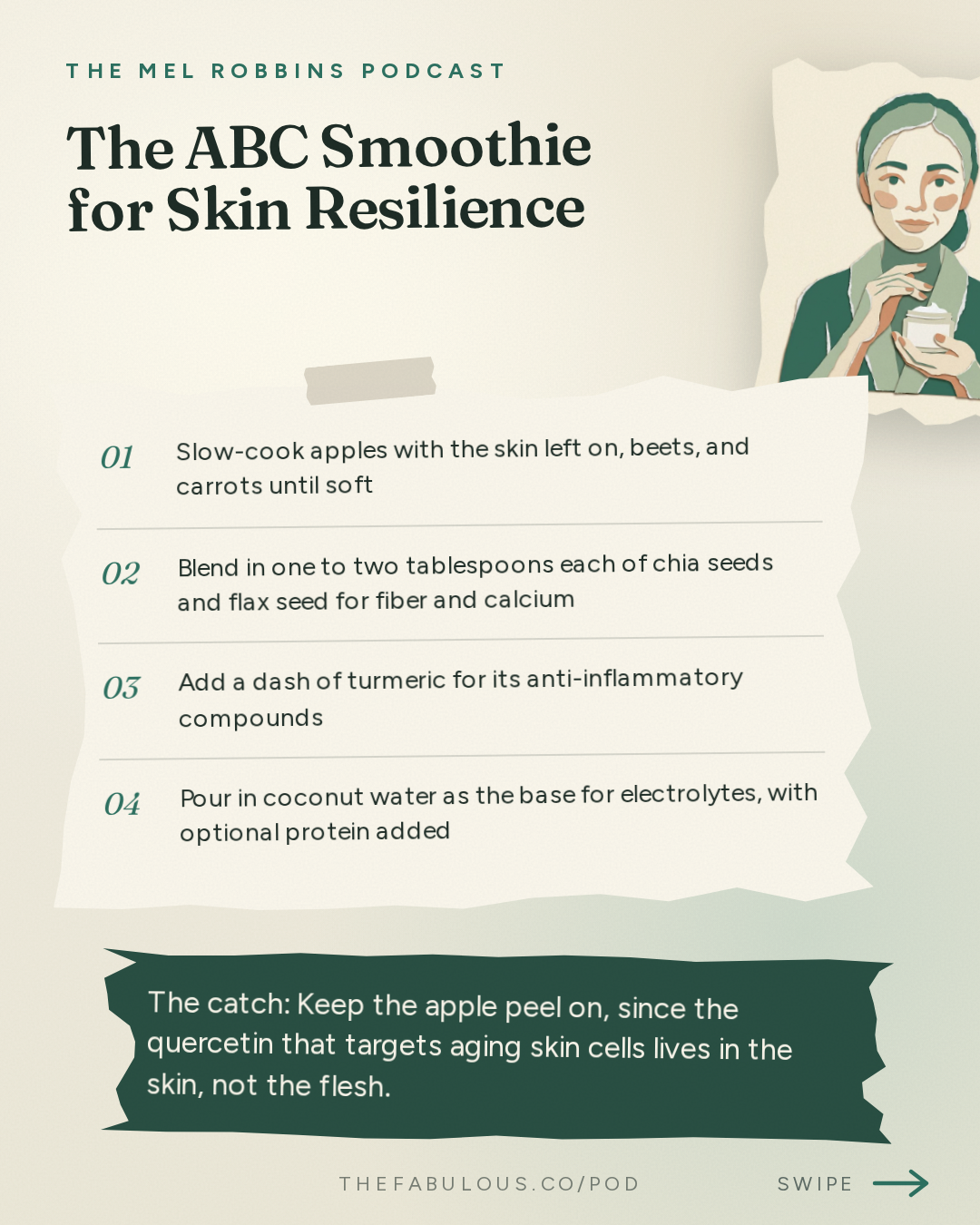
In a 12-week randomized trial, acne patients who switched to a low glycemic index diet, meaning lower in sugar and refined carbohydrates, saw a 23 percent improvement in flares (35:33). A separate 2025 analysis of the UK Biobank, a large biomedical database drawing on over 200,000 people, found that higher fiber intake tracked with fewer psoriasis flares, likely because fiber blunts the blood sugar spikes that drive glycation (39:48). Wyles's own habit, inherited from her grandmother in Chennai, is a slow-cooked blend of apples (skin on, for the flavonoid quercetin), beets, and carrots, with chia and flax seed for fiber and calcium, turmeric for its anti-inflammatory effect, and coconut water for electrolytes (41:20).
Movement matters too, through a mechanism most people have never heard of: exosomes, tiny signaling particles cells release into the bloodstream. In a small randomized study of older adults, the group that exercised healed wounds an average of 10 days faster than the group that did not, something Wyles attributes to beneficial exosomes triggered by movement (50:59). A separate 16-week study of 56 middle-aged women found that resistance training, more than cardio alone, improved skin elasticity and strengthened the dermis, the structural middle layer of skin that holds collagen and elastin (52:43).
What Weight Loss Takes Away
Stress leaves its own trail. Skin carries real cortisol receptors, part of what Wyles calls a localized fight-or-flight system, and chronic stress measurably slows barrier recovery, as shown in a study of women going through divorce (59:40). Hair follows a similar, slower script: a major stressful event, a death, surgery, or job loss, typically shows up as noticeable shedding three to four months later (60:27). For hair thinning tied to male pattern baldness, Wyles points to a study in which 400 milligrams of daily pumpkin seed oil over 24 weeks shifted the androgens, hormones linked to hair loss, enough to support healthier follicles (62:17).
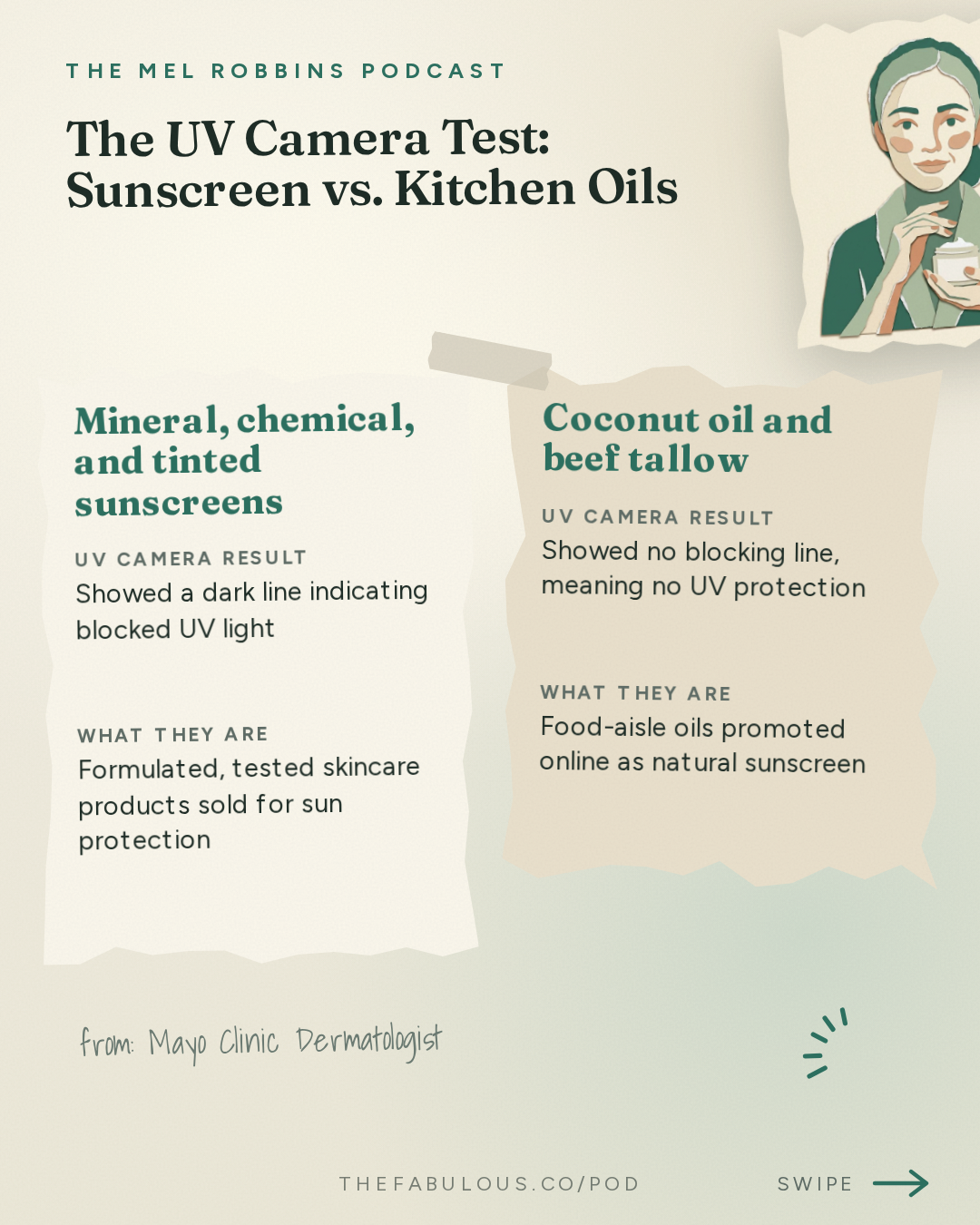
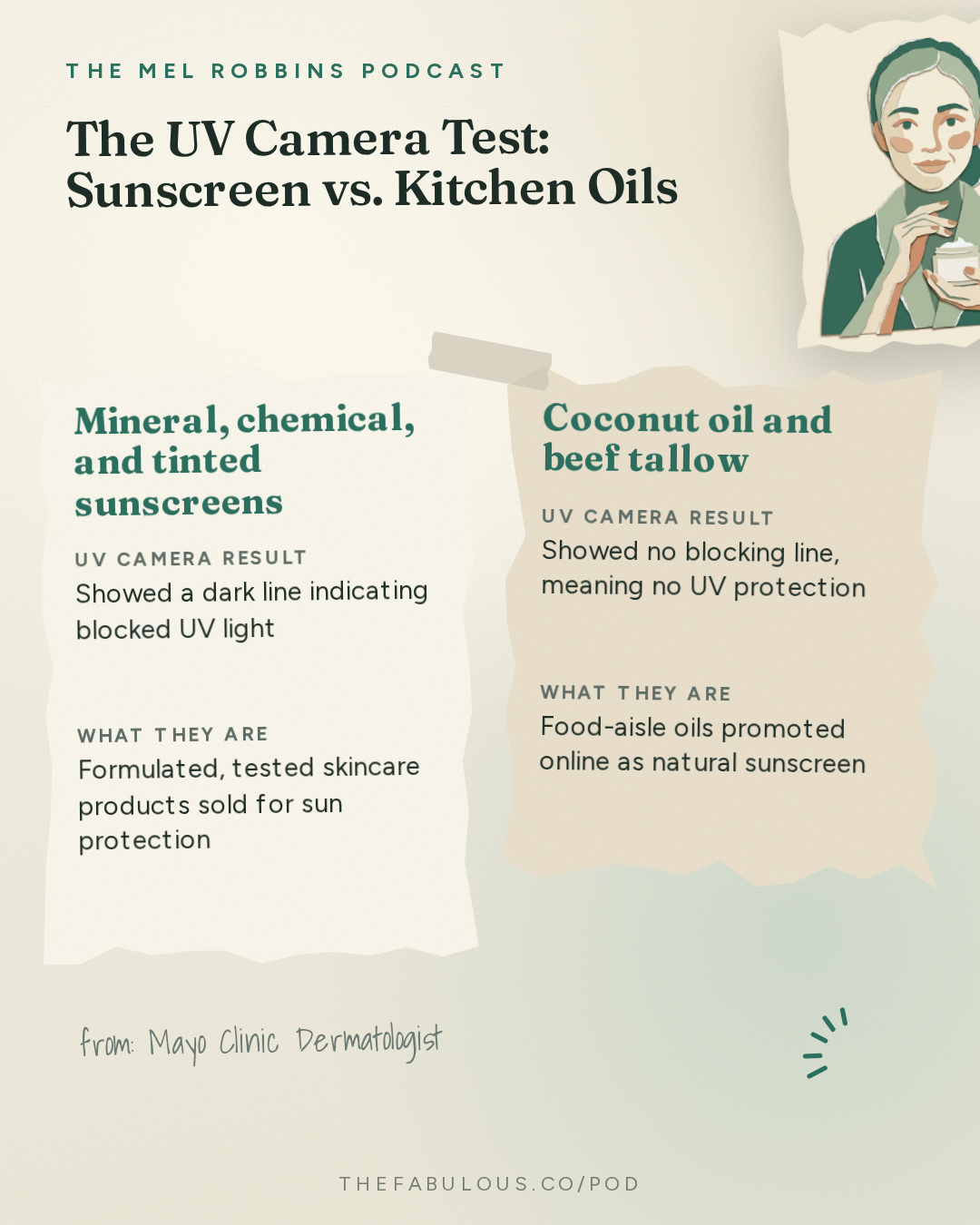
The episode's most vivid segment is a live test. Wyles applies five products, mineral sunscreen, chemical sunscreen, tinted sunscreen, coconut oil, and beef tallow, to Mel's forearm and scans each under a UV camera. The three sunscreens show a dark line indicating blocked UV light. The coconut oil and beef tallow show nothing (73:43). Her broader point: a tinted sunscreen's iron oxides also block visible light, which matters for melasma-prone skin, and sunscreen belongs in the car, since a New England Journal of Medicine photograph of a truck driver shows one side of his face aged by decades from decades of unprotected window exposure (74:26).
To explain sagging and jowls, Wyles reaches for cake. Skin has three layers (an outer epidermis, a structural dermis, and a fatty hypodermis) sitting on muscle, which sits on bone, like layers of cake on a platter. With age, the platter itself, the bone, shrinks, and the whole structure settles lower on the face (78:04). GLP-1 medications complicate this further. For every 20 pounds lost on a GLP-1 drug, patients lose roughly 10 percent of facial volume, because the fat layer that normally cushions the face thins out quickly, unlike the slow stretch of pregnancy weight gain (83:40). Wyles calls the resulting look, loose skin from rapid fat loss, Ozempic face, and her practical fix is the same lever as before: strength training, since muscle and skin are chemically linked through exercise-induced exosomes, and building muscle mass can help counter the sag.
What ties all five pillars together, sleep, diet, movement, stress, and topicals, is the same idea Wyles opened with: skin is not decoration. It is a reporting organ, and it is also a lever.
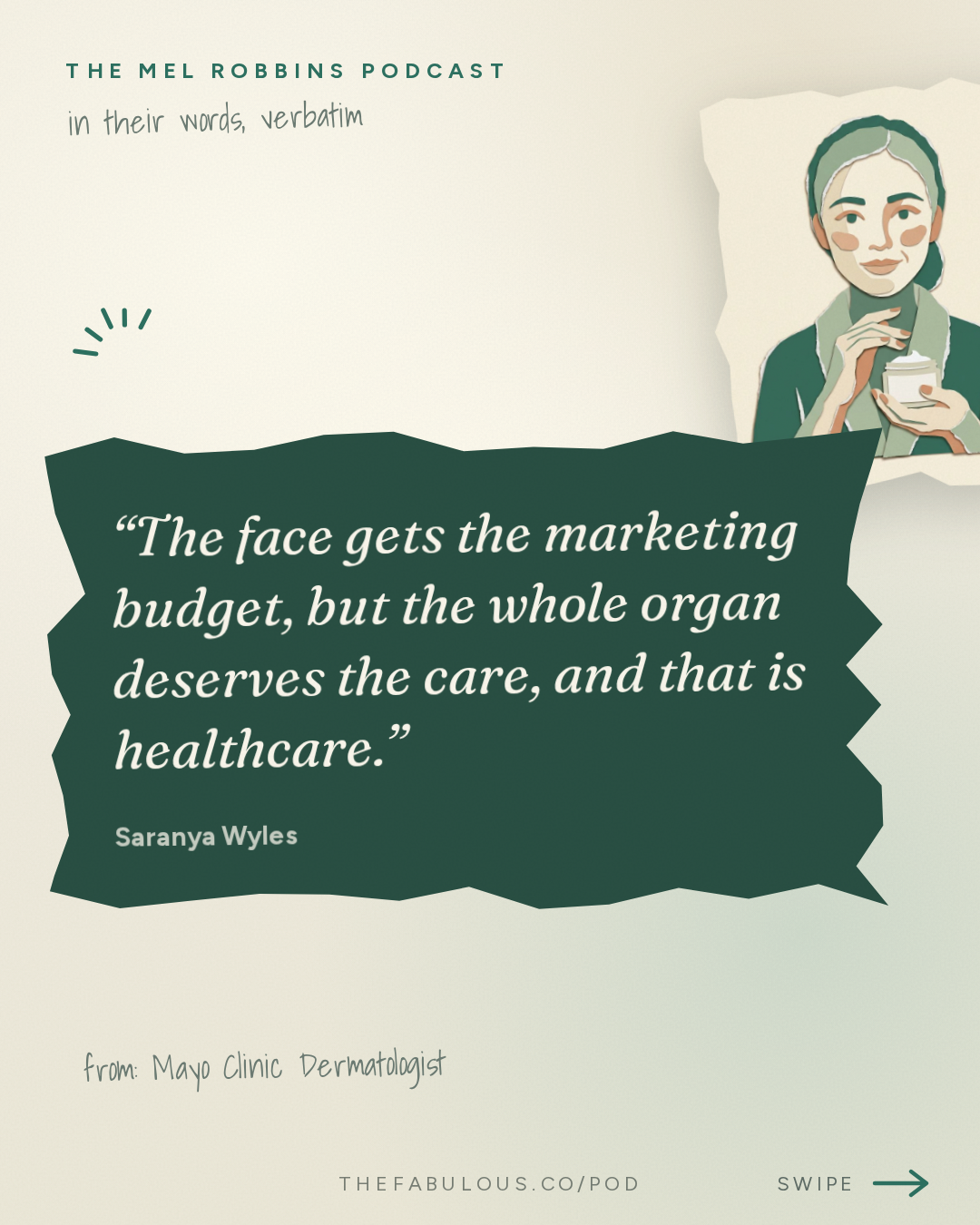
"The face gets the marketing budget, but the whole organ deserves the care, and that is healthcare." — Saranya Wyles [88:11]
The industry built around skin sells creams and serums as if the face were the whole story. Wyles's research says otherwise: the signals that actually change a face start somewhere less glamorous, in a decent night's sleep, a lower sugar plate, a set of dumbbells, and a tube of sunscreen kept in the glove compartment.
Ask this episode anything
Pod's AI answers from the episode itself, with the minute mark so you can hear it yourself.
Or start with one of these
Ask this episode
Pod's AI listens to the whole episode to answer, and points you to the minute it comes from.
The rest of this answer, and any question after it
Answers come from the episode itself, never from a summary of it.
ContinueKey takeaways
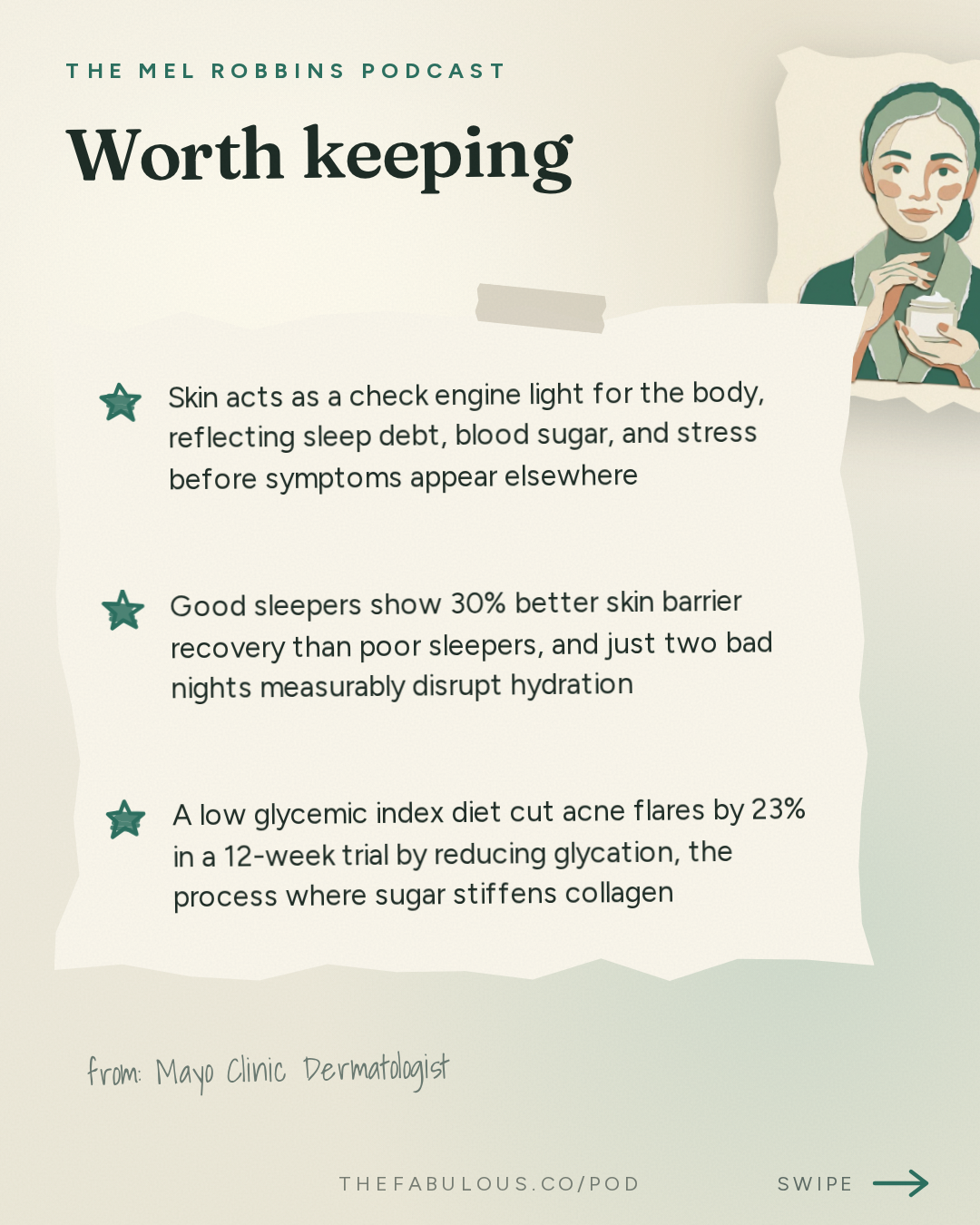
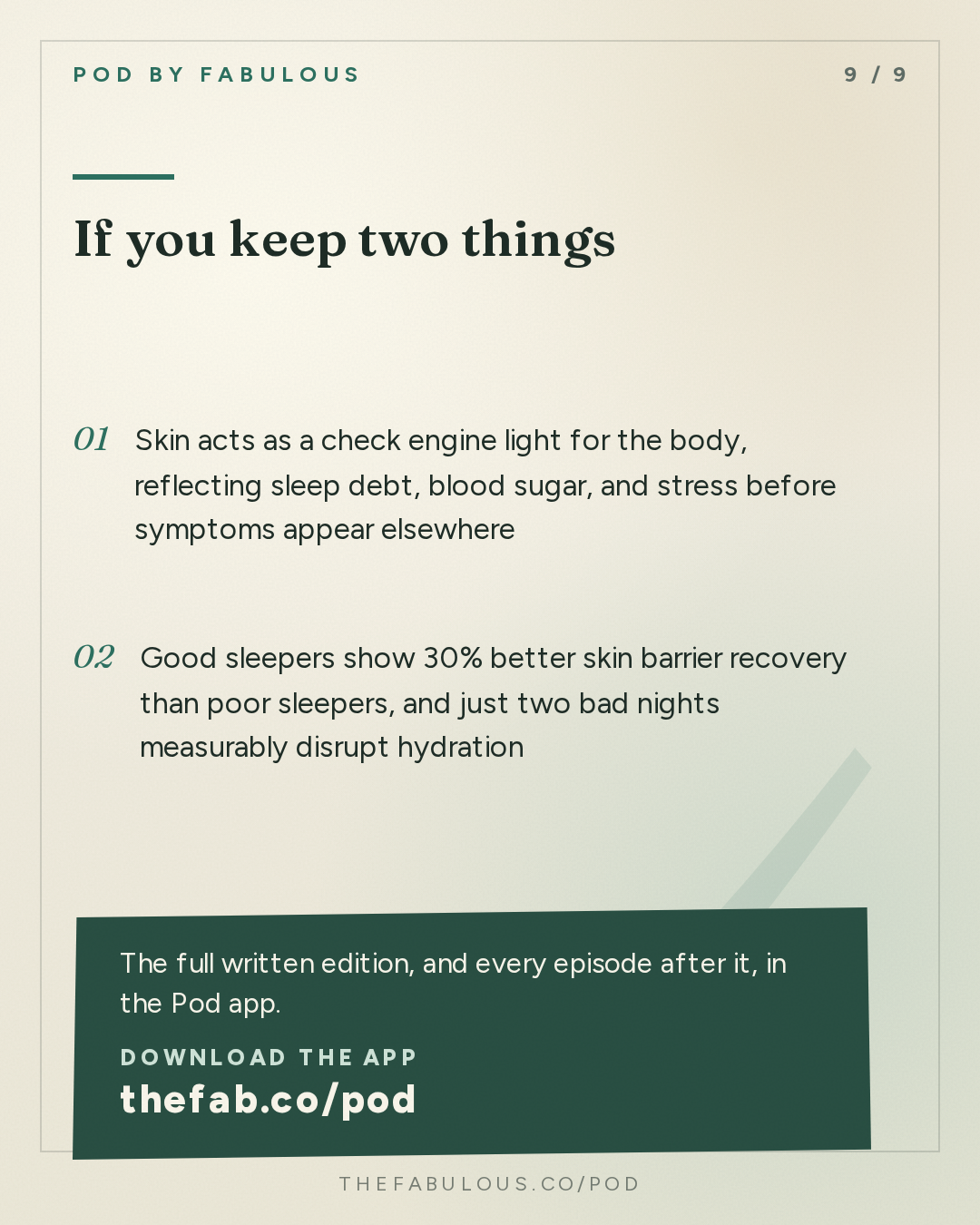
- Skin acts as a check engine light for the body, reflecting sleep debt, blood sugar, and stress before symptoms appear elsewhere
- Good sleepers show 30% better skin barrier recovery than poor sleepers, and just two bad nights measurably disrupt hydration
- A low glycemic index diet cut acne flares by 23% in a 12-week trial by reducing glycation, the process where sugar stiffens collagen
- Losing 20 pounds on a GLP-1 drug correlates with 10% facial volume loss because the fat layer under skin thins faster than skin can adapt
- A live UV camera test showed mineral, chemical, and tinted sunscreens block UV light, while coconut oil and beef tallow do not
The episode in cards

By the numbers
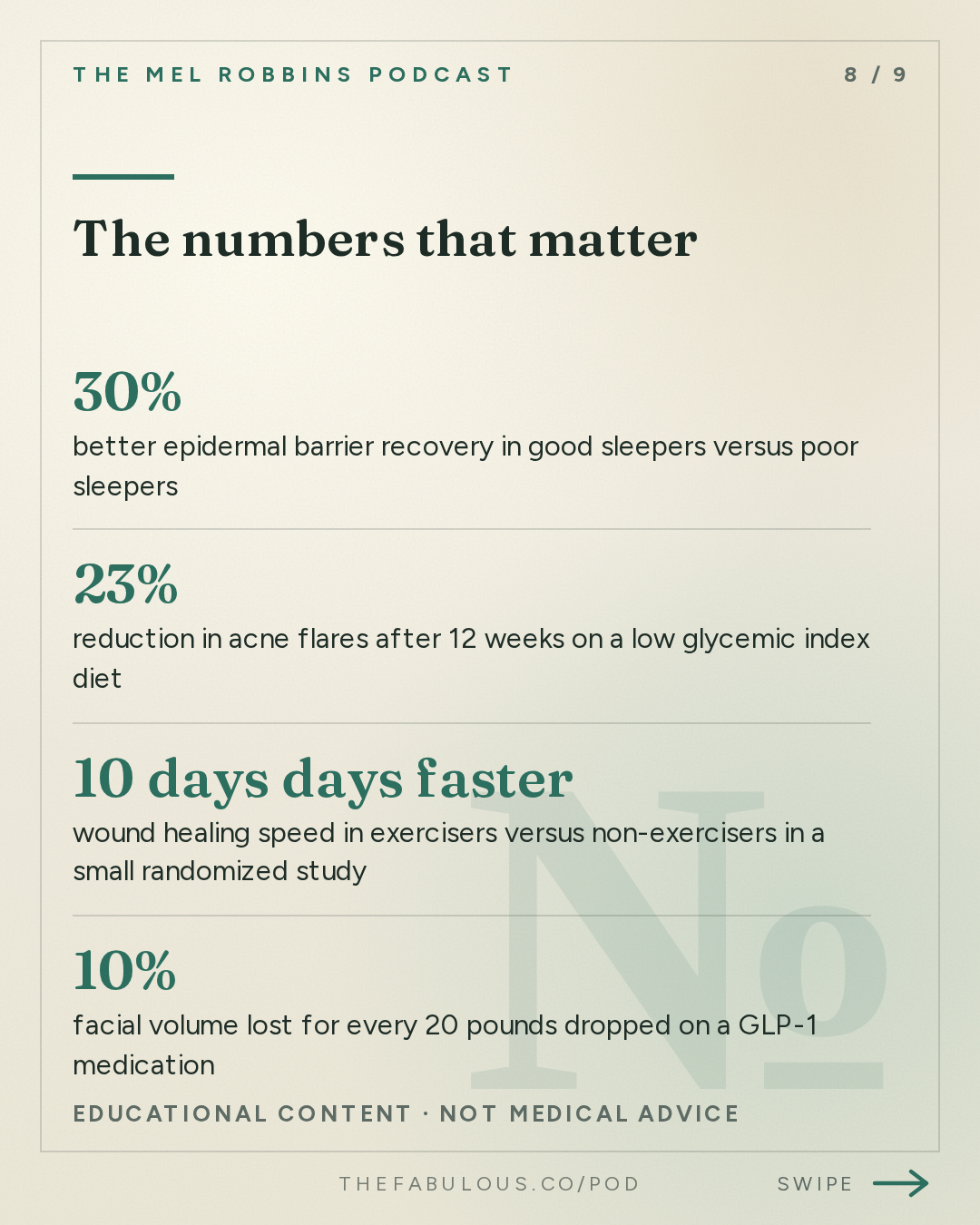
- 30% percent better epidermal barrier recovery in good sleepers versus poor sleepers
- 23% percent reduction in acne flares after 12 weeks on a low glycemic index diet
- 10 days days faster wound healing speed in exercisers versus non-exercisers in a small randomized study
- 10% percent facial volume lost for every 20 pounds dropped on a GLP-1 medication
In their words
“Your skin is more than a beauty scorecard. It is actually information. It's a two-way conduit between the outside world and the internal systemic health.”
“Glycation is how sugars stick together, so it's sticky sugars- Okay ... that happen in your skin, and the sugar sticks to something called collagen and elastin”
“The face gets the marketing budget, but the whole organ deserves the care, and that is healthcare.”
Protocols
-
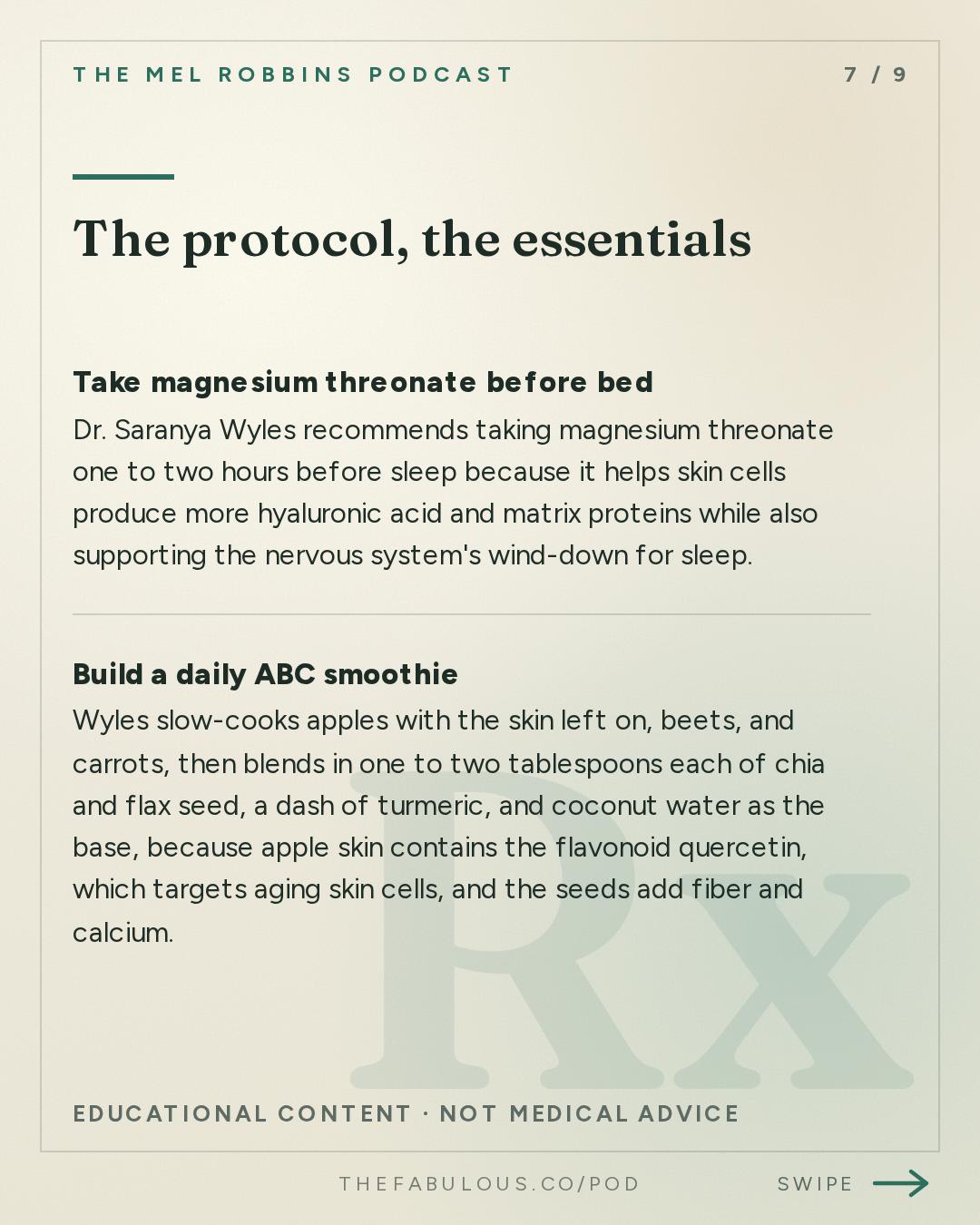
Take magnesium threonate before bed
Dr. Saranya Wyles recommends taking magnesium threonate one to two hours before sleep because it helps skin cells produce more hyaluronic acid and matrix proteins while also supporting the nervous system's wind-down for sleep.
Nightly, 1 to 2 hours before bed
-
Build a daily ABC smoothie
Wyles slow-cooks apples with the skin left on, beets, and carrots, then blends in one to two tablespoons each of chia and flax seed, a dash of turmeric, and coconut water as the base, because apple skin contains the flavonoid quercetin, which targets aging skin cells, and the seeds add fiber and calcium.
Daily
-
Aim for about 10 cups of water daily
Wyles tells women, especially those in perimenopause and menopause, to drink roughly 10 cups of water a day because baseline water loss and stress both rise at that life stage, and she pairs this with a topical moisturizer containing humectants like glycerin or beta glucans since drinking water alone will not hydrate the skin barrier.
Daily
-
Try pumpkin seed oil for thinning hair
Wyles cites a 24-week study in which men with male pattern baldness took 400 milligrams of pumpkin seed oil daily and saw a shift in the androgens that drive hair loss, and she recommends discussing the supplement with a doctor rather than treating it as a guaranteed fix.
Daily supplement
-
Keep sunscreen in the car
Wyles advises reapplying broad-spectrum SPF 30 or higher sunscreen during the daily commute because car windows do not block UVA rays, a point she illustrates with a New England Journal of Medicine photograph of a truck driver whose sun-exposed side aged decades faster than the other.
Before and during driving
Questions this episode answers
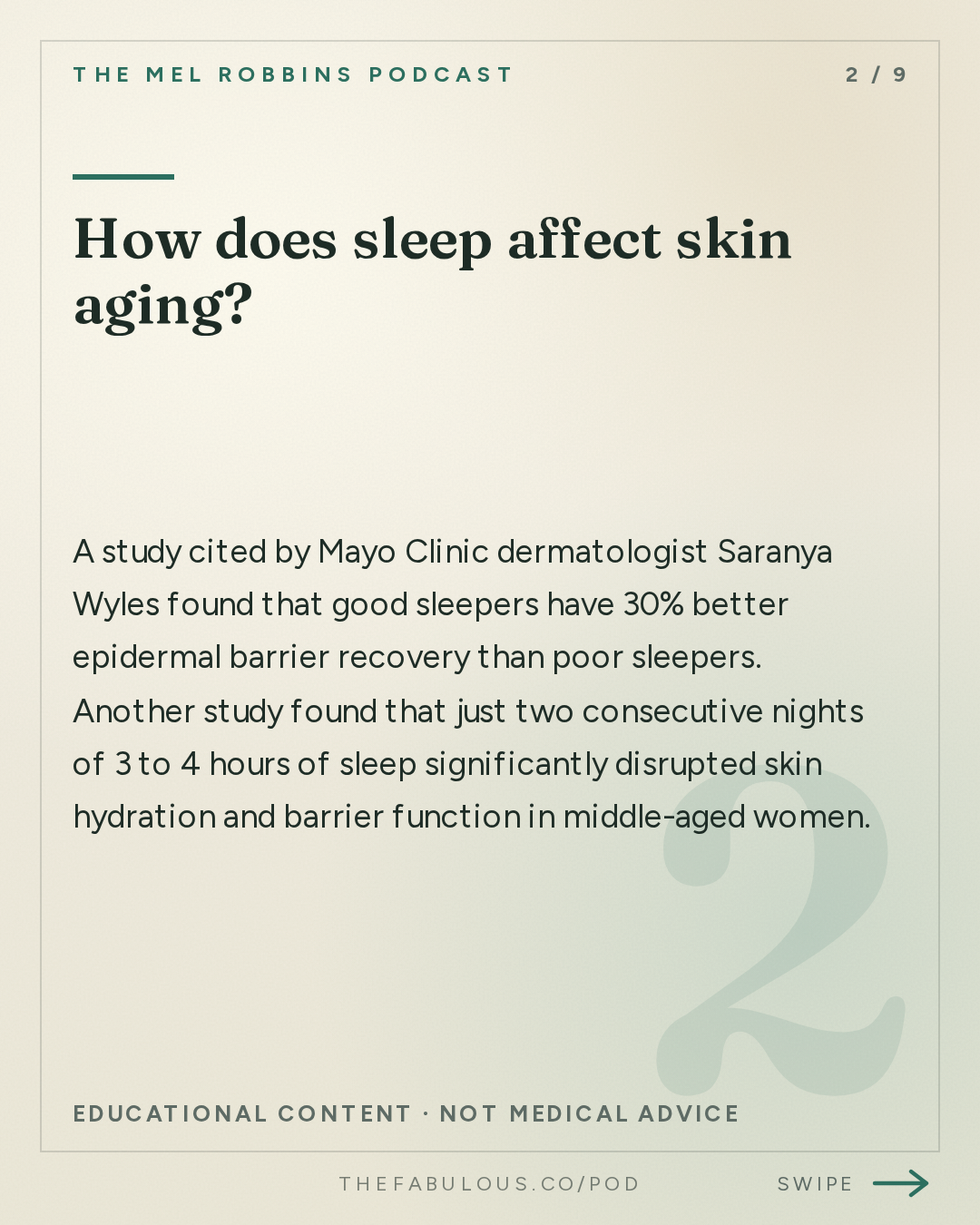
How does sleep affect skin aging?
A study cited by Mayo Clinic dermatologist Saranya Wyles found that good sleepers have 30% better epidermal barrier recovery than poor sleepers (28:48). Another study found that just two consecutive nights of 3 to 4 hours of sleep significantly disrupted skin hydration and barrier function in middle-aged women (29:32).
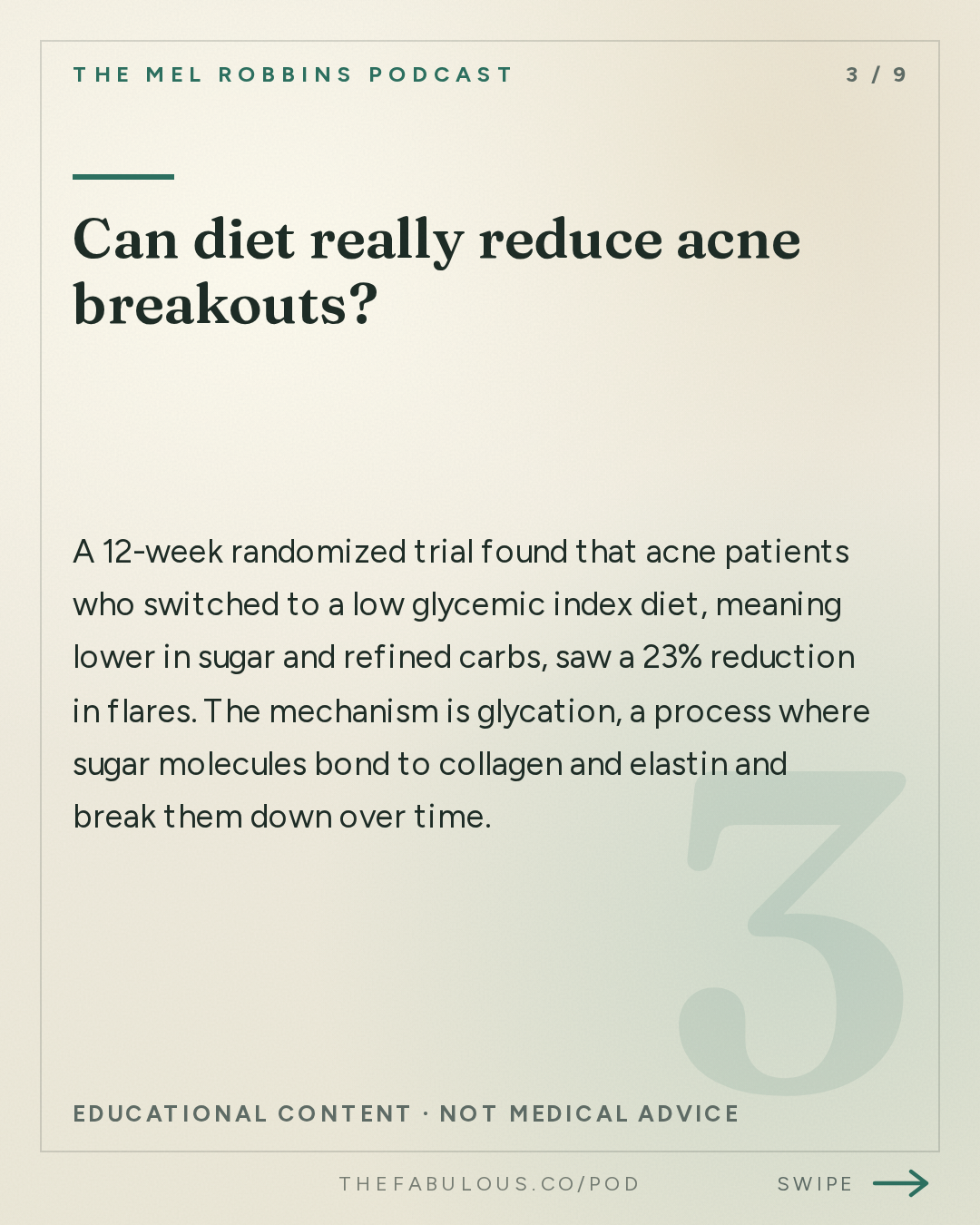
Can diet really reduce acne breakouts?
A 12-week randomized trial found that acne patients who switched to a low glycemic index diet, meaning lower in sugar and refined carbs, saw a 23% reduction in flares (35:33). The mechanism is glycation, a process where sugar molecules bond to collagen and elastin and break them down over time (36:46).
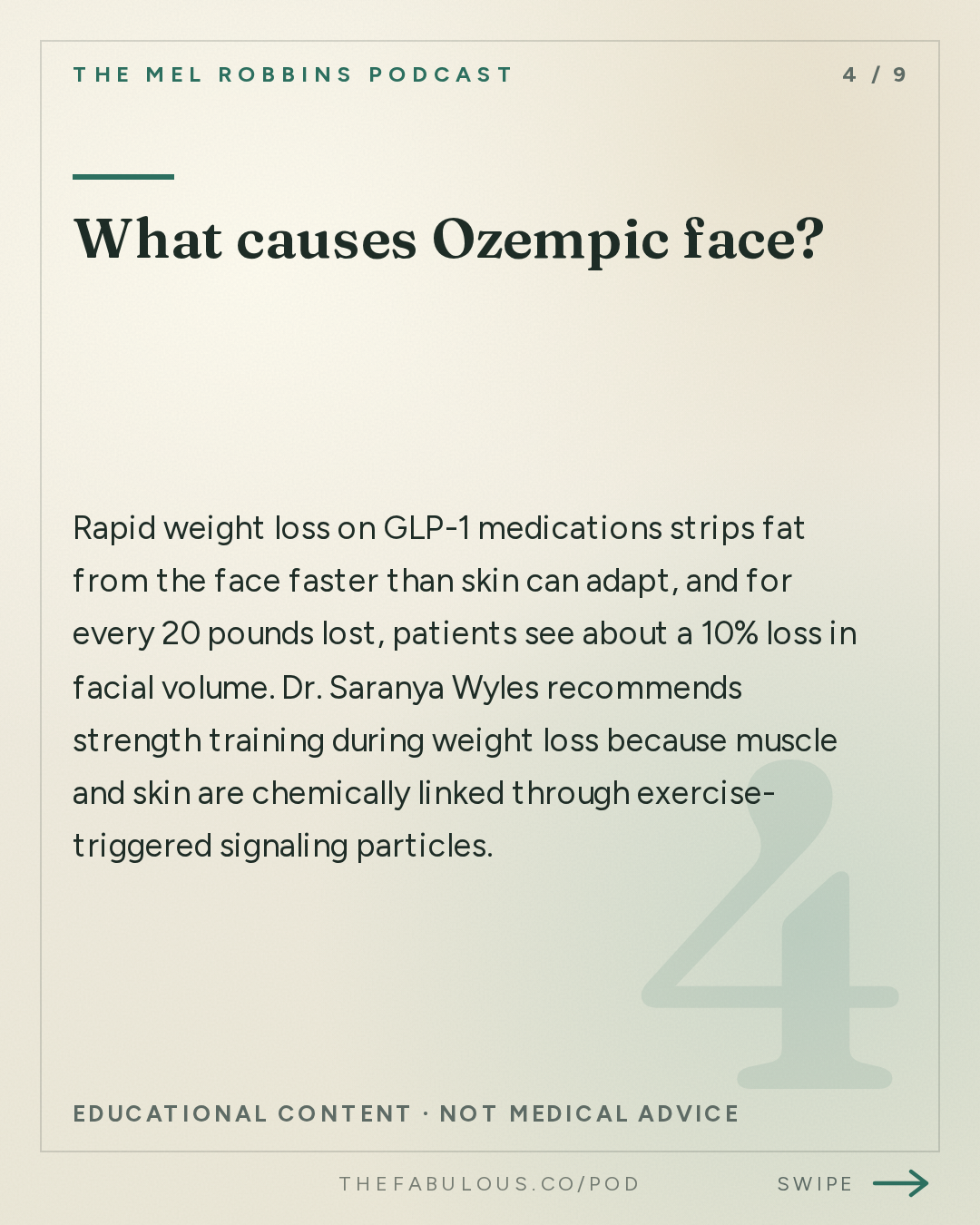
What causes Ozempic face?
Rapid weight loss on GLP-1 medications strips fat from the face faster than skin can adapt, and for every 20 pounds lost, patients see about a 10% loss in facial volume (83:40). Dr. Saranya Wyles recommends strength training during weight loss because muscle and skin are chemically linked through exercise-triggered signaling particles (86:16).
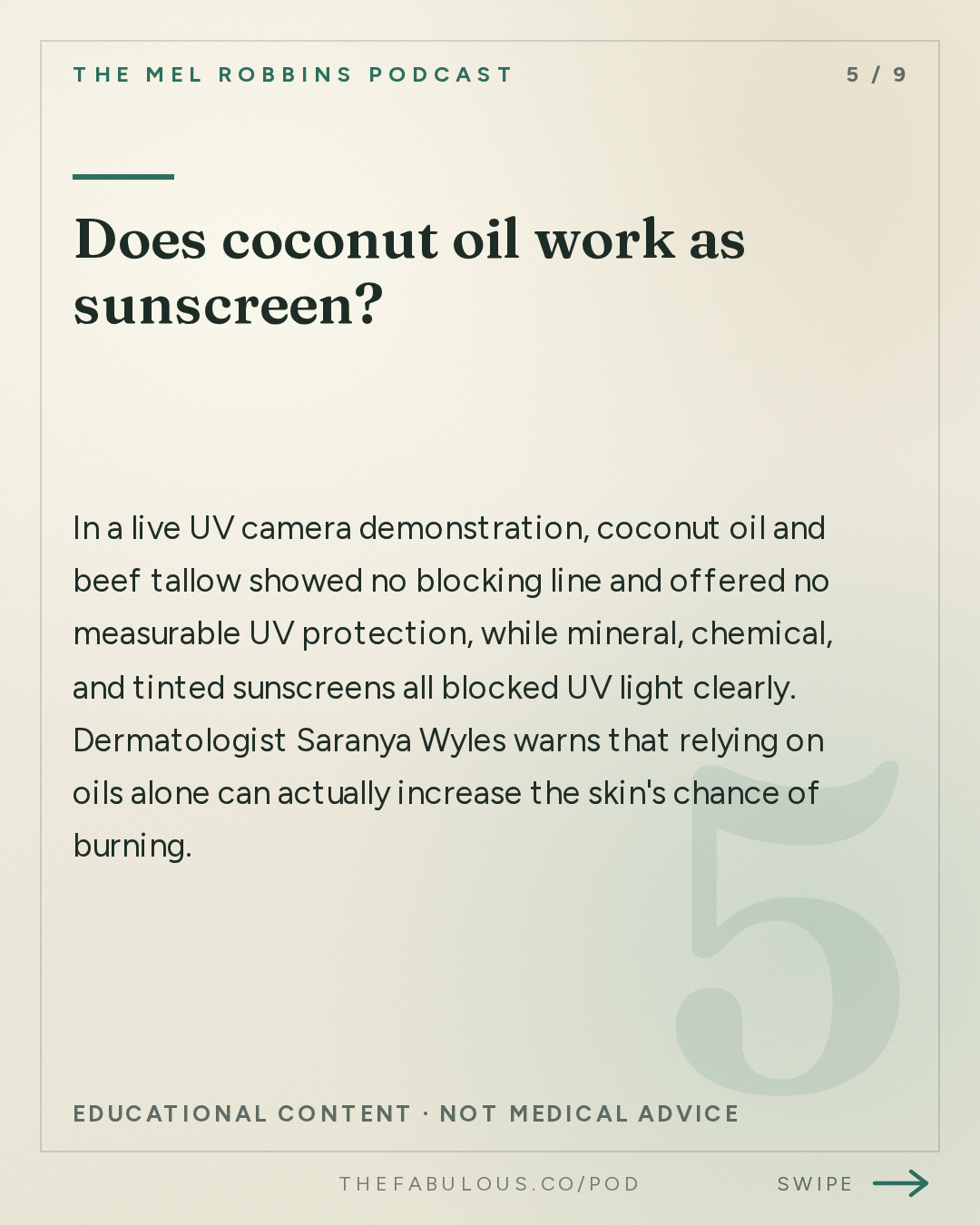
Does coconut oil work as sunscreen?
In a live UV camera demonstration, coconut oil and beef tallow showed no blocking line and offered no measurable UV protection, while mineral, chemical, and tinted sunscreens all blocked UV light clearly (73:43). Dermatologist Saranya Wyles warns that relying on oils alone can actually increase the skin's chance of burning.
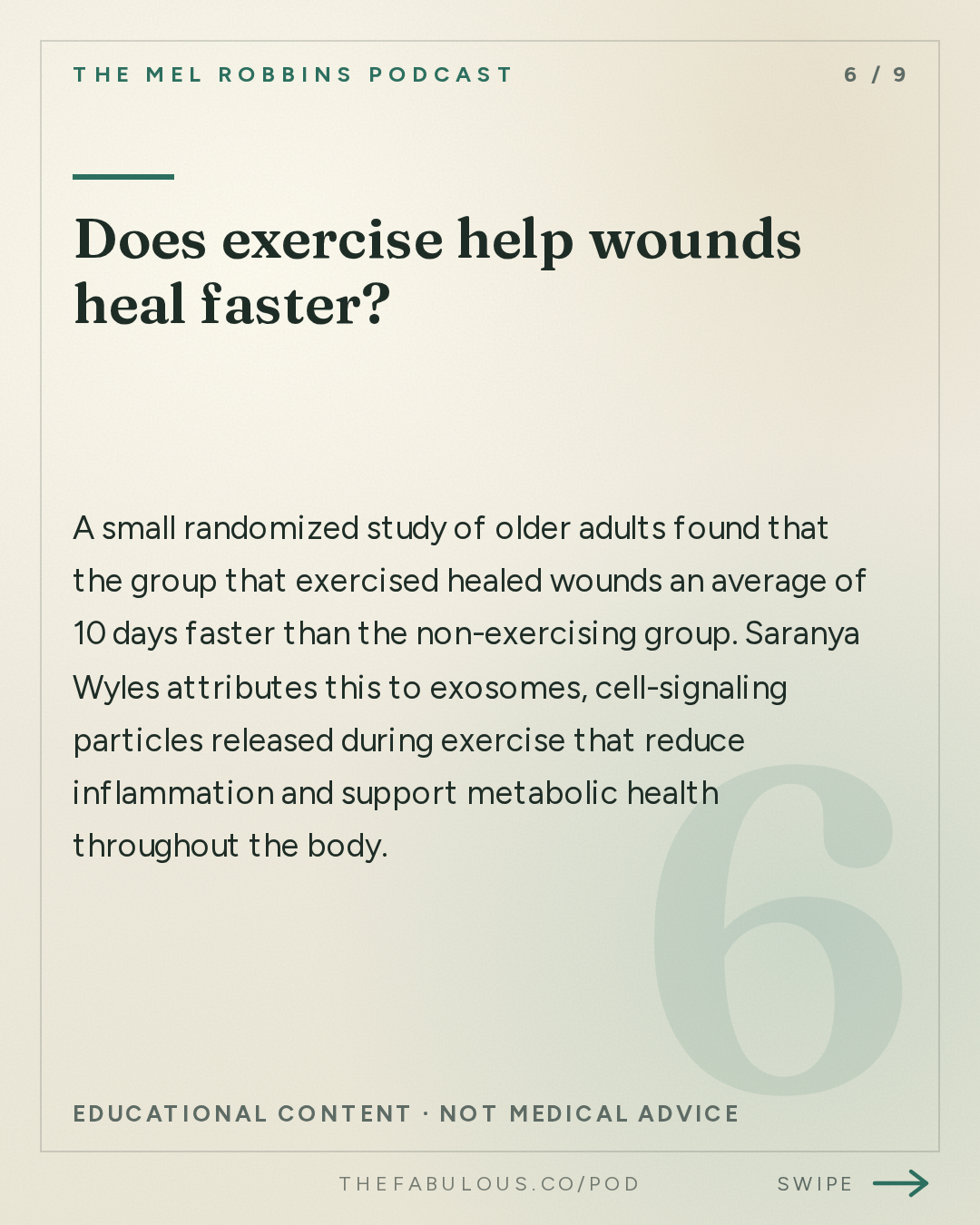
Does exercise help wounds heal faster?
A small randomized study of older adults found that the group that exercised healed wounds an average of 10 days faster than the non-exercising group (50:59). Saranya Wyles attributes this to exosomes, cell-signaling particles released during exercise that reduce inflammation and support metabolic health throughout the body.
The full read, in cards
Go deeper
- UK Biobank fiber and psoriasis analysis — found that higher fiber intake across over 200,000 people tracked with fewer psoriasis flares
- New England Journal of Medicine truck driver photograph — showed asymmetric sun damage on the window-facing side of a long-haul driver's face
- 12-week low glycemic index diet trial in acne patients — found a 23 percent reduction in acne flares after switching to a low glycemic diet
- Danish twin study on perceived age — found the older-looking twin had worse cognitive function, physical decline, and shorter telomeres
- 16-week resistance training study in middle-aged women — found resistance training improved skin elasticity more than cardio alone
Mentioned
Saranya Wyles · Mayo Clinic · Harvard Stem Cell Institute · UK Biobank · New England Journal of Medicine · GLP-1 · Pumpkin Seed Oil · Magnesium Threonate
More from this show and category
The One Skill That Makes People Like You More
Mel Robbins says empathy means understanding, not mind-reading, and everyone gets nine daily chances to practice it (07:19). She outlines four habits: asking instead of guessing, sending small gestures called pebbling, offering concrete help without being asked, and waving first, drawing on research from Harvard, Stanford, and the University of Toronto.
Ina Garten's Advice for Career Reinvention
Ina Garten left a federal budget job at 30 to buy a 400-square-foot Hamptons food store that grossed just $87 on its first day, and calls her approach working scared. On Mel Robbins's podcast, the Barefoot Contessa founder explains why jumping in before you feel ready, reframing boring tasks, and running small experiments beat waiting for a perfect plan.
Dr. Lara Boyd on How to Rewire Your Brain
Neuroscientist Lara Boyd says experience, not any drug, is the brain's biggest driver of change. Her research shows plasticity peaks when a task is hard enough to succeed only half the time, and that sleep, exercise, and lower cortisol all expand the brain's capacity to rewire at any age.
How to Stop Being Overlooked at Work
Emory University marketing professor Marina Cooley argues that good work alone rarely gets noticed; in an attention economy of thousands of daily messages, people need a sticky personal brand and the habit of saying their achievements out loud. Her research shows what moves pay differs by gender, and simple scripts like asking a boss what success looks like outperform guessing.
