
John Grisham's Morning Writing Routine Explained
How One “Golden Moment” Can Transform Your Entire Life
▶ Listen to the full episode More from The Mel Robbins Podcast
The brief
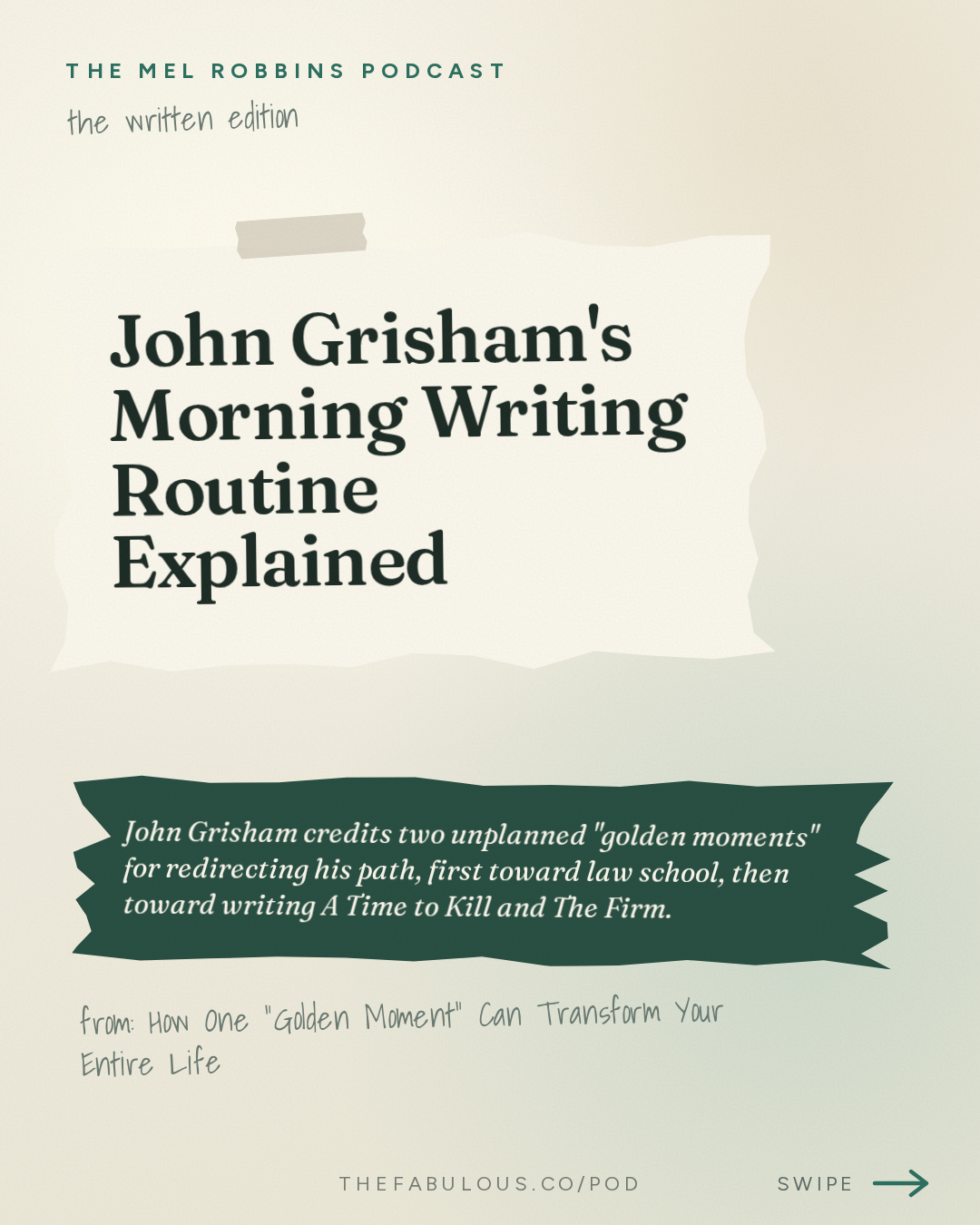
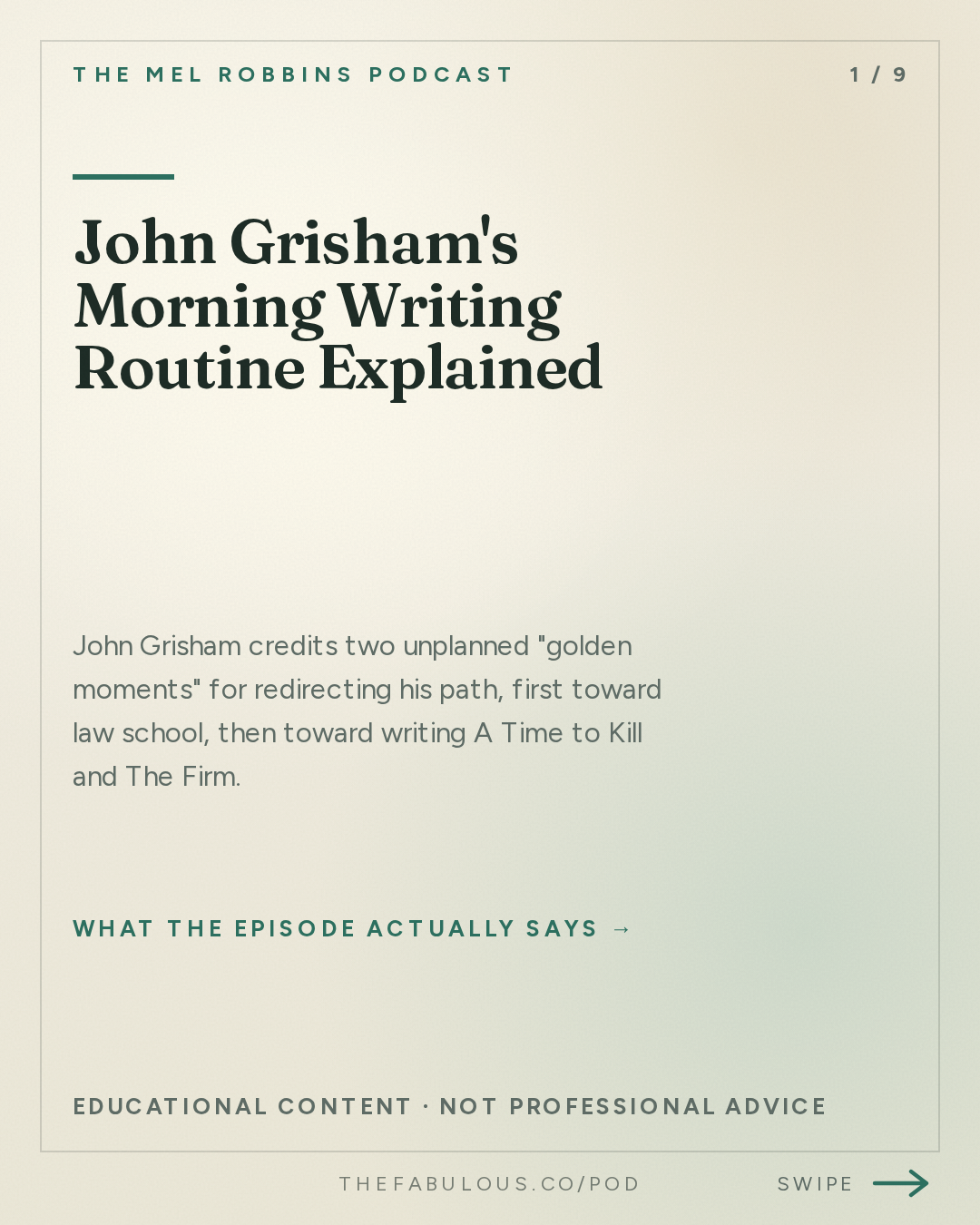
John Grisham credits two unplanned "golden moments" for redirecting his path, first toward law school, then toward writing A Time to Kill and The Firm. He built his career on writing one page a day at 5 a.m. for 30 years, absorbed 28 rejections, and then watched a bootleg manuscript trigger a $600,000 film deal and 52 straight bestsellers.
John Grisham does not believe in fate. He believes in moments. Twice in his life, he says, a light switches on and nothing afterward looks the same. The first happened in a finance classroom at Mississippi State in 1975. Saigon was falling, the Vietnam War still hung over his generation, and a classmate who had actually served in combat tore into a professor who argued America should have fought harder (35:53). Grisham, twenty years old and drifting through a general business major, struck up a conversation with the veteran afterward. The older student told him to drop business and study accounting instead, because it would prepare him for law school. Grisham took the advice that same afternoon.
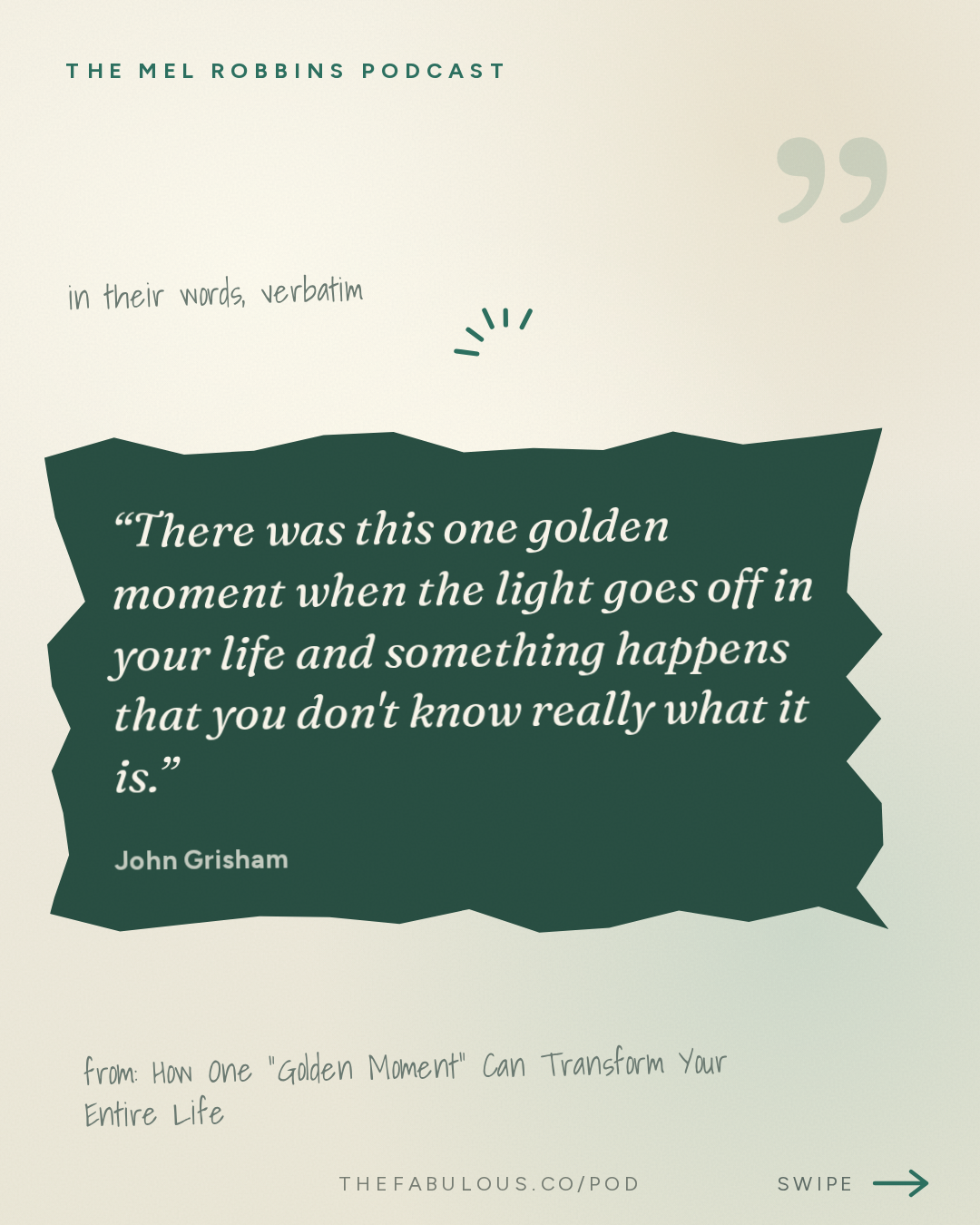
"There was this one golden moment when the light goes off in your life and something happens that you don't know really what it is." (John Grisham, 35:53)
The second golden moment arrived five years later, when Grisham was a thirty-year-old small-town lawyer hanging around his local courthouse, dreaming of becoming a big trial attorney. A judge cleared the courtroom one day so a ten or twelve year old girl could testify about being raped (42:48). Grisham, an officer of the court, stayed. He watched the child move through "every emotion known to the human soul" for an hour, then watched the defendant sit unmoved. Walking back through the empty courtroom later to retrieve a forgotten briefcase, Grisham imagined a different ending, one where a grieving father might take justice into his own hands. That image became A Time to Kill, the novel he had never planned to write.
Neither moment was engineered. Both arrived while Grisham was simply present, paying attention, doing the unglamorous work of showing up at a courthouse or a lecture hall. That distinction matters, because the rest of his story on Mel Robbins's podcast is not about luck. It is about what he did with five years of mornings afterward.
One Page, Every Day, Same Chair
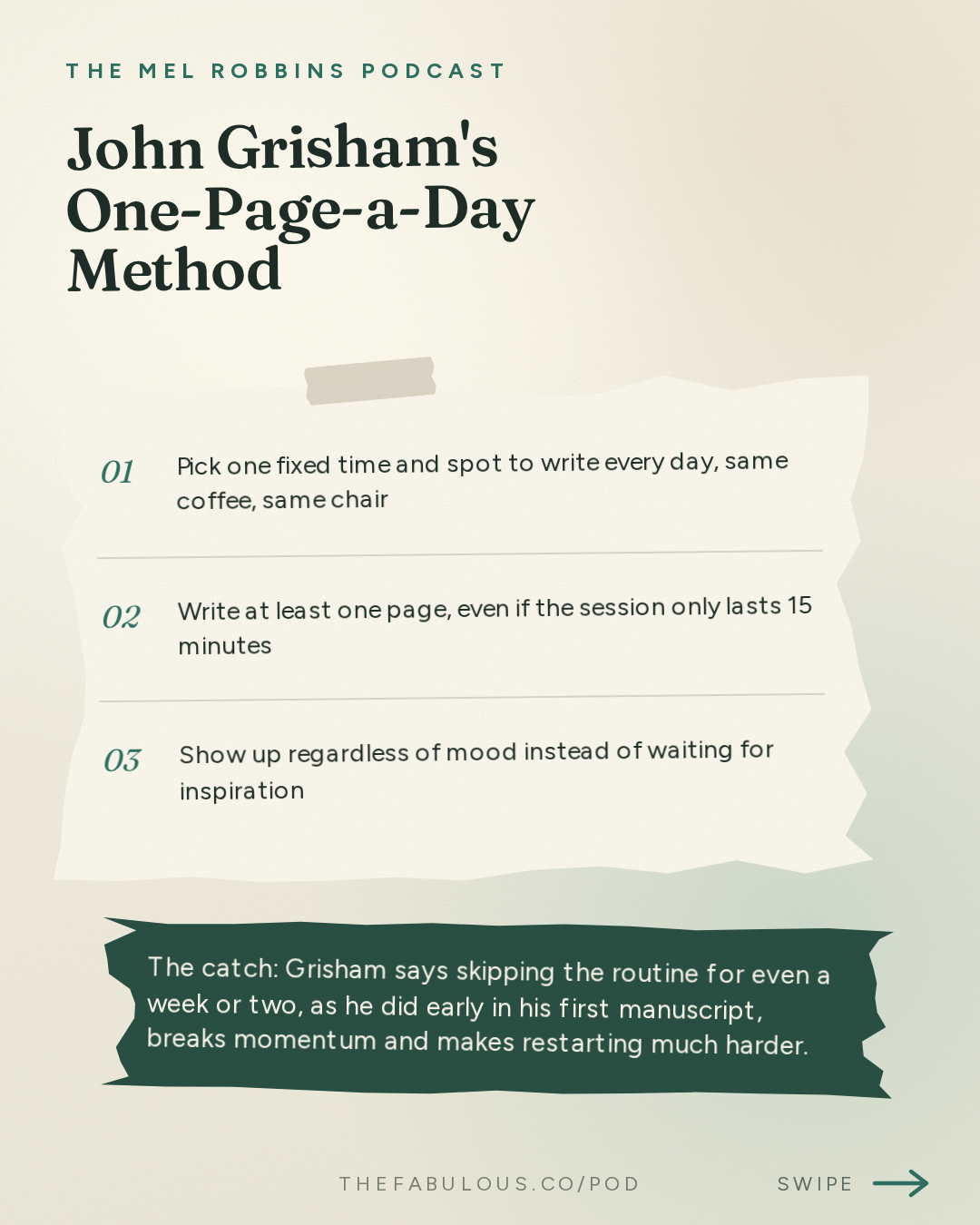
Grisham started A Time to Kill on legal pads at age thirty, writing by hand before work. He took weeks off when motivation dipped, then discovered his wife Renee kept asking where the next chapter was. "I realized that you have to do a little bit every day, or it's not gonna get done," he says (15:53). The habit that followed has not changed in roughly forty years: wake at 5 a.m., sit at the same desk, drink the same coffee, and write at least one page before doing anything else (17:01).
"Write a page every day. Stop talking about it. Don't talk your book to death. Sit down and write a page every day." (John Grisham, 16:38)
The habit produced an early lesson in discipline, but not in craft. His first manuscript, typed out, ran almost 1,000 pages (18:45). His editor cut a third of it, and Grisham realized he had wasted roughly a year of writing on material that never belonged in the book. From then on, he adopted a rule borrowed from novelist John Irving: know the ending before writing the opening scene (19:25). He also learned to compress any new story idea into a thirty-second pitch, testing it on Renee before investing years in it (20:07). Writers who skip outlining, he says, tend to sprint through fifty thousand words on pure inspiration, then write themselves into a corner they cannot escape (19:46).
Before any of this, Grisham worked a string of jobs that had nothing to do with literature: laying asphalt, driving a bulldozer, selling underwear at a Memphis Sears, where he nearly got fired for refusing to accept a suspicious return (27:38). He does not frame these as wasted years. "Every job you ever have is material for the rest of your life," he says (27:11), and the itch to avoid that kind of work for good is part of what pushed him toward college and eventually law school.
One early setback left a deeper mark than any manual labor job. In a community college English class, after turning in a term paper, his professor accused him of plagiarism in a hallway, in front of no one who could vouch for him, with no way to prove his innocence (29:53). He received an F on the paper and the exam, and a D-minus for the course. He left the school. Years later, when he began writing novels about wrongful convictions, he traced some of that instinct back to the hallway. "It's very traumatic to be accused of something when you know you're innocent," he says (33:01), and that specific, searing unfairness became a recurring engine in his fiction and, eventually, in his advocacy work.
The Deal That Found Him
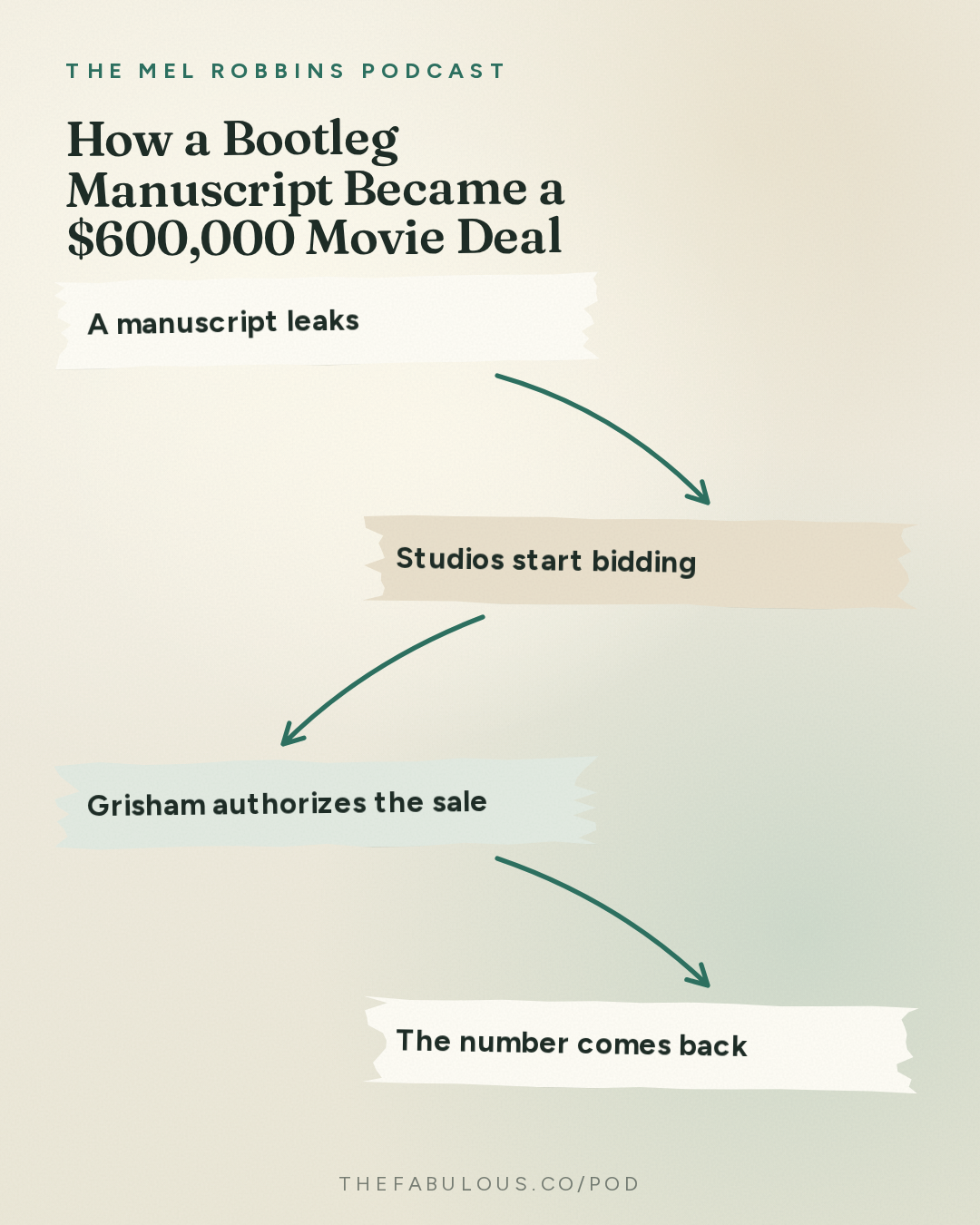
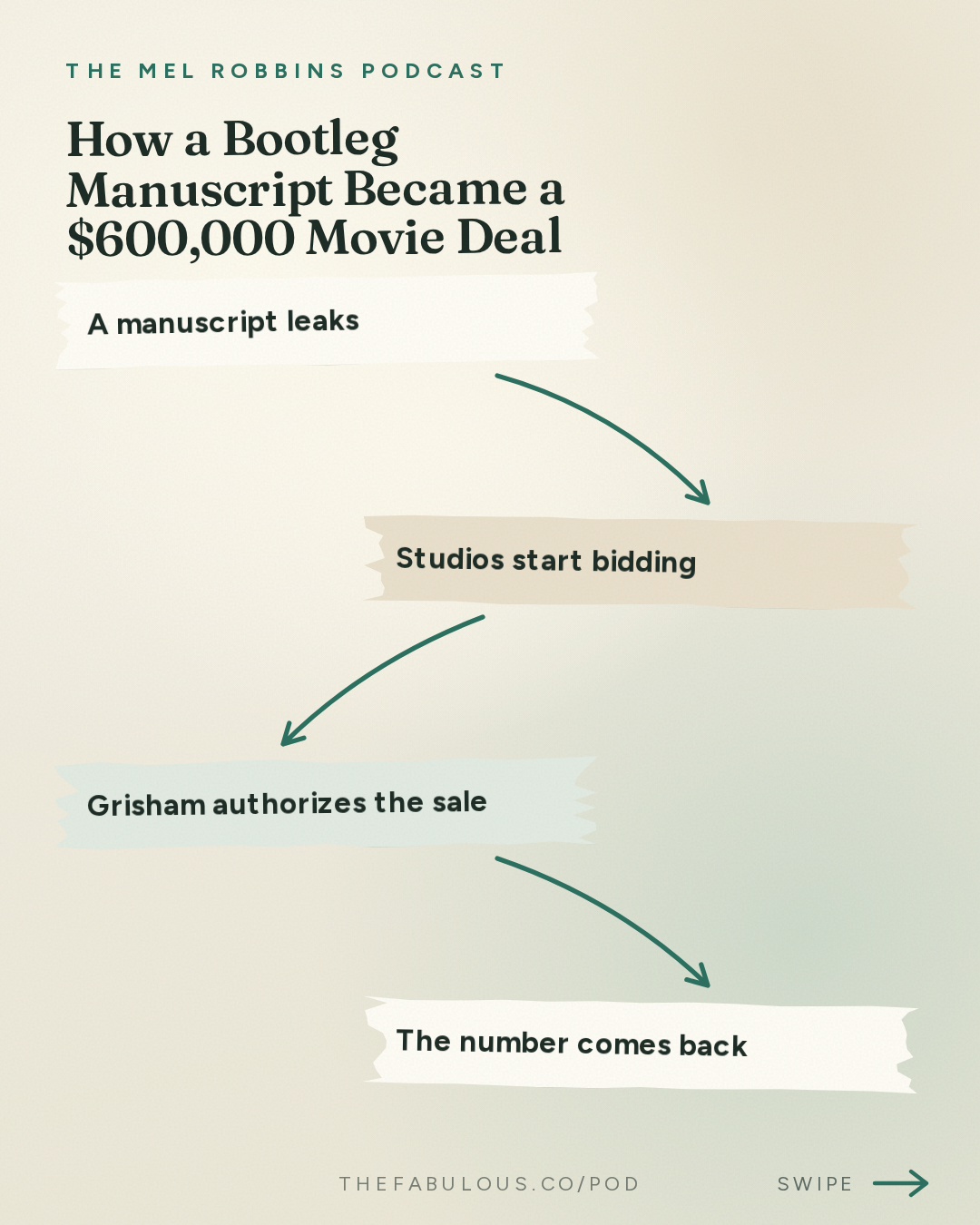
Grisham finished The Firm in 1989 and sent it to his agent, who was lukewarm and wanted changes Grisham refused to make. The manuscript sat, unsold, through the holidays. Then, without Grisham's knowledge, a Hollywood scout obtained a bootleg copy over Christmas break and circulated twenty-five photocopies to studios and production companies (55:06). By the time anyone thought to ask whether Grisham himself had been contacted, a bidding war was already underway between Paramount, Universal, and Disney's Touchstone. His agent called on a Sunday morning asking for authority to accept the highest offer, before Grisham even knew a number was involved (56:40). Paramount Pictures won with $600,000, more money than Grisham had earned in ten years of practicing law (57:25). The book deal, and the sales, followed.
It would be easy to read that sequence as pure chance. Grisham resists the word, even as he uses it. "I know you make your own luck," he says, "but I got a huge lucky break with The Firm" (54:14). What preceded the break was five years of 5 a.m. mornings, a flop of a debut novel, and 28 rejection letters for his early manuscripts (58:58). The lucky break found a writer who had already built the discipline to use it.
Grisham also describes a habit of pattern-matching himself against people further along than he was. As a third-year law student, he skipped class to watch two accomplished trial lawyers face off in a civil case, taking notes on how they worked a courtroom (62:35). Later, as a novelist, a young bookstore executive told him offhandedly that "the big guys come out every year," naming Stephen King, Michael Crichton, and Robert Ludlum as novelists who published annually (60:56). Grisham adopted the same release cadence and has kept it for 35 years. He also describes standing in a Waldenbooks store, intimidated by the wall of bestsellers, and deliberately flipping the comparison: reading a mediocre popular novel and thinking, "I can beat this" (63:59). Looking up supplied the craft to chase. Looking sideways, at writers no better than he was, supplied the nerve.
That same restlessness eventually pulled him toward the Innocence Project, an organization working to overturn wrongful convictions. Grisham read an obituary about a man who came within five days of execution in Oklahoma despite being innocent, and the story would not leave him (68:56). He has spent twenty years since writing and advocating around wrongful convictions, work he says keeps him from sliding into despair about the state of the world. His method for staying functional is the same one that got him through five years of rejection letters: narrow the focus to what is within reach. "What can I do today to make it a little better?" he asks himself (71:22), rather than absorbing every grim headline at once.
The through-line across law school, underwear counters, courtroom benches, and bestseller lists is less about talent than about continuation. Grisham's golden moments were brief and unplanned. Everything that mattered afterward happened on ordinary mornings, one page at a time, for years before anyone outside his kitchen knew his name.
Ask this episode anything
Pod's AI answers from the episode itself, with the minute mark so you can hear it yourself.
Or start with one of these
Ask this episode
Pod's AI listens to the whole episode to answer, and points you to the minute it comes from.
The rest of this answer, and any question after it
Answers come from the episode itself, never from a summary of it.
ContinueKey takeaways
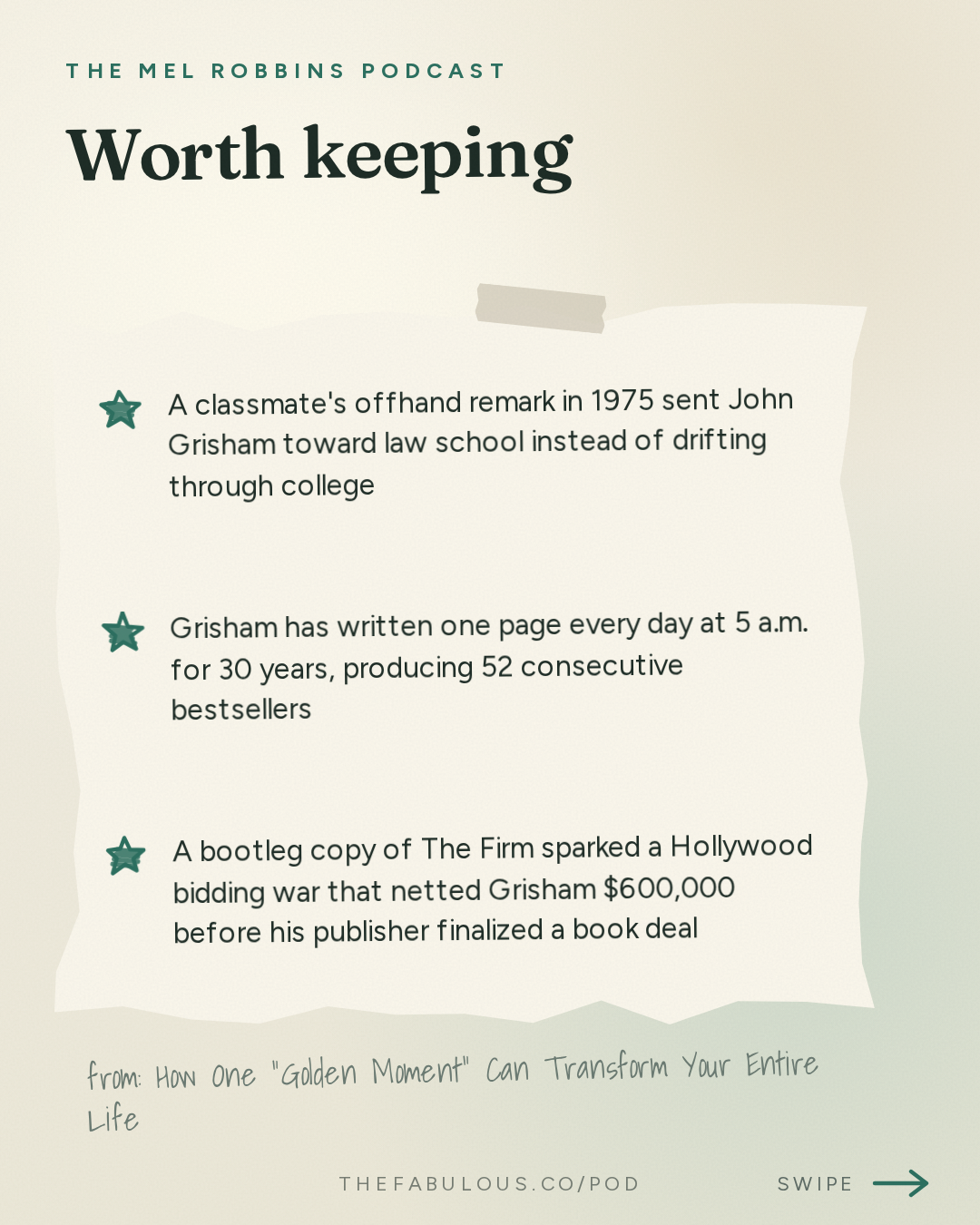
- A classmate's offhand remark in 1975 sent John Grisham toward law school instead of drifting through college
- Grisham has written one page every day at 5 a.m. for 30 years, producing 52 consecutive bestsellers
- A bootleg copy of The Firm sparked a Hollywood bidding war that netted Grisham $600,000 before his publisher finalized a book deal
- Grisham absorbed 28 rejection letters on his early manuscripts before any publisher said yes
- An obituary about a wrongly condemned Oklahoma man pulled Grisham into two decades of Innocence Project advocacy work
The episode in cards
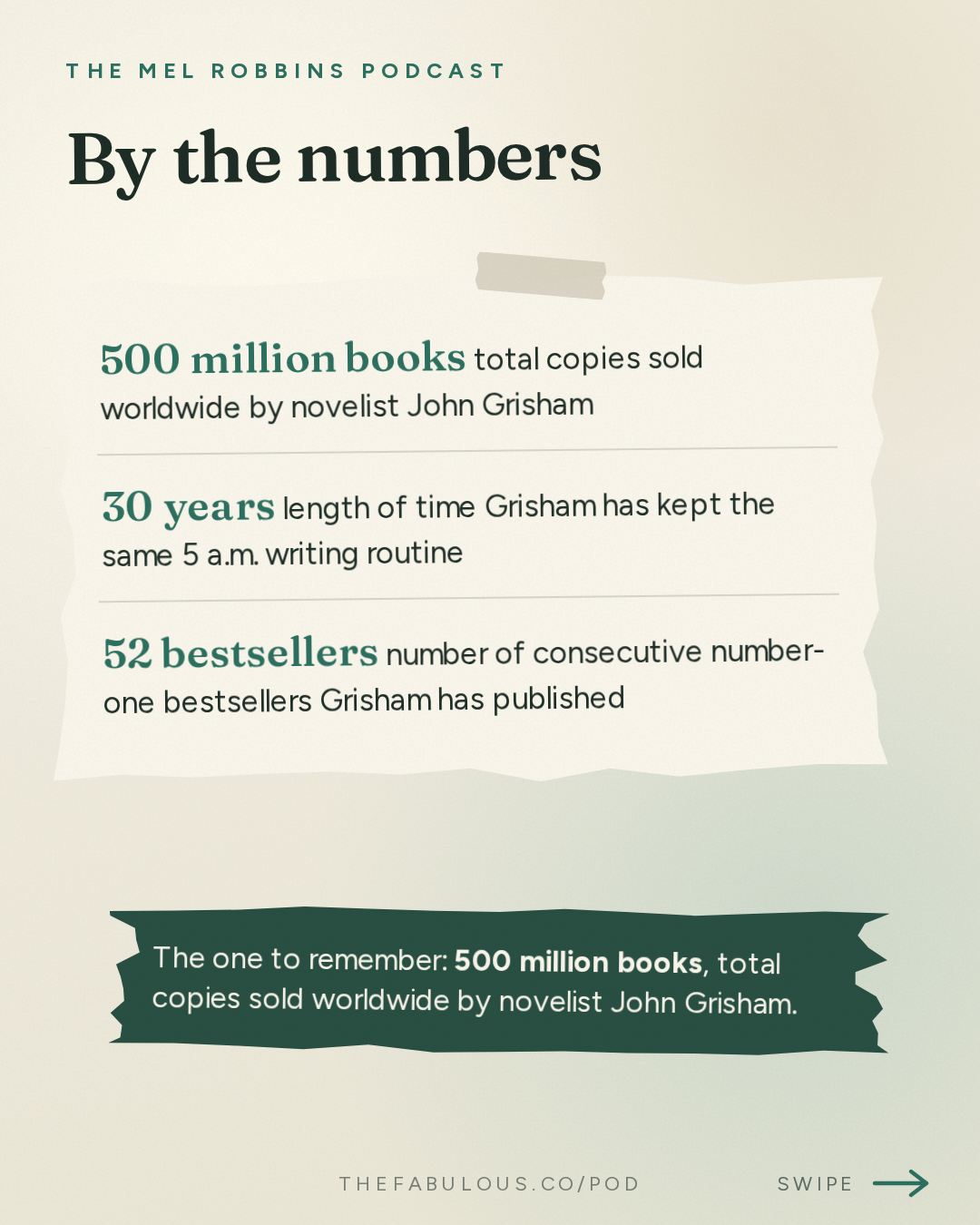
By the numbers
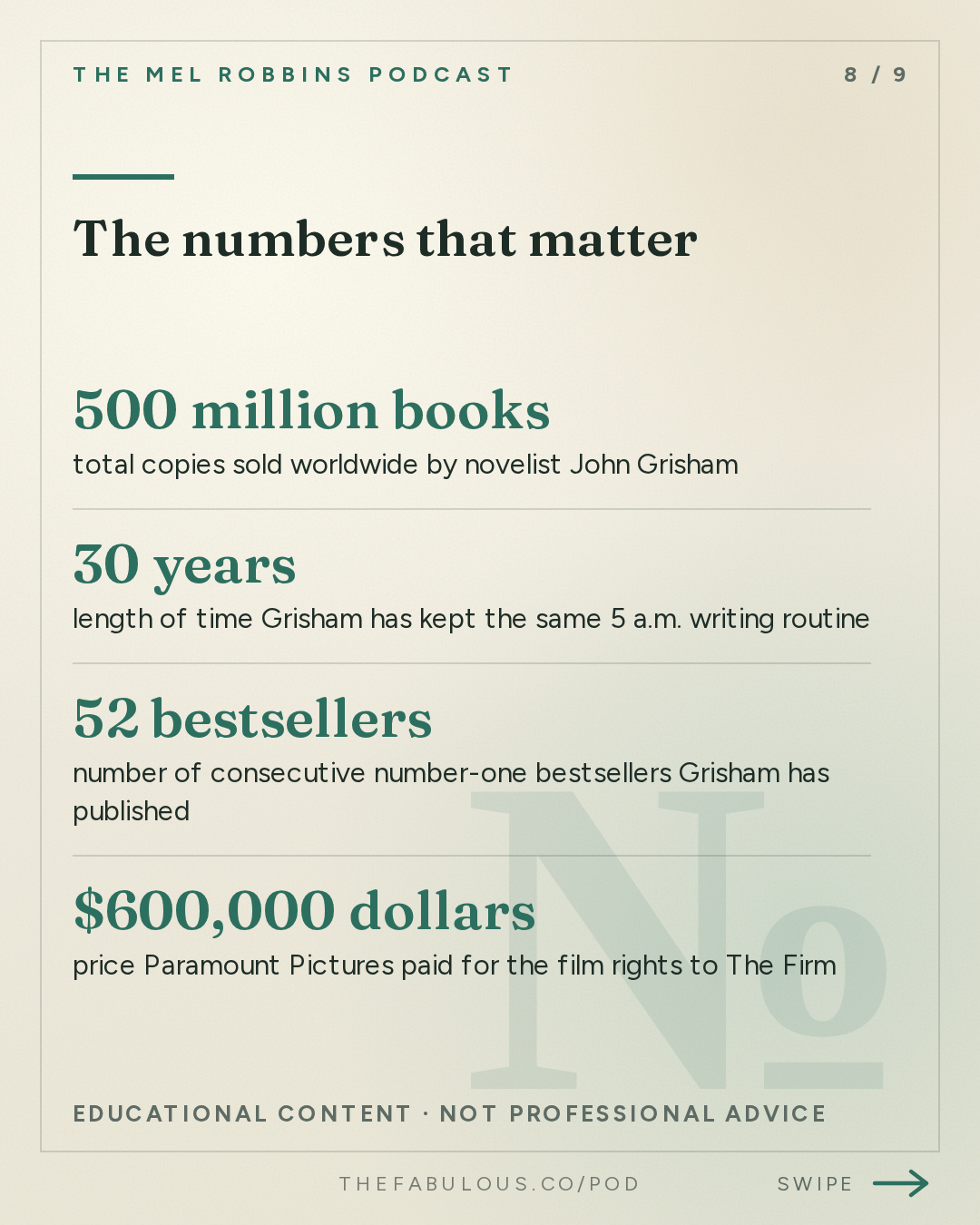
- 500 million books total copies sold worldwide by novelist John Grisham
- 30 years length of time Grisham has kept the same 5 a.m. writing routine
- 52 bestsellers number of consecutive number-one bestsellers Grisham has published
- $600,000 dollars price Paramount Pictures paid for the film rights to The Firm
- 28 rejections number of rejection letters Grisham received for his early manuscripts
In their words
“There was this one golden moment when the light goes off in your life and something happens that you don't know really what it is.”
“Every job you ever have is material for the rest of your life.”
“If you're still here, the story hasn't ended. There's more to write”
Protocols
-
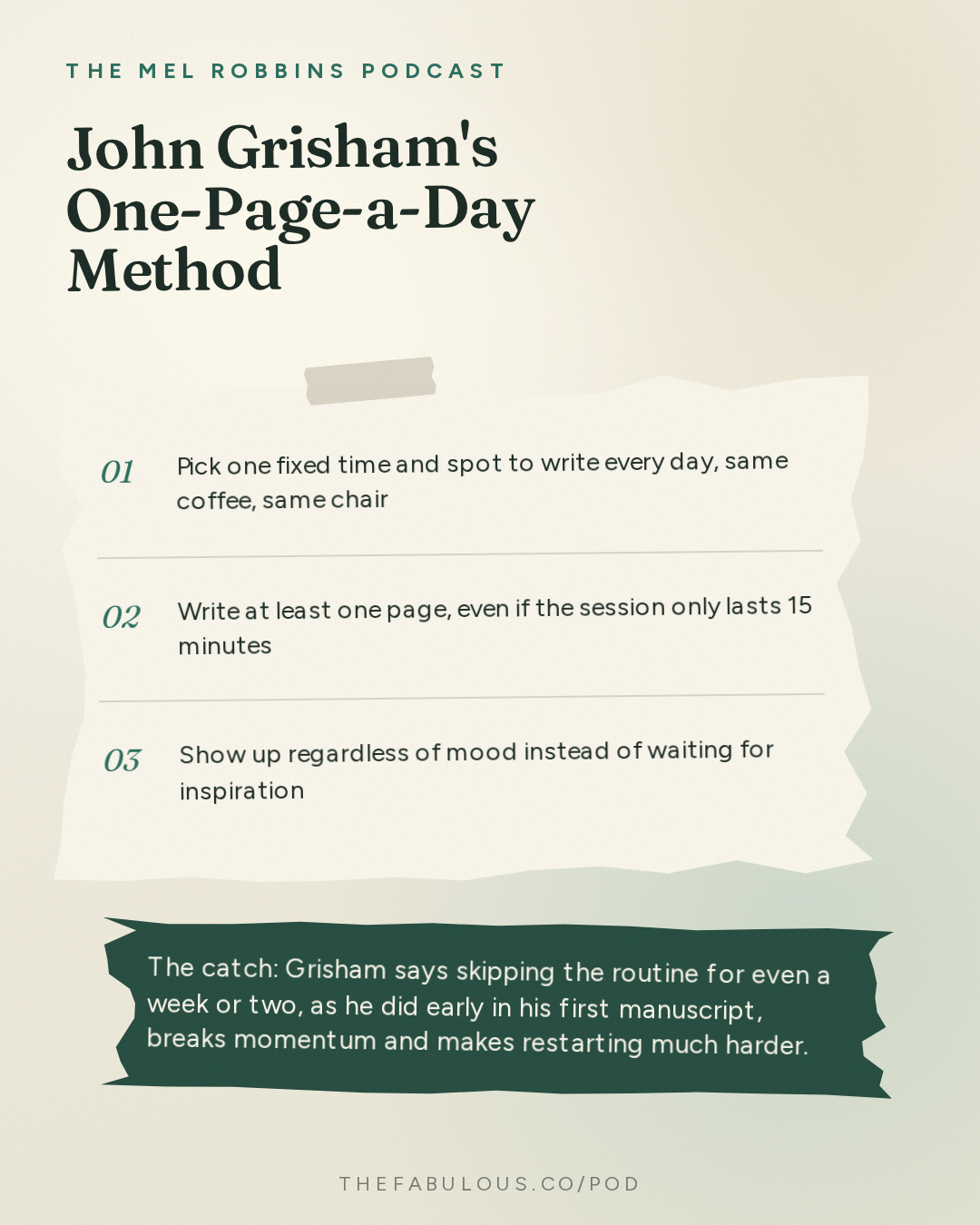
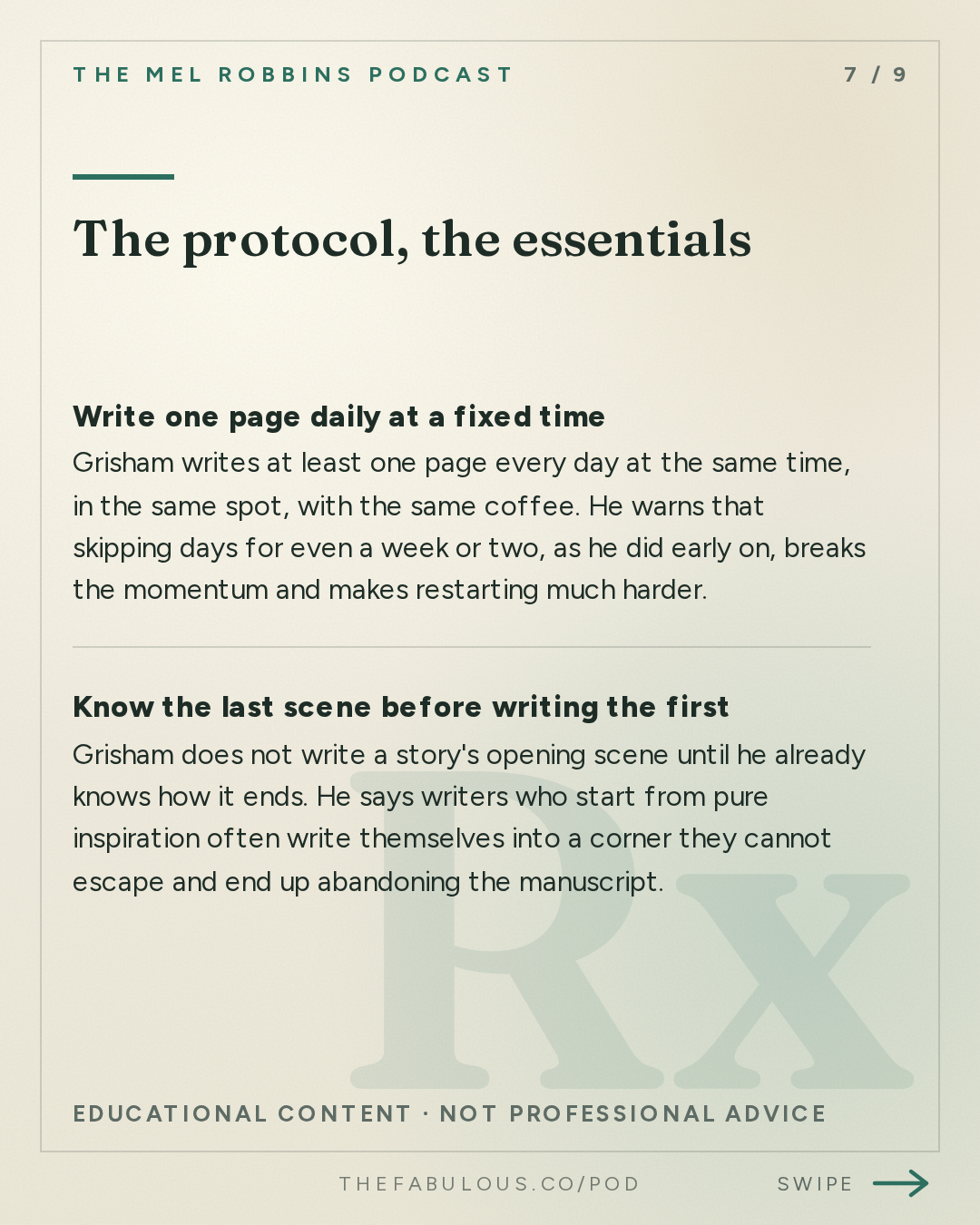
Write one page daily at a fixed time
Grisham writes at least one page every day at the same time, in the same spot, with the same coffee. He warns that skipping days for even a week or two, as he did early on, breaks the momentum and makes restarting much harder.
Daily
-
Know the last scene before writing the first
Grisham does not write a story's opening scene until he already knows how it ends. He says writers who start from pure inspiration often write themselves into a corner they cannot escape and end up abandoning the manuscript.
Once per project, before drafting begins
-
Refine any new idea to a 30-second pitch
Grisham pitches new story ideas to his wife Renee in 30 seconds or less before developing them further. He treats her blunt rejection of weak pitches as a filter that saves him from spending years on an idea that will not work.
Before starting any new project
Questions this episode answers
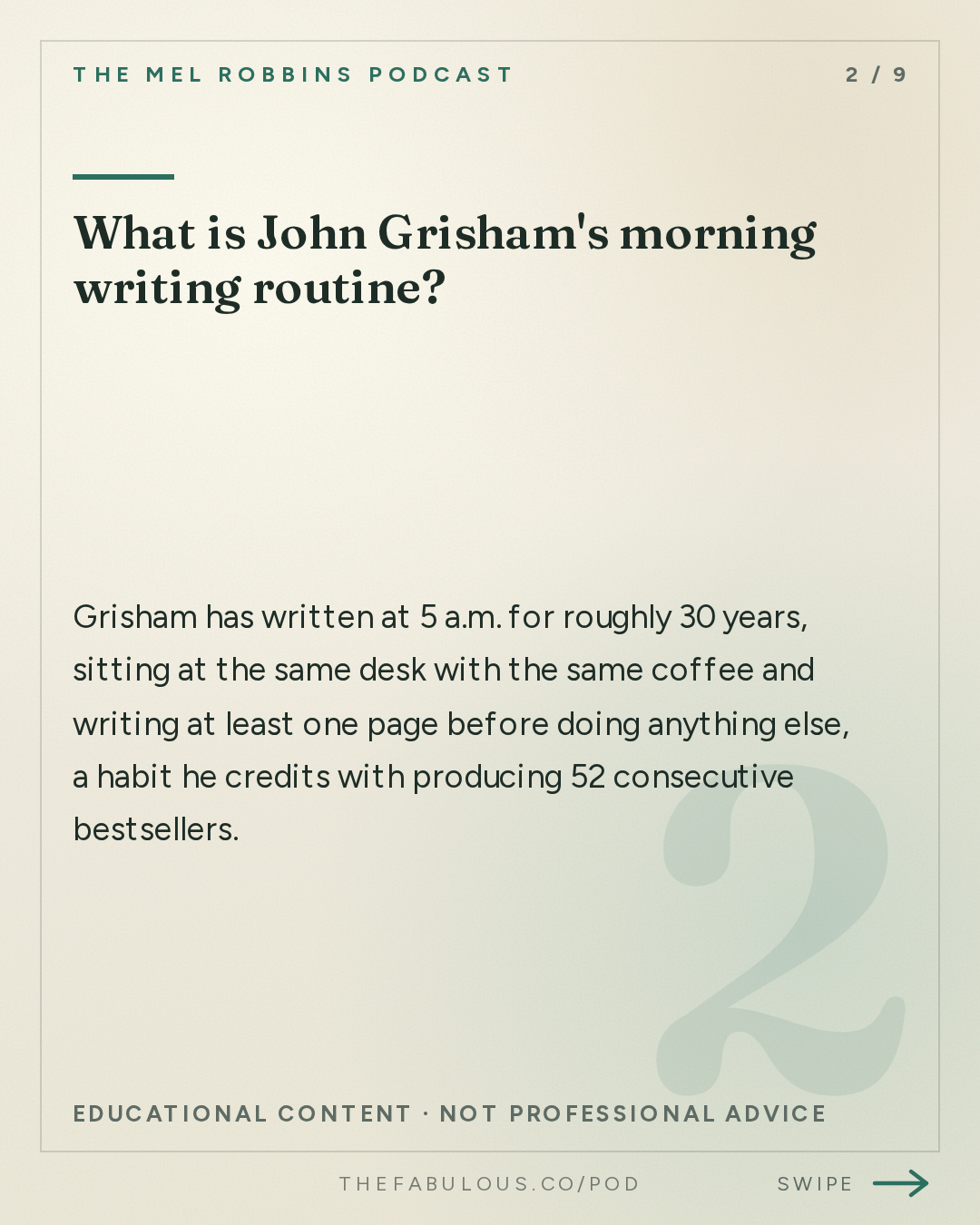
What is John Grisham's morning writing routine?
Grisham has written at 5 a.m. for roughly 30 years, sitting at the same desk with the same coffee and writing at least one page before doing anything else, a habit he credits with producing 52 consecutive bestsellers (01:26, 17:01).
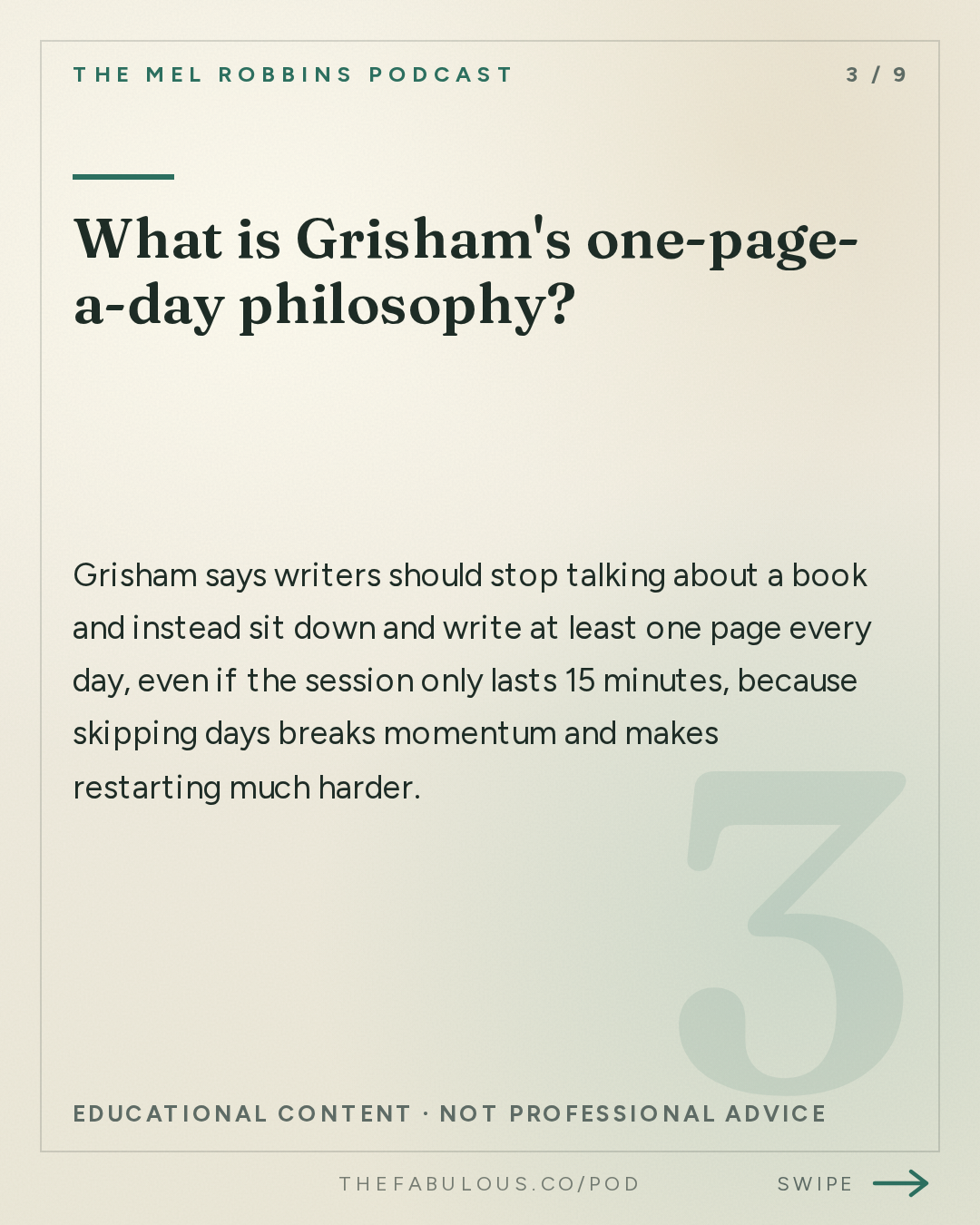
What is Grisham's one-page-a-day philosophy?
Grisham says writers should stop talking about a book and instead sit down and write at least one page every day, even if the session only lasts 15 minutes, because skipping days breaks momentum and makes restarting much harder (16:38).
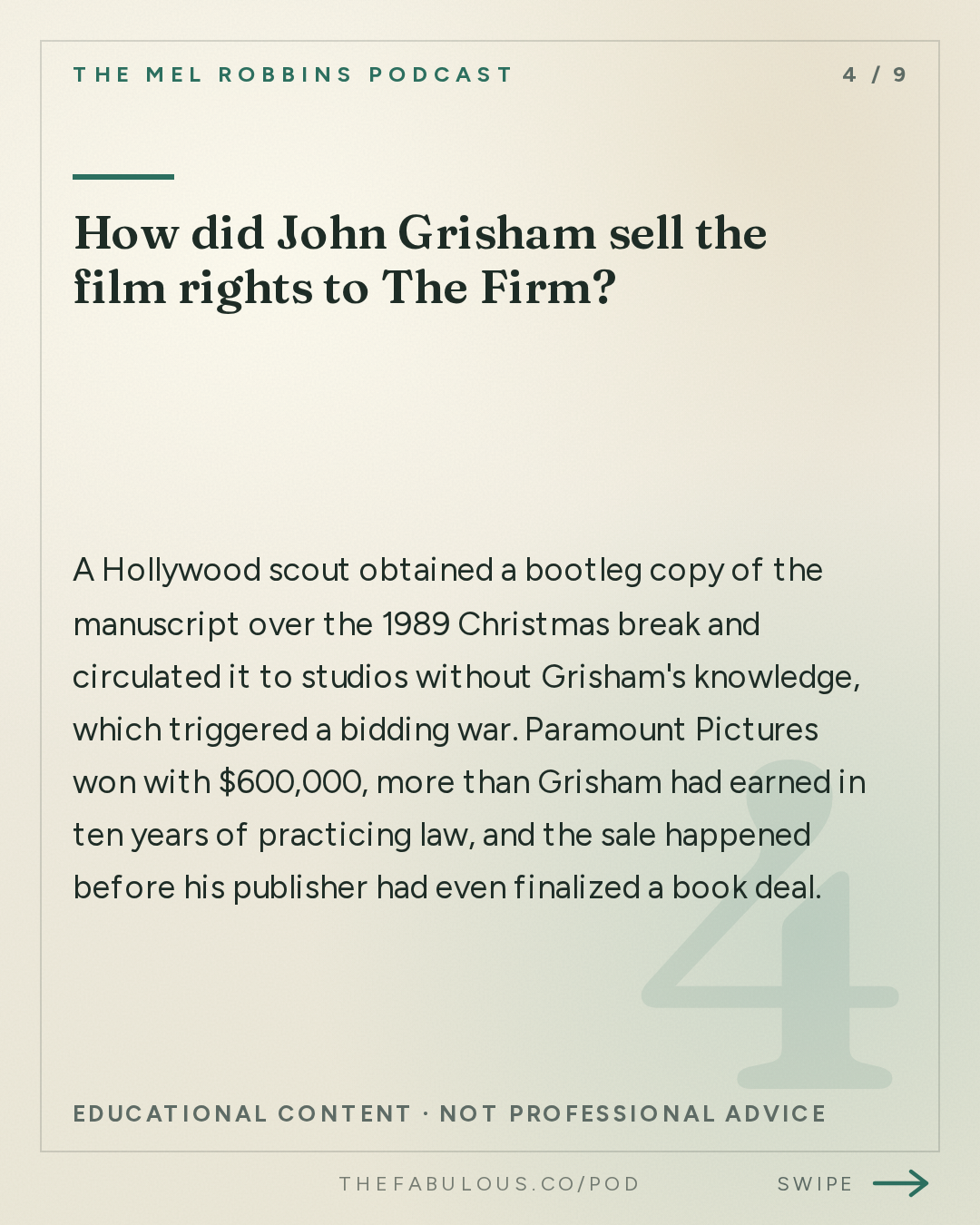
How did John Grisham sell the film rights to The Firm?
A Hollywood scout obtained a bootleg copy of the manuscript over the 1989 Christmas break and circulated it to studios without Grisham's knowledge, which triggered a bidding war. Paramount Pictures won with $600,000, more than Grisham had earned in ten years of practicing law, and the sale happened before his publisher had even finalized a book deal (55:06, 57:25).
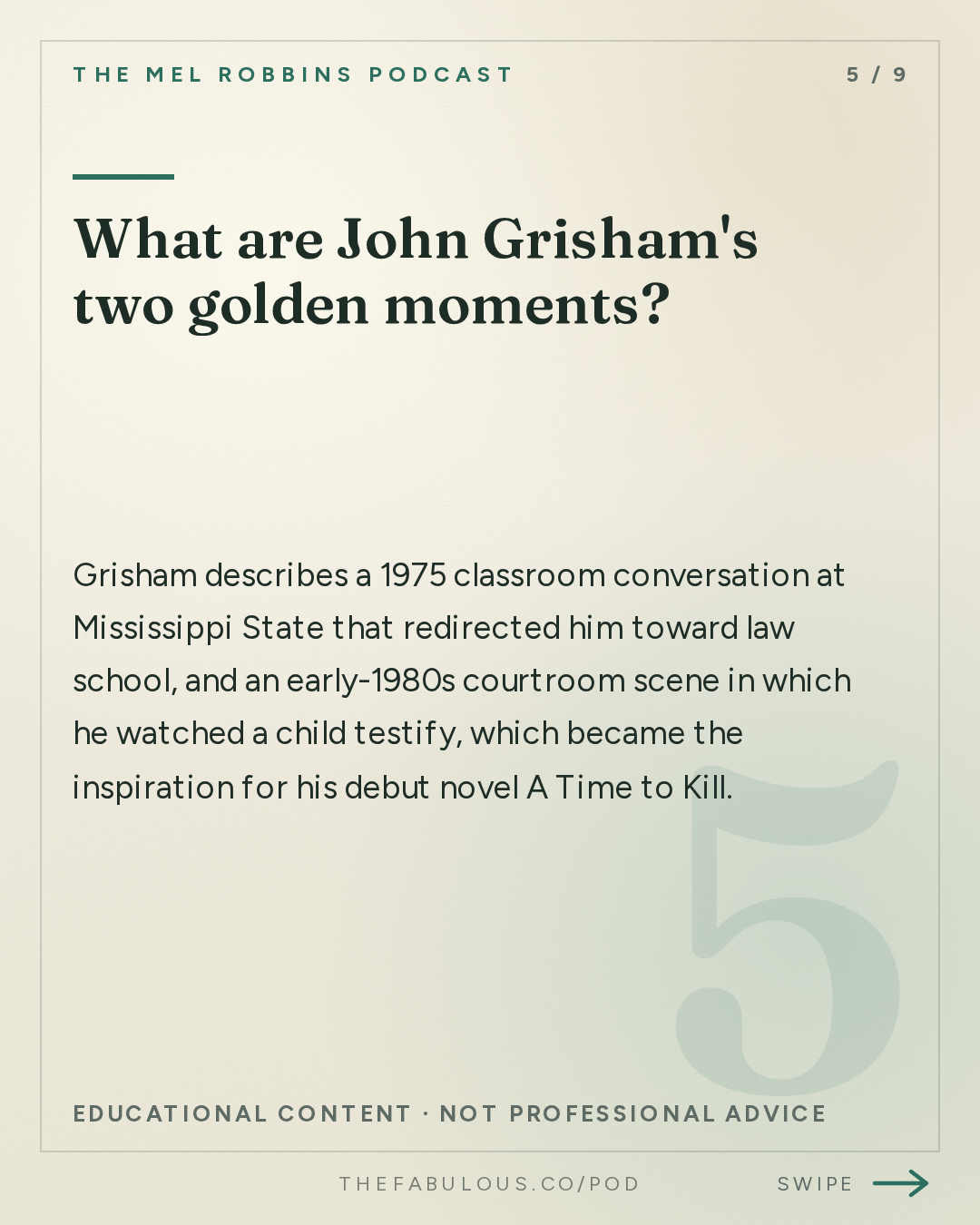
What are John Grisham's two golden moments?
Grisham describes a 1975 classroom conversation at Mississippi State that redirected him toward law school (35:53), and an early-1980s courtroom scene in which he watched a child testify, which became the inspiration for his debut novel A Time to Kill (42:48).
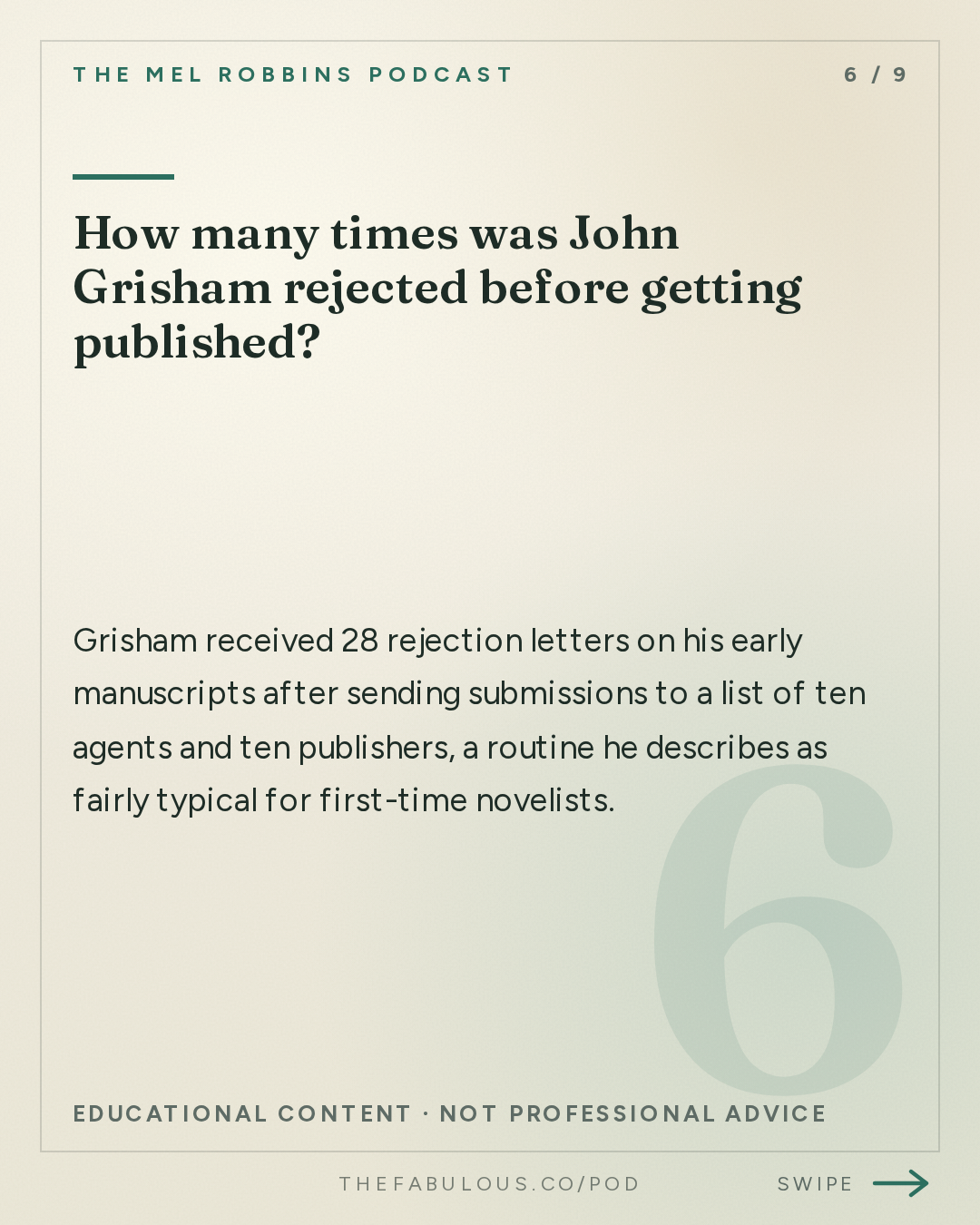
How many times was John Grisham rejected before getting published?
Grisham received 28 rejection letters on his early manuscripts after sending submissions to a list of ten agents and ten publishers, a routine he describes as fairly typical for first-time novelists (58:58).
The full read, in cards
Go deeper
- The Firm — Grisham's second novel, inspired by an offhand remark about a law firm no one ever left, sold its film rights for $600,000 before the book deal was finalized
- A Time to Kill — Grisham's debut novel, drafted after he witnessed a child's courtroom testimony, had a third of its roughly 1,000-page manuscript cut by his first editor
Mentioned
John Grisham · The Firm · A Time to Kill · Paramount Pictures · The Innocence Project · Bryan Stevenson · Jerry Spence · Mississippi State · Ole Miss
More from this show and category
How to Stop Living Paycheck to Paycheck
Vivian Tu, a former JP Morgan trader known online as your rich BFF, argues that living paycheck to paycheck is a system problem, not a willpower problem. She lays out a pay-yourself-first savings rule, the avalanche method for debt, a formula for calculating financial independence, and why automating money beats relying on discipline.
Body Language Tricks for Instant Confidence
Behavioral researcher Vanessa Van Edwards explains how tiny, testable body-language and language cues (ear-to-shoulder distance, hand steeples, priming words) shift how confident and likable people perceive us, and how an A-B-C-D task audit stops burnout by clarifying which work and relationships actually deserve energy.
Mel Robbins' Let Them Theory for Difficult People
Mel Robbins' Me, We, Them framework redirects relationship stress toward the one variable anyone can control: their own reaction. She names three habits that wreck relationships (expecting others to change, letting their behavior dictate your mood, assuming they 'should' know what you need) and offers a script from therapist Terry Real for saying the hard thing without blame.
James Sexton's Guide to the Six Stages of Divorce
Divorce attorney James Sexton maps the six stages of divorce and gives scripts for telling a spouse and a 48-hour safety plan. He explains why an avoided conversation gets more expensive with time, why grief means the love was real, and how to actually help someone else going through it.
