
How Sleep Deprivation Affects Decisions
Do You Have Trouble Sleeping?
The brief
Sleep deprivation degrades ethical judgment and decision-making in novel situations, contributing to disasters from train crashes to BP's 2005 explosion. Chronic pain, meanwhile, is reshaped by fear, relationships, and mindset as much as by tissue damage, per sleep researcher Chris Barnes and pain psychologist Rachel Zoffness.
On a December morning in 2013, a train engineer named William Rockefeller took a curve on New York's Hudson rail line at nearly eighty miles an hour. The posted limit was thirty-five. He hit the brakes, but too late. Four people died and sixty were injured when the train derailed (03:10). Investigators first called it operator error. Later it came out that Rockefeller had likely fallen asleep at the controls. He also had sleep apnea, a disorder in which the airway closes during the night and a person is startled awake, sometimes hundreds of times per hour, without ever fully remembering it (05:32).
University of Washington sleep researcher Chris Barnes has spent years studying cases like this one, and a nearly identical UK crash in 2001 in which a driver named Gary Hart fell asleep at the wheel, setting off a chain of events that killed ten people (08:33). Barnes argues that blaming the individual is too easy. "We usually prefer simple, easy answers," he says. "We don't often ask the question, okay, why did that human error occur?" (09:21). Rockefeller and Hart were not reckless men with long records of accidents. They were ordinary people whose sleep debt, work schedules, and undiagnosed disorders stacked together until the odds caught up with them.
Barnes knows the feeling personally. In 2019, with newborn twins and a three-year-old at home, he got a 3 a.m. call that his father might be dying. He drove an hour to the hospital, learned his father was stable, and drove home exhausted. On the freeway, he fell asleep for what he estimates was three to five seconds, at highway speed (14:24).
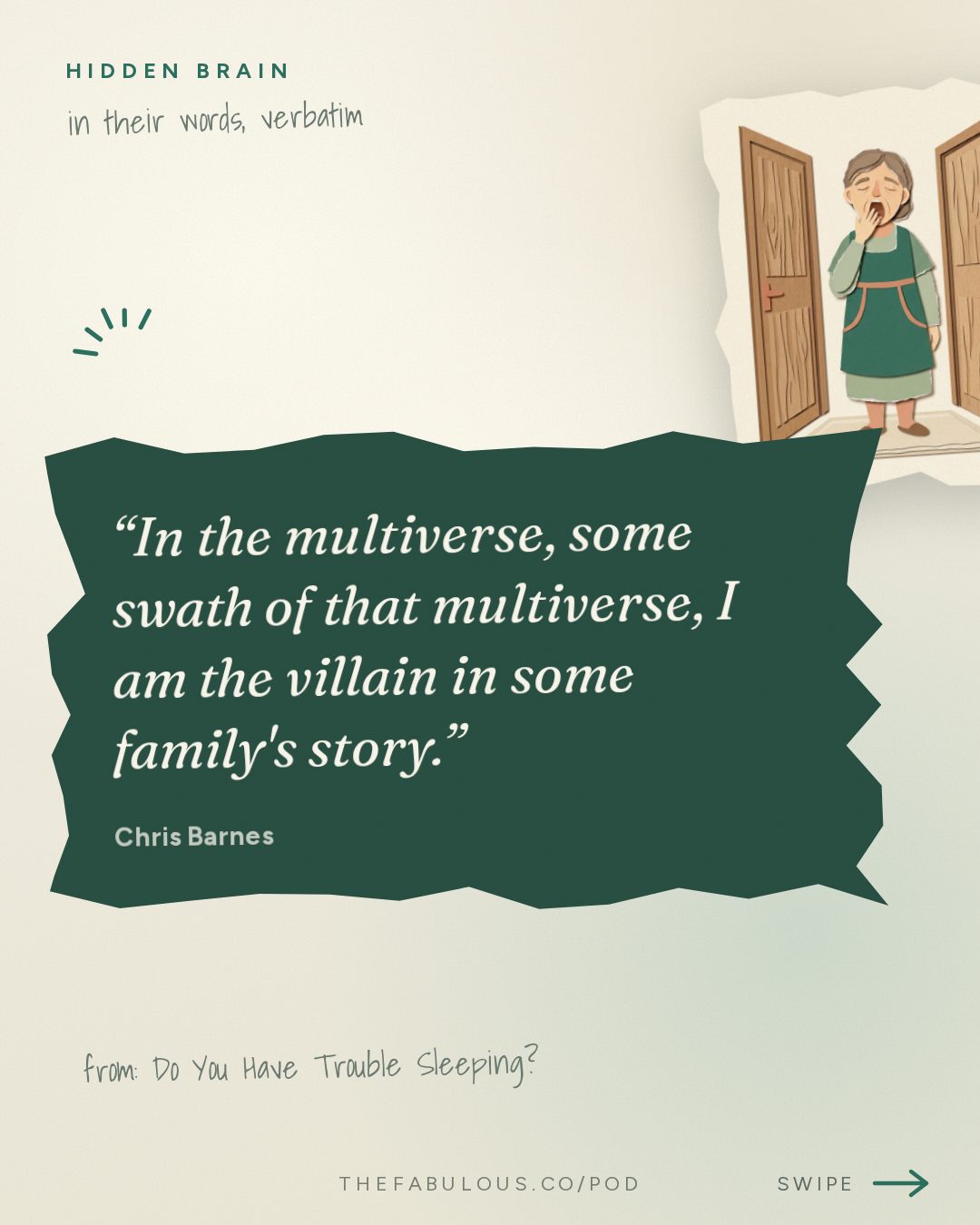
"In the multiverse, some swath of that multiverse, I am the villain in some family's story." — Chris Barnes (15:21)
That line captures something the data confirm at scale. Barnes and a co-author at the National University of Singapore found that car crashes spike in Singapore and Taiwan the morning after popular European soccer matches, because fans stay up into the early hours to watch games broadcast at a reasonable hour across the ocean but an unreasonable one at home (16:15). The effect grows with how popular the teams are. It is not an anecdote. It shows up in taxi company records and in nationwide crash data alike.
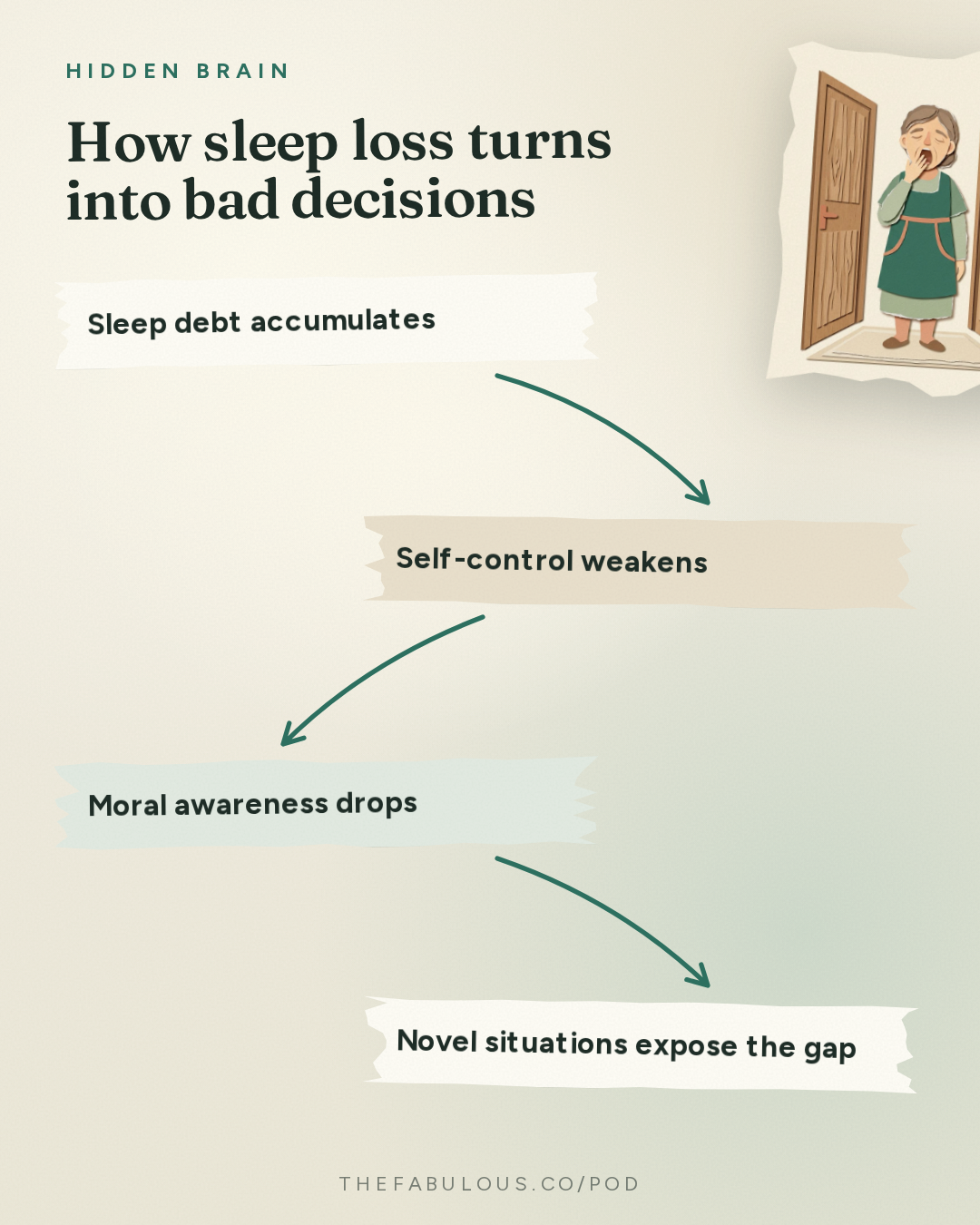
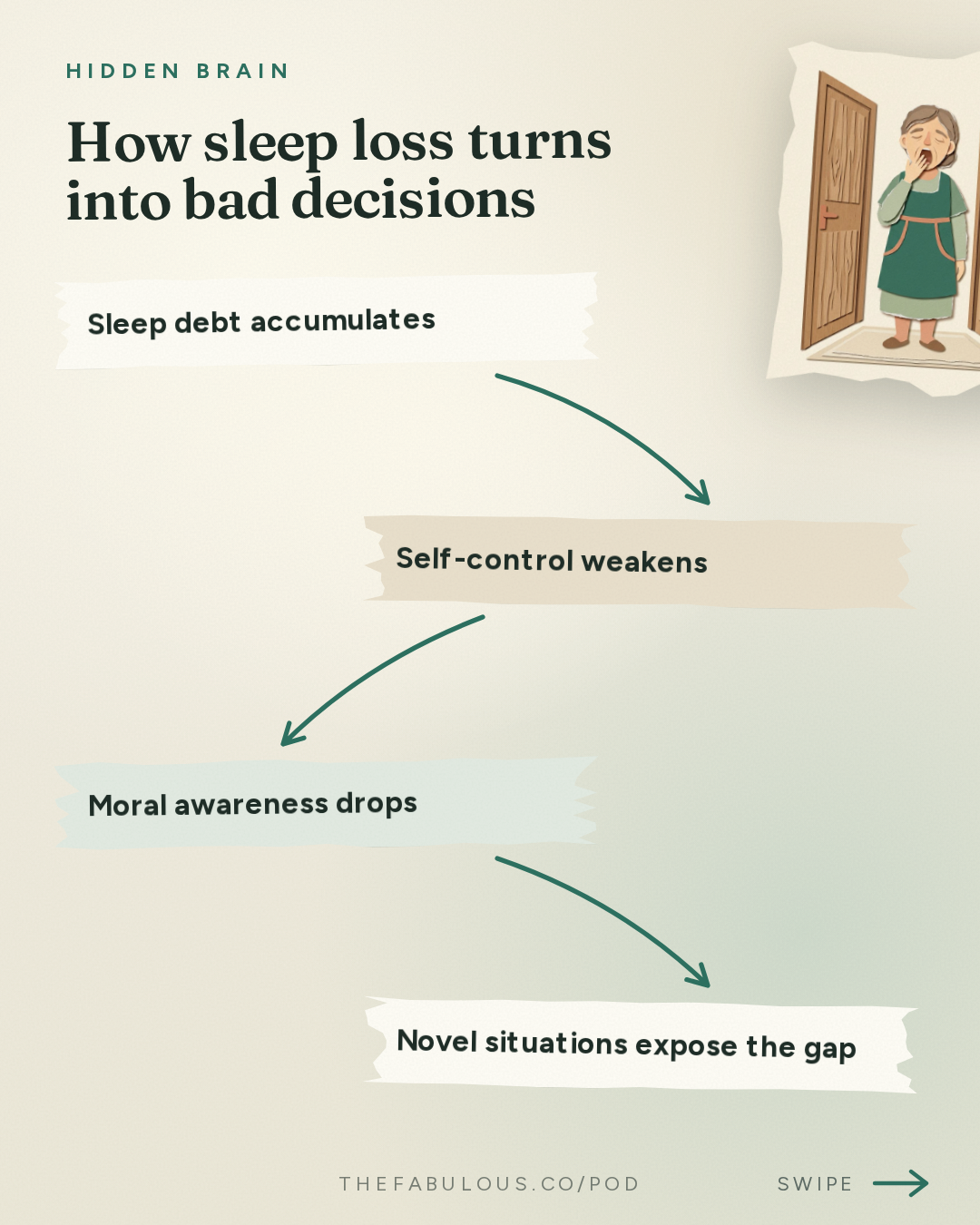
What makes sleep loss so dangerous is not just fatigue. Barnes's research finds that sleep deprivation specifically damages decision-making in situations that are new or unexpected, the kind where a person cannot simply fall back on habit (22:34). It also erodes something subtler: moral awareness, the basic recognition that a decision has an ethical dimension at all. "When people are sleep deprived, their moral awareness is lower," Barnes says, "so they're less likely to even appreciate that there's a moral aspect to the decision" (25:13). In his studies, the same person behaves more or less ethically on different days, depending in part on how they slept the night before (24:31). The effect is not trivial even at small doses. Barnes points to nap studies showing that ten or fifteen minutes of sleep is enough to move the needle on outcomes like performance (24:52).
The stakes rise sharply in industrial settings. In 2005, a BP refinery in Texas City exploded after fuel vented and ignited, killing fifteen workers and injuring 180. One worker involved had accumulated 43 hours of sleep debt from a month of 12-hour shifts stacked on top of two-hour commutes (28:26). Chernobyl and Three Mile Island, the two most infamous nuclear accidents, both began between 1:30 and 4 a.m., the hours when the body's circadian rhythm, its internal 24-hour clock, pushes hardest toward sleep (29:46). And Barnes's own research on a half million mining injuries over 25 years found a 5.6 percent spike in injuries the Monday after the spring shift to daylight saving time, even though mining happens underground, away from any change in daylight (34:33).
What the Body Clock Is Owed
Most adults need seven to nine hours of sleep, Barnes says, and very few of the people who think they are an exception actually are (38:59). Screens complicate things further: blue light suppresses melatonin, the hormone that signals the body to wind down, which is why using a phone at night can quietly steal the sleep needed to be sharp the next day (42:13). Barnes is careful to note that blue-light-filtering glasses are not a cure, just a partial fix.
He also points to a cultural habit that works against all of this: bragging about sleep deprivation as a badge of status. In his research, men who brag about getting little sleep are seen as stronger, while women who do the same are seen as more self-sacrificing. Either way, the behavior gains social credit even though it predicts worse ethics, worse decisions, and more injuries (43:30). The dynamic helps explain why a problem this well documented remains so hard to fix. The data says rest. The culture says push through.
The Myth of the Broken Body
Pain, it turns out, runs on a similarly misunderstood logic. Psychologist Rachel Zoffness, who teaches at the University of California, San Francisco, and wrote the book Tell Me Where It Hurts: The New Science of Pain and How to Heal, argues that pain is never purely a biological signal. "One of the biggest myths we've been sold is that pain is a purely biomedical problem," she says, "something to do just with anatomy and physiology, that requires a purely biomedical solution" (57:59). She calls pain biopsychosocial, meaning it emerges from three overlapping sources: biology (tissue, inflammation, genetics), psychology (emotion, fear, belief), and social circumstances (relationships, stress, support).
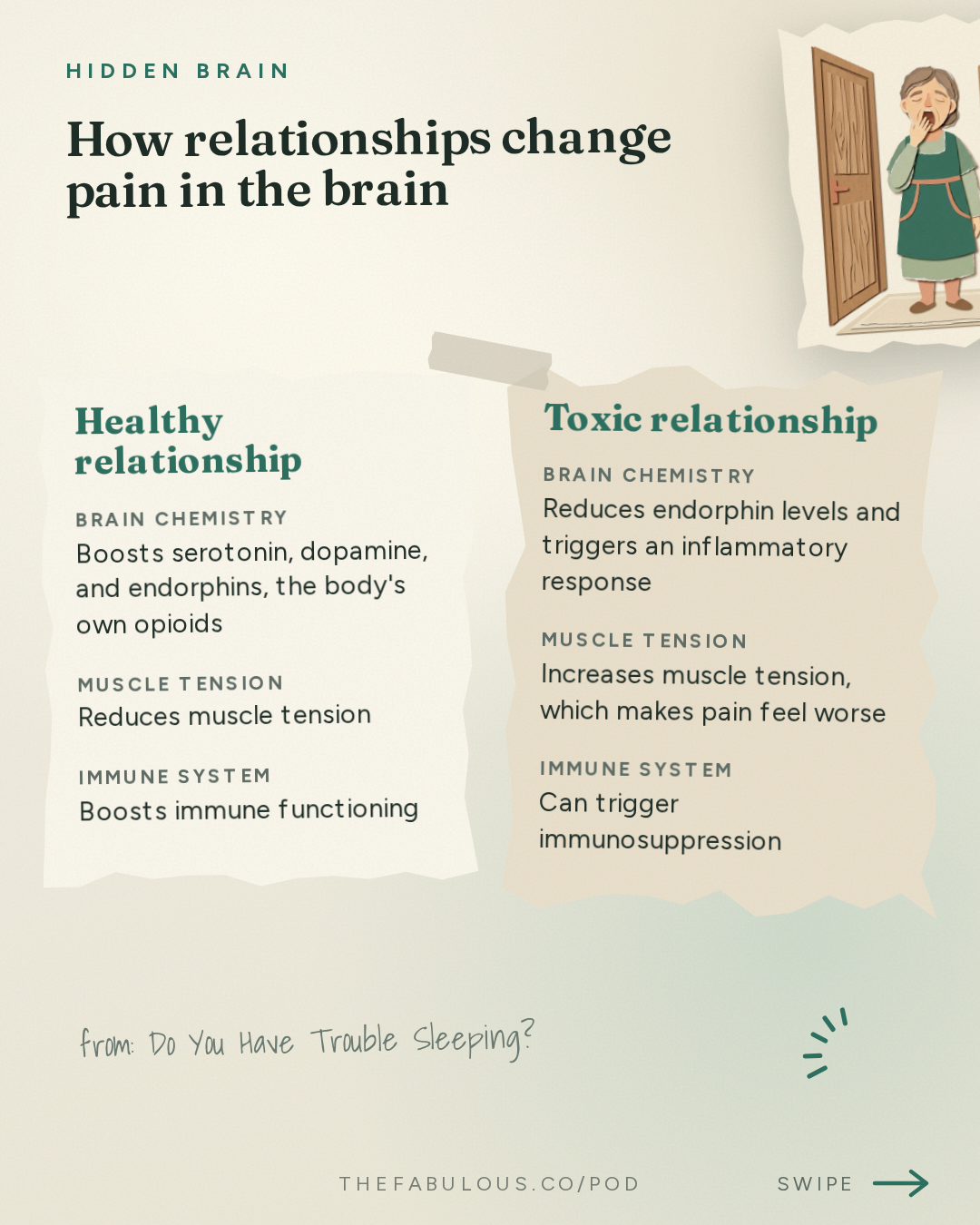
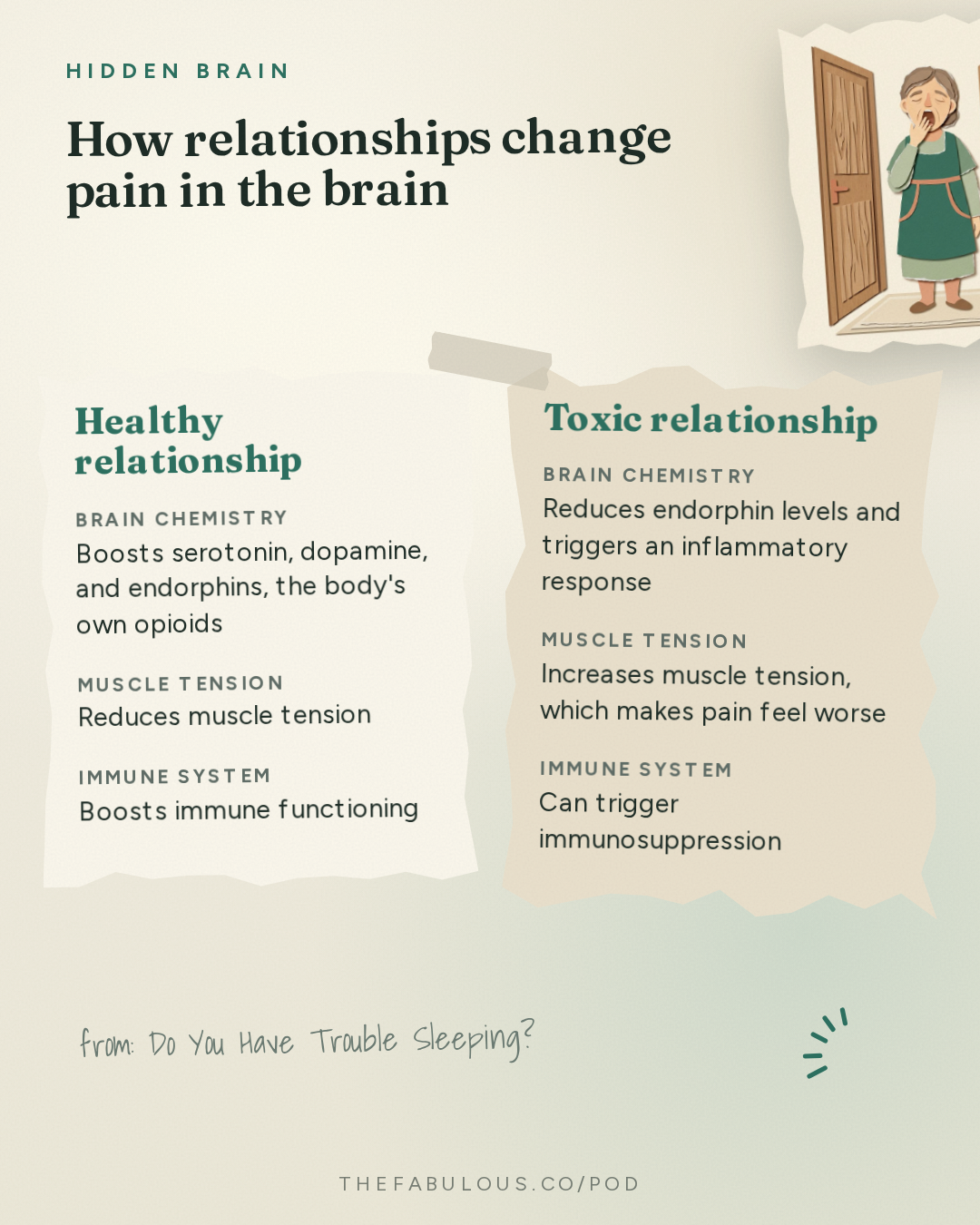
The social piece sounds like the strangest claim until a listener named Bruce describes his own experience. He had chronic back pain for 25 years; his wife had chronic migraines. They divorced. Two years later, at a graduation, she noticed he was sitting upright instead of leaning back, the posture he had always needed for his back pain. Neither of them had had a symptom in a year and a half (59:44). Zoffness explains that healthy, low-conflict relationships raise levels of serotonin, dopamine, and the body's own natural opioids called endorphins, while turning down muscle tension and inflammation. Toxic, high-conflict relationships do the reverse: they raise inflammation, increase muscle tension, and reduce endorphin levels, all of which Zoffness summarizes simply as turning pain volume up in the brain (62:53).
Fear works through a related channel. A listener named Donna, who lived for years with a painful bladder condition called interstitial cystitis, described treating her own body as an enemy, living in constant fear of triggering a flare, until she reframed the pain as her brain being afraid rather than her body being broken. Within months, her life changed (65:35). Zoffness explains the mechanism: fear activates the amygdala, a brain region tied to threat detection, and an amygdala on high alert turns pain volume up, creating a loop where pain breeds fear and fear amplifies pain (66:56).
Perhaps the clearest illustration of the gap between damage and pain is Usain Bolt. The Jamaican sprinter grew up with a spine that twisted into an S-shape from scoliosis, and by the time he won eight Olympic gold medals, his right leg was half an inch shorter than his left. He ran anyway, largely without pain (78:36). "Hurt and harm, pain and damage are not the same thing," Zoffness says (77:34). The same disconnect shows up in endometriosis, a condition causing tissue overgrowth around the uterus: the amount of overgrowth often has little relationship to how much pain a woman reports (80:00).
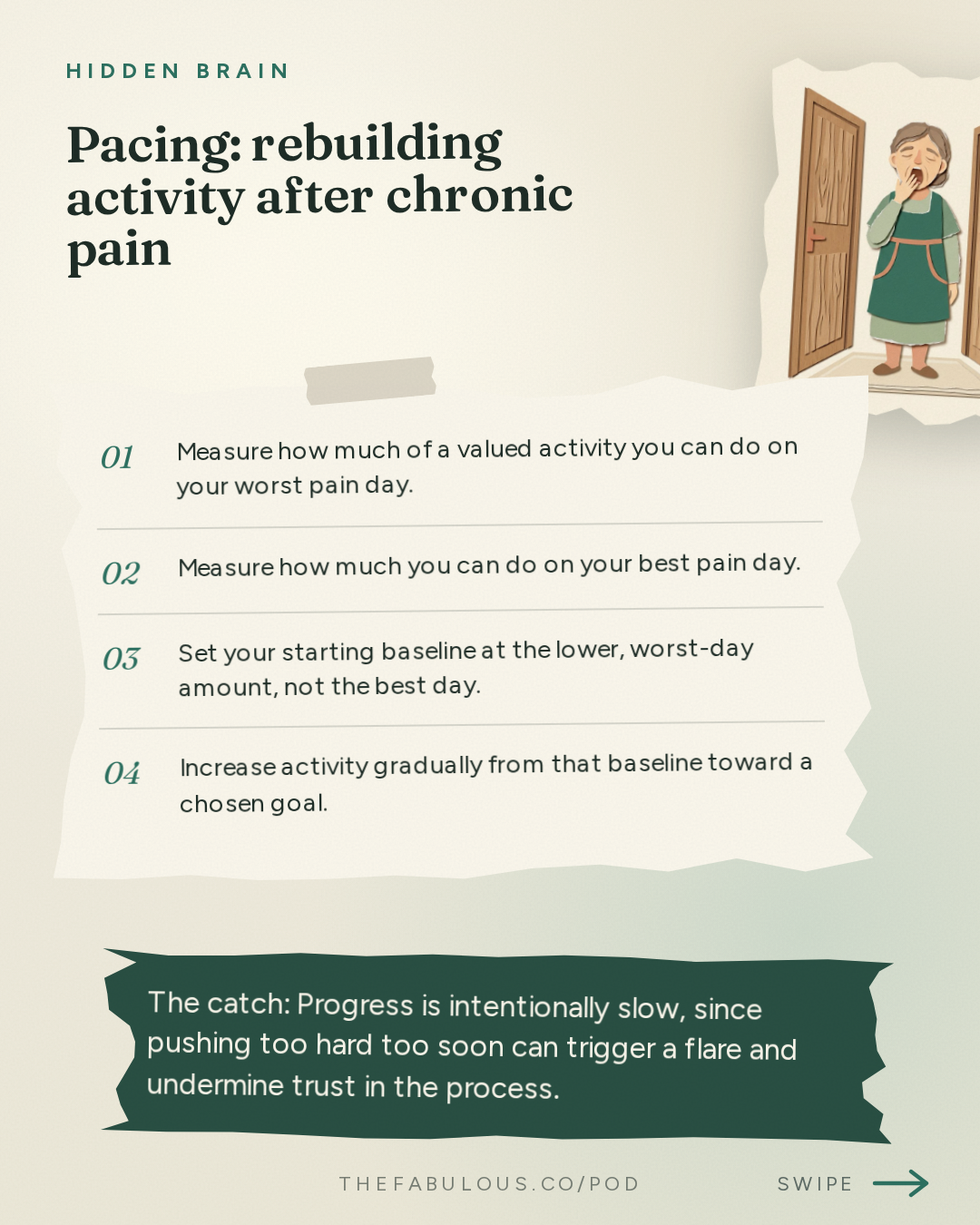
None of this means pain is imagined. Zoffness is emphatic that pain is always real, never "all in your head." What she offers instead is a tool she calls pacing: patients identify how much of a beloved activity they can manage on a bad pain day, treat that low number as the starting baseline, and build up gradually, the way a runner trains for a marathon rather than attempting 26 miles on day one (83:55). She also describes a mental image called the pain dial, a volume knob in the brain and spinal cord. Focusing attention on a painful body part turns the dial up, because the brain's prefrontal cortex acts like a magnifier on whatever gets attention. Distraction, exercise, volunteering, or simply engaging with the world turns the dial back down (94:02).
Sleep debt and chronic pain look like unrelated problems: one is about staying awake too long, the other about a body that will not stop hurting. But both stories point to the same lesson. The brain is not a passive instrument that records what the body hands it. It actively shapes outcomes, for better or worse, depending on how well it is rested, how safe it feels, and what it has learned to expect. Barnes's research suggests better sleep policy, later school start times, saner shift schedules, no more disruptive spring clock changes, could prevent a measurable share of accidents and bad decisions. Zoffness's research suggests that treating chronic pain seriously means treating the whole person, not just the scan. Both arguments ask for the same shift in thinking: stop looking only at the broken part, and start looking at the system around it.
Ask this episode anything
Pod's AI answers from the episode itself, with the minute mark so you can hear it yourself.
Or start with one of these
Ask this episode
Pod's AI listens to the whole episode to answer, and points you to the minute it comes from.
The rest of this answer, and any question after it
Answers come from the episode itself, never from a summary of it.
ContinueKey takeaways
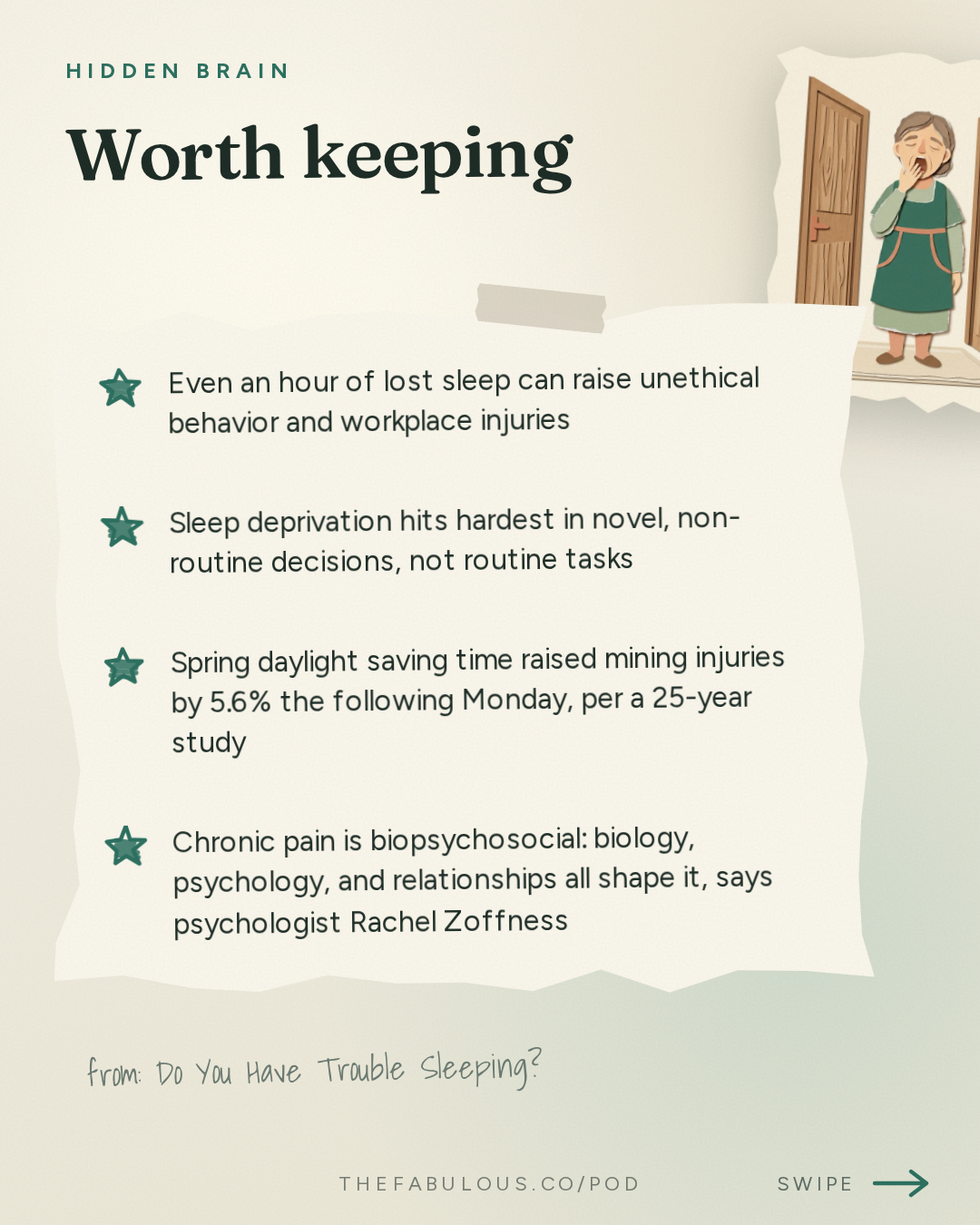
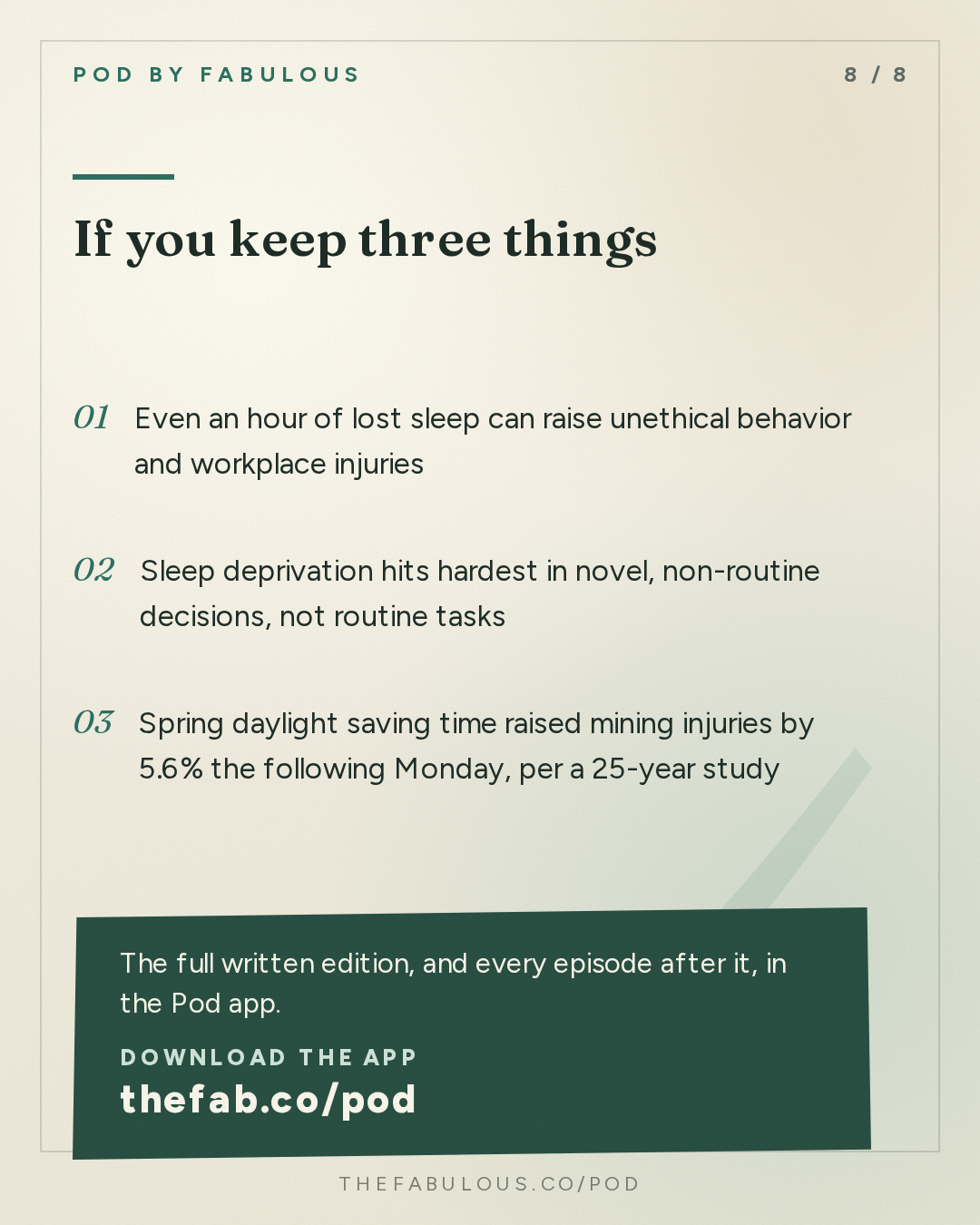
- Even an hour of lost sleep can raise unethical behavior and workplace injuries
- Sleep deprivation hits hardest in novel, non-routine decisions, not routine tasks
- Spring daylight saving time raised mining injuries by 5.6% the following Monday, per a 25-year study
- Chronic pain is biopsychosocial: biology, psychology, and relationships all shape it, says psychologist Rachel Zoffness
- Pacing means raising activity gradually from a bad-day baseline, not pushing through pain
The episode in cards
By the numbers
- 43 hours hours Accumulated sleep debt of a worker before the 2005 BP Texas City explosion
- 70% percent Share of studies linking optimism to lower pain intensity, frequency, and disability
In their words
“In the multiverse, some swath of that multiverse, I am the villain in some family's story.”
“Research indicates that when people are sleep deprived, their moral awareness is lower, so they're less likely to even appreciate that there's a moral aspect to the decision”
“One of the biggest myths we've been sold is that pain is a purely biomedical problem.”
“Hurt and harm, pain and damage are not the same thing.”
“The brain is always changing and pain is always changing, and that means pain can change.”
Protocols
-
Match the task to your alertness
Chris Barnes, a sleep researcher at the University of Washington, checks in with himself on how alert he feels, then does simple tasks like answering email when drowsy and saves demanding work, like giving detailed feedback to a student, for moments when he feels more energized.
ongoing, adjusted day to day
-
Use blue-light glasses as a partial fix, not a cure
Barnes recommends blue-light-filtering glasses when using a phone or screen late at night, since blue light suppresses melatonin and signals the body to stay awake, but he stresses that avoiding screens at night entirely is still the better solution.
nightly, when screens are unavoidable
-
Pace activity to a bad-day baseline
Rachel Zoffness, a psychologist at the University of California, San Francisco, has patients measure how much of a valued activity they can do on their worst pain day and their best pain day, set the baseline at the lower number, and increase it gradually toward a goal, the way a runner trains for a marathon.
gradual, reviewed over weeks
-
Turn the pain dial down with distraction
Zoffness teaches patients to picture a pain dial in the brain and spinal cord and to lower it by shifting attention away from the painful body part, through activities like volunteering, socializing, or hobbies, because focused attention acts like a magnifier that raises perceived pain.
as needed when pain rises
Questions this episode answers
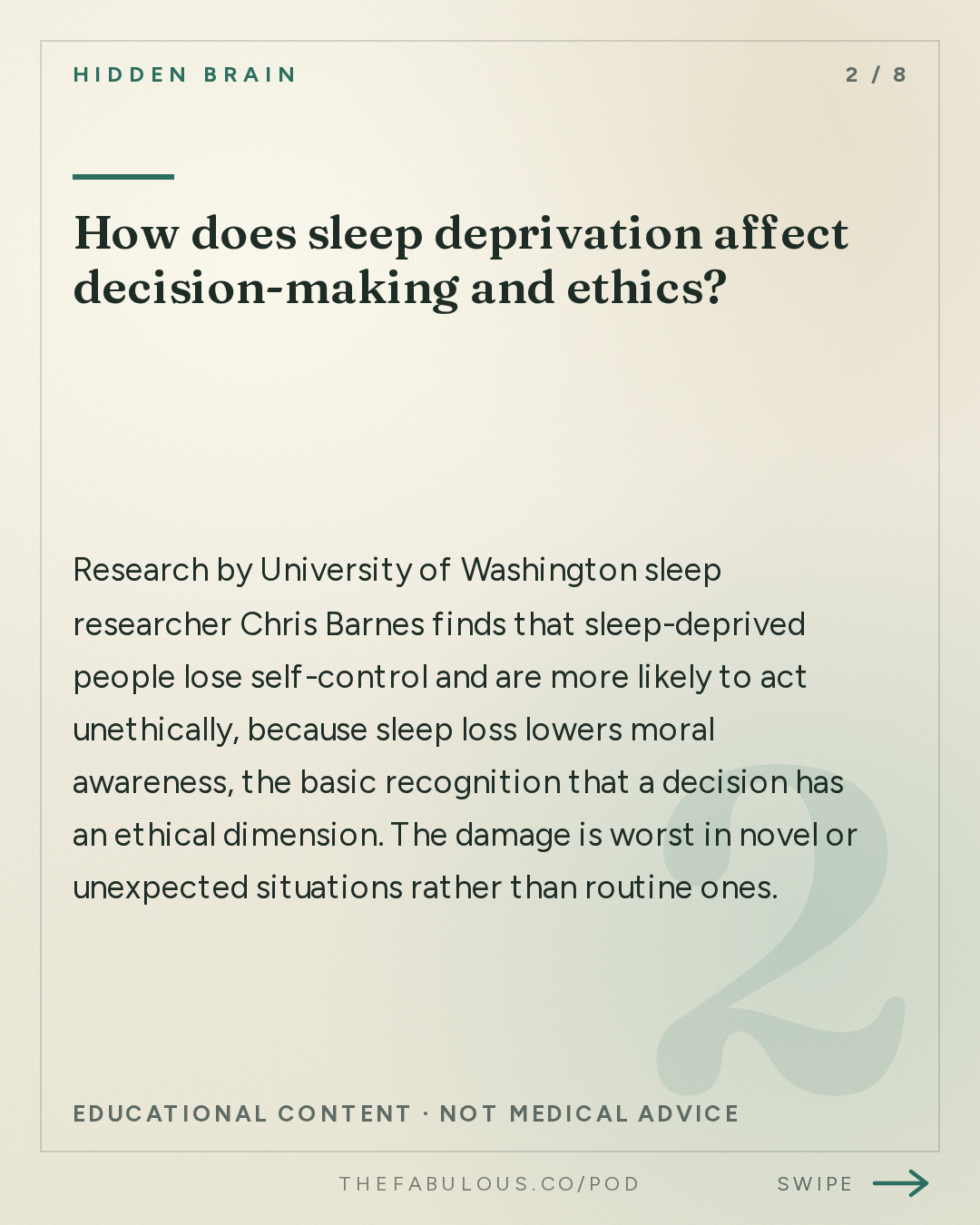
How does sleep deprivation affect decision-making and ethics?
Research by University of Washington sleep researcher Chris Barnes finds that sleep-deprived people lose self-control and are more likely to act unethically, because sleep loss lowers moral awareness, the basic recognition that a decision has an ethical dimension (24:03, 25:13). The damage is worst in novel or unexpected situations rather than routine ones (22:34).
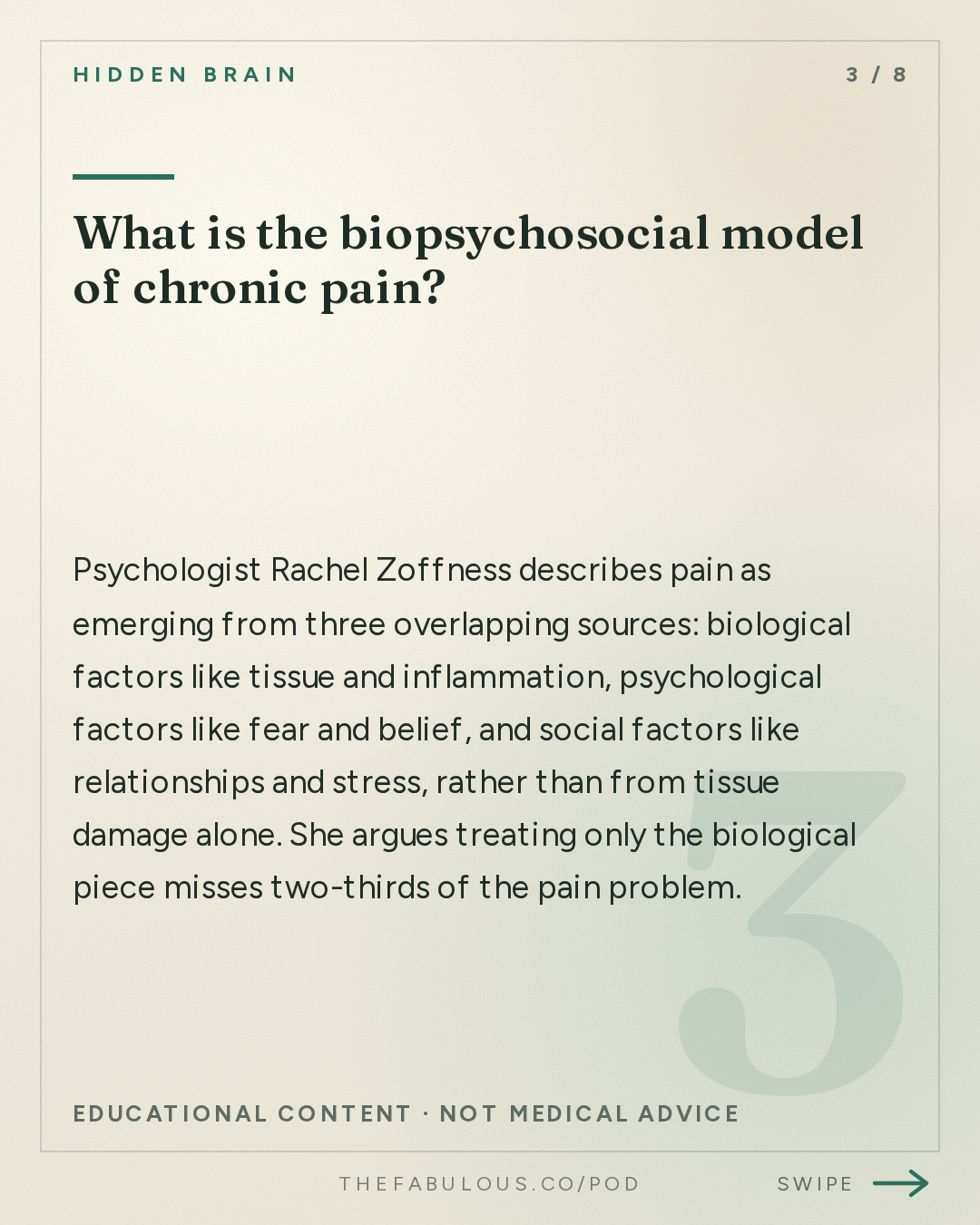
What is the biopsychosocial model of chronic pain?
Psychologist Rachel Zoffness describes pain as emerging from three overlapping sources: biological factors like tissue and inflammation, psychological factors like fear and belief, and social factors like relationships and stress, rather than from tissue damage alone (57:59). She argues treating only the biological piece misses two-thirds of the pain problem (58:40).
Does daylight saving time actually cause more accidents?
Yes. A 1996 study and a 2018 follow-up both found a spike in car crashes and traffic fatalities after the spring clock change, and Chris Barnes's own research on about 500,000 mining injuries over 25 years found a 5.6% spike in injuries the Monday after the spring transition (34:10, 34:33).
What is pacing for chronic pain recovery?
Pacing, as taught by psychologist Rachel Zoffness, means measuring how much of a valued activity a person can manage on their worst pain day, setting that as a baseline, and increasing it gradually toward a goal, similar to how a runner trains for a marathon instead of attempting 26 miles on day one (83:55, 85:55).
Can you have severe tissue damage without feeling pain?
Yes. Sprinter Usain Bolt competed through scoliosis so severe it left one leg half an inch shorter than the other, winning eight Olympic gold medals largely without pain, which Rachel Zoffness uses to show that tissue damage and pain are not the same thing (77:34, 78:36).
Do blue-light glasses actually help with sleep?
Chris Barnes says blue light suppresses melatonin, the hormone that signals the body to fall asleep, so filtering it out with glasses can be a useful partial fix when screens are unavoidable at night, though he stresses it is not a complete solution and avoiding screens late at night works better (42:13).
The full read, in cards
Go deeper
- Tell Me Where It Hurts: The New Science of Pain and How to Heal — Rachel Zoffness's book laying out the biopsychosocial model of pain and the pacing protocol
- 1996 study on daylight saving time and car crashes — found an elevated rate of crashes and traffic fatalities following the spring clock change
- Time zone edge study on daylight exposure and cancer — found worse health outcomes, including higher cancer rates, on the side of a time zone that gets daylight later in the day
- 25-year mining injury study — examined about 500,000 mining injuries and found a 5.6% spike the Monday after spring daylight saving time
Mentioned
Chris Barnes · Rachel Zoffness · University of Washington · University of California, San Francisco · William Rockefeller · Gary Hart · Usain Bolt · Tell Me Where It Hurts · Chernobyl · Three Mile Island · BP
More from this show and category
Why Am I Unhappy? The Psychology Behind It
Psychologists George Loewenstein and Alison Ledgerwood argue that most unhappiness starts inside the mind, not from outside events. Loewenstein traces it to the hedonic treadmill and guilt over our own feelings; Ledgerwood traces it to a negativity bias built to spot threats. Their shared fix: notice good moments without suppressing bad ones, and ask whether a reaction fits now or an old pattern (96:51).
How to Build Agency: Martin Seligman's Method
Martin Seligman argues that agency, the belief that our actions can change outcomes, is a skill built through specific exercises, not an inherited trait. He describes three tools, disputing catastrophic thoughts, graded task assignment, and writing about a best possible self, backed by decades of research on optimism and helplessness.
Seligman on Learned Helplessness and Optimism
Psychologist Martin Seligman found that helplessness is learned, and so is optimism. His research links explanatory style to depression risk, predicts success at West Point and in sales, and traces a psychological theory of human progress from ancient Greece to St. Augustine to modern China.
Why Conversations Go Wrong: Tannen and Levine
Georgetown linguist Deborah Tannen and University of Chicago psychologist Emma Levine explain why conversations misfire and when lying helps. Tannen shows that mismatched pacing and indirectness create hidden meta-messages about relationships, while Levine finds most lies are pro-social, told to spare feelings when the truth offers no benefit.
