
The Psychology of Music and Memory
Music and Your Mind
The brief
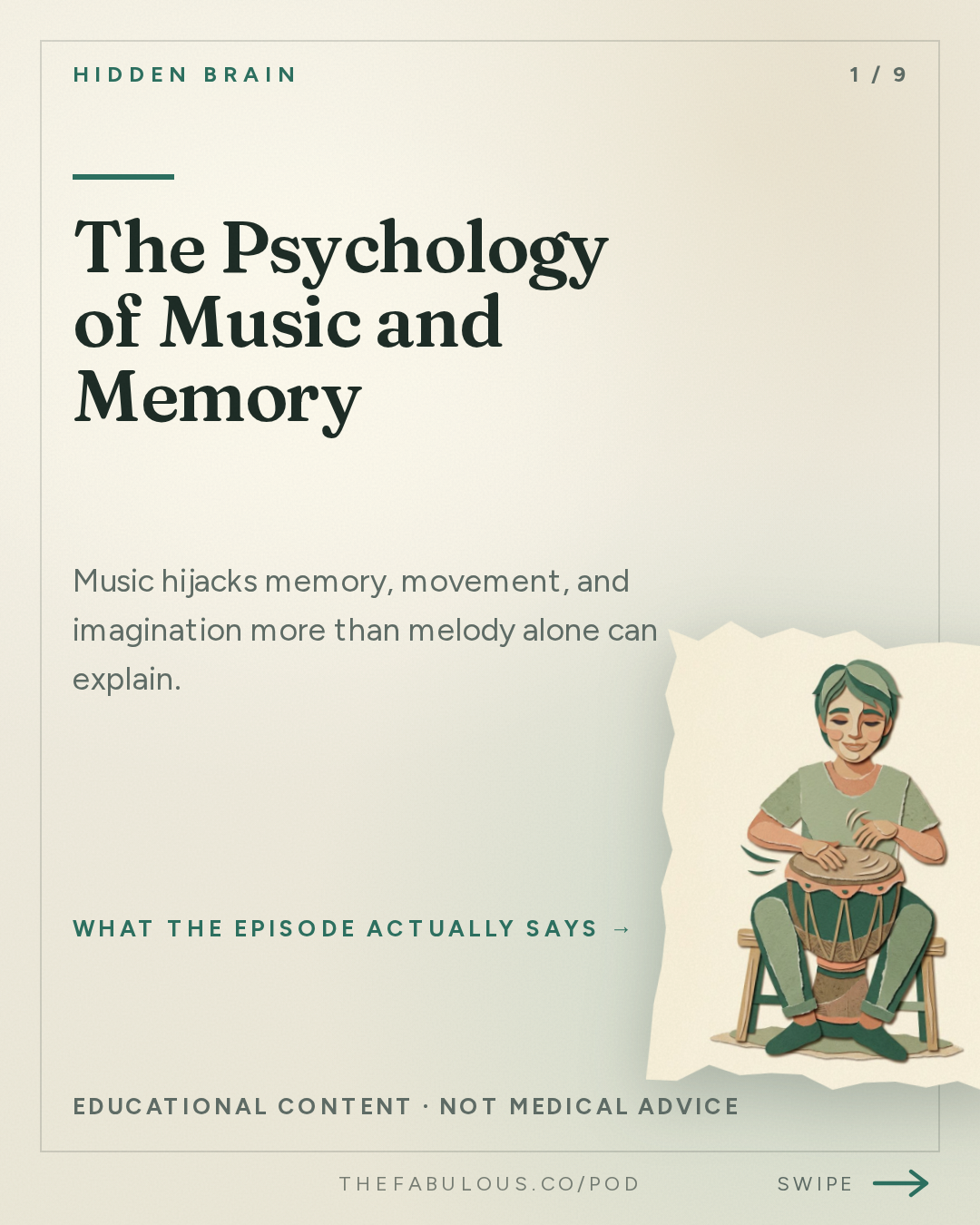
Music hijacks memory, movement, and imagination more than melody alone can explain: strangers hearing the same unfamiliar piece picture nearly identical scenes, and engaging in art, not just enjoying it, lowers blood pressure, cortisol, and loneliness. Princeton's Elizabeth Margulis and UCL's Daisy Fancourt explain why listening and making are both medicine.
Two notes. That's all John Williams needed to turn a sunny beach into a crime scene in the 1975 film Jaws (00:00). The sound itself is nothing: two notes, repeating. What it conjures is a shark. This gap, between the thin physical signal and the enormous world it builds in a listener's head, is the subject of two conversations Hidden Brain host Shankar Vedantam has with researchers who study what music actually does once it leaves the speaker and enters a mind.
The first is with Elizabeth Margulis, a music psychologist at Princeton University who goes by Lisa. She trained as a pianist at the Peabody Conservatory, where music was treated like a puzzle: counterpoint, harmony, a theorist named Schenker who notated pieces almost like equations (09:12). That tradition, she explains, traces back centuries, to Pythagorean ratios in the sixth century BCE and German Romantic ideas that music was a purer language than words (11:14). But Margulis's own most powerful experiences with music had nothing to do with structure. She describes standing at a summer music camp as a teenager, weeping as an orchestra played Liszt's Les Préludes on the final night of the season, and then, years later, bursting into tears when the same piece came on the radio, before she even consciously recognized the tune (03:51). A different memory surfaced mid-workout: the song "Every Rose Has Its Thorn" transported her back, instantly and in full sensory detail, to a seventh-grade scavenger hunt where she'd tried out a swear word and humiliated herself in front of her new classmates (06:44).
"Music-evoked personal memories... tend to have a lot of vivid sensory detail, so more like a reliving and less like a factual recollection." — Elizabeth Margulis [09:12]
That distinction matters. A fact you recall; a memory like this you re-enter, temperature and shame included. Margulis argues that the conservatory's note-by-note analysis, while useful, had trained her to ignore exactly this part of listening, the part where sound turns into a life.
The Shared Daydream
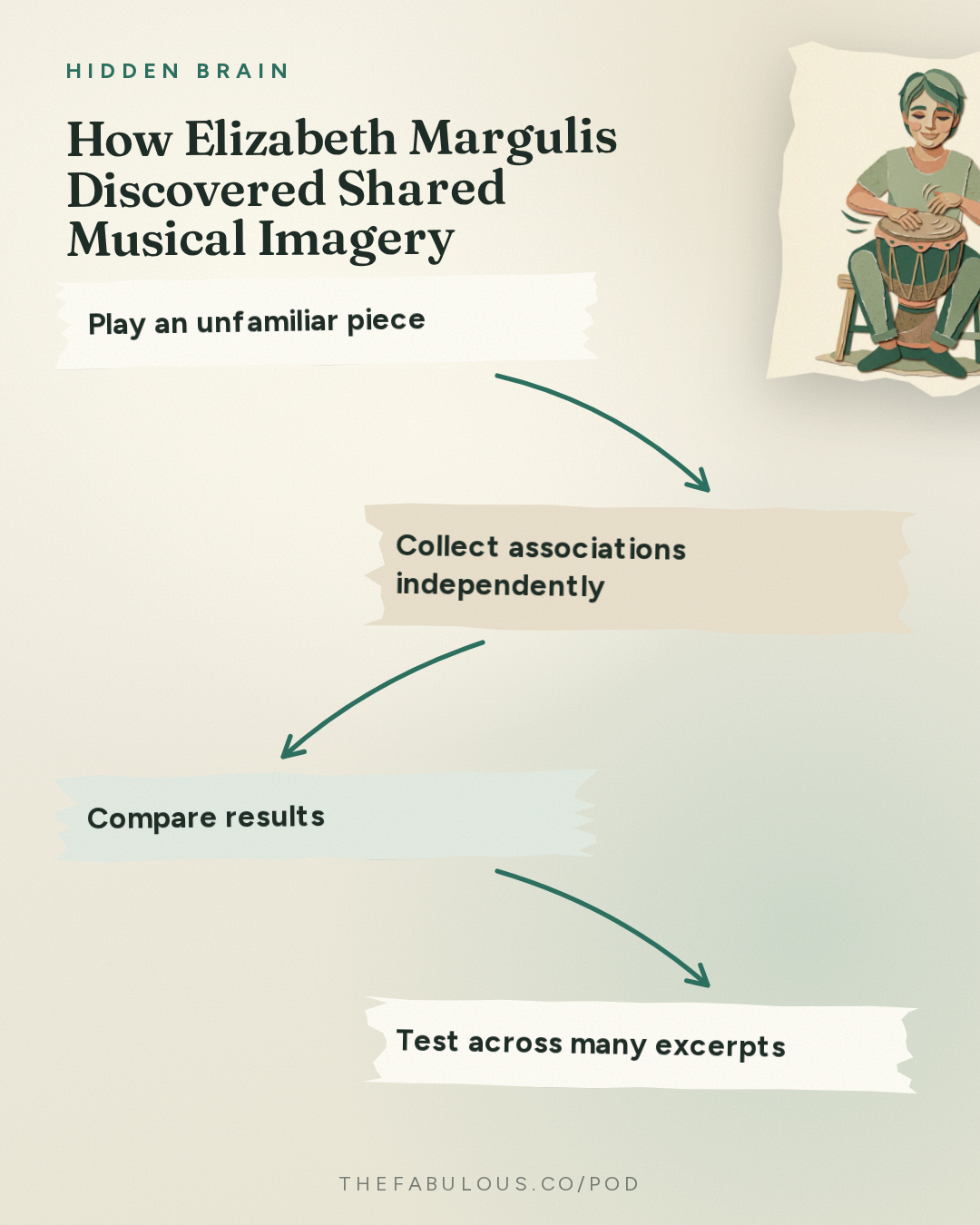
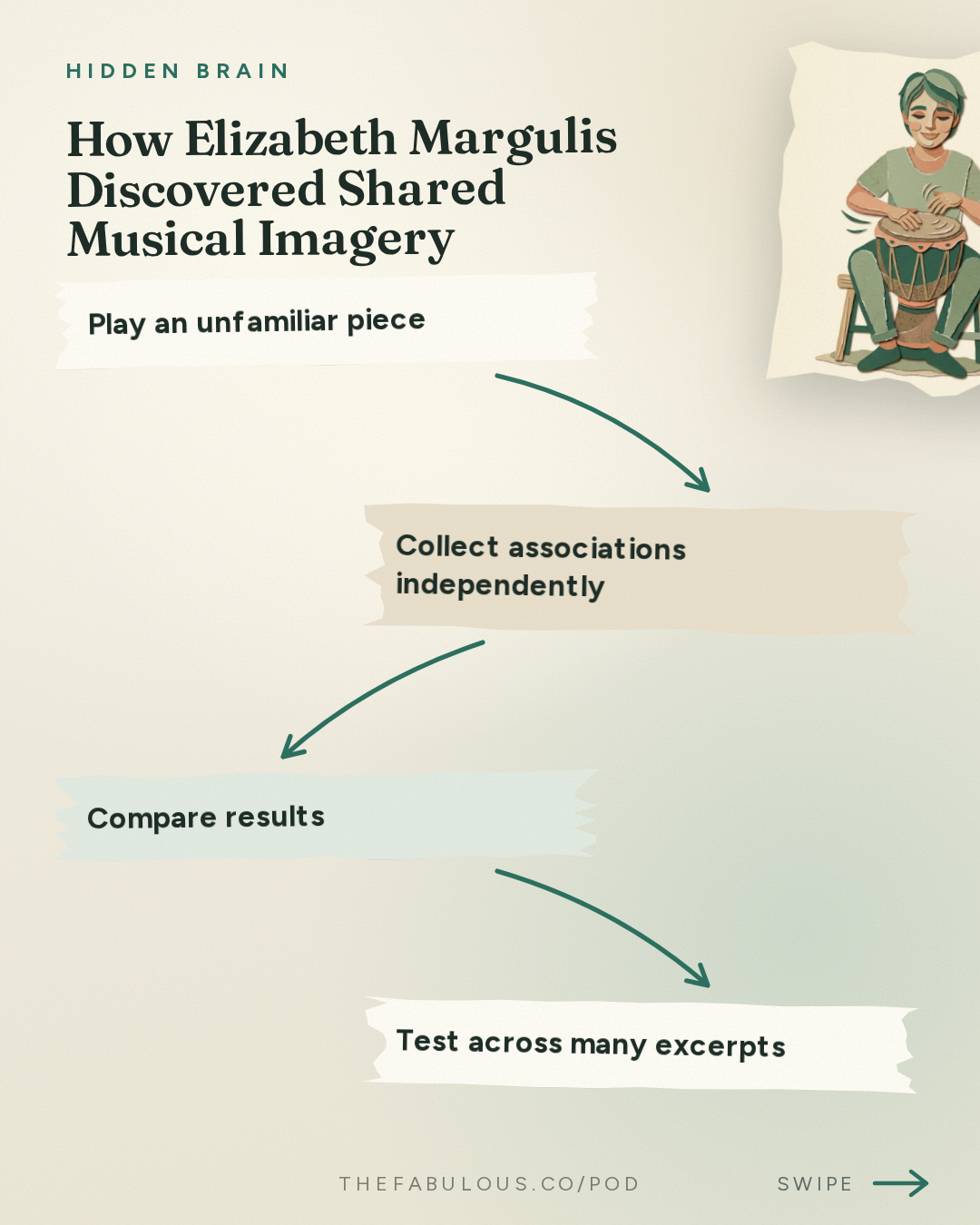
Margulis stumbled onto her central research question by accident. Teaching an introductory class, she played students an obscure, wordless excerpt from Wagner's Ring Cycle that almost none of them could have heard before, expecting a chorus of different, idiosyncratic reactions to illustrate how subjective music is. Instead, one student said "pirates." Then another said the same thing, picturing ships battening down hatches against waves (21:09). She assumed they were copying each other, until she repeated the exercise the next year with students writing answers down privately. The first slip of paper she opened said "pirates" again (22:25).
That accident became a decade of research. Margulis found that for a wide range of unfamiliar musical excerpts, strangers converge on startlingly specific, shared images: a cartoon cat chasing a cartoon mouse for a movement from Liszt's Faust Symphony, a sword fight between hero and villain for a passage of Mahler's Second Symphony, a girl watching snow fall by a window for another piece entirely (23:38). Her explanation is that listeners are "incredibly astute trackers of statistics," picking up on the auditory patterns, tempos, and textures that have, across a lifetime of film scores and media, become attached to certain scenes (27:09). When she took the same experiment to a remote Dong-speaking village in China, with little exposure to Western media, the pattern held in a revealing way: listeners there also agreed with each other instantly, but their shared image for a piece that evoked a stalking murderer for American listeners was children playing games outside (36:35). The specificity travels. The content is local.
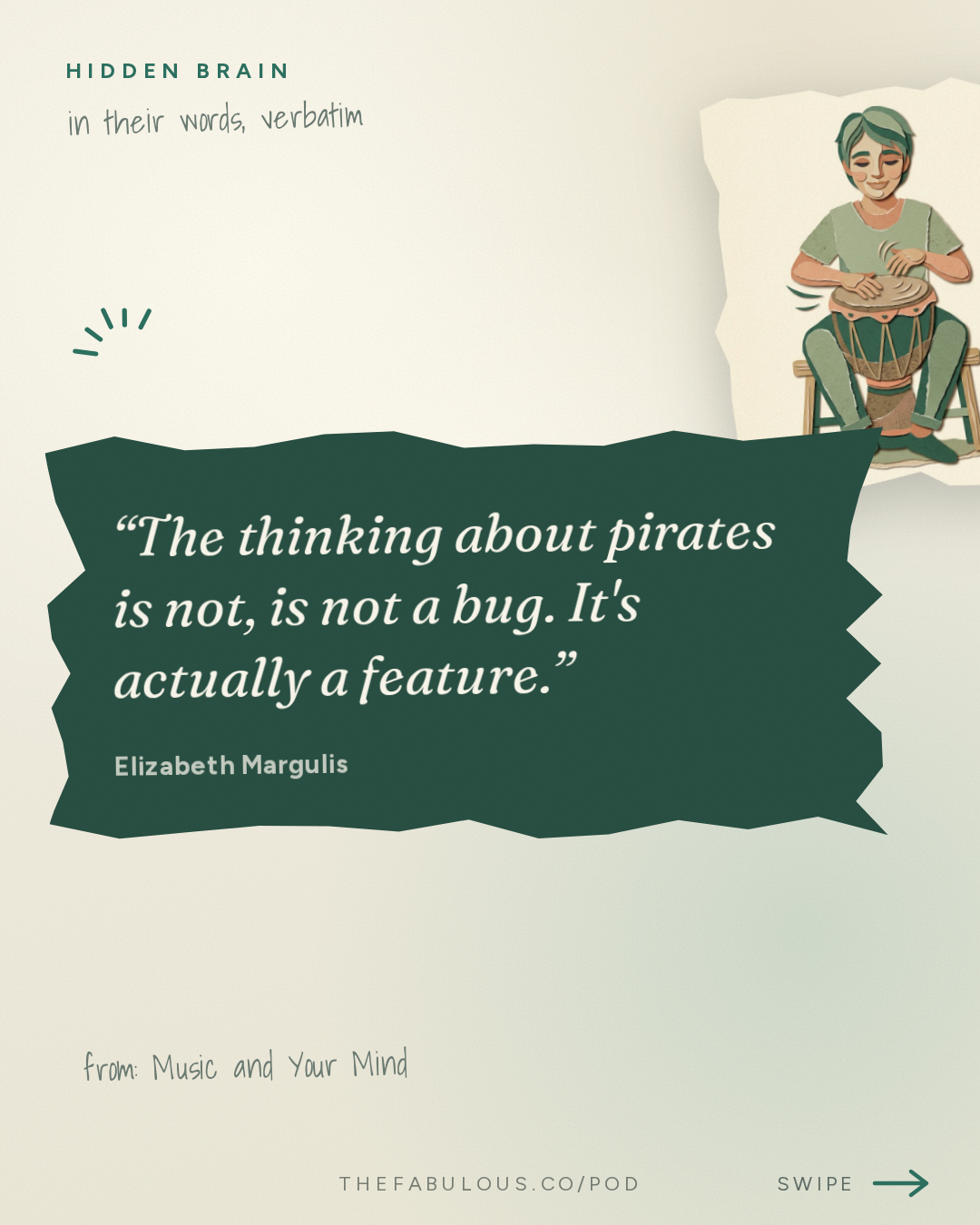
"The thinking about pirates is not, is not a bug. It's actually a feature." — Shankar Vedantam [47:04]
Margulis extends this into practical advice: resist the urge to read the program notes before a piece, let the mind wander into story and image first, and treat musical daydreaming as a sign the brain is working, not failing, to track repetition, surprise, and structure (43:18). She also points to a stranger finding: listeners who hear the exact same recording twice, unknowingly, usually rate the second playing as more expressive (49:24), because repetition itself changes what the ear notices. None of this is confined to concert halls. Music heard in adolescence sticks for life in what researchers call the "reminiscence bump," and by 12 months of age, infants raised in one musical culture lose the ability to easily process the rhythms of another, a fluency that is recoverable with exposure in infancy but not, typically, through passive listening in adulthood (39:25).
Art as a Health Behavior
The second half of the episode turns from how music is perceived to what engaging with any art form does to the body. Daisy Fancourt, a psychologist at University College London and author of Art Cure: The Science of How the Arts Save Lives, frames the arts plainly: as a health-enhancing behavior, on par with exercise or sleep hygiene. Engaging with art, she says, lowers blood pressure and heart rate, reduces the stress hormone cortisol, affects inflammation in the immune system, and counters loneliness by connecting people to others (57:45).
Several listeners wrote in with their own evidence. One, called Dolphin, described a year of insomnia that ended only after she started painting a dandelion every night before bed. Fancourt's read is that the ritual does double duty: it keeps a screen out of the bedtime routine, and its repetitiveness entrains heart rate and breathing to a slower pace, the same physiological shift that sleep needs (63:22). Another listener, Catherine, said painting during a period of eating disorders and emotional crisis effectively saved her life; Fancourt connects this to new research showing that engaging with art activates some of the same processes, like surfacing unconscious material, that talk therapy relies on (60:07).
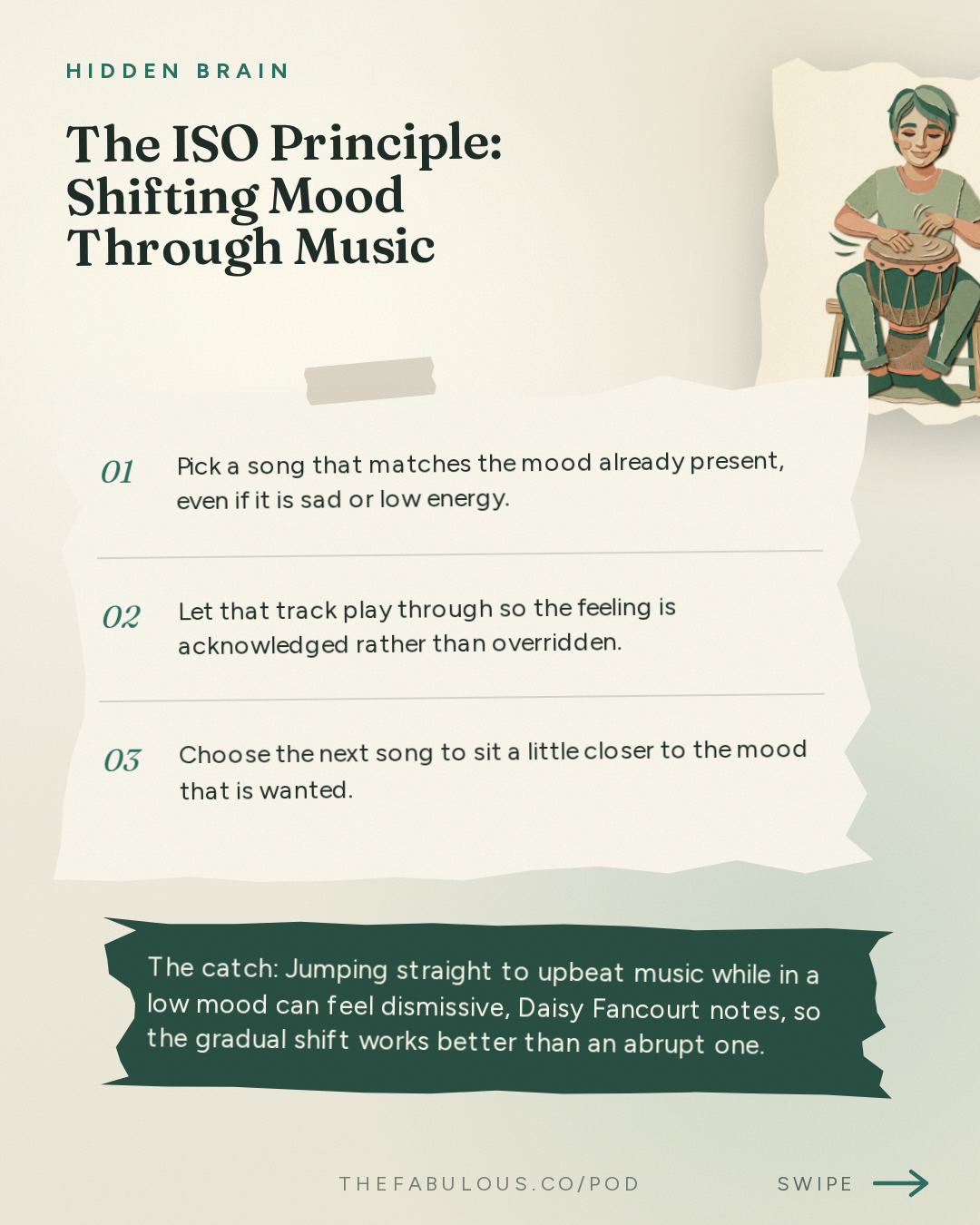
Fancourt names a specific technique for using music to shift mood: the ISO principle, developed in music therapy. Start by listening to a piece that matches the mood already present, sad for sad, then move through a sequence of tracks that edge gradually toward the mood that's wanted (61:10). The logic is that jumping straight to upbeat music when someone is low can feel dismissive; matching first, then shifting, works with the emotional state rather than against it.
A recurring theme is that mastery is beside the point. A chamber music teacher named Karen argued that the benefits of making art come from the process, not the polish, and Fancourt agrees emphatically, noting that for most of human history everyone sang, danced, and told stories as ordinary life, and that treating skill as the price of entry is a modern, costly idea (65:58). Still, not all art-making is equally protective. For long-term brain health and neuroplasticity, the ability of the brain to form new connections, Fancourt says the research points to cognitively complex, novel activities, like learning an instrument, as showing the strongest links, while for mental health outcomes like anxiety and depression, making art and simply experiencing it show parallel benefits (70:13).
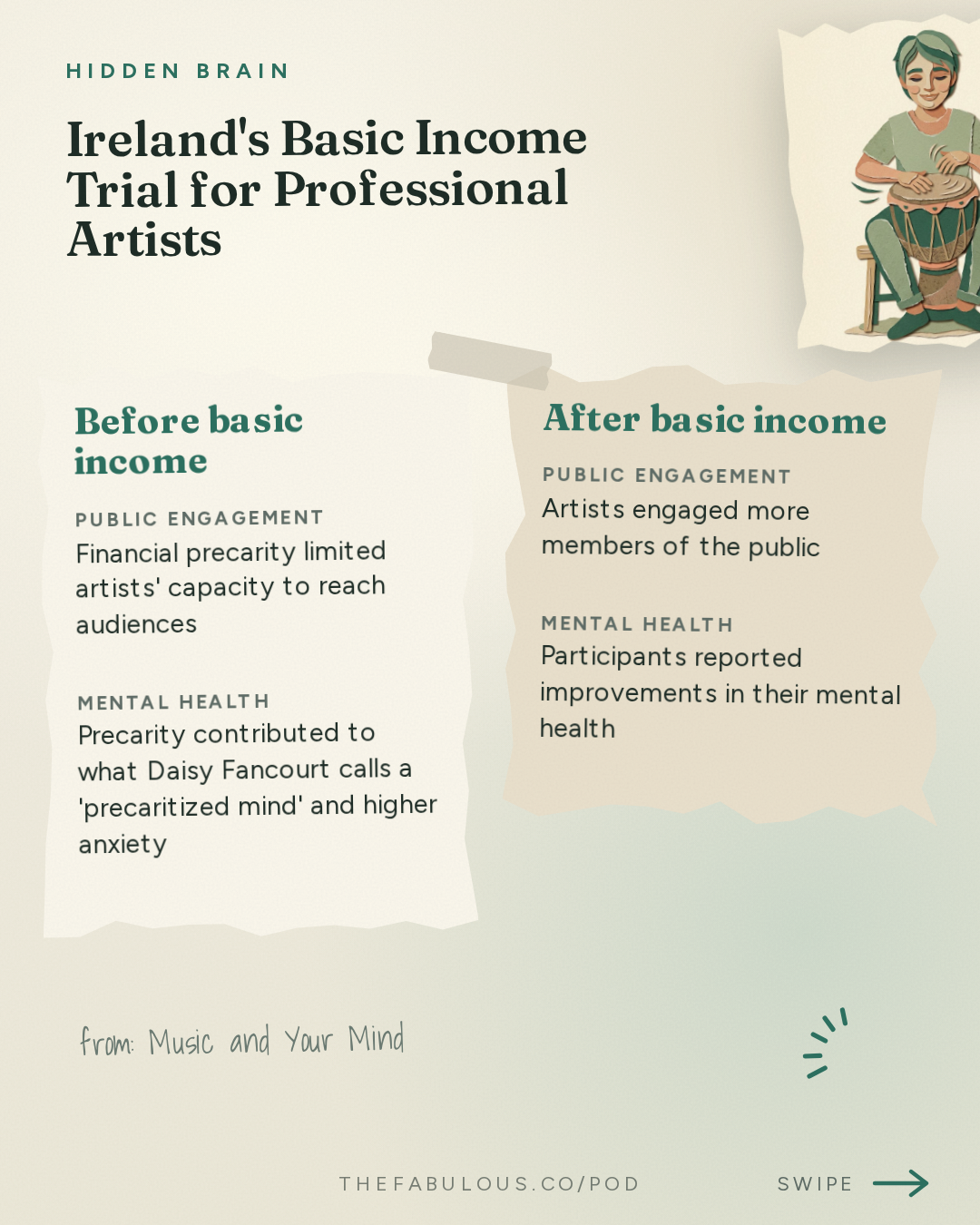
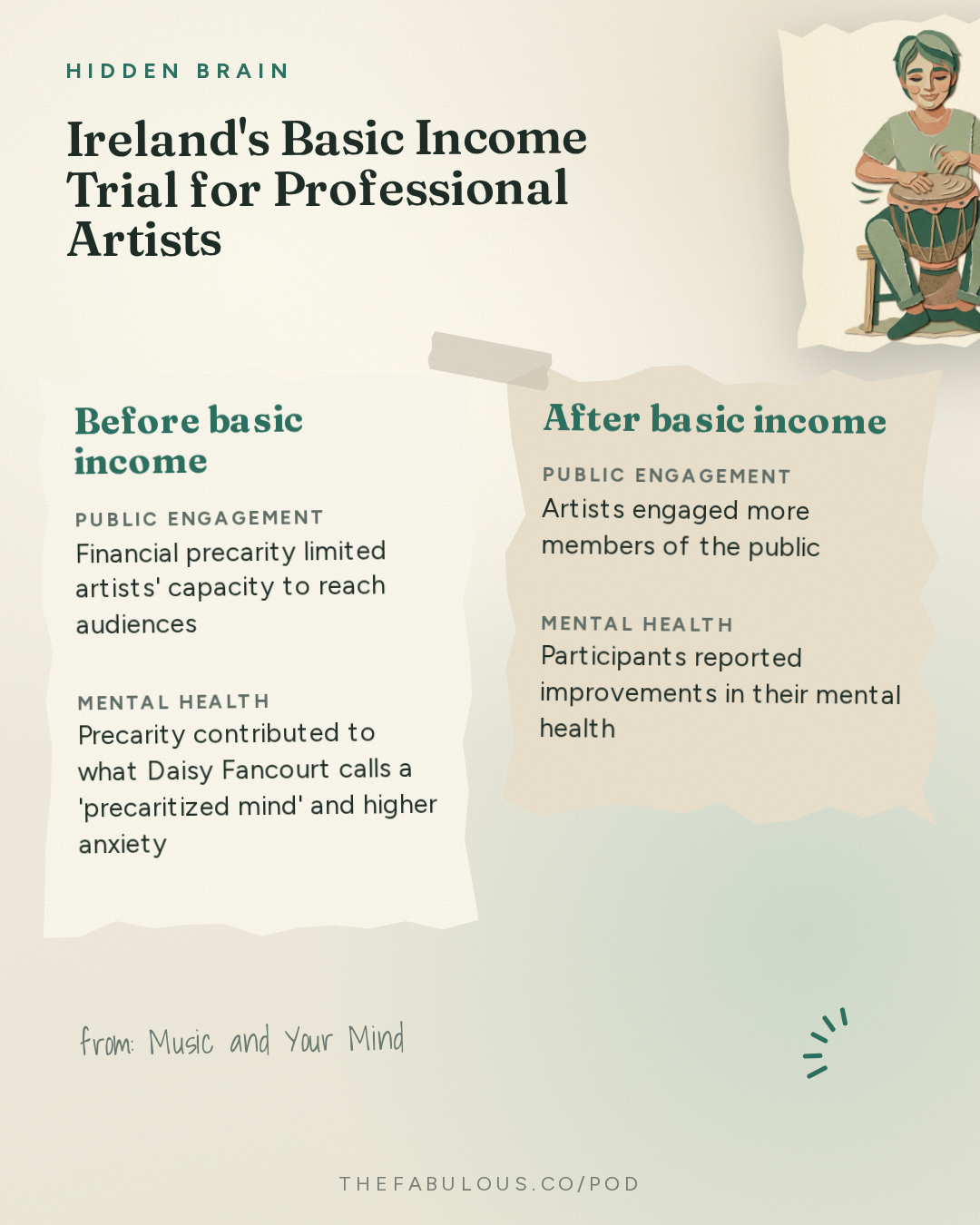
There is a catch for people who do this for a living. Fancourt says professional artists report higher average wellbeing but also higher rates of anxiety and depression, largely because the work is entangled with financial precarity, a state she calls a "precaritized mind" (80:11). Ireland tested a fix: a trial basic income paid to 2,000 professional artists, no strings attached (81:04). Participants engaged more of the public and reported better mental health; the country has since made the scheme permanent after seeing a measurable economic return, and Scotland has said it wants to try something similar (81:24).
The episode ends on a practical note. In a U.S. study that tracked 22,000 individual experiences across more than 200 different activities, the single activity most likely to produce a flow state, the absorbed, time-losing focus that athletes and artists both describe, was arts and crafts (89:17). Fancourt's advice for anyone wanting to start is low stakes: try a new craft each month until one sticks, and go see something outside the comfort zone, a student exhibition or a community choir counts as much as a concert hall (97:50). The through-line of both conversations is the same: music and art are not decorations on a life already lived. They are among the tools that make a life, including its memories, legible to the person living it.
Ask this episode anything
Pod's AI answers from the episode itself, with the minute mark so you can hear it yourself.
Or start with one of these
Ask this episode
Pod's AI listens to the whole episode to answer, and points you to the minute it comes from.
The rest of this answer, and any question after it
Answers come from the episode itself, never from a summary of it.
ContinueKey takeaways
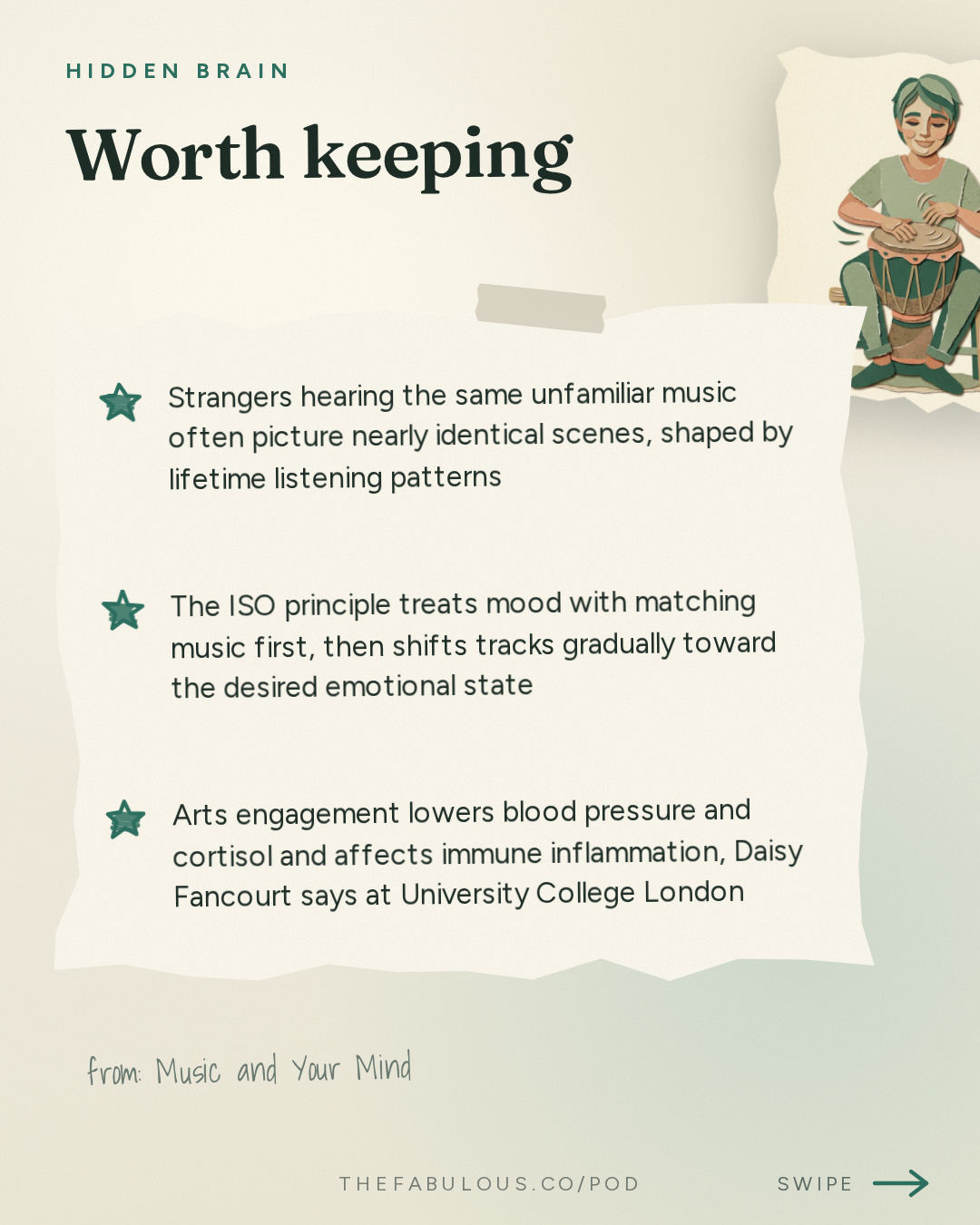
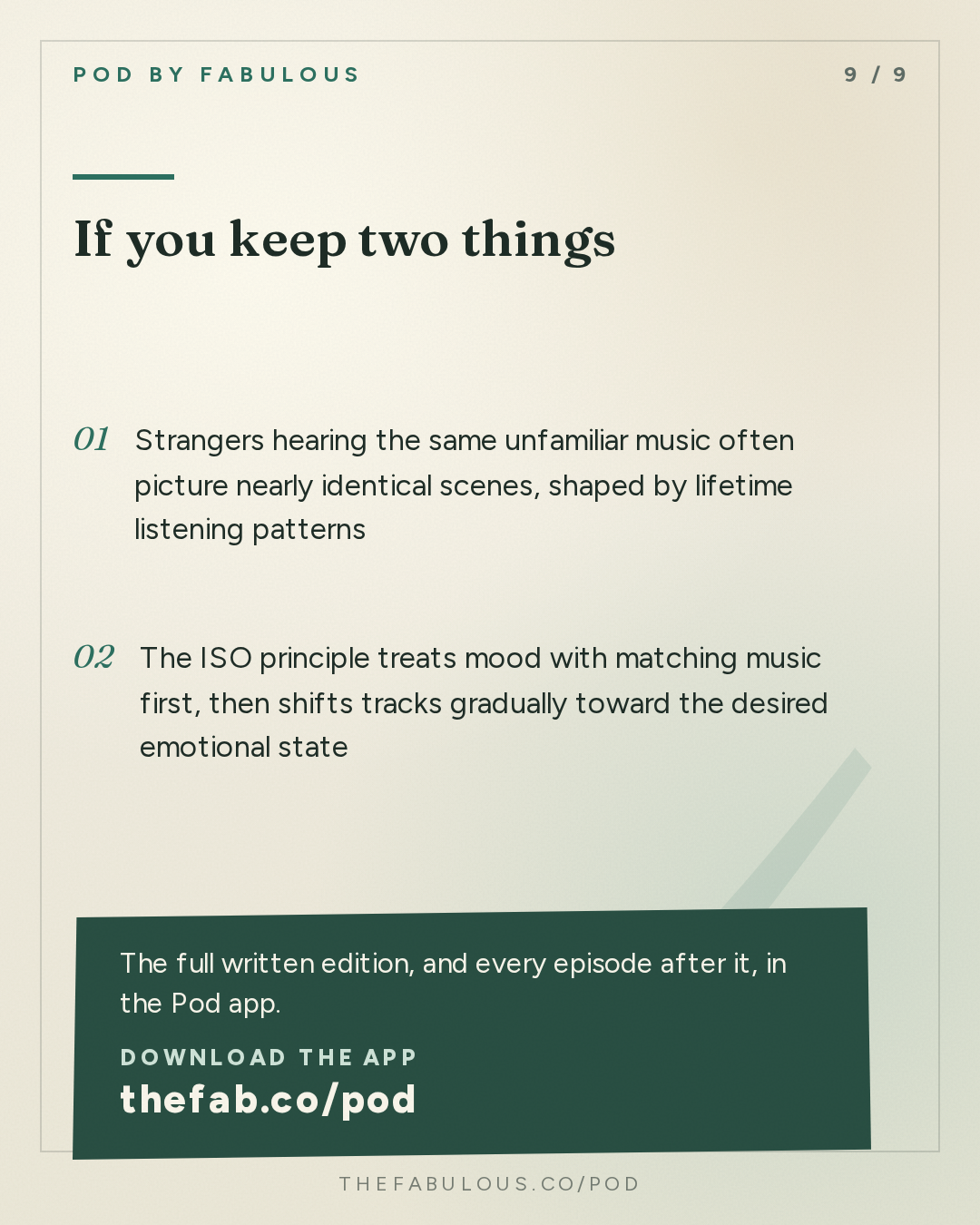
- Strangers hearing the same unfamiliar music often picture nearly identical scenes, shaped by lifetime listening patterns
- The ISO principle treats mood with matching music first, then shifts tracks gradually toward the desired emotional state
- Arts engagement lowers blood pressure and cortisol and affects immune inflammation, Daisy Fancourt says at University College London
- Infants lose fluency in foreign musical rhythms by 12 months of age unless given specific cultural exposure
- Ireland's basic income trial for 2,000 professional artists improved mental health and public engagement, leading to a permanent program
The episode in cards
By the numbers
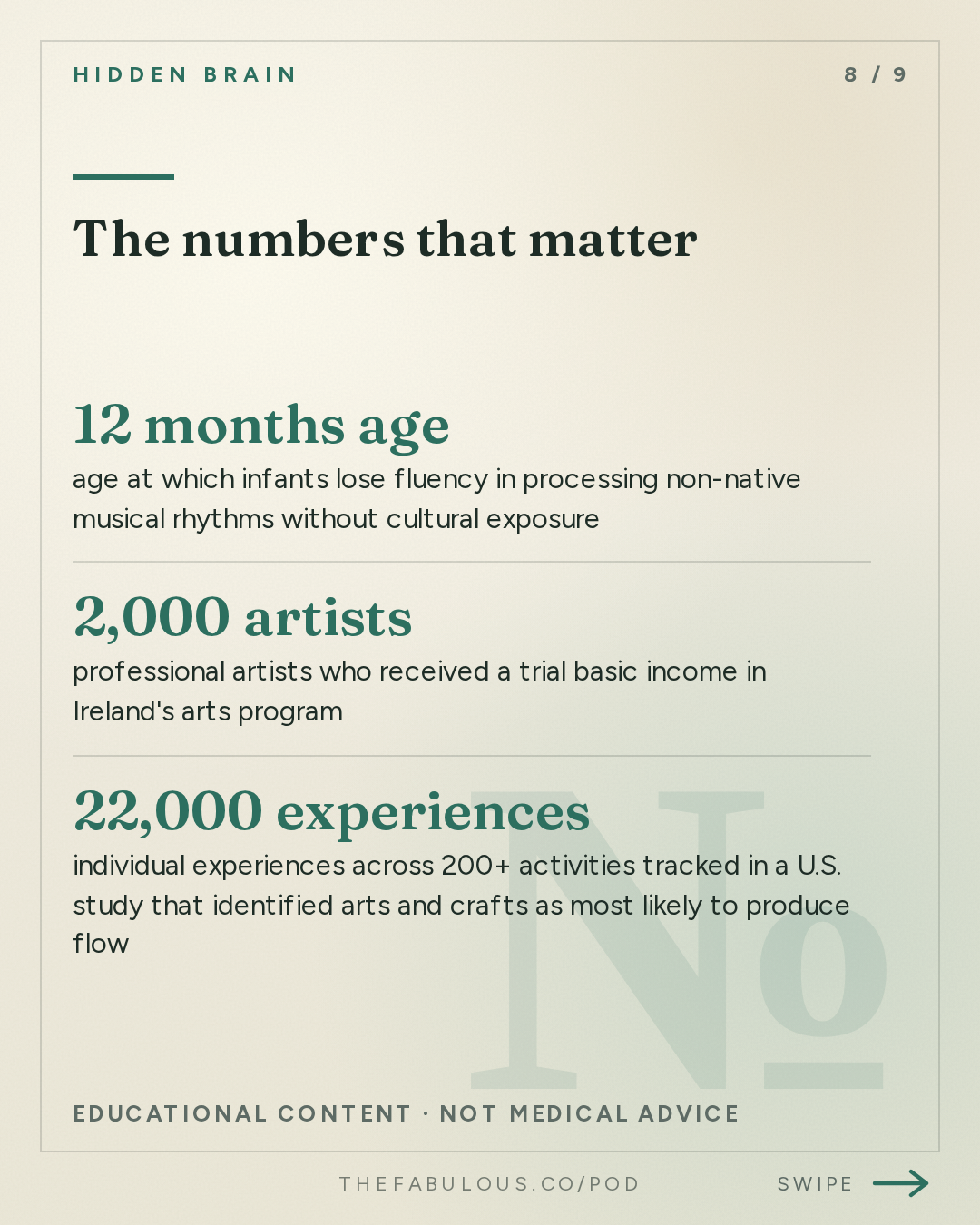
- 12 months age age at which infants lose fluency in processing non-native musical rhythms without cultural exposure
- 2,000 artists professional artists who received a trial basic income in Ireland's arts program
- 22,000 experiences individual experiences across 200+ activities tracked in a U.S. study that identified arts and crafts as most likely to produce flow
In their words
“Music-evoked p- personal memories. They tend to have a lot of vivid sensory detail, so more like a reliving and less like a factual”
“The thinking about pirates is not, is not a bug. It's actually a feature.”
“The message isn't make great art, it's let's create.”
“If your brain knows that you get into your pajamas, you draw your dandelion, you go to sleep, it's something that really helps to stage gate that process.”
Protocols
-
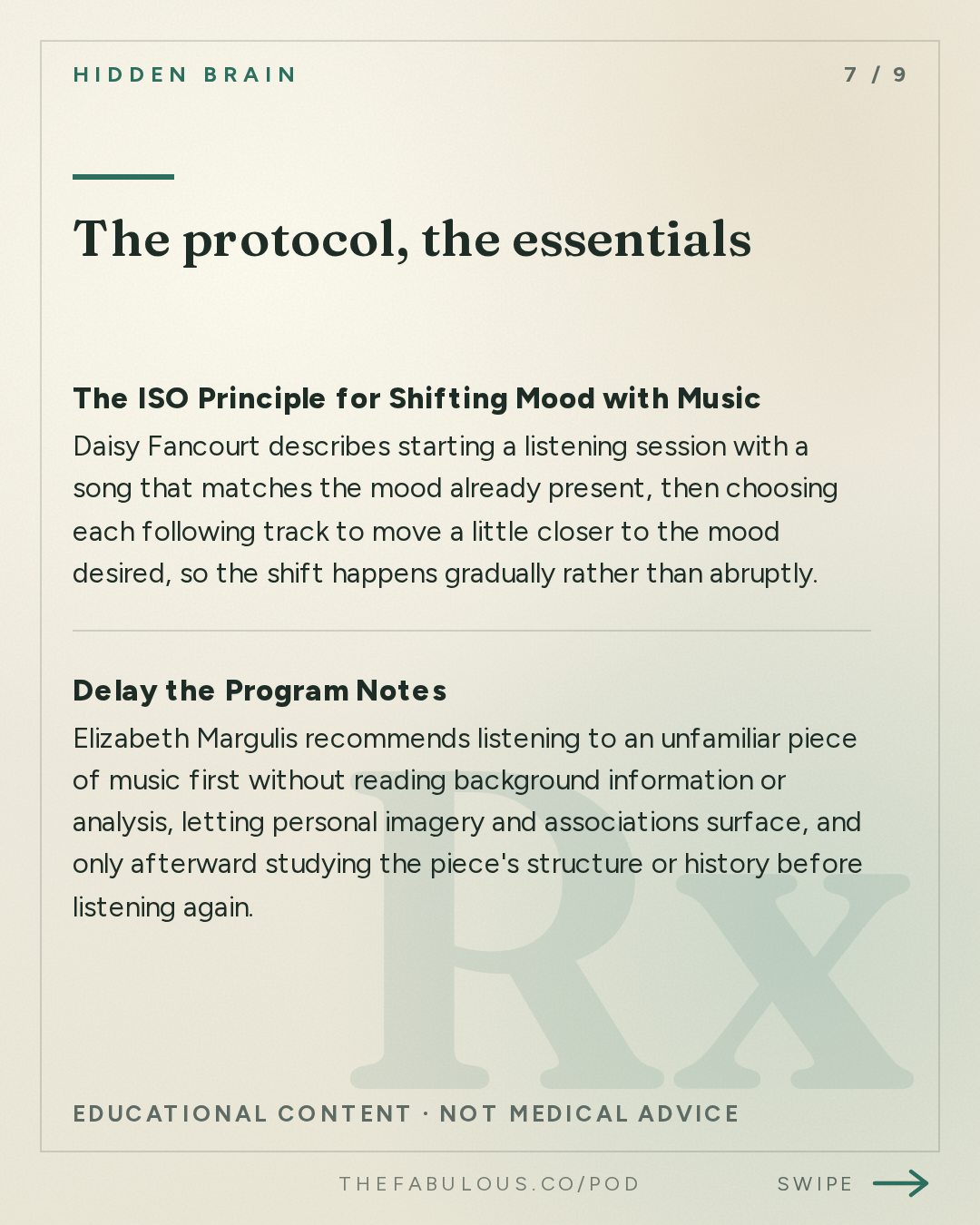
The ISO Principle for Shifting Mood with Music
Daisy Fancourt describes starting a listening session with a song that matches the mood already present, then choosing each following track to move a little closer to the mood desired, so the shift happens gradually rather than abruptly.
As needed, whenever using music to regulate emotion
-
Delay the Program Notes
Elizabeth Margulis recommends listening to an unfamiliar piece of music first without reading background information or analysis, letting personal imagery and associations surface, and only afterward studying the piece's structure or history before listening again.
On first listen to new or unfamiliar music
-
A Low-Stakes Way to Start an Arts Practice
Daisy Fancourt suggests trying a new craft for a few hours each month over several months until one feels genuinely compelling, and separately, attending an unfamiliar performance or exhibition, including free student or community shows, rather than waiting for something polished or expensive.
Monthly discovery period, then ongoing
Questions this episode answers
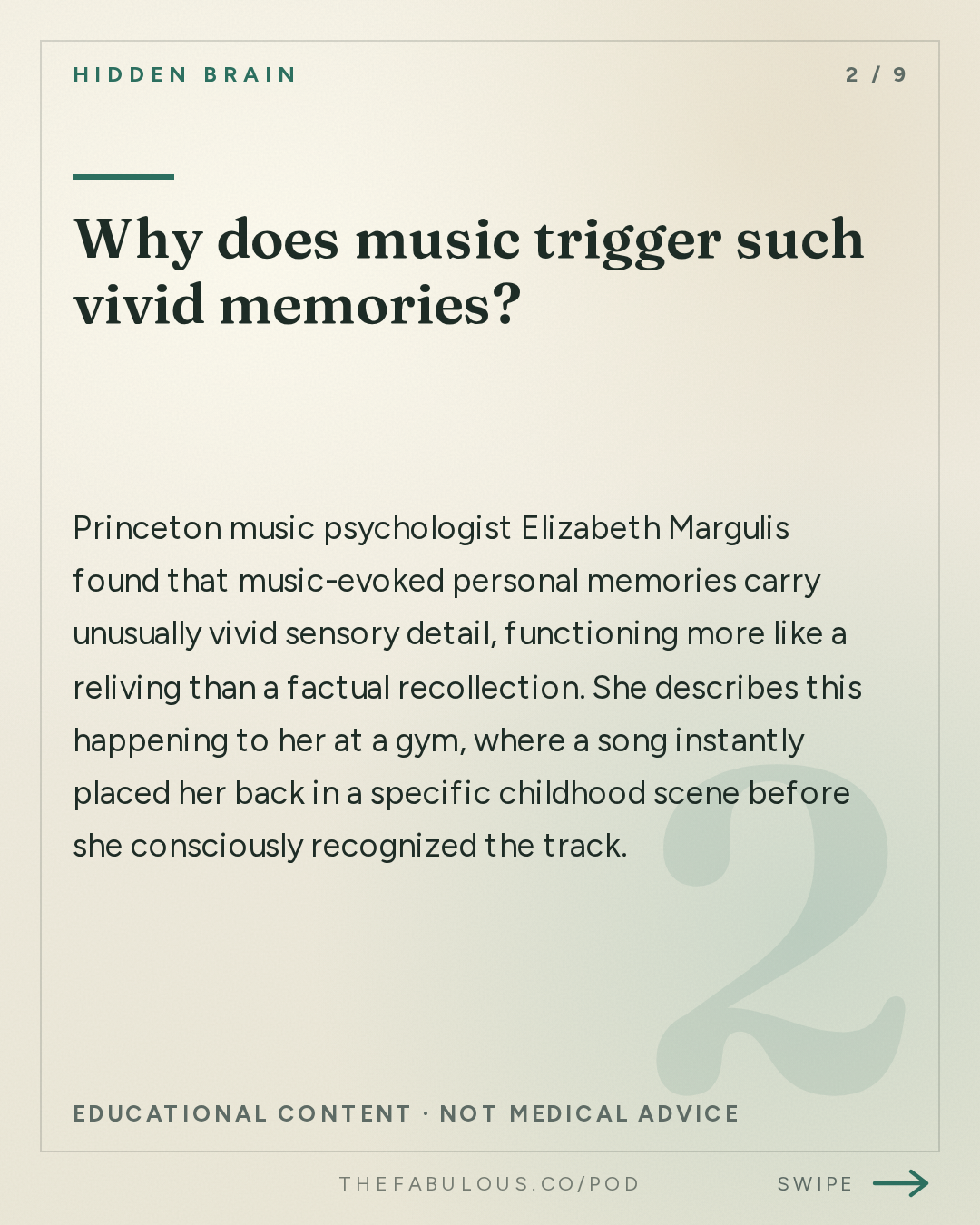
Why does music trigger such vivid memories?
Princeton music psychologist Elizabeth Margulis found that music-evoked personal memories carry unusually vivid sensory detail, functioning more like a reliving than a factual recollection (09:12). She describes this happening to her at a gym, where a song instantly placed her back in a specific childhood scene before she consciously recognized the track.
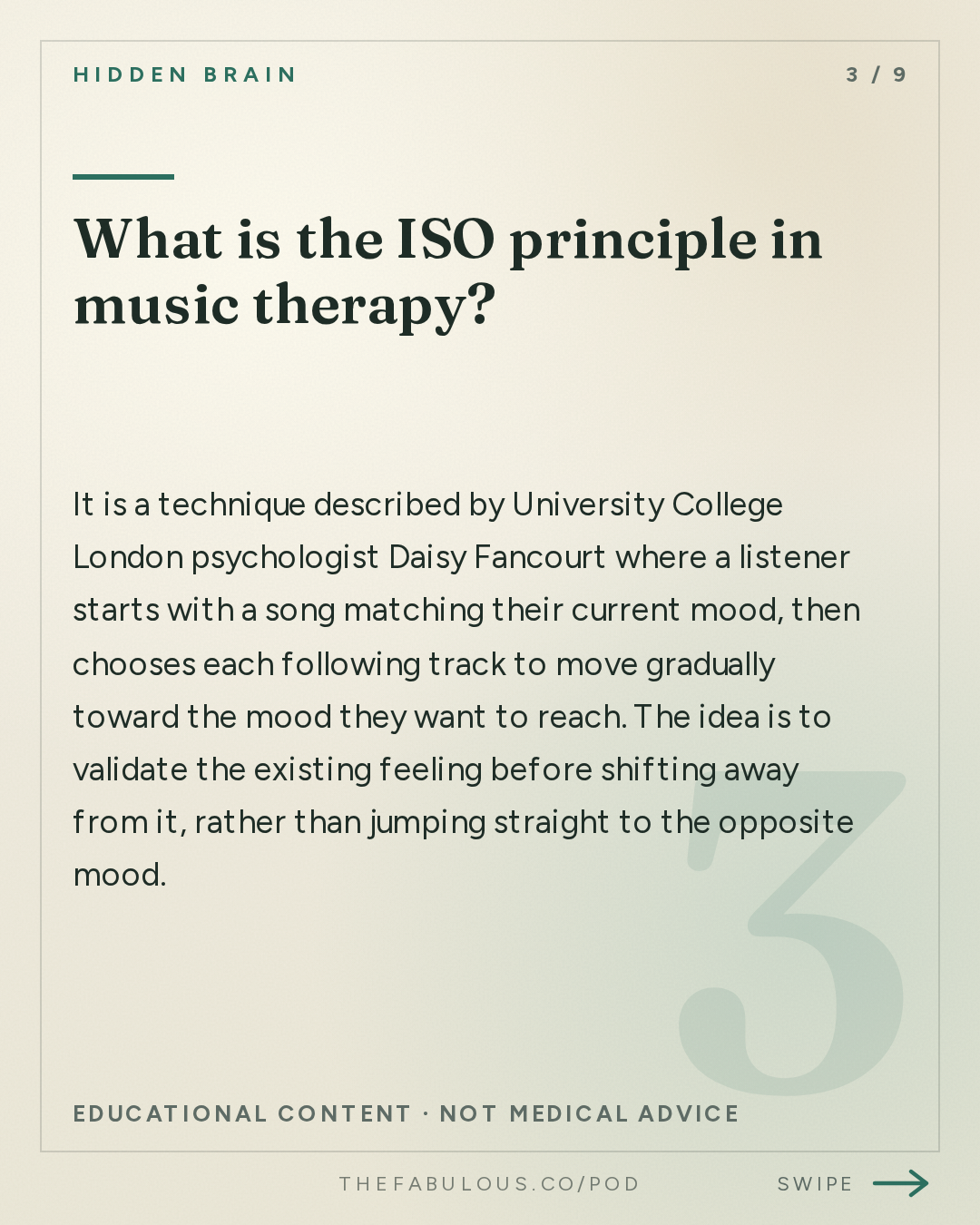
What is the ISO principle in music therapy?
It is a technique described by University College London psychologist Daisy Fancourt where a listener starts with a song matching their current mood, then chooses each following track to move gradually toward the mood they want to reach (61:10). The idea is to validate the existing feeling before shifting away from it, rather than jumping straight to the opposite mood.
Why do strangers picture similar things when they hear unfamiliar music?
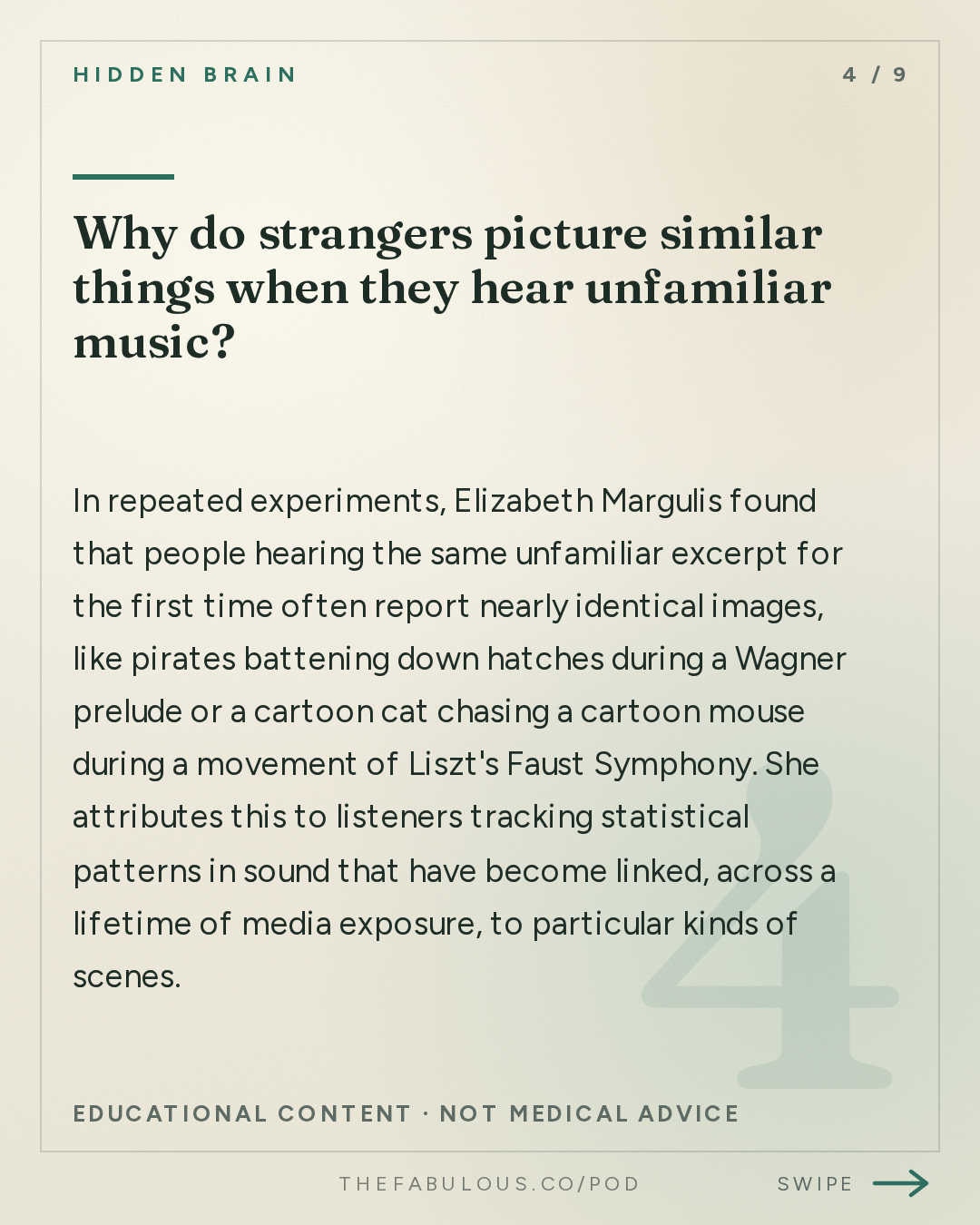
In repeated experiments, Elizabeth Margulis found that people hearing the same unfamiliar excerpt for the first time often report nearly identical images, like pirates battening down hatches during a Wagner prelude (22:25) or a cartoon cat chasing a cartoon mouse during a movement of Liszt's Faust Symphony (24:25). She attributes this to listeners tracking statistical patterns in sound that have become linked, across a lifetime of media exposure, to particular kinds of scenes (27:09).
What is the reminiscence bump in music psychology?
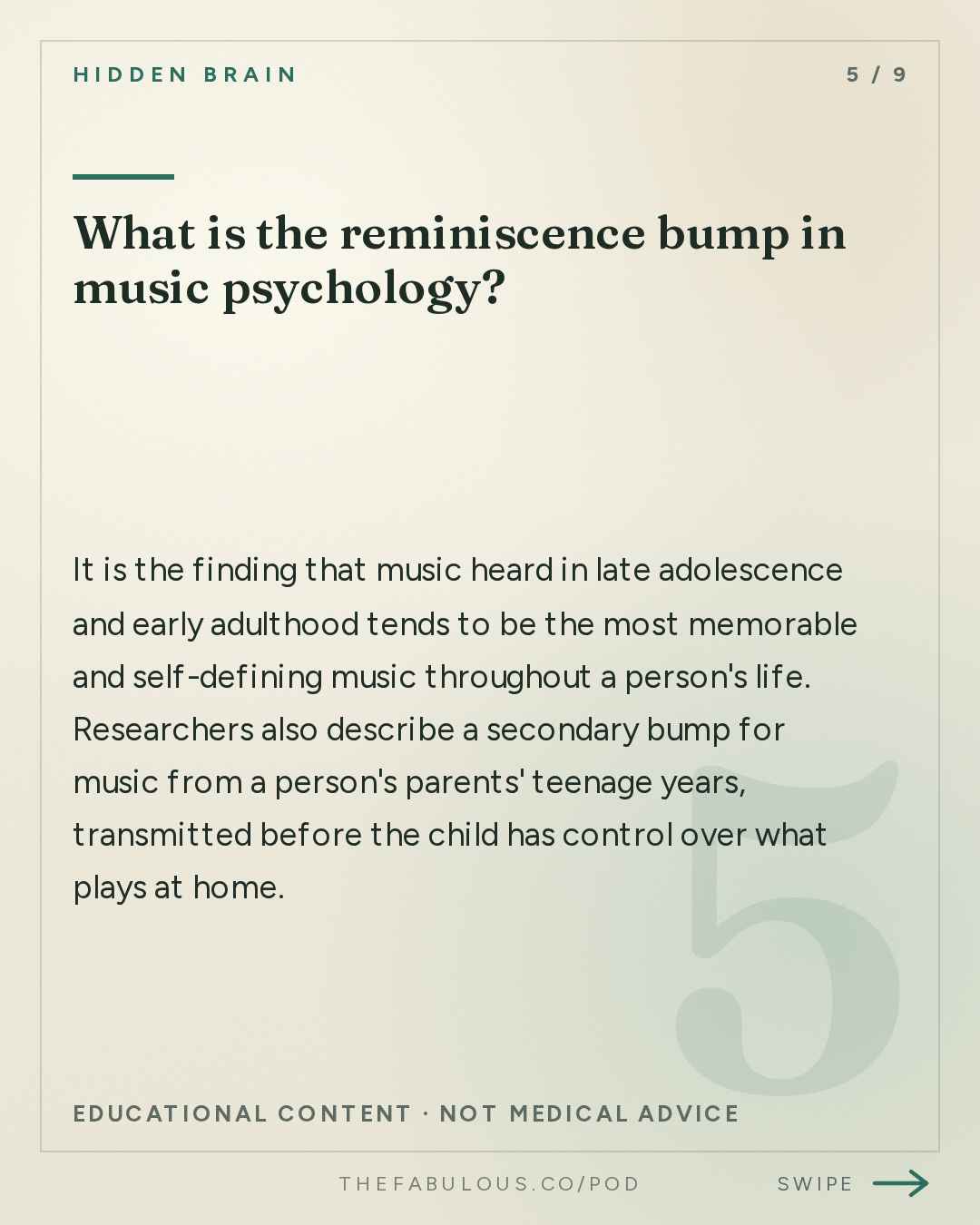
It is the finding that music heard in late adolescence and early adulthood tends to be the most memorable and self-defining music throughout a person's life (34:08). Researchers also describe a secondary bump for music from a person's parents' teenage years, transmitted before the child has control over what plays at home.
Can engaging with art actually lower blood pressure and stress hormones?
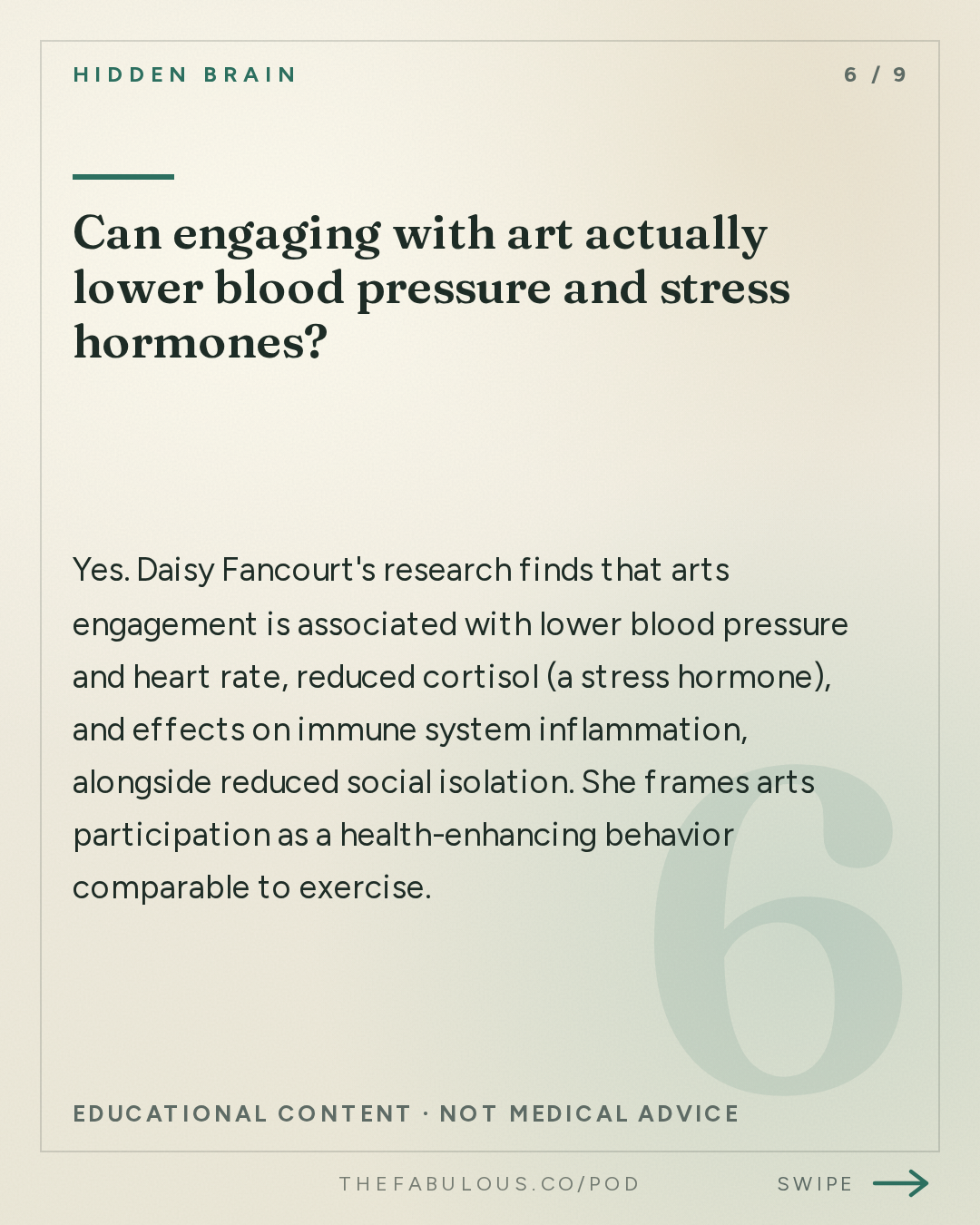
Yes. Daisy Fancourt's research finds that arts engagement is associated with lower blood pressure and heart rate, reduced cortisol (a stress hormone), and effects on immune system inflammation, alongside reduced social isolation (57:45). She frames arts participation as a health-enhancing behavior comparable to exercise.
Are professional artists more likely to struggle with anxiety and depression?
Daisy Fancourt's research found that professional artists report higher average wellbeing but also higher rates of anxiety and depression, largely tied to financial precarity, which she calls a 'precaritized mind' (80:11). A trial basic income program for 2,000 professional artists in Ireland improved their mental health and public engagement, leading the country to make the program permanent (81:04).
The full read, in cards
Go deeper
- Transported: The Everyday Magic of Musical Daydreams — Elizabeth Margulis's book on musical daydreaming and imagery evoked by unfamiliar music
- Art Cure: The Science of How the Arts Save Lives — Daisy Fancourt's book on the physiological and mental health effects of arts engagement
- Ireland's basic income trial for professional artists — Trial paying 2,000 artists a salary showed improved mental health and public engagement, leading to a permanent program
- U.S. flow state study — Tracked 22,000 experiences across 200+ activities and found arts and crafts most conducive to flow
- Alf Gabrielson's peak musical experience research — Swedish psychologist documented shared attributes of people's most powerful musical experiences
Mentioned
Elizabeth Margulis · Daisy Fancourt · John Williams · Franz Liszt · Igor Stravinsky · Helen Bonny · Richard Wagner · Gustav Mahler · Alf Gabrielson · Laura Cirelli · Princeton University · University College London
More from this show and category
What Is the Underdog Effect in Psychology?
The 'underdog effect' explains why being doubted sometimes fuels better performance instead of undermining it, especially when the critic lacks credibility. Wharton researcher Sameer Nurmohamed and Boston College's Ben Rogers show how reframing setbacks as an underdog story or a hero's journey can raise confidence, job success, and a sense of meaning.
What Is Covering? Kenji Yoshino Explains
Covering is downplaying a known stigmatized identity to put others at ease, a term legal scholar Kenji Yoshino traces from FDR to Deloitte's workplace data. A 2012 Deloitte survey found 61% of employees cover some part of themselves, and even 45% of straight white men report doing it too.
How Romantic Attraction and Compatibility Really Work
Attraction is not a checklist, and stated preferences rarely predict who we actually choose. UC Davis psychologist Paul Eastwick finds machine learning scores 0% accuracy predicting speed-dating compatibility, while University of Maryland psychologist Ed Lemay shows social projection bias leads partners to assume feelings and values that may not exist.
How Sleep Deprivation Affects Decisions
Sleep deprivation degrades ethical judgment and decision-making in novel situations, contributing to disasters from train crashes to BP's 2005 explosion. Chronic pain, meanwhile, is reshaped by fear, relationships, and mindset as much as by tissue damage, per sleep researcher Chris Barnes and pain psychologist Rachel Zoffness.
