
What Is Covering? Kenji Yoshino Explains
Dropping the Mask
The brief
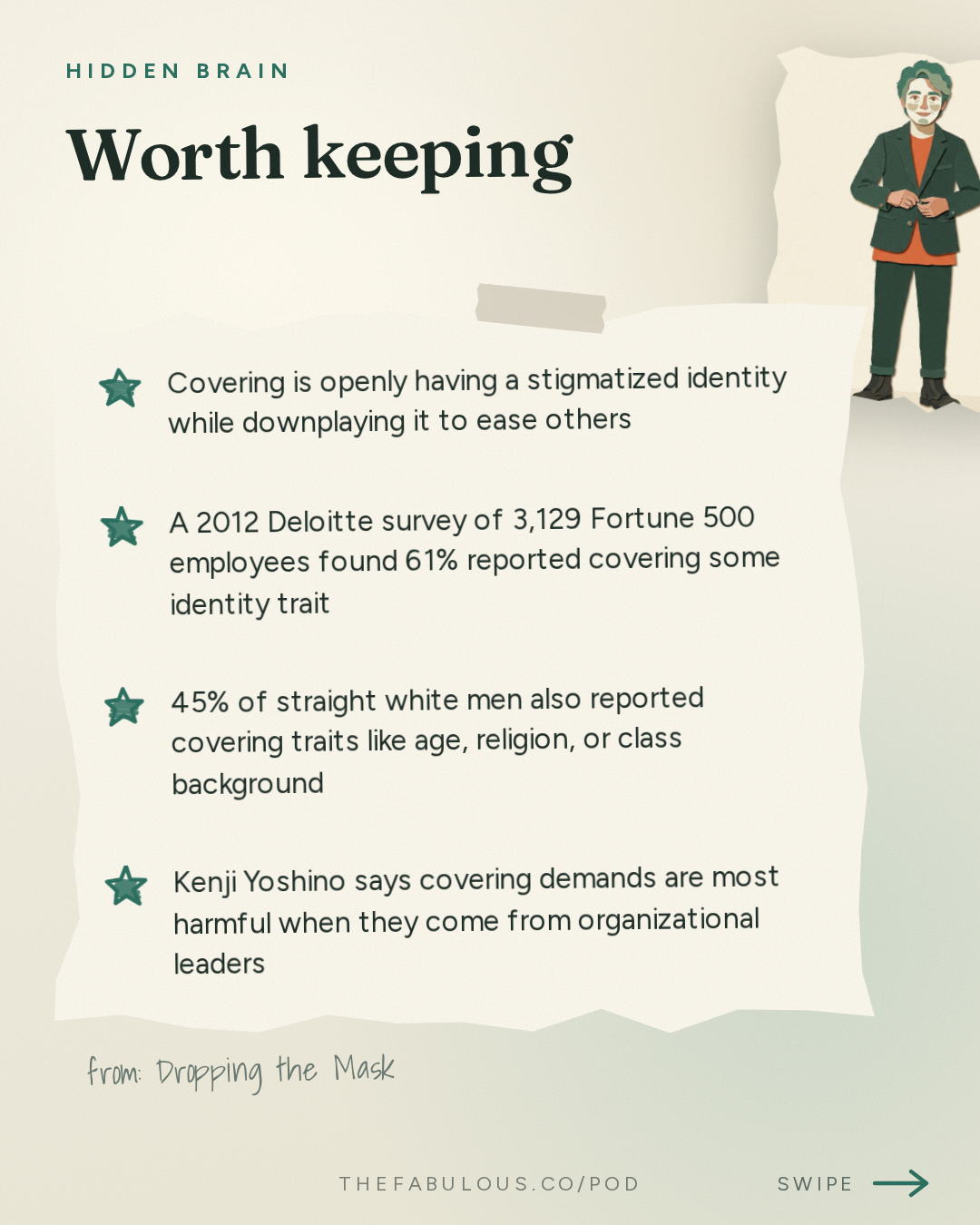
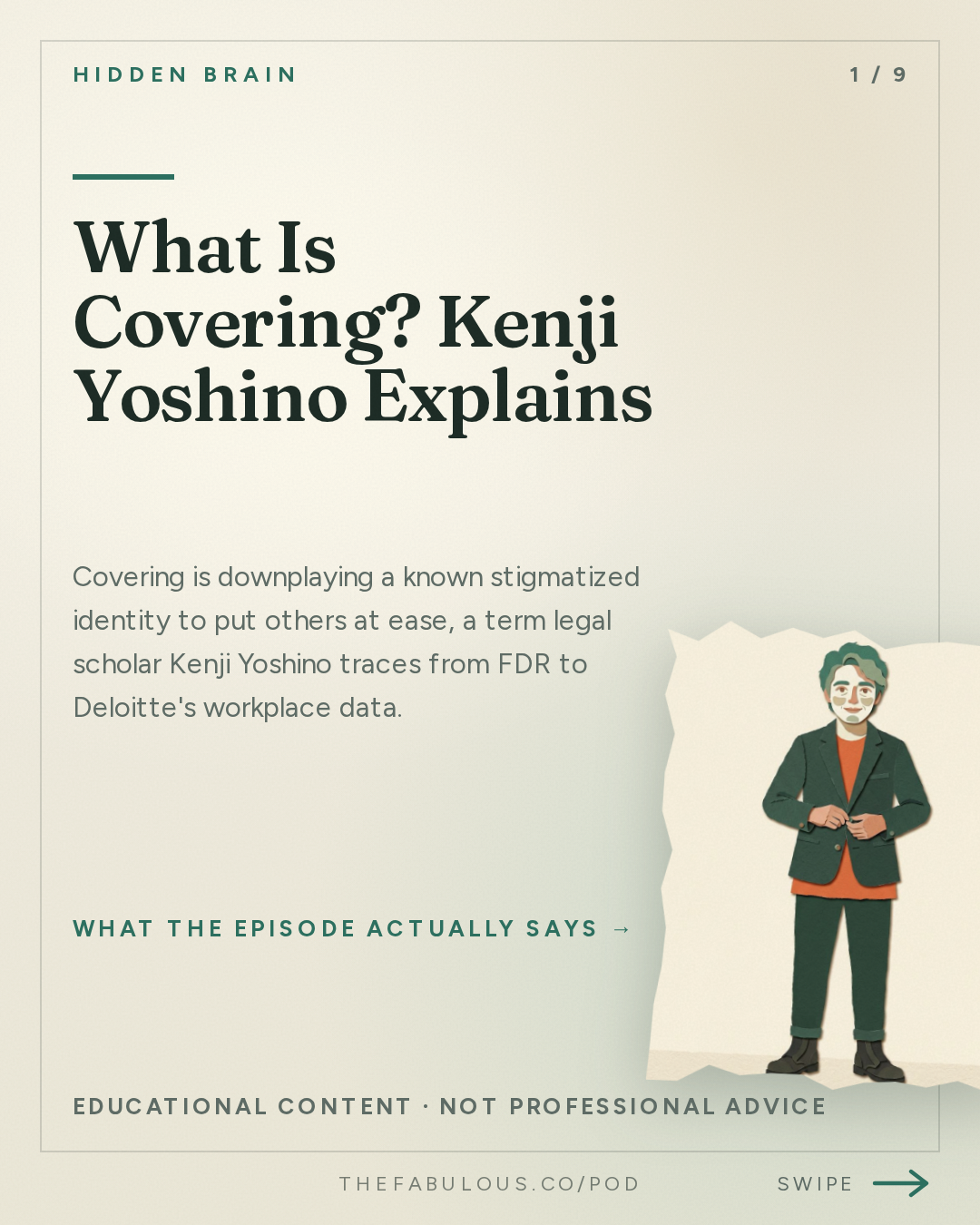
Covering is downplaying a known stigmatized identity to put others at ease, a term legal scholar Kenji Yoshino traces from FDR to Deloitte's workplace data. A 2012 Deloitte survey found 61% of employees cover some part of themselves, and even 45% of straight white men report doing it too.
Franklin Roosevelt never hid that he had polio. Everyone around him knew he used a wheelchair. Yet for twelve years in the White House he made sure he was photographed only from the waist up, seated behind a desk before his cabinet filed in, driving a specially rigged car in full view of reporters so the public would see a man who looked unmistakably capable (05:07). Margaret Thatcher never hid that she was a grocer's daughter from a small town in Lincolnshire. Her handlers sent her to a voice coach instead, and she came back with the clipped, lowered, unmistakably patrician voice the world remembers as the sound of the Iron Lady (08:15). Neither of them was lying about who they were. Both were doing something that has a name, borrowed from a two-page aside in a 1963 book by sociologist Erving Goffman: covering.
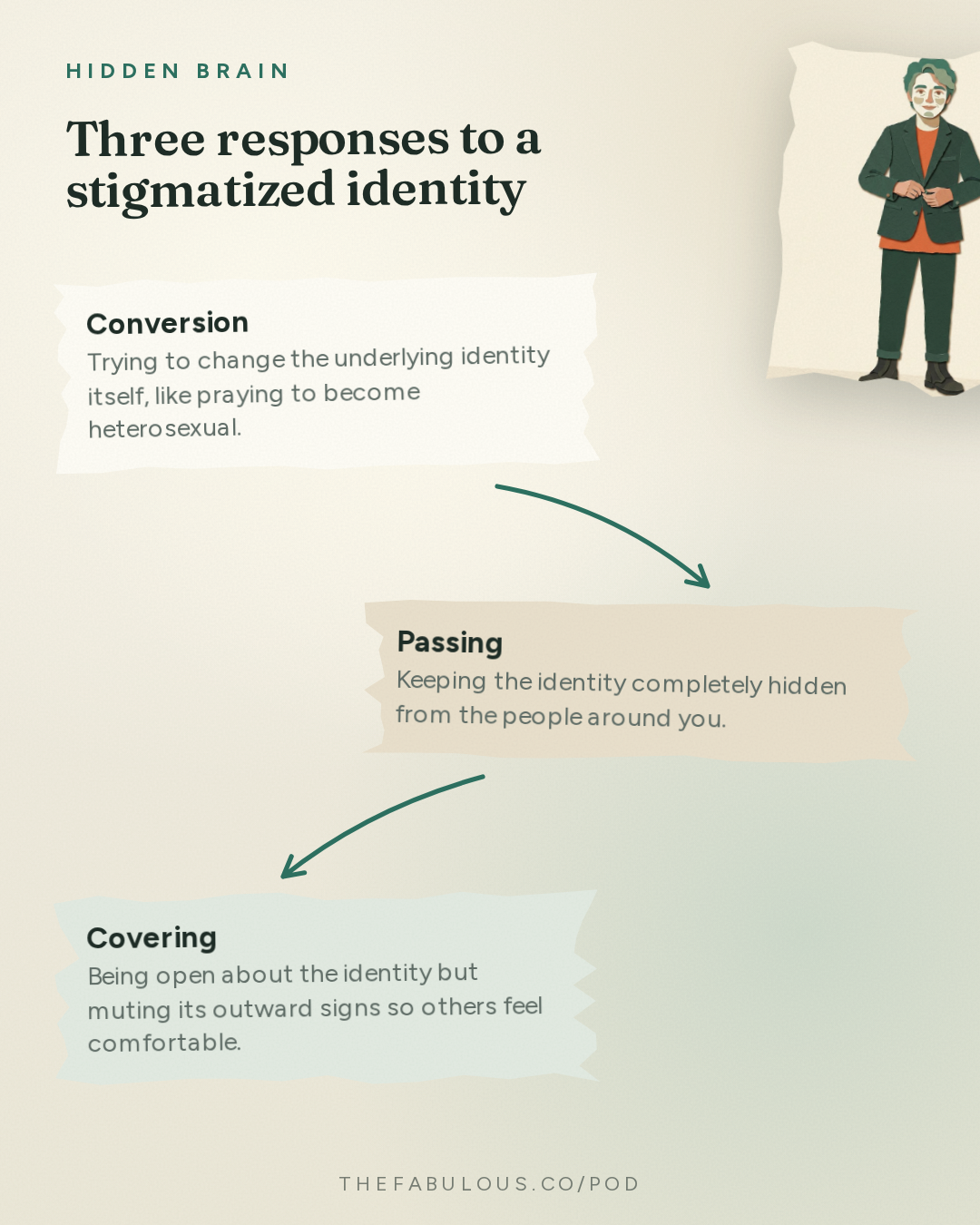
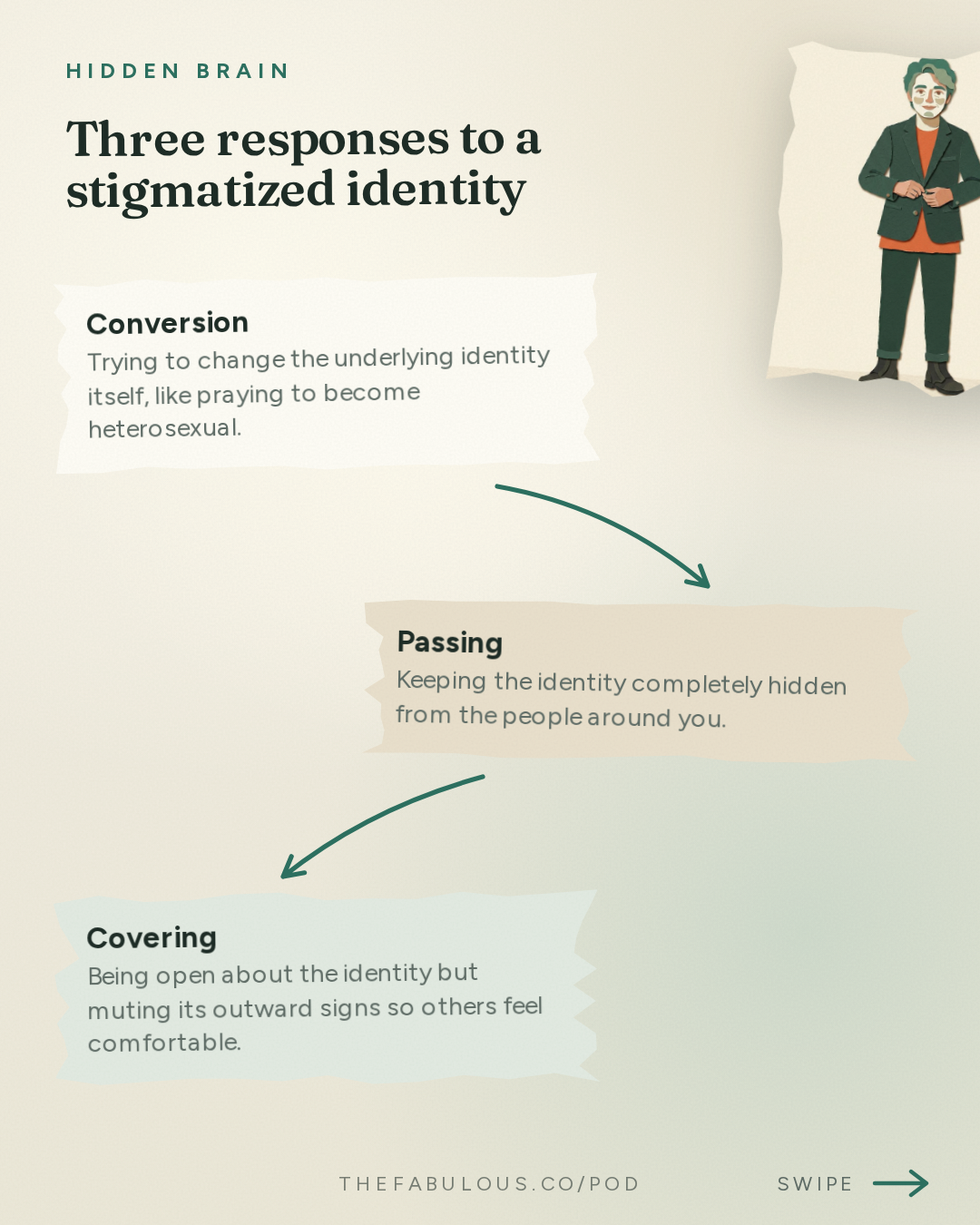
NYU legal scholar Kenji Yoshino found that name in Goffman's book, Stigma: Notes on the Management of Spoiled Identity, and it changed how he understood his own life (24:11). Yoshino is gay, and by the time he read Goffman he had already lived through what he describes as three separate responses to a stigmatized identity. First comes conversion, the wish to change who you are: as a young man on a Rhodes Scholarship in England, he knelt in a college chapel and prayed to be made straight (16:20). Next comes passing, hiding the identity entirely, which he did through much of law school (18:56). The third response is subtler. Covering means being open about an identity while muting its outward signs so other people feel comfortable. Erving Goffman's book gave Yoshino the word that unlocked this for him.
"It is not perverted, it is thwarted." — Kenji Yoshino's psychiatrist [18:18]
A few years later, as a junior law professor, a kind and well-meaning colleague gave him career advice that turned out to be a textbook covering demand: he would have an easier path to tenure, the colleague said, if he were "a homosexual professional rather than a professional homosexual" (21:41). Nobody was asking Yoshino to convert or to return to the closet. They were asking him to be gay quietly, with no activism and no scholarship on gay rights. Yoshino's key insight is that, unlike conversion or passing, almost anyone can be asked to cover. Race and disability cannot be converted away or easily hidden. But the volume at which a person displays any identity can always be turned down, which is why covering, he argues, is a genuinely universal experience (27:25).
Once Yoshino had the word, he started seeing it everywhere, including in situations that have nothing to do with sexual orientation. New mothers in demanding jobs often face what researchers call the motherhood penalty, an assumption that having children makes a woman less committed to her career. A study by psychologists Beatrice Arronda and Peter Glick found that women can partly offset this bias through what Yoshino calls work-devotional behavior: never mentioning their children at work and constantly signaling unlimited availability (29:54). That, too, is covering. So was the moment when Yoshino's mother, worried about a New York Times profile naming him an openly gay advocate, asked him why he had to be a "jandaku," her family's transliteration of Joan of Arc: why carry the banner, rather than simply living a life (37:42).
What It Costs
In 2012, Yoshino partnered with the consultancy Deloitte to test whether covering was a widespread phenomenon or just a personal theory. A survey of 3,129 employees across eight Fortune 500 sectors found that 61 percent of respondents reported covering some aspect of their identity at work, and that somewhere between 60 and 73 percent of those who covered said it damaged their sense of self (47:47, 47:58). The most striking figure, to Yoshino, was not about any marginalized group. It was that 45 percent of straight white men, the group with the least obvious reason to hide anything, also reported covering, usually around age, religion, socioeconomic background, or a history of illness (54:40). A related finding showed that 53 percent of respondents felt their organization's leaders expected them to cover, and half of those people said the expectation measurably reduced their commitment to the workplace (68:29). Yoshino extends this logic beyond categories most people associate with diversity work. He points to Susan Cain's book Quiet, which argues introverts, roughly a third of Americans, face constant pressure to perform the louder, backslapping style of an "extrovert ideal" at work, even though leaders from James Madison to Abraham Lincoln were by most accounts introverts (56:56). The same reasoning, he says, applies to depression and addiction: the goal is not to erase stigma overnight, but to stop forcing people to hide a struggle so they can actually get help (59:50).
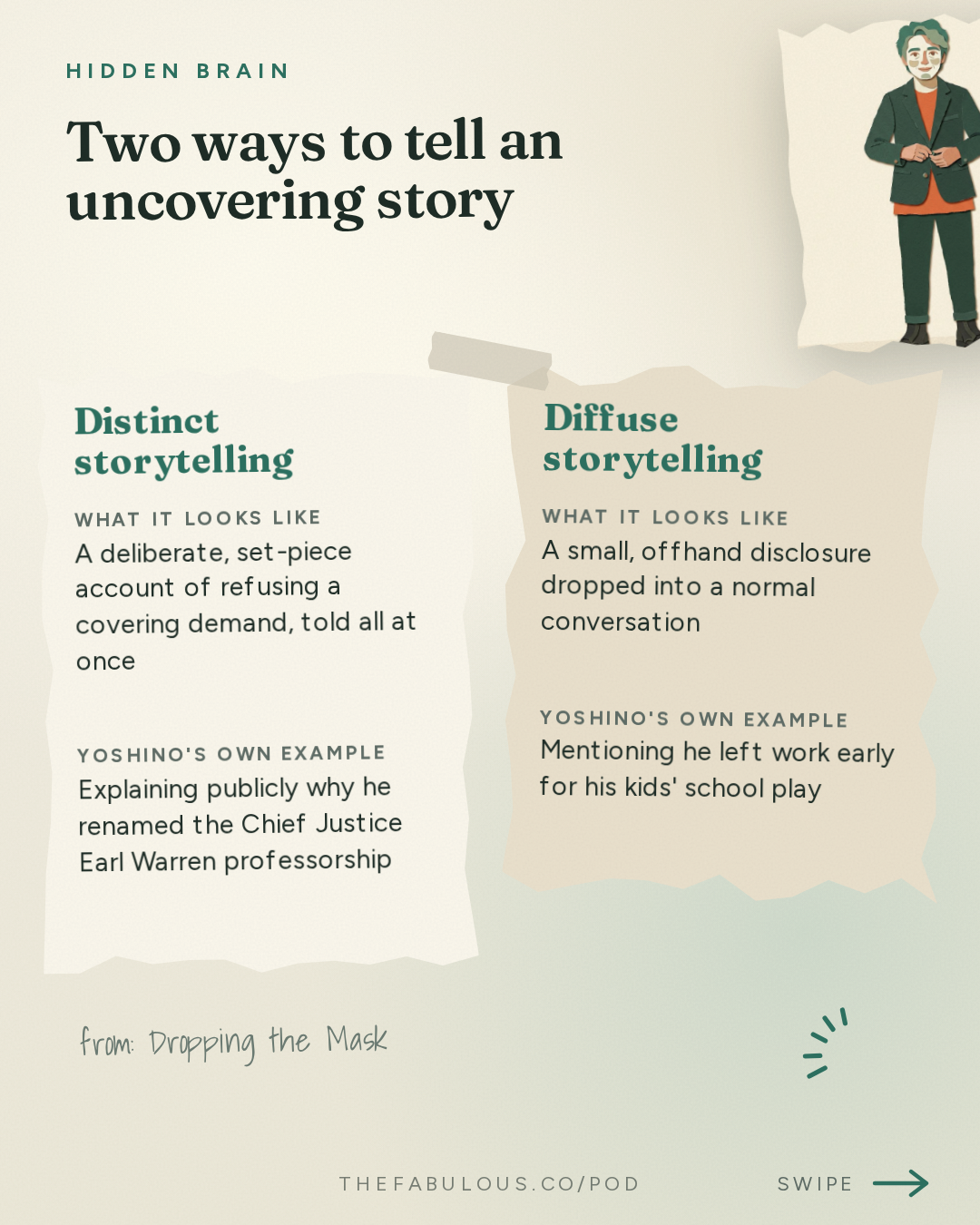
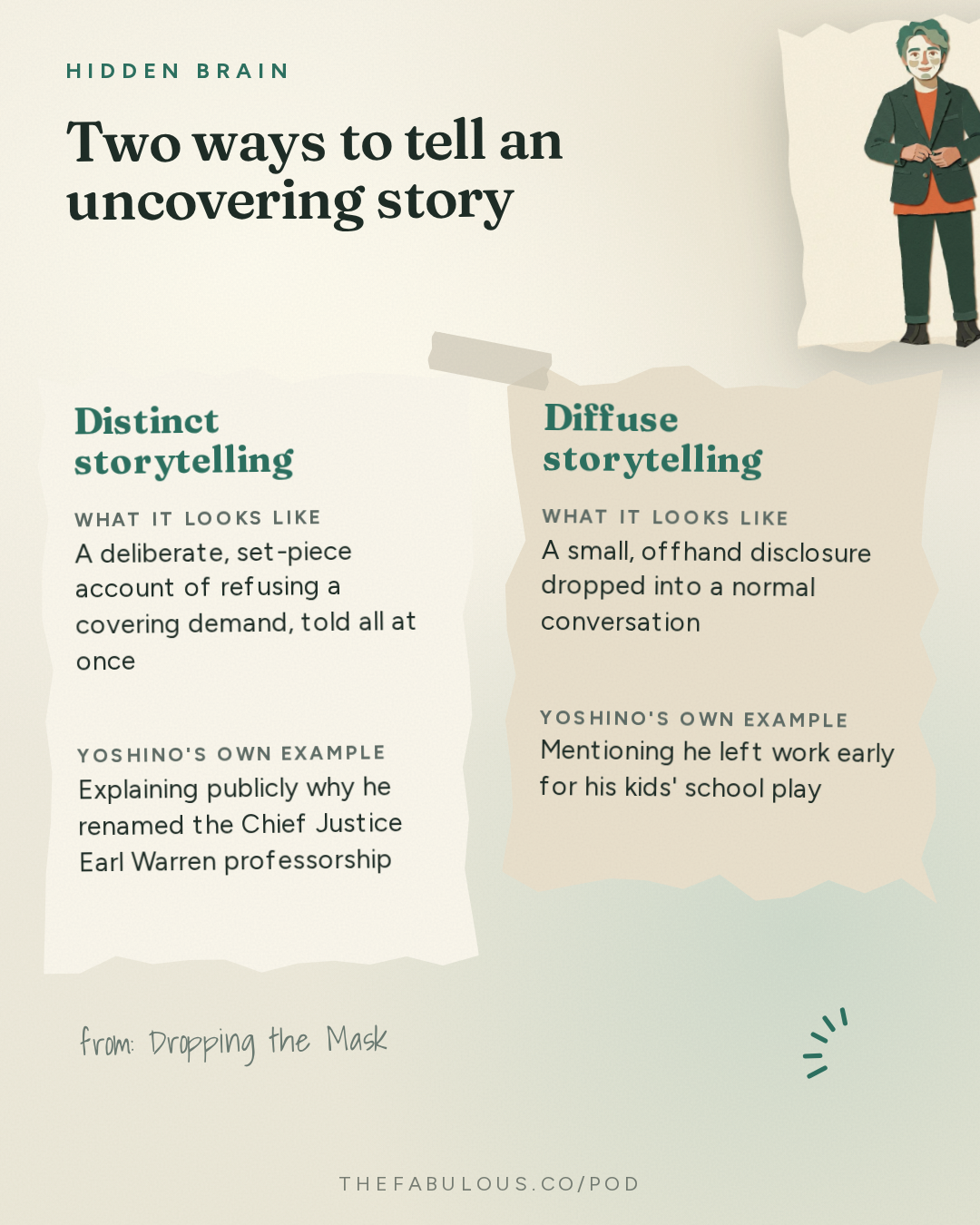
Yoshino's own test came in 2008, when NYU offered him an endowed chair named for Earl Warren, who as Attorney General of California had overseen the internment of more than 100,000 Japanese Americans during World War II (50:20). Yoshino, who is of Japanese descent, turned it down. Three days later the dean called back with a revision: the Chief Justice Earl Warren Professorship, honoring the man who later wrote Brown v. Board of Education and called the internment his greatest regret. Yoshino accepted. He calls an episode like this a distinct story, a deliberate, set-piece account of refusing a covering demand (64:44). He contrasts it with diffuse storytelling: small, unplanned disclosures, like mentioning in passing that he left work early for his kids' school play, which quietly give colleagues permission to do the same (66:58).
Building the Room
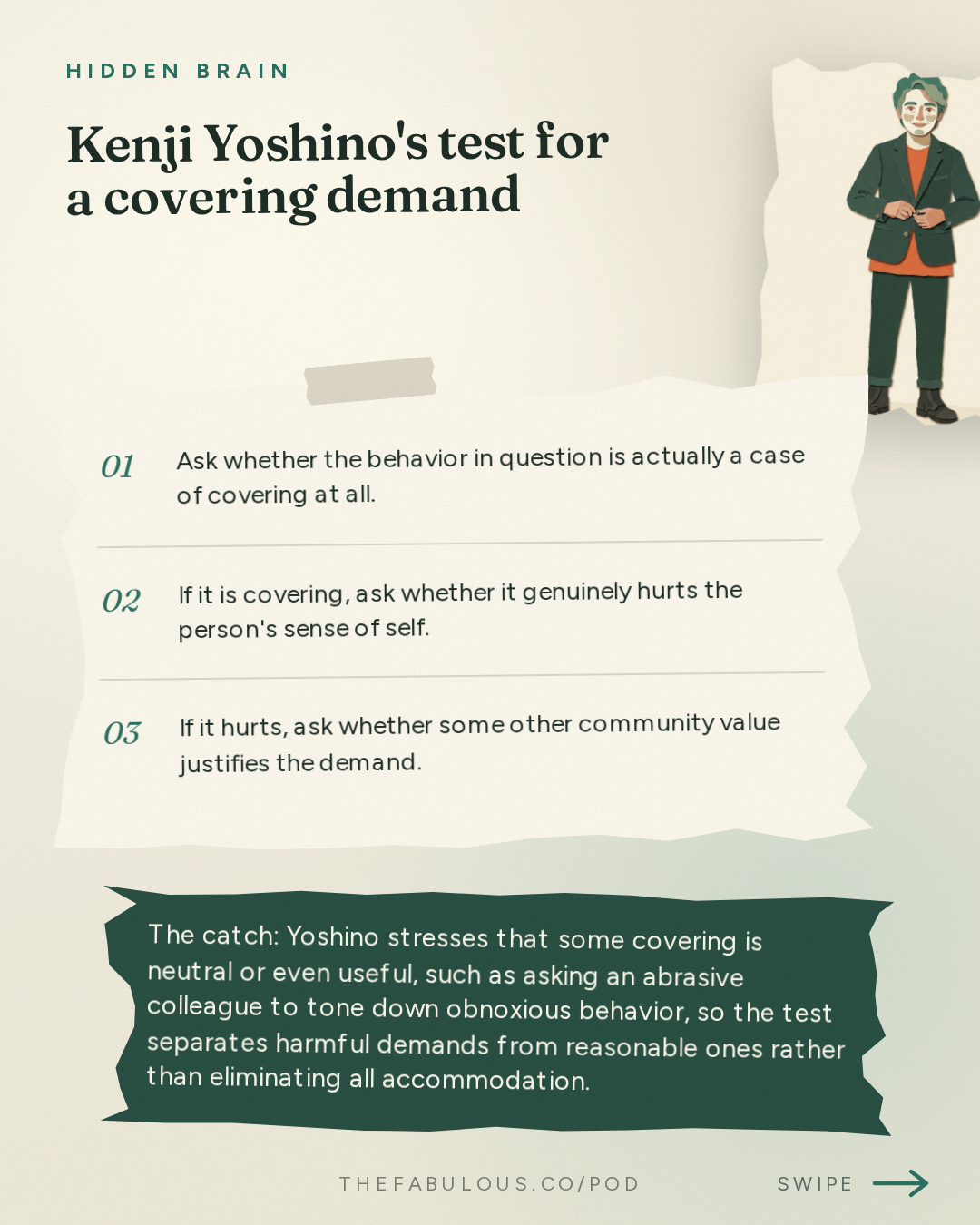
Yoshino is careful to say not all covering is bad. Asking an abrasive colleague to tone down genuinely obnoxious behavior is also a form of covering, and he thinks a world where that argument always loses would be a worse one (32:33). His test runs in order: is this actually covering, does it hurt, and if it hurts, is there a value on the other side that justifies the demand. If the answer to that last question is no, the demand deserves to be challenged (85:43). For leaders who want to lower the pressure to cover, Yoshino borrows a phrase from Harvard Business School professor Amy Edmondson, who studies what she calls psychological safety: a team climate of mutual trust in which people feel safe being themselves (106:21).
"The way you get somebody to uncover, it's a little bit like asking a bird to eat from your hand." — Kenji Yoshino [106:55]
Nobody forces the bird. The work is building an environment calm enough that it chooses to land. Yoshino's larger claim is that belonging is worthless if it was never offered to the real person in the first place, since trusting that others accept you means first letting them see who you actually are. FDR's waist-up photographs helped keep him in office. Thatcher's coached voice helped make her the Iron Lady. Neither of them stopped covering, and most people will recognize some version of the same quiet editing in their own week. Yoshino's point is not that the editing should stop overnight. It is that naming it is the first step toward asking, honestly, whether it still needs to happen at all.
Ask this episode anything
Pod's AI answers from the episode itself, with the minute mark so you can hear it yourself.
Or start with one of these
Ask this episode
Pod's AI listens to the whole episode to answer, and points you to the minute it comes from.
The rest of this answer, and any question after it
Answers come from the episode itself, never from a summary of it.
ContinueKey takeaways
- Covering is openly having a stigmatized identity while downplaying it to ease others
- A 2012 Deloitte survey of 3,129 Fortune 500 employees found 61% reported covering some identity trait
- 45% of straight white men also reported covering traits like age, religion, or class background
- Kenji Yoshino says covering demands are most harmful when they come from organizational leaders
- Small disclosures, which Yoshino calls diffuse storytelling, can normalize authenticity at work over time
The episode in cards


By the numbers
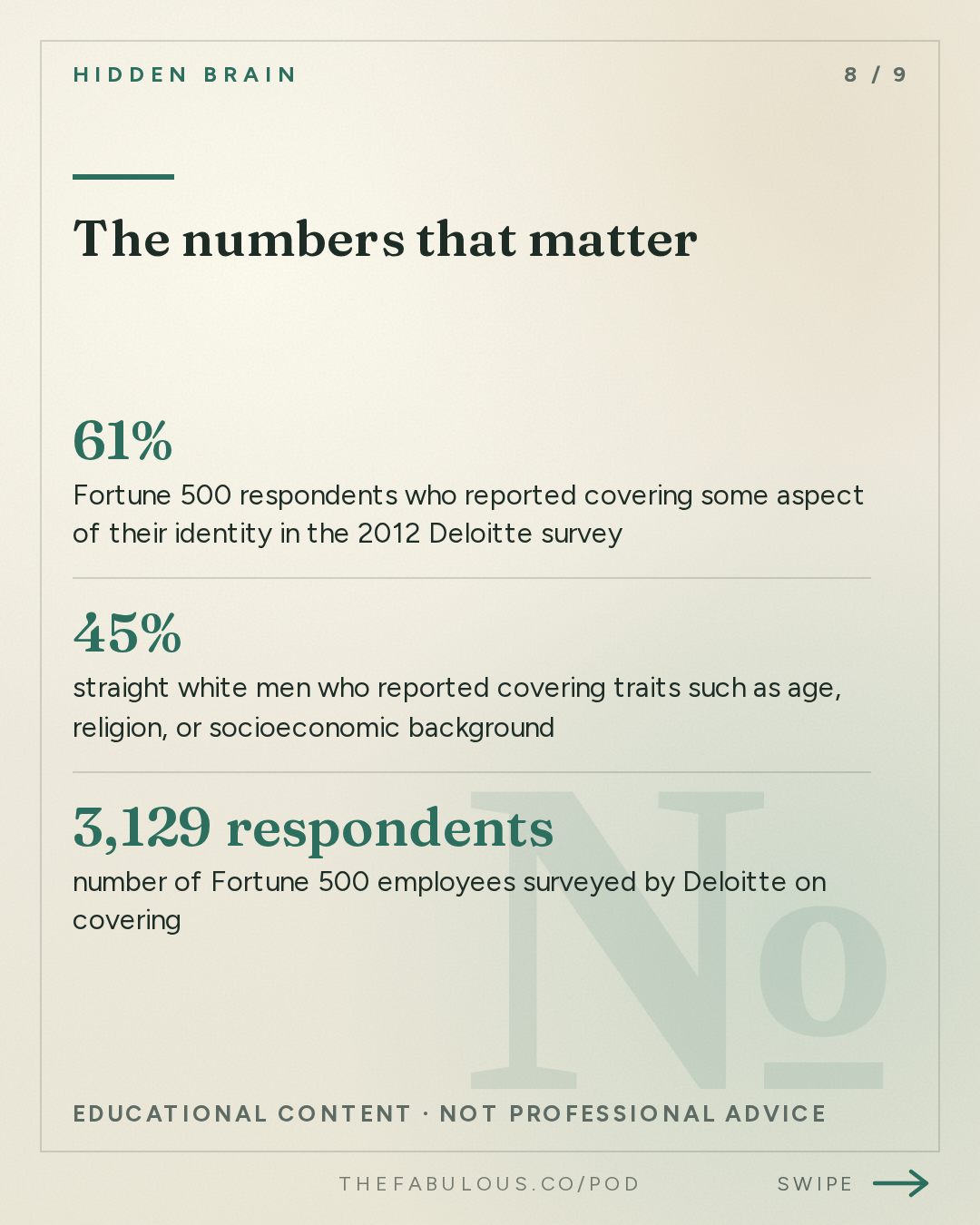
- 61% percent Fortune 500 respondents who reported covering some aspect of their identity in the 2012 Deloitte survey
- 45% percent straight white men who reported covering traits such as age, religion, or socioeconomic background
- 3,129 respondents number of Fortune 500 employees surveyed by Deloitte on covering
In their words
“It is not perverted, it is thwarted.”
“You'll have a lot smoother ride to getting tenure if you are a homosexual professional rather than a professional homosexual."”
“You don't achieve any kind of belonging if the person who belongs is not really you.”
“The way you get somebody to uncover, it's a little bit like asking a bird to eat from your hand.”
“The lady's not for turning.”
Protocols
-
Arronda and Glick's fix for the motherhood penalty
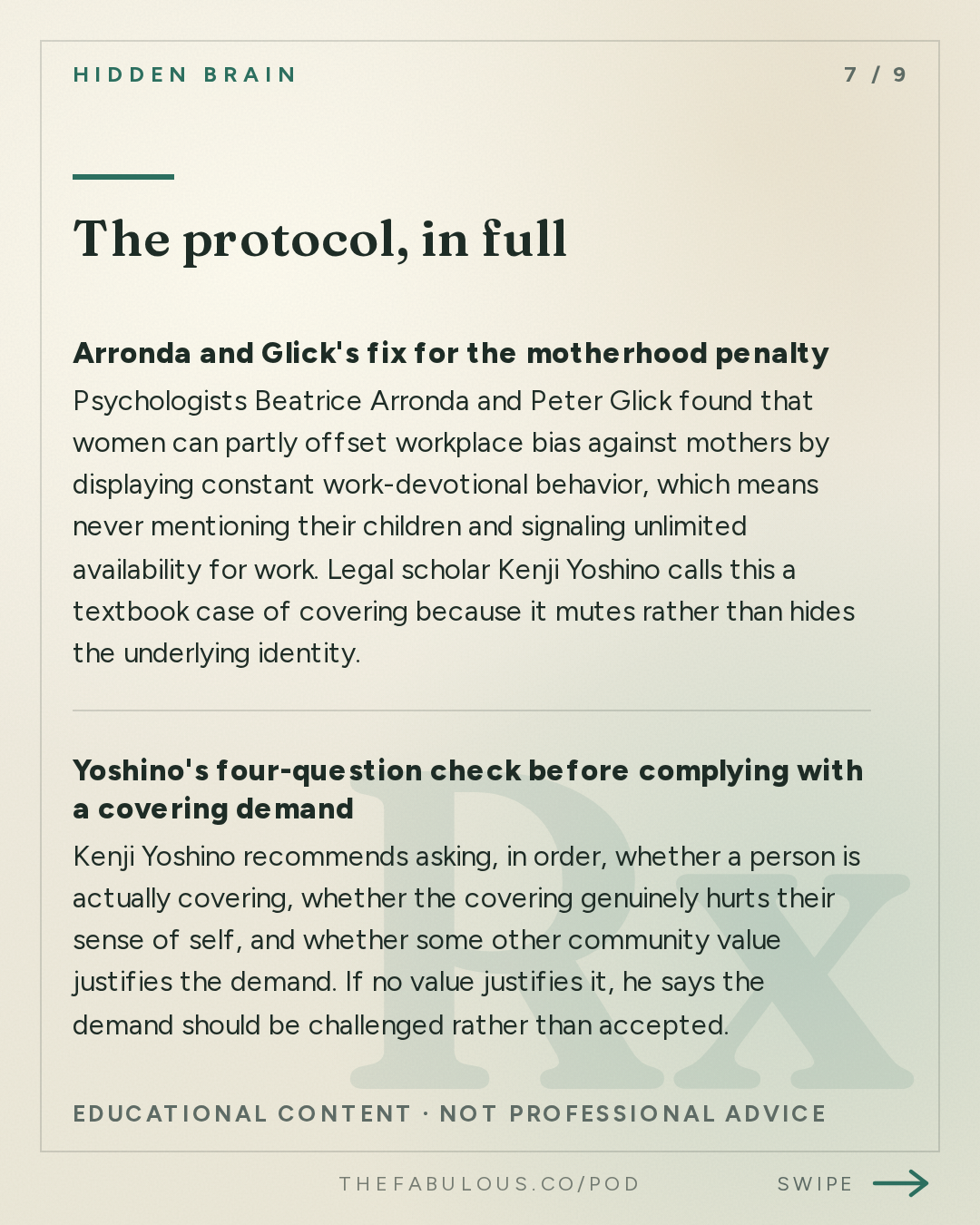
Psychologists Beatrice Arronda and Peter Glick found that women can partly offset workplace bias against mothers by displaying constant work-devotional behavior, which means never mentioning their children and signaling unlimited availability for work. Legal scholar Kenji Yoshino calls this a textbook case of covering because it mutes rather than hides the underlying identity.
ongoing, in every workplace interaction
-
Yoshino's four-question check before complying with a covering demand
Kenji Yoshino recommends asking, in order, whether a person is actually covering, whether the covering genuinely hurts their sense of self, and whether some other community value justifies the demand. If no value justifies it, he says the demand should be challenged rather than accepted.
apply whenever a workplace or social norm asks someone to mute part of their identity
Questions this episode answers
What is the difference between passing and covering?
Passing means hiding a stigmatized identity so others do not know it exists, while covering means being open about the identity but downplaying its outward signs, legal scholar Kenji Yoshino explains (74:19). Only certain groups can pass, since traits like race are visible, but Yoshino says everyone can be asked to cover (74:47).
What did the Deloitte study on covering find?
A 2012 Deloitte survey of 3,129 Fortune 500 employees across eight sectors found that 61% reported covering some aspect of their identity at work, and that 60 to 73% of those who covered said it hurt their sense of self (47:47, 47:58). The same data showed covering pressure from organizational leaders was especially damaging to workplace commitment (68:29).
Do straight white men experience covering too?
Yes, the Deloitte survey found 45% of straight white men reported covering traits such as age, religion, socioeconomic background, or a history of illness (54:40). Kenji Yoshino argues this shows covering is a universal pressure rather than something limited to traditionally marginalized groups.
How can women reduce the motherhood penalty at work?
A study by psychologists Beatrice Arronda and Peter Glick, cited by Kenji Yoshino, found women can partly offset bias against mothers by displaying constant work-devotional behavior, never mentioning their children and signaling unlimited availability for work (29:54). Yoshino calls this a clear example of covering, since it mutes rather than hides the underlying identity.
What are effective uncovering strategies in a workplace?
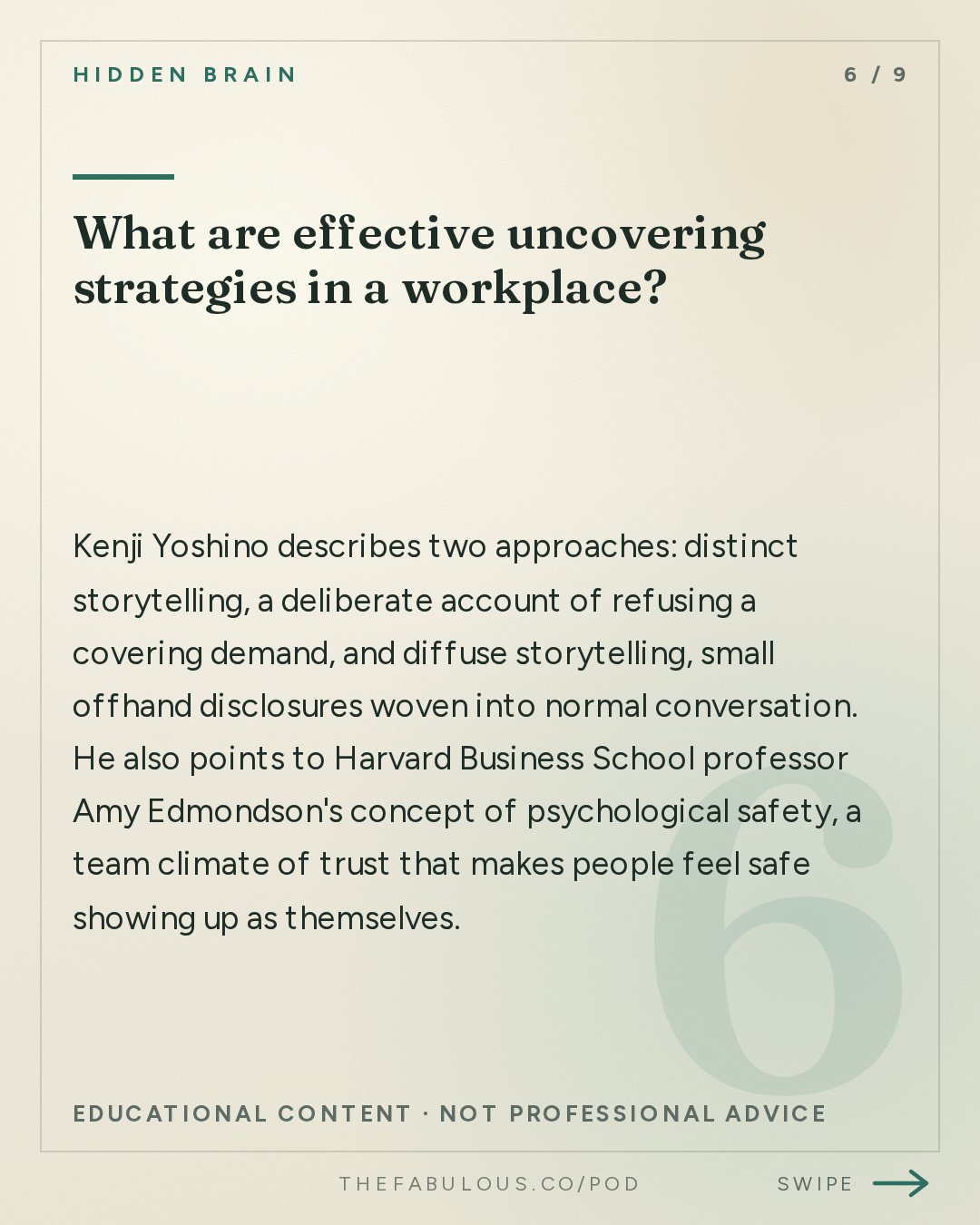
Kenji Yoshino describes two approaches: distinct storytelling, a deliberate account of refusing a covering demand, and diffuse storytelling, small offhand disclosures woven into normal conversation (64:44, 66:58). He also points to Harvard Business School professor Amy Edmondson's concept of psychological safety, a team climate of trust that makes people feel safe showing up as themselves (106:21).
The full read, in cards
Go deeper
- Stigma: Notes on the Management of Spoiled Identity — Sociologist Erving Goffman's 1963 book coined the concept of covering, downplaying a known stigmatized identity to ease others' discomfort.
- Deloitte covering study — A 2012 survey of 3,129 Fortune 500 employees found most people cover some identity trait and that doing so often damages self-image and workplace commitment.
- Quiet: The Power of Introverts in a World That Can't Stop Talking — Susan Cain argues introverts face pressure to conform to a culturally dominant extrovert ideal at work.
- Motherhood penalty study — Psychologists Beatrice Arronda and Peter Glick found women can partly offset workplace bias against mothers through constant work-devotional behavior.
Mentioned
Kenji Yoshino · Franklin Delano Roosevelt · Margaret Thatcher · Ben Kingsley · Erving Goffman · Deloitte · Earl Warren · Susan Cain · Robert Putnam · Amy Edmondson · Stigma: Notes on the Management of Spoiled Identity · Quiet · Covering: The Hidden Assault on Our Civil Rights
More from this show and category
How Romantic Attraction and Compatibility Really Work
Attraction is not a checklist, and stated preferences rarely predict who we actually choose. UC Davis psychologist Paul Eastwick finds machine learning scores 0% accuracy predicting speed-dating compatibility, while University of Maryland psychologist Ed Lemay shows social projection bias leads partners to assume feelings and values that may not exist.
How Sleep Deprivation Affects Decisions
Sleep deprivation degrades ethical judgment and decision-making in novel situations, contributing to disasters from train crashes to BP's 2005 explosion. Chronic pain, meanwhile, is reshaped by fear, relationships, and mindset as much as by tissue damage, per sleep researcher Chris Barnes and pain psychologist Rachel Zoffness.
Why Am I Unhappy? The Psychology Behind It
Psychologists George Loewenstein and Alison Ledgerwood argue that most unhappiness starts inside the mind, not from outside events. Loewenstein traces it to the hedonic treadmill and guilt over our own feelings; Ledgerwood traces it to a negativity bias built to spot threats. Their shared fix: notice good moments without suppressing bad ones, and ask whether a reaction fits now or an old pattern (96:51).
How to Build Agency: Martin Seligman's Method
Martin Seligman argues that agency, the belief that our actions can change outcomes, is a skill built through specific exercises, not an inherited trait. He describes three tools, disputing catastrophic thoughts, graded task assignment, and writing about a best possible self, backed by decades of research on optimism and helplessness.
