
How Romantic Attraction and Compatibility Really Work
How Love Really Works
The brief
Attraction is not a checklist, and stated preferences rarely predict who we actually choose. UC Davis psychologist Paul Eastwick finds machine learning scores 0% accuracy predicting speed-dating compatibility, while University of Maryland psychologist Ed Lemay shows social projection bias leads partners to assume feelings and values that may not exist.
In the 2013 film About Time, a young man and woman lock eyes for the first time and the universe seems to click into place. It is the oldest promise of the romantic comedy: find the right face, feel the bolt of recognition, and you will know. Psychologist Paul Eastwick of the University of California, Davis has spent two decades testing whether that promise holds up outside the movie theater. His answer, delivered with the patience of someone who has run the numbers, is that it mostly does not (00:00).
Eastwick's interest in the subject began with heartbreak. As a teenager he read a Time magazine cover story called "Infidelity: It May Be in Our Genes," published not long after a girlfriend left him for his best friend. The article described evolutionary psychology's view of mating as a kind of ruthless marketplace, men and women forever scanning for an upgrade (04:43). A friend later gave him blunt advice: hit the gym, buy better clothes, raise your "mate value," a number from one to ten that supposedly determines how well you do in the dating market. Years later Eastwick met a woman named Lauren who told him he checked every box on her list, intelligent, accomplished, compatible interests, and then chose someone else anyway (11:11). The scoreboard said he should have won. He did not. That contradiction became the engine of his research career.
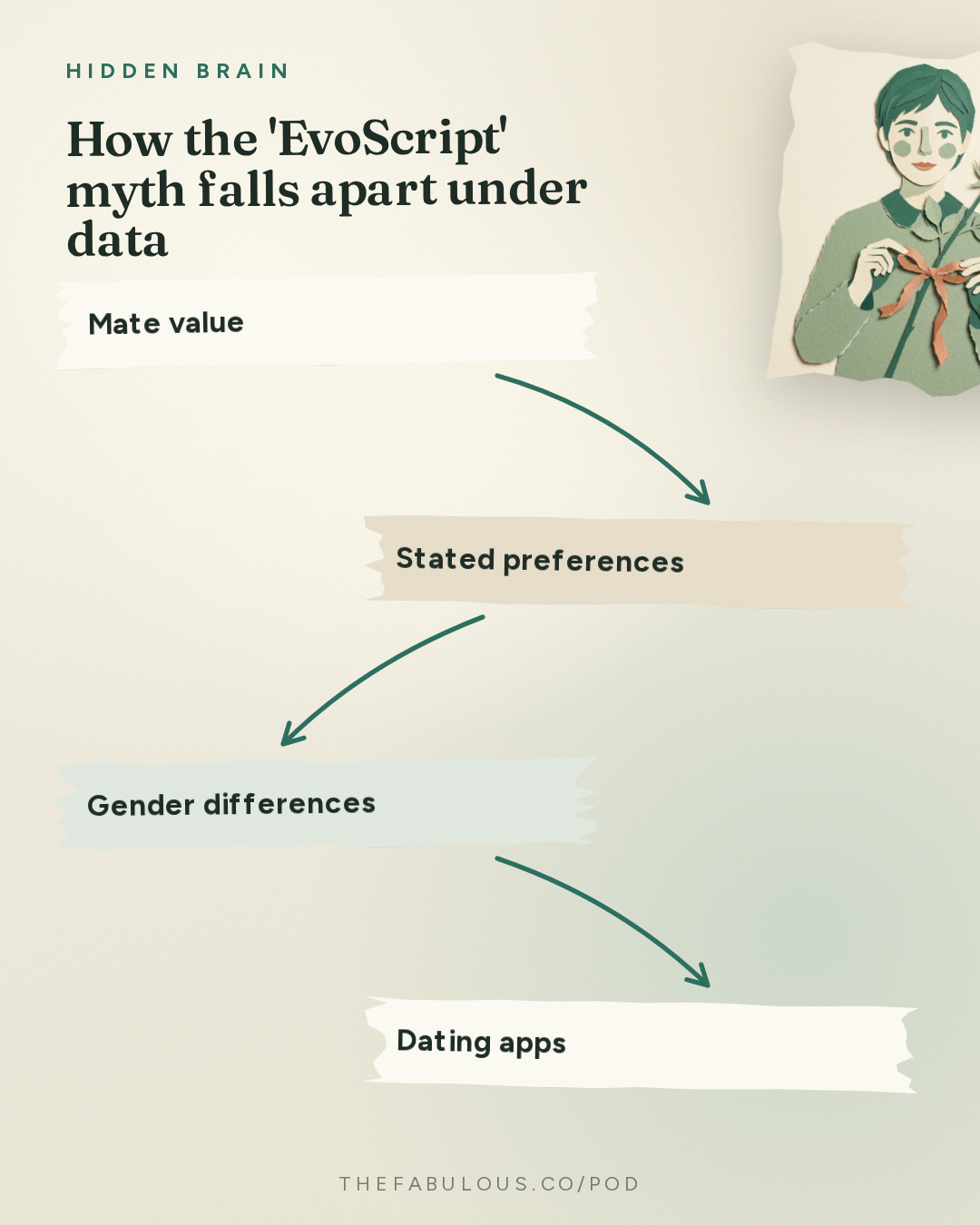
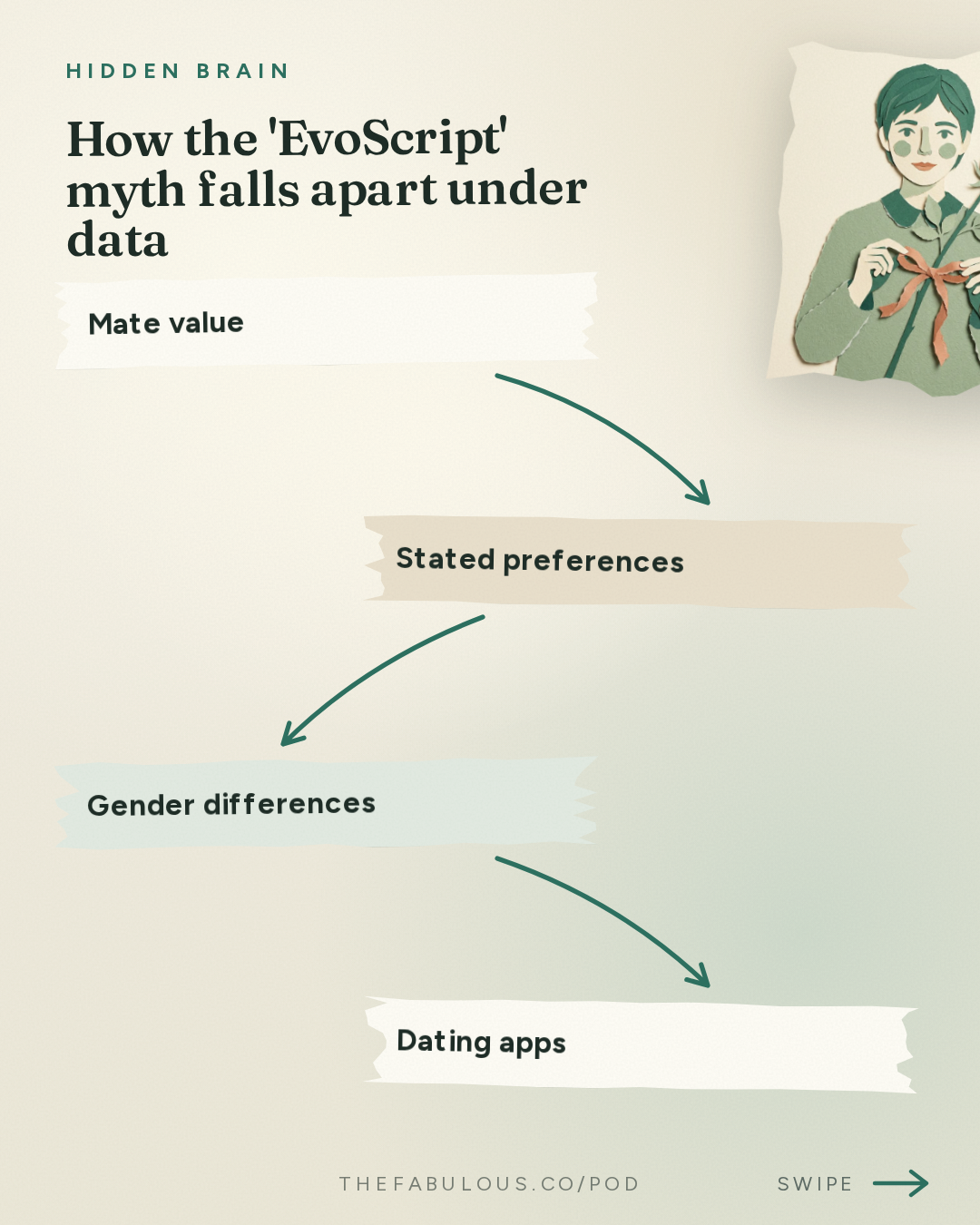
Eastwick calls the marketplace story the "EvoScript": the idea that everyone has a mate value, that men and women want fundamentally different things, and that people pick a lane between short-term and long-term strategies (15:12). Popularized by podcasters and self-help gurus, the script feels intuitive. It is also, according to Eastwick's data, badly incomplete. One clue is what happens to agreement about attractiveness as people spend time together. Strangers looking at photographs tend to agree closely on who is a six and who is an eight. But the longer two people actually know each other, the more that consensus falls apart, some people start seeing a three where others see a nine (18:23).
"Relationships are gonna work best when two people find each other who think that each other is a 10." — Paul Eastwick, UC Davis psychologist (18:50)
That line matters because it inverts the marketplace logic entirely. A relationship does not need the approval of twenty thousand strangers rating a photograph. It needs one person to see something nobody else quite sees. Eastwick's speed-dating studies back this up in an unglamorous way: when researchers ask people what they want in a partner, intelligence, humor, adventurousness, those stated preferences barely predict who they like once they actually meet someone face to face. Introduce a person with three different but equally appealing qualities, attractive, sociable, kind, and the attraction is just as strong (21:56).
"The things that we say we're looking for don't match up all that well with the traits that actually appeal to us once we meet folks face to face." — Paul Eastwick (22:25)
The much-repeated claim that men chase looks and women chase status also shrinks under scrutiny. In live speed-dating interactions, a trait like ambition draws equal interest from men and women, the gender gap shows up in surveys, not in behavior (27:04). Dating apps, Eastwick argues, make the gap look bigger than it is. In speed dating, men say yes to a second date about 50% of the time and women say yes about 35% of the time, a real but modest difference (31:35). Online, men's yes rate stays near 50%, but women's collapses to about 5%, a swing that has nothing to do with biology and everything to do with scrolling through strangers' photos without the social cues of an actual conversation (31:55). Eastwick thinks this distortion feeds the online "manosphere": men who feel rejected 95% of the time start blaming women or feminism instead of the format of the app itself (32:50).
Perhaps the most humbling finding involves psychologist Samantha Joel, Eastwick's collaborator, who tried to see whether self-reported data, traits, goals, preferences, fed into a machine learning model could predict who would hit it off at a speed-dating event. The model's accuracy: 0% (36:30).
"We have been completely unable to explain ahead of time why two people end up being compatible." — Paul Eastwick (36:45)
Compatibility Is Built, Not Found
If compatibility cannot be predicted from a questionnaire, what is it? Eastwick's answer is closer to gardening than shopping. Two people grow together, developing private rituals, in-jokes, and shared stories, and it is that accumulated history, not a matching algorithm, that creates closeness (41:15). He offers his own long-distance relationship with his partner Allison as an example: unable to see each other often, they started cooking the same dinner over video calls several nights a week, he taught her about wine, she taught him to cook, and the ritual became scaffolding that still holds the relationship up years later (51:30). He also credits a college friendship, with a woman named Crystal who kept inviting him into a wider circle, for introducing him to the partner he eventually dated, a reminder that the number of friends of the opposite gender someone has predicts their odds of forming a relationship later (47:03). His practical advice follows from this: do not rule people out because they fail to match a mental checklist, since every new person is a chance to discover a preference that was never on the list in the first place (47:29).
The Mirror We Mistake for a Window
Compatibility is only half the story. The other half is how accurately partners read each other once they are together, and here University of Maryland psychologist Ed Lemay has sobering news. Lemay studies social projection, the tendency to assume other people, especially romantic partners, are more like ourselves than they really are (57:53).
"Social projection is a bias where we assume other people are more like us than they really are." — Ed Lemay, University of Maryland psychologist (58:03)
The bias cuts both ways. Assuming a partner shares your warmth can build closeness. Assuming a partner shares your irritability or wandering eye can manufacture conflict that was never really there (58:26). Lemay walked through several listener stories to show how this plays out. One listener, Kelly, felt hurt when her husband did not open the car door the way a friend's husband had, reading his omission as a verdict on his care for her, when for him the gesture might carry no meaning at all (63:11). Another listener, Morgan, twenty-three and certain she does not want children, assumed her boyfriend's ambivalence masked hidden resentment, when research suggests people often project their present-day feelings about a relationship onto its imagined future, with no guarantee the forecast is accurate (67:33).
Projection reaches beyond the living room. Lemay's research on "primal world beliefs," general convictions about whether the world is good, safe, or enticing, found that people who see the world as more enticing also rate their partners as more supportive, even compared to what objective observers and the partners themselves reported (72:40). The same mechanism shows up in politics: elected officials project their own views onto constituents at roughly the same rate ordinary citizens project onto their political party, a finding Lemay says helps explain why polarization can feel starker than it actually is (75:30). It even extends to machines. Lonely people are more likely to anthropomorphize pets and AI chatbots, treating them as companions who share their values, a pattern Lemay links to a basic human need for connection rather than any confusion about what AI actually is (79:11).
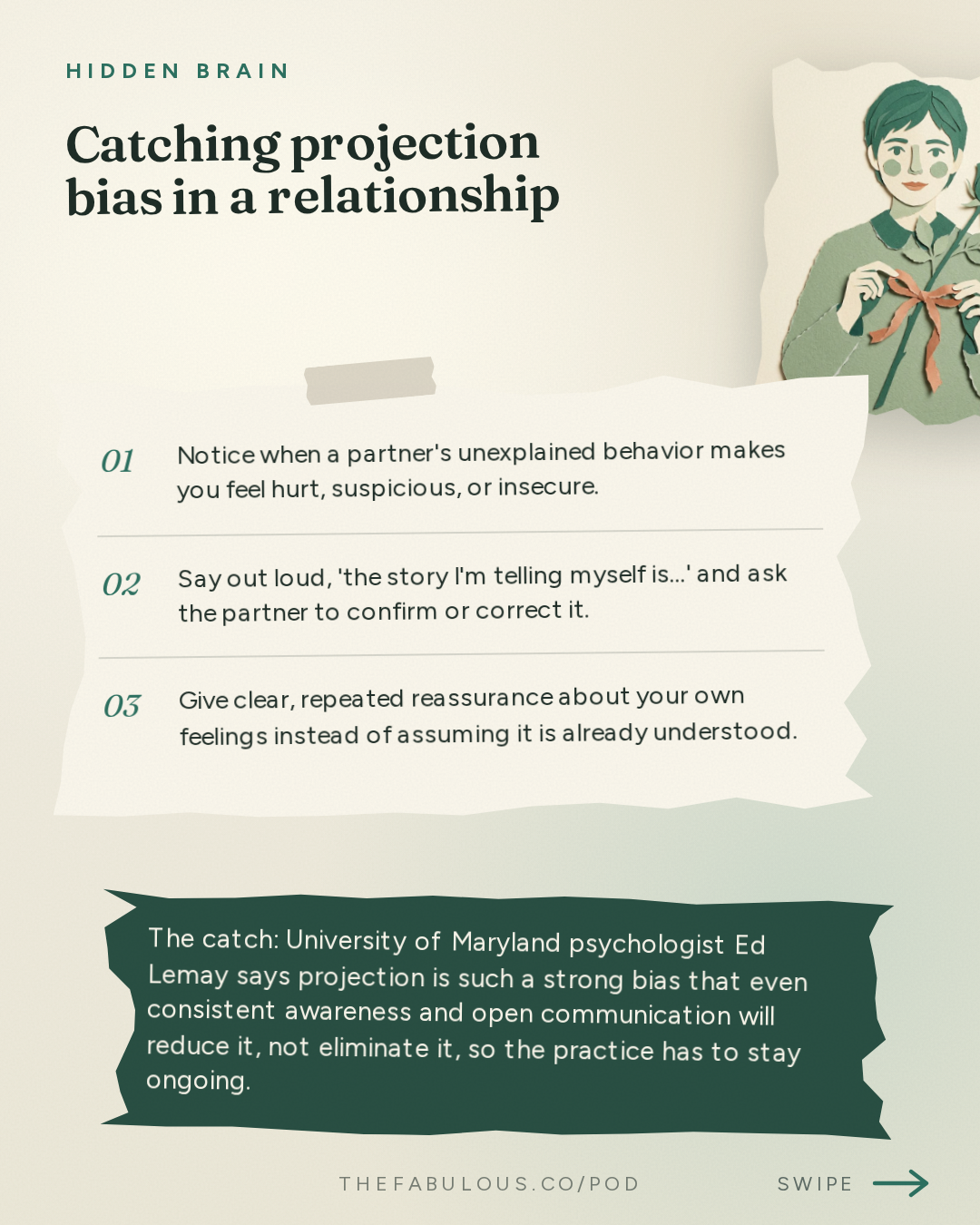
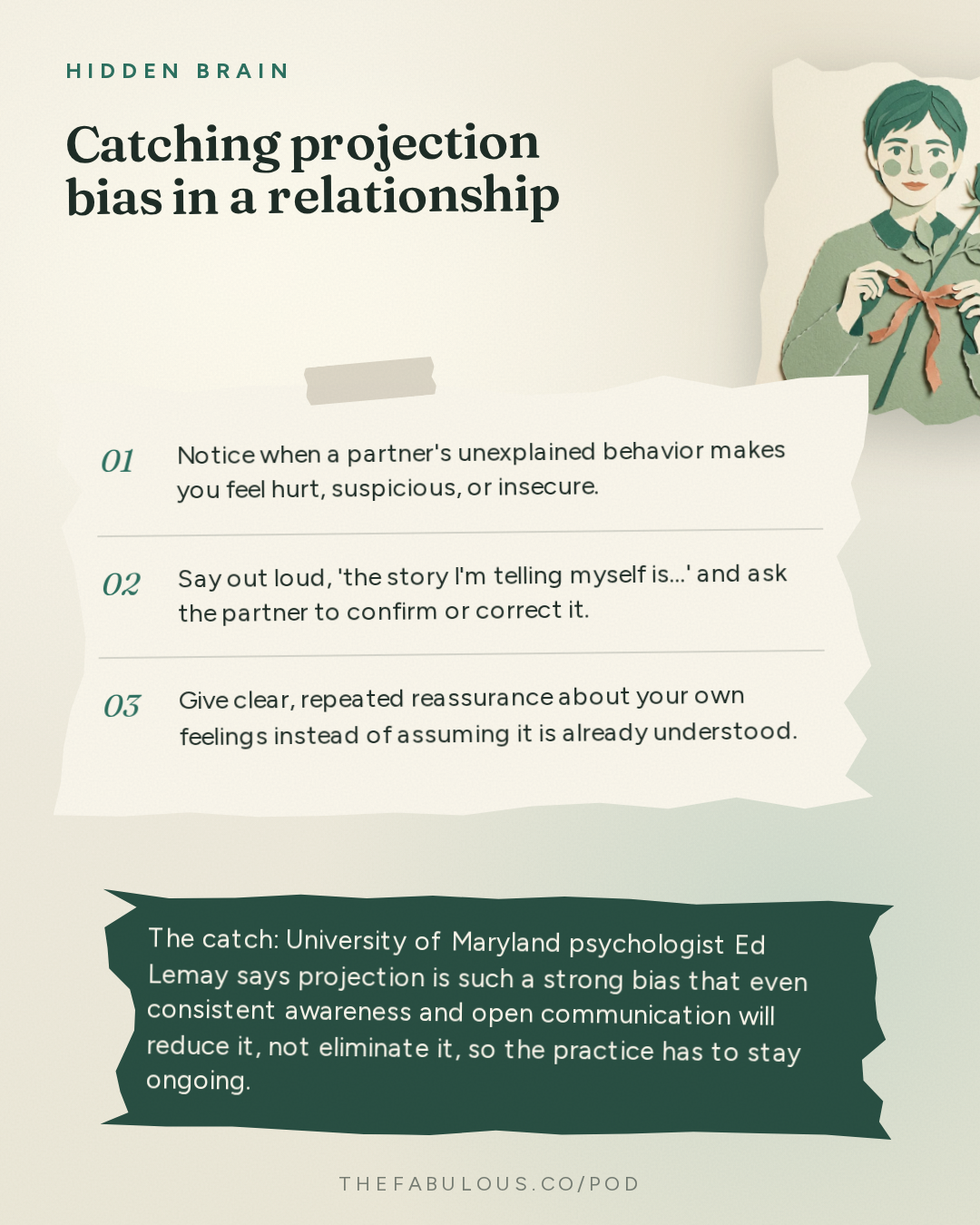
What can be done about a bias this pervasive? Lemay is cautious about promising a cure. But listener Linda, married forty-three years and navigating her husband's post-retirement PTSD, offered a method that Lemay says tracks real evidence: she and her husband began naming their assumptions out loud before treating them as fact.
"When we're projecting, we do a lot of asking each other, 'The story I'm telling myself is,' you know, and we check with each other." — Linda, listener (93:22)
Lemay calls this kind of open checking-in a genuine corrective: it will not erase projection, which he considers too strong a bias to fully extinguish, but it narrows the space where misreading can grow unchecked (94:32). Paired with deliberate reassurance and a habit of noticing a partner's actual expressions of care rather than dismissing them, the practice turns a blind spot into a conversation. Between Eastwick's gardens and Lemay's mirrors, the episode arrives at a similar place from two directions: the partner worth keeping is rarely the one who matches a list. It is the one with whom the story, however imperfect the telling, keeps getting rewritten together.
Ask this episode anything
Pod's AI answers from the episode itself, with the minute mark so you can hear it yourself.
Or start with one of these
Ask this episode
Pod's AI listens to the whole episode to answer, and points you to the minute it comes from.
The rest of this answer, and any question after it
Answers come from the episode itself, never from a summary of it.
ContinueKey takeaways
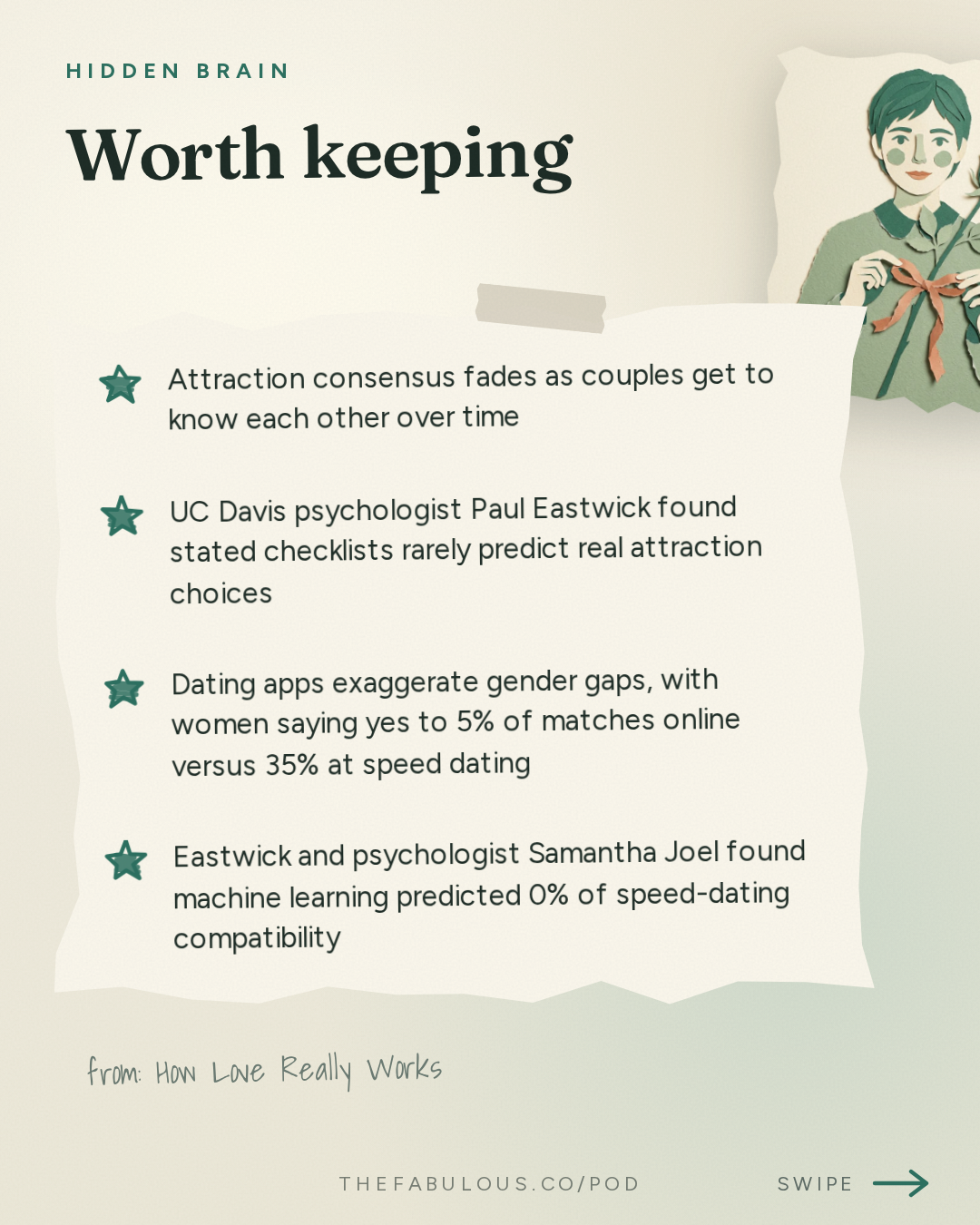
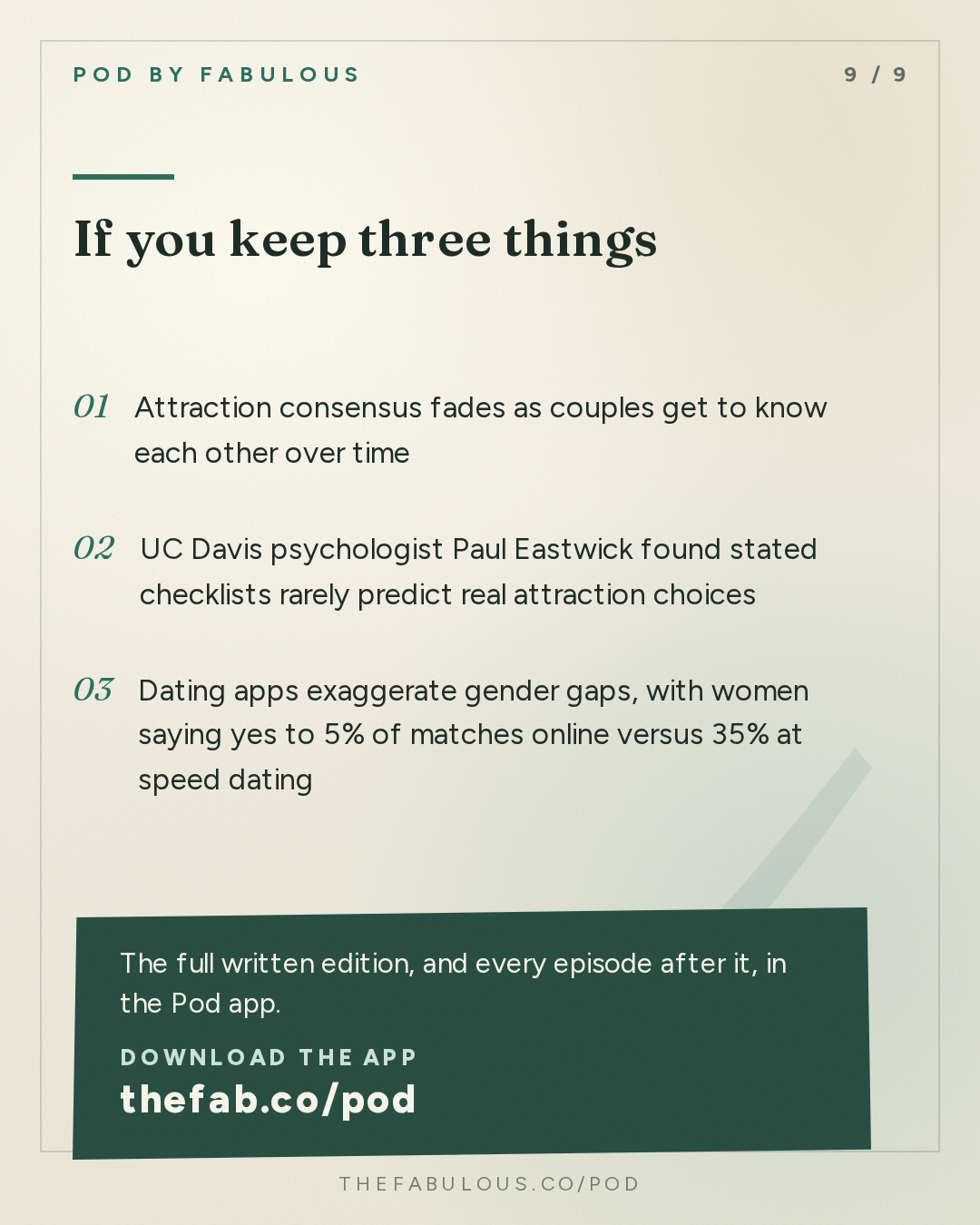
- Attraction consensus fades as couples get to know each other over time
- UC Davis psychologist Paul Eastwick found stated checklists rarely predict real attraction choices
- Dating apps exaggerate gender gaps, with women saying yes to 5% of matches online versus 35% at speed dating
- Eastwick and psychologist Samantha Joel found machine learning predicted 0% of speed-dating compatibility
- University of Maryland psychologist Ed Lemay says projection bias makes partners assume shared feelings and values
The episode in cards
By the numbers
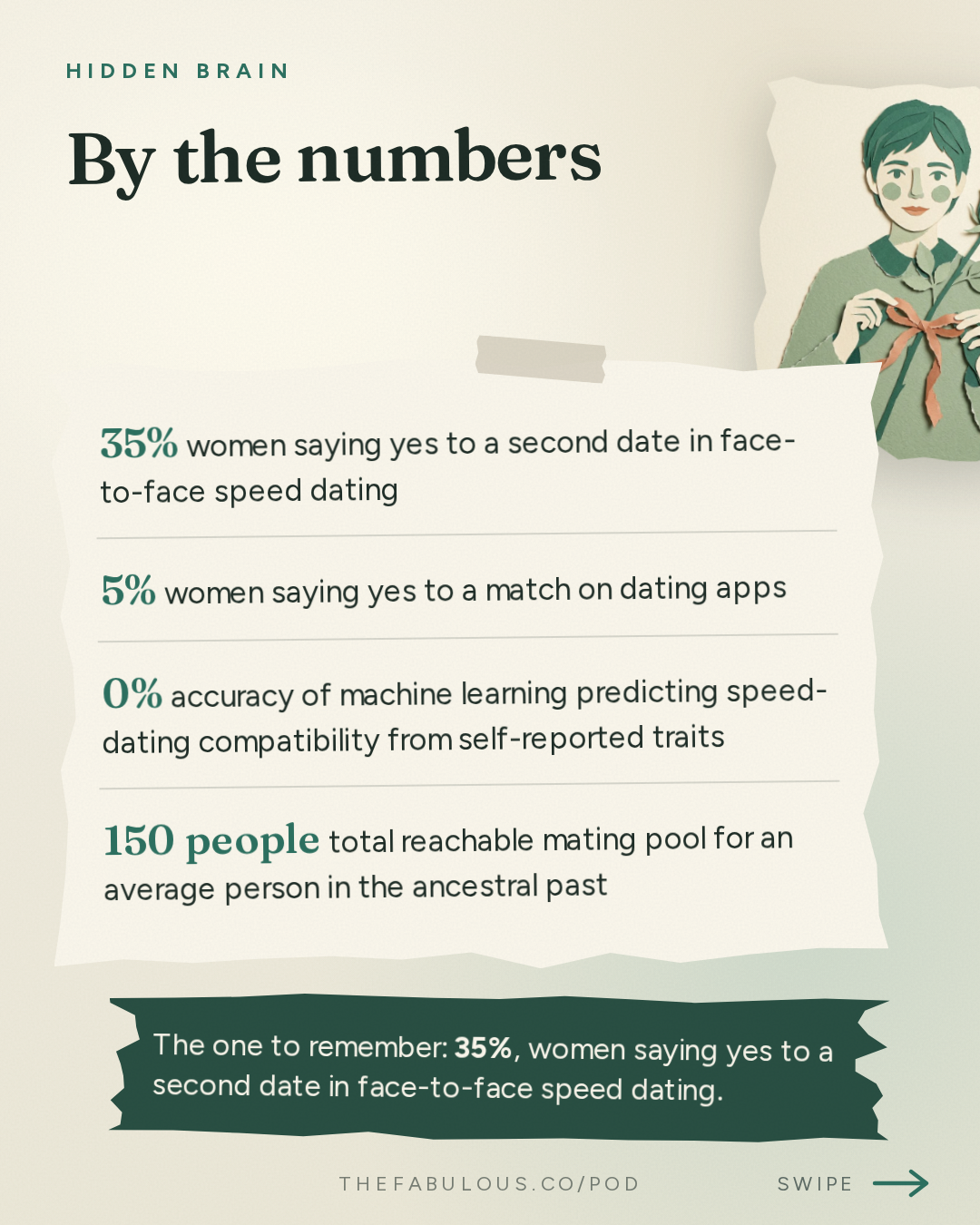
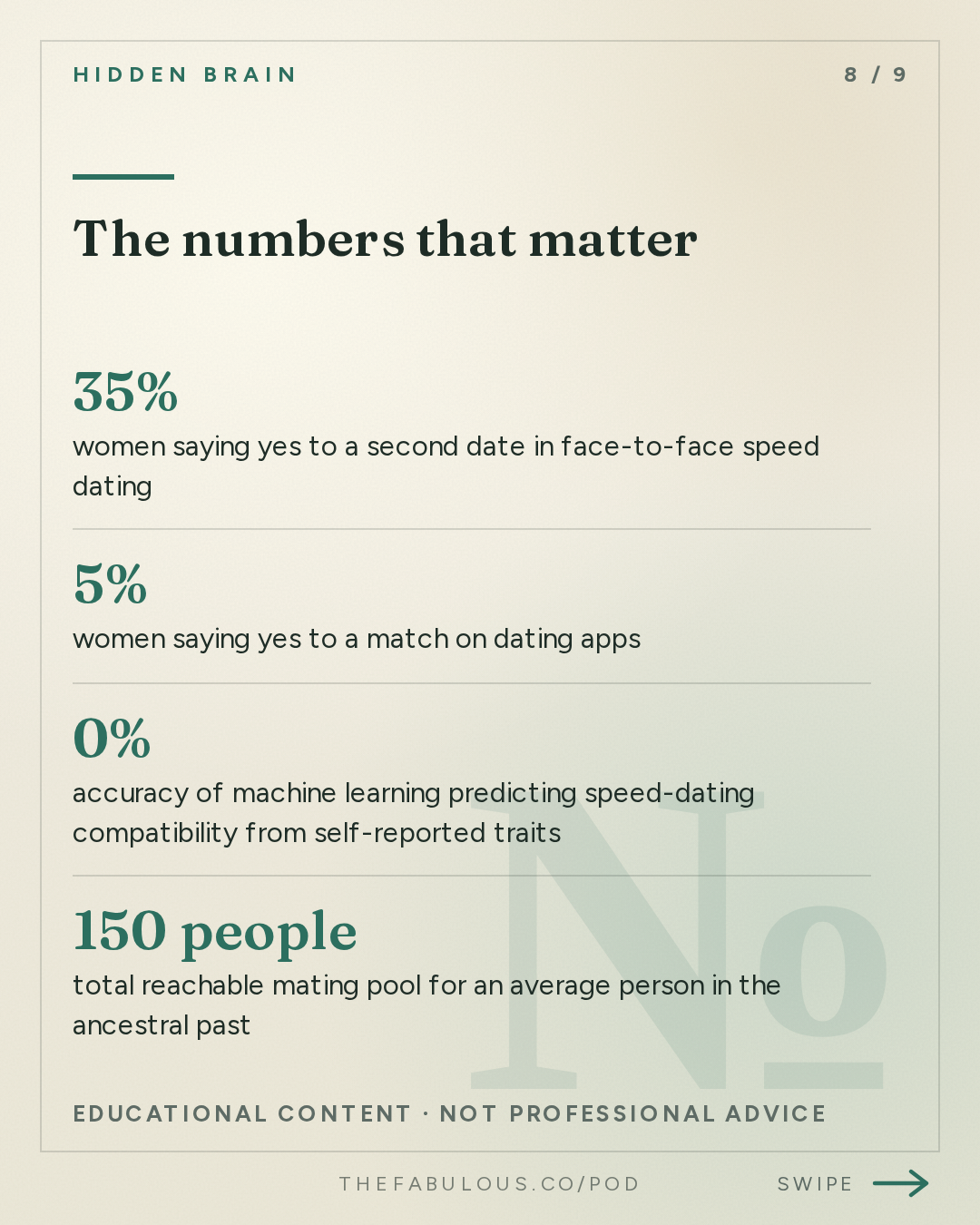
- 35% women saying yes to a second date in face-to-face speed dating
- 5% women saying yes to a match on dating apps
- 0% accuracy of machine learning predicting speed-dating compatibility from self-reported traits
- 150 people total reachable mating pool for an average person in the ancestral past
- 35 traits number of attributes researchers needed just to begin explaining partner preference
In their words
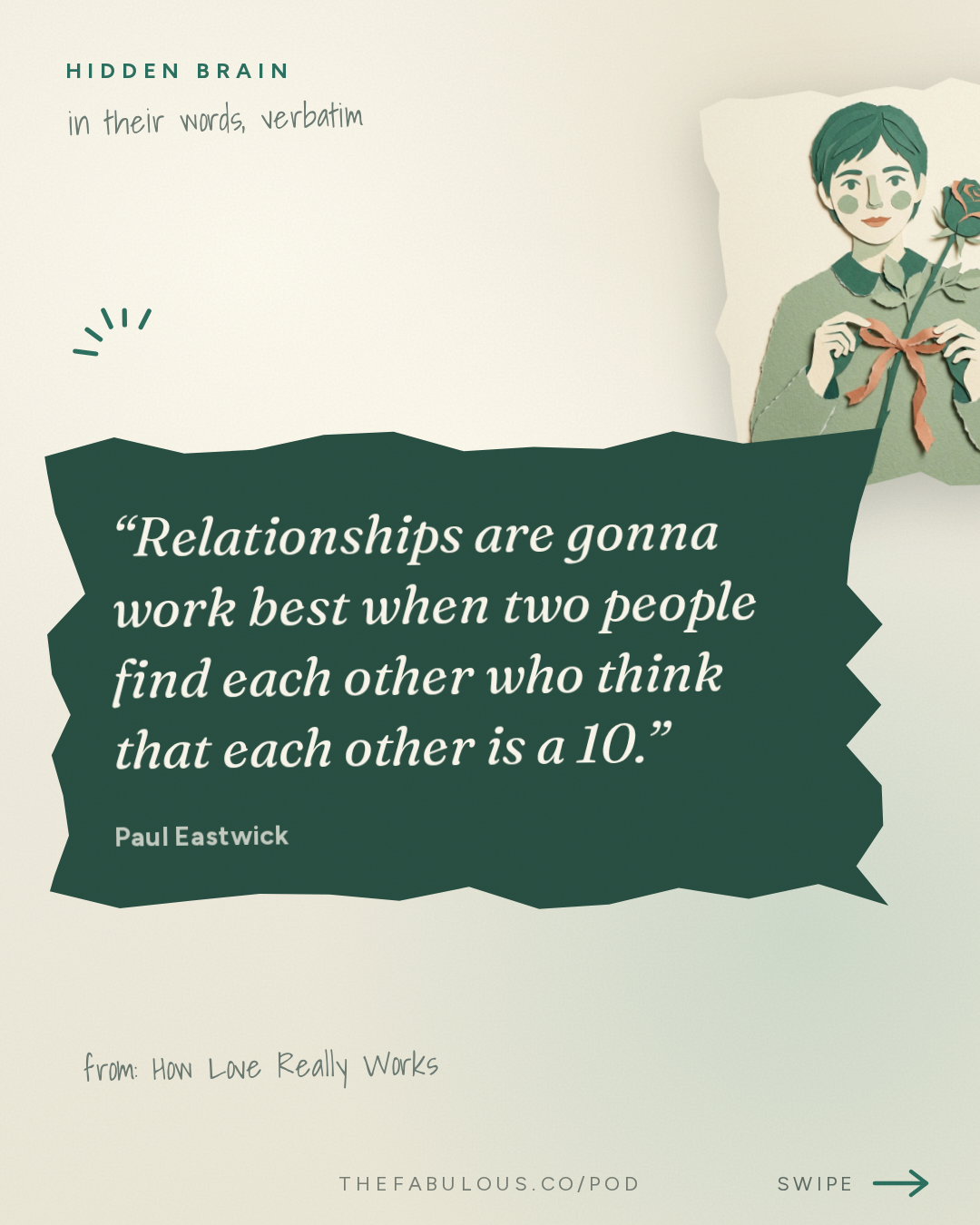
“Relationships are gonna work best when two people find each other who think that each other is a 10.”
“The things that we say we're looking for don't match up all that well with the traits that actually appeal to us once we meet folks face to face.”
“We have been completely unable to explain ahead of time why two people end up being compatible.”
“Social projection is a bias where we assume other people are more like us than they really are.”
“When we're projecting, we do a lot of asking each other, 'The story I'm telling myself is...'”
Protocols
-
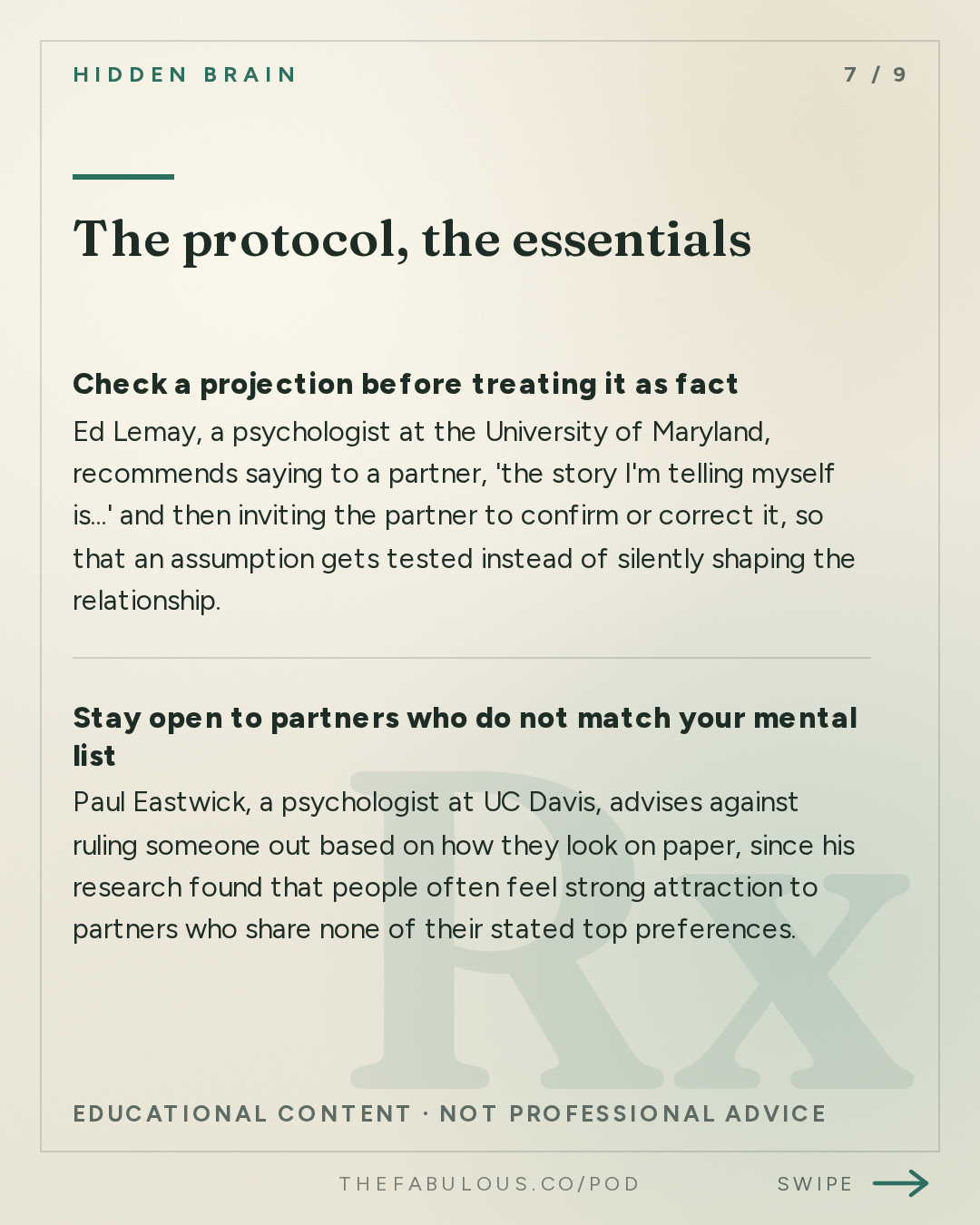
Check a projection before treating it as fact
Ed Lemay, a psychologist at the University of Maryland, recommends saying to a partner, 'the story I'm telling myself is...' and then inviting the partner to confirm or correct it, so that an assumption gets tested instead of silently shaping the relationship.
whenever a doubt or suspicion about a partner's feelings arises
-
Stay open to partners who do not match your mental list
Paul Eastwick, a psychologist at UC Davis, advises against ruling someone out based on how they look on paper, since his research found that people often feel strong attraction to partners who share none of their stated top preferences.
each time a new person is introduced through a social network
-
Reframe relationship comparisons as inspiration, not despair
Ed Lemay suggests that when a current partner compares unfavorably to a past partner or another couple, the person should ask what specifically is missing and whether that quality could be reintroduced, rather than letting the comparison lower satisfaction with the current relationship.
whenever an upward comparison to an ex or another couple comes to mind
Questions this episode answers
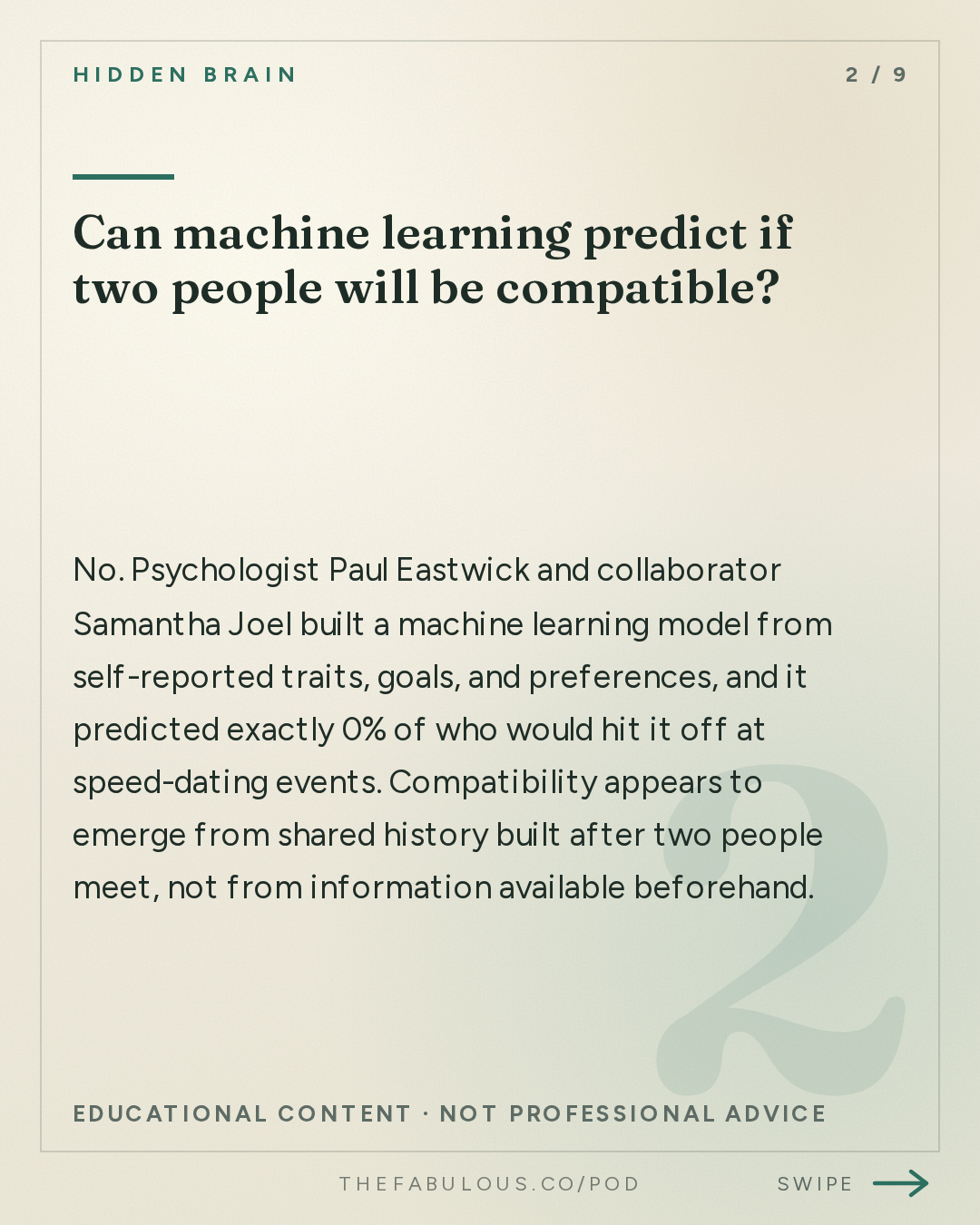
Can machine learning predict if two people will be compatible?
No. Psychologist Paul Eastwick and collaborator Samantha Joel built a machine learning model from self-reported traits, goals, and preferences, and it predicted exactly 0% of who would hit it off at speed-dating events (36:30). Compatibility appears to emerge from shared history built after two people meet, not from information available beforehand.
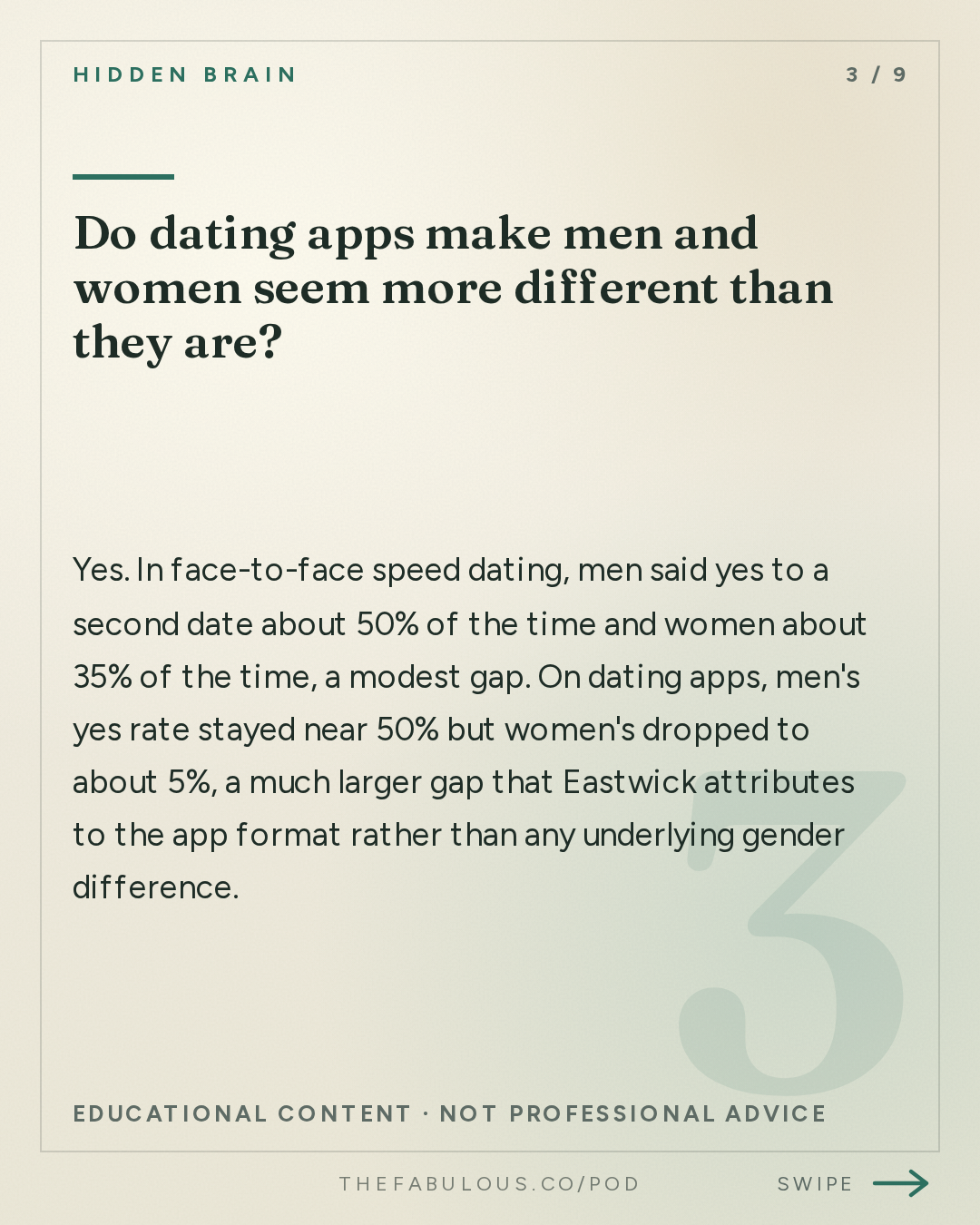
Do dating apps make men and women seem more different than they are?
Yes. In face-to-face speed dating, men said yes to a second date about 50% of the time and women about 35% of the time, a modest gap (31:35). On dating apps, men's yes rate stayed near 50% but women's dropped to about 5%, a much larger gap that Eastwick attributes to the app format rather than any underlying gender difference (31:55).
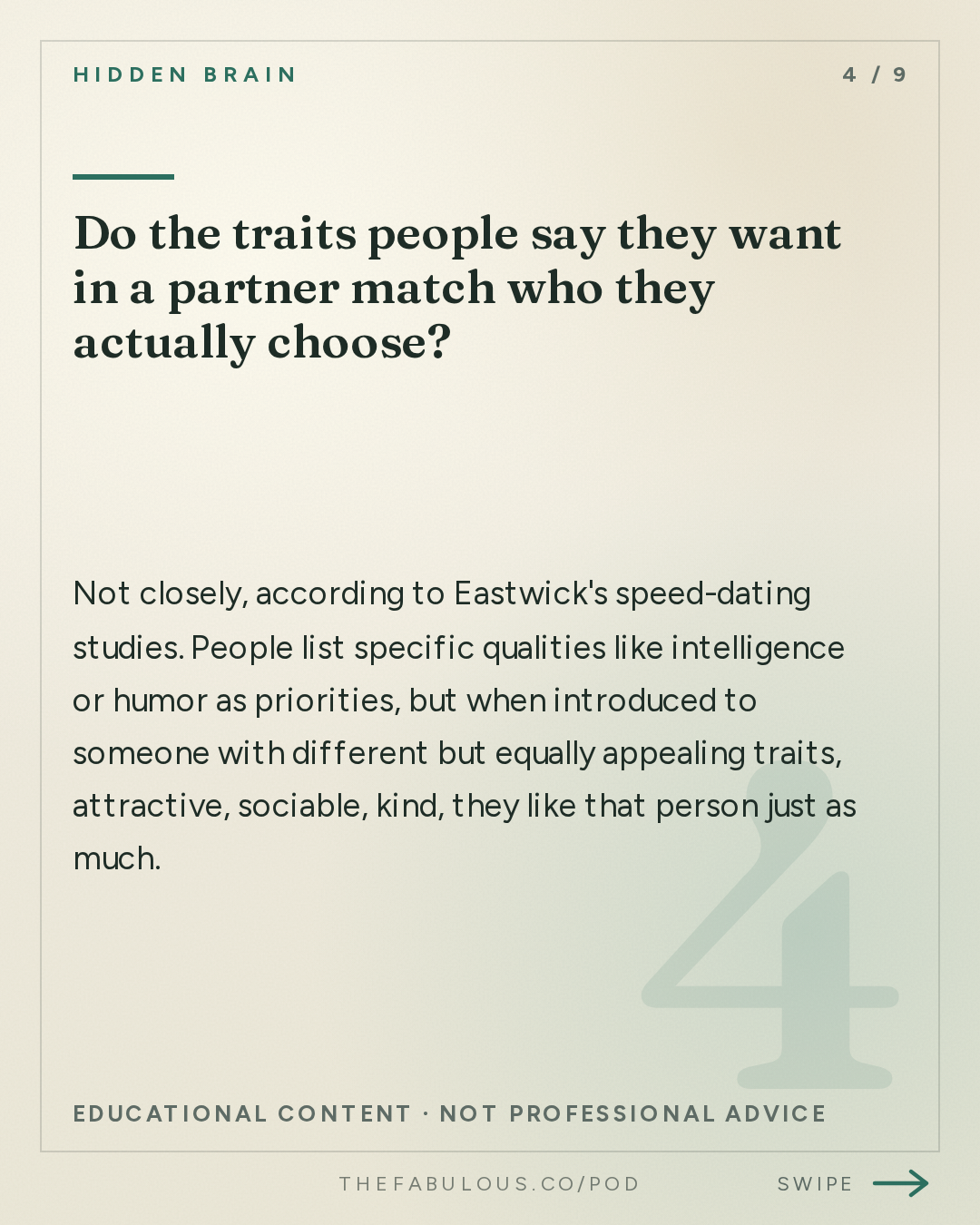
Do the traits people say they want in a partner match who they actually choose?
Not closely, according to Eastwick's speed-dating studies. People list specific qualities like intelligence or humor as priorities, but when introduced to someone with different but equally appealing traits, attractive, sociable, kind, they like that person just as much (21:56).
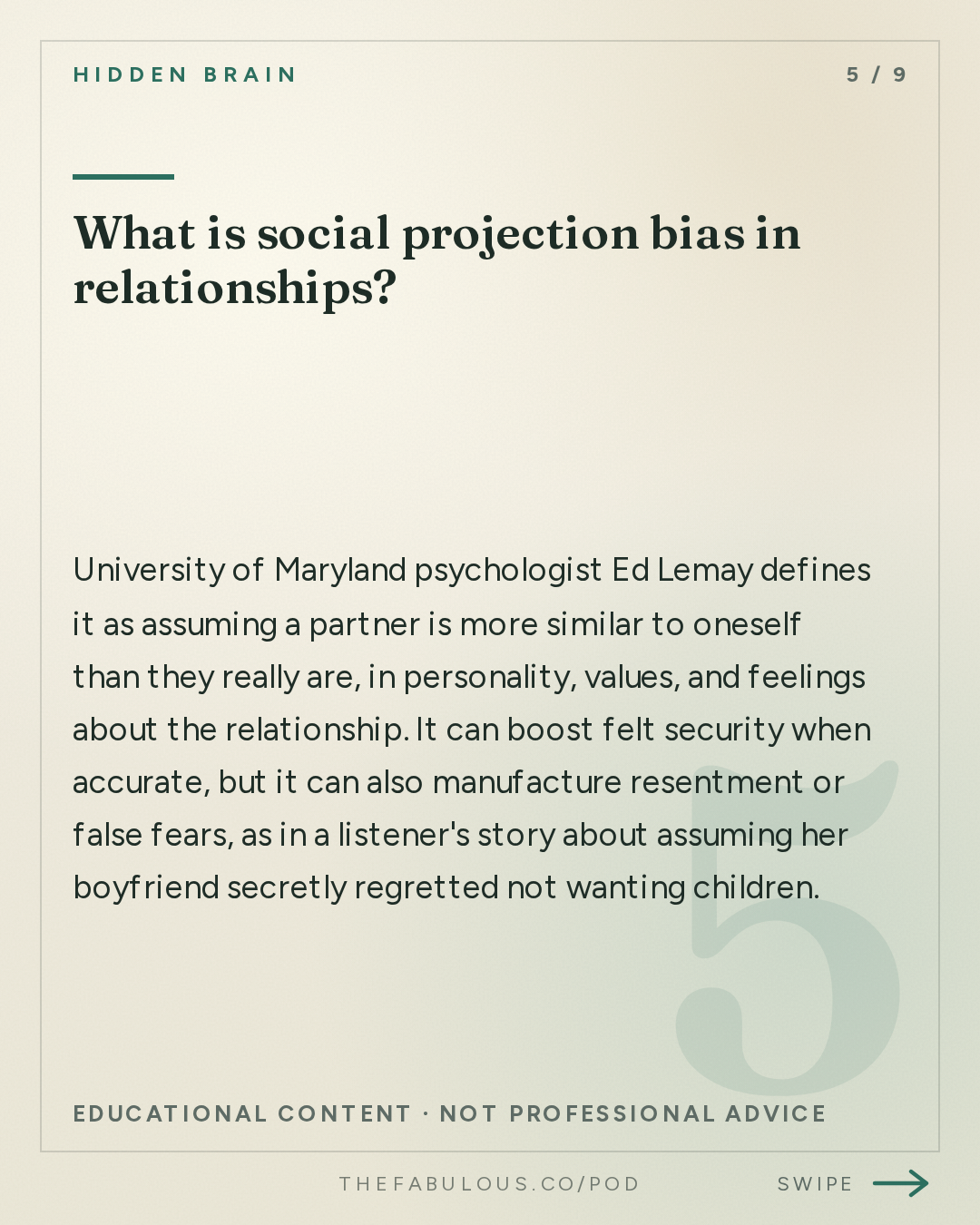
What is social projection bias in relationships?
University of Maryland psychologist Ed Lemay defines it as assuming a partner is more similar to oneself than they really are, in personality, values, and feelings about the relationship (58:03). It can boost felt security when accurate, but it can also manufacture resentment or false fears, as in a listener's story about assuming her boyfriend secretly regretted not wanting children (67:33).
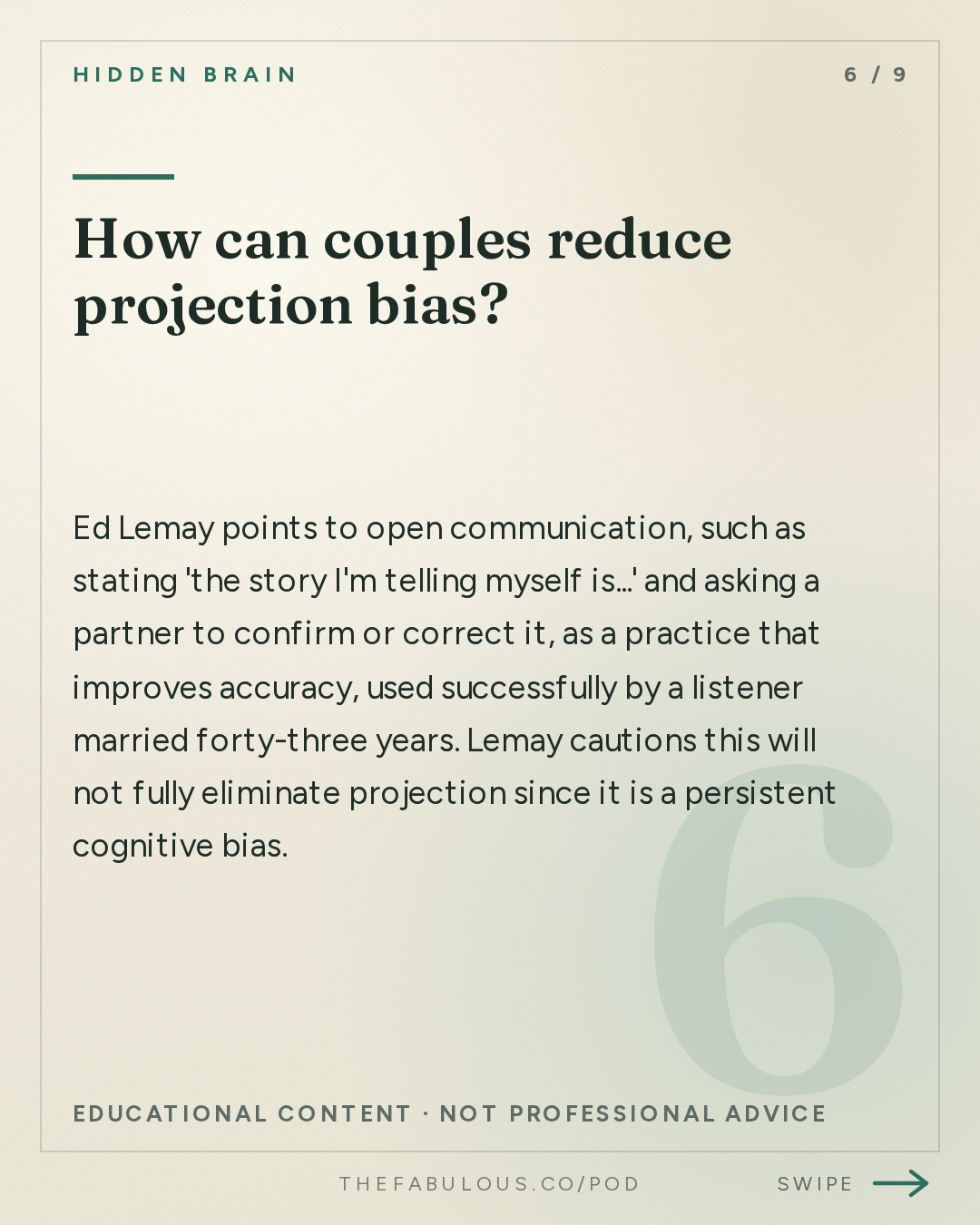
How can couples reduce projection bias?
Ed Lemay points to open communication, such as stating 'the story I'm telling myself is...' and asking a partner to confirm or correct it, as a practice that improves accuracy, used successfully by a listener married forty-three years (93:22). Lemay cautions this will not fully eliminate projection since it is a persistent cognitive bias (94:32).
The full read, in cards
Go deeper
- Bonded by Evolution: The New Science of Love and Connection — Paul Eastwick's book arguing that attraction is shaped by shared history rather than a fixed mate value score
- Time magazine, "Infidelity: It May Be in Our Genes" — early evolutionary psychology cover story that shaped Eastwick's youthful fear that relationships are a zero-sum competition
- Samantha Joel's speed-dating machine learning study — found that self-reported traits and preferences predicted 0% of actual romantic compatibility
- Research on primal world beliefs and relationship perception — found people who see the world as enticing rate their partners as more supportive than objective coders do
Mentioned
Paul Eastwick · Ed Lemay · Samantha Joel · UC Davis · University of Maryland · Bonded by Evolution · About Time · Joe Rogan · Jordan Peterson
More from this show and category
How Sleep Deprivation Affects Decisions
Sleep deprivation degrades ethical judgment and decision-making in novel situations, contributing to disasters from train crashes to BP's 2005 explosion. Chronic pain, meanwhile, is reshaped by fear, relationships, and mindset as much as by tissue damage, per sleep researcher Chris Barnes and pain psychologist Rachel Zoffness.
Why Am I Unhappy? The Psychology Behind It
Psychologists George Loewenstein and Alison Ledgerwood argue that most unhappiness starts inside the mind, not from outside events. Loewenstein traces it to the hedonic treadmill and guilt over our own feelings; Ledgerwood traces it to a negativity bias built to spot threats. Their shared fix: notice good moments without suppressing bad ones, and ask whether a reaction fits now or an old pattern (96:51).
How to Build Agency: Martin Seligman's Method
Martin Seligman argues that agency, the belief that our actions can change outcomes, is a skill built through specific exercises, not an inherited trait. He describes three tools, disputing catastrophic thoughts, graded task assignment, and writing about a best possible self, backed by decades of research on optimism and helplessness.
Seligman on Learned Helplessness and Optimism
Psychologist Martin Seligman found that helplessness is learned, and so is optimism. His research links explanatory style to depression risk, predicts success at West Point and in sales, and traces a psychological theory of human progress from ancient Greece to St. Augustine to modern China.
