
Alia Crum on How Mindset Shapes Stress and Hunger
How Mindsets Shape Reality w/ Dr. Alia Crum
▶ Listen to the full episode More from The Psychology Podcast
The brief
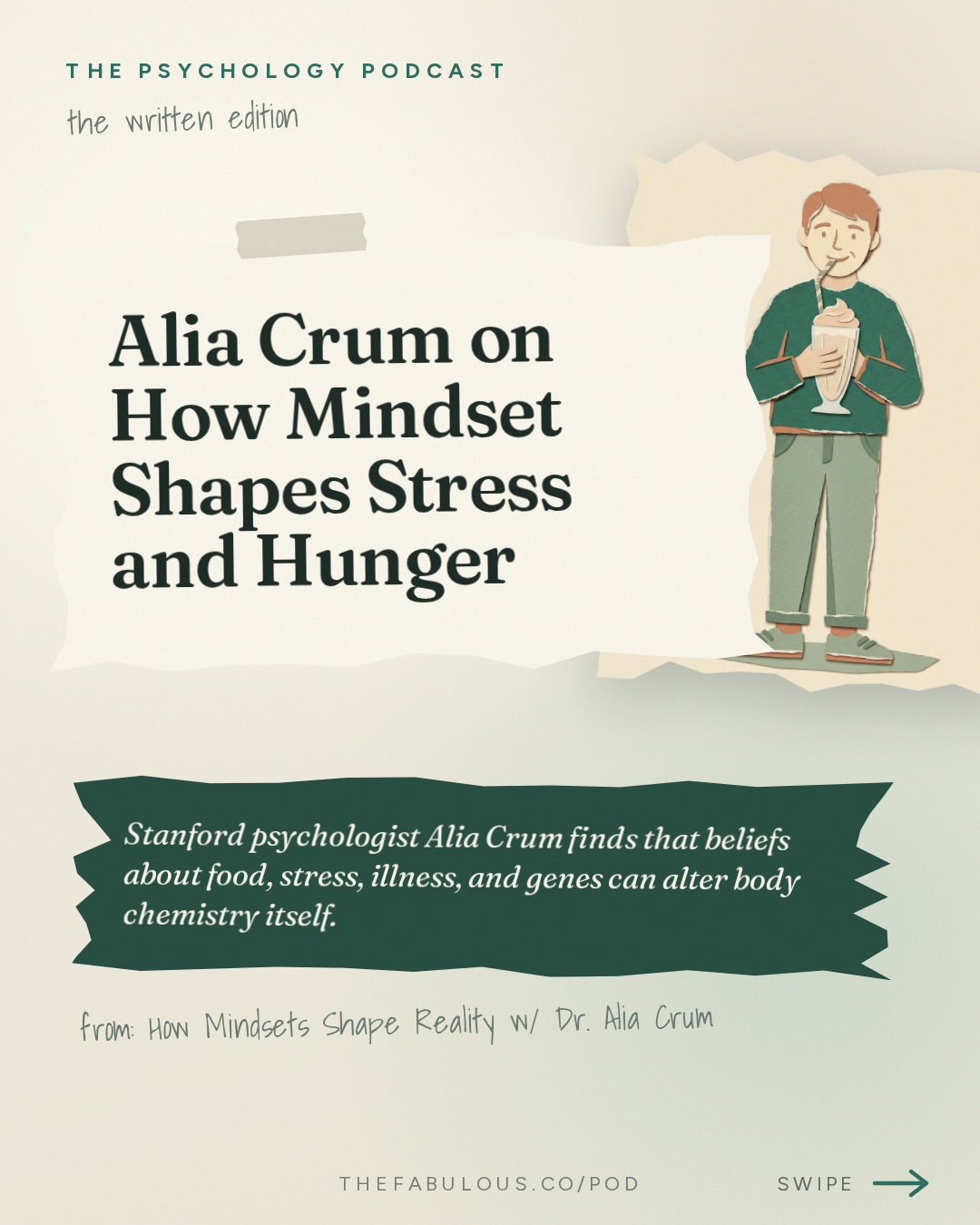
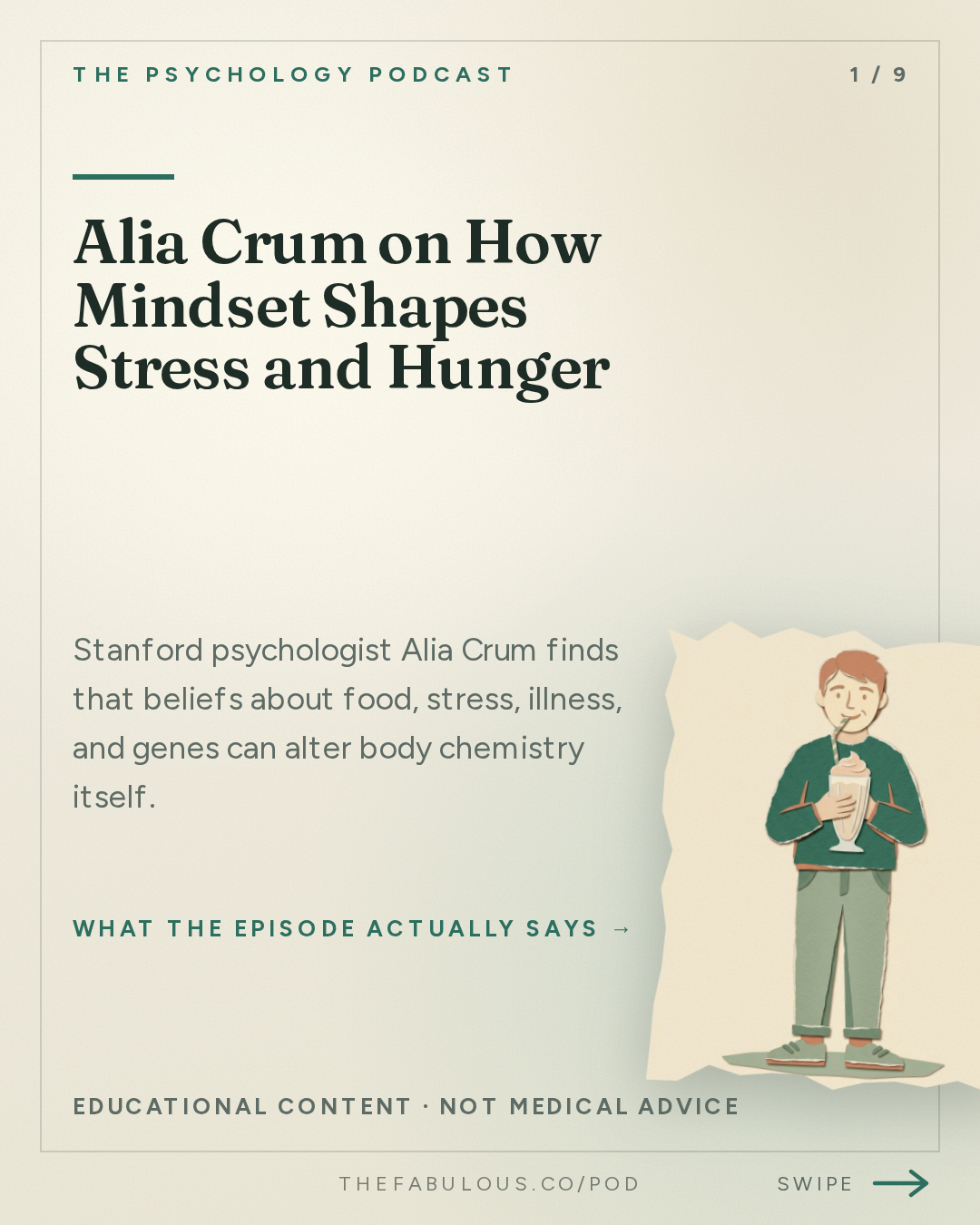
Stanford psychologist Alia Crum finds that beliefs about food, stress, illness, and genes can alter body chemistry itself. Labeling an identical milkshake indulgent rather than sensible triples the drop in the hunger hormone ghrelin (12:37), and believing one carries a low-efficiency exercise gene lowers real oxygen conversion regardless of actual genotype (47:10).
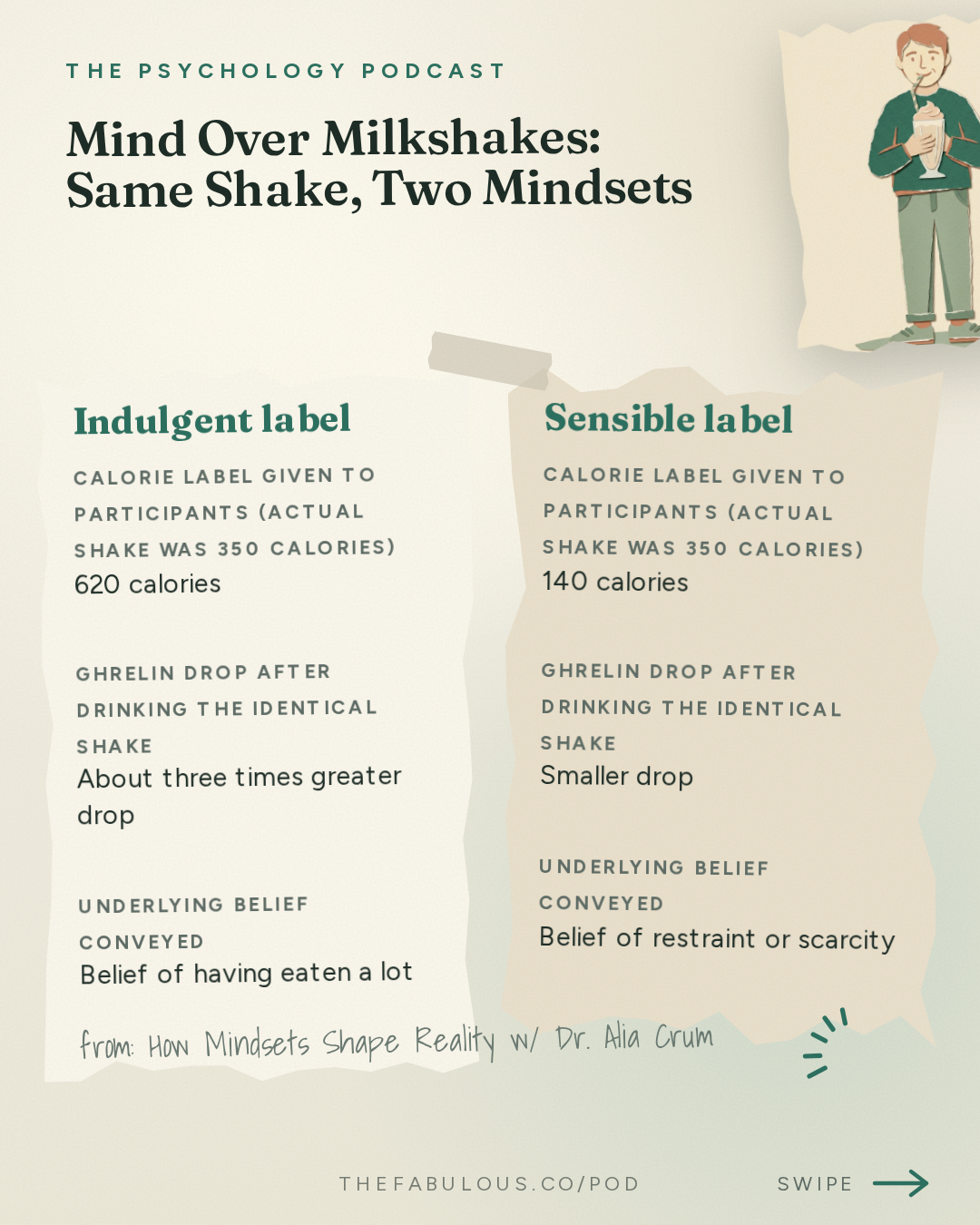
Pour someone a milkshake, tell them it has 620 calories, and their body starts acting like they just ate a big meal, even though the shake is actually 350 calories (12:02). Tell someone else the same shake has 140 calories, and their body barely reacts. Same cup, same ingredients, same spoon. Different story attached to it, different biology inside the person drinking it. This is the finding that made Stanford psychologist Alia Crum's career, and it runs through her conversation with cognitive scientist and Columbia professor Scott Barry Kaufman about how belief gets under the skin.
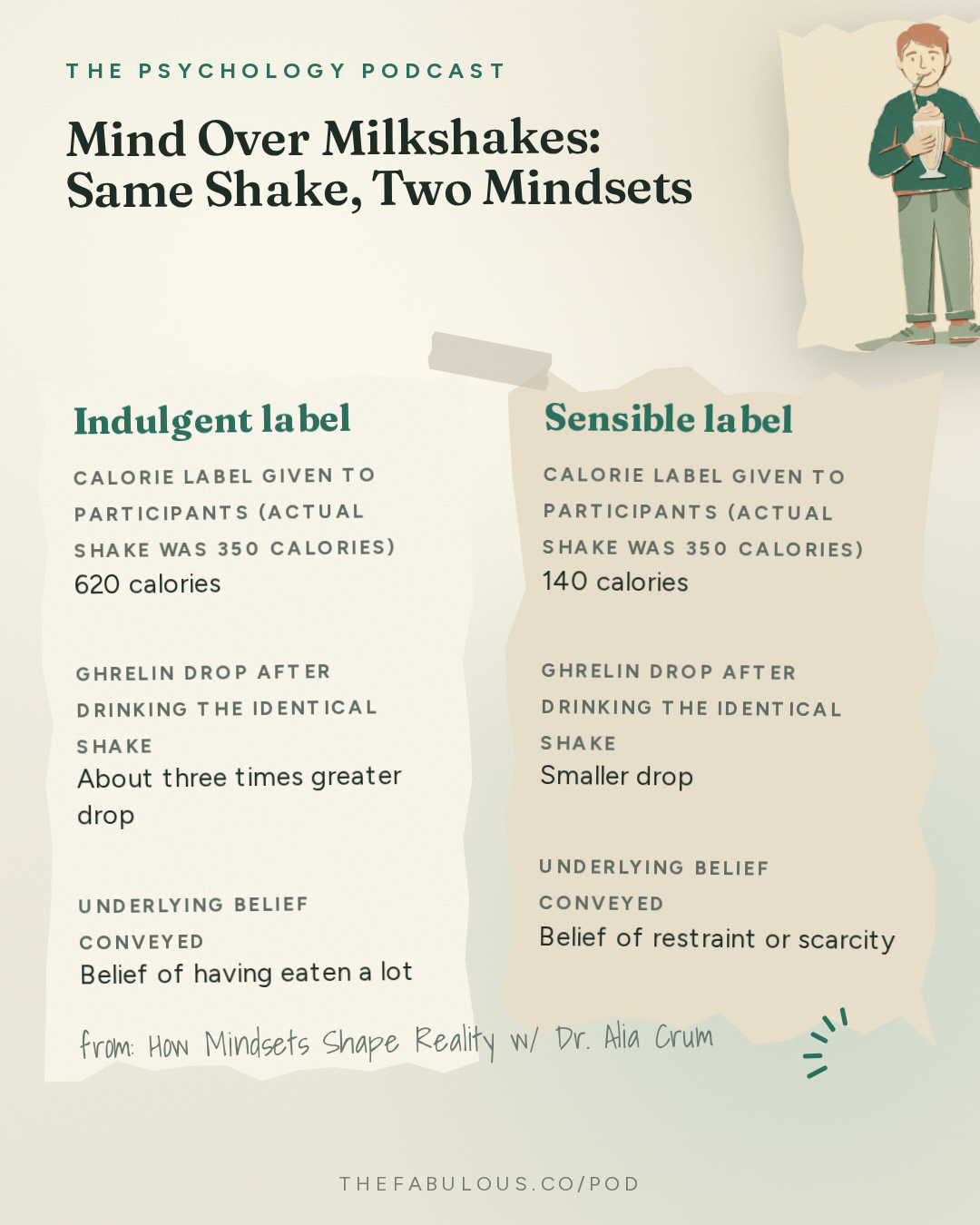
Crum studies mindsets, which she defines as the lenses through which information is perceived, organized, and interpreted (00:50). That sounds like a soft claim until she backs it with a hormone. The hormone is ghrelin, sometimes called the hunger hormone, which rises before a meal to push the brain toward food and slows metabolism in case food doesn't arrive, then normally drops once a person eats (10:05). In Crum's 2011 Mind Over Milkshakes study at Yale New Haven Hospital, participants drank the identical shake but were told it was either a 620 calorie indulgent treat or a 140 calorie sensible one (12:02). The people who believed they were indulging showed a ghrelin drop three times larger than the people who believed they were being sensible (12:37).
"When people thought they were consuming an indulgent shake, their body responded as if they had had more food." (Alia Crum, 12:37)
The surprise wasn't that belief mattered. Placebo research had already shown that. The surprise was the direction. Crum expected the healthy mindset to help. Instead, believing one is eating sparingly seems to tell the body it is still short on food, which keeps ghrelin high and metabolism slow (13:40). A restraint mindset can work against the very diet it's meant to serve.
"The mindset of sensibility or restraint or scarcity actually counteracts the hard work that you might be doing actually reducing your caloric intake." (Alia Crum, 14:11)
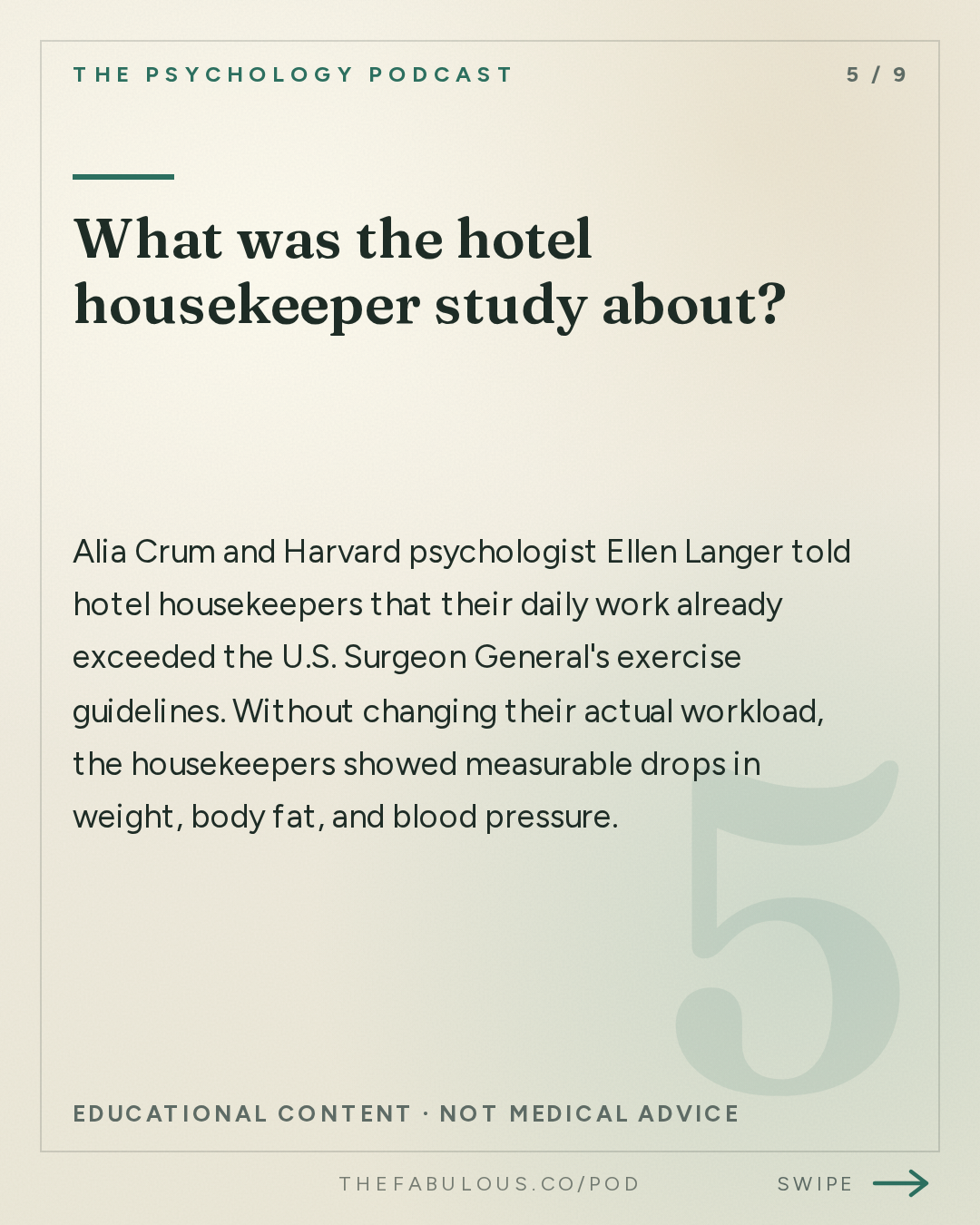
This wasn't Crum's first pass at the idea that belief can rewrite a body's response. Years earlier, as an undergraduate working with Harvard psychologist Ellen Langer, she studied hotel housekeepers who were getting plenty of exercise on the job without knowing it. Once researchers told the housekeepers that their work already exceeded the U.S. Surgeon General's exercise guidelines, the women showed measurable drops in weight, body fat, and blood pressure, without changing what they actually did all day (08:03). The labor stayed the same. Only the story about the labor changed.
The Body Believes What the Mind Decides
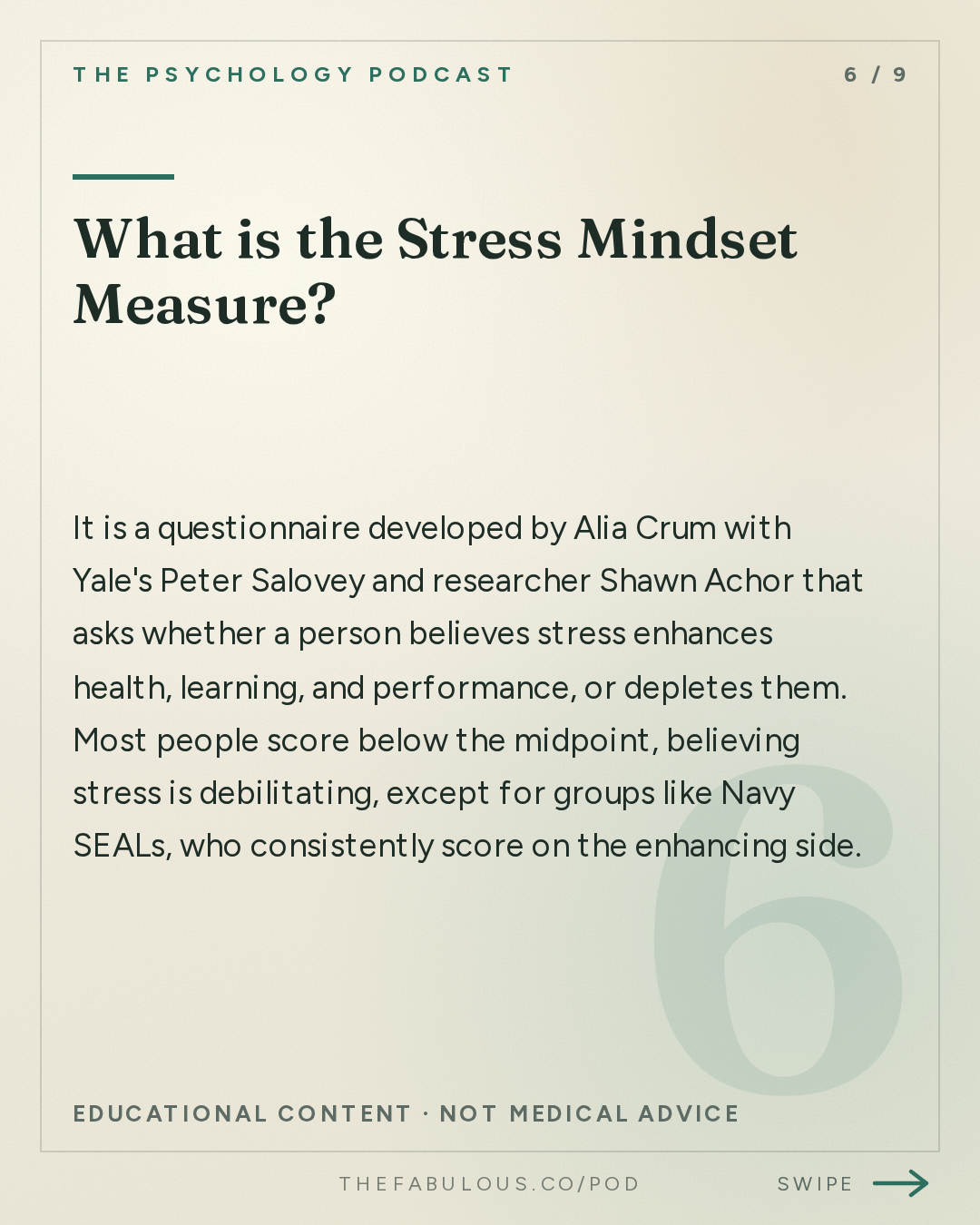
Crum's next target was stress. A 2013 paper she wrote with Yale's Peter Salovey and researcher Shawn Achor introduced the Stress Mindset Measure, a short questionnaire asking whether a person believes stress enhances performance, learning, and health, or drains them (18:24). Most people, across many countries and translations, score below the midpoint, meaning they see stress as something to avoid (19:25). The one group Crum has found that consistently scores on the enhancing side is Navy SEALs, the U.S. Navy's special operations force, who volunteer for extreme stress because they trust they can handle it (20:18).
That belief seems to change body chemistry. People who see stress as enhancing show a moderate, adaptive cortisol response instead of a spike or a shutdown (24:54). Cortisol, the stress hormone, gets blamed for a lot, but Crum points out it is also tied to attention and engagement, so the goal isn't to suppress it, it's to keep it in a useful middle range (25:39). People who believe stress is debilitating tend to swing to one of two extremes: they either freak out or check out, and both show up as unhelpful hormone patterns (24:54).
"The body's stress response was not designed to kill us. Like, it was not designed to hold us back. It was designed to help us rise to the occasion to meet the demands we're faced with." (Alia Crum, 21:35)
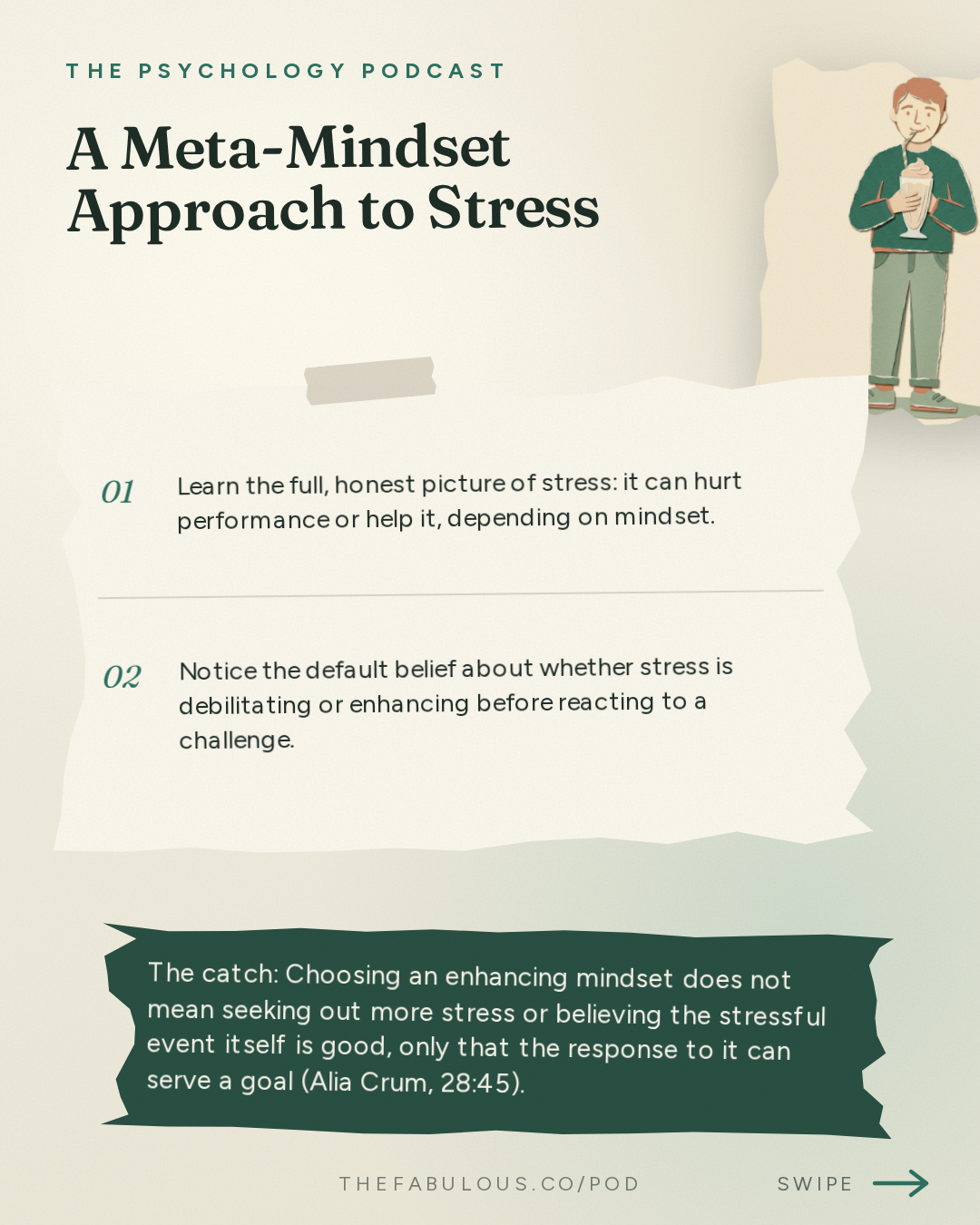
Crum draws a line here that a lot of pop psychology blurs. Believing stress is enhancing doesn't mean chasing more of it, and it doesn't mean the stressful event itself is good. Borrowing a concept associated with psychologist Peter Salovey's circle, she distinguishes clean discomfort, the raw stress or fear itself, from dirty discomfort, the layer of judgment piled on top, the guilt or panic about feeling stressed at all (26:33). The aim isn't to erase the first layer. It's to stop manufacturing the second one.
"Stress is the experience or anticipation of encountering challenges in your goal-related efforts." (Alia Crum, 27:52)
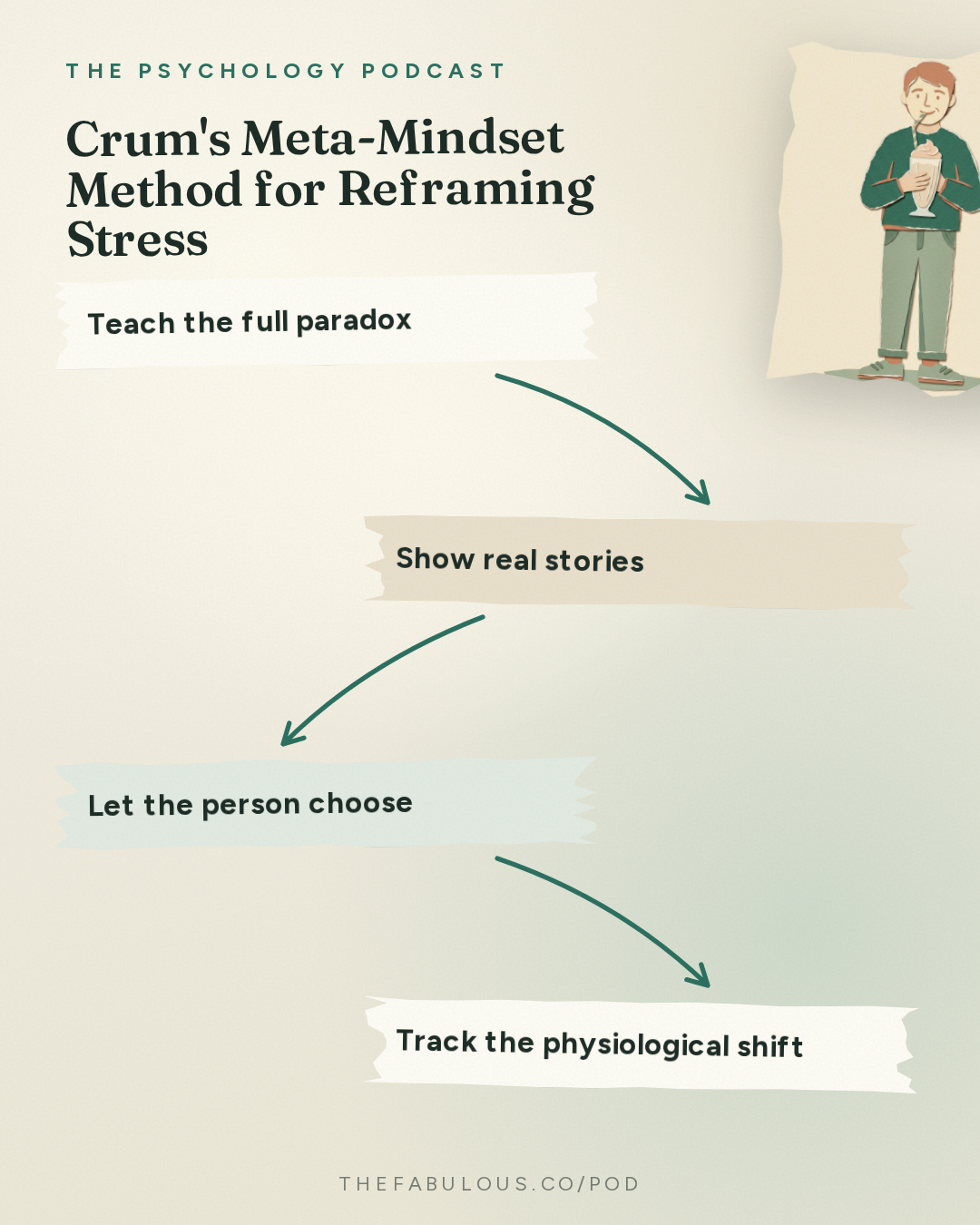
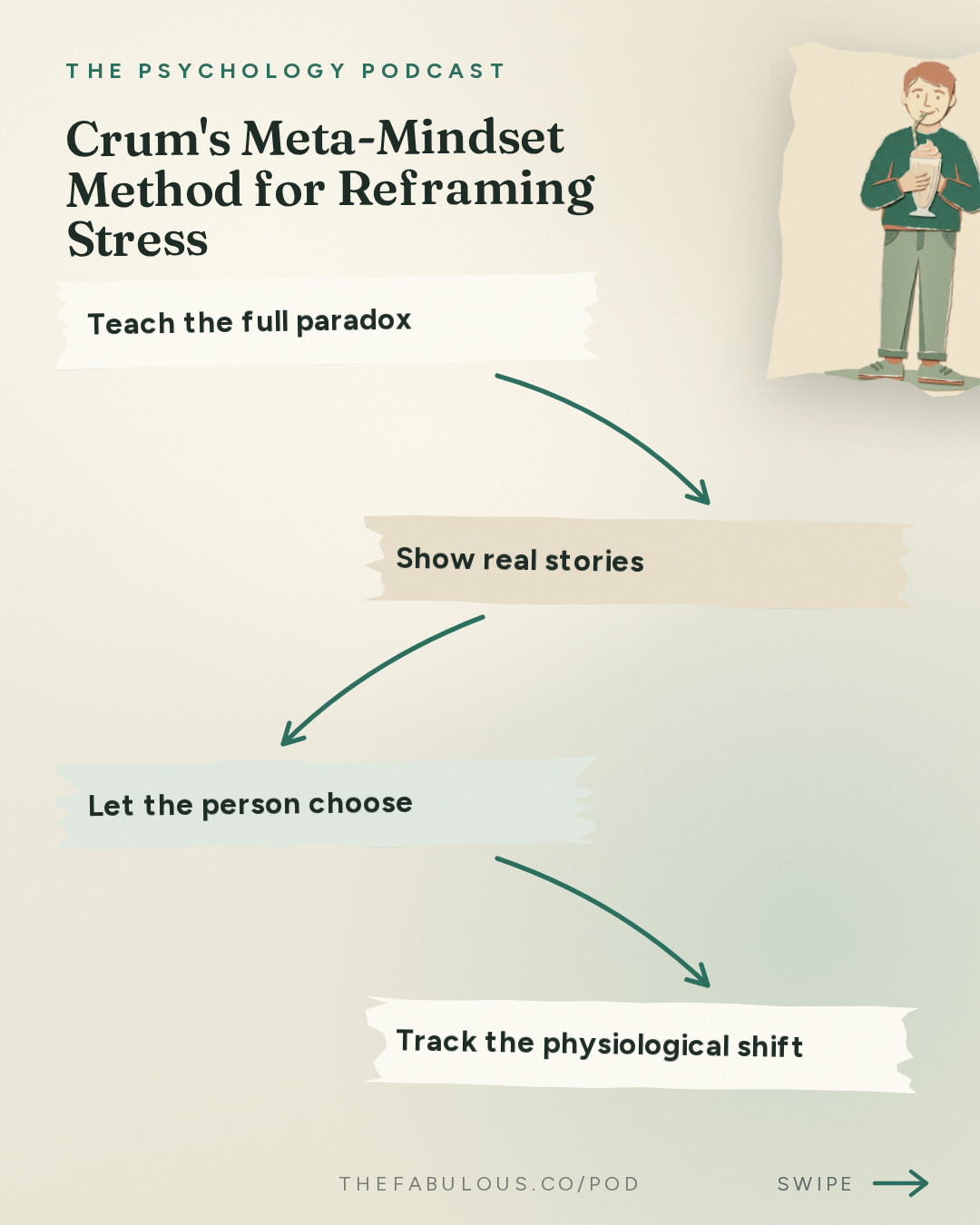
That definition matters because it explains why stress can't and shouldn't be eliminated: it only shows up around things a person actually cares about. No one gets stressed about a stranger's failing grade. The useful move isn't avoidance, it's choosing, deliberately, to treat the stress response as an ally. Crum calls this a metacognitive or meta-mindset approach: instead of telling people the enhancing mindset is simply the true one, her interventions show the full paradox, that stress can wound or strengthen, and let people choose the enhancing frame because it's useful, not because it's forced on them (32:49).
The same design shows up in Crum's work with cancer patients. People diagnosed with cancer tend to hold one of three mindsets: the diagnosis as catastrophe, as something manageable, or as an opportunity for growth (36:39). Strikingly, which mindset a person holds has almost no relationship with how severe their cancer actually is (38:21). Someone with stage four disease may see opportunity, while someone with an early, treatable case may feel their life is over. Crum's team built a documentary-style digital intervention, roughly an hour of survivors describing how shifting their mindset changed their experience, and found it improved patients' health-related quality of life, meaning day-to-day functioning, mood, and symptom management (35:44). Accepting the diagnosis has to come first, and from there a person might choose to fight hard or, as Kaufman notes of one widely covered case, choose to stop fighting and spend remaining time differently. Crum treats both as legitimate outcomes of an honest mindset (41:21).
Genes Are Not Verdicts
The most unsettling study in the conversation involves genes rather than beliefs about the world. In a 2019 study, Crum's lab looked at CREB1, a gene linked to how efficiently the body uses oxygen during exercise; people carrying a particular version, or allele, of the gene were thought to tire faster and be more prone to weight gain (43:26). Researchers tested people's actual VO2 max, a measure of exercise capacity, then handed each participant a report on their genetic result a week later, before a second identical test. The catch: the report didn't always match reality. Some people with the protective gene were told they had the risk version, and vice versa (48:37). What predicted the second test's outcome wasn't the actual gene. It was what people were told. Those told they carried the risk allele converted oxygen to carbon dioxide less efficiently, regardless of true genotype (47:10), and also reported feeling hotter, more pain, and less motivation (47:40).
Crum connects this to genome-wide association studies, or GWAS, the large genetic surveys used to estimate risk for traits like intelligence or disease. Those studies currently explain only about 2 to 15% of the variance in outcomes such as intelligence or achievement (50:10), a modest number that a consumer genetics report can make feel like fate. Crum's CREB1 result suggests the report itself, not just the gene, can become part of the outcome. She and Kaufman both note the parallel to the Pygmalion effect, the classic finding that a teacher's expectation of a student can shape that student's performance regardless of the student's actual ability; a genetic label, they suggest, may work the same way on the body (51:43).
Crum ends on a wider claim, developed with University of Pennsylvania researcher Jer Clifton and published this year in The American Psychologist, that people also carry primal world beliefs, basic assumptions about whether the world itself is safe or dangerous, abundant or scarce (53:12). Where Carol Dweck's growth mindset concerns beliefs about intelligence, and Crum's own work concerns beliefs about stress, food, illness, and genes, Clifton's research asks what people believe about the one situation they never leave, the world itself. The claim reframes personality less as a fixed trait and more as a belief about a permanent situation (58:23), which returns the conversation to where it started. A mindset is not a fact about the world. It's a lens a person picks up, often without noticing, and Crum's career has been spent showing, hormone by hormone, cell by cell, that the lens changes what it sees.
Ask this episode anything
Pod's AI answers from the episode itself, with the minute mark so you can hear it yourself.
Or start with one of these
Ask this episode
Pod's AI listens to the whole episode to answer, and points you to the minute it comes from.
The rest of this answer, and any question after it
Answers come from the episode itself, never from a summary of it.
ContinueKey takeaways
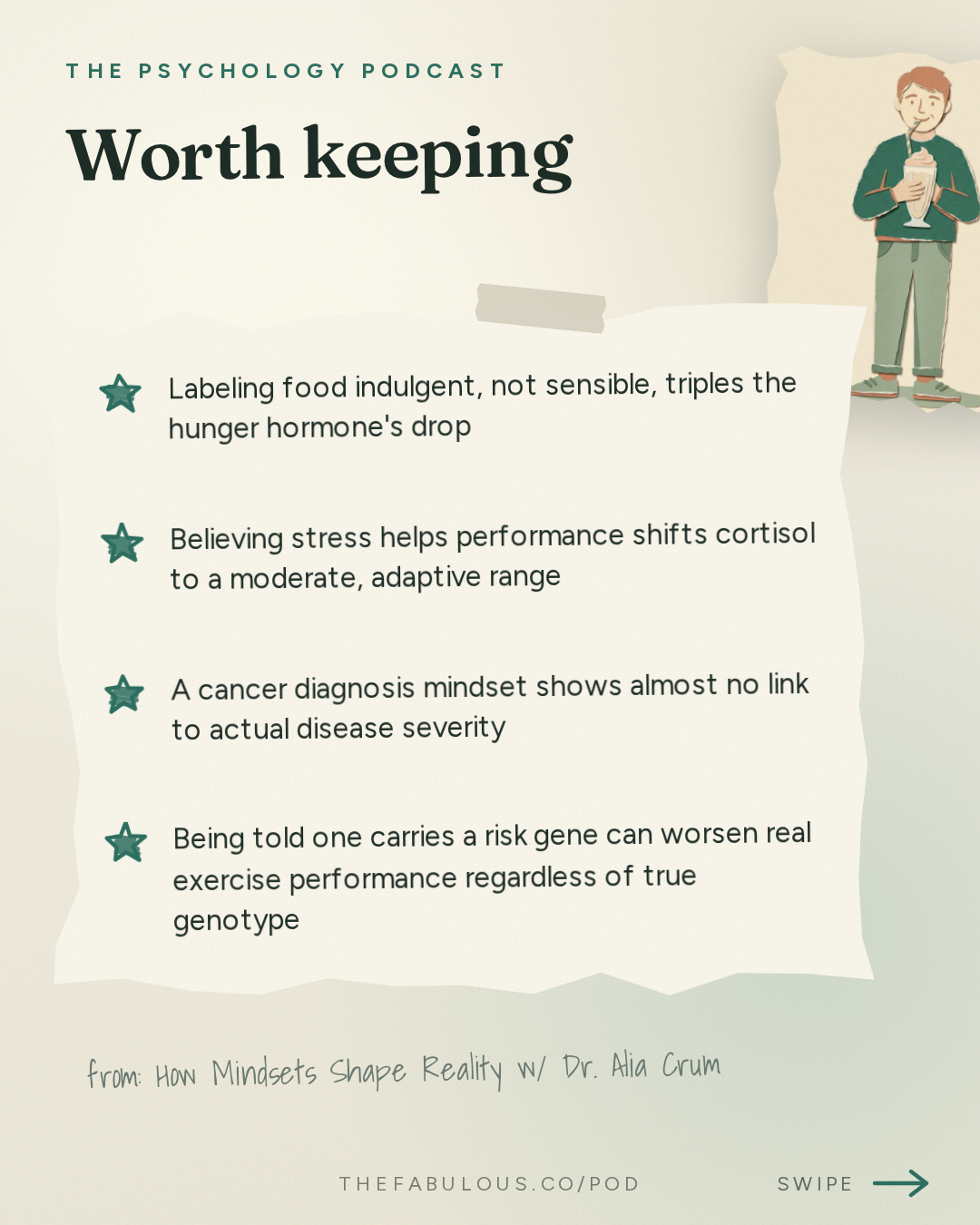
- Labeling food indulgent, not sensible, triples the hunger hormone's drop
- Believing stress helps performance shifts cortisol to a moderate, adaptive range
- A cancer diagnosis mindset shows almost no link to actual disease severity
- Being told one carries a risk gene can worsen real exercise performance regardless of true genotype
- Primal beliefs about world safety or abundance function like personality, per Penn's Jer Clifton
The episode in cards

By the numbers
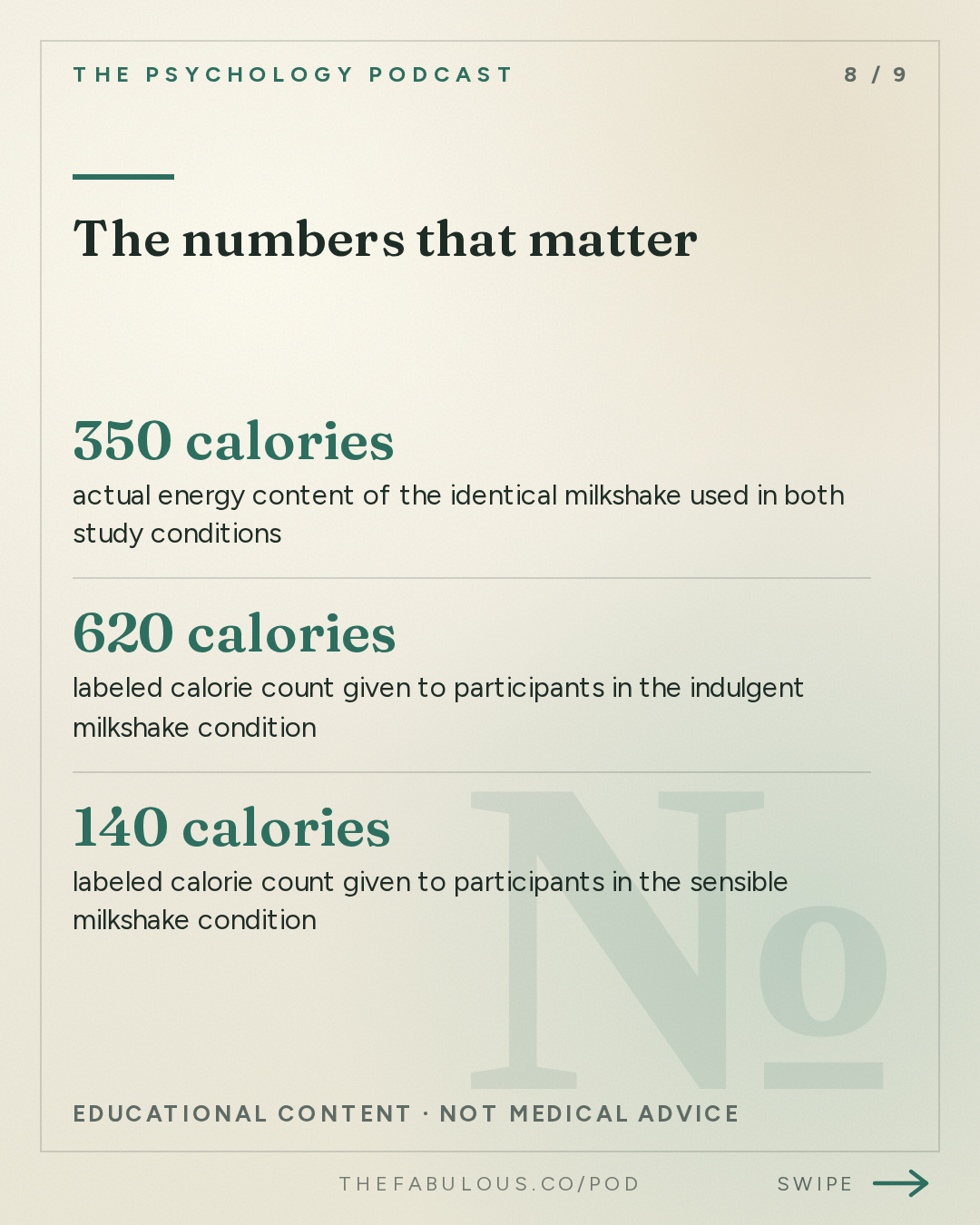
- 350 calories actual energy content of the identical milkshake used in both study conditions
- 620 calories labeled calorie count given to participants in the indulgent milkshake condition
- 140 calories labeled calorie count given to participants in the sensible milkshake condition
In their words
“When people thought they were consuming an indulgent shake, their body responded as if they had had more food.”
“The mindset of sensibility or restraint or scarcity actually counteracts the hard work that you might be doing actually reducing your caloric intake.”
“The body's stress response was not designed to kill us. Like, it was not designed to hold us back. It was designed to help us rise to the occasion to meet the demands we're faced with.”
“Stress is the experience or anticipation of encountering challenges in your goal-related efforts.”
Protocols
-
Reframe stress as enhancing before a challenge
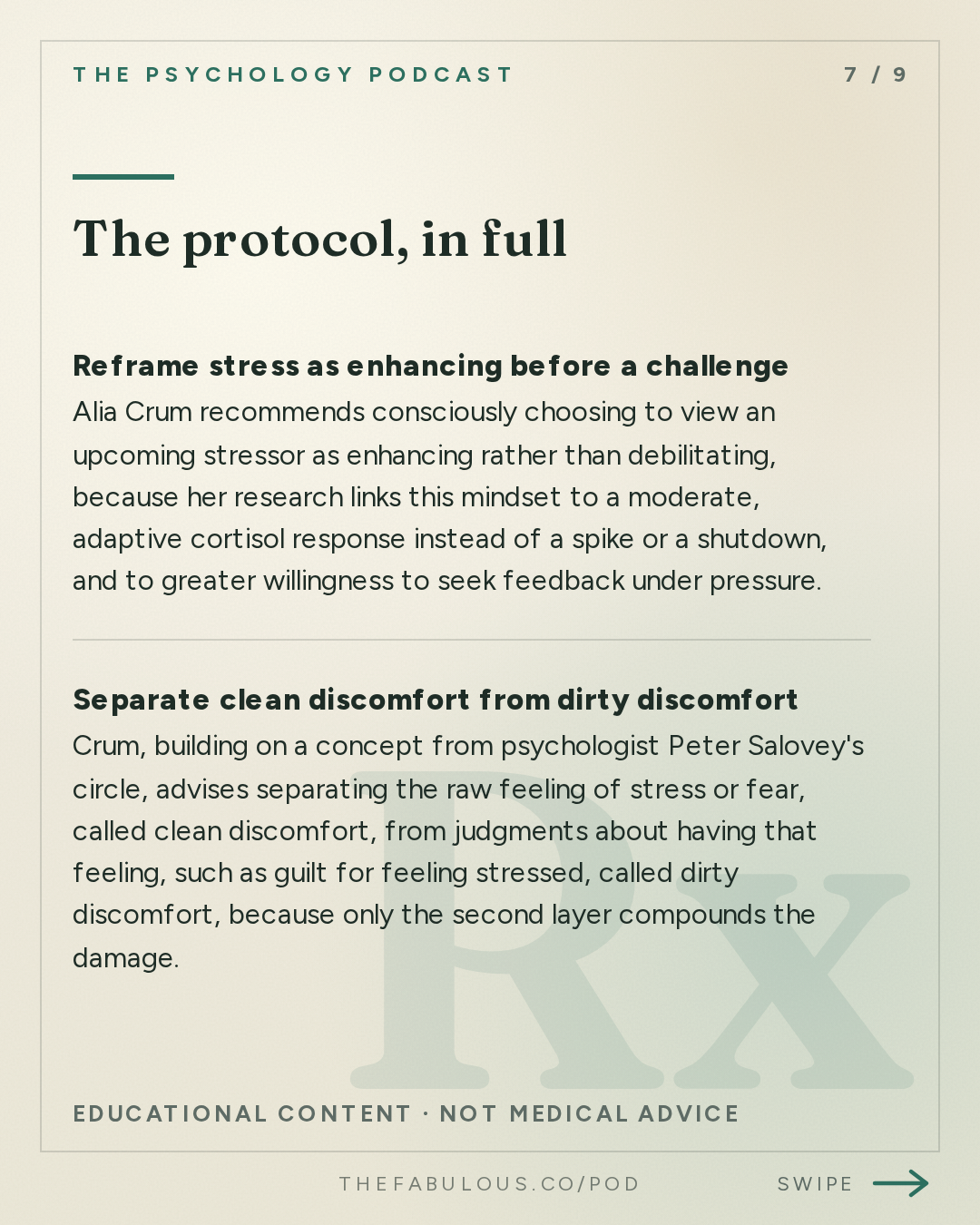
Alia Crum recommends consciously choosing to view an upcoming stressor as enhancing rather than debilitating, because her research links this mindset to a moderate, adaptive cortisol response instead of a spike or a shutdown, and to greater willingness to seek feedback under pressure.
Before or during any goal-related challenge
-
Separate clean discomfort from dirty discomfort
Crum, building on a concept from psychologist Peter Salovey's circle, advises separating the raw feeling of stress or fear, called clean discomfort, from judgments about having that feeling, such as guilt for feeling stressed, called dirty discomfort, because only the second layer compounds the damage.
Whenever a stressful feeling appears
Questions this episode answers
What is the Mind Over Milkshakes study?
It is a 2011 Yale study by psychologist Alia Crum in which participants drank an identical 350 calorie milkshake but were told it was either a 620 calorie indulgent shake or a 140 calorie sensible shake (12:02). The group told they were drinking the indulgent shake showed a drop in the hunger hormone ghrelin about three times larger than the group told they were drinking the sensible shake (12:37).
Is stress actually good for you?
Alia Crum's Stress Mindset Measure research finds that people who believe stress can enhance performance show a moderate, adaptive cortisol response, rather than an extreme spike or a total shutdown (24:54). Cortisol itself is linked to attention and engagement, not only harm, so the goal is a useful middle range, not eliminating stress (25:39).
Does believing you have a bad gene change your body?
In a 2019 study on the CREB1 gene, which is linked to exercise efficiency, Alia Crum's team told participants a randomly assigned genetic result that did not always match their real genotype. People told they carried the risk allele converted oxygen to carbon dioxide less efficiently on a real VO2 max test, regardless of their actual genetic risk (47:10).
What was the hotel housekeeper study about?
Alia Crum and Harvard psychologist Ellen Langer told hotel housekeepers that their daily work already exceeded the U.S. Surgeon General's exercise guidelines. Without changing their actual workload, the housekeepers showed measurable drops in weight, body fat, and blood pressure (08:03).
What is the Stress Mindset Measure?
It is a questionnaire developed by Alia Crum with Yale's Peter Salovey and researcher Shawn Achor that asks whether a person believes stress enhances health, learning, and performance, or depletes them (18:24). Most people score below the midpoint, believing stress is debilitating, except for groups like Navy SEALs, who consistently score on the enhancing side (20:18).
The full read, in cards
Go deeper
- Mind Over Milkshakes: Not Just Nutrients Determine Ghrelin Response — found that labeling an identical milkshake as indulgent produced a threefold larger ghrelin drop than labeling it sensible
- Rethinking Stress: The Role of Mindsets in Deterring the Stress Response — introduced the Stress Mindset Measure and showed UBS bankers' health and performance shifted after watching mindset-framing videos
- Learning One's Genetic Risk Changes Physiology Independent of Actual Genetic Risk — found people told they carried a low-efficiency exercise gene converted oxygen to carbon dioxide less efficiently regardless of true genotype
- Paper on primal world beliefs, The American Psychologist — argued that basic beliefs about whether the world is safe or dangerous function like a form of personality
Mentioned
Alia Crum · Scott Barry Kaufman · Tal Ben-Shahar · Ellen Langer · Peter Salovey · Carol Dweck · Jer Clifton · Hans Selye · Shawn Achor · Anne Harrington · Yale University · Stanford University · University of Pennsylvania · Navy SEALs · UBS · CREB1 · Stress Mindset Measure · GWAS · The American Psychologist
More from this show and category

Scott Barry Kaufman's 7 Lessons from 11 Years of Podcasting
Scott Barry Kaufman closes 11 years and 478 episodes of The Psychology Podcast with seven lessons on human potential, personality change, and creativity. He argues neuroticism is the easiest Big Five trait to shift and openness the hardest, and that lasting change comes from habits, not willpower (09:06, 15:22).

How Sleep Deprivation Affects Decisions
Sleep deprivation degrades ethical judgment and decision-making in novel situations, contributing to disasters from train crashes to BP's 2005 explosion. Chronic pain, meanwhile, is reshaped by fear, relationships, and mindset as much as by tissue damage, per sleep researcher Chris Barnes and pain psychologist Rachel Zoffness.

5 Skin Habits From a Mayo Clinic Dermatologist
Mayo Clinic dermatologist Saranya Wyles argues skin is a check engine light for the whole body, not a beauty scorecard, and shares five pillars (sleep, diet, movement, stress, topicals) that measurably change how skin ages, from barrier recovery after sleep to facial volume loss on GLP-1 drugs.
The One Skill That Makes People Like You More
Mel Robbins says empathy means understanding, not mind-reading, and everyone gets nine daily chances to practice it (07:19). She outlines four habits: asking instead of guessing, sending small gestures called pebbling, offering concrete help without being asked, and waving first, drawing on research from Harvard, Stanford, and the University of Toronto.
