
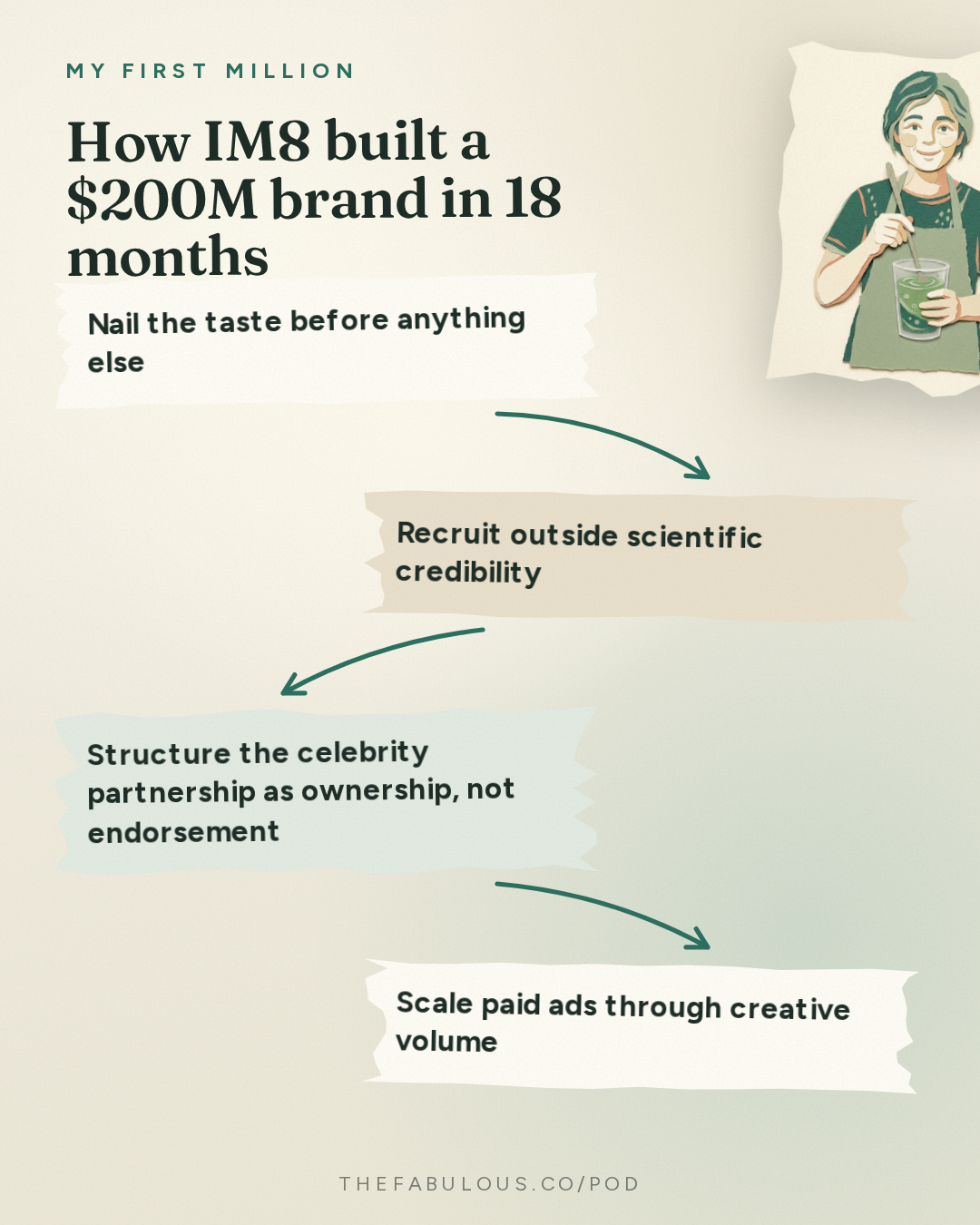
Danny Yeung on Scaling IM8 to $100M
How we scaled to $100M in under a year (ft. IM8 co-founder Danny Yeung)
The brief
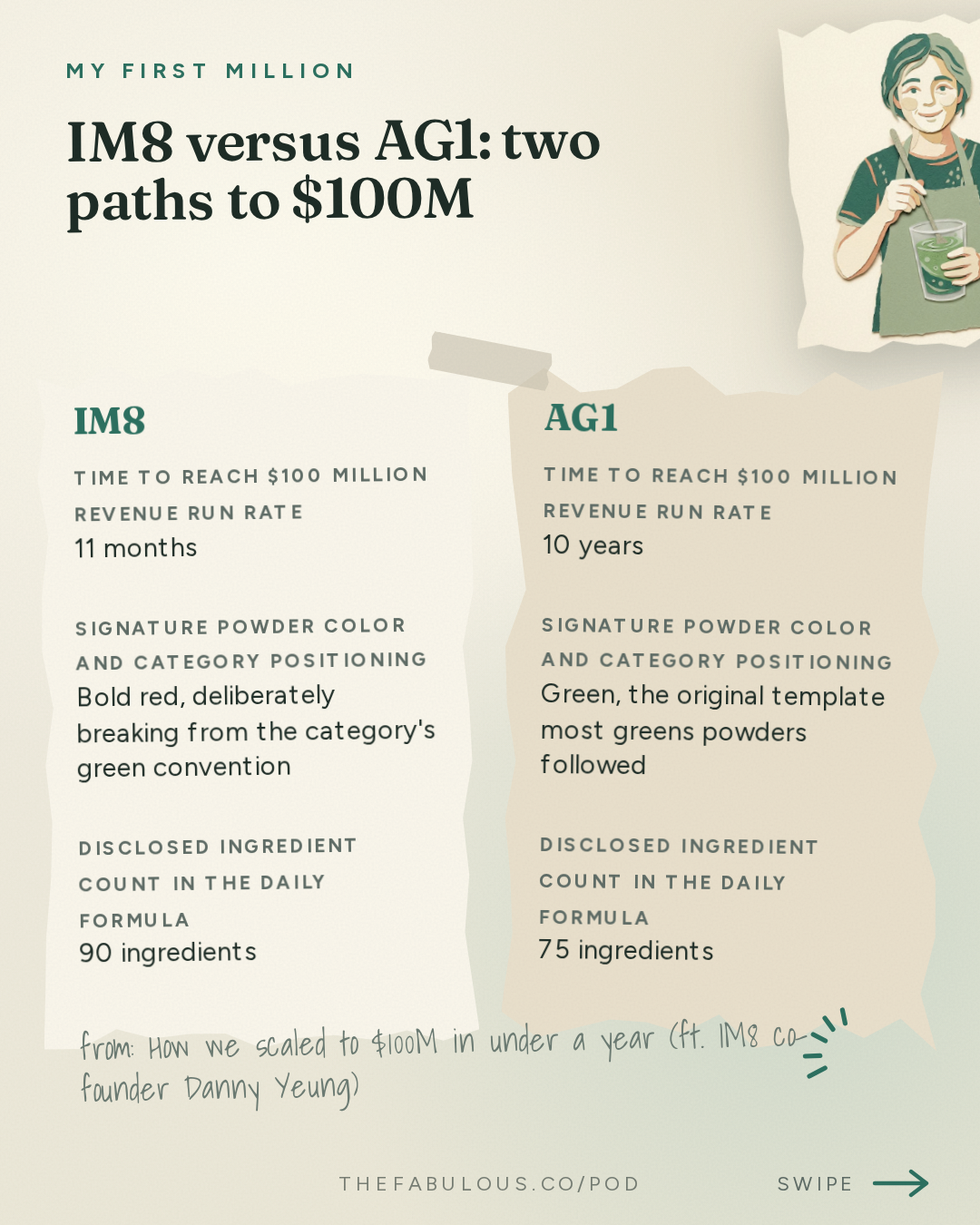
IM8, a supplement drink co-founded with David Beckham, hit a $100 million revenue run rate in 11 months, says co-founder Danny Yeung (00:00). AG1 took 10 years to reach the same mark (08:45). IM8 got there by pairing Beckham as a working co-founder, a scientific advisory board, heavy Meta ad testing, and 200 offline trust-building events.
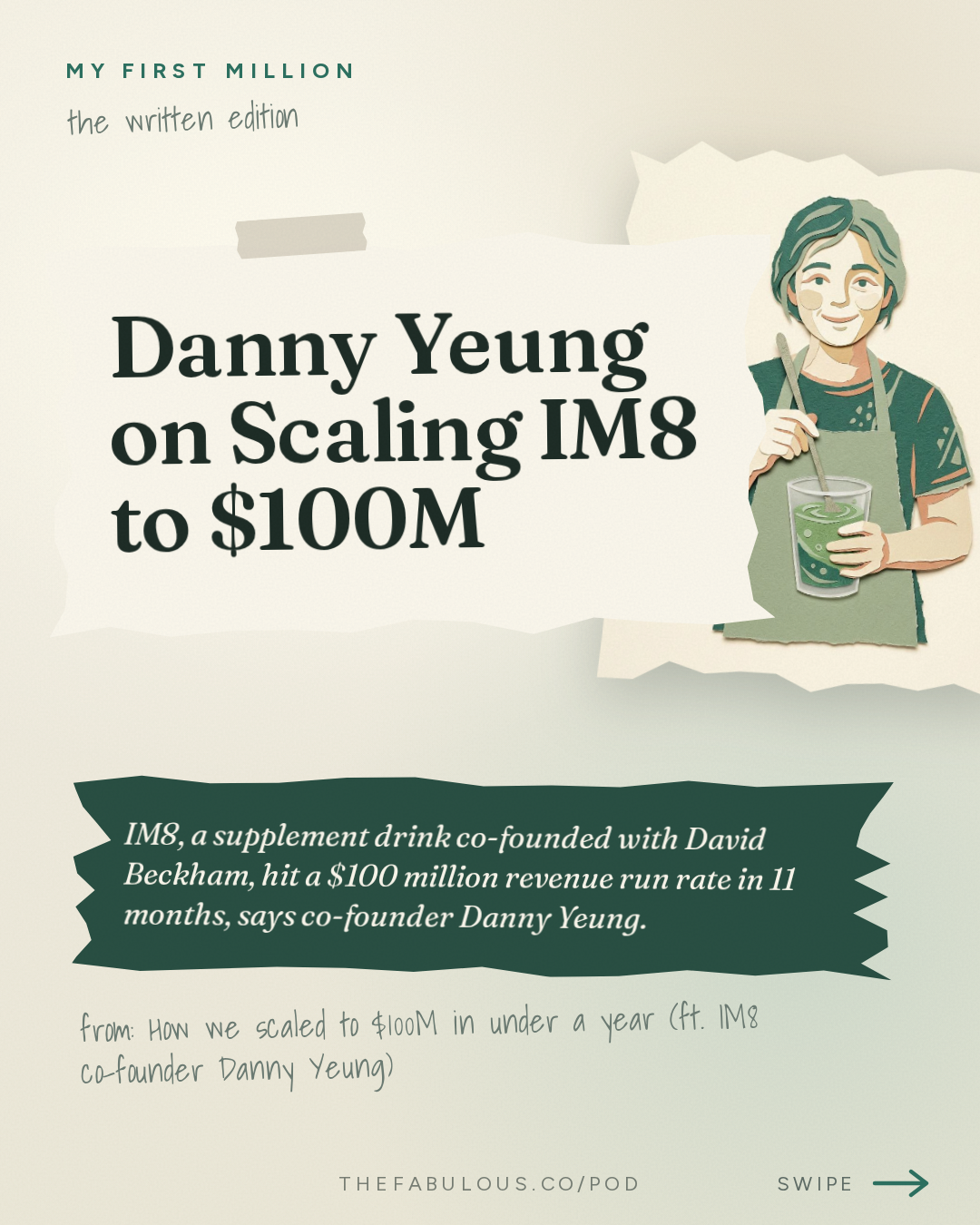
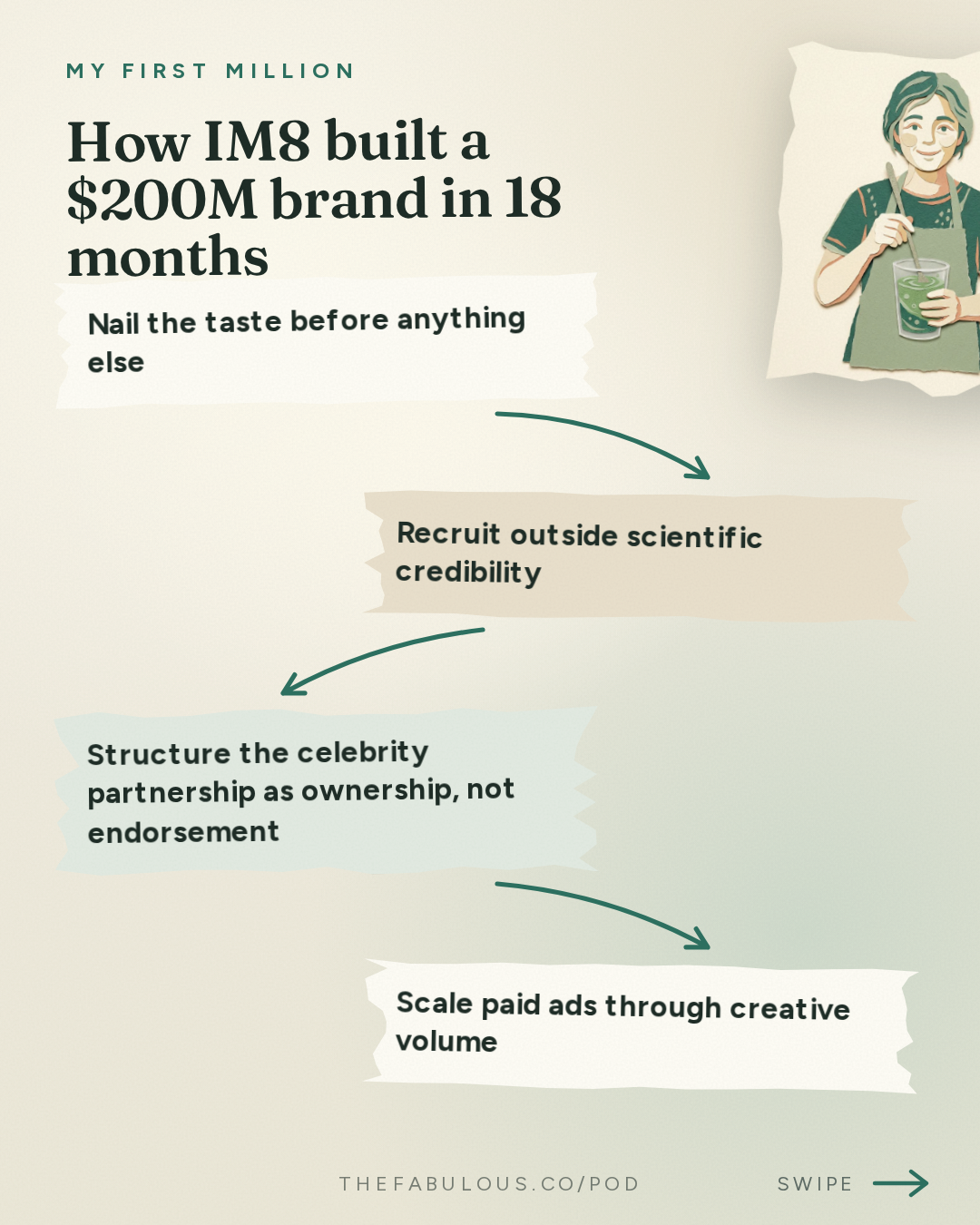
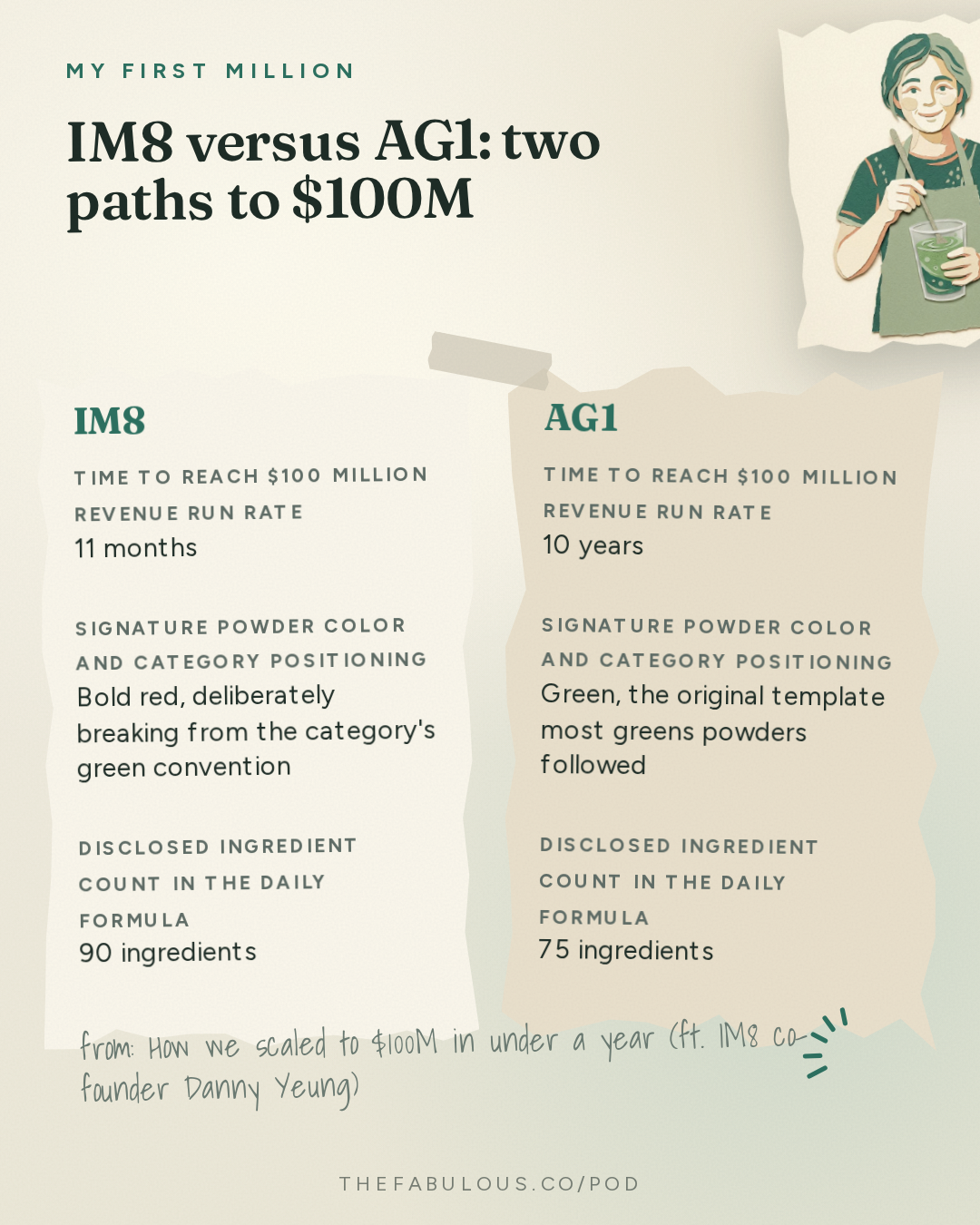
Ten years and eleven months are two ways of describing the same finish line. AG1, the greens powder that built the modern supplement-subscription category, needed a decade to reach a $100 million annual revenue run rate. IM8, a red powder launched in December of 2024, got there in eleven months, then doubled to a $200 million run rate within eighteen (08:32, 08:52). The gap between those two numbers is the subject of this conversation, and the man explaining it, Danny Yeung, has spent thirty years collecting the instincts that closed it.
Yeung's resume reads like a list of unrelated businesses: a teenage telemarketer selling timeshares in San Francisco, a restaurant owner at 24, a hotel-furniture importer who landed a $4 million contract with MGM's Las Vegas properties, and the founder of a Hong Kong group-buying site that Groupon eventually bought a majority stake in (00:35, 01:05, 08:35). Then came Prenetics, a DNA-testing company Yeung started in 2014, years before anyone outside a lab cared about genetic testing. When COVID arrived, Prenetics became Hong Kong's dominant PCR-testing provider, running as many as 40,000 tests a day and generating more than $700 million in revenue over three years (02:33, 02:50). Then the market corrected. Eighteen months after COVID, Prenetics' valuation fell from over a billion dollars to about $50 million, a 95 percent drop that Yeung says taught him who his real friends were (03:00, 03:25).
Out of that collapse came the idea for IM8. Yeung met David Beckham around the time he was already circling the supplement category, and the conversation that started it wasn't a pitch. Beckham and his wife Victoria, despite every resource available to them, found supplement routines overwhelming, especially while traveling with a dozen bottles and pills (05:44). Yeung saw an opening: a single daily sachet, mixed with water, that could replace the whole shelf. But he set one condition before Beckham signed on.
"I told David, if we do this together, I don't want you just as ambassador, I want you as a co-founder, but this brand has to live beyond you." - Danny Yeung [06:36]
That distinction, ambassador versus co-founder, is not cosmetic. Celebrity supplement brands fail more often than they succeed, according to Yeung's own board, which initially opposed the whole idea (11:40). A paid face can walk away or get canceled; a co-founder has equity, incentive, and reputational risk baked in from day one. Yeung says he told his board that if the bet was wrong, he would resign (11:16).
The product itself is almost aggressively simple: 90 ingredients, from multivitamins to CoQ10 to pre-, pro-, and postbiotics, compressed into one sachet meant to replace 16 separate supplements. It sells for $90 a month, against an estimated $250 to $300 for buying the equivalent pills individually (07:46, 08:08). Getting the formulation right was not a lab exercise alone. Yeung spent a week living inside the manufacturing factory, testing 20 to 30 flavor variations a day until the team found something people would actually want to drink again the next morning (12:15). The color, a deep red rather than the green that dominates the greens-powder category, came from beets in the formulation, and once the team saw it, they leaned in rather than correcting it toward category convention (12:52).
Building the trust that a red powder needs
A bold product needs bold proof behind it, because skepticism is the default reaction to any celebrity-adjacent supplement. Yeung's answer was to recruit a scientific advisory board with names that don't attach themselves lightly to consumer brands: Mayo Clinic physician Dr. Dawn Mussallem, former NASA chief scientist James Green, and Cedars-Sinai microbiome director Suzanne Devkota (14:40). IM8 ran a clinical trial before launch and submitted the product to third-party testing by both Eurofins and NSF Certification for Sport, the same standard used to confirm a product is free of banned substances for professional athletes (16:33, 16:52). That groundwork paid off in an unusual way: an email arrived from the team of Aryna Sabalenka, the world's top-ranked women's tennis player, saying she'd been using the product for three months on a coach's recommendation and wanted to partner (18:52). Every ambassador who followed, Yeung says, came to IM8 rather than the other way around (19:43).
The marketing engine underneath all of this runs on a different logic than it did even a few years ago. IM8 keeps 2,000 to 3,000 Meta ads live at any given time and tests 500 to 800 new creative assets every week (23:10). Yeung's explanation is blunt: ad buying itself has become a commodity, since Meta's algorithm now handles targeting automatically. The lever that still matters is creative diversity.
"You don't need to do the targeting, you don't need to do all this stuff. All you need to really figure out is how do you get really good creatives and really good creative diversity on the different personas, because now you need the creative to do the targeting." - Danny Yeung [23:41]
The numbers back up the claim in a way that should unsettle anyone who assumes more spend always means higher acquisition cost. In the first quarter, IM8's cost to acquire a customer (CAC) was $305, against an average order value of about $230 (25:15). In the second quarter, the company doubled its marketing spend from $17 million to $33 million, and CAC actually fell by four dollars, to $301 (25:27). By July, spending more than $10 million a month, CAC had dropped further to $239 (27:40). Yeung credits part of that to something distinctly analog: more than 200 in-person events, including seven in seven days around the US Open in New York, where customers meet the scientific advisory board face to face (25:47, 26:24). He doesn't have hard data proving the offline events are lowering CAC, he admits, but he's doubling down anyway, on the theory that in an age when nobody can tell what's AI-generated and what's real, a live human handing over a sample is worth more than it used to be (26:45, 27:45).
The arithmetic of rejection
Underneath the ad-spend numbers is a psychological discipline that Yeung traces back to being a fifteen-year-old telemarketer selling timeshares on the night shift, dialing 100 to 200 people a shift and hearing no from 90 to 95 percent of them (00:35, 31:10, 31:27). He describes the mindset simply: tell yourself the next call is more likely to land, and keep dialing. That same math shows up later in the episode from the host, recounting his uncle Vinnie, a door-to-door salesman who turned rejection into a spreadsheet problem. If a yes is worth $100 and it takes 20 nos to get there, then every no is worth $5, banked progress rather than failure.
"If a yes is worth $100 to me, and it's gonna take me 20 nos to get one yes, then every no is worth $5 to me." - Sean, host, recounting his uncle Vinnie [35:25]
Yeung's version of the same lesson shows up in a story about cold-calling a Hong Kong restaurant group during his group-buying days. A marketing director hung up on him and cursed him out. Rather than quit, Yeung found the man's boss, called the front desk, and got a meeting the next day. The owner, impressed that Yeung hadn't backed off after being insulted, signed all 30 of his restaurants on the spot, filling Yeung's entire next month of deals with a single yes (32:45, 34:09).
The conversation closes on a tension Yeung says every founder has to hold at once: the need to be delusional enough to act on conviction with no evidence, and realistic enough to cut fast when the evidence turns against them. He points to letting go of 2,000 employees the moment he sensed COVID testing demand was ending, a decision that protected Prenetics while at-home testing companies like Cue Health and Lucira, both once billion-dollar-plus public companies, went bankrupt within eighteen months by overbuilding manufacturing capacity that never found a post-pandemic market (44:45, 45:04). Being a founder rather than a hired CEO, Yeung argues, is precisely the willingness to take that kind of risk, in both directions, without a board's permission (48:07).
Ask this episode anything
Pod's AI answers from the episode itself, with the minute mark so you can hear it yourself.
Or start with one of these
Ask this episode
Pod's AI listens to the whole episode to answer, and points you to the minute it comes from.
The rest of this answer, and any question after it
Answers come from the episode itself, never from a summary of it.
ContinueKey takeaways
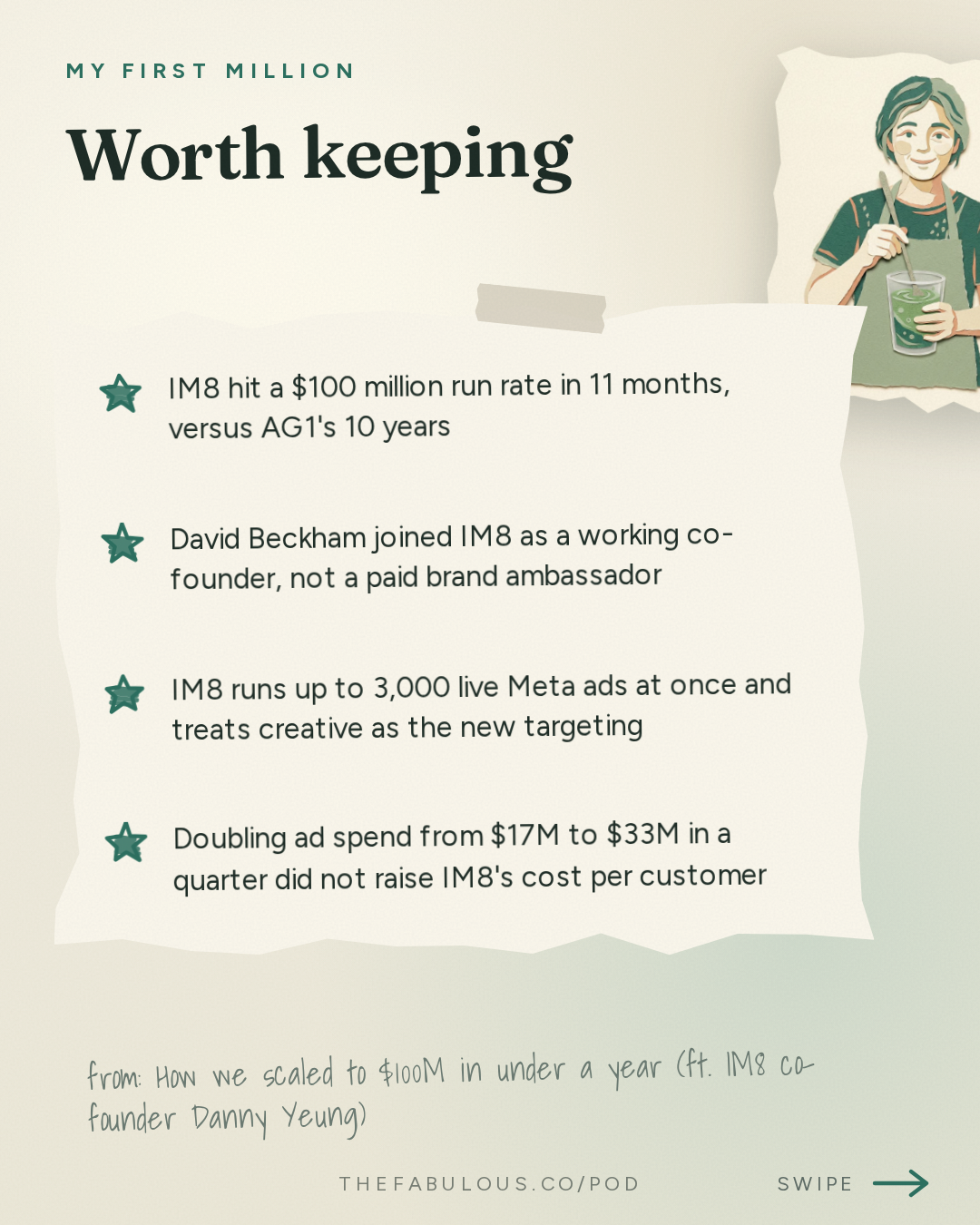
- IM8 hit a $100 million run rate in 11 months, versus AG1's 10 years (00:00, 08:45)
- David Beckham joined IM8 as a working co-founder, not a paid brand ambassador (06:36)
- IM8 runs up to 3,000 live Meta ads at once and treats creative as the new targeting (23:10)
- Doubling ad spend from $17M to $33M in a quarter did not raise IM8's cost per customer (25:27)
- Danny Yeung says founders must alternate between delusional conviction and hard realism (52:09)
The episode in cards
By the numbers
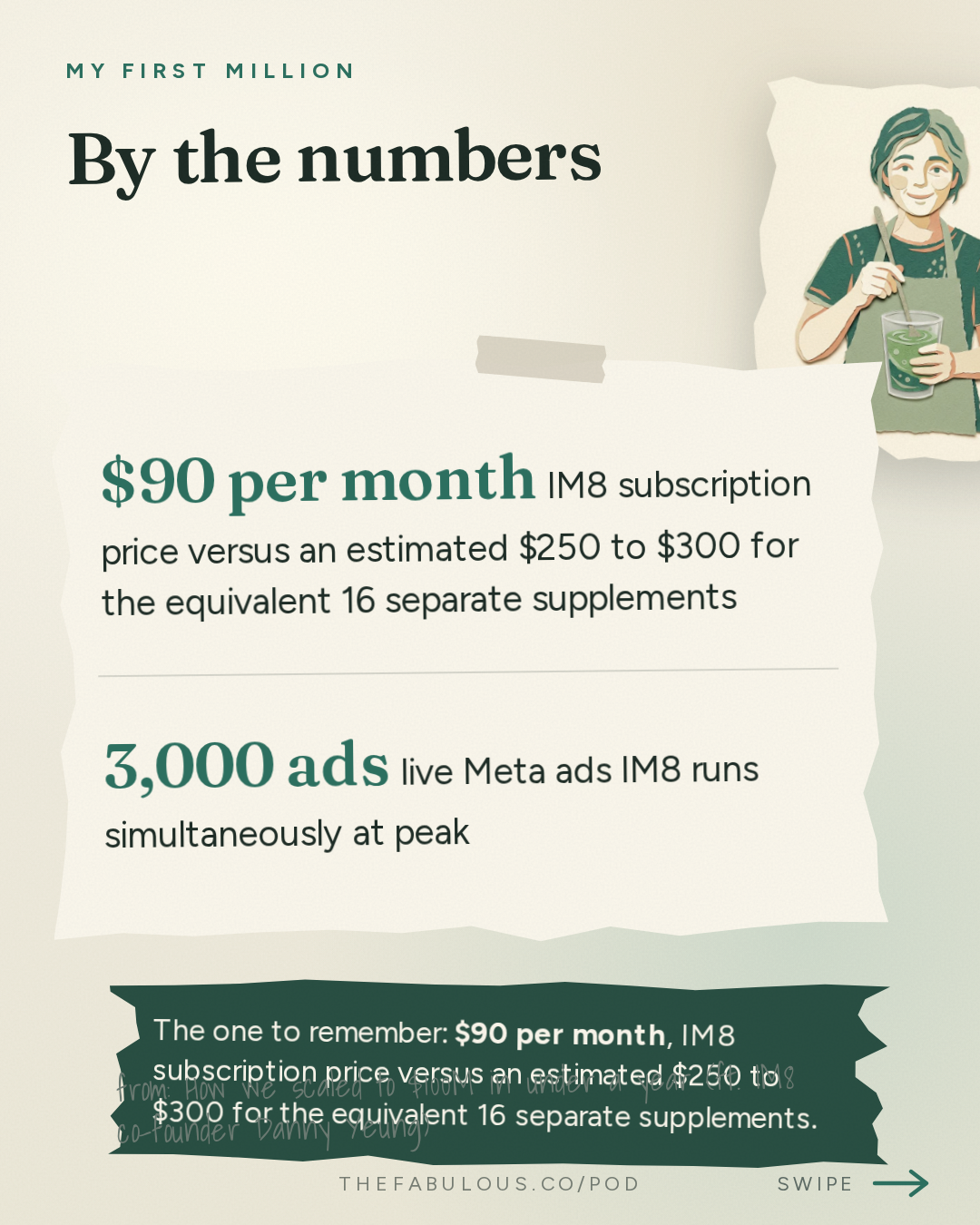
- $90 per month IM8 subscription price versus an estimated $250 to $300 for the equivalent 16 separate supplements
- 3,000 ads live Meta ads IM8 runs simultaneously at peak
In their words
“You don't need to do the targeting. You don't need to do all this stuff, right? All you need to really figure out is how do you get really good creatives and really good creative diversity on the different personas, because now you need the creative to do the targeting”
“If a yes is worth $100 to me, and it's gonna take me, you know, for every 20 nos, I get one yes-" Mm-hmm. Then he's like, "Then every no is”
Protocols
-
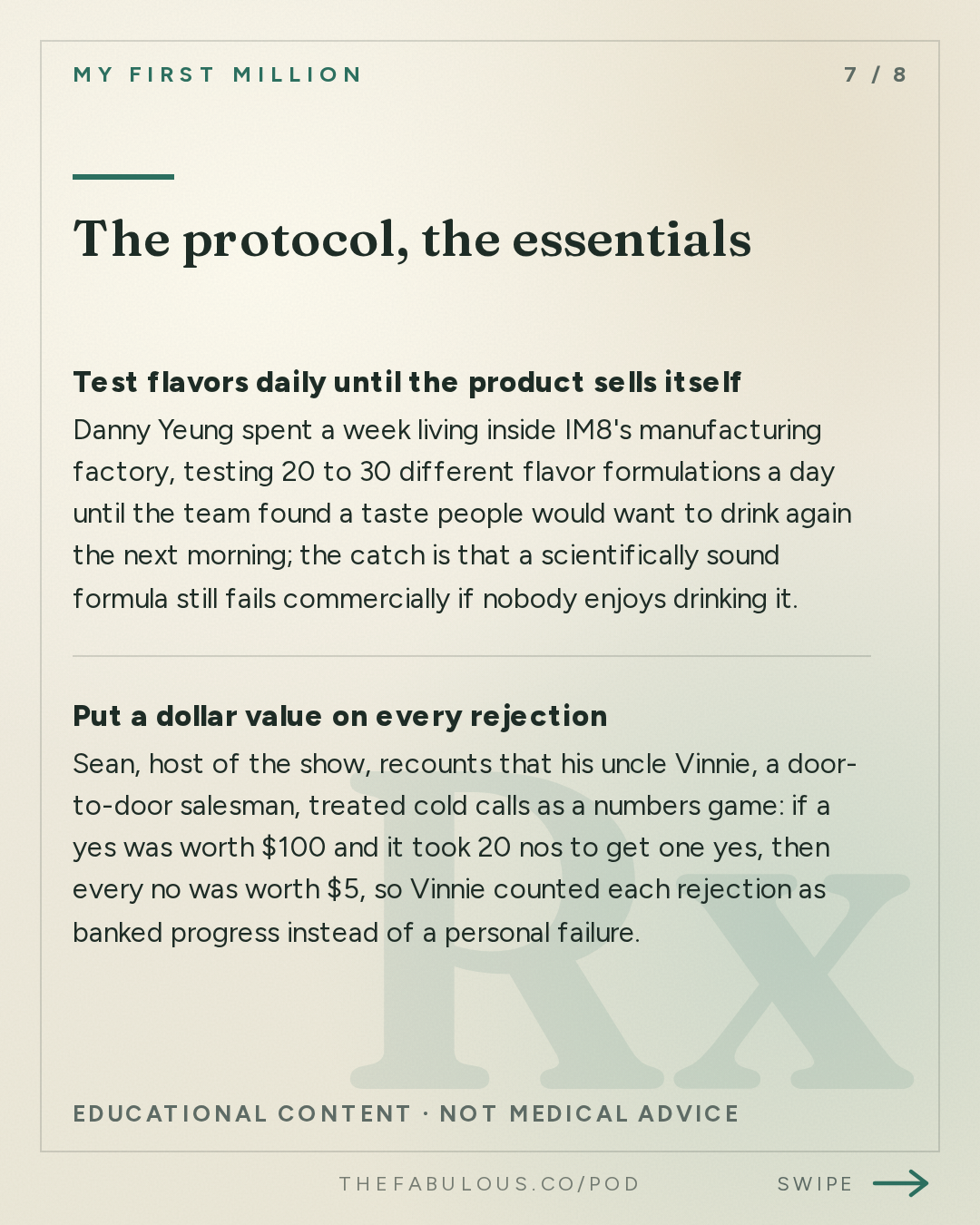
Test flavors daily until the product sells itself
Danny Yeung spent a week living inside IM8's manufacturing factory, testing 20 to 30 different flavor formulations a day until the team found a taste people would want to drink again the next morning; the catch is that a scientifically sound formula still fails commercially if nobody enjoys drinking it.
daily for one week during product development
-
Put a dollar value on every rejection
Sean, host of the show, recounts that his uncle Vinnie, a door-to-door salesman, treated cold calls as a numbers game: if a yes was worth $100 and it took 20 nos to get one yes, then every no was worth $5, so Vinnie counted each rejection as banked progress instead of a personal failure.
applied to every sales call or pitch
-
Retire ad creative before it goes stale
Danny Yeung's team tracks a creative fatigue score across IM8's 2,000 to 3,000 live Meta ads so they can swap out a creative before its return on ad spend drops, drawing fresh content from more than 1,000 ambassadors and affiliates who post daily; the tradeoff is that this requires constant production, not a one-time campaign.
continuous, with 500 to 800 new creatives tested weekly
Questions this episode answers
How fast did IM8 reach $100 million in revenue?
IM8 hit a $100 million annual revenue run rate in 11 months, according to co-founder Danny Yeung, compared with the 10 years it took the rival greens brand AG1 to reach the same number (00:00, 08:45).
What is in the IM8 supplement?
IM8's daily sachet contains 90 ingredients, including multivitamins, CoQ10, and pre-, pro-, and postbiotics, and is meant to replace 16 separate supplements a person would otherwise buy. It costs $90 a month versus an estimated $250 to $300 for the equivalent pills, says Danny Yeung (07:46, 08:08).
Is David Beckham just a paid spokesperson for IM8?
No. Danny Yeung says he insisted Beckham join as a co-founder rather than a hired ambassador, so the brand would not depend entirely on Beckham's image, a structure Yeung says is rare among celebrity-backed supplement lines (06:36).
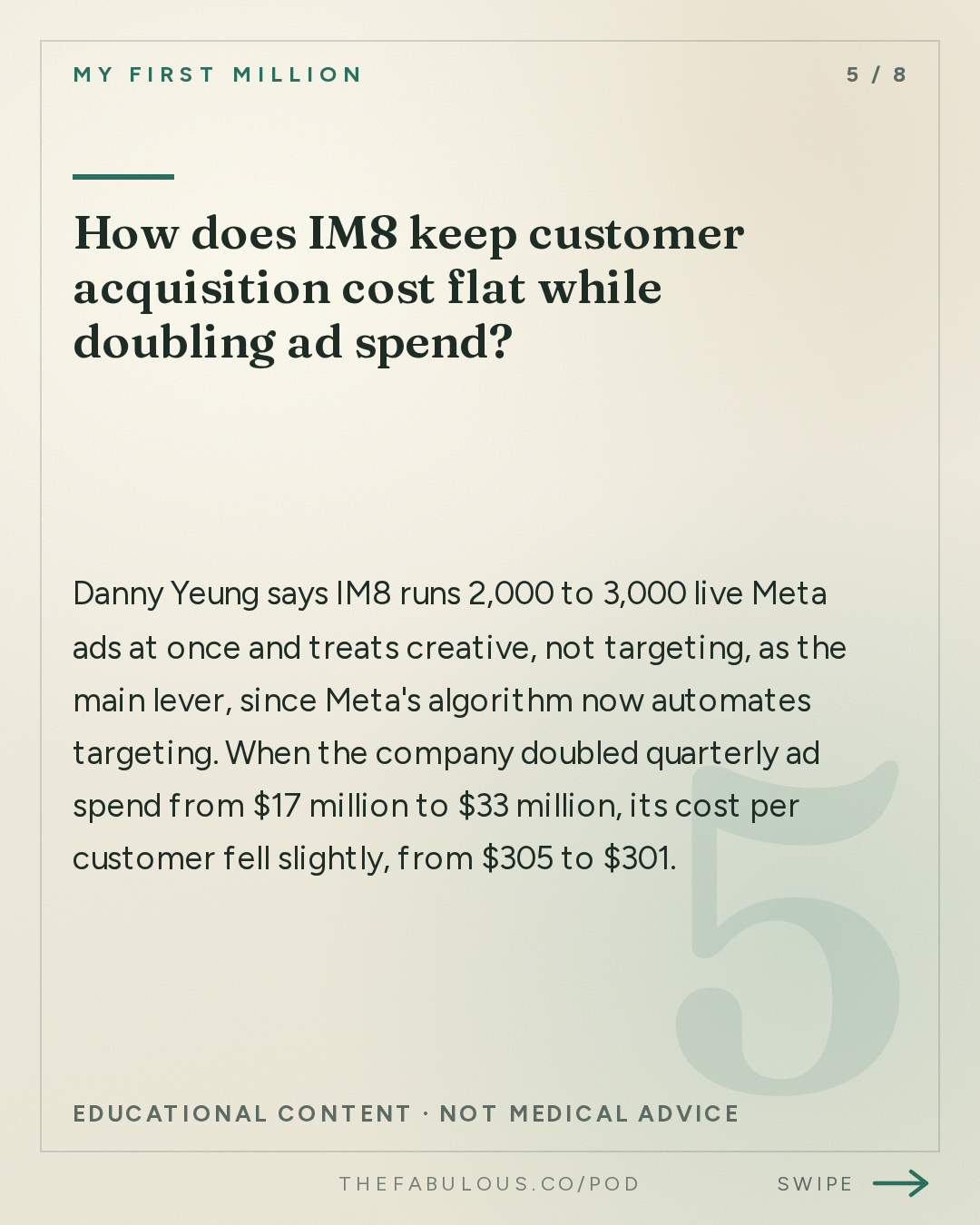
How does IM8 keep customer acquisition cost flat while doubling ad spend?
Danny Yeung says IM8 runs 2,000 to 3,000 live Meta ads at once and treats creative, not targeting, as the main lever, since Meta's algorithm now automates targeting. When the company doubled quarterly ad spend from $17 million to $33 million, its cost per customer fell slightly, from $305 to $301 (23:10, 25:27).
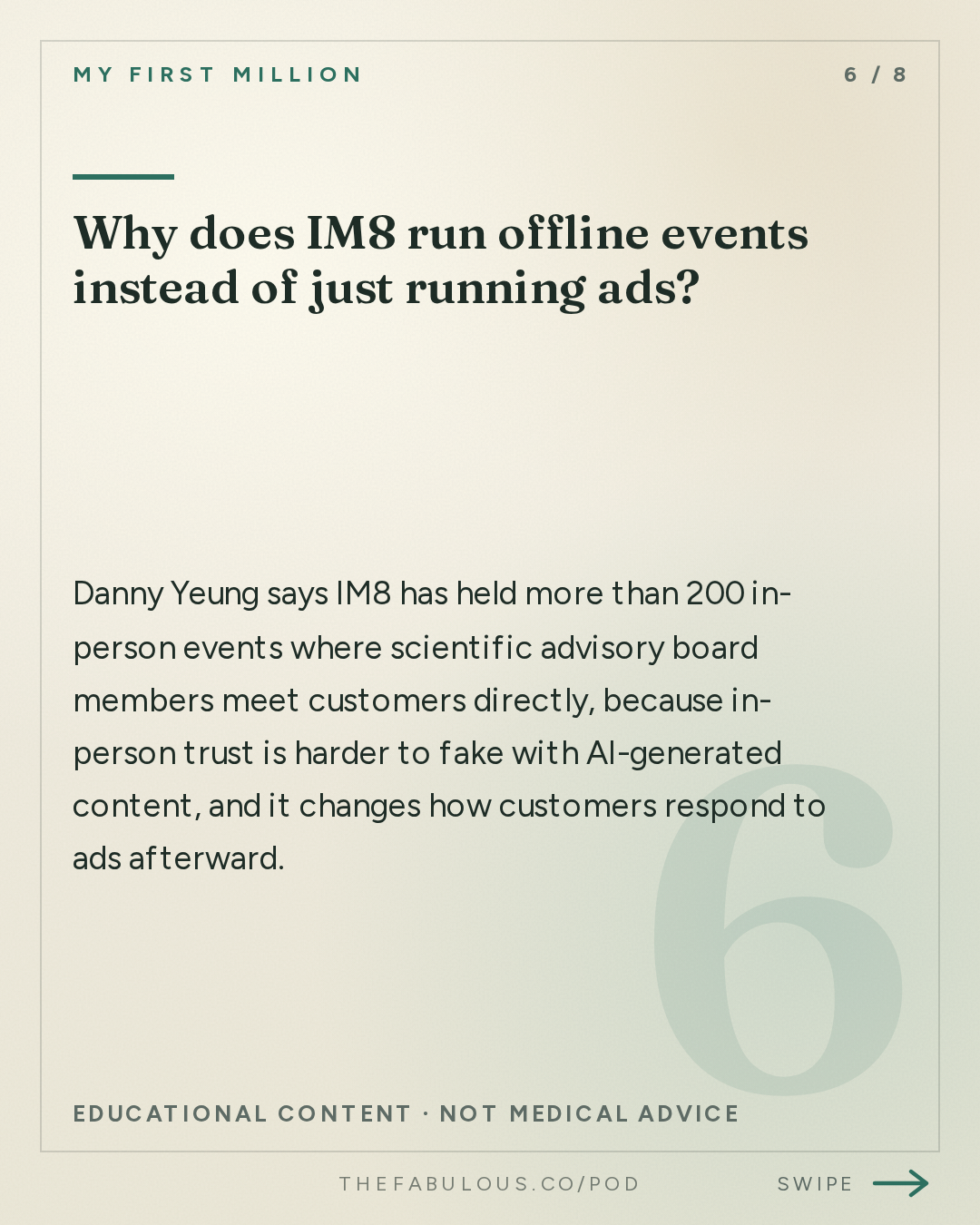
Why does IM8 run offline events instead of just running ads?
Danny Yeung says IM8 has held more than 200 in-person events where scientific advisory board members meet customers directly, because in-person trust is harder to fake with AI-generated content, and it changes how customers respond to ads afterward (25:47, 26:45).
What is IM8's scientific advisory board?
IM8 recruited outside experts, including Mayo Clinic physician Dr. Dawn Mussallem and former NASA chief scientist James Green, to help formulate the product and to oversee a clinical trial and third-party testing through Eurofins and NSF Certification for Sport before launch, according to Danny Yeung (14:56, 16:52).
The full read, in cards
Go deeper
- Founder Mode — Paul Graham's essay arguing founders should stay deeply involved in every part of the business rather than delegate like a hired CEO, referenced by Danny Yeung to explain why he stays hands-on at IM8
- NSF Certification for Sport and Eurofins third-party testing — independent testing IM8 used before launch to confirm the product is free of 280 banned substances for professional athletes
Mentioned
Danny Yeung · David Beckham · IM8 · Prenetics · AG1 · Dr. Dawn Mussallem · James Green · NASA · Mayo Clinic · Meta · Aryna Sabalenka · Paul Graham · Craig Clemens · Golden Hippo · Eric Ryan
More from this show and category
Low-Frequency Investing: The 2.9-Decision Portfolio
A retail investor who made only 2.9 decisions a year beat the S&P 500 in 11 of 11 years, averaging 21.8% annual returns versus 13.5%. The hosts run his brokerage history through the AI assistant Claude, then widen out to Jack Dorsey's 140-reason pre-mortem, Mark Zuckerberg's talent-density bet, Elon Musk's 24-hour rebuilding rule, and a four-step method called DARE for panic and fear.
The 6 Traits of Natural Money Makers
Sam Parr and Shaan Puri map the "natural money maker": unemotional, maximizing, and comfortable with complexity. They share entrepreneur Sayed Balkhi's "second derivative" rule (spend only investment returns, never income) and a 3% liquid-net-worth spending cap, plus six other wealth-building personality types like the Tank, the Trickster, and the Sniffer.
Shaan Puri's 3 Embarrassing Moments That Changed Him
Shaan Puri, host of My First Million, shares three embarrassing stories, including a 110 narcissism test score and a failed 250-page restaurant business plan. He explains how each moment taught him to stop chasing external validation, favor action over endless planning, and reinvent his identity by deciding who to become before he felt ready.
Jeff Harmon's Marketing Playbook Explained
Jeff Harmon built OraBrush, Poo-Pourri, Squatty Potty, and Angel Studios by spotting marketing glitches: cheap or ignored channels nobody else was using. He turned a 19-minute skippable ad into an $11 million crowdfund for The Chosen and grew Angel Studios into a $500 million business run by a 3 million-member guild that votes on every film.
