
Shaan Puri's 3 Embarrassing Moments That Changed Him
3 embarrassing moments that changed my life
The brief
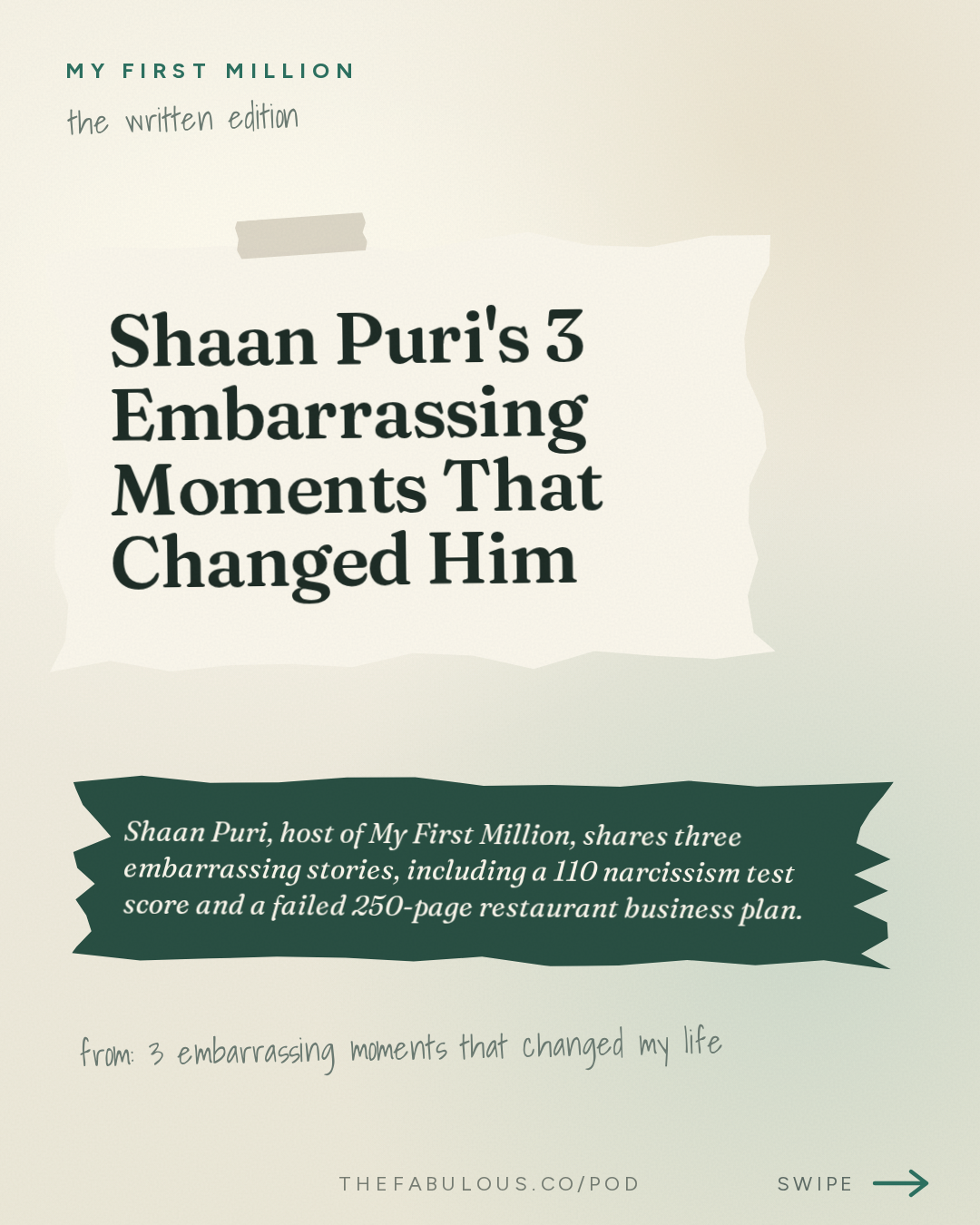
Shaan Puri, host of My First Million, shares three embarrassing stories, including a 110 narcissism test score and a failed 250-page restaurant business plan. He explains how each moment taught him to stop chasing external validation, favor action over endless planning, and reinvent his identity by deciding who to become before he felt ready.
A business coach pulls up a slide, and the host of My First Million, Shaan Puri, leans in to read it. Every category sits low except one, which spikes clean off the chart. The label says narcissism. Puri's score is 110, well into the narcissistic personality tendency range his coach measures on a scale most people never see (01:54). His first reaction isn't shame. It's pride. "That's right," he thinks. "I win" (02:01). That reflex, instant competitive pleasure at scoring high on a trait most people would hide, is the hinge of the episode's opening story, and it sets up the question Puri spends the hour chasing: when does believing you're special help, and when does it wreck you?
His coach's answer is worth keeping.
"What's served you can also screw you. The dose makes the poison." — Shaan Puri's coach [03:25]
The trait behind narcissism, the coach explains, is a conviction that ordinary rules and averages don't apply to you. Ninety percent of new businesses fail, he reminds Puri, and the narcissistic reflex is to assume you're the exception (03:25). That belief can push someone to start a company nobody else would attempt. It can also blind them to the odds they're actually facing.
What makes the trait dangerous, per the coach, is vagueness. A person can feel certain something about them is special without being able to say what it is. That fog sends people hunting for proof elsewhere, on social media, on a stage, in a room of thirty founders at a private event, where Puri admits he's felt a pang of insecurity even while everything around him is going well (04:30, 04:49). Outside validation, when it lands, produces a spike. When it doesn't, the low that follows runs deeper than ordinary disappointment (04:07). The fix isn't modesty. It's specificity: get clear on what's actually valuable about you so you stop waiting for someone else to confirm it (05:22). Paired with that insight is a smaller story about the same chapter: a call from Scott Harrison, founder of the nonprofit charity:water, the first the two had spoken in ten years. Harrison didn't want anything. He'd listened to the podcast and had one note: Puri says "like" roughly five hundred times an episode, and if podcasting is actually his craft, he should fix it (06:47). Puri's reaction mixes embarrassment with gratitude. Unprompted honesty, he notes, is rare enough that getting it feels like a gift even when it stings.
The 250-Page Trap
Jump to story two. Puri is 21, and he and two friends decide they will build the next Chipotle, except in sushi (08:08). None of them cook, none grew up eating the stuff, and pitch meetings go nowhere until one cold email lands: the founder of the fast-casual chain Noodles and Company agrees to lunch. For three months beforehand, the trio prepares. Their idea of preparation is a business plan, the kind with employee dress codes and promotion ladders, bound into roughly 250 pages (10:17). They slide it across the table expecting to impress. Instead they watch the founder flip through without reading, searching for a polite way to say nothing is there.
"I could see on his face he was trying to work out how to be nice to us, 'cause we were so hopeless that it was not rejection, it was pity." — Shaan Puri [11:59]
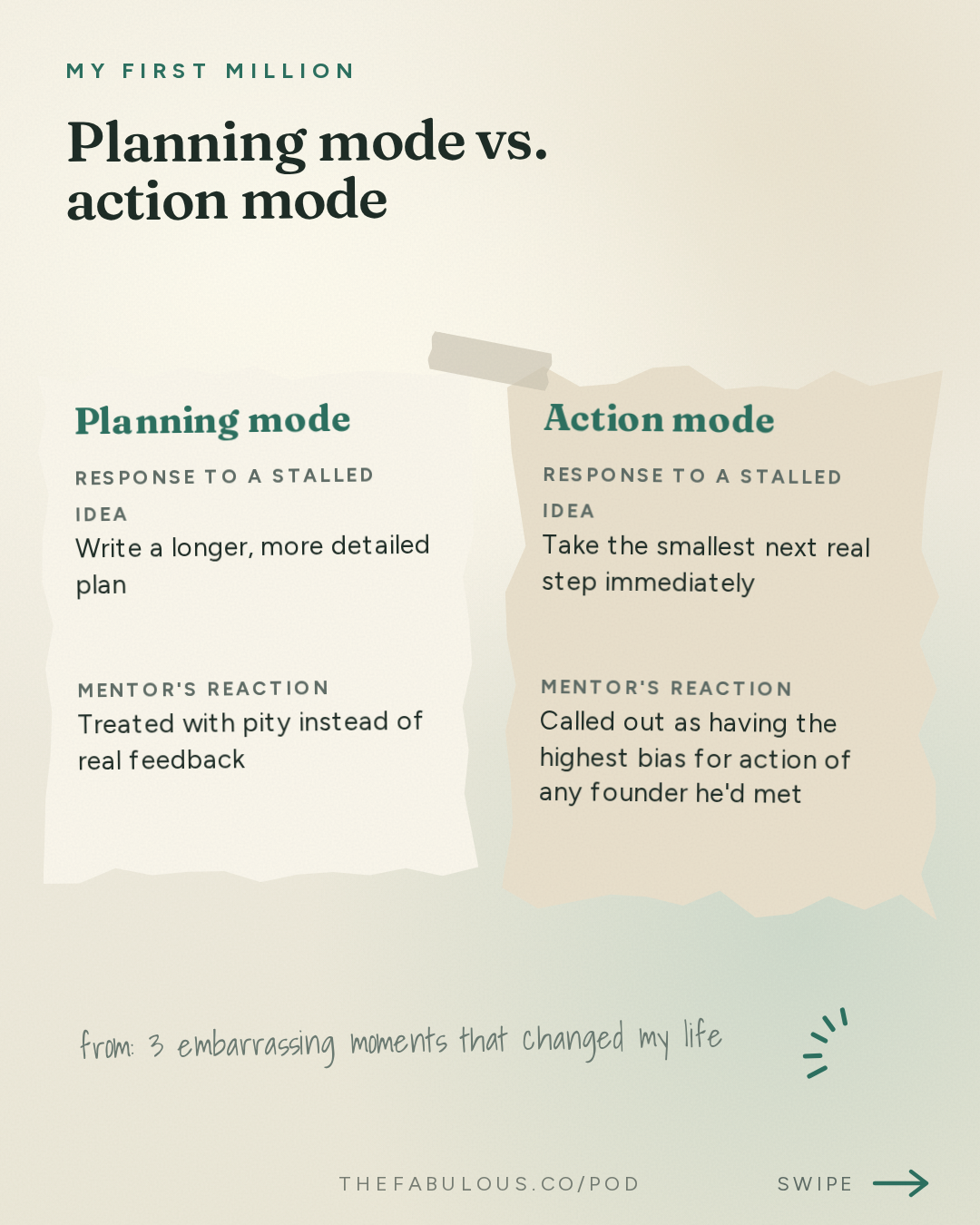
Pushed to be blunt, the founder gives it straight: starting a restaurant means finding a location, signing a lease, and opening the doors within 90 days, not writing a document nobody will read (12:24). Puri's diagnosis of himself, looking back, is sharper than the founder's was. Planning, he says, had become his particular flavor of procrastination, the version of hard work that felt safe because it avoided the actual, uncomfortable task of finding a lease and serving a customer (09:42).
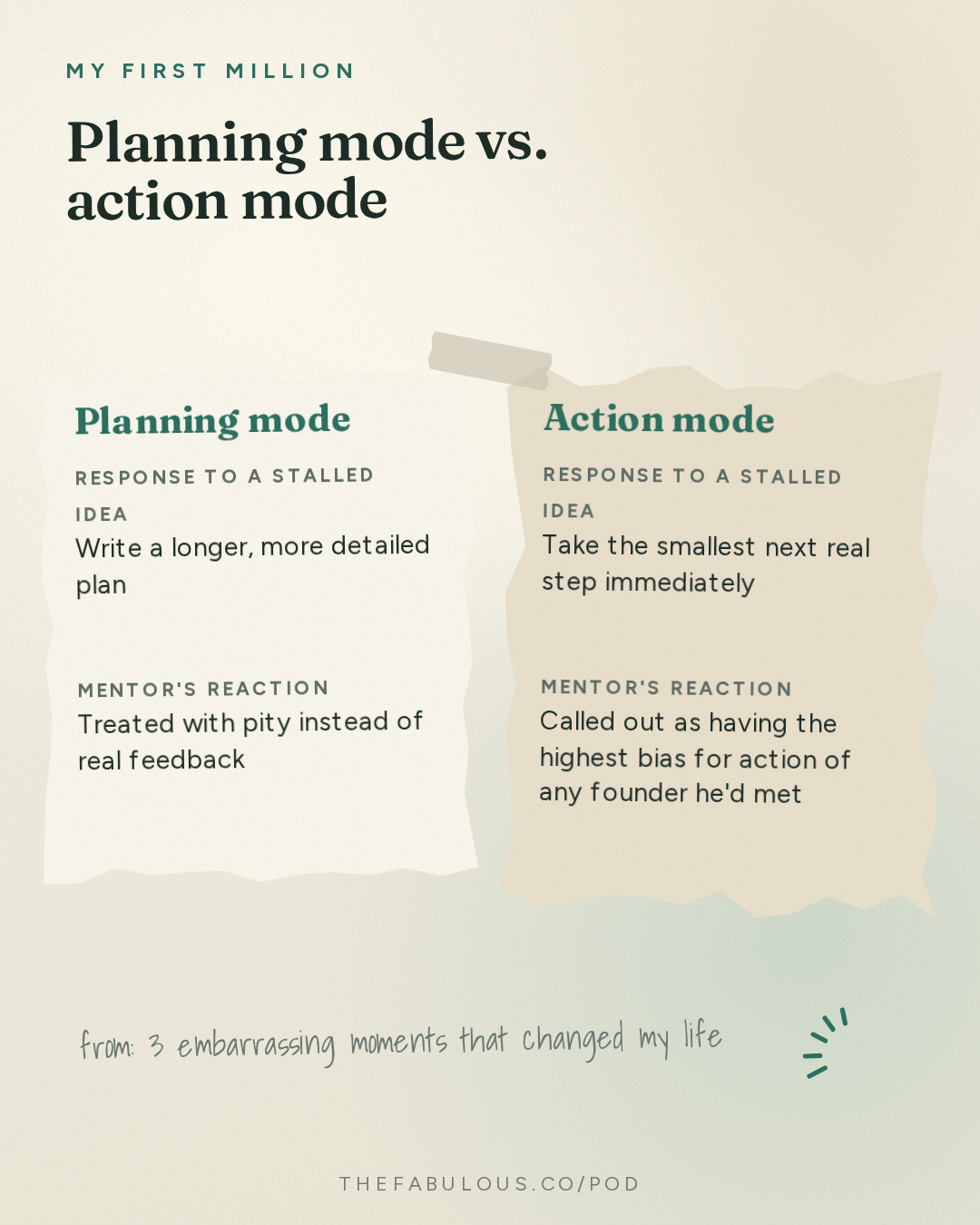
That night, defeated, the three watch an old Seinfeld episode in which George Costanza decides everything he's done his whole life has been wrong, so he'll now do the opposite. Asked for his usual chicken salad, he stops the waitress: what's the opposite of chicken salad, he wonders, and orders tuna on toast instead (14:18). He then approaches a woman he'd normally avoid and introduces himself with the embarrassing truth instead of a performance, and it works. Puri adopts the bit as a method: wherever the instinct is to plan more, do the opposite and act instead. A year later, he and his co-founders take advice from a new mentor and report back results within 48 hours (15:44). The mentor is startled enough to write publicly that he doesn't know if their idea is any good, but they have the highest bias for action of any founders he's met (16:01). The shift costs nothing but ego. What it buys, in this telling, is speed: the gap between an idea and a real test of it shrinks from months to two days.
Becoming Someone Else
Before any of this, back in high school in Houston, at 14 or 15 years old, Puri was, in his words, the laugh track of his own life, not a main character or even a sidekick, just background noise, as his older sister liked to tease (17:27). Shy enough that confessing a crush felt impossible, he wrote a love letter without naming the girl, left it by her locker, and watched her read it with polite confusion. Asked who it was for, he panicked and invented a fictional girlfriend at another school, then spent the next six months maintaining the lie rather than admitting the letter had been about her (18:38, 19:45).
The lie ended only because his family moved to China partway through tenth grade. On the flight, his sister, the same one who'd named him the laugh track, offered a reframe: nobody at the new school knew who he had been. He could just be somebody else. She asked him to name the coolest guy at his old school, the kind of easygoing, well-liked kid he'd admired from a distance, and told him he could simply decide to be that guy the moment he landed (20:25, 21:00).
"They don't know you're the laugh track. They don't know who you are, so you can just be a different guy." — Shaan Puri, quoting his sister [20:42]
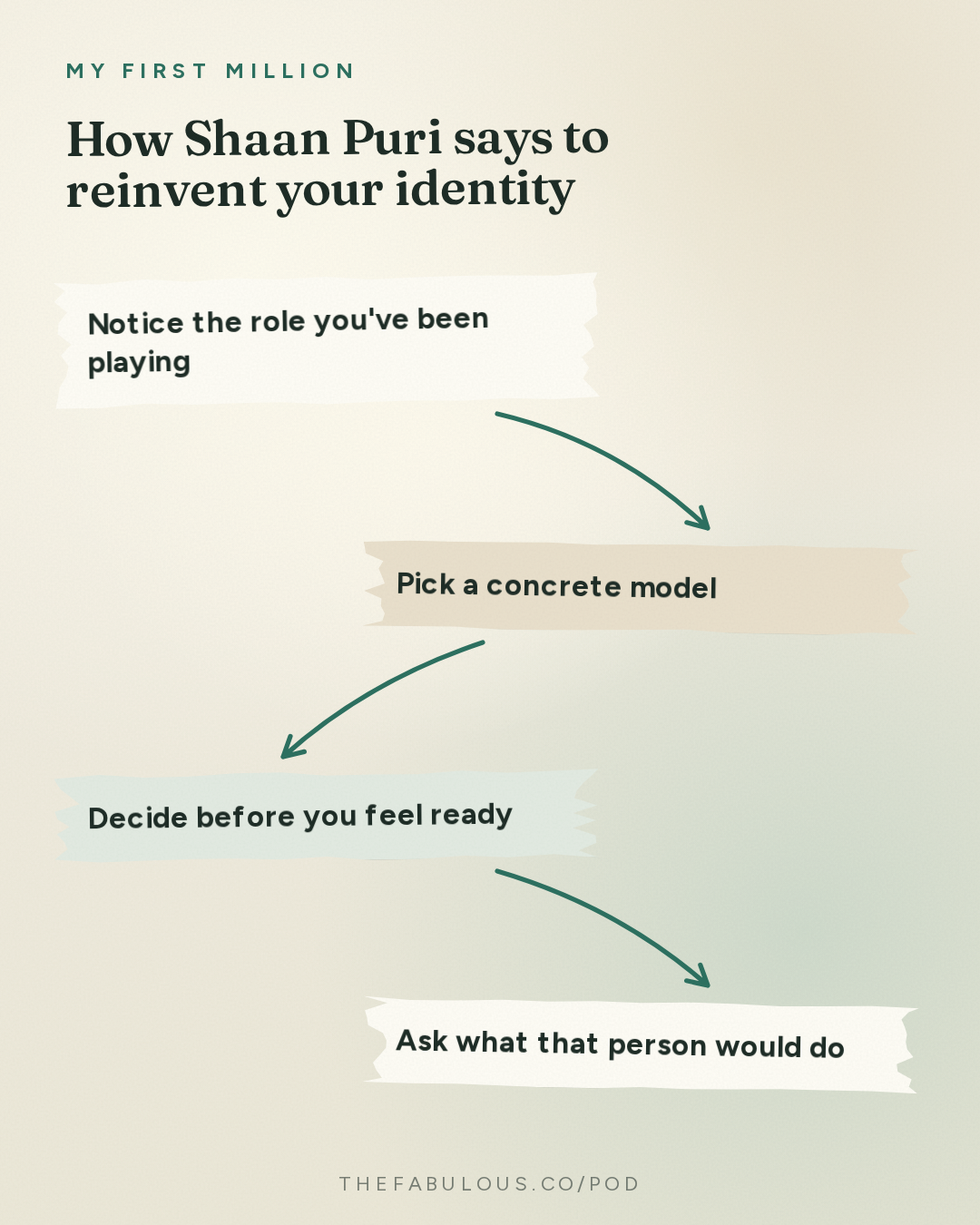
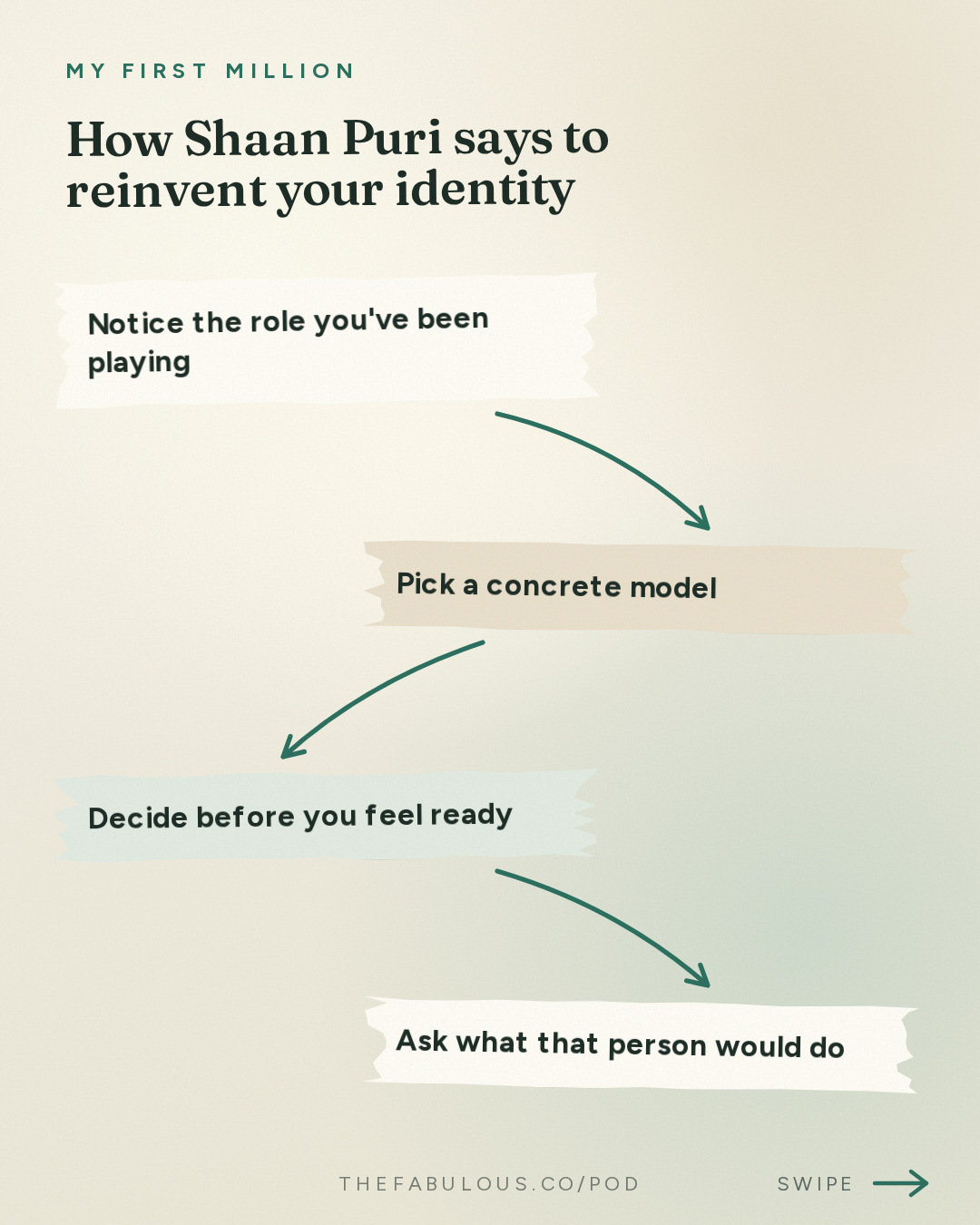
Puri frames the takeaway as a small operating principle: identity is a decision that sits upstream of every action that follows (21:20). He didn't need a script, only a standing question for each situation: what would that version of me do? He says he's repeated the move more than once, most recently when he stopped thinking of himself only as a tech entrepreneur and decided, with no track record to back it up yet, that he could be a version of podcaster Tim Ferriss, someone who says things entertaining and insightful enough that people come back. He booked a studio, called a friend, and recorded what became the first episode of My First Million (22:00, 22:18).
What connects a narcissism score, a pity-filled lunch meeting, and a lie about a fake girlfriend isn't the sting itself. It's what each one forced him to look at: how he gets his sense of worth, how he dresses up avoidance as diligence, and how much of what he calls himself is just habit rather than fact. None of the fixes are complicated. Get specific about your own value instead of fishing for it. Do the opposite of your default when the default isn't working. Decide who you are before you wait to feel like it. The stories are small, which is rather the point: the wound doesn't have to be dramatic to open a door, it just has to be honest enough to notice (22:56).
Ask this episode anything
Pod's AI answers from the episode itself, with the minute mark so you can hear it yourself.
Or start with one of these
Ask this episode
Pod's AI listens to the whole episode to answer, and points you to the minute it comes from.
The rest of this answer, and any question after it
Answers come from the episode itself, never from a summary of it.
ContinueKey takeaways
- A 110 narcissism score taught Shaan Puri to stop chasing outside validation
- A 250-page business plan got pity, not funding, from the founder of Noodles & Company
- Shaan Puri says doing the opposite of a stuck habit beats more planning, the tuna on toast pivot
- Identity change starts with a decision, not a new location, Shaan Puri says
- Scott Harrison's blunt call about saying 'like' 500 times an episode showed the value of honest feedback
The episode in cards
By the numbers
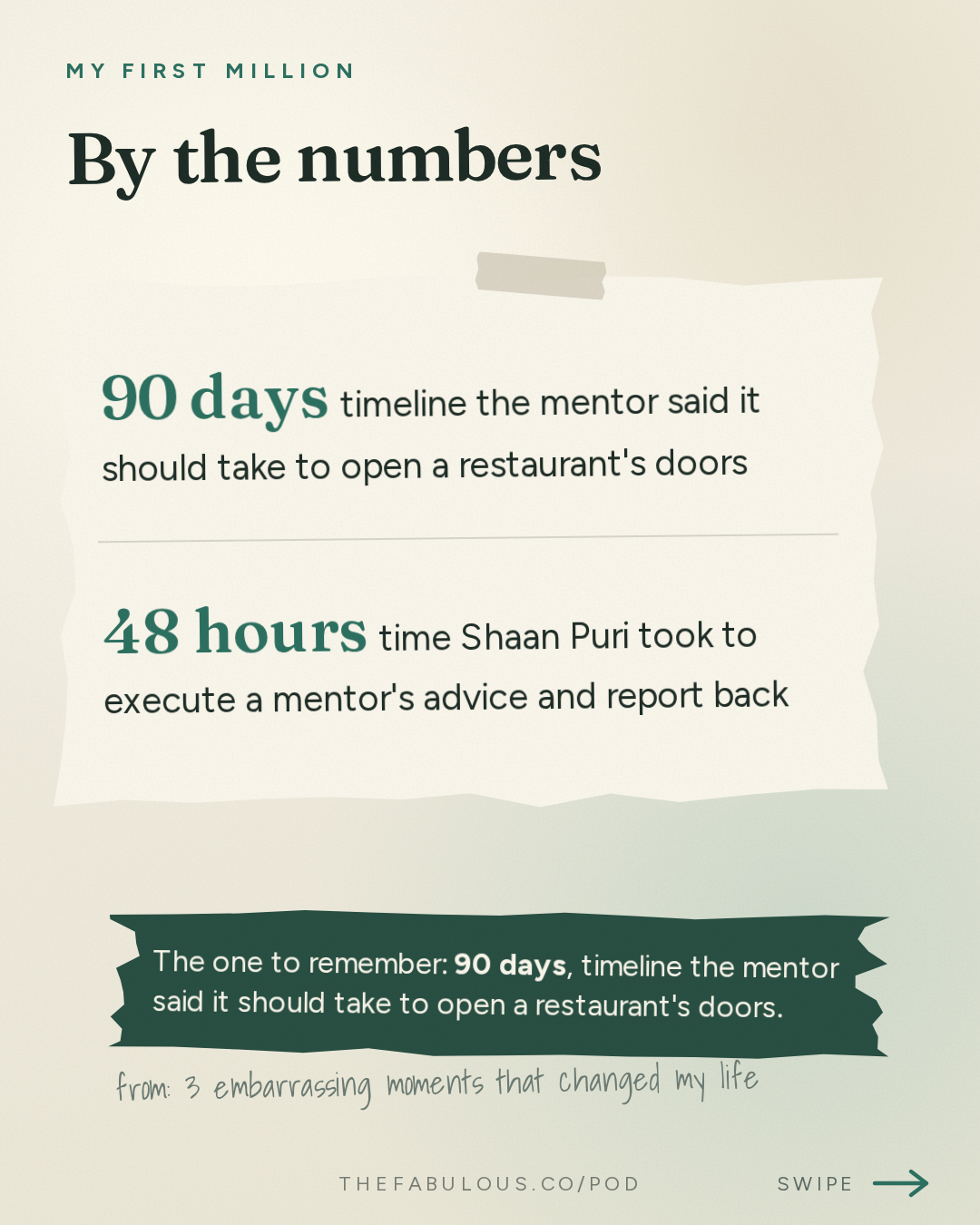
- 90 days timeline the mentor said it should take to open a restaurant's doors
- 48 hours time Shaan Puri took to execute a mentor's advice and report back
In their words
“What's served you can also screw you. The dose makes the poison”
“When you've filled your own water cup, you're not waiting, you're not sitting around waiting for the waiter to come back.”
“I could see on his face he was trying to work out How to be nice to us, 'cause we were so hopeless that it was not rejection, it was pity.”
“They don't know you're the laugh track. They don't know who you are, so you can just be a different guy.”
Protocols
-
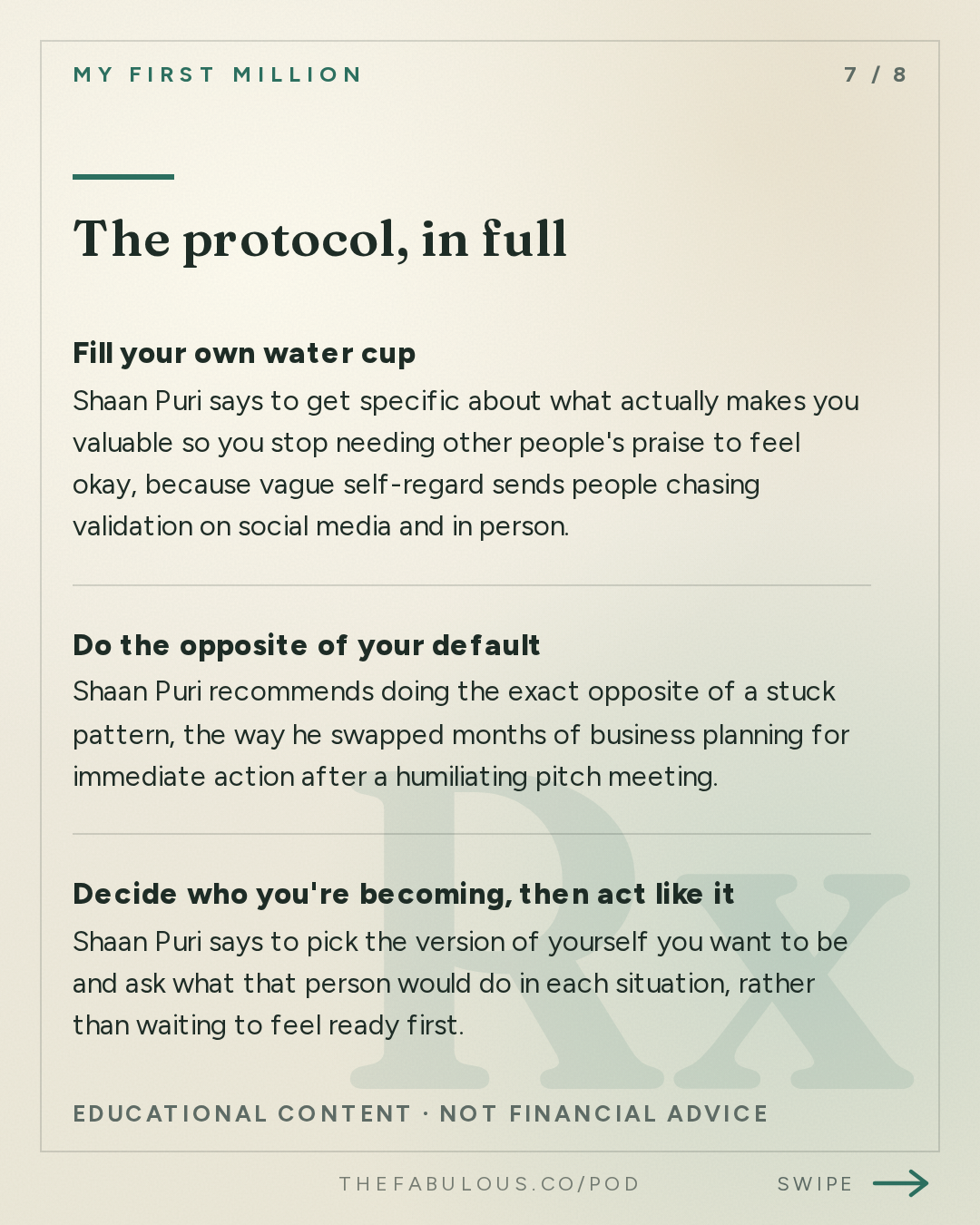
Fill your own water cup
Shaan Puri says to get specific about what actually makes you valuable so you stop needing other people's praise to feel okay, because vague self-regard sends people chasing validation on social media and in person.
whenever insecurity shows up around other people's opinions
-
Do the opposite of your default
Shaan Puri recommends doing the exact opposite of a stuck pattern, the way he swapped months of business planning for immediate action after a humiliating pitch meeting.
when a habitual approach has stopped working
-
Decide who you're becoming, then act like it
Shaan Puri says to pick the version of yourself you want to be and ask what that person would do in each situation, rather than waiting to feel ready first.
at any reinvention point, such as a new school or a new career
Questions this episode answers
What was Shaan Puri's narcissism test score?
A life coach had Shaan Puri take a personality test that scored him 110 on a narcissistic personality tendency scale, far above the other categories measured (01:54). The coach explained the trait as a belief that general rules, including the 90 percent failure rate for new businesses, don't apply to the person who has it (03:25).
What is the 'tuna on toast' philosophy from My First Million?
It's Shaan Puri's name for doing the opposite of a stuck habit, borrowed from a Seinfeld episode where George Costanza orders tuna on toast instead of his usual chicken salad and reverses his approach to life (14:18). Puri applied it after a failed restaurant pitch, swapping months of business planning for immediate action, which a mentor later said gave him the highest bias for action of any founder he'd met (16:01).
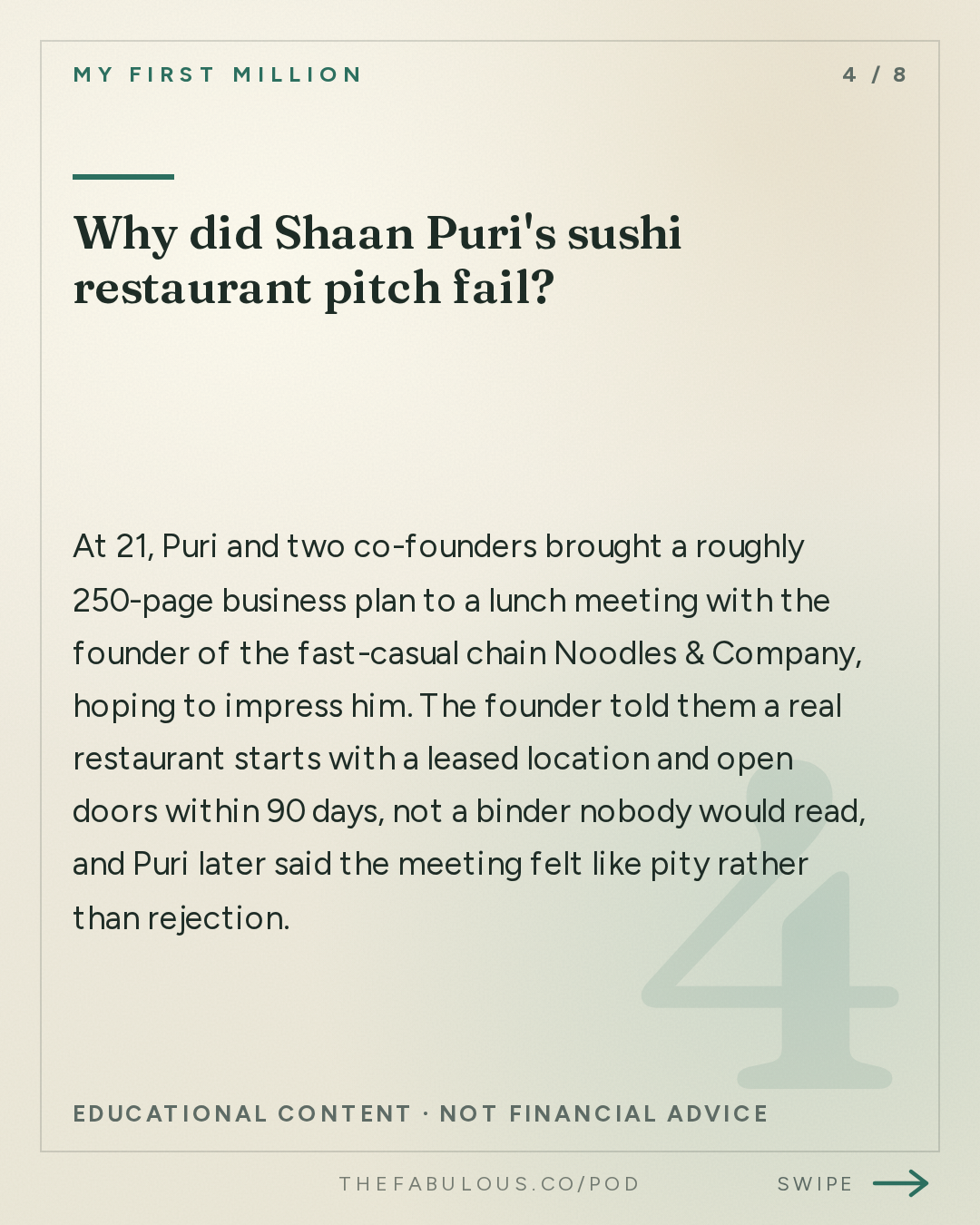
Why did Shaan Puri's sushi restaurant pitch fail?
At 21, Puri and two co-founders brought a roughly 250-page business plan to a lunch meeting with the founder of the fast-casual chain Noodles & Company, hoping to impress him (08:08, 10:17). The founder told them a real restaurant starts with a leased location and open doors within 90 days, not a binder nobody would read, and Puri later said the meeting felt like pity rather than rejection (11:59, 12:24).
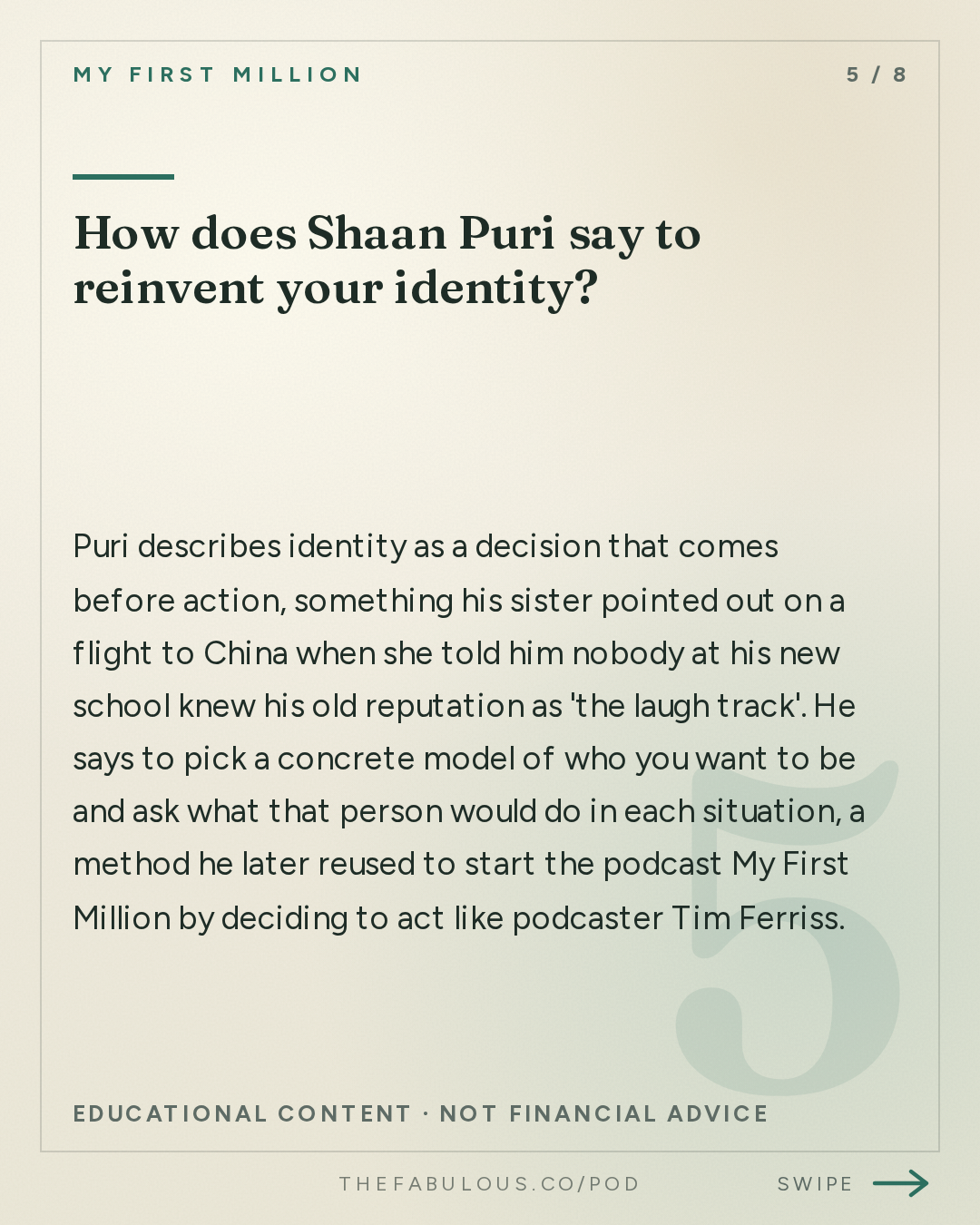
How does Shaan Puri say to reinvent your identity?
Puri describes identity as a decision that comes before action, something his sister pointed out on a flight to China when she told him nobody at his new school knew his old reputation as 'the laugh track' (20:25, 20:42). He says to pick a concrete model of who you want to be and ask what that person would do in each situation, a method he later reused to start the podcast My First Million by deciding to act like podcaster Tim Ferriss (21:20, 22:18).
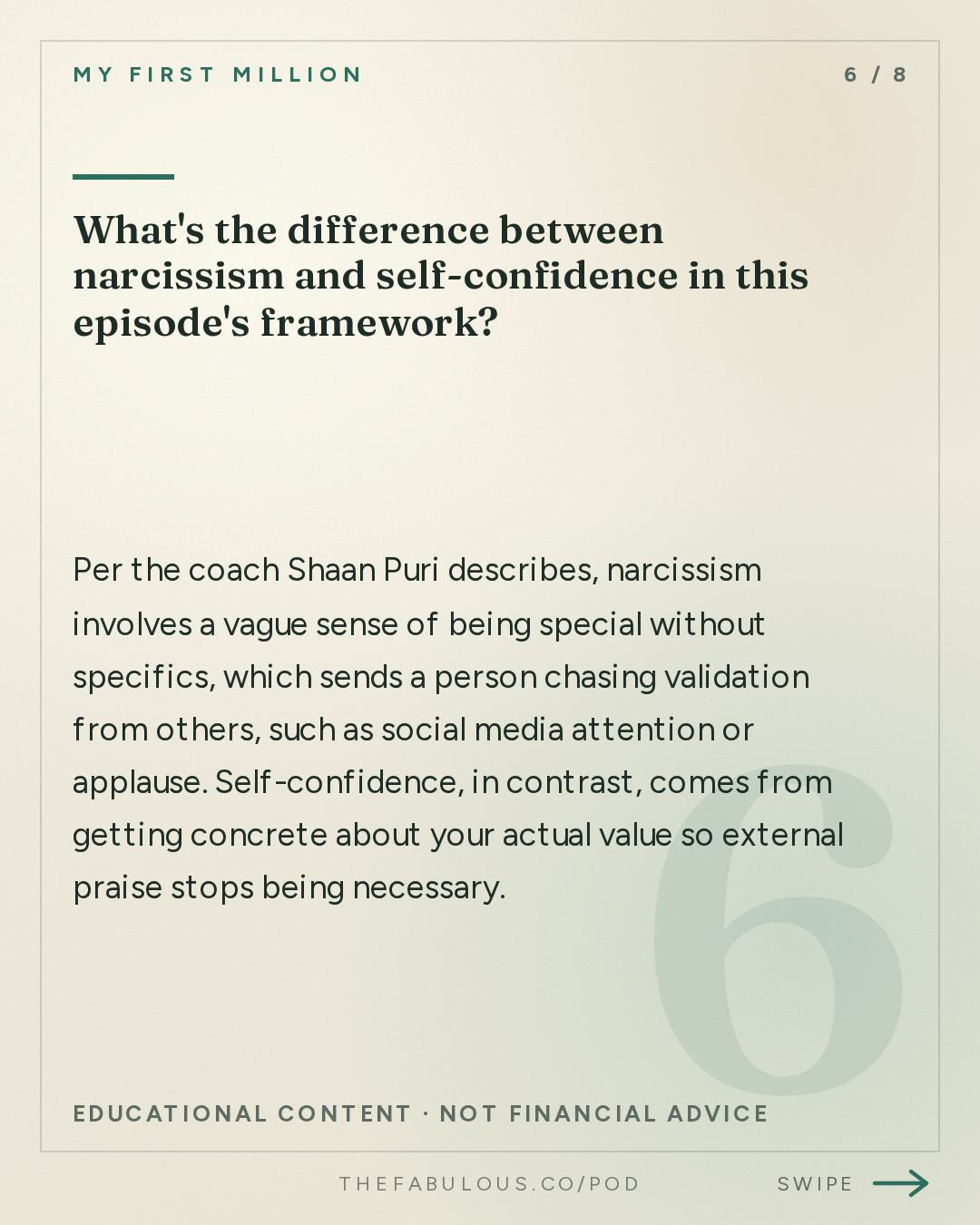
What's the difference between narcissism and self-confidence in this episode's framework?
Per the coach Shaan Puri describes, narcissism involves a vague sense of being special without specifics, which sends a person chasing validation from others, such as social media attention or applause (03:45, 04:07). Self-confidence, in contrast, comes from getting concrete about your actual value so external praise stops being necessary (05:22).
The full read, in cards
Go deeper
- Seinfeld ("The Opposite") — George Costanza's decision to do the opposite of his instincts, including ordering tuna on toast, inspired Shaan Puri's pivot from planning to action
Mentioned
Scott Harrison · charity:water · Noodles & Company · Chipotle · George Costanza · Seinfeld · Tim Ferriss
More from this show and category
Jeff Harmon's Marketing Playbook Explained
Jeff Harmon built OraBrush, Poo-Pourri, Squatty Potty, and Angel Studios by spotting marketing glitches: cheap or ignored channels nobody else was using. He turned a 19-minute skippable ad into an $11 million crowdfund for The Chosen and grew Angel Studios into a $500 million business run by a 3 million-member guild that votes on every film.
Oxytocin Doping for Marriage: The Business Case
Palmer Luckey wants to fight divorce with oxytocin, a bonding hormone already sold unregulated online as powder. The hosts trace how niche communities like Knights of Columbus and Angel Studios turn shared identity into insurance and content revenue, and explain why even a hit movie like Angel Studios' biggest box-office success nets just a 2.5x return.
MIT Scientist on Simulation Theory and Elon Musk
MIT-trained computer scientist and video game entrepreneur Rizwan Virk argues the physical world may be a rendered simulation, echoing Elon Musk's 2016 claim that the odds of living in base reality are one in billions. He ties Nick Bostrom's simulation argument to quantum physics, ancient religious texts, and a real 2025 incident where OpenAI's own test agents hacked Hugging Face.
How Whatnot Became a $20 Billion Company
Whatnot is a livestream shopping app now valued at $20 billion, built by founder Grant Lafontaine after a failed Craigslist clone idea. He pivoted to Funko Pop collectibles, became the platform's first seller to solve the marketplace chicken-and-egg problem, and scaled sales from $2.3 million in 2020 to $1 billion by 2022.
