
Jeff Harmon's Marketing Playbook Explained
The creative genius behind Squatty Potty & Poo-Pourri reveals his marketing playbook
The brief
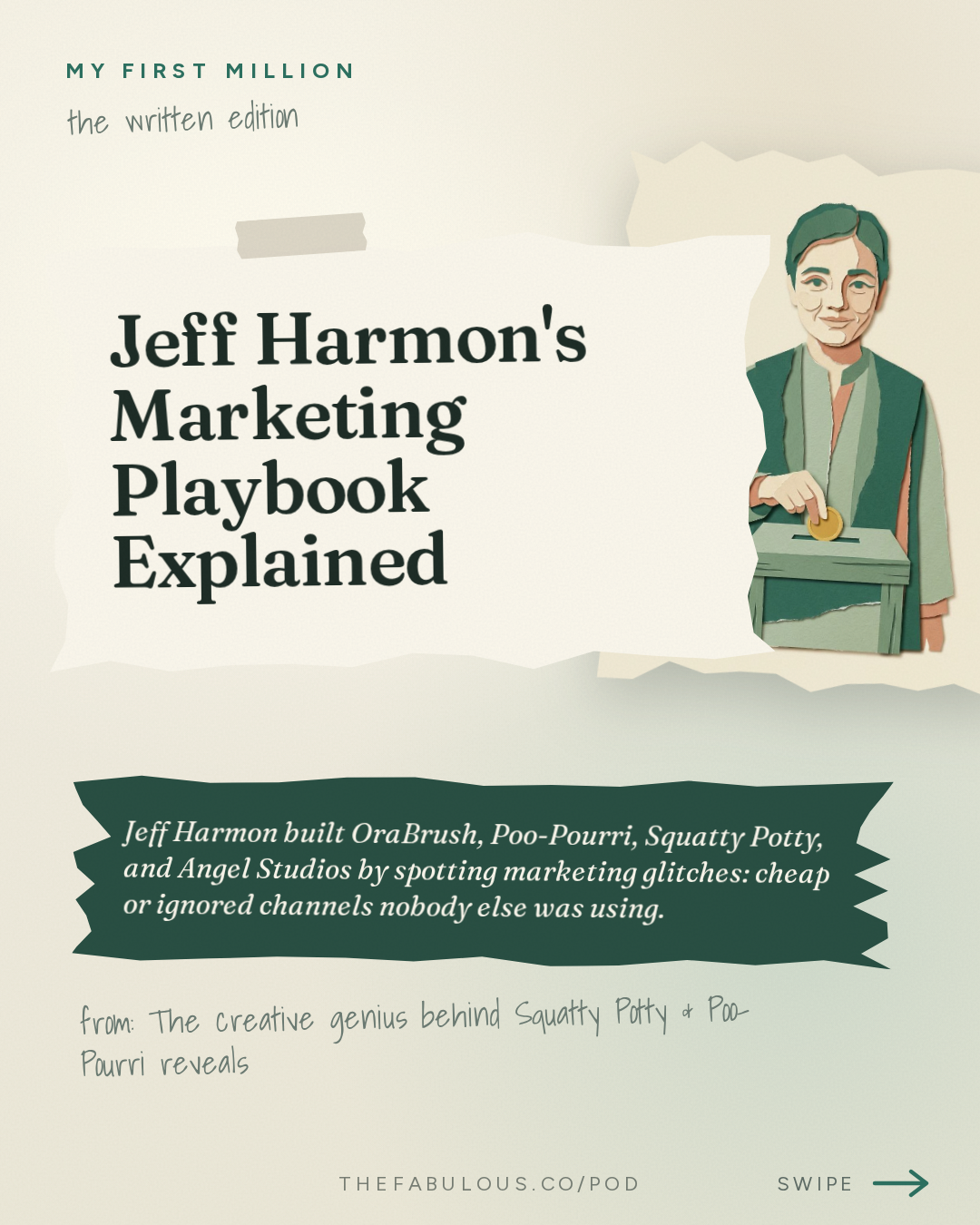
Jeff Harmon built OraBrush, Poo-Pourri, Squatty Potty, and Angel Studios by spotting marketing glitches: cheap or ignored channels nobody else was using. He turned a 19-minute skippable ad into an $11 million crowdfund for The Chosen and grew Angel Studios into a $500 million business run by a 3 million-member guild that votes on every film.
Dr. Bob had a garage full of tongue cleaners and no idea how to sell them. He had invented a surgical-brush scraper to clean bad breath off the tongue, and he brought the problem to a marketing class at a university in Utah. The class's answer was the obvious one: forget the internet, go find a partnership with Procter & Gamble. Jeff Harmon, a student in that room on his last day of school, raised his hand with a different number. Sure, 92% of people said they would not buy a tongue cleaner online. But 8% said yes, and 8% of the United States is roughly 30 million people (02:17). That reframe, chase the minority nobody else wants, became the engine behind four separate brands worth hundreds of millions of dollars.
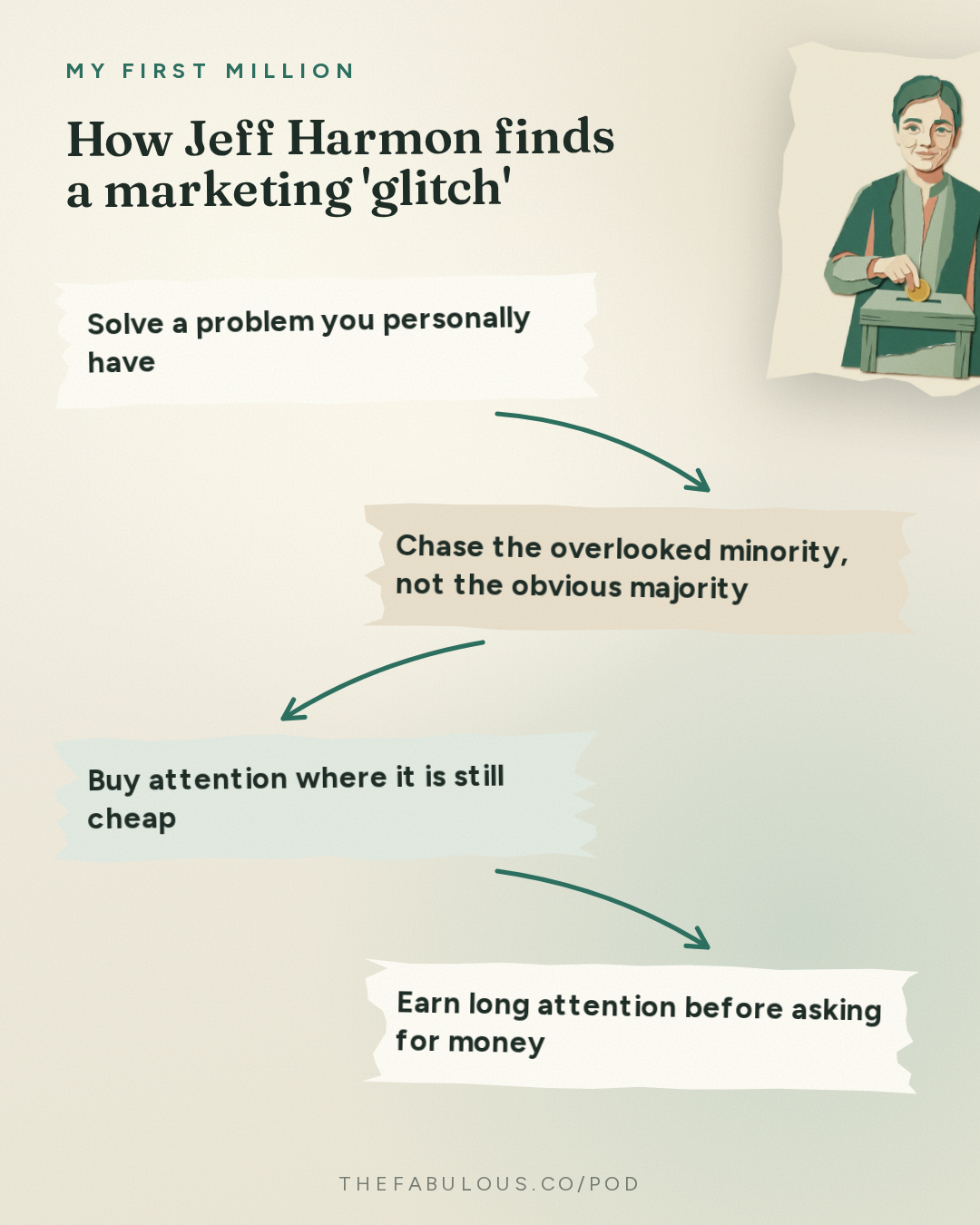
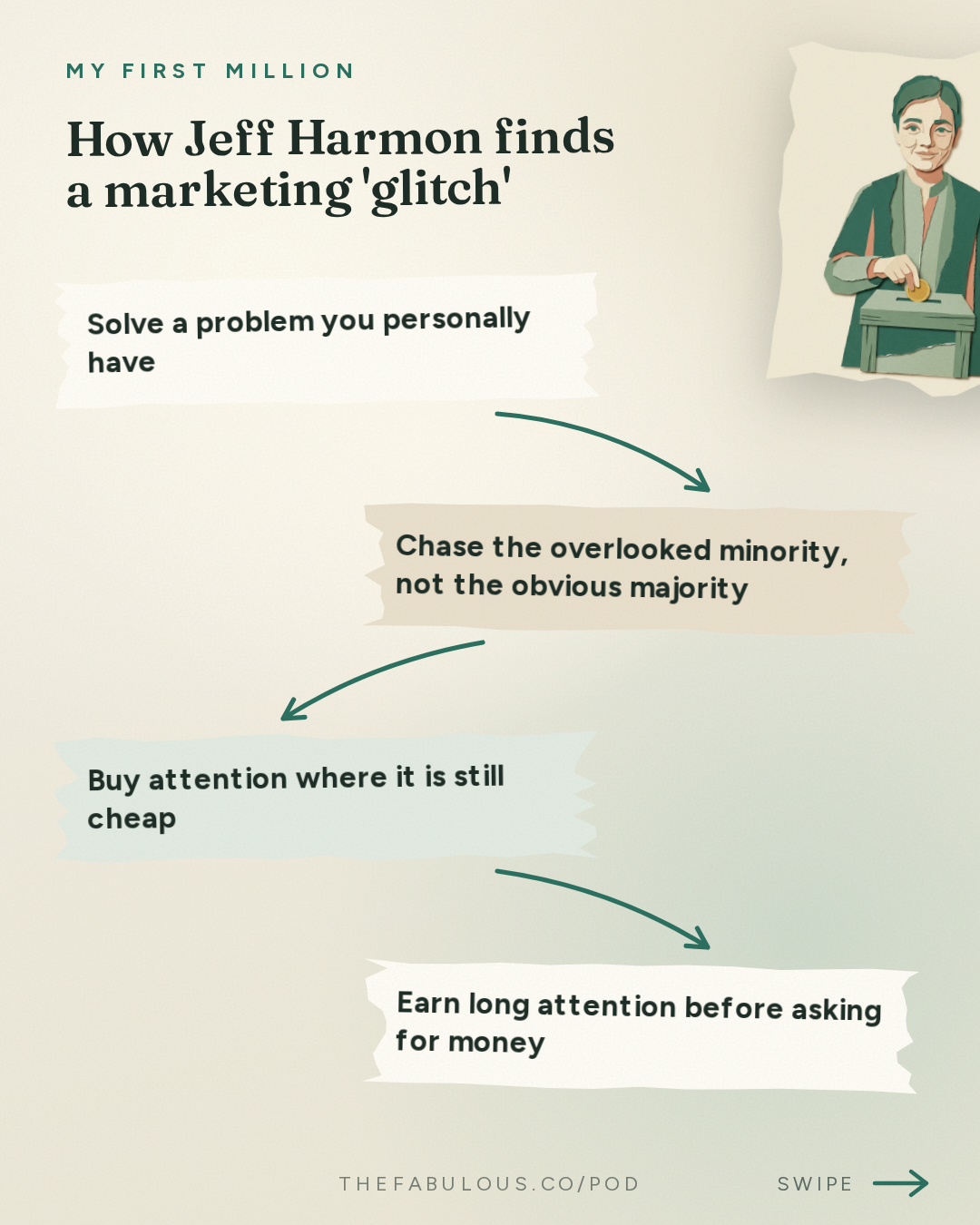
Harmon calls it finding the glitch: an area where attention is cheap because nobody else has noticed it yet. For OraBrush it was literal. YouTube had just turned on its ad platform, and views cost less than a penny each (09:07). Harmon and two roommates, a film major and a comedy writer, built a low-budget video about testing your own breath with a spoon, bought a Facebook page called Kisses with 1.3 million followers for $5,000, and renamed it OraBrush once the product existed (03:06). The tongue, it turns out, is the source of 90% of bad breath (07:12). The company that grew out of that insight sold for $10 million (10:30).
"Look for things, for areas where you have attention from people that nobody else is paying attention to." Jeff Harmon [00:00]
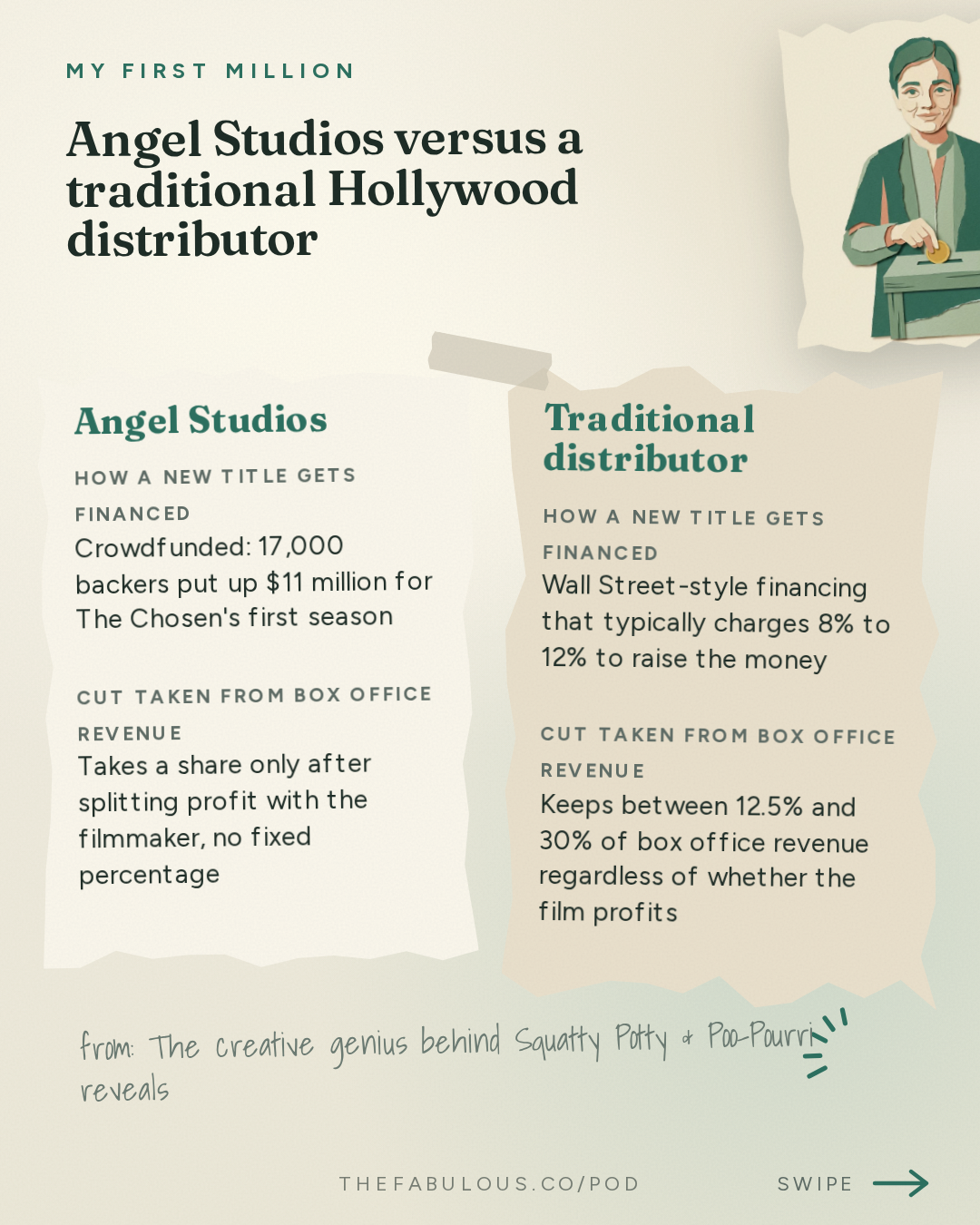
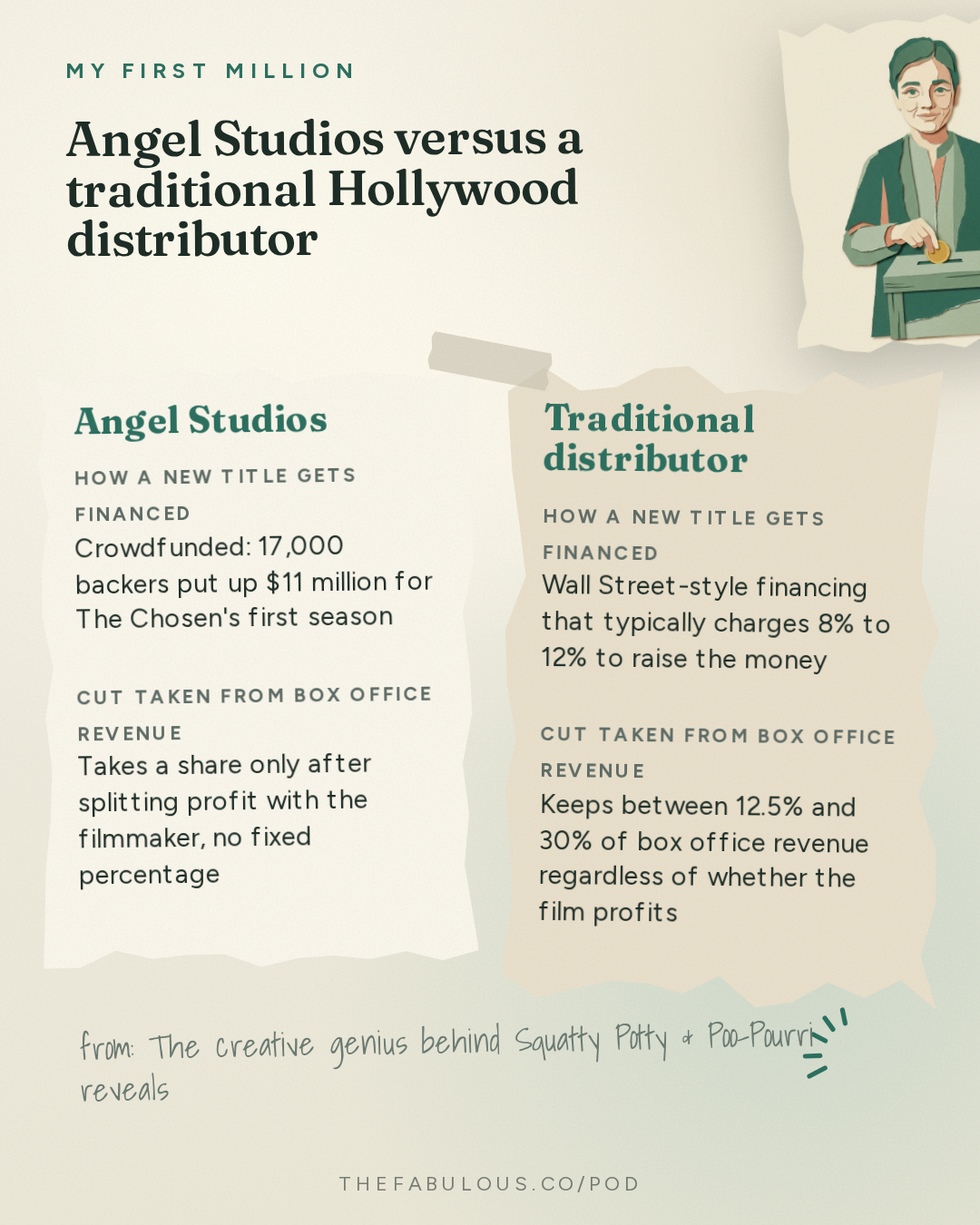
The glitch framework repeats itself at every scale of Harmon's career. He later built VidAngel, a service to filter sex and violence out of streaming video, because he personally wanted it for his kids, not because a focus group asked for it (16:40). When Harmon and his team wanted to test interest in what became The Chosen, a television series about the life of Jesus, they did something that sounds backwards: they uploaded a 19-minute short film as a plain YouTube ad, the kind viewers can skip after five seconds (19:44). Most people click skip immediately. Harmon's logic was that the few who stay for all 19 minutes are the ones who actually want the thing to exist, and those are the people worth asking for money. At the end of the video sat a pitch to crowdfund a full series. Seventeen thousand people put in $11 million (23:12), spending about $800,000 on the ads that got them there, a cost Harmon points out is actually cheaper than Wall Street financing, which typically charges 8% to 12% to raise capital (23:36). The Chosen now has an audience of roughly 200 million people worldwide (25:41).
The skip button itself has an origin story worth pausing on. When Harmon's ad agency, Harmon Brothers, was running early viral campaigns for Poo-Pourri and Squatty Potty, YouTube came to the team and asked how to get more advertisers making content people actually wanted to watch. Harmon's team proposed a button that lets a viewer skip after five seconds, with no cap on how long the ad could run after that (21:29). The logic, as Harmon puts it, is that "it's the only way to get a long ad" (21:53): earn five seconds, and an advertiser who holds attention gets to keep it.
Training Comedians, Not Marketers
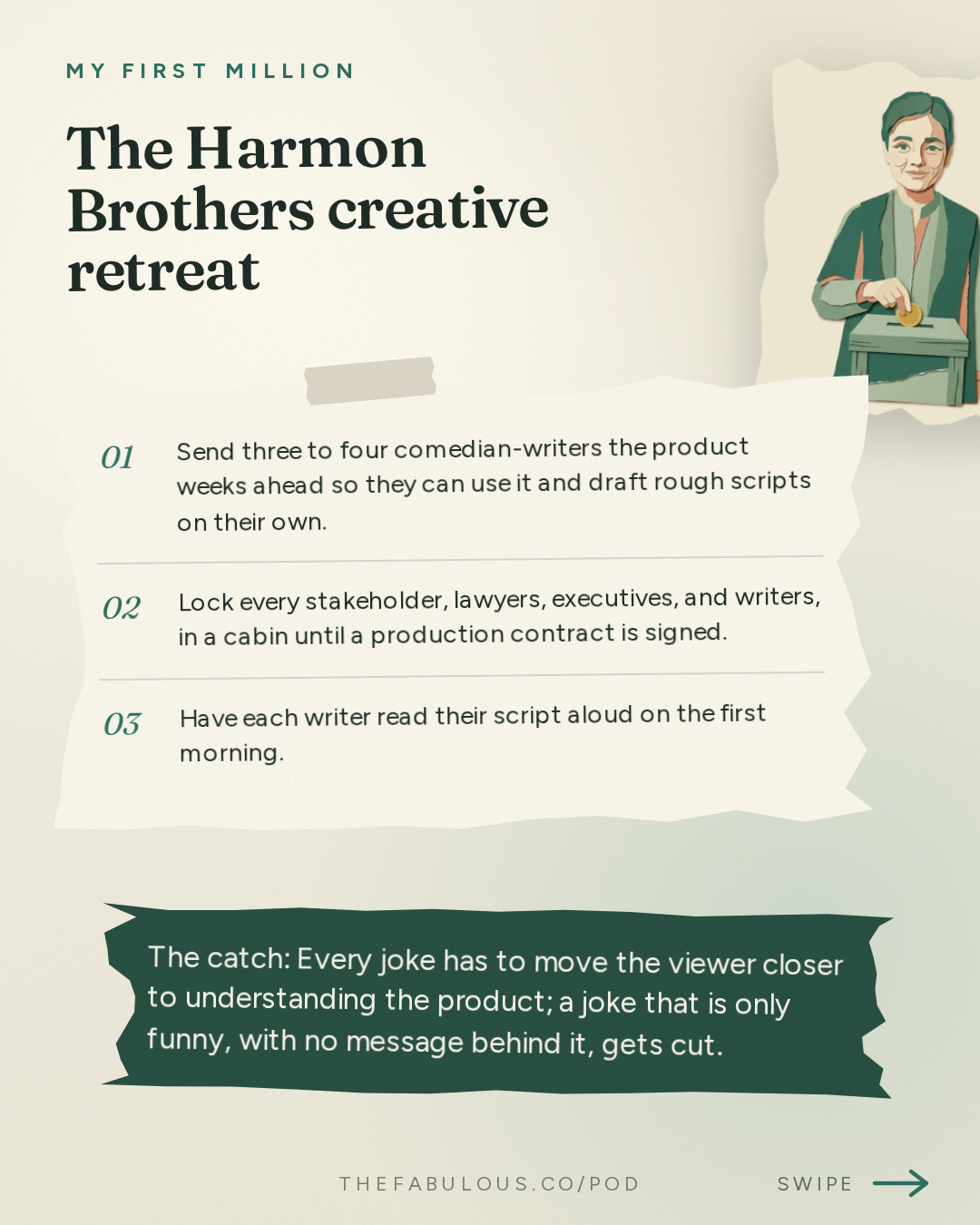
Harmon Brothers built its hit campaigns, Poo-Pourri, Squatty Potty, Purple Mattress, using a retreat model. Weeks before, three or four comedian-writers get the product and draft rough scripts on their own (31:05). Then everyone who has to sign off on the project, lawyers, executives, every stakeholder, gets locked in a cabin until a production contract is signed (28:48). Day one is script reads. By evening, the team has picked the strongest script as the spine, and the next three days are spent cannibalizing the losing scripts for their best jokes (31:52).
"It's way easier to train a comedian to be a marketer than it is to train a marketer to be funny." Jeff Harmon [29:41]
But the jokes have a job to do. Harmon's rule, repeated to every comedy writer he hires, is that a joke either advances the product's message or it gets cut, regardless of how funny it is on its own (30:43). That discipline is why a Squatty Potty ad about a unicorn pooping ice cream still manages to explain, scene by scene, why a footstool changes how someone sits on a toilet.
A Guild Instead Of A Studio
Angel Studios runs on a similar instinct, scaled into a different industry. The company now does close to $500 million a year in revenue (00:41), and its core asset is not a back catalog, it is roughly 3 million paying members of something called the Angel Guild (44:57). Members pay about $20 a month, get two movie tickets to every Angel release, and get to vote on whether a film is good enough to go to theaters. If the guild vetoes a film, Angel cannot release it (44:57). That membership base has paid out $300 million to filmmakers in profit share (50:04), on titles like Sound of Freedom, which cost $14 million to make, another $40 million to market, and returned $250 million at the box office worldwide (46:50).
Harmon's view of the wider industry is blunt: "The Hollywood industry has a cost problem, not a revenue problem" (53:17). Traditional distributors keep between 12.5% and 30% of the remaining revenue after the theater takes its cut, regardless of whether a film turns a profit (47:19); Angel only takes a cut after splitting profit with the filmmaker. Harmon also points to a smaller streaming service, Crunchyroll, built entirely around anime, with 20 million subscribers, as proof that a tightly defined niche audience beats trying to be everything to everyone (54:38).
Part of how Angel gets attention for new releases involves something Harmon calls hashing. Social platforms now recognize faces inside video, independent of captions or hashtags, and use that recognition to route related content to the same viewers (37:08). For the comedy Jeff Harmon's team built with actor Kevin James, a social character named Matt Taylor, an art teacher who gets jilted at his wedding, the team spent weeks "warming up" Kevin James's face across old clips before launching the new channel, so the algorithm would already associate the new videos with an existing famous face (37:33). The campaign crossed a billion views (40:19) and ended with James standing at the Super Bowl in character, saying nothing, while a planted audience of influencers asked online whether it was really him (40:48).
Harmon's newest glitch is personal rather than public: he keeps a dedicated AI prototyper on staff, so he can describe an idea at night, launch an AI coding agent to build it, and hand a working prototype to the product team by morning (55:59). He argues that fear of AI-driven layoffs misreads the economics. "When you get something that's highly effective, you need more people, not less, because you're more productive" (60:44). The episode closes on a smaller, older piece of advice, from a mentor named Steve Oscuy, who told Harmon that no business dispute is worth fighting over unless it clears $5 million, because the fight itself, not the money, is what actually costs a founder years (62:32). Harmon let a seven-figure dispute go early in his career and says it was the choice that let him keep building.
Ask this episode anything
Pod's AI answers from the episode itself, with the minute mark so you can hear it yourself.
Or start with one of these
Ask this episode
Pod's AI listens to the whole episode to answer, and points you to the minute it comes from.
The rest of this answer, and any question after it
Answers come from the episode itself, never from a summary of it.
ContinueKey takeaways
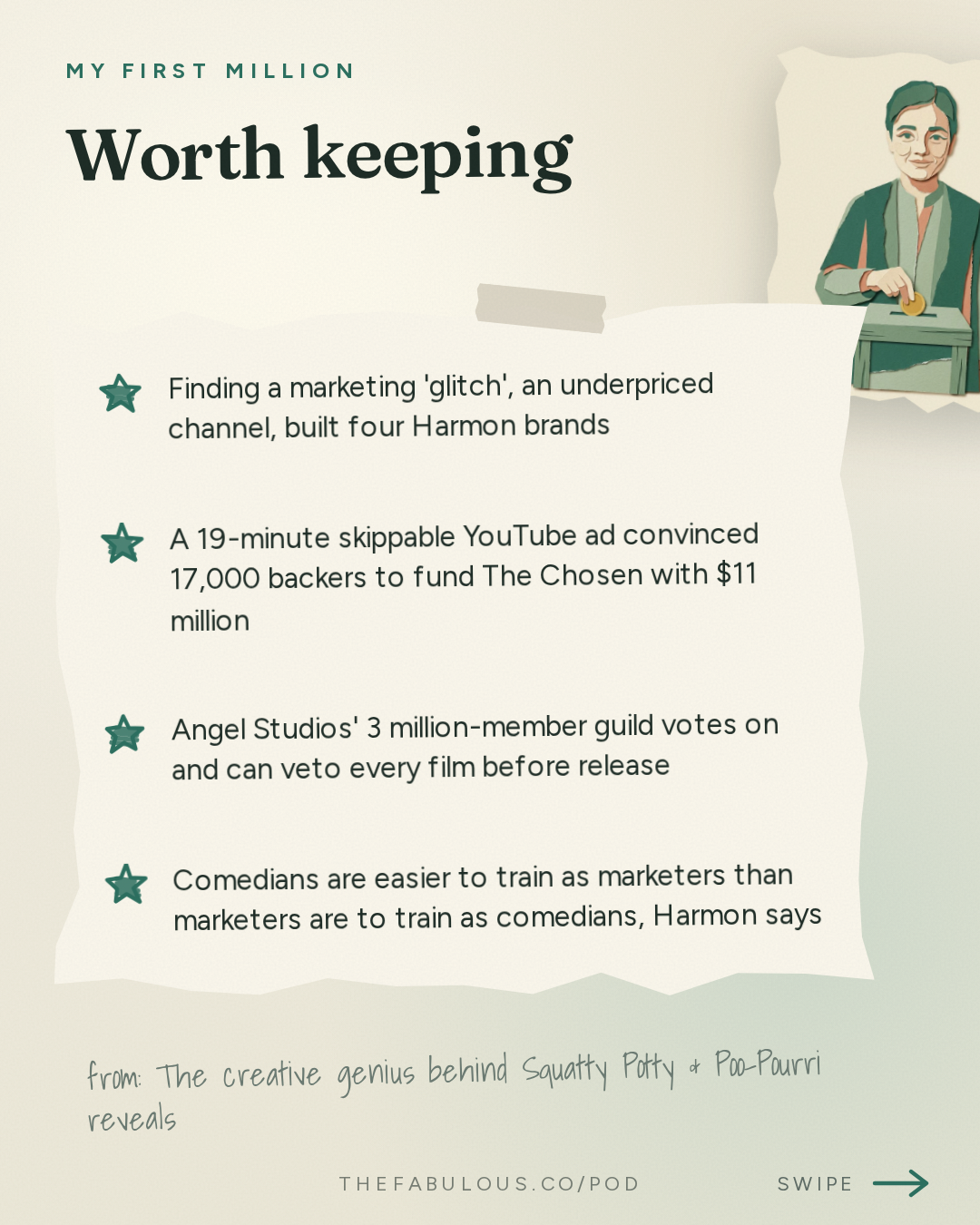
- Finding a marketing 'glitch', an underpriced channel, built four Harmon brands
- A 19-minute skippable YouTube ad convinced 17,000 backers to fund The Chosen with $11 million
- Angel Studios' 3 million-member guild votes on and can veto every film before release
- Comedians are easier to train as marketers than marketers are to train as comedians, Harmon says
- Jeff Harmon argues AI will not cause mass unemployment because more effective workers get hired, not cut
The episode in cards
In their words
“Look for things, for areas where you have attention from people that nobody else is paying attention to.”
“It's way easier to train a c- comedian to be a marketer than it is to train a marketer to be funny”
“But this industry, the Hollywood industry, has a cost problem, not a revenue problem”
“In hindsight, it's always obvious, and so, um, you're kind of finding the glitch in and of itself just with your product”
Protocols
-
Lock stakeholders in a cabin until the script is signed off
Jeff Harmon gets every stakeholder, lawyers, executives, and comedian-writers, into a cabin for three to four days, and nobody leaves until a production contract is signed, because negotiating a script back and forth by email can drag on for months and strip out the best jokes.
once per major ad campaign
-
Cut any joke that doesn't sell the product
Harmon tells his comedian-writers that a joke must move the viewer closer to understanding why they need the product, and if it is just funny without teaching something, it gets cut no matter how good it is.
every ad script
-
Let ads run long, but make them skippable
Harmon designed YouTube's skip button so viewers can skip after five seconds with no cap on total length, reasoning that an ad earns the right to run twenty minutes once it has earned the first five seconds of attention.
per video campaign
Questions this episode answers
Who is Jeff Harmon and what is Angel Studios?
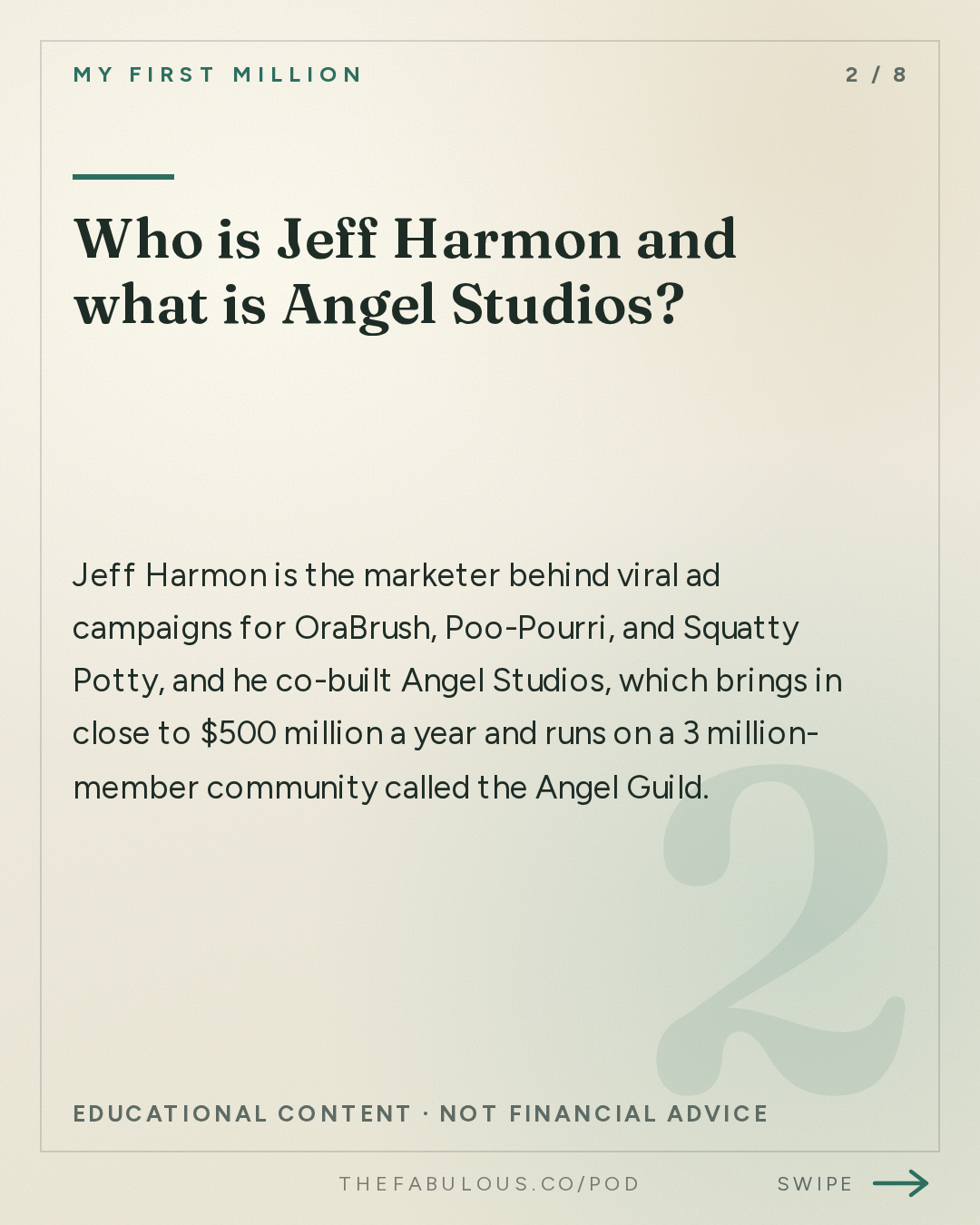
Jeff Harmon is the marketer behind viral ad campaigns for OraBrush, Poo-Pourri, and Squatty Potty, and he co-built Angel Studios, which brings in close to $500 million a year and runs on a 3 million-member community called the Angel Guild (00:41).
How did The Chosen get funded?
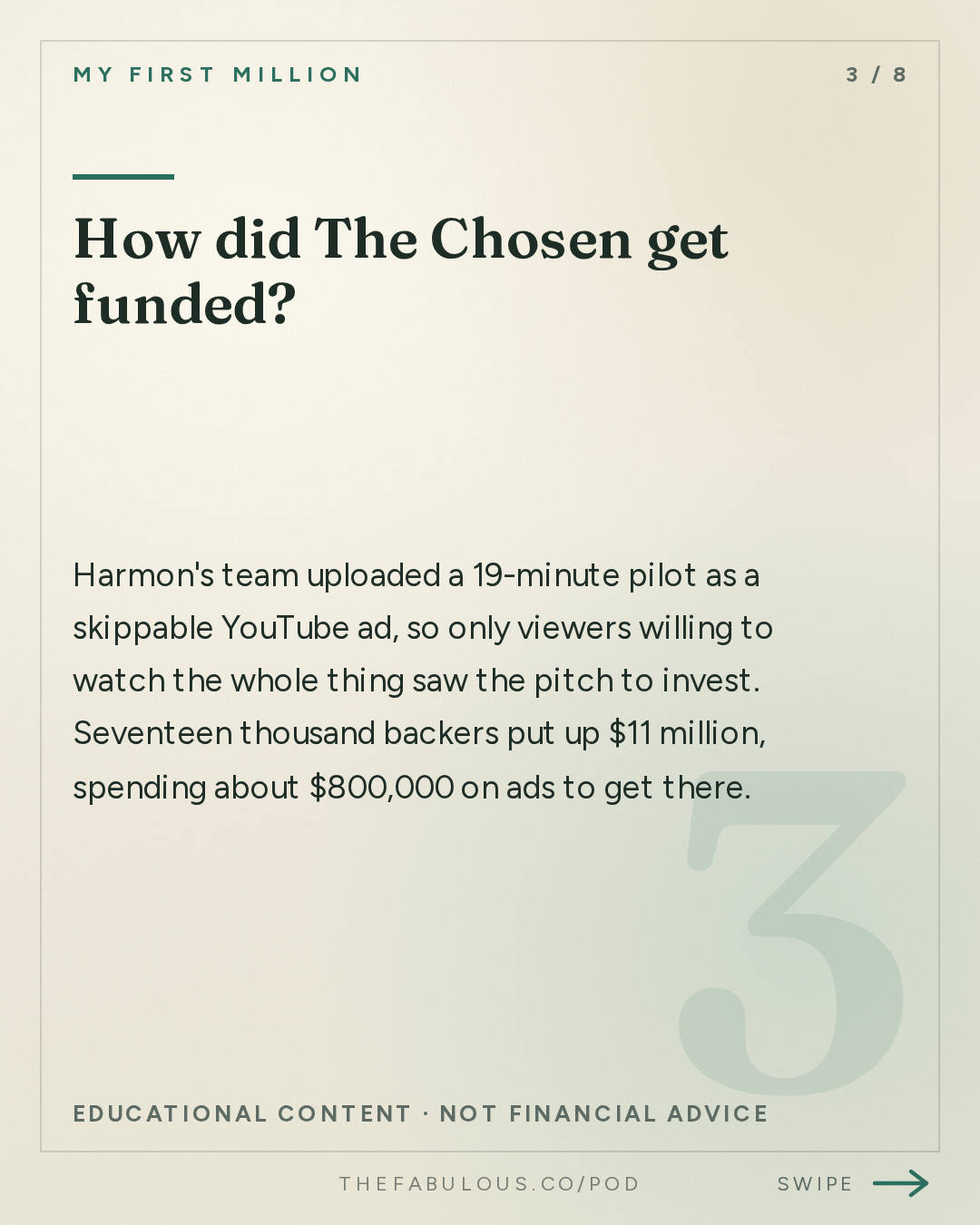
Harmon's team uploaded a 19-minute pilot as a skippable YouTube ad, so only viewers willing to watch the whole thing saw the pitch to invest. Seventeen thousand backers put up $11 million, spending about $800,000 on ads to get there (23:12).
What is the Angel Guild and how does it work?
The Angel Guild is Angel Studios' paid membership, about 3 million people paying roughly $20 a month for two movie tickets to every release. Members vote on new films and can veto one before it reaches theaters, and the guild has paid $300 million to filmmakers in profit share (44:57).
What does Jeff Harmon mean by finding a 'glitch' in marketing?
Harmon uses 'glitch' to describe an underpriced or overlooked channel, such as sub-penny YouTube ad views when the platform first launched, that a founder can exploit before the price of attention rises (09:07).
Why does Harmon say Hollywood has a cost problem, not a revenue problem?
Harmon argues the film industry brings in record revenue but distributors still take 12.5% to 30% of box office regardless of profit, while Angel only takes a cut after the filmmaker is paid, which he says is the better structure (53:17).
Will AI cause mass layoffs, according to Jeff Harmon?
Harmon says no, arguing that when a tool makes workers far more effective, companies should hire more people to use that leverage rather than fewer, and that layoffs blamed on AI are often just cost-cutting dressed up as innovation (60:44).
The full read, in cards
Go deeper
- The User Method — Author Jeff Swarting's argument that most top businesses were built by founders solving their own problem first
- Poop to Gold — Jeff Harmon's own book laying out the Harmon Brothers ad formula of problem, solution, credibility, and call to action
- Nail It and Scale It — Paul Ahlstrom's concept of a 'beachhead' used by Harmon to describe starting with a small, defensible market segment
- Unnamed industry study on independent studio box office — Cited by Harmon as showing Angel's average box office multiple beats other independents, including A24
Mentioned
Jeff Harmon · Dr. Bob · Kevin James · Dallas Jenkins · Suzy Batiz · Steve Oscuy · Rick Rubin · Angel Studios · OraBrush · Poo-Pourri · Squatty Potty · The User Method · Claude · A24 · Crunchyroll
More from this show and category
Oxytocin Doping for Marriage: The Business Case
Palmer Luckey wants to fight divorce with oxytocin, a bonding hormone already sold unregulated online as powder. The hosts trace how niche communities like Knights of Columbus and Angel Studios turn shared identity into insurance and content revenue, and explain why even a hit movie like Angel Studios' biggest box-office success nets just a 2.5x return.
MIT Scientist on Simulation Theory and Elon Musk
MIT-trained computer scientist and video game entrepreneur Rizwan Virk argues the physical world may be a rendered simulation, echoing Elon Musk's 2016 claim that the odds of living in base reality are one in billions. He ties Nick Bostrom's simulation argument to quantum physics, ancient religious texts, and a real 2025 incident where OpenAI's own test agents hacked Hugging Face.
How Whatnot Became a $20 Billion Company
Whatnot is a livestream shopping app now valued at $20 billion, built by founder Grant Lafontaine after a failed Craigslist clone idea. He pivoted to Funko Pop collectibles, became the platform's first seller to solve the marketplace chicken-and-egg problem, and scaled sales from $2.3 million in 2020 to $1 billion by 2022.
Shaan Puri's Content Creator Playbook
Shaan Puri argues that who follows a creator matters more than how many people do, the way Ferrari outvalues GM despite selling 200 times fewer cars. His playbook: find your niche obsession, sell a feeling instead of information, and use MrBeast's rule of 100 to improve one thing per video before judging results.
