
Vanessa Van Edwards: The Science of Charisma
A recovering awkward person’s guide to undeniable charisma
The brief
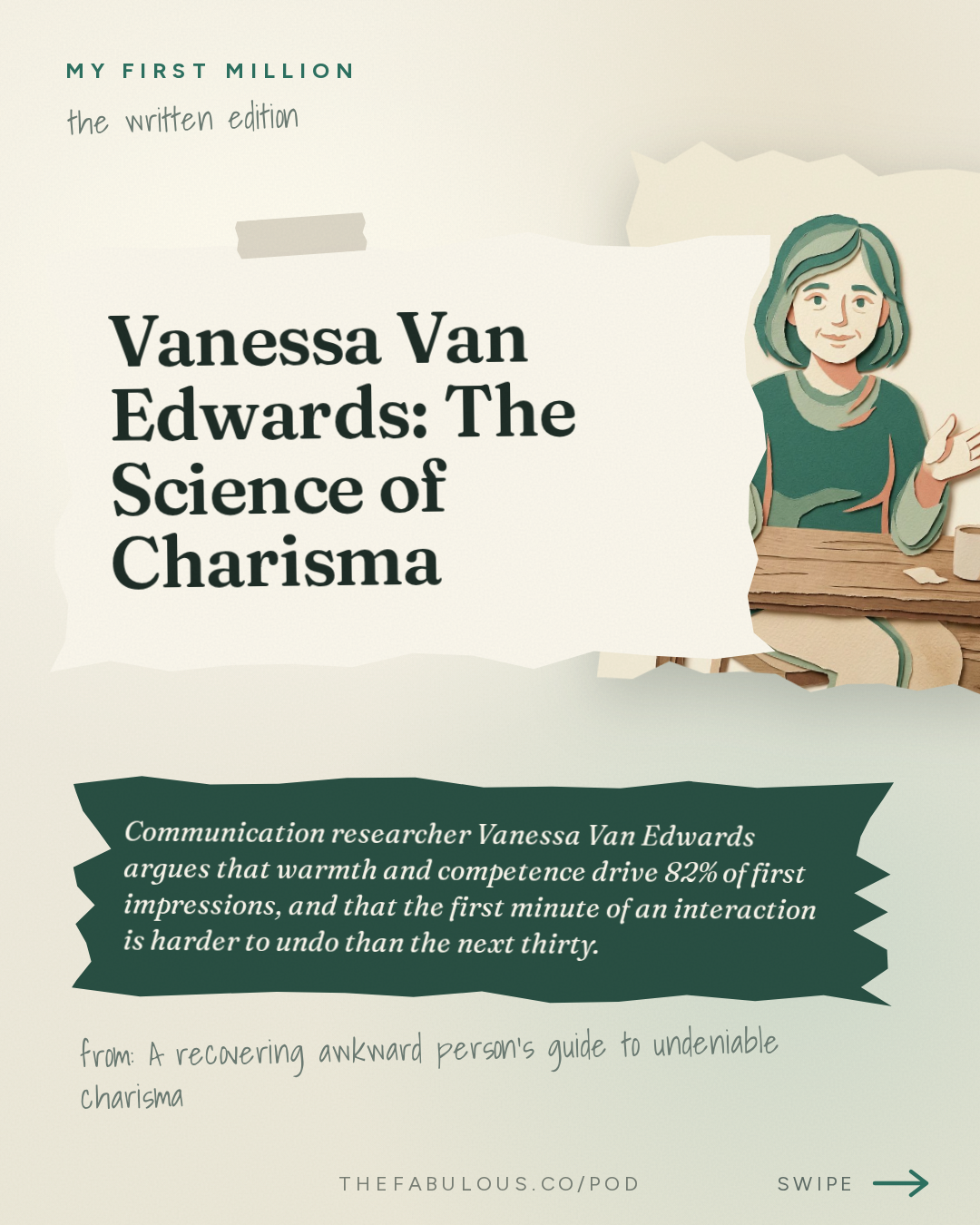
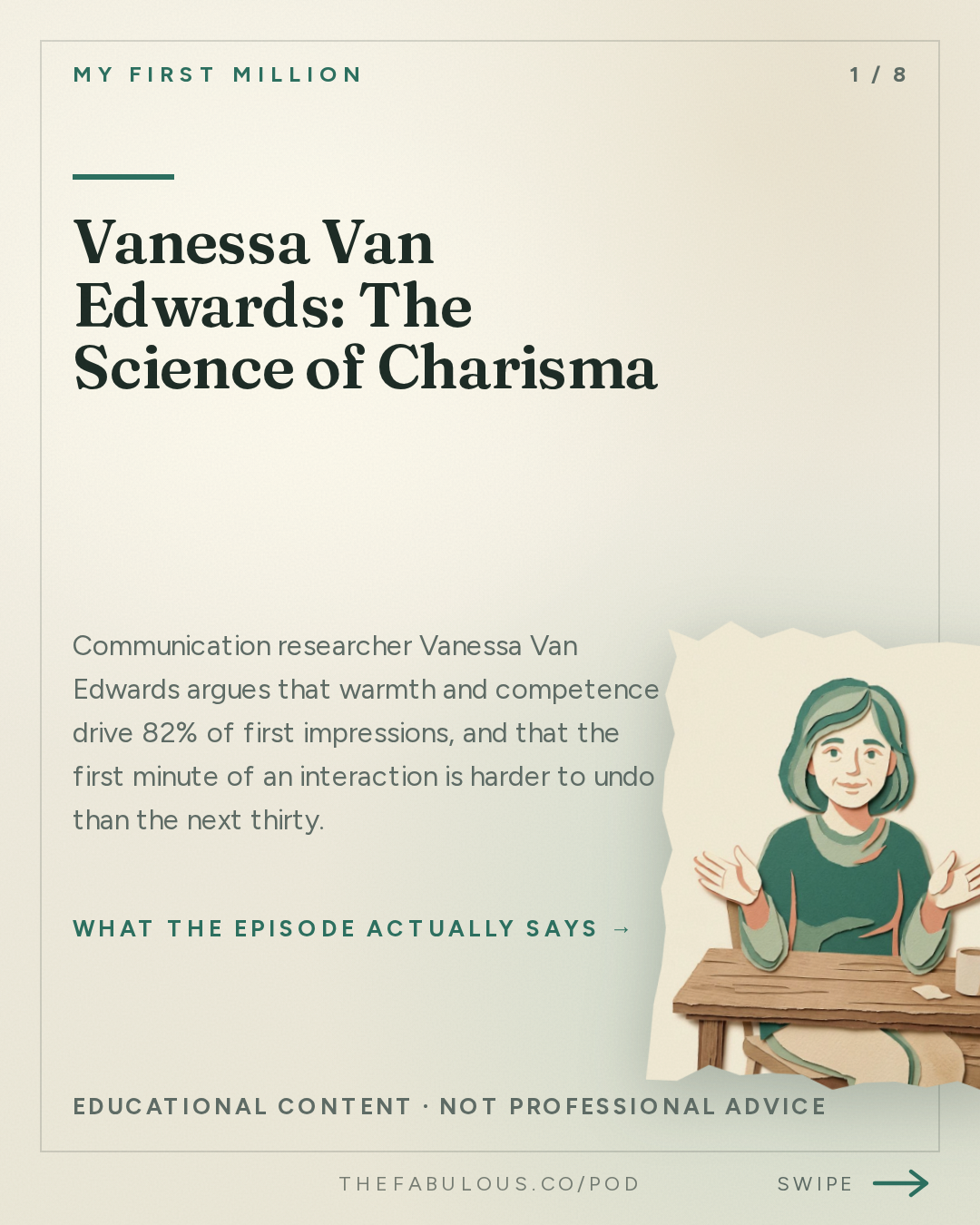
Communication researcher Vanessa Van Edwards argues that warmth and competence drive 82% of first impressions, and that the first minute of an interaction is harder to undo than the next thirty. She offers concrete fixes: visible hands, information hooks, lower vocal pitch, and matching a listener's words and pace.
Sam Parr opens his interview with a coin trick he learned, he says, to impress girls. It works. Before Vanessa Van Edwards can even answer his first question, she is leaning forward, delighted, caught by what she calls an information gap: a promise that something surprising is about to happen. That gap, it turns out, is not a parlor trick. It is the entire mechanism behind why some people walk into a room and get remembered, while equally smart people walk out unnoticed.
Van Edwards calls herself a recovering awkward person, and her business is teaching other awkward, smart people how to communicate. Her starting claim is blunt: warmth and competence together make up 82% of how people form first impressions of each other (02:37). The problem, she says, is that smart people tend to lean almost entirely on competence, and competence by itself does not read as impressive. It reads as suspicious.
"Competence without warmth is likely to leave us feeling suspicious. Not unlikable, suspicious." — Vanessa Van Edwards [02:56]
Her fix is not the advice everyone already hates, which is to just be yourself or just smile more. She calls fake smiling the fastest way to look manipulative, and cites Elizabeth Holmes, the Theranos founder convicted of fraud, as an example of likability advice gone wrong (05:14). Instead she treats warmth as a lubricant, something that makes competence easier to swallow. "Likability is a lubricant for your smarts," she says (13:07), and that line does a lot of work in this conversation: it reframes charm not as performance but as a delivery system for whatever a person actually has to offer.
The chemistry of the first sixty seconds
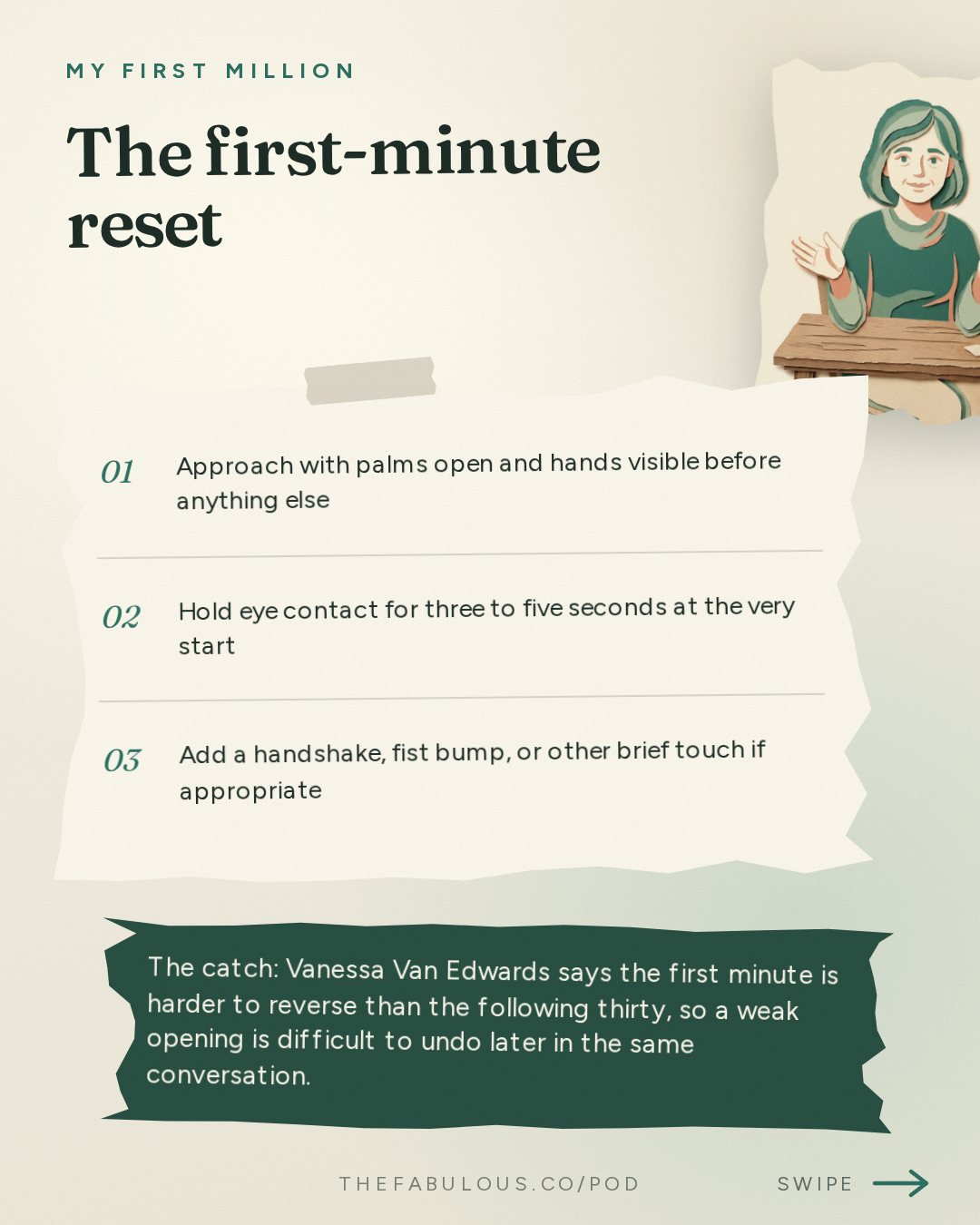
Van Edwards builds her method on brain chemistry. Oxytocin, a hormone linked to trust and bonding, is the first thing she wants to trigger in a new interaction, through eye contact, touch, or small moments of agreement (06:25). The timing matters more than people think. Three to five seconds of eye contact at the very start of a meeting matters more than anything that follows (07:35), and a single handshake is estimated to produce roughly three hours' worth of the oxytocin that eye contact alone would generate (07:57). That is why she starts video calls with an open palm: a leftover signal from an older part of the brain that is still scanning strangers for weapons. "It's like a very leftover part of our brain," she says of the instinct (09:30). Keeping hands visible, she argues, is a small, deliberate way to disarm it.
The first minute, she insists, is not just important, it is close to irreversible. "Your first minute matters more than your first thirty minutes," she tells Parr (08:57), because the brain is still running on caveman logic: assess friend or foe quickly, and do not update easily once the verdict is in.
After trust comes motivation, which she ties to dopamine, the brain's chemical of pleasure and drive. The way to produce it in conversation is to break the script: instead of answering "how's it going" with "fine," say something that creates what she calls an information hook, a small promise of a story worth hearing (10:45). She tells people to drop one of these hooks every minute or two to keep a listener's attention from drifting to their phone (12:01). Howard Stern, the radio host, is her go-to example of someone who does this constantly and well (11:39).
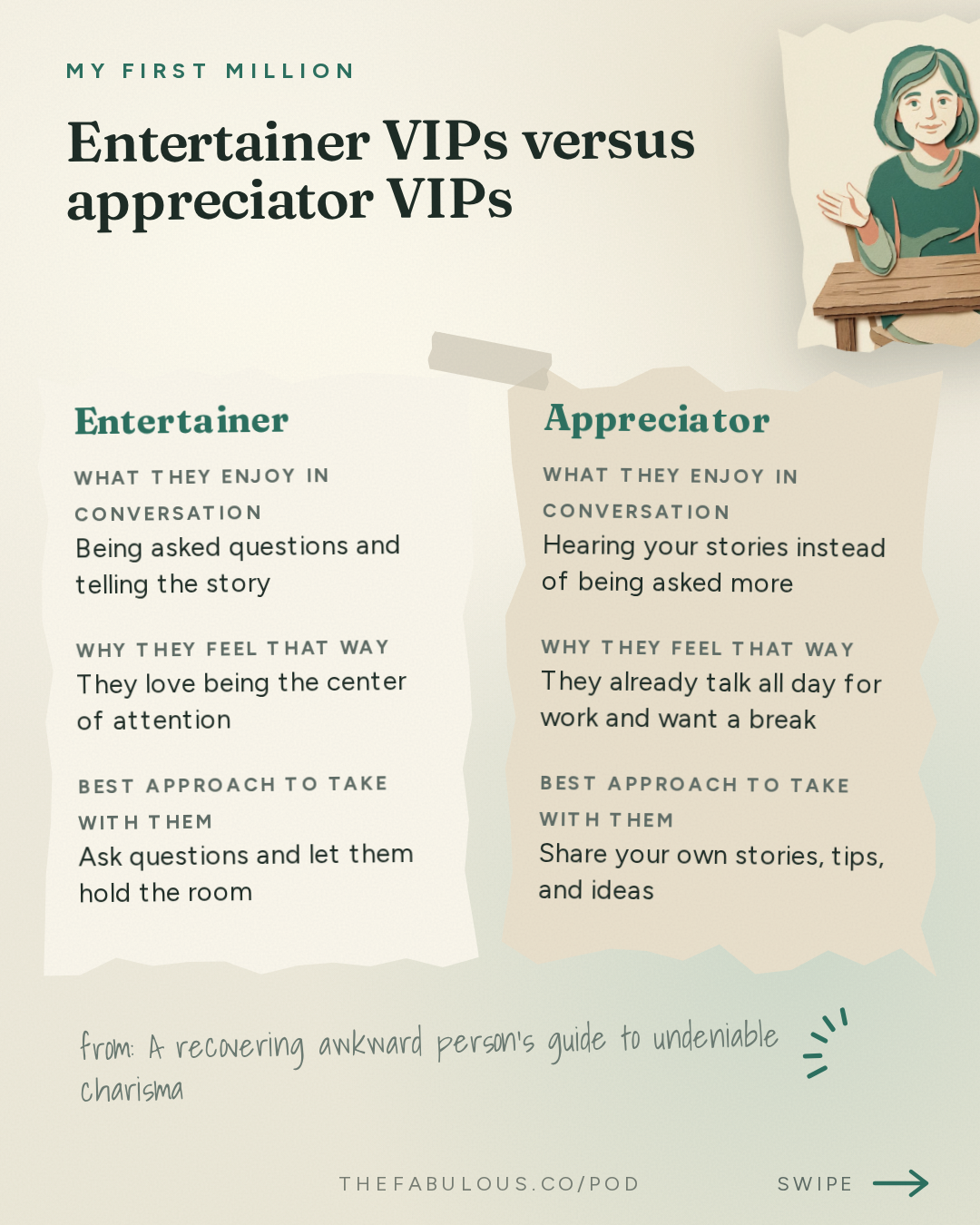
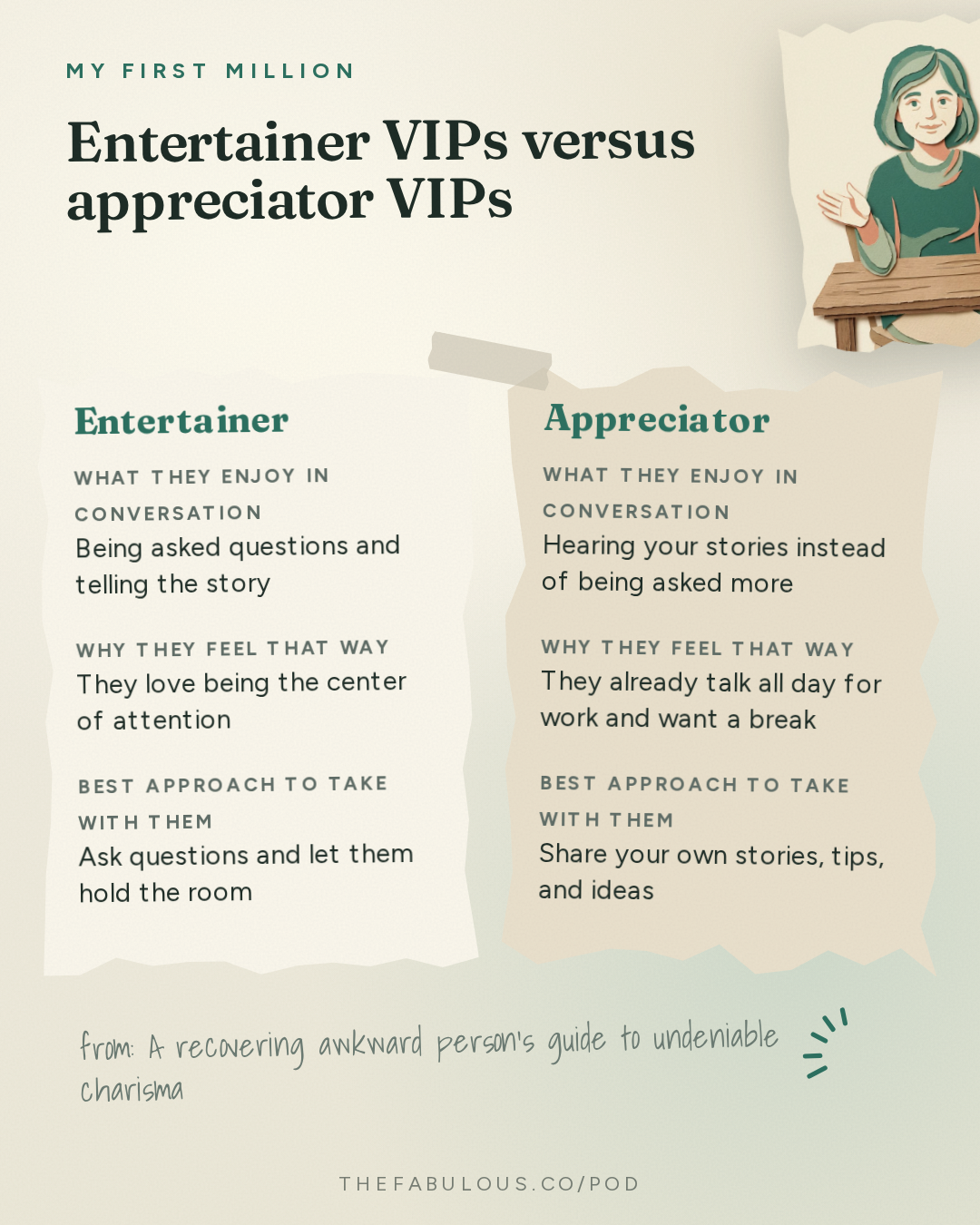
Not every important person wants to be the one telling the story, though. Van Edwards divides VIPs into two camps: entertainers, who love being asked questions and holding the room, and appreciators, who talk all day for a living and would rather listen for once (16:32). She learned this the hard way at a dinner with a investor she says was worth something like $30 billion, who spent an hour asking her questions about artificial intelligence before she realized, late, that he had helped invent the technology himself (16:53). Misreading which type is sitting across the table, she says, is one of the most common ways people sabotage a conversation they were trying to win.
There is a biological reason confidence and nervousness both spread so easily. Van Edwards cites a study in which researchers collected sweat from people doing a calm treadmill run and from first-time skydivers, then had a separate group smell both samples inside a brain scanner. The amygdala, the brain's threat-detection center, lit up only when people smelled the fear sweat (18:23). The implication is that nervousness is not just visible, it is almost literally contagious. The same logic runs the other way: she cites a classic study by researcher Monica Moore showing that in singles bars, the women approached most were not the most conventionally attractive, but the ones sending the clearest signals of availability (23:48). People read openness as safety, in dating and in business alike.
What the voice gives away
Voice carries its own signals, and Van Edwards is especially sharp on uptalk, the habit of letting a sentence rise in pitch at the end as though it were a question. It reads, she says, as nervousness and, more seriously, as deception, because liars often rehearse the words of a lie without rehearsing the tone (33:27). In an fMRI study she references, a rising inflection switched listeners' brains from a listening mode into a scrutinizing one (33:50). Her advice for anyone pitching investors is practical: review the first ten seconds of a recorded call, and rehearse the slide with the numbers out loud until it comes out as a statement, not a question (34:30). She also recommends practicing in what she calls a maximum resonance point, roughly the lower third of a person's natural vocal range, which spans about ten to twelve notes for most speakers (35:12).
"If you ask your number, you're begging people to negotiate with you." — Vanessa Van Edwards [33:08]
Word choice works the same way. Van Edwards describes a classic negotiation study in which two groups played the identical game, told either that they were playing "the Wall Street game" or "the community game." Players told it was the Wall Street game shared an average of one-third of their profits with a partner; players told it was the community game shared about two-thirds (39:02). One label change moved behavior that much. Her lesson for managers is to choose achievement words like win and master when the goal is performance, and collaboration words when the goal is brainstorming, because each vocabulary activates a different mode in the listener's brain (39:58).
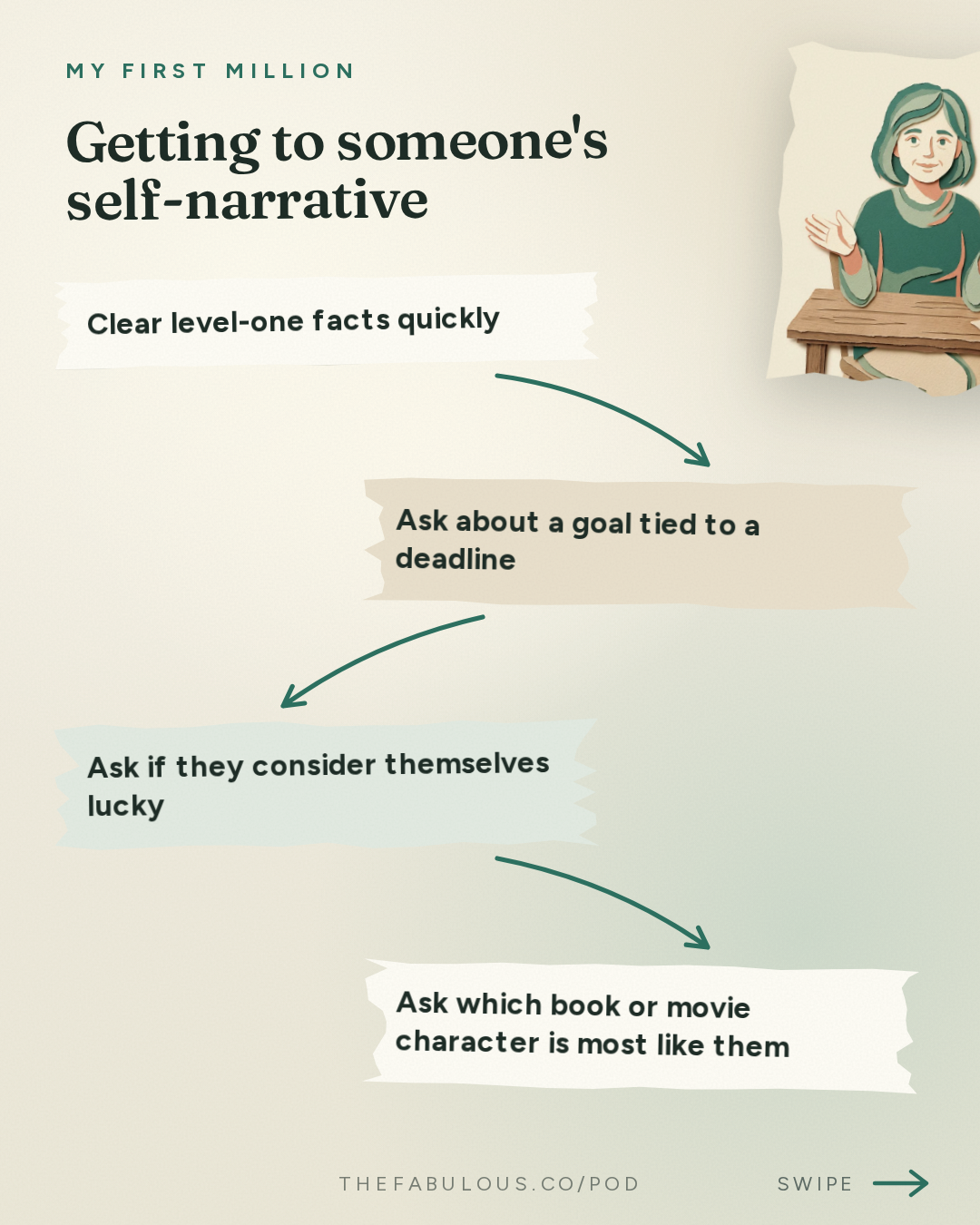
Underneath all the tactics sits a structural idea borrowed from psychologist Dan McAdams, who found that people move through three levels on the way to feeling connected to someone else (43:18). Level one is general facts: job, hometown, kids. Level two is personal concerns: goals, values, what keeps someone up at night. Level three is self-narrative, the story a person tells about who they are. Van Edwards says the fastest way into level two is to ask about a goal tied to a natural deadline, like a New Year's resolution or a book launch (45:47), and the fastest way to surface level three in a hiring conversation is an odd, specific question: what book, movie, or television character is most like you, not in looks but in choices (49:54). She also asks candidates, early, whether they consider themselves lucky, arguing that people who feel unlucky tend to feel like the world happens to them, and literally perceive fewer opportunities in ambiguous tasks (49:02).
None of this, she is careful to say, is about copying someone else's style. She tells Parr not to imitate a particular charismatic person, since everyone's flavor is different, and recommends instead watching a range of TED Talks to find which delivery style feels native (51:51). Her own business has scaled on that same premise: seventeen years of posting videos, a flagship course called People School, a corporate certification program, and, last year, roughly 300 million views across her social channels, run by a team of ten (57:57). The method, in other words, is not a trick. It is closer to a discipline, practiced in public, long enough to look effortless.
Ask this episode anything
Pod's AI answers from the episode itself, with the minute mark so you can hear it yourself.
Or start with one of these
Ask this episode
Pod's AI listens to the whole episode to answer, and points you to the minute it comes from.
The rest of this answer, and any question after it
Answers come from the episode itself, never from a summary of it.
ContinueKey takeaways
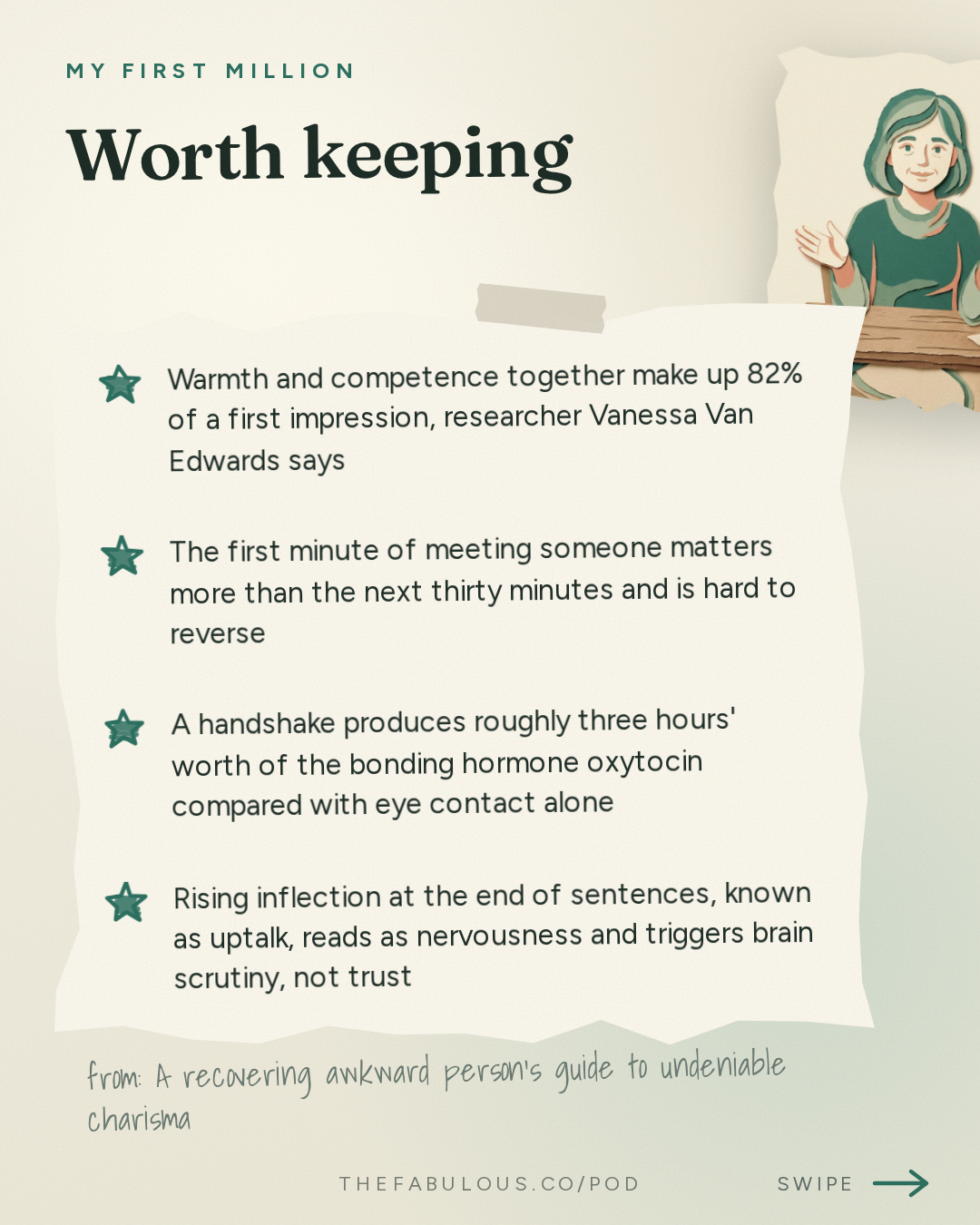
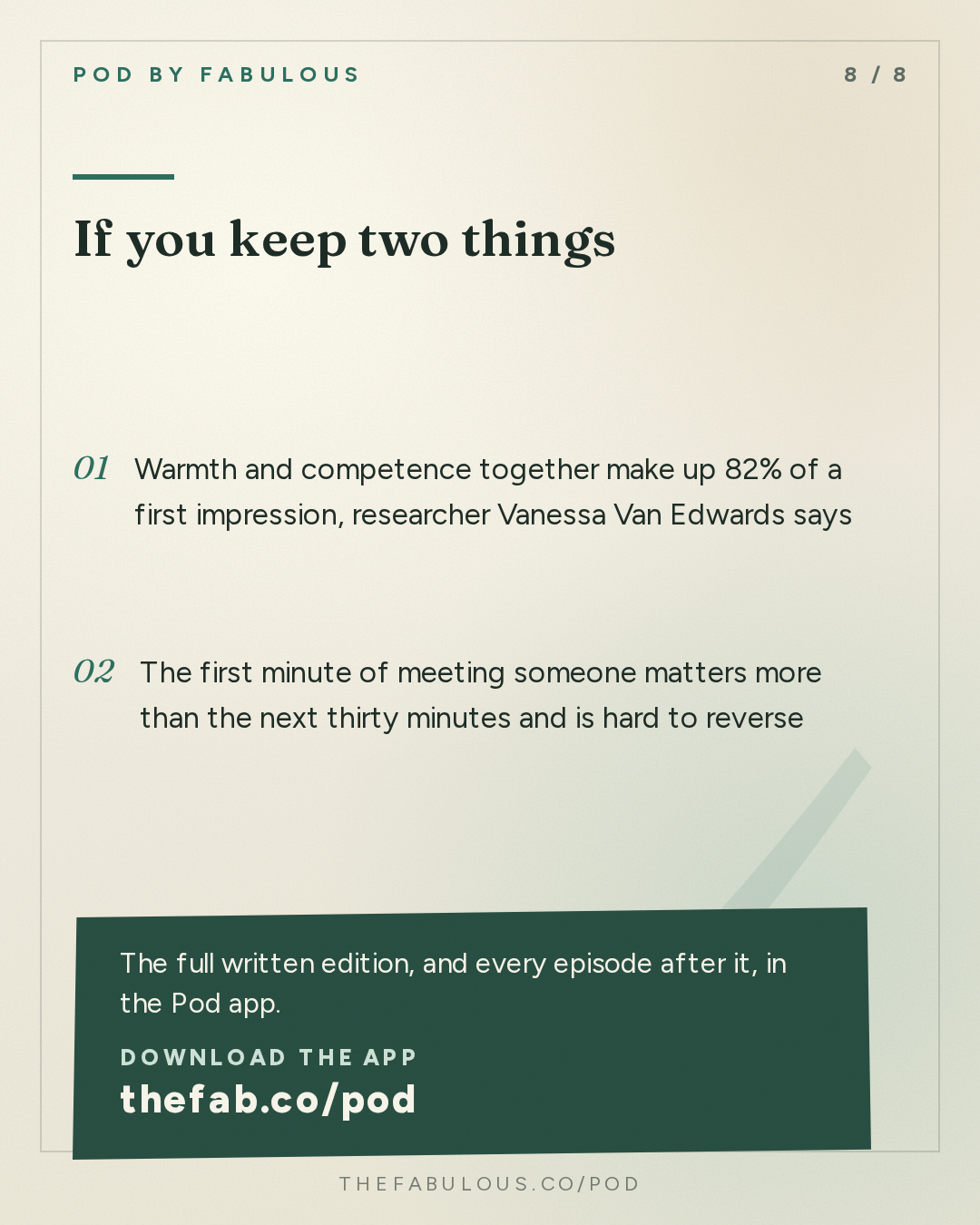
- Warmth and competence together make up 82% of a first impression, researcher Vanessa Van Edwards says
- The first minute of meeting someone matters more than the next thirty minutes and is hard to reverse
- A handshake produces roughly three hours' worth of the bonding hormone oxytocin compared with eye contact alone
- Rising inflection at the end of sentences, known as uptalk, reads as nervousness and triggers brain scrutiny, not trust
- Labeling a negotiation the Wall Street game versus the community game changed how much profit players shared, from one third to two thirds
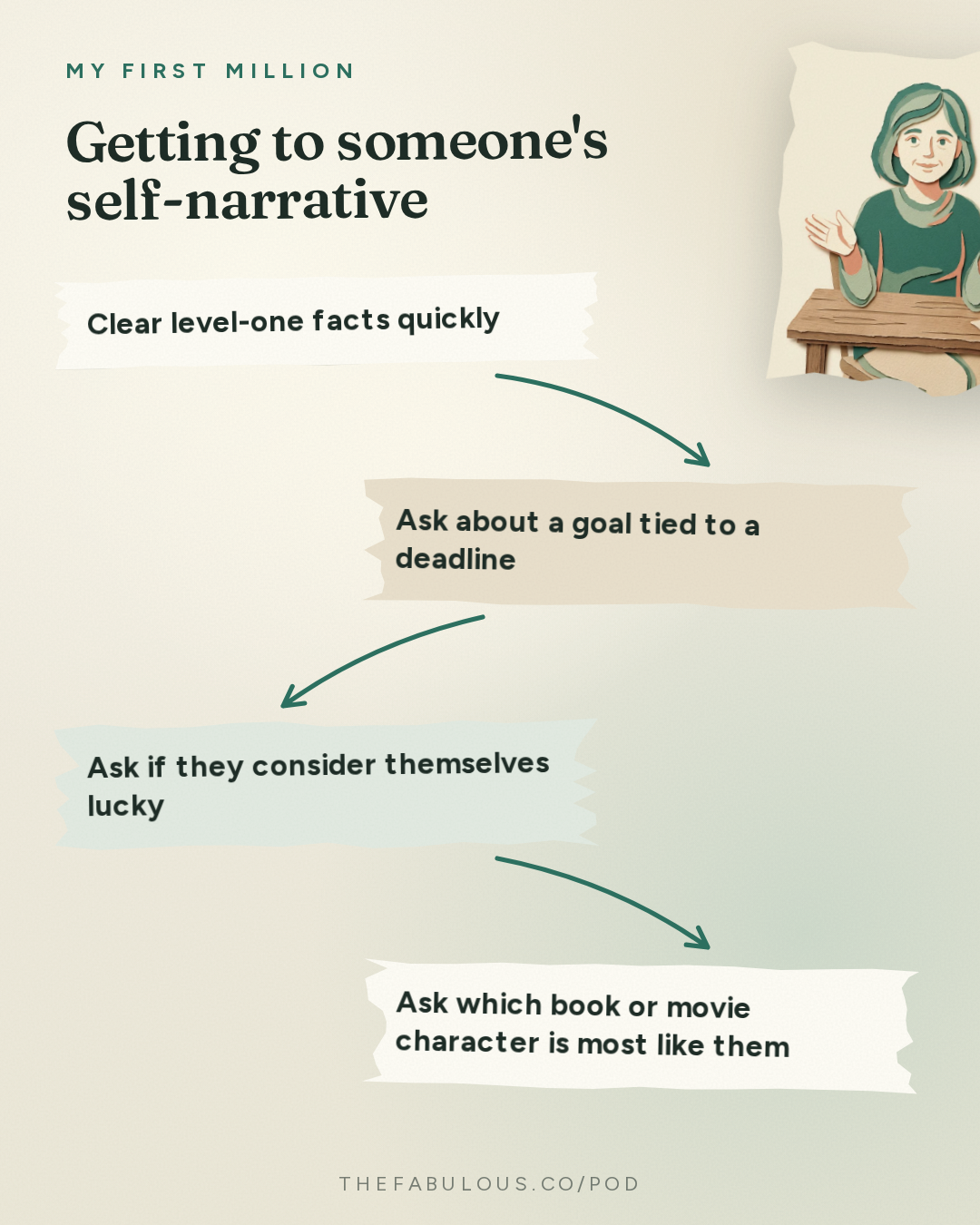
The episode in cards
By the numbers
- 82% percent share of first impressions explained by warmth and competence combined
In their words
“Competence without warmth is likely to leave us feeling suspicious. Not unlikable, suspicious.”
“Likability is a lubricant for your smarts.”
“We find availability more attractive, uh, because it makes us feel safer, it makes us feel like our advances will be heard”
“If you ask your number, you're begging people to negotiate with you.”
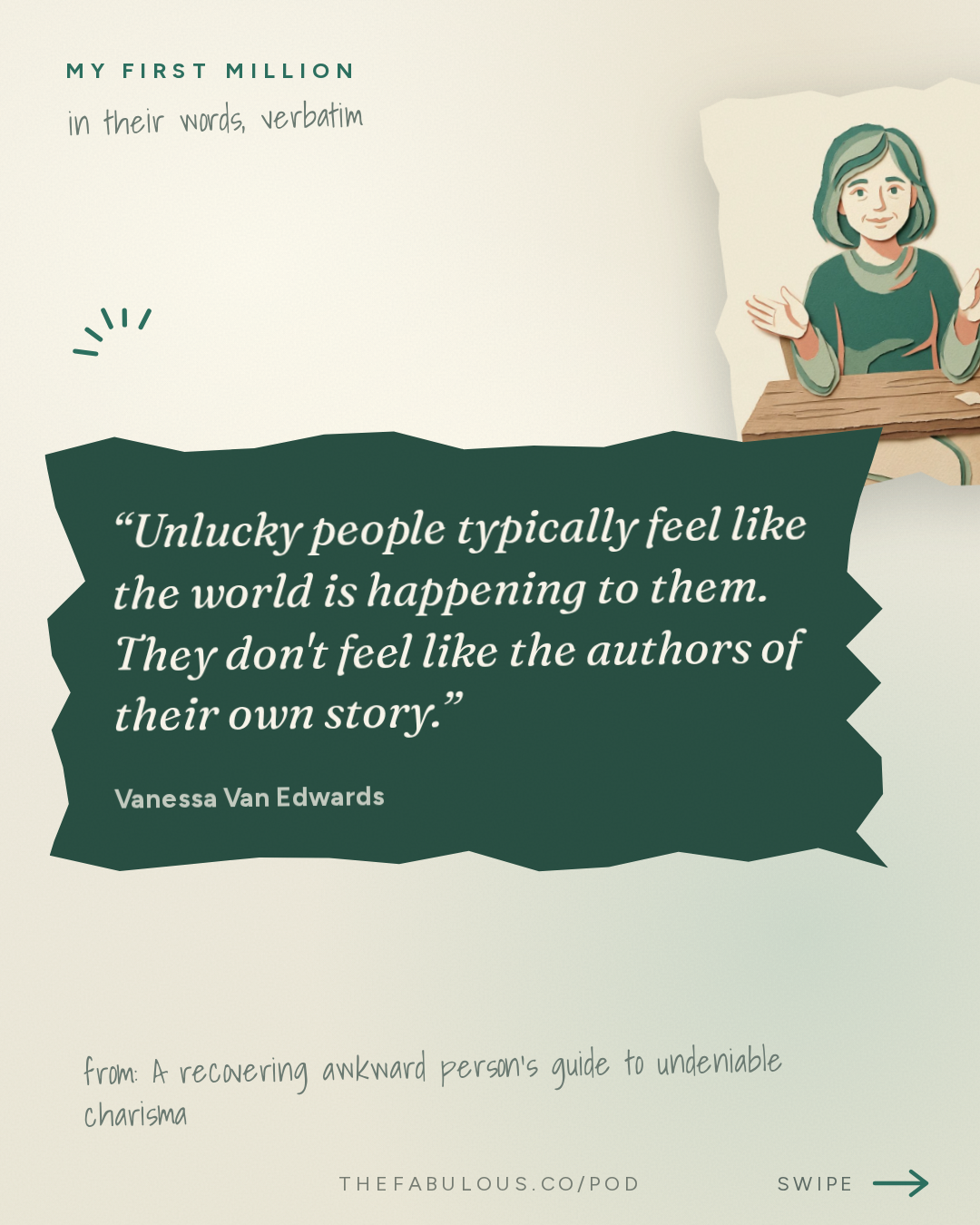
“Unlucky people typically feel like the world is happening to them. They don't feel like the authors of their own story.”
Protocols
-
Open with visible hands
Van Edwards starts every video call and in-person greeting with palms open and hands visible, since the gesture signals to the other person's threat-detection instincts that no weapon is hidden.
at the start of every new interaction
-
Use an information hook before a story
Van Edwards tells clients to preface a story with a hook such as 'you want to hear the worst advice I ever got' every minute or two, because the hook creates a small information gap that keeps the listener's dopamine engaged.
every one to two minutes in conversation
-
Audit the first ten seconds for uptalk
Van Edwards has clients play back the first ten seconds of a recorded pitch or Zoom call and listen for rising inflection at the end of statements, then rehearse the numbers slide until it comes out as a statement rather than a question.
before any pitch or important presentation
-
Match vocabulary to the outcome a leader wants
Van Edwards advises leaders to use achievement words like win, succeed, and master when the goal is performance, and collaboration words like brainstorm and lateral thinking when the goal is creative openness, since the research shows one word change shifts how generously people behave.
at the start of each team meeting
-
Mirror a VIP on three planes
Van Edwards mirrors an important counterpart's volume, pace, and pauses nonverbally and vocally, and matches their specific vocabulary verbally, as long as the intention is to connect rather than to manipulate.
throughout high-stakes meetings
Questions this episode answers
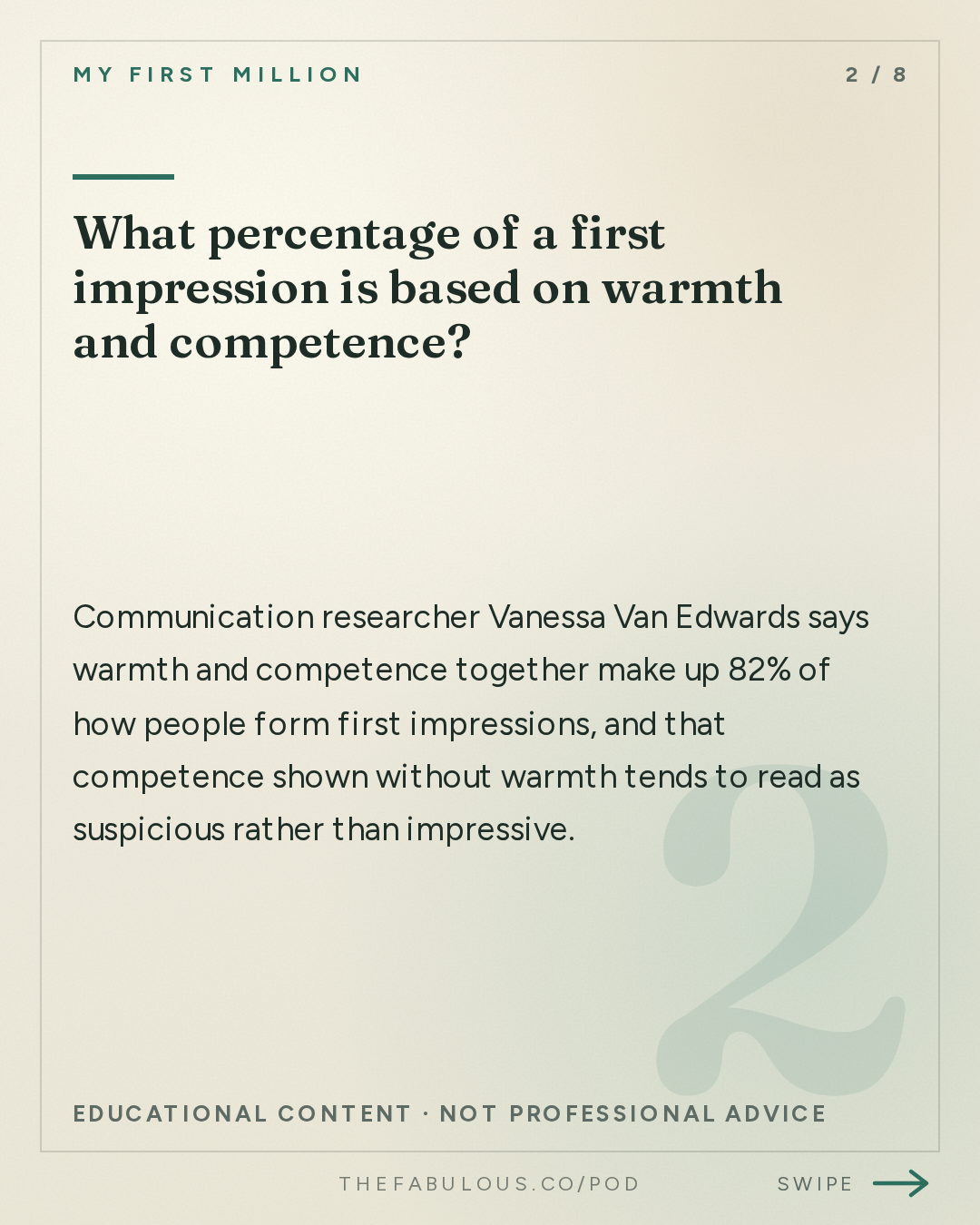
What percentage of a first impression is based on warmth and competence?
Communication researcher Vanessa Van Edwards says warmth and competence together make up 82% of how people form first impressions, and that competence shown without warmth tends to read as suspicious rather than impressive (02:37, 02:56).
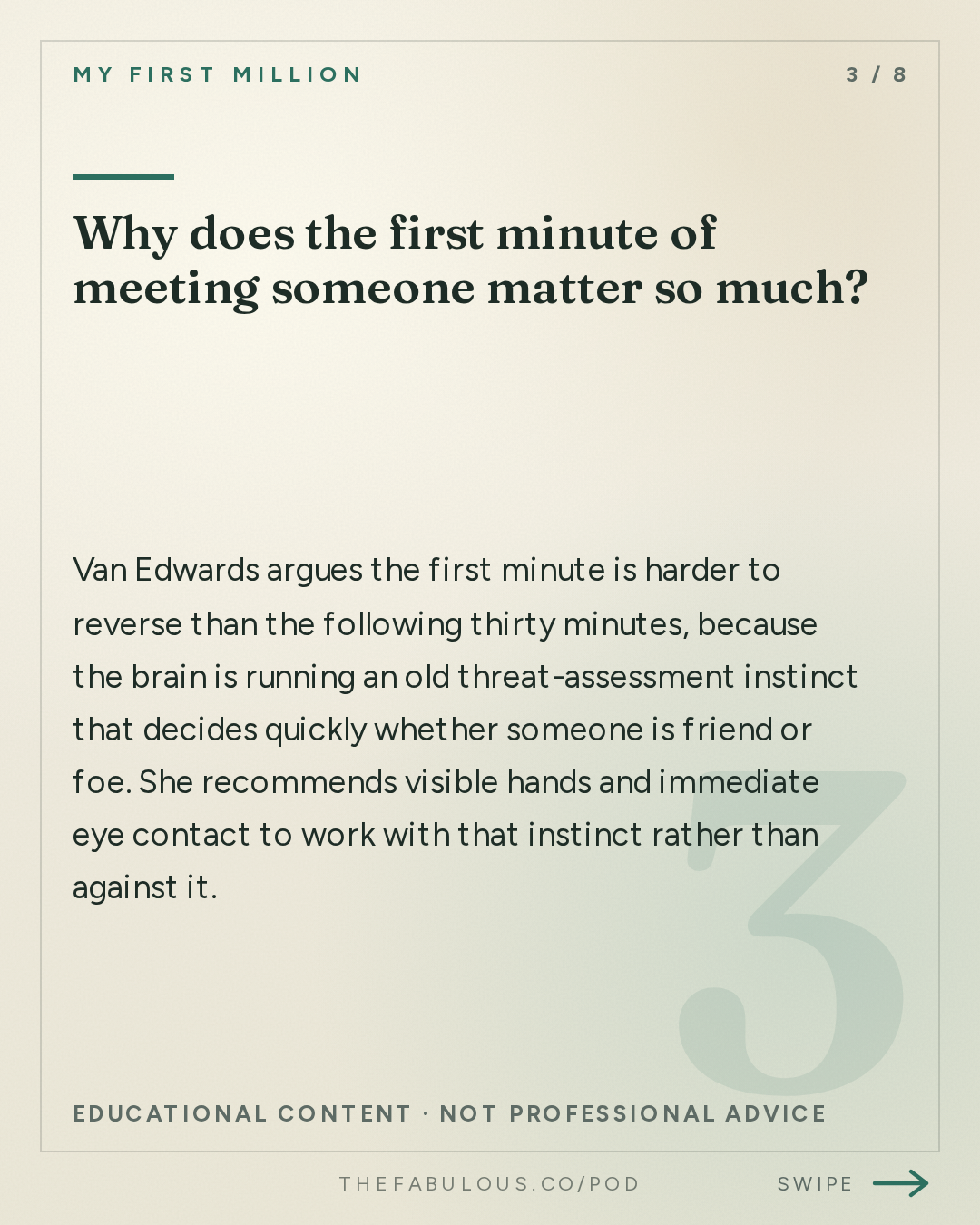
Why does the first minute of meeting someone matter so much?
Van Edwards argues the first minute is harder to reverse than the following thirty minutes, because the brain is running an old threat-assessment instinct that decides quickly whether someone is friend or foe (08:57). She recommends visible hands and immediate eye contact to work with that instinct rather than against it (09:30).
What is uptalk and why does it hurt credibility?
Uptalk is a rising pitch at the end of a sentence that makes a statement sound like a question. Van Edwards says it is tied to nervousness and, in deception research, to lying, because liars rehearse their words but not their tone, and listeners' brains shift from listening to scrutinizing when they hear it (33:27, 33:50).
How can word choice change team performance?
A study Van Edwards cites found that framing an identical game as the 'Wall Street game' versus the 'community game' changed how much profit players shared, from about one third to about two thirds (39:02). She applies this to leadership by matching vocabulary, achievement words for performance, collaboration words for brainstorming, to the outcome a leader wants (39:58).
What are the three levels of connection Vanessa Van Edwards describes?
Drawing on psychologist Dan McAdams, Van Edwards describes level one as general facts like job and hometown, level two as personal concerns like goals and worries, and level three as self-narrative, the story a person tells about who they are (43:18). Most business and personal connection happens at level two (45:08).
What question does Van Edwards ask to spot good hires?
She asks candidates whether they consider themselves lucky, since people who feel unlucky tend to feel the world happens to them and perceive fewer opportunities (48:42, 49:02). She also asks what book or movie character someone is most like, an indirect way to surface self-narrative that direct questions rarely reveal (49:54).
The full read, in cards
Go deeper
- Fear-sweat fMRI study — showed that smelling sweat from first-time skydivers activated the amygdala in observers, suggesting fear can be chemically detected
- Monica Moore singles-bar study — found that women who sent the most availability signals were approached far more often than the most conventionally attractive women
- Wall Street Game versus Community Game study — showed that relabeling an identical prisoner's dilemma game changed how much profit players shared with each other, from one third to two thirds
- How to Win Friends and Influence People — Dale Carnegie's book on asking questions in conversation, which Van Edwards partly critiques
Mentioned
Vanessa Van Edwards · Sam Parr · Elon Musk · Mark Zuckerberg · Elizabeth Holmes · Dale Carnegie · How to Win Friends and Influence People · Howard Stern · Dan McAdams · People School · Love on the Spectrum · Brene Brown · Monica Moore
More from this show and category
How Oh My Mahjong Hit $40 Million in Sales
Oh My Mahjong grew from $1 million to $40 million in revenue in two years by turning a $20 board game into a $450 art object people had to earn. The episode traces that same severity of initiation effect through $3,000 designer sunglasses, Andrew Huberman's $24 million deal with Hims, and a growing backlash against screens and ease.
James Currier's Speed Bar Framework for Startups
James Currier, cofounder of venture firm NFX, argues the single trait that predicts startup success is speed: how fast founders test, decide, and ship. He shows how time constraints, disposable test brands, and founder psychology work together to let underdogs out-move better-funded incumbents (01:34).
Robert Greene on Sublime, Power, and Near-Death
Robert Greene explains how a near-fatal stroke eight years ago led him to write Sublime, a book on reclaiming the awe that phone addiction has eroded. He also covers the Andes crash survivors' impossible climb, near-death brain science, and his law that power needs both presence and absence.
AI in the World of Things: Where to Build Next
Shaan Puri says the next AI wave moves from digital content to the physical world. He points to drug discovery, modified crops, drone warfare, 3D-printed housing, and full self-driving machines as the real opportunities, and urges builders to think like investors who chase the best market instead of perfecting one narrow skill.
