
Robert Greene on Sublime, Power, and Near-Death
Robert Greene almost died. Here’s what it taught him about living
The brief
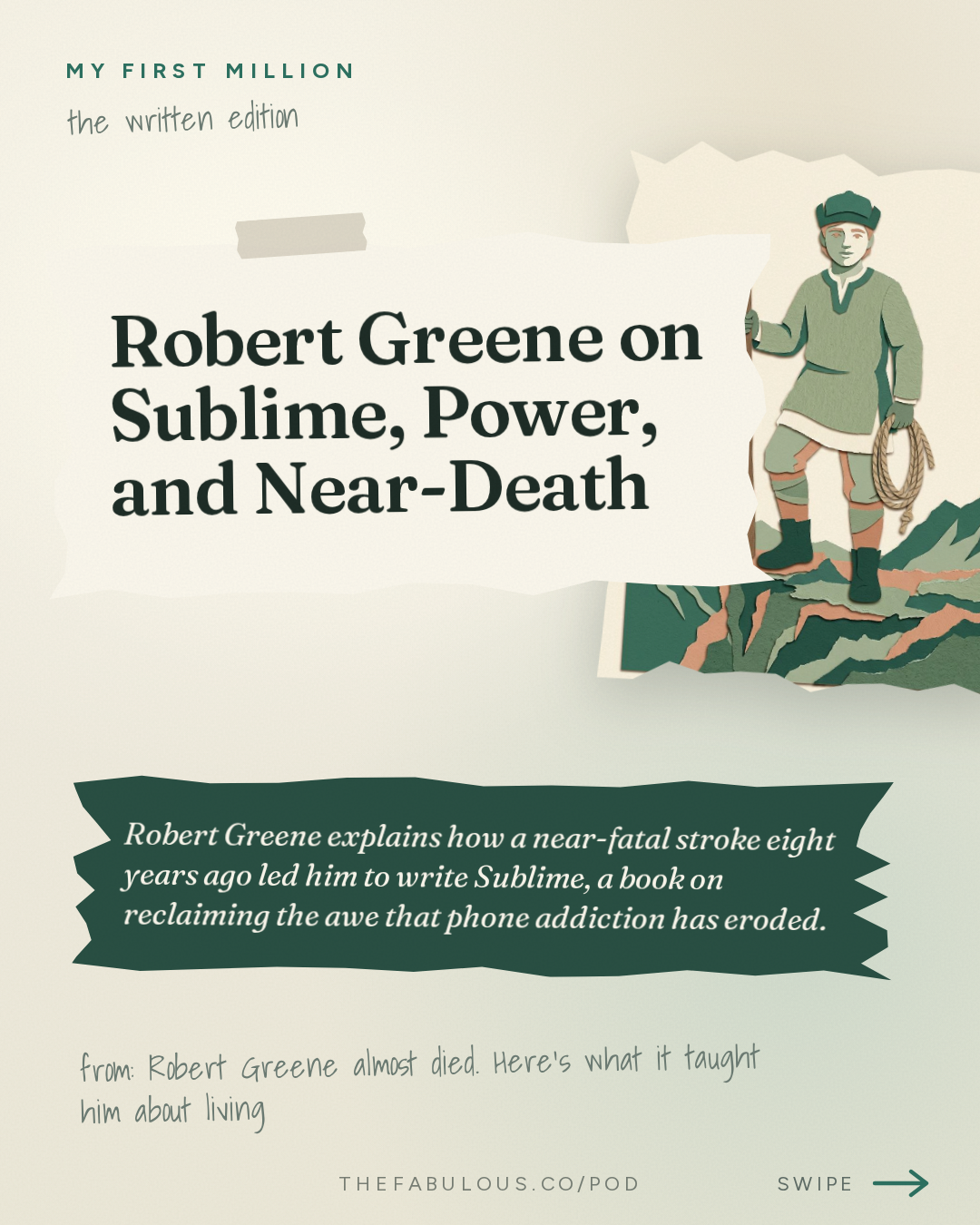
Robert Greene explains how a near-fatal stroke eight years ago led him to write Sublime, a book on reclaiming the awe that phone addiction has eroded. He also covers the Andes crash survivors' impossible climb, near-death brain science, and his law that power needs both presence and absence.
Eight years ago, Robert Greene was driving in Los Angeles when his girlfriend noticed something was badly wrong and called 911 without panicking. Emergency responders arrived with seconds to spare (00:45). Thirty seconds later, Greene says, he would have been dead or brain-damaged. He survived, but the stroke took the use of one hand and his ability to walk unaided. It also, by his account, rearranged how he sees the sky.
Greene is the author of The 48 Laws of Power, a book whose title alone announces its temperament: forceful, acquisitive, built for winning. His new book, Sublime, reads almost like an apology for all that grasping. It argues that modern life has shrunk people's circle of experience, and that the shrinking is not an accident. "People are suffering from the narrowness of their experience, a lot of it coming from technology," he says (01:05). The book is not a memoir of his recovery so much as an attempt to give ordinary readers a version of the clarity he found near death, without requiring them to nearly die first.
His diagnosis starts with a number. Something like 90% of American adults carry a smartphone, and by Sam's estimate, nearly that same share are functionally addicted to it, checking it for seven hours a day on average (05:54, 06:41). He is careful to say he has no hard data proving this generation is uniquely troubled; people in the 1920s drank martinis at dinner and called it normal, and English villagers once stayed mildly drunk on ale because the water wasn't safe (03:43). What he thinks actually is new is the design of the thing in people's pockets. Social feeds are curated by someone else's algorithm, not chosen by the person scrolling. "We are animals that want agency. We want to be able to control something about our own lives," he says, and he thinks the phone quietly takes that control away, dosed out an app at a time (05:07).
His prescription sounds almost too simple: leave the phone behind, go outside, and let boredom do its work. "Get outside your house, go out into nature, go out into Central Park, or go out into Connecticut somewhere, and leave your goddamn phone behind. Lock it in a drawer," he says, describing the itch that follows, the need to know who won the election, and the way that itch eventually breaks and turns a mind back outward, toward sound and weather and the sensation of one's own body moving (13:06). A child does this automatically, he notes; a two-year-old is awestruck by a color. Adults lose the habit and have to relearn it on purpose.
What a mountain without gear can teach about limits
Greene's favorite illustration of human capacity under pressure is the 1972 crash of a plane carrying a Uruguayan rugby team into the Andes (18:49). The survivors had only spring clothing, no climbing equipment, and a mountain in front of them roughly 14,000 feet high (19:16). Food ran out fast enough that the living ate the dead to stay alive. One survivor, Nando Parrado, had lost his mother and sister in the crash and was thinking of his father back home, who he believed would not survive losing his whole family. That thought, Greene says, is what sent Parrado up the mountain with two companions, using a hand-made pick cut from airplane wreckage to carve finger holds into ice for two straight hours (21:19). At the summit he found more mountains behind the first one, no equipment, and no clear way down, yet he and one companion kept walking until they reached green fields and people. Of roughly 45 passengers, about 18 survived (22:36).
Greene's point is not inspirational in the greeting-card sense. It is closer to a claim about design: humans carry more capacity than they use, and extremity reveals it rather than creating it. "We put limits on what we think we can do, but there are actually no limits," he says (23:00). He pairs the story with the work of the psychiatrist Victor Frankl, who survived Auschwitz and later wrote Man's Search for Meaning, arguing that the prisoners most likely to survive were the ones who still had something, or someone, to live for (24:08). Purpose, in both stories, functions less like motivation and more like fuel: it is the thing that keeps the body moving once willpower alone has run out.
Power as a rhythm, not a performance
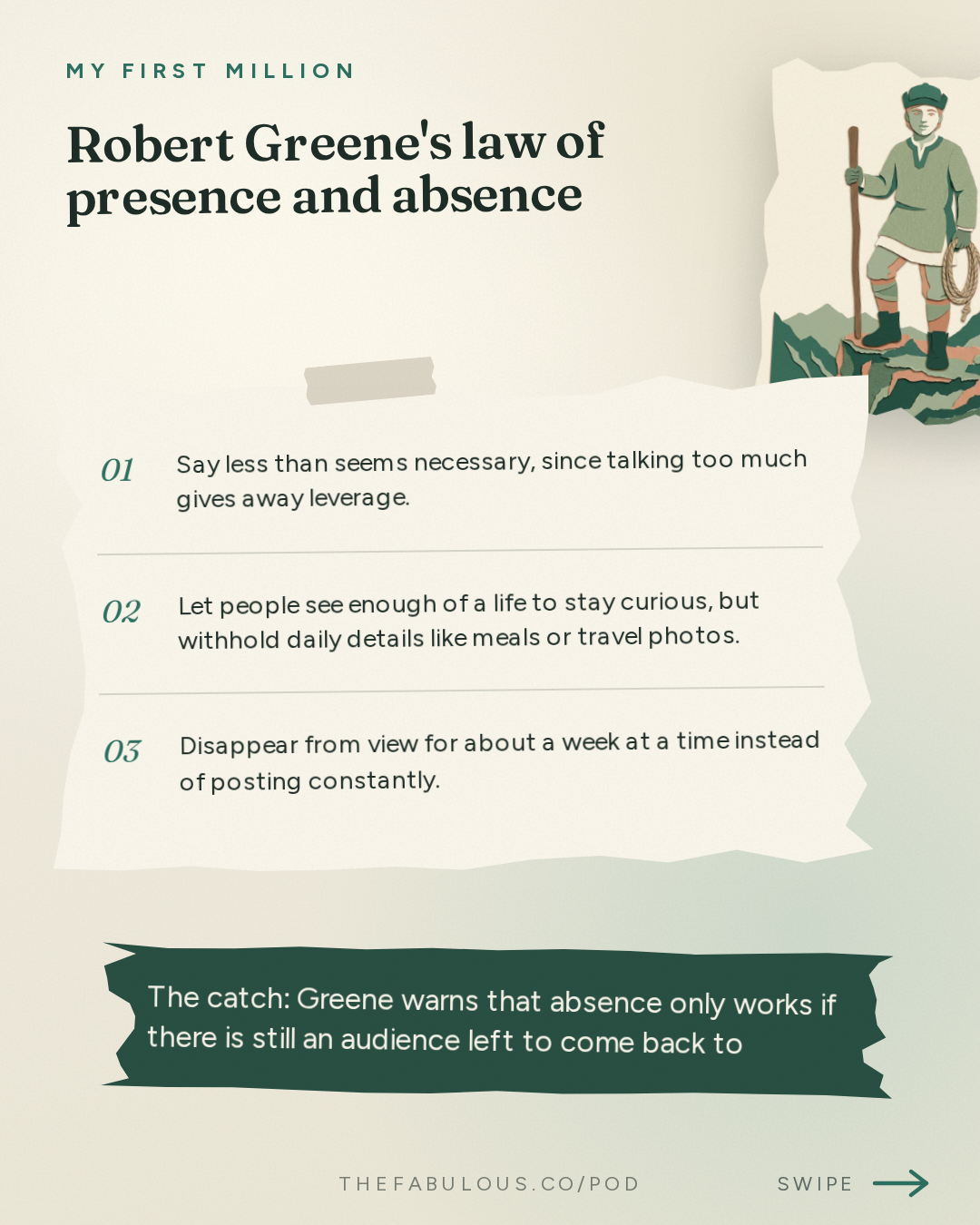
Greene's older, harder-edged books return in the conversation as a kind of counterweight. Asked what the first lesson of a hypothetical "power course" would be, he does not hesitate: say less than people expect, and manage the rhythm between being seen and being unseen. "Power is about absence and presence. If you're always present, people take you for granted and they grow bored with you," he says, adding that constant absence is its own trap, since there is then nothing left to talk about (30:35). He points to Beyoncé disappearing from public output for stretches and returning with new work to a public that has spent months speculating about her (34:58). The catch, by his own account, is that the strategy only works if there is a public still paying attention when someone reappears; absence that goes on too long just reads as irrelevance.
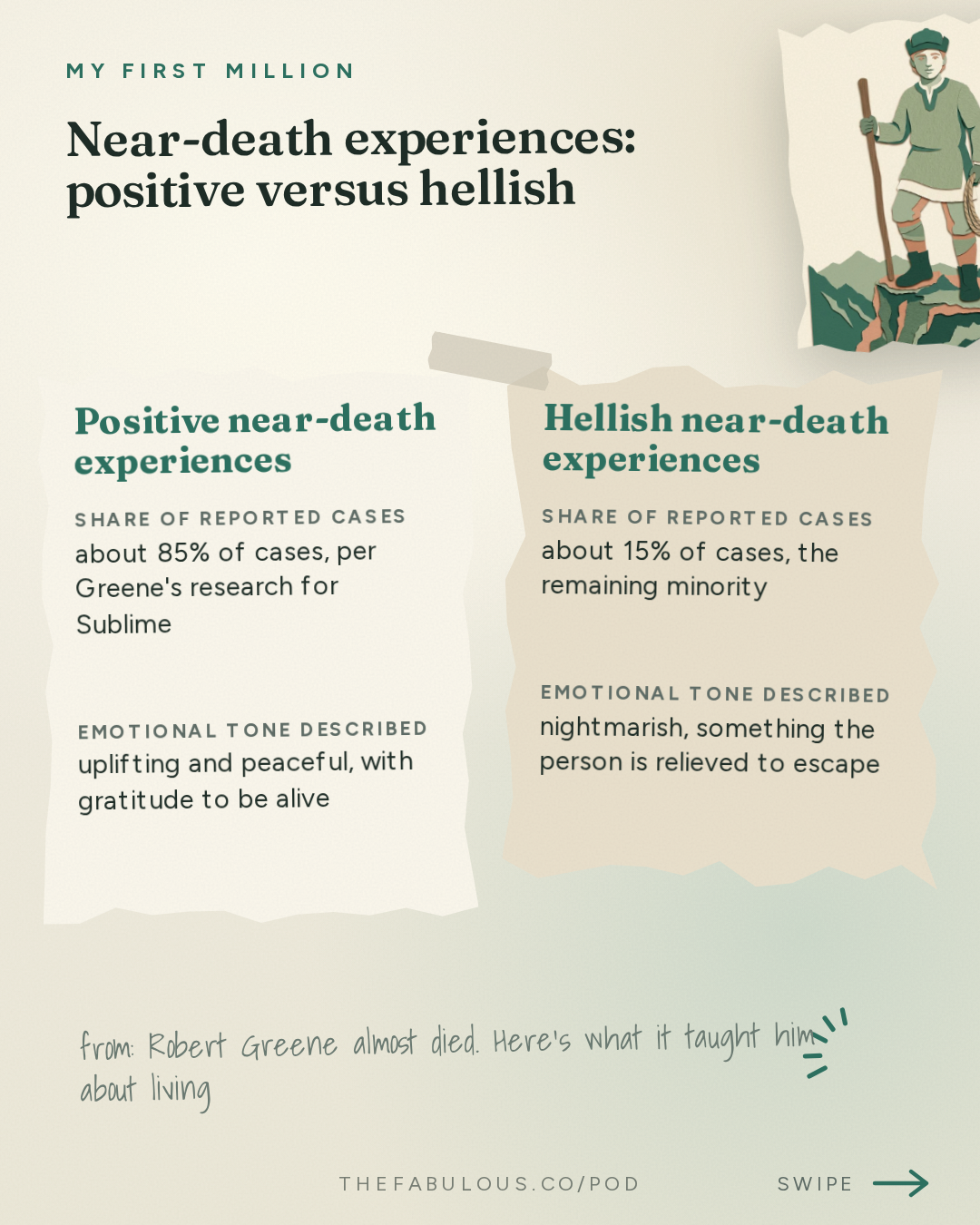
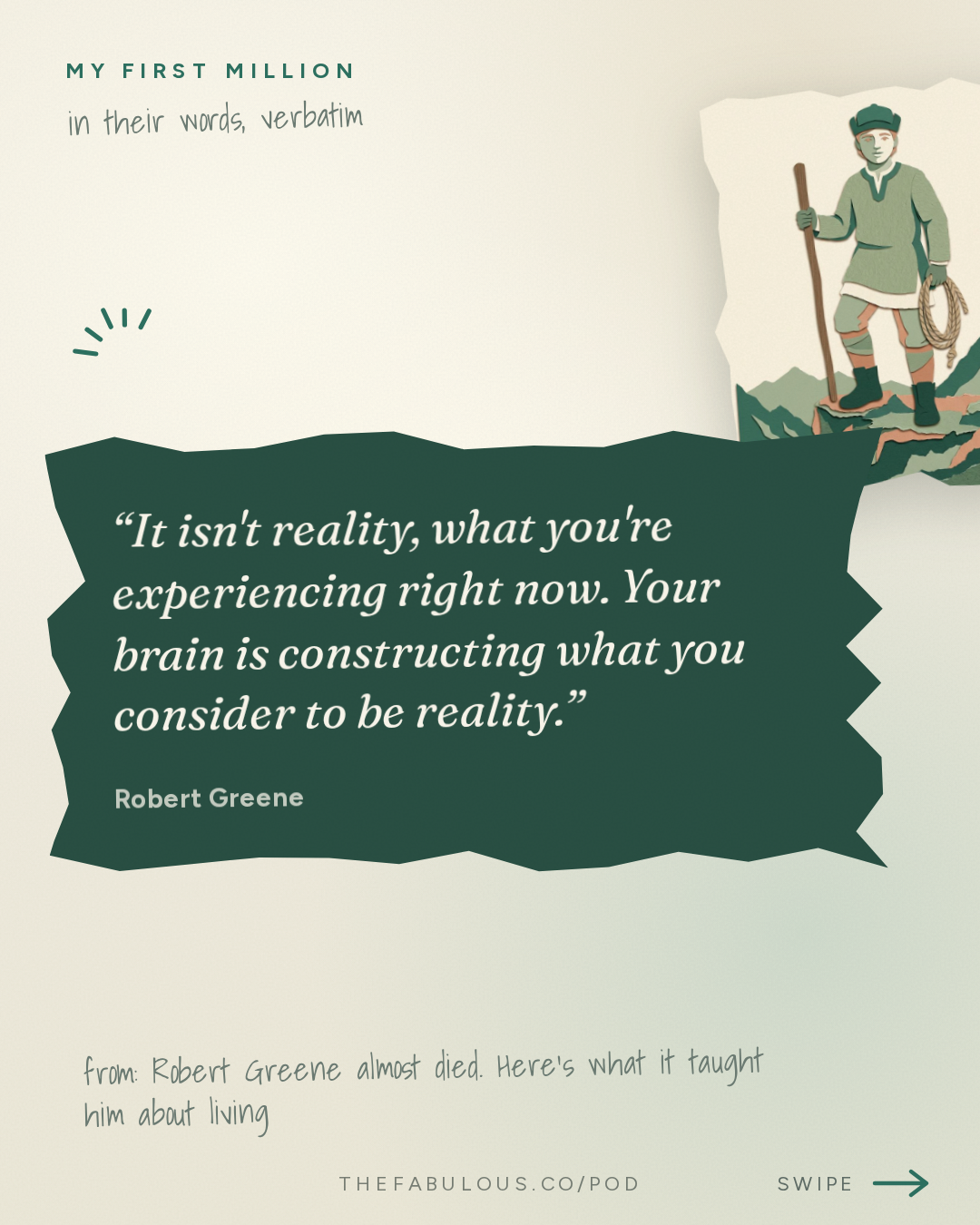
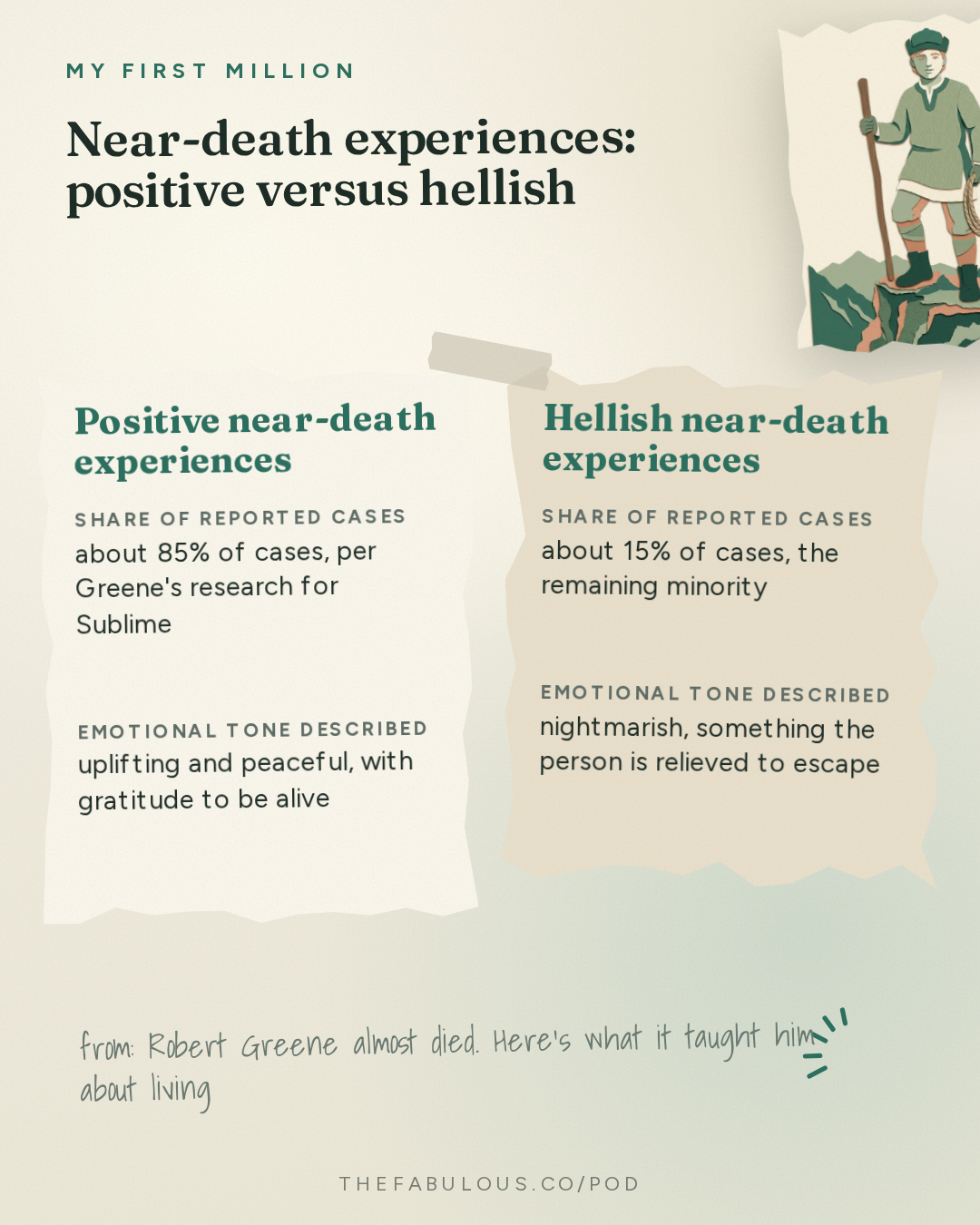
The same mechanism, Greene suggests, explains his own experience of his stroke and near-death. He describes the sky looking unnaturally saturated when he first woke from his coma, a sensation that recurs in waves even now (47:12). He frames this not as hallucination but as a glimpse behind a curtain the brain normally keeps drawn. "It isn't reality, what you're experiencing right now. Your brain is constructing what you consider to be reality," he says, arguing that ordinary perception is itself a construction, and that the dying brain's breakdown of that construction is what produces the tunnels, the light, and the life review that near-death literature keeps describing (46:14). He points listeners toward Dying to Live, a book by the neuroscientist and self-described skeptic Susan Blackmore, who argues these visions come from the brain's physiology as it shuts down rather than from anything supernatural (45:26). Greene's own research for Sublime found that about 85% of reported near-death experiences are positive or peaceful, with the remaining share closer to nightmarish (43:55).
Charisma gets the same close reading. Greene calls its nonverbal form "aura": "Aura is basically non-verbal charisma. It's without even having to do anything, it's just there," he says (57:21). His research for an earlier book, The Art of Seduction, turned up a pattern he finds uncomfortable: a large share of people regarded as charismatic had difficult or abandoned childhoods, and channeled the resulting hunger for attention into public life (60:16). What reads to an audience as magnetism, he argues, is often raw inner intensity, anger or love, pushed outward without being named. He uses 50 Cent, who survived being shot nine times at close range and later worked with Greene on The 50th Law, as an example of confidence forged by having already survived the worst (62:13). Still, Greene insists the trait at the center of it all is simpler than backstory: "Confidence is by far the most charismatic quality that you could have," he says, while conceding that faked confidence reads as empty bravado rather than the real thing (61:36).
None of this, in Greene's telling, makes charismatic people easy to live with or admire wholesale. He names Kobe Bryant, Steve Jobs, and Winston Churchill as figures who accomplished enormous things while being, by most accounts, difficult or unkind in their private dealings (70:06). He offers his former research assistant, author Ryan Holiday, and Oklahoma City Thunder head coach Mark Daigneault as rarer cases: people who combined real competence with decent character. Daigneault took over a losing NBA team while still in his early thirties, developed an unconventional offensive-rebounding strategy other teams later copied, and won a championship by pairing strategic intelligence with genuine empathy for his players (72:40). Greene's own book Mastery makes the same point more generally: raw skill without social intelligence neutralizes itself, while the two together produce outsized results (75:54).
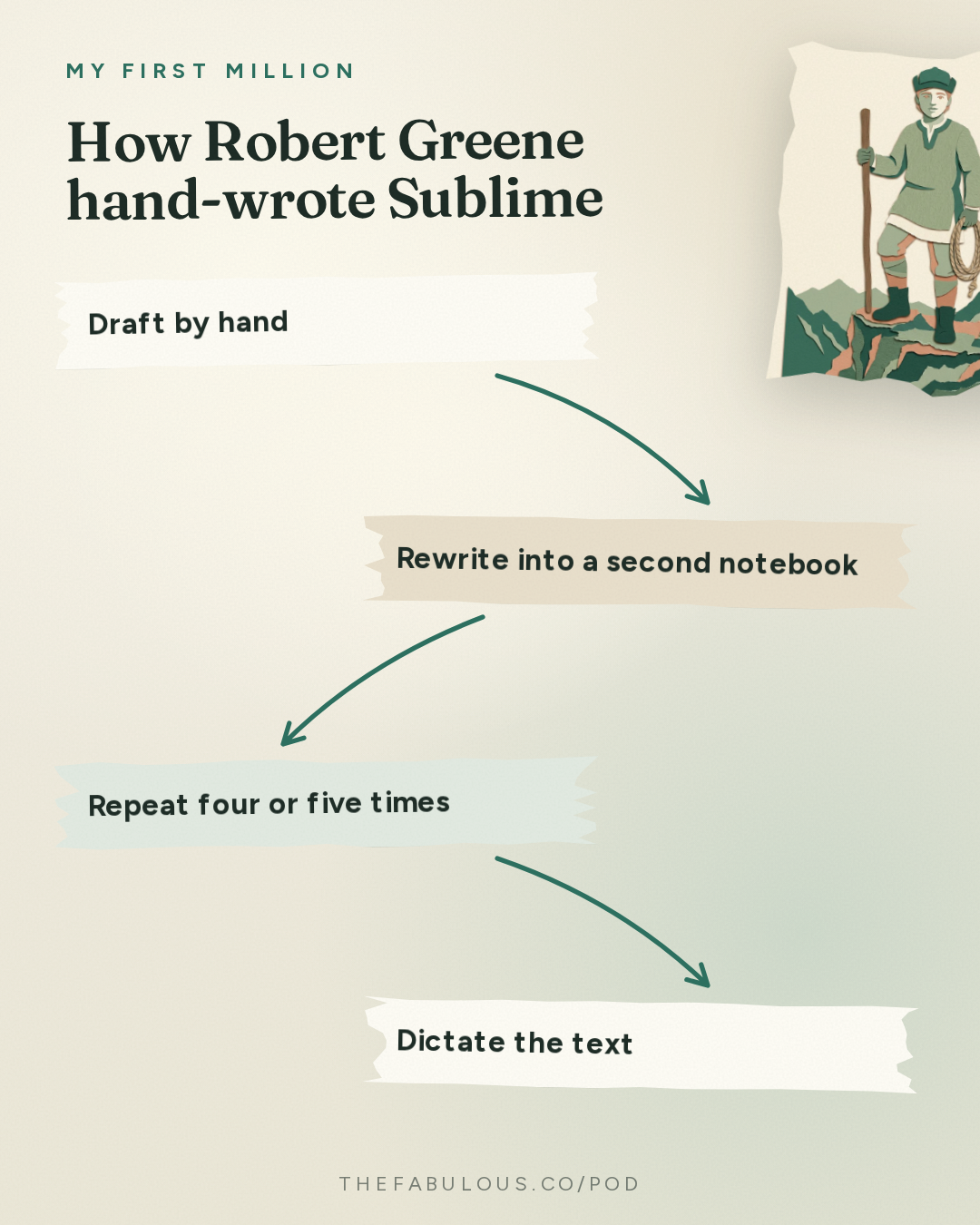
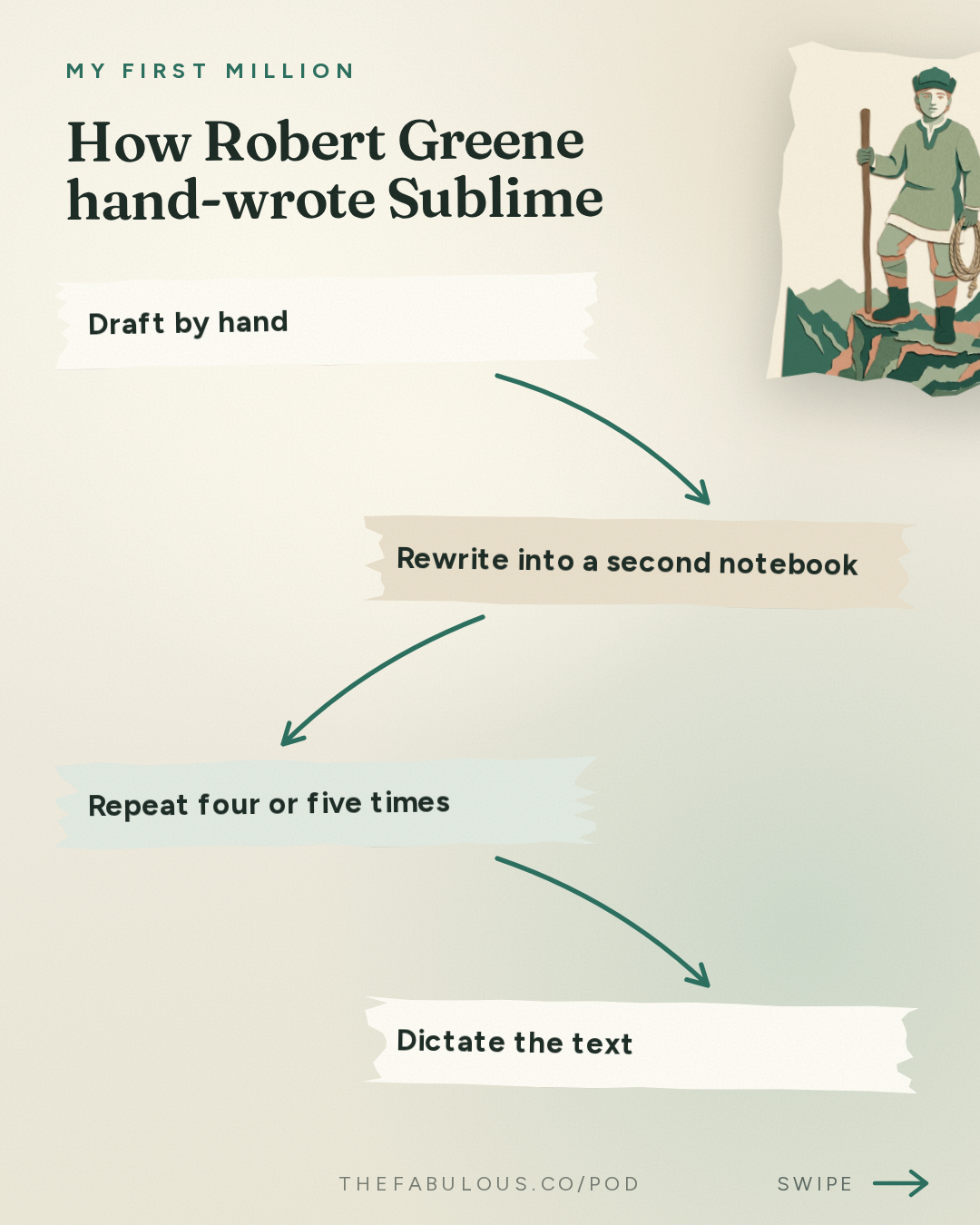
That same logic shapes how Greene talks about writing Sublime itself, a book he admits has almost no obvious search demand next to The 48 Laws of Power. He wrote every draft by hand, rewriting each passage word for word into a second notebook while editing, cycling through that process four or five times, then dictating, printing, hand-editing the printout, and finally typing the last changes with the one hand the stroke left him (40:55). The result took roughly seven years. His closing argument is less about productivity than about where work should come from at all: write what needs expressing, not what the market currently rewards, and trust that genuine excitement will eventually find its own audience. As Sam notes, borrowing an idea from musician Mike Posner's own comeback, the point is to make what's cool to oneself, and sometimes the whole world agrees (79:43).
Ask this episode anything
Pod's AI answers from the episode itself, with the minute mark so you can hear it yourself.
Or start with one of these
Ask this episode
Pod's AI listens to the whole episode to answer, and points you to the minute it comes from.
The rest of this answer, and any question after it
Answers come from the episode itself, never from a summary of it.
ContinueKey takeaways
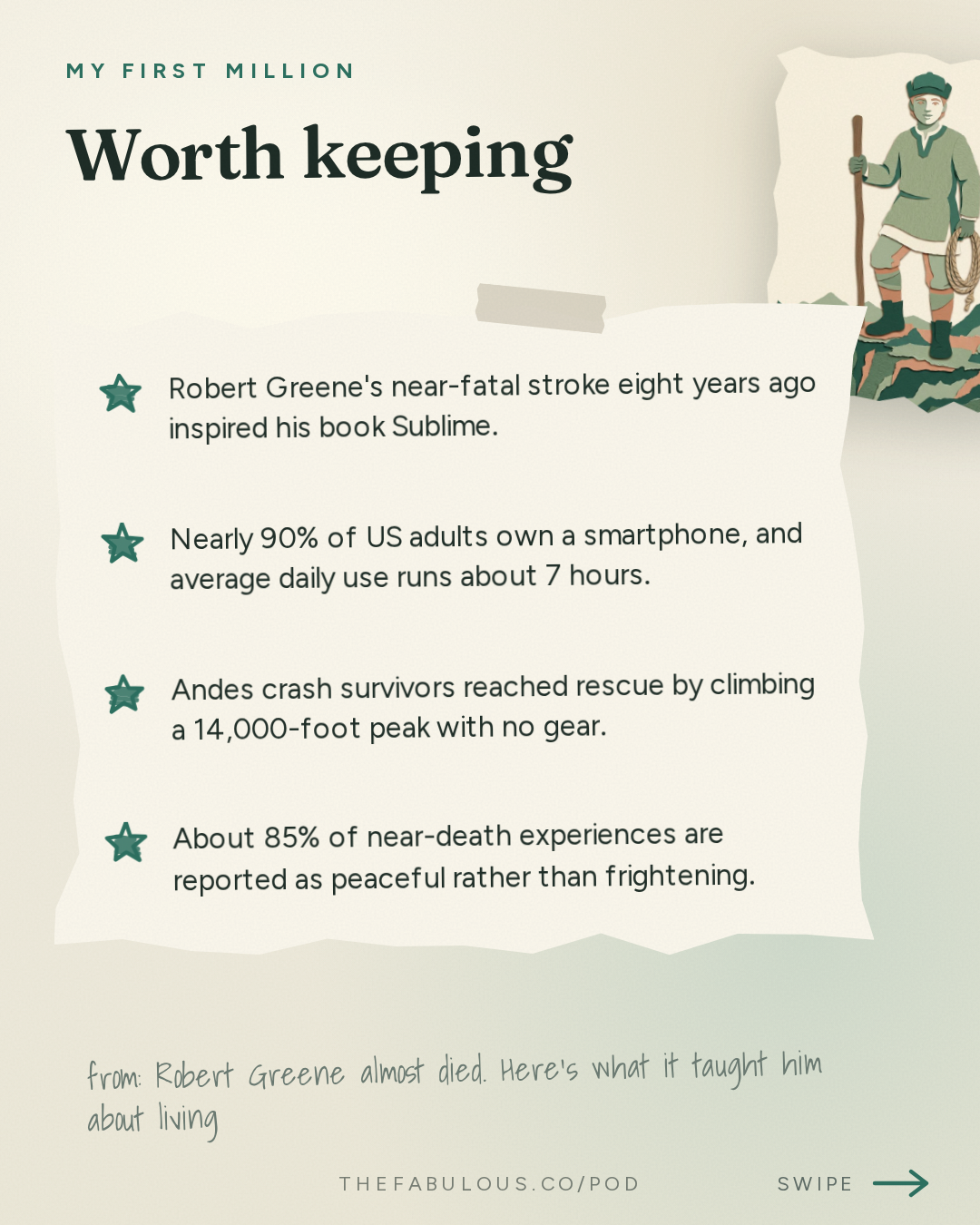
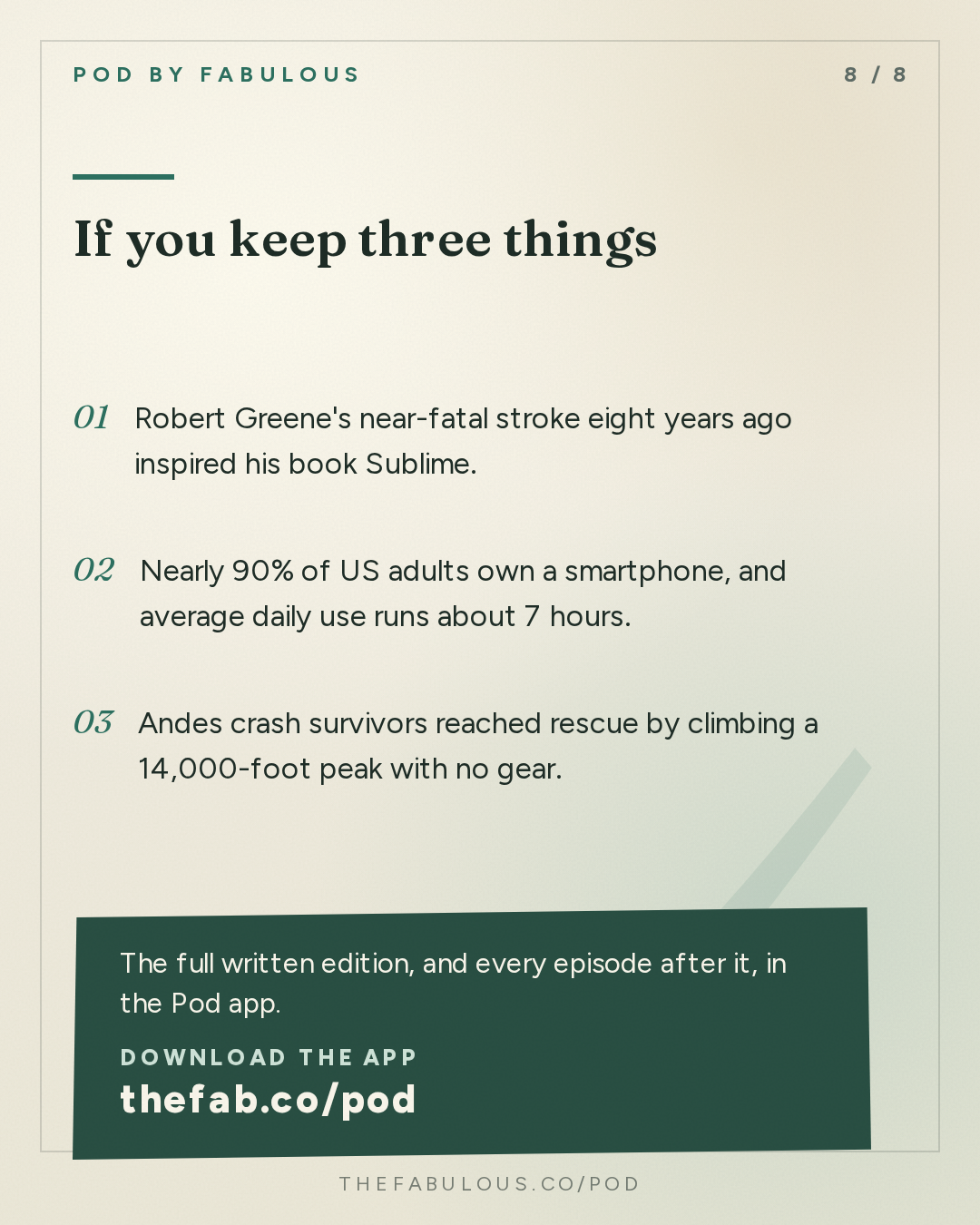
- Robert Greene's near-fatal stroke eight years ago inspired his book Sublime.
- Nearly 90% of US adults own a smartphone, and average daily use runs about 7 hours.
- Andes crash survivors reached rescue by climbing a 14,000-foot peak with no gear.
- About 85% of near-death experiences are reported as peaceful rather than frightening.
- Confidence, not backstory or likability, is the trait Greene calls most charismatic.
The episode in cards
By the numbers
- 85% percent near-death experiences reported as positive or peaceful
In their words
“People are suffering from the narrowness of their experience, a lot of it coming from technology.”
“We are animals that, that want agency. We want to be able to control something about our own lives”
“It isn't reality, what you're experiencing right now. Your brain is constructing what you consider to be reality.”
“Confidence is by far the most charismatic quality that you could have.”
Protocols
-
Disconnect from the phone to recover a sense of awe
Robert Greene recommends leaving the phone at home and spending unstructured time outdoors, such as walking in a park or climbing, so attention turns toward sound, light, and the body instead of a screen; he notes the first minutes will feel like withdrawal before the mind settles outward.
whenever possible, ideally for an hour or more at a stretch
-
Use absence, not constant presence, to hold power
Greene advises withdrawing from public view for about a week at a time rather than posting constantly, because disappearing creates curiosity while being always present breeds boredom; he adds that total, permanent withdrawal defeats the purpose, since it leaves nothing left for people to talk about.
periodic, roughly a week at a time
-
Write in multiple handwritten passes before typing
Greene wrote Sublime by handwriting a draft in one notebook, then rewriting it word for word into a second notebook while editing, repeating that cycle four or five times, then dictating the text, printing it, hand-editing the pages, dictating again, and finally typing the last edit with one working hand.
repeated across roughly seven years to finish the book
Questions this episode answers
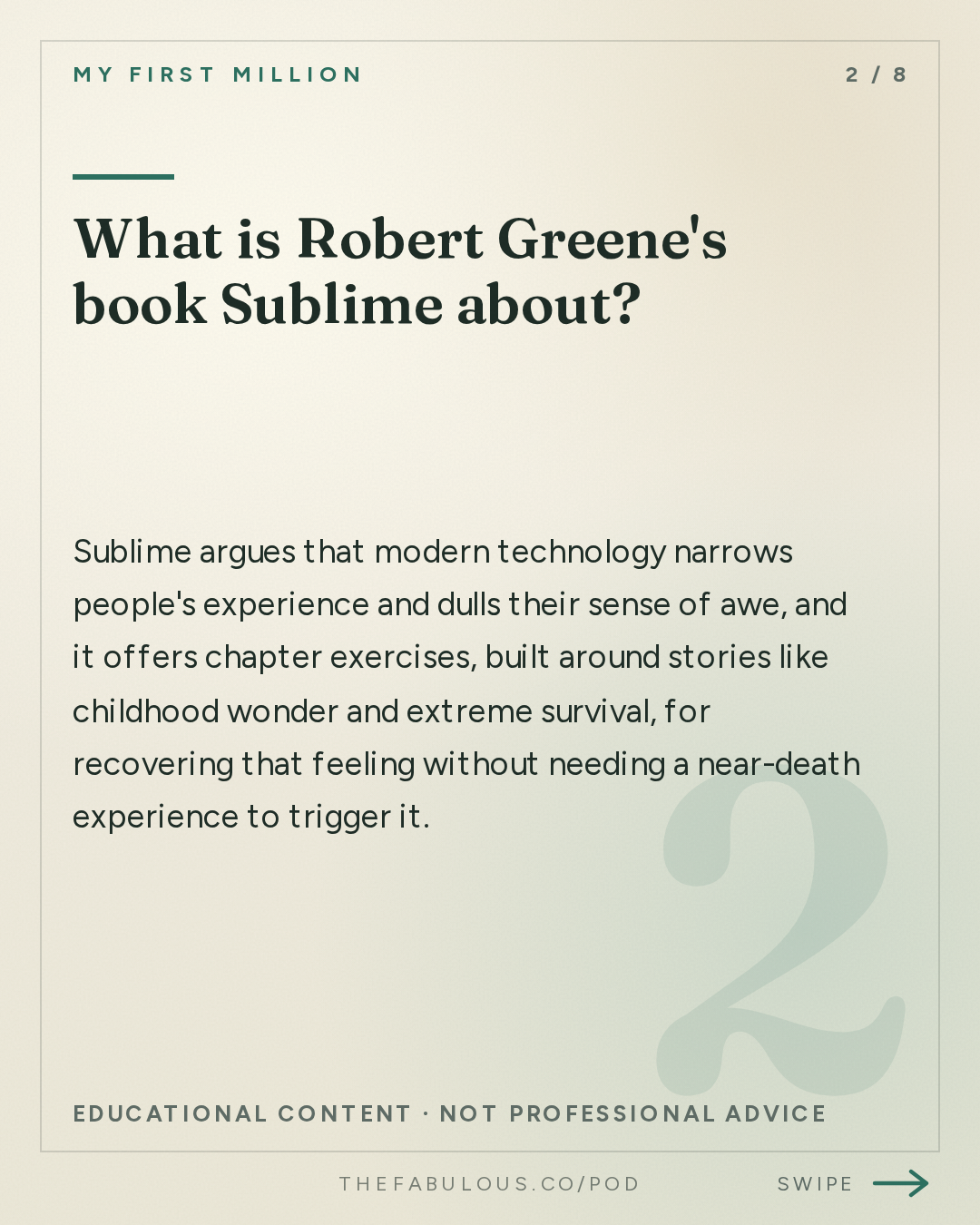
What is Robert Greene's book Sublime about?
Sublime argues that modern technology narrows people's experience and dulls their sense of awe, and it offers chapter exercises, built around stories like childhood wonder and extreme survival, for recovering that feeling without needing a near-death experience to trigger it (00:45).
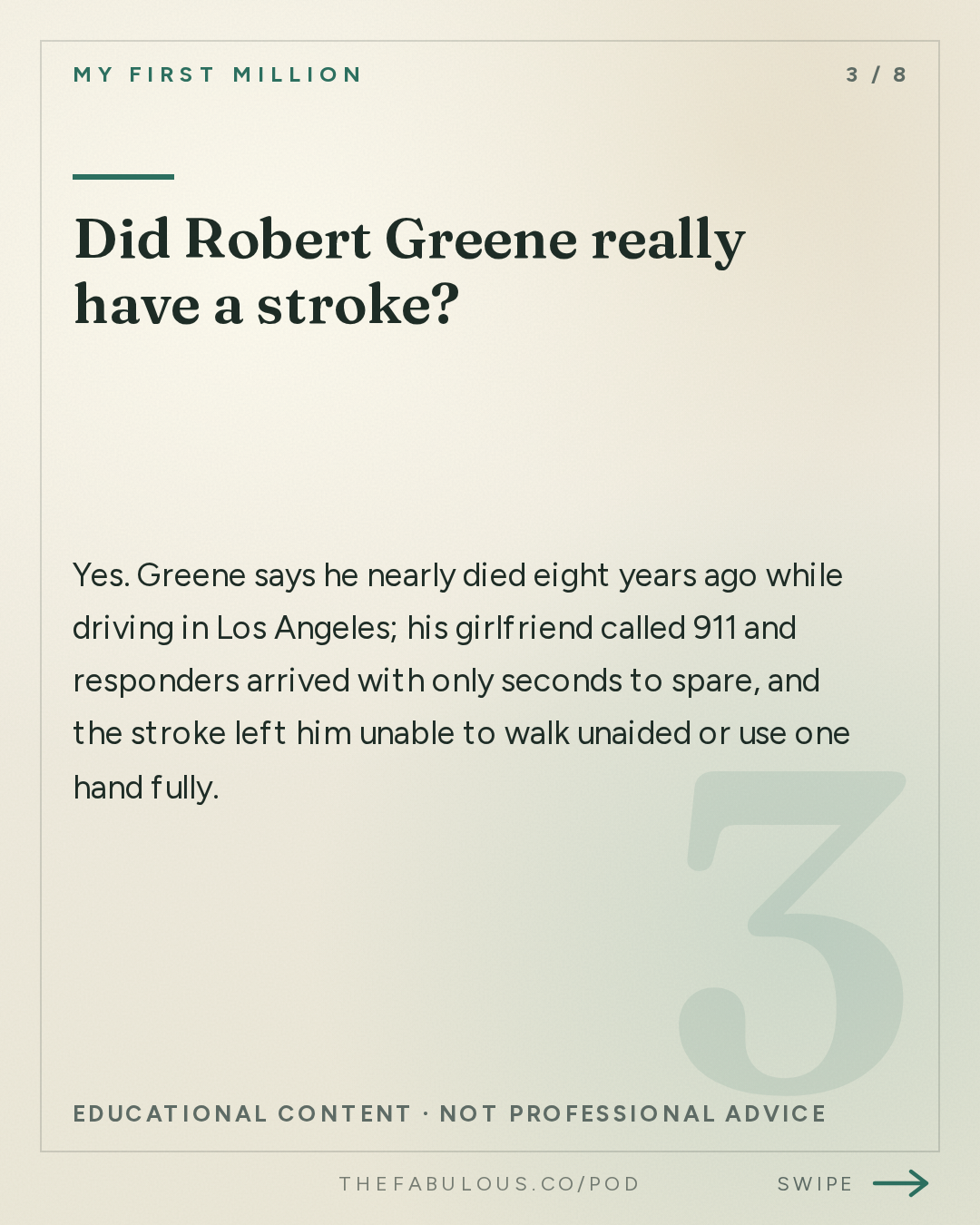
Did Robert Greene really have a stroke?
Yes. Greene says he nearly died eight years ago while driving in Los Angeles; his girlfriend called 911 and responders arrived with only seconds to spare, and the stroke left him unable to walk unaided or use one hand fully (00:45).
What percentage of near-death experiences are positive?
Based on Greene's research for Sublime, about 85% of reported near-death experiences are positive or peaceful, with roughly 15% described as hellish or nightmarish; he discusses this alongside Susan Blackmore's book Dying to Live, which explains the visions as effects of the dying brain rather than supernatural events (43:55).
What does Robert Greene say makes someone charismatic?
Greene says confidence is the single most charismatic trait a person can have, and that nonverbal charisma, which he calls aura, often comes from intense inner emotion, like anger or love, that shows on the face without being stated aloud (57:21, 61:36).
What is Robert Greene's law about power, presence, and absence?
Greene teaches that constant presence makes people take someone for granted, while periodic absence, such as withdrawing from public view for about a week, creates curiosity and perceived importance; he cautions that permanent absence backfires because it leaves nothing for an audience to talk about (30:35).
Who is Mark Daigneault and why does Robert Greene admire him?
Mark Daigneault is the head coach of the Oklahoma City Thunder, who took over the team's losing record in his early thirties and later won an NBA championship using an unconventional offensive-rebounding strategy; Greene cites him as a rare case of someone who combines strategic intelligence with genuine empathy for players (72:40).
The full read, in cards
Go deeper
- Man's Search for Meaning — Victor Frankl's argument that Auschwitz survivors endured because they held onto a purpose to live for
- Dying to Live — neuroscientist Susan Blackmore's account explaining near-death visions as the dying brain scrambling ordinary perception
- The Escape Artist — recounts one of the few escapes from Auschwitz, raised by host Sam as a book about extreme survival
Mentioned
Robert Greene · Sublime · 48 Laws of Power · Nando Parrado · Victor Frankl · Man's Search for Meaning · 50 Cent · Mark Daigneault · Oklahoma City Thunder · Ryan Holiday · Steve Jobs · Susan Blackmore · Winston Churchill · Malcolm X · Marilyn Monroe · Kobe Bryant · Josh Kushner
More from this show and category
AI in the World of Things: Where to Build Next
Shaan Puri says the next AI wave moves from digital content to the physical world. He points to drug discovery, modified crops, drone warfare, 3D-printed housing, and full self-driving machines as the real opportunities, and urges builders to think like investors who chase the best market instead of perfecting one narrow skill.
AI-Proof Businesses: Community Moats Explained
Technology moats are dissolving as AI makes software easy to copy, but human trust networks still hold. The episode profiles NADA 20 Group, BNI, and Moda Communities, then breaks down the whale economy and the mystery box psychology that keeps mobile games, collectible apps, and even crypto hacks spinning (00:00, 10:47, 21:27).
Bill Perkins: Die With Zero Explained
Hedge fund manager Bill Perkins says net worth has a peak date, not a peak dollar amount, because the body's ability to enjoy money fades with age. The Die With Zero author urges maximizing risk while young, giving inheritances early, and treating fame as a tax that shrinks a life rather than a reward for building one (14:26, 20:51, 47:26).
What It Was Really Like Working for Jeff Bezos
Ethan Evans, a former Amazon VP who spent 15 years inside the company, describes Jeff Bezos as brilliant but allergic to praise, a leader who ran on pattern recognition, anecdote over data, and a 24-hour 'question mark email' system that forced accountability. Evans also explains why he is happier now, working fewer hours for less title but more freedom.
