
What It Was Really Like Working for Jeff Bezos
Ex-Amazon VP tells us what it’s really like working with Jeff Bezos
The brief
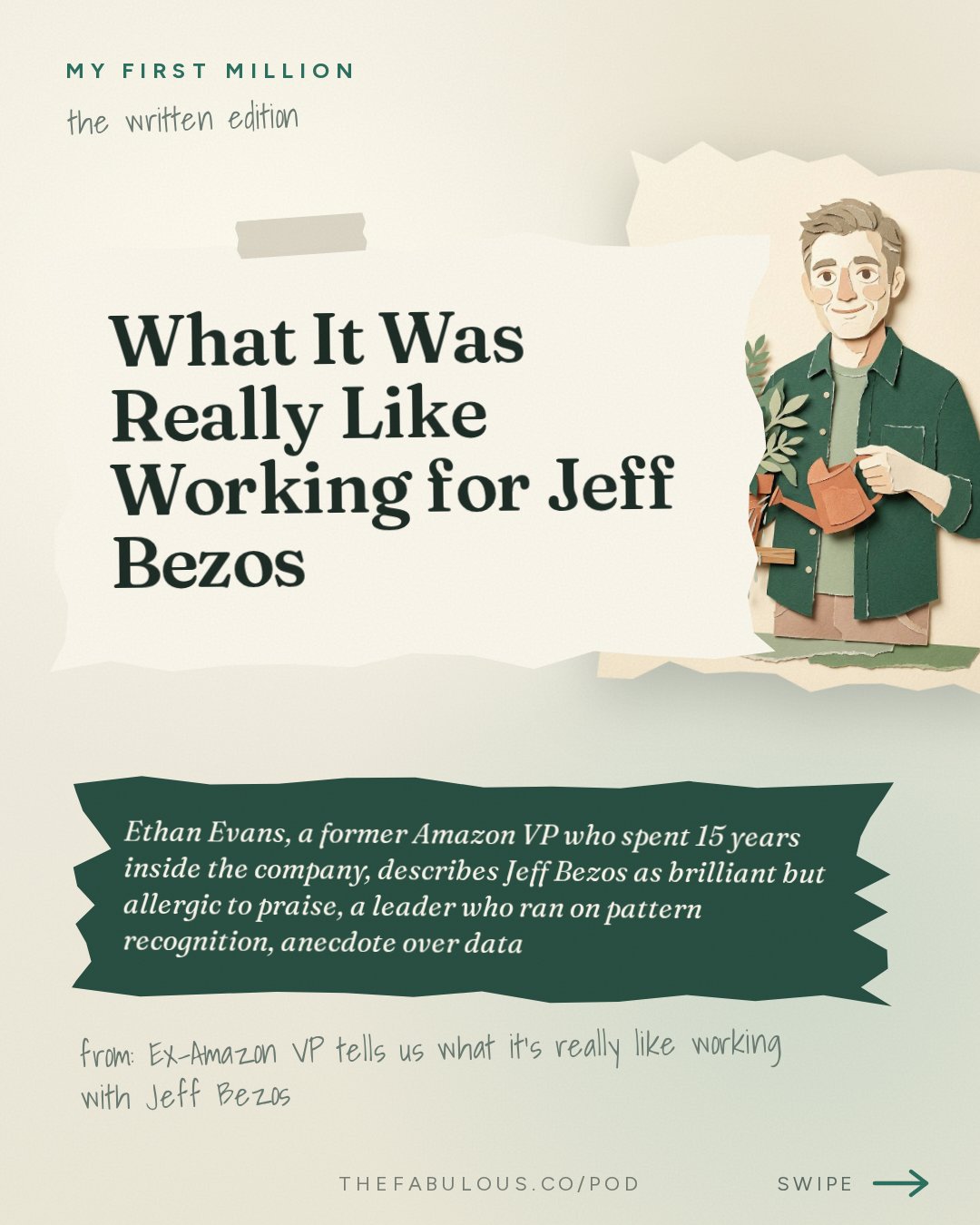
Ethan Evans, a former Amazon VP who spent 15 years inside the company, describes Jeff Bezos as brilliant but allergic to praise, a leader who ran on pattern recognition, anecdote over data, and a 24-hour 'question mark email' system that forced accountability. Evans also explains why he is happier now, working fewer hours for less title but more freedom.
When Amazon bought Twitch for $970 million in 2014, the company sent a man to sit in the room. Not an investor, not a lawyer: an adult. Ethan Evans, then an Amazon vice president, was parachuted into Twitch's executive team, and the staff assumed the worst. "There was, in fact, early on, a huge overtone that I was just a spy," he recalls, "that my job there was to, like, shadow Emmett and then take him out" (00:58). It never was the plan, but denial only made the rumor louder, which is itself a small lesson in how power is read inside a company: people do not believe the absence of a conspiracy, only its confirmation.
Evans spent 15 years at Amazon (00:22), long enough to watch the stock rise 9,082 percent across his tenure (16:06), and long enough to sit across the table from Jeff Bezos often enough to describe, in granular detail, how the man actually worked. That granularity is the real value of this conversation. Everyone knows Bezos is rich and relentless. Fewer people know the mechanics: the specific habits, phrases, and small systems that turned one executive's instincts into a culture that ran across hundreds of leaders.
The feedback that never said good job
Start with the flaw Evans names first: Bezos could not compliment. "Jeff was not mean but very demanding and never said anything good," Evans says. "He just would come in and be like, 'Okay, I see your idea. Here's the three things to fix. Get moving'" (03:33). Evans watched Bezos visibly work on this with an executive coach, like a puppet with strings showing, and once saw him deliver an hour of pure criticism, stand to leave, then turn back at the door to add, "Oh yeah, but good job. You're doing great," before walking out, clearly checking a box (04:47).
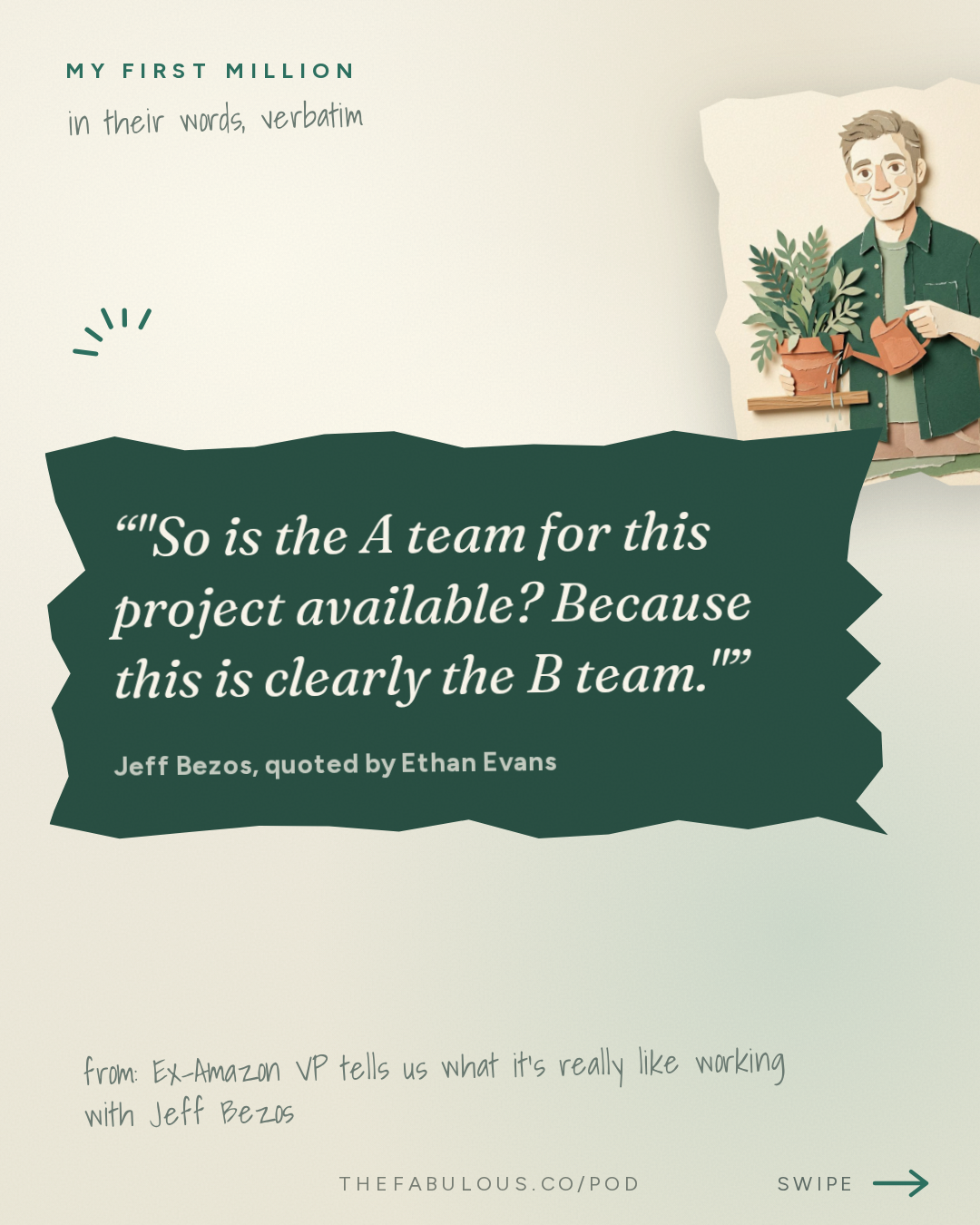
The sharper edge of this same instinct produced one of the best documented Bezos lines: watching a team present work he disliked, he stopped the meeting and asked, "So is the A team for this project available? Because this is clearly the B team" (06:50). Evans frames this less as cruelty than self-directed frustration leaking outward: in one case, Bezos tore into a PR team over a product idea that looked bad in the press, demanding "How could we be so stupid?" The woman across the table initially thought he meant her personally before realizing he was actually talking to himself (08:10). The flaw, as Evans names it, was not harshness so much as an inability to keep his own disappointment contained, a trait that scaled badly once he was running tens of thousands of people instead of a small team.
None of this erased his judgment. Evans is blunt that Bezos was usually right, citing the fights he picked and won over the Kindle and over shrinking Amazon's shipping window from two days to one (04:26). The counterexample is the Fire Phone, a smartphone that failed in the market and produced a $170 million hardware write-off (04:26). Evans's read is that years of being right convinced Bezos his vision was infallible, "which led to the Fire Phone disaster," and that trying to tell him otherwise at the time was "like trying to tell a new father that baby is butt ugly" (05:42).
Pattern recognition, not raw IQ
The most useful idea in the conversation is Evans's explanation for why Bezos (and, separately, Twitch co-founder Emmett Shear) could read a document for twenty minutes and locate the exact weak point a team had spent three months not noticing. Evans's answer is not intelligence, it is repetition: "he did it for years... he literally spent 10,000 hours reading those documents and giving feedback" (10:40). The number borrows from the familiar claim that 10,000 hours of deliberate practice produces expertise, and Evans's point is that running three to five of these reviews a day, every day, for over a decade builds a kind of X-ray vision that looks like genius from the outside but is really just dense, repeated exposure to the same category of problem.
Evans pairs this with a story from a Twitch offsite, where a facilitator asked the room to physically stand in the corner representing the most important ingredient of trust: intimacy, credibility, or integrity. Eighteen of twenty people, Evans included, walked to integrity. Emmett Shear alone walked to credibility, explaining that what actually breaks a team is someone saying "I got this" and then, months later, turning out not to have had it at all (13:50). Evans connects this directly to how Bezos rewarded people: not always the smartest person in the room, but the one who would "throw his body on it and roll around and take the burns" on any mess handed to them, and who reliably turned a D into a B even without the talent to make it an A (14:40). In a company as large as Amazon, Evans argues, a reliable B is often worth more than a dazzling but unpredictable attempt at an A.
The systems that scaled one man's instincts
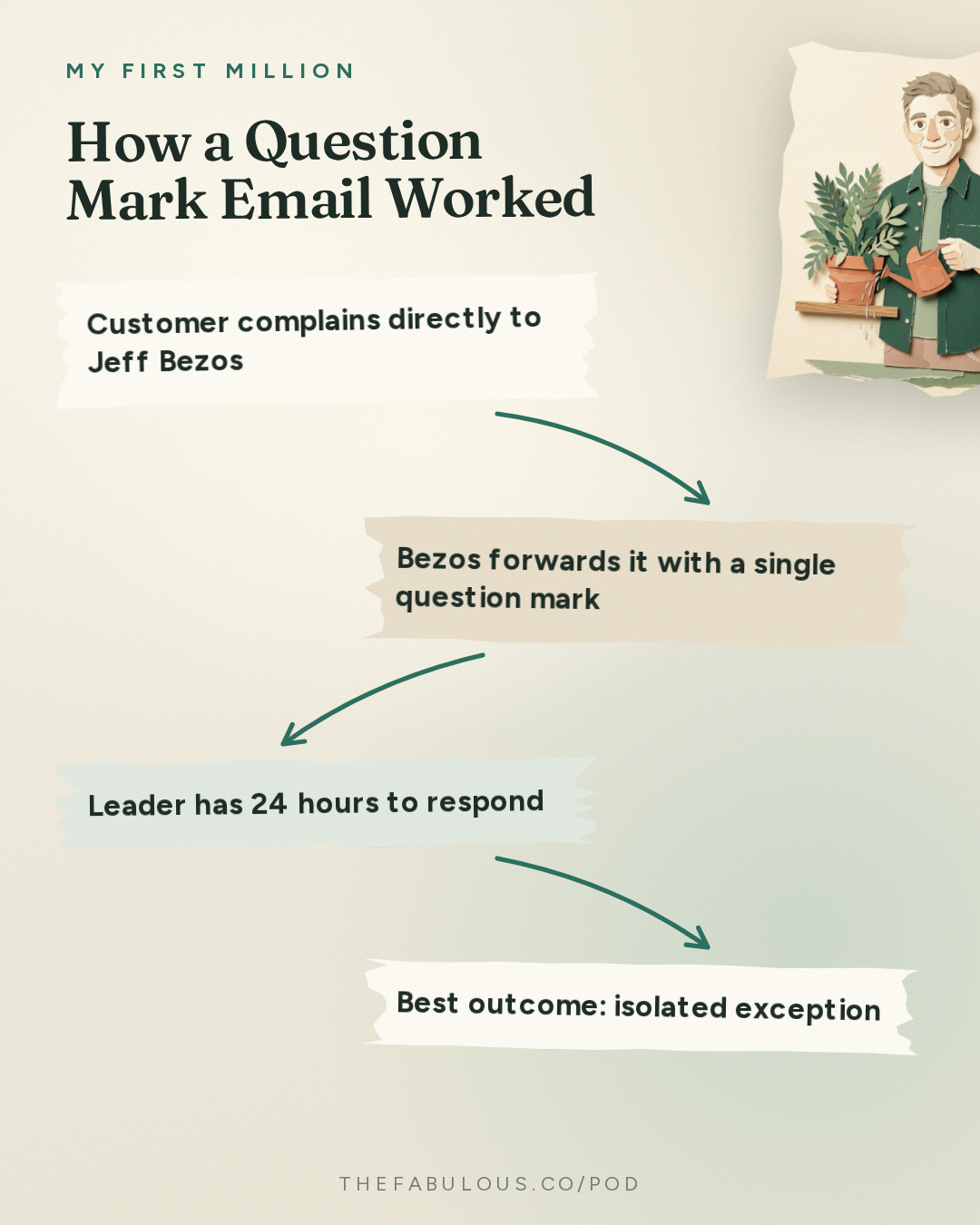
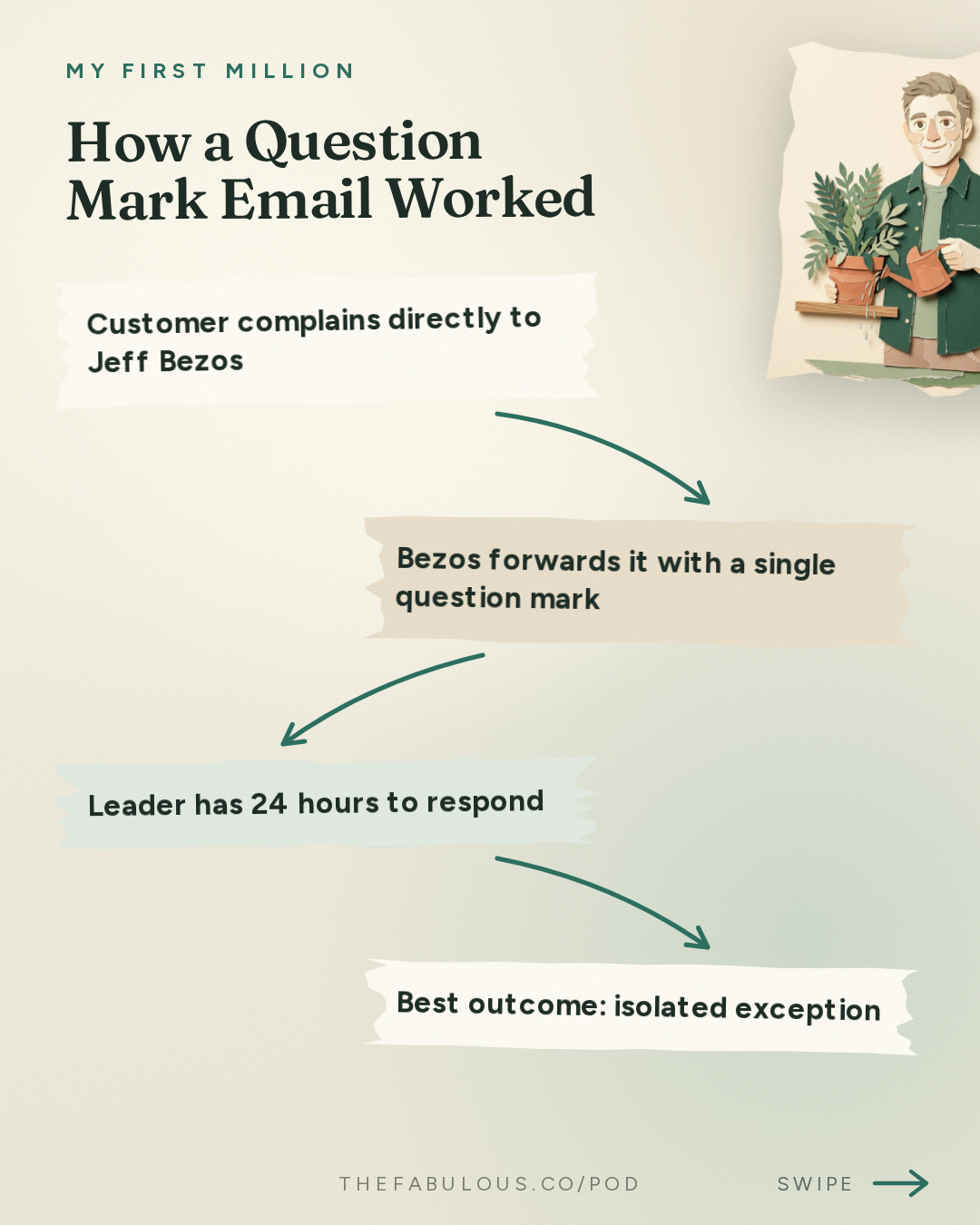
Bezos also had a stated preference that, at Amazon's size, the two-day shipping companys actual metric was anecdote over aggregate data. His reasoning, as Evans repeats it: even if 99 percent of orders arrive correctly, one percent of Amazon's volume is still roughly 25 million packages a day going wrong (19:23). A single customer complaint, read directly, made that abstract one percent concrete. The mechanism Bezos built around this was the "question mark email": a customer complaint forwarded to the responsible leader with nothing attached but a question mark, which, by unwritten rule, meant a response was due within 24 hours explaining what happened and what would fix it (20:09). Evans still remembers the time his team got something worse than a question mark, a flat "Please tell me we're not doing this," and had to reply that yes, they were. Bezos wrote back, "Just euthanize me," having just finished watching the first season of Entourage (20:56).
The deeper operating principle behind all of this was what Bezos called being strategically patient but tactically impatient: accept that anything great, whether rockets or one-day shipping, takes years to build, but refuse to let any single day pass without squeezing out visible progress, because a five-year plan is really twenty quarters stacked end to end, and losing even a few of them means never arriving (23:38). The phrase Bezos preferred for the resulting lifestyle was "work-life harmony" rather than "work-life balance," on the theory that loving the work justified the hours (25:12), alongside the saying, half joke and half warning, that Amazon was "a place where high performers go to feel bad about themselves" because the bar kept rising no matter how well someone had just done (26:21).
What it costs, and what replaces it
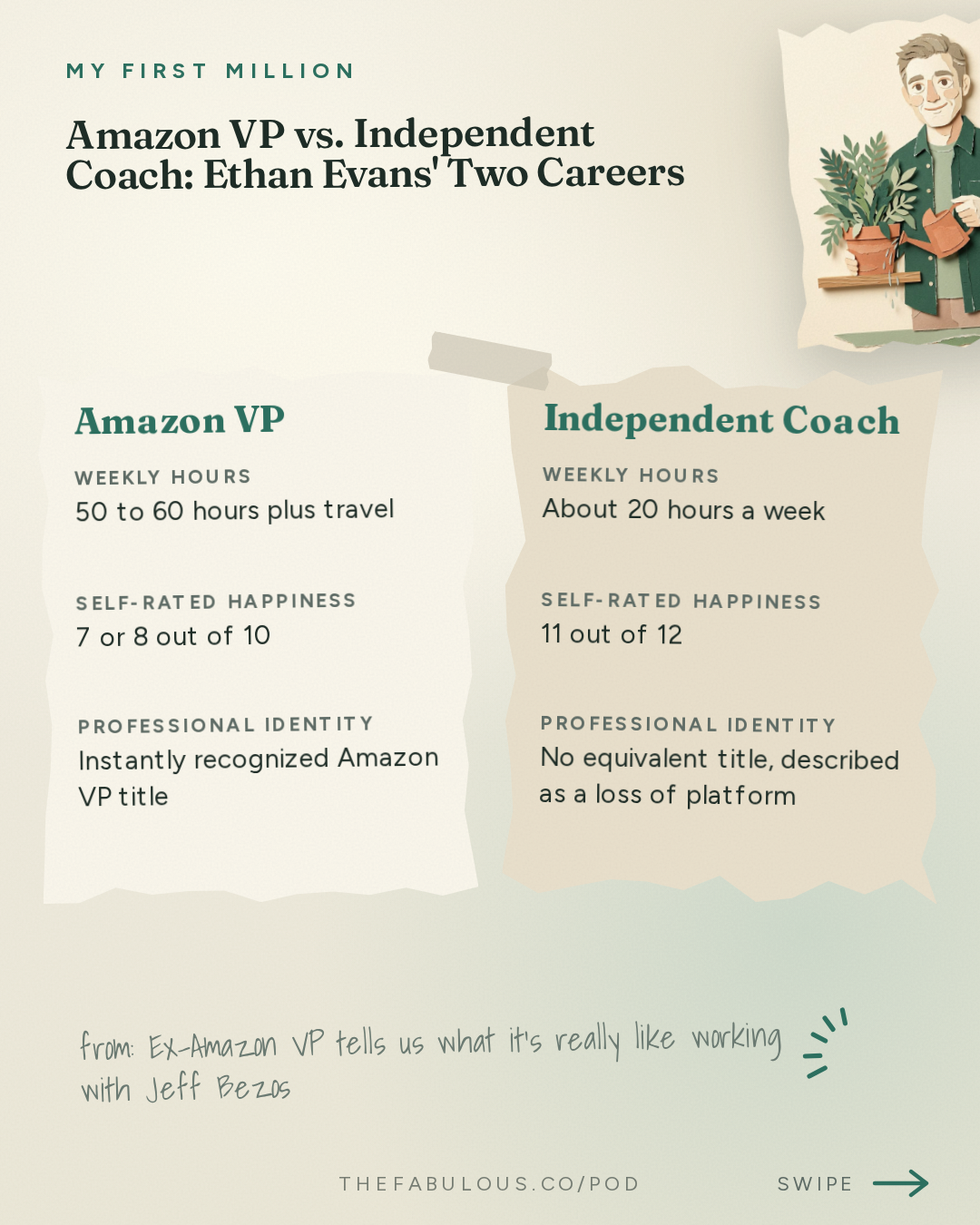
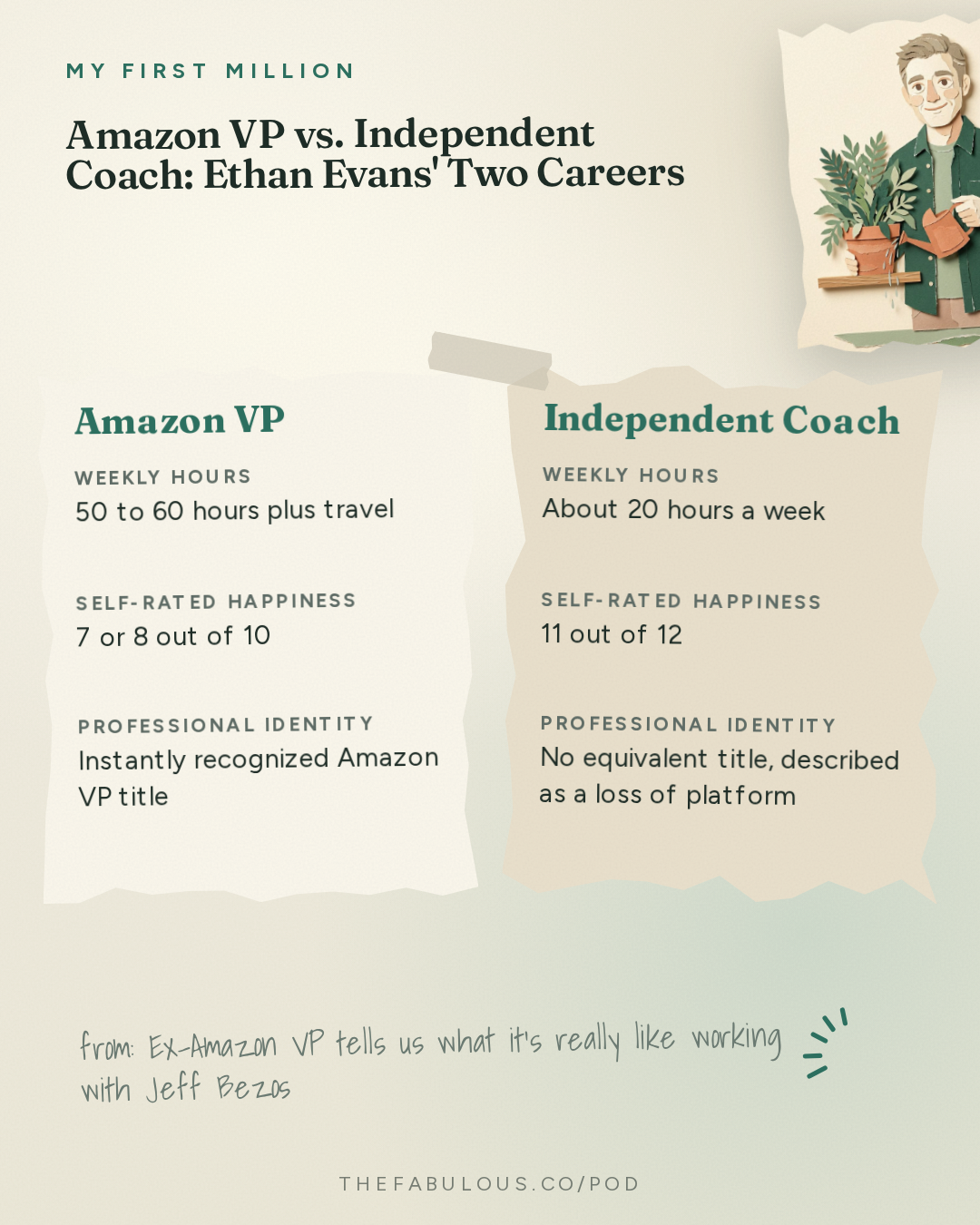
Evans is equally specific about the trade he made leaving all this behind. As an Amazon vice president, his target compensation was about $900,000 a year, with actual pay often landing in the low millions once stock performance was included (33:09), for roughly 50 to 60 hours of work a week plus travel. On a 1-to-10 happiness scale, he rates that period a 7 or 8. Today, working an average of 20 hours a week as an independent executive coach, he earns $700,000 to $800,000 this year, and rates his happiness an 11 out of 12, adding, "I didn't know the scale went to 12" (32:47). The cost is identity: without a title like Amazon vice president attached to his name, he feels the loss of a platform that used to make people return his calls (34:08).
Two origin stories round out the picture of how Amazon actually made decisions. Prime began life internally as "Project 100," named for the 100 days Bezos gave the team to launch it after a rough quarter following the dot-com crash (48:40), and it inherited its unit economics from an earlier experiment in free shipping, where Amazon discovered that a single DVD did not carry enough profit margin to cover the cost of shipping for free, but two items did, which is why the free-shipping threshold was set at $25 (52:14). And when it came to the Amazon website's famously plain, text-heavy design, Evans says the real hidden metric behind every page was not aesthetics but load speed, because milliseconds of delay drove customers away long before anyone noticed the colors (54:28).
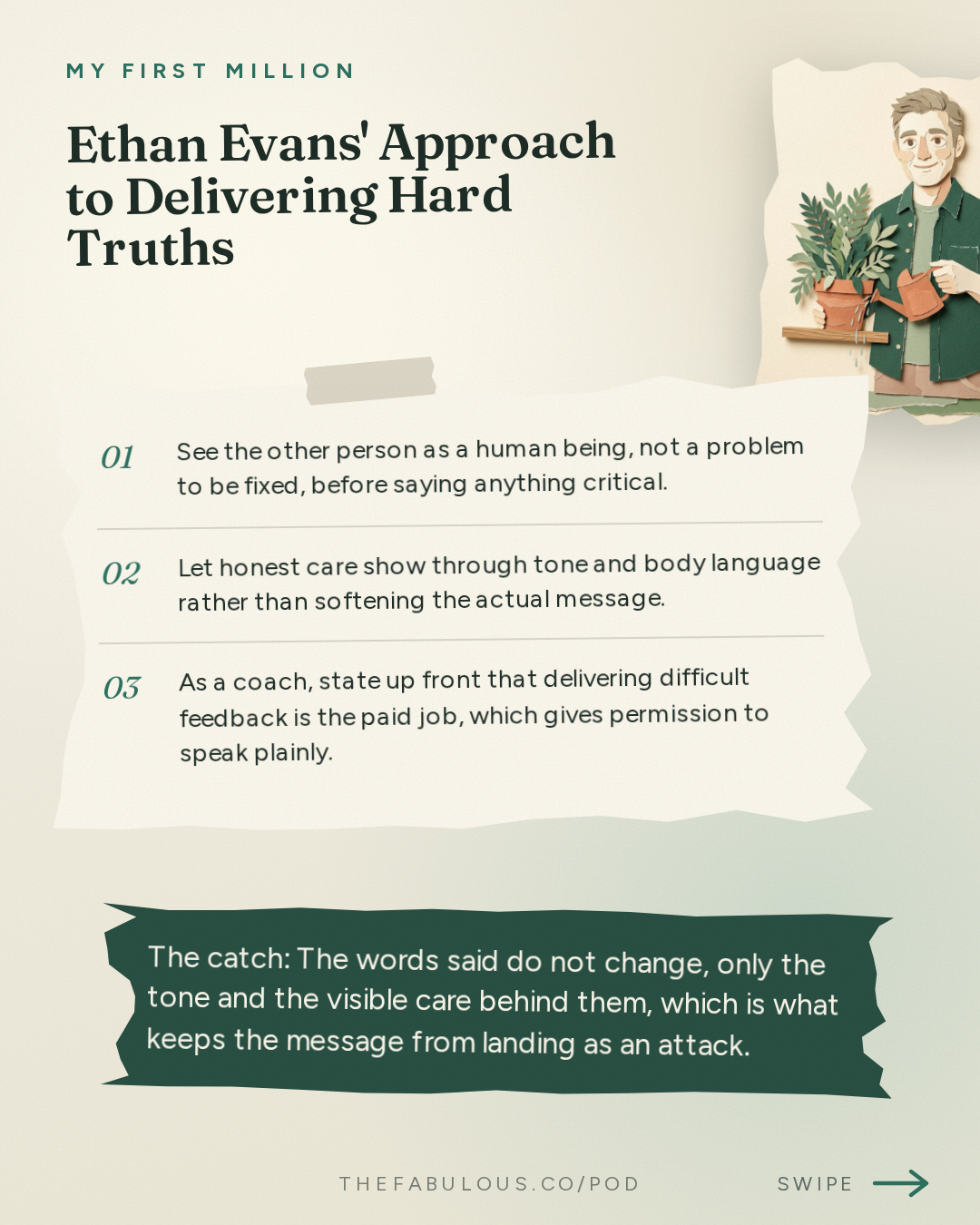
The conversation closes on something smaller and more personal: how to deliver hard truths without making someone feel attacked. Evans credits a book called Leadership and Self-Deception, from the Arbinger Institute, with the underlying technique.
"You have to see the person as a human, not as a machine to fix. So I have to care about the person first." — Ethan Evans [72:51]
It is a modest note to end on, after an hour spent inside the operating system of one of the most demanding executives alive, but it is consistent with everything before it: systems, patience, and repetition matter, but only if the person running them still remembers there is a person on the other end of the question mark.
Ask this episode anything
Pod's AI answers from the episode itself, with the minute mark so you can hear it yourself.
Or start with one of these
Ask this episode
Pod's AI listens to the whole episode to answer, and points you to the minute it comes from.
The rest of this answer, and any question after it
Answers come from the episode itself, never from a summary of it.
ContinueKey takeaways
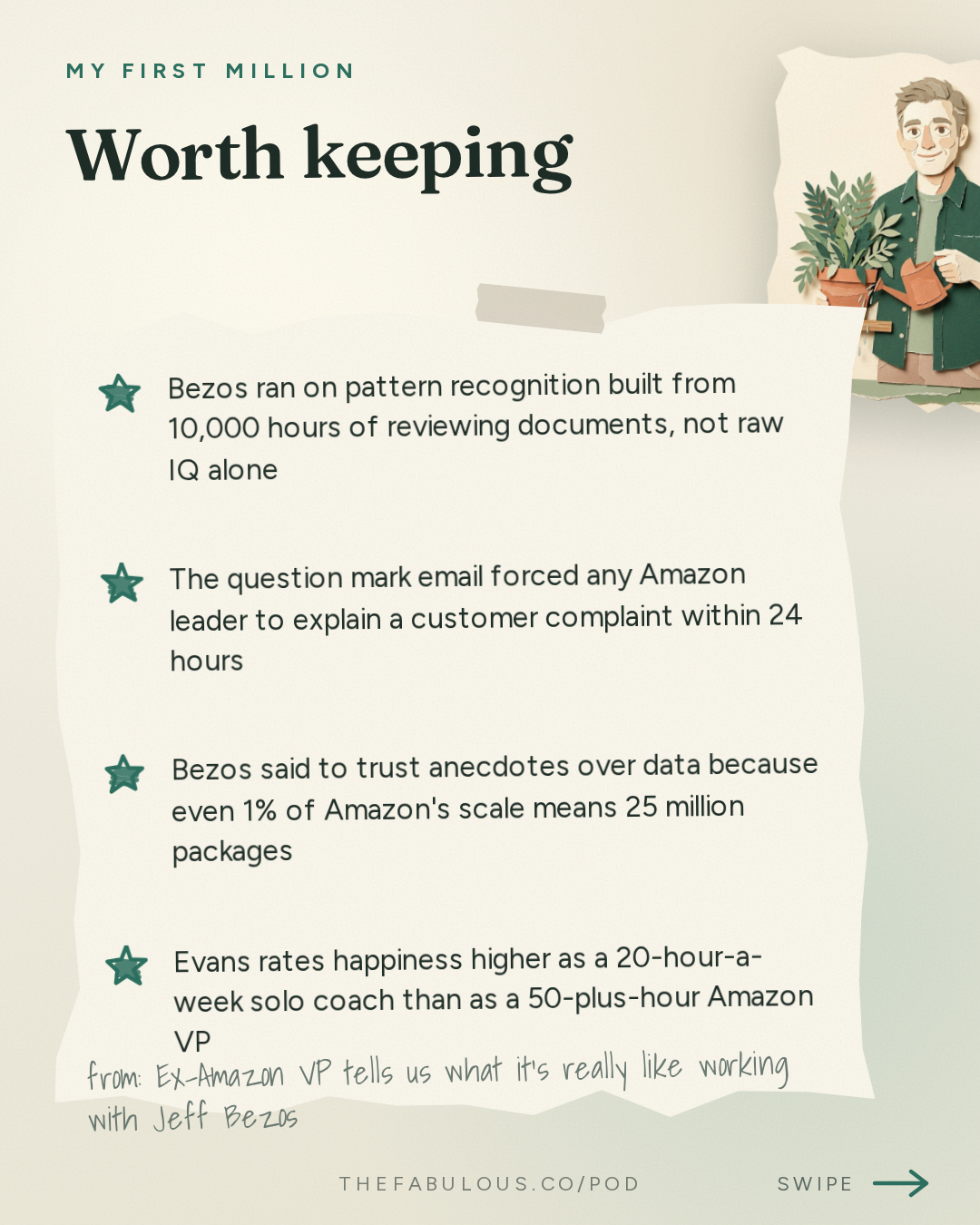
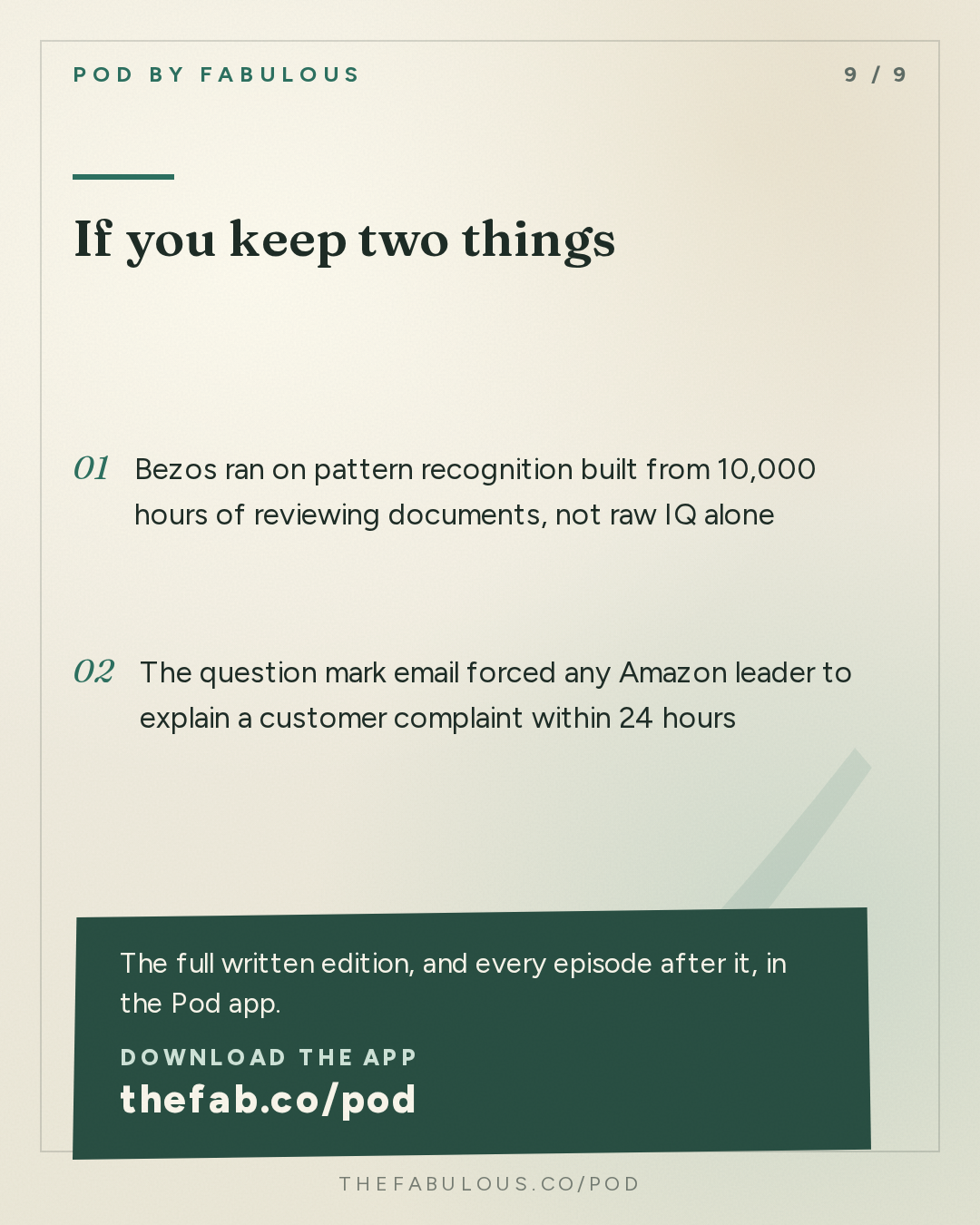
- Bezos ran on pattern recognition built from 10,000 hours of reviewing documents, not raw IQ alone
- The question mark email forced any Amazon leader to explain a customer complaint within 24 hours
- Bezos said to trust anecdotes over data because even 1% of Amazon's scale means 25 million packages
- Evans rates happiness higher as a 20-hour-a-week solo coach than as a 50-plus-hour Amazon VP
- Amazon Prime began as Project 100, a 100-day deadline to launch after a weak quarter
The episode in cards
By the numbers
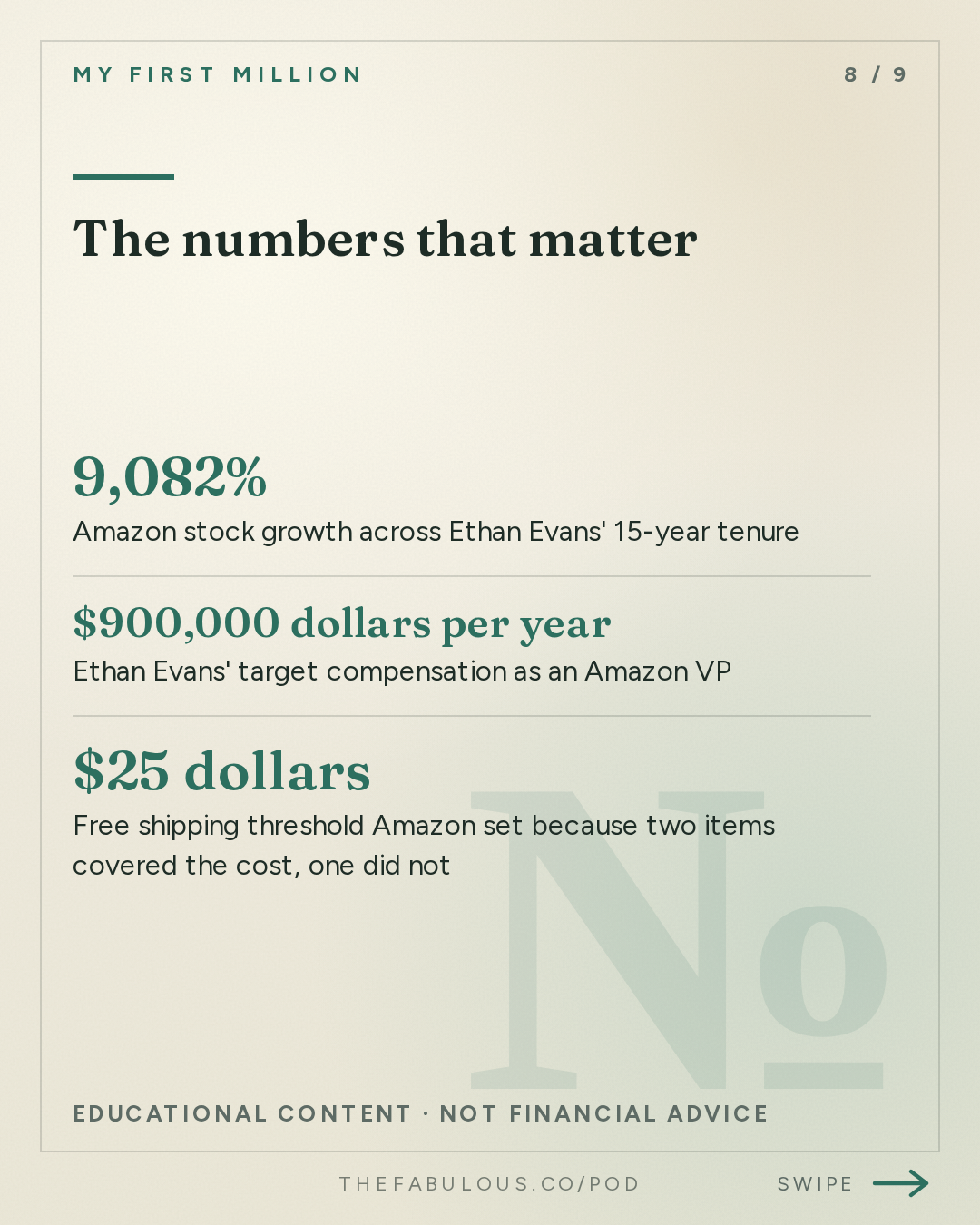
- 9,082% percent Amazon stock growth across Ethan Evans' 15-year tenure
- $900,000 dollars per year Ethan Evans' target compensation as an Amazon VP
- $25 dollars Free shipping threshold Amazon set because two items covered the cost, one did not
In their words
“"So is the A team for this project available? Because this is clearly the B team."”
“Between data and anecdotes, trust the anecdotes.”
“To do anything great, you're gonna have to be patient for the end result. But every day you better be making every tiny bit of progress you can squeeze out”
“You have to see the person as a human, not as a machine to fix. So I, I have to care about the person first”
“Amazon is a place where high performers go to feel bad about themselves.”
Protocols
-
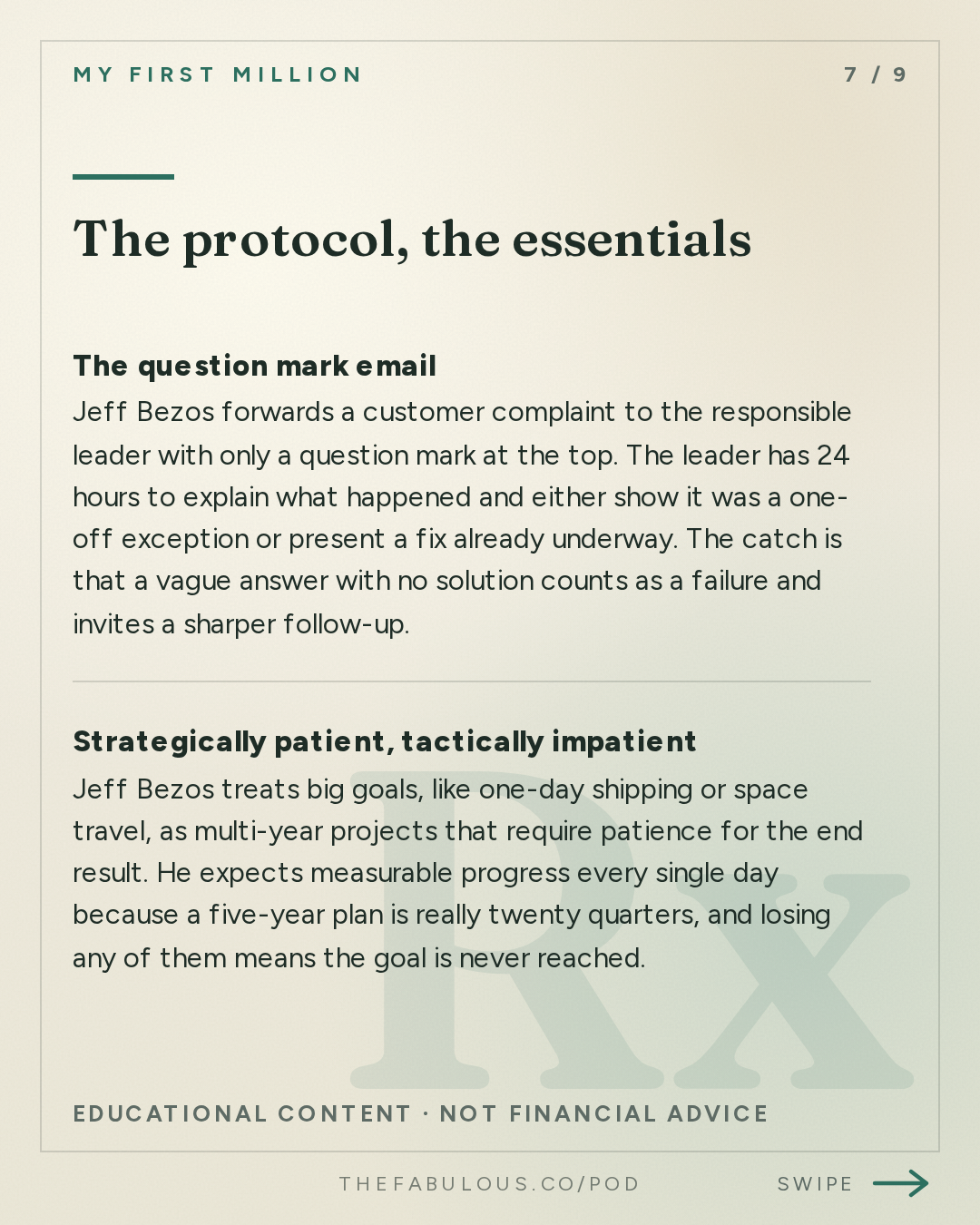
The question mark email
Jeff Bezos forwards a customer complaint to the responsible leader with only a question mark at the top. The leader has 24 hours to explain what happened and either show it was a one-off exception or present a fix already underway. The catch is that a vague answer with no solution counts as a failure and invites a sharper follow-up.
As needed, triggered by customer complaints reaching Bezos directly
-
Strategically patient, tactically impatient
Jeff Bezos treats big goals, like one-day shipping or space travel, as multi-year projects that require patience for the end result. He expects measurable progress every single day because a five-year plan is really twenty quarters, and losing any of them means the goal is never reached.
Daily check against a multi-year goal
-
Deliver hard truths by caring first
Ethan Evans says to see the other person as a human being rather than a problem to fix before giving critical feedback. He adds that, as a coach, he tells clients up front that delivering difficult news is literally the job they are paying him for, which makes the feedback easier to accept.
Before any difficult conversation
Questions this episode answers
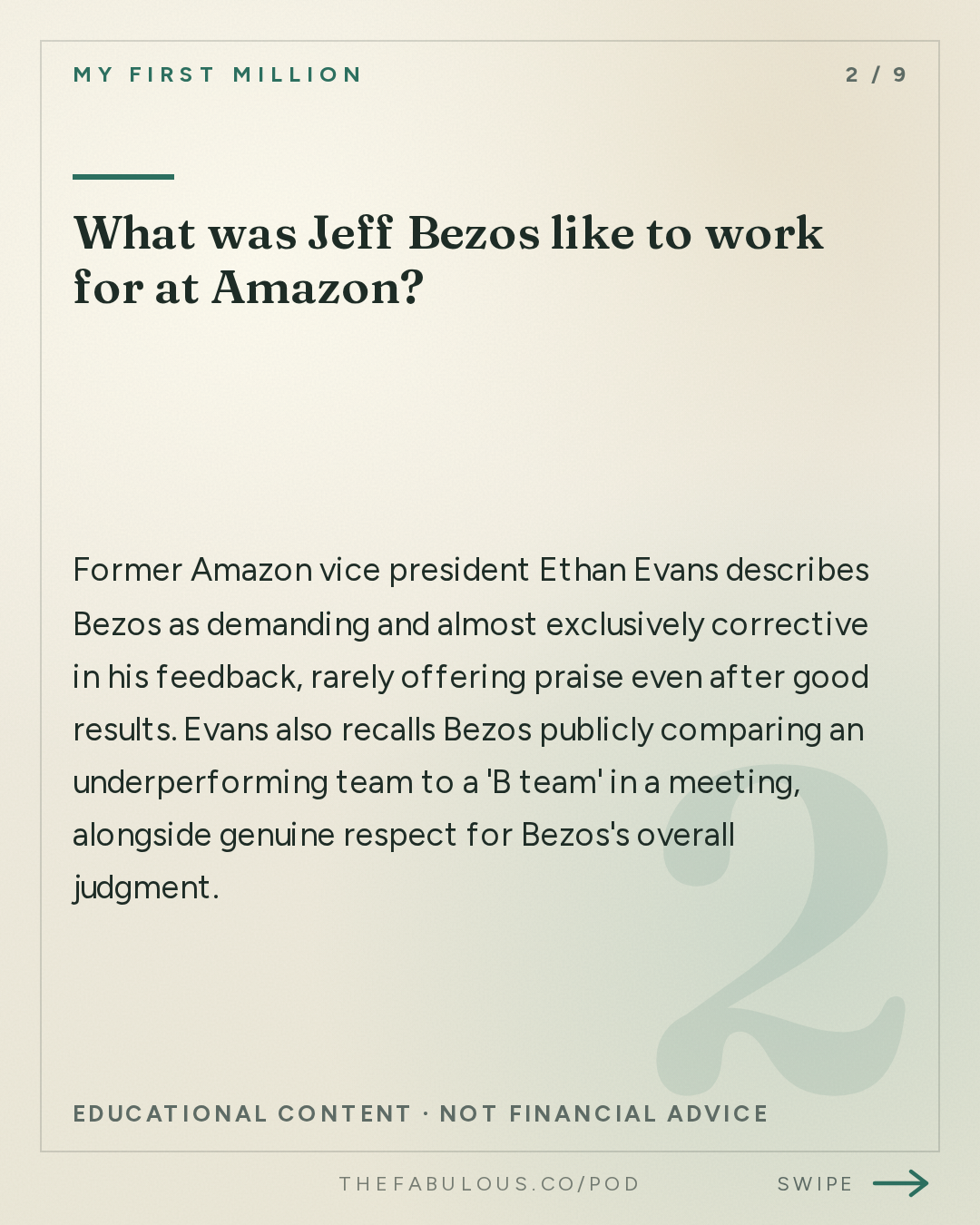
What was Jeff Bezos like to work for at Amazon?
Former Amazon vice president Ethan Evans describes Bezos as demanding and almost exclusively corrective in his feedback, rarely offering praise even after good results (04:05). Evans also recalls Bezos publicly comparing an underperforming team to a 'B team' in a meeting (06:50), alongside genuine respect for Bezos's overall judgment.
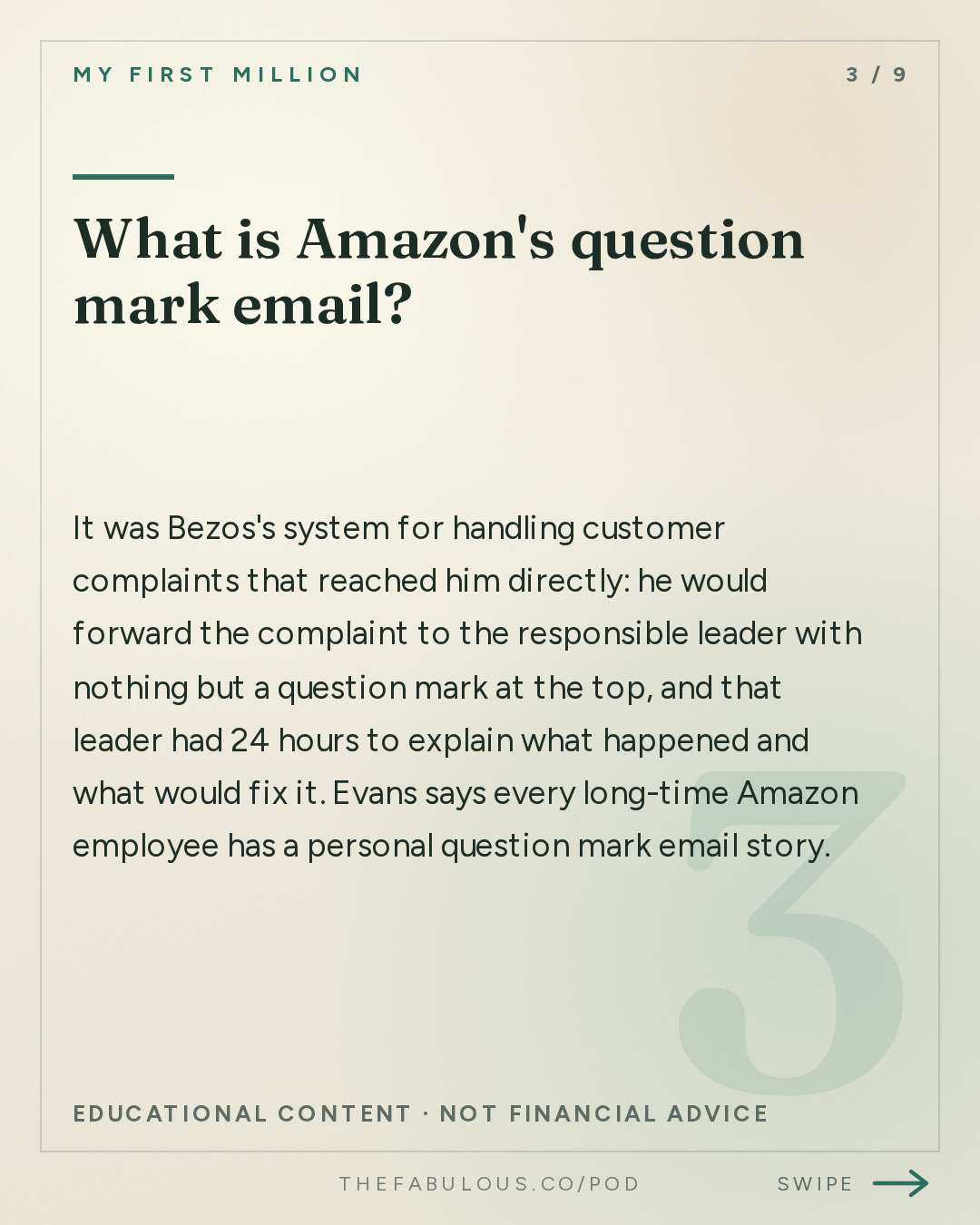
What is Amazon's question mark email?
It was Bezos's system for handling customer complaints that reached him directly: he would forward the complaint to the responsible leader with nothing but a question mark at the top, and that leader had 24 hours to explain what happened and what would fix it (20:09). Evans says every long-time Amazon employee has a personal question mark email story.
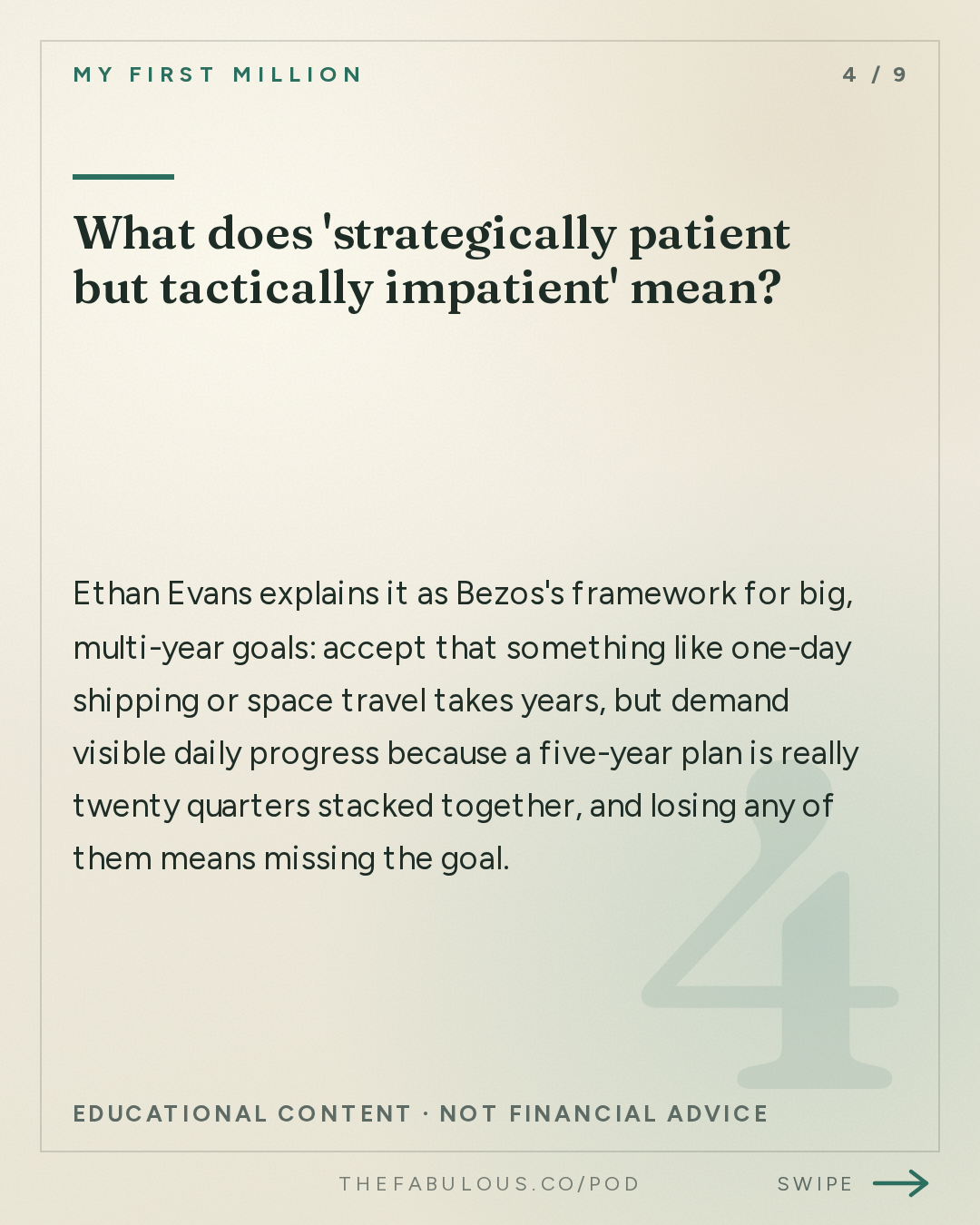
What does 'strategically patient but tactically impatient' mean?
Ethan Evans explains it as Bezos's framework for big, multi-year goals: accept that something like one-day shipping or space travel takes years, but demand visible daily progress because a five-year plan is really twenty quarters stacked together, and losing any of them means missing the goal (23:38).
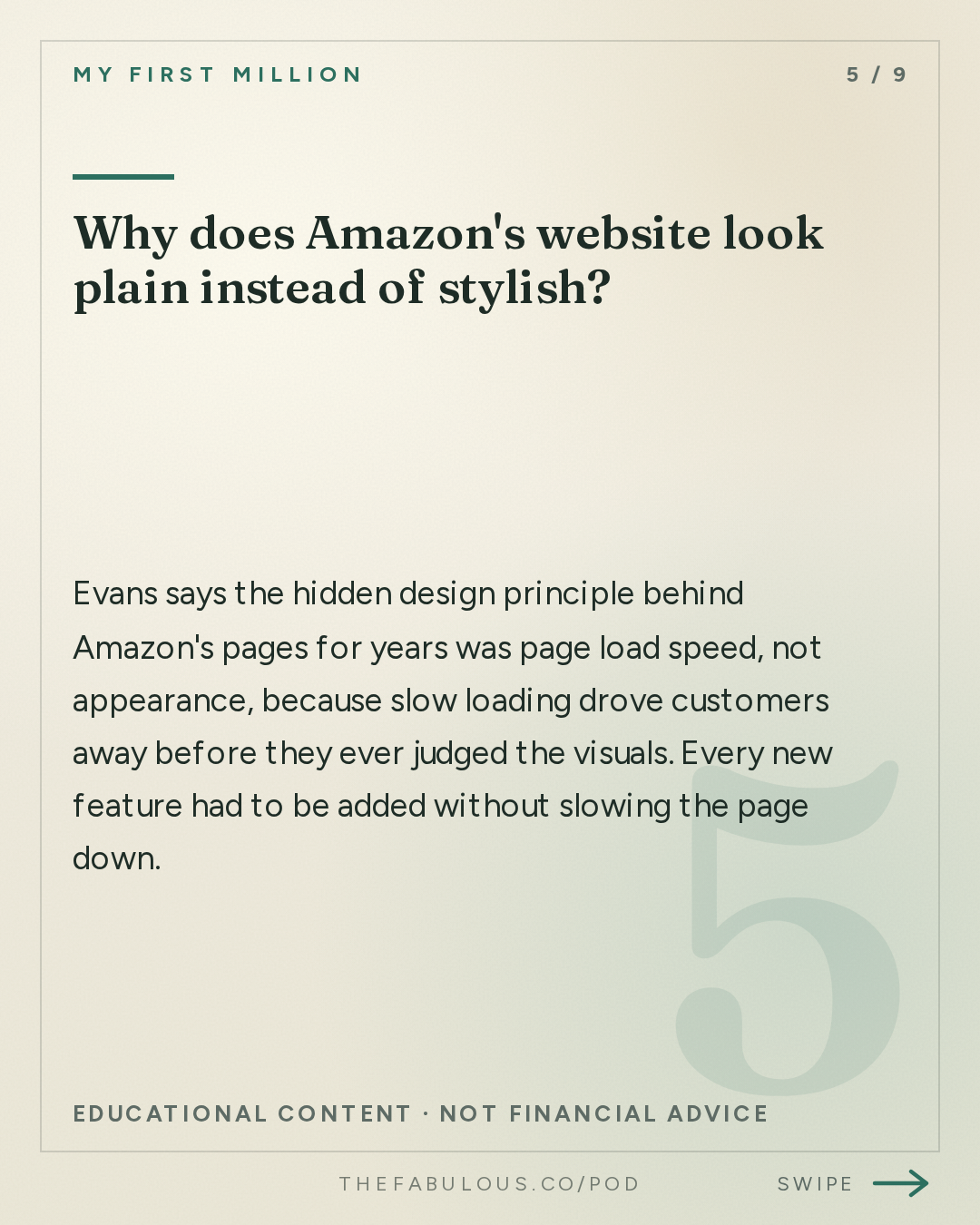
Why does Amazon's website look plain instead of stylish?
Evans says the hidden design principle behind Amazon's pages for years was page load speed, not appearance, because slow loading drove customers away before they ever judged the visuals (54:28). Every new feature had to be added without slowing the page down.
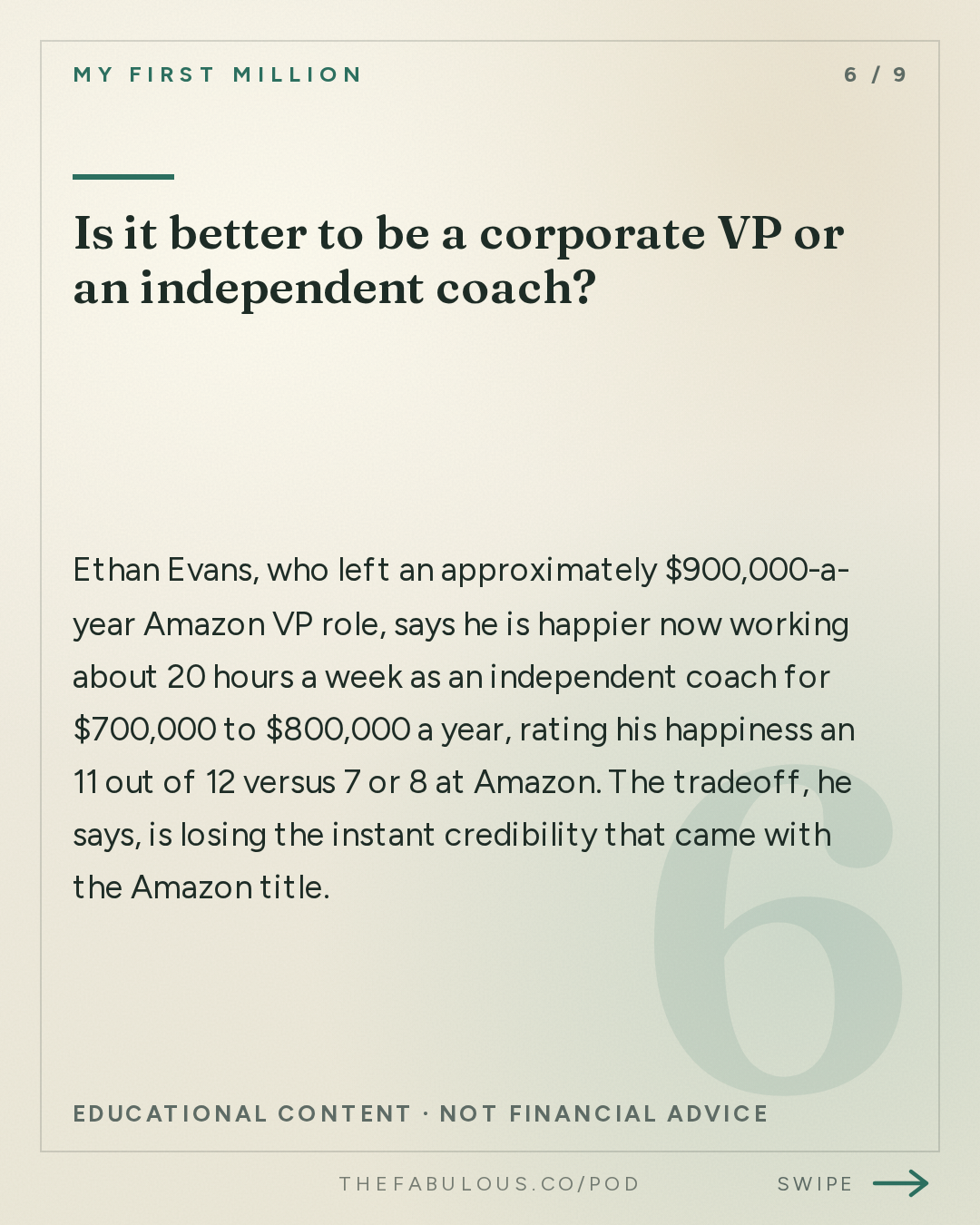
Is it better to be a corporate VP or an independent coach?
Ethan Evans, who left an approximately $900,000-a-year Amazon VP role (33:09), says he is happier now working about 20 hours a week as an independent coach for $700,000 to $800,000 a year, rating his happiness an 11 out of 12 versus 7 or 8 at Amazon (32:47). The tradeoff, he says, is losing the instant credibility that came with the Amazon title (34:08).
Why was Amazon's free shipping threshold set at $25?
Evans says Amazon discovered through pricing experiments that a single DVD or similar item did not generate enough profit margin to cover free shipping, but two items together did, which is why the threshold landed at $25 for many years (52:14). This followed earlier, higher thresholds of $100, then $75, then $50 before settling there.
The full read, in cards
Go deeper
- Leadership and Self-Deception — Arbinger Institute book Evans credits for the idea of seeing people as humans rather than problems to fix
Mentioned
Ethan Evans · Jeff Bezos · Twitch · Amazon · Emmett Shear · Fire Phone · Kindle · Andy Jassy · Charlie Ward · Leadership and Self-Deception · Arbinger Institute
More from this show and category
Nick Kokonas's Theory of Business Arbitrage
Nick Kokonas built three careers by finding the same arbitrage: a gap between how fast information moves and how slowly an industry reacts to it. The Chicago trader turned restaurateur and software founder used a 20-second phone-line edge to build a $100 million trading year (31:53), then applied the same logic to Alinea and Tock (00:16).
Peter Levels: Why SaaS Lost Its Moat
Peter Levels says plain software has no moat left in the AI era, and what remains is data, network effects, distribution, or regulation. The episode also follows Bryan Johnson's attempt to dunk at 49, Elon Musk's SpaceX share giveaway to 72 million kids, and a pest control brand's $1,000 first week built on direct-to-consumer branding.
Low-Frequency Investing: The 2.9-Decision Portfolio
A retail investor who made only 2.9 decisions a year beat the S&P 500 in 11 of 11 years, averaging 21.8% annual returns versus 13.5%. The hosts run his brokerage history through the AI assistant Claude, then widen out to Jack Dorsey's 140-reason pre-mortem, Mark Zuckerberg's talent-density bet, Elon Musk's 24-hour rebuilding rule, and a four-step method called DARE for panic and fear.
The 6 Traits of Natural Money Makers
Sam Parr and Shaan Puri map the "natural money maker": unemotional, maximizing, and comfortable with complexity. They share entrepreneur Sayed Balkhi's "second derivative" rule (spend only investment returns, never income) and a 3% liquid-net-worth spending cap, plus six other wealth-building personality types like the Tank, the Trickster, and the Sniffer.
