
Nick Kokonas's Theory of Business Arbitrage
How to find your arbitrage (from the guy who’s done it 3x) ft. Nick Kokonas
The brief
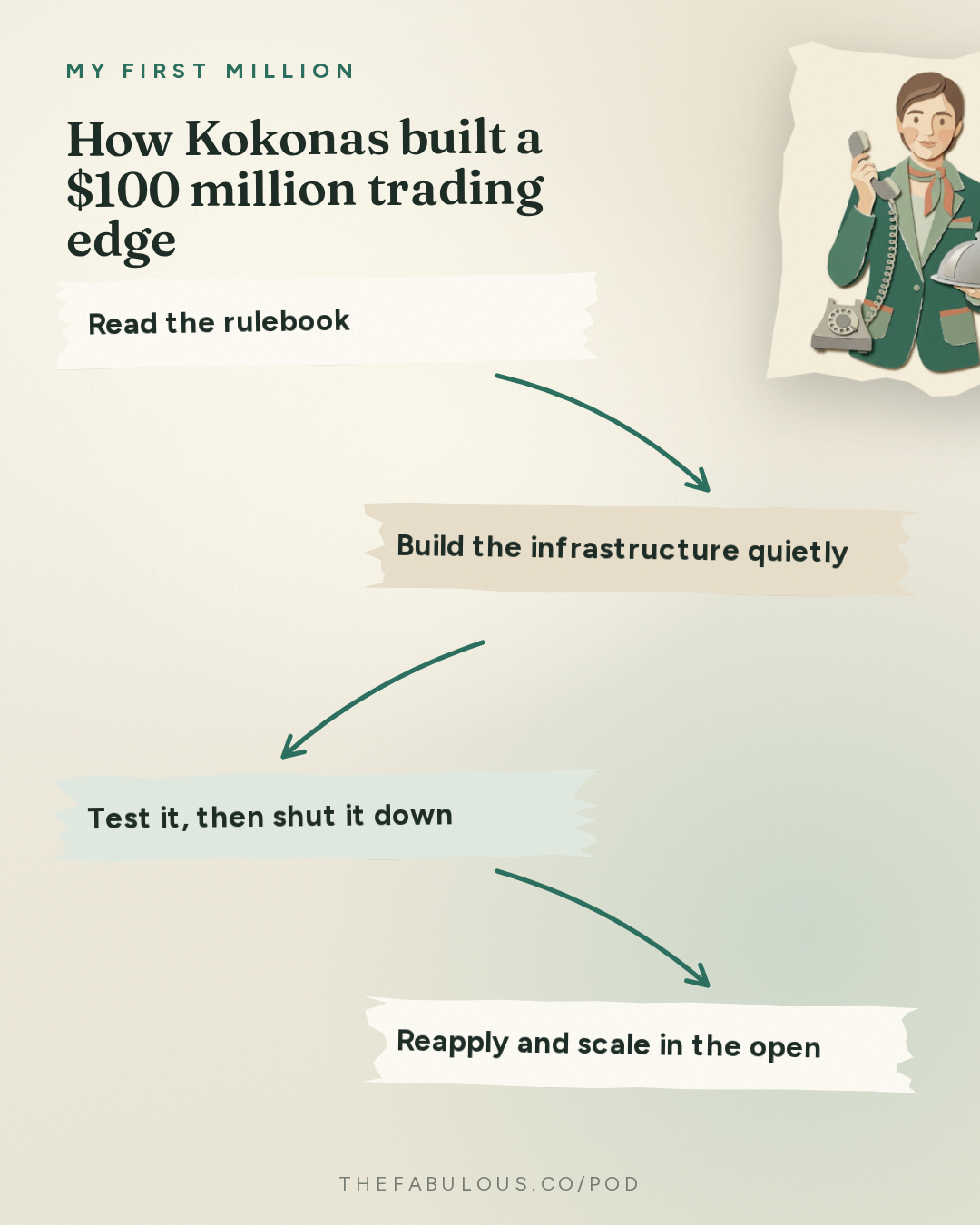
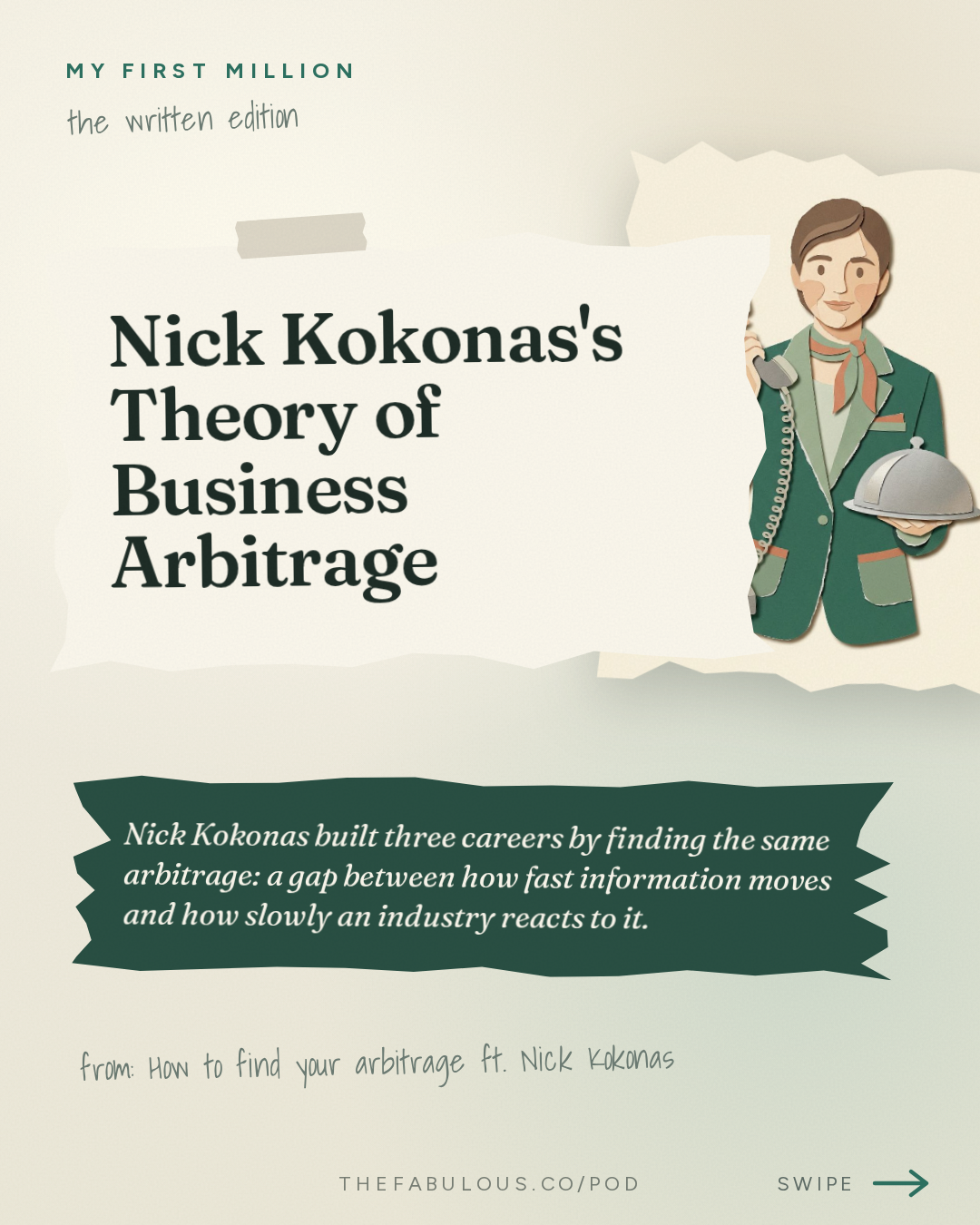
Nick Kokonas built three careers by finding the same arbitrage: a gap between how fast information moves and how slowly an industry reacts to it. The Chicago trader turned restaurateur and software founder used a 20-second phone-line edge to build a $100 million trading year (31:53), then applied the same logic to Alinea and Tock (00:16).
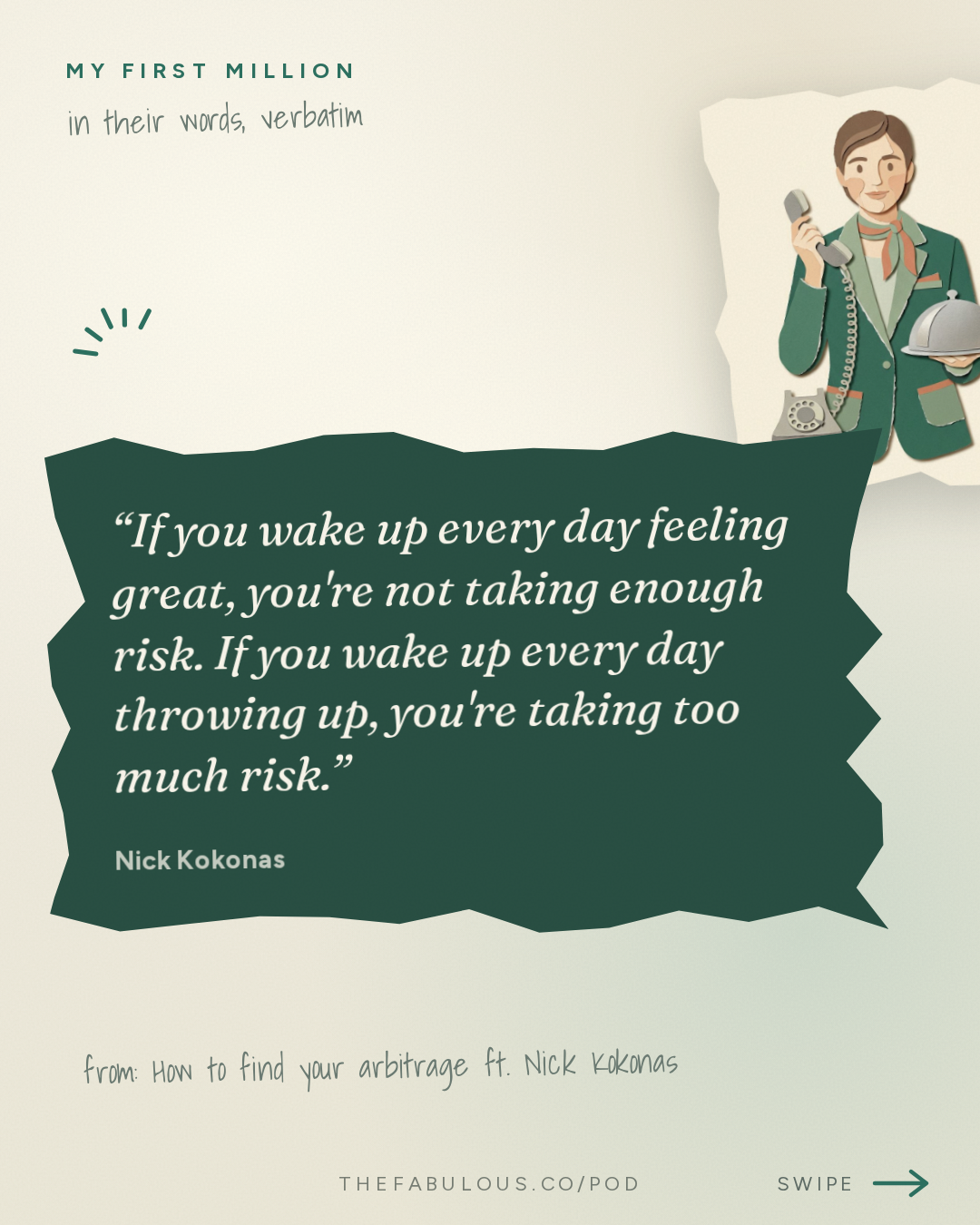
Nick Kokonas's old trading partner, Keith Goggin, gave him a rule for measuring risk: if someone wakes up every day feeling great, they are not taking enough of it, and if they wake up every day throwing up, they are taking too much (00:00). Kokonas has spent three decades living by a version of that rule, and it has taken him from a Chicago trading pit to the kitchen of what was once called the best restaurant in America, to a software company that sold for hundreds of millions of dollars, and now to an immersive magic venue being built under Wall Street. The common thread, he says, is not courage or even intelligence. It is timing.
"I am now convinced that every arb is just about timescale." Nick Kokonas, [00:16]
By that he means every opening he has found is really a gap between how fast information moves and how slowly an industry gets around to pricing it. Kokonas was a philosophy major with no finance background when he decided, at 24, that he wanted to trade options on the Chicago Mercantile Exchange floor. To get in the building at all, he hid his education and applied for a runner's job at $5.25 an hour (12:58), the lowest rung on the floor, carrying paper order tickets between brokers by hand. The trader then paid him $250 a week to mentor him after hours, an arrangement he admits was "totally illegal" by today's standards (17:49), until he understood options well enough to trade them himself. He started with $60,000 in capital, $20,000 his own and $40,000 from a backer (00:00, 11:32), and gave himself one year to get on a trading badge. He missed the deadline by a week.
What Kokonas was looking for on the floor, he says, was "the smallest highest hoops": niches difficult enough to enter that few people would bother chasing him into them (16:08). The biggest one involved a thirty second lag. In the late 1990s, new exchange traded funds like the Nasdaq 100 tracker known as the triple Qs had to be hedged against futures contracts in Chicago, and the information connecting a New York trade to its Chicago hedge traveled by phone call and paper ticket. Kokonas wanted to shortcut it.
The Twenty Second Edge
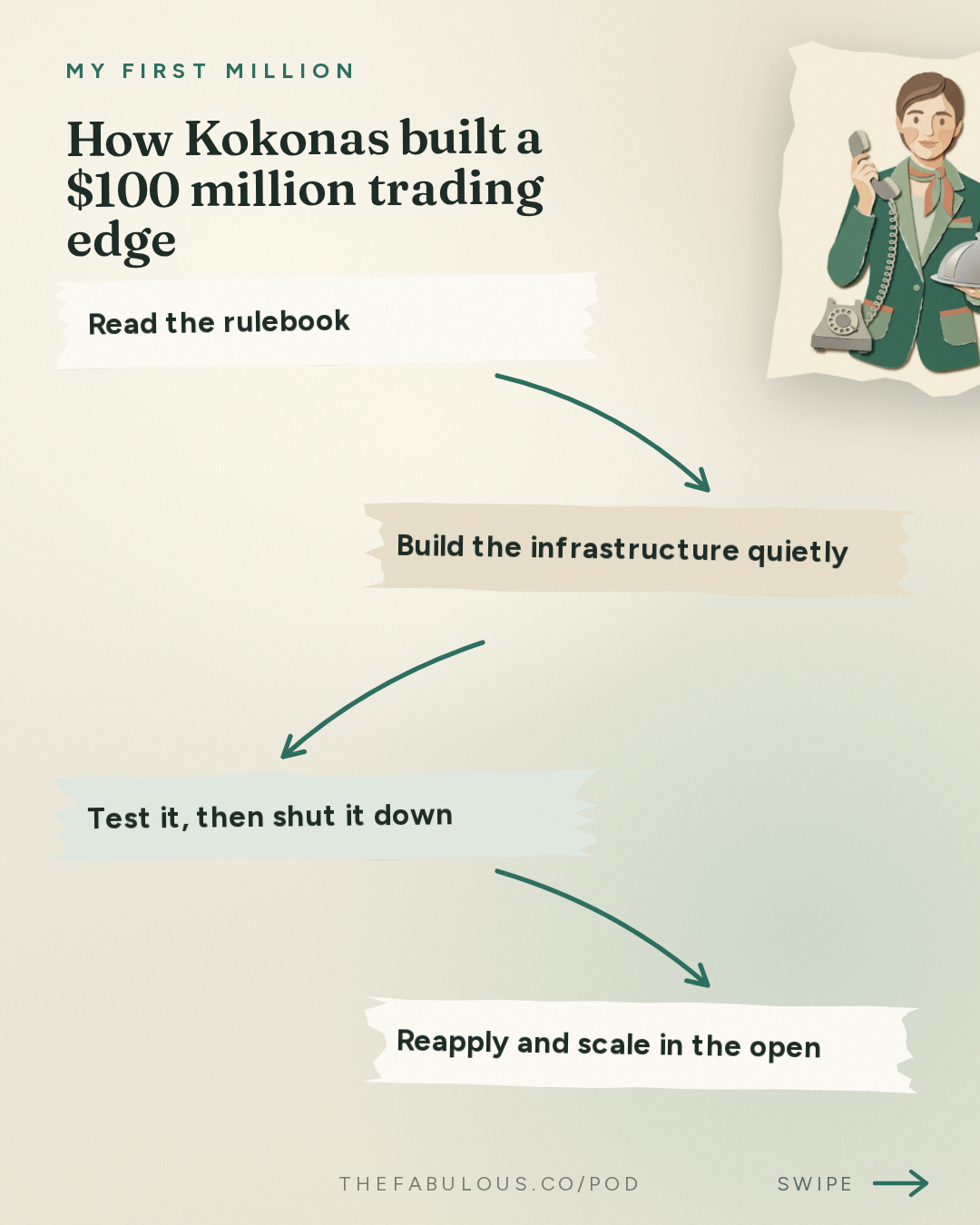
His first move was unglamorous: he read the Commodity Futures Trading Commission's full rulebook himself, rather than relying on lawyers and brokers who worked from case law and habit (27:56). He found nothing that forbade a dedicated phone line between the New York and Chicago desks of the same firm. The exchange's board, controlled by broker groups who stood to lose from the idea, refused him a permit to run the cable, so he paid union electricians in cases of Jameson to run it anyway (28:59). When the line went live for the first time, the first trade made, in his words, a couple hundred thousand dollars instantly (30:02). His reaction was not elation. It was fear. "It was so good that the powers that be would kill you," he says, and he does not mean that figuratively (30:19). He shut the operation down and reapplied for a formal pilot program, arguing the new ETF category was growing fast enough that the exchange should want to support it. Within six months of reopening it properly, his firm was executing roughly 2 percent of the daily volume of the American Stock Exchange, and that year it cleared more than $100 million in trading profit (31:53).
He was 31. The gain did not last: arbitrage windows always close, he says, as competitors catch on and technology shrinks the gap further (36:57). By 2002, trading profits across the industry had fallen sharply, and Kokonas, grieving his father's death and unsettled by the September 11 attacks, found he no longer wanted the life. He quit badly, announcing his departure mid argument in a staff meeting. By then he had come to believe expertise itself is dangerous. "Once you get to expert level, you're screwed," he says, "because somebody who's younger, hungrier, more willing to break convention to find the new way through is going to kick your ass" (21:39). His fix has been to quit before that happens, roughly once a decade, and start over at the bottom of a new hill.
What Magicians Know About Trust
The next hill was a restaurant he knew nothing about running. Kokonas met a young chef named Grant Achatz and decided, with zero hospitality experience, to try building the best restaurant in America, at a moment when the Michelin Guide had not yet reached the United States. Rather than keep the plan private, he posted the entire business plan on a food forum called eGullet, including menu drafts, naming debates, and a four thousand word essay explaining that restaurant bread mostly exists to fill guests up cheaply (61:05). The open posts drew hundreds of thousands of views and the attention of the New York Times before the restaurant, called Alinea, ever opened (59:17). "There's no chance it would have been this good," he says, if he had built the same restaurant quietly (61:53).
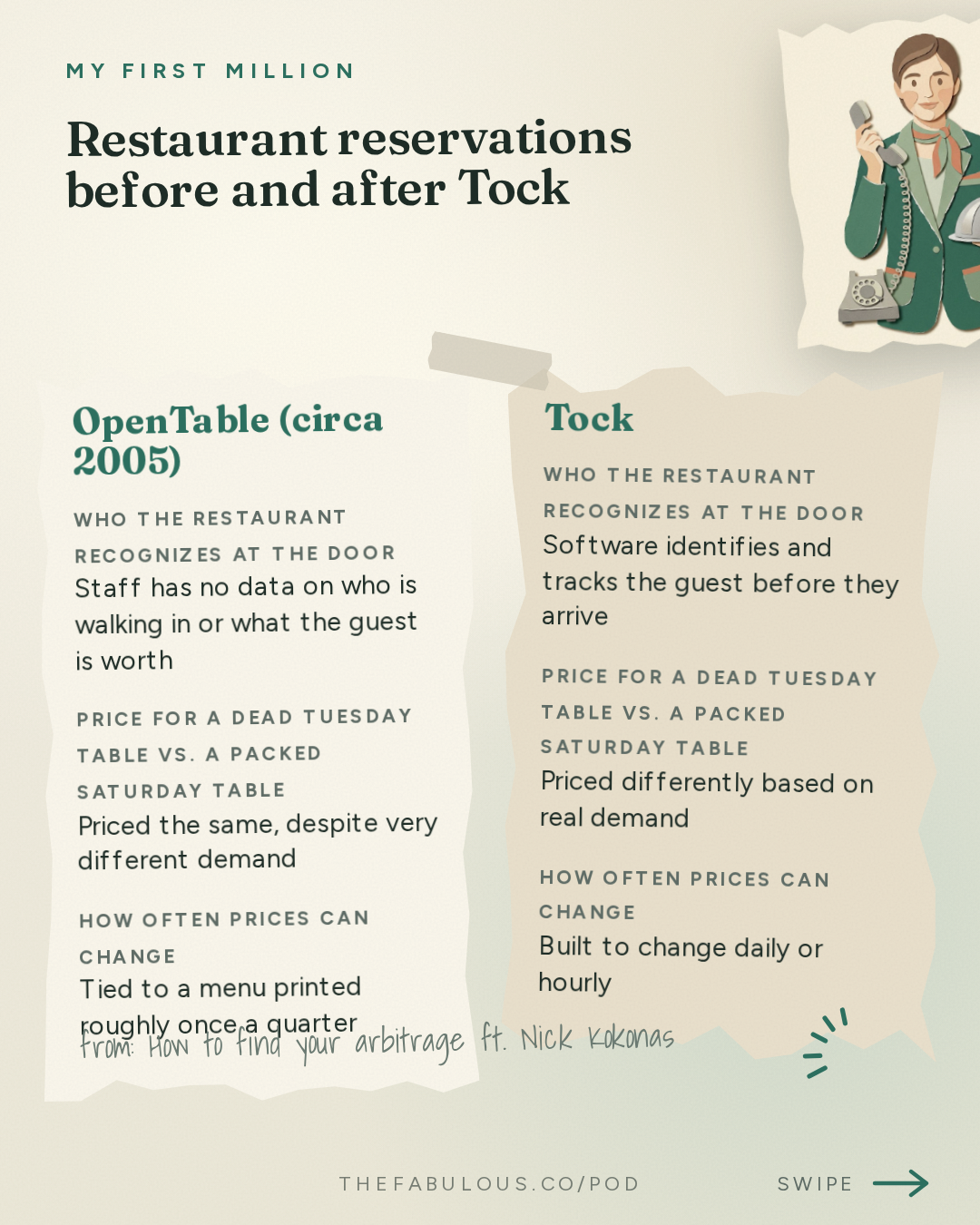
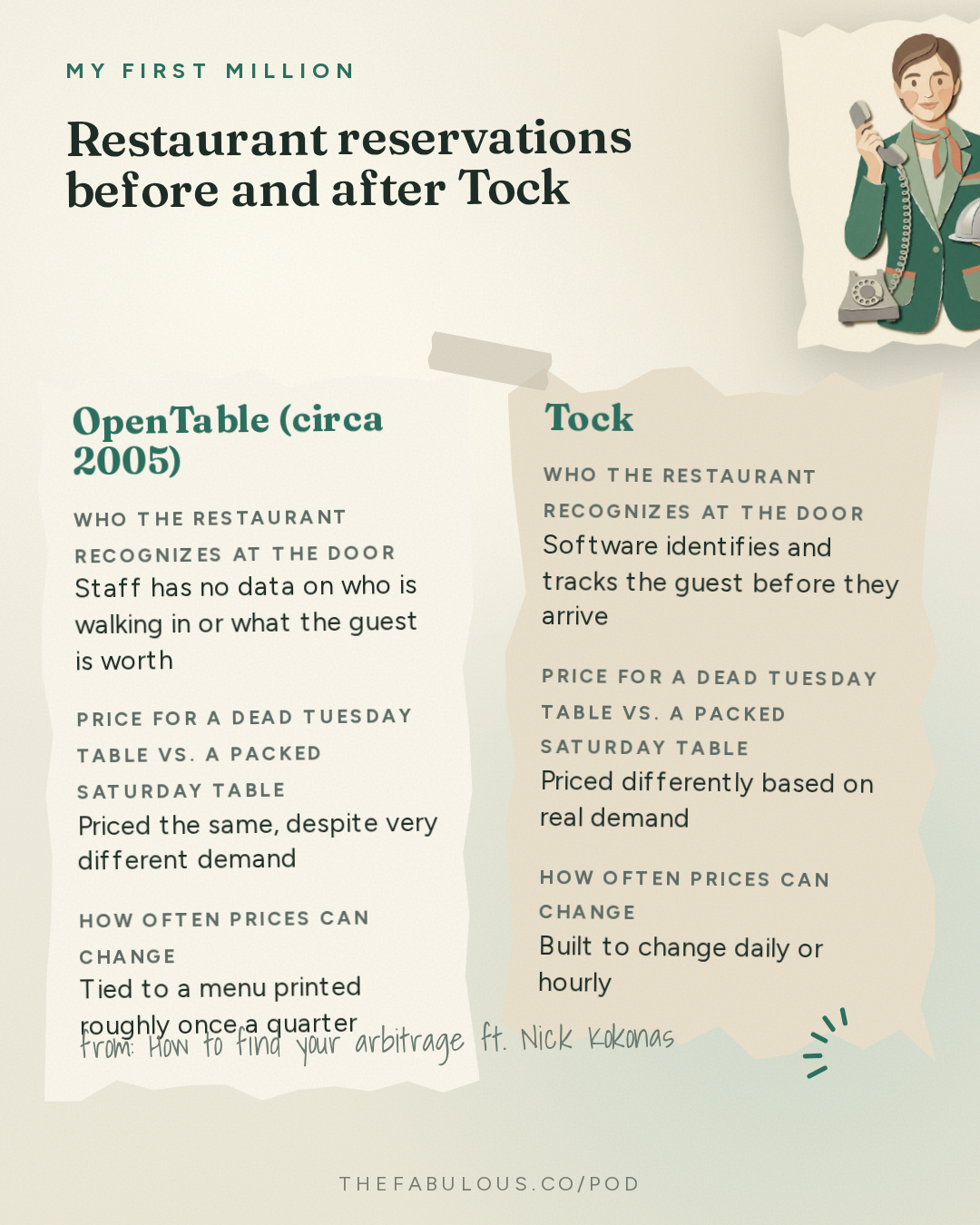
Running Alinea exposed a slower mispricing: restaurant reservations. A table at 9 p.m. on a dead Tuesday was priced the same as the same table at 7 p.m. on a packed Saturday, despite wildly different demand (45:47). Reservation platforms like OpenTable made this worse, Kokonas argues, by owning the customer relationship and leaving restaurants almost no information about who was walking through the door (44:57). He built his software company, Tock, to fix both problems: restaurants could see and price their own customers instead of handing that leverage to a middleman. Kokonas studied magicians the way he once studied market makers, looking for technique rather than entertainment. One lesson reshaped how Alinea's waiters sold wine.
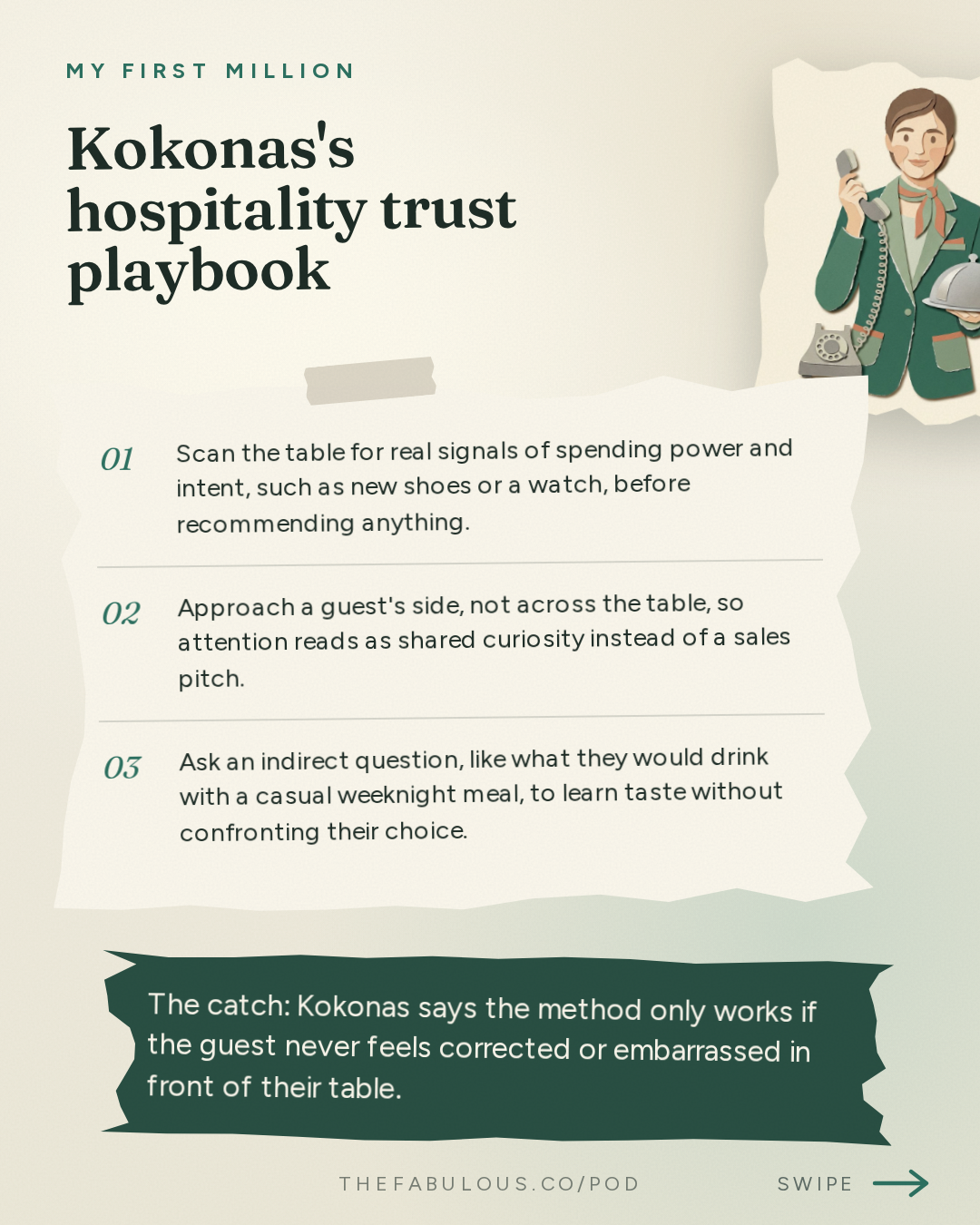
"To gain people's trust, you don't sit across from them or stand across from them. You will stand next to them." Nick Kokonas, [74:29]
He describes reading a table of six guests by their shoes and watches, judging who actually wanted to spend and who was performing wealth, then steering the conversation toward a better pairing instead of correcting their order outright (76:47, 77:38). The aim, in his telling, is never to make a guest feel caught out. It is to make the restaurant and the guest feel like they are on the same side of the table.
Tock eventually sold to Squarespace, and Kokonas handled the deal the way he once handled a trading floor problem: directly. Facing an 896 question due diligence list that outside lawyers estimated would take four to six weeks, his small team converted it into a shared, color coded document and answered it themselves in three days (95:33). "If you're gonna be a successful trader, you will stop doing all the stupid shit," he says of the discipline that kind of work requires (101:54). Investors who had stayed with the Alinea Group since its 2005 opening received eight times their money when it sold in 2023, and roughly 27 to 28 times their money cumulatively across the life of the investment (98:44, 98:50).
His newest project returns, in a roundabout way, to the childlike wonder he says drives all of it. After watching a lottery trick on YouTube by the magician Nate Staniforth and emailing him an unsolicited critique of one flawed detail, the two spent years designing Strange House, an immersive experience built around close up illusion rather than a stage show, modeled loosely on the structure of Disney's Haunted Mansion (107:15, 118:45). The venue will occupy 90,000 square feet of space under Wall Street in Manhattan and needs at least $20 million in annual revenue to work as a business (120:45, 117:21). Kokonas calls the bet the same thing he has always called it, a question of timescale: as artificial intelligence automates more of ordinary life, he expects shared, in-person experience to become scarcer and more valuable, not less (120:01). "Intensity is the strategy," he says of what actually separates people who find these openings from people who do not (100:28). The strategy, in other words, was never hidden. It was always visible. Almost nobody applies enough of it to see it through.
Ask this episode anything
Pod's AI answers from the episode itself, with the minute mark so you can hear it yourself.
Or start with one of these
Ask this episode
Pod's AI listens to the whole episode to answer, and points you to the minute it comes from.
The rest of this answer, and any question after it
Answers come from the episode itself, never from a summary of it.
ContinueKey takeaways
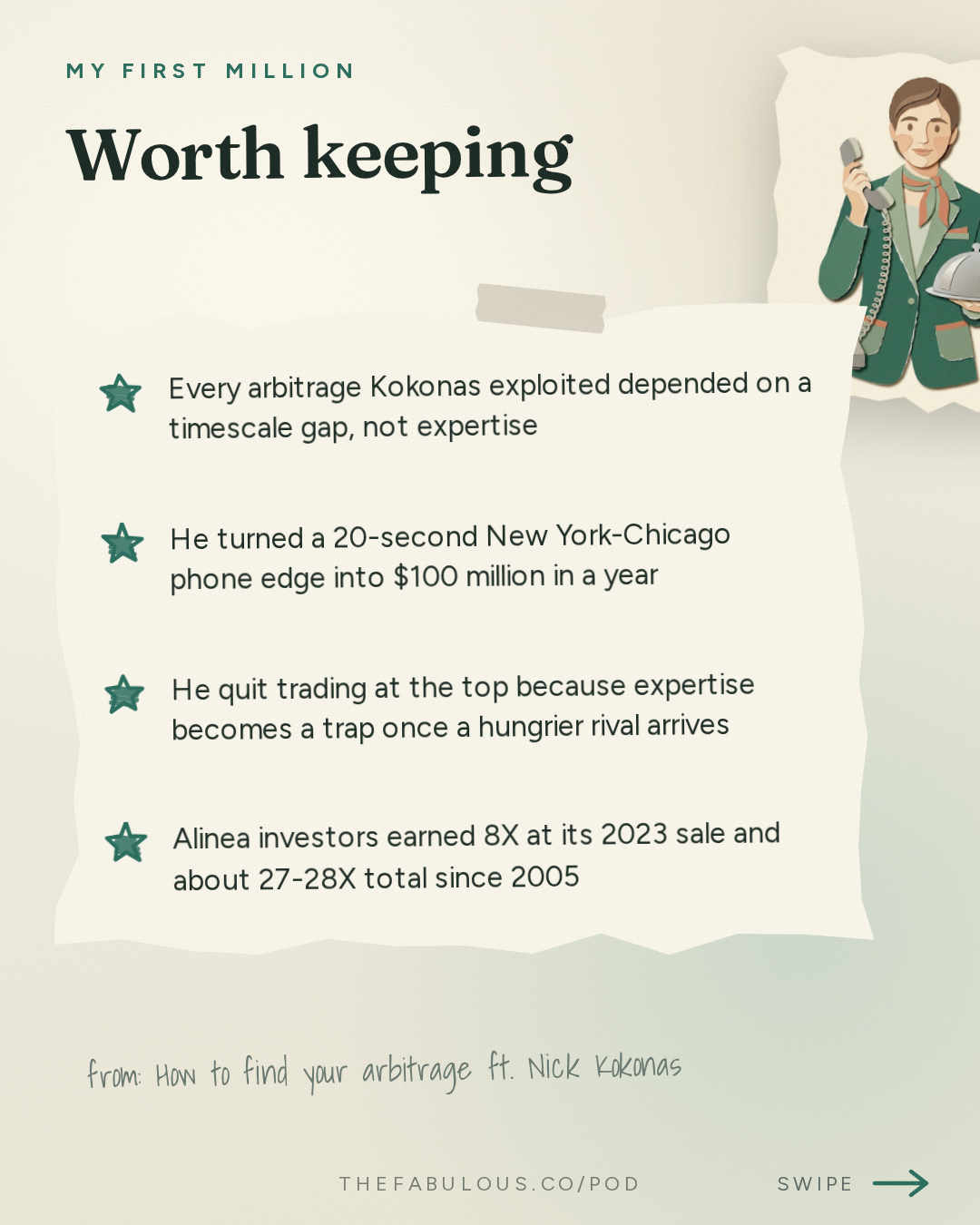
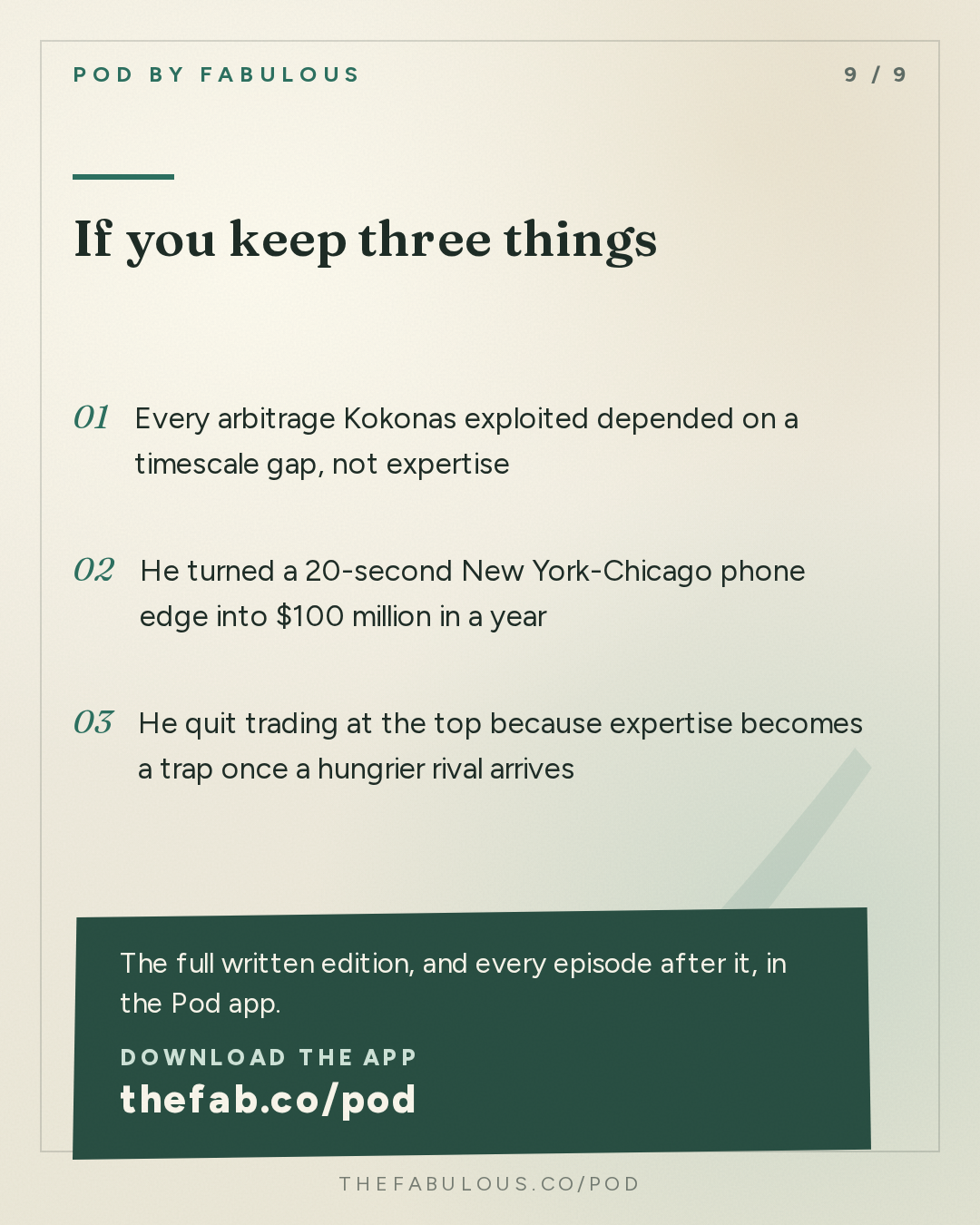
- Every arbitrage Kokonas exploited depended on a timescale gap, not expertise
- He turned a 20-second New York-Chicago phone edge into $100 million in a year (31:53)
- He quit trading at the top because expertise becomes a trap once a hungrier rival arrives (21:39)
- Alinea investors earned 8X at its 2023 sale and about 27-28X total since 2005 (98:44)
- Strange House, his new immersive magic venue, needs $20 million a year in revenue to work (117:21)
The episode in cards
By the numbers
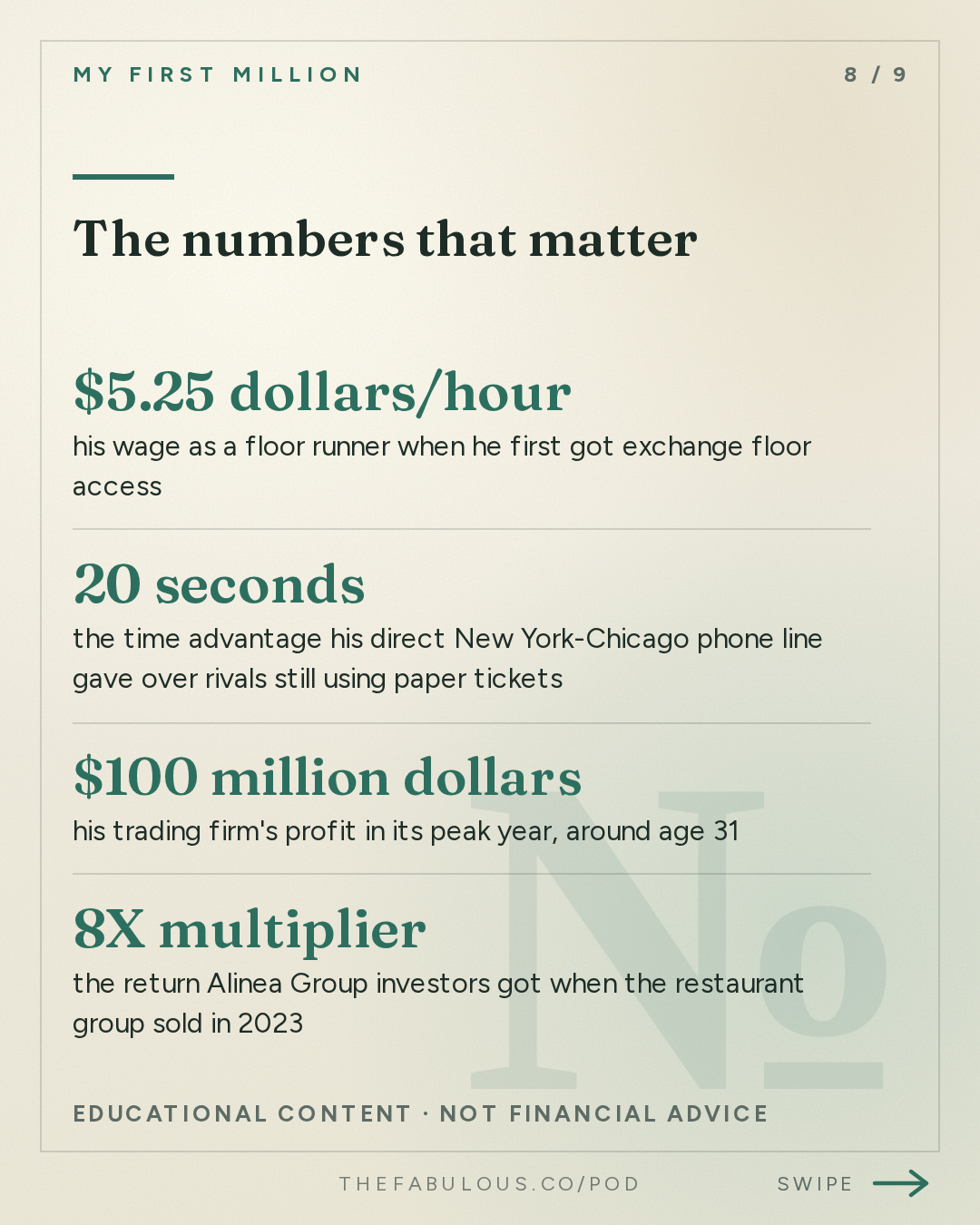
- $5.25 dollars/hour his wage as a floor runner when he first got exchange floor access
- 20 seconds seconds the time advantage his direct New York-Chicago phone line gave over rivals still using paper tickets
- $100 million dollars his trading firm's profit in its peak year, around age 31
- 8X multiplier the return Alinea Group investors got when the restaurant group sold in 2023
- $20 million dollars/year the minimum annual revenue Strange House needs to work as a business
In their words
“If you wake up every day feeling great, you're not taking enough risk. If you wake up every day throwing up, you're taking too much risk.”
“I am now convinced that every arb is just about timescale.”
“To gain people's trust, you don't sit across from them or stand across from them. You will stand next to them”
“If you're gonna be a successful trader, you will stop doing all the stupid shit.”
“Intensity is the strategy.”
Protocols
-
Read the actual rulebook before building around a mispricing
Kokonas reads the full regulatory text himself instead of trusting lawyers who rely on case law and convention, which is how he confirmed his New York-Chicago trading line was legal before anyone else had checked.
Before entering any regulated market or industry
-
Run your own M&A due diligence instead of outsourcing it
Kokonas had his small executive team convert an 896-question diligence list into a shared, color-coded document and answer it directly, finishing in three days what outside lawyers and bankers had quoted at four to six weeks.
During acquisition due diligence
-
Stand beside the customer, not across from them
Kokonas trains restaurant staff to stand alongside a guest rather than facing them when recommending wine or food, because standing shoulder to shoulder reads as shared judgment instead of a sales pitch.
Every guest interaction
-
Staff a restaurant so every night can run like a Saturday
Kokonas says owners should hire and schedule enough staff to run at full capacity nightly, because a manager left to set their own pace will quietly under-book tables to protect their own energy.
Nightly staffing and capacity planning
Questions this episode answers
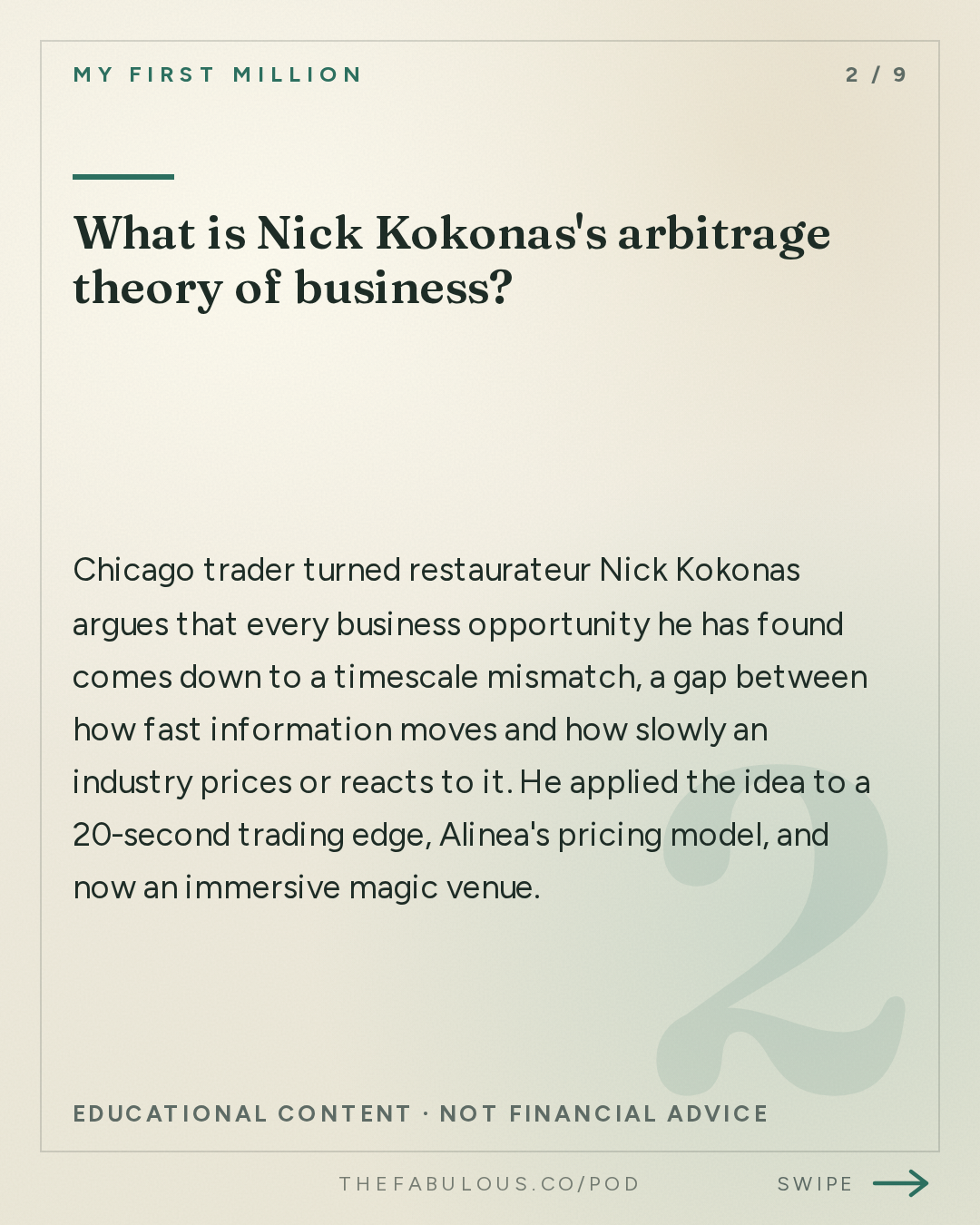
What is Nick Kokonas's arbitrage theory of business?
Chicago trader turned restaurateur Nick Kokonas argues that every business opportunity he has found comes down to a timescale mismatch, a gap between how fast information moves and how slowly an industry prices or reacts to it (00:16). He applied the idea to a 20-second trading edge, Alinea's pricing model, and now an immersive magic venue.
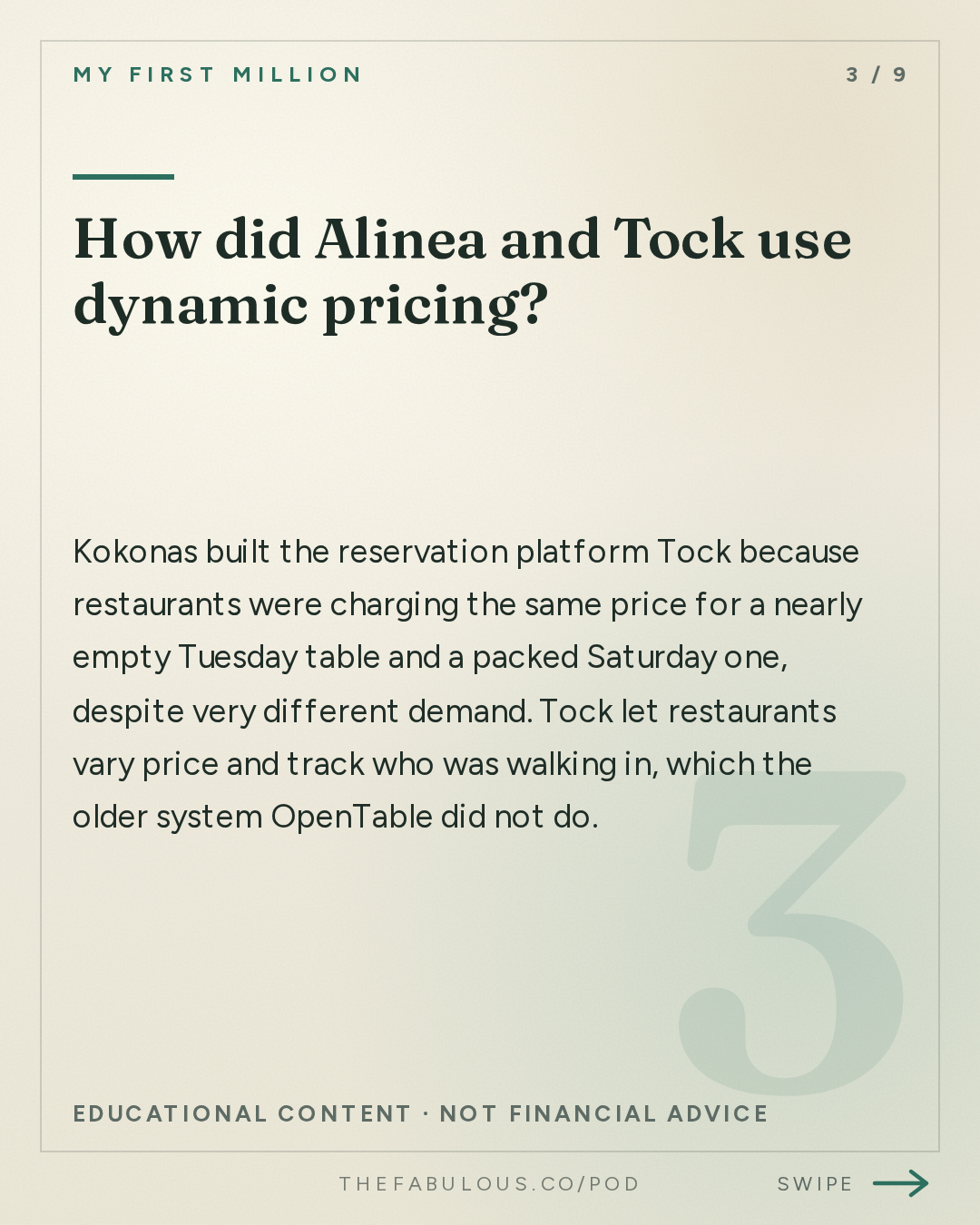
How did Alinea and Tock use dynamic pricing?
Kokonas built the reservation platform Tock because restaurants were charging the same price for a nearly empty Tuesday table and a packed Saturday one, despite very different demand (45:47). Tock let restaurants vary price and track who was walking in, which the older system OpenTable did not do (45:17).
Why did Nick Kokonas sell Tock?
Kokonas says Tock's pandemic-era growth of 200 percent a year was always going to slow, and he worried investors would misread that normal deceleration as decline rather than maturation (94:33). He sold the company to Squarespace and ran due diligence himself with a small team instead of paying an investment bank (97:16).
What is Strange House, Nick Kokonas's new project?
Strange House is an immersive, magic-based experience Kokonas is building with magician Nate Staniforth in 90,000 square feet of space under Wall Street in Manhattan (120:45). It moves small groups through a sequence of close-up illusions, structured loosely like Disney's Haunted Mansion, and needs at least $20 million in annual revenue to work as a business (117:21).
What does Nick Kokonas mean by 'expertise is a trap'?
In Kokonas's view, once someone becomes the expert in a field, a younger, hungrier non-expert with fresh eyes will eventually outcompete them, so he treats reaching expert status as a signal to quit and start over (21:39). This is why he has changed careers roughly every decade, moving from trading to restaurants to software to immersive entertainment.
The full read, in cards
Go deeper
- Market Wizards — trading-interview book Kokonas cites for its 'One Lot Wonders' idea that successful traders simply stop repeating stupid mistakes
- Art and Fear — source of the pottery-class parable showing volume of work beats chasing a single perfect piece
- Finding Real Magic — Nate Staniforth's book on his trip to India, which Kokonas read after they met over a lottery-trick email
- Hearts of Darkness — documentary about the chaotic making of Apocalypse Now that Kokonas rewatches to put his own risk-taking in perspective
Mentioned
Nick Kokonas · Grant Achatz · Alinea · Tock · Jane Street · David Byrne · Nate Staniforth · Elan Lee · Market Wizards · Stop Making Sense · Chicago Mercantile Exchange · Squarespace
More from this show and category
Peter Levels: Why SaaS Lost Its Moat
Peter Levels says plain software has no moat left in the AI era, and what remains is data, network effects, distribution, or regulation. The episode also follows Bryan Johnson's attempt to dunk at 49, Elon Musk's SpaceX share giveaway to 72 million kids, and a pest control brand's $1,000 first week built on direct-to-consumer branding.
Low-Frequency Investing: The 2.9-Decision Portfolio
A retail investor who made only 2.9 decisions a year beat the S&P 500 in 11 of 11 years, averaging 21.8% annual returns versus 13.5%. The hosts run his brokerage history through the AI assistant Claude, then widen out to Jack Dorsey's 140-reason pre-mortem, Mark Zuckerberg's talent-density bet, Elon Musk's 24-hour rebuilding rule, and a four-step method called DARE for panic and fear.
The 6 Traits of Natural Money Makers
Sam Parr and Shaan Puri map the "natural money maker": unemotional, maximizing, and comfortable with complexity. They share entrepreneur Sayed Balkhi's "second derivative" rule (spend only investment returns, never income) and a 3% liquid-net-worth spending cap, plus six other wealth-building personality types like the Tank, the Trickster, and the Sniffer.
Shaan Puri's 3 Embarrassing Moments That Changed Him
Shaan Puri, host of My First Million, shares three embarrassing stories, including a 110 narcissism test score and a failed 250-page restaurant business plan. He explains how each moment taught him to stop chasing external validation, favor action over endless planning, and reinvent his identity by deciding who to become before he felt ready.
