
The 6 Traits of Natural Money Makers
the 6 traits of people who can’t stop making money
The brief
Sam Parr and Shaan Puri map the "natural money maker": unemotional, maximizing, and comfortable with complexity. They share entrepreneur Sayed Balkhi's "second derivative" rule (spend only investment returns, never income) and a 3% liquid-net-worth spending cap, plus six other wealth-building personality types like the Tank, the Trickster, and the Sniffer.
Carl Icahn once bought a shipping company and, within two weeks of showing up at the office, decided that twelve floors of employees served no purpose he could identify. He fired all of them in a single day. Four or five months later he asked his team whether anyone had noticed the loss. Nobody had (02:28). Sam Parr tells this story on My First Million to illustrate a species of businessperson he calls the natural money maker: someone who treats a company, a deal, or a career the way a surgeon treats an organ, without sentiment, purely by what the numbers say.
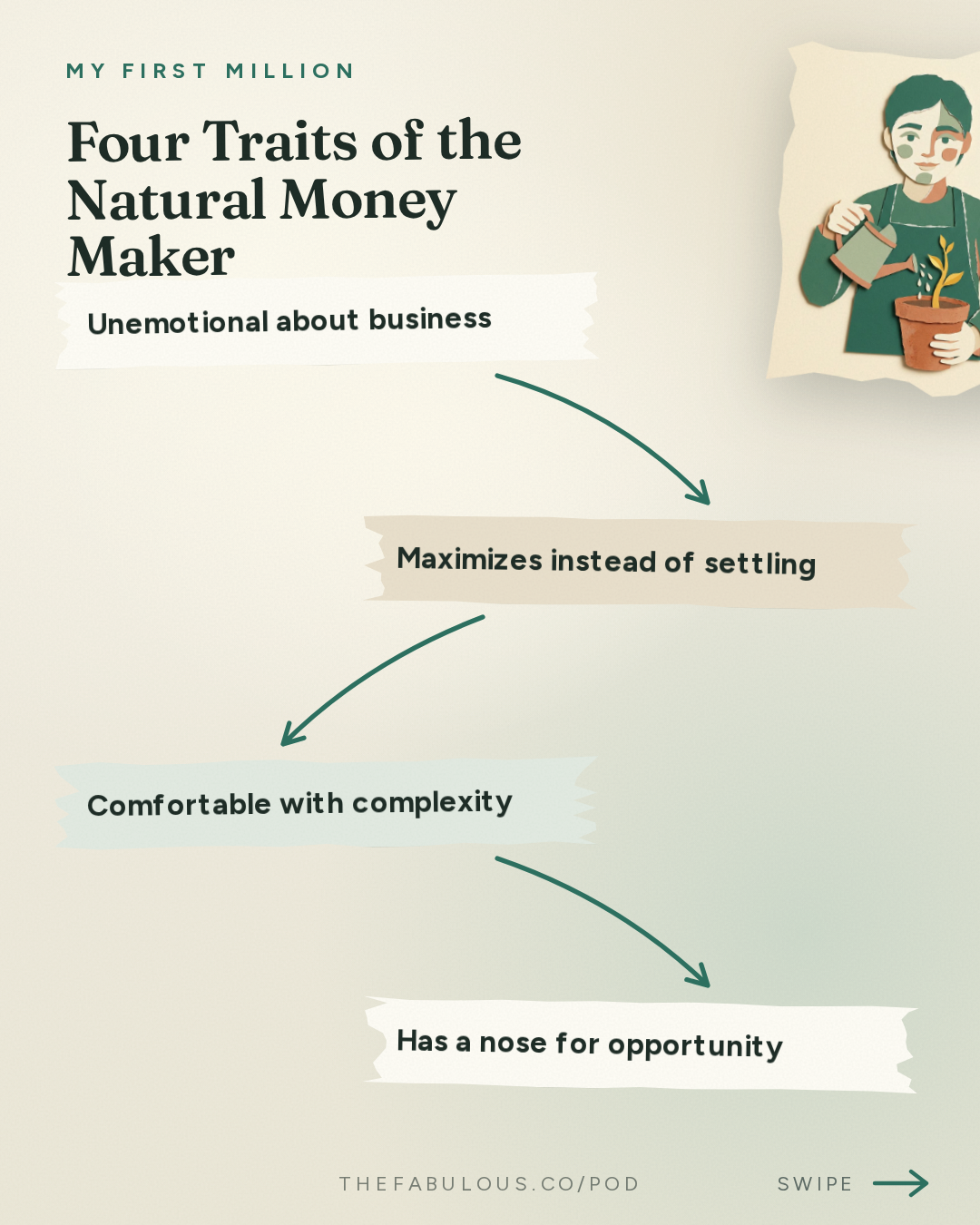
Parr separates this trait from entrepreneurship generally. Ted Turner, who built CNN, had vision and a feel for people and markets, but Parr does not call him a natural money maker (00:50). The distinction matters because the natural money maker's edge is not one skill. It is a temperament, and the kind of person who succeeds across multiple unrelated fields rather than mastering a single one (01:49).
"A natural money maker is a person who tends to, uh, be involved in deal-making, brokering, and inserting themselves into situations." Sam Parr, [00:27]
The clearest case study on the episode is Nick Kokonas, a philosophy major who became a trader instead of taking a safer job at a bank (03:26). As a floor trader he would walk away some days a few hundred thousand dollars richer, other days that much poorer (04:06). His best year, his trading firm cleared $100 million in profit from a single arbitrage: in the early days of exchange-traded funds, the quoted price of the basket of stocks inside an ETF did not always match the real-time price of buying each stock individually. Kokonas found the gap, then solved the harder problem of seeing prices fast enough to exploit it, by running fiber cable between the New York and Chicago exchanges so his quotes beat everyone still relaying orders by phone and paper slip (04:27, 05:16).
Then he left trading and opened a restaurant. Alinea became the first restaurant outside New York to earn a Michelin star, in an industry famous for eating founders alive. At its peak it did $26 million a year in revenue with close to 20 percent profit margins, and during the pandemic, when most restaurants closed, Kokonas pivoted to $35 takeaway dinners and kept the business alive (06:36). By the time he and Parr spoke, Kokonas had already moved on to buying a wine collection worth roughly a million dollars for $150,000 (07:00). The pattern, Parr argues, is not genius in any one domain. It is a nose for mispriced opportunity that works regardless of the domain.
Diminishing Returns Are Still Returns
The second trait Parr names is a refusal to stop. Most people hit a point of enough and walk away from a deal because the upside looks small relative to the hassle. Natural money makers do not. Parr describes a wealthy friend who spent his free time figuring out how to buy defaulted or soon-to-default credit card debt, hire a firm to collect it, and earn roughly a 14 percent return, despite not needing the money at all (07:47).
"Natural money makers do not say it's too much trouble. They do not say diminishing returns are... they, they say diminishing returns are still returns." Sam Parr, [08:29]
Parr pairs this with an old story about the nineteenth century financier Jay Gould, who, dying of tuberculosis with less than a year to live, was begged by his family at dinner to let a railroad deal go. He thought about it for a week, then told them he had to return to his first love, making money. He closed the deal and died about six months later (08:29). It is an extreme example, offered as the far end of a spectrum: the natural money maker's idea of enough keeps moving.
This appetite pairs with a comfort around complexity that Parr says most people, including most entrepreneurs, do not share. The average businessperson wants to keep things simple, he argues, while the natural money maker can hold a deal with several interlocking contingencies in their head and compare it quickly to the alternatives (10:21, 11:06). Shaan Puri, Parr's co-host, pushes back a little: the people he knows in this category do not experience their deals as complicated. They experience them as simple, because they have already found the shortcut, the person who has done it before, the machine that pays for itself in two months (14:24, 17:06). A friend who built an entire manufacturing plant on a phone call and a payback calculation, Puri says, treated the logic as something that fits on a fortune cookie (17:06). The execution is hard. The reason to do it is not.
The Second Derivative, and Other Rules for Not Going Broke
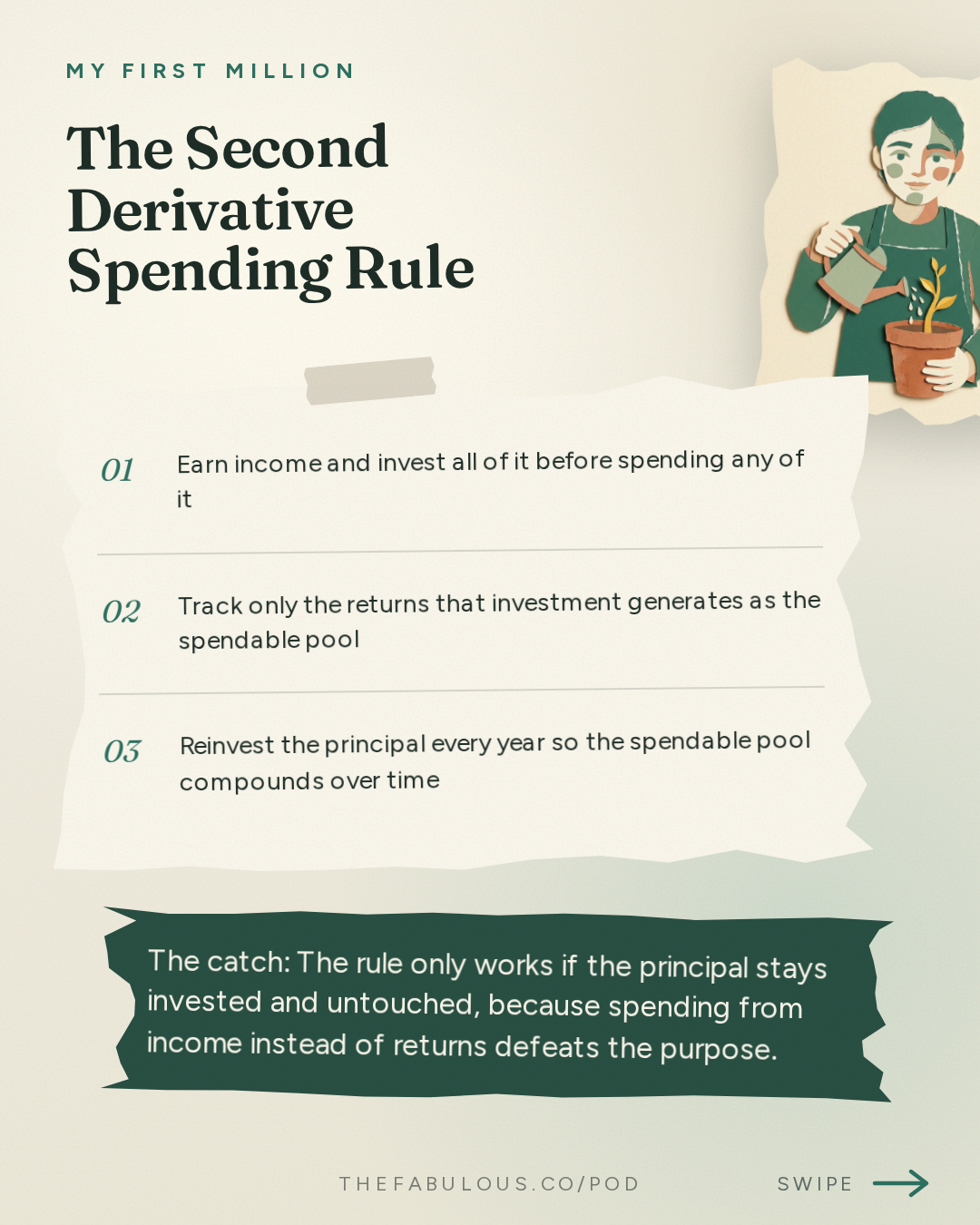
The episode's most concrete piece of advice comes from entrepreneur Sayed Balkhi, who built a fortune out of a WordPress blog, then plugins, then real estate, including gas stations he buys for roughly $200,000 apiece as simple, low-maintenance cash flow (13:21, 13:46). Balkhi's mentor taught him what he calls the second derivative rule: do not spend your income. Invest all of it, and spend only the returns that investment generates.
"You only spend the second derivative... you are only spending not your income, but the investment returns off your income." Shaan Puri, [18:51]; Sam Parr, [19:11]
At first, Parr explains, the spendable amount is small. On $100,000 of income invested, the first year's return might only be $10,000 (19:11). But the pool compounds: add another $100,000 the next year, and now there is $200,000 generating returns, and so on, until after five or seven years a person can live entirely off the gains without ever touching the principal (19:31). Puri's version of the same discipline is simpler to state: he caps his annual spending at under 3 percent of his liquid net worth, a number low enough, he says, that he can go to sleep knowing it will never run out (19:51).
Neither host romanticizes this as misery dressed up as discipline. Puri notes that some natural money makers he knows, like his friend Val, are generous and happy, while plenty of ordinary entrepreneurs are miserable for unrelated reasons (21:32). But he adds a caution about people who keep playing the game past the point where money changes their life. Trading hours for dollars they will never spend is, in his words, a trade that stops making sense (23:18). He compares it to his own decision to spend a year learning piano badly, with no payoff beyond the fact that it was new and fun (25:09). The money kept compounding whether or not he noticed it. The piano lessons needed his attention on purpose.
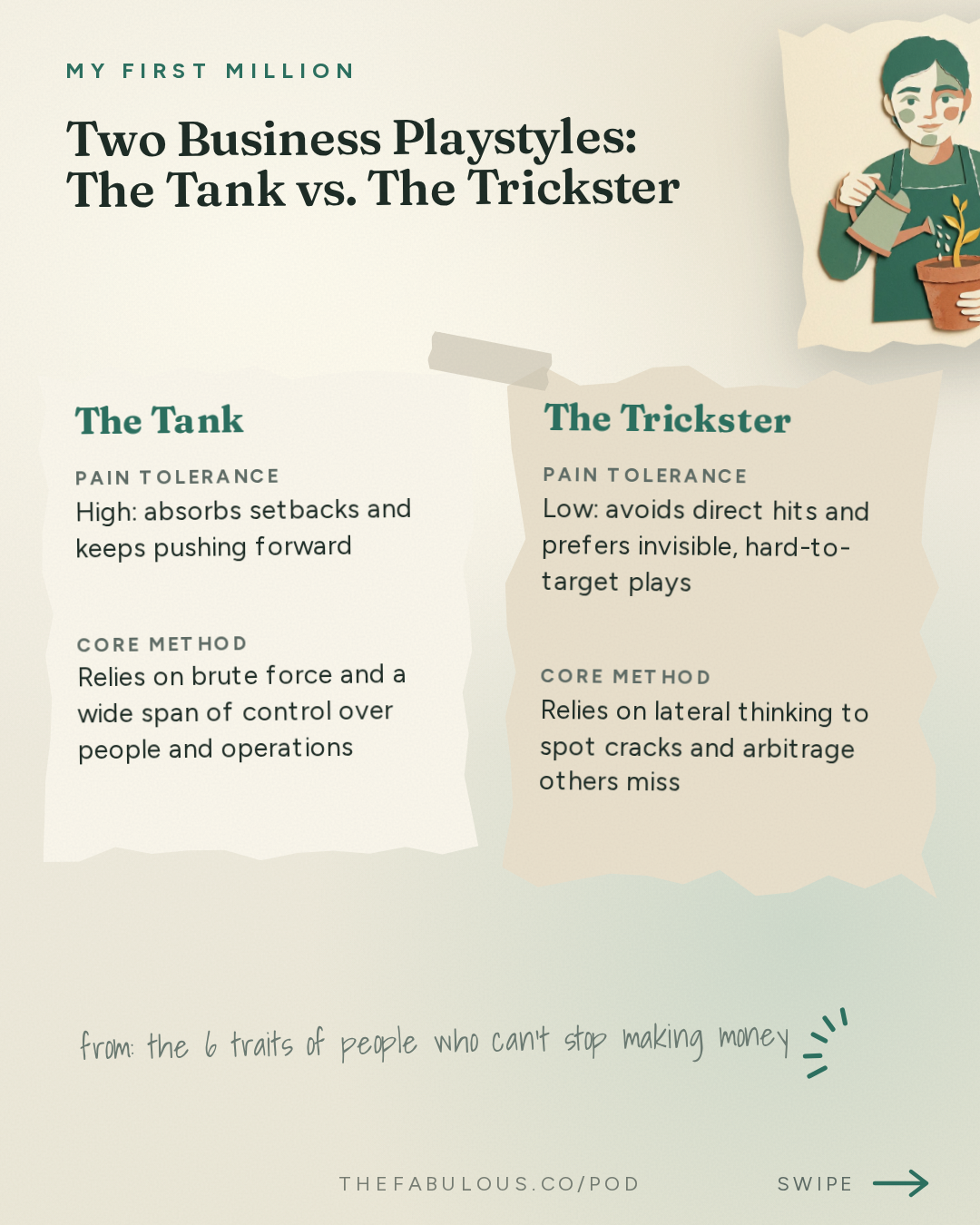
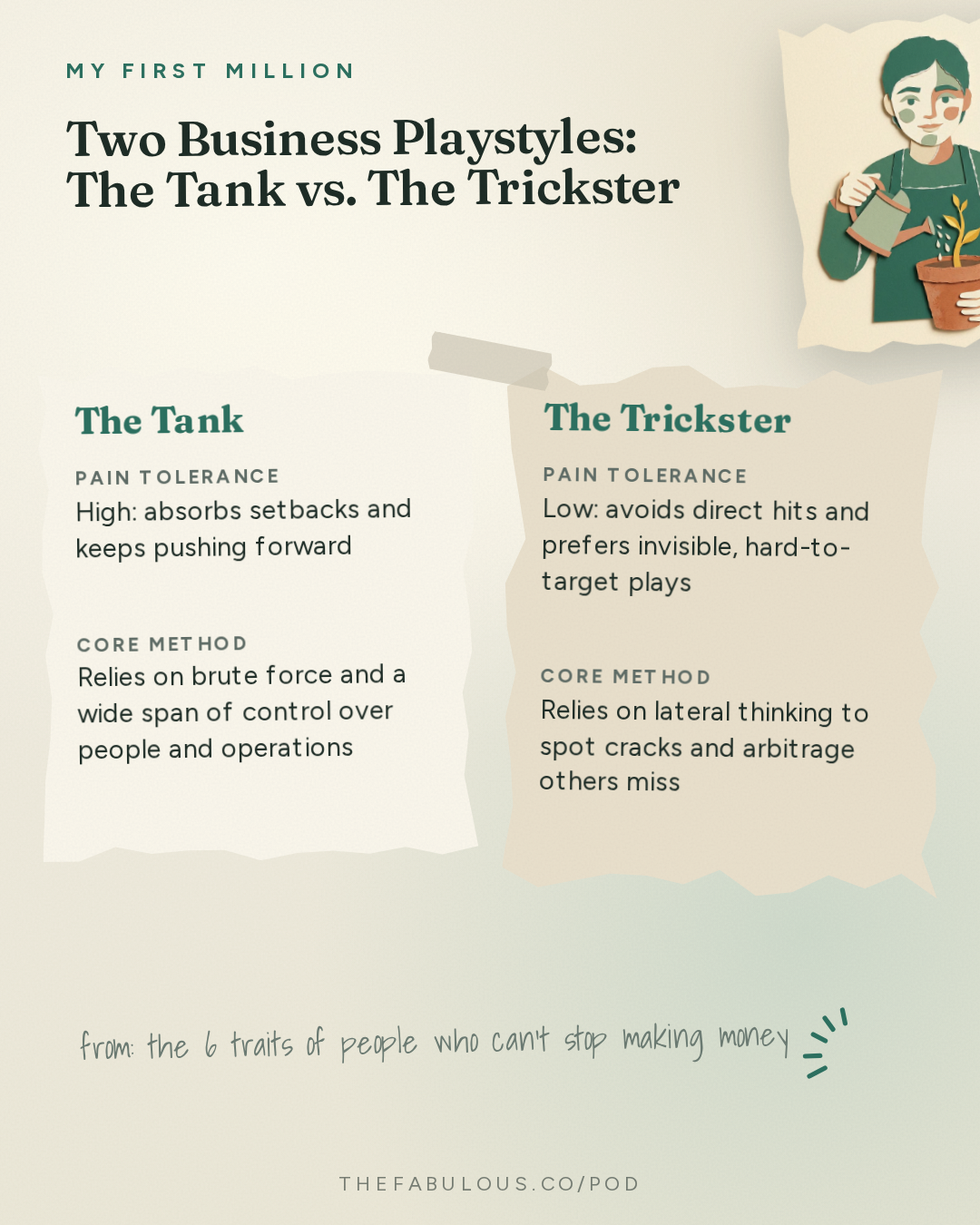
Parr and Puri spend the back half of the episode sketching out other ways to win that have nothing to do with the natural money maker profile. There is the Tank, the operator who leads by brute force, high pain tolerance, and a wide span of control over people, a type they compare to former Snowflake CEO Frank Slootman (28:36). There is the Trickster, who has almost no tolerance for direct hits but is nearly impossible to pin down, the type who finds the cultural crack nobody else sees, like entrepreneur Alex Tew turning "do nothing for two minutes" into the app Calm (30:11, 30:30). There is the Fierce Nerd, a term borrowed from a Paul Graham essay, describing the high-IQ, highly competitive person who looks harmless until met on their own turf (31:46). And there is the Deep Student, who never plays the game directly but studies everyone who does, with the endurance of a historian (32:37).
The last archetype Puri names, almost as an afterthought, might be the most useful for anyone without capital to deploy: the Sniffer. Unlike the natural money maker, the Sniffer is not hands-on and often is not even the one executing the deal. They simply see value before anyone else does. Puri cites his friend Austin Rief, co-founder of the newsletter Morning Brew, who kept flagging non-obvious trends years before they became obvious (34:49). He also points to investor Sean Parker, who made more money off Facebook than almost anyone except Mark Zuckerberg without building the company himself, because he recognized what it was before the market did, and later pushed the founders of Spotify to see how big their own idea could get (36:53, 37:18).
"It's a conviction arbitrage. You, you, you believe before everybody else believes. You see it before everybody else s- sees it for to be true." Shaan Puri, [37:47]
None of this is offered as a hierarchy. The hosts return, near the end, to a line from investor Ray Dalio, who they say takes personality tests more seriously than almost any other person of his wealth and stature they have met. Dalio's question, as Puri paraphrases it, is simple: will a person have more success fighting their nature, or working with it (34:12)? The six archetypes in this episode are less a taxonomy than a mirror. The point is not to decide which one is best. It is to notice which one already describes the way a person operates, then stop apologizing for it.
Ask this episode anything
Pod's AI answers from the episode itself, with the minute mark so you can hear it yourself.
Or start with one of these
Ask this episode
Pod's AI listens to the whole episode to answer, and points you to the minute it comes from.
The rest of this answer, and any question after it
Answers come from the episode itself, never from a summary of it.
ContinueKey takeaways
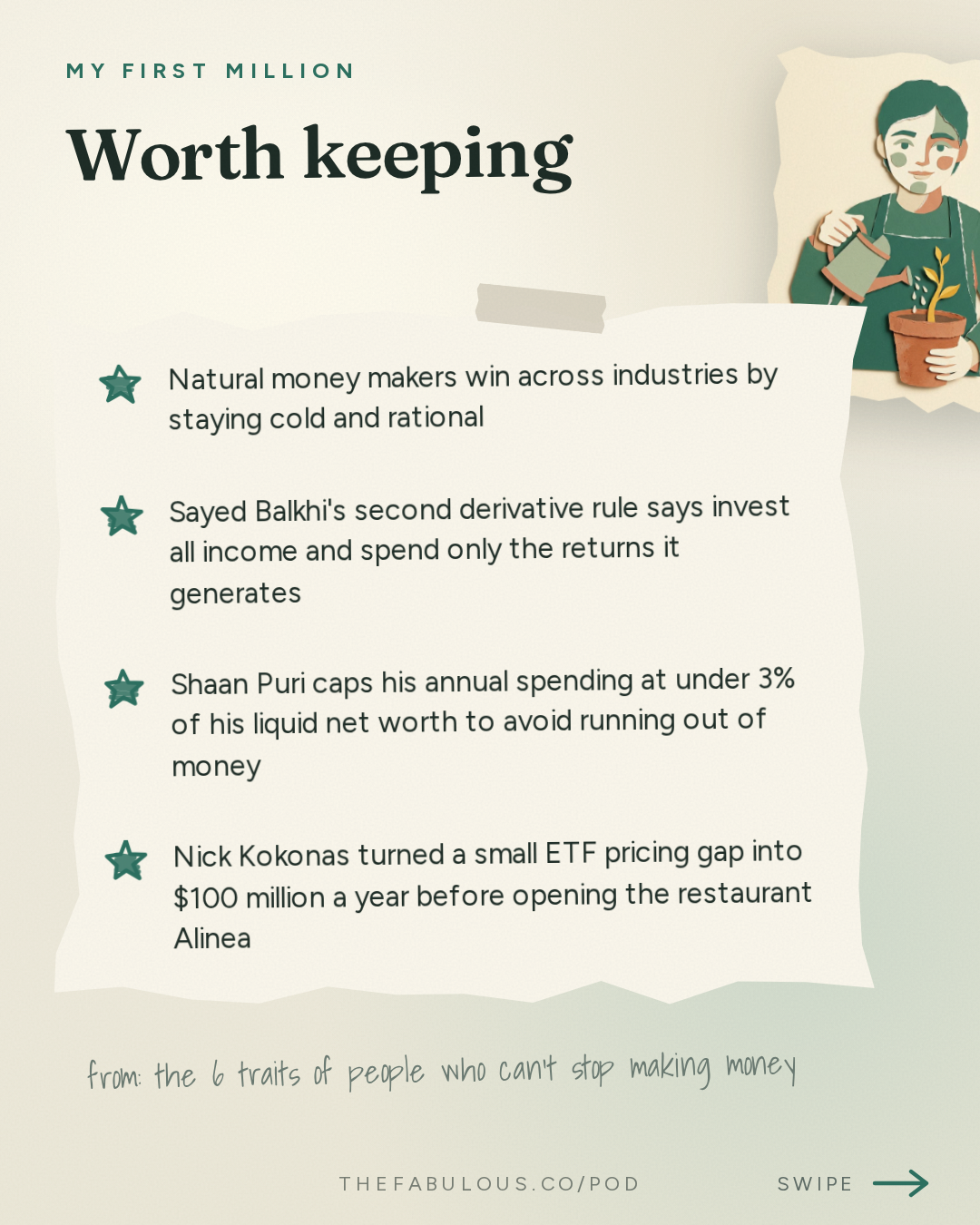
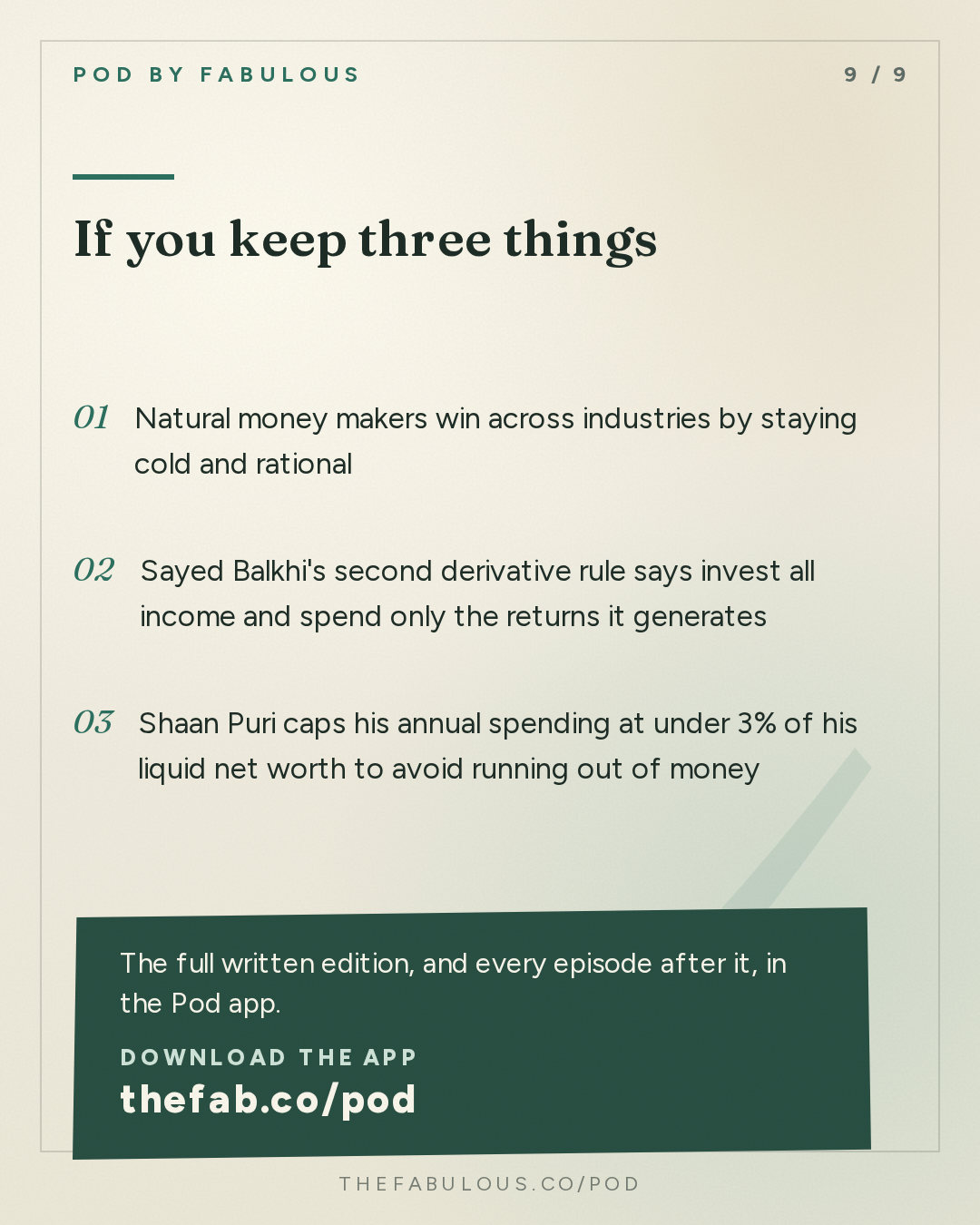
- Natural money makers win across industries by staying cold and rational
- Sayed Balkhi's second derivative rule says invest all income and spend only the returns it generates
- Shaan Puri caps his annual spending at under 3% of his liquid net worth to avoid running out of money
- Nick Kokonas turned a small ETF pricing gap into $100 million a year before opening the restaurant Alinea
- Six other business archetypes exist too, including the Tank, the Trickster, and the Sniffer who spots trends early
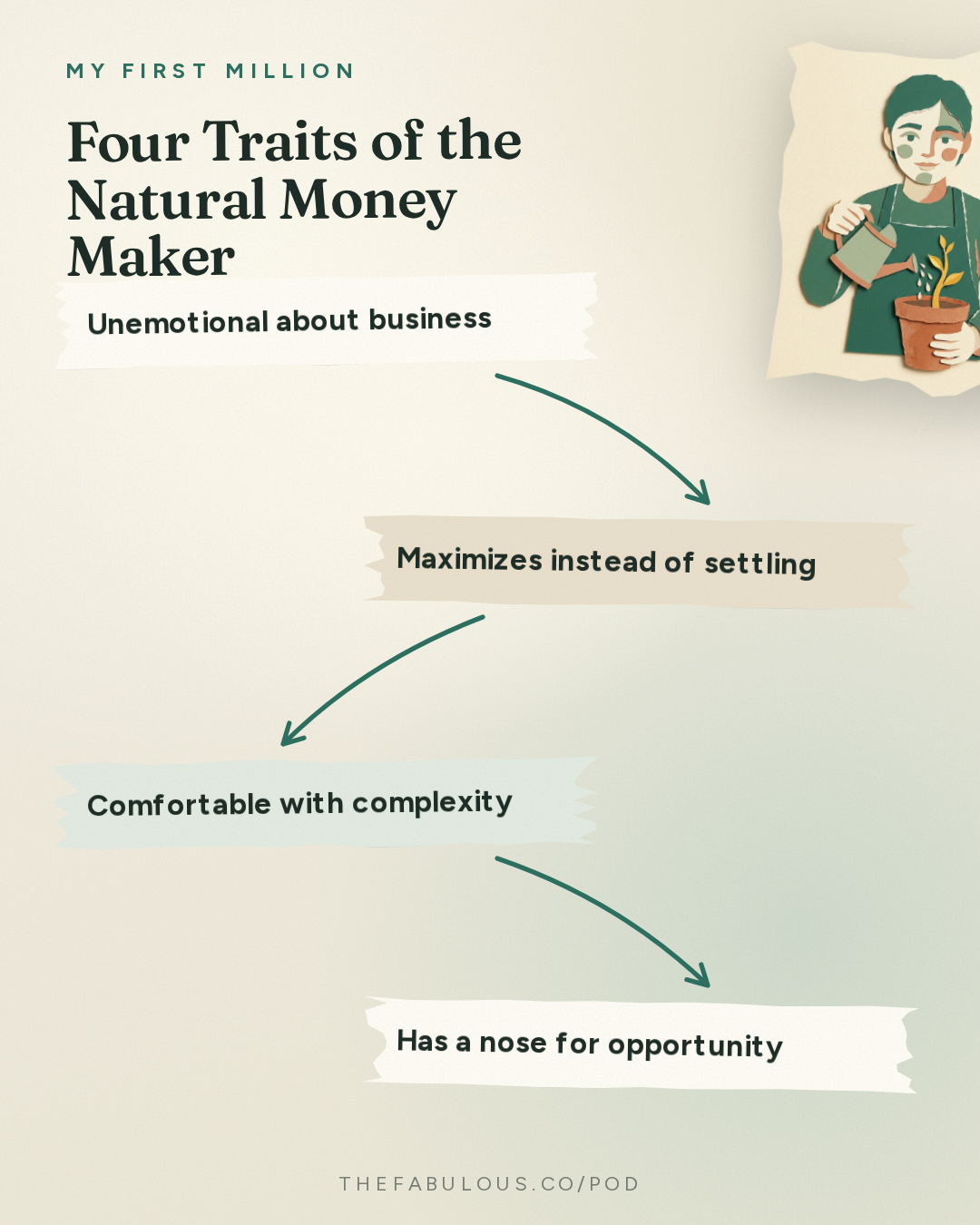
The episode in cards
By the numbers
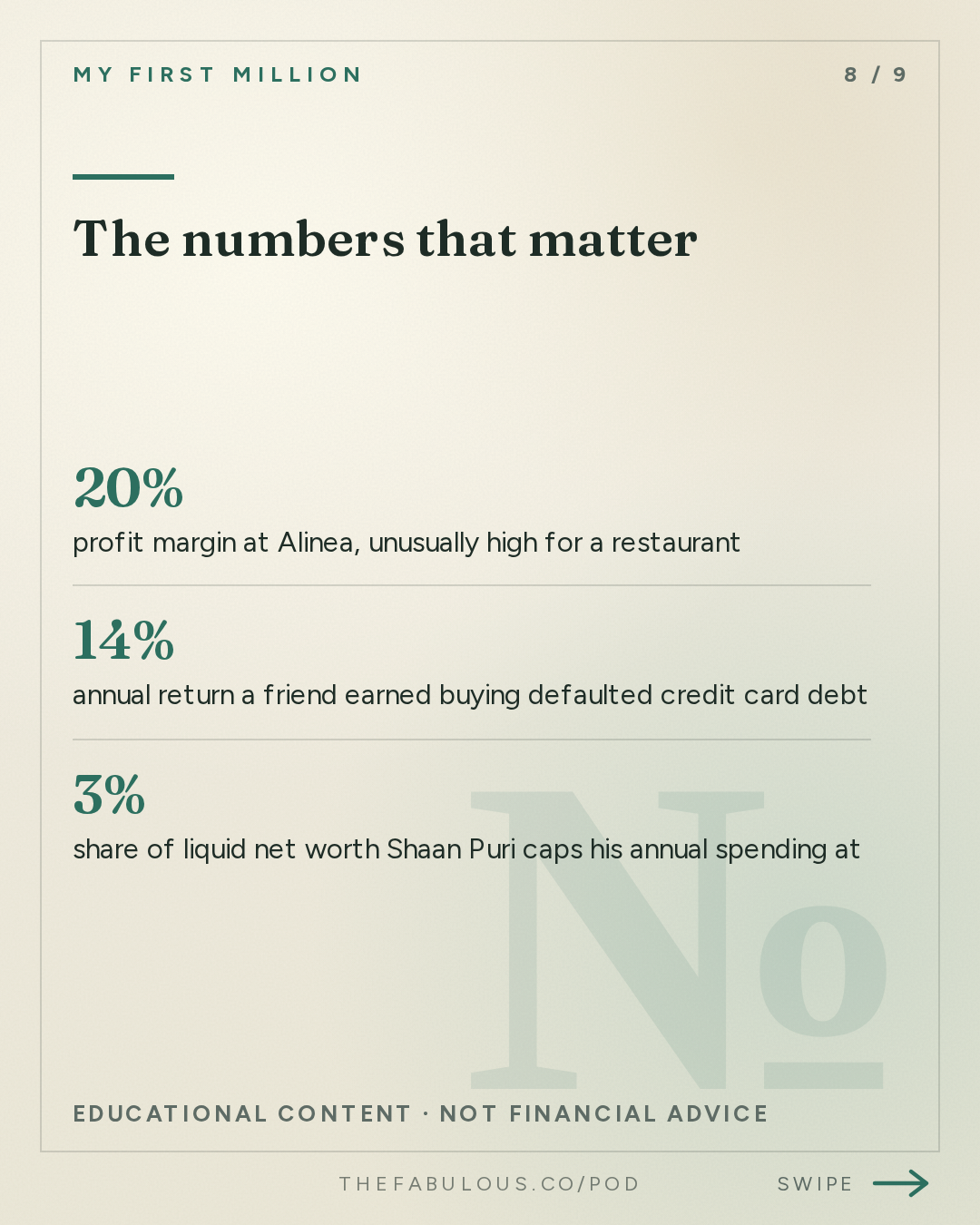
- 20% percent profit margin at Alinea, unusually high for a restaurant
- 14% percent annual return a friend earned buying defaulted credit card debt
- 3% percent share of liquid net worth Shaan Puri caps his annual spending at
In their words
“A natural money maker is a person who tends to, uh, be involved in deal-making, brokering, and inserting themselves into situations.”
“Natural money makers do not say it's too much trouble. They do not say diminishing returns are... They, they say diminishing returns are still returns”
“My annual budget is less than 3% of my liquid net worth. And I do that because I can go to bed at night knowing that, uh, it won't ever run out.”
“It's a conviction arbitrage. You, you, you believe before everybody else believes. You see it before everybody else s- sees it for to be true”
Protocols
-
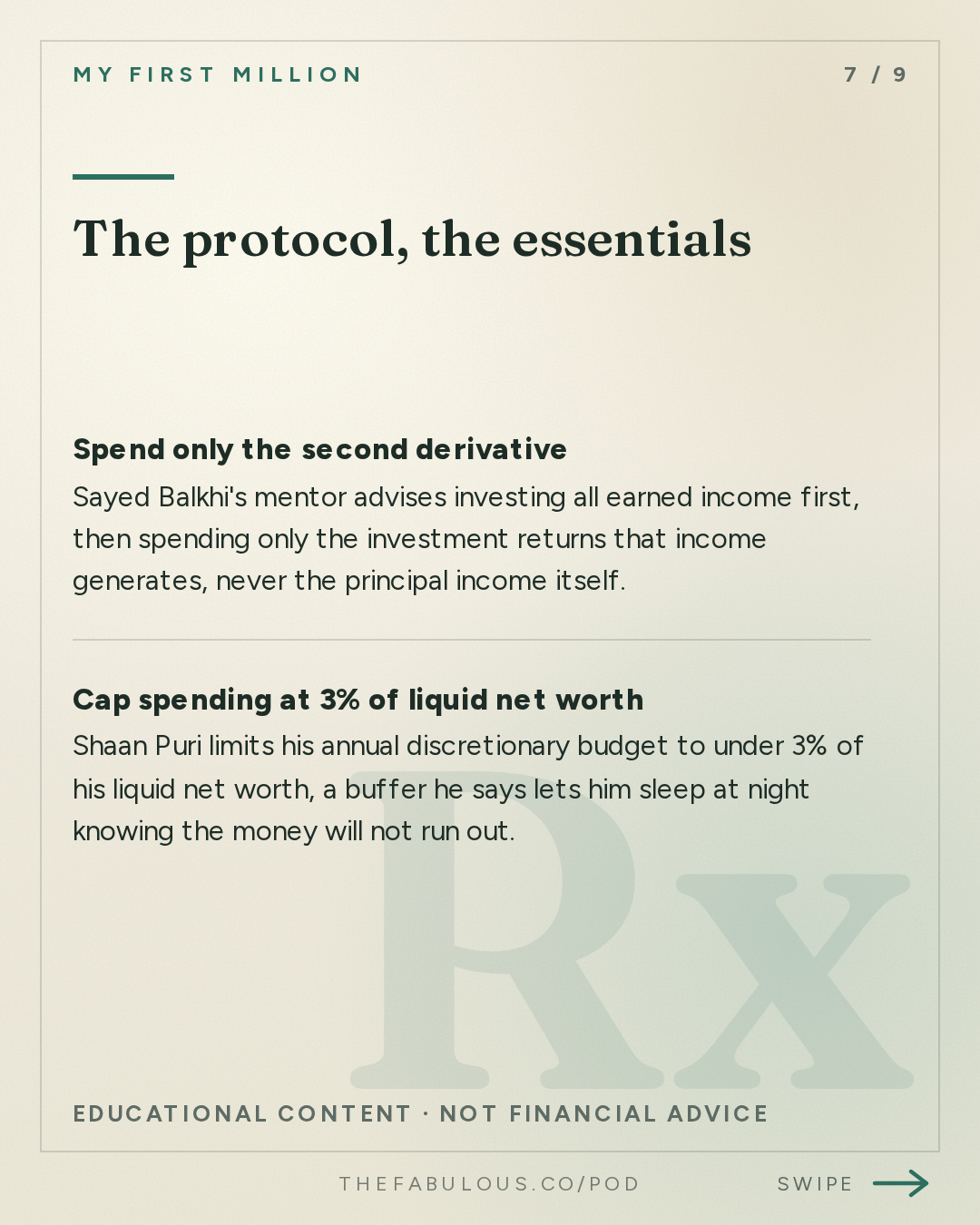
Spend only the second derivative
Sayed Balkhi's mentor advises investing all earned income first, then spending only the investment returns that income generates, never the principal income itself.
ongoing, reassessed as income compounds
-
Cap spending at 3% of liquid net worth
Shaan Puri limits his annual discretionary budget to under 3% of his liquid net worth, a buffer he says lets him sleep at night knowing the money will not run out.
annual
-
Pick a strategy that fits your wiring
Investor Ray Dalio advises asking whether a person will have more success fighting their natural tendencies or working with them, then choosing a business strategy that fits that inherent wiring rather than fighting it.
when choosing a business approach
Questions this episode answers
What is a natural money maker?
Podcast host Sam Parr defines it as someone who makes deals, brokers, and inserts themselves into situations, winning across multiple unrelated industries instead of relying on one specialized skill (00:27, 01:49). The trait is temperament, not expertise: staying unemotional and purely rational about business decisions (02:11).
What is the second derivative spending rule?
It is entrepreneur Sayed Balkhi's mentor's advice to invest all earned income first and spend only the investment returns that income generates, never the income itself (18:51). As the invested principal grows, the spendable return compounds, which can let someone live off gains alone after five to seven years (19:31).
How much of my net worth should I spend each year?
There is no universal number in the episode, but co-host Shaan Puri says he personally caps his annual discretionary spending at under 3 percent of his liquid net worth, a level he says lets him sleep knowing the money will not run out (19:51).
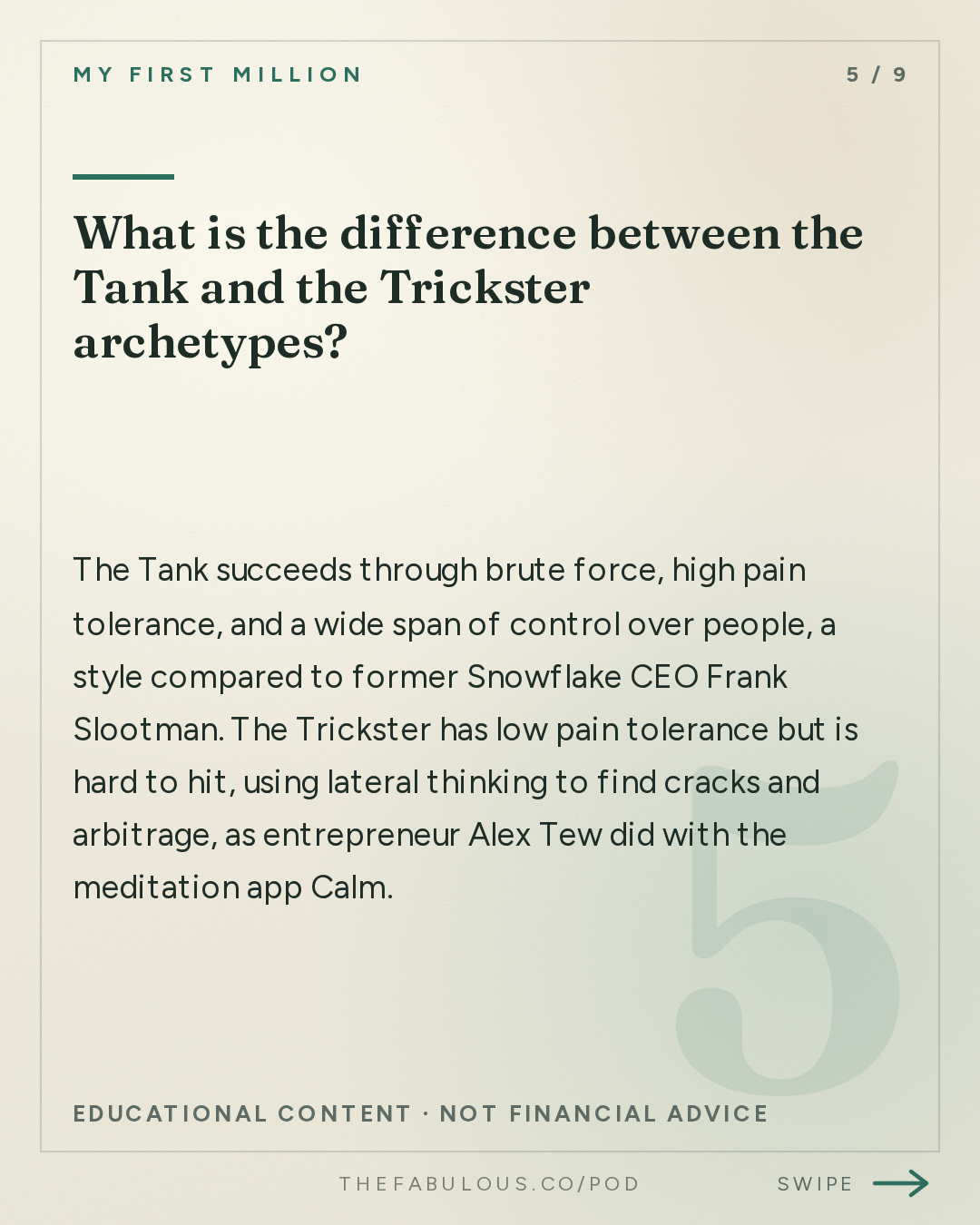
What is the difference between the Tank and the Trickster archetypes?
The Tank succeeds through brute force, high pain tolerance, and a wide span of control over people, a style compared to former Snowflake CEO Frank Slootman (28:36). The Trickster has low pain tolerance but is hard to hit, using lateral thinking to find cracks and arbitrage, as entrepreneur Alex Tew did with the meditation app Calm (30:11, 30:30).
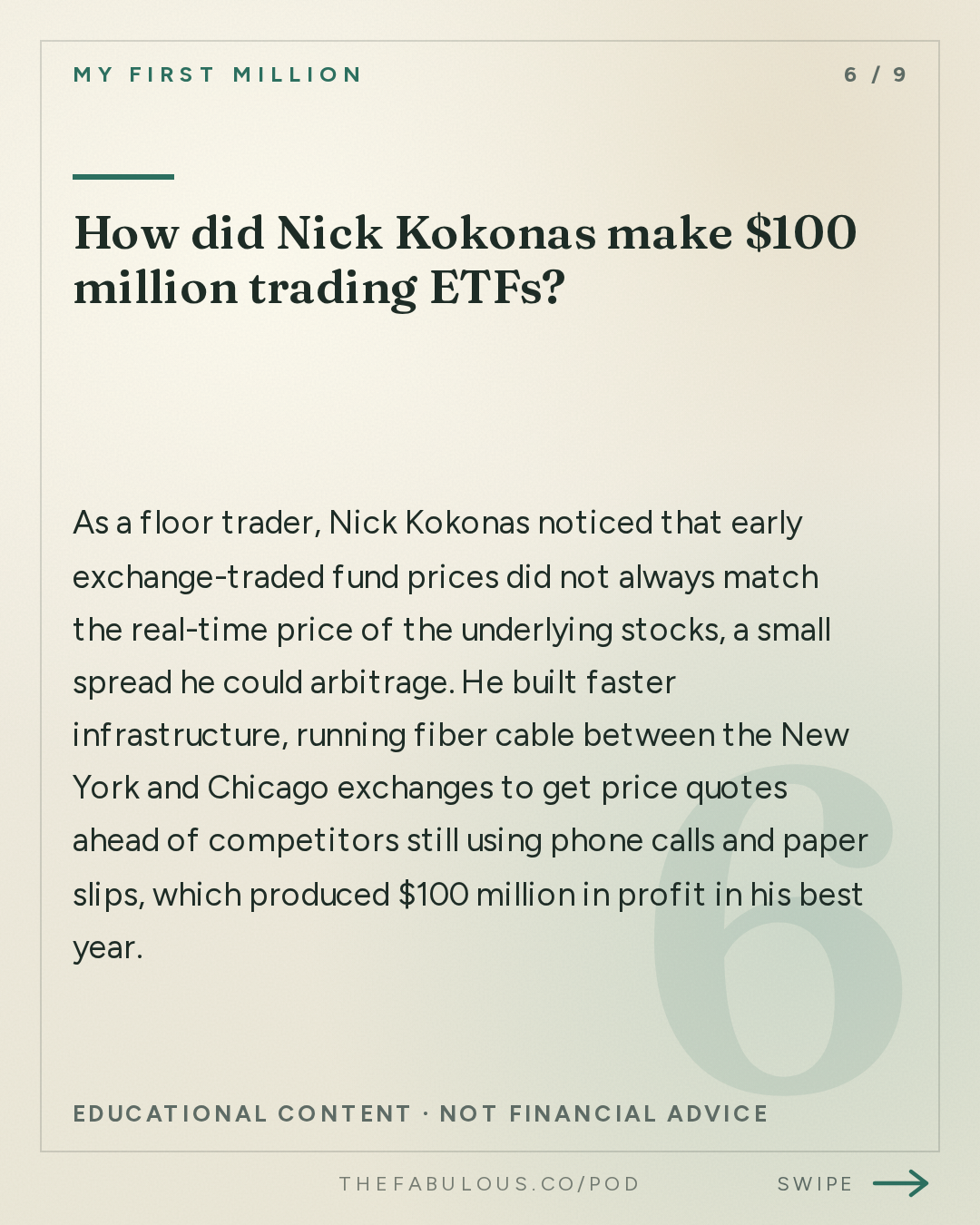
How did Nick Kokonas make $100 million trading ETFs?
As a floor trader, Nick Kokonas noticed that early exchange-traded fund prices did not always match the real-time price of the underlying stocks, a small spread he could arbitrage (04:46). He built faster infrastructure, running fiber cable between the New York and Chicago exchanges to get price quotes ahead of competitors still using phone calls and paper slips, which produced $100 million in profit in his best year (04:27, 05:16).
The full read, in cards
Go deeper
- Fierce Nerd — Paul Graham essay arguing that nerdy, high-IQ people can be intensely competitive on their own terms
Mentioned
Ted Turner · Carl Icahn · Nick Kokonas · Alinea · Jay Gould · Charlie Munger · Sayed Balkhi · Brian Johnson · Jesse Itzler · Brian Chesky · Frank Slootman · Alex Tew · Eric Ryan · Ray Dalio · Austin Rief · Sean Parker
More from this show and category
Shaan Puri's 3 Embarrassing Moments That Changed Him
Shaan Puri, host of My First Million, shares three embarrassing stories, including a 110 narcissism test score and a failed 250-page restaurant business plan. He explains how each moment taught him to stop chasing external validation, favor action over endless planning, and reinvent his identity by deciding who to become before he felt ready.
Jeff Harmon's Marketing Playbook Explained
Jeff Harmon built OraBrush, Poo-Pourri, Squatty Potty, and Angel Studios by spotting marketing glitches: cheap or ignored channels nobody else was using. He turned a 19-minute skippable ad into an $11 million crowdfund for The Chosen and grew Angel Studios into a $500 million business run by a 3 million-member guild that votes on every film.
Oxytocin Doping for Marriage: The Business Case
Palmer Luckey wants to fight divorce with oxytocin, a bonding hormone already sold unregulated online as powder. The hosts trace how niche communities like Knights of Columbus and Angel Studios turn shared identity into insurance and content revenue, and explain why even a hit movie like Angel Studios' biggest box-office success nets just a 2.5x return.
MIT Scientist on Simulation Theory and Elon Musk
MIT-trained computer scientist and video game entrepreneur Rizwan Virk argues the physical world may be a rendered simulation, echoing Elon Musk's 2016 claim that the odds of living in base reality are one in billions. He ties Nick Bostrom's simulation argument to quantum physics, ancient religious texts, and a real 2025 incident where OpenAI's own test agents hacked Hugging Face.
