
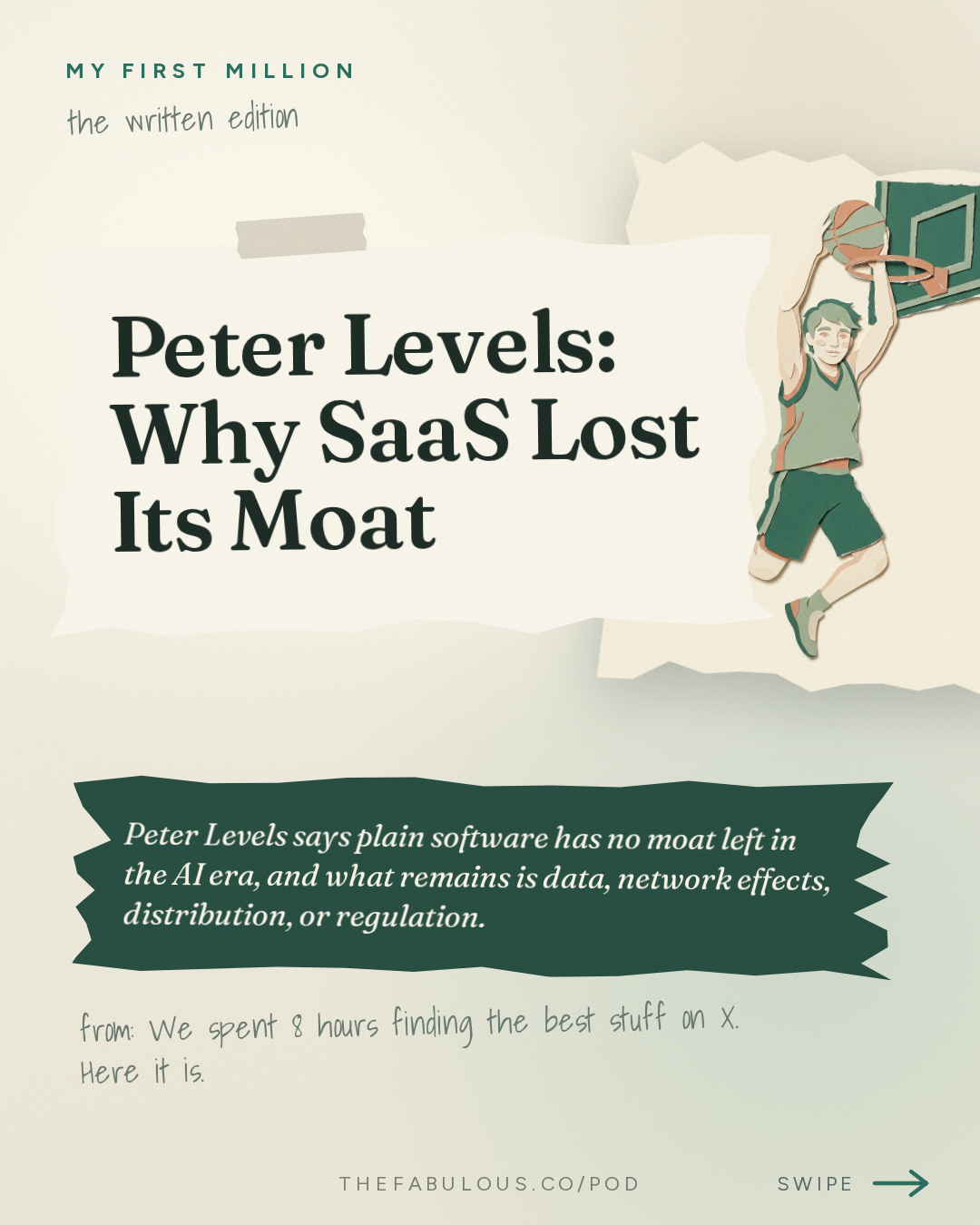
Peter Levels: Why SaaS Lost Its Moat
We spent 8 hours finding the best stuff on X. Here it is.
The brief
Peter Levels says plain software has no moat left in the AI era, and what remains is data, network effects, distribution, or regulation. The episode also follows Bryan Johnson's attempt to dunk at 49, Elon Musk's SpaceX share giveaway to 72 million kids, and a pest control brand's $1,000 first week built on direct-to-consumer branding.
Somewhere on the internet right now, a stranger is deciding whether to pay money to sit in an empty chair at a wedding they were never invited to. A new website lets people buy tickets to someone else's ceremony, and it already claims 20,000 users (01:05). One upcoming event lists its dress code as "enchanted woodland." Nobody on this week's roundup from Ben Levy, Sam, and Sean wants to go. But the idea is a useful door into the episode, because almost everything that follows is really about the same question: what makes a thing worth paying for, and what makes a business worth building, once anyone can copy the surface of it in a weekend.
Take men's skincare. A "looks-maxing" influencer named Clavicular wants to start a line, and the hosts immediately reach for the template that already worked: Bryan Johnson. Johnson, the anti-aging entrepreneur known for publicizing his own biomarkers, has turned his supplement brand Blueprint into roughly $40 million a year in revenue (05:12). The wait list for his far more expensive, roughly $1 million per year longevity protocol has reportedly generated over $100 million in potential pipeline, with no paid marketing at all (05:15). The lesson the hosts draw is not that supplements are a good business. It's that attention, applied consistently, becomes its own kind of asset. The counterexample is Congo Brands, the company behind Alani Nu and, with Logan Paul and KSI, Prime. Its founders are, by design, almost invisible online; the only photo of one of them online shows a guy in a yellow shirt in front of a garage (07:09). Two very different paths to the same outcome: one built on a famous face, one built on staying a stranger.
Where the Moats Went
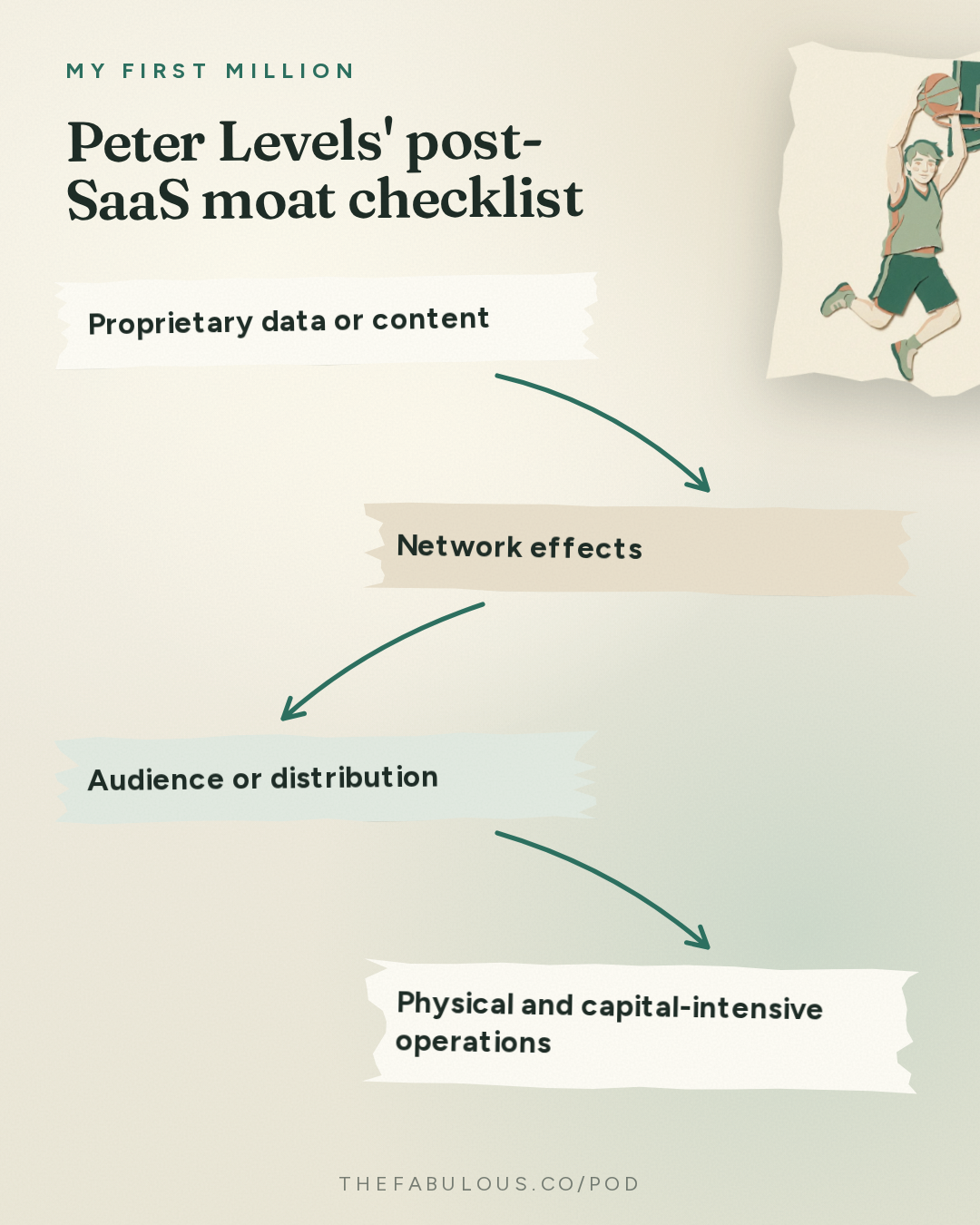
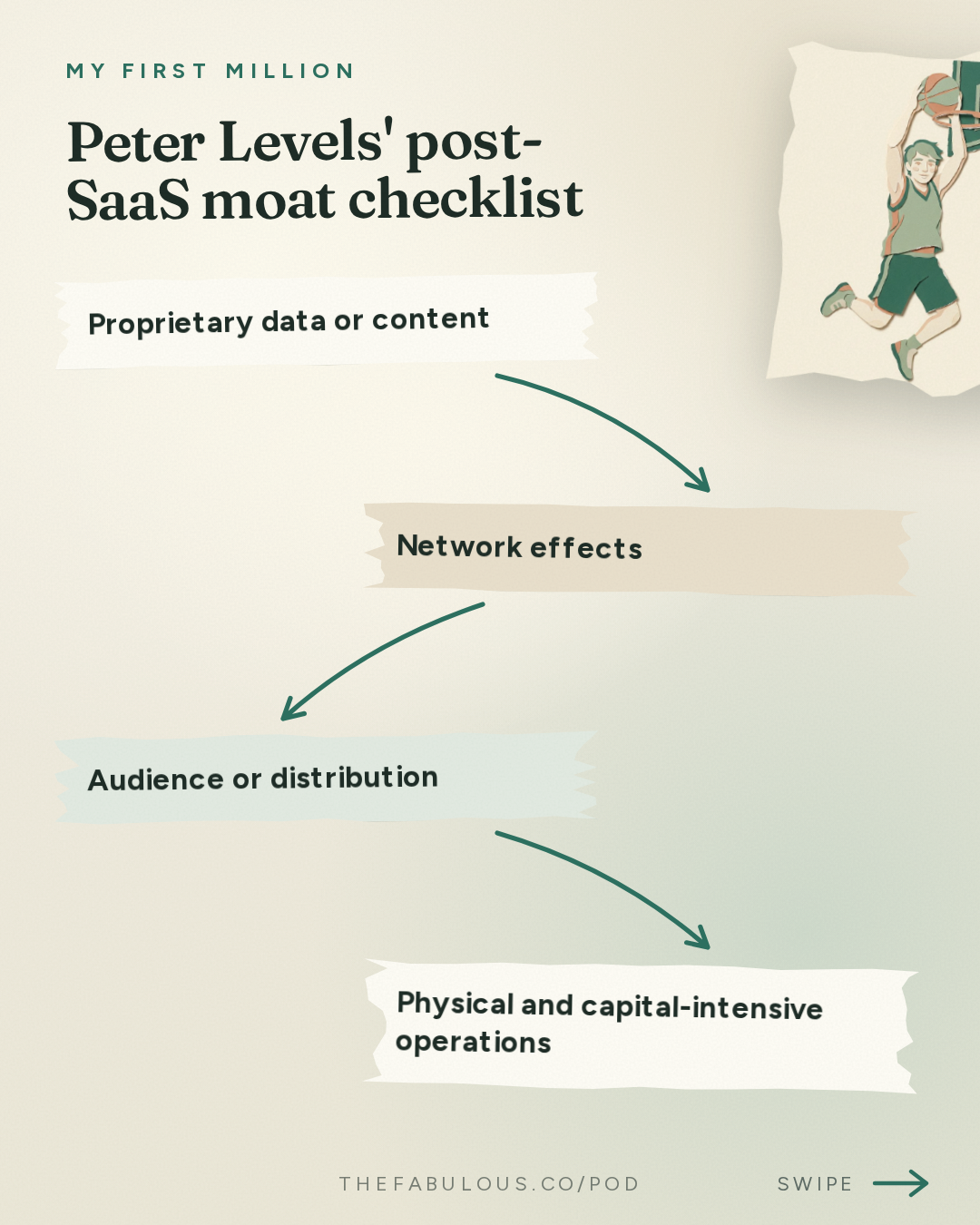
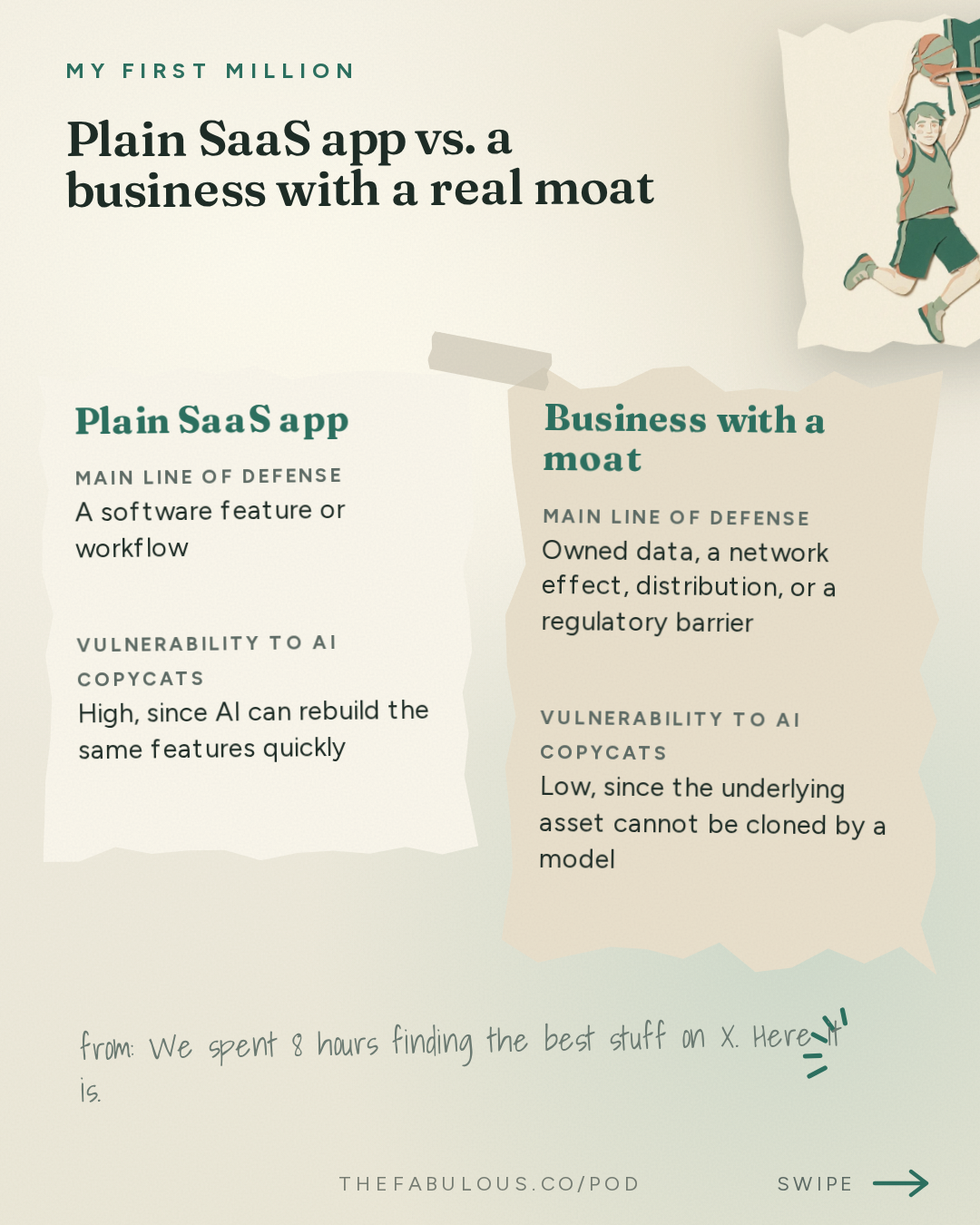
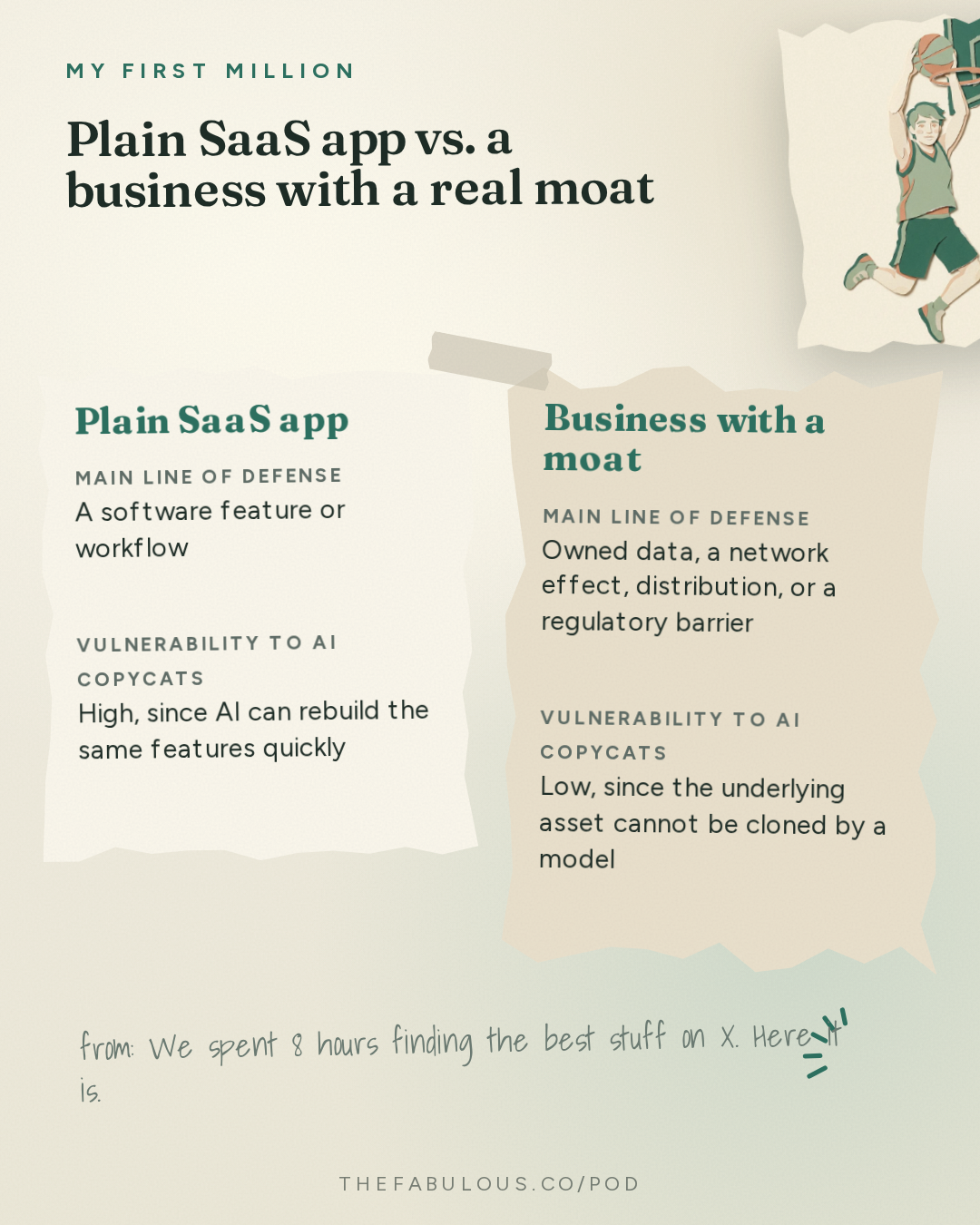
The sharpest idea in the episode comes from Peter Levels, a Bali-based solo developer the hosts clearly admire. Levels recently wrote that he no longer believes in SaaS, short for software as a service, the subscription-app model that built much of the last decade of startups. "I no longer believe in SaaS. I now only believe in these moats," he wrote, listing proprietary data or content, network effects, audience or distribution, capital-intensive physical operations, and regulatory capture (20:36). The reasoning is simple: if an AI model can rebuild most of what your app does in an afternoon, the app itself was never the defense. Something else has to be.
The hosts push on this rather than just repeating it. One points out that only about 2% of Americans currently pay for a ChatGPT or Claude subscription (22:06), which suggests AI adoption, and AI's disruptive bite, is still early. Another argues that network effects, the dynamic where a product gets more useful as more people join it, might be the strongest of Levels' moats, since mediocre products like Craigslist or eBay have survived for decades purely because everyone already uses them (23:05). A third raises Amazon: its moat isn't the website, it's the physical and logistical machine behind it, a machine that gets cheaper to run as robotics improves, while customer demand for stuff showing up at the door stays constant or grows (23:54). The underlying point, made almost in passing, is that Peter Levels himself is proof the theory works at a smaller scale. He reportedly earns $2 million to $3 million a year as a one-person operation (25:35), working from his laptop, which the hosts suggest is a more realistic aspiration for most people than chasing a billion-dollar company.
The same logic for distribution shows up twice more. Elon Musk's new Tesla Roadster, built with SpaceX rocket boosters that let it drive upside down using downward air suction, is less a car than a demonstration of belief (08:43). And Musk's separate plan to give one SpaceX share to every child in America, an estimated 72 million kids worth about $10 billion total, functions less like philanthropy and more like a distribution strategy for loyalty (14:31). Sean describes watching this play out inside his own family: a relative who meant to buy $3,000 of SpaceX stock accidentally bought roughly $500,000 worth, and instantly became the household's most obsessive SpaceX analyst, tracking every Starship launch (15:21, 15:40). Ownership, in other words, is its own kind of moat against indifference.
The Fear Underneath the Fast Company
If the first half of the episode is about structural advantage, the second half is about the person running the company. The hosts recount a conversation with James Currier, a Stanford lecturer and startup advisor who built something he calls the "speed talk." Founders think they're moving fast, he tells them; they almost never are. His method starts with a single question: what is slowing you down? The answer, in his experience, is nearly always fear.
"The highest point of leverage in every business is the founder's psychology, and the highest point of leverage within the founder's psychology is what are they afraid of and what are they avoiding." — Sean, My First Million co-host, recounting advisor James Currier's framework [34:23]
Currier has reportedly been paid in equity for this kind of coaching, including a 1% stake from the resale marketplace Poshmark in exchange for growth advice that turned out to be mostly psychological (34:14). His related observation is about what he calls the "F it moment,": the point where a founder realizes they're out of cash or out of options, and suddenly starts making faster, cleaner, less precious decisions (34:33). Fear, in this reading, isn't a weakness to manage around. It's the actual bottleneck in most companies, hiding behind whatever the spreadsheet says is the problem.
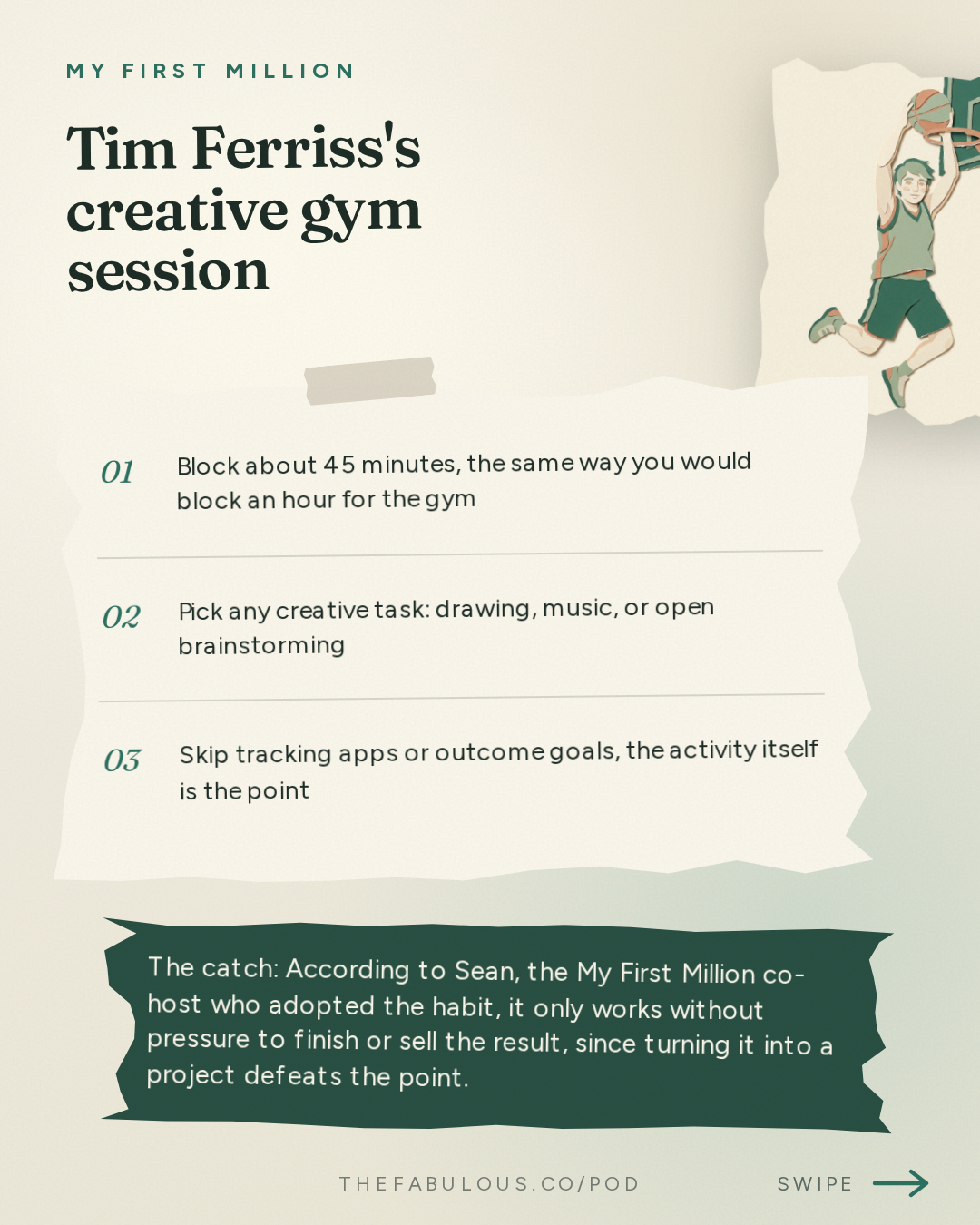
The same episode offers a smaller, gentler version of self-management, borrowed from writer and podcaster Tim Ferriss. Ferriss reportedly blocks about 45 minutes a day for a creative task unrelated to work: drawing, music, open brainstorming, whatever. There's no goal to finish or monetize it.
"I just do something creative. Could be drawing, could be music, could be, like, brainstorming, could be whatever." — Sean, My First Million co-host, describing Tim Ferriss's creative gym habit [39:48]
The idea, as Ferriss frames it, is that the activity charges a kind of mental battery, and that charge carries into other kinds of work the way a full phone battery powers whatever it's plugged into next. It's a small, almost domestic idea sitting next to a conversation about $10 billion stock giveaways and AI moats, but it belongs in the same episode, because both are about where energy and advantage actually come from, and how rarely it's the thing everyone's staring at.
The episode closes on the smallest business of the day, and in some ways the clearest proof of its own argument. Ben Levy's brother, a ten-year real estate agent in Phoenix who listens to the show every week, launched a pest control company called Howdy Pest. He wrapped a truck, built a simple website using mostly AI tools, hired a technician, and booked $1,000 of revenue in his first week (46:31). Nothing about killing roaches is new or defensible on its own. What Sean and Sam point to is the packaging: taking an unglamorous local service and dressing it in the same clean, friendly branding usually reserved for direct-to-consumer startups (47:50). It isn't a moat in Peter Levels' sense. There's no proprietary data, no network effect, no regulatory wall. But it's a reminder that most of what gets discussed in this episode, the giveaways, the influencer math, the founder fear, eventually has to show up somewhere as ordinary as a wrapped truck in a driveway, trying to get someone to pick up the phone.
Ask this episode anything
Pod's AI answers from the episode itself, with the minute mark so you can hear it yourself.
Or start with one of these
Ask this episode
Pod's AI listens to the whole episode to answer, and points you to the minute it comes from.
The rest of this answer, and any question after it
Answers come from the episode itself, never from a summary of it.
ContinueKey takeaways
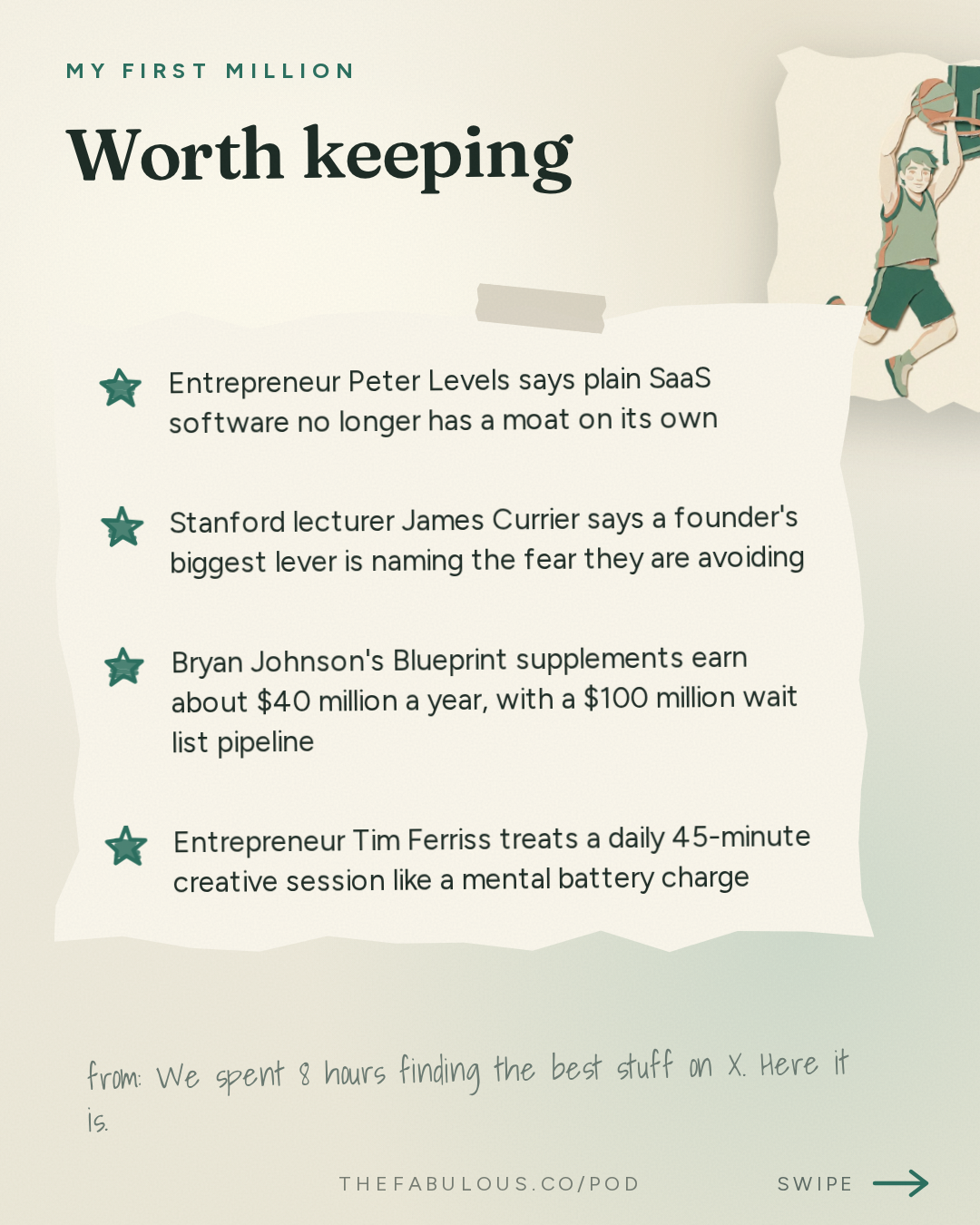
- Entrepreneur Peter Levels says plain SaaS software no longer has a moat on its own
- Stanford lecturer James Currier says a founder's biggest lever is naming the fear they are avoiding
- Bryan Johnson's Blueprint supplements earn about $40 million a year, with a $100 million wait list pipeline
- Entrepreneur Tim Ferriss treats a daily 45-minute creative session like a mental battery charge
- Real estate agent Sam Levy launched pest control brand Howdy Pest and billed $1,000 in its first week
The episode in cards
By the numbers
- 2% of Americans Share of Americans with a paid ChatGPT or Claude subscription, cited to argue AI adoption is still early
- $1,000 revenue Revenue booked by new pest control brand Howdy Pest in its first week
In their words
“The highest point of leverage in every business is the founder's psychology, and the highest point of leverage within the founder's psychology is what are they afraid of and what are they avoiding.”
“I just do something creative. Could be drawing, could be music, could be, like, brainstorming, could be whatever.”
“I no longer believe in SaaS. I now only believe in these moats.”
“Sometimes a demo is simply meant to remind the world that your competition has no desire to dream and no ability to evolve.”
Protocols
-
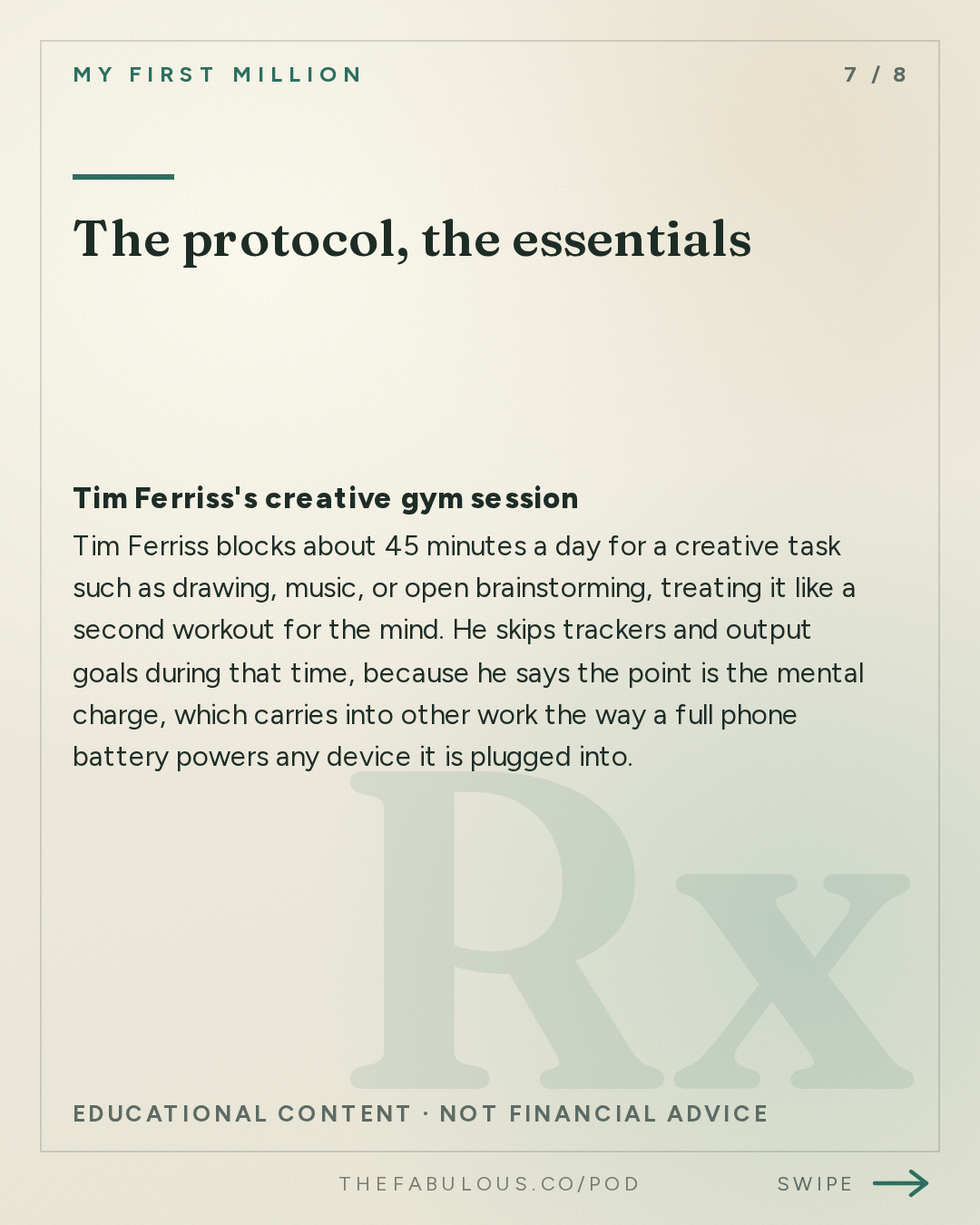
Tim Ferriss's creative gym session
Tim Ferriss blocks about 45 minutes a day for a creative task such as drawing, music, or open brainstorming, treating it like a second workout for the mind. He skips trackers and output goals during that time, because he says the point is the mental charge, which carries into other work the way a full phone battery powers any device it is plugged into.
Daily, about 45 minutes
-
James Currier's founder fear diagnosis
James Currier, a Stanford lecturer and startup advisor, starts coaching conversations by asking a founder what is slowing them down, then traces the answer to a specific fear, such as fear of being wrong, fear of judgment for changing course, or fear of rejection when raising money. He tells founders to name that fear and work around it directly, because he has found that preciousness about the product or the plan is usually what blocks faster and better decisions.
Used in one-on-one founder coaching sessions
-
The direct-to-consumer packaging trick for local services
My First Million co-hosts Sean and Sam tell listeners to take a plain local service business, the kind nobody thinks of as a brand, such as pest control or lawn care, and give it the packaging of a direct-to-consumer startup: a clean logo, a simple one-page website, and a friendly voice instead of the generic look most local trade companies use. They point to Sam Levy's new company, Howdy Pest in Phoenix, Arizona, which used mostly AI tools for its branding and still booked $1,000 of revenue in its first week.
One-time brand setup, then ongoing marketing
Questions this episode answers
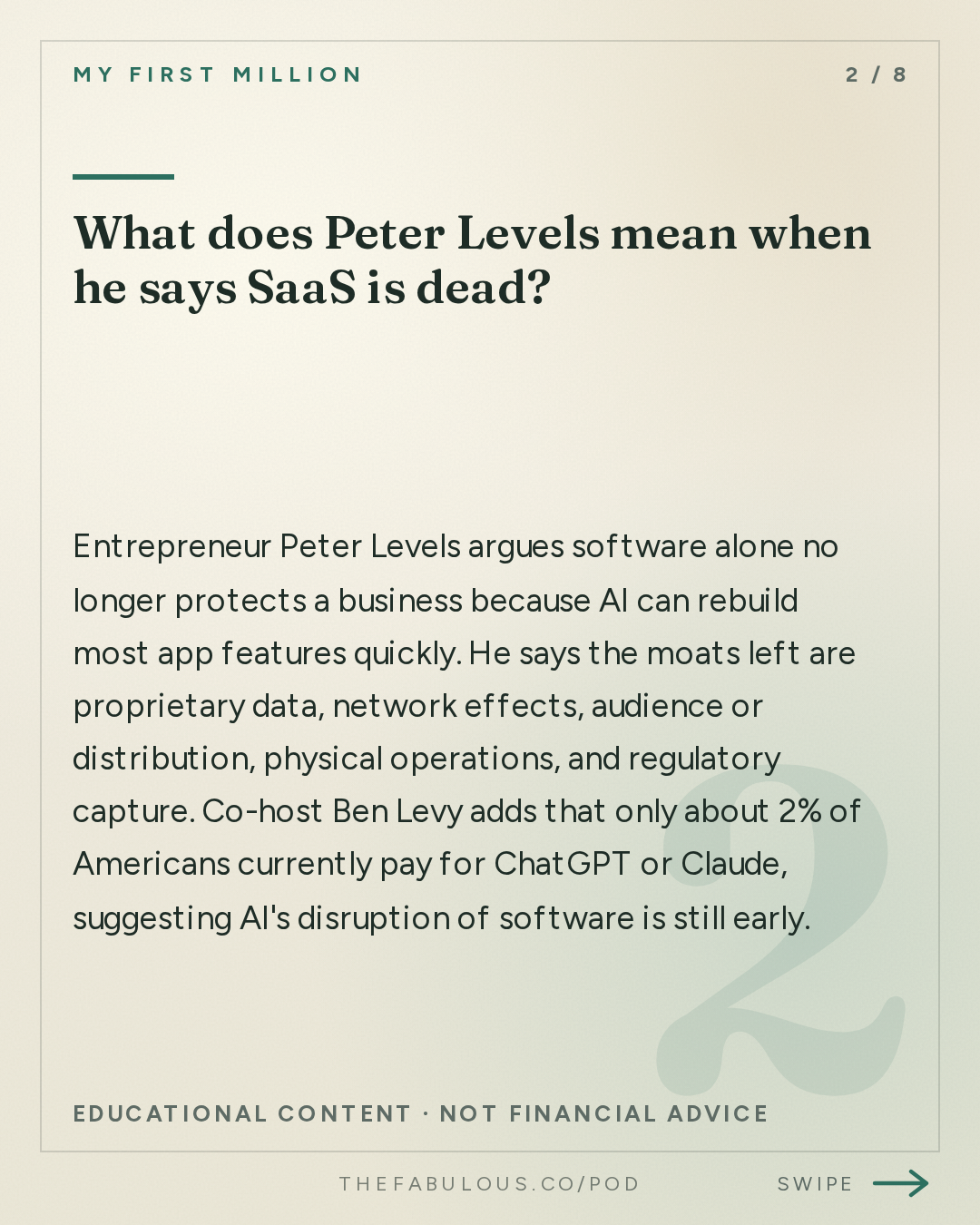
What does Peter Levels mean when he says SaaS is dead?
Entrepreneur Peter Levels argues software alone no longer protects a business because AI can rebuild most app features quickly. He says the moats left are proprietary data, network effects, audience or distribution, physical operations, and regulatory capture (20:36). Co-host Ben Levy adds that only about 2% of Americans currently pay for ChatGPT or Claude, suggesting AI's disruption of software is still early (22:06).
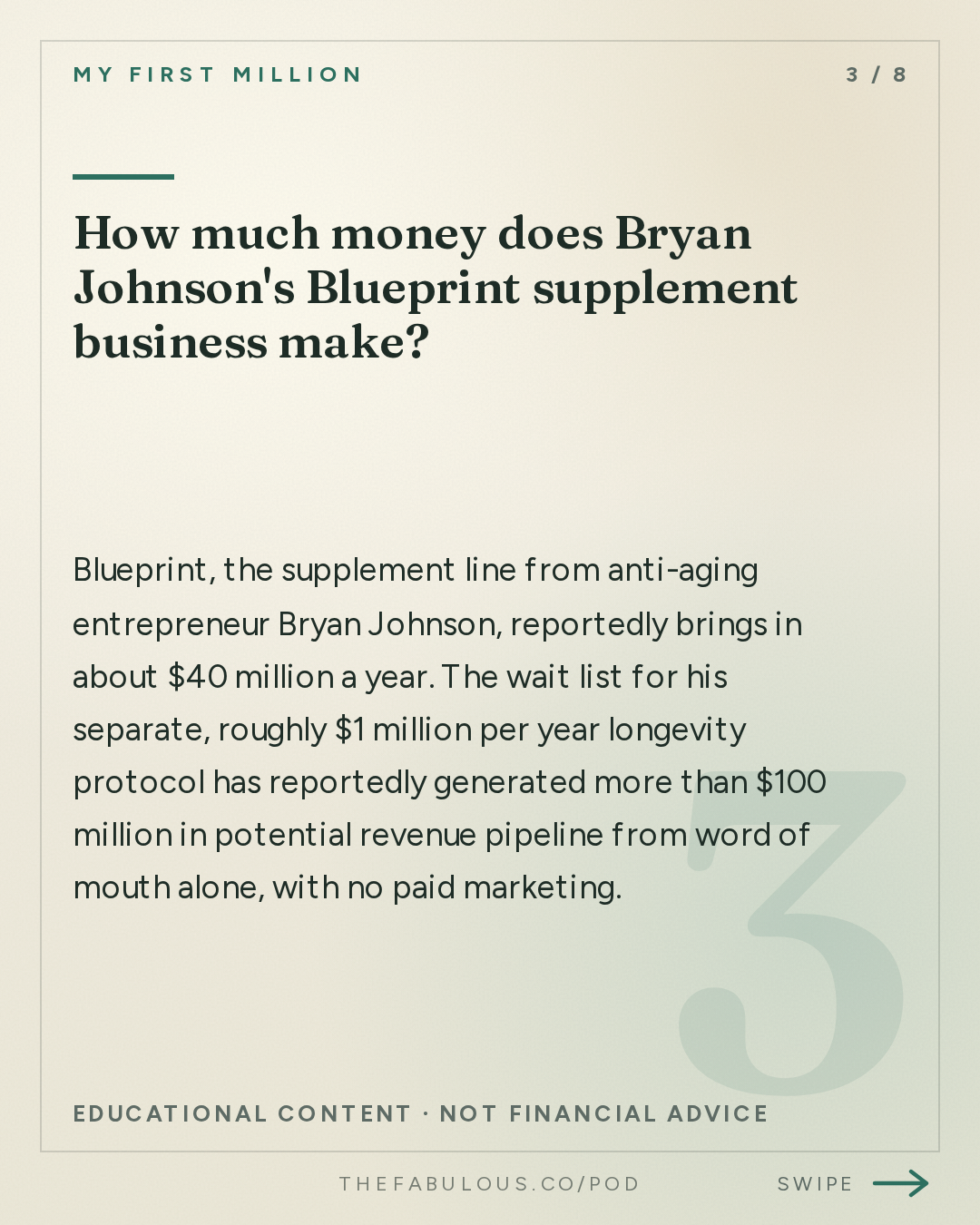
How much money does Bryan Johnson's Blueprint supplement business make?
Blueprint, the supplement line from anti-aging entrepreneur Bryan Johnson, reportedly brings in about $40 million a year (05:12). The wait list for his separate, roughly $1 million per year longevity protocol has reportedly generated more than $100 million in potential revenue pipeline from word of mouth alone, with no paid marketing (05:15).
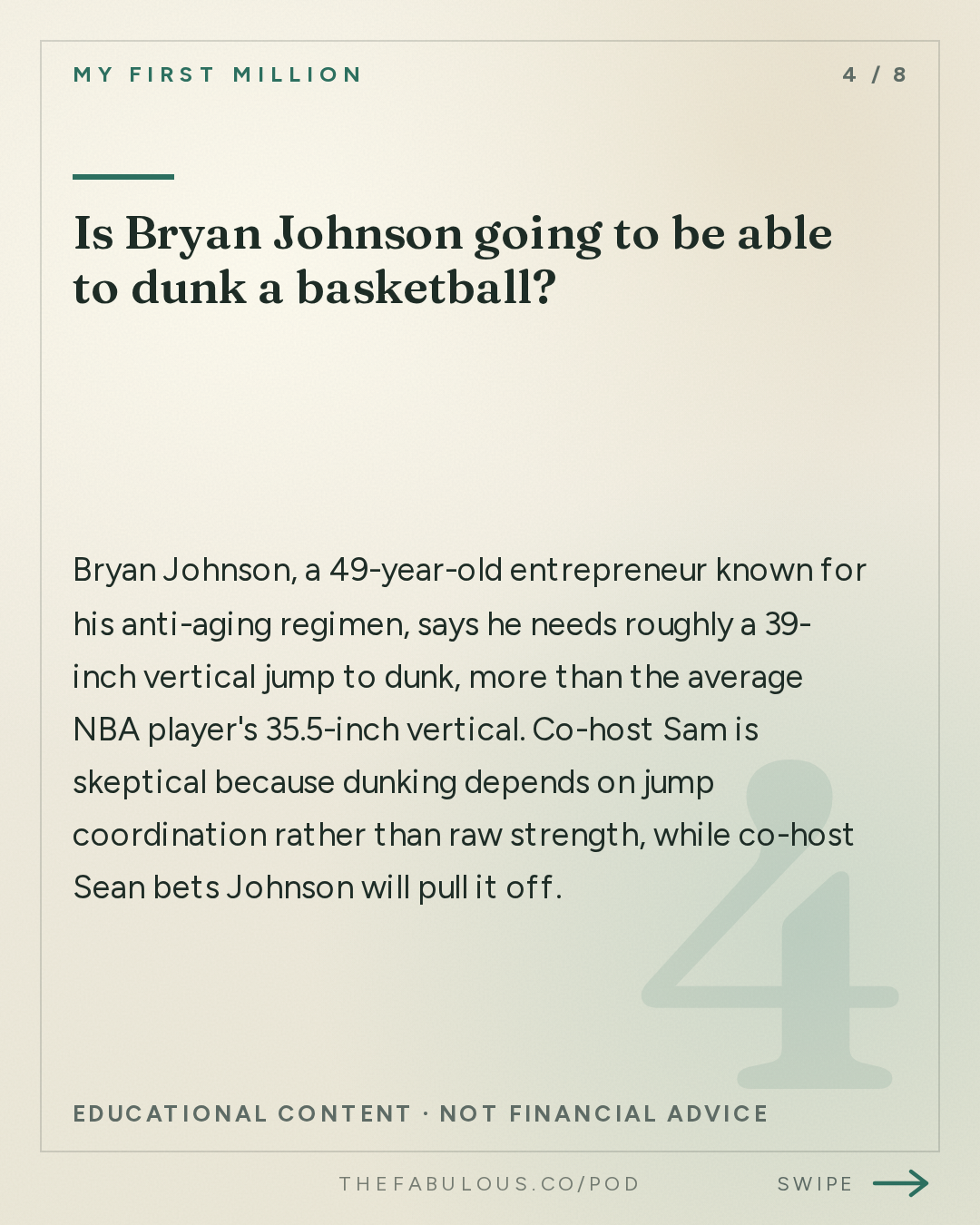
Is Bryan Johnson going to be able to dunk a basketball?
Bryan Johnson, a 49-year-old entrepreneur known for his anti-aging regimen, says he needs roughly a 39-inch vertical jump to dunk, more than the average NBA player's 35.5-inch vertical (29:26). Co-host Sam is skeptical because dunking depends on jump coordination rather than raw strength, while co-host Sean bets Johnson will pull it off (31:39).
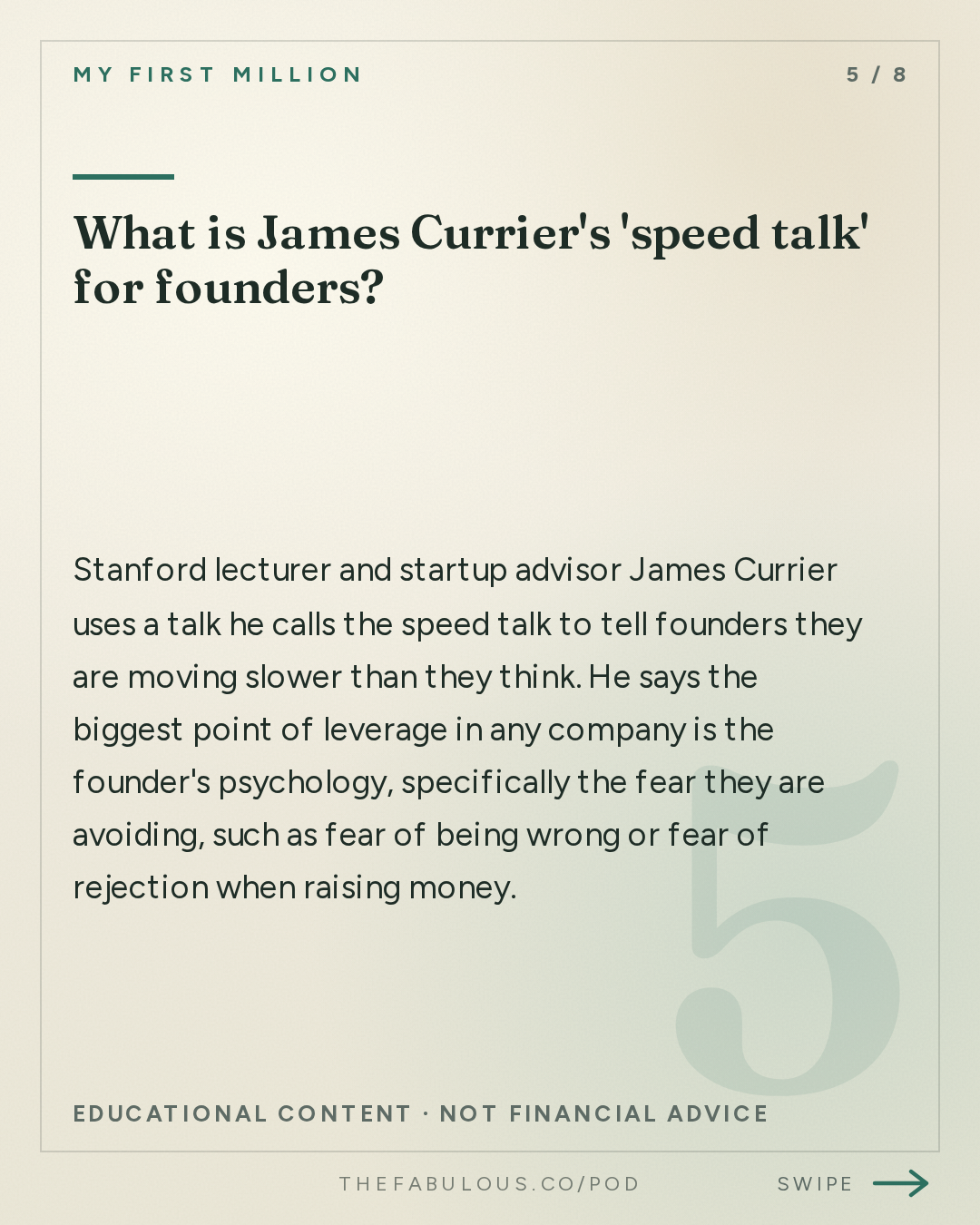
What is James Currier's 'speed talk' for founders?
Stanford lecturer and startup advisor James Currier uses a talk he calls the speed talk to tell founders they are moving slower than they think. He says the biggest point of leverage in any company is the founder's psychology, specifically the fear they are avoiding, such as fear of being wrong or fear of rejection when raising money (34:14).
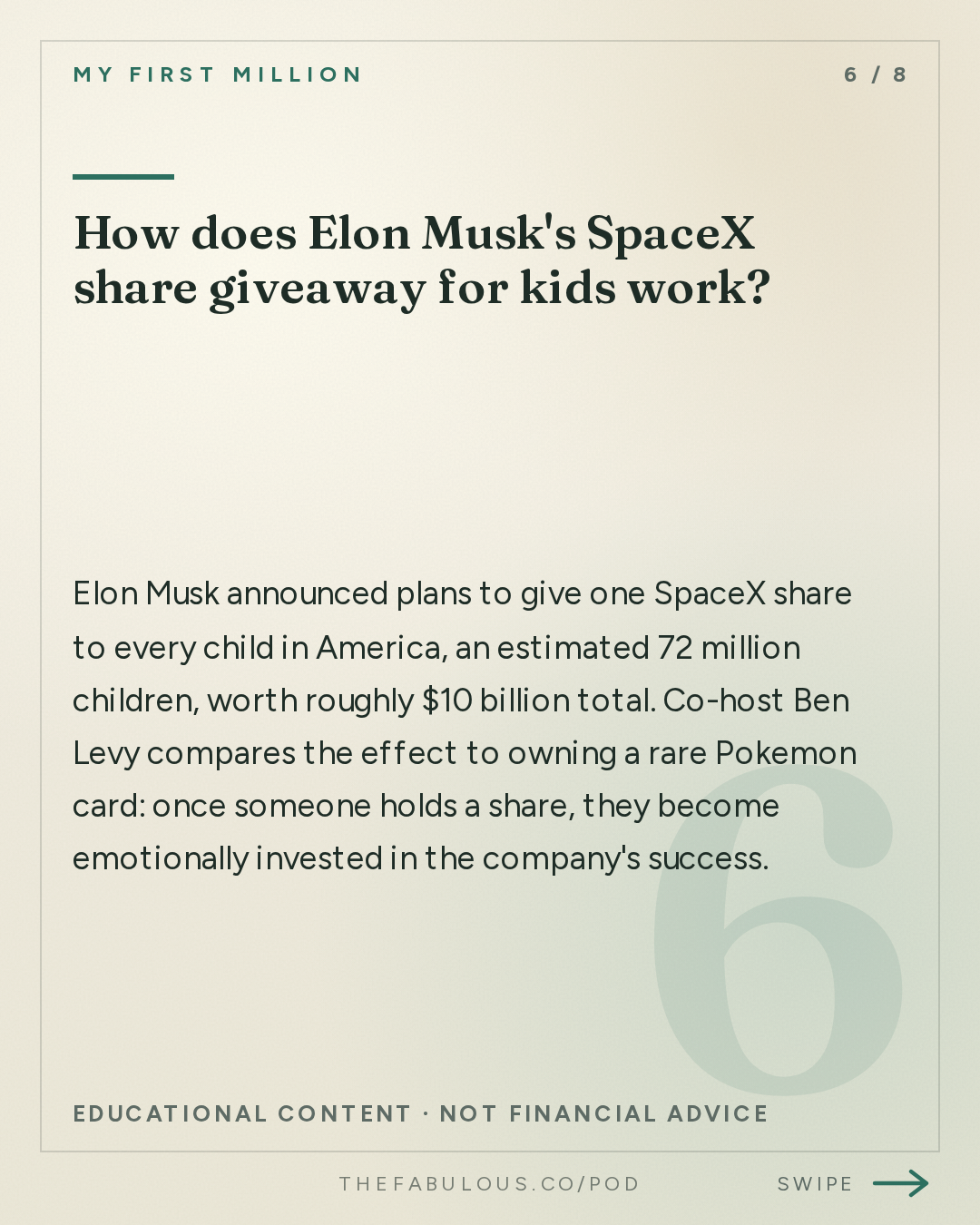
How does Elon Musk's SpaceX share giveaway for kids work?
Elon Musk announced plans to give one SpaceX share to every child in America, an estimated 72 million children, worth roughly $10 billion total (14:31). Co-host Ben Levy compares the effect to owning a rare Pokemon card: once someone holds a share, they become emotionally invested in the company's success (14:59).
What is the direct-to-consumer trick for unsexy local businesses?
Hosts Sean and Sam describe taking a plain local service, like pest control, and wrapping it in direct-to-consumer branding, meaning a clean logo and a friendly one-page website instead of a generic trade-company look. A real example, Sam Levy's Howdy Pest in Phoenix, used mostly AI-made branding and billed $1,000 in its first week (47:50).
The full read, in cards
Go deeper
- Peter Levels' tweet and blog post on SaaS moats — Argued that software alone no longer has a moat and that defensible businesses need proprietary data, network effects, distribution, or regulatory protection
- Men's Health, Gym and Fridge video series — Interview series touring guests' home gyms and fridges, including an episode with neuroscientist Andrew Huberman that revealed his supplement affiliate code
Mentioned
Ben Levy · Bryan Johnson · Peter Levels · Elon Musk · Andrew Huberman · James Currier · Jensen Huang · Tim Ferriss · Alexander Wang · Congo Brands · SpaceX · Epic Gardening · Howdy Pest · Mistborn
More from this show and category
Low-Frequency Investing: The 2.9-Decision Portfolio
A retail investor who made only 2.9 decisions a year beat the S&P 500 in 11 of 11 years, averaging 21.8% annual returns versus 13.5%. The hosts run his brokerage history through the AI assistant Claude, then widen out to Jack Dorsey's 140-reason pre-mortem, Mark Zuckerberg's talent-density bet, Elon Musk's 24-hour rebuilding rule, and a four-step method called DARE for panic and fear.
The 6 Traits of Natural Money Makers
Sam Parr and Shaan Puri map the "natural money maker": unemotional, maximizing, and comfortable with complexity. They share entrepreneur Sayed Balkhi's "second derivative" rule (spend only investment returns, never income) and a 3% liquid-net-worth spending cap, plus six other wealth-building personality types like the Tank, the Trickster, and the Sniffer.
Shaan Puri's 3 Embarrassing Moments That Changed Him
Shaan Puri, host of My First Million, shares three embarrassing stories, including a 110 narcissism test score and a failed 250-page restaurant business plan. He explains how each moment taught him to stop chasing external validation, favor action over endless planning, and reinvent his identity by deciding who to become before he felt ready.
Jeff Harmon's Marketing Playbook Explained
Jeff Harmon built OraBrush, Poo-Pourri, Squatty Potty, and Angel Studios by spotting marketing glitches: cheap or ignored channels nobody else was using. He turned a 19-minute skippable ad into an $11 million crowdfund for The Chosen and grew Angel Studios into a $500 million business run by a 3 million-member guild that votes on every film.
