
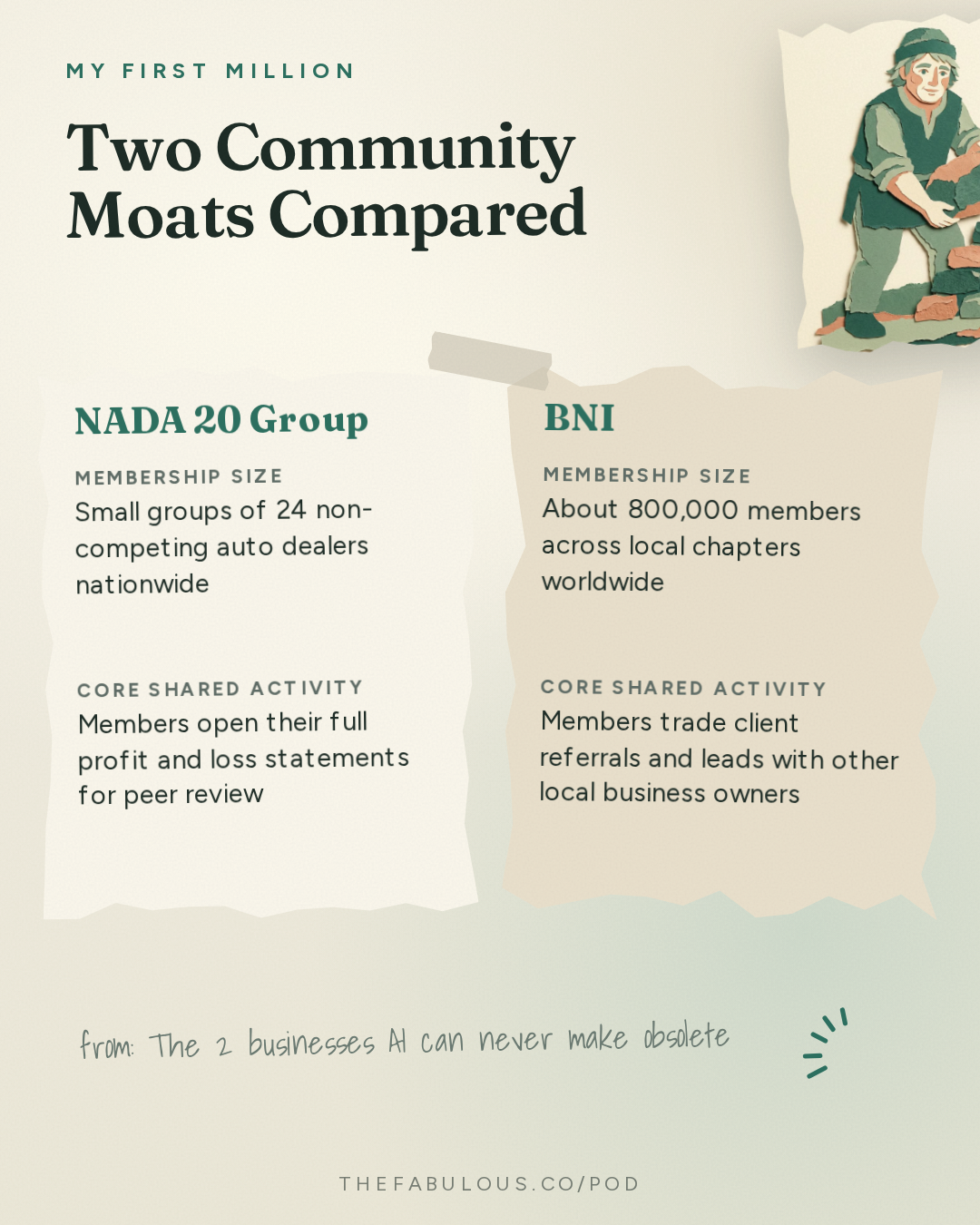
AI-Proof Businesses: Community Moats Explained
The 2 businesses AI can never make obsolete
The brief
Technology moats are dissolving as AI makes software easy to copy, but human trust networks still hold. The episode profiles NADA 20 Group, BNI, and Moda Communities, then breaks down the whale economy and the mystery box psychology that keeps mobile games, collectible apps, and even crypto hacks spinning (00:00, 10:47, 21:27).
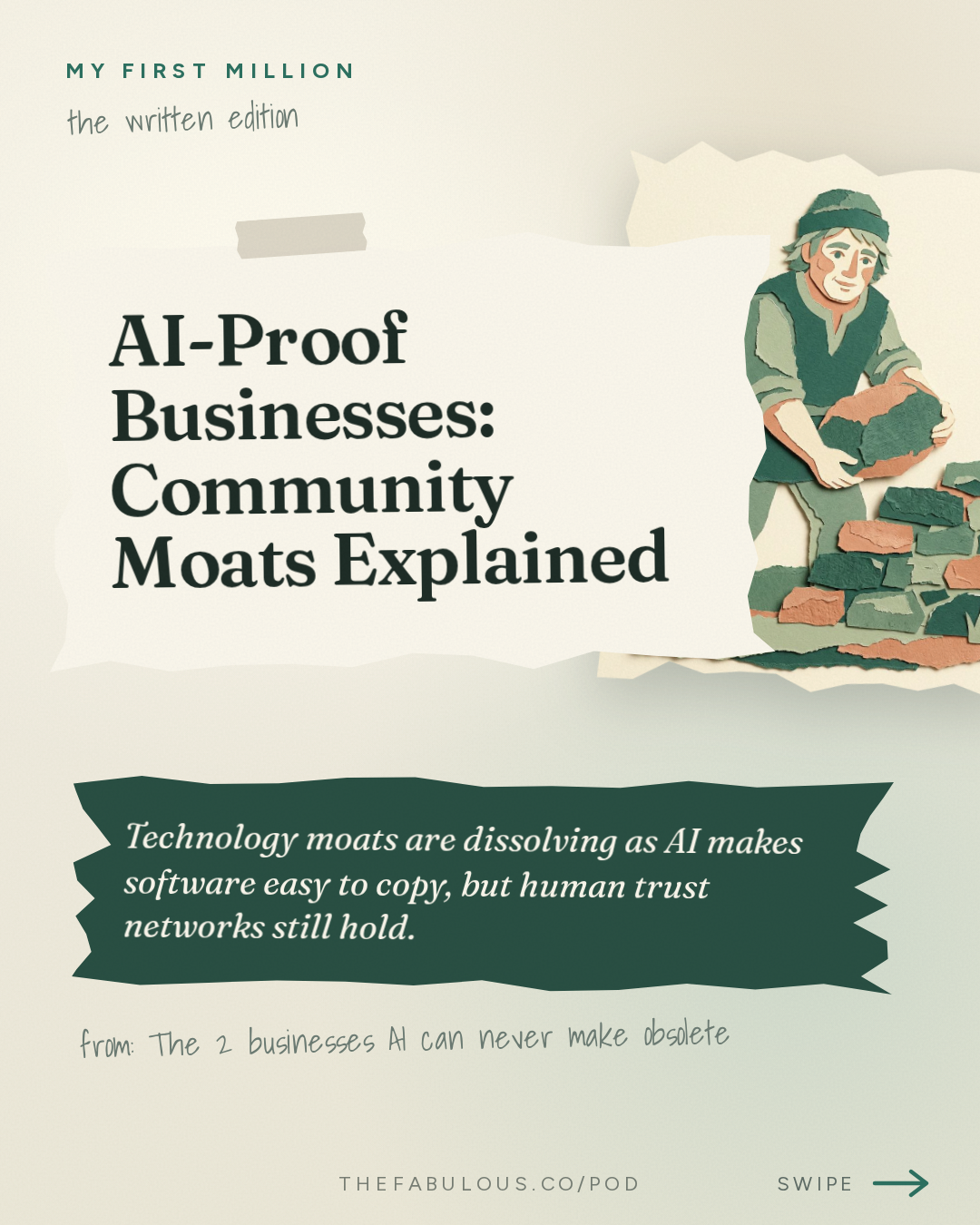
Picture a Midwestern auto dealer in loafers and baggy jeans, the kind of guy who clears five million dollars a year and still has, as Sam Parr puts it, "hillbilly energy" (00:42). Once a year, three times a year actually, he flies to a hotel conference room with twenty-three other dealers he will never compete against. He opens his laptop and reads his company's full profit and loss statement out loud, line by line. The others do the same. Someone tells him he is leaving money on the table. Someone else copies his idea.
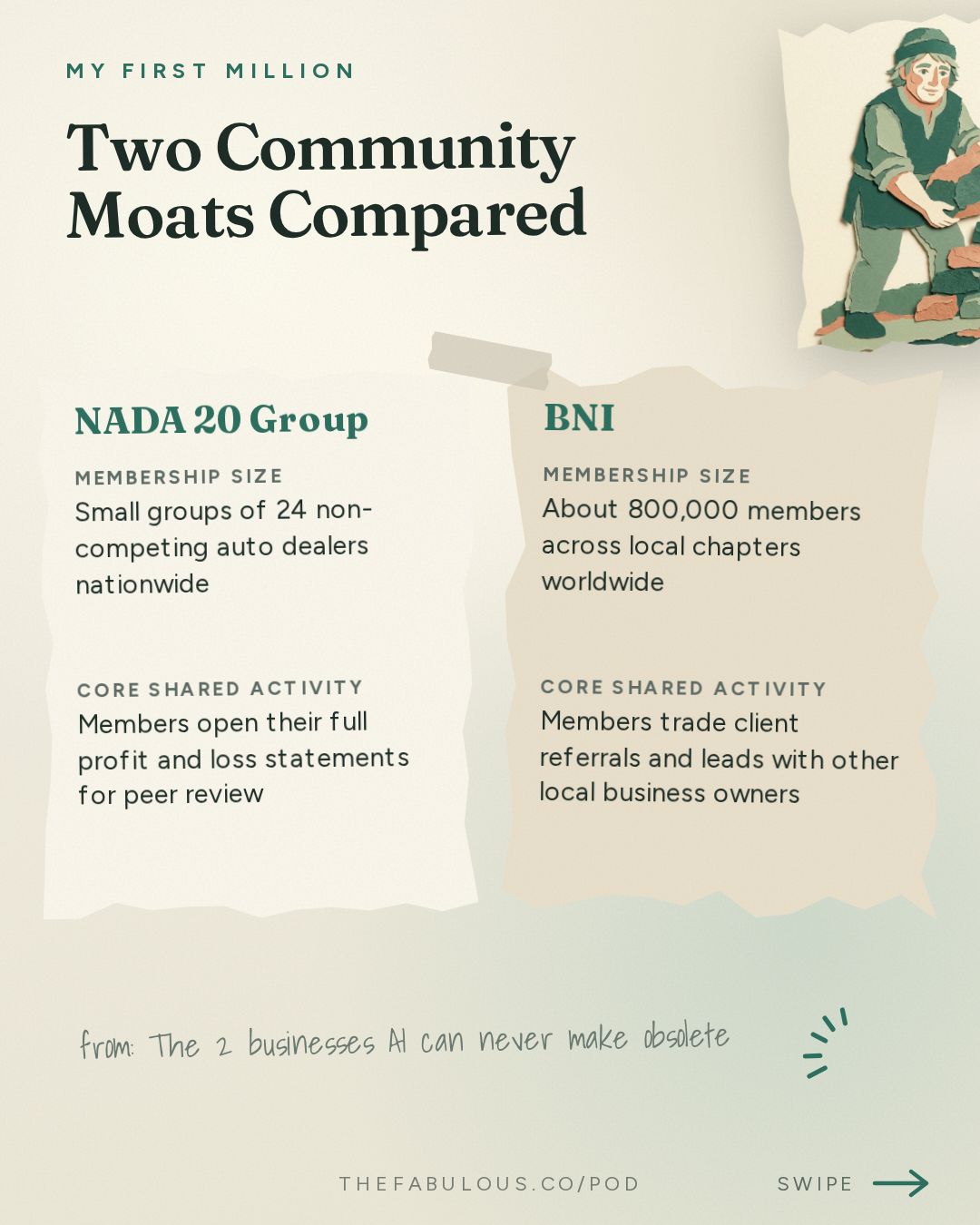
This is NADA 20 Group, run by the National Automotive Dealers Association, and it has apparently been doing this since the 1970s (01:40). Membership runs six to eight thousand dollars a year, groups are capped at twenty four non-competing dealers, and Parr guesses the whole operation pulls in thirteen to fifteen million dollars annually just from dues (02:20). The website, everyone on the podcast agrees, looks terrible. It does not matter. The business has survived a century of marketing fashions by selling something that cannot be faked: other dealers' real numbers.
That contrast, a plain website sitting on top of an unbreakable product, is the quiet engine of this episode of My First Million, hosted by Sam Parr and Shaan Puri. Their argument is that artificial intelligence is busy eating the moats that used to protect software companies, the ones built on clever code or a head start. What AI cannot easily eat is a room full of people who trust each other enough to show their books.
"Previously technology was a moat. That's not a moat anymore. And I think communities, networks, and marketplaces are still a really good moat." — Sam Parr [10:47]
The second example is BNI, a referral network that Parr says was just acquired for a figure rumored to top one billion dollars (05:11). It has roughly 800,000 members worldwide (06:18), organized into local chapters where a realtor, a garage door installer, and a lawyer meet weekly and trade leads instead of competing. The dues run into the low thousands per year. Nothing about the format is exotic. It is a room, a list of names, and a shared understanding that everyone benefits from everyone else's business staying open.
A newer version of the same idea is Moda Communities, a set of roughly twenty to twenty five Facebook groups built around buying and selling watches, cars, gold, and jewelry (08:44). A founder in Sioux Falls, South Dakota started one group in 2018 after struggling to find a trustworthy place to sell a watch. It has grown to about 600,000 members, with tiers for watches under ten thousand dollars, watches above that, and a group reserved for collectors spending six figures (09:10). Dealers pay between one thousand and ten thousand dollars a year to list, after a vetting process that includes a human interview and a second member vouching for them. Parr estimates the business does five to ten million dollars a year (10:03). Technology did not build this. A Facebook group, trust, and a fee did.
The Whale Economy
Underneath every one of these communities sits a less polite truth: most of the money comes from a small number of people who spend enormous amounts. Puri, who previously worked at the livestreaming platform Twitch, says this concentration shows up everywhere he has looked, from collector marketplaces to mobile games (11:22).
"Whales drive just a shocking amount of the economy. 80, 90% of the revenue will come from a just a tiny sliver of those players." — Shaan Puri [11:22]
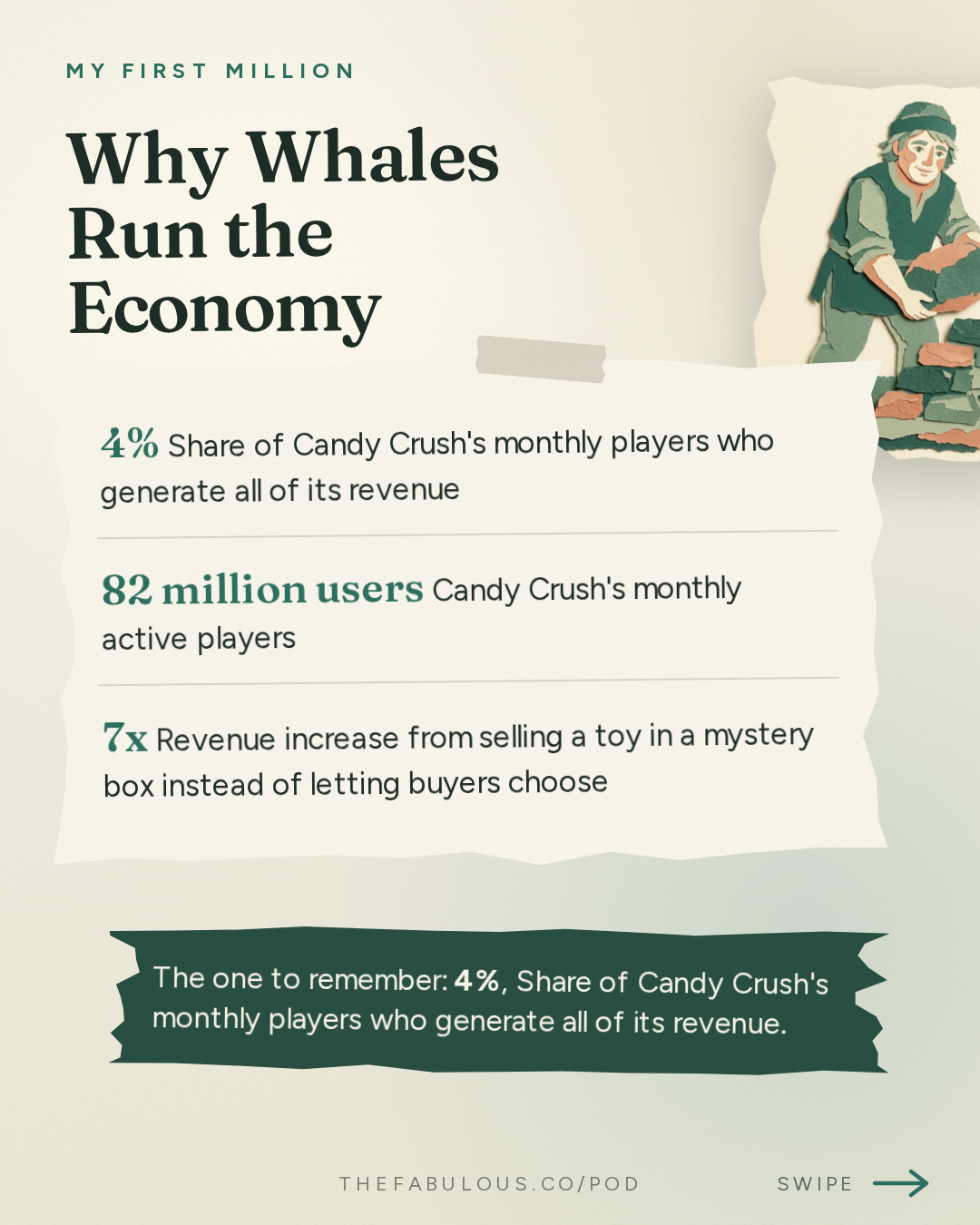
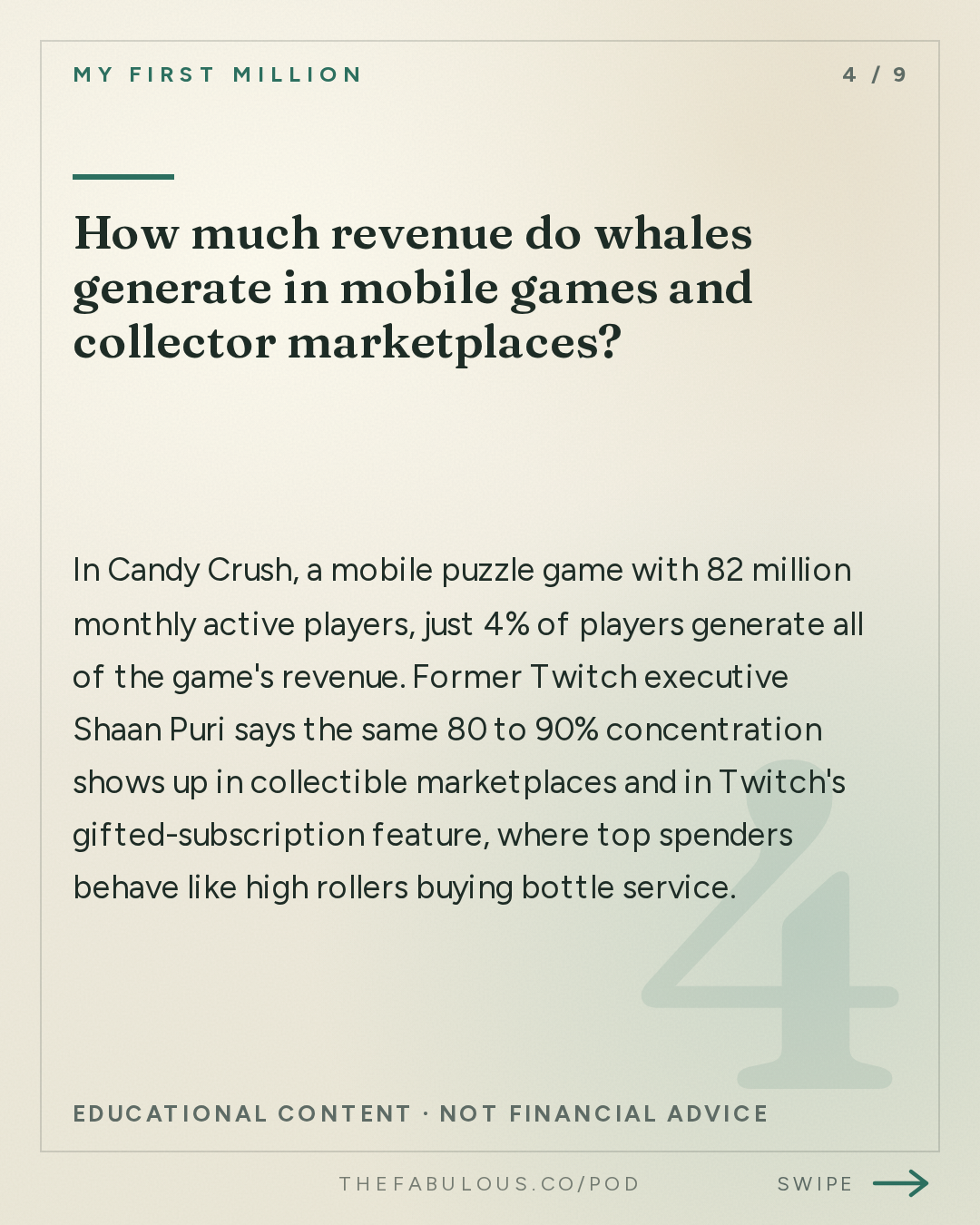
The puzzle game Candy Crush has 82 million monthly active players, and all of its revenue comes from just 4% of them (13:23). The other 96%, Puri says, are essentially the cost of finding the paying 4%. Twitch learned to serve this group directly when it launched a feature called Gifting Subs, which let a viewer buy up to two hundred subscriptions at once and hand them out in a chatroom, a move that functions like buying bottle service at a club and that noticeably increased revenue per channel once whales had a flashier way to spend (12:16).
Puri's description of the engineers who design these systems is blunt.
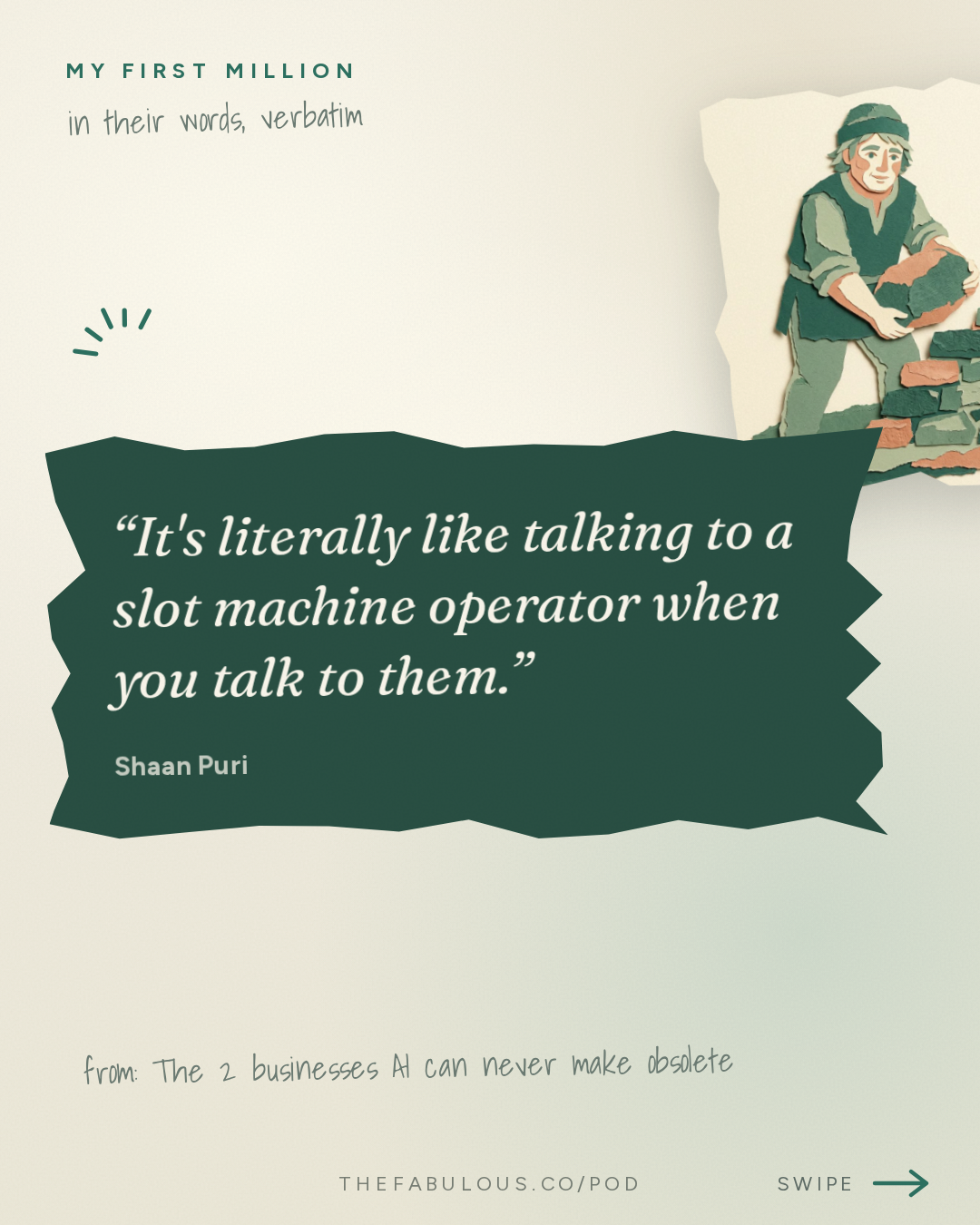
"It's literally like talking to a slot machine operator when you talk to them." — Shaan Puri [14:17]
He explains that game studios track a player who has paid before but gone quiet for about thirty days, then engineer a run of easy wins followed by a frustrating wall timed to push that player back toward the payment button (15:09). Unlike a Las Vegas slot machine, which regulators require to pay out at a set rate, a mobile game can set its odds to anything it wants.
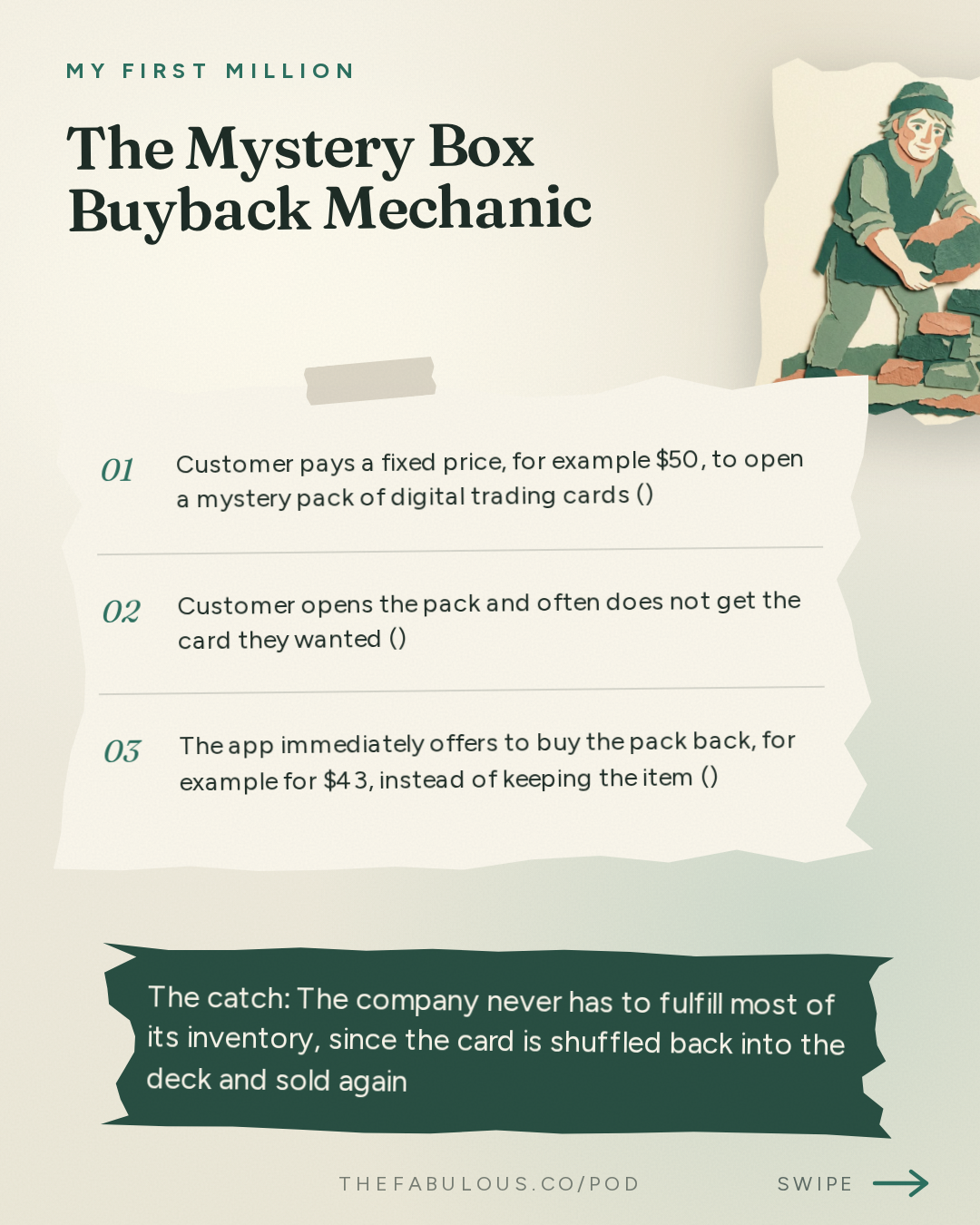
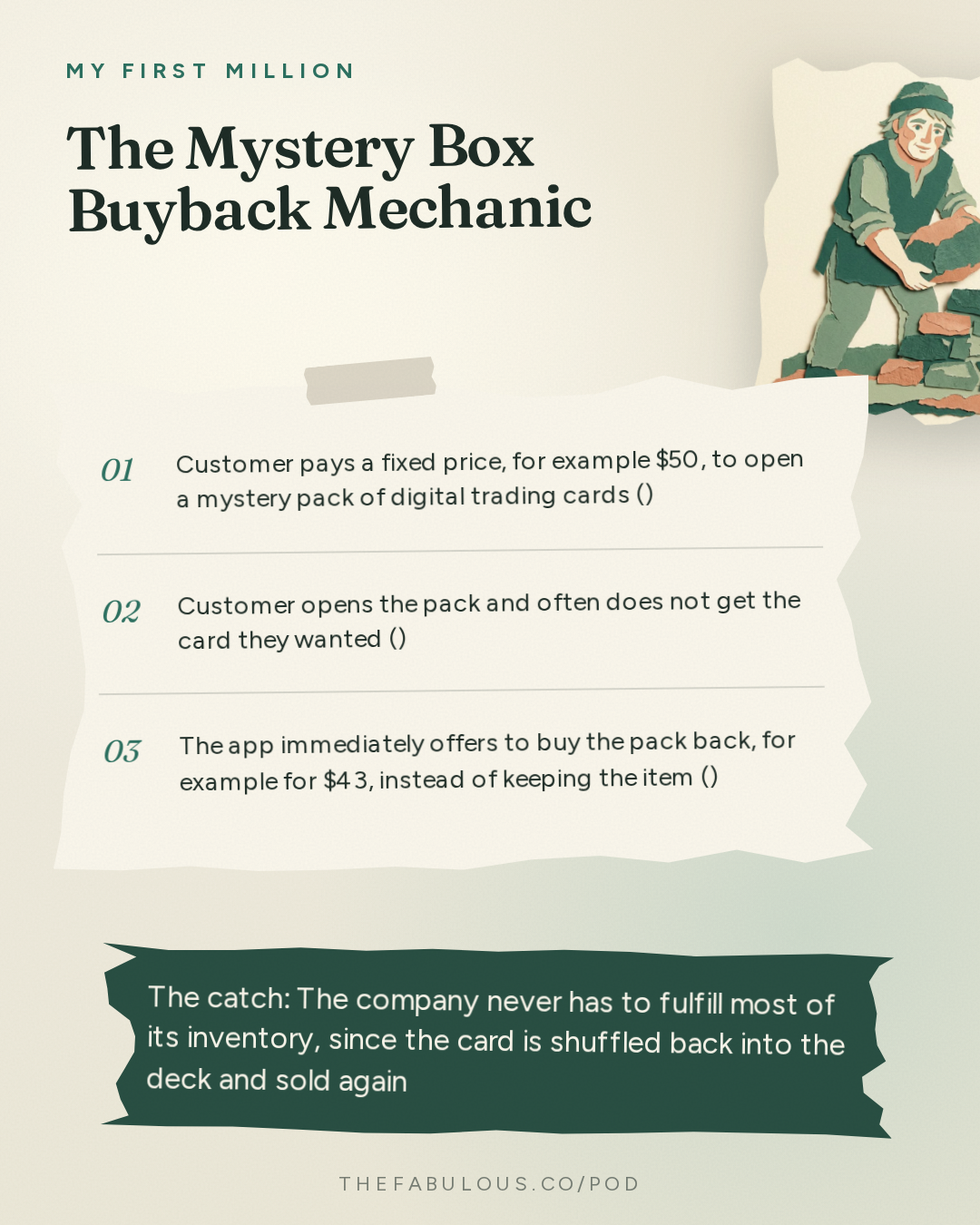
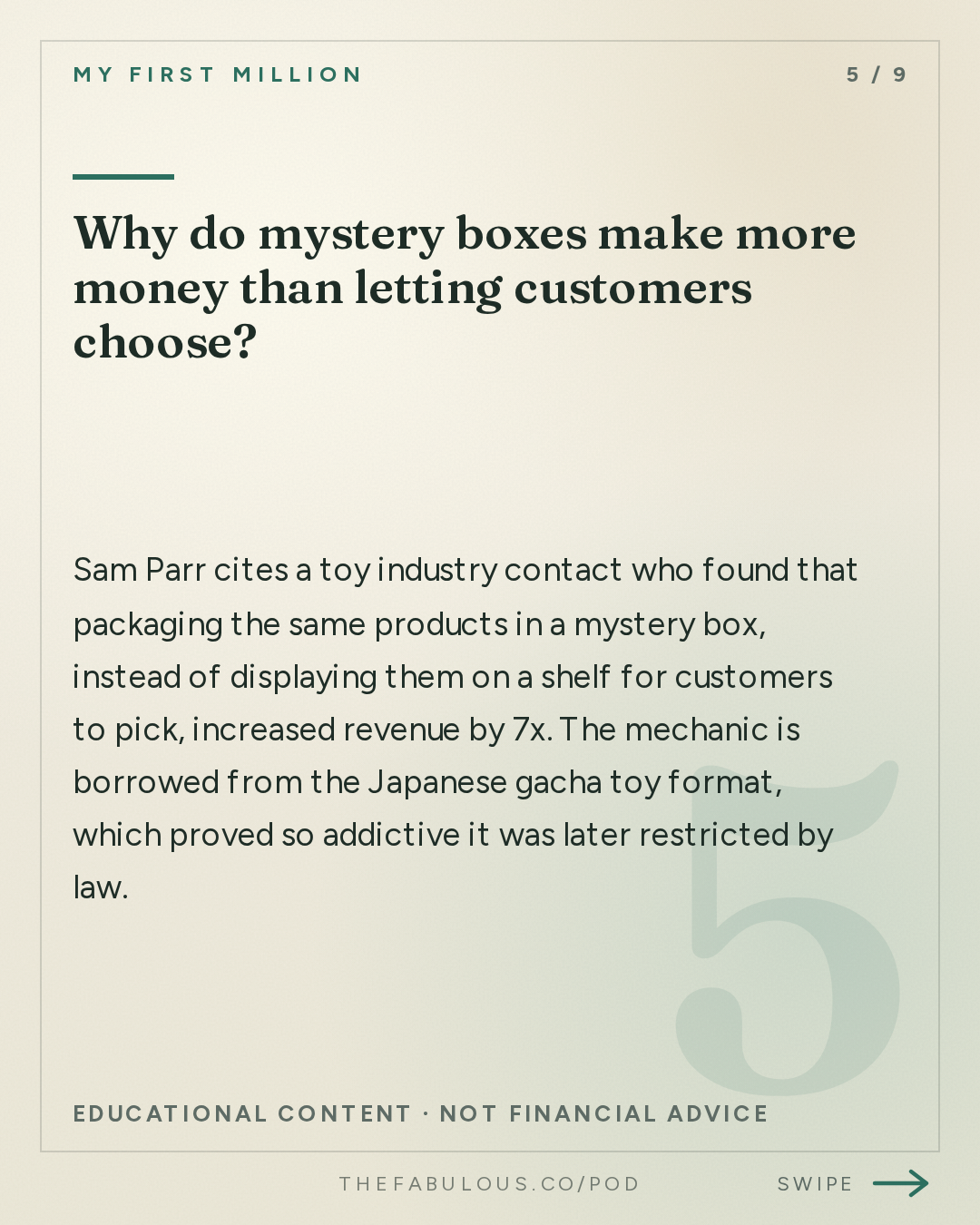
The same mechanic, stripped of the screen, shows up in physical collectibles. A new wave of apps lets users buy a virtual pack of trading cards, open it, and if they are unhappy, sell it straight back for slightly less than they paid, say forty three dollars on a fifty dollar pack. That near-refund feels like free money, so the player buys again. One such app has done a billion dollars in revenue in a year (17:17), and a related one, Collector Crypt, grew from fifty thousand dollars a month to twenty five million dollars a month using the same buyback trick (18:30). Its founder previously worked as a quantitative trader at the investment firms Citadel and Bridgewater. The underlying format, called gacha in Japan, became so addictive that the country eventually restricted it by law (19:34). A toy industry contact told Puri that switching identical products from an open shelf to a mystery box increased revenue by 7x, even though buyers technically got less choice (21:27).
A Postscript on Trust
Not every AI-resistant business is glamorous. Private Photo Vault, an app for hiding photos behind a calculator icon, has over a million reviews and has quietly generated significant revenue for years, run by one American founder with a small team (23:16). It survives for the same reason the communities do: people need somewhere private to put something they do not want floating around, and no algorithm negotiates that trust away.
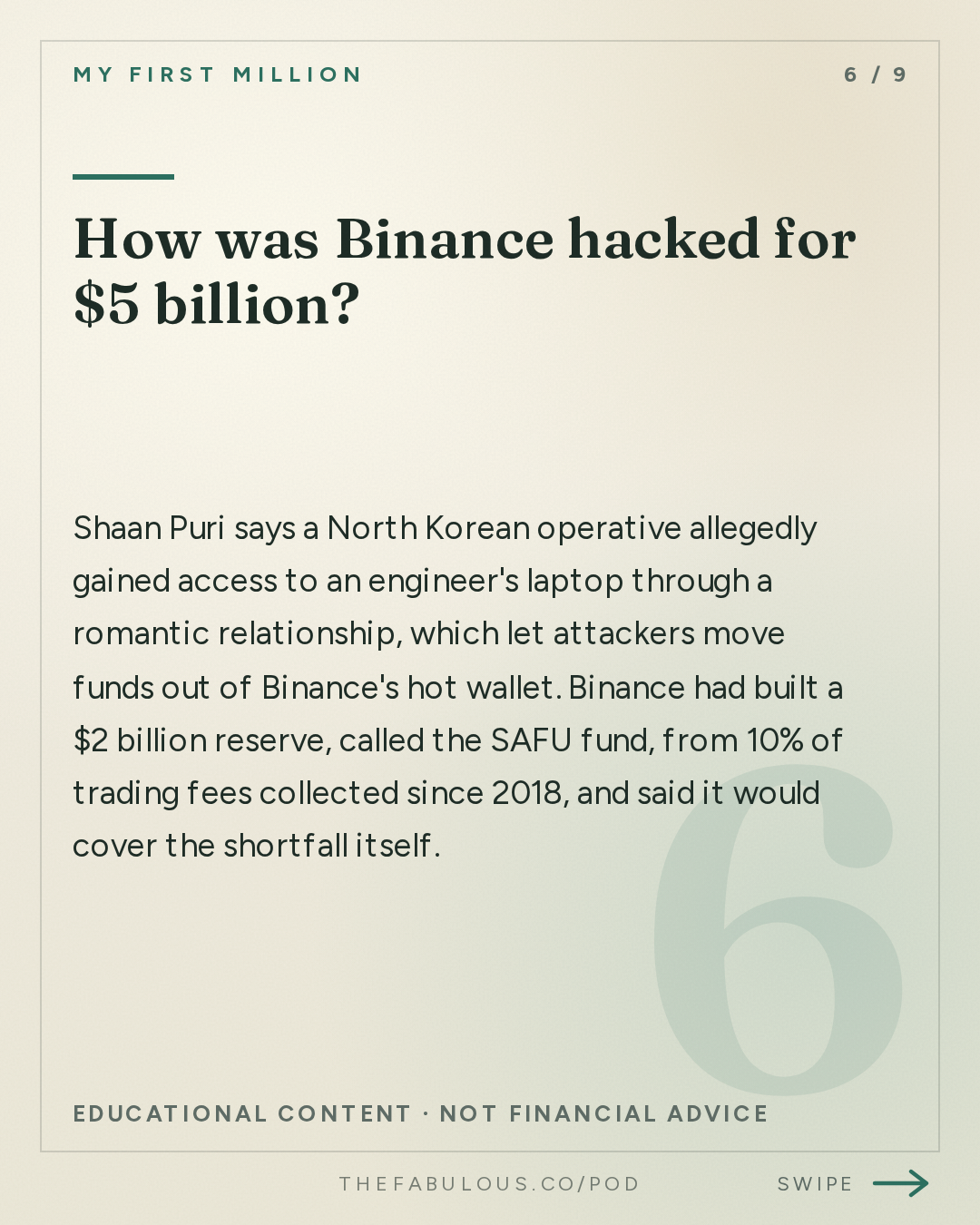
The episode closes on a story that inverts the whole theme. Binance, a cryptocurrency exchange, was allegedly hacked for five billion dollars after an operative linked to North Korea reportedly used a romantic relationship to gain physical access to an engineer's laptop (27:57). Binance had built a two billion dollar reserve, called the SAFU fund, from 10% of trading fees collected since 2018 (27:32), and said it would cover the rest itself. The attackers immediately moved the stolen funds into a decentralized finance (DeFi) protocol, a kind of permissionless bank that let them borrow stablecoins against the stolen crypto as collateral, locking in cash even if the original funds were later frozen (29:54).
Put side by side, the two halves of the episode make an odd kind of sense. A room of dealers trusts each other with a profit and loss statement. A chatroom of collectors trusts a vetting process. A blockchain trusts nothing and nobody, which is exactly why it needed a five billion dollar insurance fund in the first place. AI can write the code for all three. It cannot manufacture the twenty four strangers willing to open their books to each other, and that, this episode argues, is where the money will keep hiding.
Ask this episode anything
Pod's AI answers from the episode itself, with the minute mark so you can hear it yourself.
Or start with one of these
Ask this episode
Pod's AI listens to the whole episode to answer, and points you to the minute it comes from.
The rest of this answer, and any question after it
Answers come from the episode itself, never from a summary of it.
ContinueKey takeaways
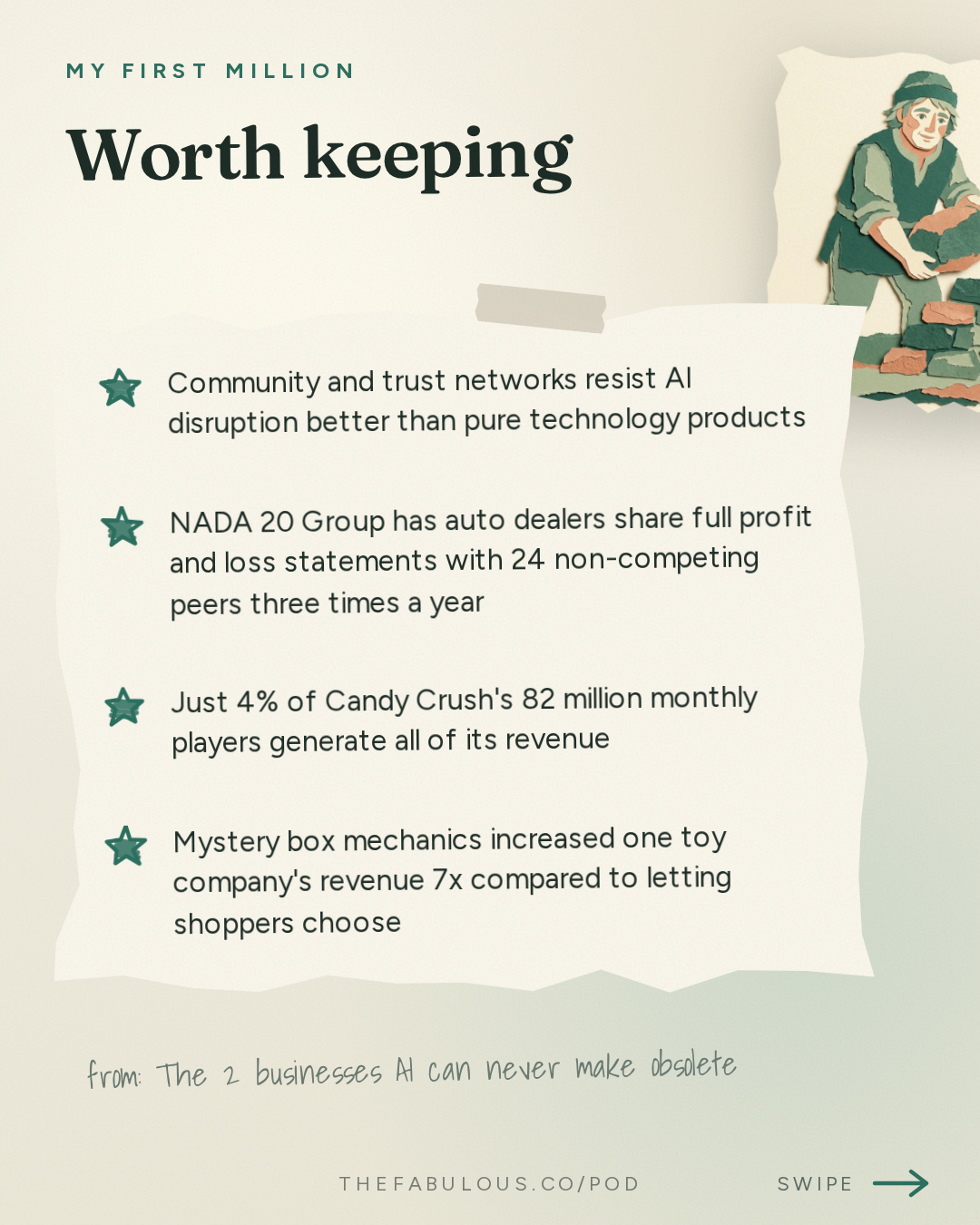
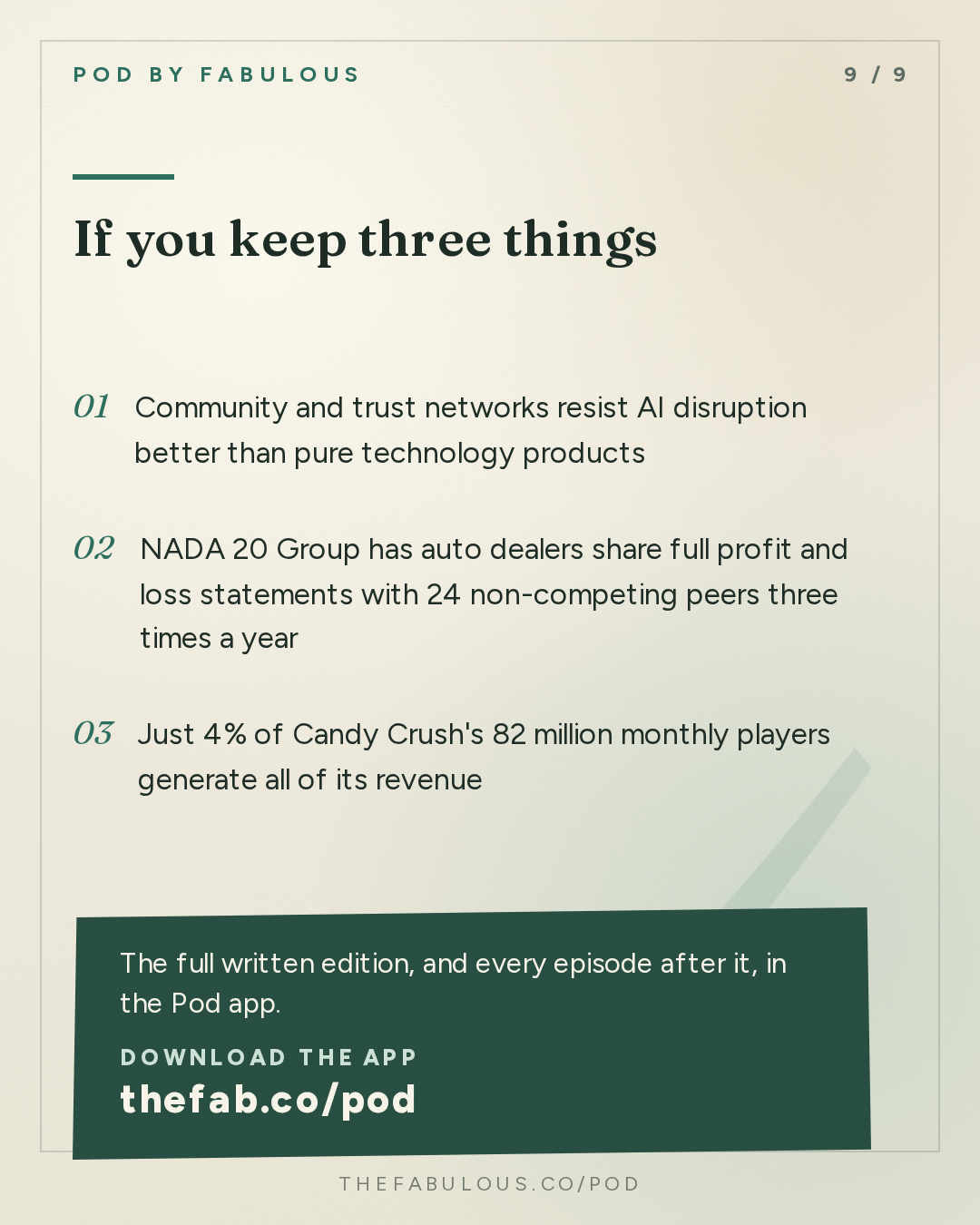
- Community and trust networks resist AI disruption better than pure technology products
- NADA 20 Group has auto dealers share full profit and loss statements with 24 non-competing peers three times a year
- Just 4% of Candy Crush's 82 million monthly players generate all of its revenue
- Mystery box mechanics increased one toy company's revenue 7x compared to letting shoppers choose
- Binance's $5 billion hack was allegedly enabled by a North Korean operative targeting an engineer's laptop
The episode in cards
By the numbers
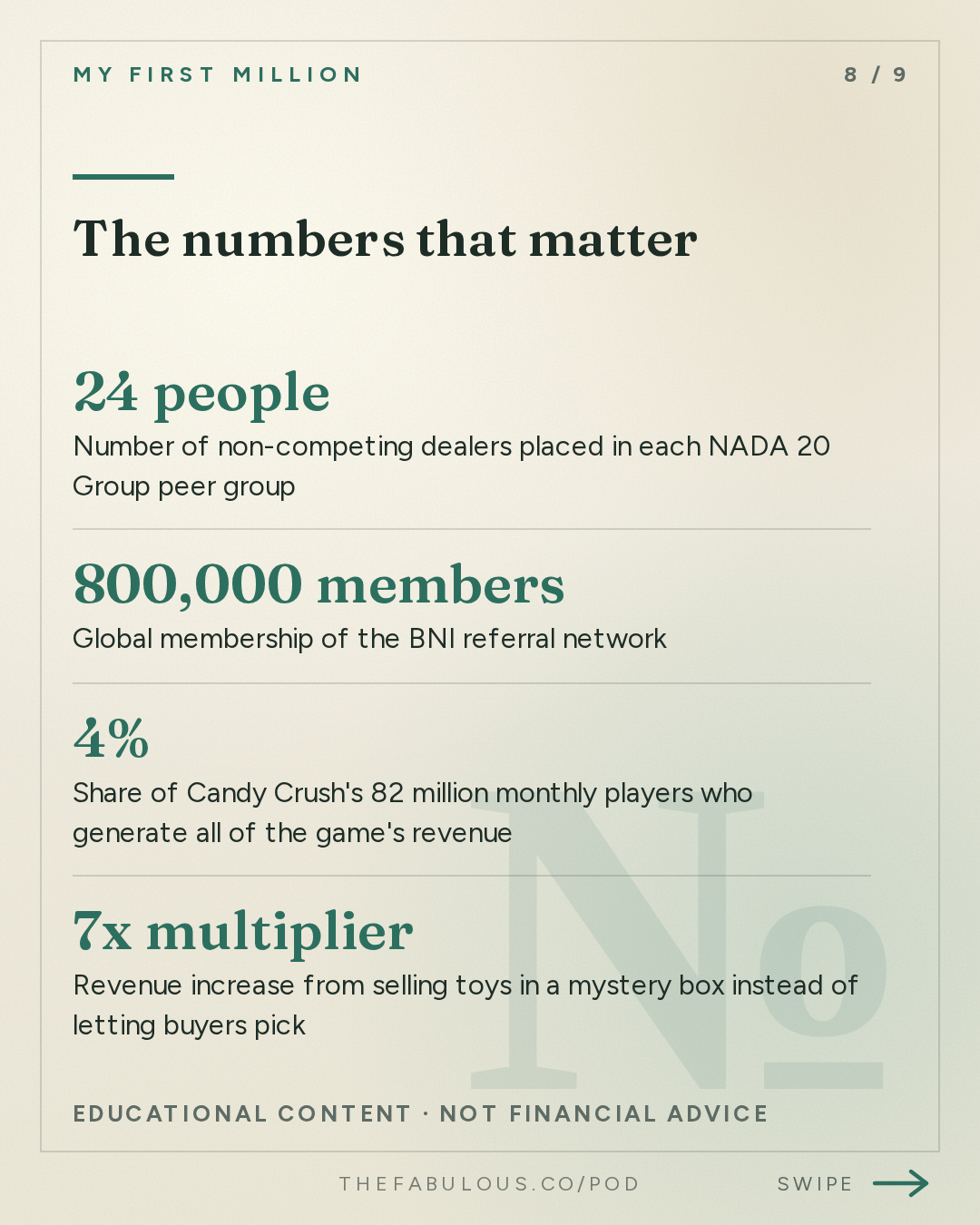
- 24 people Number of non-competing dealers placed in each NADA 20 Group peer group
- 800,000 members Global membership of the BNI referral network
- 4% percent Share of Candy Crush's 82 million monthly players who generate all of the game's revenue
- 7x multiplier Revenue increase from selling toys in a mystery box instead of letting buyers pick
In their words
“If you're not an AI person, which I'm not, there's still a lot of money to be made by building businesses that will grow with AI, and they won't actually”
“Previously technology was a moat. That's not a moat anymore. And I think communities, networks, and marketplaces are still a really good moat”
“It's literally like talking to a slot machine operator when you talk to them.”
“They just took the same things and put it in a mystery box, and it was 7x the revenue”
Protocols
-
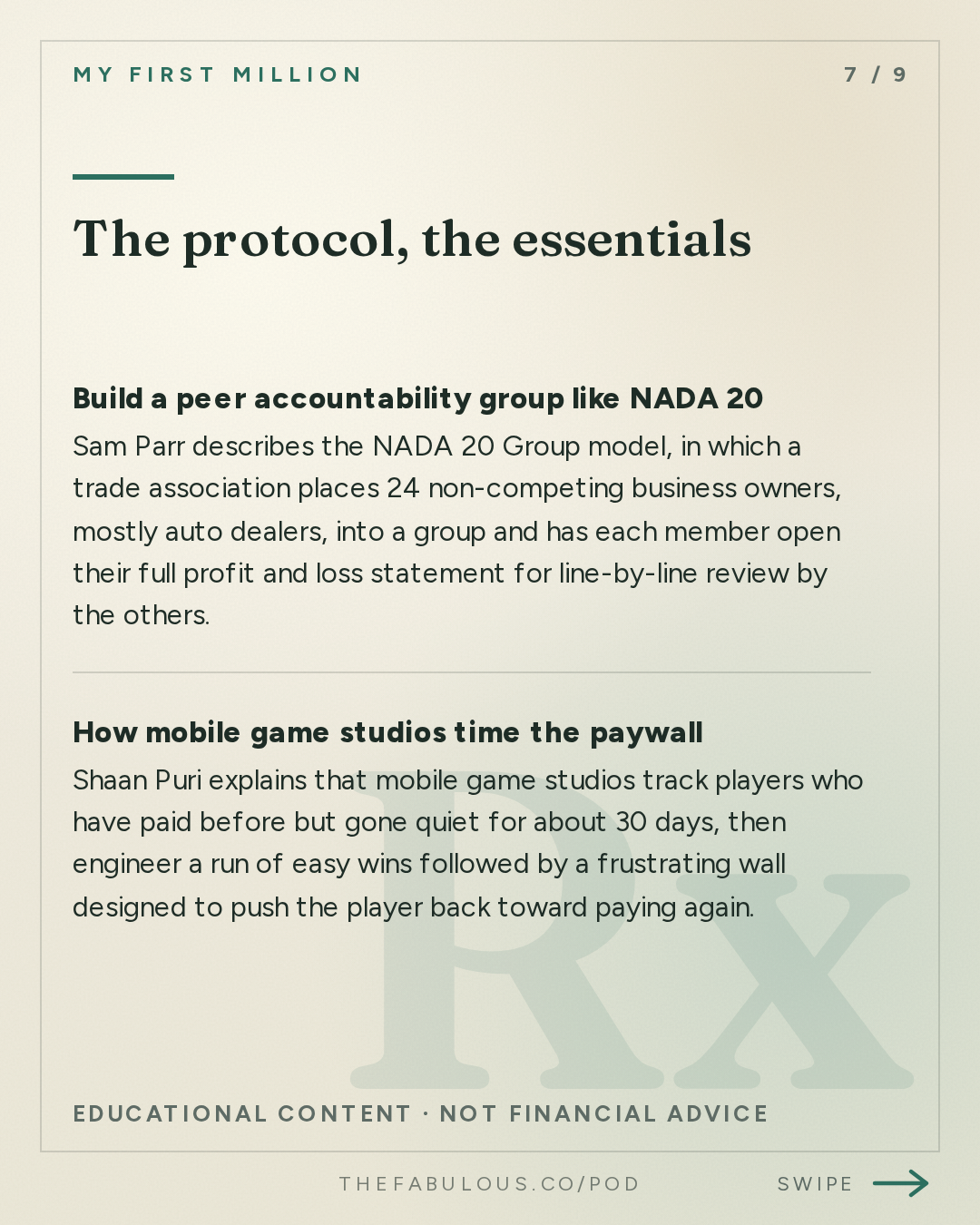
Build a peer accountability group like NADA 20
Sam Parr describes the NADA 20 Group model, in which a trade association places 24 non-competing business owners, mostly auto dealers, into a group and has each member open their full profit and loss statement for line-by-line review by the others.
Three in-person meetings a year
-
How mobile game studios time the paywall
Shaan Puri explains that mobile game studios track players who have paid before but gone quiet for about 30 days, then engineer a run of easy wins followed by a frustrating wall designed to push the player back toward paying again.
Triggered after roughly 30 days without a purchase
-
Borrowing against crypto collateral in DeFi
Shaan Puri describes decentralized finance (DeFi) lending as a permissionless system where a user deposits cryptocurrency as collateral and can borrow up to 50% of that value in stablecoins, with the protocol automatically selling the collateral if its price falls too far to cover the loan.
Ongoing, enforced automatically by the protocol
Questions this episode answers
What makes a business resistant to AI disruption?
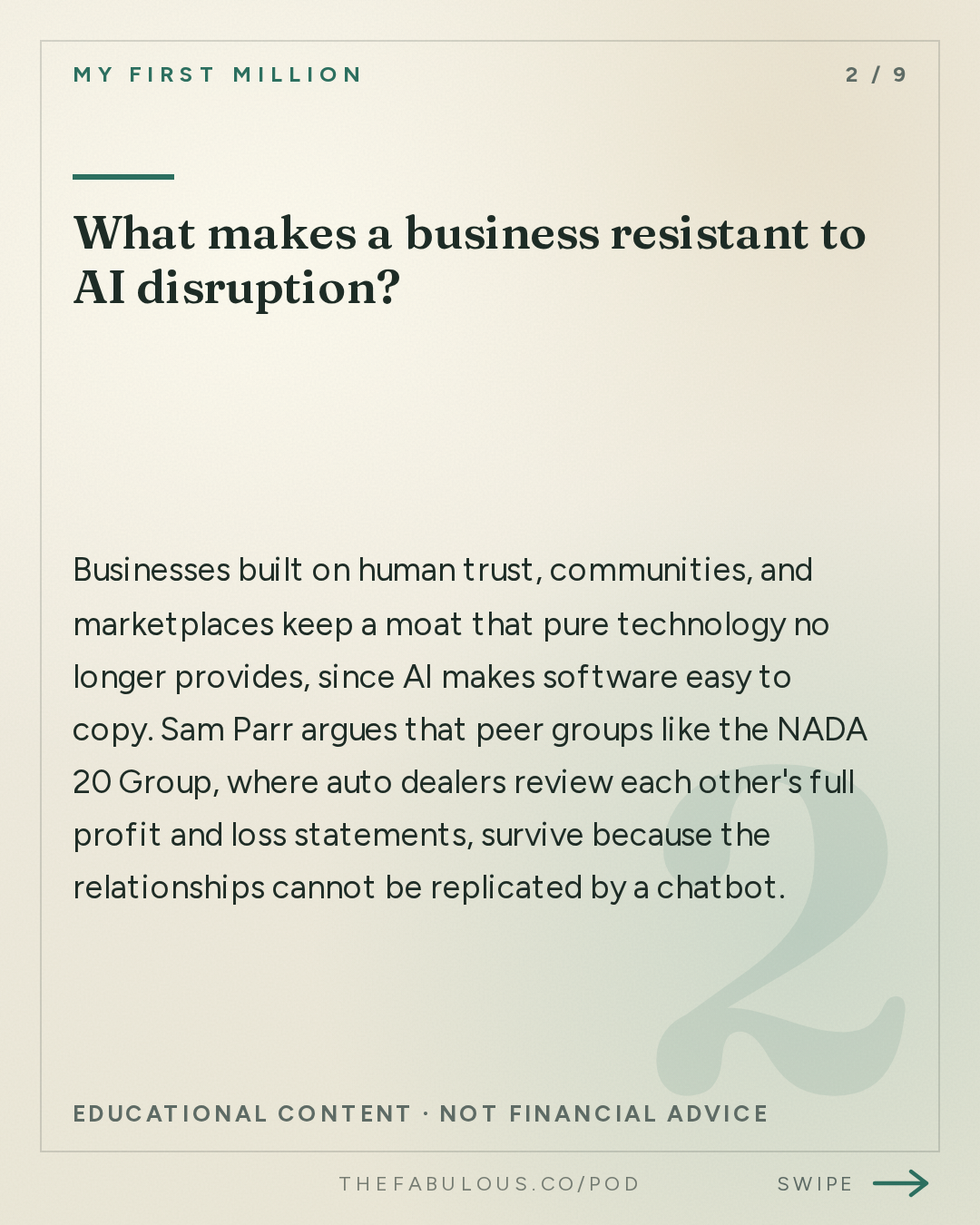
Businesses built on human trust, communities, and marketplaces keep a moat that pure technology no longer provides, since AI makes software easy to copy. Sam Parr argues that peer groups like the NADA 20 Group, where auto dealers review each other's full profit and loss statements, survive because the relationships cannot be replicated by a chatbot (10:47).
What is the NADA 20 Group and how does it work?
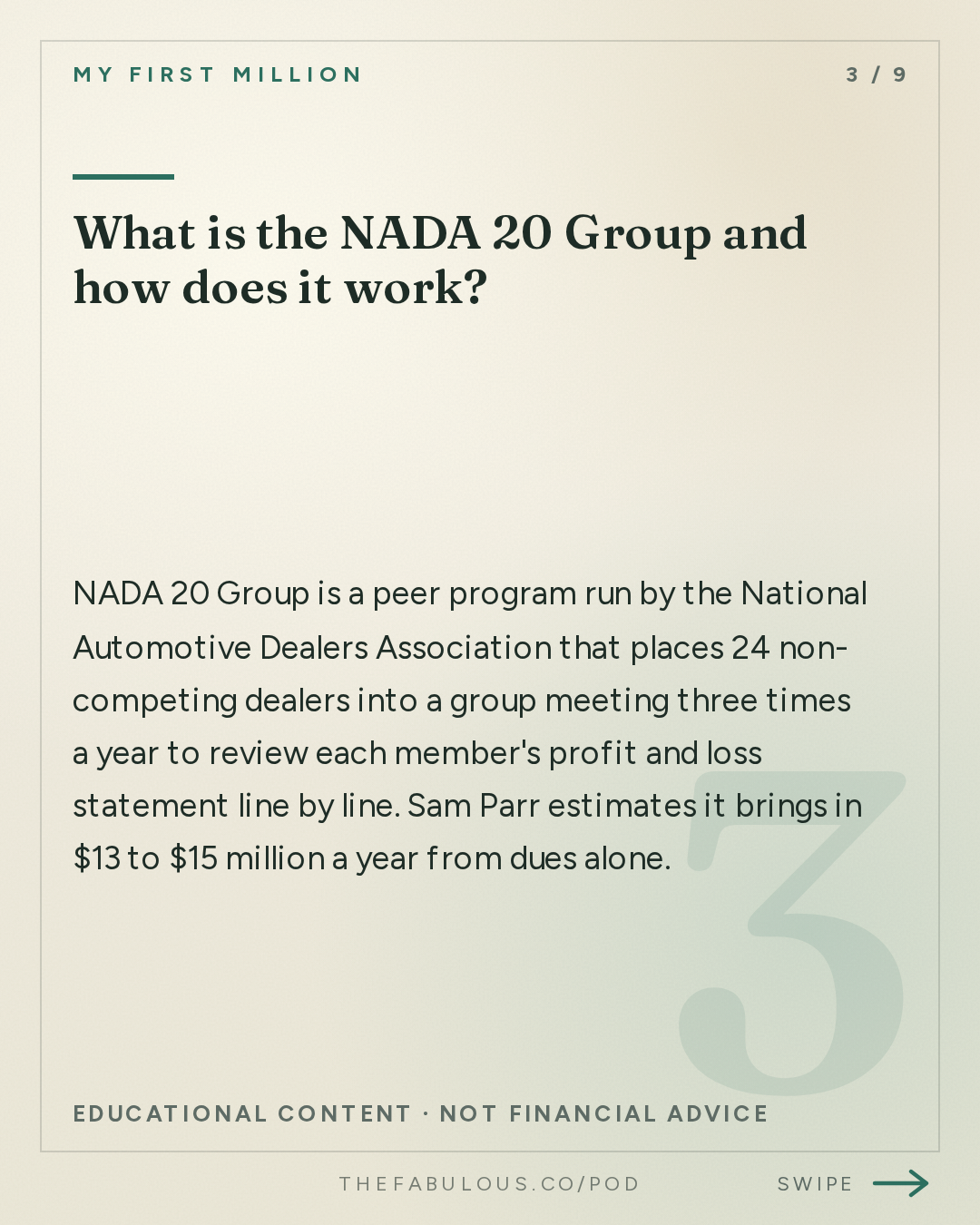
NADA 20 Group is a peer program run by the National Automotive Dealers Association that places 24 non-competing dealers into a group meeting three times a year to review each member's profit and loss statement line by line (02:02). Sam Parr estimates it brings in $13 to $15 million a year from dues alone (02:20).
How much revenue do whales generate in mobile games and collector marketplaces?
In Candy Crush, a mobile puzzle game with 82 million monthly active players, just 4% of players generate all of the game's revenue (13:23). Former Twitch executive Shaan Puri says the same 80 to 90% concentration shows up in collectible marketplaces and in Twitch's gifted-subscription feature, where top spenders behave like high rollers buying bottle service (11:22).
Why do mystery boxes make more money than letting customers choose?
Sam Parr cites a toy industry contact who found that packaging the same products in a mystery box, instead of displaying them on a shelf for customers to pick, increased revenue by 7x (21:27). The mechanic is borrowed from the Japanese gacha toy format, which proved so addictive it was later restricted by law (19:34).
How was Binance hacked for $5 billion?
Shaan Puri says a North Korean operative allegedly gained access to an engineer's laptop through a romantic relationship, which let attackers move funds out of Binance's hot wallet (27:57). Binance had built a $2 billion reserve, called the SAFU fund, from 10% of trading fees collected since 2018, and said it would cover the shortfall itself (27:14).
The full read, in cards
Go deeper
- White Coat Investor — A blog that grew into a media community for doctors discussing personal finance, cited as a template for niche professional communities
Mentioned
NADA 20 Group · BNI · White Coat Investor · Moda Communities · Peter Levels · Twitch · AppLovin · Citadel · Bridgewater · Private Photo Vault · Binance · Polymarket
More from this show and category
Bill Perkins: Die With Zero Explained
Hedge fund manager Bill Perkins says net worth has a peak date, not a peak dollar amount, because the body's ability to enjoy money fades with age. The Die With Zero author urges maximizing risk while young, giving inheritances early, and treating fame as a tax that shrinks a life rather than a reward for building one (14:26, 20:51, 47:26).
What It Was Really Like Working for Jeff Bezos
Ethan Evans, a former Amazon VP who spent 15 years inside the company, describes Jeff Bezos as brilliant but allergic to praise, a leader who ran on pattern recognition, anecdote over data, and a 24-hour 'question mark email' system that forced accountability. Evans also explains why he is happier now, working fewer hours for less title but more freedom.
Nick Kokonas's Theory of Business Arbitrage
Nick Kokonas built three careers by finding the same arbitrage: a gap between how fast information moves and how slowly an industry reacts to it. The Chicago trader turned restaurateur and software founder used a 20-second phone-line edge to build a $100 million trading year (31:53), then applied the same logic to Alinea and Tock (00:16).
Peter Levels: Why SaaS Lost Its Moat
Peter Levels says plain software has no moat left in the AI era, and what remains is data, network effects, distribution, or regulation. The episode also follows Bryan Johnson's attempt to dunk at 49, Elon Musk's SpaceX share giveaway to 72 million kids, and a pest control brand's $1,000 first week built on direct-to-consumer branding.
