
Bill Perkins: Die With Zero Explained
$100M hedge fund manager: Do not make the mistake of dying rich
The brief
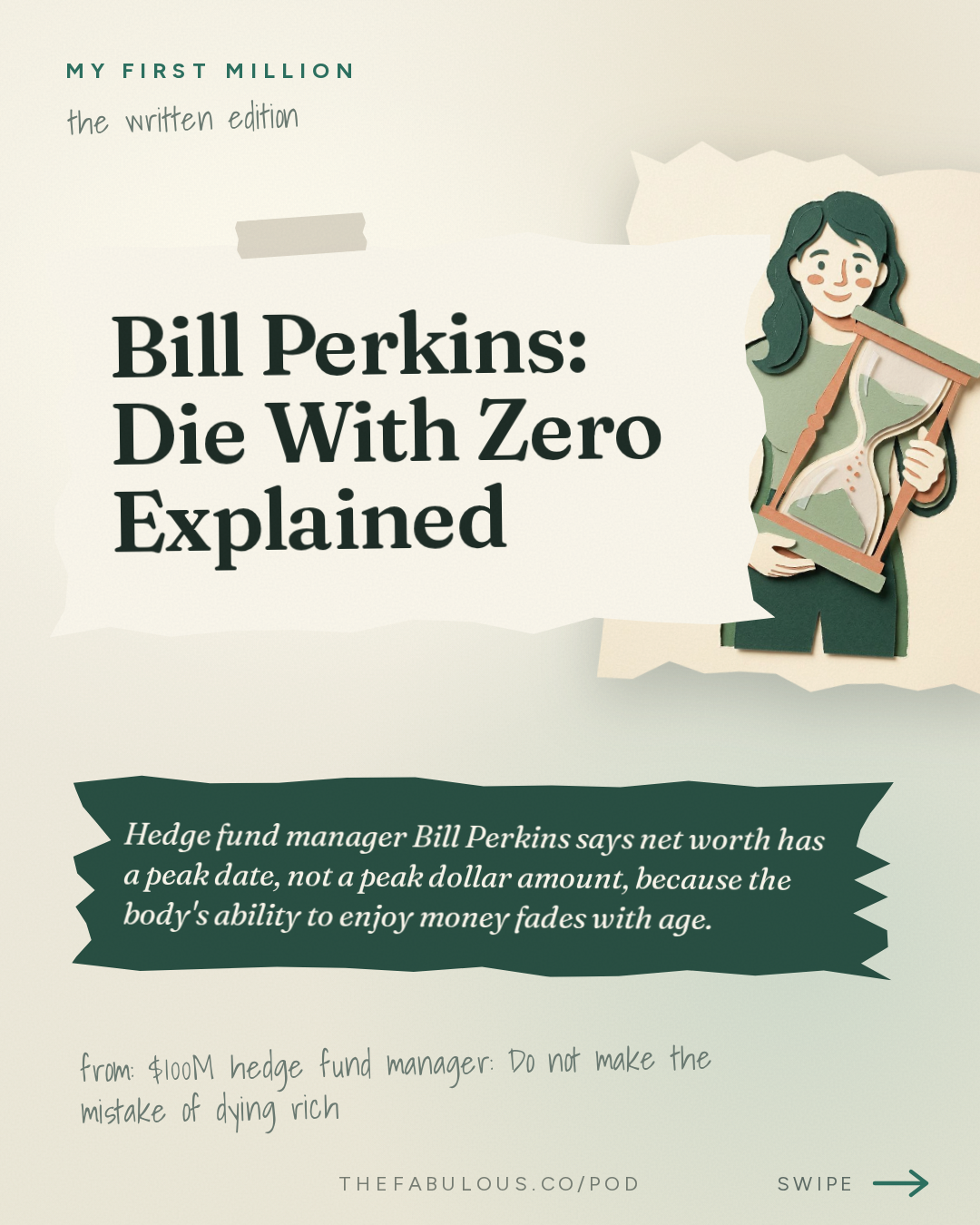
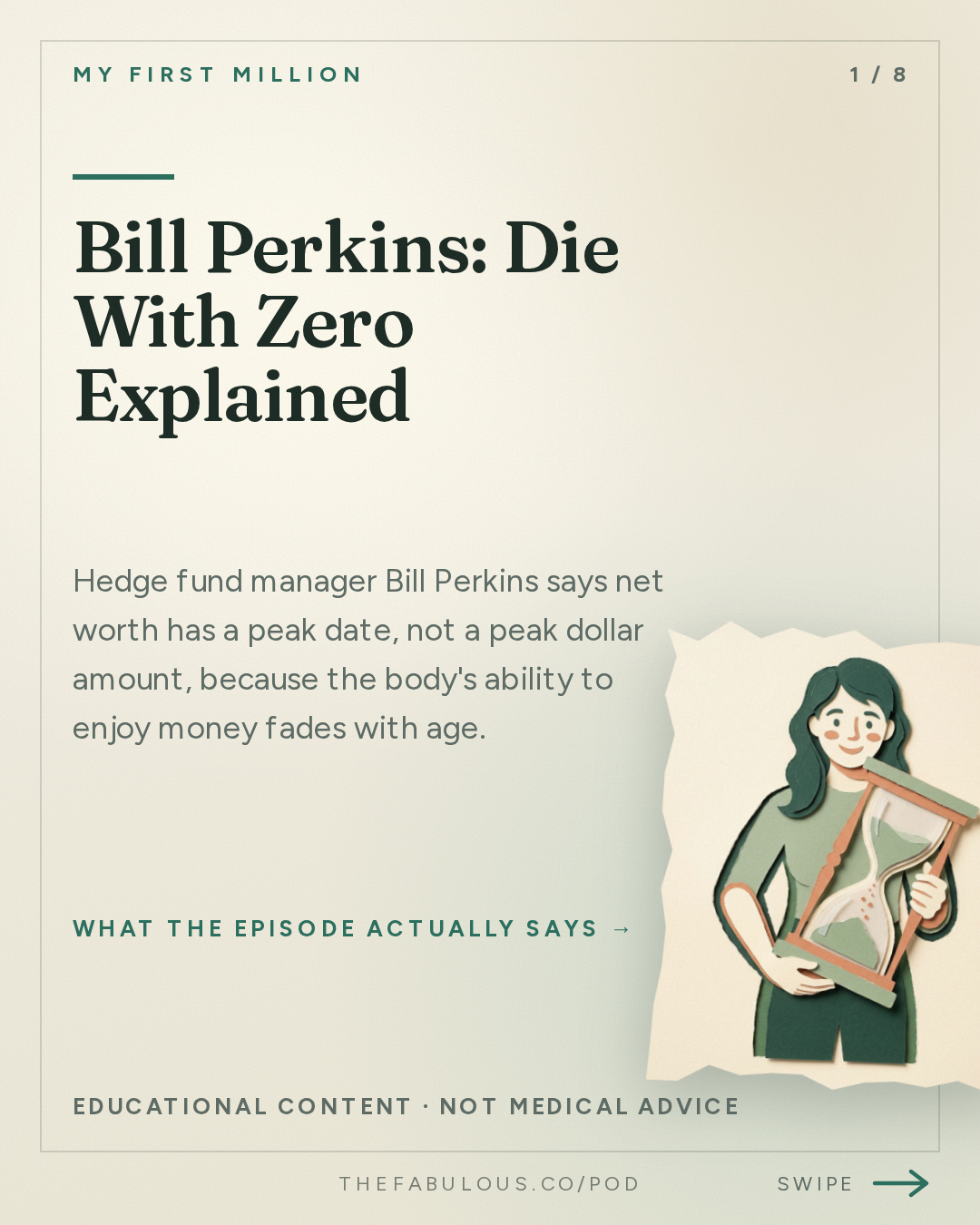
Hedge fund manager Bill Perkins says net worth has a peak date, not a peak dollar amount, because the body's ability to enjoy money fades with age. The Die With Zero author urges maximizing risk while young, giving inheritances early, and treating fame as a tax that shrinks a life rather than a reward for building one (14:26, 20:51, 47:26).
At Sotheby's, a stranger two seats away locked eyes with a hedge fund manager and said, out loud, in the middle of a live auction: "I'm not going to stop." Perkins said, "Well, then I'm going to make you pay." The room laughed. Ten minutes and several million dollars later, Bill Perkins owned a painting he had been chasing since childhood. He had told his wife beforehand that if he fainted, she should keep bidding. He did not faint. He paid fifteen million dollars (66:00), roughly five times his own pre-auction ceiling, for a canvas called Sugar Shack by the painter and former NFL lineman Ernie Barnes.
It is a strange way to meet a man whose defining idea is about restraint, or at least about timing. Perkins made his first fortune trading natural gas derivatives, first on the floor of the New York Mercantile Exchange, later running a desk in Houston after deregulation opened the market in the mid-1990s (01:16). He describes the job less like gambling and more like selling insurance: utilities and industrial buyers feared a cold winter and paid him to take that fear off their hands, and because winter risk premiums usually bled out, the prices fell, and Perkins, who was almost always short, usually won (03:00). In one stretch his fund's capital swung between roughly one hundred million dollars and two hundred and fifty million dollars within a single year, a drawdown of fifty percent followed by a run-up of two hundred and fifty percent (09:18). Over his career he generated close to a billion dollars in profit for the firms he traded for (03:39).
None of that is the reason Bill Perkins has a podcast tour and a bestselling book. The reason is a sentence he landed on sometime in his thirties, after reading a personal finance book called Your Money or Your Life, which argues that money is simply something traded for the finite hours of a person's time (15:18). That idea metastasized into Perkins's central claim, the one that gives his book, Die With Zero, its title and its bite.
A date, not a number
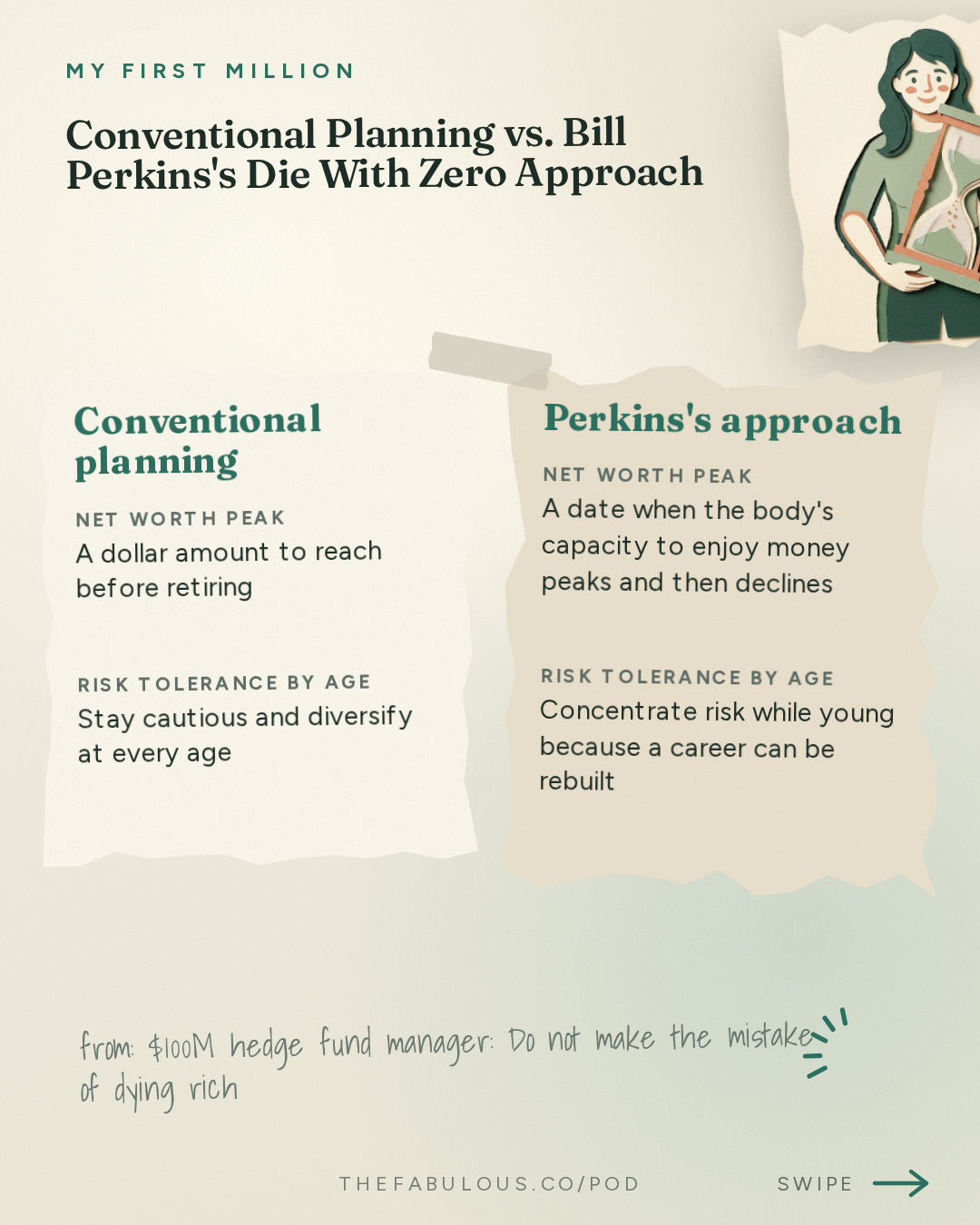
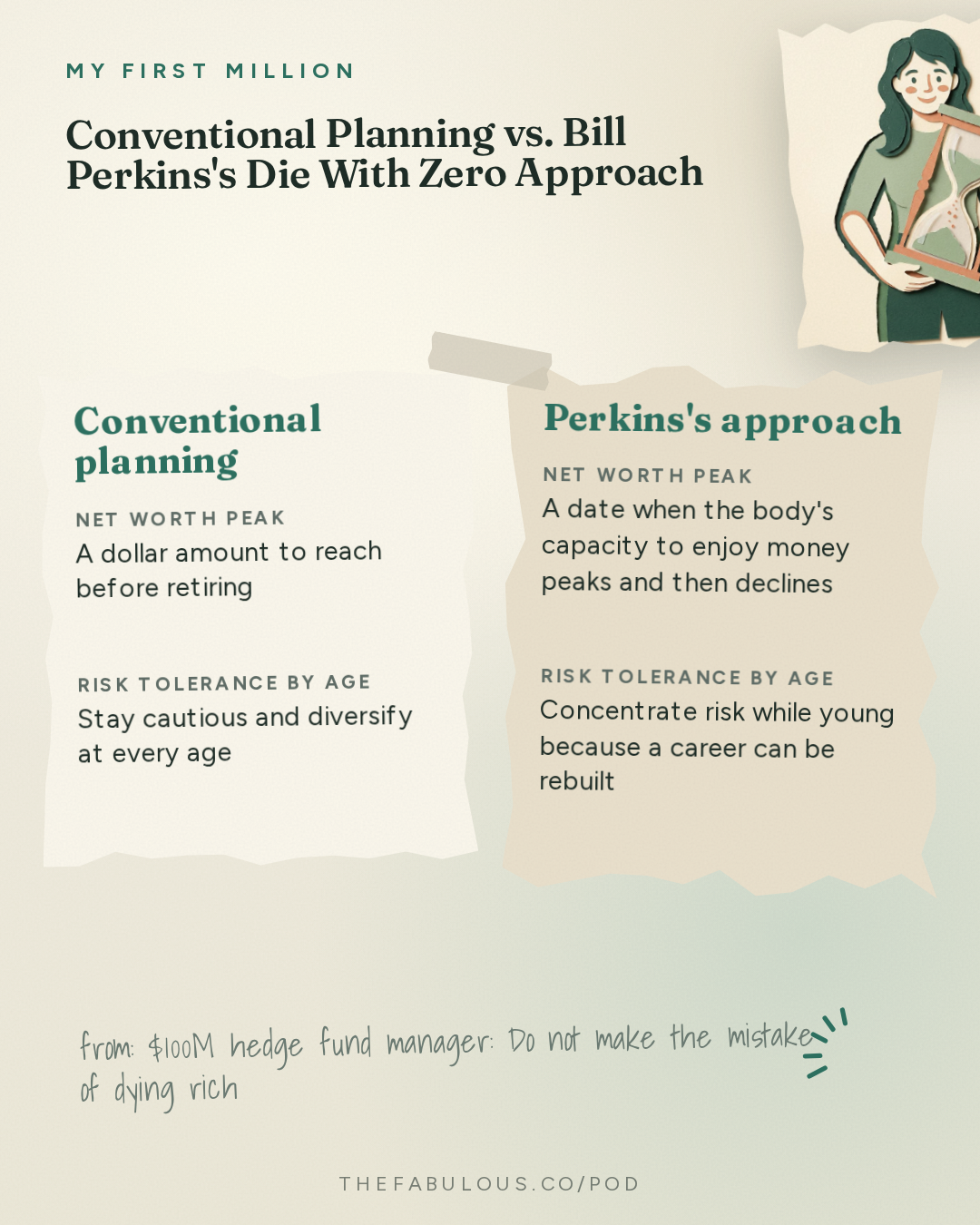
Most financial planning treats "enough" as a dollar figure: save until the number hits seven figures, then relax. Perkins argues the real ceiling is a moment in time, not an amount of money, because the body is a depreciating asset whose capacity to convert cash into experience declines with age, and that decline accelerates as death approaches.
"The number doesn't matter, the age date matters. Like your net worth peak is actually a date, not, not a number." (Bill Perkins, 14:26)
He places the real inflection point somewhere between thirty and sixty-five, the window in which added income stops buying added fulfillment because the body can no longer use it. A sixty-five-year-old with two million extra dollars cannot necessarily backpack across Europe, ski with old friends, or do whatever it was that money was supposedly for. Perkins has his own version of the parable: people who spend a lifetime pumping water into a well, scooping out only the tiniest sip, and dying still thirsty.
"They spent their whole life pumping rather than drinking." (Bill Perkins, 19:17)
This is where Die With Zero earns its uncomfortable title. Perkins's argument is not that money is bad, but that unspent money late in life is a kind of waste, a transfer of lived hours to a future self who may be too old, too sick, or too dead to use them. He extends the logic to inheritance: instead of leaving a lump sum in a will for adult children to receive after a parent's death, often well into the heirs' own fifties or sixties, Perkins argues for giving the money earlier, while children are still young enough to spend it on something that compounds into a life, a home, a business, time off to raise kids (47:26). He has watched listeners of his book restructure their estate plans this way, calling the old model "obvious" in retrospect once it is pointed out.
The ego tax
If net worth peak is Perkins's financial thesis, ego is his psychological one. Asked why people do not take entrepreneurial risk even when they can financially absorb the downside, Perkins does not point to fear of losing money. He points to fear of losing status.
"Most people don't start a business or don't go chase an opportunity, et cetera, don't do it because of ego, not because of the money risk." (Bill Perkins, 20:51)
People can survive becoming a waiter again, he argues. What they cannot survive, in their own minds, is the perceived judgment of friends and family watching them fail. He is blunt about this with people close to him, less so with strangers, but the diagnosis recurs throughout the conversation: ego, not arithmetic, is the usual brake pedal.
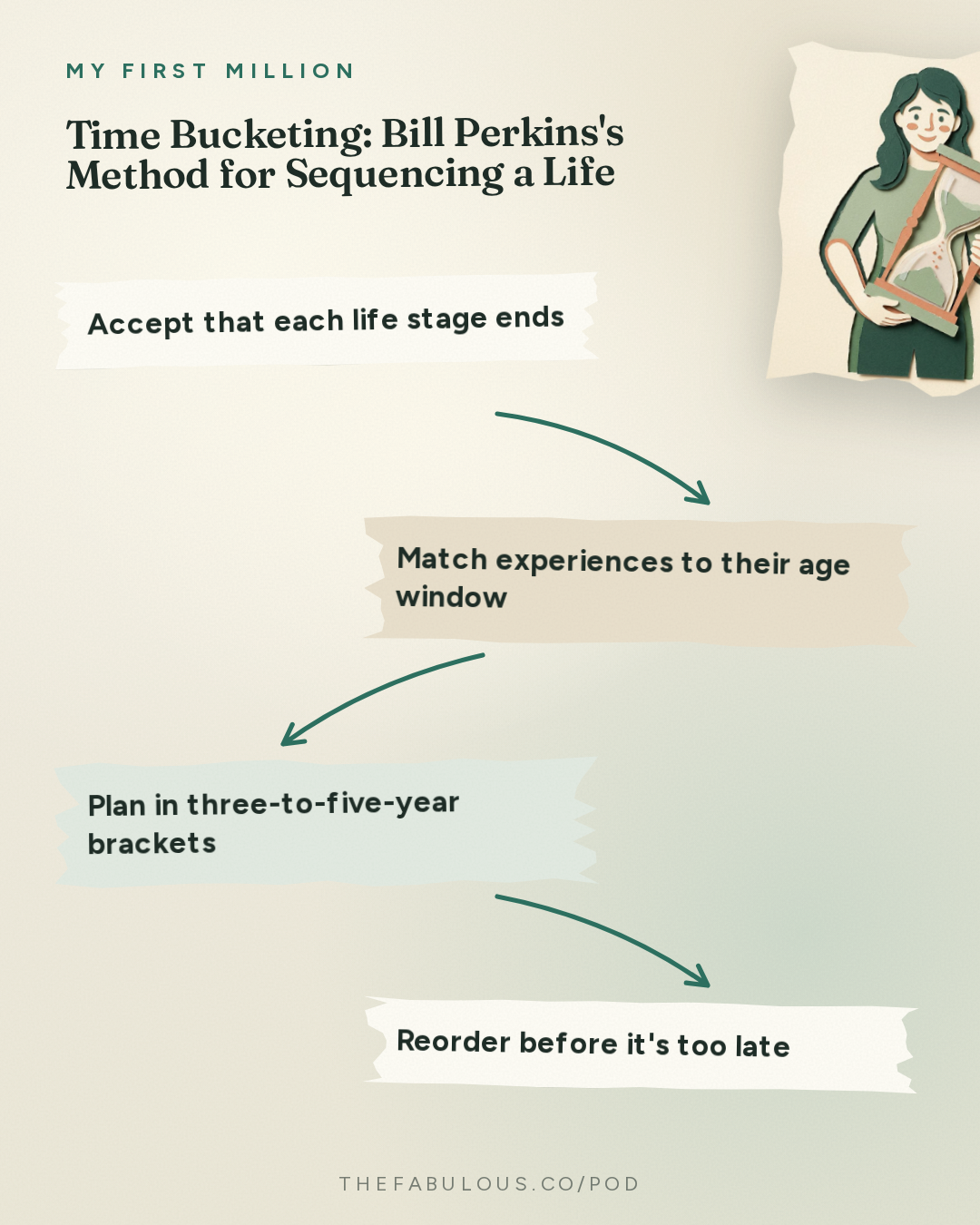
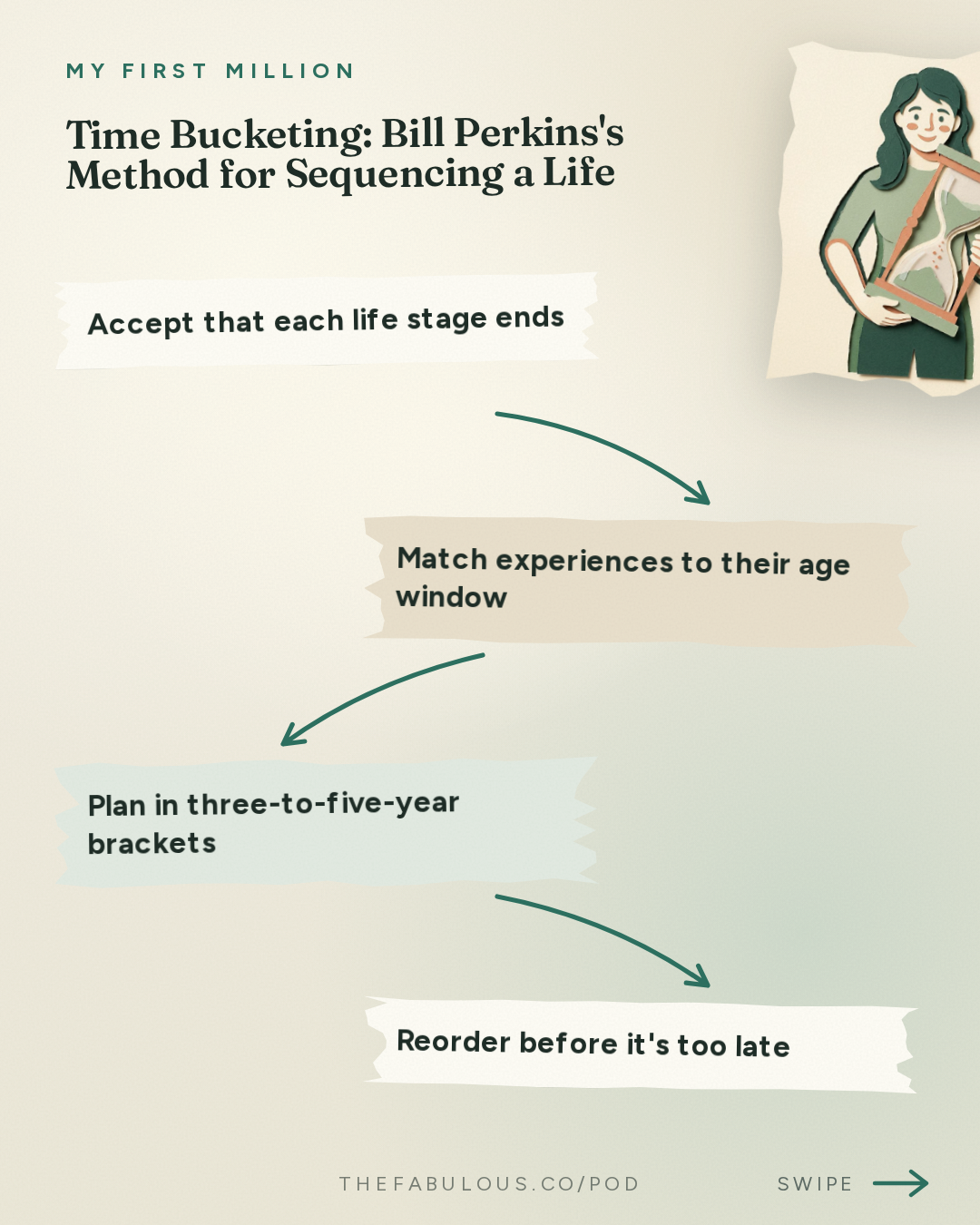
The same logic shapes how Perkins thinks about sequencing a life, an idea he calls time bucketing, distinct from a bucket list. A bucket list assumes experiences are interchangeable across decades, something to get to eventually. Perkins's claim is that many experiences are only available, or only good, inside a specific age bracket (35:43). Backpacking through Europe on couch-surfing sites and night trains is a twenty-something's game; doing it at thirty-three, with money in the bank, just feels grim. He describes planning his own life in three-to-five-year brackets with his wife, deciding, for instance, how long to live abroad while their young son is still small enough to travel easily.
"Life is like Tetris. You kinda have to get the order right in order to get the high score and fulfillment." (Bill Perkins, 36:29)
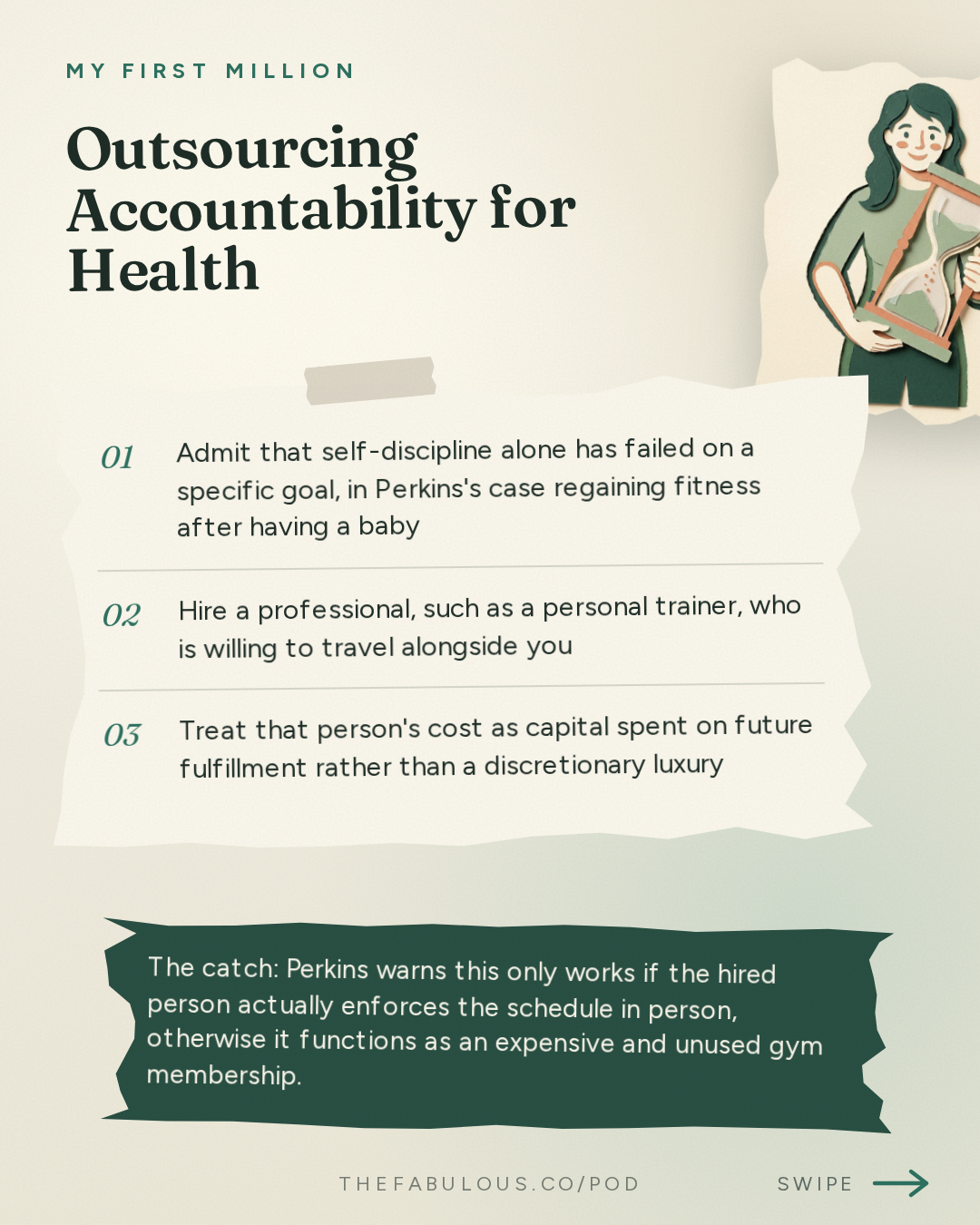
Health sits inside the same framework. Perkins cites his doctor's "Centenarian Olympics," a list of roughly fifty physical tasks, picking up a small child, hiking, surfing, from which a person selects the ten that matter most to them for their final decade, then works backward from current fitness data, especially VO2 max (a measure of how efficiently the body uses oxygen during exercise), to see which of those ten are still achievable on the current trajectory (41:36). Perkins admits his own numbers have slipped: eight percent body fat four years ago, when he remarried, versus sixteen to eighteen percent now, after a new baby and two years of what he calls self-granted excuses (39:12). His fix is pragmatic rather than inspirational.
"If I can't be accountable, I need to outsource accountability." (Bill Perkins, 42:36)
Concretely, that means hiring a trainer willing to travel with him, removing the excuse that travel breaks the routine, because the routine now comes with him.
Fame gets the same cost-benefit treatment as everything else. Perkins spent a period after his divorce chasing a more public, hedonistic life, and watched friends like the former Olympic swimmer Michael Phelps and the poker-adjacent celebrity figure Dan Bilzerian lose the ability to walk through a city unbothered.
"Fame shrinks your world, and you go into a bubble. You can't, you can't walk around." (Bill Perkins, 77:23)
He decided the trade was bad: public recognition in exchange for private freedom, paid for by becoming a slave to whatever persona made a person famous in the first place. It is the same arithmetic running through the whole conversation, applied to money, to time, to health, to status. Perkins is not arguing against ambition. He is arguing that every form of capital, dollars, hours, reputation, has a shelf life, and that the real failure is not spending too much of it. It is dying with too much left on the shelf.
Ask this episode anything
Pod's AI answers from the episode itself, with the minute mark so you can hear it yourself.
Or start with one of these
Ask this episode
Pod's AI listens to the whole episode to answer, and points you to the minute it comes from.
The rest of this answer, and any question after it
Answers come from the episode itself, never from a summary of it.
ContinueKey takeaways
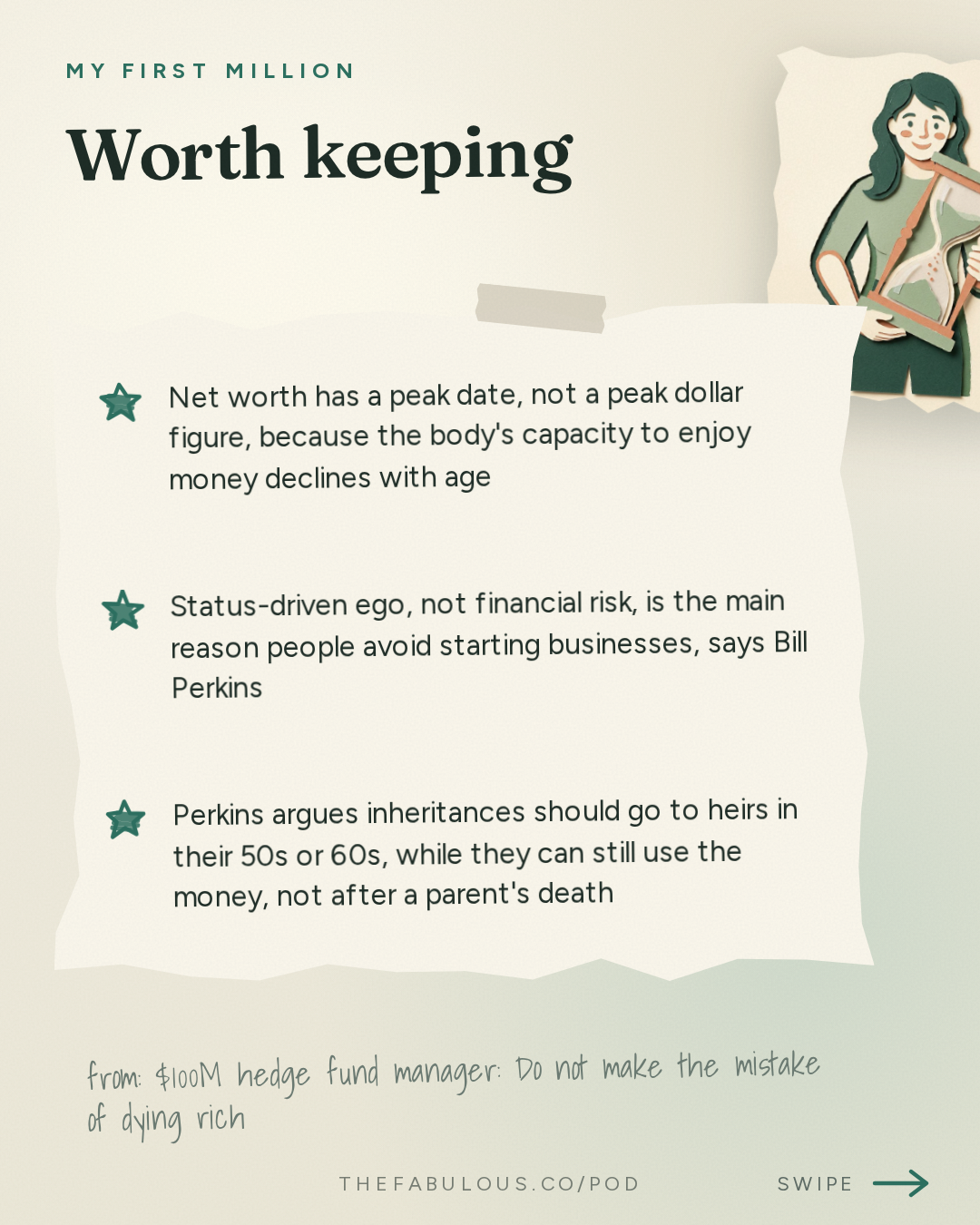
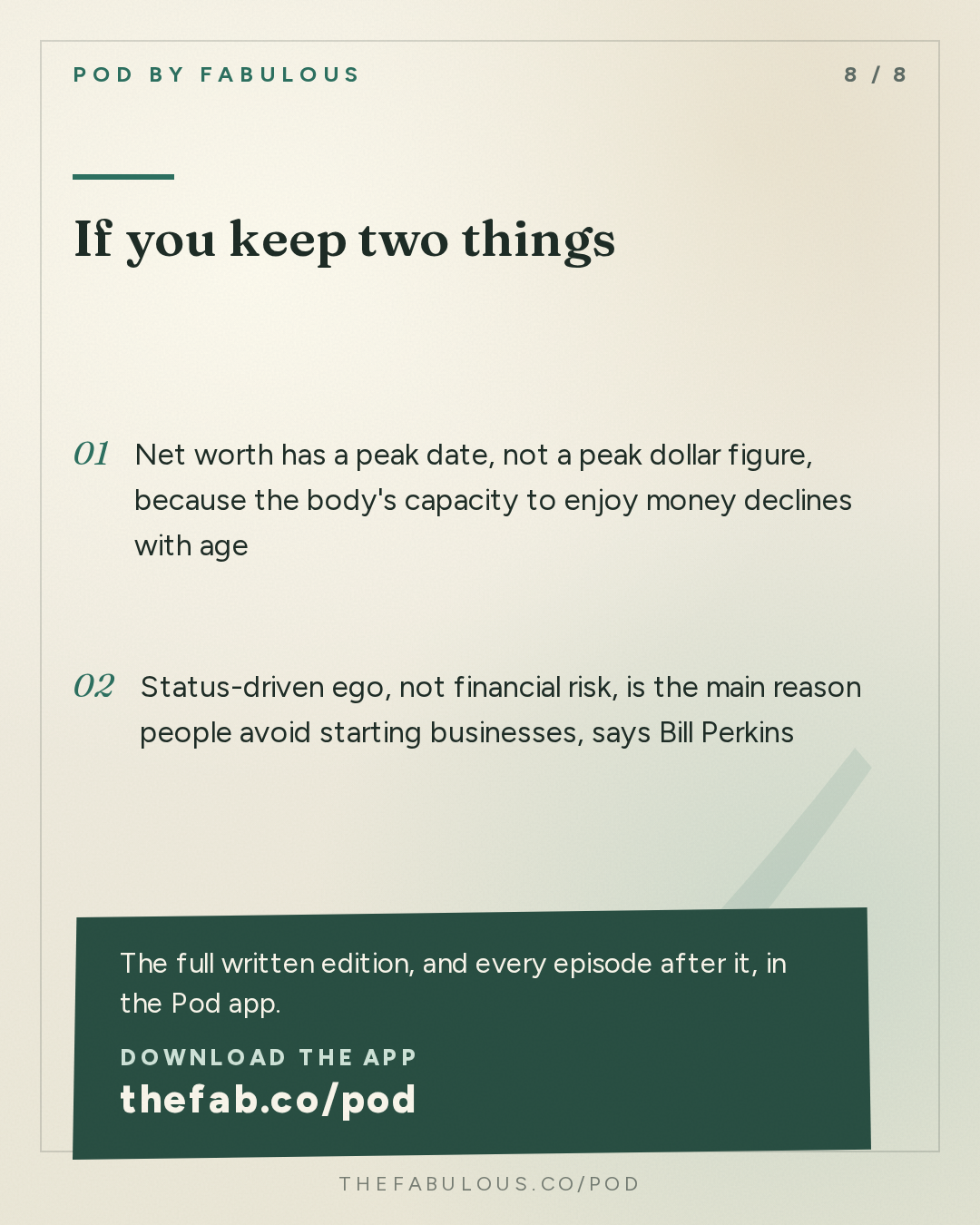
- Net worth has a peak date, not a peak dollar figure, because the body's capacity to enjoy money declines with age
- Status-driven ego, not financial risk, is the main reason people avoid starting businesses, says Bill Perkins
- Perkins argues inheritances should go to heirs in their 50s or 60s, while they can still use the money, not after a parent's death
- Time bucketing means scheduling experiences like travel or risk-taking inside the specific age window when they actually work
- Perkins outsources self-discipline by hiring a trainer who travels with him, calling it a fix for failed willpower
The episode in cards


In their words
“The number doesn't matter, the age date matters. Like your net worth peak is actually a date, not, not a number”
“They spent their whole life pumping rather than drinking.”
“Most people who don't start a business or don't go chase an opportunity, et cetera, don't do it because of ego, not because of the money risk”
“If I can't be accountable, I need to outsource accountability.”
“Fame shrinks your world, and you go into a bubble. You can't, you can't walk around.”
Protocols
-
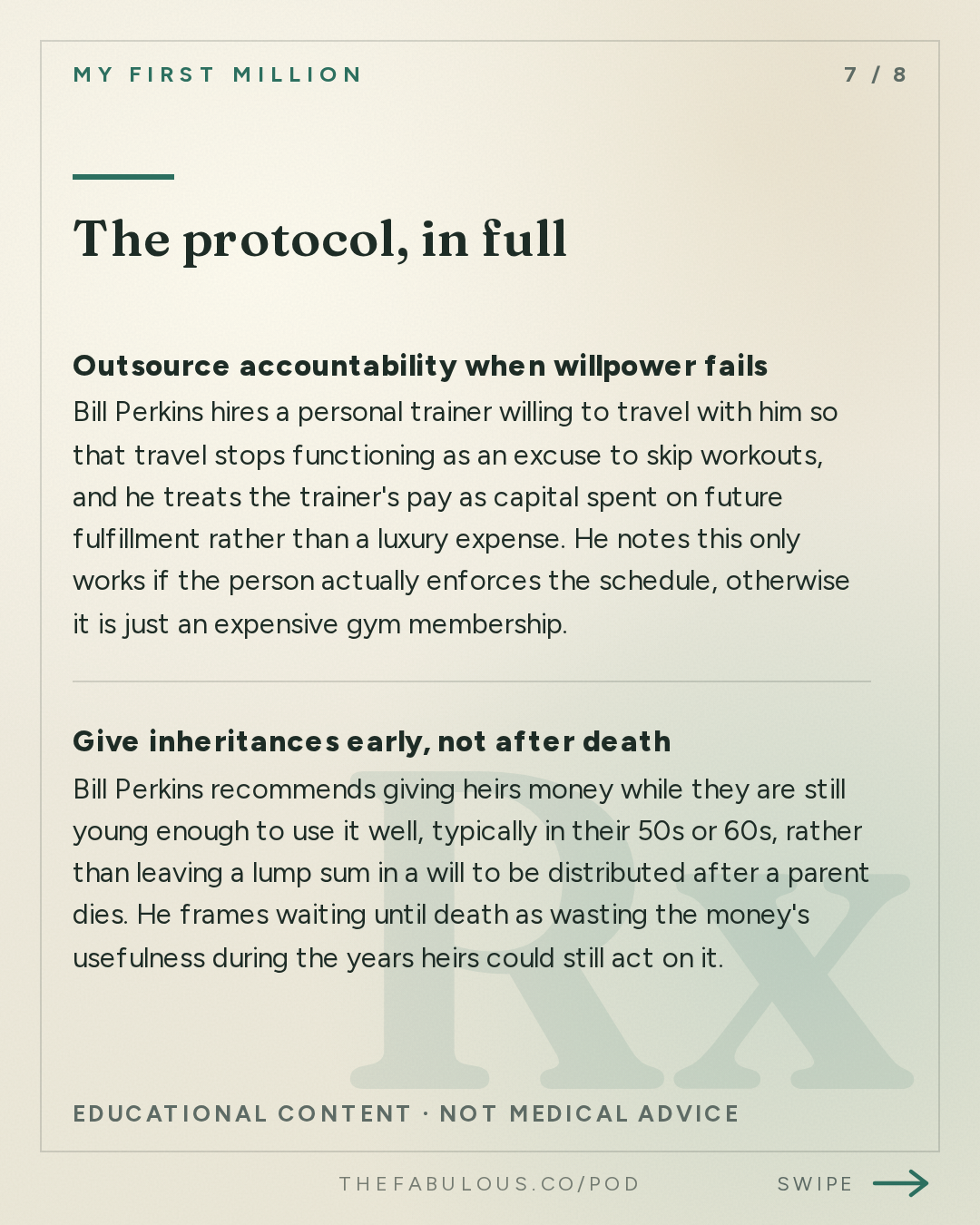
Outsource accountability when willpower fails
Bill Perkins hires a personal trainer willing to travel with him so that travel stops functioning as an excuse to skip workouts, and he treats the trainer's pay as capital spent on future fulfillment rather than a luxury expense. He notes this only works if the person actually enforces the schedule, otherwise it is just an expensive gym membership.
ongoing, including while traveling
-
Give inheritances early, not after death
Bill Perkins recommends giving heirs money while they are still young enough to use it well, typically in their 50s or 60s, rather than leaving a lump sum in a will to be distributed after a parent dies. He frames waiting until death as wasting the money's usefulness during the years heirs could still act on it.
one-time or periodic gifting during the parent's lifetime
Questions this episode answers
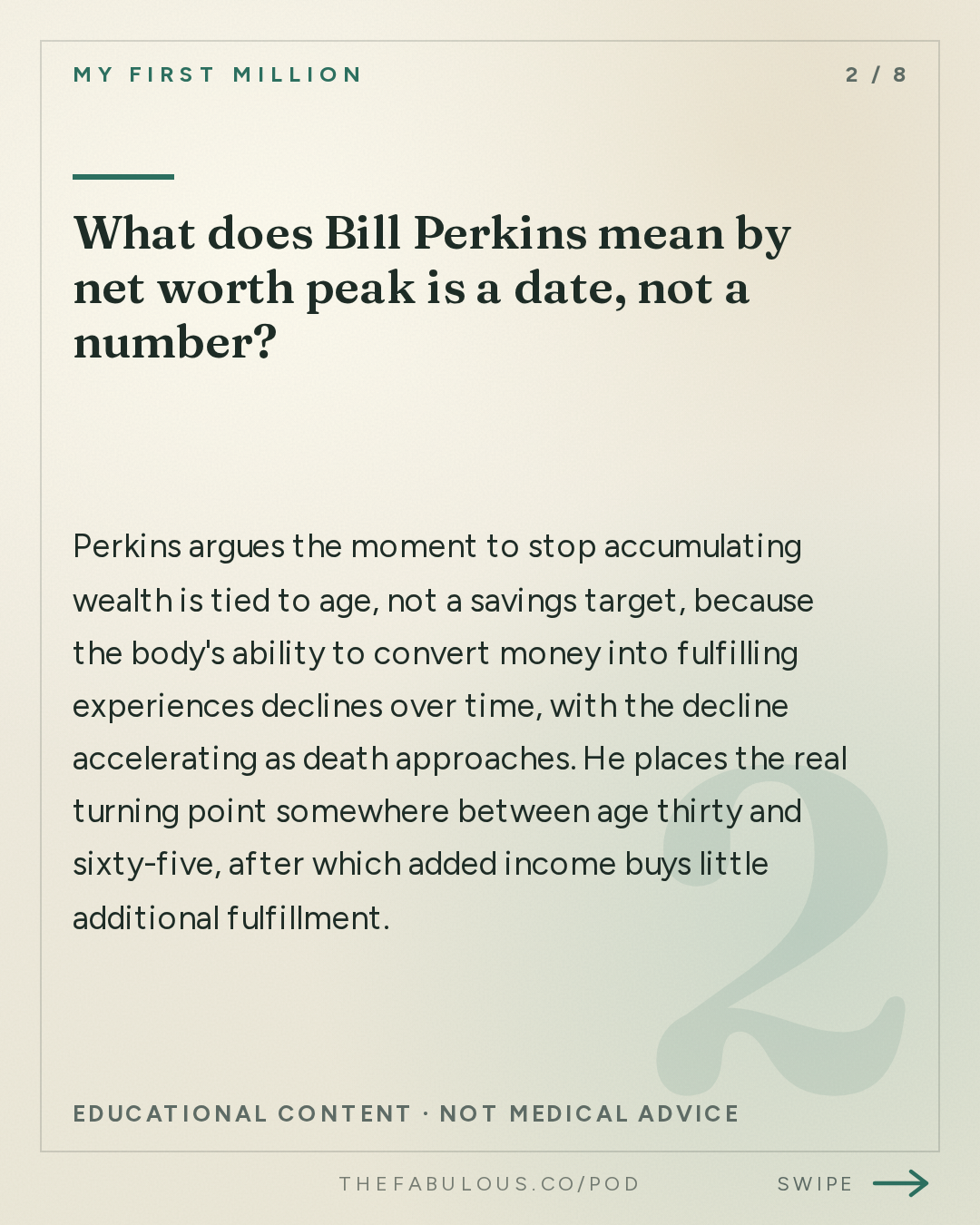
What does Bill Perkins mean by net worth peak is a date, not a number?
Perkins argues the moment to stop accumulating wealth is tied to age, not a savings target, because the body's ability to convert money into fulfilling experiences declines over time, with the decline accelerating as death approaches (14:26). He places the real turning point somewhere between age thirty and sixty-five, after which added income buys little additional fulfillment.
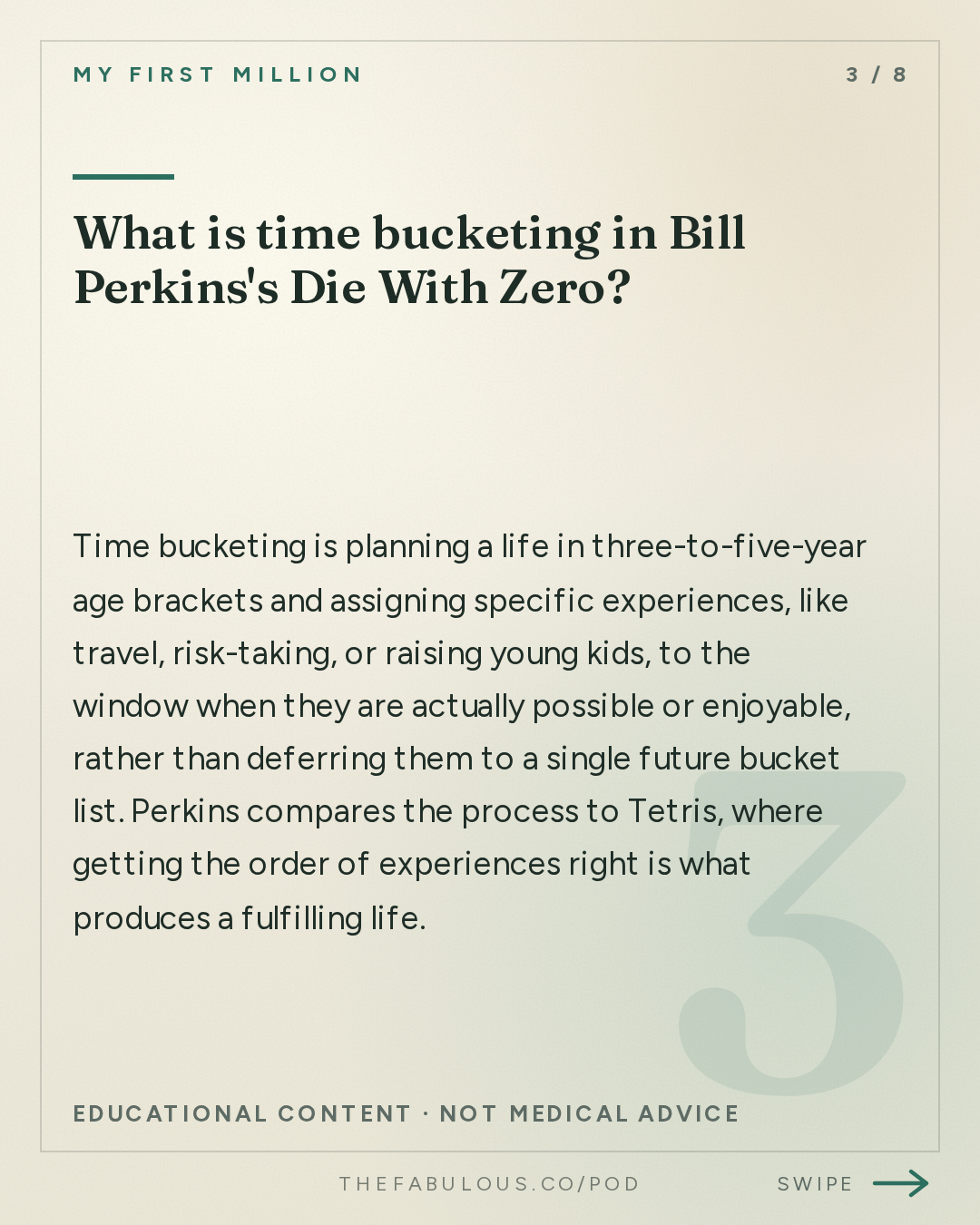
What is time bucketing in Bill Perkins's Die With Zero?
Time bucketing is planning a life in three-to-five-year age brackets and assigning specific experiences, like travel, risk-taking, or raising young kids, to the window when they are actually possible or enjoyable, rather than deferring them to a single future bucket list (36:53). Perkins compares the process to Tetris, where getting the order of experiences right is what produces a fulfilling life (36:29).
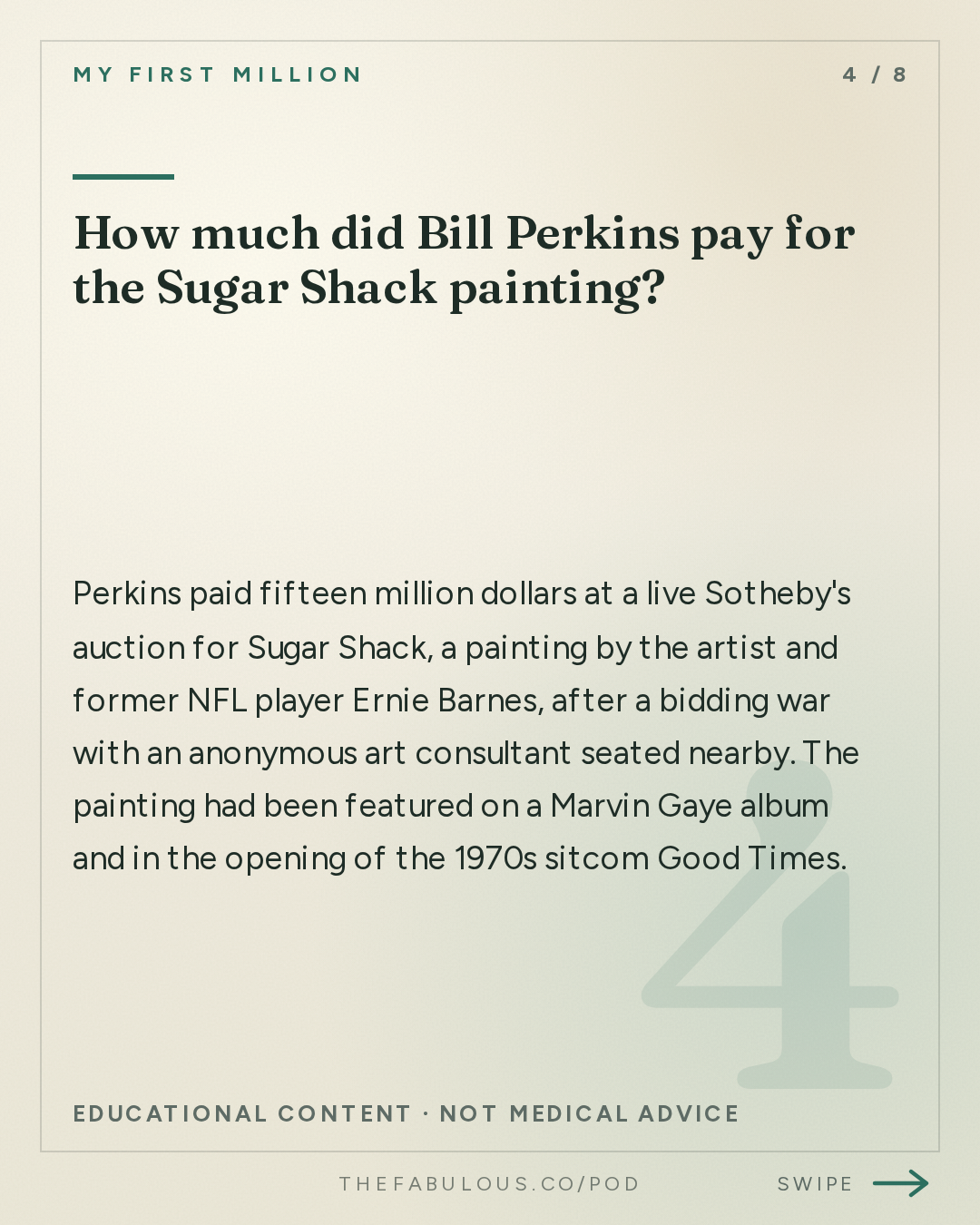
How much did Bill Perkins pay for the Sugar Shack painting?
Perkins paid fifteen million dollars at a live Sotheby's auction for Sugar Shack, a painting by the artist and former NFL player Ernie Barnes, after a bidding war with an anonymous art consultant seated nearby (66:00). The painting had been featured on a Marvin Gaye album and in the opening of the 1970s sitcom Good Times.
When does Bill Perkins say parents should give their kids an inheritance?
Perkins recommends giving inheritances to heirs while they are still young enough to use the money effectively, often in their fifties or sixties, instead of waiting until a parent's death to distribute it through a will (47:26). He says many readers find this obvious in hindsight once it is pointed out, since waiting until death wastes years the money could have been useful.
Why does Bill Perkins think fame is bad?
Perkins calls fame a tax that shrinks a person's world, describing how famous friends like swimmer Michael Phelps could not walk through public places without being mobbed (77:23). He also argues fame forces a person into performing a fixed persona, limiting how they can act even when the situation calls for something different.
The full read, in cards


Go deeper
- Die With Zero — Perkins's book arguing net worth peaks on a date rather than a dollar amount and that unspent wealth at death represents wasted life hours
- Your Money or Your Life — the book that introduced Perkins to the idea that money is something traded for the finite hours of a person's life
Mentioned
Bill Perkins · Die With Zero · Your Money or Your Life · Sugar Shack · Ernie Barnes · Marvin Gaye · John Arnold · Sotheby's · Daniel Negreanu · Tim Urban · Michael Phelps · Sylvester Stallone
More from this show and category
What It Was Really Like Working for Jeff Bezos
Ethan Evans, a former Amazon VP who spent 15 years inside the company, describes Jeff Bezos as brilliant but allergic to praise, a leader who ran on pattern recognition, anecdote over data, and a 24-hour 'question mark email' system that forced accountability. Evans also explains why he is happier now, working fewer hours for less title but more freedom.
Nick Kokonas's Theory of Business Arbitrage
Nick Kokonas built three careers by finding the same arbitrage: a gap between how fast information moves and how slowly an industry reacts to it. The Chicago trader turned restaurateur and software founder used a 20-second phone-line edge to build a $100 million trading year (31:53), then applied the same logic to Alinea and Tock (00:16).
Peter Levels: Why SaaS Lost Its Moat
Peter Levels says plain software has no moat left in the AI era, and what remains is data, network effects, distribution, or regulation. The episode also follows Bryan Johnson's attempt to dunk at 49, Elon Musk's SpaceX share giveaway to 72 million kids, and a pest control brand's $1,000 first week built on direct-to-consumer branding.
Low-Frequency Investing: The 2.9-Decision Portfolio
A retail investor who made only 2.9 decisions a year beat the S&P 500 in 11 of 11 years, averaging 21.8% annual returns versus 13.5%. The hosts run his brokerage history through the AI assistant Claude, then widen out to Jack Dorsey's 140-reason pre-mortem, Mark Zuckerberg's talent-density bet, Elon Musk's 24-hour rebuilding rule, and a four-step method called DARE for panic and fear.
