
AI in the World of Things: Where to Build Next
What I’d build if I wanted to get rich with AI
The brief
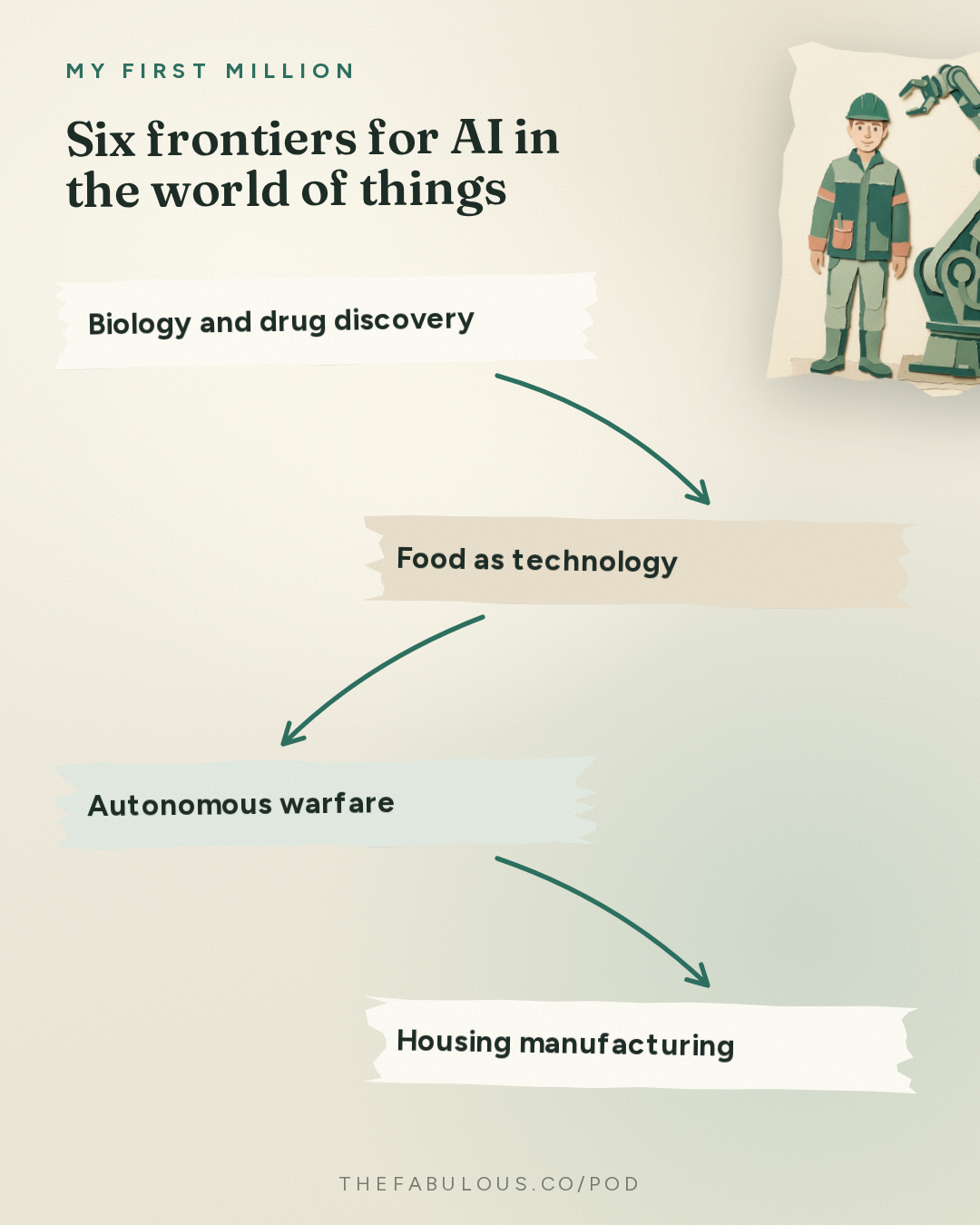
Shaan Puri says the next AI wave moves from digital content to the physical world. He points to drug discovery, modified crops, drone warfare, 3D-printed housing, and full self-driving machines as the real opportunities, and urges builders to think like investors who chase the best market instead of perfecting one narrow skill.
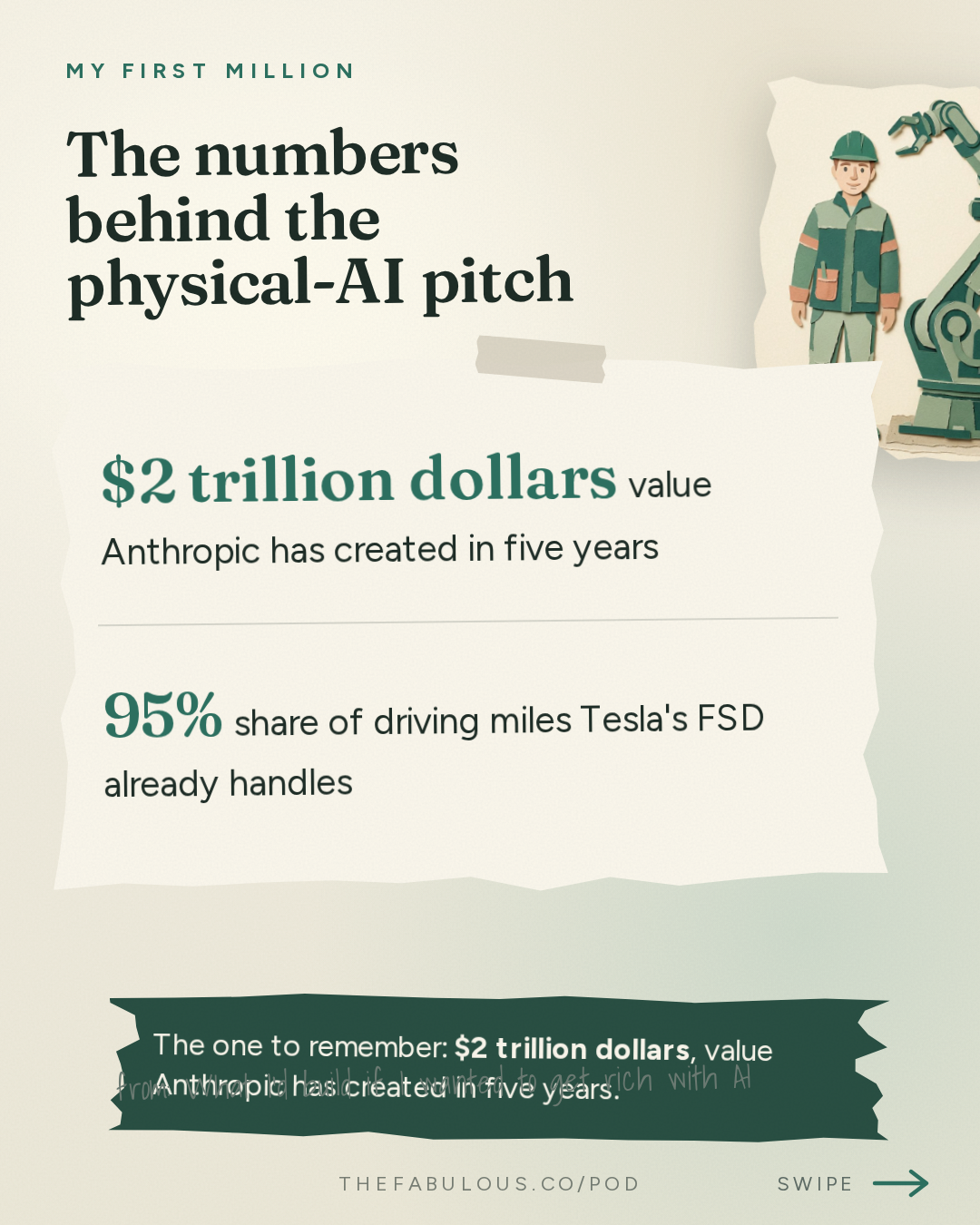
Here is a number that puts founder anxiety in perspective. Anthropic, the AI lab behind the chatbot Claude, has existed for roughly 2,500 days. In that stretch, its seven co-founders have collectively created ninety six million dollars of net worth every single day since the company started (01:22). The company itself has generated something like two trillion dollars in value in five years (00:58). Numbers like that can make a person feel either very late to the party or very foolish for not having gone to one already.
That tension is where this conversation between My First Million co-hosts Shaan Puri and Sam Parr begins. Puri admits that watching AI succeed this fast has left him asking a blunt question: if a machine can now do almost anything, what is actually worth building. His answer arrives as a kind of mental map, and the organizing idea is a line borrowed, half-jokingly, from the television character Michael Scott.
Skate to where the puck is going, not where it has been. [02:02]
Five years ago, Puri argues, the smart move was joining an AI model company or building on top of one, making tools like the image generator Midjourney or the chatbot ChatGPT. That window is closing. Everyone can see it now, which is exactly the problem. Puri's claim is that the obvious AI plays, writing content, building software, wrapping a chatbot in a new interface, have turned into a crowded, low-margin scramble.
I think using AI in the world of, um, you know, bits, which is basically, like, digital stuff, I think has very low returns. [03:11]
Bits, in his shorthand, means anything that lives purely as digital information: text, images, software. Things means the physical world: bodies, crops, houses, machines. His bet is that the next five years of AI opportunity sit mostly in things, not bits.
From Bits to Things
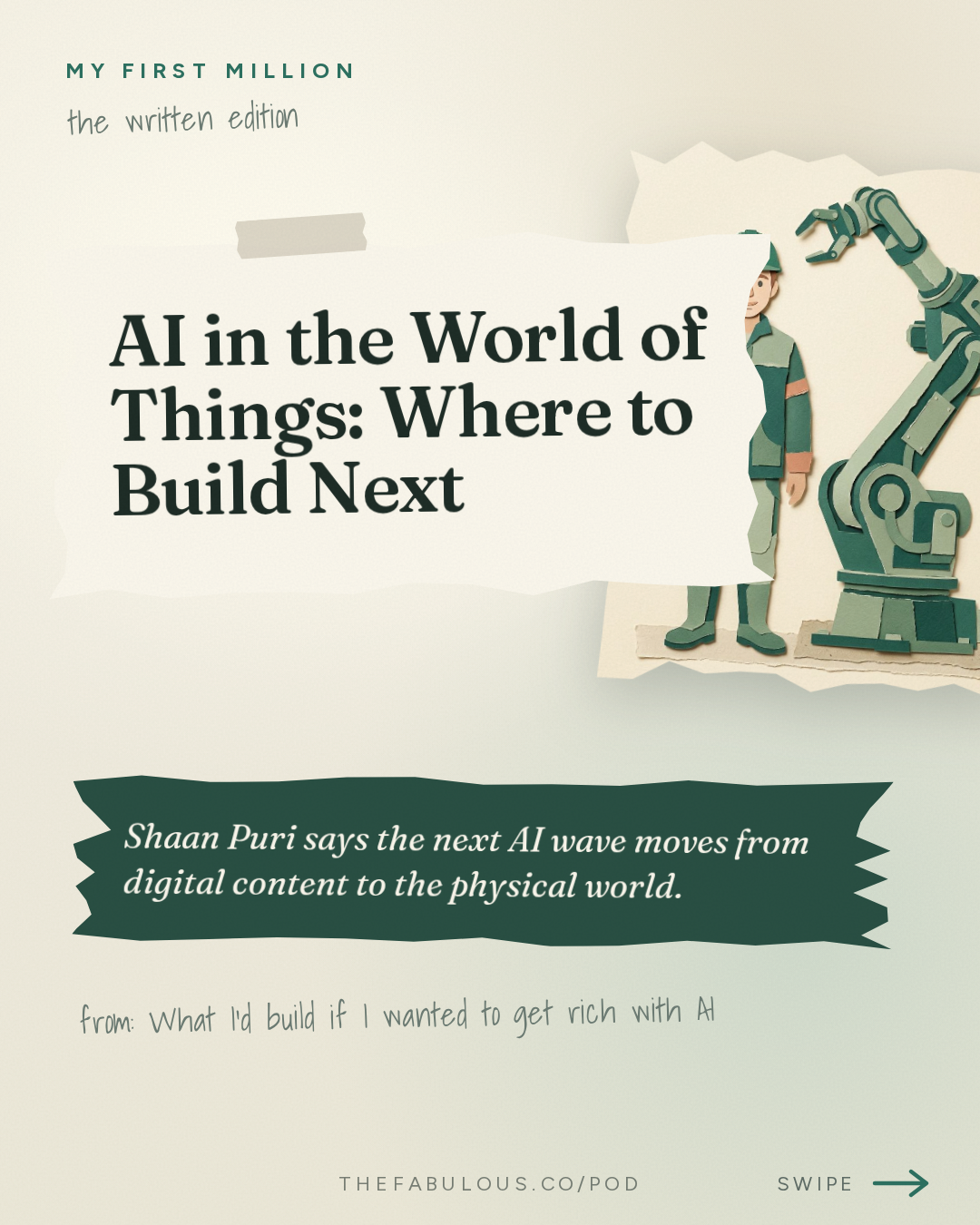
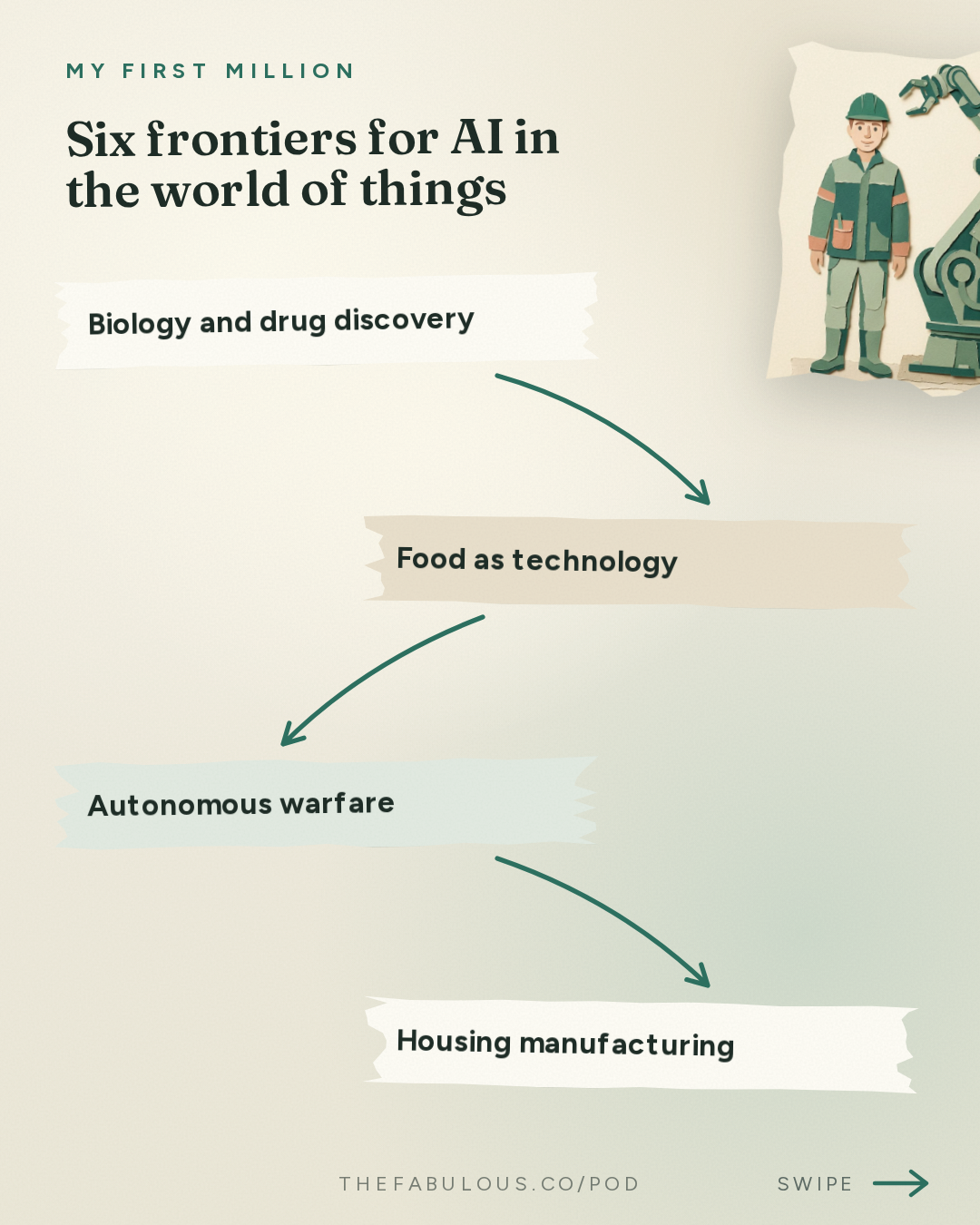
The clearest example is medicine. A new drug typically takes ten years and two billion dollars to develop, and fails eighty to ninety percent of the time (04:21). That math has always limited drug development to a handful of giant companies. Puri points to Eli Lilly, which he says is now buying computing power and building data centers the way a tech company would, in order to apply AI across its drug pipeline (04:42). Google has gone further with a dedicated company called Isomorphic, led by DeepMind co-founder Demis Hassabis, built around the single goal of curing disease with AI-driven biology (05:07). Puri also references an online account of a cancer patient who used AI tools to sequence his own tumor and identify a working treatment, part of a small but growing group of people effectively directing their own care.
Food gets the same treatment. A Y Combinator-backed startup called Nitro Duck is using the gene-editing tool CRISPR to engineer fruit for higher yield and better taste (07:07), continuing a process that once took twenty years of selective breeding to produce something like the Honeycrisp apple. Entrepreneur David Friedberg is doing similar work on seeds for potatoes and corn, aiming for better flavor and better yield for farmers (08:25). Puri's broader claim is that food itself is a technology platform, from the tractors that work the fields to the genetic code of the plant.
Warfare is shifting too, in his telling, away from expensive manned equipment and toward cheap, disposable drones fighting other drones (09:38), the model he associates with companies like Anduril and with reports from current conflict zones. He also describes a strange new detail from a 2016 raid on a foreign leader, where reports suggest American forces used a directed-energy weapon that left guards unable to move, something he says sounds like science fiction but appears to be real.
Housing is where the numbers get the most concrete. Puri says current mortgage rates sit around seven and a quarter percent, and that building a home in his area costs roughly six hundred to eight hundred dollars per square foot (13:39). He points to Zuru Tech, run by entrepreneur Nick Bobrae and his brother, which operates a factory in China that effectively prints modular luxury homes, assembled like large Lego blocks, at a cost Puri estimates at twenty times cheaper than conventional building (14:01). The company bought sixty to eighty million dollars worth of fire-damaged lots in Los Angeles to build on (15:17), funded entirely by about a billion dollars of the founders' own money, with no outside investors (16:58). Puri connects this back to an old idea: the same manufacturing precision that makes a Lego brick fit perfectly, every time, at massive scale, is the same discipline Elon Musk has applied to car assembly, reportedly simplifying Tesla's production by molding entire car sections as single pieces instead of hundreds of parts (17:14).
The list keeps going, more briefly: new materials science, full self-driving extended beyond cars into forklifts and window-washing robots, with Puri noting that Tesla's current self-driving system already handles about ninety five percent of his own driving miles (19:02); ocean technology, which he compares to the current boom in space technology; and what he calls human body hardware, meaning brain-computer interfaces like Neuralink and advanced prosthetic limbs, including a robotic arm project called Adam Limbs built by a friend, which Puri argues could replace the outdated plastic prosthetics given to veterans (20:00).
Finding the Right Body of Water
Midway through, the conversation turns from a list of sectors to a theory of how outlier success actually happens. Sam Parr brings up Charlie Munger's idea of the Lollapalooza effect, the notion that any extreme outcome, like America's industrial rise between 1880 and 1970, usually comes from seven or eight tailwinds arriving at once rather than one single cause (32:07). Puri had already laid out his own version of this for America specifically: cheap iron ore shipped out of Duluth, Minnesota, so much of it that by the 1950s the Great Lakes trade carried enough material to build fifty million cars a year (22:23), combined with tariff-free trade across fifty states and a country left physically untouched by World War II.
From there the conversation moves briefly into politics, with both hosts agreeing that the loudest voices on each side get rewarded by media incentives for being extreme, and that a plainspoken, common-sense political position is oddly absent from the current landscape of options (27:23). It's a tangent, but it connects to Puri's larger argument: big outcomes need big, boring structural advantages, not just good intentions.
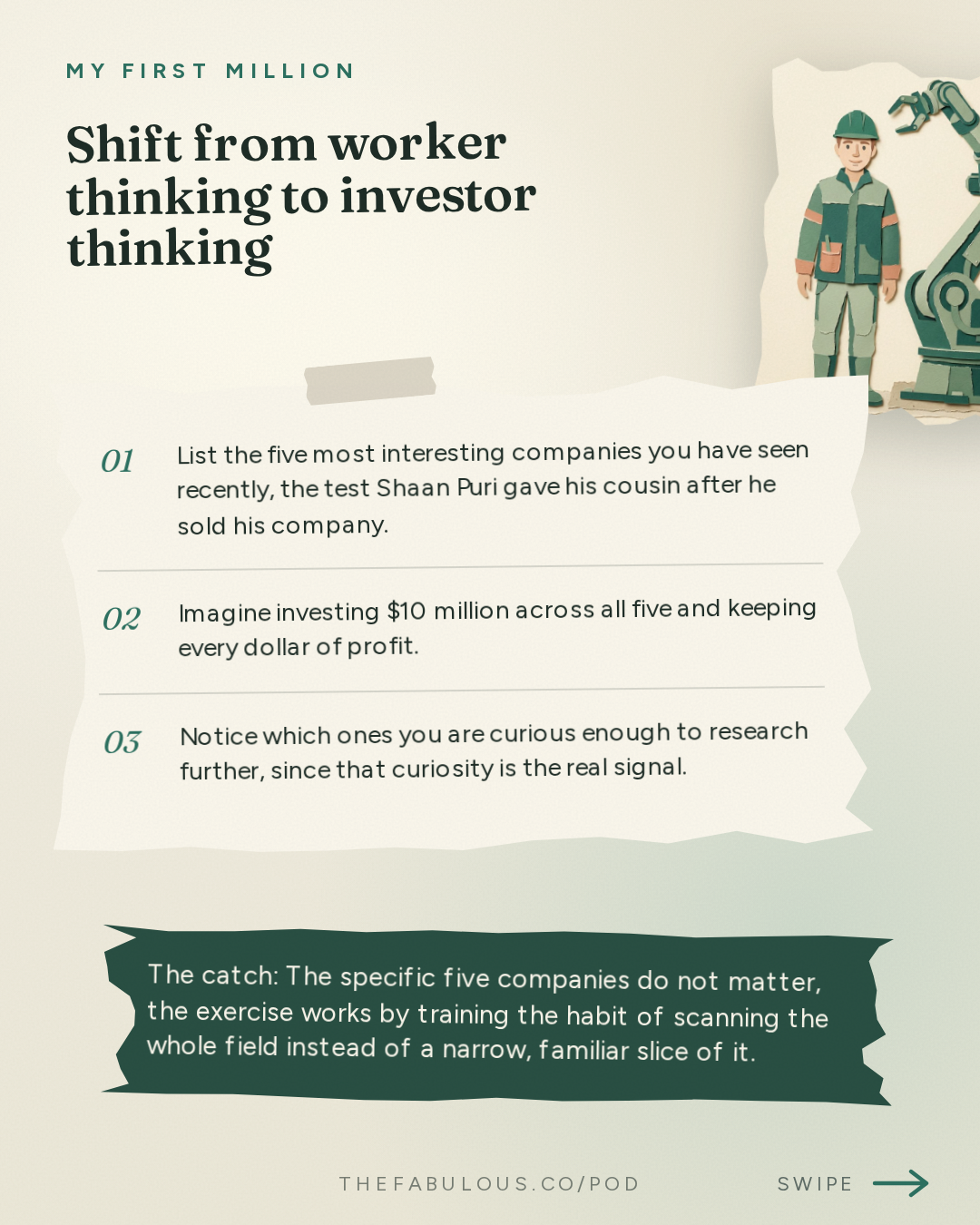
The practical takeaway comes near the end, aimed at Puri's cousin, who recently sold a company and was trying to decide what to do next. Puri's advice was to stop thinking like a worker, someone who asks what they're already good at and stays in their lane, and start thinking like an investor, someone who goes where the opportunity is regardless of personal history. He gave his cousin an exercise: write down the five most interesting companies you've seen, then imagine investing ten million dollars across them and keeping all the profit (36:16). The exercise is less about picking winners and more about breaking the habit of looking through a narrow peephole.
Go find the right body of water. That's far more important than trying to be the best sailor in a shitty body of water. [35:47]
The line is borrowed from entrepreneur Mark Pincus, who used it to describe choosing social media as his field in the early 2000s, before building Zynga and investing early in Facebook. Puri's closing bet is that the right body of water for the next decade is the physical world, not the digital one, and that whoever moves there early will look, in five years, like the people who joined Anthropic or OpenAI five years ago.
Ask this episode anything
Pod's AI answers from the episode itself, with the minute mark so you can hear it yourself.
Or start with one of these
Ask this episode
Pod's AI listens to the whole episode to answer, and points you to the minute it comes from.
The rest of this answer, and any question after it
Answers come from the episode itself, never from a summary of it.
ContinueKey takeaways
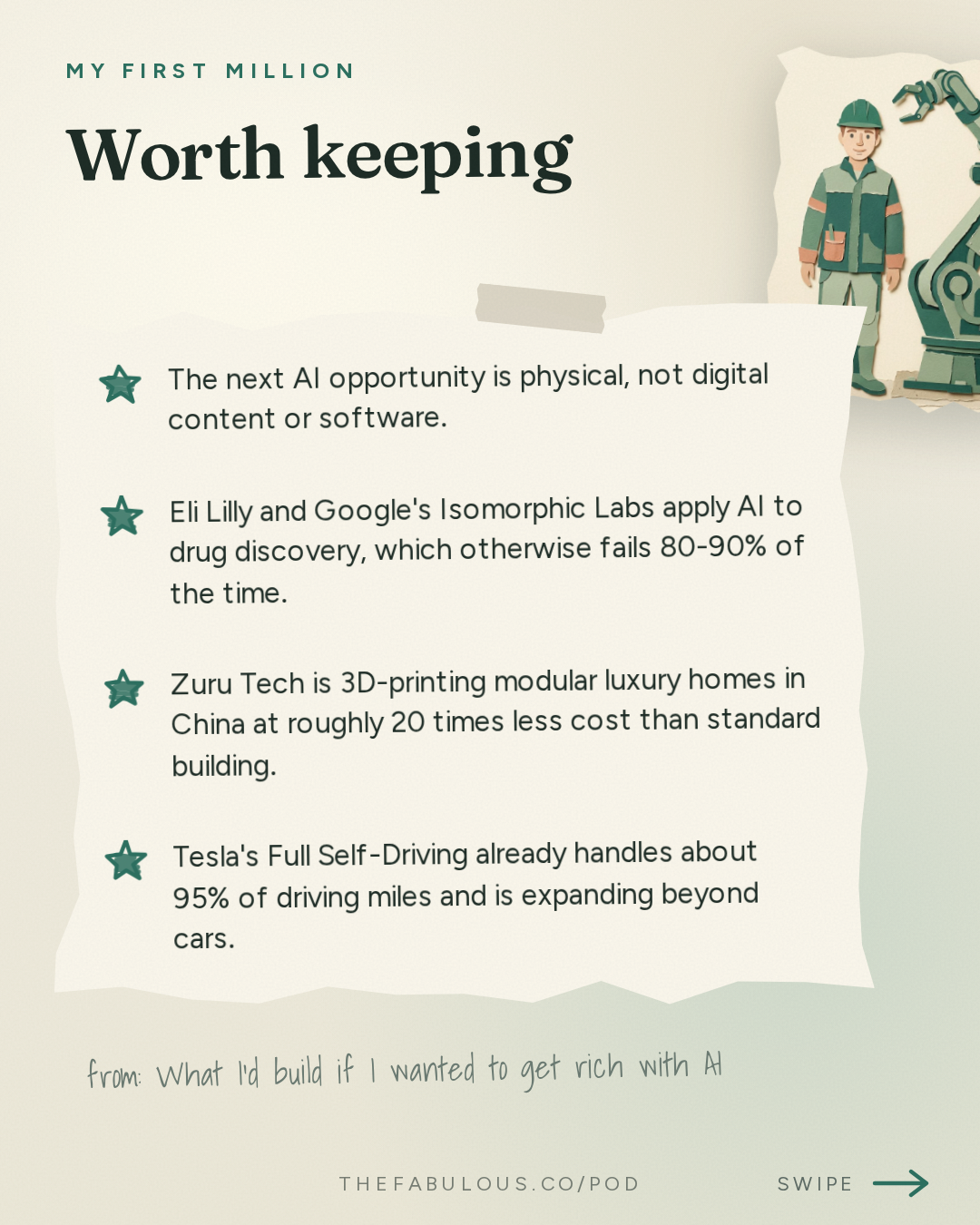
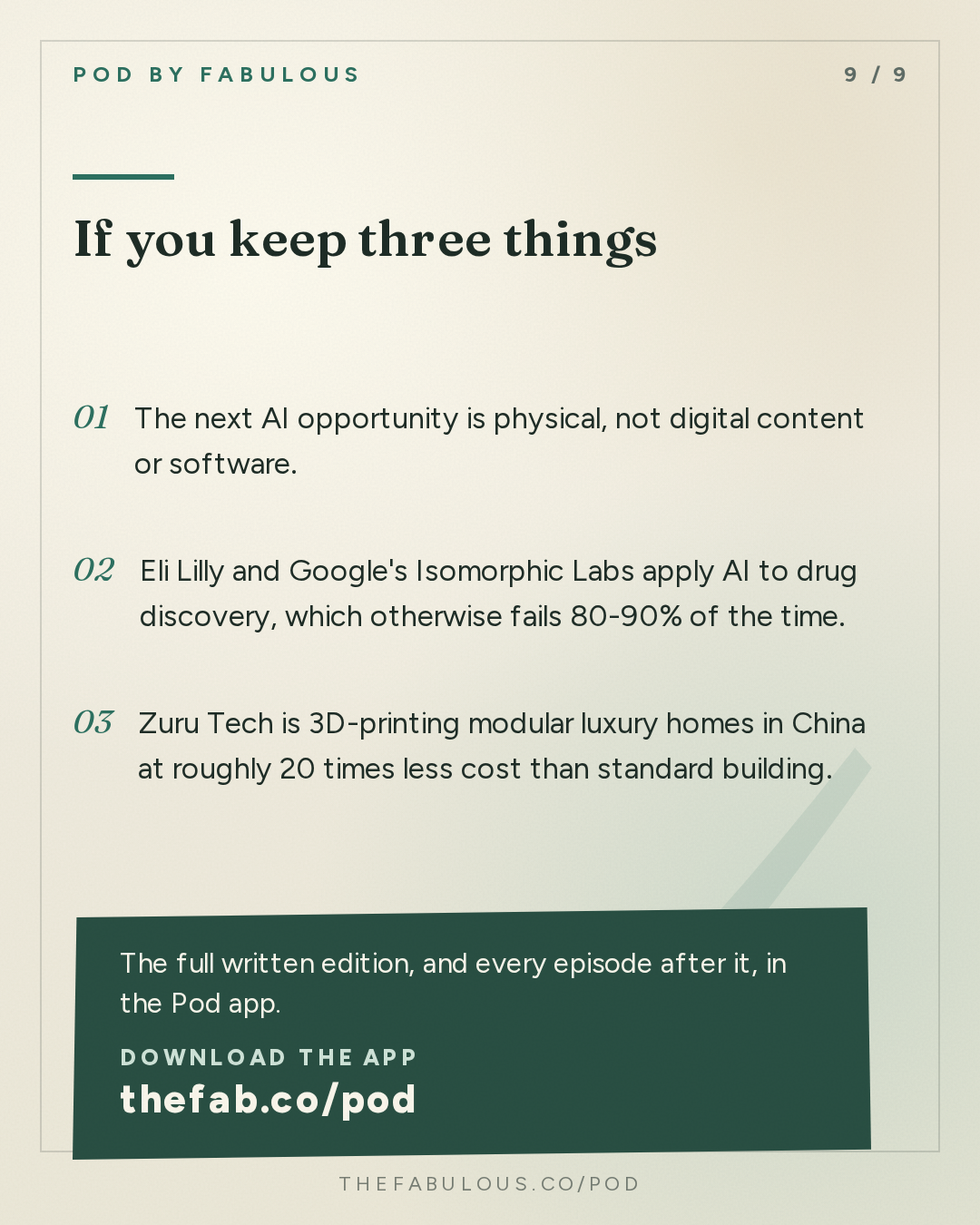
- The next AI opportunity is physical, not digital content or software.
- Eli Lilly and Google's Isomorphic Labs apply AI to drug discovery, which otherwise fails 80-90% of the time.
- Zuru Tech is 3D-printing modular luxury homes in China at roughly 20 times less cost than standard building.
- Tesla's Full Self-Driving already handles about 95% of driving miles and is expanding beyond cars.
- Shaan Puri says choosing the right market matters more than being the best operator in a bad one.
The episode in cards
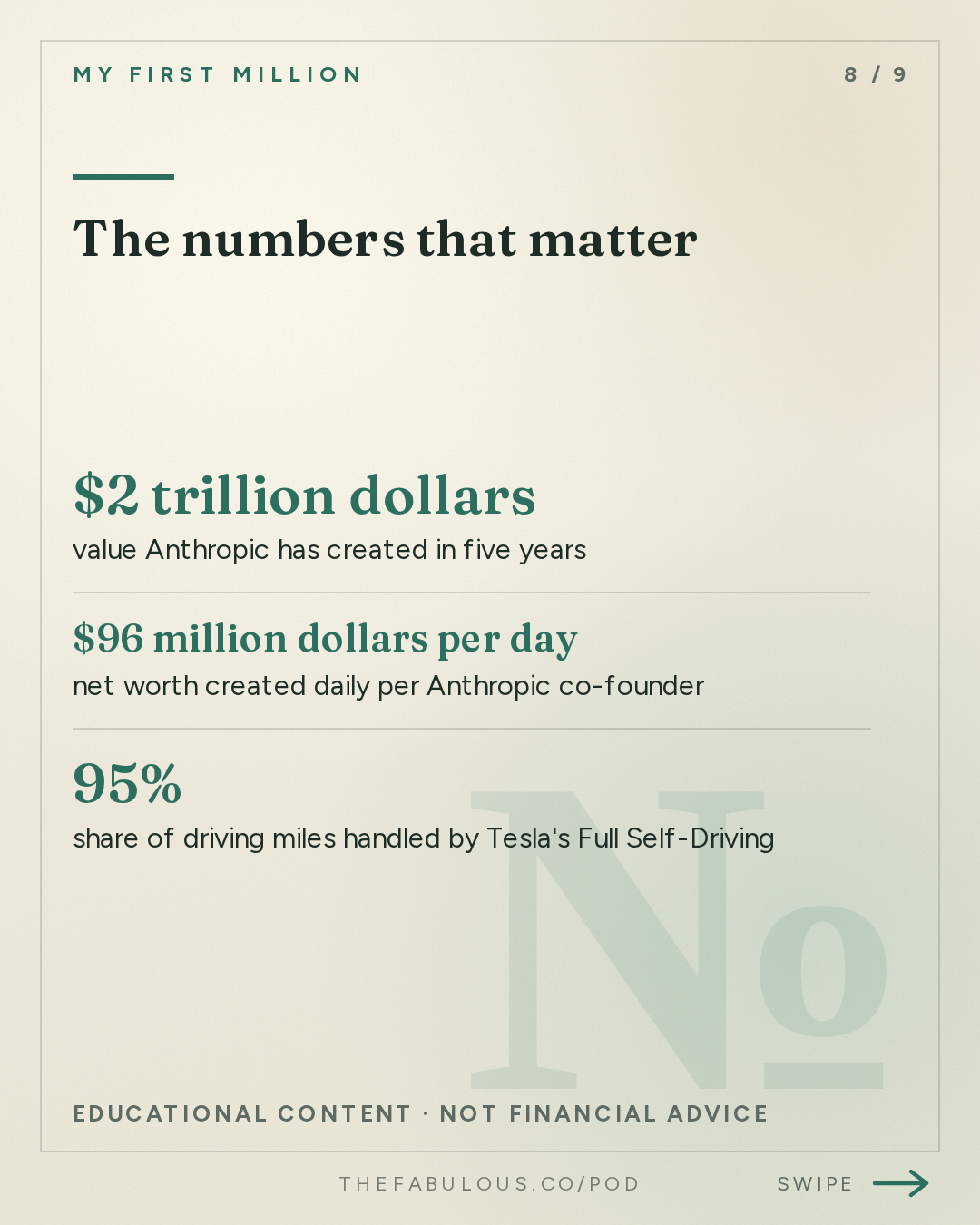
By the numbers
- $2 trillion dollars value Anthropic has created in five years
- $96 million dollars per day net worth created daily per Anthropic co-founder
- 95% percent share of driving miles handled by Tesla's Full Self-Driving
In their words
“Skate to where the puck is going, not where it has been.”
“I think that using AI in the world of, um, you know, bits, which is basically, like, digital stuff, I think has very low returns”
“If you, like, if you ask Elon who he admires in terms of manufacturing, he'll say Lego.”
“Go find the right body of water. That's far more important than trying to be the best sailor in a shitty body of water.”
Protocols
-
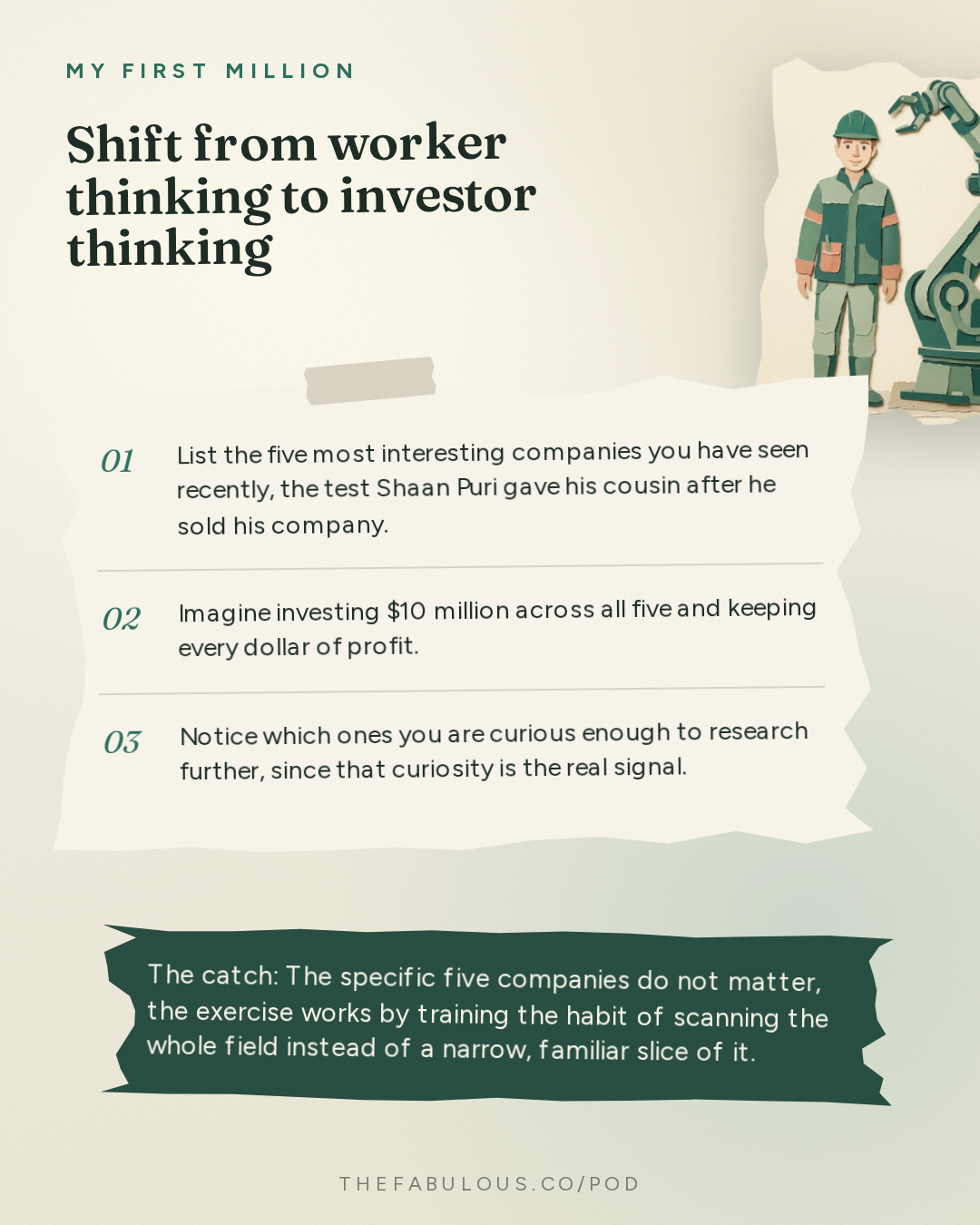
Think like an investor, not a worker
Shaan Puri tells his cousin, a founder who had just sold his company, to write down the five most interesting companies he has seen and imagine investing $10 million across all five while keeping every dollar of profit. The point of the exercise is to notice which ones he is curious enough to dig into further, since that curiosity signals where real opportunity may be hiding beyond his existing industry or job history.
One-time exercise when evaluating a career or industry change
-
Pick the right market before trying to master it
Shaan Puri, citing entrepreneur Mark Pincus, argues that choosing the right market or industry matters more than being the most skilled person inside a weak one, since the market itself drives most of the outcome regardless of individual skill.
Apply before committing to an industry or company, not after
Questions this episode answers
What does 'AI in the world of things' mean?
Shaan Puri uses it to describe applying AI to physical problems, like drug development, farming, housing, and robotics, instead of digital content or software, which he says has become a low-return, crowded space (02:50).
How is AI being used in drug discovery?
Companies like Eli Lilly and Google's Isomorphic Labs, led by Demis Hassabis, are applying heavy AI compute to a process that normally takes 10 years, costs $2 billion, and fails 80-90% of the time, aiming to speed up and de-risk finding new treatments (04:21).
What is Zuru Tech doing with AI and homebuilding?
Zuru Tech, run by entrepreneur Nick Bobrae, operates a Chinese factory that manufactures modular luxury homes assembled like large building blocks, at an estimated 20 times lower cost than conventional construction, funded by about $1 billion of the founders' own money (14:01).
How far along is Tesla's self-driving technology?
According to Shaan Puri's own daily use, Tesla's Full Self-Driving currently handles about 95% of his driving miles, with manual takeover mainly limited to parking lot spot selection (19:02).
Why does the episode say digital AI content has low returns?
Shaan Puri argues that using AI to generate content, images, or SaaS tools has become a race to the bottom because the barrier to entry is now low and competition is intense, pushing the real opportunity toward physical-world applications instead (03:11).
The full read, in cards
Mentioned
Anthropic · Eli Lilly · Isomorphic · Demis Hassabis · Zuru Tech · Nick Bobrae · David Friedberg · Elon Musk · Neuralink · Mark Pincus · Anduril · Adam Limbs · Charlie Munger · Joe Lonsdale
More from this show and category
AI-Proof Businesses: Community Moats Explained
Technology moats are dissolving as AI makes software easy to copy, but human trust networks still hold. The episode profiles NADA 20 Group, BNI, and Moda Communities, then breaks down the whale economy and the mystery box psychology that keeps mobile games, collectible apps, and even crypto hacks spinning (00:00, 10:47, 21:27).
Bill Perkins: Die With Zero Explained
Hedge fund manager Bill Perkins says net worth has a peak date, not a peak dollar amount, because the body's ability to enjoy money fades with age. The Die With Zero author urges maximizing risk while young, giving inheritances early, and treating fame as a tax that shrinks a life rather than a reward for building one (14:26, 20:51, 47:26).
What It Was Really Like Working for Jeff Bezos
Ethan Evans, a former Amazon VP who spent 15 years inside the company, describes Jeff Bezos as brilliant but allergic to praise, a leader who ran on pattern recognition, anecdote over data, and a 24-hour 'question mark email' system that forced accountability. Evans also explains why he is happier now, working fewer hours for less title but more freedom.
Nick Kokonas's Theory of Business Arbitrage
Nick Kokonas built three careers by finding the same arbitrage: a gap between how fast information moves and how slowly an industry reacts to it. The Chicago trader turned restaurateur and software founder used a 20-second phone-line edge to build a $100 million trading year (31:53), then applied the same logic to Alinea and Tock (00:16).
