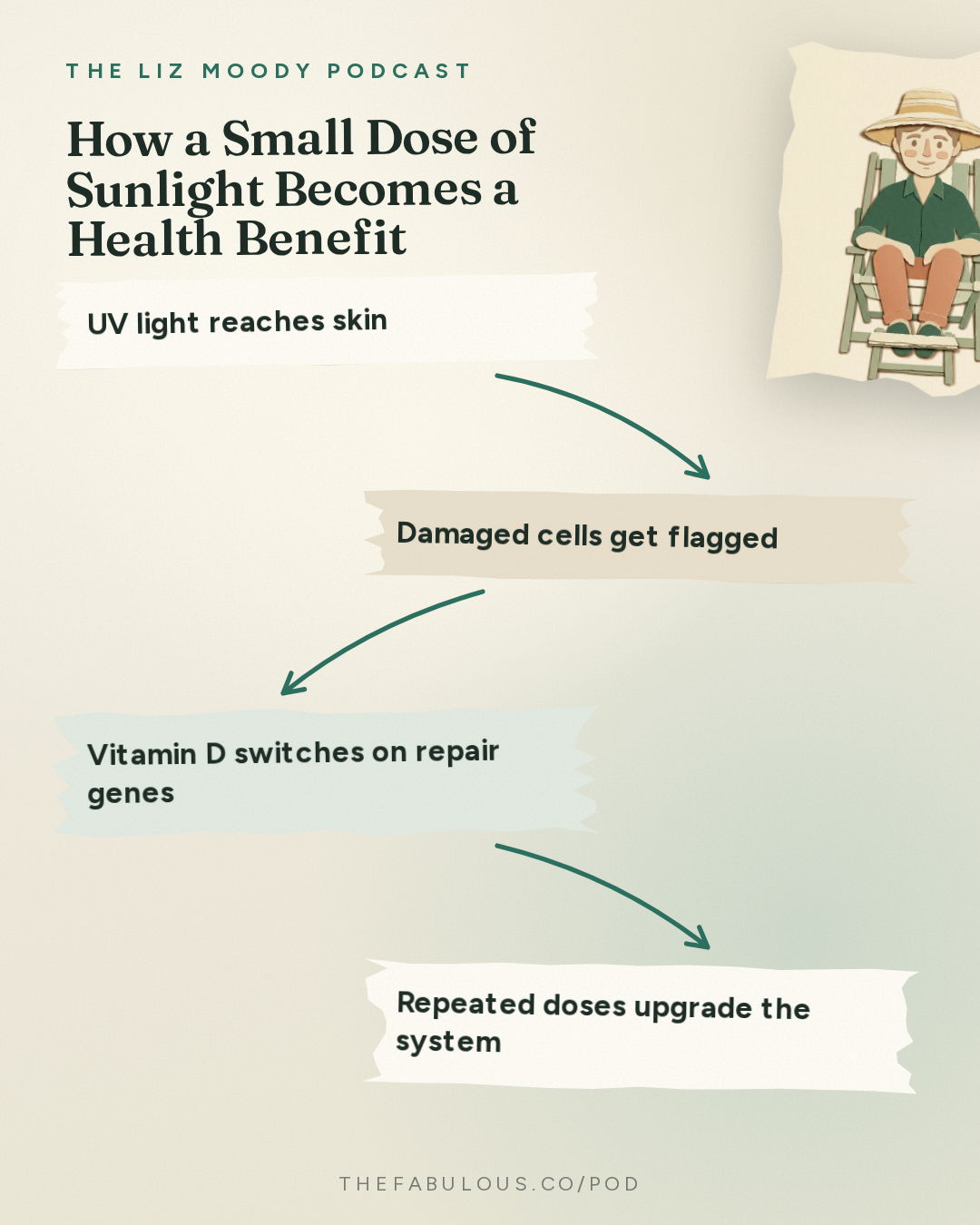
Sun Exposure Science: Rowan Jacobsen Interview
New Research: We Got Sun Exposure All Wrong (And It's Massively Hurting Our Health)
▶ Listen to the full episode More from The Liz Moody Podcast
The brief
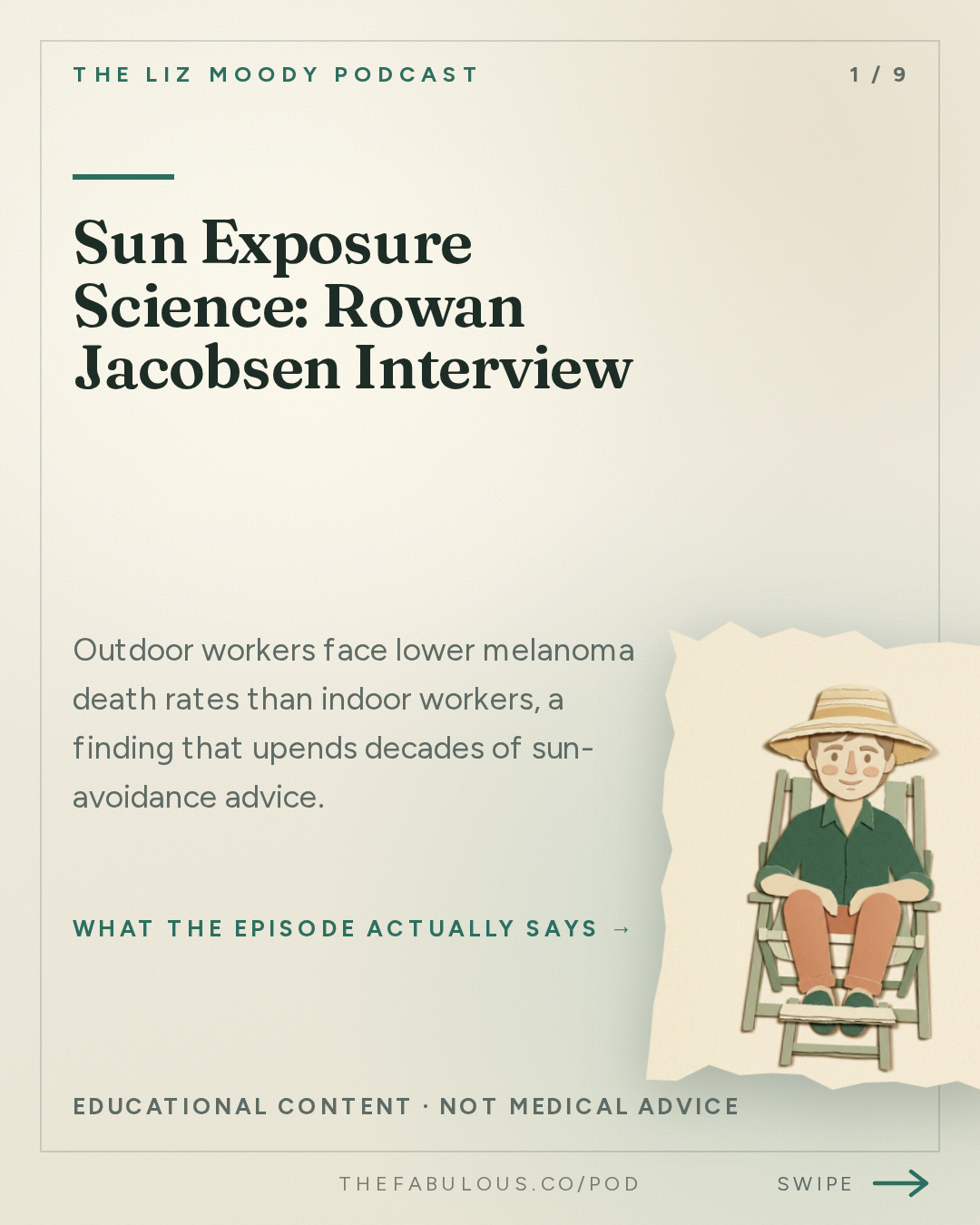
Outdoor workers face lower melanoma death rates than indoor workers, a finding that upends decades of sun-avoidance advice. Science journalist Rowan Jacobsen argues that sunlight lowers blood pressure, calms the immune system, and treats depression, while vitamin D pills fail to match those benefits, so moderate daily exposure may do more good than harm for most skin types.
Two weeks before this conversation, host Liz Moody got a phone call that scared her: a biopsy had come back as melanoma, the most dangerous form of skin cancer. It was caught at stage zero and removed cleanly from her chest (00:00). The diagnosis left her with a question most dermatology does not answer well: did a lifetime of sun exposure hurt her, or did the sun protect her in ways nobody talks about?
Science journalist Rowan Jacobsen spent years chasing that question for his new book, In Defense of Sun. He is not a dermatologist and does not sell sunscreen, skincare, or supplements, which he says freed him to follow the research across cardiology, immunology, and sleep science instead of staying inside the usual skin-only lane (00:58). What he found complicates much of what the public has been told since the sunscreen campaigns of the 1980s.
Start with the puzzle that opens the episode. Outdoor workers, people who spend their careers in direct sun, have lower melanoma mortality than people who work indoors (01:55). Women in a 20-year Swedish study called the Melanoma in Southern Sweden study who actively sought sun, through winter vacations or regular sunbathing, lived longer than women who avoided it, even though sun-seekers were not necessarily more careful about sunscreen (03:08). The lie in Jacobsen's opening game turned out to be the one that sounds safest: that people with dark skin need sunscreen every day. Melanin, the pigment that gives skin its color, does so much protective work on its own that for most daily activity it makes sunscreen unnecessary for people who have a lot of it (20:50).
"Melanin is the best sun protectant ever developed. We haven't created anything that can compete with melanin." - Rowan Jacobsen [21:00]
The real risk factor for melanoma, Jacobsen says, is not steady sun exposure but a history of blistering childhood sunburns combined with fair skin (08:19). Outdoor workers get regular, moderate doses that build protection gradually, while occasional beachgoers get hit with the sudden blast their skin is not ready for.
The Light Sunscreen Does Not Block
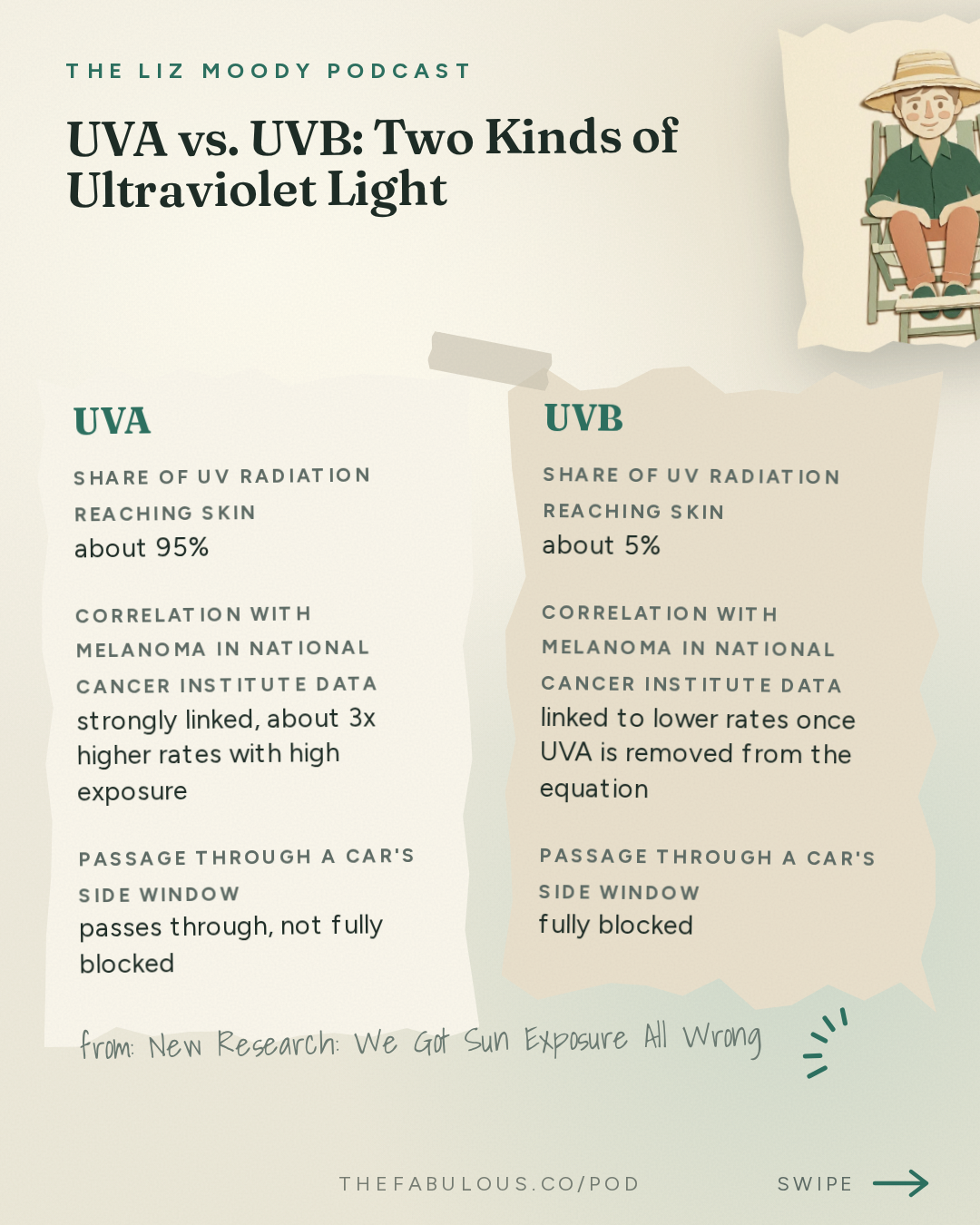
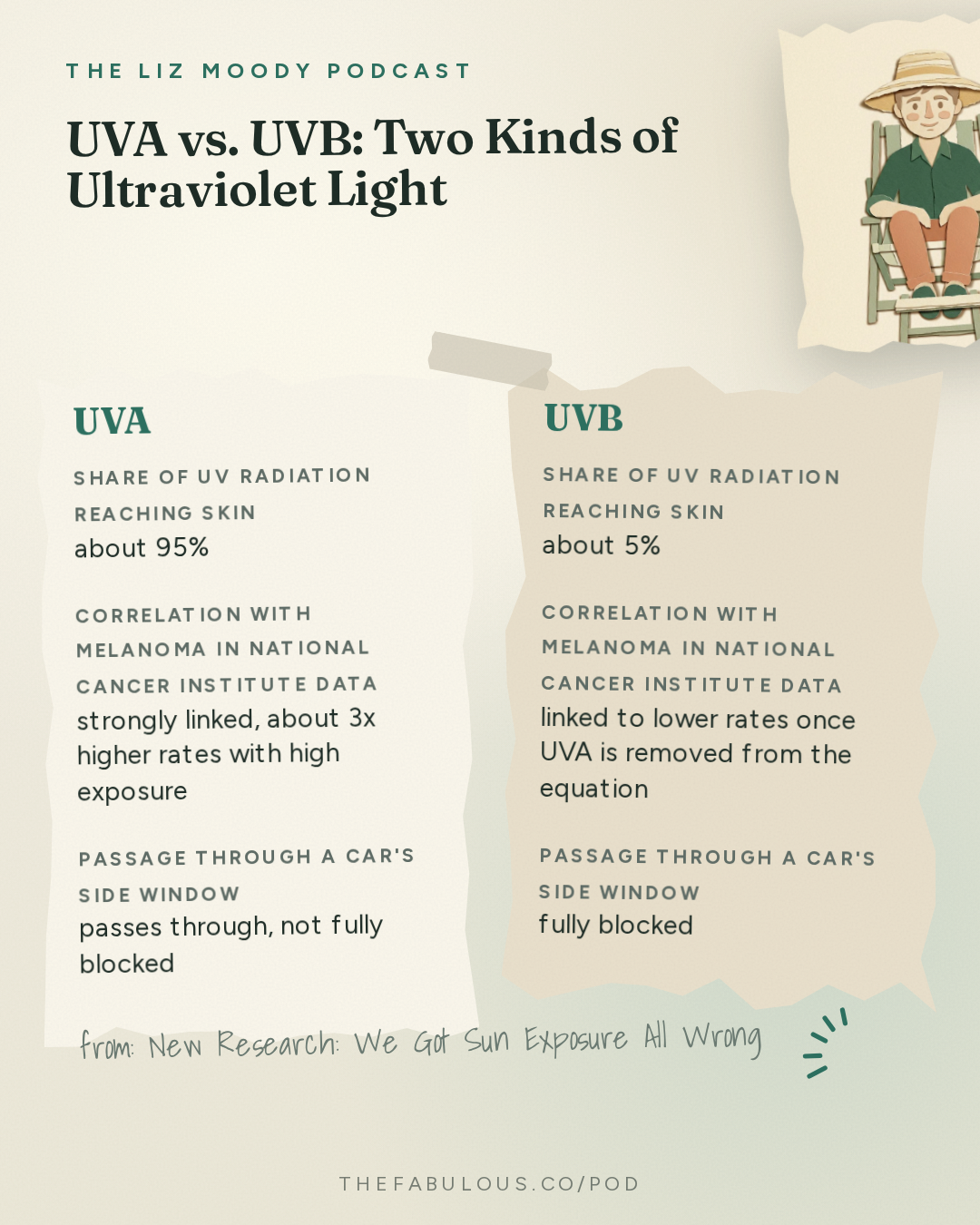
Part of the problem is how sunscreen was built. For most of the twentieth century, scientists assumed only ultraviolet light, the high-energy band invisible to the eye, could damage skin cells enough to cause cancer, so sunscreen was designed to block it. Newer research shows about half of the free radicals, unstable molecules that damage DNA and other cell structures, generated by sunlight come from visible light, which ordinary sunscreen lets straight through (12:45). Within ultraviolet light itself there was a second miscalculation: UVA makes up about 95 percent of the ultraviolet radiation that reaches skin, while UVB is only about 5 percent, yet sunscreens from the 1970s and 1980s blocked mainly UVB (13:49). That let people stay out far longer without burning, the body's usual warning sign, while absorbing UVA the whole time. A newly approved ingredient called bemotrizinol, already used for two decades in Asian and European sunscreens, blocks the full UVA spectrum and is starting to replace older US formulas (15:10).
That distinction matters because of a finding Jacobsen calls one of the strangest things he came across. A National Cancer Institute analysis separated UVA exposure from UVB exposure across the country and found that UVA tracked closely with melanoma, while UVB, once UVA was accounted for, was linked to lower melanoma rates (105:15). This does not mean sunburn is good. It suggests the band long treated as the dangerous one may be doing protective work, likely through the vitamin D and repair processes it triggers, while UVA causes damage more quietly.
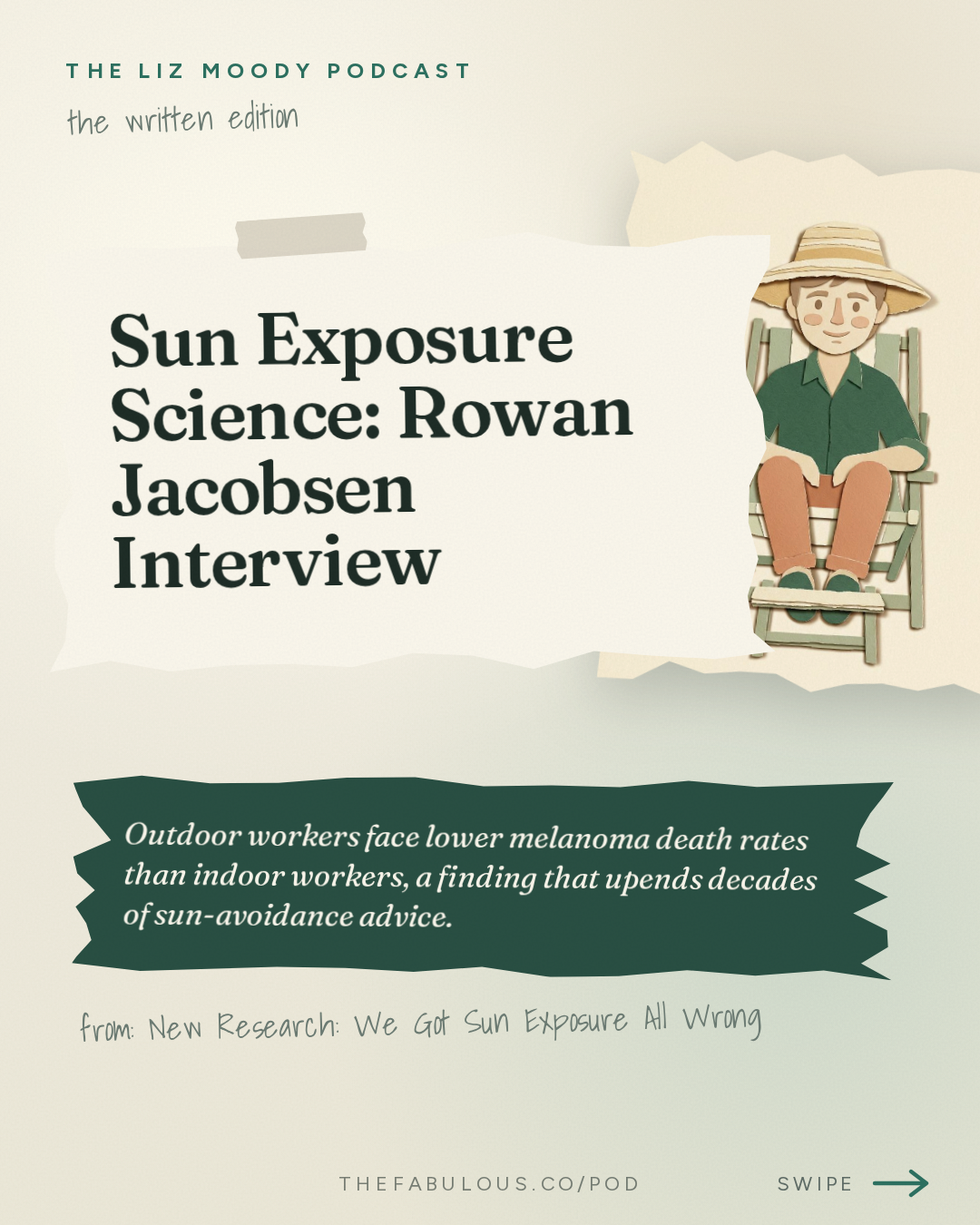
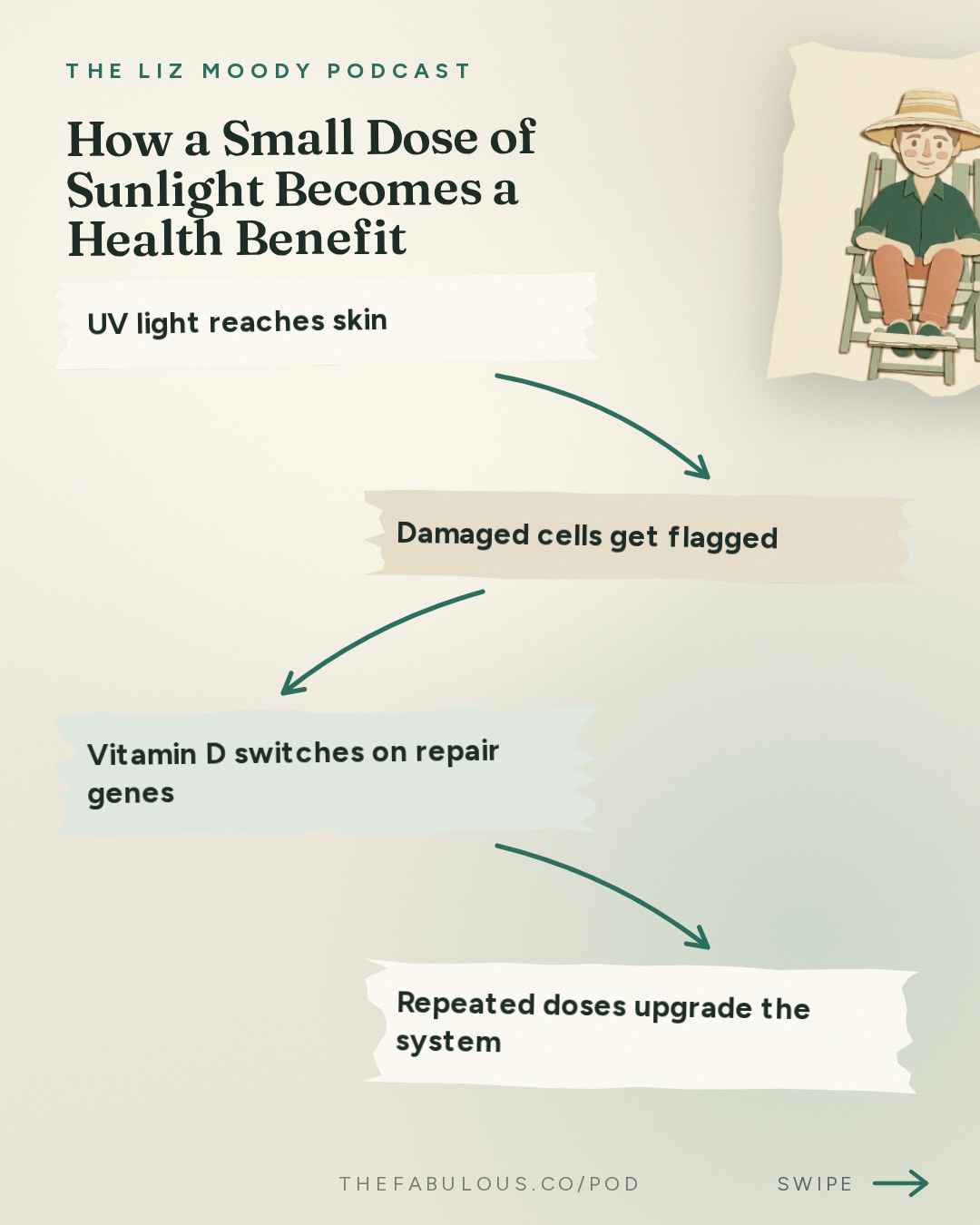
Underneath all of this sits a concept called hormesis: the idea that a small, repeated dose of stress trains the body to repair itself better. Exercise works this way, tearing muscle fibers so the body rebuilds them stronger. Jacobsen argues sunlight works the same way on skin. Ultraviolet light damages DNA in small amounts, which activates repair systems, including a gene called P53 that flags and eliminates badly damaged cells before they can turn cancerous (26:04).
"Your body gets good at fixing that damage by regularly causing the damage in small doses." - Rowan Jacobsen [25:00]
The same logic appears in cardiovascular health. Sunlight hitting skin releases nitric oxide from nitrate compounds stored there, mostly sourced from leafy greens, and nitric oxide relaxes blood vessels and lowers blood pressure (29:33). Heart disease kills far more people than melanoma does: melanoma makes up only 1 to 2 percent of all skin cancers and does not rank among the top 40 causes of death from disease (44:08). Jacobsen argues the trade-off is lopsided, a modest rise in skin cancer risk set against a documented drop in the nation's leading killer (31:05).
Sun exposure also appears to calm an overactive immune system. Children who play outside three hours a day have about one-fifth the rate of multiple sclerosis compared with children who do not, a pattern researchers have tracked since the 1970s (33:37). Jacobsen compares it to the reversal in peanut allergy advice, where exposing children to a trigger early turned out to prevent problems later rather than cause them (34:18).
The Hidden Light Gap Indoors
Much of the conversation turns out to be less about skin than about eyes and circadian rhythm, the body's internal 24-hour clock that governs sleep, hormones, and metabolism in nearly every cell (63:08). Light is measured in lux, a unit of brightness. A typical indoor room lit by artificial light sits around 100 to 200 lux. A sunny day outdoors runs 50,000 to 100,000 lux, and even an overcast or rainy day still delivers 10,000 to 20,000 lux, far brighter than almost any room people spend time in (60:57, 61:20). A UK study that tracked people's light exposure with wearable sensors found that people with the brightest days were 34 percent less likely to die of any cause, while people with the darkest nights were 20 percent less likely to die of any cause (68:25).
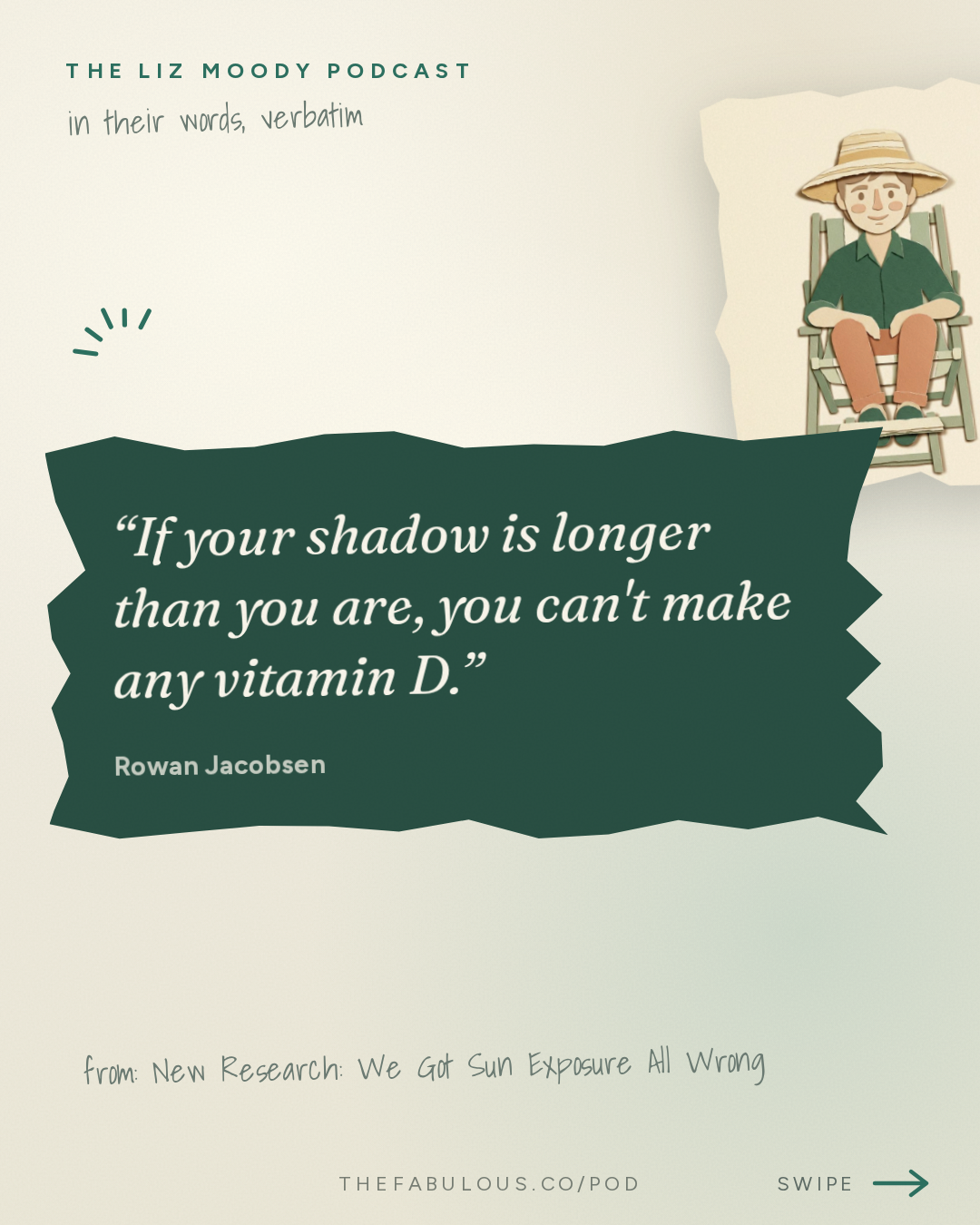
"If your shadow is longer than you are, you can't make any vitamin D." - Rowan Jacobsen [88:01]
That gap shows up in mental health too. Researchers gave people with severe depression smart light bulbs that automatically shifted from blue to red-orange light in the evening and simply told them to try to get outside more, without tracking whether they did. Eighty-two percent moved from severe to mild depression within four weeks, a result that held when the control group later got the same bulbs (78:06).
The vitamin D story is where Jacobsen is bluntest. Decades of observational data showed people with higher vitamin D in their blood had lower rates of nearly every disease, which led to mass supplementation. But long, large clinical trials that actually tested vitamin D pills against placebo found no significant benefits for people who were not already deficient (83:40). Jacobsen's explanation is that vitamin D levels were always a marker of sun exposure, and sun exposure brings a bundle of other benefits, nitric oxide, circadian signaling, immune regulation, that a pill cannot replicate. Below a blood level of about 16 nanograms per milliliter, disease risk climbs, and supplementing still makes sense there (87:16). Above it, he says, the pill is probably not doing much.
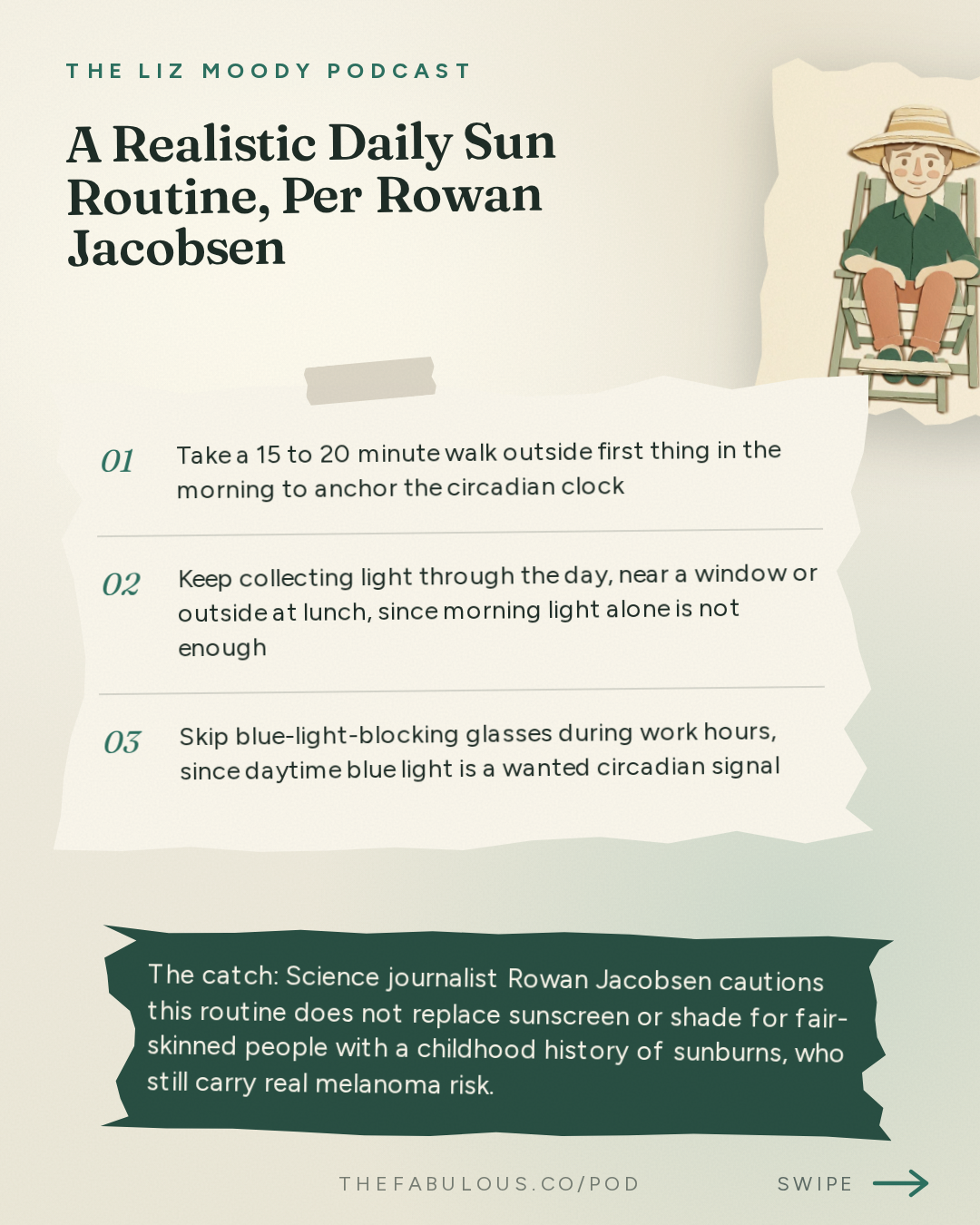
None of this argues for reckless sun exposure or says dermatologists are wrong to warn against sunburn. Jacobsen repeats that fair-skinned people with a childhood history of burns, people like Moody, still carry real risk and should cover up during peak hours. His argument is narrower: total sun avoidance, the message most people absorbed, trades a small reduction in skin cancer risk for measurable increases in heart disease, autoimmune disease, and depression. The sun does not have a lobby. Nobody profits from telling people to stand outside for twenty minutes. The evidence, now, is arguing for it anyway.
Ask this episode anything
Pod's AI answers from the episode itself, with the minute mark so you can hear it yourself.
Or start with one of these
Ask this episode
Pod's AI listens to the whole episode to answer, and points you to the minute it comes from.
The rest of this answer, and any question after it
Answers come from the episode itself, never from a summary of it.
ContinueKey takeaways
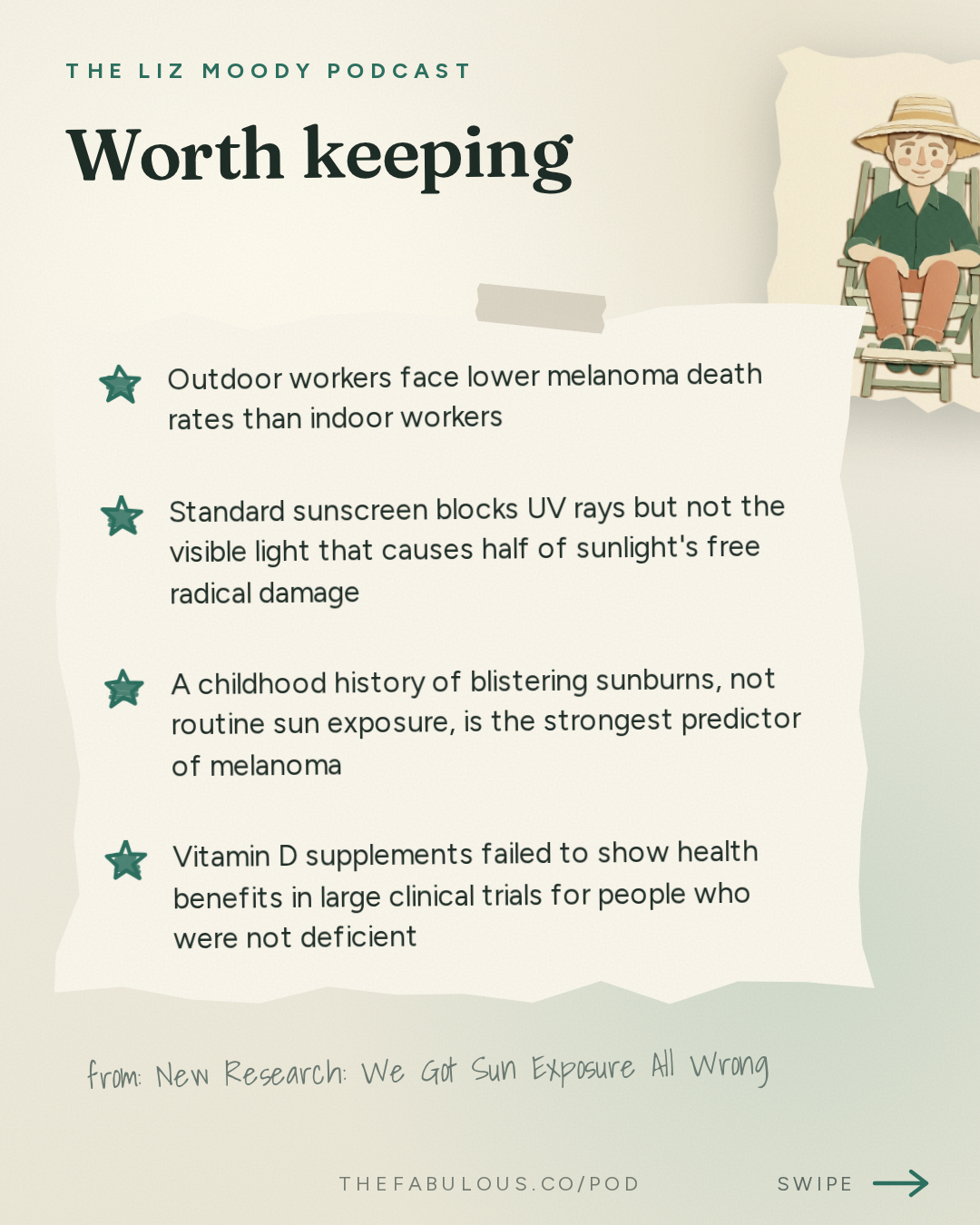
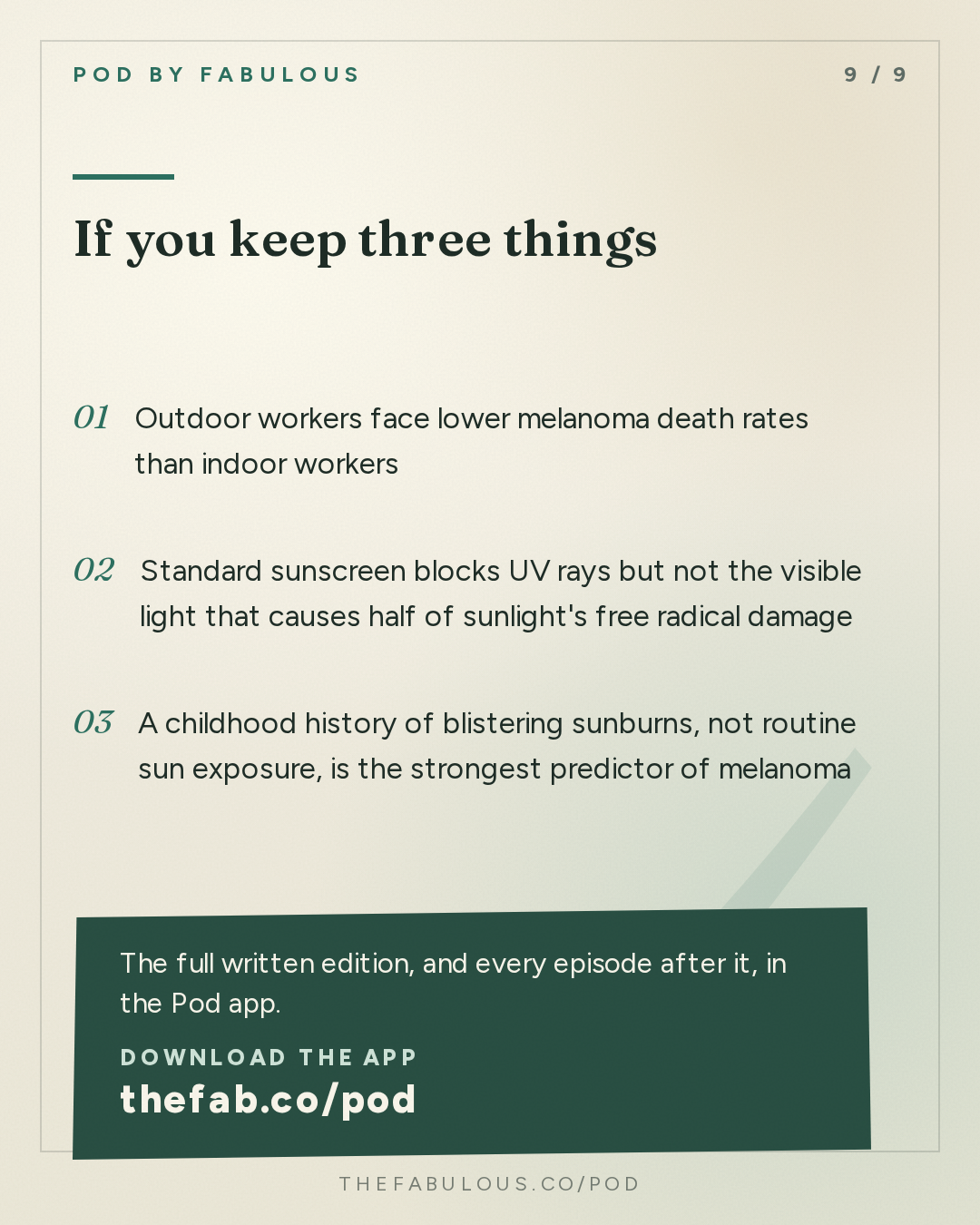
- Outdoor workers face lower melanoma death rates than indoor workers
- Standard sunscreen blocks UV rays but not the visible light that causes half of sunlight's free radical damage
- A childhood history of blistering sunburns, not routine sun exposure, is the strongest predictor of melanoma
- Vitamin D supplements failed to show health benefits in large clinical trials for people who were not deficient
- Evening smart bulbs that cut blue light moved 82% of participants from severe to mild depression in a month
The episode in cards

By the numbers
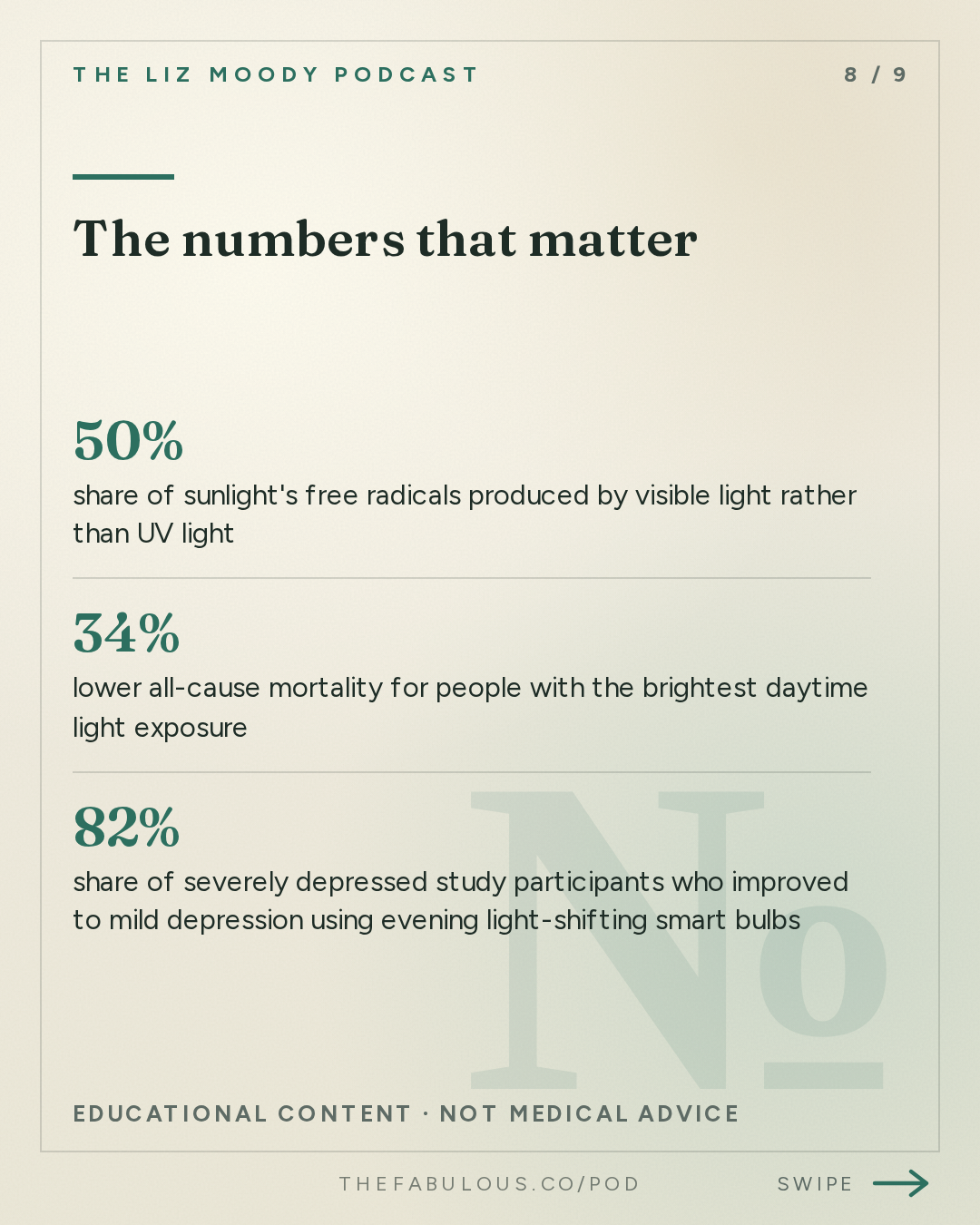
- 50% share of sunlight's free radicals produced by visible light rather than UV light
- 34% lower all-cause mortality for people with the brightest daytime light exposure
- 82% share of severely depressed study participants who improved to mild depression using evening light-shifting smart bulbs
In their words
“Outdoor workers, their skin seems to get so used to protecting itself from the sun that it doesn't get overwhelmed by the, the, like a sudden blast of sun that their skin's not”
“Melanin is the best, like, sun protectant ever developed. We haven't created anything that can compete with melanin”
“If your shadow is longer than you are, you can't make any vitamin D.”
“Cause, but the people getting the brightest days were about 34% less likely to die from any cause”
Protocols
-
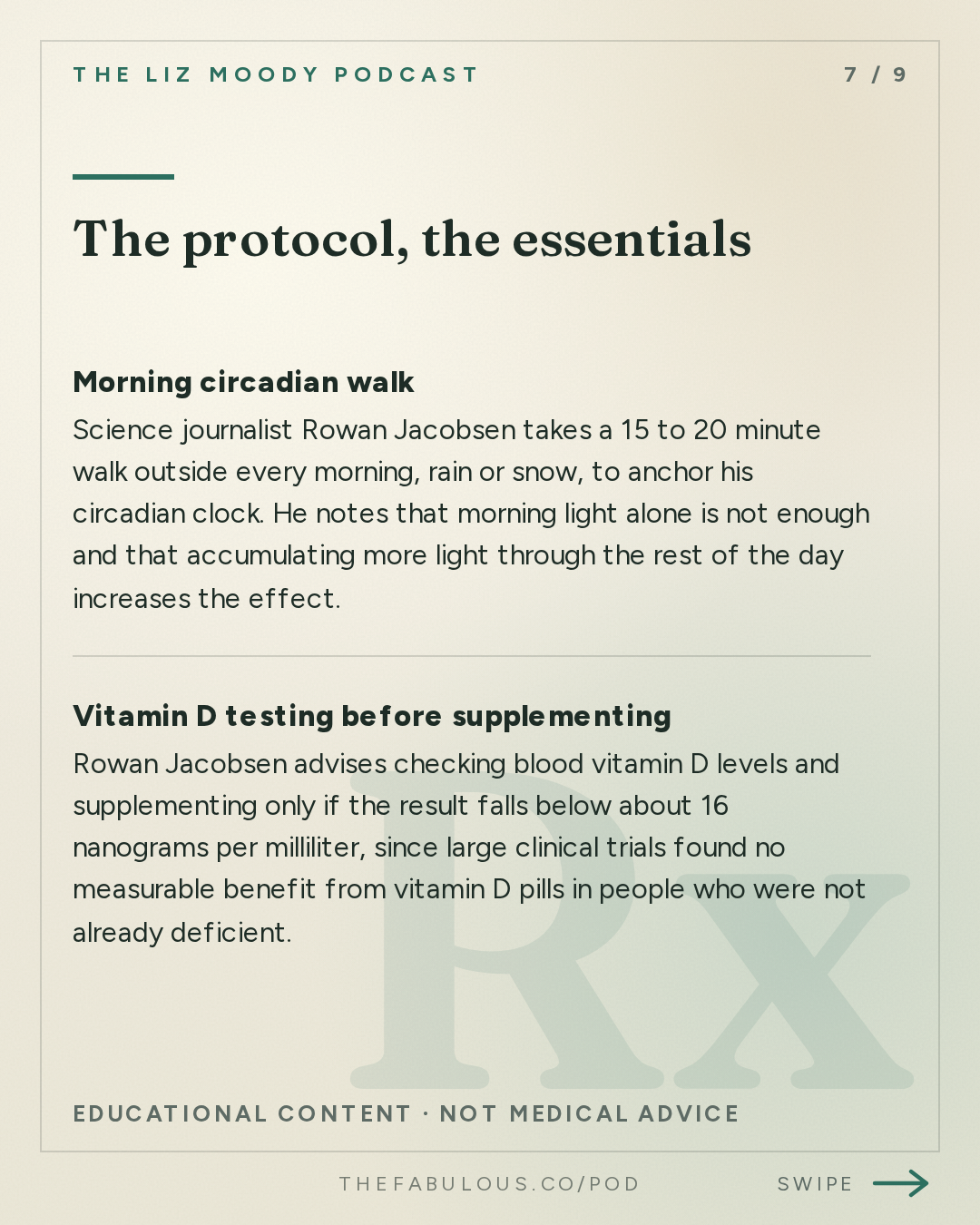
Morning circadian walk
Science journalist Rowan Jacobsen takes a 15 to 20 minute walk outside every morning, rain or snow, to anchor his circadian clock. He notes that morning light alone is not enough and that accumulating more light through the rest of the day increases the effect.
daily, in the morning
-
Vitamin D testing before supplementing
Rowan Jacobsen advises checking blood vitamin D levels and supplementing only if the result falls below about 16 nanograms per milliliter, since large clinical trials found no measurable benefit from vitamin D pills in people who were not already deficient.
as needed, based on a blood test
-
Choose SPF 30 over SPF 50 or higher
Rowan Jacobsen suggests SPF 30 is enough for most people during prolonged sun exposure, since it still blocks the bulk of UV damage while letting in enough UVB to support vitamin D production. He adds that regulators push higher SPFs mainly because most people apply too little and skip reapplying.
when spending extended time in direct sun
-
Use the shadow rule in winter
Rowan Jacobsen recommends checking whether a shadow is longer than a person's own height; if it is, the sun angle is too low for skin to produce vitamin D, so midday hours become the only window for vitamin D production in winter and in northern climates.
seasonal, mainly fall through winter
Questions this episode answers
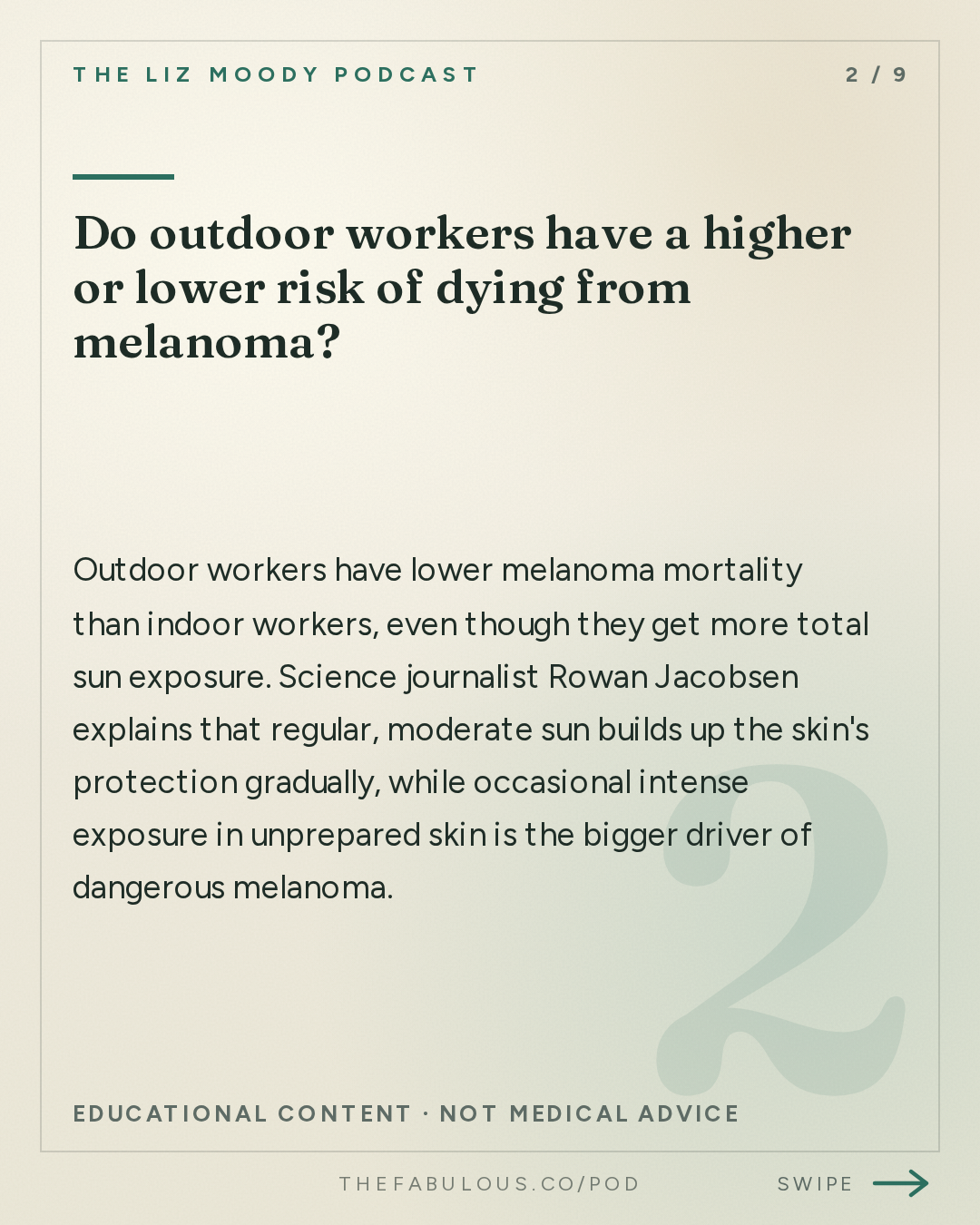
Do outdoor workers have a higher or lower risk of dying from melanoma?
Outdoor workers have lower melanoma mortality than indoor workers, even though they get more total sun exposure (01:55). Science journalist Rowan Jacobsen explains that regular, moderate sun builds up the skin's protection gradually, while occasional intense exposure in unprepared skin is the bigger driver of dangerous melanoma (08:19).
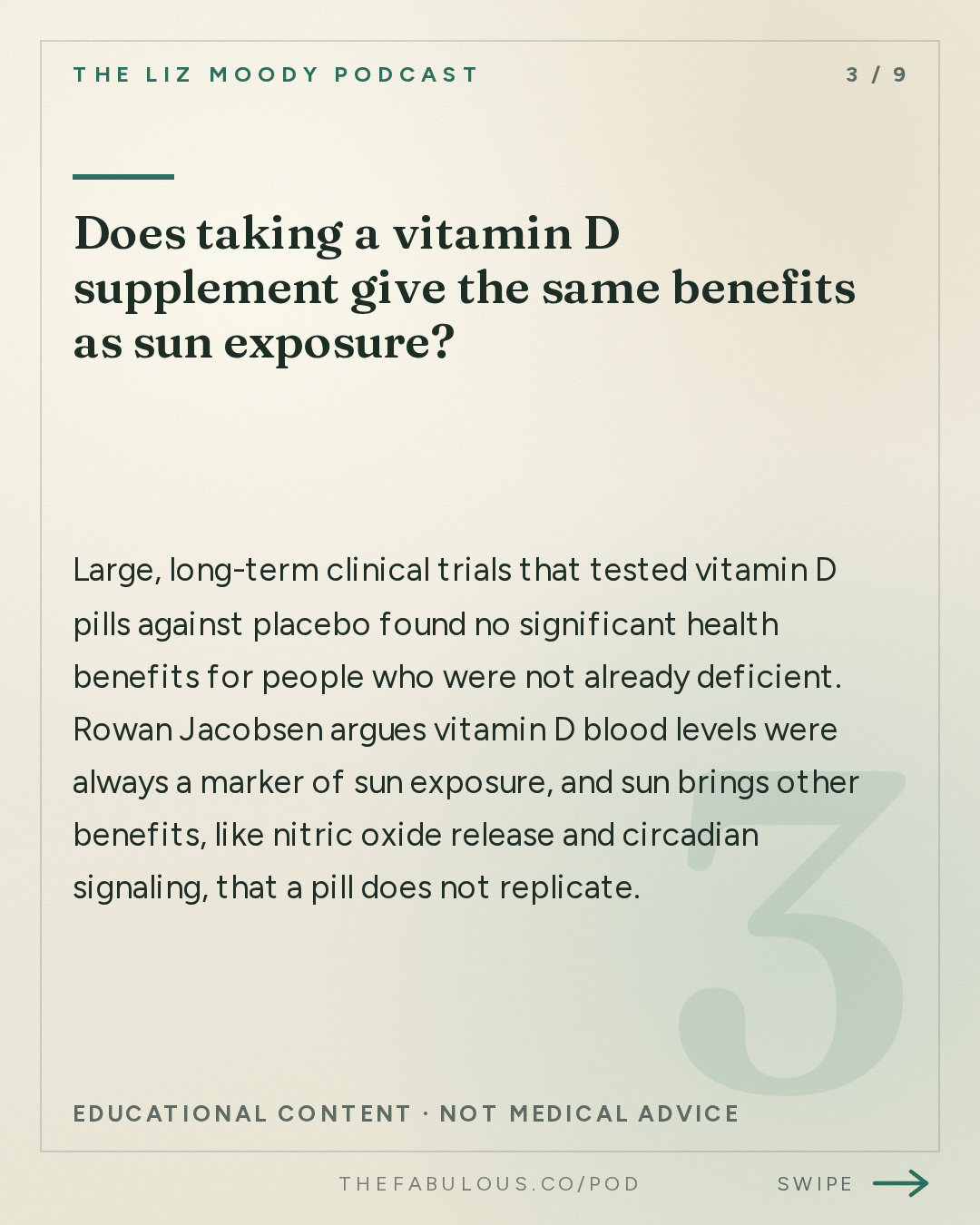
Does taking a vitamin D supplement give the same benefits as sun exposure?
Large, long-term clinical trials that tested vitamin D pills against placebo found no significant health benefits for people who were not already deficient (83:40). Rowan Jacobsen argues vitamin D blood levels were always a marker of sun exposure, and sun brings other benefits, like nitric oxide release and circadian signaling, that a pill does not replicate.
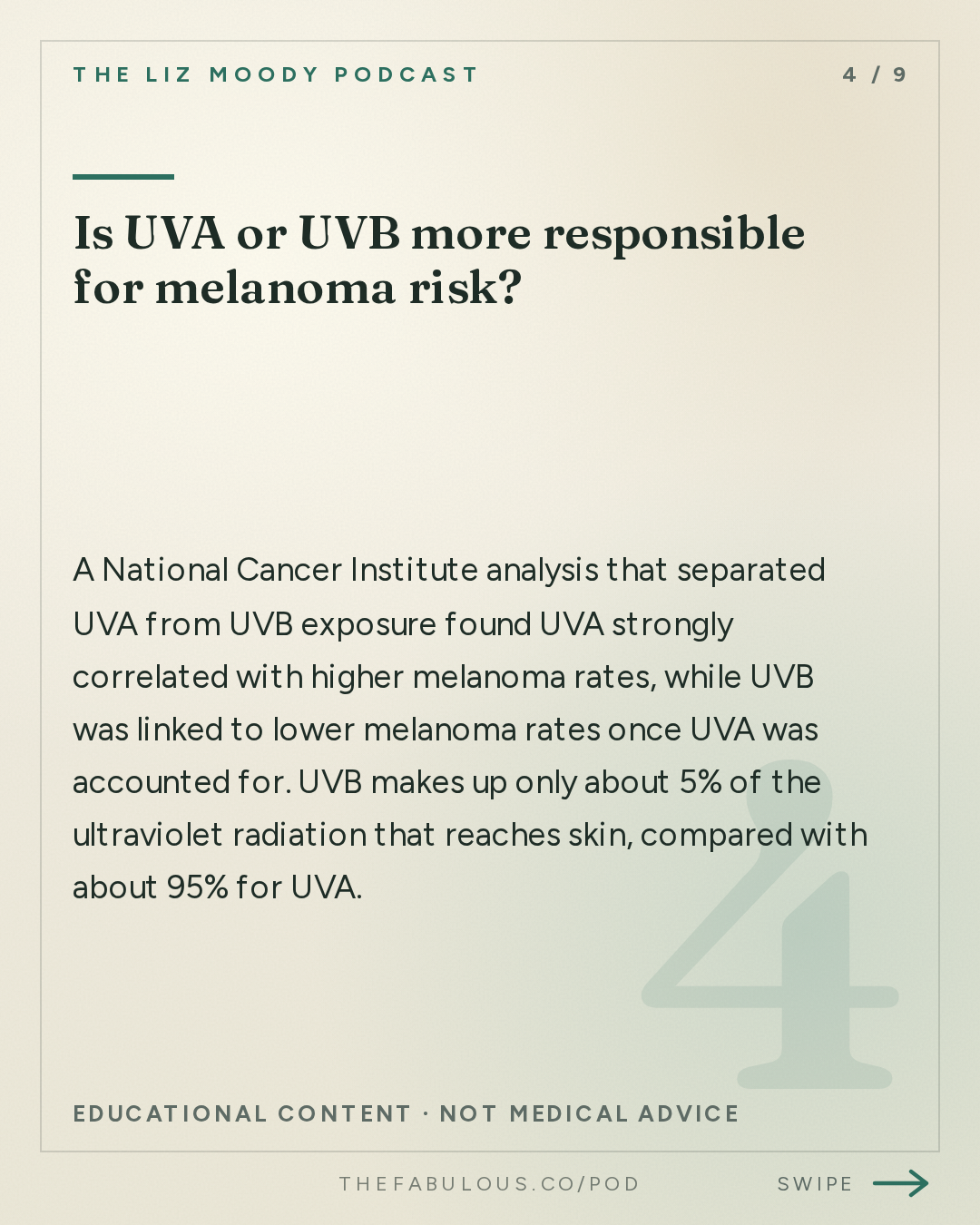
Is UVA or UVB more responsible for melanoma risk?
A National Cancer Institute analysis that separated UVA from UVB exposure found UVA strongly correlated with higher melanoma rates, while UVB was linked to lower melanoma rates once UVA was accounted for (105:15). UVB makes up only about 5% of the ultraviolet radiation that reaches skin, compared with about 95% for UVA (13:49).
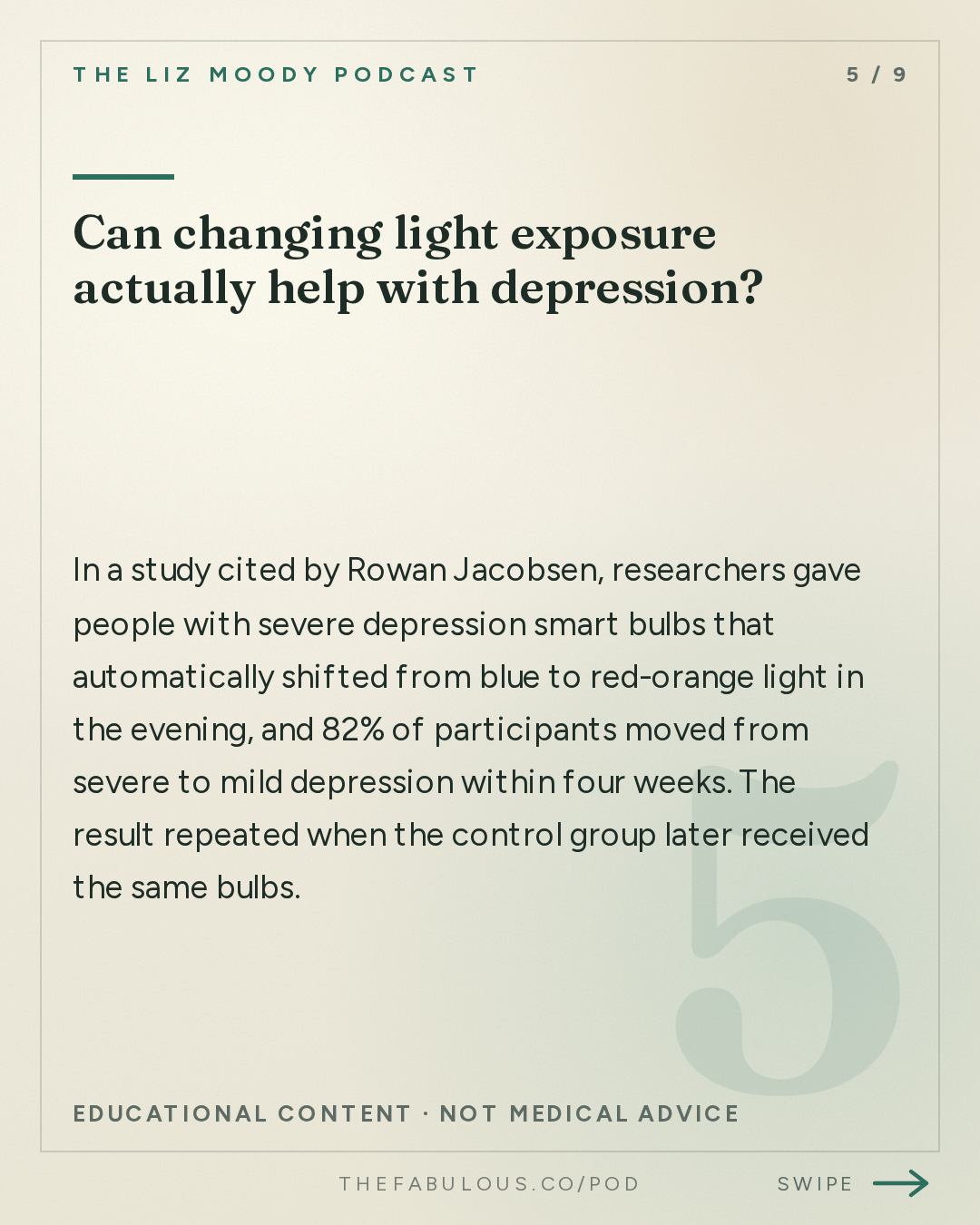
Can changing light exposure actually help with depression?
In a study cited by Rowan Jacobsen, researchers gave people with severe depression smart bulbs that automatically shifted from blue to red-orange light in the evening, and 82% of participants moved from severe to mild depression within four weeks (78:06). The result repeated when the control group later received the same bulbs.
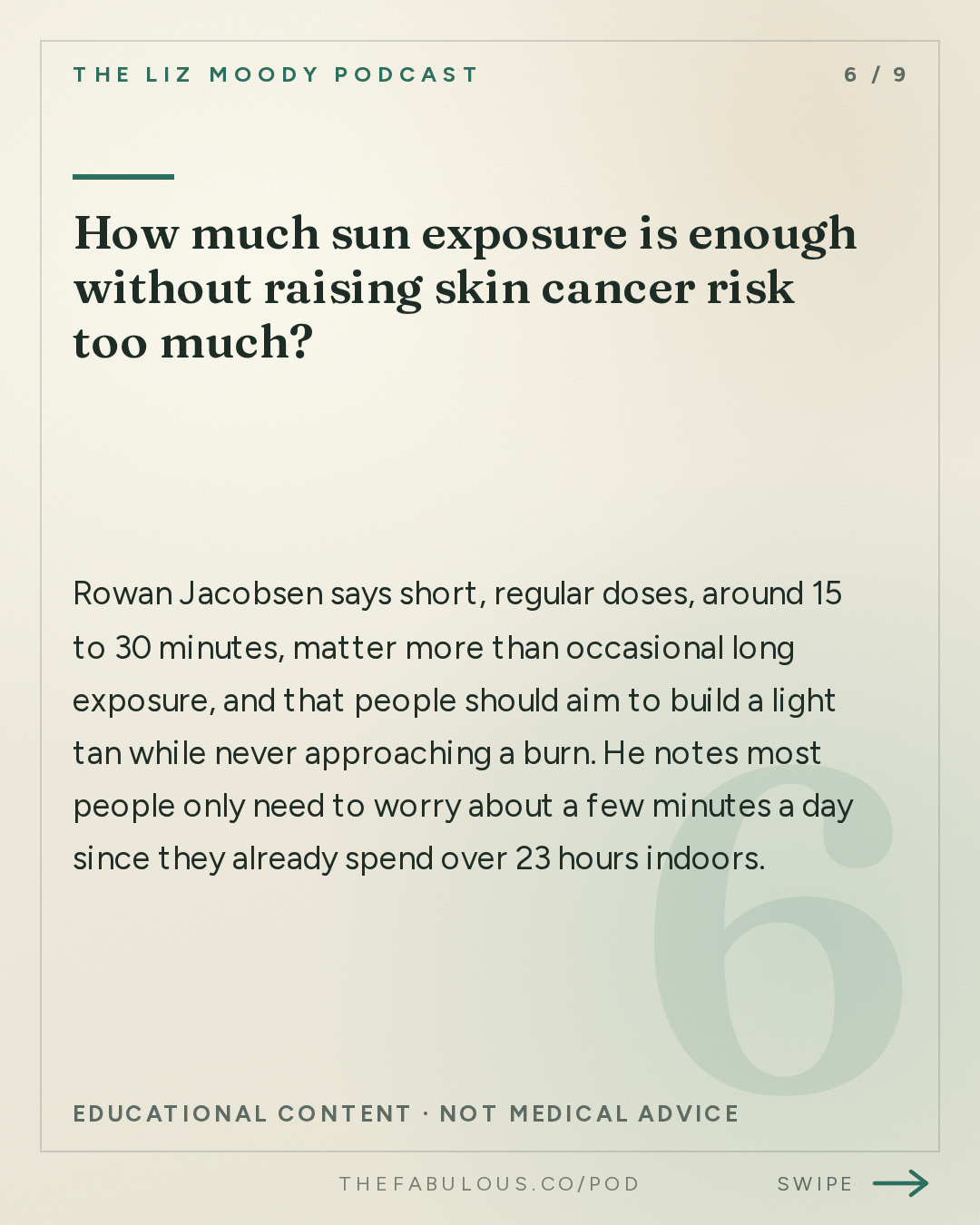
How much sun exposure is enough without raising skin cancer risk too much?
Rowan Jacobsen says short, regular doses, around 15 to 30 minutes, matter more than occasional long exposure, and that people should aim to build a light tan while never approaching a burn (23:05). He notes most people only need to worry about a few minutes a day since they already spend over 23 hours indoors (58:21).
The full read, in cards
Go deeper
- In Defense of Sun — Rowan Jacobsen's book arguing that sun avoidance ignores major benefits for heart, immune, and mental health
- Melanoma in Southern Sweden study — A 20-year Swedish study found women who actively sought sun had better longevity than women who avoided it
- National Cancer Institute UVA/UVB analysis — Separated UVA from UVB exposure nationally and found UVA correlates with melanoma while UVB appears protective
- UK wearable light-exposure mortality study — Tracked light exposure via wrist sensors and linked both bright days and dark nights to lower all-cause mortality
- Smart bulb depression intervention study — Shifting evening light from blue to red moved 82% of severely depressed participants to mild depression within a month
Mentioned
Rowan Jacobsen · Richard Weller · Liz Moody · Bob Marley · bemotrizinol · P53 · Sean Kane
More from this show and category
Ellen Vora: Heal Gut, Hormones, Anxiety
Psychiatrist Ellen Vora says gut, hormone, and anxiety struggles often trace back to suppressed truth, estrogen dominance, and mistaking fear for intuition. She offers concrete fixes: daily bowel habits and magnesium glycinate for hormone balance, and a simple tone-test (intuition is quiet, fear is loud) for telling real guidance from anxious noise.
Is the Male Loneliness Crisis Real?
Pew and Harvard surveys show men and women are equally lonely, debunking the male loneliness crisis narrative. Income is the stronger predictor: adults earning under $40,000 are far more likely to be lonely than those earning over $90,000. Host Liz Moody explains mankeeping, Stanford researcher Angelica Ferrara's term for the unpaid labor women do managing men's social lives.
Marisa Franco's Real Rules of Adult Friendship
Psychologist Marisa Franco grades viral friendship advice from S to F, debunking myths about bad texters and one-sided friends. She recommends assuming people like you, capping new-friend dinners at six to eight guests, and meeting work friends outside the office before a job ends to keep the friendship alive.
Dr. Florence Camatte: GLP-1s and Longevity
Endocrinologist Florence Camatte says most age-related disease traces to one inherited flaw: poor glucose control. That is why she calls GLP-1 drugs like Mounjaro the antibiotics of this century, and why she recommends five blood tests, testosterone for women starting in their 30s, and trazodone over cold plunges for real longevity gains.
