Dr. Florence Camatte: GLP-1s and Longevity
Should Everyone Be On GLP-1s? + Other Longevity Secrets Your Doctor Won't Tell You
▶ Listen to the full episode More from The Liz Moody Podcast
The brief
Endocrinologist Florence Camatte says most age-related disease traces to one inherited flaw: poor glucose control. That is why she calls GLP-1 drugs like Mounjaro the antibiotics of this century, and why she recommends five blood tests, testosterone for women starting in their 30s, and trazodone over cold plunges for real longevity gains.
Almost everyone alive today is carrying a memory of hunger they never personally lived through. That is the strange premise Dr. Florence Camatte opens with: nearly every human being inherited a body built by ancestors who survived famine, whether the Irish famine or an earlier one, and that inheritance is still running the show (02:58). Camatte is not a biohacker with a podcast feed and a theory. She trained at the National Institutes of Health and spent twenty five years on the Yale faculty, where she founded the Women's Health Research Center (00:25). Her claim, stated flatly, is that she has never once seen a patient with an optimal fasting glucose, fasting insulin, and hemoglobin A1C all at the same time. Not one.
"I haven't met one person with an optimal fasting sugar, fasting insulin, or hemoglobin A1C in combination. Not one." — Dr. Florence Camatte [03:23]
That single observation is the spine of the whole conversation. If nearly every adult has some degree of what Camatte calls a disorder of carbohydrate metabolism, the inability to handle sugar the way a healthy body should, then a lot of what gets filed under separate diseases, heart attack, stroke, dementia, even osteoporosis, may really be downstream effects of the same glucose problem working on different organs (03:23). That reframing is also why Camatte describes GLP-1 drugs, the class that includes Mounjaro and works by mimicking a gut hormone that signals fullness to the brain, as the modern equivalent of antibiotics.
"GLP-1s are the antibiotics of the 21st century, because it's antibiotics that in the 20th century, that kept us living longer." — Dr. Florence Camatte [01:12]
The hormone itself is not synthetic in origin. GLP-1 is something the body already makes, starting in a hunger-regulating region of the brain called the arcuate nucleus, and it touches nearly every organ system once it is amplified by a drug (02:05). Liz Moody points to trial data showing a 20 percent drop in heart attacks and strokes and a 24 percent drop in kidney failure among people using these drugs (01:12), and Camatte has personal skin in the game: she has used a GLP-1 herself since the first one reached the market twenty one years ago, partly because her own kidney function, like her identical twin's, improved on it (06:05).
None of this is presented as a free lunch. Camatte is specific about where the drugs go wrong. Teenagers and young women who were already under-fed, she says, can lose bone density they never built in the first place, since bone needs protein, calcium, and vitamin D to turn over and GLP-1 induced appetite loss can starve that process (07:01). She also flags a narrow but real danger: anyone with a family history of medullary thyroid cancer should not take these drugs, because the genetic risk is the kind of thing a prescription cannot outweigh (07:43). The lesson is not that GLP-1s are risk-free. It is that the risk calculation should start with a person's actual biology rather than a cultural panic in either direction.
Five Numbers Worth Asking For
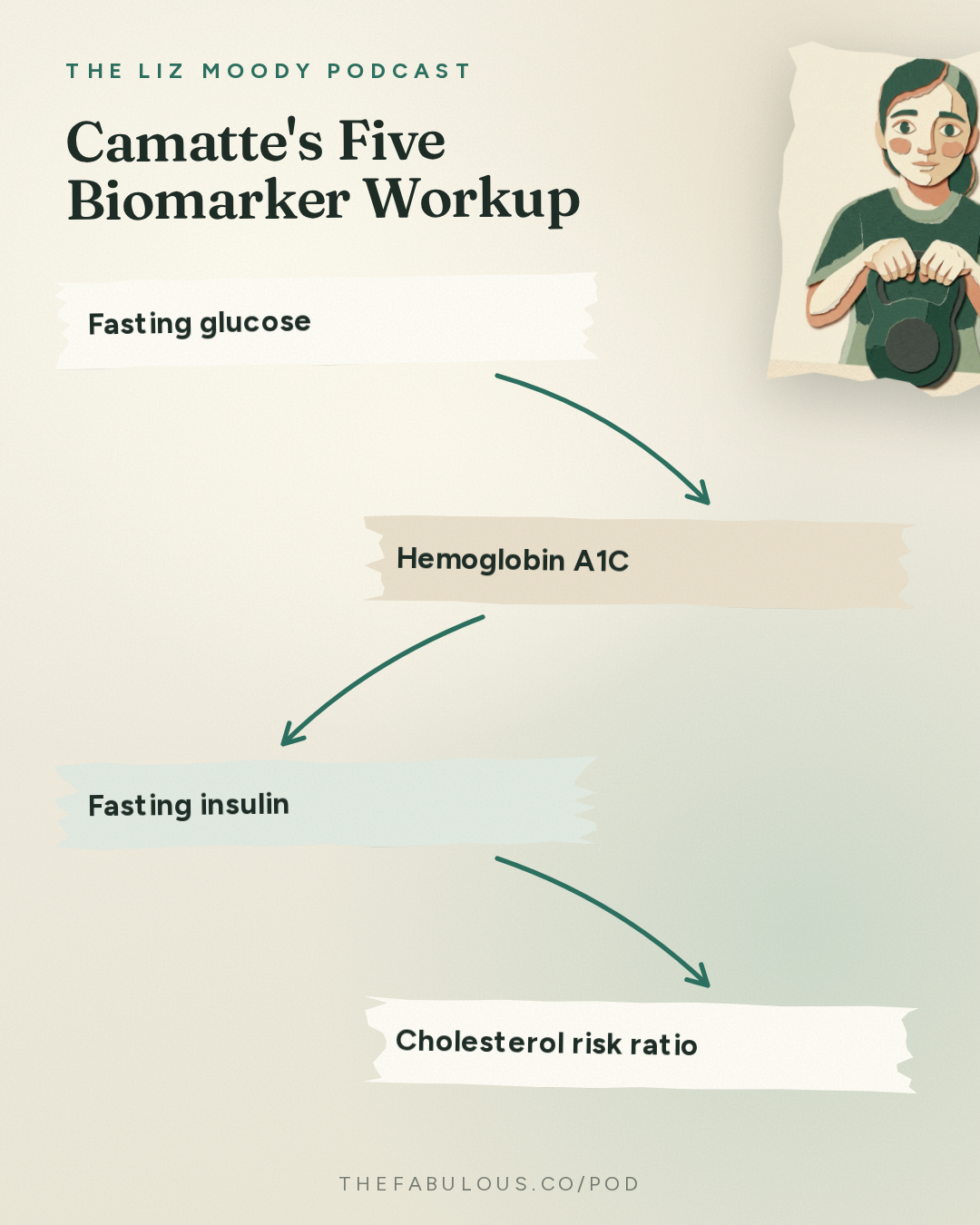
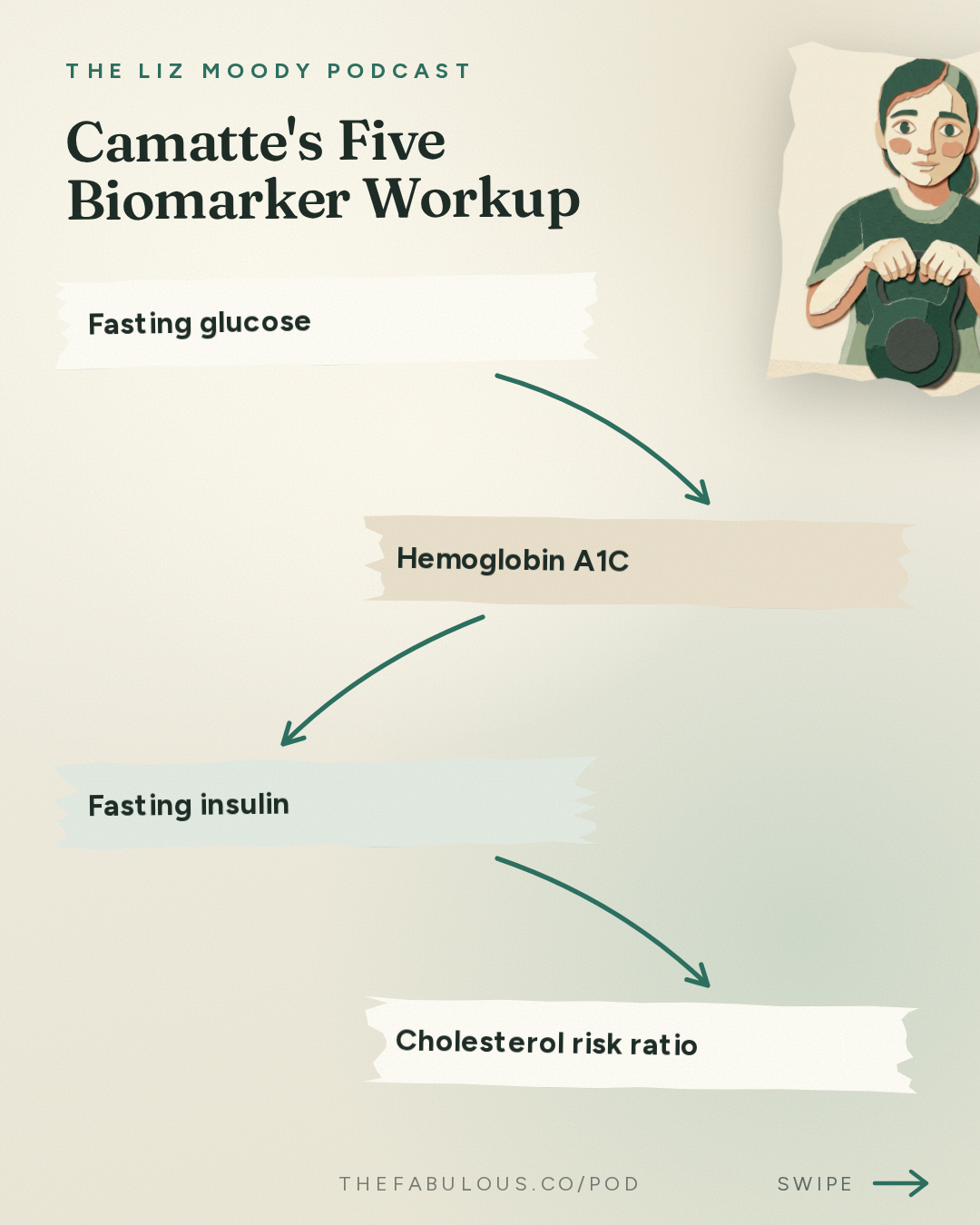
Camatte's practical answer to "should I take this" is not a drug question at all. It is a testing question. She recommends five biomarkers that most doctors do not order as a set: fasting glucose, hemoglobin A1C (a measure of average blood sugar over roughly one hundred days), fasting insulin, a cholesterol risk ratio, and free testosterone (08:46). Fasting insulin is the one she says is most neglected and most revealing: in a healthy system, insulin should read close to zero three hours after a meal, yet she regularly sees it still elevated the next morning, which is an early signature of insulin resistance that can show up decades before a diabetes diagnosis (09:06). Free testosterone makes the list because, in her telling, it is the first hormone to decline in both men and women once they hit their thirties, which sets off a chain reaction: less muscle, more fat around the middle, and faster bone loss (09:38).
That is also why she calls muscle "the organ of longevity" (12:34): muscle tissue absorbs and stores circulating sugar, so losing it compounds the same glucose problem the drugs are trying to fix. Her baseline prescription for protecting muscle, independent of any drug, is at least one gram of protein per kilogram of body weight alongside regular resistance training (15:08). For women specifically, she targets a free testosterone level between 6 and 30, adjusted to how a given patient actually feels and functions rather than to a lab's population average, since she argues reference ranges reflect a broad, often unwell population rather than an optimal one (16:48). She has taken testosterone herself since her thirties, originally prompted by watching two aunts die from osteoporosis complications, and now prescribes it to most of her patients (17:29).
Smaller, odder claims thread through the same logic. She says brushing teeth three times a day is linked to a lower heart attack risk than brushing once, because oral bacteria entering the bloodstream can affect heart valves (40:52). She describes vitamin D not as a vitamin at all but as a fat-soluble steroid hormone central to immune function, and pairs it with vitamin K2 for calcium absorption (43:53). And for anyone determined to eat a dessert anyway, her workaround is sequencing: eat protein, fat, and fiber, a handful of nuts will do, before the sugar hits, which blunts the resulting glucose spike without requiring anyone to give up the treat entirely (48:32).
What Sleep Buys That The Gym Cannot
If testosterone and glucose are the daytime story, sleep is the one Camatte will not compromise on. Liz Moody cites research, including work by Stanford geneticist Michael Snyder, showing a sharp jump in biological aging around age 44 and again around 60, driven in part by the hormonal shifts already discussed (57:26). Her own rule for travelers and overworked patients who pride themselves on hitting the gym after midnight on four hours of sleep is blunt.
"Sleep trumps your gym. So don't worry about working out if you haven't gotten quality sleep." — Dr. Florence Camatte [82:18]
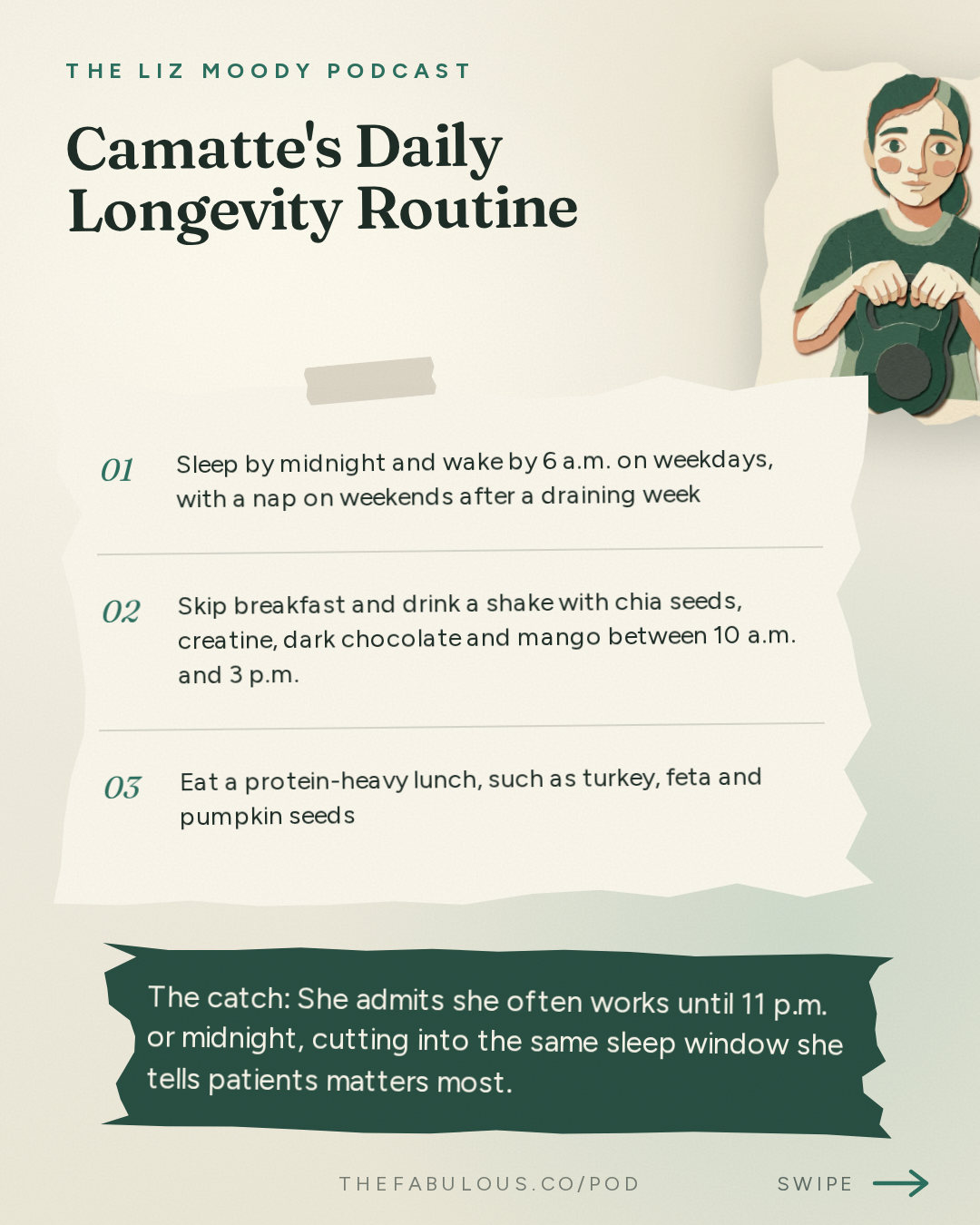
The mechanism she gives is straightforward: sleep is when growth hormone rises and cortisol falls, the nightly reset that a hard workout cannot substitute for. For patients whose sleep is disrupted by hormonal change, particularly women in perimenopause, she often reaches for trazodone, a low-dose prescription sleep aid that she says works immediately when it works, in roughly 60 to 70 percent of the people she tries it on (55:46).
At the far, expensive edge of the conversation sits therapeutic plasma exchange, a procedure where plasma is removed from one arm, cleaned, and the red blood cells returned through the other, a less dramatic cousin of the young-blood-for-old-blood idea that tech entrepreneur Bryan Johnson pursued using his own son's blood (70:34). Camatte tried it on herself starting about five years ago, one treatment a month for three months, and reports her own biological age measures improved by fifteen years on the trend line she tracks, at a cost of ten to fifteen thousand dollars per treatment (71:03). She is careful to call it promising rather than proven, noting ongoing research into its effects on Alzheimer's risk and on clearing microplastics from the body (71:24).
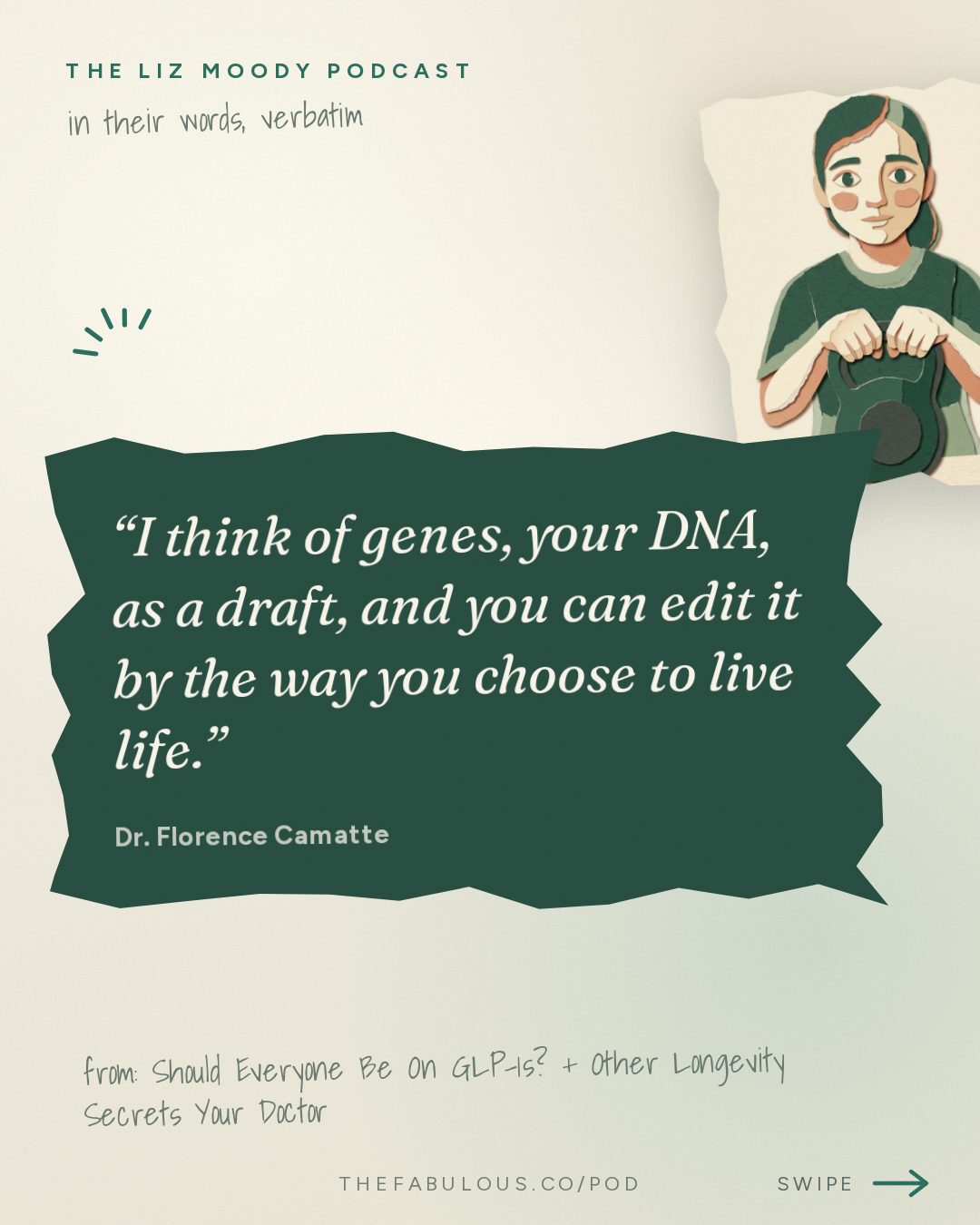
What ties all of this together, the testing, the testosterone, the drugs, the sleep rules, is a line Camatte returns to near the start of the conversation: she thinks of DNA as a draft, something that can be edited by the way a person chooses to live (30:03). Ancestors who survived famine handed down bodies built for scarcity, in a world that no longer runs on scarcity. The five biomarkers are simply a way of reading that inherited draft before deciding what to change.
Ask this episode anything
Pod's AI answers from the episode itself, with the minute mark so you can hear it yourself.
Or start with one of these
Ask this episode
Pod's AI listens to the whole episode to answer, and points you to the minute it comes from.
The rest of this answer, and any question after it
Answers come from the episode itself, never from a summary of it.
ContinueKey takeaways
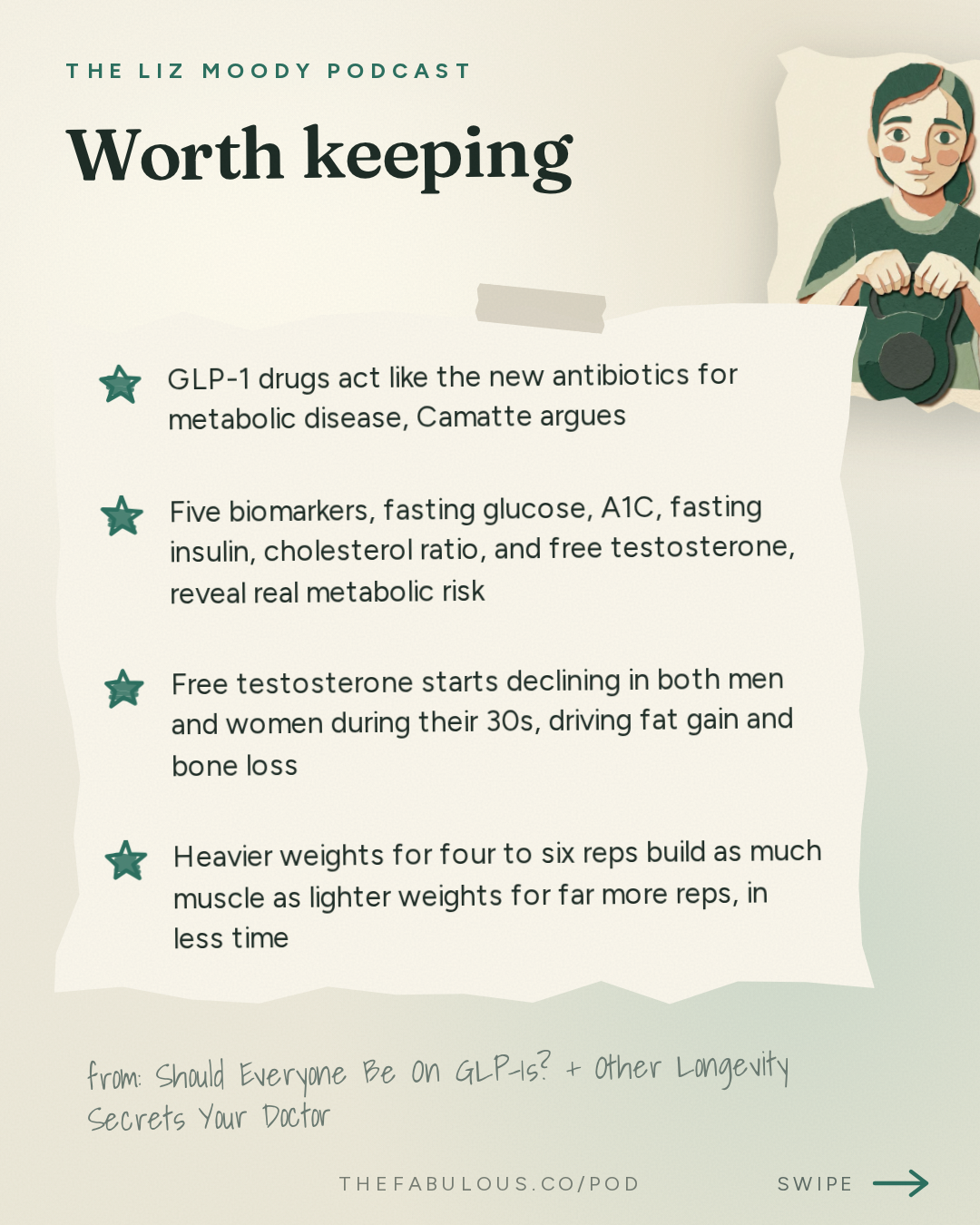
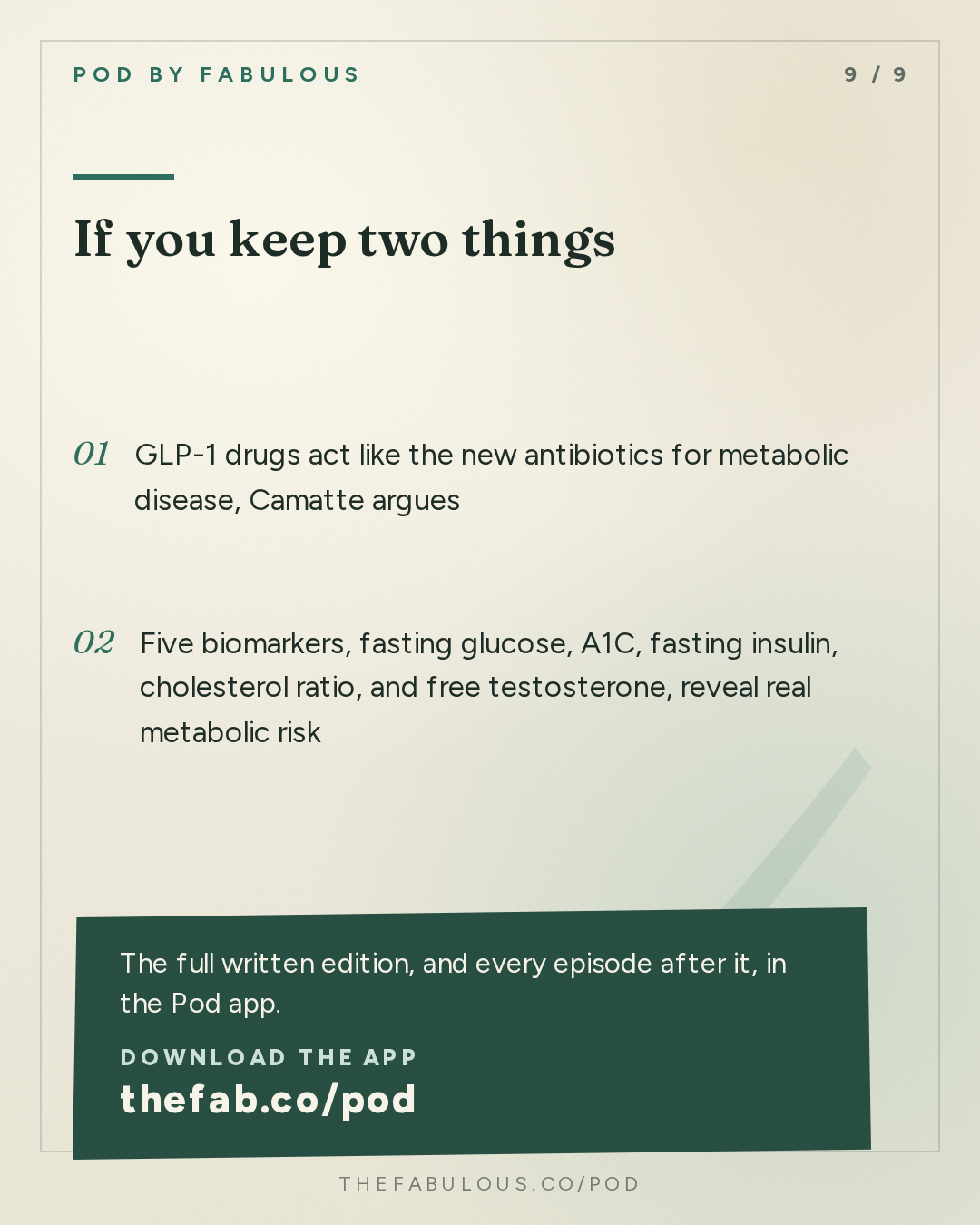
- GLP-1 drugs act like the new antibiotics for metabolic disease, Camatte argues
- Five biomarkers, fasting glucose, A1C, fasting insulin, cholesterol ratio, and free testosterone, reveal real metabolic risk
- Free testosterone starts declining in both men and women during their 30s, driving fat gain and bone loss
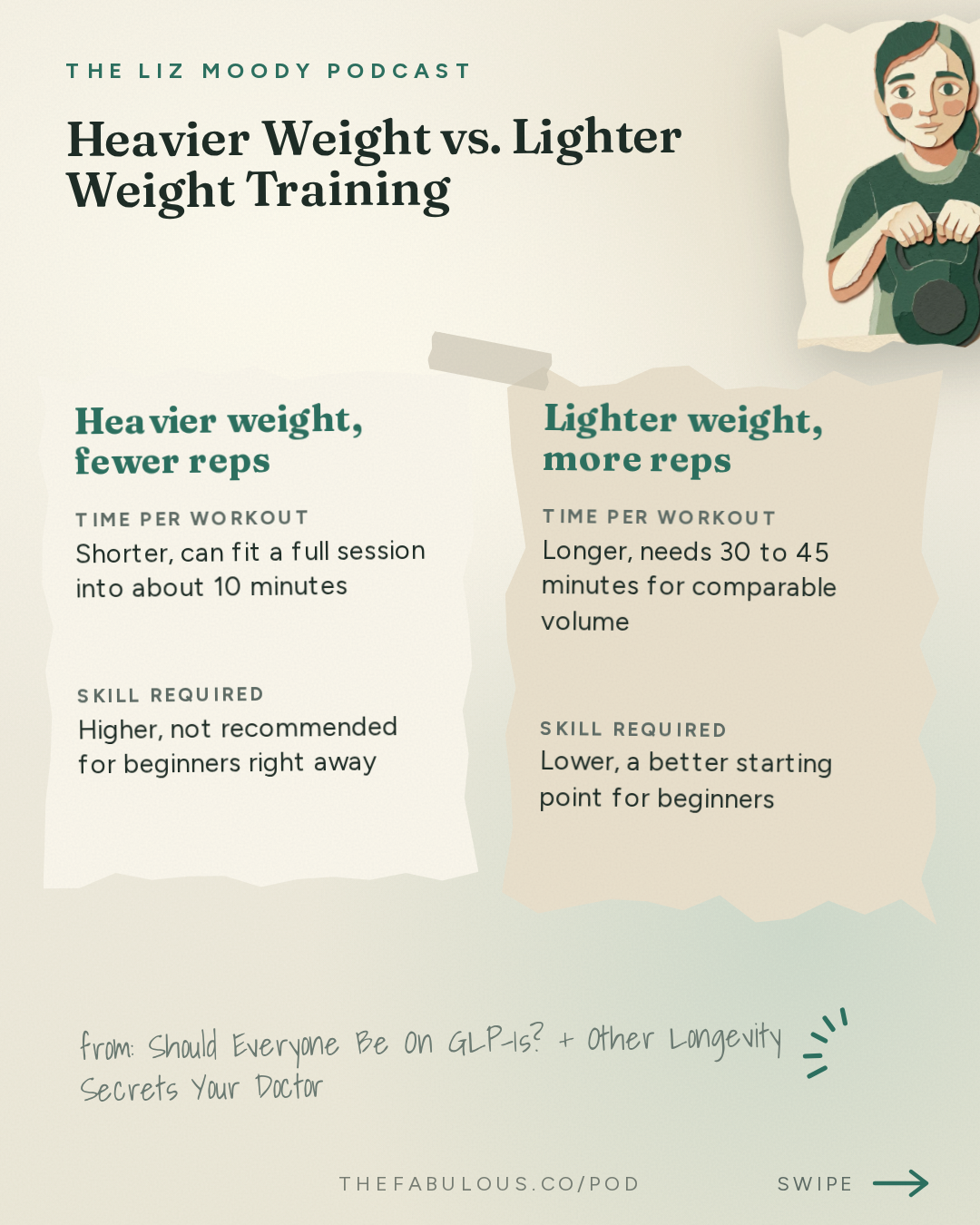
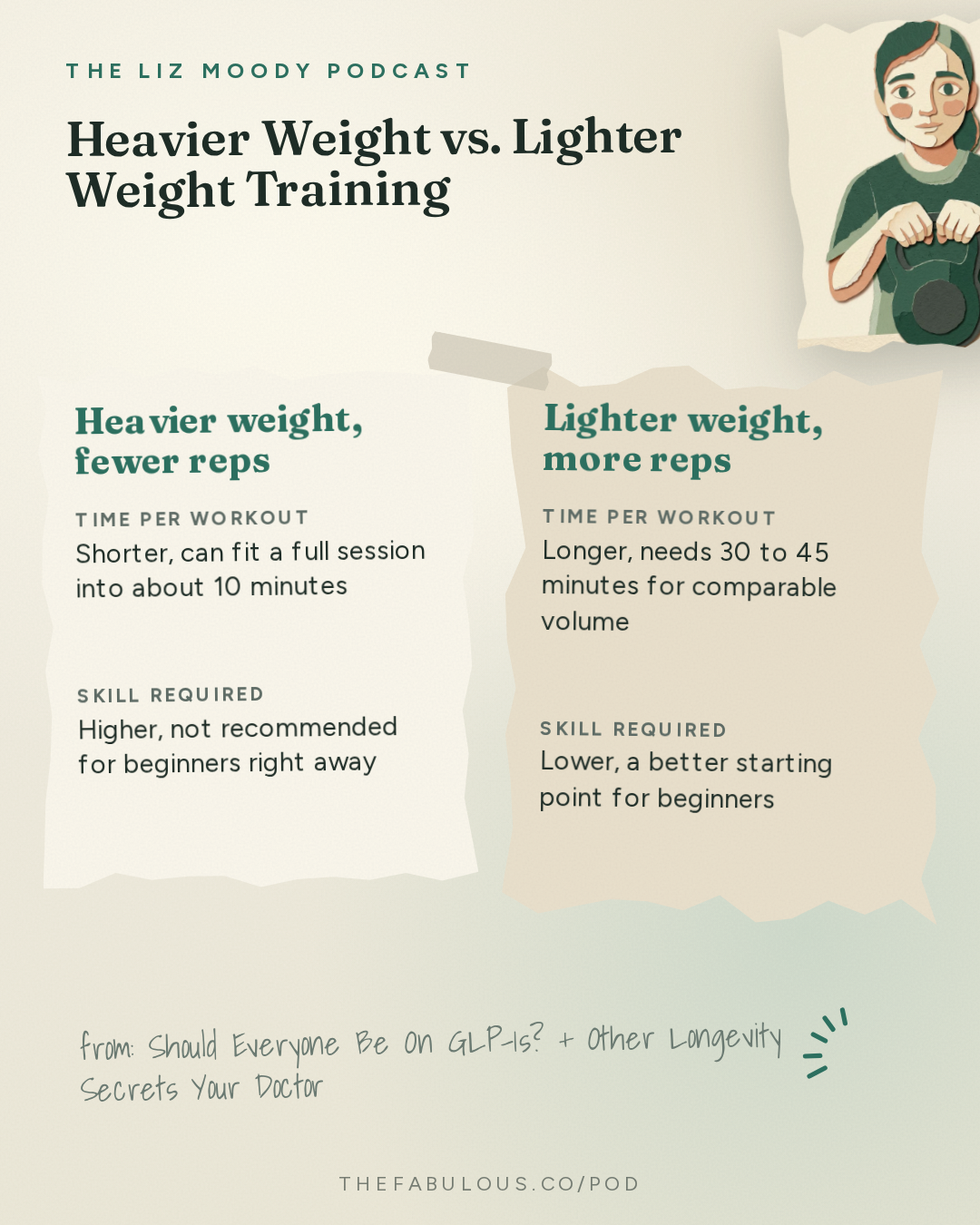
- Heavier weights for four to six reps build as much muscle as lighter weights for far more reps, in less time
- Sleep quality outweighs exercise for longevity, so skip the gym after a four-hour night, Camatte advises
The episode in cards

By the numbers
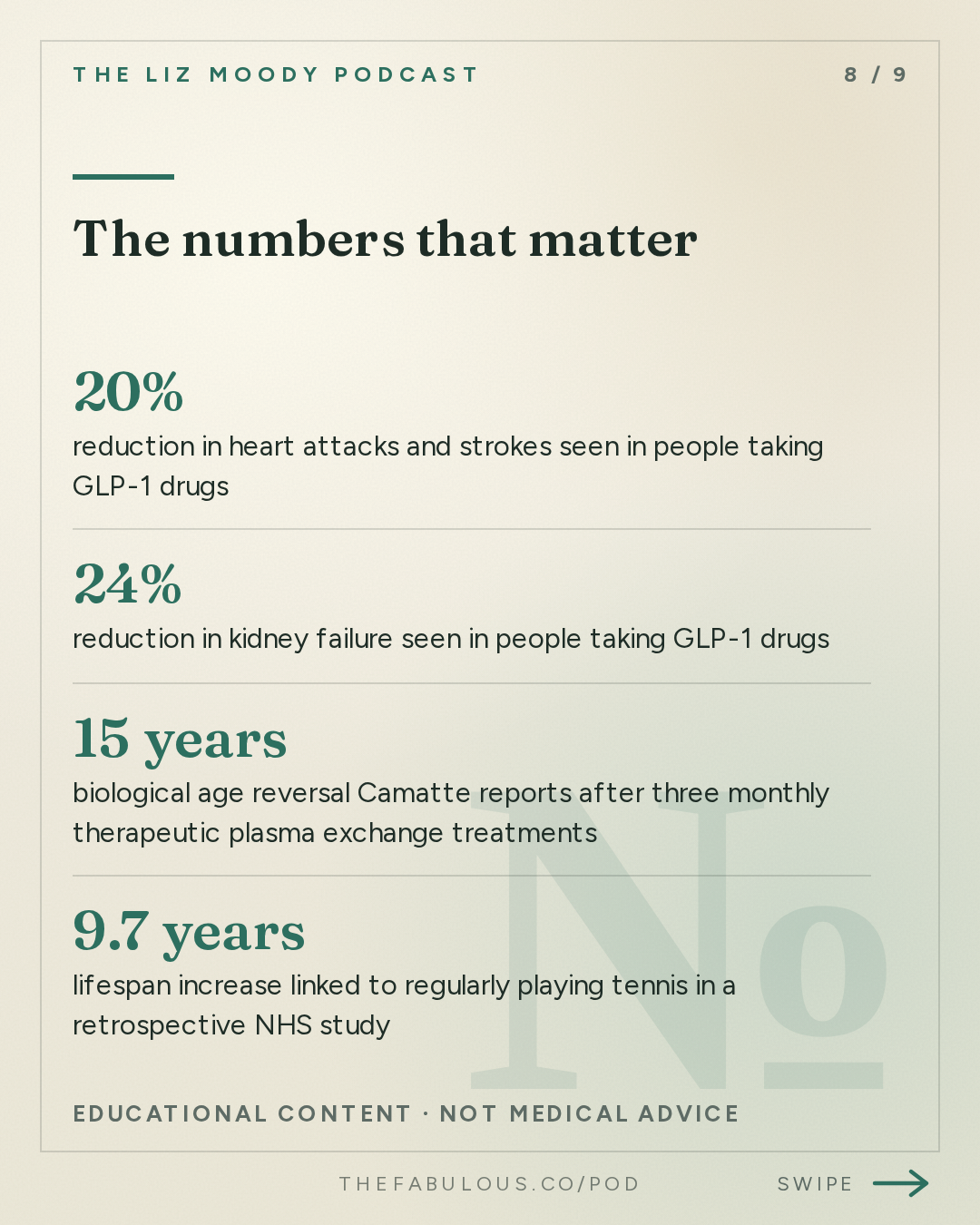
- 20% percent reduction in heart attacks and strokes seen in people taking GLP-1 drugs
- 24% percent reduction in kidney failure seen in people taking GLP-1 drugs
- 15 years biological age reversal Camatte reports after three monthly therapeutic plasma exchange treatments
- 9.7 years lifespan increase linked to regularly playing tennis in a retrospective NHS study
In their words
“GLP-1s are the antibiotics of the 21st century, because it's antibiotics that in the 20th century, that kept us living longer.”
“I haven't met one person with an optimal fasting sugar, fasting insulin, or hemoglobin A1C in combination. Not one”
“Muscle is the organ of longevity.”
“"Sleep trumps your gym." So don't worry about working out if you haven't gotten quality sleep”
“I think of genes, your DNA, as a draft, and you can edit it by the way you choose to live life.”
Protocols
-
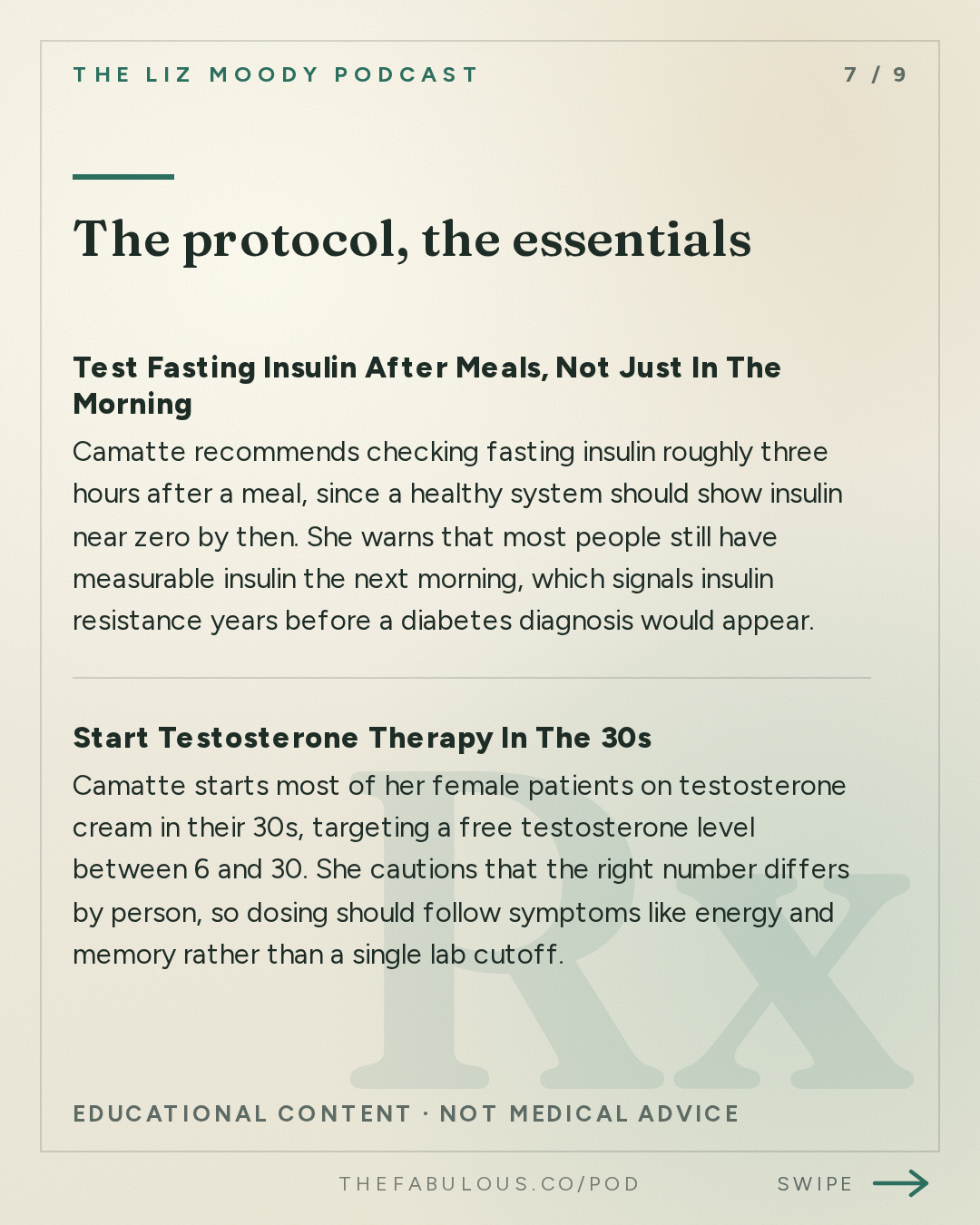
Test Fasting Insulin After Meals, Not Just In The Morning
Camatte recommends checking fasting insulin roughly three hours after a meal, since a healthy system should show insulin near zero by then. She warns that most people still have measurable insulin the next morning, which signals insulin resistance years before a diabetes diagnosis would appear.
Drawn alongside routine bloodwork, repeated as other biomarkers are tracked
-
Start Testosterone Therapy In The 30s
Camatte starts most of her female patients on testosterone cream in their 30s, targeting a free testosterone level between 6 and 30. She cautions that the right number differs by person, so dosing should follow symptoms like energy and memory rather than a single lab cutoff.
Daily cream application, reassessed after follow-up blood tests
-
Lift Heavier For Fewer Reps To Save Gym Time
Camatte's fitness collaborator recommends lifting a heavier weight for four to six reps instead of a lighter weight for many more, since both approaches produce equal muscle stimulus in far less time. She cautions that beginners should build skill with lighter weights first, since the low-rep heavy version requires more technique.
Four sets per muscle group per week, split across two sessions
-
Pair Protein And Fat With Any Sugary Treat
Camatte advises eating protein, fat, and fiber, such as a handful of nuts or nut butter, before eating dessert or any high-sugar food. She explains this sequencing slows the release of sugar and insulin, which blunts the glucose spike without requiring anyone to skip the treat.
Before any high-sugar food
-
Use Trazodone Nightly Rather Than On Bad Nights Only
Camatte prescribes a low dose of trazodone for patients whose sleep is disrupted by hormonal shifts, directing them to take it nightly rather than saving it for restless nights. She reports it works immediately when it works, in roughly 60 to 70 percent of patients, and cautions that irregular use prevents the consistent pattern the drug needs to help.
Nightly, low dose
Questions this episode answers
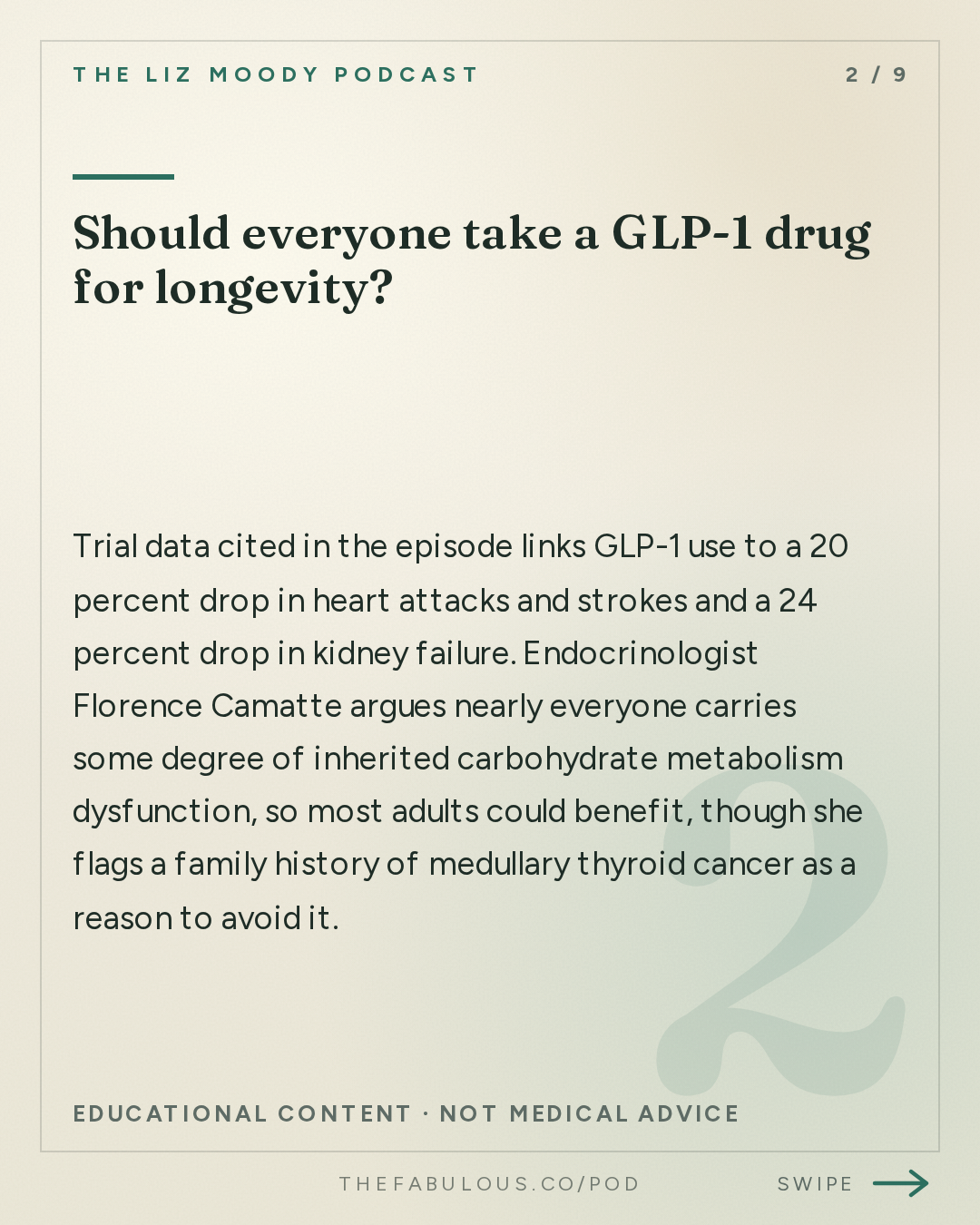
Should everyone take a GLP-1 drug for longevity?
Trial data cited in the episode links GLP-1 use to a 20 percent drop in heart attacks and strokes and a 24 percent drop in kidney failure (01:12). Endocrinologist Florence Camatte argues nearly everyone carries some degree of inherited carbohydrate metabolism dysfunction, so most adults could benefit, though she flags a family history of medullary thyroid cancer as a reason to avoid it (07:43).
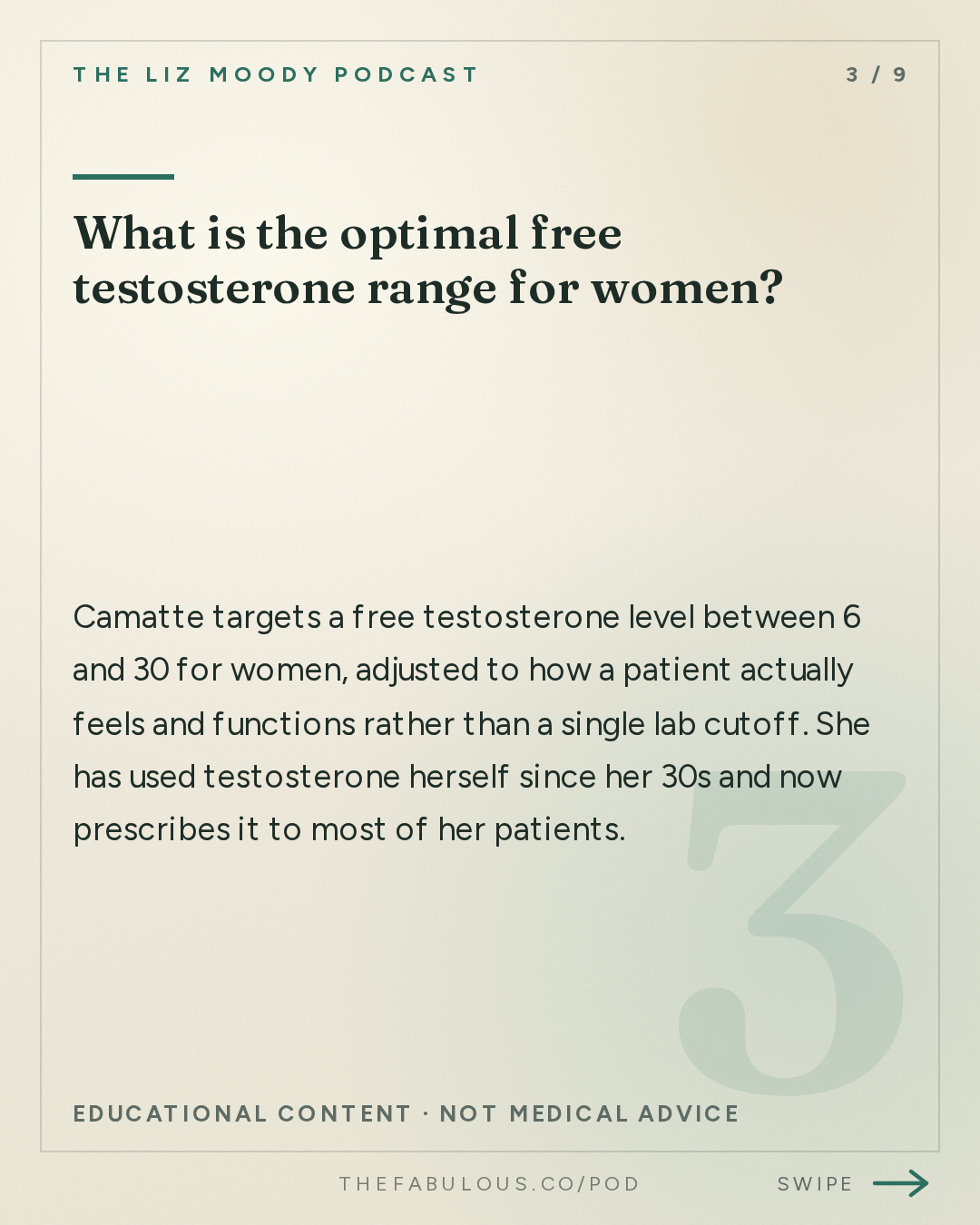
What is the optimal free testosterone range for women?
Camatte targets a free testosterone level between 6 and 30 for women, adjusted to how a patient actually feels and functions rather than a single lab cutoff (16:48). She has used testosterone herself since her 30s and now prescribes it to most of her patients (17:29).
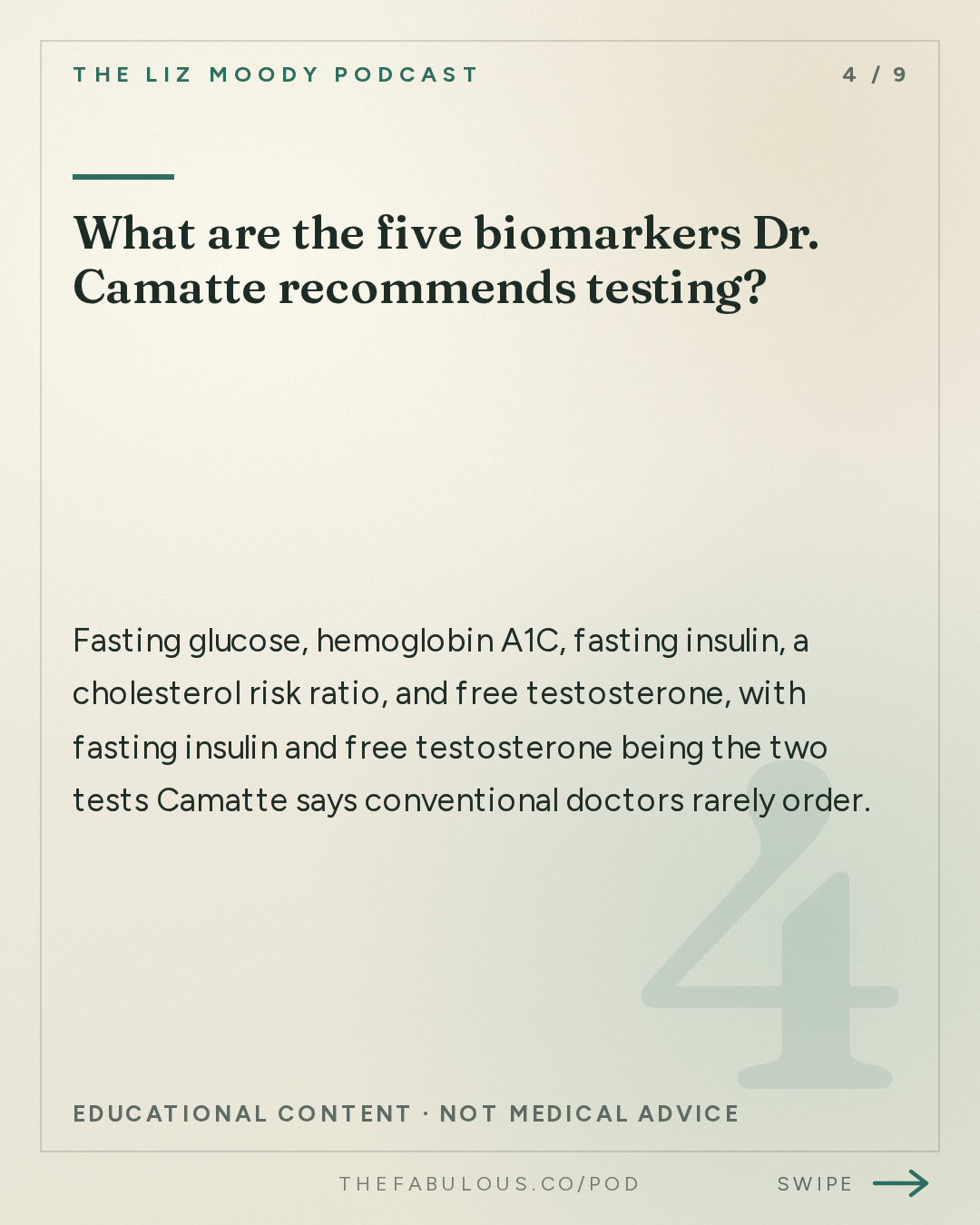
What are the five biomarkers Dr. Camatte recommends testing?
Fasting glucose, hemoglobin A1C, fasting insulin, a cholesterol risk ratio, and free testosterone, with fasting insulin and free testosterone being the two tests Camatte says conventional doctors rarely order (08:46).
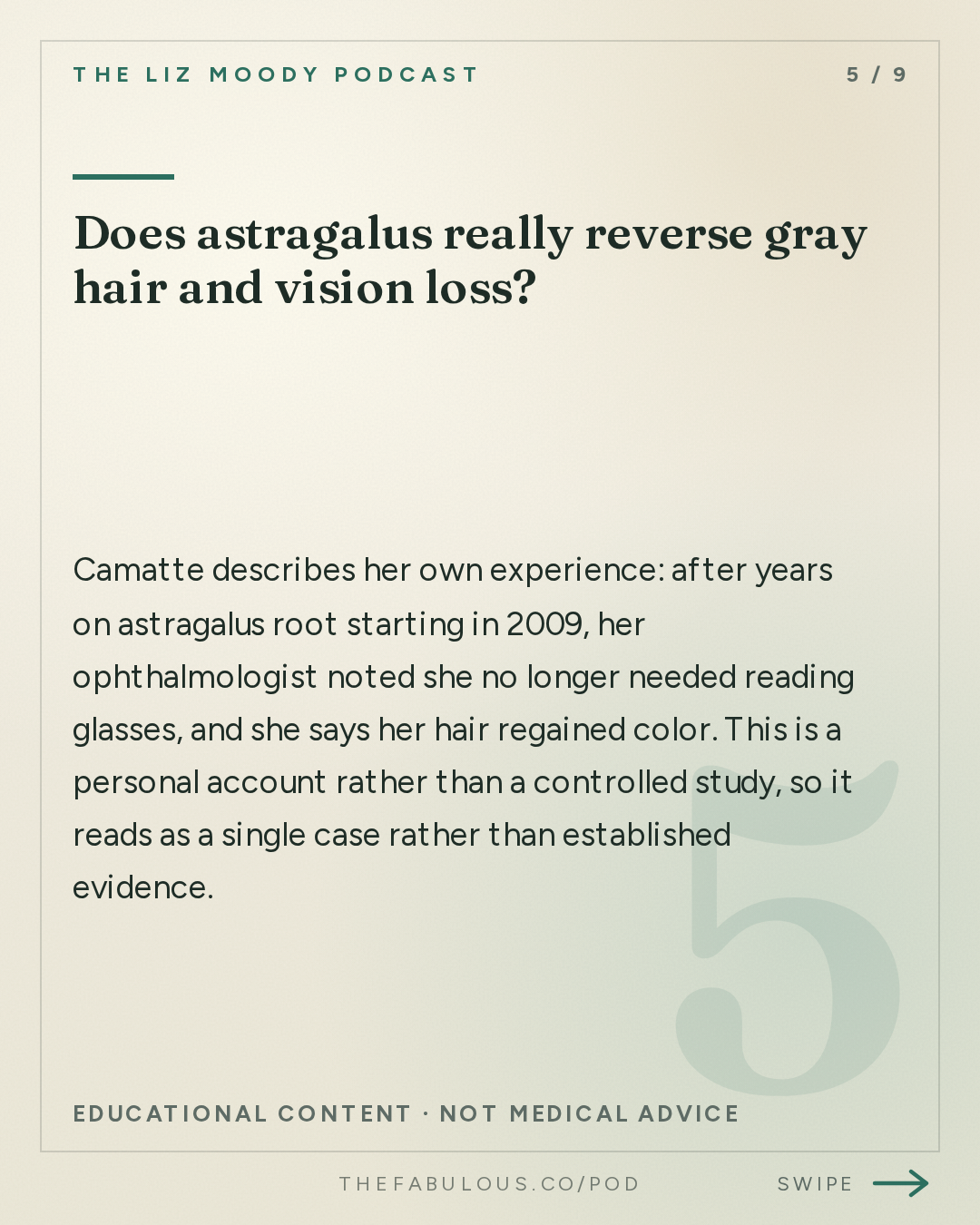
Does astragalus really reverse gray hair and vision loss?
Camatte describes her own experience: after years on astragalus root starting in 2009, her ophthalmologist noted she no longer needed reading glasses, and she says her hair regained color (13:50). This is a personal account rather than a controlled study, so it reads as a single case rather than established evidence.
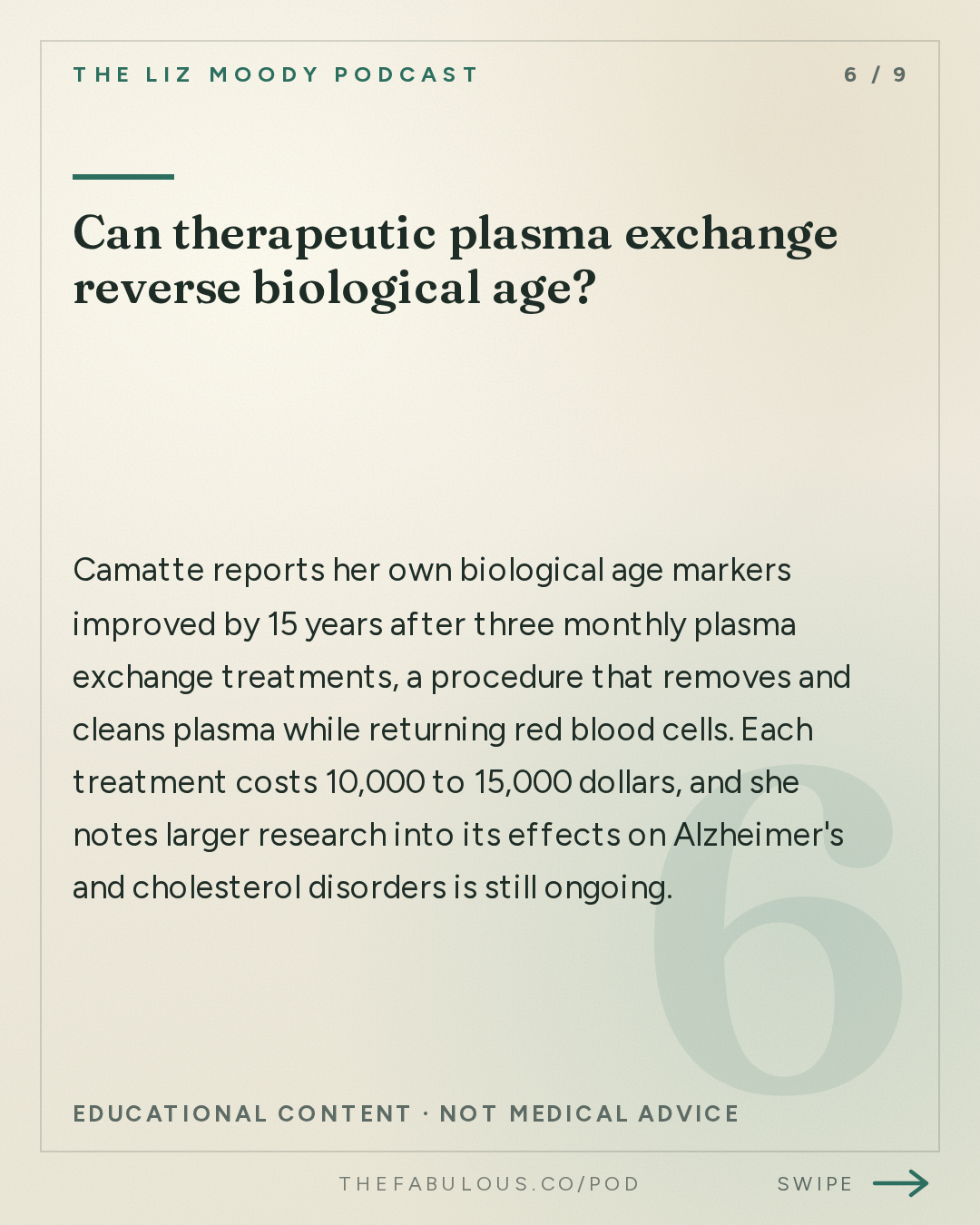
Can therapeutic plasma exchange reverse biological age?
Camatte reports her own biological age markers improved by 15 years after three monthly plasma exchange treatments, a procedure that removes and cleans plasma while returning red blood cells (71:03). Each treatment costs 10,000 to 15,000 dollars, and she notes larger research into its effects on Alzheimer's and cholesterol disorders is still ongoing (71:24).
Is sleep more important than exercise for longevity?
Camatte tells patients that sleep trumps the gym, meaning someone running on four hours of sleep should skip a workout rather than push through it (82:18). She points to sleep's role in raising growth hormone and lowering cortisol as the underlying mechanism (82:41).
The full read, in cards
Go deeper
- Invincible — Camatte's book laying out her five biomarker framework and personalized longevity approach
- NHS retrospective study on tennis and lifespan — Found tennis players lived roughly 9.7 years longer than non-players in a large retrospective cohort
- Stanford aging-rate research (Michael Snyder) — Identified sharp jumps in biological aging markers around age 44 and age 60
- Twin study on inherited disease risk — Found that over half of disease risk traced to inherited genetics rather than environment
Mentioned
Dr. Florence Camatte · Invincible · Mounjaro · Invitae · LabCorp · Trazodone · Michael Snyder · Bryan Johnson · Astragalus · James Clear
More from this show and category
Gen Z vs Millennial Iced Coffee Workplace Debate
The viral debate over bringing an iced latte to a job interview is really about generational tolerance for discomfort at work. Liz Moody traces how 2008-era scarcity built millennial hustle culture, why it burned women out, and why Gen Z's boundary setting grew from watching that burnout up close.
When to Leave a Relationship: The Science
UC Davis relationship researcher Paul Eastwick says shared hobbies barely predict relationship success, and sentiment during conflict matters far more. He highlights the Gottman-inspired five-to-one ratio of positive to negative interactions, notes sexual satisfaction predicts more than frequency, and says celebrating a partner's good news matters more than comforting them in crisis.
Kelly McGonigal on the Real Science of Joy
Stanford health psychologist Kelly McGonigal says joy is a biological capacity to feel uplifted, not a reward for a perfect life. A meta-analysis of 93 studies and over 1 million people links joy to five to eight extra years of life, and she says cynicism, not busyness, is the biggest barrier to feeling it.
How to Make Real-Life Friends Like Sitcom Characters
Liz Moody argues that sitcom-level friendship is not about chemistry but about three conditions: proximity, living life together instead of just catching up, and shared in-jokes, all of which anyone can rebuild starting this fall (04:41, 07:44, 09:25).
