
How to Make Real-Life Friends Like Sitcom Characters
Sitcom Friend Fall: Make Your Friendships Feel Like The Ones You See On TV
▶ Listen to the full episode More from The Liz Moody Podcast
The brief
Liz Moody argues that sitcom-level friendship is not about chemistry but about three conditions: proximity, living life together instead of just catching up, and shared in-jokes, all of which anyone can rebuild starting this fall (04:41, 07:44, 09:25).
Ask this episode anything
Pod's AI answers from the episode itself, with the minute mark so you can hear it yourself.
Or start with one of these
Ask this episode
Pod's AI listens to the whole episode to answer, and points you to the minute it comes from.
The rest of this answer, and any question after it
Answers come from the episode itself, never from a summary of it.
Continue
Key takeaways
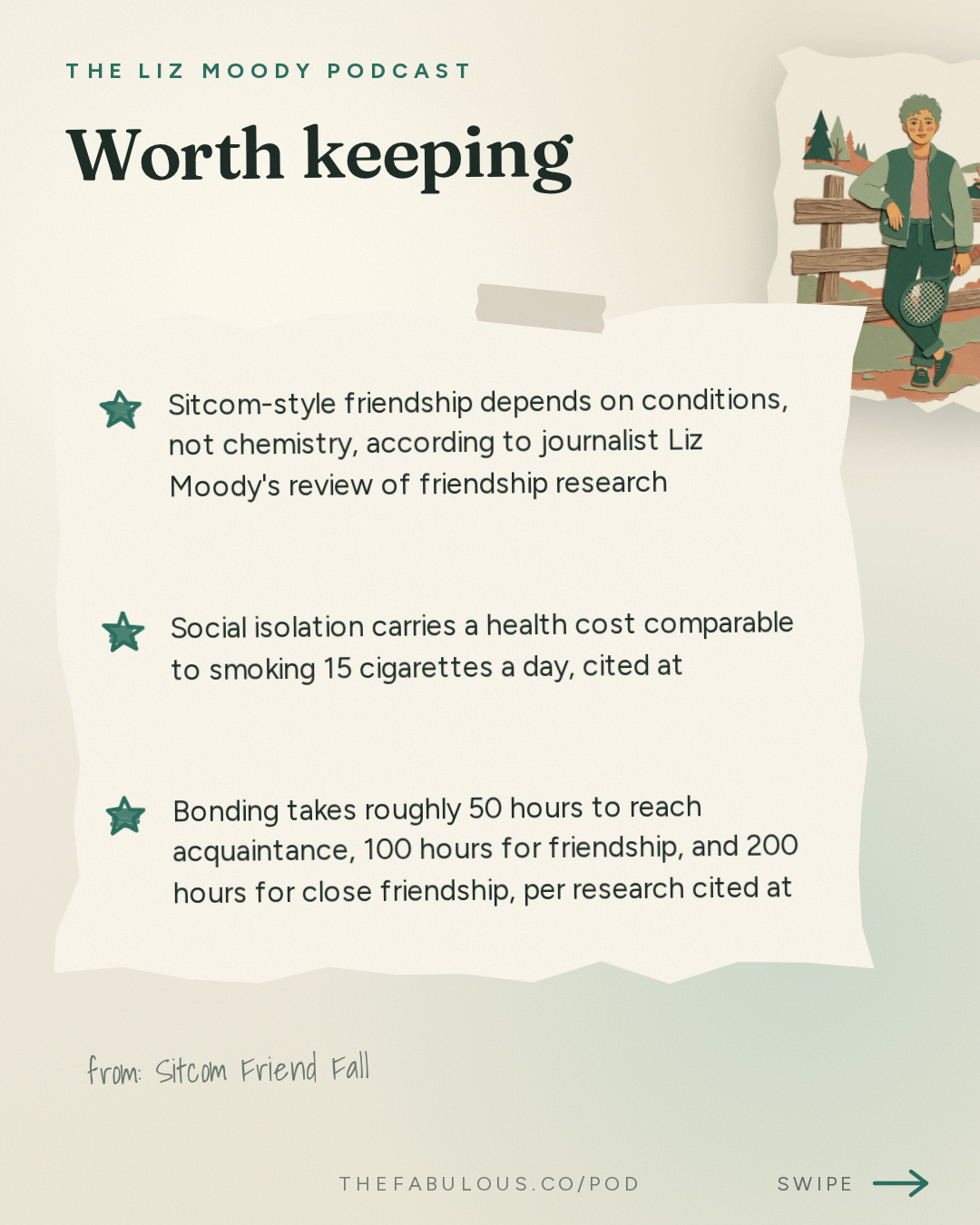
- Sitcom-style friendship depends on conditions, not chemistry, according to journalist Liz Moody's review of friendship research
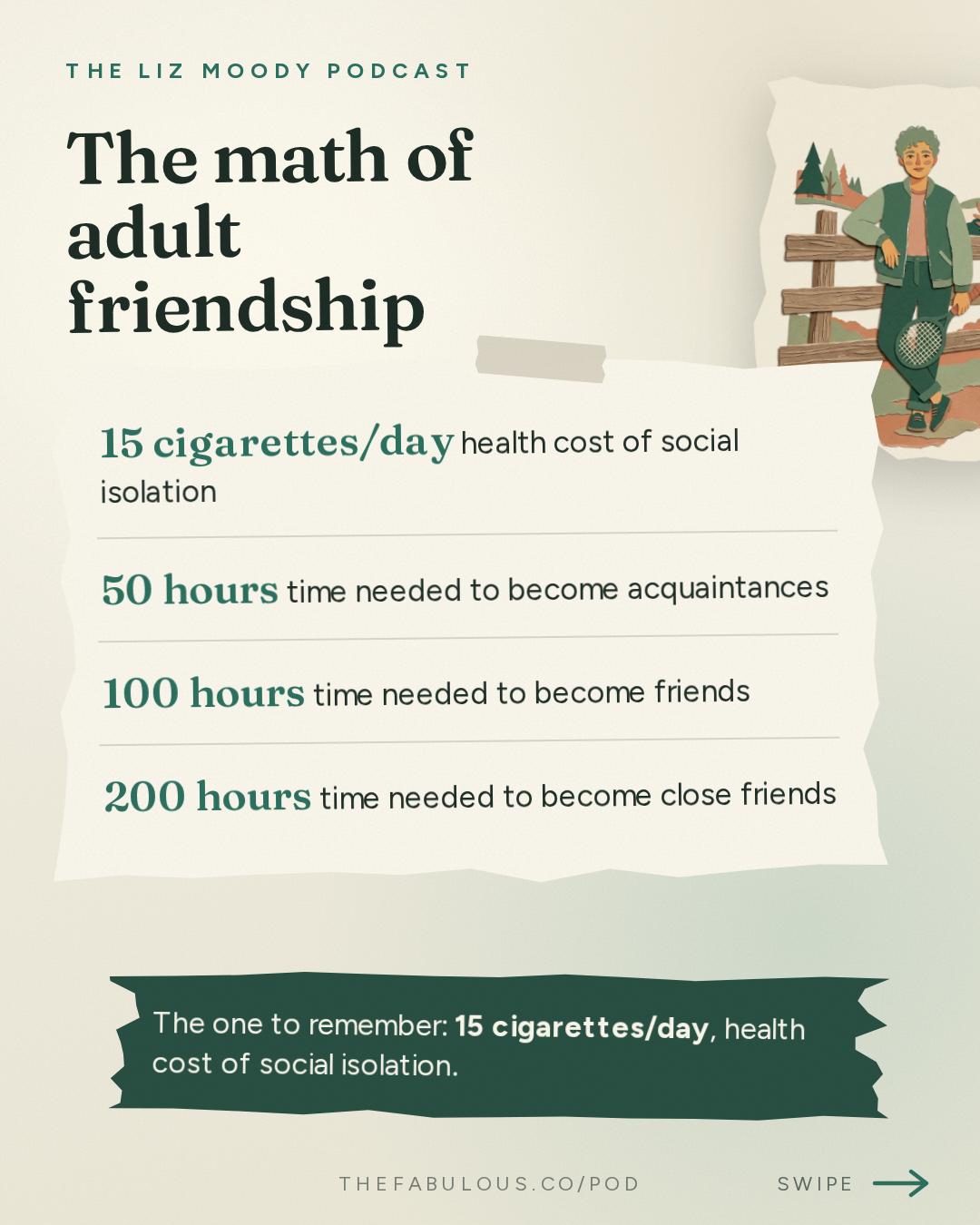
- Social isolation carries a health cost comparable to smoking 15 cigarettes a day, cited at [03:26]
- Bonding takes roughly 50 hours to reach acquaintance, 100 hours for friendship, and 200 hours for close friendship, per research cited at [07:03]
- A visible phone, even face down, measurably reduces connection quality during hangouts, per research cited at [19:41]
- A standing plan plus one memorable repeated element creates the shared microculture that cements close friend groups, per Liz Moody at [24:12]
The episode in cards

On a recent afternoon, Liz Moody said goodbye to a close friend, and the two of them spent five full minutes negotiating a shared calendar, landing on the next time they could both hang out: two months away (00:15). She thought about how strange that gap would look on television. On Friends, on New Girl, on the new sitcom Adults, characters wander into each other's apartments constantly, no group text required. That contrast nagged at her enough to send her into the research, and what she found reframes the whole problem. Sitcom friendship, she argues, is not a personality trait some people are lucky enough to have and others are not. It is a set of physical and behavioral conditions, and almost anyone can rebuild them.
Moody has spent nearly 20 years as a journalist interviewing experts and reading friendship studies (04:24), and the conclusion she keeps landing on cuts against a very common piece of self-blame: the idea that if your friend group does not sparkle the way a sitcom cast does, something is wrong with you or with the people around you.
"Friendships, more than vibes, are about conditions." — Liz Moody [04:41]
Before getting into the mechanics, she wants the stakes on the record. Social isolation carries roughly the same health cost as smoking 15 cigarettes a day (03:26). Layer onto that a culture of constant relocation, friends scattered across London, New York, and Los Angeles, and the result is a generation that has gotten very good at maintaining long-distance affection through texting and very bad at generating the daily, unglamorous contact that actually built most of our close friendships in the first place, usually in a college dorm or a high school classroom we didn't choose (04:46).
Three conditions, not one lucky break
The first condition is proximity. A study out of Dartmouth College found that how close two students' dorm rooms were to each other predicted friendship more strongly than shared interests or background (06:19). Underneath that sits something called the mere exposure effect: the more a person's face shows up in our field of vision, even without our conscious notice, the more our brain decides it likes that face (06:40). Sitcom characters live across the hall from each other or share an apartment for exactly this reason. It is not a plot convenience so much as an engine.
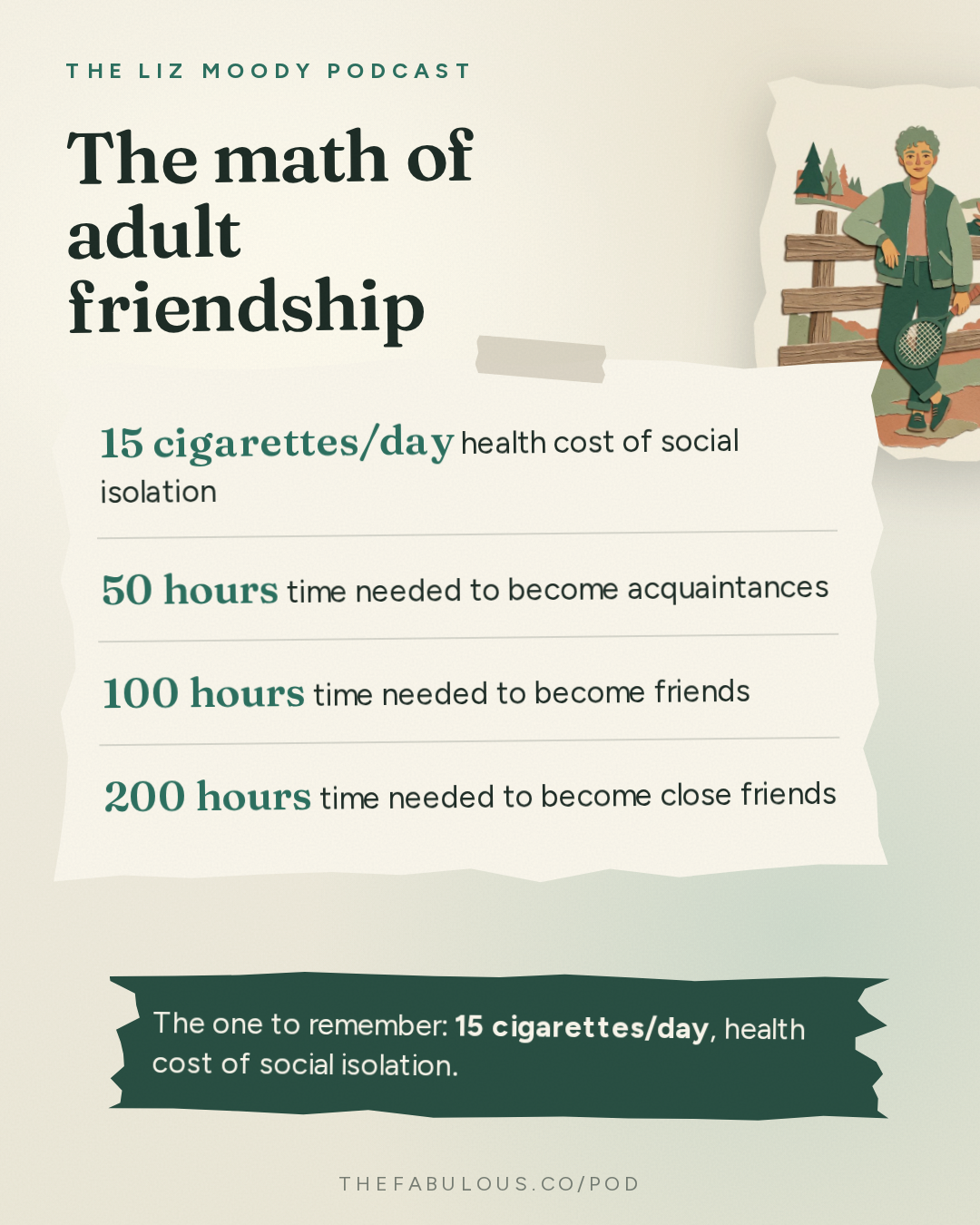
That engine runs on time, and the research gives startlingly specific numbers for how much: roughly 50 hours to become acquaintances, 100 hours to become friends, and 200 hours to become close friends (07:03). Living together or working together is simply the fastest way to bank those hours without ever scheduling a hangout, which is why proximity keeps surfacing as the single strongest predictor in the data.
The second condition is what Moody calls living life together instead of reporting back on life already lived. Watch closely and sitcom characters operate at only two settings: doing absolutely nothing side by side, no pressure to perform, or doing something wild together, a scheme, an adventure, a new core memory. What almost never appears on screen is the thing that eats up most adult friendship time in real life: the forced, structured drink where two people trade status updates.
"They completely skip that forced, structured, let's get a drink and give our status updates phase that makes up 90% of our adult friendships." — Liz Moody [08:58]
The third condition is shared microculture, and it is the one Moody says is most overlooked. Human brains are wired to sort the world into in-groups and out-groups, and the sorting does not need a real basis. In one influential line of research, people randomly assigned to arbitrary groups, say a blue group and a yellow group, still felt more warmth toward their own group and were more willing to disadvantage the other one (10:01). Sitcoms exploit this constantly through invented rituals: the drinking game True American on New Girl, the cosmopolitans in Sex and the City, the running joke on How I Met Your Mother where characters salute and repeat "major trouble" (10:24). None of these are meaningful on their own. What they build is a private language, and a private language is what makes a group feel like a group.
The uncomfortable part is the point
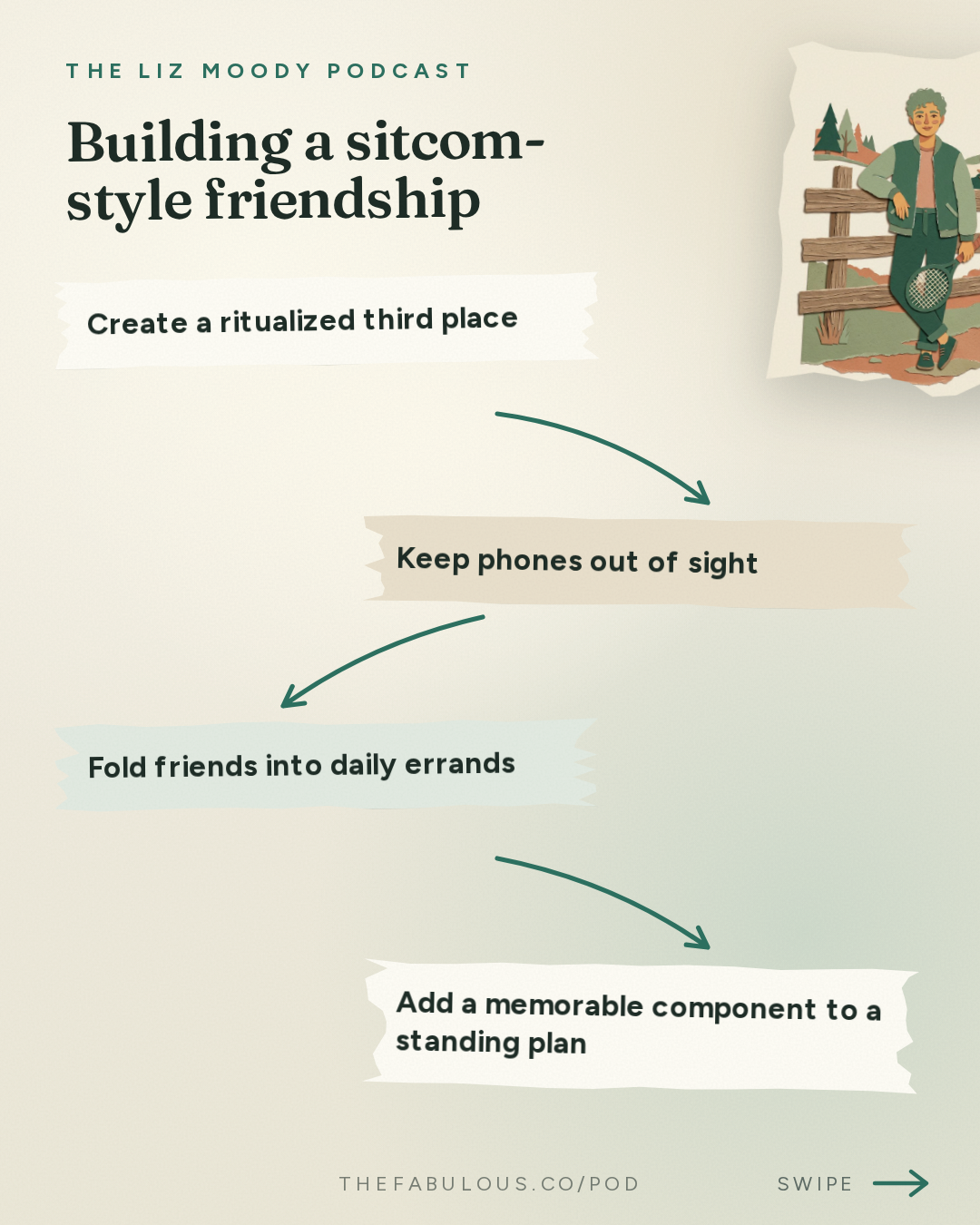
Knowing the three conditions is the easy half. The harder half is that rebuilding them requires doing things that feel slightly inconvenient on purpose, which is where Moody's five-step plan for what she calls a sitcom friend fall comes in. Step one is choosing a ritualized third place, a standing coffee shop or gym session at a fixed day and time, like her own weekly Wednesday gym date with a friend, so that hours accumulate without anyone negotiating a calendar (12:24). Step two is what she calls face-down phone theory: even a phone lying screen-down on the table pulls a sliver of attention away from the person in front of us, which measurably reduces how connected and how fun the interaction feels (19:41). Step three is folding friends into errands already on the calendar, a Trader Joe's run or a DMV trip, rather than waiting for a dedicated slot that never arrives (21:26). Step four is engineering a microculture on purpose through what she calls a micro ritual: a standing plan plus one memorable, repeatable component, such as turning a monthly dinner into a book club, or a coffee date into an article-sharing session (24:12). Step five is allowing friends to see the unglamorous version of daily life: the messy apartment, the bad mood, the un-styled hair.
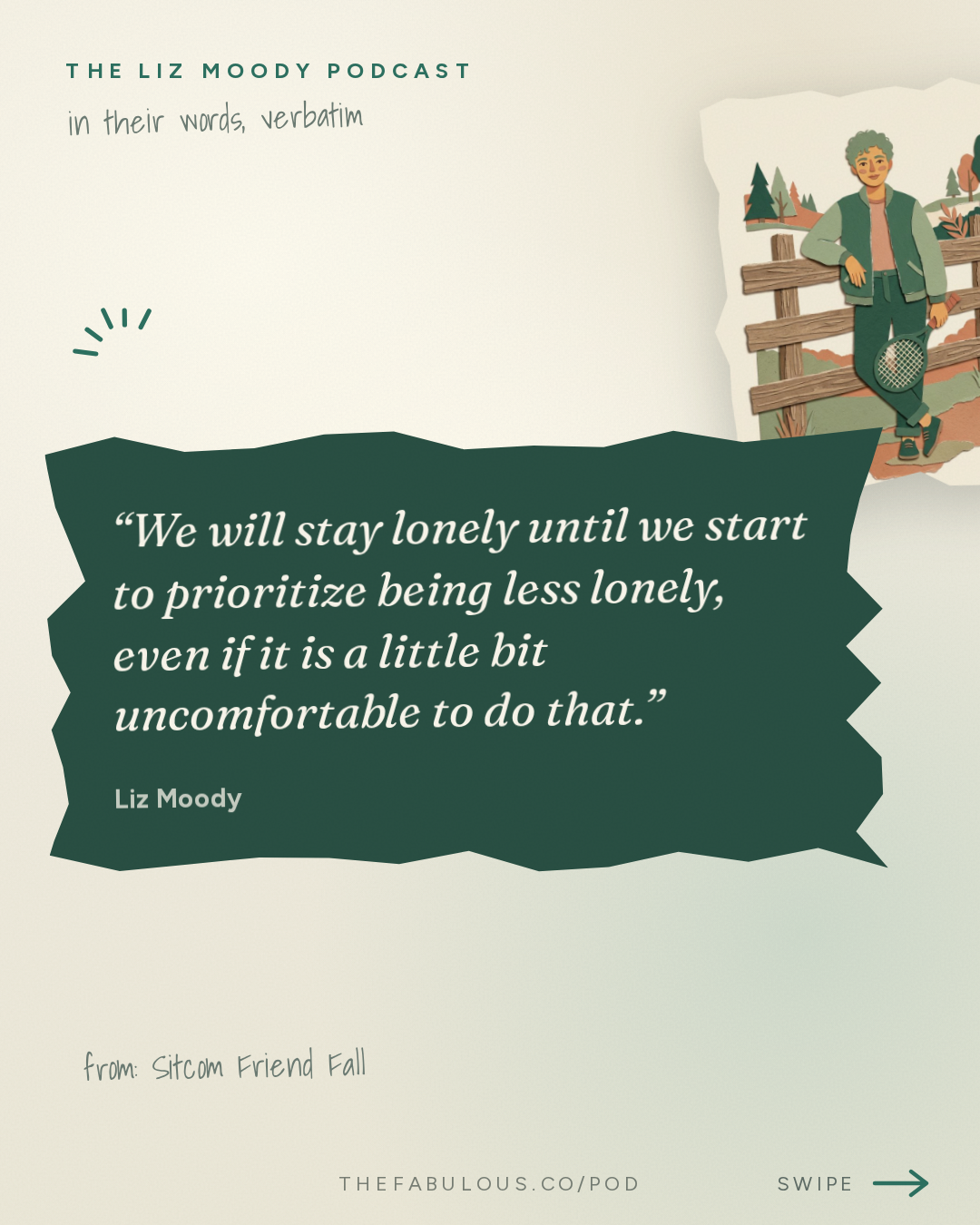
"We will stay lonely until we start to prioritize being less lonely, even if it is a little bit uncomfortable to do that." — Liz Moody [13:34]
That last point deserves a beat, because it is the least intuitive piece of advice in the episode and possibly the most important. The instinct when a friend comes over is to clean up, to look presentable, to perform an upbeat version of ourselves. Moody argues that instinct works directly against intimacy. Sitcom characters bond precisely because they catch each other at the bad moments, the messy apartment, the meltdown before opening night, the friend who shows up uninvited and finds someone in a robe eating cereal. Trying to shift into a sparkly, on version of ourselves for company, she says, is exactly the habit to break.
"Don't try to shift your emotional state so that you can be on, and sparkly, and bubbly for them. Show them how you actually feel." — Liz Moody [29:22]
None of this requires moving in with anyone, although Moody admits, half-joking, that living in a commune remains a personal long-term goal. What she is proposing instead is a set of small, repeatable substitutes for proximity: a standing plan, a phone left in another room, an errand turned into company, a private joke deliberately cultivated, and a willingness to be seen unfiltered. Every one of these traces back to the same underlying mechanism, hours logged together under low-pressure conditions, which is the actual raw material that mere exposure, in-group bonding, and shared history are built from.
What makes the argument land is how ordinary the fixes are. Nobody is being asked to become funnier or more interesting. The friend who nagged Moody into this research is the same friend she still had to text-negotiate a date with, two months out. The fix she is proposing is not a personality upgrade. It is a schedule change: one standing Wednesday, one open door on a Monday, one phone left in a bag. The sitcoms make it look effortless because the writers compressed years of proximity into thirty minutes. The actual work, this episode argues, is just showing up on the same Tuesday, at the same coffee shop, often enough that the hours quietly add up.
By the numbers
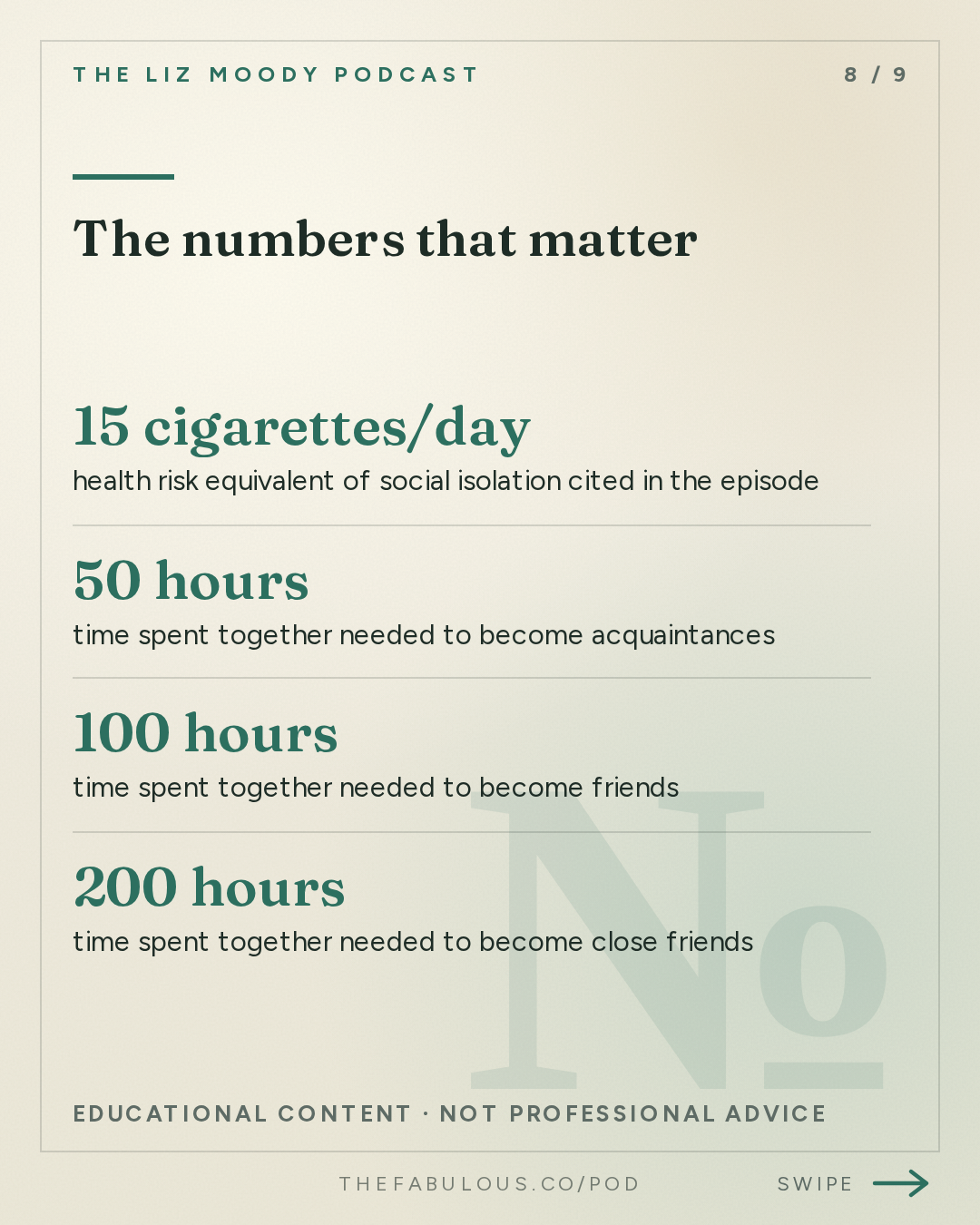
- 15 cigarettes/day health risk equivalent of social isolation cited in the episode
- 50 hours time spent together needed to become acquaintances
- 100 hours time spent together needed to become friends
- 200 hours time spent together needed to become close friends
In their words
“Friendships, more than vibes, are about conditions.”
“They completely skip that forced, structured, let's get a drink and give our status updates phase that makes up 90% of our adult friendships.”
“We will stay lonely until we start to prioritize being less lonely, even if it is a little bit uncomfortable to do that.”
“Don't try to shift your emotional state so that you can be on, and sparkly, and bubbly for them. Show them how you actually feel”
Protocols
-
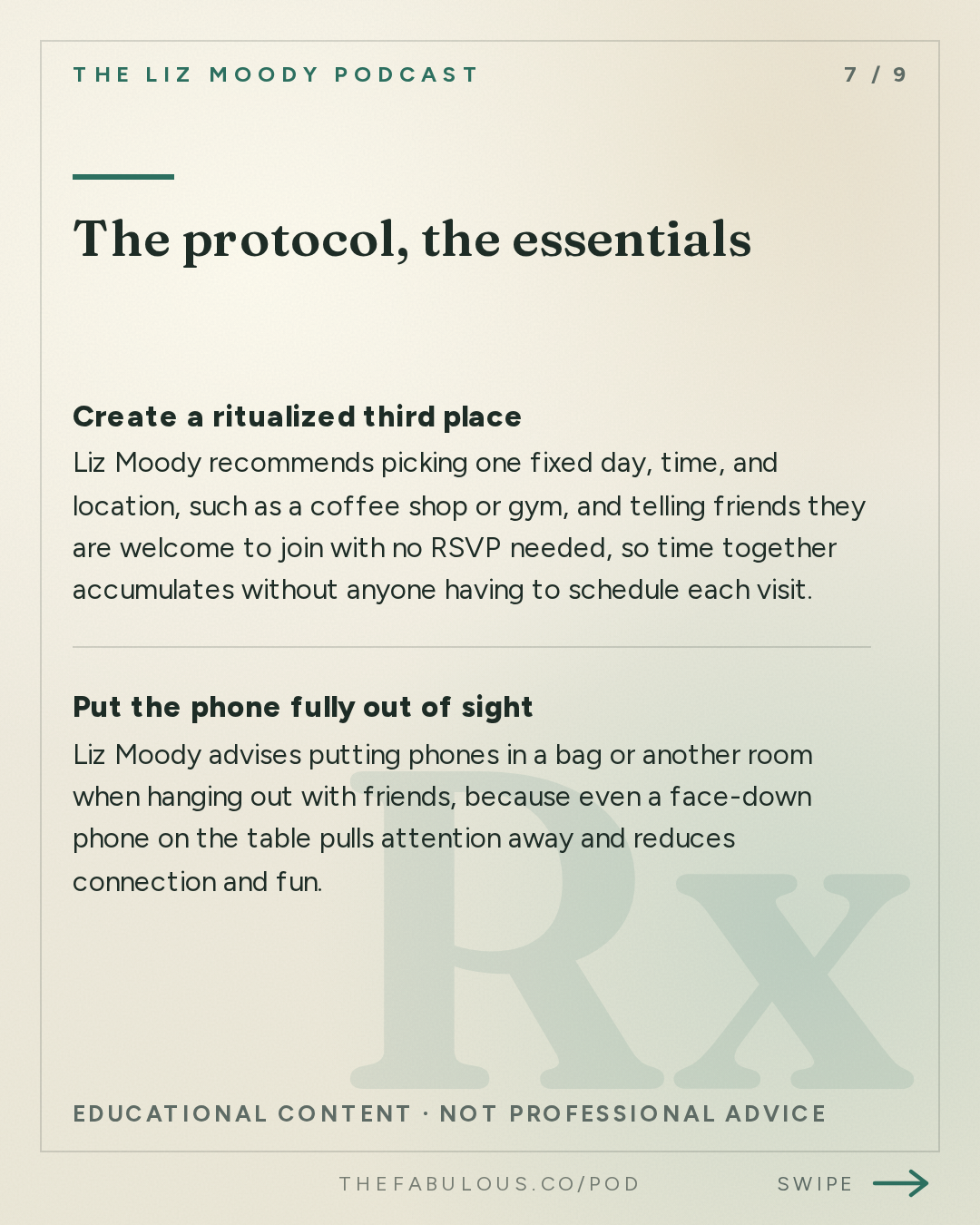
Create a ritualized third place
Liz Moody recommends picking one fixed day, time, and location, such as a coffee shop or gym, and telling friends they are welcome to join with no RSVP needed, so time together accumulates without anyone having to schedule each visit.
Weekly
-
Put the phone fully out of sight
Liz Moody advises putting phones in a bag or another room when hanging out with friends, because even a face-down phone on the table pulls attention away and reduces connection and fun.
Every hangout
-
Fold friends into errands instead of waiting for free time
Liz Moody suggests inviting a friend along to routine tasks already on the calendar, such as a Trader Joe's run or a gym session, rather than waiting for a dedicated hangout slot.
As errands come up
-
Build a micro ritual to create shared microculture
Liz Moody recommends pairing a standing plan with one memorable, repeatable component, such as turning a monthly dinner into a themed book club, so the group develops in-jokes and a shared language over time.
Monthly or as scheduled
Questions this episode answers
How many hours does it take to become close friends with someone?
Research cited in the episode puts it at about 50 hours to become acquaintances, 100 hours to become friends, and 200 hours to become close friends (07:03). Living together or seeing someone on a fixed weekly schedule is how those hours accumulate fastest, according to Liz Moody.
Is loneliness actually bad for physical health?
The episode cites research showing social isolation carries a health risk comparable to smoking 15 cigarettes a day (03:26). Liz Moody frames this as the reason friendship deserves real prioritization, not just nostalgia for sitcom-style bonds.
Does having my phone on the table hurt my conversations?
Yes. The episode cites findings that a visible phone, even face down and even with the screen off, pulls attention away from the person present and reduces connection and enjoyment (19:41). Liz Moody calls this face-down phone theory and recommends putting the phone in a bag or another room entirely.
Why do sitcom friend groups feel closer than real-life friendships?
Liz Moody argues it comes down to three conditions rather than luck: physical proximity, living life together instead of just catching up, and shared in-jokes or microcultures (04:41, 07:44, 09:25). Dorm proximity research from Dartmouth found closeness predicted friendship better than shared interests (06:19).
What is a micro ritual and how does it build a friend group's culture?
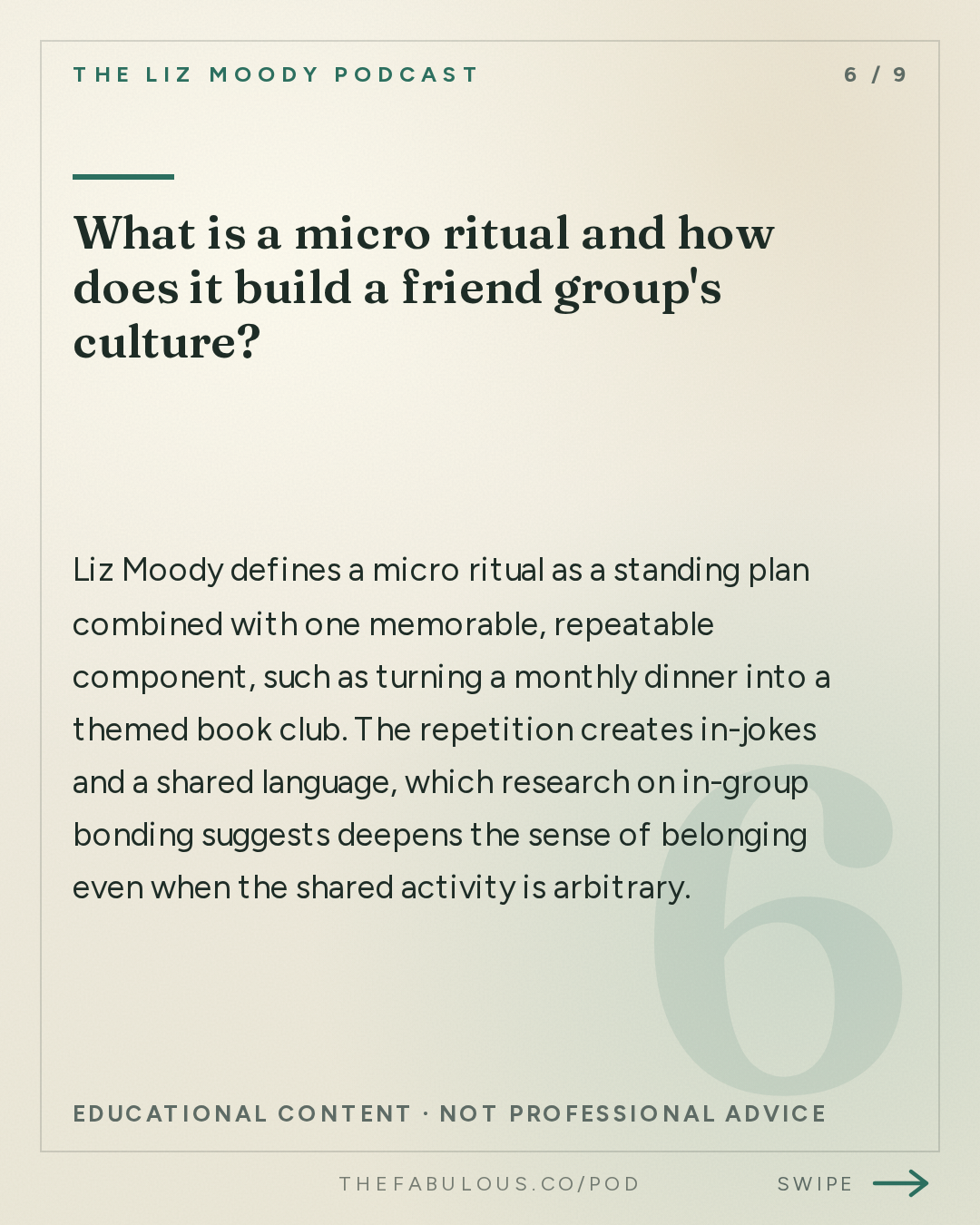
Liz Moody defines a micro ritual as a standing plan combined with one memorable, repeatable component, such as turning a monthly dinner into a themed book club (24:12). The repetition creates in-jokes and a shared language, which research on in-group bonding suggests deepens the sense of belonging even when the shared activity is arbitrary (10:01).
The full read, in cards
Go deeper
- Dartmouth dorm proximity study — found dorm room proximity predicted college friendship more strongly than shared interests or background
- Research on hours required to form friendships — found it takes about 50 hours to become acquaintances, 100 for friends, and 200 for close friends
- Minimal group / in-group bias research — found people assigned to arbitrary groups still favored their own group and disadvantaged the other
Mentioned
Liz Moody · Dartmouth · Friends · New Girl · How I Met Your Mother · Sex and the City · Schitt's Creek · Adults
More from this show and category
How to Share the Mental Load With Your Partner
Mental load coach Zach Watson says men often confuse doing a chore with owning it, and that sharing the mental load makes men happier too. He recommends the Fair Play card system, weekly 'build meetings,' and naming emotions precisely to cut defensiveness and split invisible labor fairly.

How to Stop Living Paycheck to Paycheck
Vivian Tu, a former JP Morgan trader known online as your rich BFF, argues that living paycheck to paycheck is a system problem, not a willpower problem. She lays out a pay-yourself-first savings rule, the avalanche method for debt, a formula for calculating financial independence, and why automating money beats relying on discipline.
Body Language Tricks for Instant Confidence
Behavioral researcher Vanessa Van Edwards explains how tiny, testable body-language and language cues (ear-to-shoulder distance, hand steeples, priming words) shift how confident and likable people perceive us, and how an A-B-C-D task audit stops burnout by clarifying which work and relationships actually deserve energy.
Mel Robbins' Let Them Theory for Difficult People
Mel Robbins' Me, We, Them framework redirects relationship stress toward the one variable anyone can control: their own reaction. She names three habits that wreck relationships (expecting others to change, letting their behavior dictate your mood, assuming they 'should' know what you need) and offers a script from therapist Terry Real for saying the hard thing without blame.
