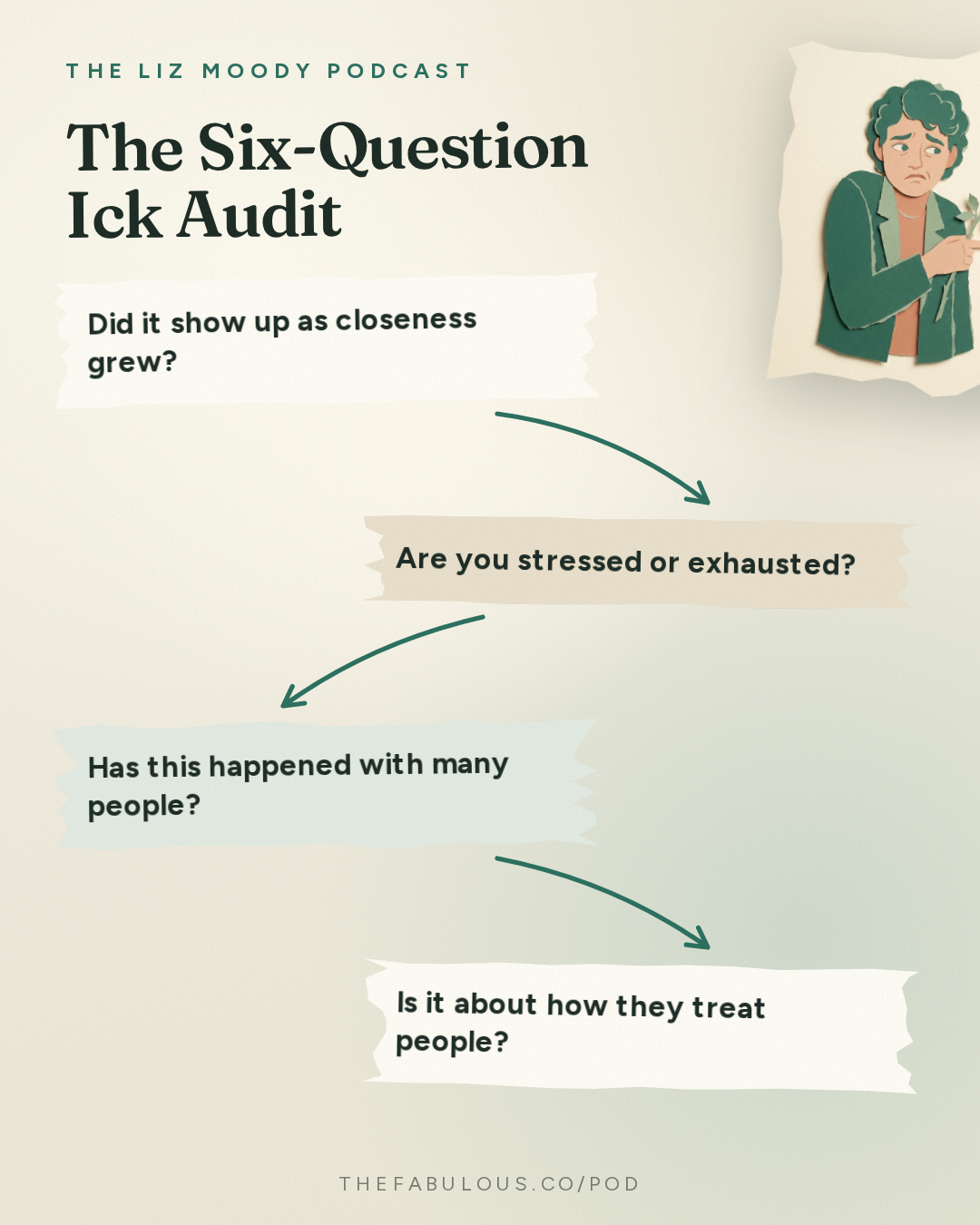
The Science of Getting the Ick, Explained
Why You Get The Ick (The Science Of Disgust In Love & Friendship)
▶ Listen to the full episode More from The Liz Moody Podcast
The brief
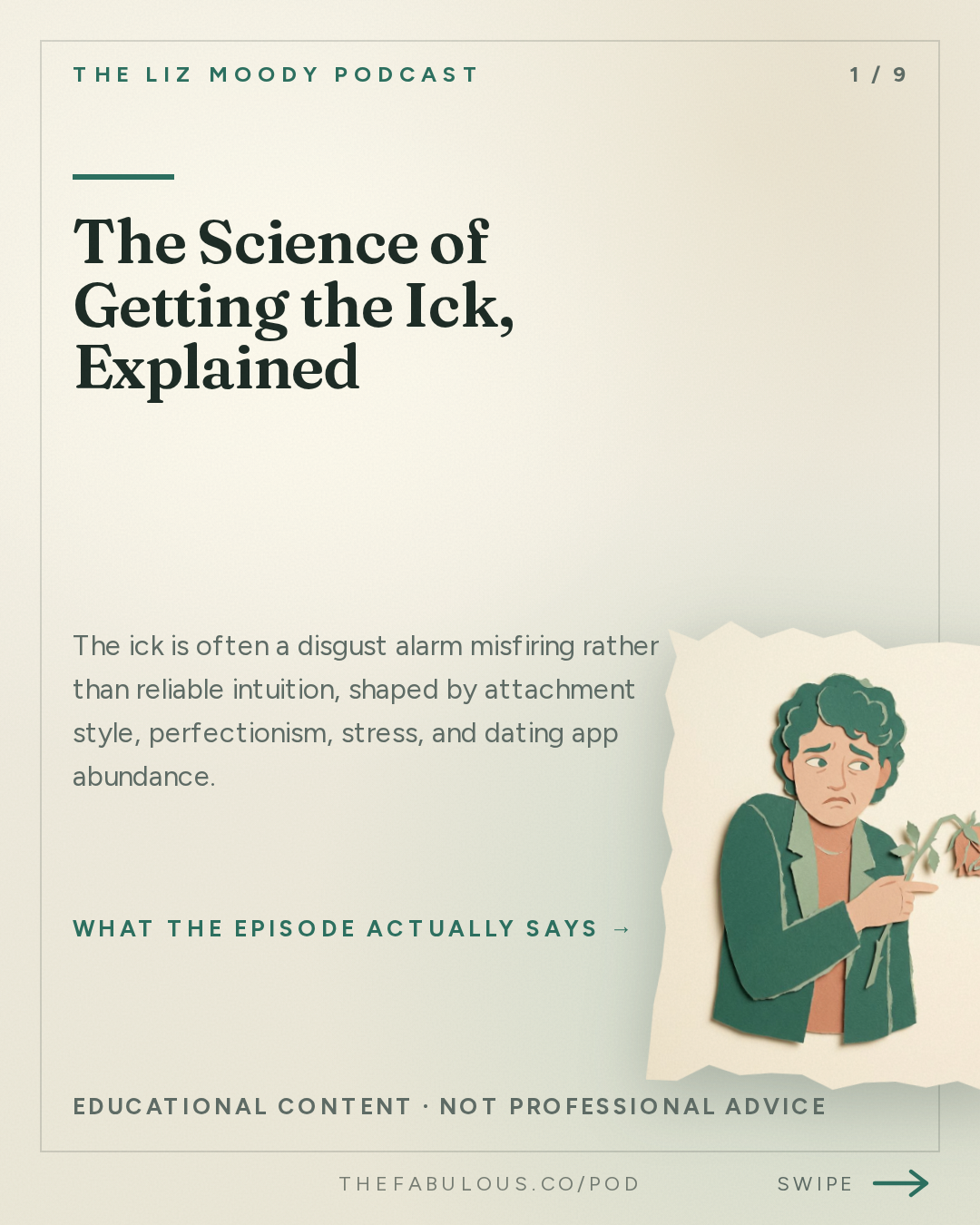
The ick is often a disgust alarm misfiring rather than reliable intuition, shaped by attachment style, perfectionism, stress, and dating app abundance. Liz Moody's six-question audit and research from the Gottmans suggest love filters out minor annoyances, while moral icks, like rudeness to strangers, are the ones worth trusting.
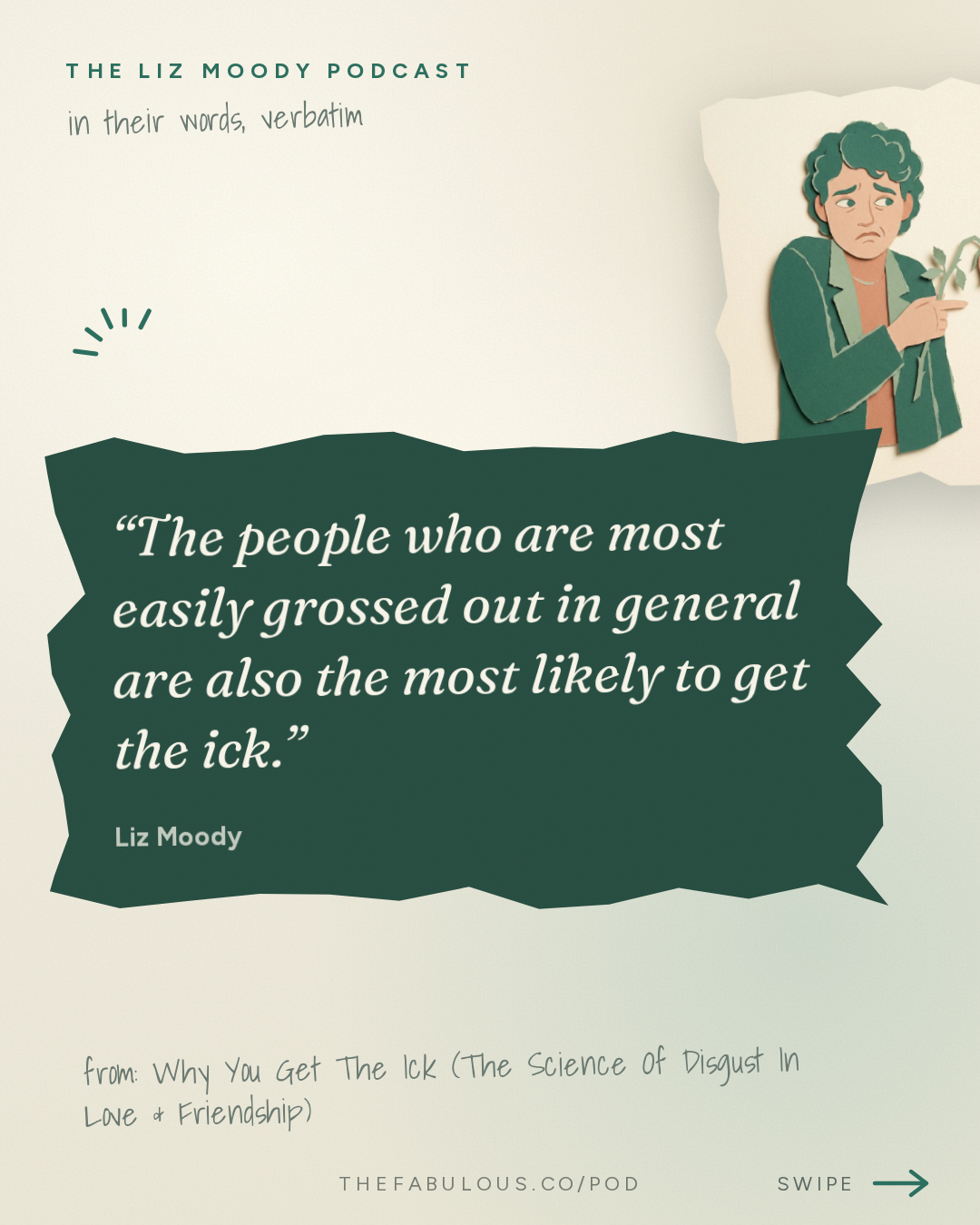
Somewhere between a shrug and a breakup sits a feeling most people cannot quite name: the ick, that sudden lurch of disgust at a person who, a minute ago, was perfectly kissable. Podcast host Liz Moody asked 700,000 listeners to describe theirs (00:00). The answers ranged from a golf stance to rudeness toward a waiter, and they led her to the first peer-reviewed study of the phenomenon, which defines the ick simply as a sudden feeling of disgust (01:03). The study's first finding is almost too obvious to be satisfying: people who are generally easier to gross out are also more likely to get the ick (01:21). Moody's own marriage supplies the control group. She has a lower disgust threshold than her husband Zach, which is why he, not she, cleans up after the cat (01:28).
Disgust, it turns out, is not one emotion but three, each with its own job. Pathogen disgust keeps people away from raw chicken, vomit, and anything that might carry disease (02:16). Sexual disgust is tuned to flag traits that would make someone a poor evolutionary bet as a mate (02:42). Moral disgust is the one that keeps a society from falling apart: it fires when someone lies, cheats, or steals (03:06). Mapped onto dating life, too much tongue during a kiss reads as sexual disgust, rudeness to a waiter reads as moral disgust, and chewing with an open mouth reads as pathogen disgust (03:27). The system works. The trouble is that the alarm is calibrated for a world of real pathogens and real threats to group survival, and it goes off just as readily for far smaller things.
"The alarm for disgust in our brain is way too sensitive. It's like that smoke alarm in your hallway that goes off whenever you lightly burn your toast." (Liz Moody, [04:15])
Moody names four reasons the alarm misfires. The first is attachment style, the pattern formed in childhood that shapes how safe or unsafe closeness feels. People who lean avoidant experience closeness itself as a kind of danger, and when a relationship starts to feel safe, the nervous system can respond by hunting for a flaw, something to justify pulling back (05:18).
"When that happens, your nervous system will often look for a flaw in the other person so that you have a reason to pull back so that you can feel safe." (Liz Moody, [05:18])
The second reason is perfectionism. The same peer-reviewed study found that people who score higher on perfectionism are considerably more likely to get the ick, because they are already primed to spot flaws, in themselves and in everyone else (06:45). The study's authors put it plainly: the ick may be less about genuine incompatibility and more about unrealistic expectations (07:00). The third reason is simple abundance. One study on dating apps found that the odds of accepting a profile dropped 27 percent between the first profile a person viewed and the last, meaning swipers get close to a third pickier as they go (08:20). More perceived options make smaller flaws feel more disqualifying. The fourth reason is stress, which Moody says shuts down the part of the brain that thinks critically and also the part that can read real intuition. Until the nervous system settles, what feels like a gut feeling is often just anxiety wearing a disguise (09:28).
"If our nervous system is not in a state of relaxation, it is almost impossible to trust our gut because our gut is so frequently misfiring with anxiety." (Liz Moody, [09:39])
Moody argues that at least three of these four dials have been turned up by modern life. Constant visibility, the sense of being perceived at all times online, raises the pressure to be flawless and makes other people's imperfections feel less tolerable by comparison (15:44). An endless stream of dating-app profiles manufactures a feeling of infinite option (16:09). And a life spent reading news and worrying, rather than acting, keeps thoughts circling in the anxious, self-referential loops the brain produces when it is not occupied with a task, what researchers call the default mode network (17:00). None of this means the present is harder than the past in absolute terms. It means the specific flavor of modern difficulty, mostly cognitive rather than physical, is unusually good at keeping the nervous system keyed up, which is exactly the condition under which the ick alarm misfires most.
The Override Switch
There is, however, a counterforce, and it is almost embarrassingly simple: love. Citing research from the Gottmans, the married psychologists known for decades of research on marriage, Moody describes a filter effect: when a couple is doing well, minor annoyances get reclassified as quirks (18:15). A sock on the floor in a happy marriage is cute. In an unhappy one, the same sock becomes evidence that a partner is selfish. The effect shows up elsewhere too. Mothers rate their own baby's dirty diaper as far less disgusting than a stranger's baby's diaper (19:00), which suggests the filter is not really about the object at all. It is about the relationship surrounding the object.
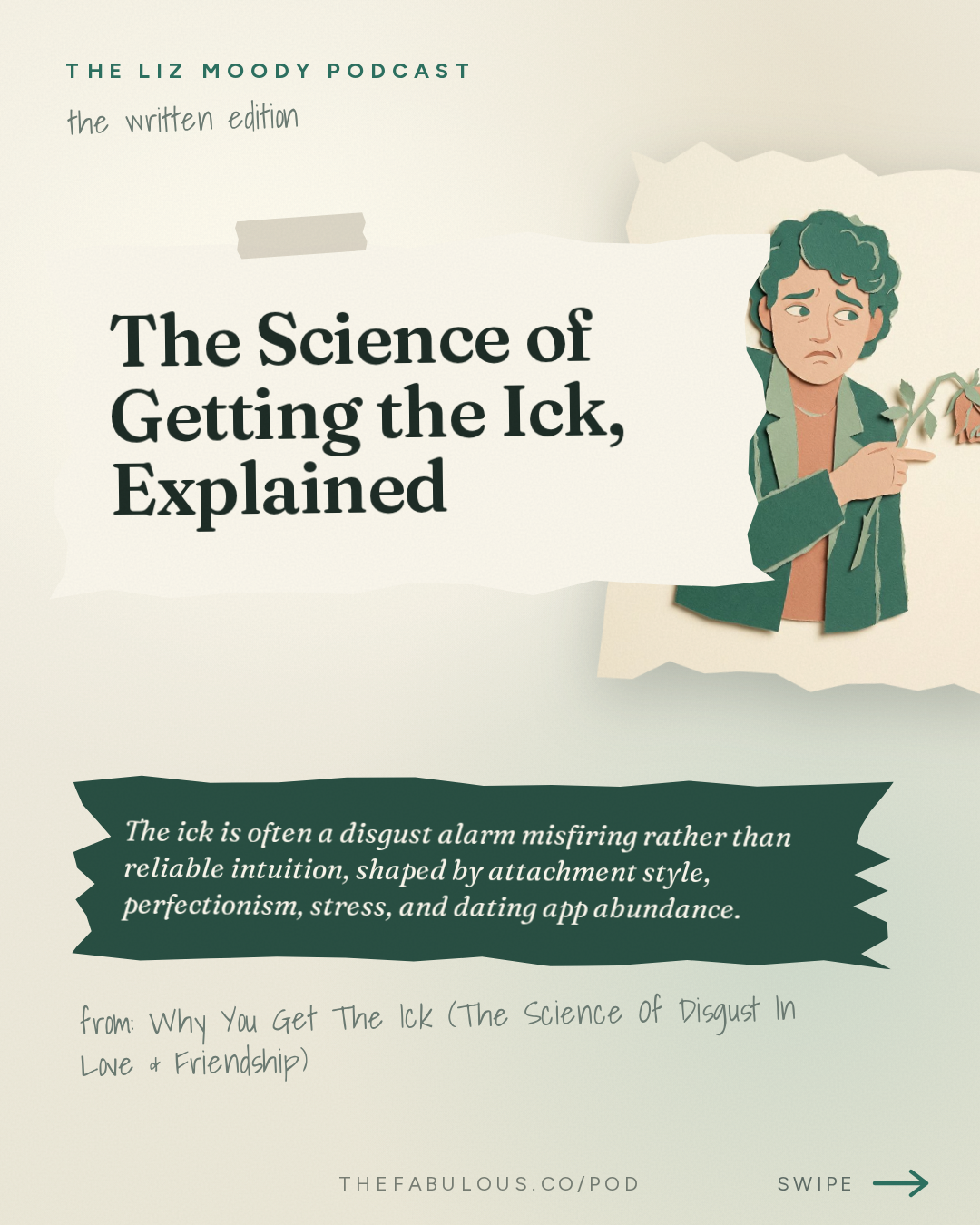
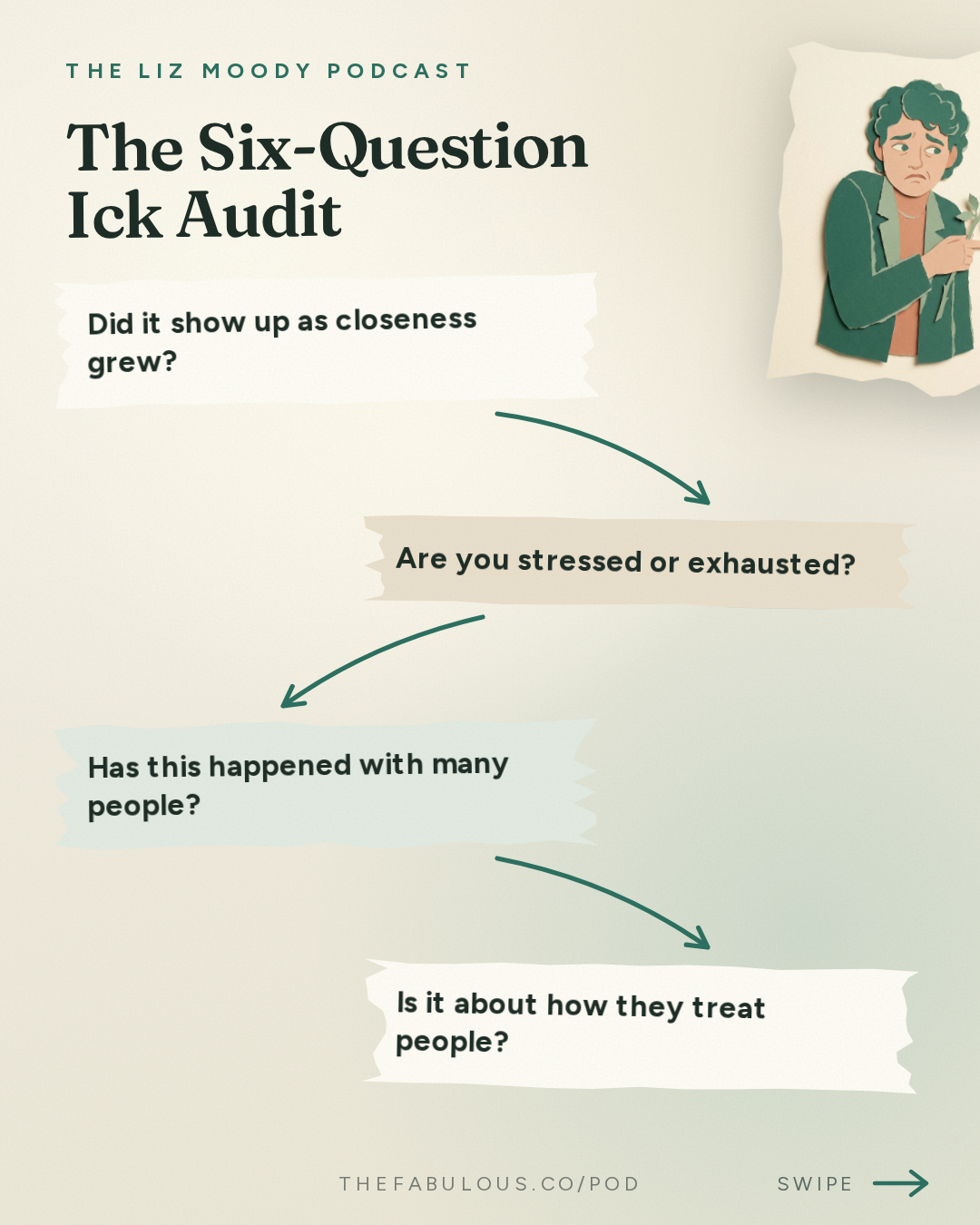
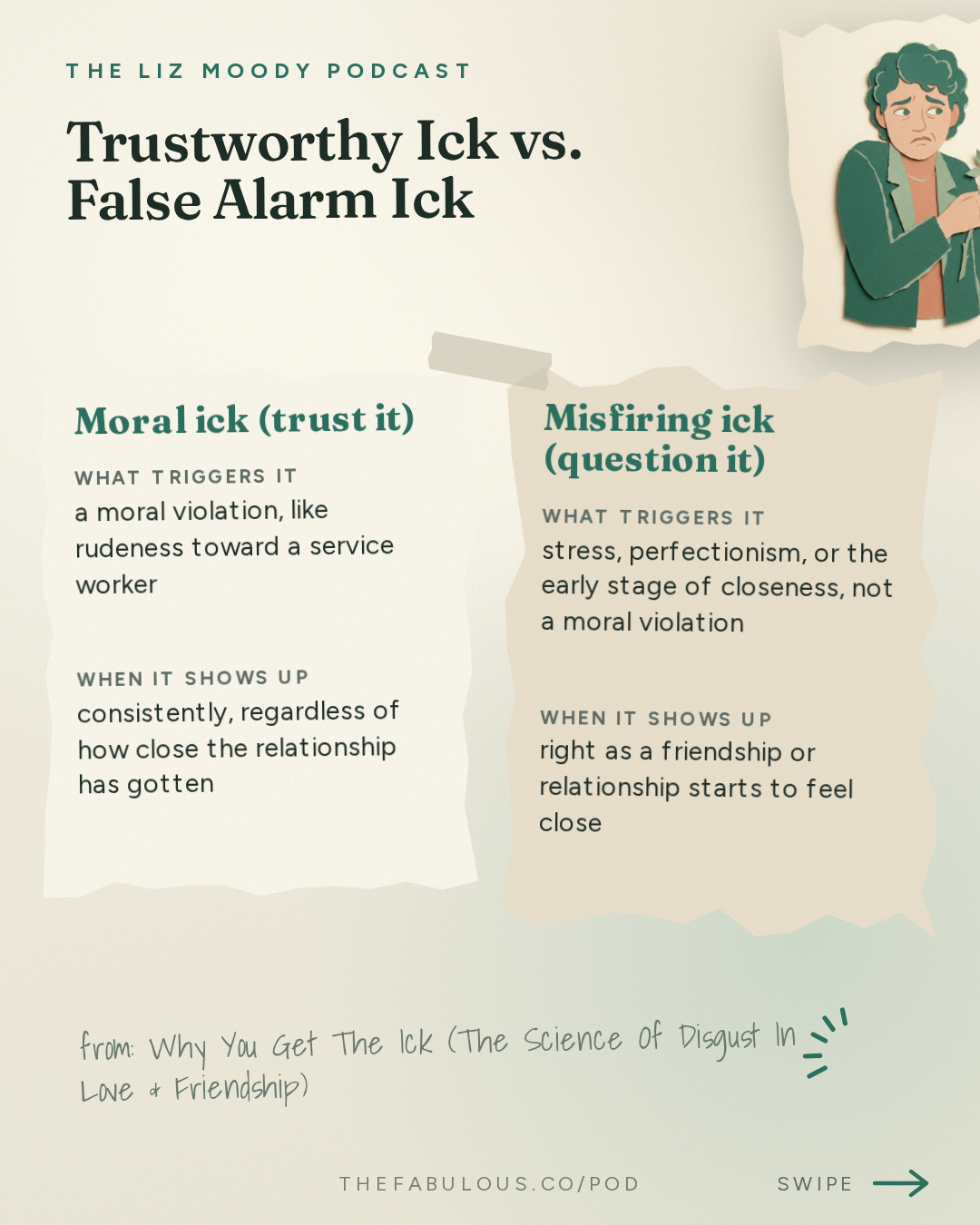
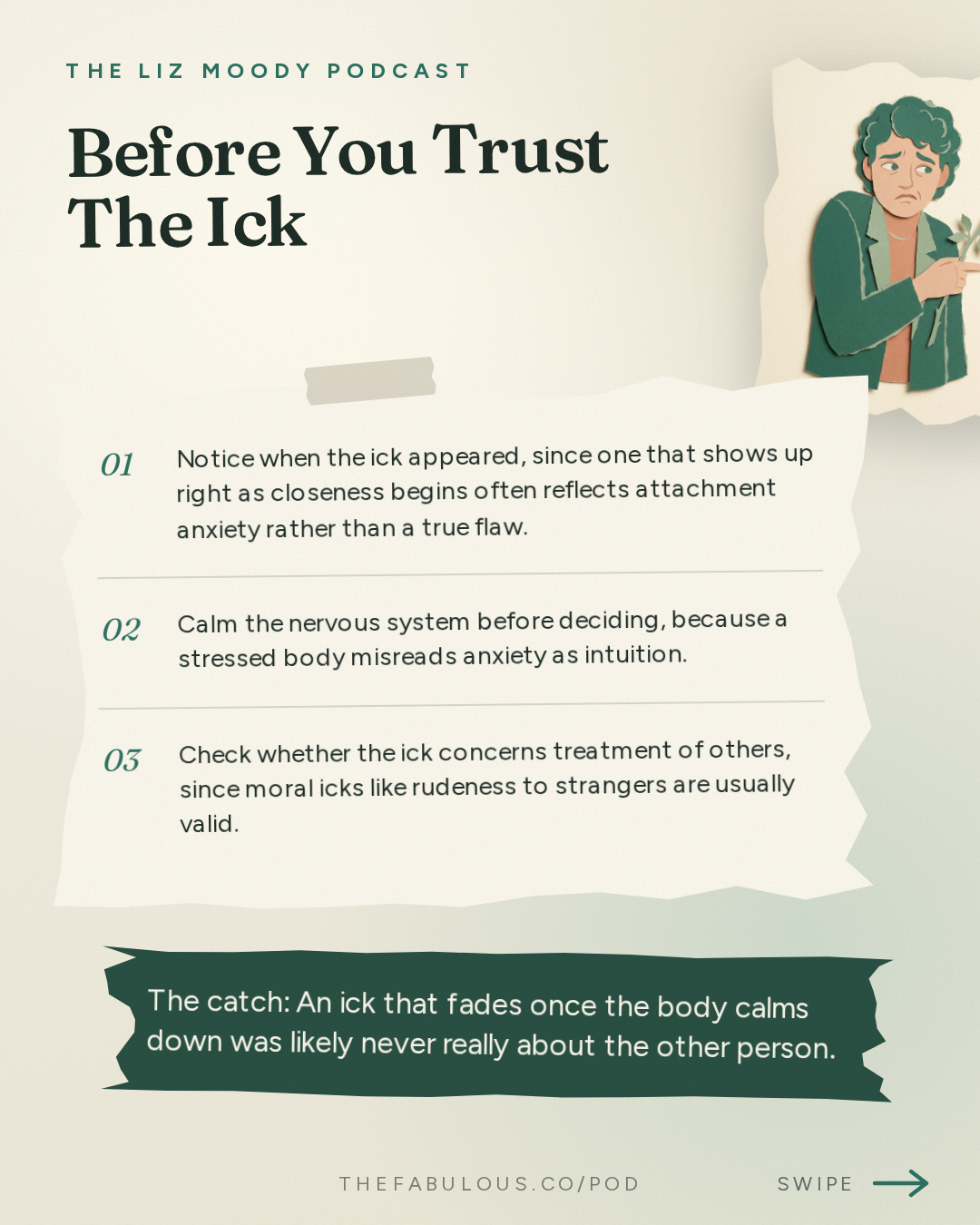
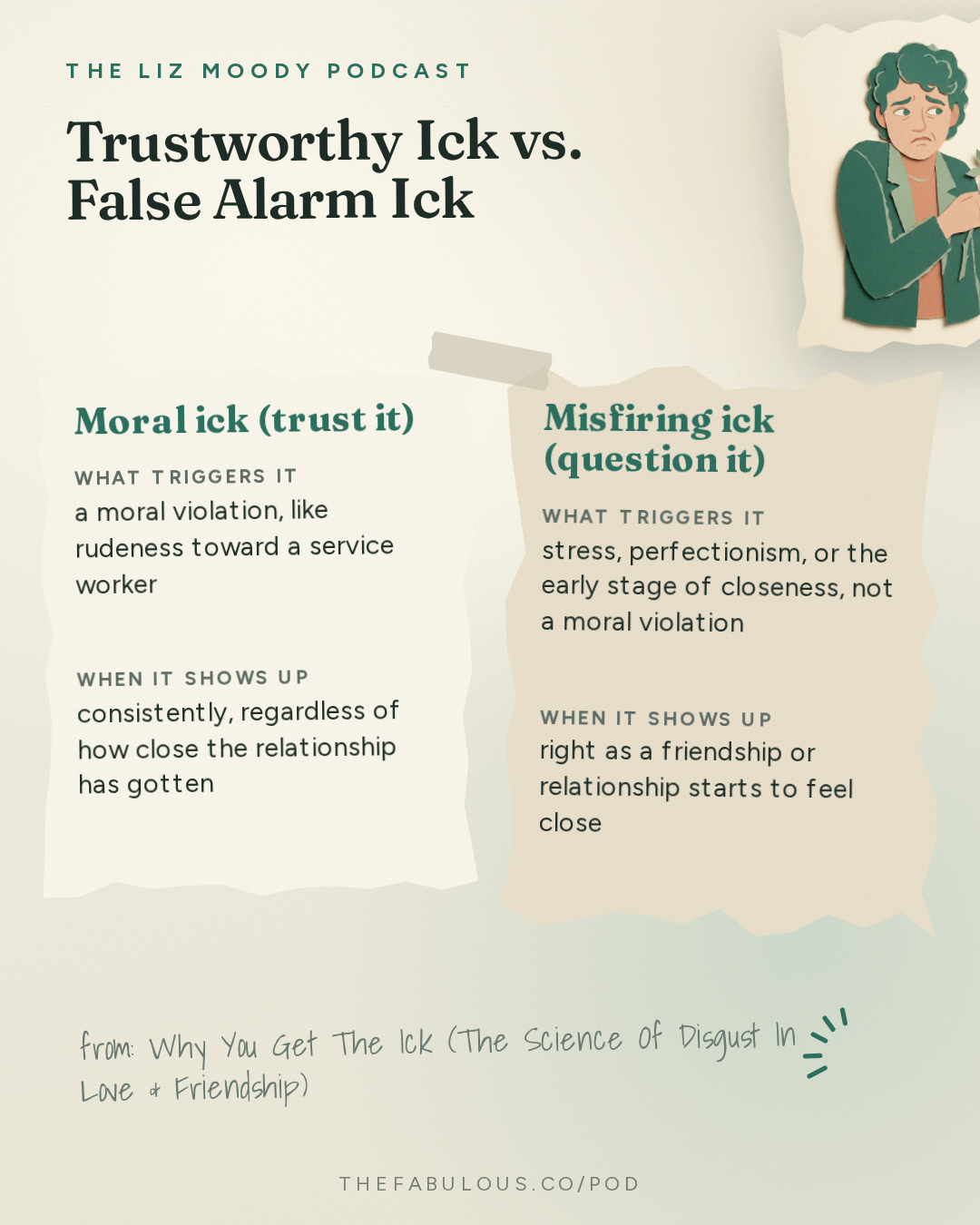
Moody turns all of this into a practical audit, six questions to run before deciding whether an ick is signal or noise (20:20). Did it appear right as the relationship started to feel close, which points toward attachment anxiety rather than a real flaw (20:32)? Is the nervous system stressed, overwhelmed, or exhausted right now, in which case the feeling should wait until it calms down (21:14)? Has this been happening with a lot of different people lately, which can point to perfectionism or too many options (21:59)? Is the ick about how someone treats other people, since moral icks, like rudeness toward a service worker, are the ones worth taking seriously (22:20)? Can the trait change, and is the person willing to try, given that communication and respect matter more than the trait itself (24:18)? And if the trait is permanent, could it be lived with happily, turned from an ick into a quirk (25:10)?
The fourth question leans on a striking finding. The largest study ever conducted on relationship happiness pooled 11,000 couples across 43 separate studies and found that a partner's individual personality accounted for as little as 5 percent of how happy someone is in the relationship (23:09). What mattered far more was how much appreciation a person felt, how conflict got managed, and how committed the partner seemed, in other words, treatment rather than traits. That is one reason Moody treats moral icks differently from the rest: someone careless with a stranger's dignity is giving information about how they manage power, and power is the thing partners actually live inside.
"Every time you get an ick, that actually is important information. But it might not just be information about the person that you are getting the ick about." (Liz Moody, [25:33])
That reversal is the real argument of the episode. The ick is not a lie detector aimed outward. It is a readout of a nervous system, tuned by a childhood, a stress level, a number of open tabs on a dating app, and whether love has been allowed to do its filtering work. Treated that way, disgust stops being a verdict on a partner and starts being a question about the self, one worth answering honestly before it answers for a relationship that a calmer week might have saved.
Ask this episode anything
Pod's AI answers from the episode itself, with the minute mark so you can hear it yourself.
Or start with one of these
Ask this episode
Pod's AI listens to the whole episode to answer, and points you to the minute it comes from.
The rest of this answer, and any question after it
Answers come from the episode itself, never from a summary of it.
ContinueKey takeaways
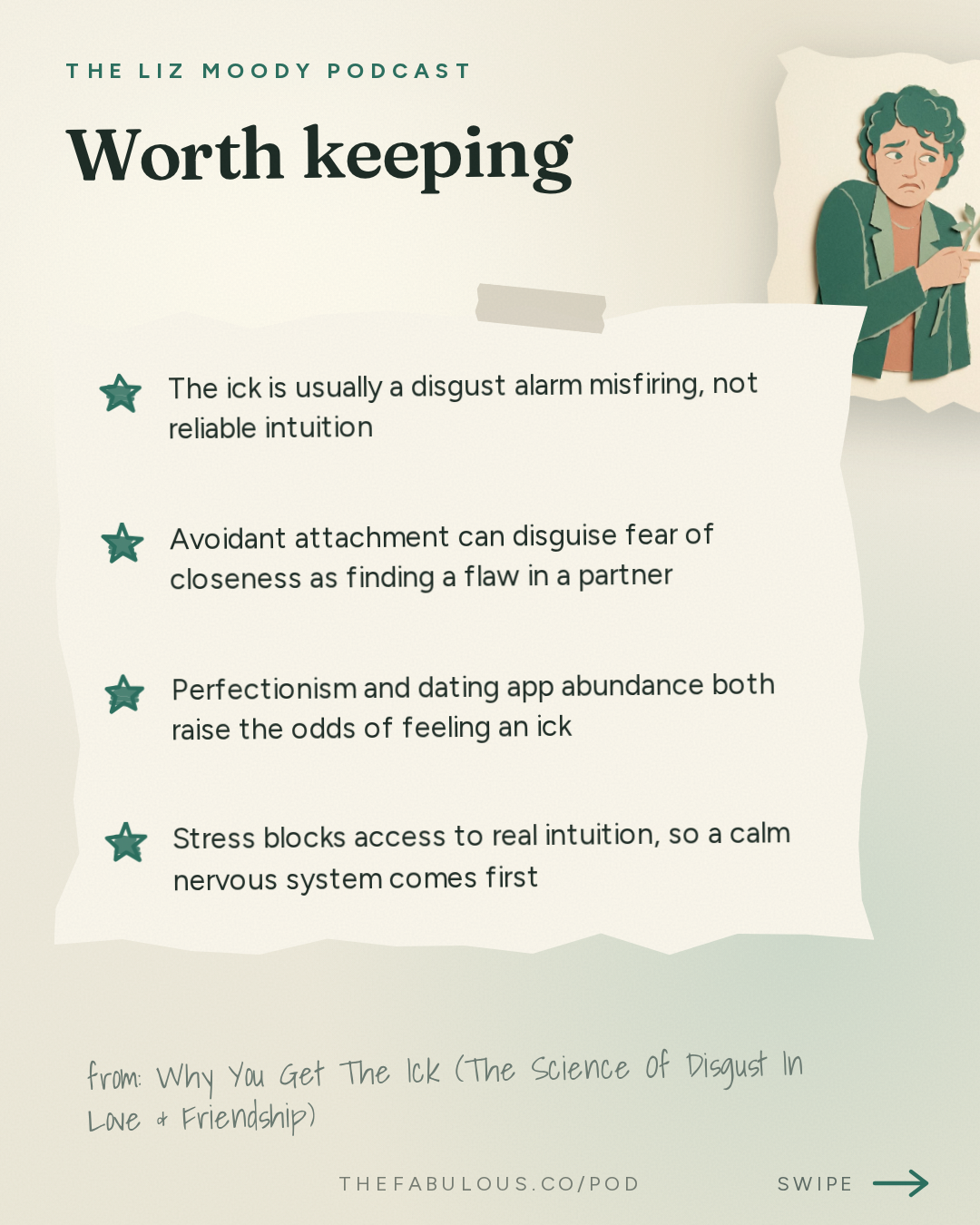
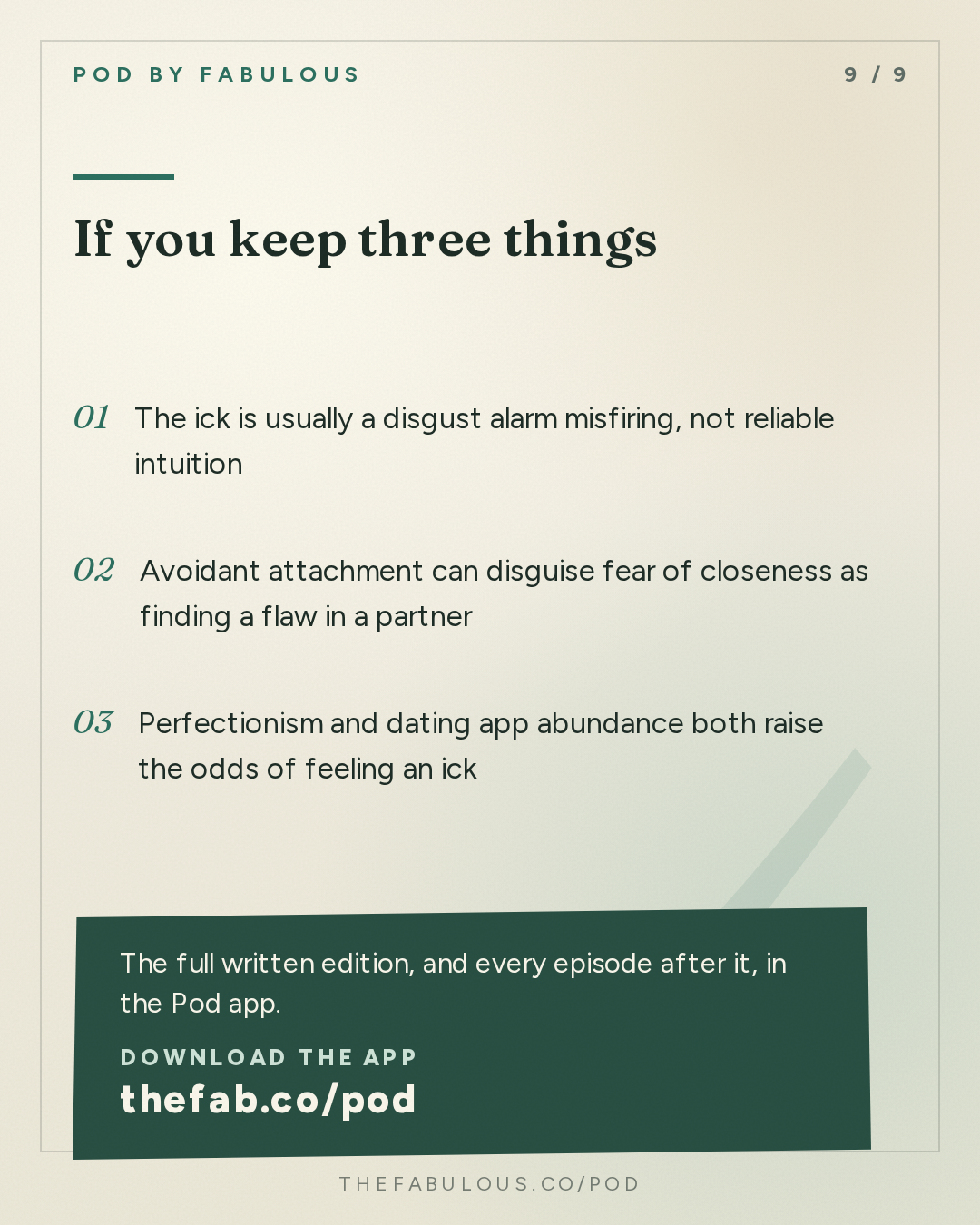
- The ick is usually a disgust alarm misfiring, not reliable intuition
- Avoidant attachment can disguise fear of closeness as finding a flaw in a partner
- Perfectionism and dating app abundance both raise the odds of feeling an ick
- Stress blocks access to real intuition, so a calm nervous system comes first
- Moral icks, like rudeness to strangers, are the ones worth trusting as red flags
The episode in cards
By the numbers
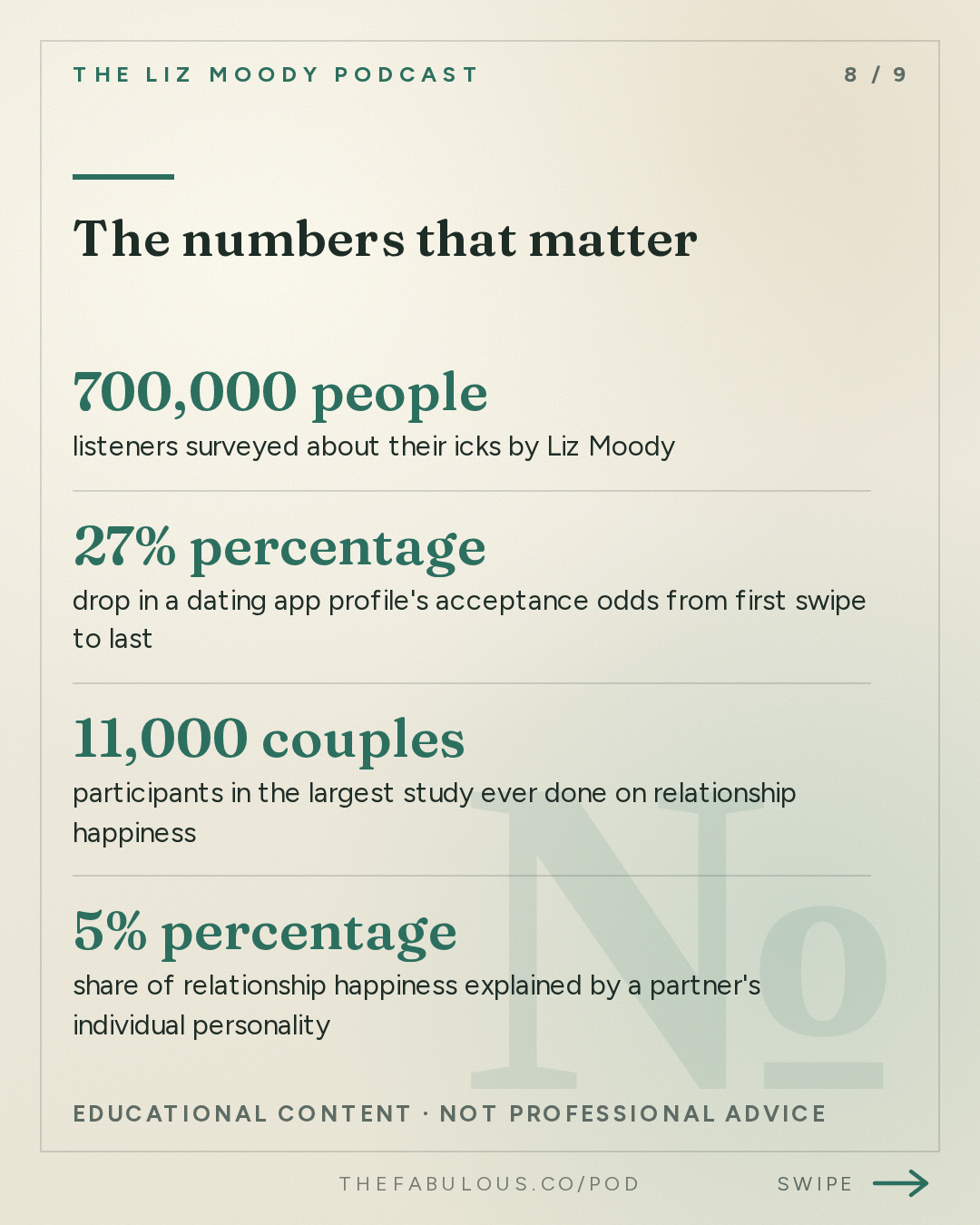
- 700,000 people listeners surveyed about their icks by Liz Moody
- 27% percentage drop in a dating app profile's acceptance odds from first swipe to last
- 11,000 couples participants in the largest study ever done on relationship happiness
- 5% percentage share of relationship happiness explained by a partner's individual personality
In their words
“The people who are most easily grossed out in general are also the most likely to get the ick.”
“The alarm for disgust in our brain is way too sensitive. It's like that smoke alarm in your hallway that goes off whenever you lightly burn your toast.”
“When that happens, your nervous system will often look for a flaw in the other person so that you have a reason to pull back so that you can feel safe.”
“If our nervous system is not in a state of relaxation, it is almost impossible to trust our gut because our gut is so frequently misfiring with anxiety.”
“Every time you get an ick, that actually is important information. But it might not just be information about the person that you are getting the ick about.”
Protocols
-
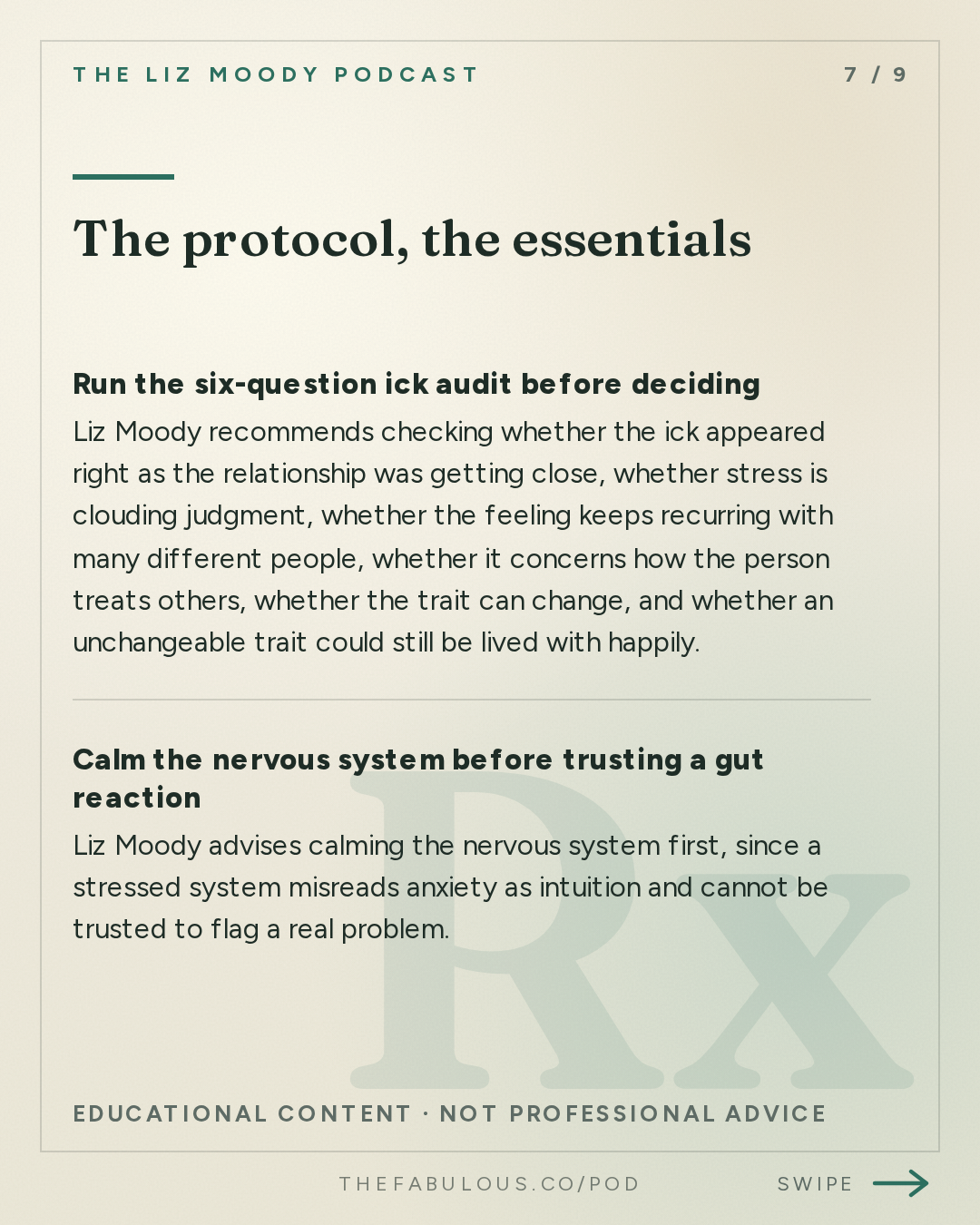
Run the six-question ick audit before deciding
Liz Moody recommends checking whether the ick appeared right as the relationship was getting close, whether stress is clouding judgment, whether the feeling keeps recurring with many different people, whether it concerns how the person treats others, whether the trait can change, and whether an unchangeable trait could still be lived with happily.
Any time an ick appears
-
Calm the nervous system before trusting a gut reaction
Liz Moody advises calming the nervous system first, since a stressed system misreads anxiety as intuition and cannot be trusted to flag a real problem.
Whenever feeling stressed, overwhelmed, or exhausted
-
Treat moral icks as red flags worth listening to
Liz Moody says an ick about how someone treats a service worker or another person is a moral signal worth taking seriously, since that person may eventually treat a partner the same way.
When the ick involves someone's treatment of others
Questions this episode answers
What does it mean when you get the ick?
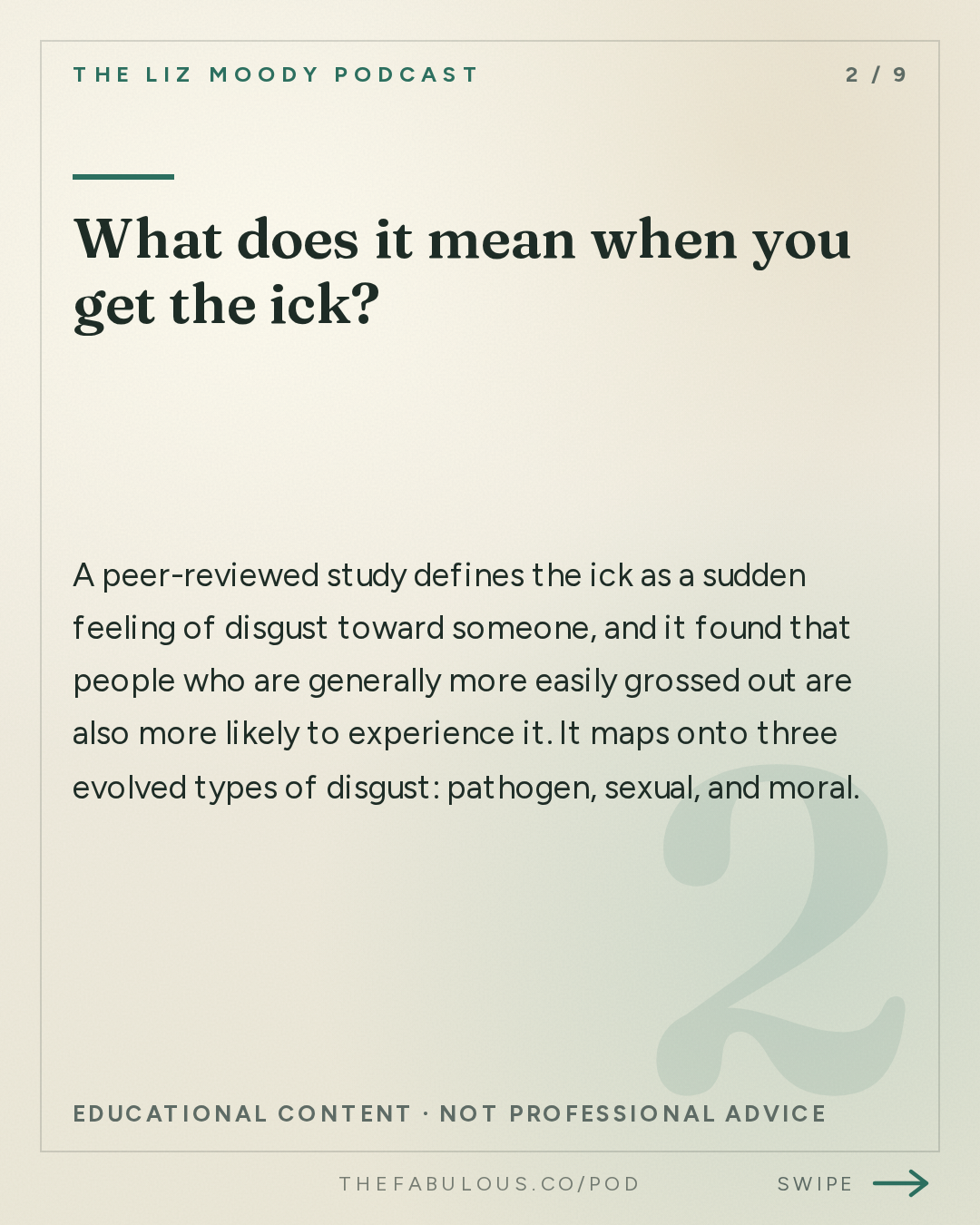
A peer-reviewed study defines the ick as a sudden feeling of disgust toward someone, and it found that people who are generally more easily grossed out are also more likely to experience it (01:21). It maps onto three evolved types of disgust: pathogen, sexual, and moral (02:16).
Is the ick always a sign of real incompatibility?
Not necessarily. The study's authors note the ick may reflect unrealistic expectations rather than genuine incompatibility, especially in people high in perfectionism (07:00). Host Liz Moody argues the feeling is often a misfiring alarm rather than reliable intuition (04:15).
Can avoidant attachment cause the ick?
Liz Moody explains that for people who lean avoidantly attached, closeness can register as danger, which can lead the nervous system to search for a flaw in a partner as a reason to pull back (05:18). An ick that appears right as a relationship deepens is one sign of this pattern (20:32).
Does dating app abundance make the ick worse?
One study cited in the episode found the chance of accepting a dating profile dropped 27 percent from the first profile swiped to the last, meaning people get close to a third pickier as options pile up (08:20). More perceived options can make small flaws feel more disqualifying.
How do you know if an ick is worth listening to?
Liz Moody offers a six-question audit covering timing, stress level, frequency across people, whether it involves treatment of others, changeability, and whether a permanent trait could be lived with happily (20:20). Moral icks, like rudeness to a service worker, are the ones she says are usually valid red flags (22:20).
Does a partner's personality determine relationship happiness?
The largest study ever done on relationship happiness, covering 11,000 couples across 43 studies, found a partner's individual personality explains only 5 percent of how happy someone is in the relationship (23:09). Appreciation, conflict management, and perceived commitment mattered far more.
The full read, in cards
Go deeper
- First peer-reviewed study of the ick — defined the ick as a sudden feeling of disgust and linked it to general disgust sensitivity and perfectionism
- Gottman research on marital satisfaction — found that couples who feel good in a marriage filter minor annoyances into quirks rather than complaints
- Largest relationship-happiness meta-analysis — pooled 11,000 couples across 43 studies and found a partner's individual personality explains only 5 percent of relationship happiness
Mentioned
Liz Moody · Zach · The Gottmans · Yale · Columbia
More from this show and category
Sun Exposure Science: Rowan Jacobsen Interview
Outdoor workers face lower melanoma death rates than indoor workers, a finding that upends decades of sun-avoidance advice. Science journalist Rowan Jacobsen argues that sunlight lowers blood pressure, calms the immune system, and treats depression, while vitamin D pills fail to match those benefits, so moderate daily exposure may do more good than harm for most skin types.
Ellen Vora: Heal Gut, Hormones, Anxiety
Psychiatrist Ellen Vora says gut, hormone, and anxiety struggles often trace back to suppressed truth, estrogen dominance, and mistaking fear for intuition. She offers concrete fixes: daily bowel habits and magnesium glycinate for hormone balance, and a simple tone-test (intuition is quiet, fear is loud) for telling real guidance from anxious noise.
Is the Male Loneliness Crisis Real?
Pew and Harvard surveys show men and women are equally lonely, debunking the male loneliness crisis narrative. Income is the stronger predictor: adults earning under $40,000 are far more likely to be lonely than those earning over $90,000. Host Liz Moody explains mankeeping, Stanford researcher Angelica Ferrara's term for the unpaid labor women do managing men's social lives.
Marisa Franco's Real Rules of Adult Friendship
Psychologist Marisa Franco grades viral friendship advice from S to F, debunking myths about bad texters and one-sided friends. She recommends assuming people like you, capping new-friend dinners at six to eight guests, and meeting work friends outside the office before a job ends to keep the friendship alive.
