
Kelly McGonigal on the Real Science of Joy
Stanford Joy Expert: Why a Raise, Weight Loss & Your Dream City Won't Make You Happy (And What Will)
▶ Listen to the full episode More from The Liz Moody Podcast
The brief
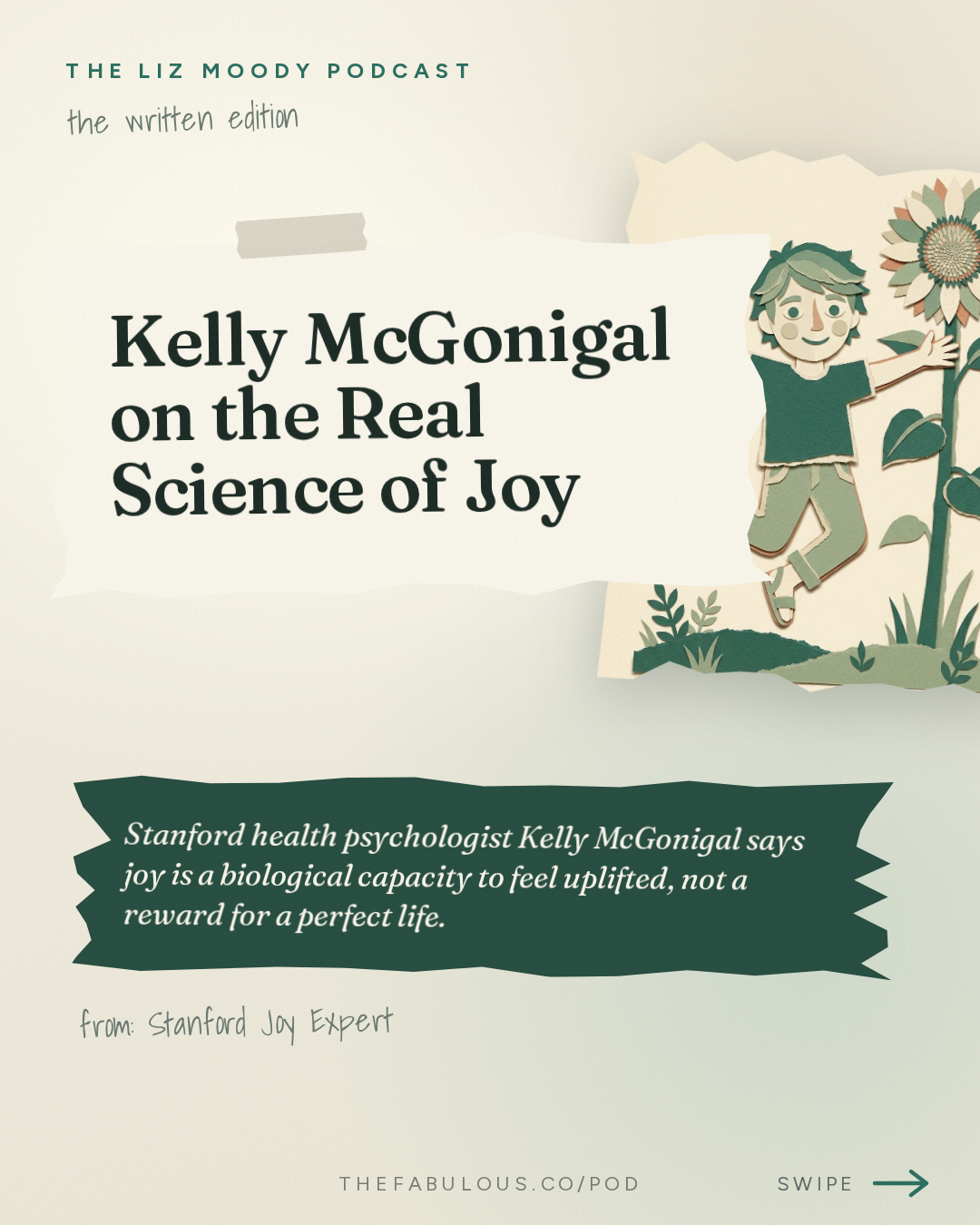
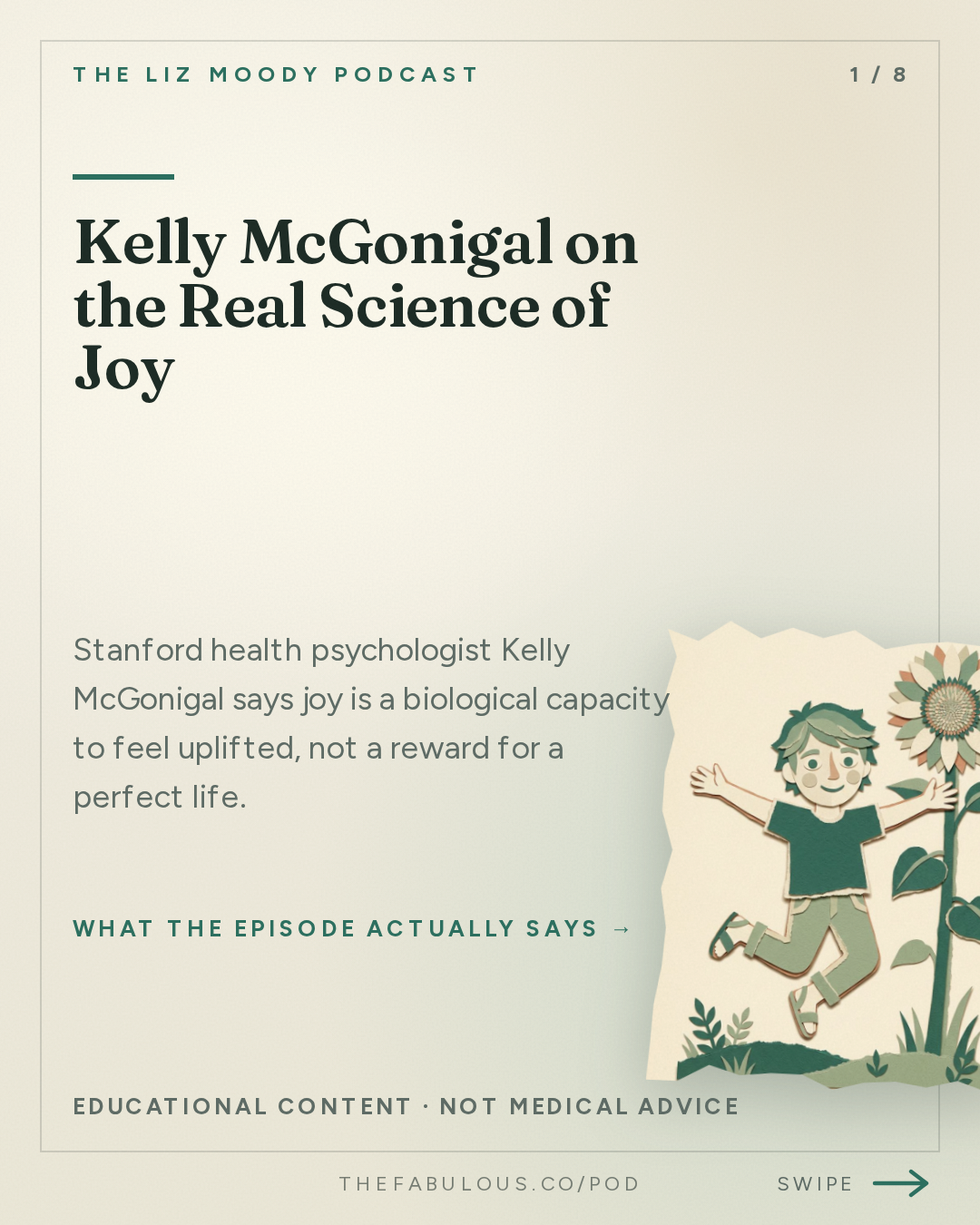
Stanford health psychologist Kelly McGonigal says joy is a biological capacity to feel uplifted, not a reward for a perfect life. A meta-analysis of 93 studies and over 1 million people links joy to five to eight extra years of life, and she says cynicism, not busyness, is the biggest barrier to feeling it.
Somewhere in a laboratory, researchers made a group of people watch comedy until they laughed hard, collected their sweat, and shipped the vials to strangers in another country. The strangers had no idea what they were smelling. They just opened the vial, inhaled, and smiled. Their mood measurably lifted (17:38). That small, strange experiment sits at the center of what Stanford health psychologist Kelly McGonigal wants people to understand about joy: it is not a private feeling that decorates a good life. It is a biological signal, chemical enough to survive a trip overseas in a sealed vial, doing real work in the body whether anyone notices it or not.
McGonigal, author of the new book Joy Is a Risk Worth Taking, has spent years studying what she calls the most common misunderstanding about joy: that it is a reward for a life with no problems in it. Her own definition is closer to the opposite.
"And the way I view joy is that actually it is your capacity to be uplifted by anything that makes life worth living, and it is most important to have that capacity when life is hard." (Kelly McGonigal, 02:17)
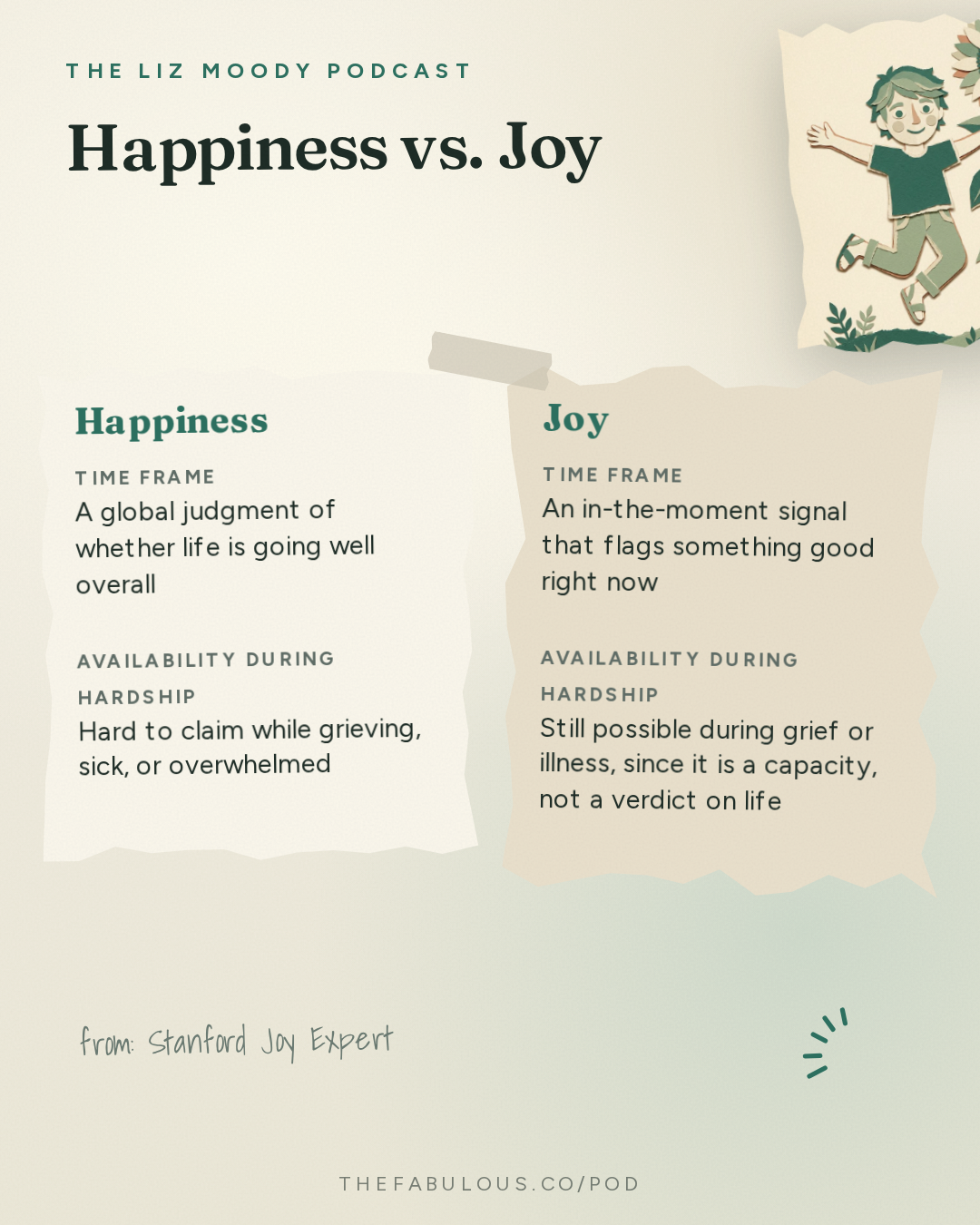
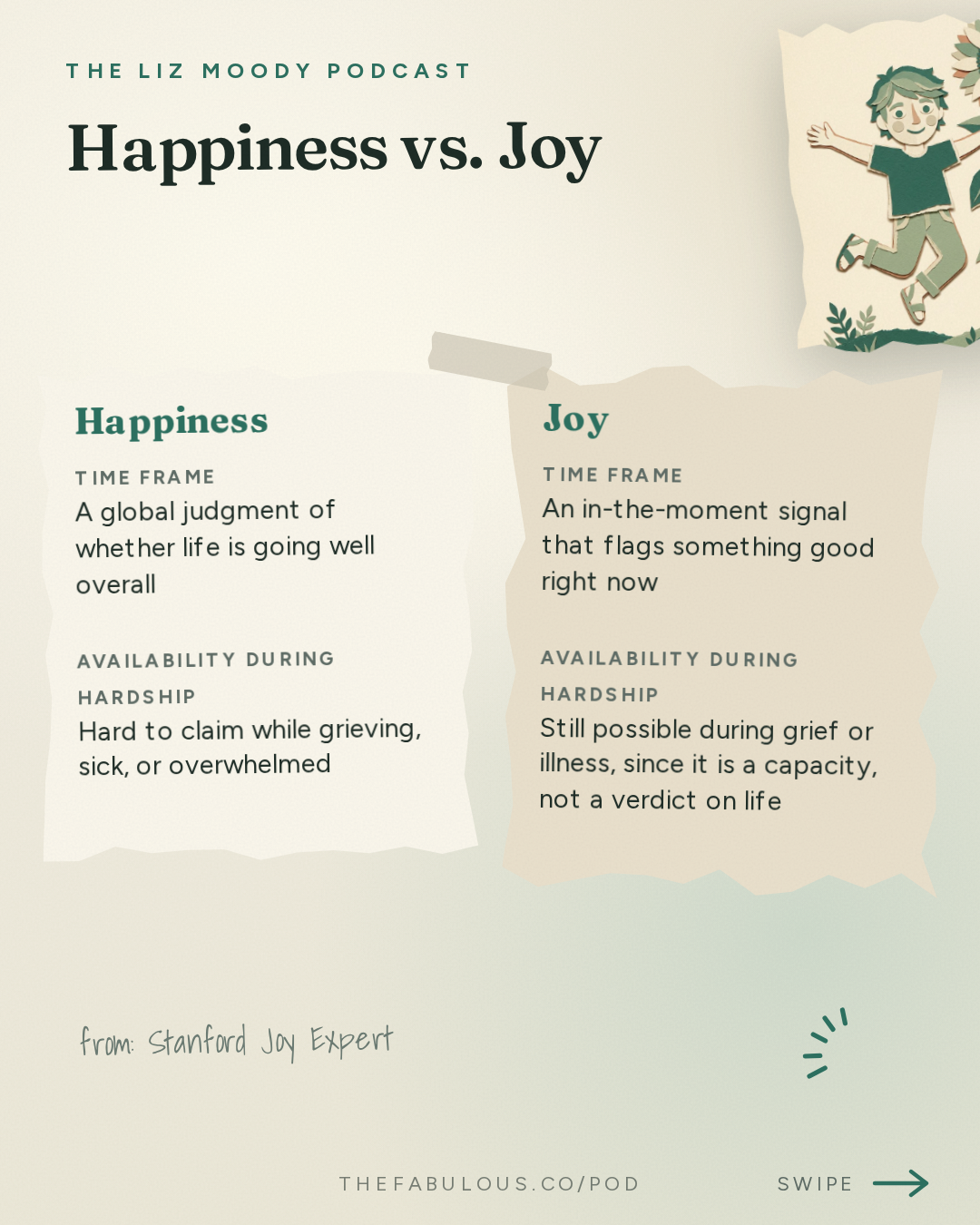
That distinction separates joy from happiness, a word people use interchangeably with it. Ask someone how happy they are, McGonigal says, and they run a kind of global audit of their life: job, health, relationships, the state of the world. It is hard to say "I'm happy" while grieving or sick, even if a moment of real lightness shows up in the middle of that same day (02:40). Joy is smaller and faster. It is a signal, not a verdict, that flares up when the brain registers something good: a bird singing, a kitten running down a hallway, a stranger's kindness.
That signal does more inside the body than casual talk about it suggests. A meta-analysis of 93 longitudinal studies, tracking more than a million people across every continent except Antarctica, found that people who report more joy, measured indirectly through positive emotion, closeness to others, and a sense that life has meaning, are less likely to be dead by the end of the study (25:34, 26:01). The effect held across cultures and health conditions, and it was not distributed evenly: it was largest for people under the most stress. "That joy is gonna act like an antidote," McGonigal says, "a source of resilience that will protect you from some of the harmful health effects... of having such a stressful, difficult life" (27:11). By some estimates, more joy tracks with five to eight additional years of life (29:11).
The Biology Underneath the Feeling
Joy's physical footprint goes beyond longevity statistics. McGonigal describes it as "biologically consequential," in the same category as stress, meaning it visibly changes cardiovascular activity, immune markers, and inflammation (18:58). It can blunt pain: in controlled experiments, the single most effective way to induce joy and reduce physical pain in a lab setting turned out to be music, not comedy (19:58). McGonigal's own father, dying of cancer, found that when medication stopped working, only two things eased his pain: listening to music, and his wife's hand on him while he listened (20:30). "It's the same mechanism of joy," she says, "even though I don't think anyone would look at that and say that's joy" (20:52).
Joy is also, oddly, social in a way most emotions are not. When two people have a good conversation, McGonigal says, their heart rhythms and brain activity start to move in sync, something researchers can measure on monitors and skull caps. She calls it a superorganism state, two nervous systems briefly acting like one (51:06). That syncing depends partly on faces. Smiles and laughter spread person to person when people can see each other's expressions, which is part of why she raises a pointed hypothesis about cosmetic injections: if Botox limits a face's ability to mirror what it sees, it may also dampen the wearer's ability to register other people's distress or joy, since the brain reads emotion partly by unconsciously copying it (52:00).
None of this makes joy an obviously rational investment, which is why McGonigal spends a stretch of the conversation debunking what most people assume will make them happy. Fame and power, she argues, tend to undermine joy rather than deliver it, because status changes the quality of a person's interactions, and genuine connection gets harder to find (32:19). Getting a raise almost never shows up when she asks people to describe a real memory of joy; a promotion or recognition sometimes does, but the raise itself rarely registers (36:17). Losing weight, buying a dream car, retiring: all overrated, in her survey of what people actually remember as joyful. Exercise is underrated. In a research project called the Happy Database, which asked people worldwide what made them happy that day, exercise consistently ranks around sixth, higher than most people would guess (36:50). Nostalgia, done right, is underrated too. McGonigal calls it an existential resource, something that makes it easier to be happy to be alive, as long as the person is reconnecting with something loved rather than comparing the past favorably to a worse present (40:27).
Cynicism, Not Busyness, Is the Real Obstacle
If joy is this available and this useful, why do so many people report feeling locked out of it? McGonigal's research, including thousands of listener responses gathered for the book, turns up a familiar list: no time, exhaustion, grief, chronic pain. But she names a less obvious barrier as the biggest one.
"Cynicism is one of the absolute biggest barriers to joy." (Kelly McGonigal, 46:50)
Cynicism, as she defines it, is the reflex that treats other people's kindness or courage as suspicious, assuming a generous act is secretly a marketing stunt, or that a compliment is obligatory rather than sincere. It feels like realism to the person doing it. McGonigal's counter is almost playful.
"The uncynical version would be to look around at like 40,000 people who have their faces lifted up and inhale some of their joy chemo signals." (Kelly McGonigal, 47:50)
She goes further, citing a study on how much people value joy relative to other emotions. Most adults, given the choice, would want to feel joy every day, more than anger, sadness, or fear. But people who score high on traits like meanness, callousness, and a willingness to exploit others value joy significantly less, and prefer anger, because joy makes people trust each other, and trust gets in the way of exploitation (82:08). "You know who really believes that joy is invaluable?" she says. "Sociopaths" (83:09).
The same logic runs through her most surprising research citation, a study led by psychologist Roy Baumeister that asked people whether their lives felt meaningful, alongside detailed measures of stress: minutes spent worrying, number of major crises endured, day to day overwhelm. Every single measure of stress correlated positively with a sense that life had meaning (84:23). McGonigal says the finding forced her to give up a tidy story she had been telling herself as a psychologist, that the goal was to help people minimize stress. "You can't achieve a meaningful life by trying to avoid stress," she says. "The things in life that make life worth living also often involve a lot of stress" (85:10).
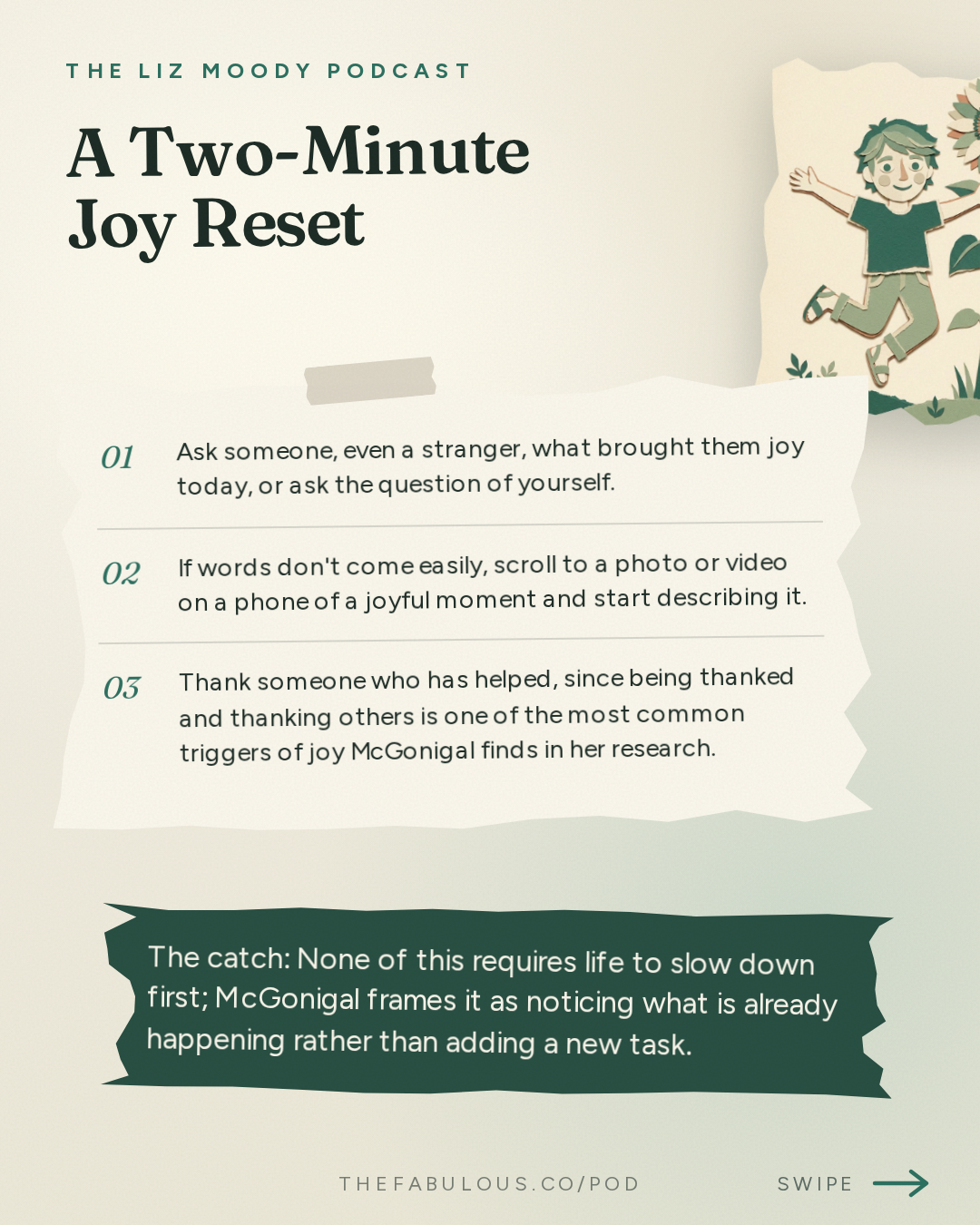
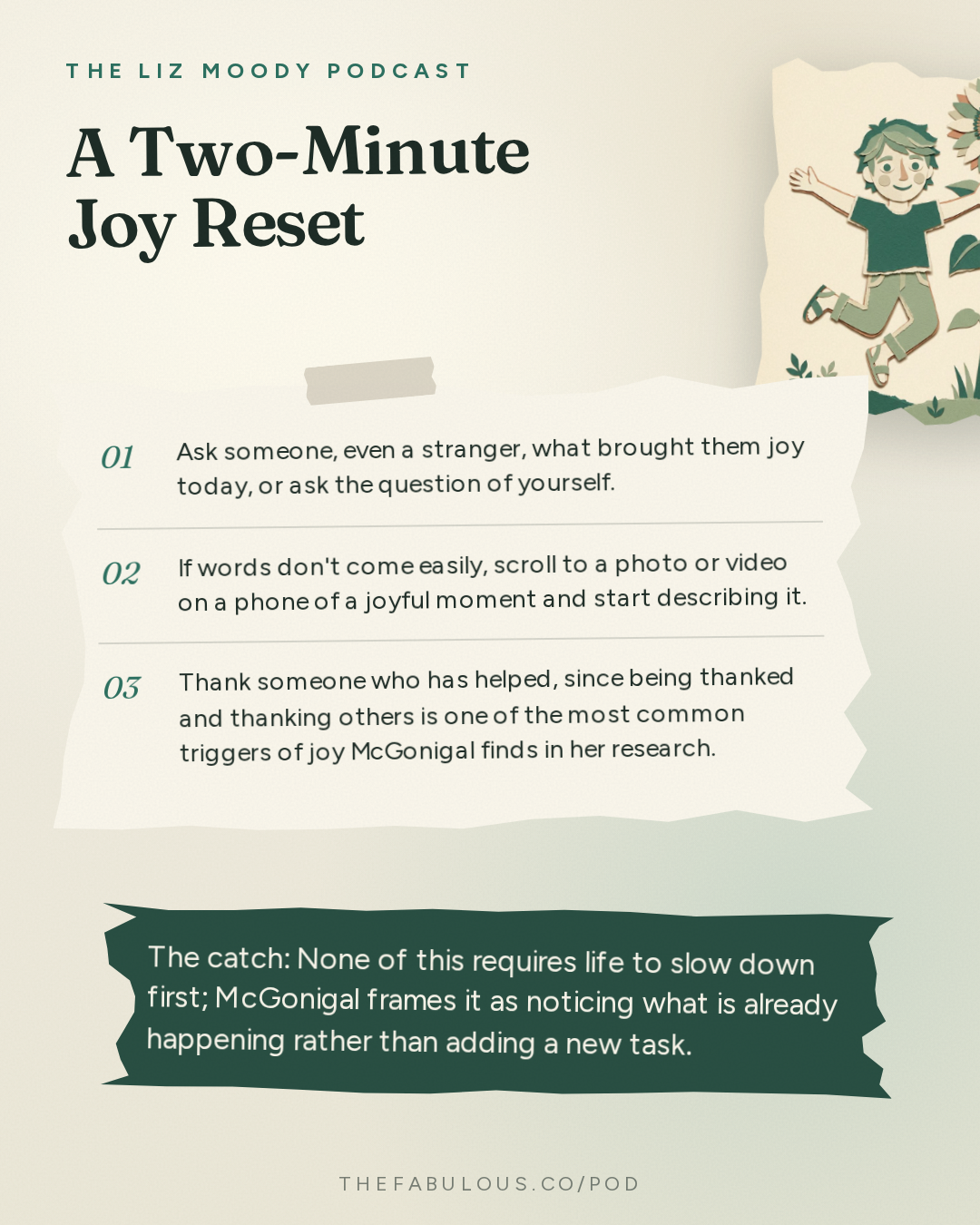
That reframing is where the practical advice in the conversation lands. McGonigal does not suggest waiting to feel calm enough to deserve joy. She tells people the feeling usually follows the action, not the other way around: schedule the walk, message the friend, show up before the motivation arrives (64:17). She recommends lowering the bar for what counts as a joyful moment enough to notice one every day, documenting it with a photo or a sentence to someone (68:02). And she keeps returning to a small, almost embarrassingly simple move: ask someone, even a stranger, what brings them joy. Her own mother tried it on the person cutting her hair and came home stunned by how much the woman wanted to talk about it (79:34). People are not used to being asked. That, more than any grand life change, is the experiment McGonigal is running: joy is not a reward waiting at the end of a harder life. It is available now, in a stranger's answer, in a photo already on a phone, in the decision to stop assuming the worst.
Ask this episode anything
Pod's AI answers from the episode itself, with the minute mark so you can hear it yourself.
Or start with one of these
Ask this episode
Pod's AI listens to the whole episode to answer, and points you to the minute it comes from.
The rest of this answer, and any question after it
Answers come from the episode itself, never from a summary of it.
ContinueKey takeaways
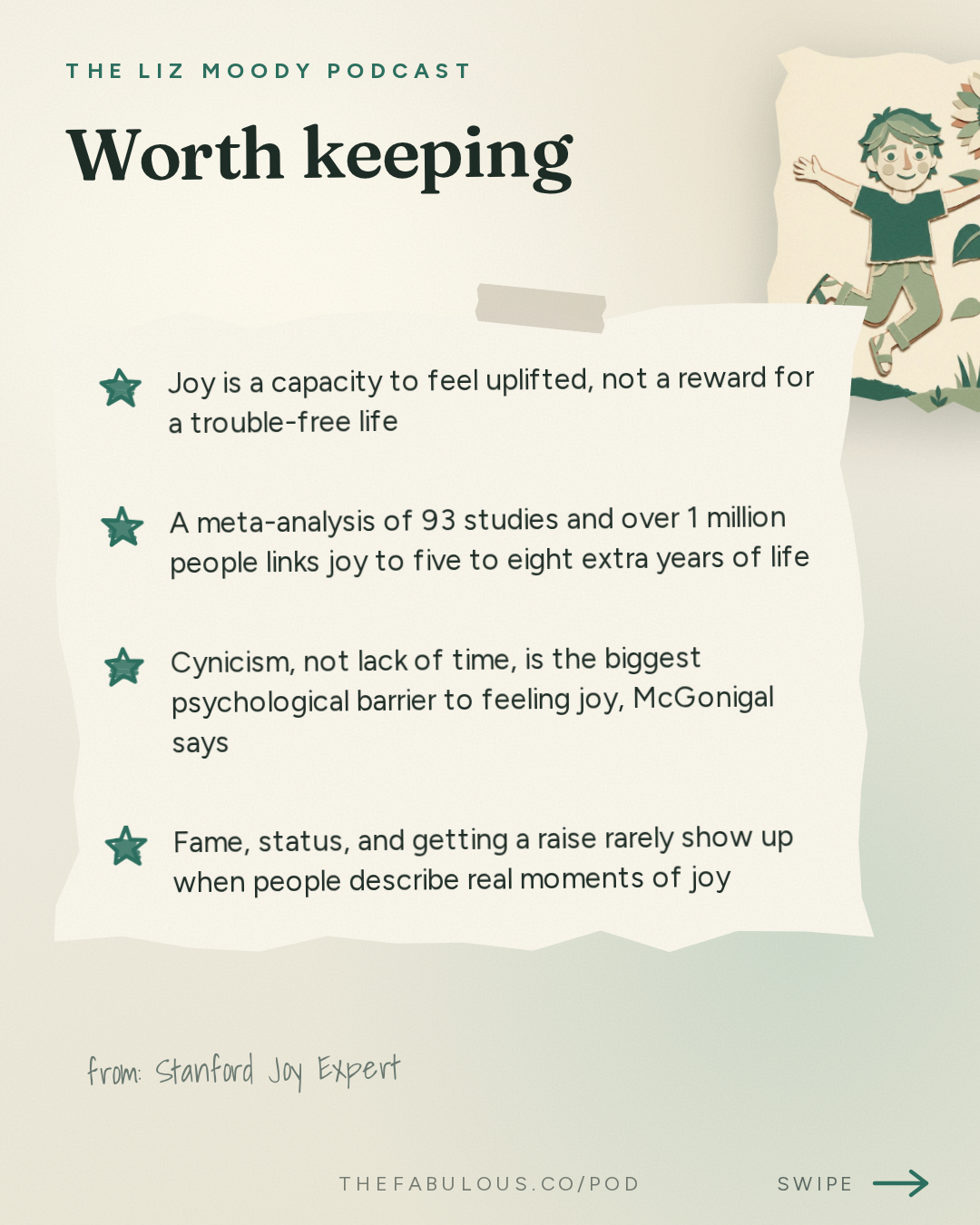
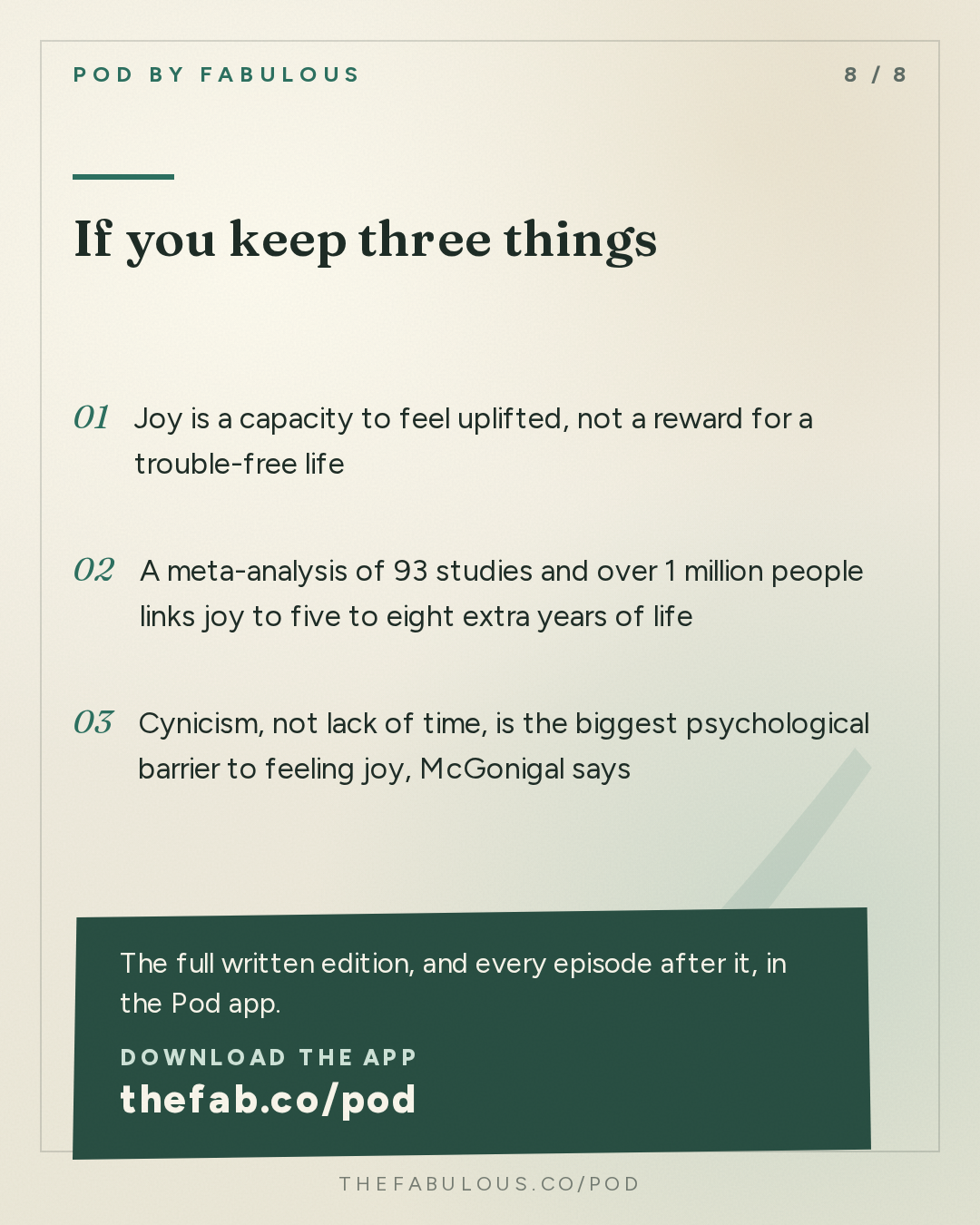
- Joy is a capacity to feel uplifted, not a reward for a trouble-free life
- A meta-analysis of 93 studies and over 1 million people links joy to five to eight extra years of life
- Cynicism, not lack of time, is the biggest psychological barrier to feeling joy, McGonigal says
- Fame, status, and getting a raise rarely show up when people describe real moments of joy
- Shared joy syncs heart rhythms and brain activity between two people into a kind of superorganism
The episode in cards
By the numbers
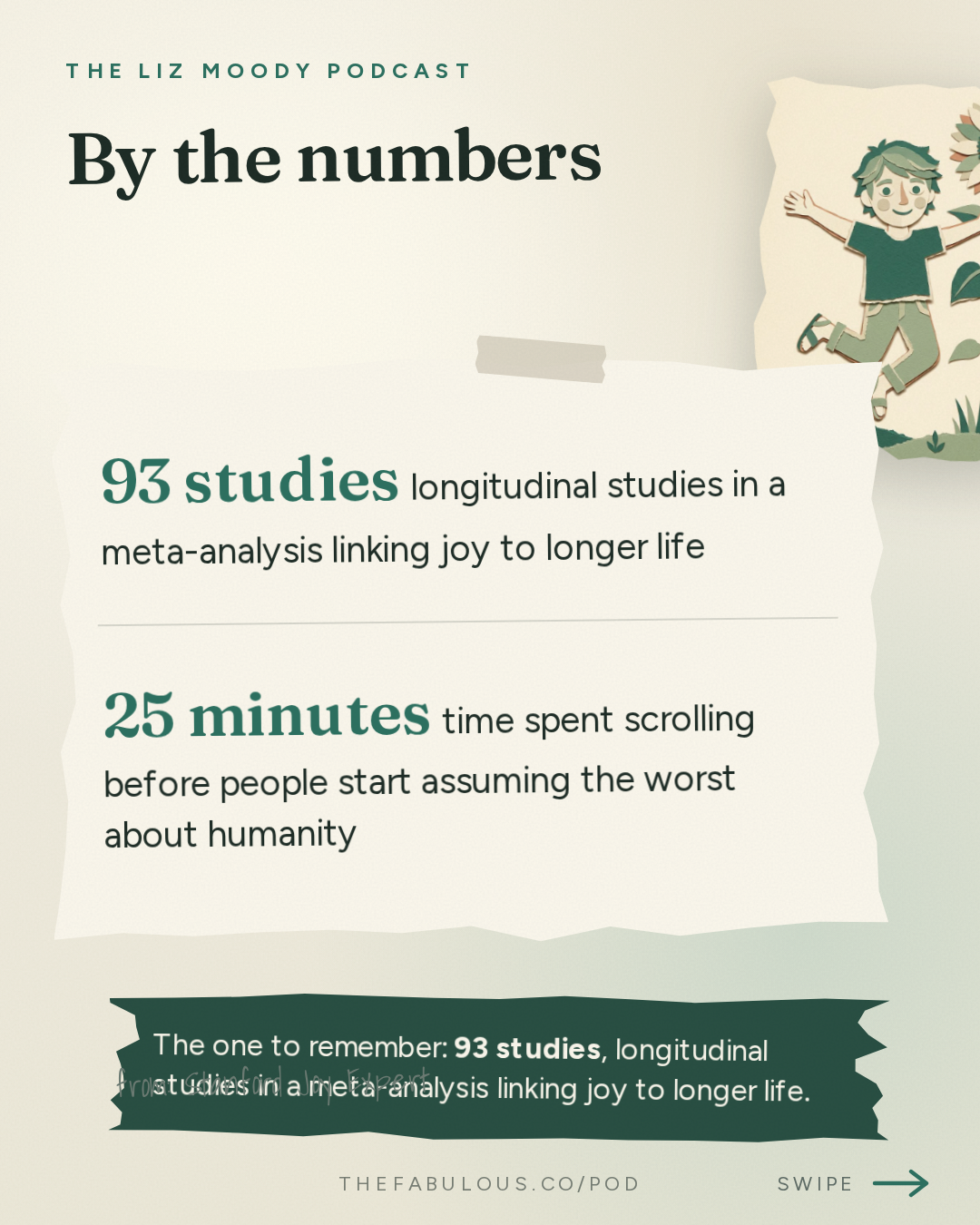
- 93 studies longitudinal studies in a meta-analysis linking joy to longer life
- 25 minutes time spent scrolling before people start assuming the worst about humanity
In their words
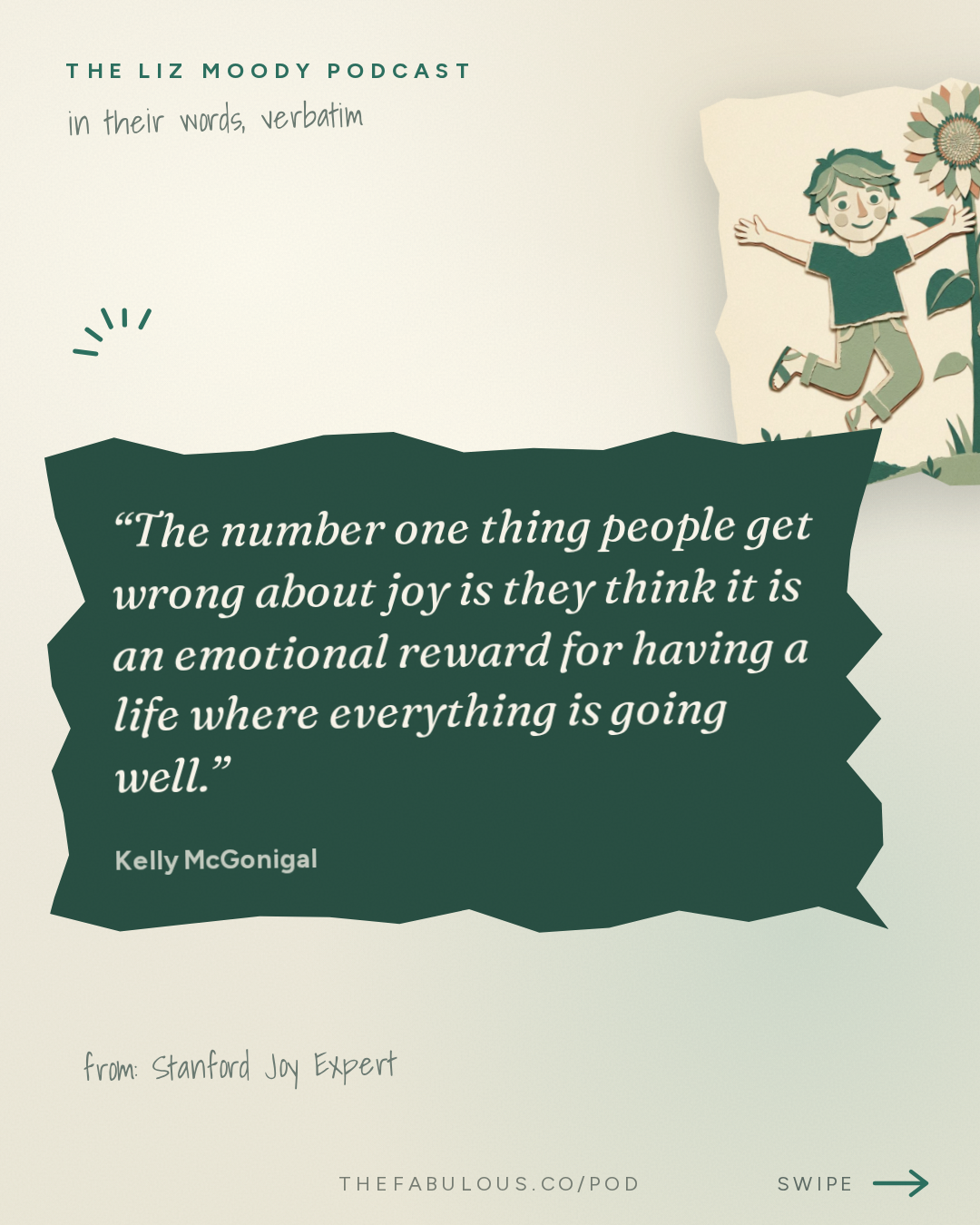
“The number one thing people get wrong about joy is they think it is an emotional reward for having a life where everything is going well.”
“One of the greatest acts of joy you can do is to listen to somebody.”
“"Well, you know who really believes that joy is invaluable? Sociopaths."”
“You can't achieve a meaningful life by trying to avoid stress.”
“The uncynical version would be to look around at like 40,000 people who have their faces lifted up and inhale some of their joy chemo signals.”
Protocols
-
Act before waiting to feel like it
McGonigal tells people not to wait until they feel peaceful or motivated before going for a walk or reaching out to a friend, because the uplifted feeling usually follows the action rather than coming first.
Whenever motivation is missing before a reliably joyful activity
-
Lower the bar for what counts as joy
McGonigal has people find one moment each day that counts as joy, even a small one that does not match an idealized picture of happiness, and document it with a photo or by telling someone about it.
Daily
-
Use loved music to ease physical pain
McGonigal points to experiments in which introducing music a person loves reduced both the sensation of pain and the distress around it, a pattern she saw firsthand with her father during late-stage cancer when medication alone was not enough.
During painful medical procedures or chronic pain flare-ups
-
Ask someone what brings them joy
McGonigal recommends asking a friend, coworker, or even a stranger to describe a recent moment of joy, and suggests scrolling to a photo or video on someone's phone as a prompt if the question stalls them.
As a regular conversation starter
Questions this episode answers
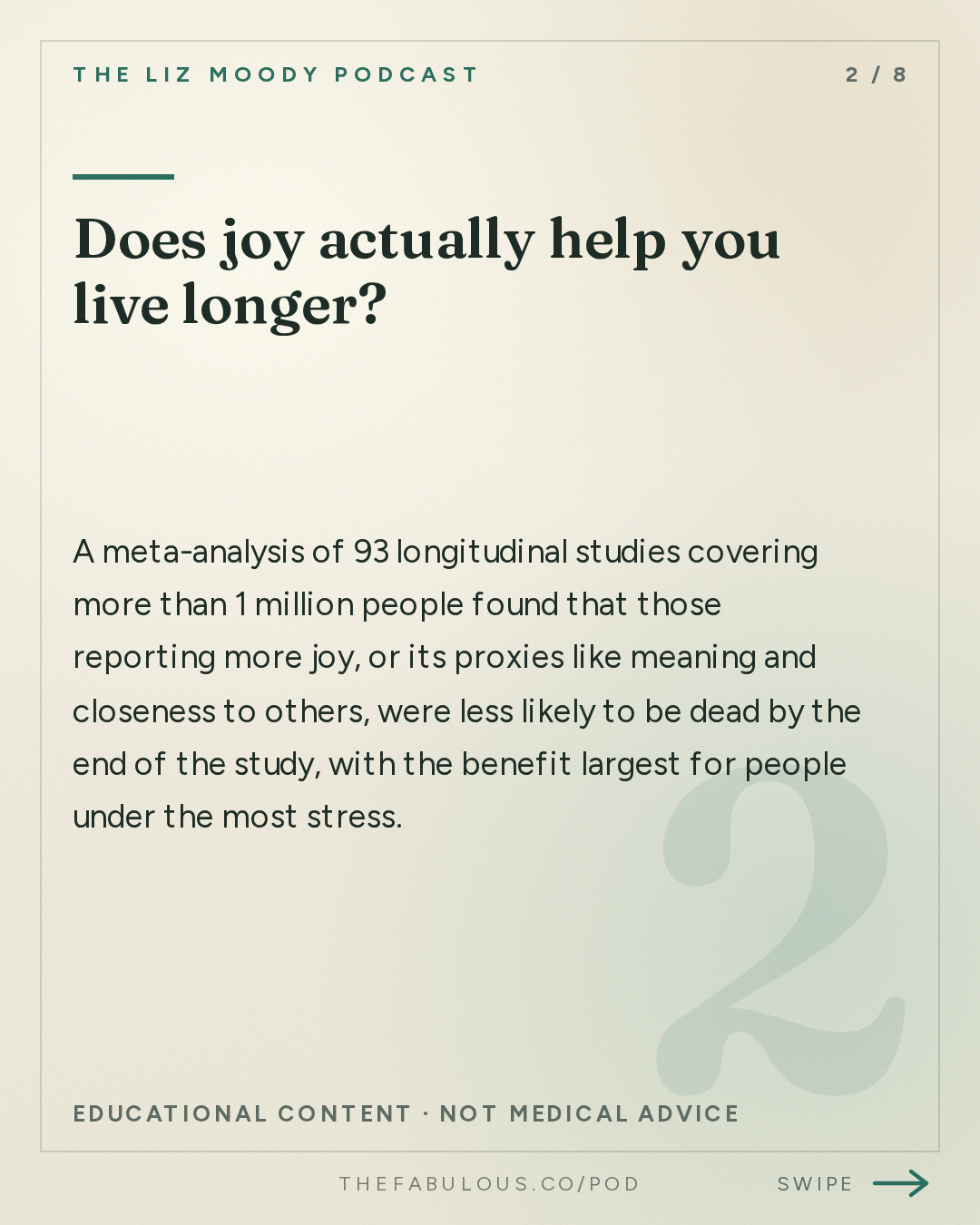
Does joy actually help you live longer?
A meta-analysis of 93 longitudinal studies covering more than 1 million people found that those reporting more joy, or its proxies like meaning and closeness to others, were less likely to be dead by the end of the study, with the benefit largest for people under the most stress (25:34, 29:11).
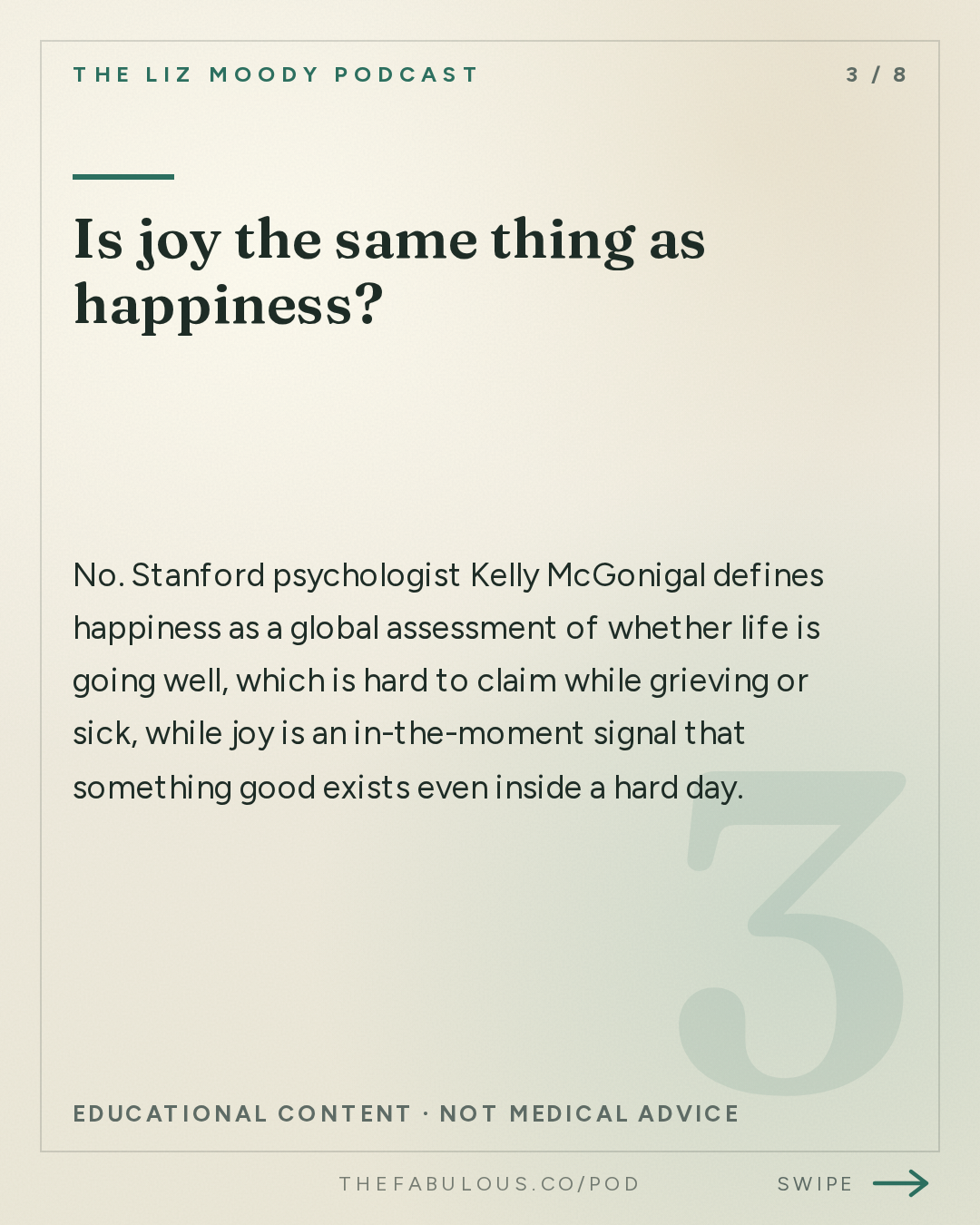
Is joy the same thing as happiness?
No. Stanford psychologist Kelly McGonigal defines happiness as a global assessment of whether life is going well, which is hard to claim while grieving or sick, while joy is an in-the-moment signal that something good exists even inside a hard day (02:40).
Does joy really have a smell?
In a cross-cultural study, researchers collected sweat from people laughing hard at comedy, shipped it to another country, and had strangers smell it; the smellers immediately smiled and reported a mood lift without knowing what they were smelling (17:38).
What is the biggest barrier to feeling joy?
McGonigal says cynicism, the assumption that other people are selfish or manipulative, is one of the biggest psychological barriers to joy because it stops someone from trusting good things enough to feel moved by them (46:50).
Does more stress mean less meaning in life?
The opposite, per a study led by psychologist Roy Baumeister that McGonigal cites: every measure of stress, from minutes spent worrying to major life crises, correlated positively with people rating their life as meaningful (84:23).
What is one thing to do right now for more joy?
McGonigal suggests asking someone, even a stranger, what brings them joy, or scrolling to a photo of a joyful moment if the question stalls, since naming or documenting joy trains the brain to notice it (88:52).
The full read, in cards
Go deeper
- Meta-analysis of 93 longitudinal studies on joy and longevity — Tracked over 1 million people across most continents and found joy predicts longer life, with the strongest benefit under high stress
- Roy Baumeister study on stress and meaning — Found every measure of stress positively correlated with people rating their life as meaningful
- The Happy Database — Global survey asking people what made them happy each day, in which exercise ranked surprisingly high
- Joy Is a Risk Worth Taking — Kelly McGonigal's new book, built from her Stanford class, reframing joy as a capacity rather than a reward
- The Joy of Movement — McGonigal's earlier book, framed as an exploration of how movement delivers other core sources of joy like connection and achievement
Mentioned
Kelly McGonigal · Stanford University · Roy Baumeister · ScholarMatch · Harry Styles · Liz Moody · Joy Is a Risk Worth Taking · The Joy of Movement
More from this show and category
How to Make Real-Life Friends Like Sitcom Characters
Liz Moody argues that sitcom-level friendship is not about chemistry but about three conditions: proximity, living life together instead of just catching up, and shared in-jokes, all of which anyone can rebuild starting this fall (04:41, 07:44, 09:25).
How to Share the Mental Load With Your Partner
Mental load coach Zach Watson says men often confuse doing a chore with owning it, and that sharing the mental load makes men happier too. He recommends the Fair Play card system, weekly 'build meetings,' and naming emotions precisely to cut defensiveness and split invisible labor fairly.

Bill Ackman on Lucy's Recovery and the Brain Institute
Bill Ackman recounts his daughter Lucy's brain hemorrhage and the brain rehabilitation institute he built in response. He also details Pershing Square's investment checklist, its move away from short selling, and the plan to turn Howard Hughes into an insurance-driven holding company modeled on Berkshire Hathaway.

Jordan Neely, Daniel Penny, and a Divided America
A six-minute subway encounter between Jordan Neely, a homeless man in mental crisis, and Daniel Penny, a former Marine, became a national Rorschach test. Journalist Anand Giridharadas argues both sides share the same wound: a feeling of being abandoned by every system meant to help them.
