
When to Leave a Relationship: The Science
Relationship Expert's Brutally Honest Takes On YOUR Juiciest Confessions
▶ Listen to the full episode More from The Liz Moody Podcast
The brief
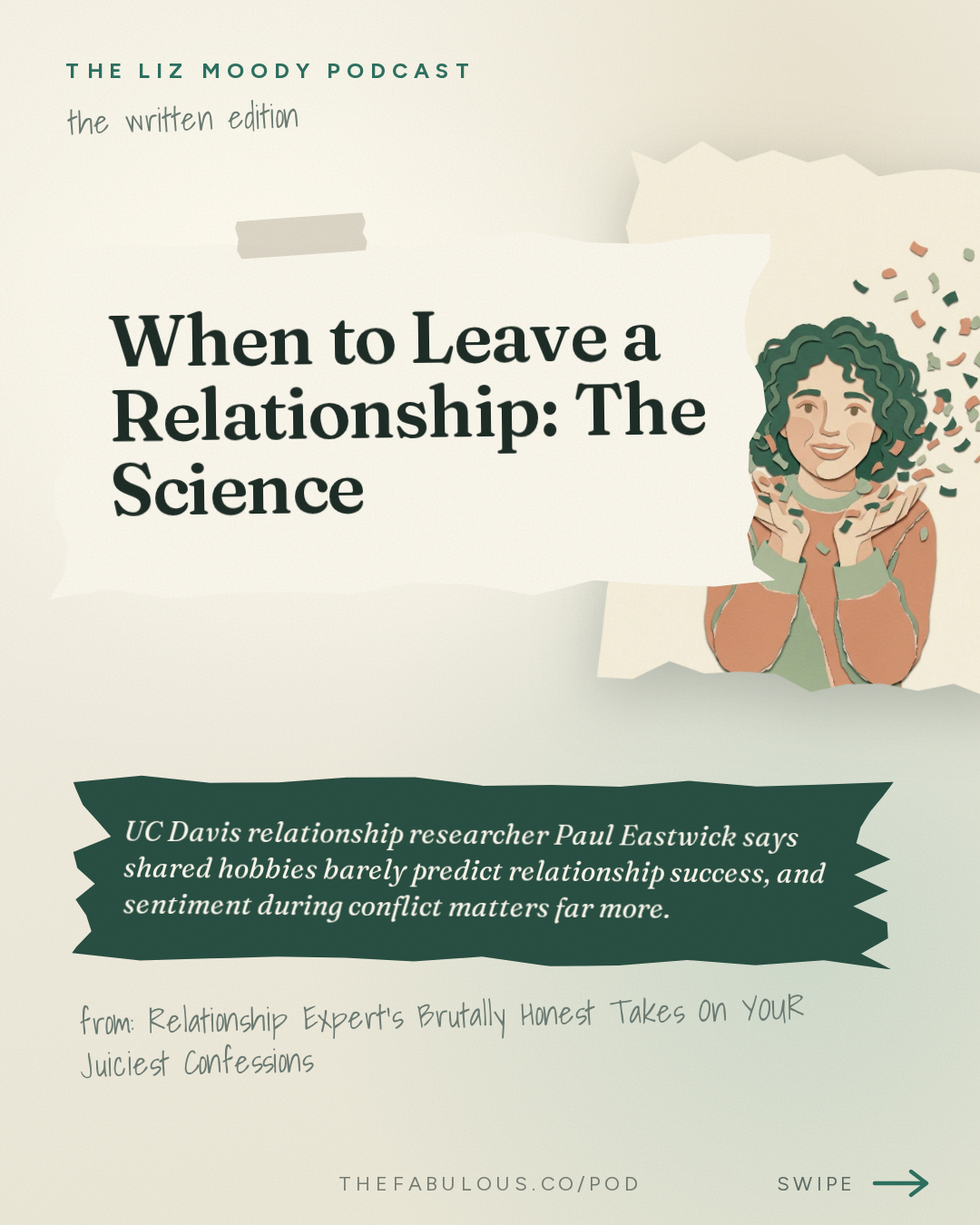
UC Davis relationship researcher Paul Eastwick says shared hobbies barely predict relationship success, and sentiment during conflict matters far more. He highlights the Gottman-inspired five-to-one ratio of positive to negative interactions, notes sexual satisfaction predicts more than frequency, and says celebrating a partner's good news matters more than comforting them in crisis.
A listener once wrote in with a simple rule she'd adopted from somewhere online: if you and your partner don't like doing the same things on weekends, the relationship is doomed. It gave her clarity, she said, to leave her first husband. It is a tidy theory. It is also, according to the man who studies this for a living, mostly wrong.
Dr. Paul Eastwick is a UC Davis professor and one of the most cited relationship scientists working today (00:00). He has run the obvious version of this experiment: hand a couple a list of roughly 100 activities, ask each person which ones they enjoy, then measure how much their answers line up (03:09). The overlap, it turns out, barely predicts how happy the couple is. What does matter is something softer: the shared sense that when the two of them spend time together, it feels good. The content of the activity is almost beside the point.
"Subjective sense that it's like, 'Oh, yeah, when we spend time together, we have so much fun,' like, that's important. But literally what the activities are... is not gonna matter all that much." (03:09) - Dr. Paul Eastwick
Eastwick takes this further than most would expect. Liz argues couples should vacation apart more often (01:44), because modern partners are asked to be everything: co-parent, roommate, best friend, adventure buddy, therapist, and soulmate, all in one body. No single person can supply all of that. He keeps a yearly trip with four friends from high school and encourages his own partner to do the same with hers. The point isn't distance. It's relief from an impossible job description.
This reframes a second confession in the episode: a woman who cheated on her partner, married the man she cheated with, and is now pregnant at 45 (04:59). Eastwick's read is careful. Wanting someone else is often a sign of dissatisfaction in the current relationship, not proof that the current partner is the wrong one (05:22). He resists the phrase "wrong person" entirely, because it implies a fixed, unfixable trait in another human being, when the more useful question points at the relationship itself: what is missing here, and can it be built.
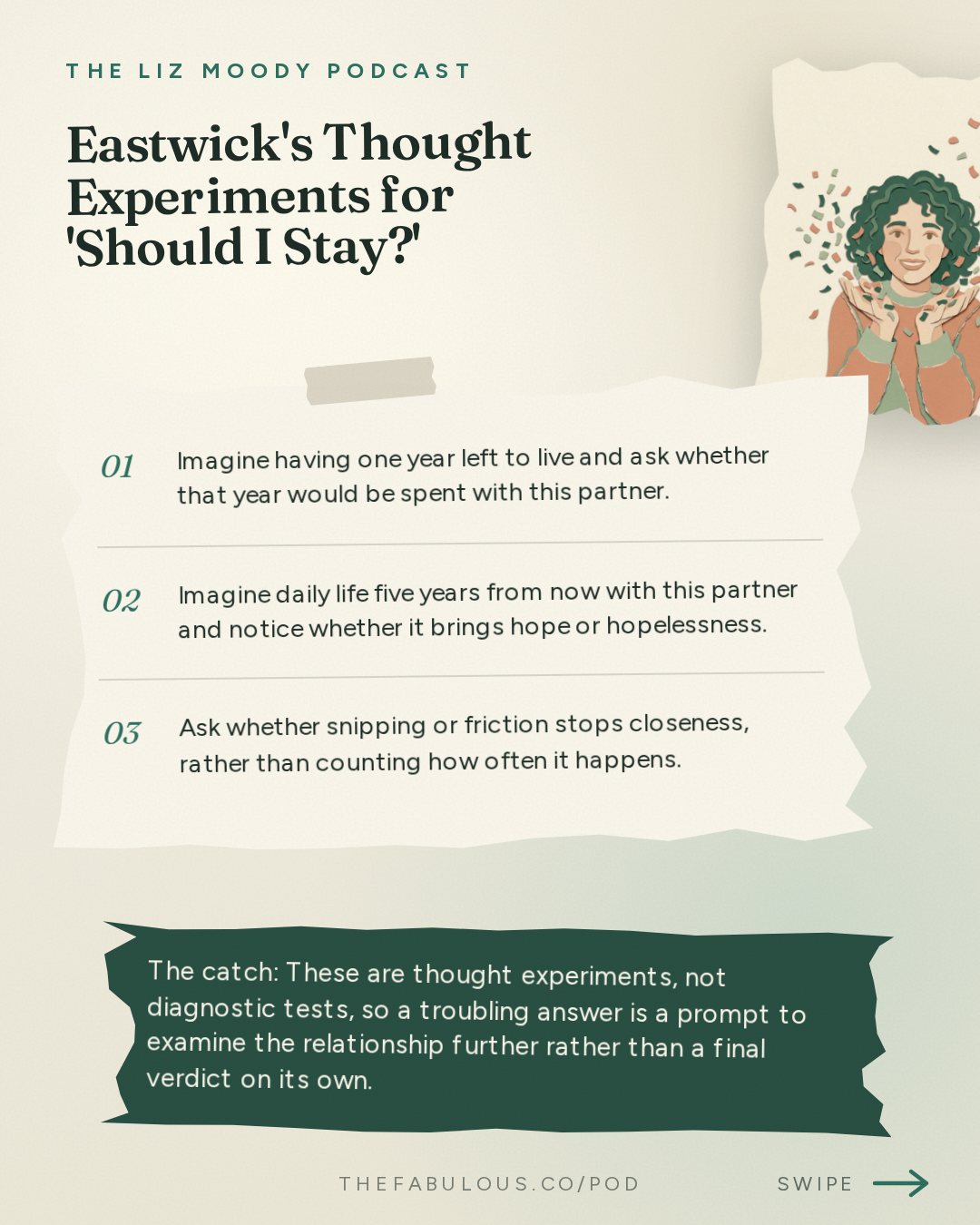
To test that question without the mess of actually leaving, Eastwick likes a thought experiment: imagine you have one year left to live. Do you want to spend it with this person (06:41)? A second version runs the same test forward instead of backward: picture yourself five years from now, still with this partner. Does that picture bring hope, or does it bring dread (07:31)? Neither test is a verdict. Both are a way of surfacing an answer the conscious mind has been avoiding.
The Weight of a Bad Moment
One listener described "snipping" at his partner constantly until a mentor finally told him the marriage was over. Eastwick's answer to how much snipping is too much is not a number. It's a function: does the friction stop you from wanting to be close to this person, or do you still find your way back to each other afterward (09:18)? Some couples bicker constantly and still feel connected. Others go quiet and polite while drifting apart underneath.
This is where the famous five-to-one ratio comes in, a figure associated with marriage researchers John and Julie Gottman: for every negative interaction in a relationship, a healthy couple needs roughly five positive ones to balance it (09:39). The ratio exists because of a basic asymmetry in how people process experience. A single harsh comment does more damage than a single kind one does good.
"Bad is stronger than good. That's, like, the flippant psychological way of talking about it." (09:59) - Dr. Paul Eastwick
That asymmetry explains a pattern Eastwick has watched unfold in his own field. For decades, couples therapy assumed relationships lived or died based on how partners fought, so researchers studied fights almost exclusively. It wasn't until around 2010 that anyone systematically studied the positive side (12:54): how couples have fun together, how they connect in ordinary, unremarkable moments. That positive material turned out to carry real predictive weight of its own, which is why Eastwick now names four components he considers central to relationship longevity: satisfying sex, validation, mutual support, and celebrating each other's wins (14:34).
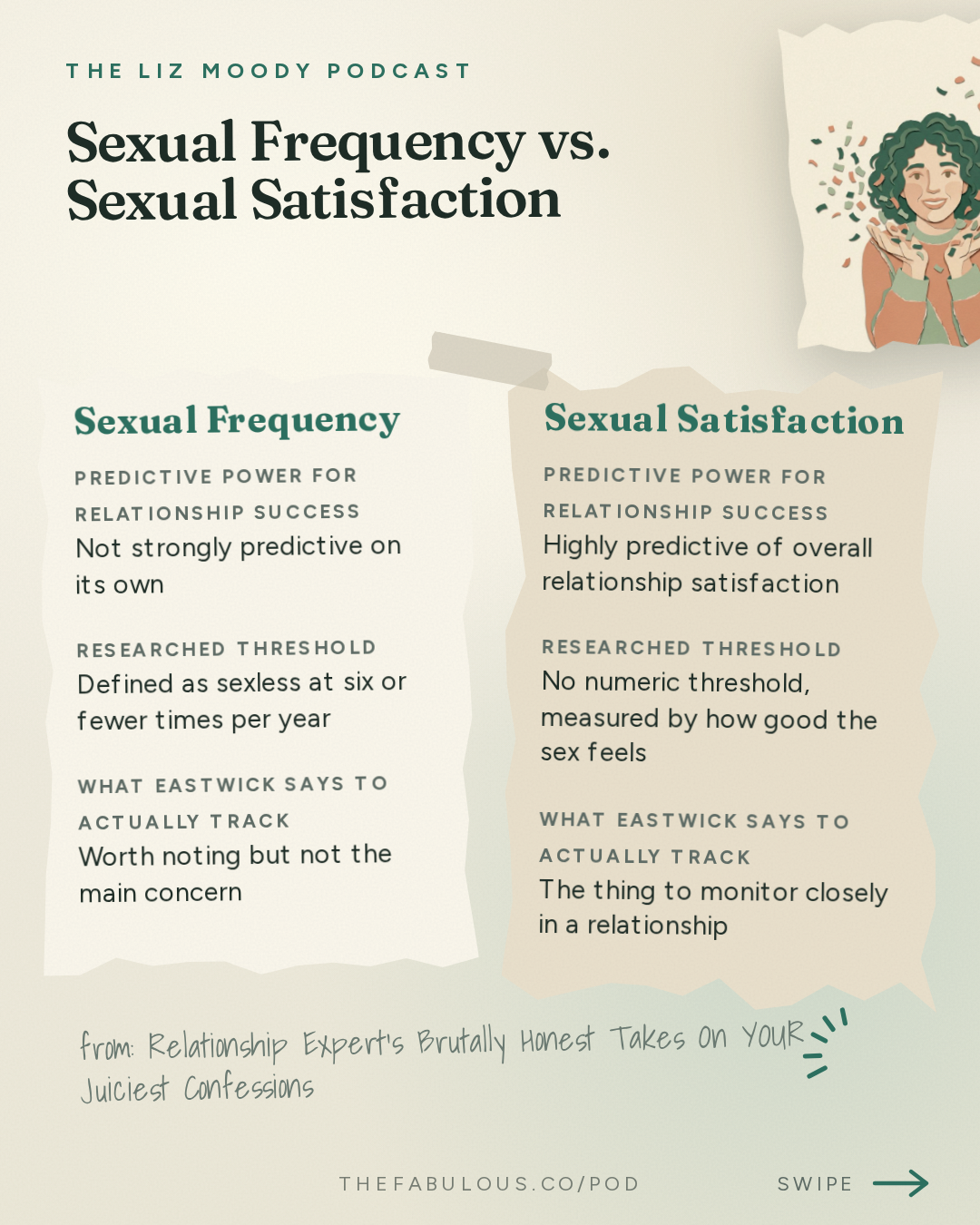
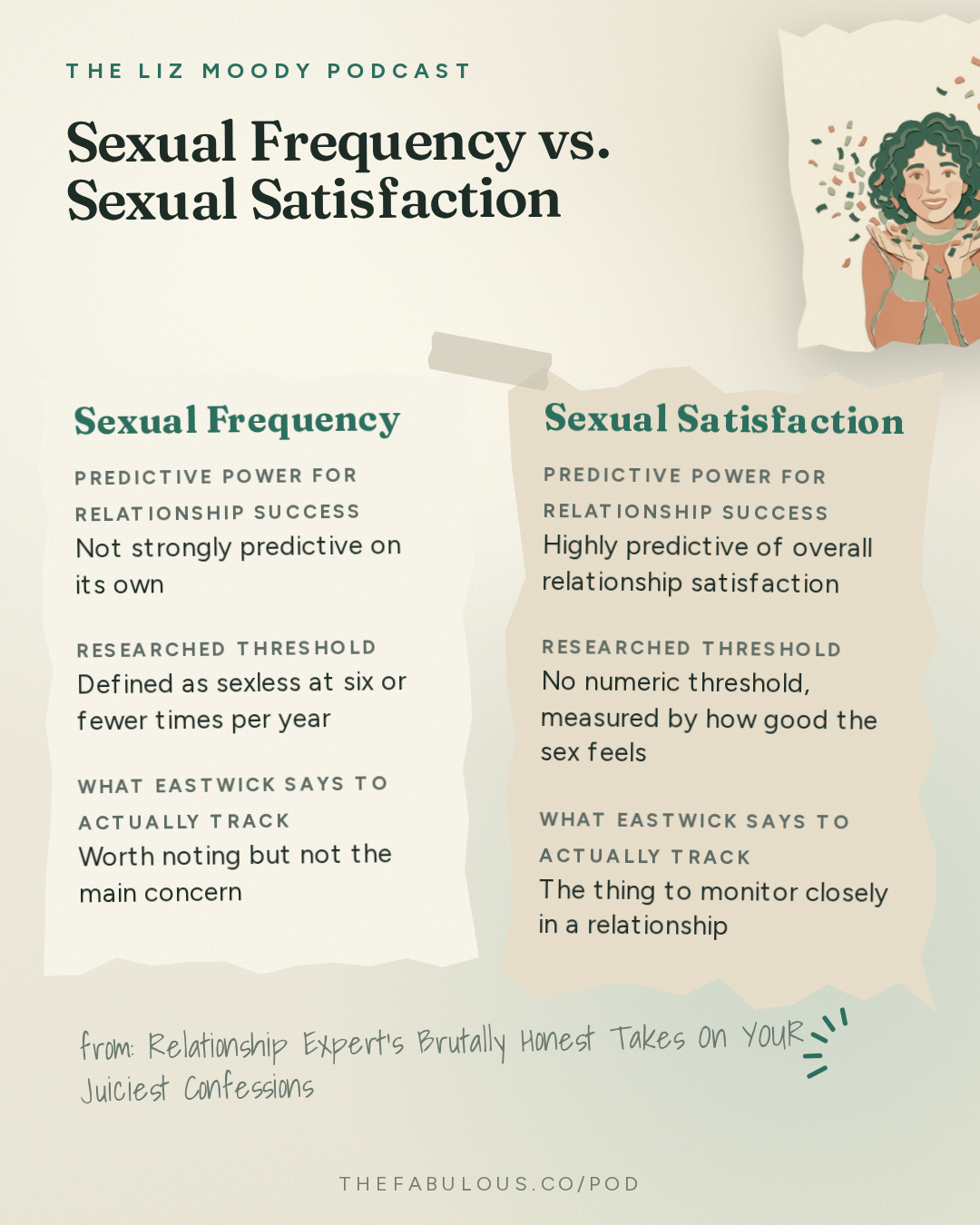
Sex deserves its own note, because the common assumption, that frequency is the thing to track, gets the emphasis backward. Sexual satisfaction predicts relationship success more reliably than how often sex happens (15:38). Researchers commonly define a "sexless marriage" as six or fewer instances a year (16:27), and couples below that line are more likely to break up. But Eastwick's actual worry isn't the count. It's whether the sex that does happen feels good and feels connecting, especially since parents raising young kids often have little sex for reasons that have nothing to do with the relationship's health.
The Weight Nobody Splits Evenly
A different kind of imbalance runs through several of the listener letters: partners who find themselves managing another adult's life, covering rent, chasing job leads, parenting a grown man's habits. Eastwick connects this to a well-documented pattern: women do more of the household's mental and emotional labor than men do (19:09), the invisible tracking of appointments, moods, and unfinished tasks that someone has to hold in their head. When that imbalance shows up in dating relationships, not just marriages, it tends to feel especially unfair, because the built-in justification of "we're building a shared life" is thinner.
His test for whether this kind of caretaking is healthy or corrosive is almost embarrassingly simple.
"If this person feels like a burden to you, that's not a good sign." (20:25) - Dr. Paul Eastwick
Helping a partner is not inherently a red flag, Eastwick says; it's part of what a relationship is for. The danger is duration without appreciation, support flowing one direction with no sign it will ever reverse. The better question isn't "is this 50/50 right now," since healthy relationships move through long stretches where one partner needs more. The better question is whether your own needs are still being met at all.
Eastwick also connects this to a separate but related failure: most men are not practicing emotional vulnerability with other men, even when they're perfectly capable of it with a girlfriend or wife (27:08). He suspects this isn't biological so much as a skill gap, one society never trained boys to build the way it trained girls to see themselves as capable and competent. Traits coded as feminine, nurturing, openness, warmth, become less socially rewarded for men to display, a dynamic he ties directly to patriarchal norms that are costly for men's friendships even as they're framed as benefiting men generally.
The episode's most consequential myth-busting, though, concerns children. A listener wrote that she stays in an unhappy marriage because divorce is expensive and might harm the kids. Eastwick is blunt: the science does not support a strong causal relationship between divorce itself and how children turn out, once you separate out genetic factors parents pass down regardless of whether they stay together (43:16, 43:36). Some outcomes, like substance abuse, may genuinely be affected by family breakup. Most of what people assume to be divorce's fingerprint is something else entirely. His conclusion isn't permission to leave or a mandate to stay; it's a warning against using "the kids" as a scientific trump card in either direction.
By the end of the conversation, Eastwick offers something closer to a philosophy than a checklist. Relationship happiness, he says, often hinges less on crisis support than on something smaller and easier to overlook: whether a partner is genuinely glad when good things happen (49:47). And for anyone standing at the edge of ending something, he reaches for an image rather than a statistic.
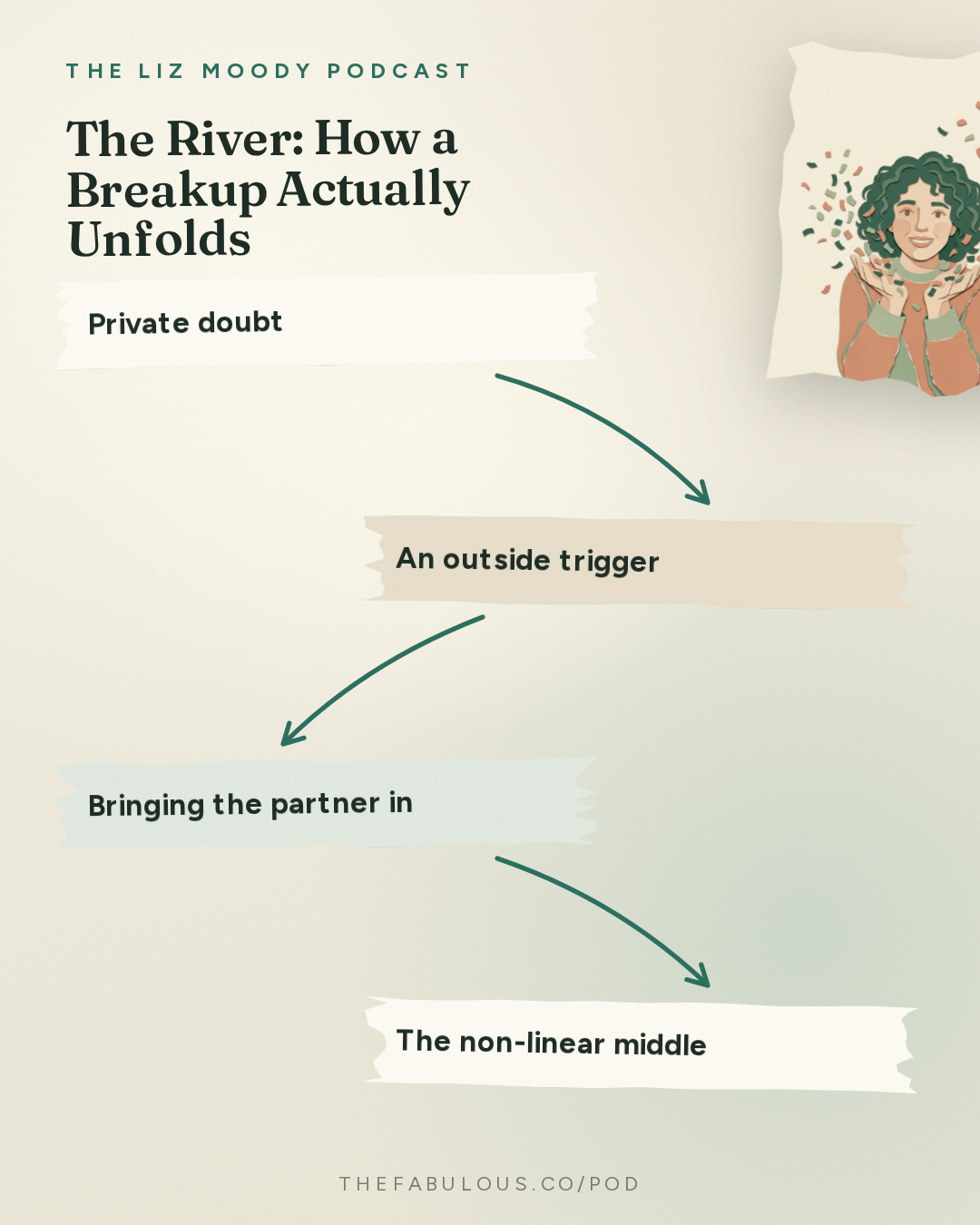
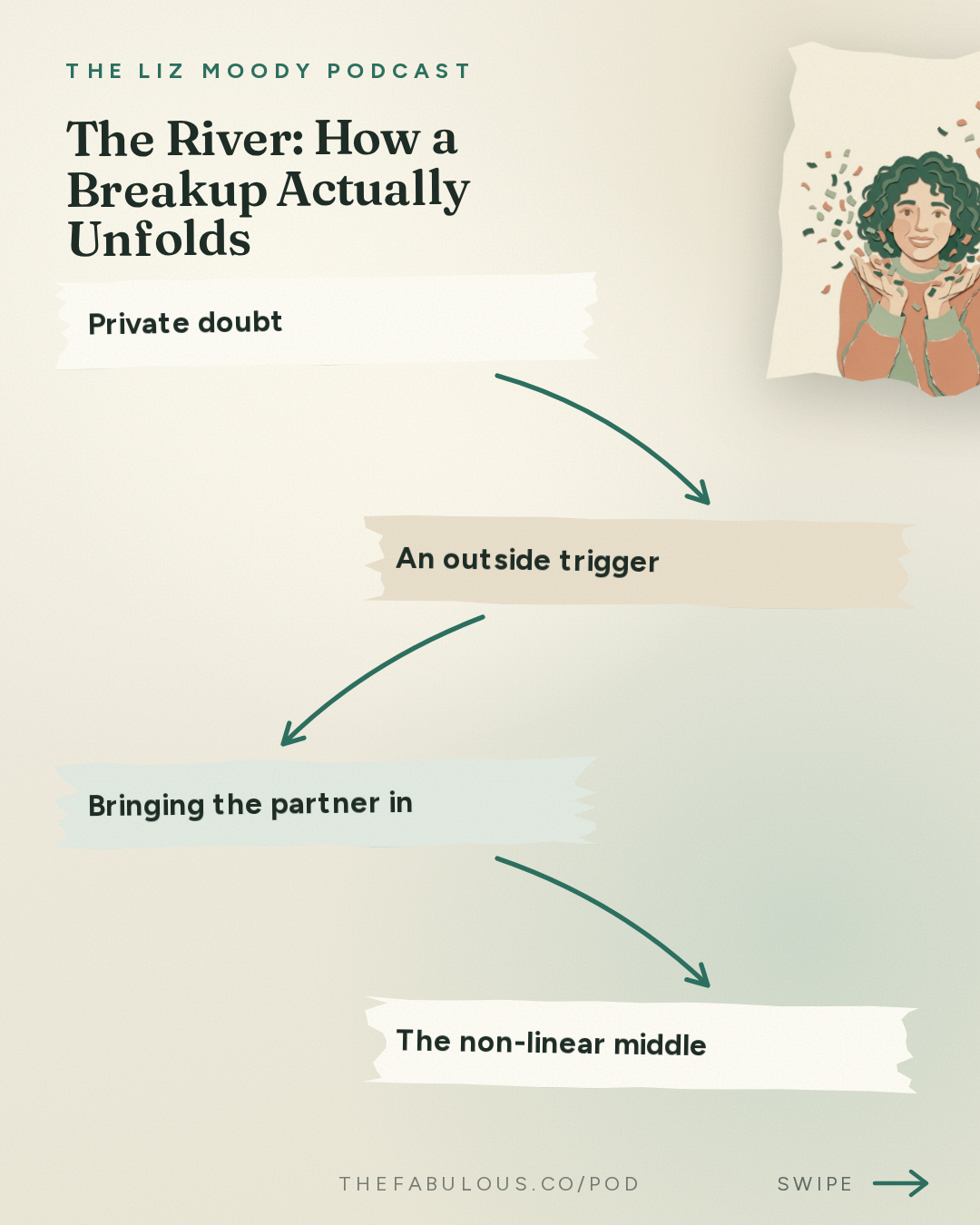
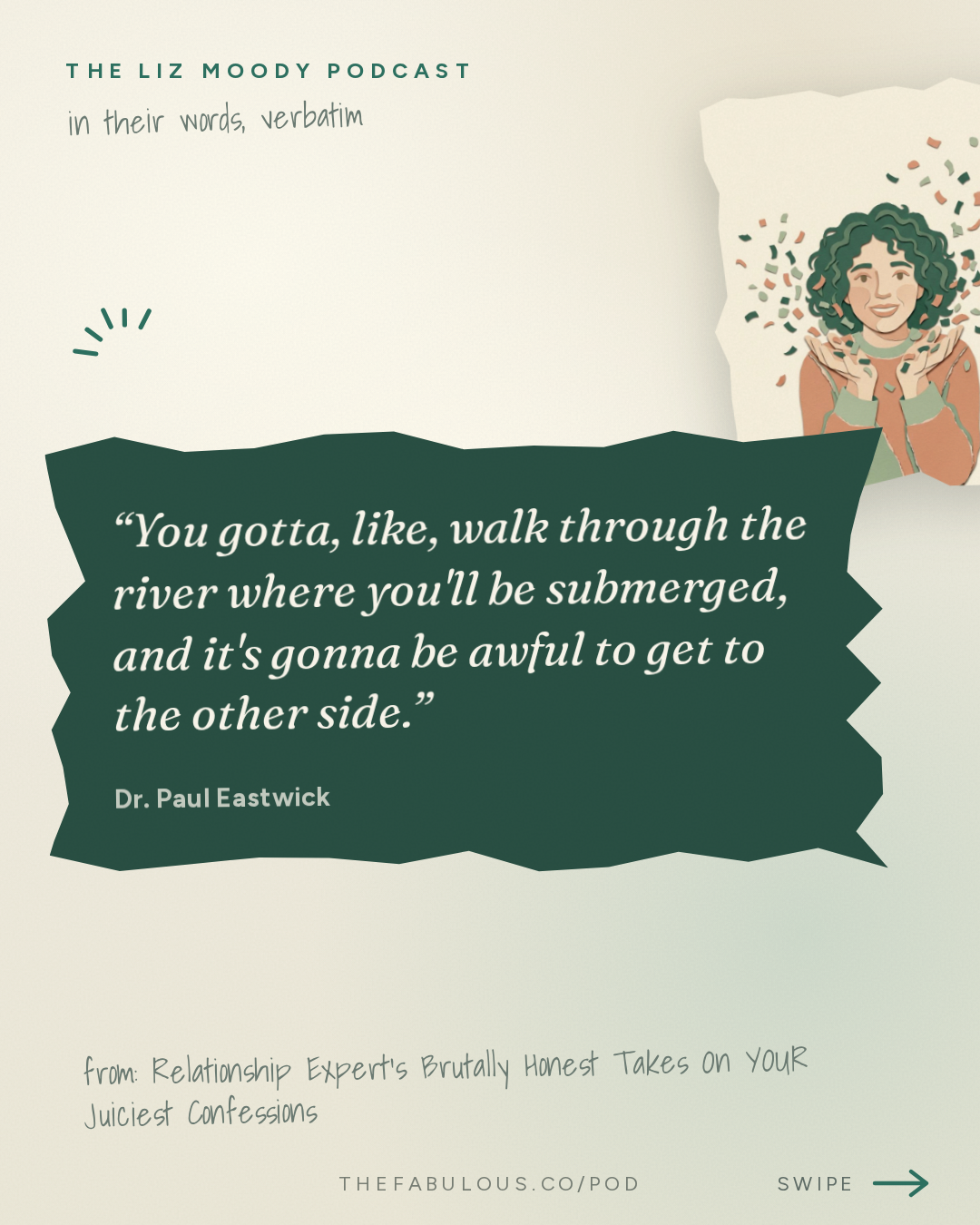
"You gotta, like, walk through the river where you'll be submerged, and it's gonna be awful to get to the other side." (49:00) - Dr. Paul Eastwick
The water gets colder the further in a person goes, he says, which is exactly why most people turn back toward the dry land they already know, even when it's the wrong place to be standing.
Ask this episode anything
Pod's AI answers from the episode itself, with the minute mark so you can hear it yourself.
Or start with one of these
Ask this episode
Pod's AI listens to the whole episode to answer, and points you to the minute it comes from.
The rest of this answer, and any question after it
Answers come from the episode itself, never from a summary of it.
ContinueKey takeaways
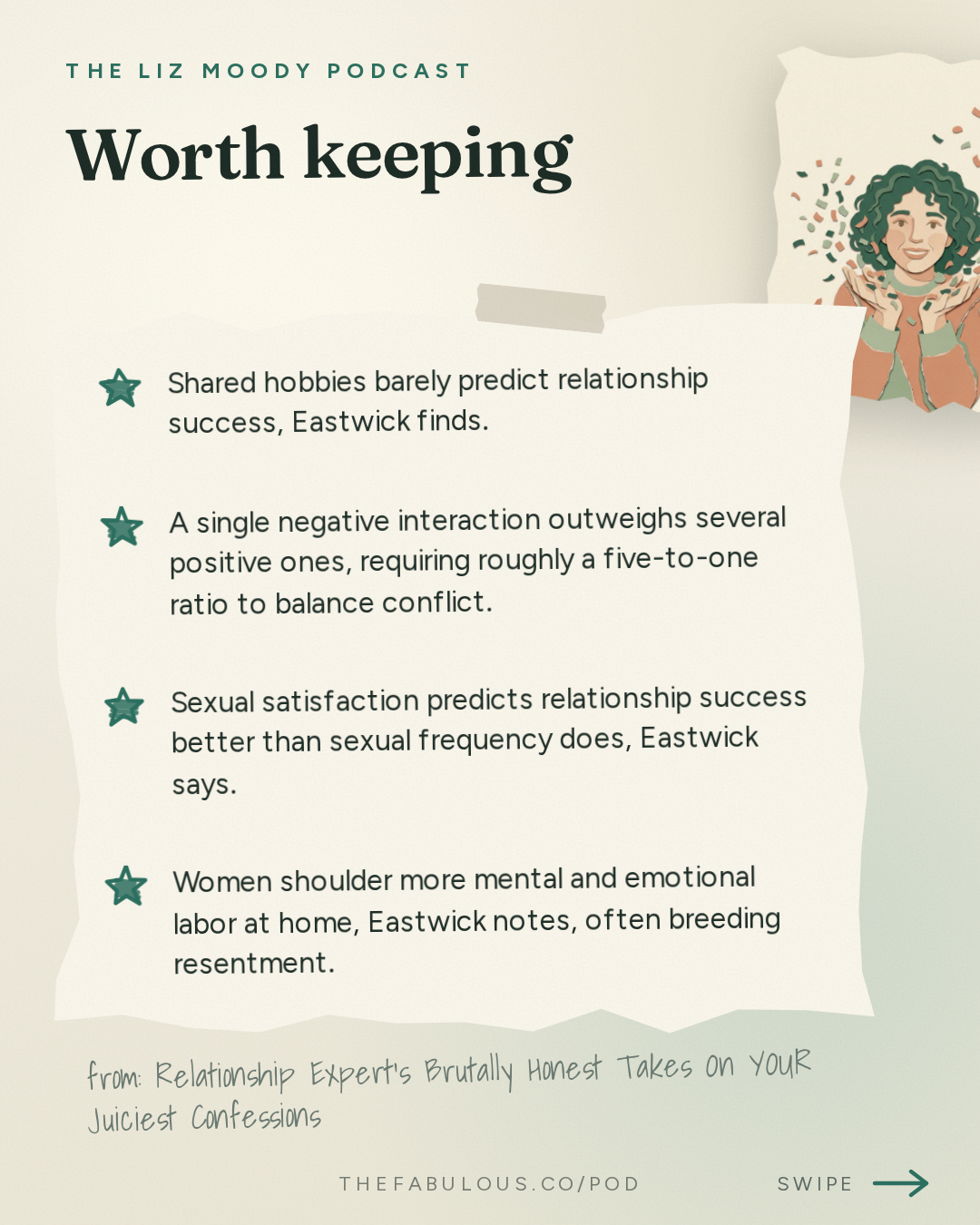
- Shared hobbies barely predict relationship success, Eastwick finds.
- A single negative interaction outweighs several positive ones, requiring roughly a five-to-one ratio to balance conflict.
- Sexual satisfaction predicts relationship success better than sexual frequency does, Eastwick says.
- Women shoulder more mental and emotional labor at home, Eastwick notes, often breeding resentment.
- Divorce does not reliably harm children once genetics are accounted for, Eastwick says.
The episode in cards

By the numbers
- 60/40 gender split in who initiates breakups, women slightly more often
- 75% share of leisure needs one partner can reasonably meet, per Eastwick's view
In their words
“Bad is stronger than good. That's, like, the flippant psychological way of talking about it.”
“If this person feels like a burden to you, that's not a good sign.”
“You gotta, like, walk through the river where you'll be submerged, and it's gonna be awful to get to the other side.”
Protocols
-
The one-year-to-live test
Eastwick suggests imagining a scenario where only one year of life remains and asking whether that year would be spent with the current partner. He frames a clear no as a meaningful signal, though not an automatic verdict on its own.
As needed, when uncertain about a relationship
-
The five-year forward test
Eastwick recommends picturing daily life five years into the future with the current partner. He says a picture that brings sadness, anger, or hopelessness is a bad sign worth taking seriously.
As needed, alongside the one-year test
-
Bring the partner into the doubt early
Eastwick advises raising relationship doubts with a partner in small steps rather than suppressing them for months or years. He notes that waiting too long often means the partner only becomes alarmed once change attempts are already too late to work.
As soon as serious doubt appears
Questions this episode answers
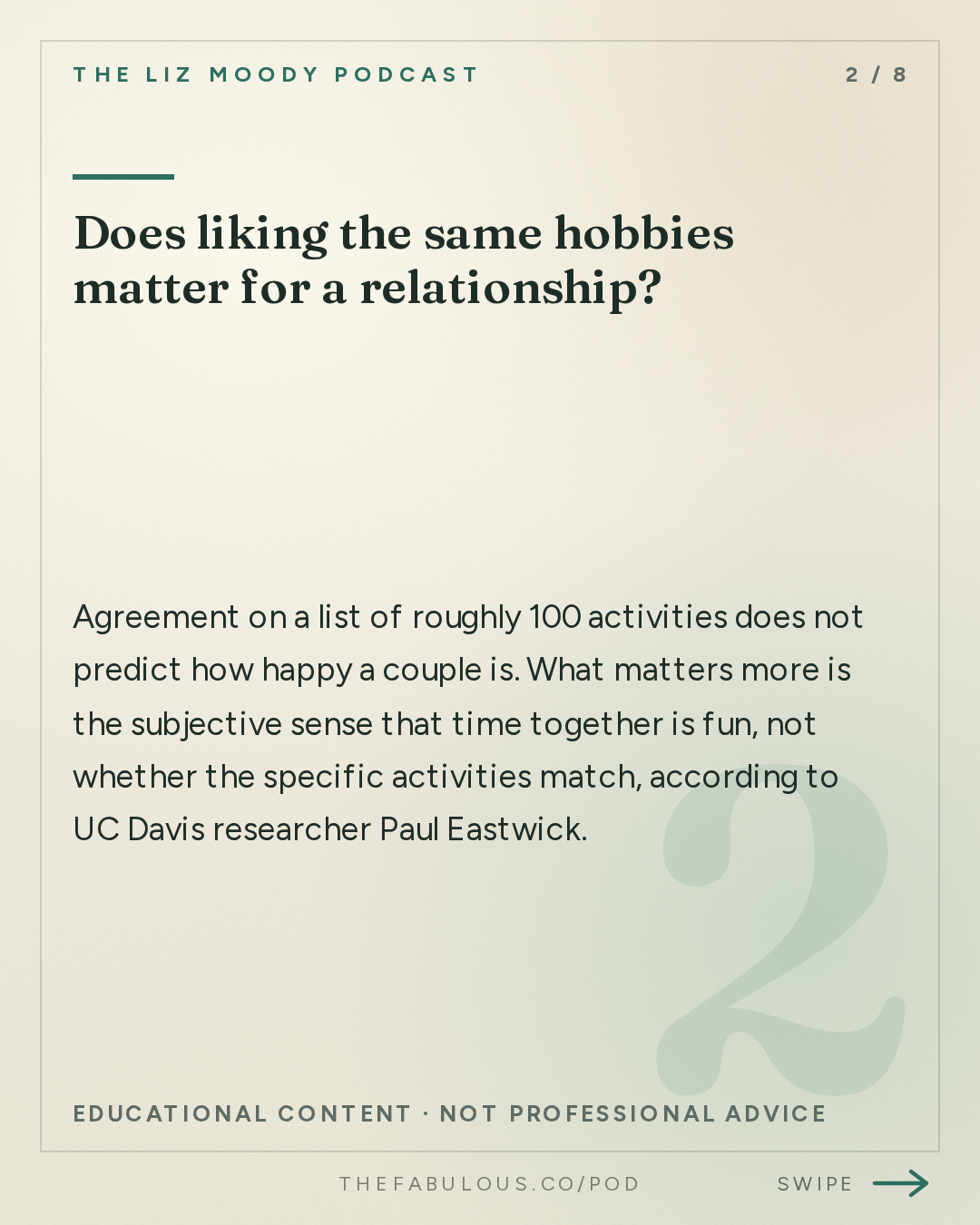
Does liking the same hobbies matter for a relationship?
Agreement on a list of roughly 100 activities does not predict how happy a couple is (03:09). What matters more is the subjective sense that time together is fun, not whether the specific activities match, according to UC Davis researcher Paul Eastwick.
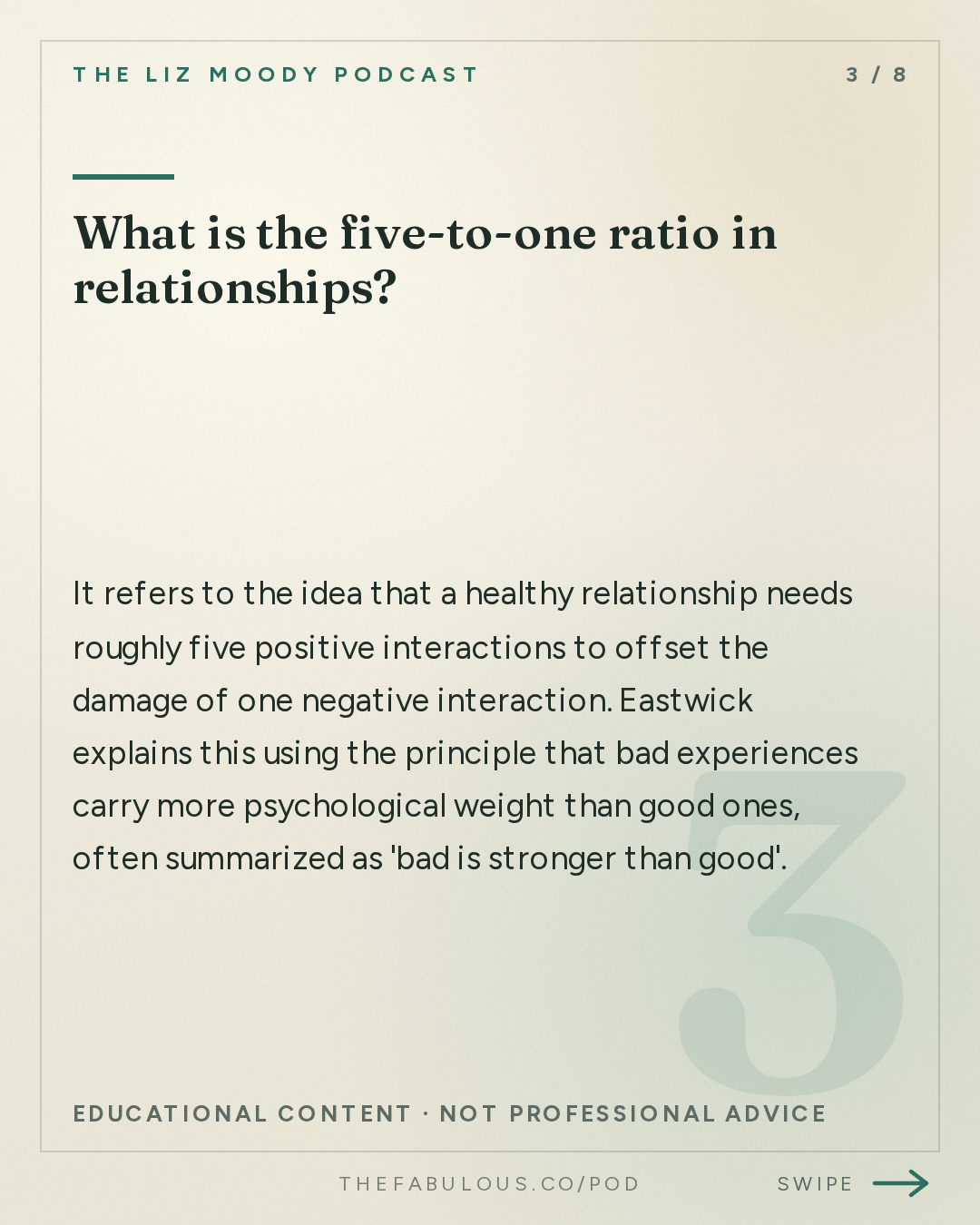
What is the five-to-one ratio in relationships?
It refers to the idea that a healthy relationship needs roughly five positive interactions to offset the damage of one negative interaction (09:39). Eastwick explains this using the principle that bad experiences carry more psychological weight than good ones, often summarized as 'bad is stronger than good' (09:59).
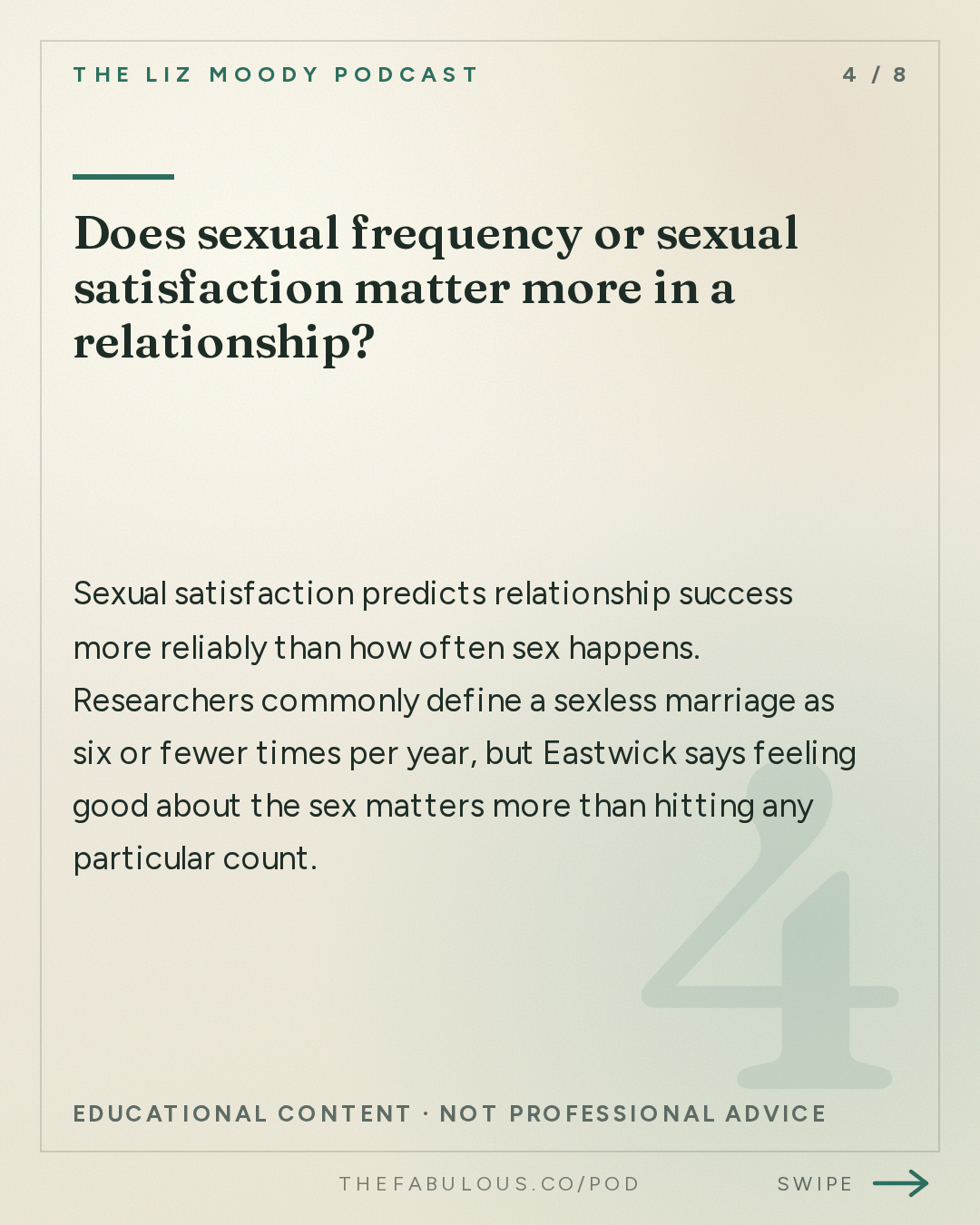
Does sexual frequency or sexual satisfaction matter more in a relationship?
Sexual satisfaction predicts relationship success more reliably than how often sex happens (15:38). Researchers commonly define a sexless marriage as six or fewer times per year, but Eastwick says feeling good about the sex matters more than hitting any particular count (16:27).
Is staying together for the kids actually good for them?
Eastwick says there is no strong causal link between divorce itself and children's outcomes once genetic factors shared by parents and kids are separated out (43:16, 43:36). He argues that using 'the kids' as the deciding factor, in either direction, is not well supported by the evidence.
Who initiates breakups more often, men or women?
Women are somewhat more likely to take the initiative to end a relationship, in a modest split of roughly 60/40 (30:54). Eastwick suggests this is largely because women on average have more outside sources of support to fall back on.
What should couples actually fix first when a relationship is struggling?
Eastwick points to four areas tied to relationship longevity: sexual satisfaction, validation, mutual support, and celebrating each other's successes (14:34). He notes that celebrating a partner's good news is even more central to relationship health than comforting them during hard times (49:47).
The full read, in cards
Go deeper
- Bonded By Evolution — Eastwick's book on the evolutionary psychology of attraction and relationships
- Love Factually — Eastwick's podcast with Eli Finkel analyzing relationship science through rom-coms
- The Cut — Piece on Gen Z women financially and emotionally supporting their boyfriends
- Gottman research on the four horsemen — Identifies contempt, criticism, stonewalling, and defensiveness as predictors of divorce
Mentioned
Dr. Paul Eastwick · UC Davis · The Gottmans · Eli Finkel · The Cut · Bonded By Evolution · Love Factually · Liz Moody
More from this show and category
Kelly McGonigal on the Real Science of Joy
Stanford health psychologist Kelly McGonigal says joy is a biological capacity to feel uplifted, not a reward for a perfect life. A meta-analysis of 93 studies and over 1 million people links joy to five to eight extra years of life, and she says cynicism, not busyness, is the biggest barrier to feeling it.
How to Make Real-Life Friends Like Sitcom Characters
Liz Moody argues that sitcom-level friendship is not about chemistry but about three conditions: proximity, living life together instead of just catching up, and shared in-jokes, all of which anyone can rebuild starting this fall (04:41, 07:44, 09:25).
How to Share the Mental Load With Your Partner
Mental load coach Zach Watson says men often confuse doing a chore with owning it, and that sharing the mental load makes men happier too. He recommends the Fair Play card system, weekly 'build meetings,' and naming emotions precisely to cut defensiveness and split invisible labor fairly.

Charlie Munger's Lessons from Henry Singleton
In a 2022 conversation, Charlie Munger tells Todd Combs that investing success rests on finding rare talent, choosing solvable problems, and smart positioning. The through-line is positioning: arranging affairs so circumstances never force bad decisions, as Munger explains using Rockefeller, Teledyne founder Henry Singleton, and the 1974 market crash.
