
How SpaceXAI Built GroqBot in One Month
How we built Grok Bot in a month | Roman Ugarte (SpaceXAI)
The brief
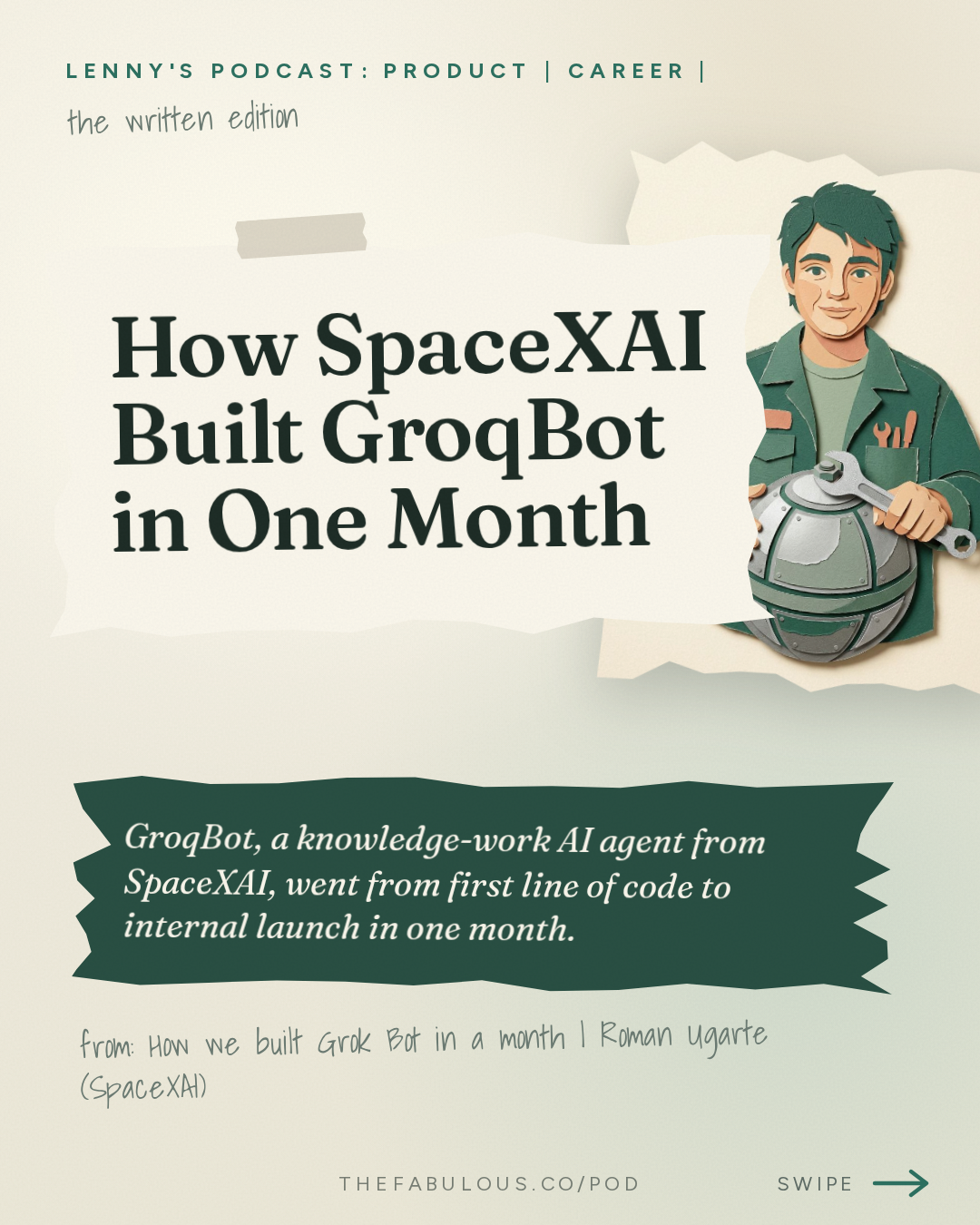
GroqBot, a knowledge-work AI agent from SpaceXAI, went from first line of code to internal launch in one month (05:07). A small isolated team, manual onboarding of 200-300 early users (11:41), and giving each bot its own cloud computer instead of sharing the user's device (31:58) drove its rapid, widely praised launch.
Imagine hiring someone and telling them, on day one, that they will not get a laptop. They will sit next to you and share yours. They will use your logins, and you will use theirs. No company would design a job this way. Yet according to Roman Ugarte, head of growth at Cursor and one of the builders behind the AI agent GroqBot, this is roughly how most people currently work with AI.
"We're onboarding these super intelligent new colleagues, these AI bots, and you're asking them to share the same computer that you have. It's crazy." — Roman Ugarte [32:33]
That observation, half joke and half thesis, explains a lot about why GroqBot, built inside the company now called SpaceXAI, became one of the fastest-adopted AI products of the year. Ugarte was employee number 15 at Cursor, the AI coding tool (01:38), and for the last two years he has run growth there. Around a month before this conversation, a small team inside the company went, in his words, into a cave. Their assignment: build an AI product for everyone who is not a software engineer. From the first line of code to a working internal prototype took only about a month (05:07). Three weeks after that internal release, the product went public. By the time this interview happened, it had been live for three weeks and had already drawn a standing-room-only meetup.
Speed like that is usually explained away with a shrug: good team, good timing. Ugarte's account is more specific, and more useful, than that.
Small rooms, fast decisions
The GroqBot team was deliberately tiny and deliberately cut off. It sat in a separate part of the office, on private Slack channels, isolated from the rest of the company. Ugarte argues this was not a nicety but a mechanism: a handful of people had to make dozens of small, non-obvious product decisions every day, and a bigger group debating a twelve-month roadmap would never have converged. Once the internal prototype existed, the team did something that sounds almost old-fashioned for an AI product: they onboarded people by hand. Two to three hundred early users, one at a time, on calls that ran about twenty minutes each (11:41, 12:05). Some of those calls were rough. A computer would not spin up, or a new user would sit there confused. Ugarte's rule was that the team had to be on those calls, because a painful onboarding today became a fixed bug tomorrow.
The manual-onboarding list was not just power users and AI insiders. It included, deliberately, people the company would never normally talk to, among them a coffee shop owner recruited through a friend of a friend, who became both a devoted user and, in Ugarte's telling, a rich source of bug reports about things like a flaky Shopify integration. The point was to find the blind spots of a team that otherwise lives, as Ugarte puts it, in the Silicon Valley AI bubble.
The onboarding calls also surfaced a pattern the team hadn't designed for. Inside the company, some employees started giving one of their bots a promotion, naming it a kind of chief of staff that would receive instructions and then fan tasks out to a roster of five to ten other, more specialized bots (12:46-13:42). The team noticed the pattern, decided it was worth encouraging in the product, but was careful not to force it on new users before knowing whether it held up outside the company's own culture. It did.
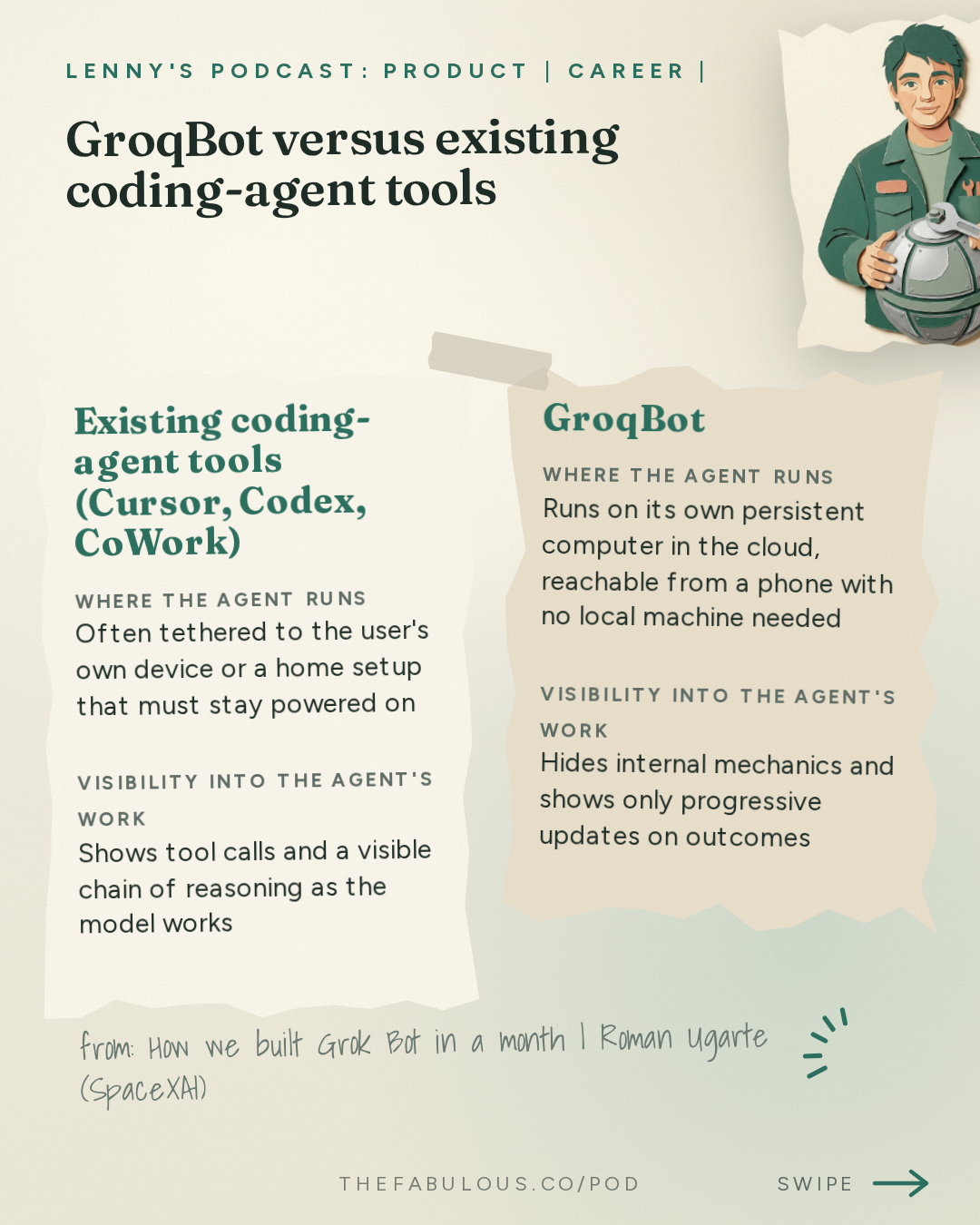
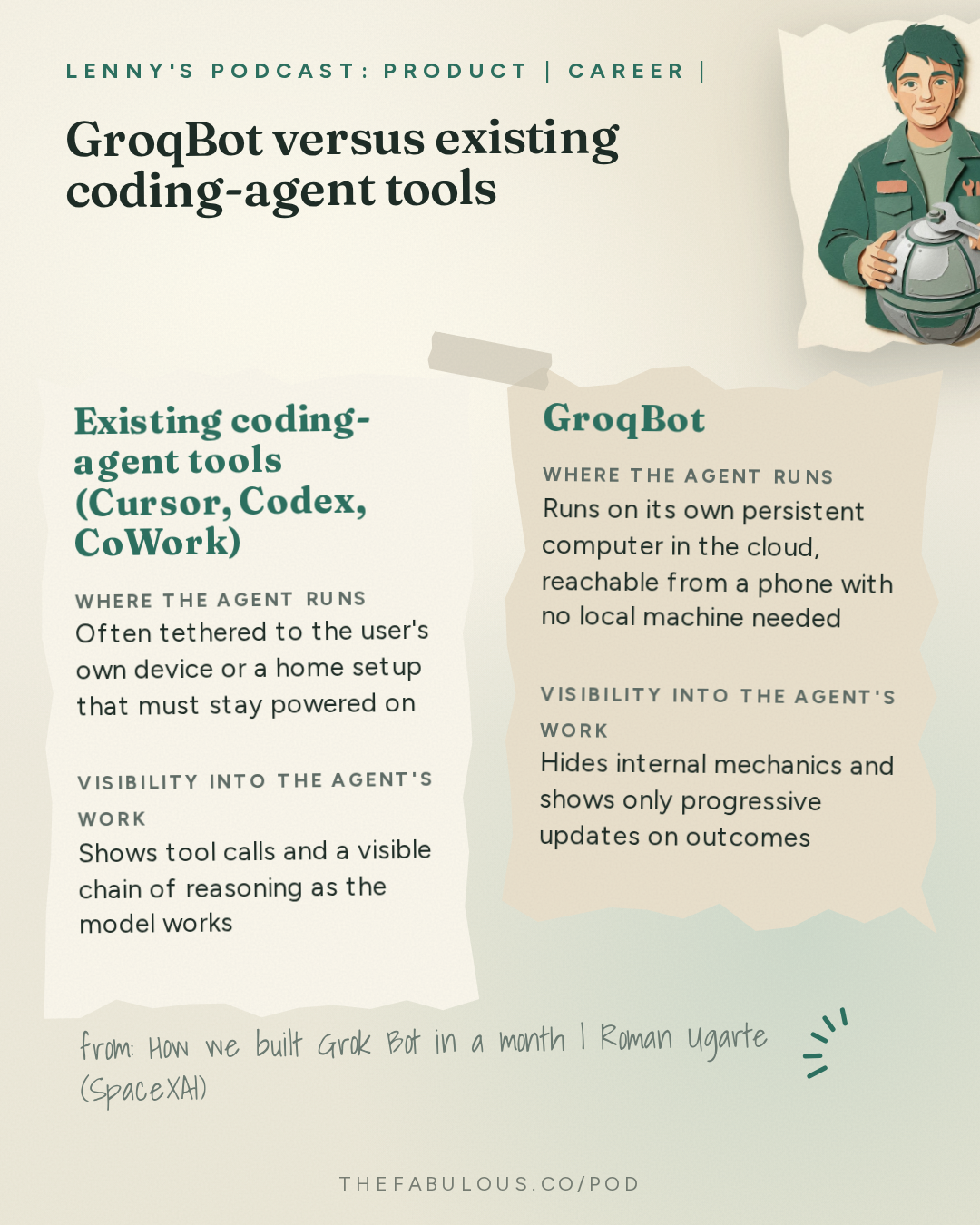
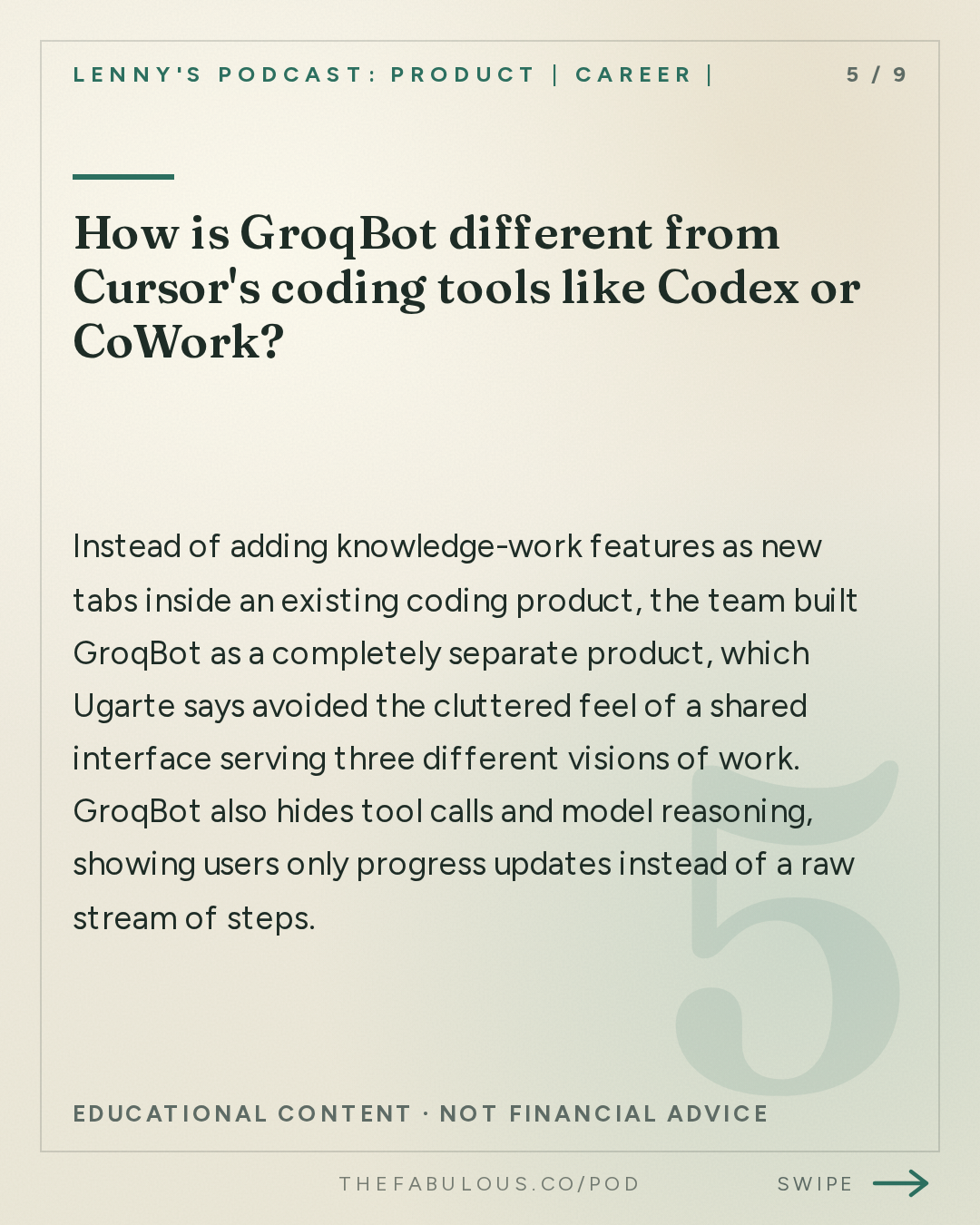
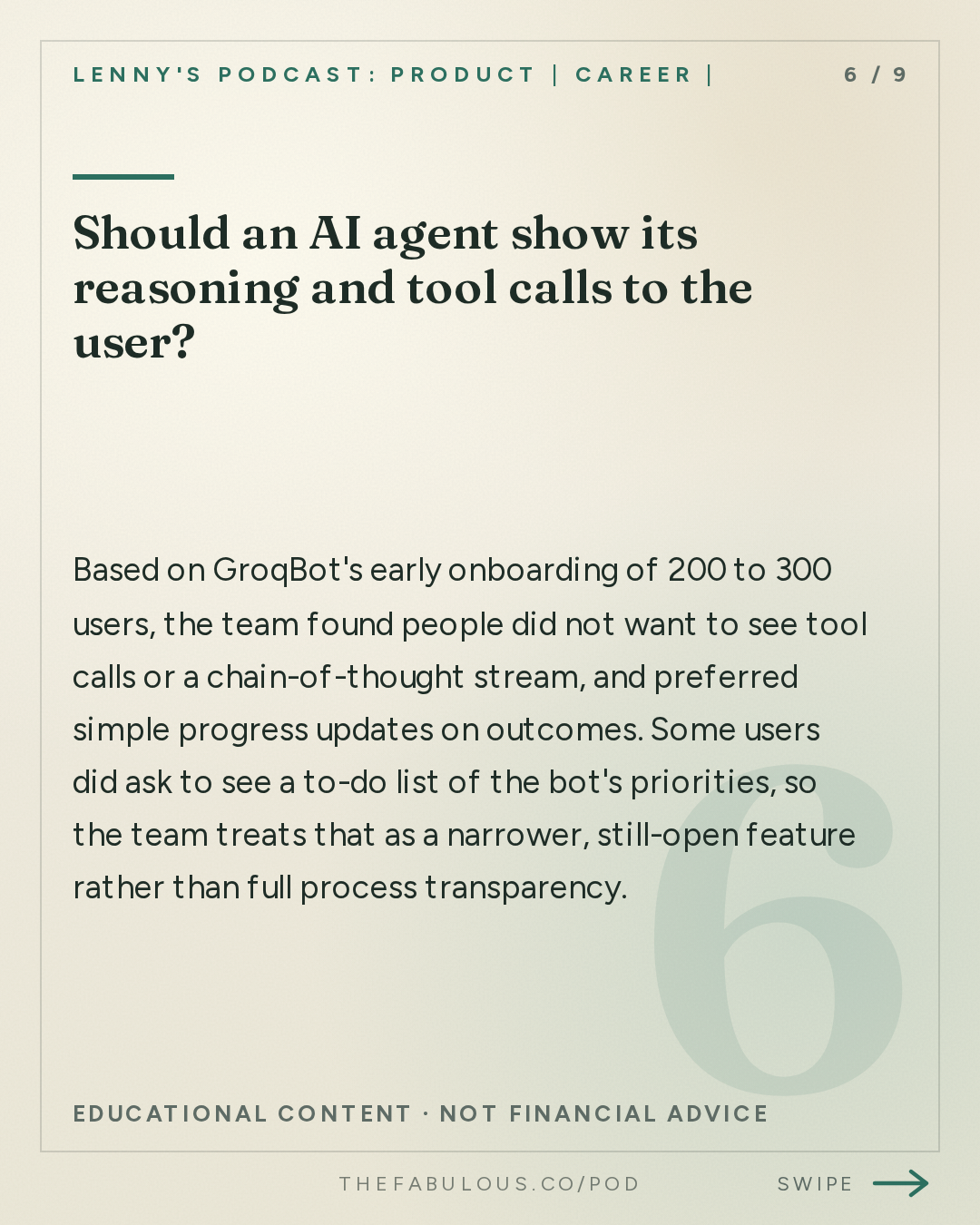
These sessions also taught the team what people did not want to see. Competing AI tools tend to show their work: a scroll of tool calls, a visible chain of thought as the model reasons its way through a task. GroqBot's team went the other direction. A user sends a message, the bot starts working, and the interface shows a simple typing indicator and progress updates as the bot sees fit, nothing more (15:16-15:42).
"We really wanted to take a strong stance that users did not need to see all of those mechanics." — Roman Ugarte [15:42]
Some users asked for a visible to-do list. Nobody asked for the raw stream of reasoning text. That distinction, small as it sounds, shaped a large share of what got cut in the three weeks between internal beta and public launch, a period Ugarte describes as mostly unshipping: removing debug-style visibility tools, developer-y dashboards, and general jank that had crept in while the core team was building for itself (19:42).
A computer of one's own
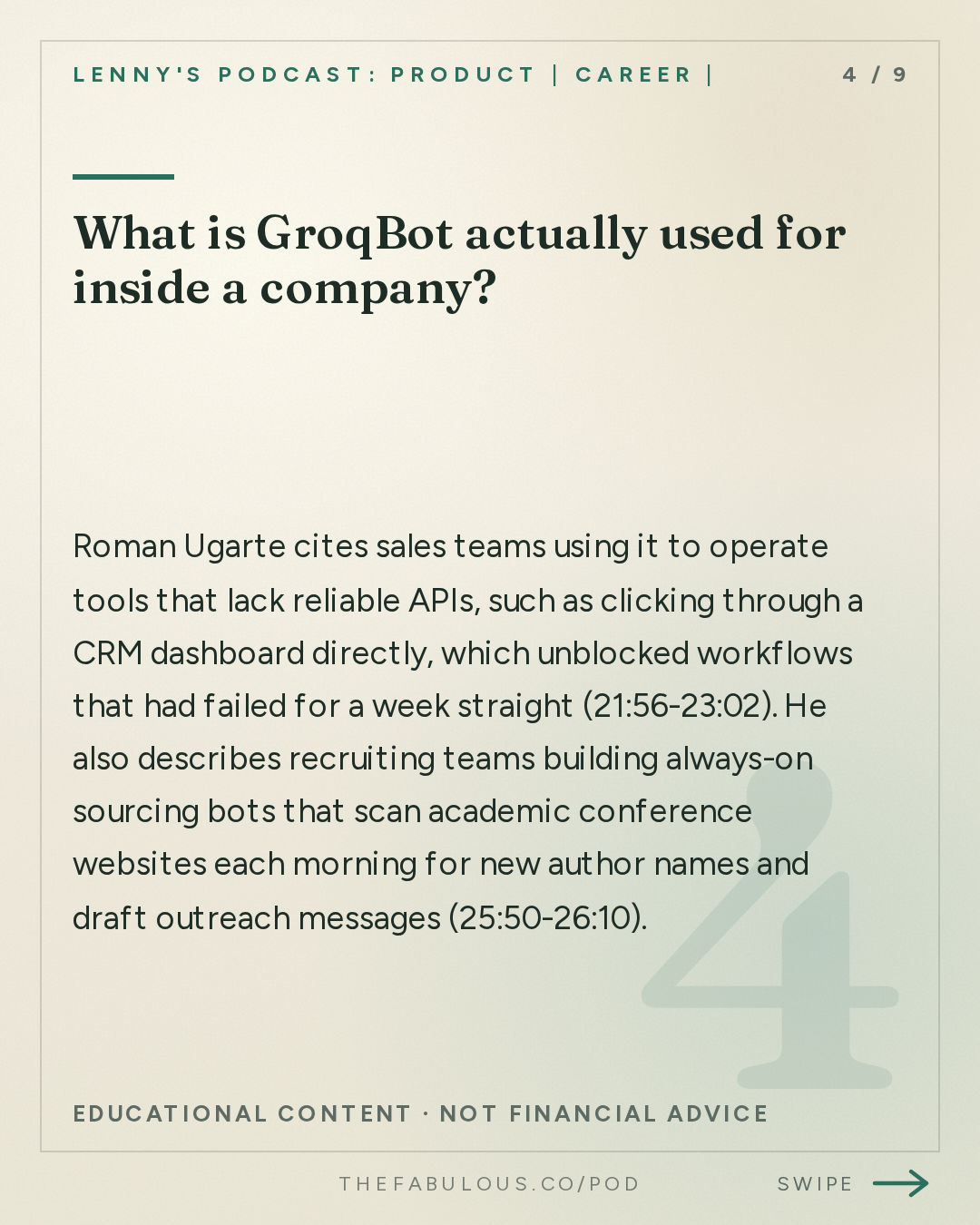
The decision Ugarte returns to most is architectural. Most AI agent tools available before GroqBot ran on a version of the user's own device, sometimes literally: a home computer left on, tethered through a VPN, so the agent could keep working. GroqBot's team decided early that every bot should run on its own persistent computer in the cloud, separate from the user's device entirely (31:08). That choice does two things. It means a bot keeps the same state everywhere the user reaches it, from a phone or a laptop, without anything needing to stay powered on at home. And it means the bot can use a computer the way a person does, clicking through a browser and typing into forms, for the large number of everyday tools that were never built with a clean API. Ugarte points to the company's own sales team as an example: tools without well-supported integrations had been unreliable for other AI assistants, and only stopped stalling once GroqBot could just operate the interface itself, mouse and all (21:56-23:02).
Ugarte credits an earlier product called OpenClaw, an enthusiast setup that ran an AI agent off a home computer, with proving the underlying idea: give a model access to the tools a person actually uses, plus its own computer, and even today's models get remarkably far (36:32-37:33). What GroqBot added was packaging: no VPN, no Mac Mini in a closet, an experience simple enough that recruiting teams at the company, according to Adam Ward, the head of talent, used it to build always-on sourcing bots that scan academic conference websites every morning for new co-author names and draft outreach messages (25:50-26:10).
The same logic runs through what Ugarte calls the company's internal culture, described with a phrase employees use casually: colleague-pilled. When a product debate stalls, the tie-breaker is not a metrics dashboard but a simple question: what would you want from a human teammate in this exact situation? He offers the number that anchors why this matters to him personally. A teammate you trust only 90 percent is still a teammate you have to watch, which means the work is not actually 90 percent done, it just feels that way while it sits on your mind (62:59).
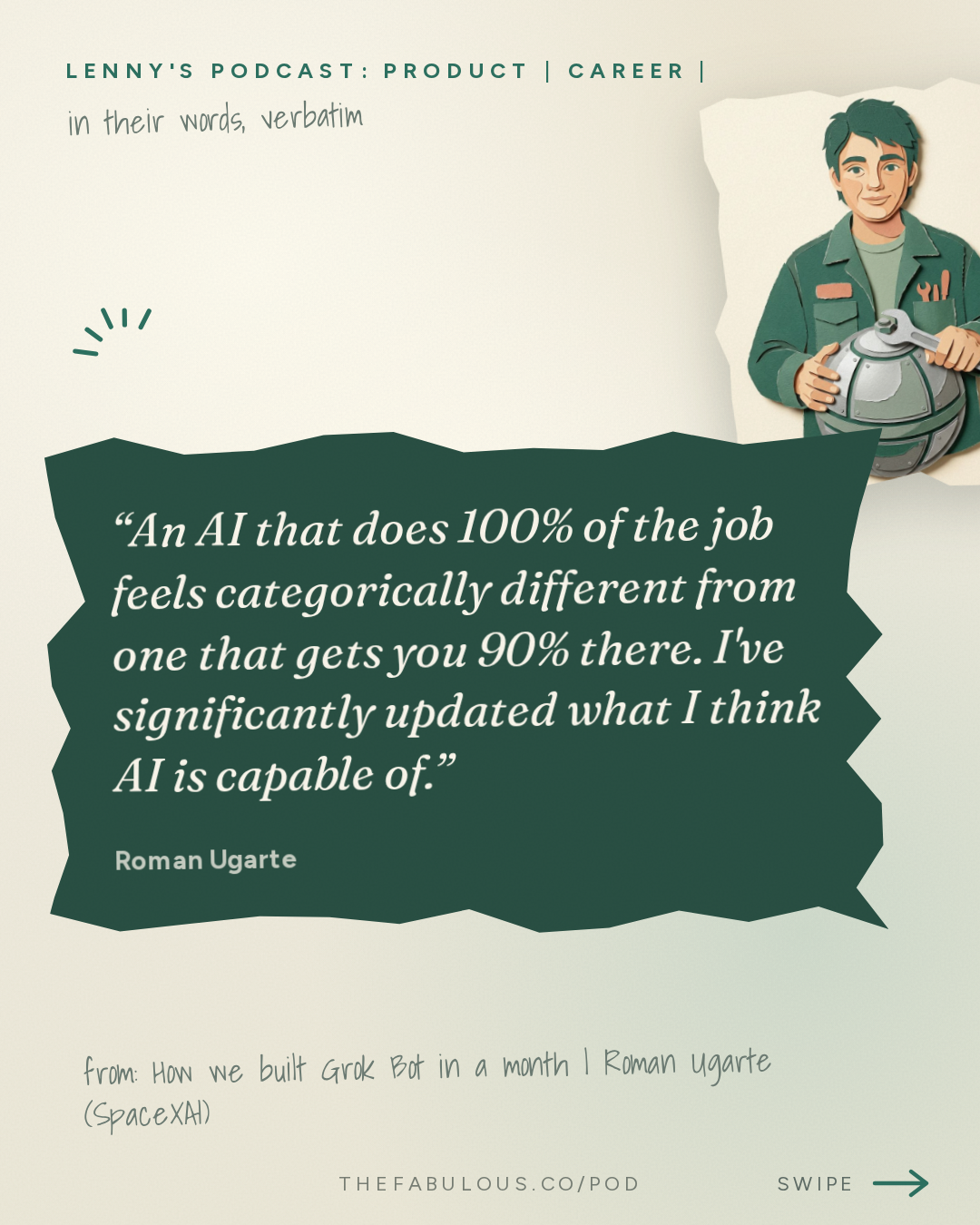
"An AI that does 100% of the job feels categorically different from one that gets you 90% there. I've significantly updated what I think AI is capable of." — Roman Ugarte [60:43]
That gap, in Ugarte's account, is the real product. Cursor scaled from 15 employees to more than 1,000 (64:33) without, he insists, losing what he calls scramble energy, the willingness to treat every six months as a moment to reinvent the product rather than defend it. He is candid that this is existential rather than aspirational: a company that cannot rebuild its priorities every six months, he says, will lose (68:49). Asked about moats, a word every AI founder currently loses sleep over, he declines to offer a strategy diagram. Cursor's advantages, he argues, were not planned; they were the residue of an obsession with building something genuinely useful today, then deleting it three months later once the underlying models made it obsolete on their own (73:14-74:20). GroqBot, on this account, is not a finished thesis about the future of work. It is what happens when a small team keeps asking, every few months, what a human colleague would actually want, and then goes and builds it before anyone gets a chance to overthink it.
Ask this episode anything
Pod's AI answers from the episode itself, with the minute mark so you can hear it yourself.
Or start with one of these
Ask this episode
Pod's AI listens to the whole episode to answer, and points you to the minute it comes from.
The rest of this answer, and any question after it
Answers come from the episode itself, never from a summary of it.
ContinueKey takeaways
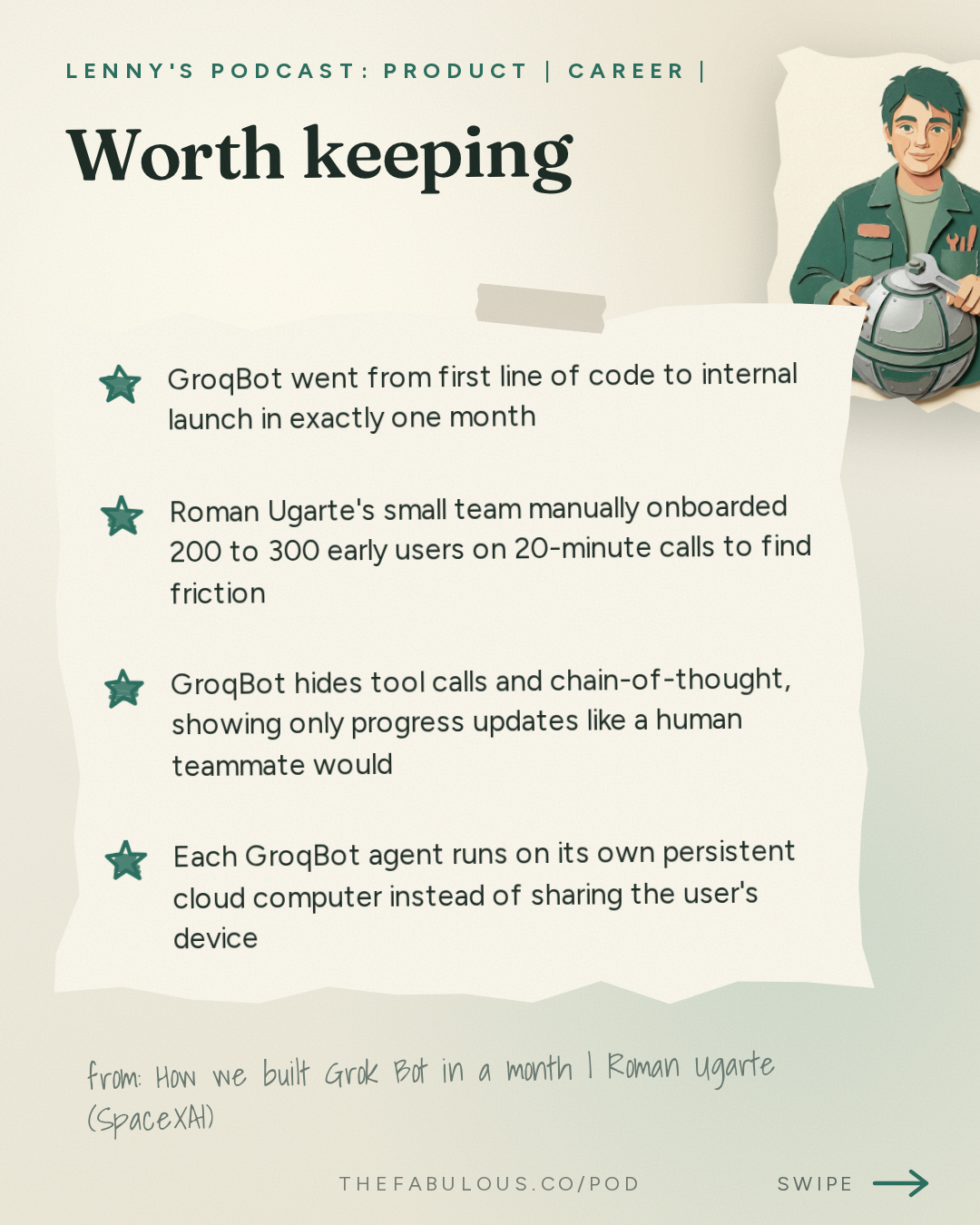
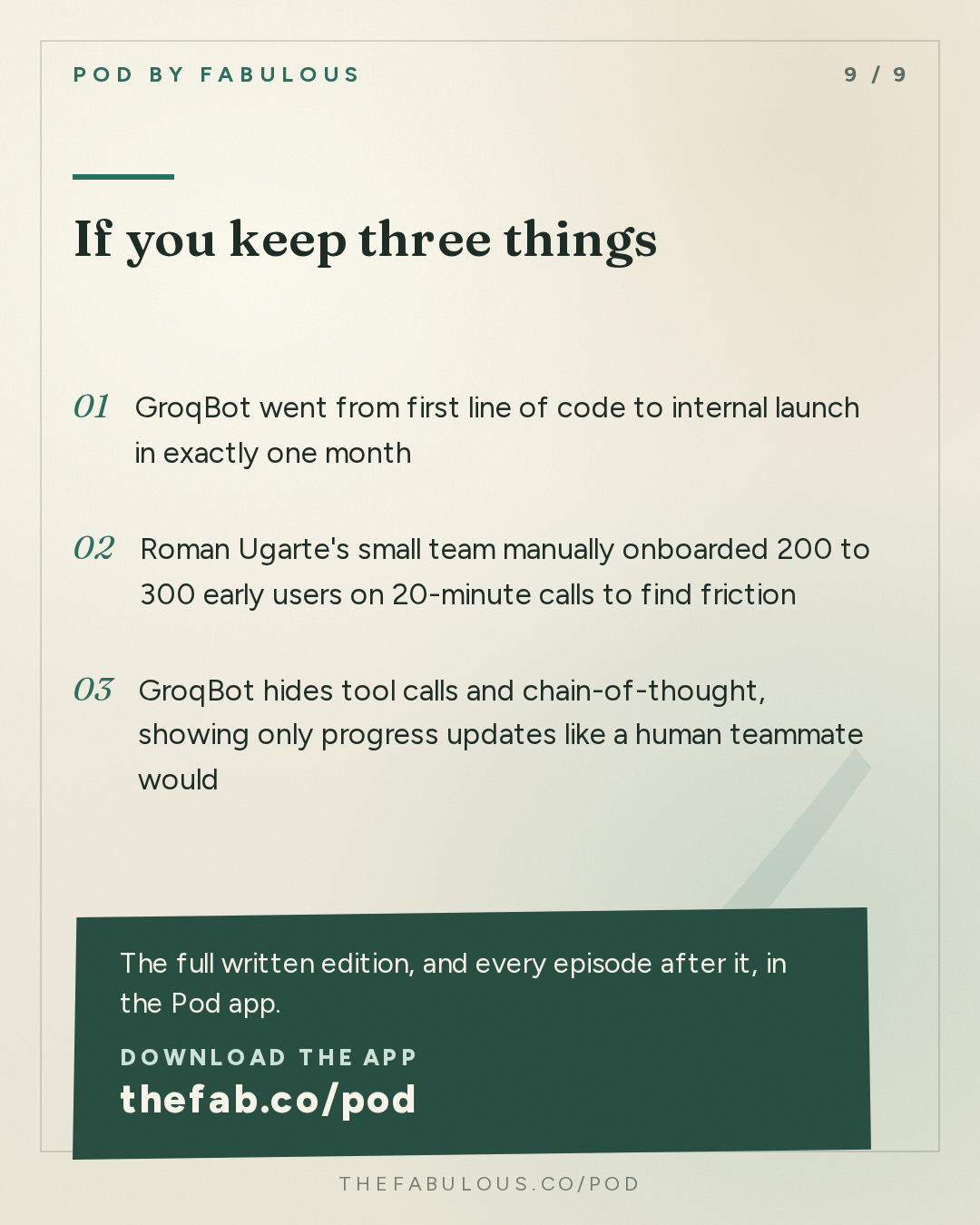
- GroqBot went from first line of code to internal launch in exactly one month
- Roman Ugarte's small team manually onboarded 200 to 300 early users on 20-minute calls to find friction
- GroqBot hides tool calls and chain-of-thought, showing only progress updates like a human teammate would
- Each GroqBot agent runs on its own persistent cloud computer instead of sharing the user's device
- SpaceXAI treats competitive moats as discovered through building useful products, not planned in advance
The episode in cards
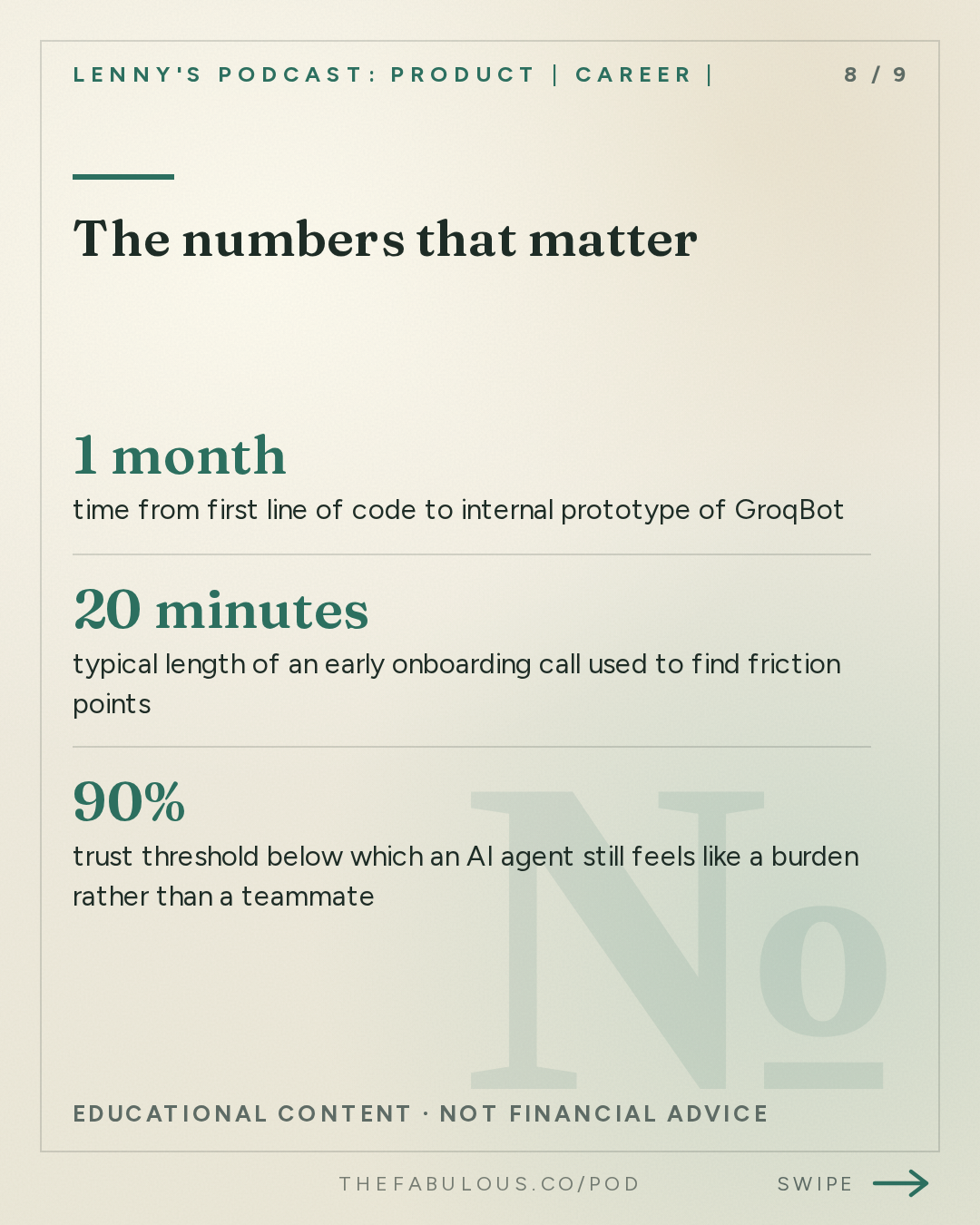
By the numbers
- 1 month time from first line of code to internal prototype of GroqBot
- 20 minutes typical length of an early onboarding call used to find friction points
- 90% percent trust threshold below which an AI agent still feels like a burden rather than a teammate
In their words
“An AI that does 100% of the job feels categorically different from one that gets you 90% there. I've significantly updated what I think AI is capable of.”
“You're onboarding these super intelligent new colleagues, these AI bots, and you're asking them to share the same computer that you have. It's crazy”
Protocols
-
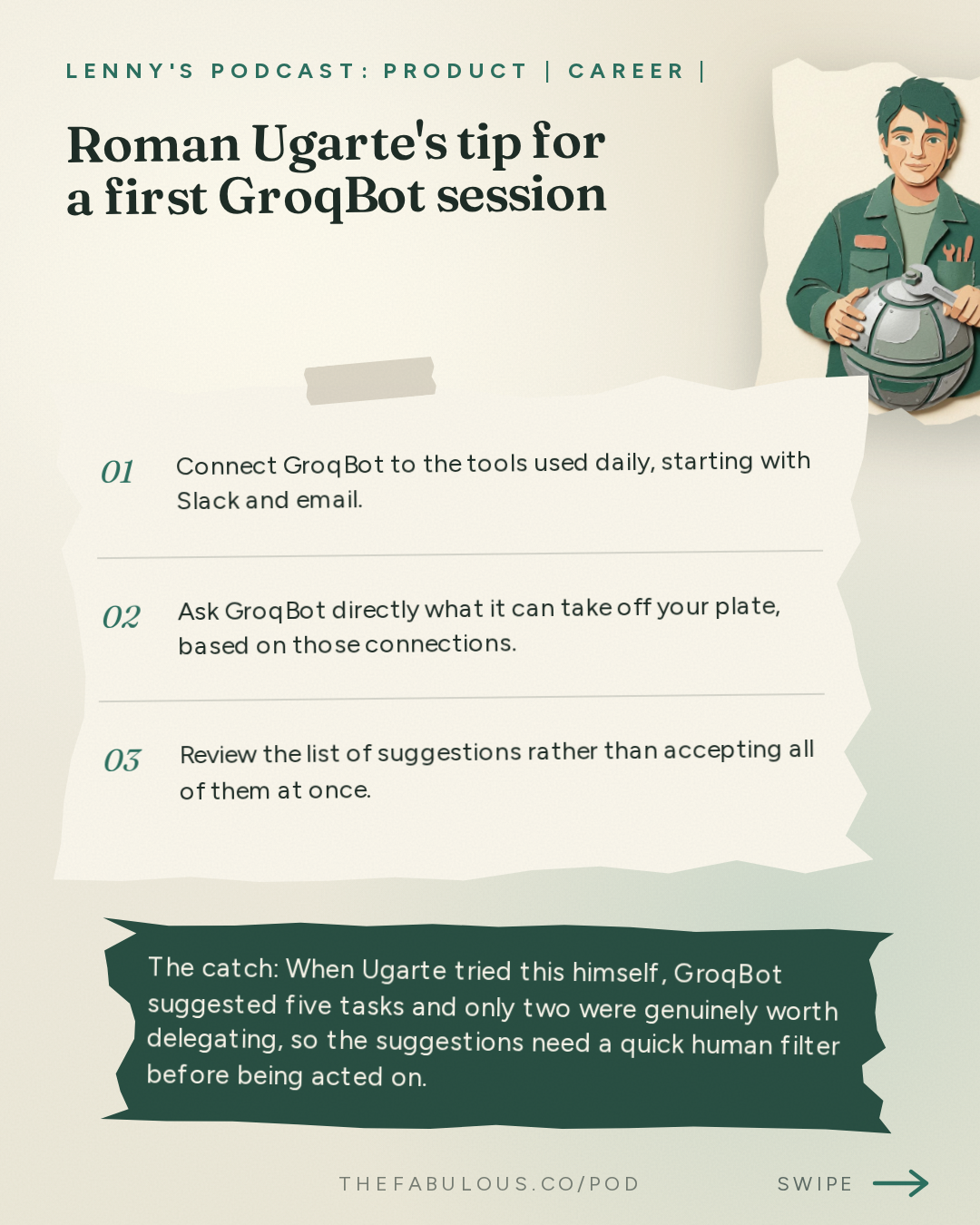
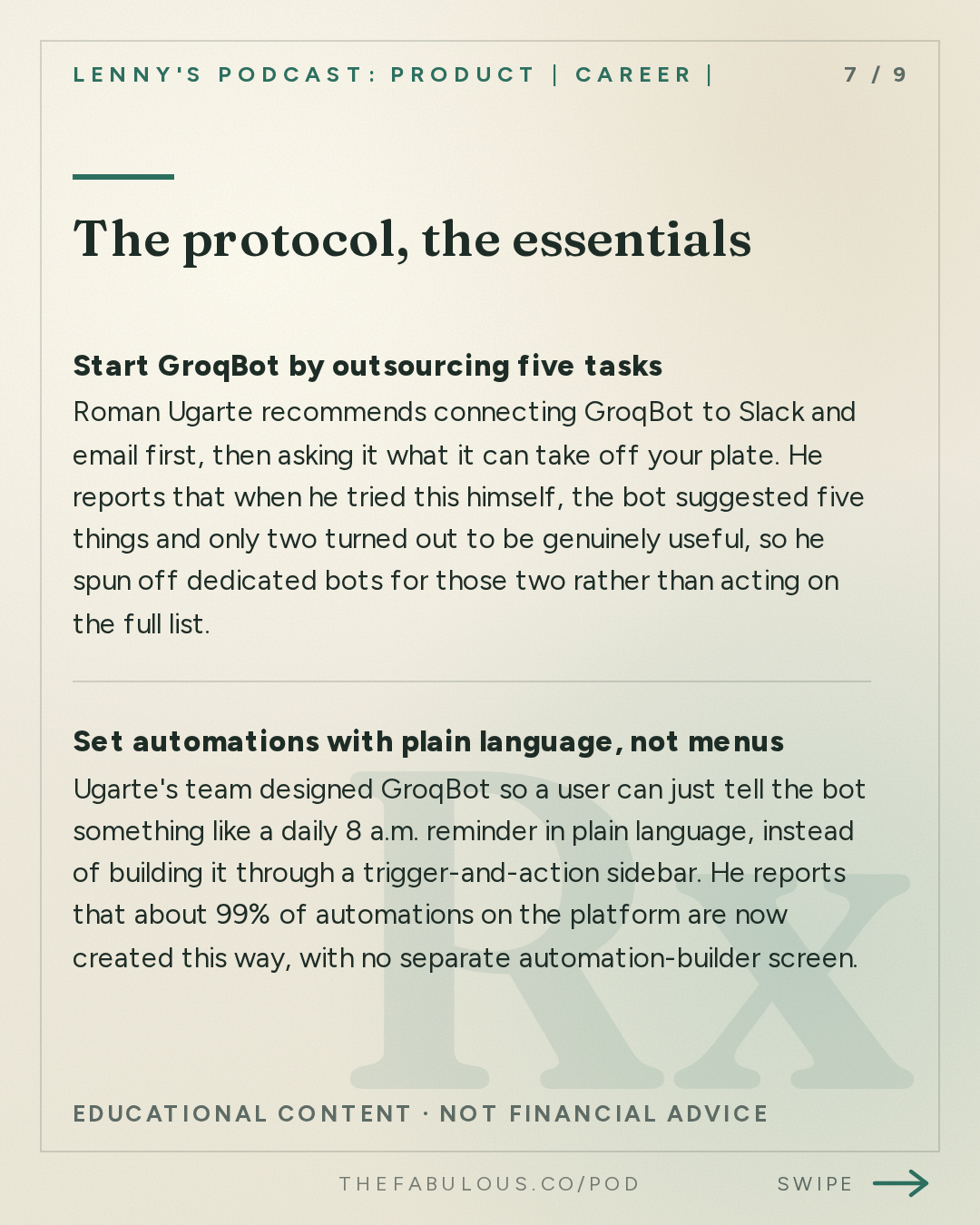
Start GroqBot by outsourcing five tasks
Roman Ugarte recommends connecting GroqBot to Slack and email first, then asking it what it can take off your plate. He reports that when he tried this himself, the bot suggested five things and only two turned out to be genuinely useful, so he spun off dedicated bots for those two rather than acting on the full list.
once, during onboarding
-
Set automations with plain language, not menus
Ugarte's team designed GroqBot so a user can just tell the bot something like a daily 8 a.m. reminder in plain language, instead of building it through a trigger-and-action sidebar. He reports that about 99% of automations on the platform are now created this way, with no separate automation-builder screen.
as needed
-
Give every agent its own cloud computer
Ugarte says a GroqBot agent should run on a dedicated computer in the cloud rather than share the user's laptop, so it keeps a persistent state and can be reached from a phone without any local machine needing to stay on. He compares sharing a device with an AI colleague to asking a new hire to sit at your desk and use your login on their first day, which he calls a bad way to onboard anyone.
built into the product by design
Questions this episode answers
How long did it take to build GroqBot?
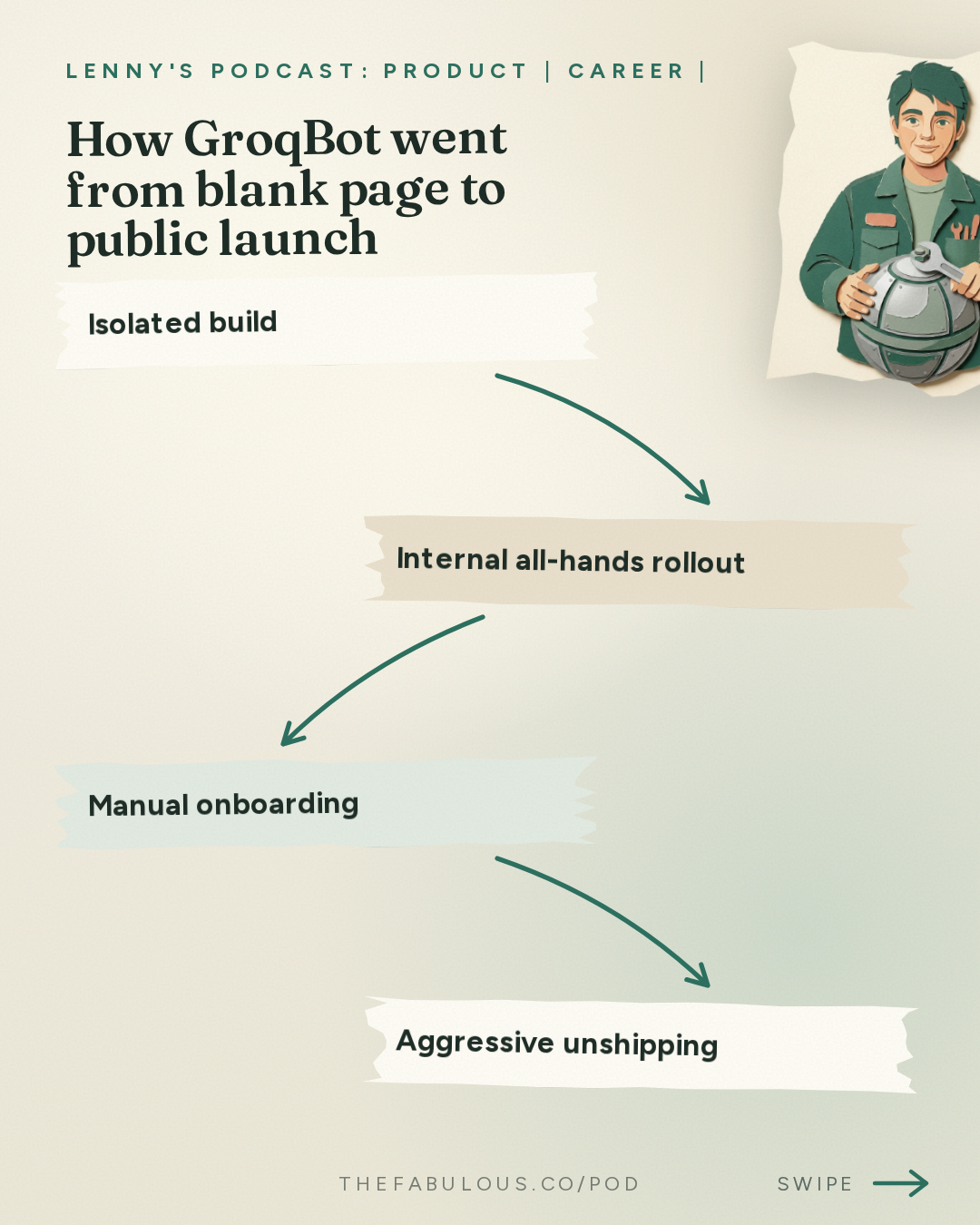
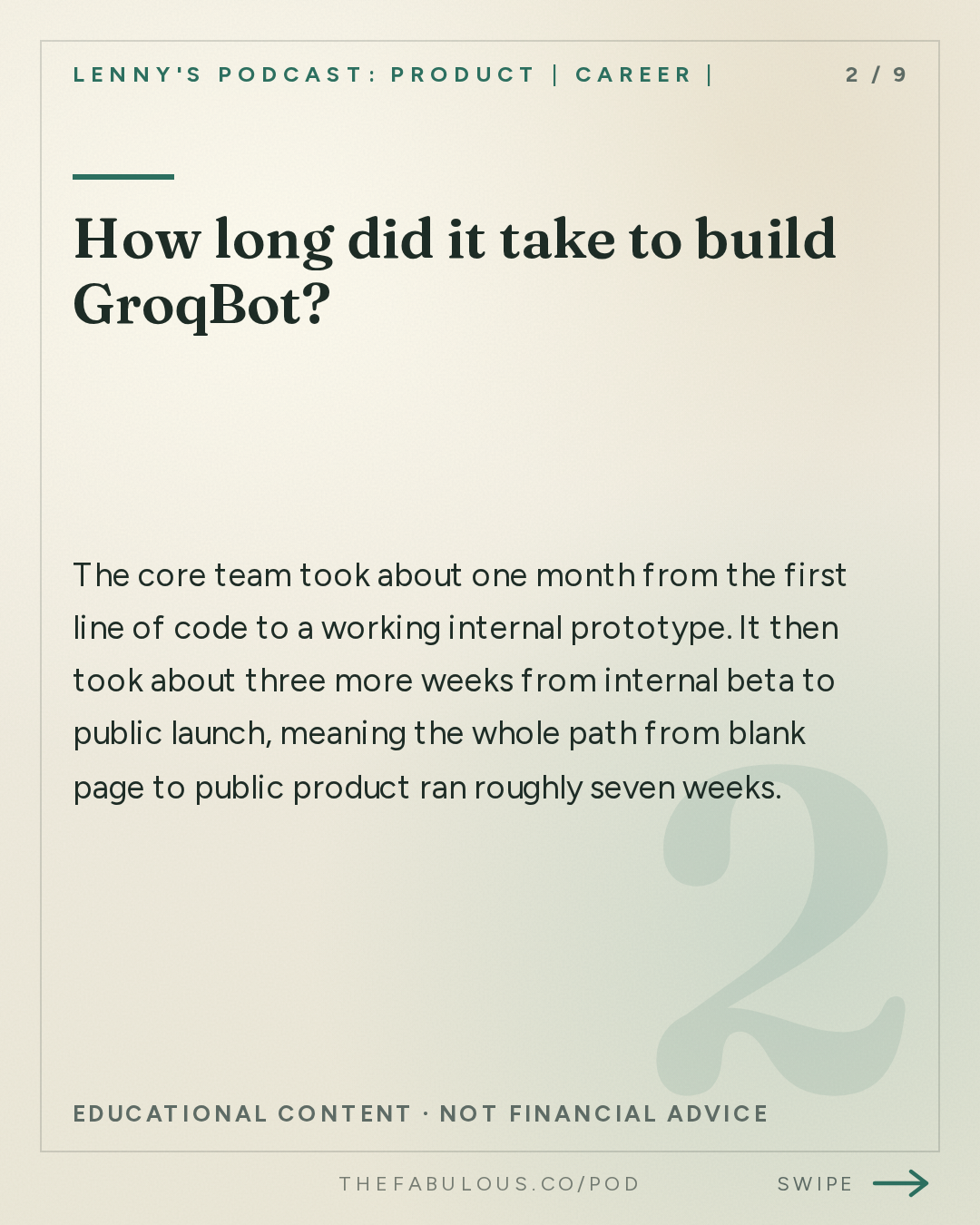
The core team took about one month from the first line of code to a working internal prototype (05:07). It then took about three more weeks from internal beta to public launch (18:50), meaning the whole path from blank page to public product ran roughly seven weeks.
Why does GroqBot give each AI agent its own computer?
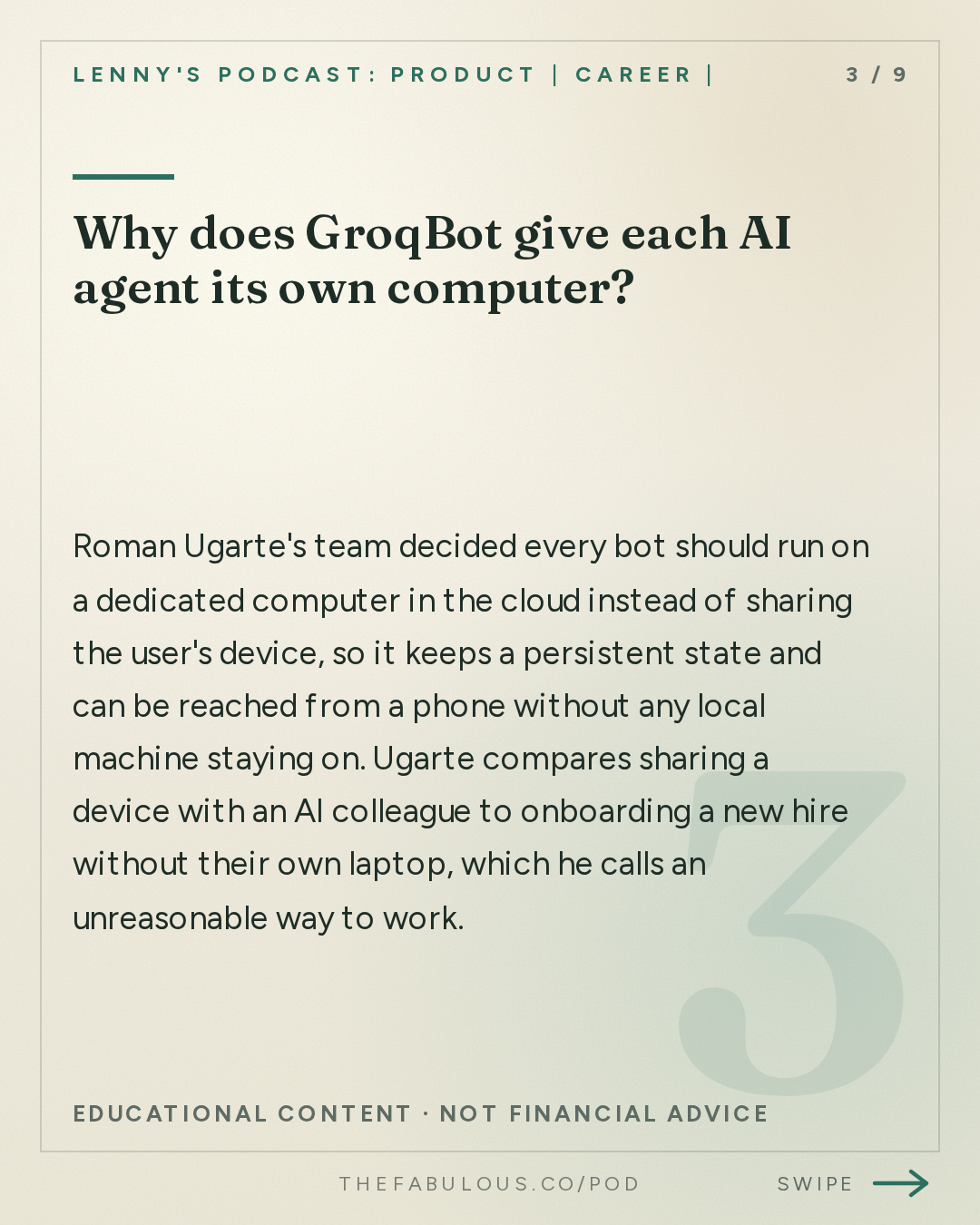
Roman Ugarte's team decided every bot should run on a dedicated computer in the cloud instead of sharing the user's device, so it keeps a persistent state and can be reached from a phone without any local machine staying on (31:08). Ugarte compares sharing a device with an AI colleague to onboarding a new hire without their own laptop, which he calls an unreasonable way to work (32:33).
What is GroqBot actually used for inside a company?
Roman Ugarte cites sales teams using it to operate tools that lack reliable APIs, such as clicking through a CRM dashboard directly, which unblocked workflows that had failed for a week straight (21:56-23:02). He also describes recruiting teams building always-on sourcing bots that scan academic conference websites each morning for new author names and draft outreach messages (25:50-26:10).
How is GroqBot different from Cursor's coding tools like Codex or CoWork?
Instead of adding knowledge-work features as new tabs inside an existing coding product, the team built GroqBot as a completely separate product, which Ugarte says avoided the cluttered feel of a shared interface serving three different visions of work (10:14). GroqBot also hides tool calls and model reasoning, showing users only progress updates instead of a raw stream of steps (15:42).
Should an AI agent show its reasoning and tool calls to the user?
Based on GroqBot's early onboarding of 200 to 300 users, the team found people did not want to see tool calls or a chain-of-thought stream, and preferred simple progress updates on outcomes (15:42). Some users did ask to see a to-do list of the bot's priorities, so the team treats that as a narrower, still-open feature rather than full process transparency (16:00).
The full read, in cards
Go deeper
- The War of Art — Steven Pressfield's book on creative resistance, which Roman Ugarte says he returns to a page at a time
- Cat's Cradle — Kurt Vonnegut novel Roman Ugarte frequently recommends and gifts to friends
Mentioned
Roman Ugarte · SpaceXAI · Cursor · GroqBot · Adam Ward · Claire Vo · OpenClaw · Exa · Desiderata
More from this show and category
How AI Models Actually Think
Anthropic researcher Emmanuel Ameisen explains that language models are grown through training, not programmed line by line, so even their creators cannot read their internal logic directly. Interpretability research shows models form internal plans, share universal concepts across languages, and sometimes fixate on wrong answers when training data rewards them incorrectly (01:45, 15:31, 37:14).

Josh Woodward on Building an AI Labs Team
Google Labs head Josh Woodward argues every company now needs a frontier team that tests new AI models obsessively, judges early products by watching users' eyes rather than dashboards, and hires for an 'unlearning rate' as much as a learning one (32:13).
OpenAI's Tibo Sottiaux on Dots and AI Agents
OpenAI's Head of ChatGPT Tibo Sottiaux says agents will soon take most actions on the internet, not humans. He describes Dots, OpenAI's persistent agent that remembers personal context, controls multiple devices, and learns from feedback, plus a plugin ecosystem with revenue sharing and 16 sign-in partners, as proof the industry is moving from manually built loops to self-learning systems (00:16, 11:58).

Molly Graham's Give Away Your Legos AI Advice
Molly Graham's decade-old advice to give away your career projects still works, but she now says some tasks, like judgment and vision, should never go to AI. Tech burnout jumped from 44% to 55% in a year, and she argues AI needs coaching like a lazy intern rather than blind trust, while good management matters more than ever.
