
Steve Jobs' Wilderness Years: NeXT and Pixar
Steve Jobs in Exile
▶ Listen to the full episode More from The Knowledge Project
The brief
Steve Jobs spent twelve years outside Apple, from 1985 to 1997, nearly going bankrupt at NeXT before learning to delegate and compromise. NeXT's software, built on object-oriented programming, became the base for the iPhone, while Pixar taught him to step back, and Bill Gates' $150 million rescued Apple when Jobs finally returned.
In 1986, a year after losing his job at the company he co-founded, Steve Jobs paid graphic designer Paul Rand $100,000 for a single logo for his new startup, NeXT. Rand's terms were blunt: one design, no revisions, use it or not (10:25). It is a strange opening image for the man who would later become famous for ruthless simplicity, the same man who, once he returned to Apple, would kill 70 percent of its product lines in a single stroke (56:15). The years between those two moments are the part of the Steve Jobs story that rarely gets told: not the garage, not the black turtleneck keynote, but twelve years of expensive, humbling, occasionally humiliating failure.
Jobs did not leave Apple as its chief executive. He ran the Macintosh division, one unit among many, and by 1985 he had become impossible to manage (02:32). The Macintosh, released in 1984, was a cultural sensation and a commercial disappointment (00:55). Sales were weak, layoffs followed, and Jobs tried to force the issue by staging a coup against CEO John Sculley, luring him toward a trip to China so the board would be free to install Jobs in his place (03:18). The plan collapsed when a rival tipped off Sculley. Jobs left Apple that fall with over $100 million and, by his own account, no real friends and no identity outside the company (05:52)(06:15).
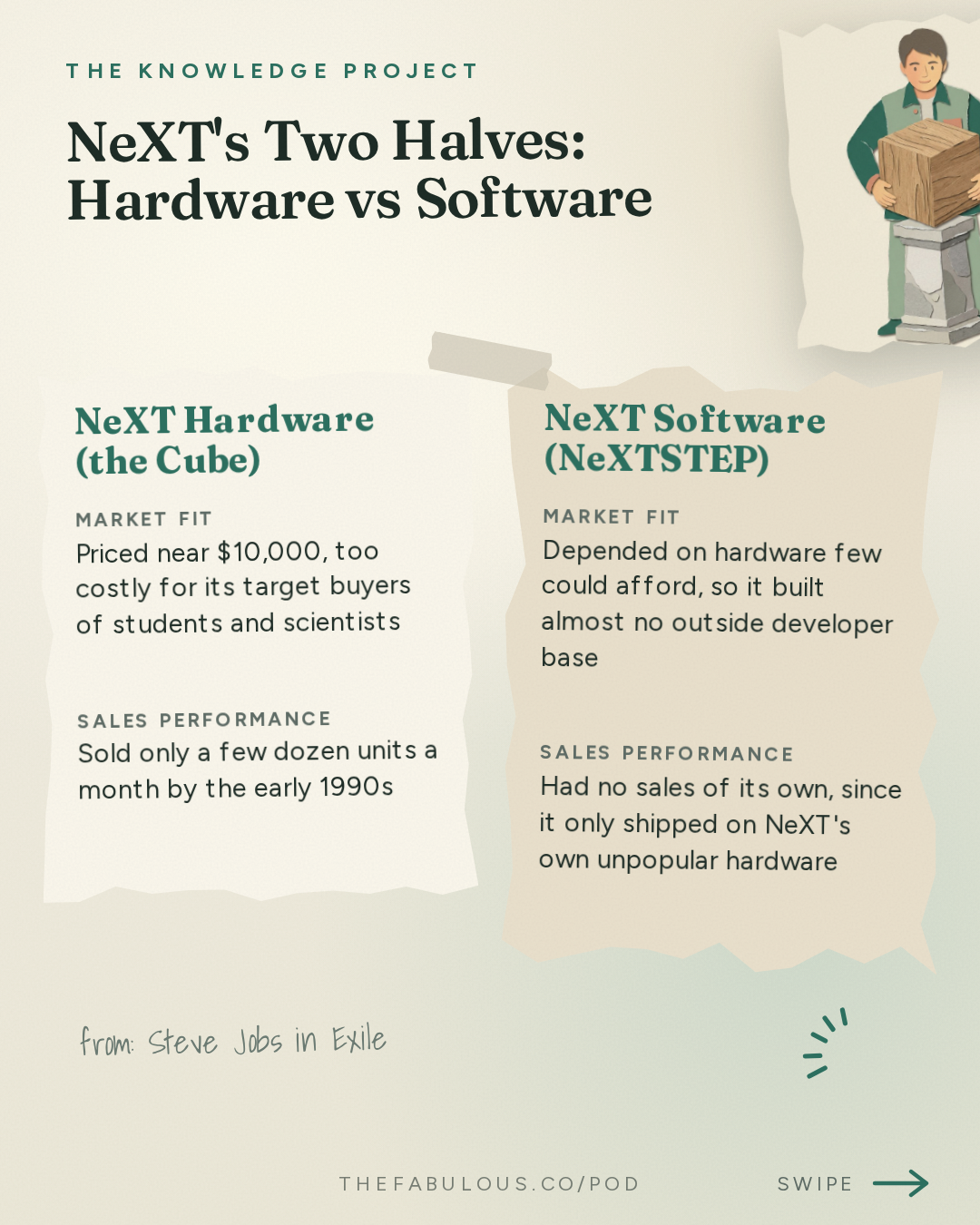
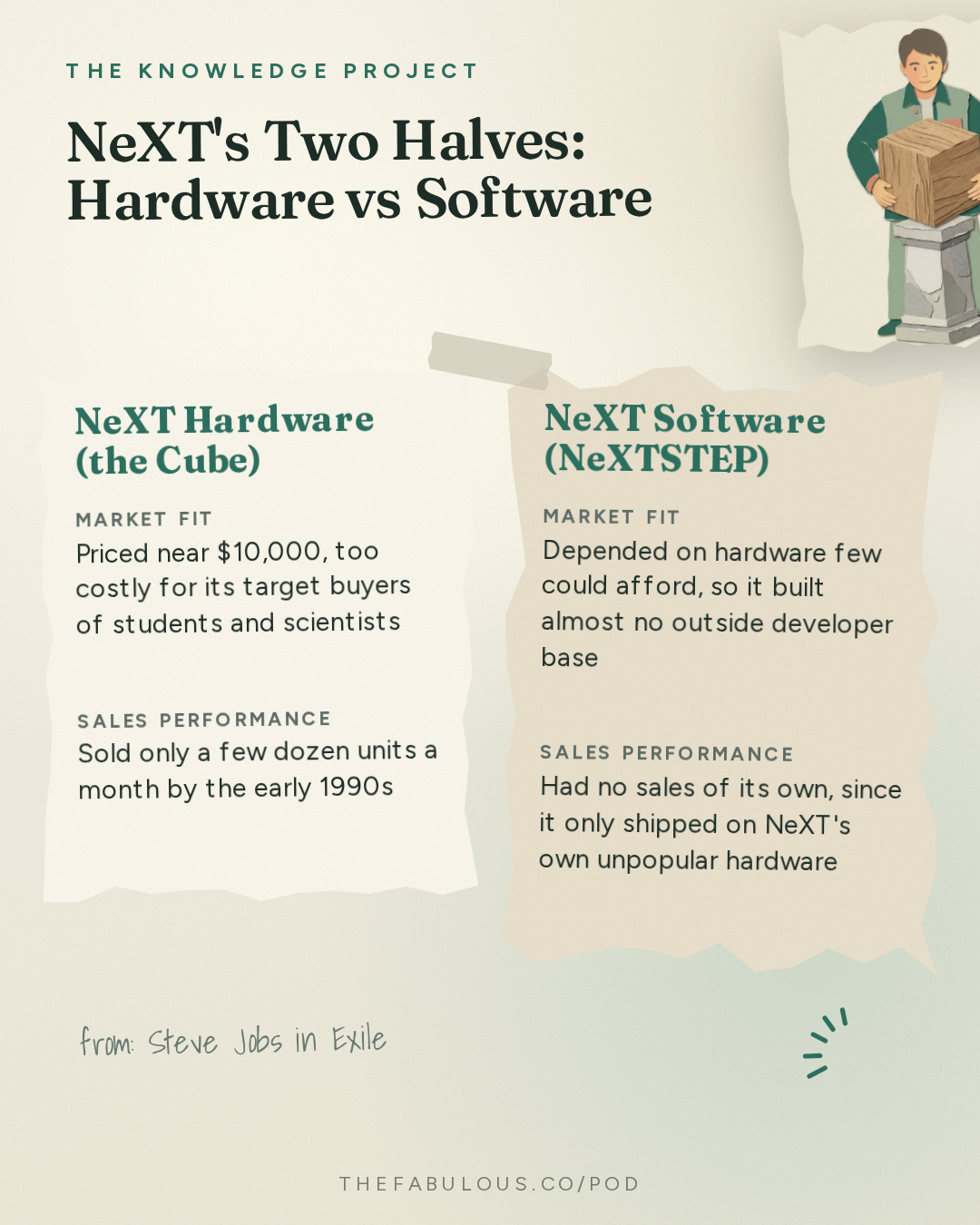
What he built next reveals exactly what he had not yet learned. NeXT Computer was going to be the perfect machine: hardware, software, even the casing, all controlled by one vision. Jobs insisted the computer be a literal cube, ninety-degree angles, which required a specialized $500,000 sanding line just to manufacture (12:06). The resulting machine cost around $10,000 (13:27), while Jobs himself projected 25,000 units a year despite his own executives warning they had no distribution network to sell them (16:20). Actual sales ran to a few dozen machines a month (18:00). Every expense at the company had been calibrated, unconsciously, to the logo's price tag: if $100,000 was normal spending for a design, it became normal spending for everything.
Jobs' hiring style during this period is more interesting than his balance sheet. He wanted people who would fight him. Interview candidates who hesitated when asked if they were the best in their field were sent away to find someone who was (14:08). At company retreats, engineers and marketers were made to stand and defend their ideas in front of him, and if he thought they weren't pushing hard enough, he pushed them harder (15:09). The catch was that all this intellectual combat did not always change his mind. Told repeatedly that the Cube's sales projections were fantasy, he kept insisting the market would come around, because the product was good and therefore, in his mind, it had to work.
"His biggest fault was building a monument to his own genius, his own vision, and thinking that that would be enough for the market and enough to beat Apple and get revenge on Apple." — Guest, Jobs historian [17:40]
By 1993, NeXT was one weekend from closing its doors (19:08), sitting on roughly $400 million in debt after nine straight years without a profit (31:40). Along the way, Jobs had managed to blow up a near-signed deal with the federal government, walking away from what could have been hundreds of millions in contracts because he refused, on principle, to sell to intelligence agencies, even after his own investor Ross Perot had lined up the paperwork (26:44). Fortune magazine, around the same time, called him a snake oil salesman (28:22). This is the Steve Jobs that history mostly skipped over: broke, alienated from his co-founders, and publicly humiliated.
Learning to Let Go
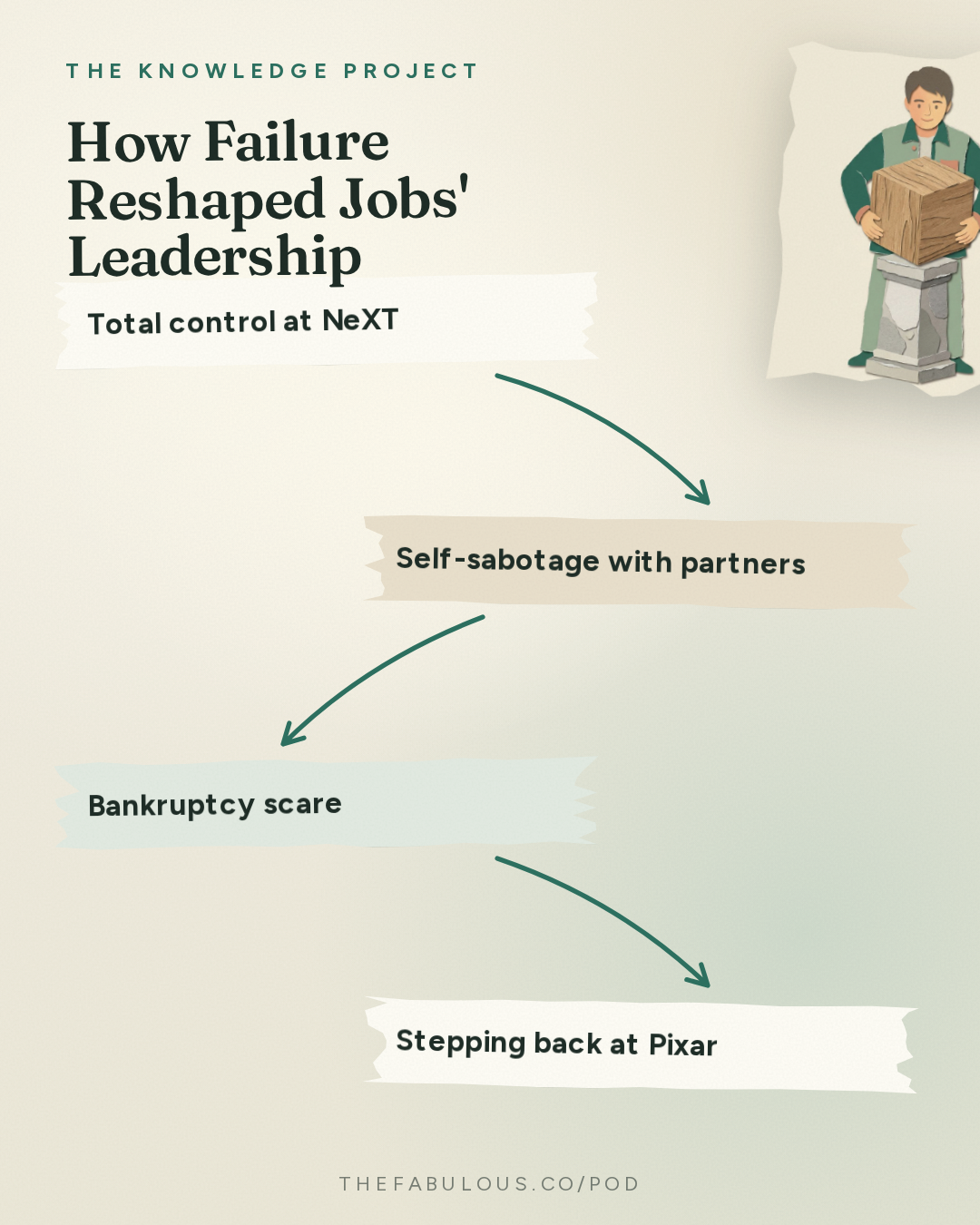
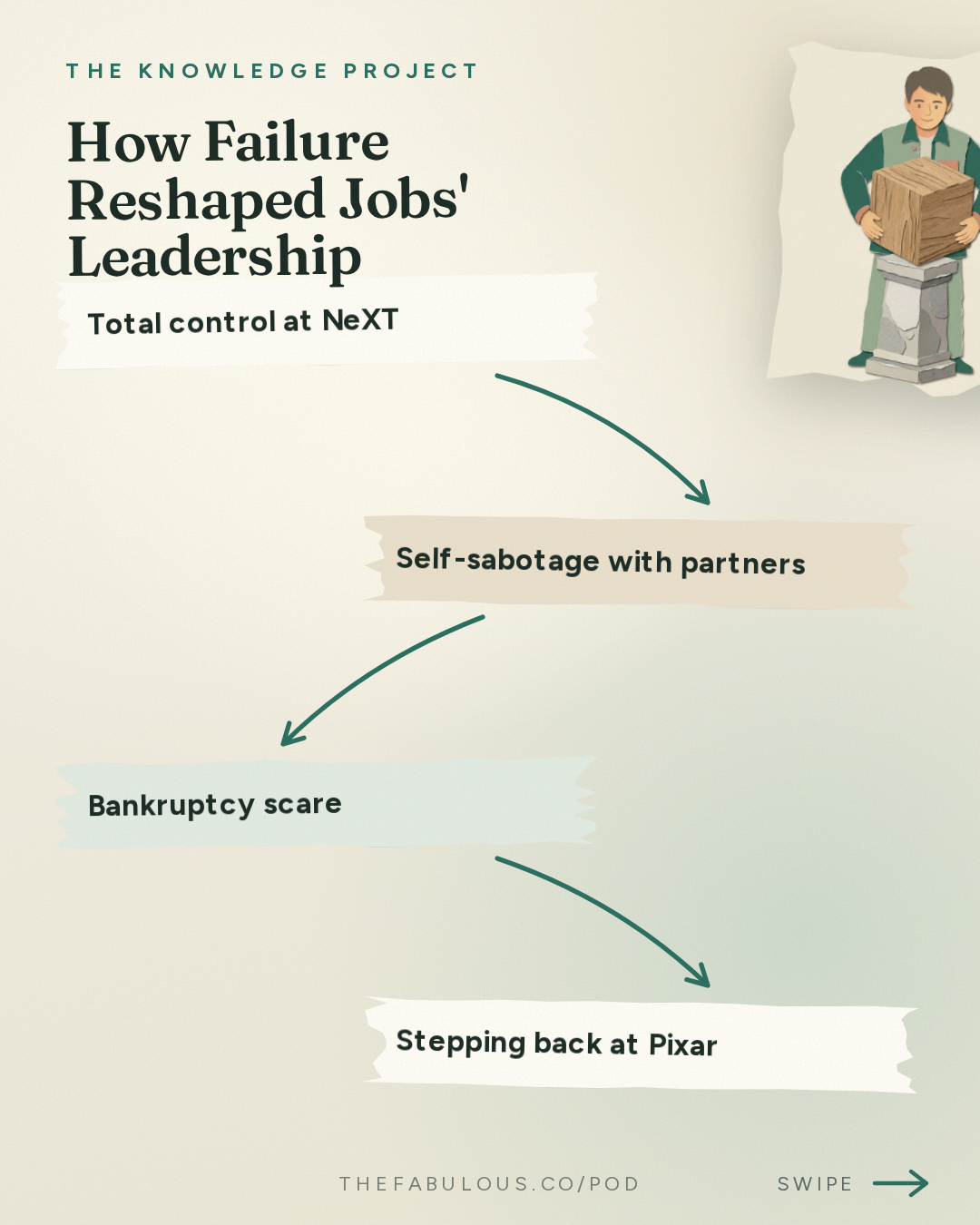
The turnaround did not come from a better idea. It came from Jobs backing off. At Pixar, which he was funding alongside NeXT out of his own pocket (28:48), the deal he struck when he bought the studio was that he would stay out of creative decisions entirely, leaving Ed Catmull and John Lasseter to run the actual filmmaking (30:37). Toy Story became a hit, Pixar went public in late 1995, and the IPO made Jobs a billionaire, solving the personal cash crunch that a decade of funding two struggling companies had created (29:17). At NeXT, a new chief financial officer, Dominique Trampot, forced the company to abandon its dream of selling to Nobel-winning scientists and pivot to enterprise software instead. NeXT posted its first-ever profit in 1994 (32:03), nine years after Jobs founded it, and only after he had largely stepped aside.
NeXT's hardware died with the company's ambitions. Its software did not. Years before anyone at Apple needed it, Jobs had bet on object-oriented programming, a way of building software out of reusable pieces, buttons, images, and other "objects", that he had first seen demonstrated at Xerox PARC (22:11). The operating system built on that idea, NeXTSTEP, had almost no market because it only ran on NeXT's unaffordable hardware. But when Apple, drowning in its own crisis of bloated product lines (35:00) and crashing operating systems, went looking for new software to buy, a NeXT middle manager named Garrett Rice made a cold call that led to a voicemail, a callback from Apple's chief technology officer, and eventually the acquisition that brought NeXTSTEP, and Steve Jobs, back into the company (40:00).
The Pragmatist Returns
Jobs did not come back as a conquering hero. He came back reluctantly, first as an unpaid advisor, insisting he could walk away at any time (41:17). He had, in a fit of frustration, already sold nearly all his Apple stock (42:48). What pulled him in fully was a phone call to Andy Grove, the CEO of Intel and one of his oldest mentors.
"Andy Grove has a reputation for being a straight shooter, and he literally told Steve, 'Steve, I don't give a shit about Apple.'" — Guest, Jobs historian [54:52]
Jobs later said that exchange was the moment he realized he did care. In October 1997 he became interim CEO, a title he shortened to iCEO, the first use of the "i" prefix at Apple that would later name the iPod and iPhone (56:15). He killed 70 percent of the company's projects almost immediately. He also did something the younger Jobs would have refused on principle: he called his rival Bill Gates and accepted a $150 million investment from Microsoft, along with a commitment to keep making Word for Apple computers (49:00)(49:20). That money kept Apple solvent. It is hard to picture the Jobs of the Cube-era NeXT making that call. His public war with Gates had been personal and constant; Gates had once told the press he'd rather "piss on" the Cube than write software for it (52:15). The deal was so unpopular with Apple's own employees that some saw it as a betrayal of everything the company stood for.
What changed between the man who lost hundreds of millions in government contracts on principle and the man who partnered with his "archenemy" to save the company was not his taste or his temper. Colleagues from this later period still describe him as exhausting to work for. What changed was his sense of where control needed to end. In a 1996 interview, reflecting on his years running NeXT and Pixar, Jobs described leadership as an inverted pyramid: once real talent is in the room, the job of the person at the top is to serve that talent, not command it, because good people can leave for another job any time they choose (47:25). It is a strange line coming from a man famous for towering over meetings and calling people's ideas stupid to their faces, but it maps onto what actually happened. Pixar thrived once he left the creative decisions to Catmull and Lasseter. NeXT turned its first profit once he let a CFO run the numbers. Apple stabilized once he put his own former lieutenants, John Rubinstein and Avie Tevanian, in charge of hardware and software and largely let them work.
There is a limit to how much he actually changed, and it is worth naming plainly. Years later, facing a cancer diagnosis, Jobs consulted a psychic and leaned on holistic diets rather than following conventional medical treatment (61:33). He had learned to extend trust and empathy to employees, arranging top medical care for people who worked for him, but he never extended the same trust to himself (60:40). The reality distortion field that once convinced him NeXT would sell 25,000 cubes a year never fully switched off; it simply got redirected, from business plans to his own body.
What the wilderness years actually produced was not a smarter Steve Jobs so much as a more useful one. He kept his stubbornness, his taste, his belief that hardware and software should be built together. What he added was the willingness to bend around a market and a willingness to hand real authority to people better suited to a given job than he was. Asked, near the end of the conversation, what success actually meant to him, the guest offered something quieter than any of the business lessons: waking up with family and friends nearby, sitting in a coffee shop, being able to enjoy whatever is in front of you, whether it's writing a book, building a company, or making a movie (63:07). Twelve years of expensive failure is a strange path to that kind of answer. It is also, apparently, the one Jobs took.
Ask this episode anything
Pod's AI answers from the episode itself, with the minute mark so you can hear it yourself.
Or start with one of these
Ask this episode
Pod's AI listens to the whole episode to answer, and points you to the minute it comes from.
The rest of this answer, and any question after it
Answers come from the episode itself, never from a summary of it.
ContinueKey takeaways
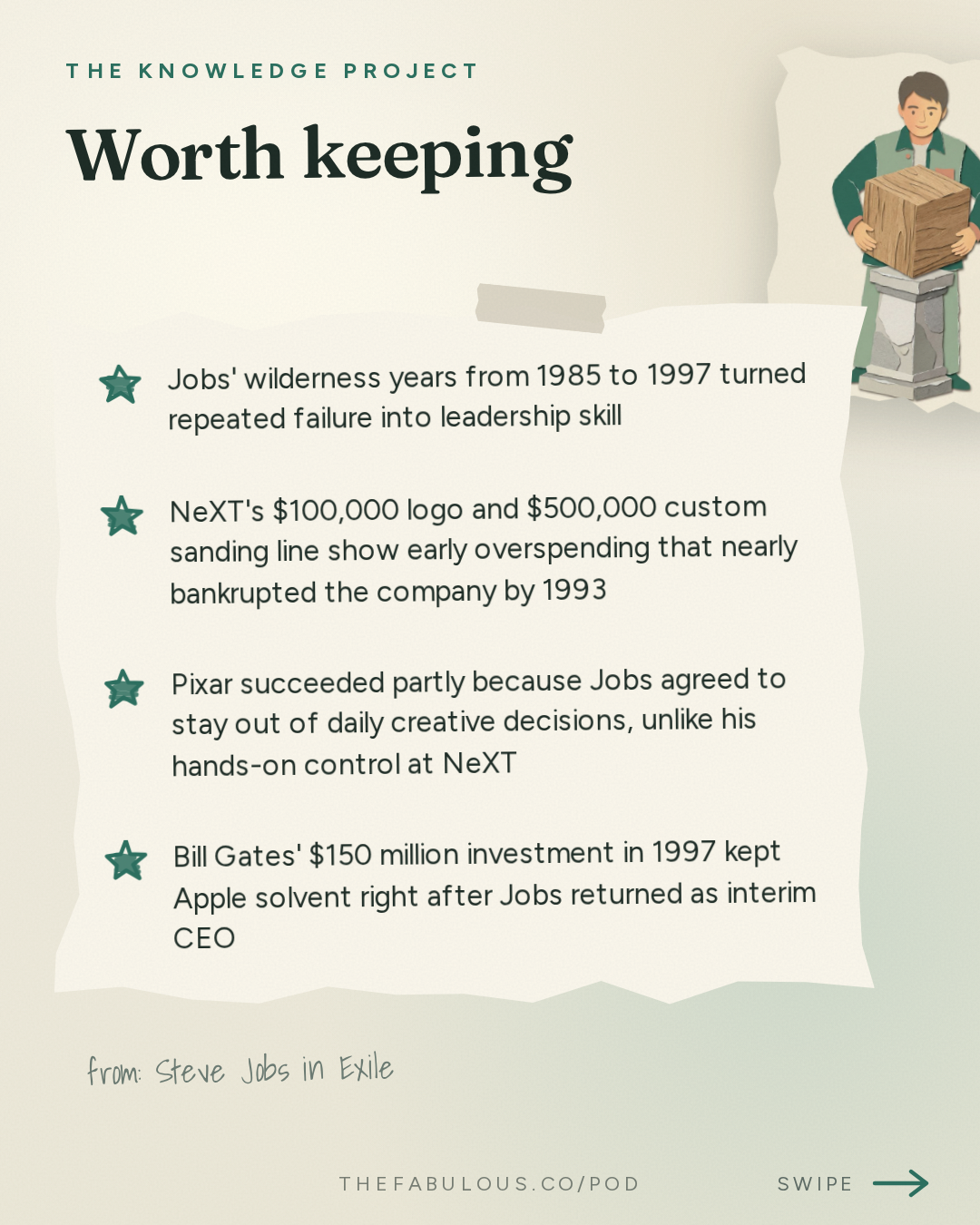
- Jobs' wilderness years from 1985 to 1997 turned repeated failure into leadership skill
- NeXT's $100,000 logo and $500,000 custom sanding line show early overspending that nearly bankrupted the company by 1993
- Pixar succeeded partly because Jobs agreed to stay out of daily creative decisions, unlike his hands-on control at NeXT
- Bill Gates' $150 million investment in 1997 kept Apple solvent right after Jobs returned as interim CEO
- NeXTSTEP, built on object-oriented programming in 1986, became the software base for every later Apple product
The episode in cards
By the numbers
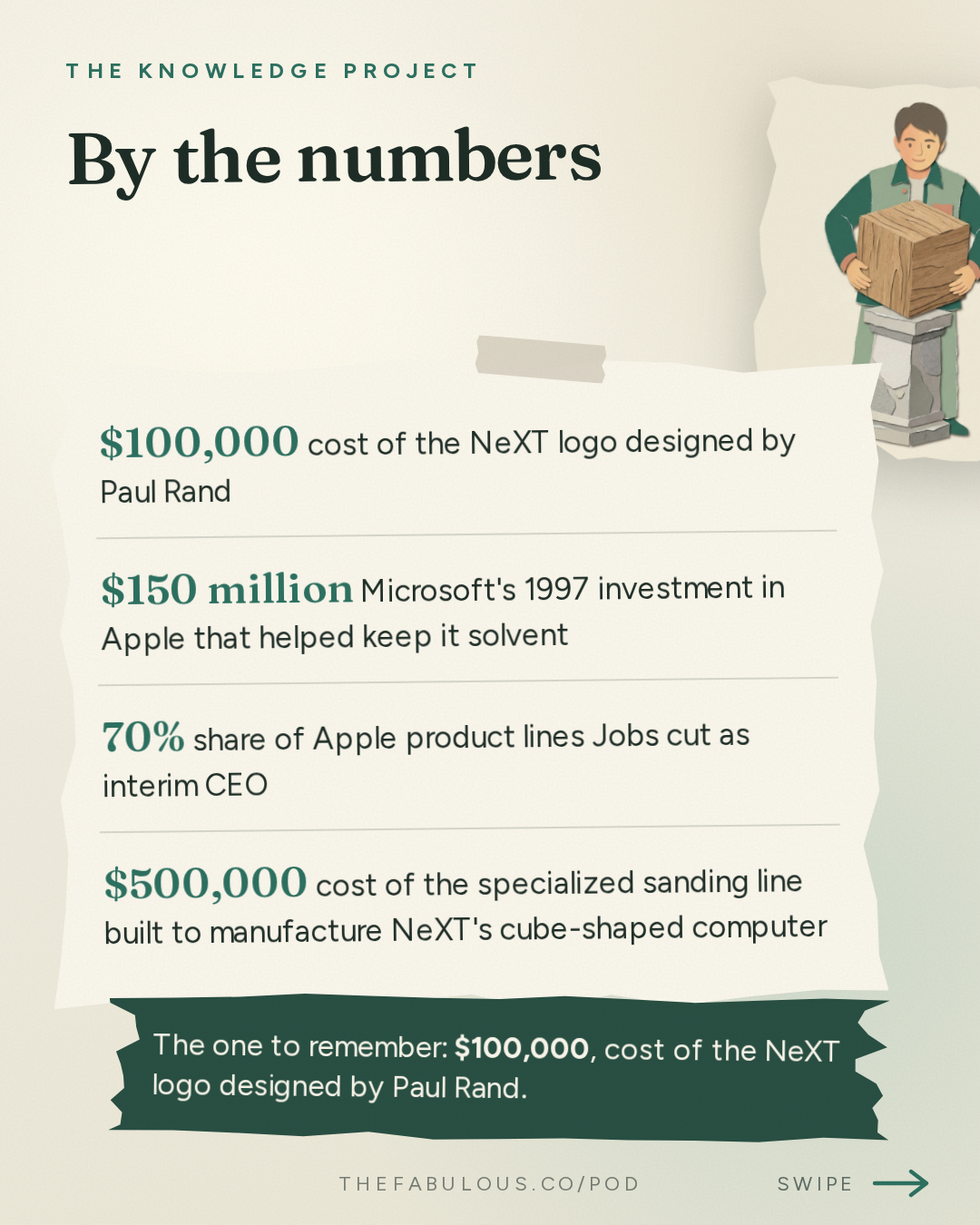
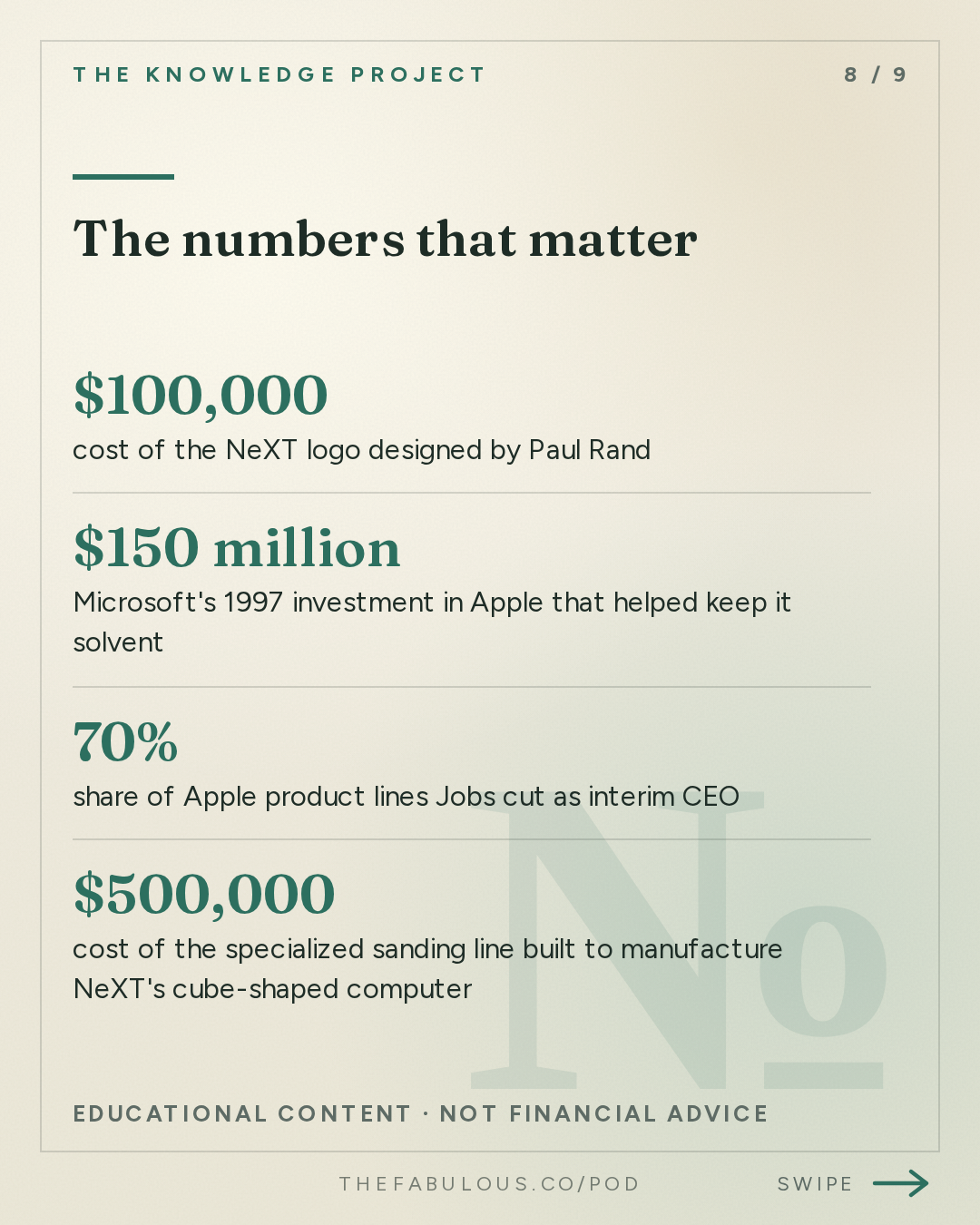
- $100,000 cost of the NeXT logo designed by Paul Rand
- $150 million Microsoft's 1997 investment in Apple that helped keep it solvent
- 70% share of Apple product lines Jobs cut as interim CEO
- $500,000 cost of the specialized sanding line built to manufacture NeXT's cube-shaped computer
In their words
“Steve took the technology of the past and made it available to everybody. He called it the bicycle for the mind”
“His biggest fault was building a monument to his own genius, his own vision, and thinking that that would be enough for the market and enough to beat Apple and get revenge on Apple.”
“Working for him was the hardest experience of my life, but it was also the most beautiful.”
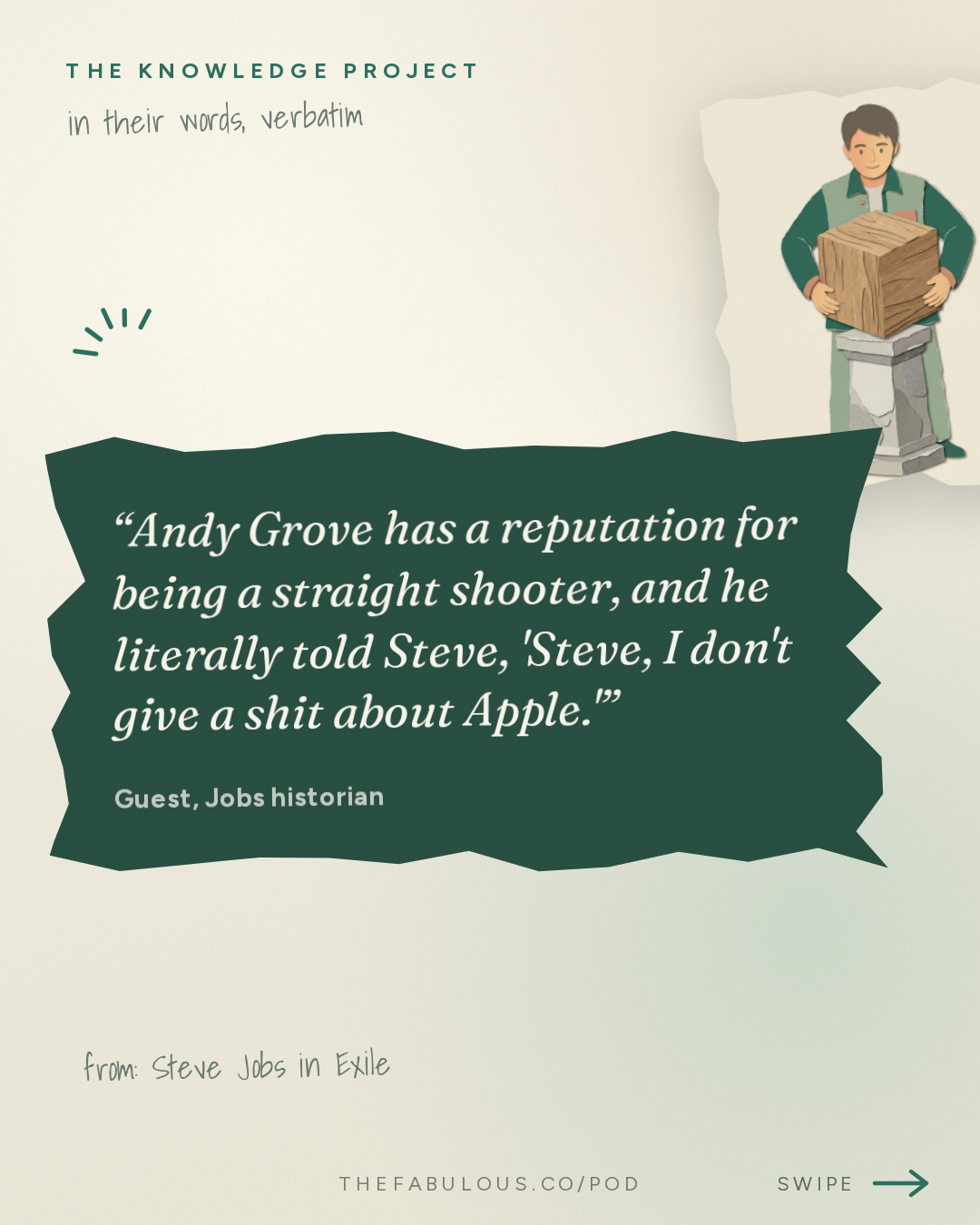
“Andy Grove has a reputation for being a straight shooter, and he literally told Steve, 'Steve, I don't give a shit about Apple.'”
Protocols
-
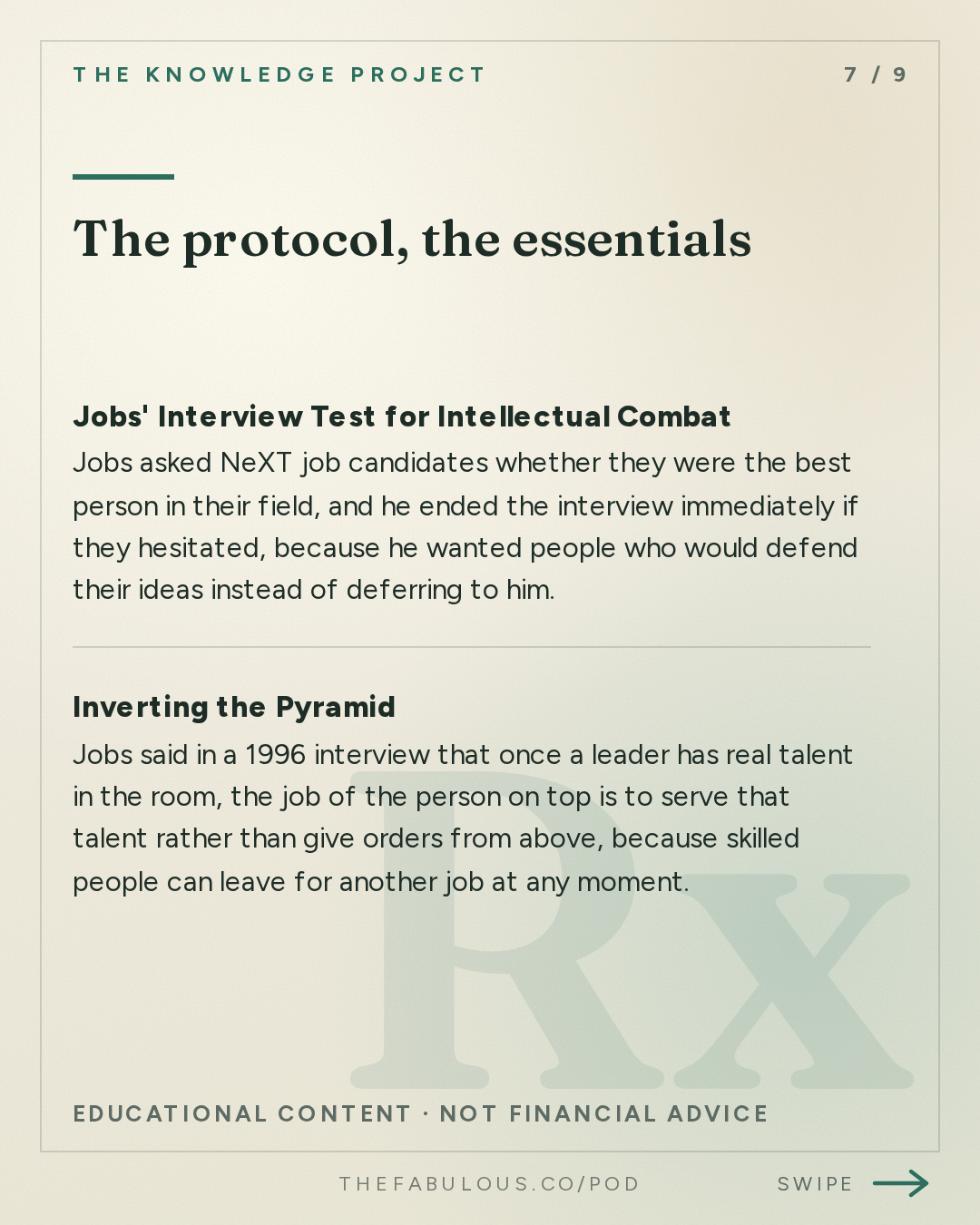
Jobs' Interview Test for Intellectual Combat
Jobs asked NeXT job candidates whether they were the best person in their field, and he ended the interview immediately if they hesitated, because he wanted people who would defend their ideas instead of deferring to him.
Applied to every hire at NeXT
-
Inverting the Pyramid
Jobs said in a 1996 interview that once a leader has real talent in the room, the job of the person on top is to serve that talent rather than give orders from above, because skilled people can leave for another job at any moment.
Ongoing leadership principle from 1996 onward
-
Making Deals With Rivals
As Apple's interim CEO in 1997, Jobs signed a deal with Microsoft founder Bill Gates to keep Microsoft Word running on Apple computers and to accept a $150 million investment, because he had concluded that reaching scale required concessions to people he had previously treated as enemies.
One-time deal, 1997
Questions this episode answers
Why did NeXT Computer fail?
NeXT's cube-shaped computer cost around $10,000 (13:27), far too expensive for its target market of students and researchers, and it sold only a few dozen units a month (18:00). By 1993 the company was one weekend from shutting down before investor Canon provided emergency cash (19:08).
What is NeXTSTEP and why does it matter?
NeXTSTEP was NeXT's operating system, built in 1986 on object-oriented programming, a method of building software from reusable pieces that Jobs first saw at Xerox PARC (22:11). Apple bought it in 1996, and it became the software foundation for every Apple product made since, including the iPhone (57:06).
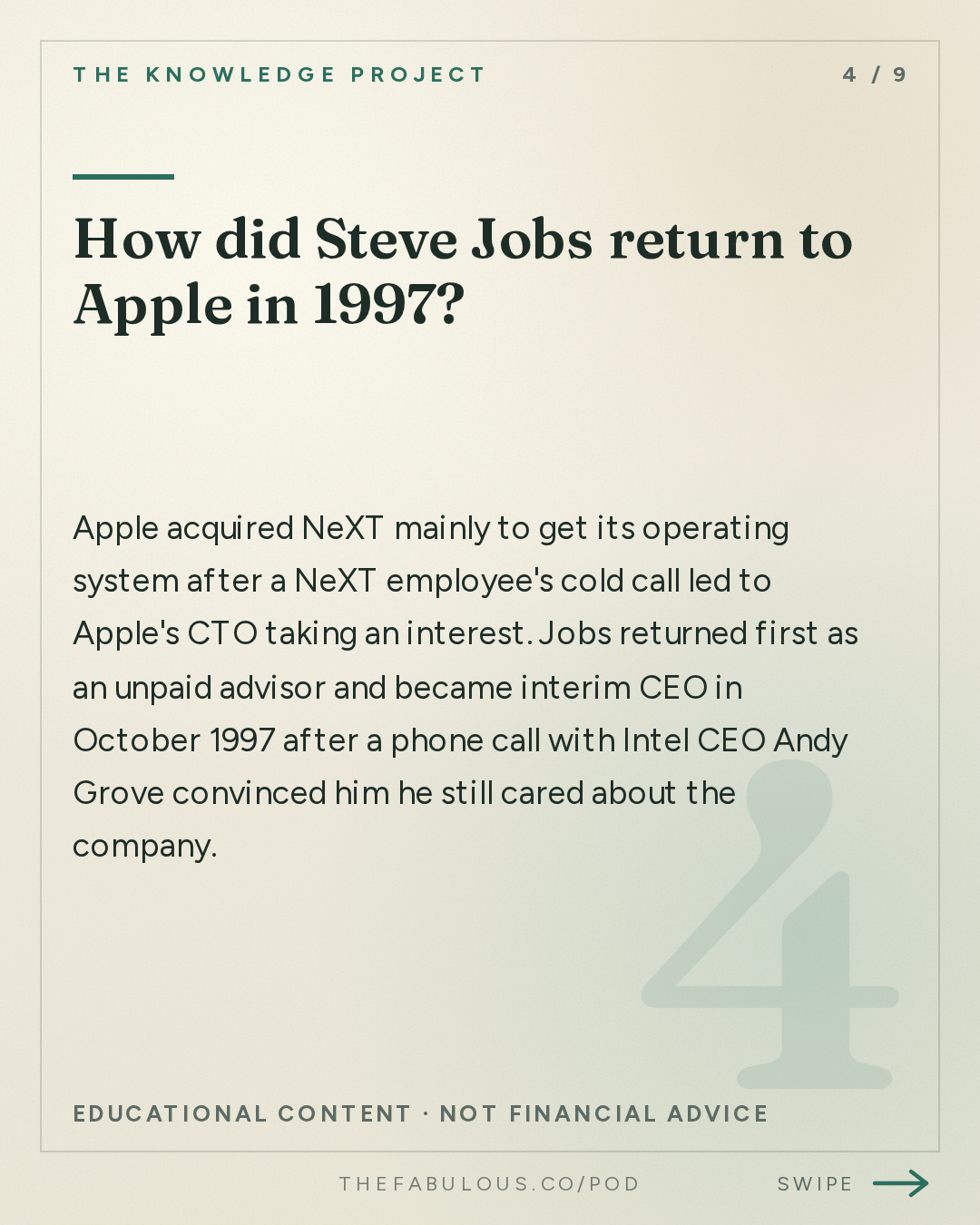
How did Steve Jobs return to Apple in 1997?
Apple acquired NeXT mainly to get its operating system after a NeXT employee's cold call led to Apple's CTO taking an interest (40:00). Jobs returned first as an unpaid advisor and became interim CEO in October 1997 after a phone call with Intel CEO Andy Grove convinced him he still cared about the company (54:52).
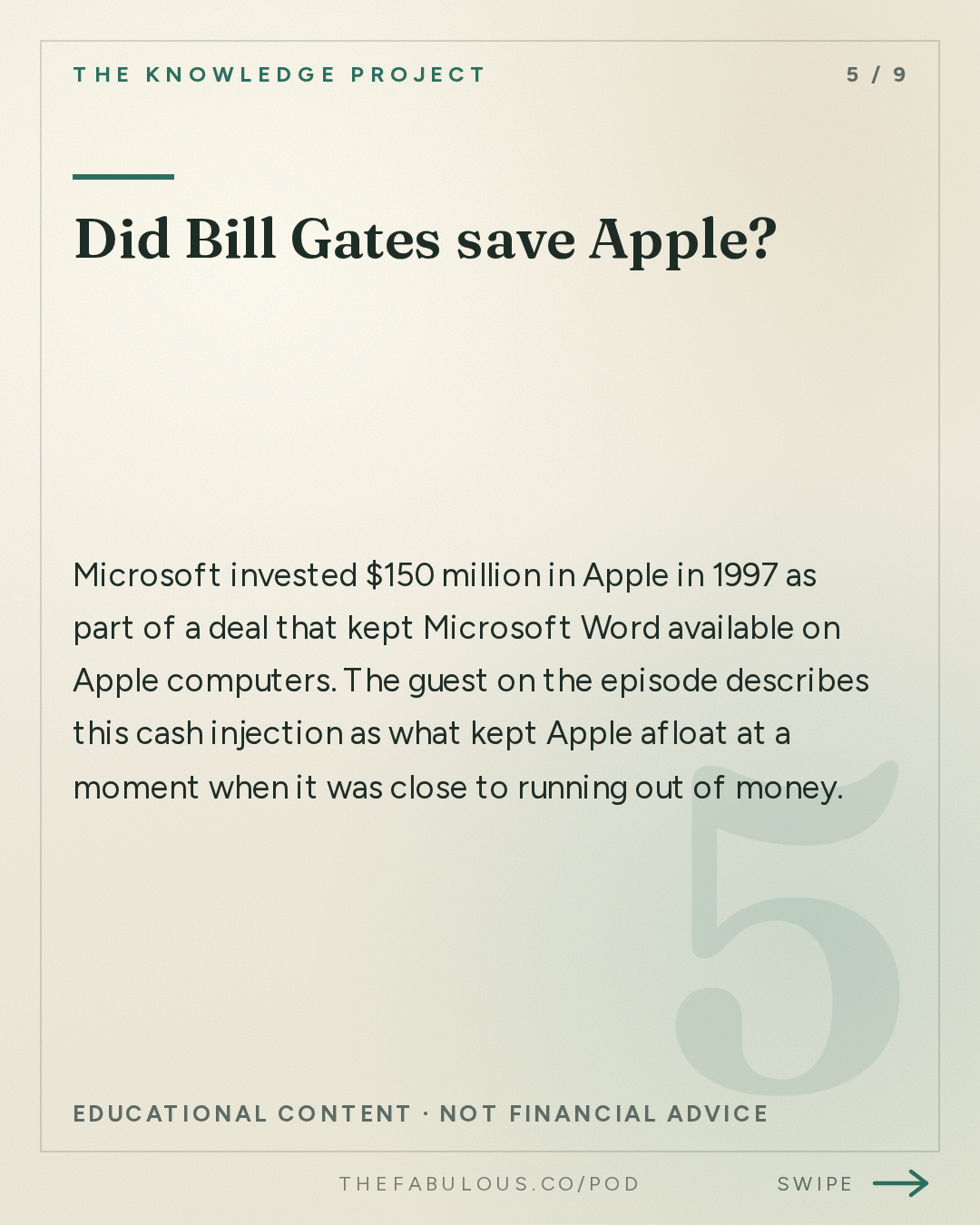
Did Bill Gates save Apple?
Microsoft invested $150 million in Apple in 1997 as part of a deal that kept Microsoft Word available on Apple computers (49:20). The guest on the episode describes this cash injection as what kept Apple afloat at a moment when it was close to running out of money (49:20).
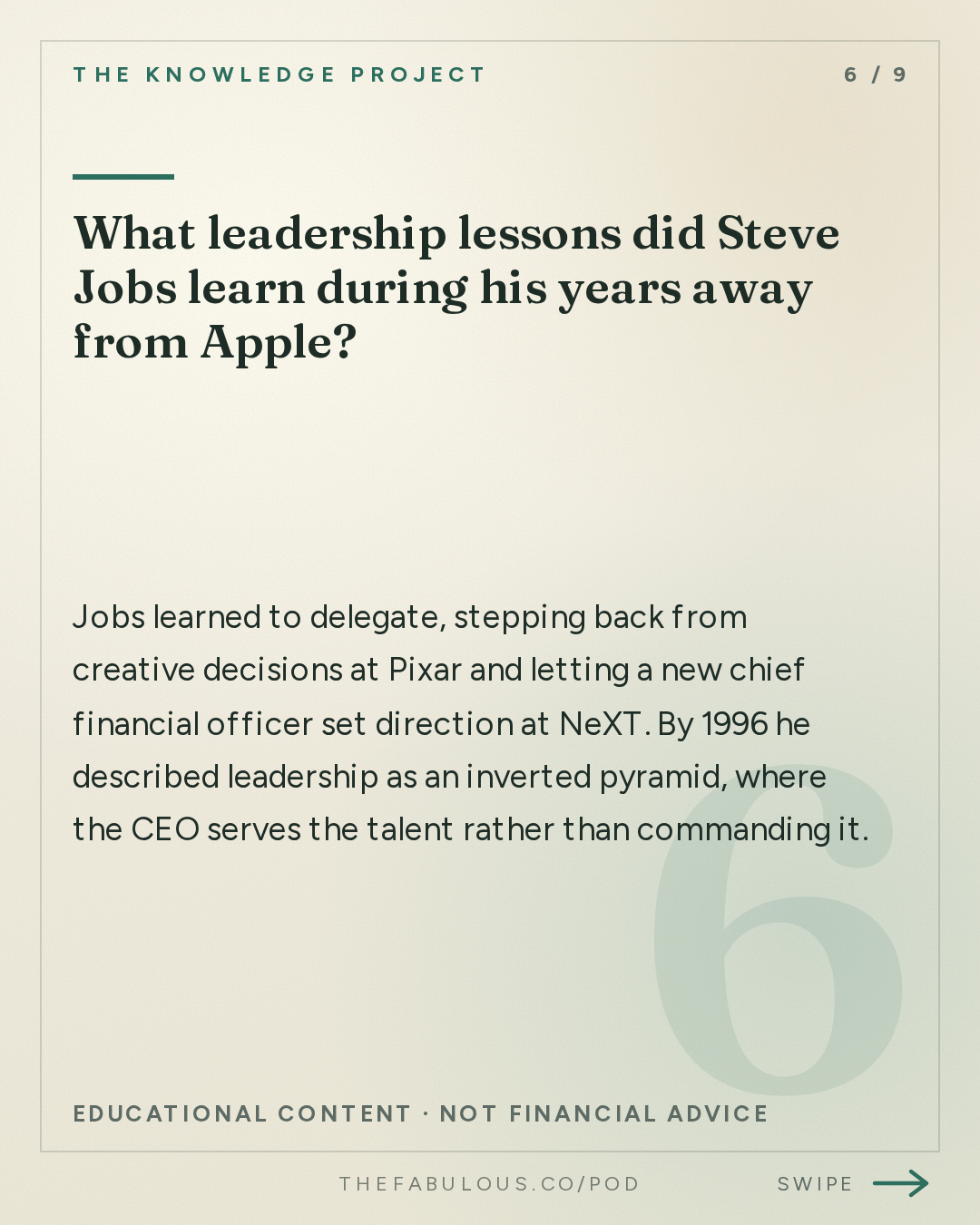
What leadership lessons did Steve Jobs learn during his years away from Apple?
Jobs learned to delegate, stepping back from creative decisions at Pixar and letting a new chief financial officer set direction at NeXT (30:37)(32:03). By 1996 he described leadership as an inverted pyramid, where the CEO serves the talent rather than commanding it (47:25).
The full read, in cards
Go deeper
- Fortune magazine article on NeXT — called Steve Jobs a 'snake oil salesman' during NeXT's near-collapse in the early 1990s
Mentioned
Steve Jobs · John Sculley · Ross Perot · Paul Rand · Bill Gates · Laurene Powell Jobs · Andy Grove · NeXT Computer · Pixar · Apple · Canon · Microsoft · NeXTstep
More from this show and category

Ryan Serhant's Sales and Productivity Secrets
Ryan Serhant, star of Million Dollar Listing and founder of real estate firm Serhant, says comfort with embarrassment separates top earners from everyone else. He outlines his 1,000 minutes rule for guarding daily time, a hook-help-ask sales framework, and why distribution matters more than product quality.

Charlie Munger's Lessons from Henry Singleton
In a 2022 conversation, Charlie Munger tells Todd Combs that investing success rests on finding rare talent, choosing solvable problems, and smart positioning. The through-line is positioning: arranging affairs so circumstances never force bad decisions, as Munger explains using Rockefeller, Teledyne founder Henry Singleton, and the 1974 market crash.

Bill Ackman on Lucy's Recovery and the Brain Institute
Bill Ackman recounts his daughter Lucy's brain hemorrhage and the brain rehabilitation institute he built in response. He also details Pershing Square's investment checklist, its move away from short selling, and the plan to turn Howard Hughes into an insurance-driven holding company modeled on Berkshire Hathaway.

Tobi Lütke: How Shopify Runs on AI Agents
Shopify CEO Tobi Lütke says AI agents like River now draft up to half the company's pull requests. But he argues machines can never take responsibility, so taste, judgment, and disciplined pruning, not raw AI output, still decide what actually gets built.
