
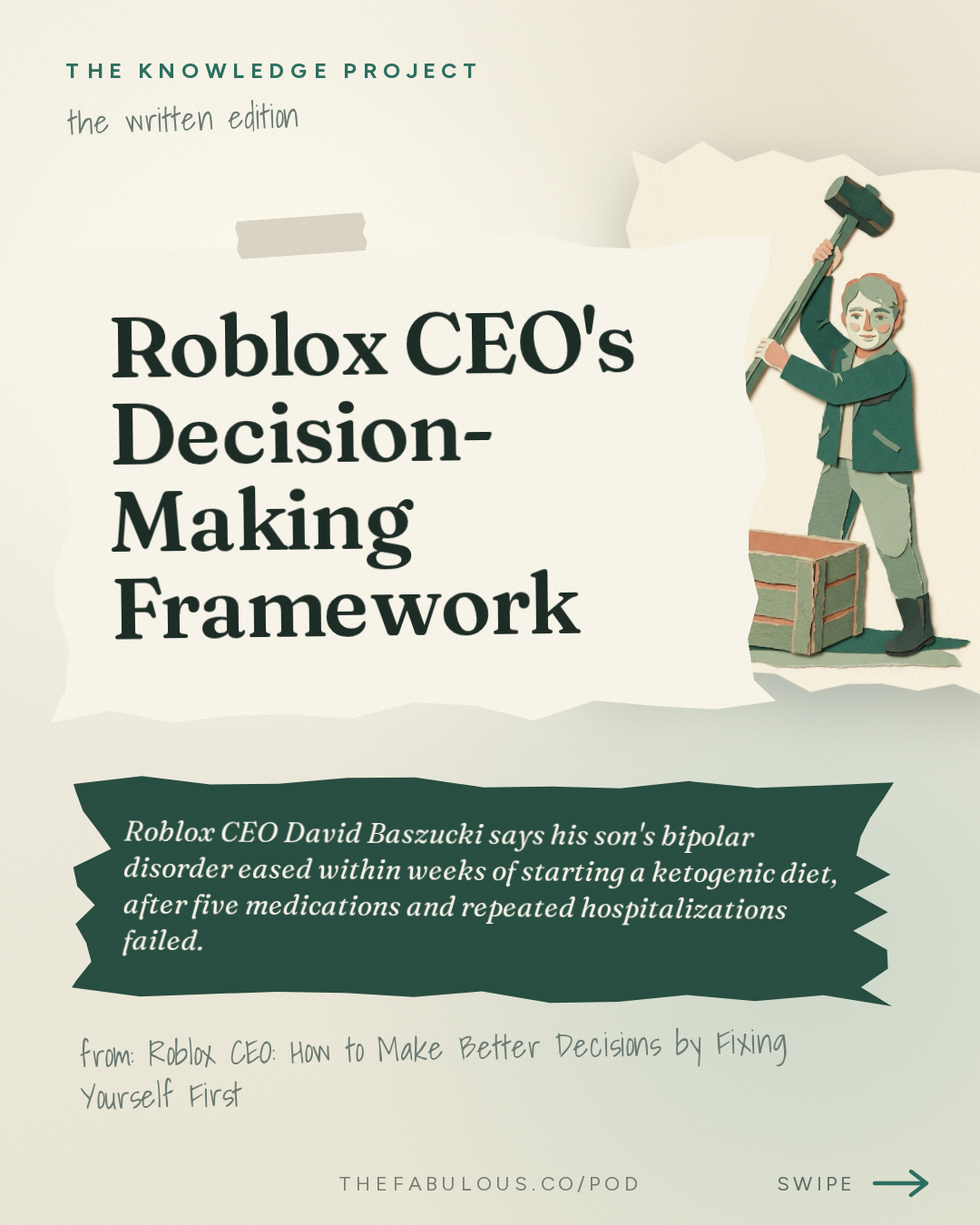
Roblox CEO's Decision-Making Framework
Roblox CEO: How to Make Better Decisions by Fixing Yourself First
▶ Listen to the full episode More from The Knowledge Project
The brief
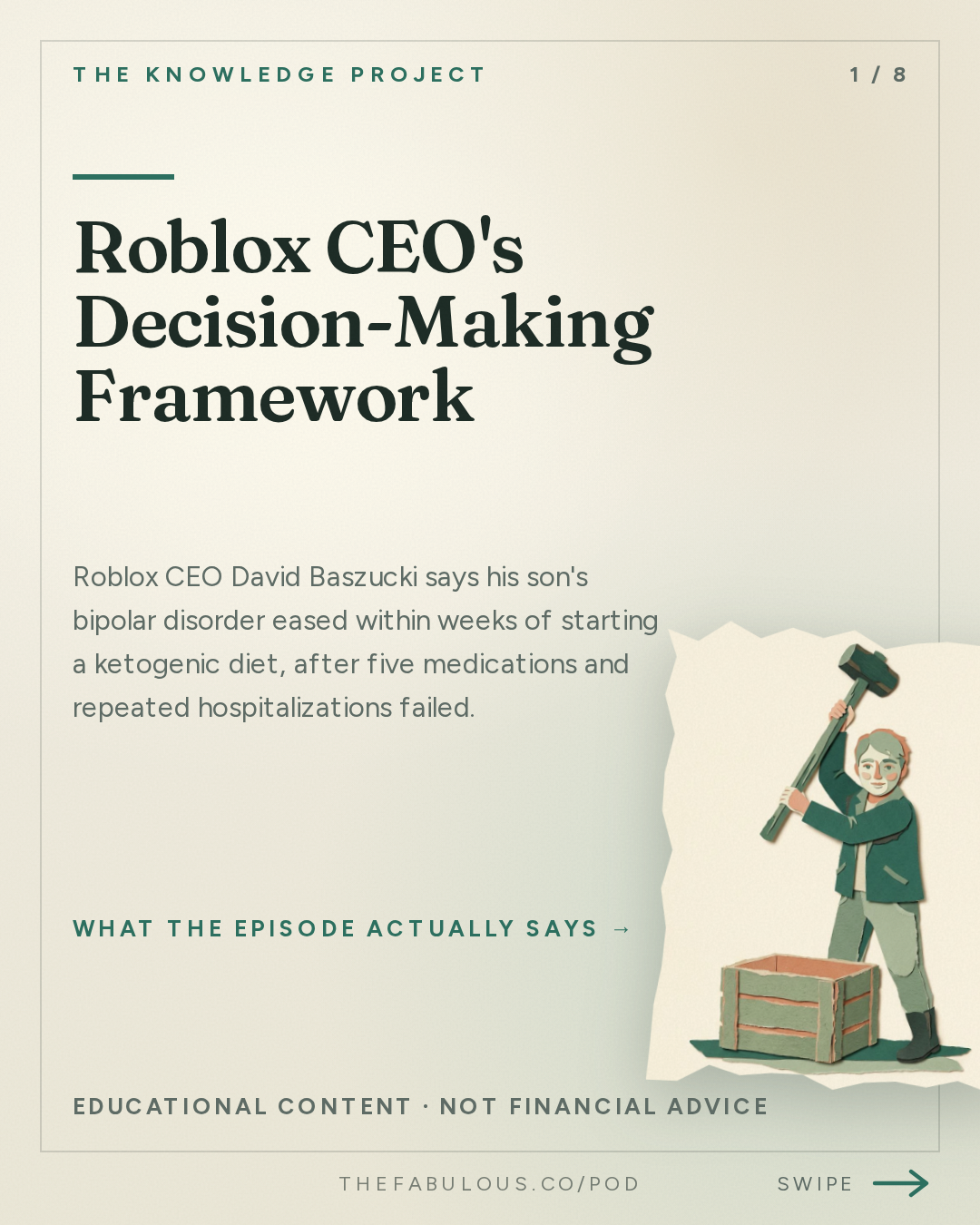
Roblox CEO David Baszucki says his son's bipolar disorder eased within weeks of starting a ketogenic diet, after five medications and repeated hospitalizations failed. He ties his own metabolic state, tracked with a continuous glucose monitor, to decision quality, and describes destroying bureaucracy, shipping unfinished products for real feedback, and holding Robux near one cent for twenty years.
For six years, doctors gave David Baszucki's son a diagnosis, a prescription pad, and a warning: he would likely need five medications for the rest of his life (02:31). There were hospitalizations. There were, in Baszucki's words, long stretches where his son "wasn't quite himself." Then someone from the metabolic health community mentioned, almost in passing, that a ketogenic diet, a way of eating built around fat and protein instead of carbohydrates, had solved their own bipolar disorder. Three weeks after Baszucki's son tried it, still on heavy medication, something changed. "I feel a little different," he said. The real him started to show through.
Baszucki, who is the chief executive of Roblox, the user-generated gaming platform his son grew up around, tells this story not as a medical claim but as a personal reckoning. He had spent a decade thinking about mental illness the way most people do, as something that happens to other families, something abstract. His son's recovery rewired that assumption entirely.
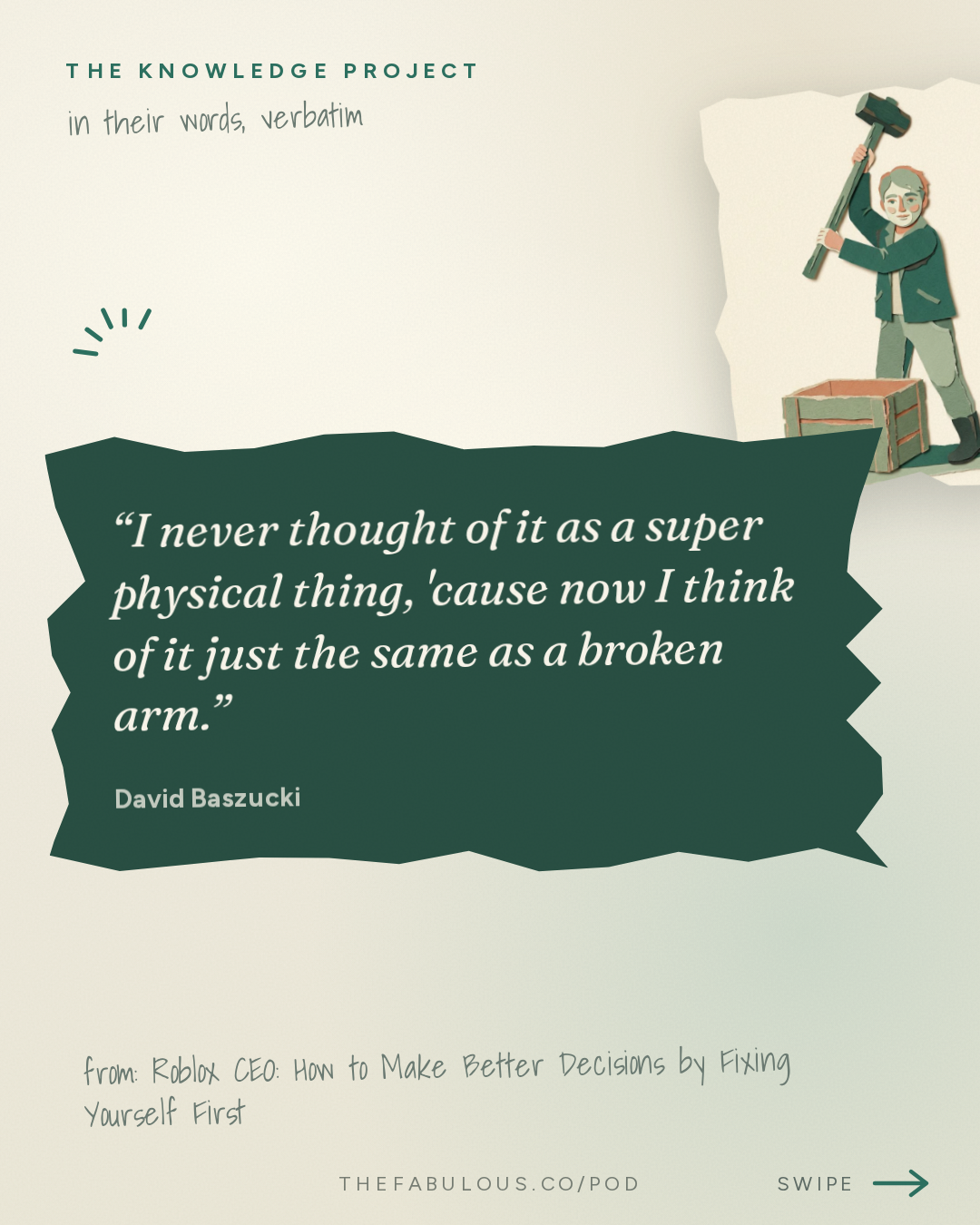
I never thought of it as a super physical thing, 'cause now I think of it just the same as a broken arm. David Baszucki [02:58]
The theory he has since built his family's informal research around is simple and speculative: the human body evolved eating a certain way for a very long time, and the agricultural revolution, which brought grain and sugar into the diet roughly ten thousand years ago, may have outpaced our biology (03:22). Some people, he suspects, including his son, are not fully adapted to a high-carbohydrate diet, and the mismatch shows up as energy problems in the brain rather than the gut. It is a theory, not a study, and Baszucki is careful to frame it that way. But it changed how he runs his own body, and, it turns out, how he runs his company.
Baszucki now wears a continuous glucose monitor, a small sensor that tracks blood sugar in real time through an app on his phone (04:18). He avoids sugar and starch, the foods most likely to spike his glucose. He has noticed a pattern: eating a lot of carbohydrates puts him into what he calls a "hibernate, sleepy mode," while a more fasted state produces something closer to alertness, a feeling of wanting to go do things. He has started treating that difference as data.
I do try to observe that from the outside in and say all big decisions make in the optimistic mode. David Baszucki [05:42]
It is a strange, useful idea: that the biggest calls a leader makes should be timed not just to information, but to physiology. A decision that looks impossible in a sluggish, carb-heavy state can look obvious an hour later, once the body has cleared out. Baszucki says he has trained himself to notice which mode he is in before he commits to anything large.
Destroying bureaucracy on purpose
The same logic, that inaction is not neutral, shows up in how Baszucki talks about running Roblox. He describes organizational bureaucracy as a kind of entropy, something that accumulates whether or not anyone intends it to. Left alone, it grows.
If one is not reducing bureaucracy, there's no neutral ground. If one is not trying to improve things, it is going backwards. David Baszucki [00:00]
Inside the company, they literally use the phrase "destroy bureaucracy." It is not a metaphor so much as a standing instruction: assume decay, and counter it actively, rather than waiting for a crisis to force a cleanup.
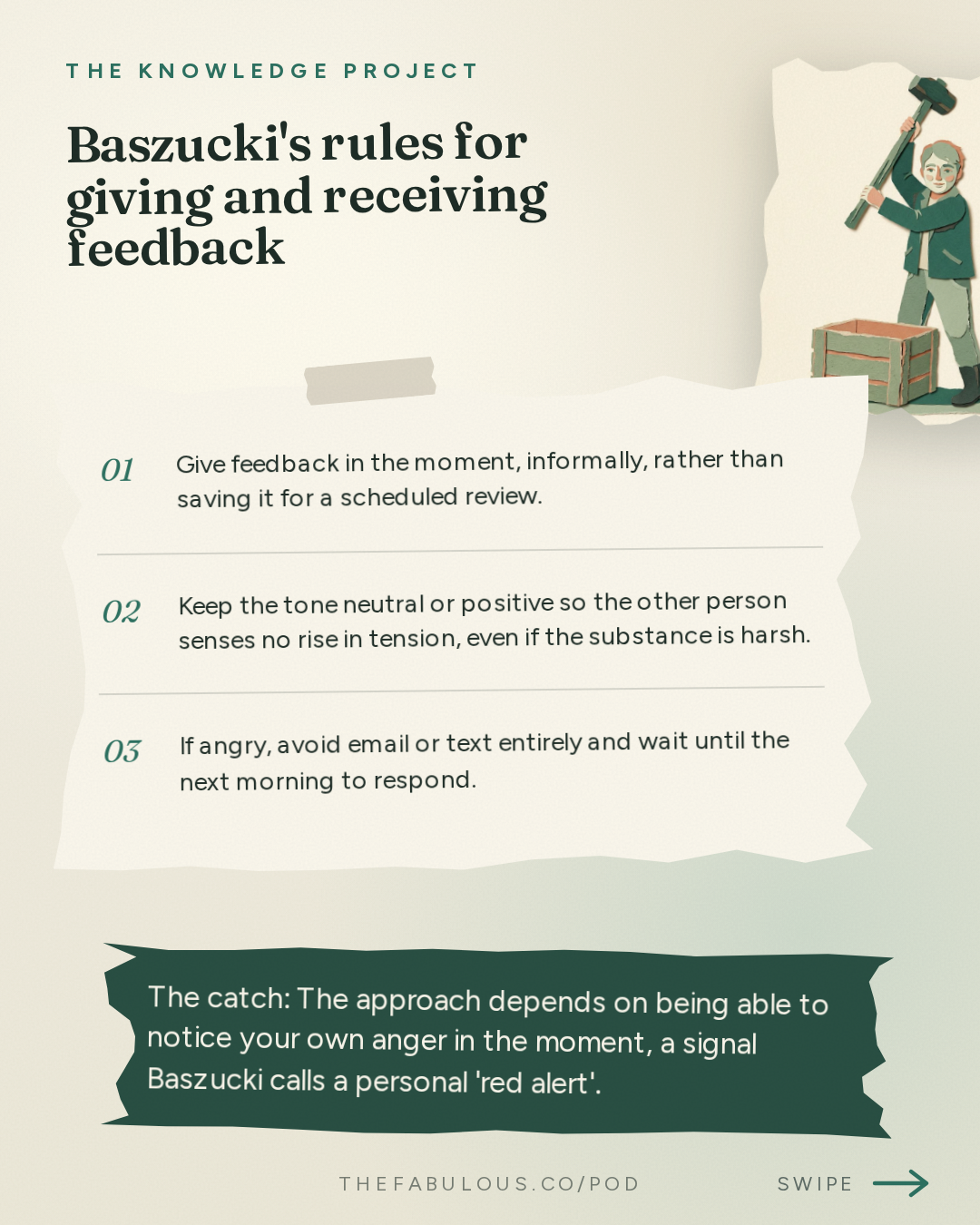
That same wariness of drift shows up in how Baszucki gives feedback. He has moved away from scheduled review sessions toward small, frequent, in-the-moment comments, on the theory that immediacy beats formality. But he is just as focused on tone as on timing. Harsh feedback delivered calmly, he argues, lands better than mild feedback delivered with visible frustration, because people can sense whether the person giving it is regulated or not (07:54). And when he notices his own blood pressure rising, he has a rule.
Don't send that email. 'Cause then like the next morning you're like, 'Oh my gosh, thank goodness I didn't send that. I can call this person.' David Baszucki [08:50]
The underlying question, he says, is what the sender is actually optimizing for. An angry email written at night is usually optimizing for the sender's own relief. The same message, delivered the next morning, can optimize for the other person's growth instead (09:13). It is a small habit, but it reframes feedback as a design problem: who is this actually for.
The magic quadrant
Roblox's product history is full of moments where the company chose speed over polish. The very first Roblox avatar, the digital character players controlled, was crude by design: blocky limbs, a face made of what Baszucki calls "programmer art." The entire gaming industry told him to hide it until it was finished. He shipped it anyway, on the theory that early feedback beats late perfection (12:30). Much of the advice he got turned out to be wrong.
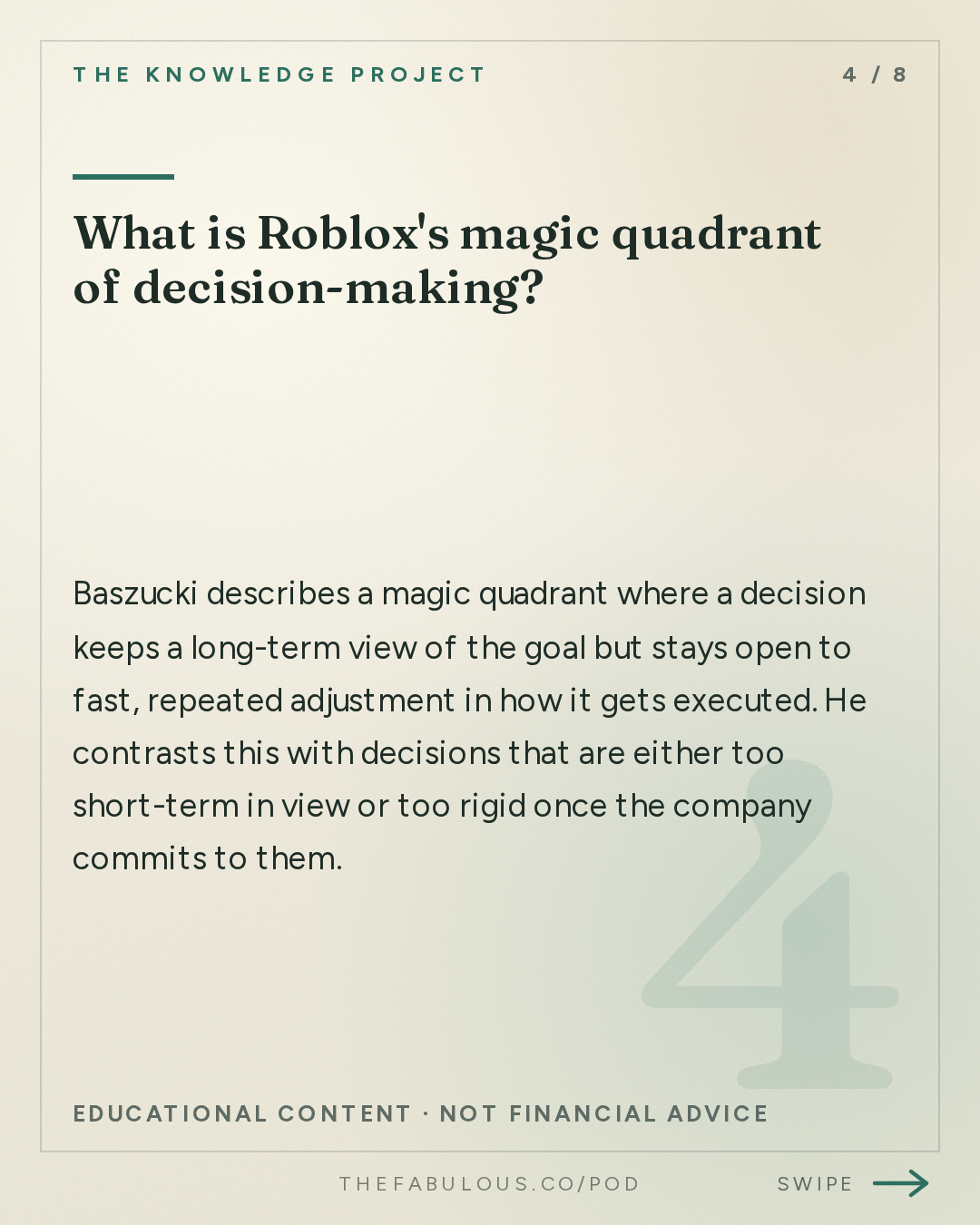
That preference for iteration over certainty crystallized into what Baszucki calls a "magic quadrant" for strategic decisions: a plan that holds a long view of where the company is going, combined with fast, repeated adjustment in how it gets there.
It's both a long view decision with hyper iteration to get there, and that's kind of a magic, safe quadrant. David Baszucki [14:34]
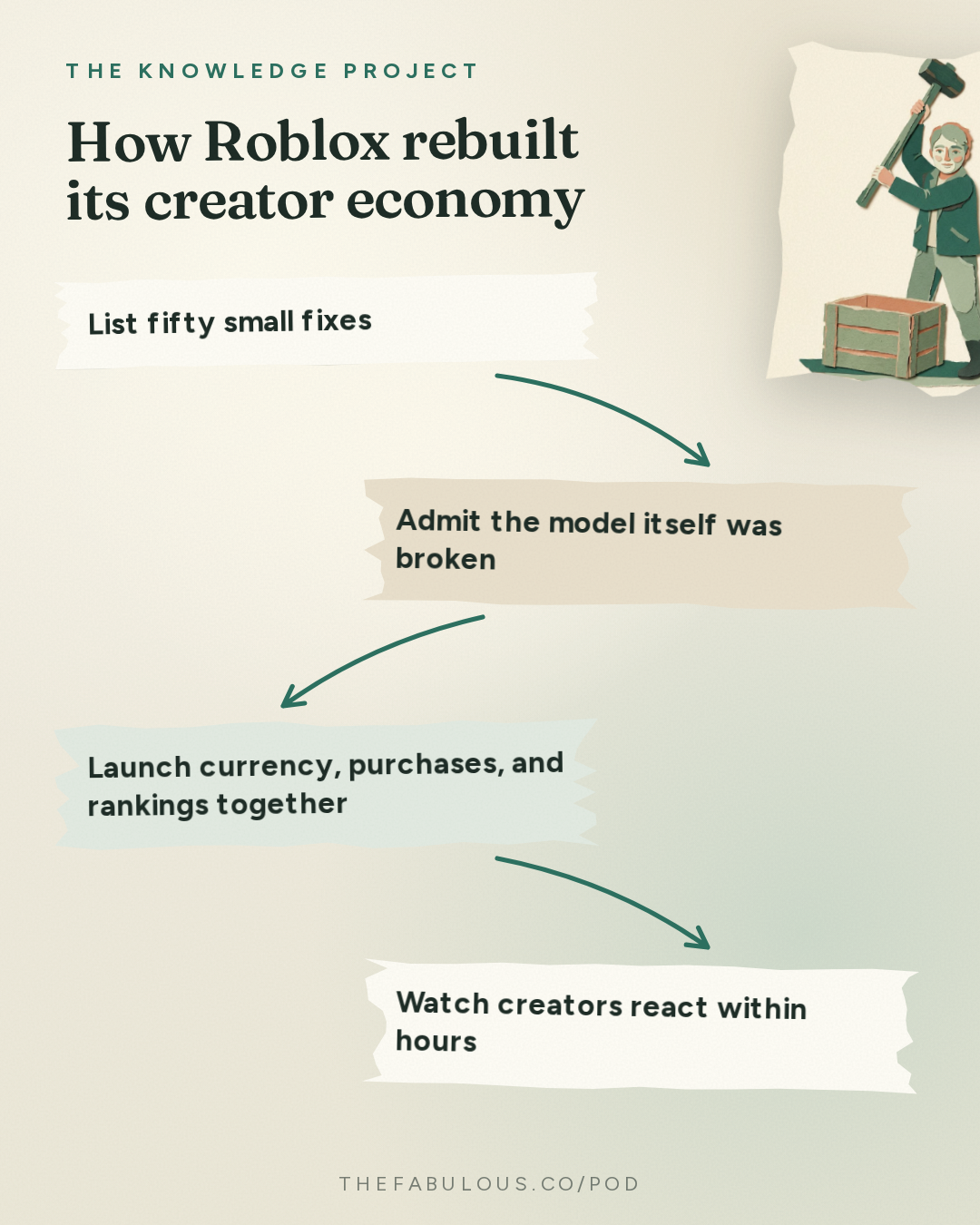
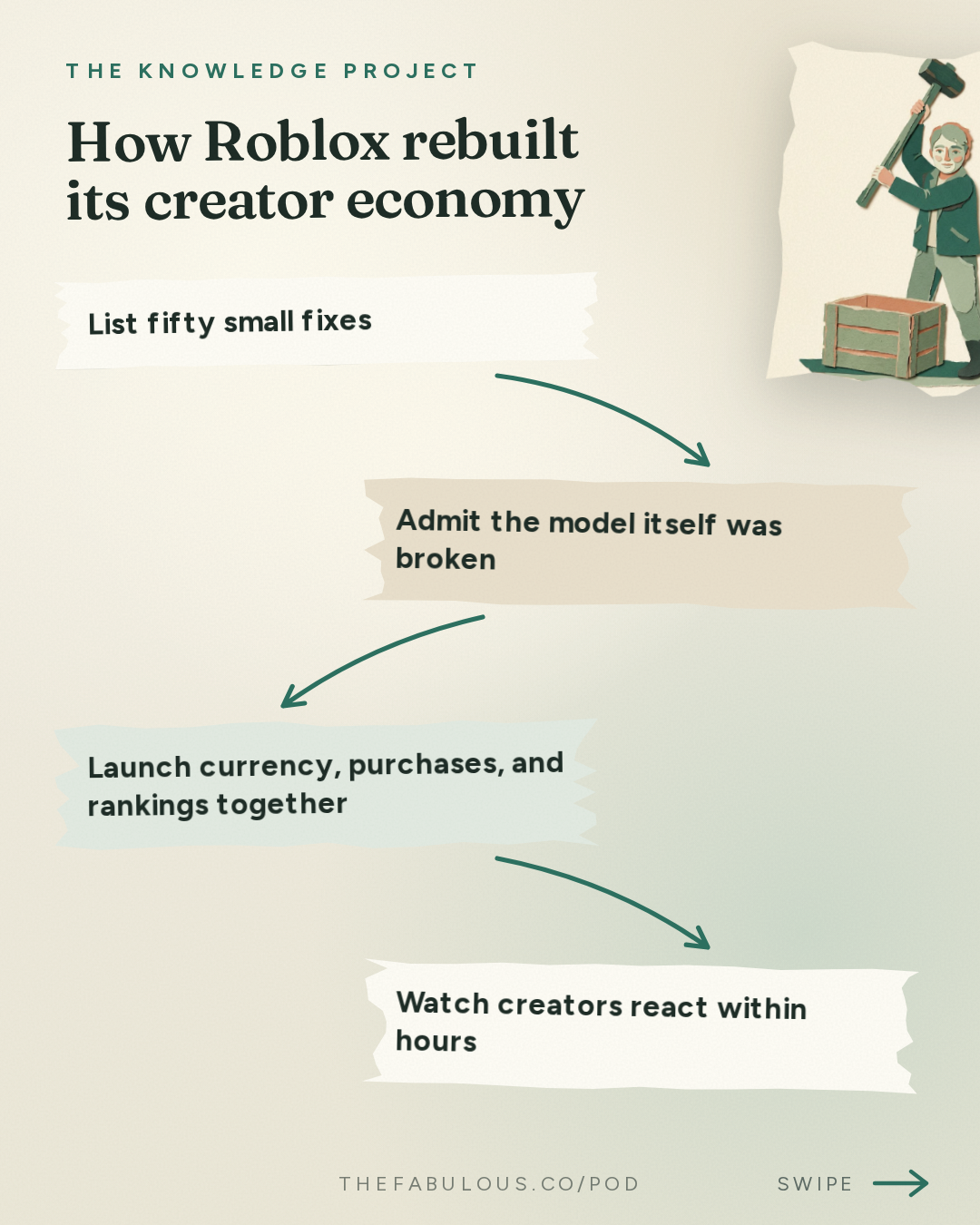
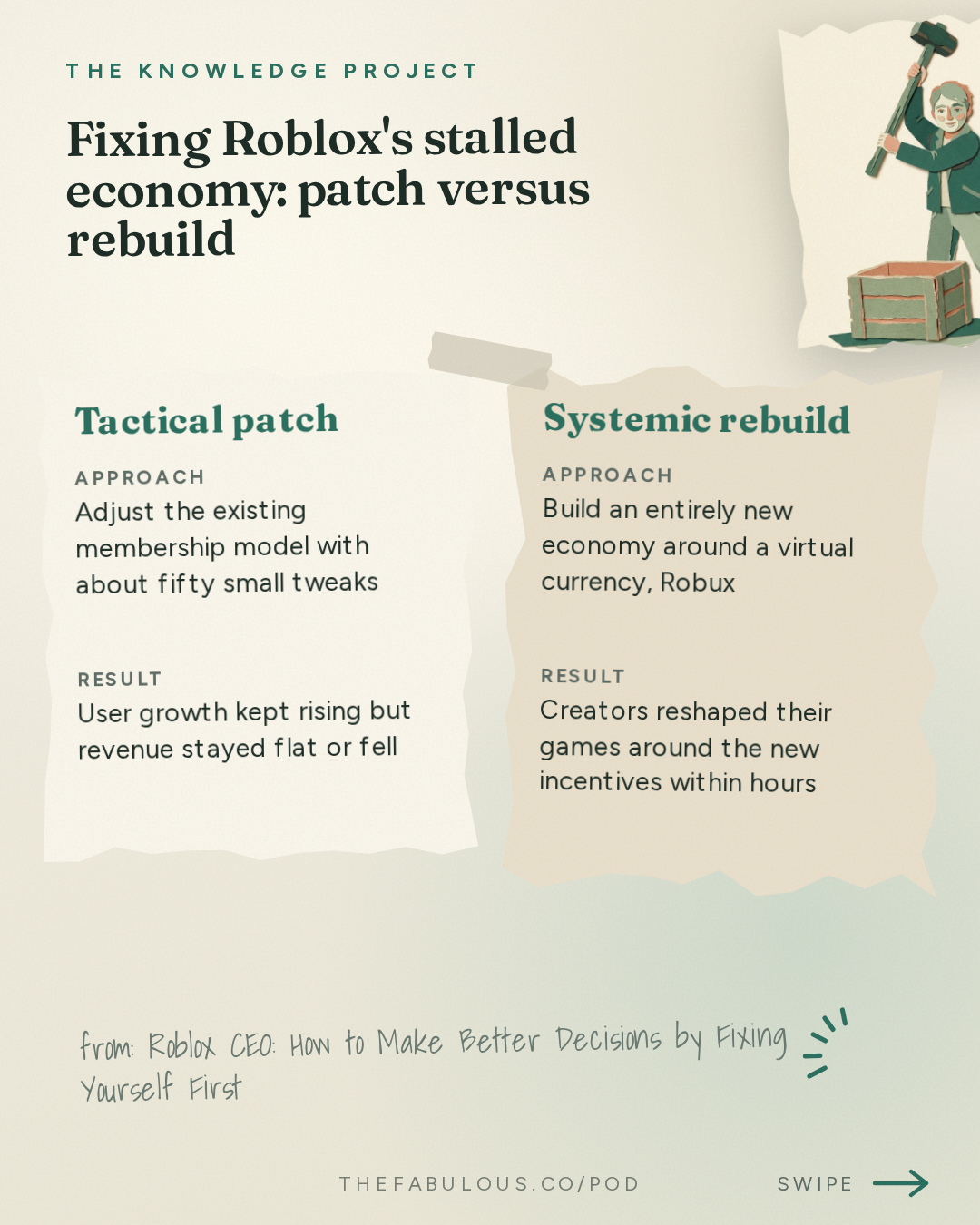
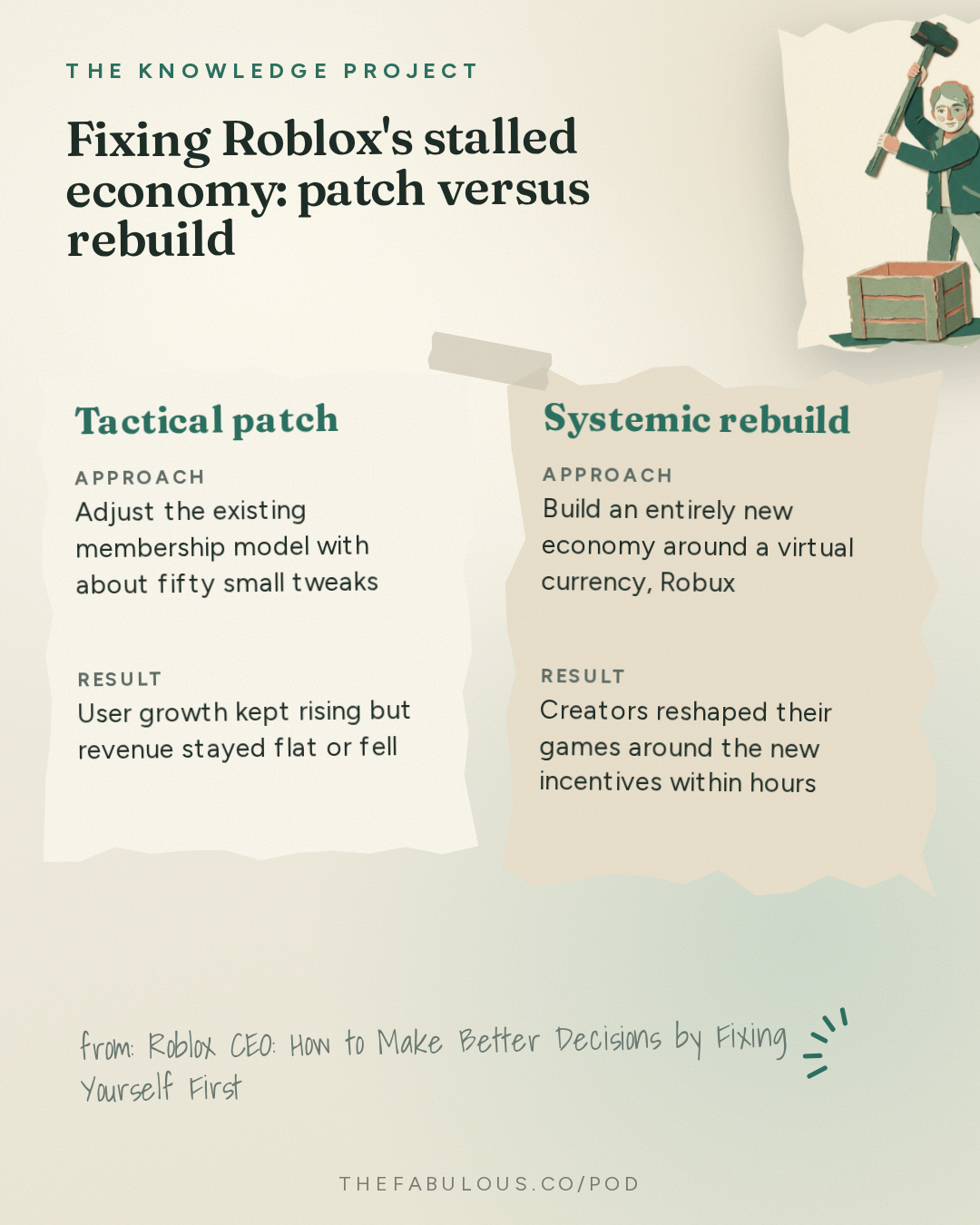
The clearest example of that logic in practice is the story of how Roblox built its virtual currency. In the platform's early years, the business model was a membership fee that granted extra building space. User numbers kept climbing, but membership revenue went flat, then started to fall. The company's first instinct was tactical: make a list of fifty small things that might be broken and fix them (28:03). They fixed about thirty. The problem did not go away.
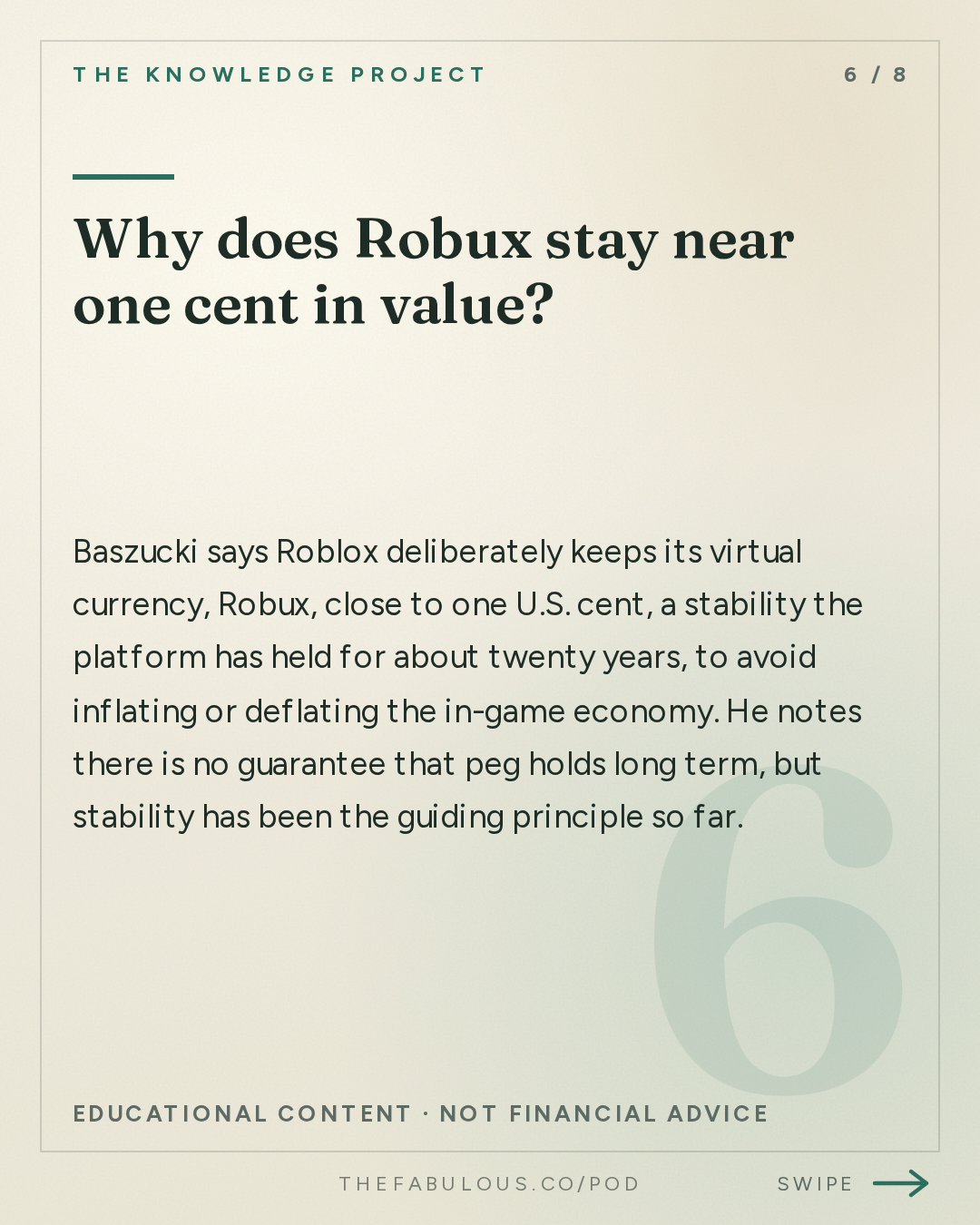
What eventually worked was not a fix at all, but a rebuild: an entirely new economy built on a virtual currency called Robux, letting creators sell upgrades, and publicly showing which games earned the most (28:49). The team launched all of it together, and within eight hours, creators were already rebuilding their games around the new incentives (29:39). Robux itself has stayed close to one U.S. cent since it launched, a stability the company has maintained for about twenty years, directly tied to the dollar (32:16).
Baszucki treats the creator economy as the platform's real engine, and he treats the underlying technical decisions the same way he treats decision-making generally: prefer the generalizable solution over the specific one. Early in Roblox's history, he wanted to hard-code specific game mechanics, like a capture-the-flag object, directly into the platform's core code. His co-founder, Erik Cassel, who died of cancer about eight years ago, argued instead for a general-purpose scripting language called Lua that let creators build almost anything (26:18). Cassel was right. The flexible system produced far more creativity than any hard-coded feature could have.
That respect for what users build extends to how people feel about their own avatars. Roblox has learned, sometimes the hard way, that players treat their digital identity as something close to real.
It's surprising how much people can attach to their digital identity, and it has to be very carefully respected. Like this is real stuff. David Baszucki [19:23]
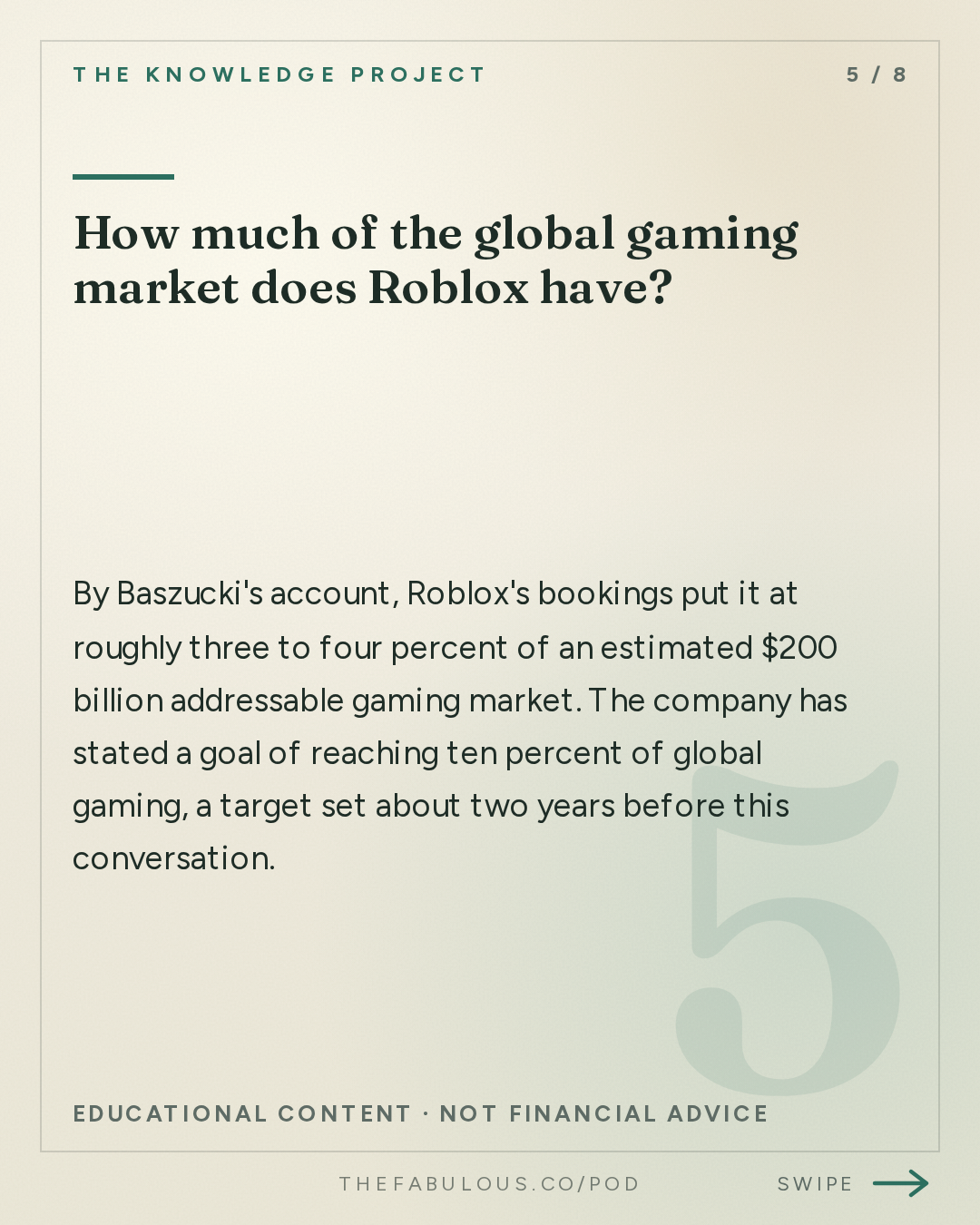
Roblox's ambitions have grown alongside that realization. The company has said it wants ten percent of the global gaming market (21:36); by its own bookings numbers against an estimated $200 billion addressable market, it is currently at three to four percent (22:04). More recently, the company has taken on the harder, slower work of platform-wide safety, including AI systems that check the age of every user, built without a legal mandate forcing the move (36:43). Baszucki says the safety investment has cost the company some near-term growth, but he treats it the same way he treats bureaucracy: something that has to be actively maintained, not something that takes care of itself.
Asked to imagine Roblox five years out, Baszucki does not talk about market share. He talks about photorealism, about a future where multiplayer digital worlds feel less like games and more like film, and about a slogan the company used when it was small: "you make the game" (40:48). He thinks AI might make that phrase more true than it has ever been, letting more people build the worlds they imagine rather than just visit the ones someone else built.
What ties the keto story to the Robux story is a single instinct: distrust the steady state. A body running on the wrong fuel looks fine until it isn't. A company running on outdated incentives looks fine until growth and revenue split apart. Baszucki's answer to both problems is the same. Notice the drift early, and be willing to rebuild rather than patch.
Ask this episode anything
Pod's AI answers from the episode itself, with the minute mark so you can hear it yourself.
Or start with one of these
Ask this episode
Pod's AI listens to the whole episode to answer, and points you to the minute it comes from.
The rest of this answer, and any question after it
Answers come from the episode itself, never from a summary of it.
ContinueKey takeaways
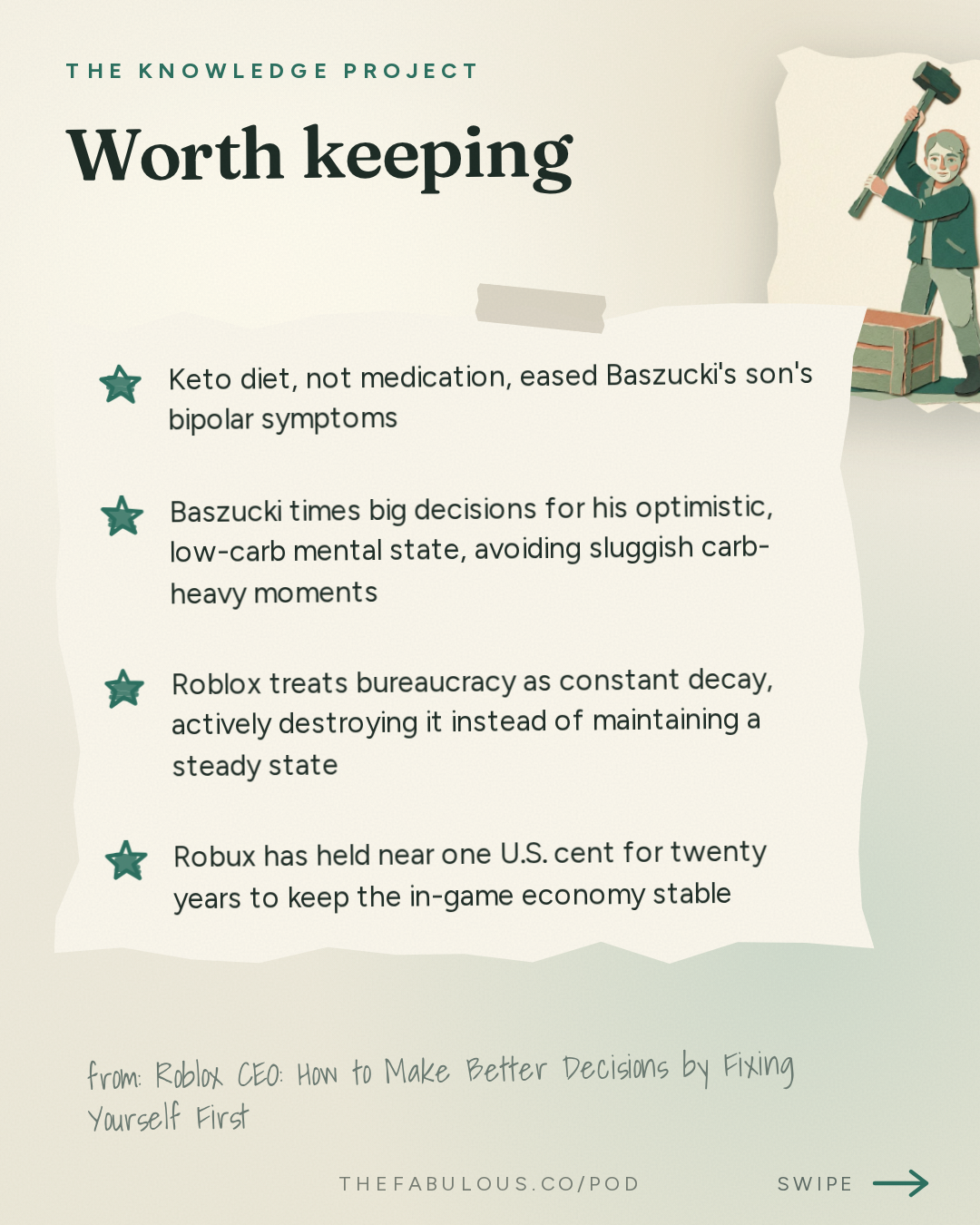
- Keto diet, not medication, eased Baszucki's son's bipolar symptoms
- Baszucki times big decisions for his optimistic, low-carb mental state, avoiding sluggish carb-heavy moments
- Roblox treats bureaucracy as constant decay, actively destroying it instead of maintaining a steady state
- Robux has held near one U.S. cent for twenty years to keep the in-game economy stable
- Roblox now uses AI to verify every user's age, ahead of government mandates
The episode in cards
By the numbers
- 10% percent Roblox's stated target share of the global gaming market
In their words
“I never thought of it as a super physical thing, 'cause now I think of it just the same as a broken arm.”
“If one is not reducing bureaucracy, there's no neutral ground. If one is not trying to improve things, it is going backwards.”
“Don't send that. 'Cause then like the next morning you're like, "Oh my gosh, thank goodness I didn't send that. I”
“It's surprising how much people can attach to their digital identity, and it has to be very carefully respected. Like this is real stuff.”
Protocols
-
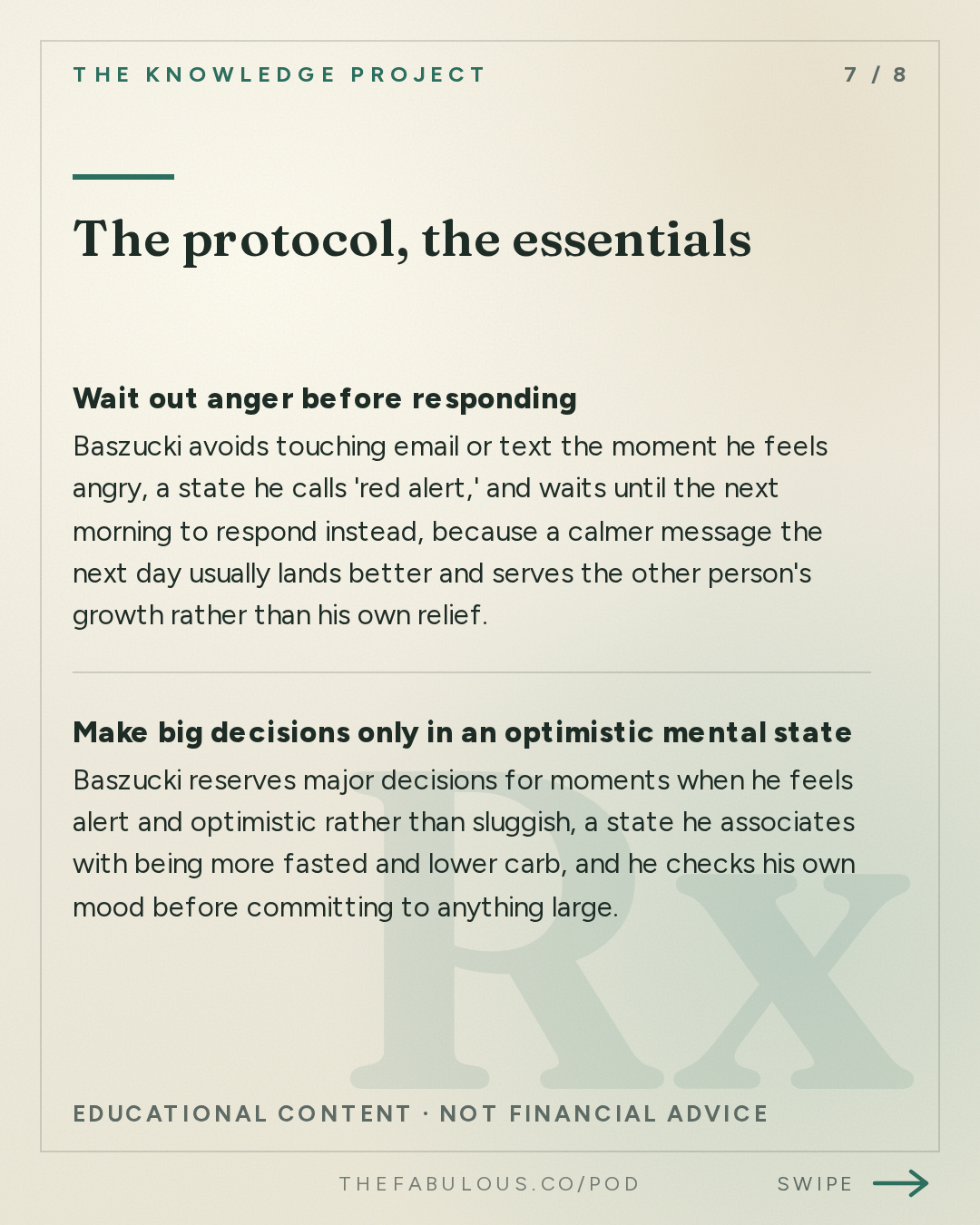
Wait out anger before responding
Baszucki avoids touching email or text the moment he feels angry, a state he calls 'red alert,' and waits until the next morning to respond instead, because a calmer message the next day usually lands better and serves the other person's growth rather than his own relief.
whenever he notices the anger response
-
Make big decisions only in an optimistic mental state
Baszucki reserves major decisions for moments when he feels alert and optimistic rather than sluggish, a state he associates with being more fasted and lower carb, and he checks his own mood before committing to anything large.
before each major decision
-
Name a single decision maker
At Roblox, Baszucki says the company tries to identify one person to make a given decision and gives that person freedom to act, rather than relying on group consensus, because a single owner moves faster than a confused group process.
for most major decisions
-
Ship early and unfinished for feedback
Roblox chose to release the first, deliberately crude Roblox avatar rather than wait for a fully finished, high-resolution character, because early real-world feedback beat the polished version the industry recommended.
for early-stage products
-
Rebuild the system instead of patching it
When Roblox's early membership economy stalled, the team first tried about thirty of fifty small fixes and the problem persisted, so they abandoned patching and built an entirely new virtual currency economy instead.
when incremental fixes fail to solve a systemic problem
Questions this episode answers
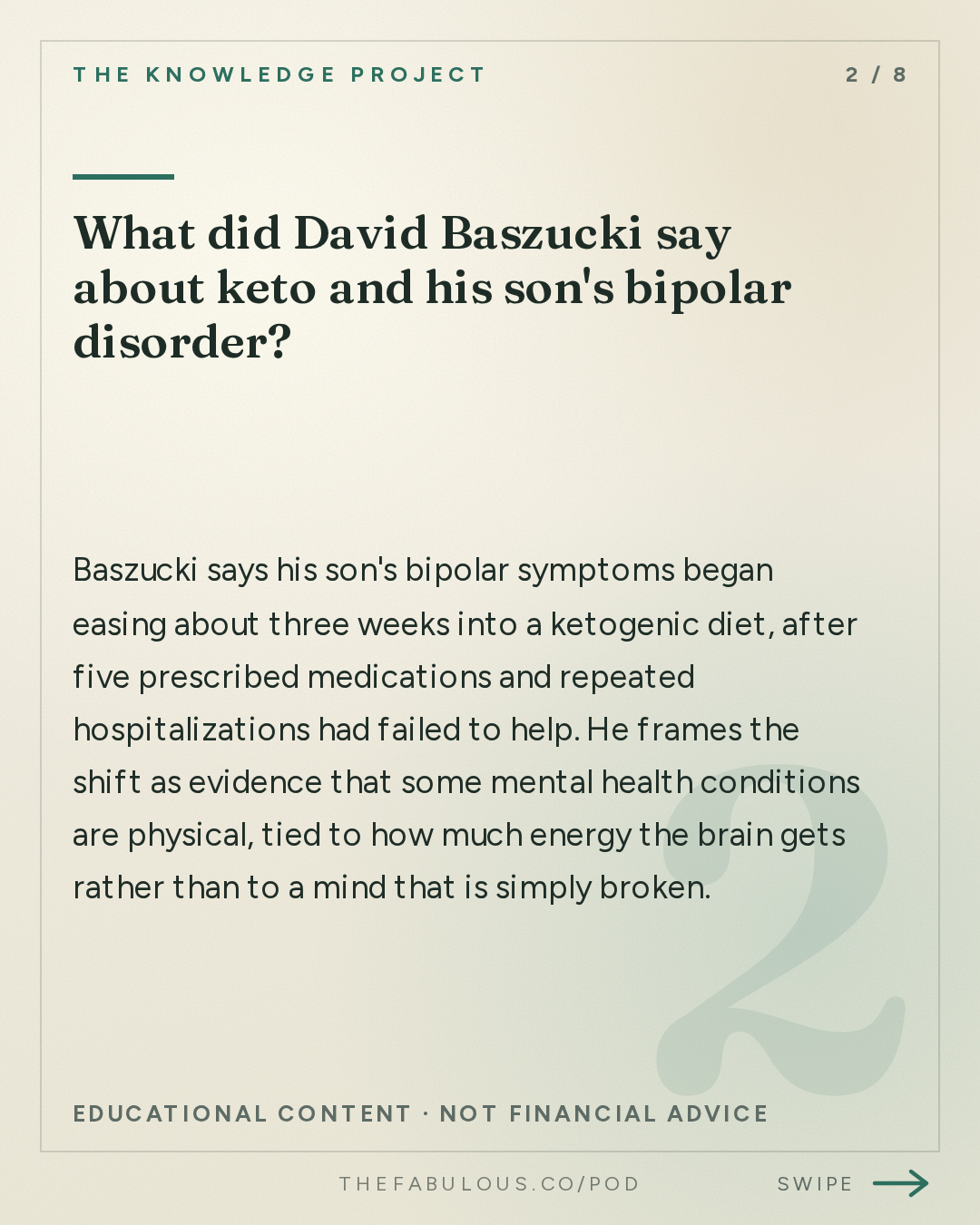
What did David Baszucki say about keto and his son's bipolar disorder?
Baszucki says his son's bipolar symptoms began easing about three weeks into a ketogenic diet, after five prescribed medications and repeated hospitalizations had failed to help (01:29). He frames the shift as evidence that some mental health conditions are physical, tied to how much energy the brain gets rather than to a mind that is simply broken (02:58).
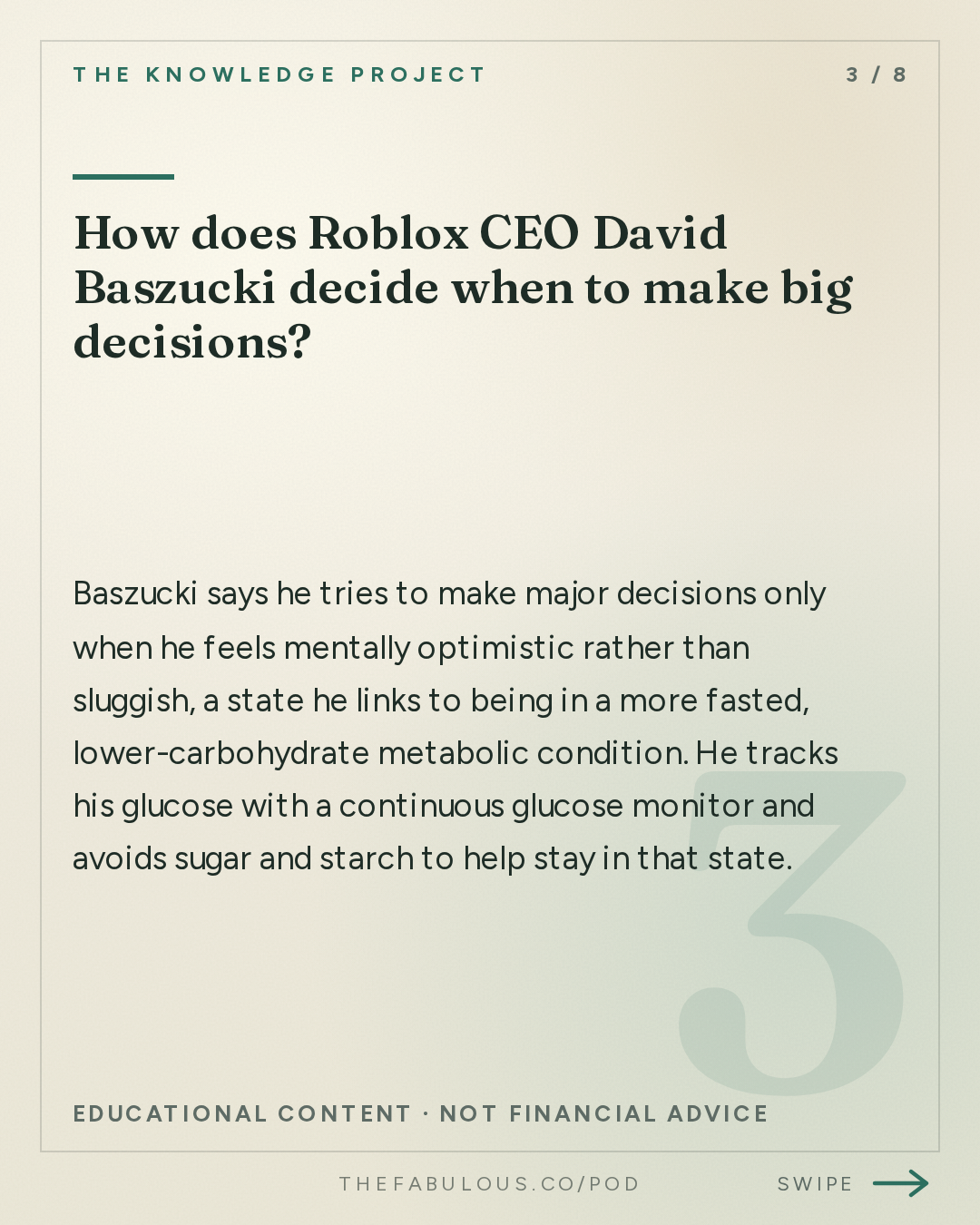
How does Roblox CEO David Baszucki decide when to make big decisions?
Baszucki says he tries to make major decisions only when he feels mentally optimistic rather than sluggish, a state he links to being in a more fasted, lower-carbohydrate metabolic condition (05:42). He tracks his glucose with a continuous glucose monitor and avoids sugar and starch to help stay in that state (04:18).
What is Roblox's magic quadrant of decision-making?
Baszucki describes a magic quadrant where a decision keeps a long-term view of the goal but stays open to fast, repeated adjustment in how it gets executed (13:57). He contrasts this with decisions that are either too short-term in view or too rigid once the company commits to them.
How much of the global gaming market does Roblox have?
By Baszucki's account, Roblox's bookings put it at roughly three to four percent of an estimated $200 billion addressable gaming market (22:04). The company has stated a goal of reaching ten percent of global gaming, a target set about two years before this conversation (21:36).
Why does Robux stay near one cent in value?
Baszucki says Roblox deliberately keeps its virtual currency, Robux, close to one U.S. cent, a stability the platform has held for about twenty years, to avoid inflating or deflating the in-game economy (32:16). He notes there is no guarantee that peg holds long term, but stability has been the guiding principle so far.
Does Roblox use AI for age verification?
Yes. Baszucki says Roblox now uses AI to check the age of every person on the platform and has open-sourced its voice safety filter, steps taken without any legal requirement forcing them (36:43). He argues private industry moved ahead of most legislation on this issue.
The full read, in cards
Go deeper
- Ready Player One — referenced as an early inspiration for the metaverse category, though Baszucki prefers less intrusive VR than the book depicts
Mentioned
David Baszucki · Roblox · Erik Cassel · Lua · Club Penguin · Ready Player One · CGM
More from this show and category

Ryan Serhant's Sales and Productivity Secrets
Ryan Serhant, star of Million Dollar Listing and founder of real estate firm Serhant, says comfort with embarrassment separates top earners from everyone else. He outlines his 1,000 minutes rule for guarding daily time, a hook-help-ask sales framework, and why distribution matters more than product quality.

Charlie Munger's Lessons from Henry Singleton
In a 2022 conversation, Charlie Munger tells Todd Combs that investing success rests on finding rare talent, choosing solvable problems, and smart positioning. The through-line is positioning: arranging affairs so circumstances never force bad decisions, as Munger explains using Rockefeller, Teledyne founder Henry Singleton, and the 1974 market crash.

Bill Ackman on Lucy's Recovery and the Brain Institute
Bill Ackman recounts his daughter Lucy's brain hemorrhage and the brain rehabilitation institute he built in response. He also details Pershing Square's investment checklist, its move away from short selling, and the plan to turn Howard Hughes into an insurance-driven holding company modeled on Berkshire Hathaway.

Tobi Lütke: How Shopify Runs on AI Agents
Shopify CEO Tobi Lütke says AI agents like River now draft up to half the company's pull requests. But he argues machines can never take responsibility, so taste, judgment, and disciplined pruning, not raw AI output, still decide what actually gets built.
