
Ryan Serhant's Sales and Productivity Secrets
How to Get People to Say Yes | Ryan Serhant
▶ Listen to the full episode More from The Knowledge Project
The brief
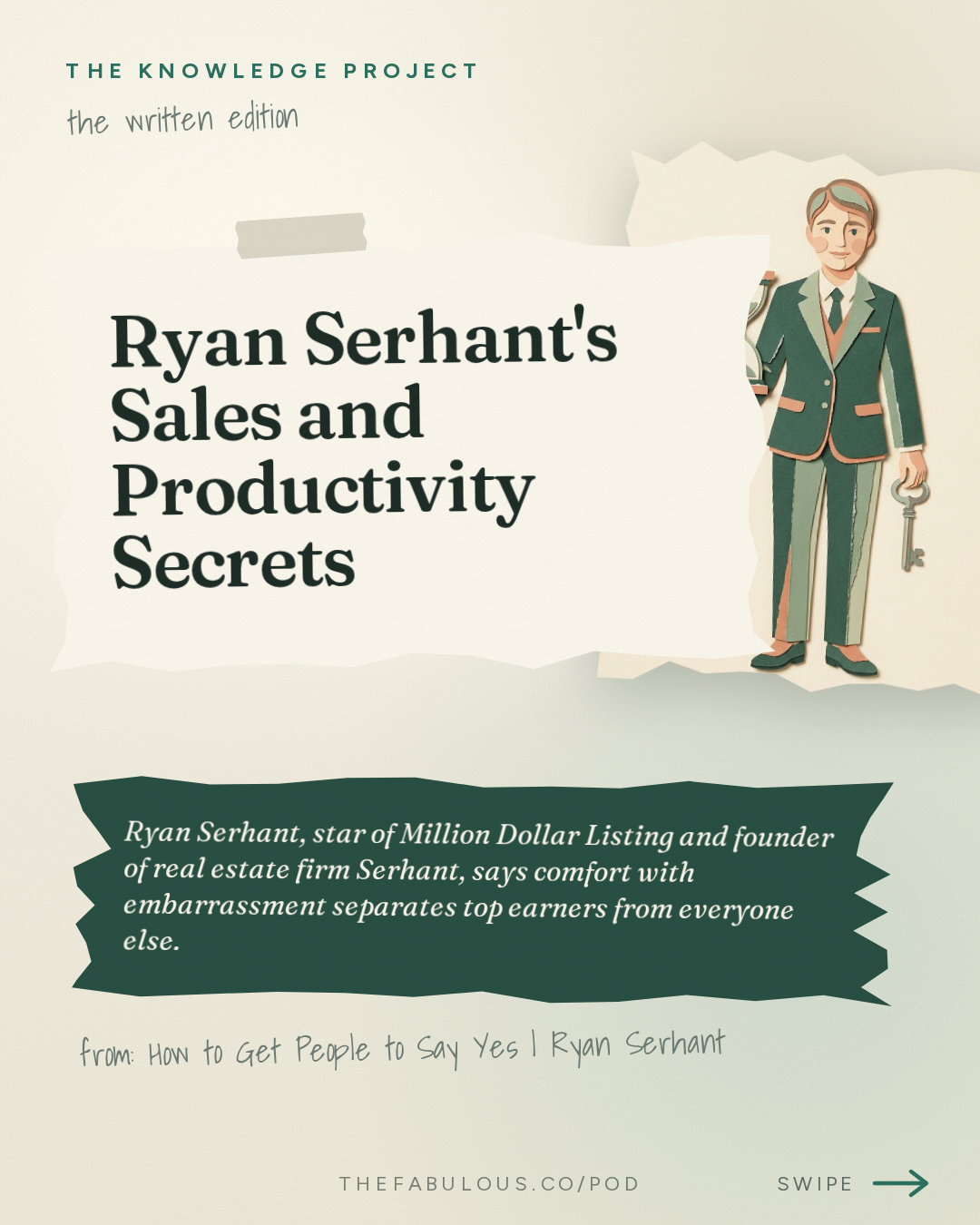
Ryan Serhant, star of Million Dollar Listing and founder of real estate firm Serhant, says comfort with embarrassment separates top earners from everyone else. He outlines his 1,000 minutes rule for guarding daily time, a hook-help-ask sales framework, and why distribution matters more than product quality.
Here is a claim that sounds backward until you sit with it: the people who make the most money are not the most talented in the room. They are the ones who no longer flinch at looking foolish. Real estate broker Ryan Serhant, who built his name on Bravo's Million Dollar Listing and now runs the brokerage and media company Serhant, opens his conversation with Shane Parrish on this exact idea. "If you're willing to embarrass yourself, you make more money every time," he says (00:00). It is a strange thesis for a business conversation, but Serhant spends the next hour showing his work.
Serhant's own origin story is the proof. He got his real estate license the day Lehman Brothers filed for bankruptcy in 2008, mostly because he needed to pay rent while trying to act in New York (03:22). Eighteen months later, in 2010, Bravo held an open casting call for a New York version of Million Dollar Listing. Three thousand agents showed up at the Hudson Hotel (04:08). Serhant made the cut to the final sixteen, who would each be followed by a camera crew for half a day to decide who became one of the show's three stars.
Acting Like the Person You Will Become
Instead of showing the crew his real life, a small studio apartment and the subway, Serhant designed a day for the man he intended to be. He borrowed a Range Rover, arranged a 5 a.m. meeting to tire out the Los Angeles-based crew, who were still on West Coast time, and recruited a friend to pose as a hedge fund client for a staged apartment tour (04:53). He calls this something different from "fake it till you make it," a phrase he dislikes because it implies lying.
"I've always aligned myself with being future me. That's it. I'm not faking anything." — Ryan Serhant [02:35]
The distinction matters to him: he was not inventing a persona, he was rehearsing one he had already decided to become within twelve to twenty-four months. Shane Parrish uses a similar exercise with his own kids, asking them to imagine a camera crew following an A-plus student around to help them get good grades, and Serhant says he does the same thing with his own daughter now (08:20). Whether or not the psychology holds up as science, Serhant's bet paid off. The show ran for ten years, spun off three more series, and eventually led to a Netflix show, Owning Manhattan.
What makes Serhant worth listening to past the origin story is how mechanically he treats the rest of the job. He breaks his sales philosophy into something close to engineering. The first move in any deal, he says, is disarming someone with a shared detail and a compliment, then asking only questions that cannot be answered with no, because people, especially men, like talking about themselves (16:38). The goal is to make the sale feel like no sale at all.
"The best sale is no sale. The art of the sale is that nothing is for sale and I'm not selling you anything." — Ryan Serhant [16:38]
He sells the dream before the product, the lifestyle before the apartment. And once a deal starts, he refuses to let it die quietly. He describes what he calls the three Fs: follow up, follow through, follow back. One of his biggest clients took five years of biweekly personal notes, sent with help from Google Alerts to track the prospect's name in the news, before the man finally replied at the end of 2017 (21:47). Serhant later sold him three properties, the largest for seventy-three million dollars (22:10). The lesson he draws is blunt: most people do not fail at follow-up, they simply quit.
Minutes as Currency, Distribution as the Real Product
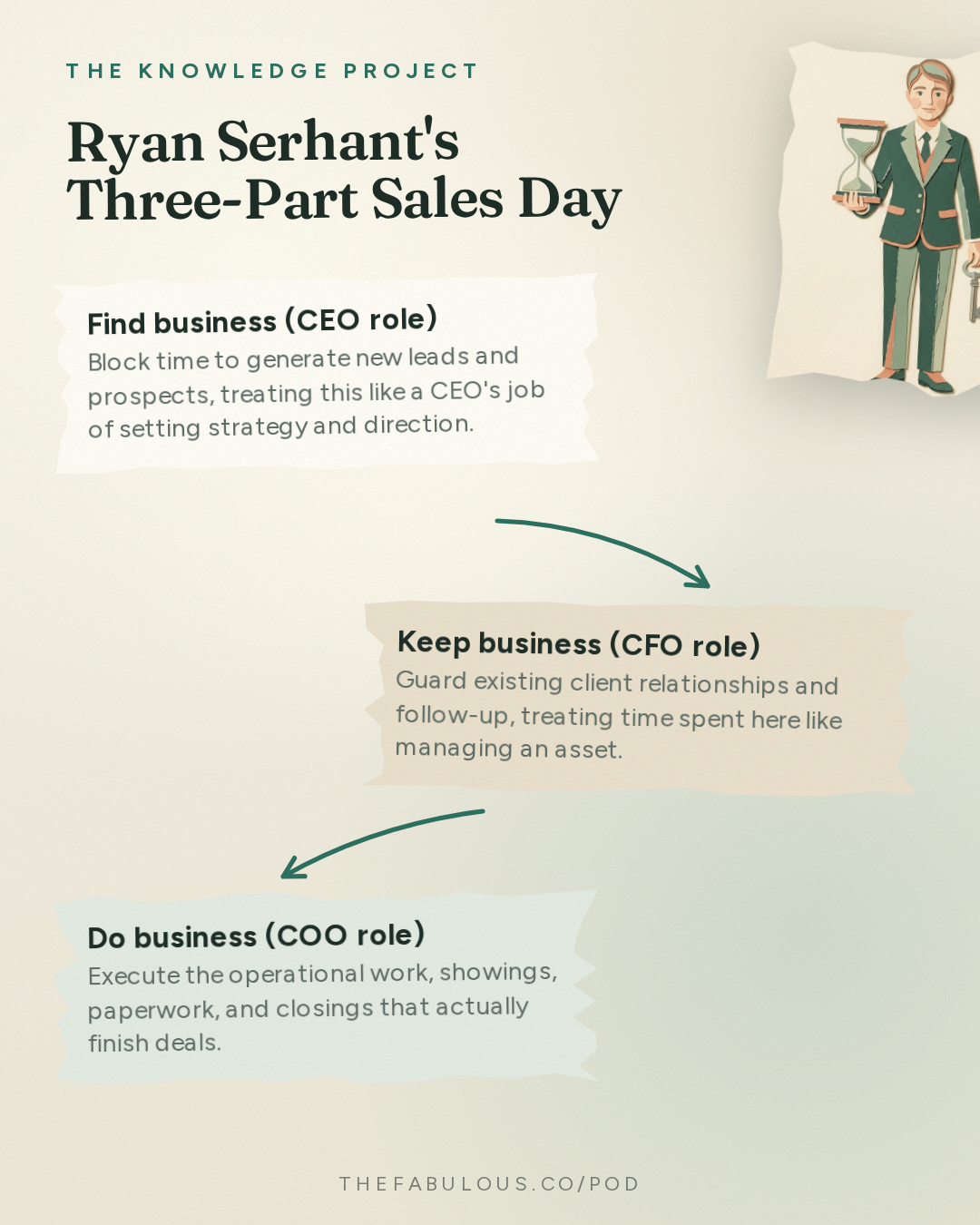
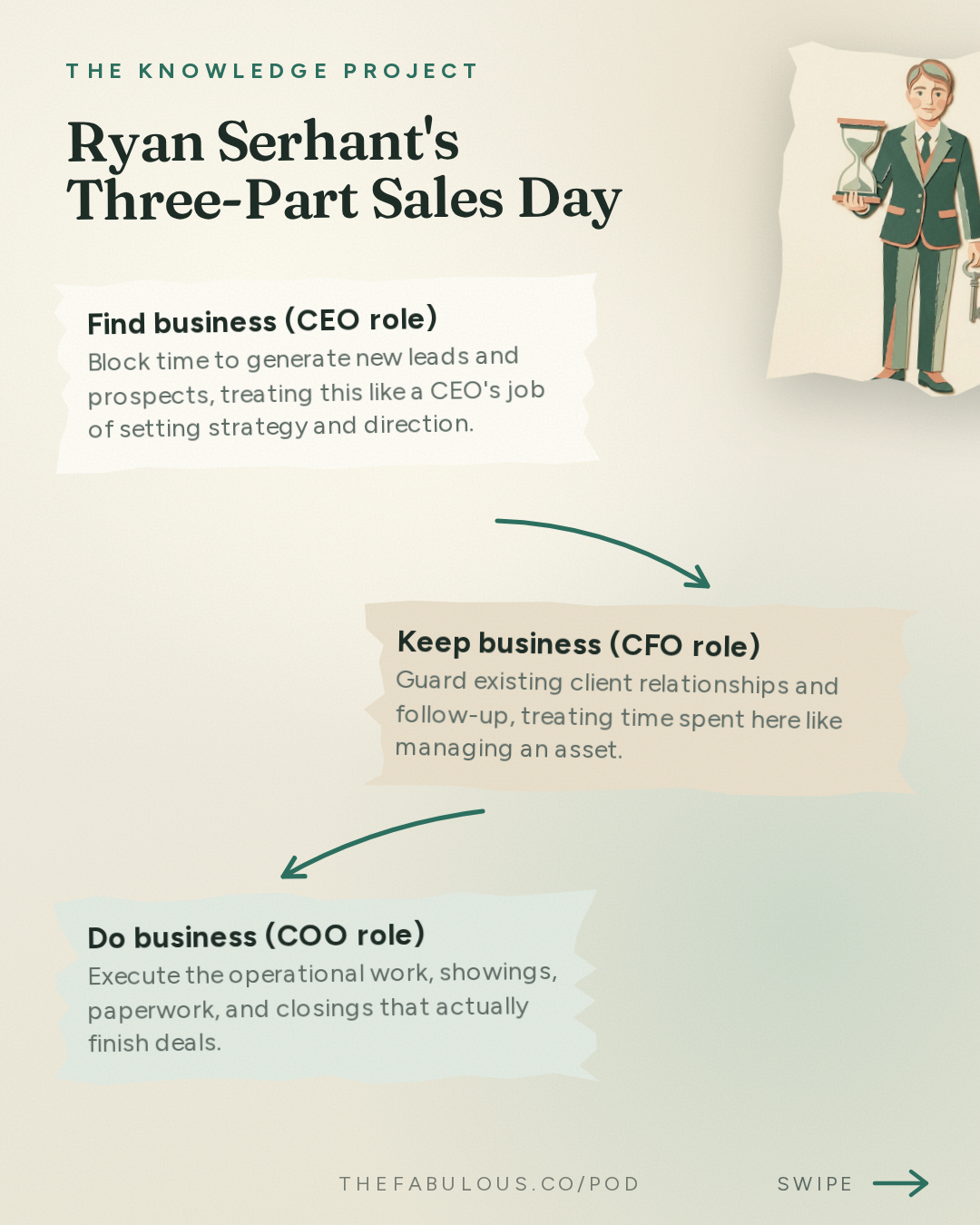
Serhant's other obsession is time. He says the average person has roughly 1,000 usable, productive minutes in a day, once sleep and routine chores are subtracted, and he treats each one like cash (13:01). If a bad phone call eats five minutes, he does not let it bleed into the next twenty. That discipline, he says, let him compress hour-long meetings into fifteen-minute ones and helped his team post 800 million dollars in sales in 2018, outselling the next-best team in New York by 350 million dollars that year (15:48).
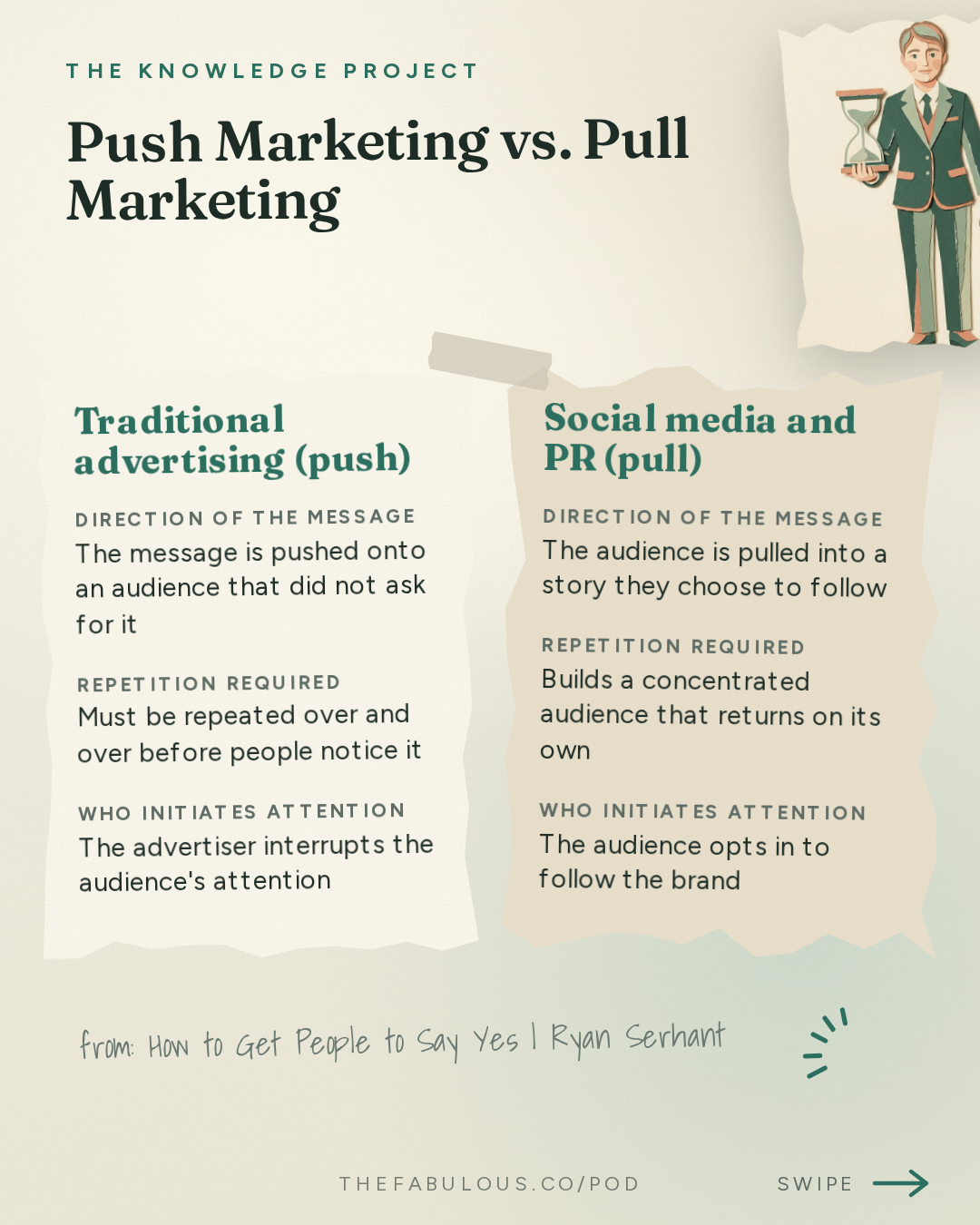
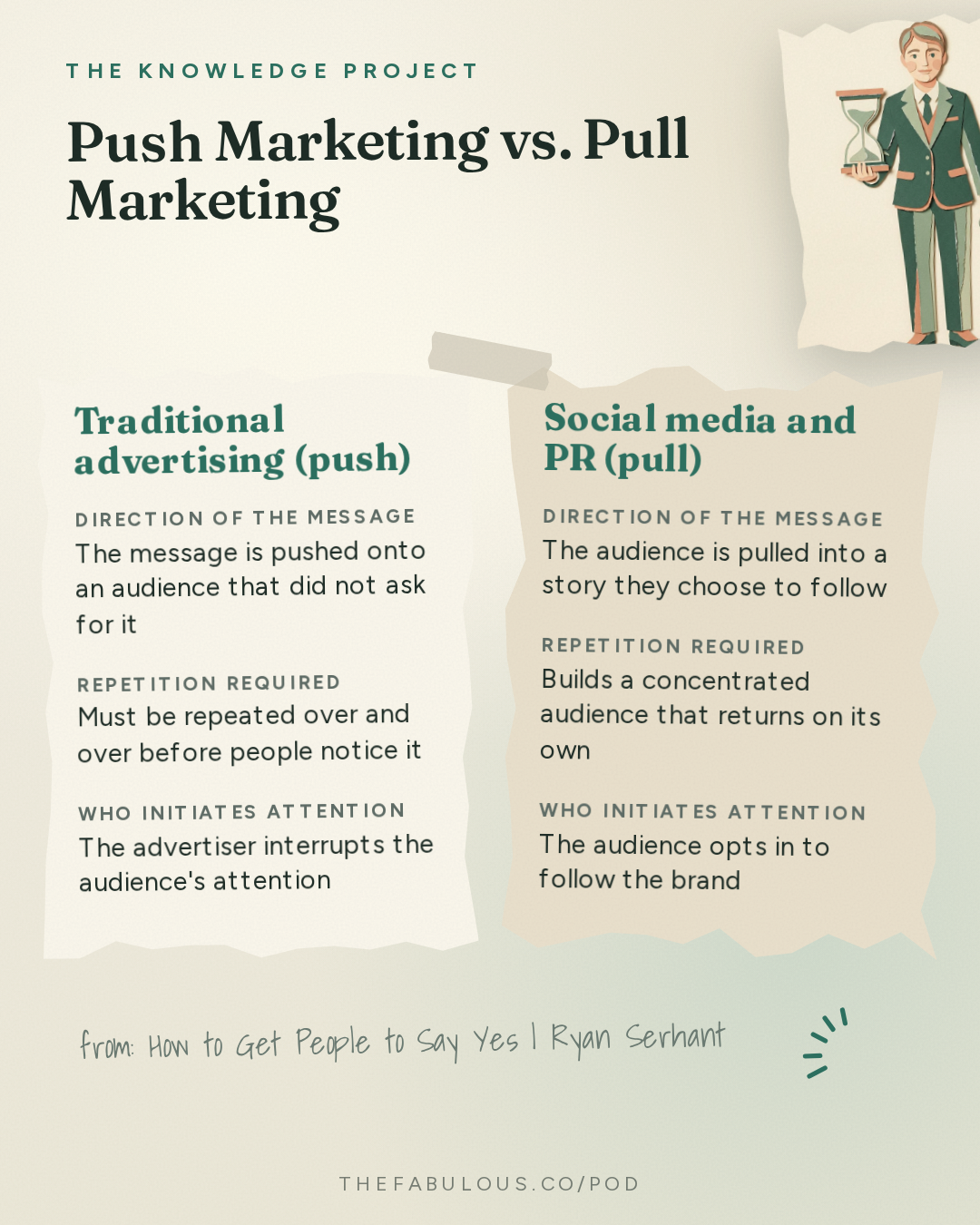
The same instinct for efficiency shows up in how he talks about marketing. Early on, Serhant noticed that nobody calls a stranger they saw on television. Attention does not automatically convert into business. So he leaned into Twitter, then Instagram, then YouTube, treating content as a distribution channel rather than a vanity project (38:46). His reasoning is almost accounting-like: a great product nobody knows about is functionally a bankrupt product (41:18). He draws a line between two kinds of marketing. Traditional advertising, he argues, is push, a message repeated at an audience until it lands. Social media and public relations are pull, building a community that chooses to follow along (42:23). That shift from push to pull is also the logic behind his sales training platform, sellit.com, which he says has trained 60,000 salespeople across 133 countries (44:53).
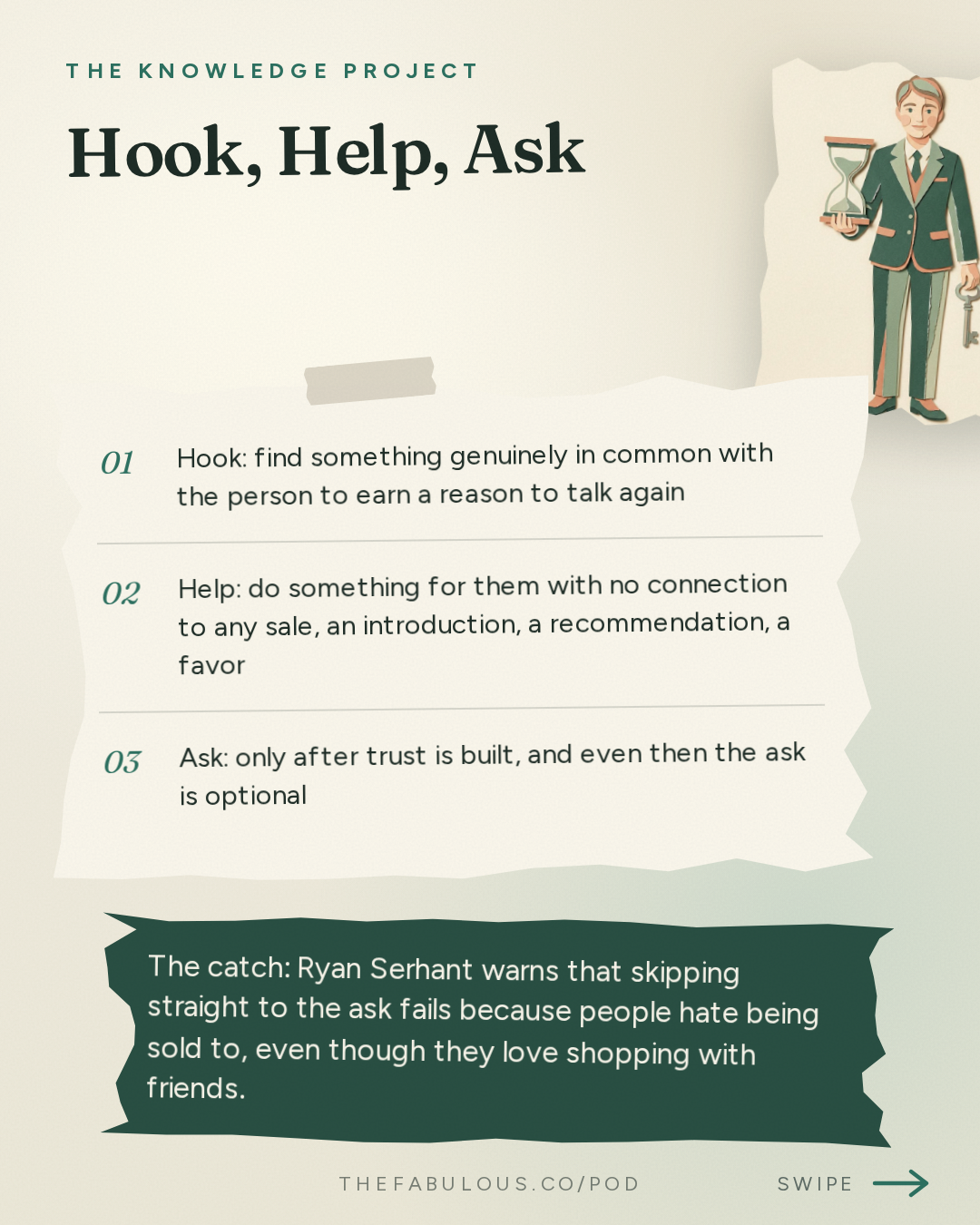
The training distills into a three-step framework he calls hook, help, ask. Hook someone by finding common ground. Help them with something that has nothing to do with the sale, an introduction, a recommendation, a favor. Only then make the ask, and even that is optional (44:53). It is the same disarm-then-build-trust logic from his real estate playbook, generalized into something closer to a doctrine.
None of this erases the costs of building a career this way. Serhant describes crying on the subway in the summer of 2008 after his debit card was declined buying groceries, a low point before his real estate license existed (33:01). He also recounts, almost gleefully, being conned by a buyer who vanished for months mid-deal on an 8.3 million dollar apartment sale, then reappeared with a fleet of armored cars and a half-finished board application (23:58). The deal closed. The client, it turned out, was simply erratic and extremely wealthy, not a fraud.
By the time he reached the top of the individual agent rankings in 2019, earning 22 million dollars in personal commissions that year (49:24), Serhant describes feeling the itch to start over. In 2020, in the middle of the pandemic, with a nine-month-old at home and the stock market in free fall, he founded his own brokerage against his parents' advice (49:50). He frames the decision less as ambition than as compulsion: "if you're not growing, you're dying," he says of running a business, though he adds that a fixed-income lifestyle business is a legitimate choice for people who want one (47:56).
Serhant closes the conversation on a note that complicates the hustle narrative a little. Asked about the chip on his shoulder, he traces it to having three sisters and two brothers, being picked last for teams, and spending years writing stories alone in a closet. But he refuses to let that story do any moral work for him now.
"I think your past explains you, but it does not excuse you." — Ryan Serhant [52:57]
It is a tidy way to summarize the whole hour. Serhant's entire system, the future-self exercise, the minute-by-minute accounting, the follow-up that outlasts most people's patience, is built on the idea that explanations are not permission. Being embarrassed, broke, or overlooked explains where someone started. It does not get them out of doing the work today.
Ask this episode anything
Pod's AI answers from the episode itself, with the minute mark so you can hear it yourself.
Or start with one of these
Ask this episode
Pod's AI listens to the whole episode to answer, and points you to the minute it comes from.
The rest of this answer, and any question after it
Answers come from the episode itself, never from a summary of it.
ContinueKey takeaways
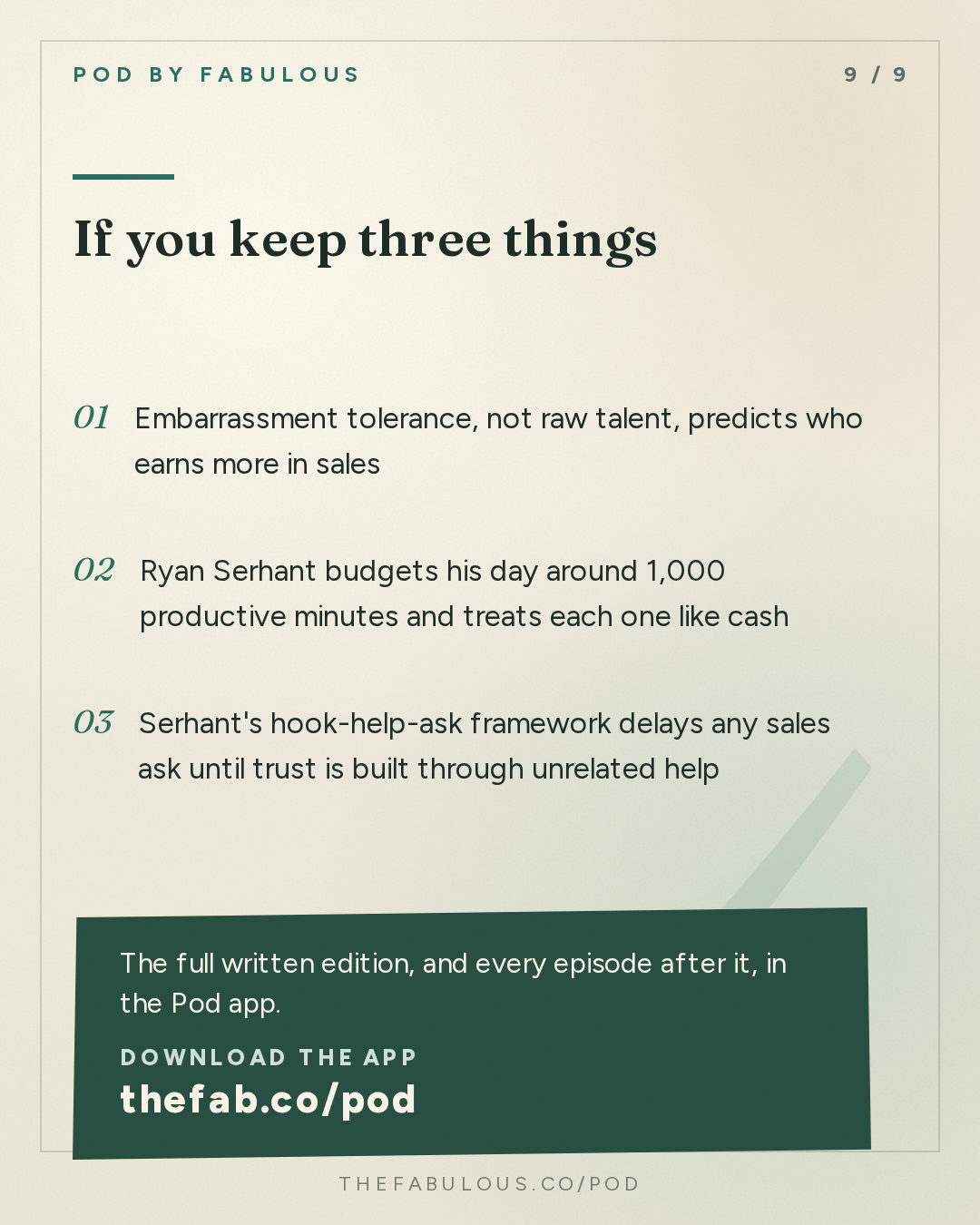
- Embarrassment tolerance, not raw talent, predicts who earns more in sales
- Ryan Serhant budgets his day around 1,000 productive minutes and treats each one like cash
- Serhant's hook-help-ask framework delays any sales ask until trust is built through unrelated help
- Distribution, not product quality, decided whether Serhant's content reached buyers on Instagram and YouTube
- Serhant's three Fs, follow up, follow through, follow back, kept him pursuing one client for five years before a sale
The episode in cards

By the numbers
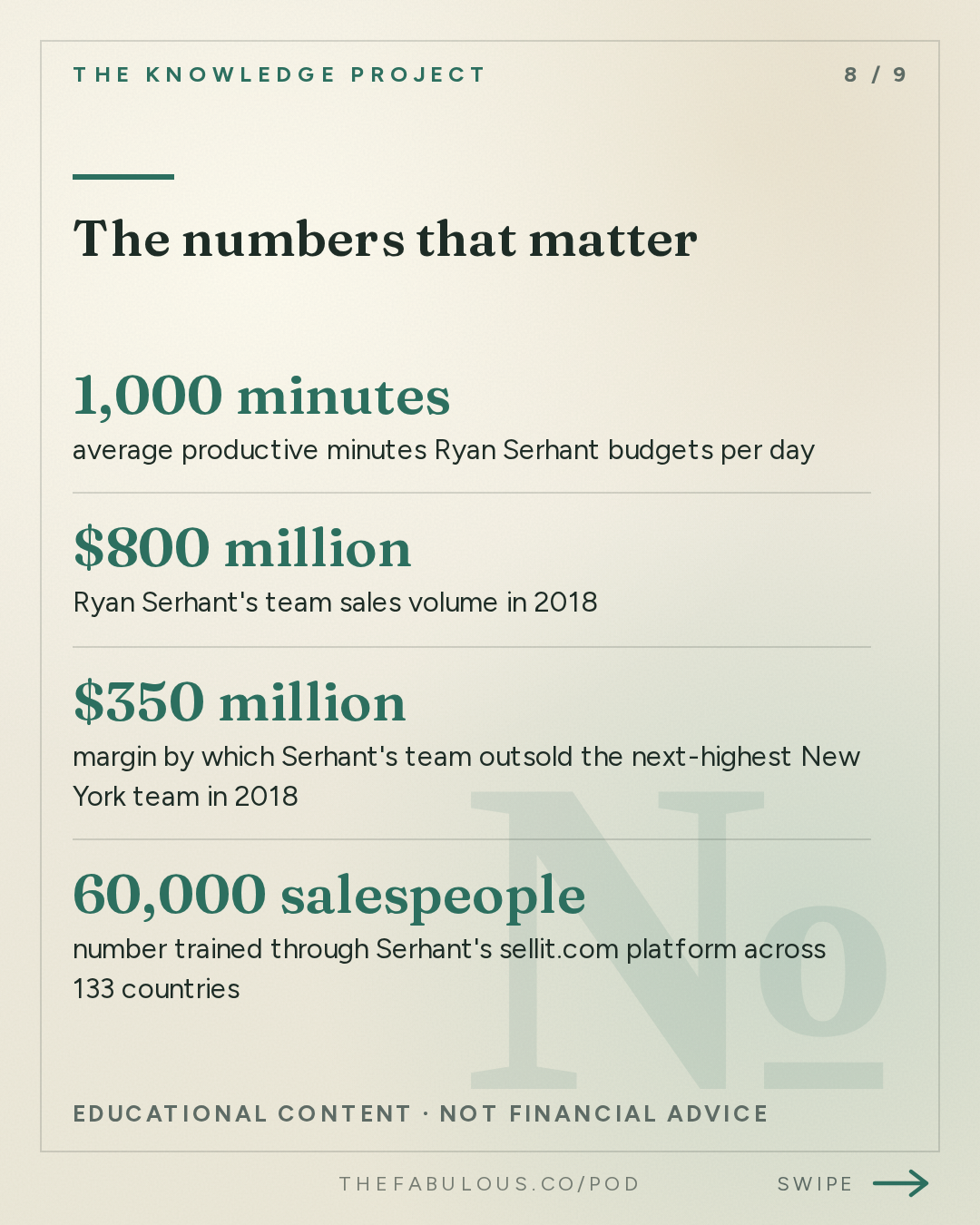
- 1,000 minutes average productive minutes Ryan Serhant budgets per day
- $800 million Ryan Serhant's team sales volume in 2018
- $350 million margin by which Serhant's team outsold the next-highest New York team in 2018
- 60,000 salespeople number trained through Serhant's sellit.com platform across 133 countries
- $22 million Ryan Serhant's personal commissions in 2019, his last year as an individual agent
In their words
“If you're willing to embarrass yourself, you make more money every time.”
“I've always aligned myself with being future me. That's it. I'm not faking anything.”
“The best sale is no sale. The art of the sale is that nothing is for sale and I'm not selling you anything.”
“I think your past explains you, but it does not excuse you.”
Protocols
-
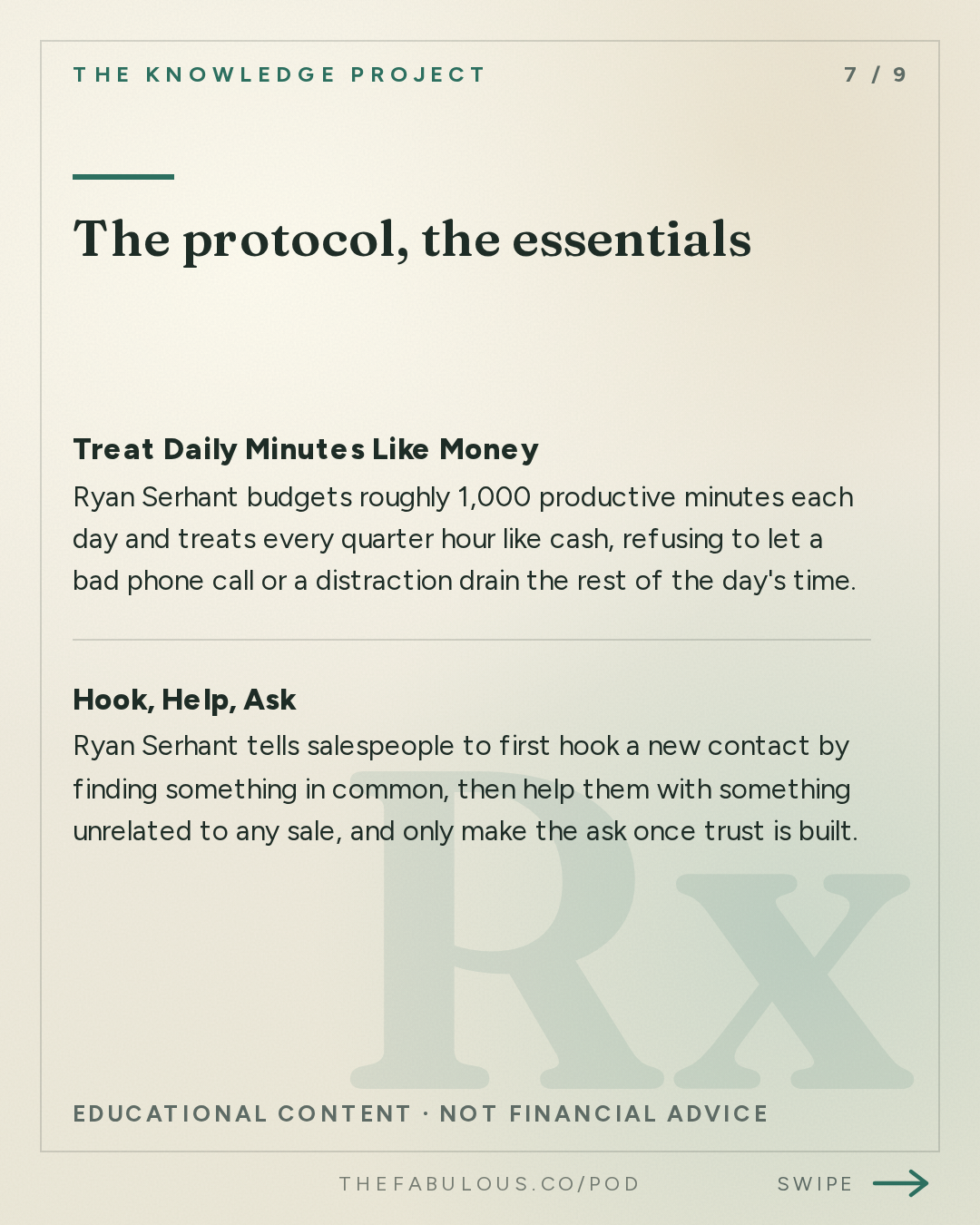
Treat Daily Minutes Like Money
Ryan Serhant budgets roughly 1,000 productive minutes each day and treats every quarter hour like cash, refusing to let a bad phone call or a distraction drain the rest of the day's time.
Daily
-
Hook, Help, Ask
Ryan Serhant tells salespeople to first hook a new contact by finding something in common, then help them with something unrelated to any sale, and only make the ask once trust is built.
With every new relationship
-
Follow Up Forever
Ryan Serhant sends a short personal note every other week, using Google Alerts to track a prospect's name and milestones, and keeps following up until the person buys, dies, or asks him to stop.
Every other week
-
Act As Future Self
Ryan Serhant writes down the person he intends to become in 12 to 24 months and acts like that person starting today, instead of continuing to act like who he used to be.
Daily
Questions this episode answers
What is Ryan Serhant's 1,000 minutes rule?
Ryan Serhant estimates that most people have about 1,000 usable, productive minutes in a day and argues these should be guarded like money, so a bad five-minute phone call does not get to consume the rest of the day's time (13:01). He says this mindset shift let him compress hour-long meetings into fifteen-minute ones.
What is the hook, help, ask sales framework?
It is a three-step sequence Ryan Serhant teaches through his training platform sellit.com: hook someone by finding common ground, help them with something unrelated to any sale, and only then make an ask, which is sometimes unnecessary (44:53). The platform has trained 60,000 salespeople in 133 countries using this structure.
Why does Ryan Serhant say embarrassment is linked to earning more money?
Serhant argues that most professionals today are not afraid of failure but are terrified of public embarrassment, which keeps them from taking the risks that generate higher income, such as cold outreach or an unconventional pitch (10:54). He says people willing to risk looking foolish consistently out-earn those who are not (00:00).
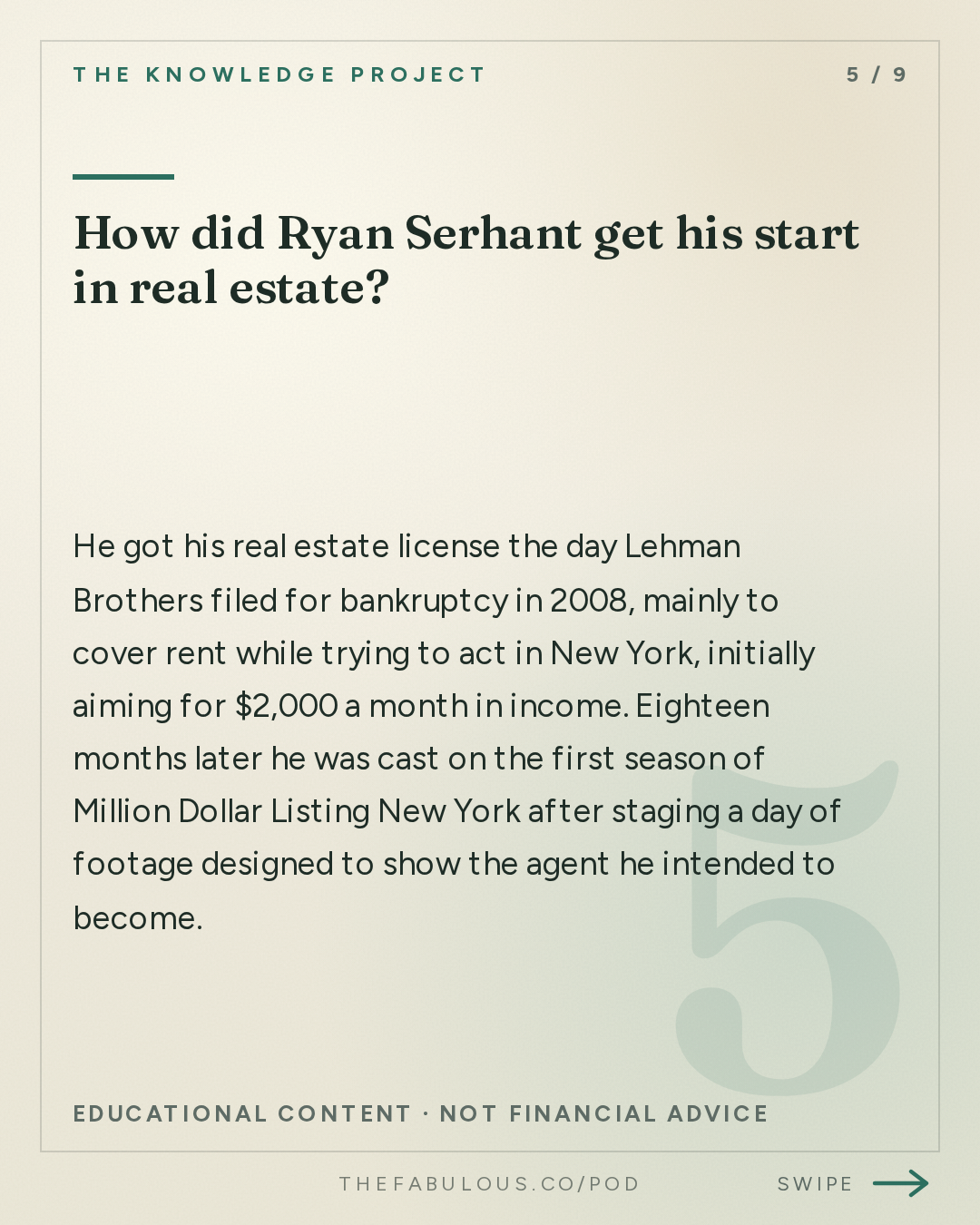
How did Ryan Serhant get his start in real estate?
He got his real estate license the day Lehman Brothers filed for bankruptcy in 2008, mainly to cover rent while trying to act in New York, initially aiming for $2,000 a month in income (03:22, 03:39). Eighteen months later he was cast on the first season of Million Dollar Listing New York after staging a day of footage designed to show the agent he intended to become (03:04).
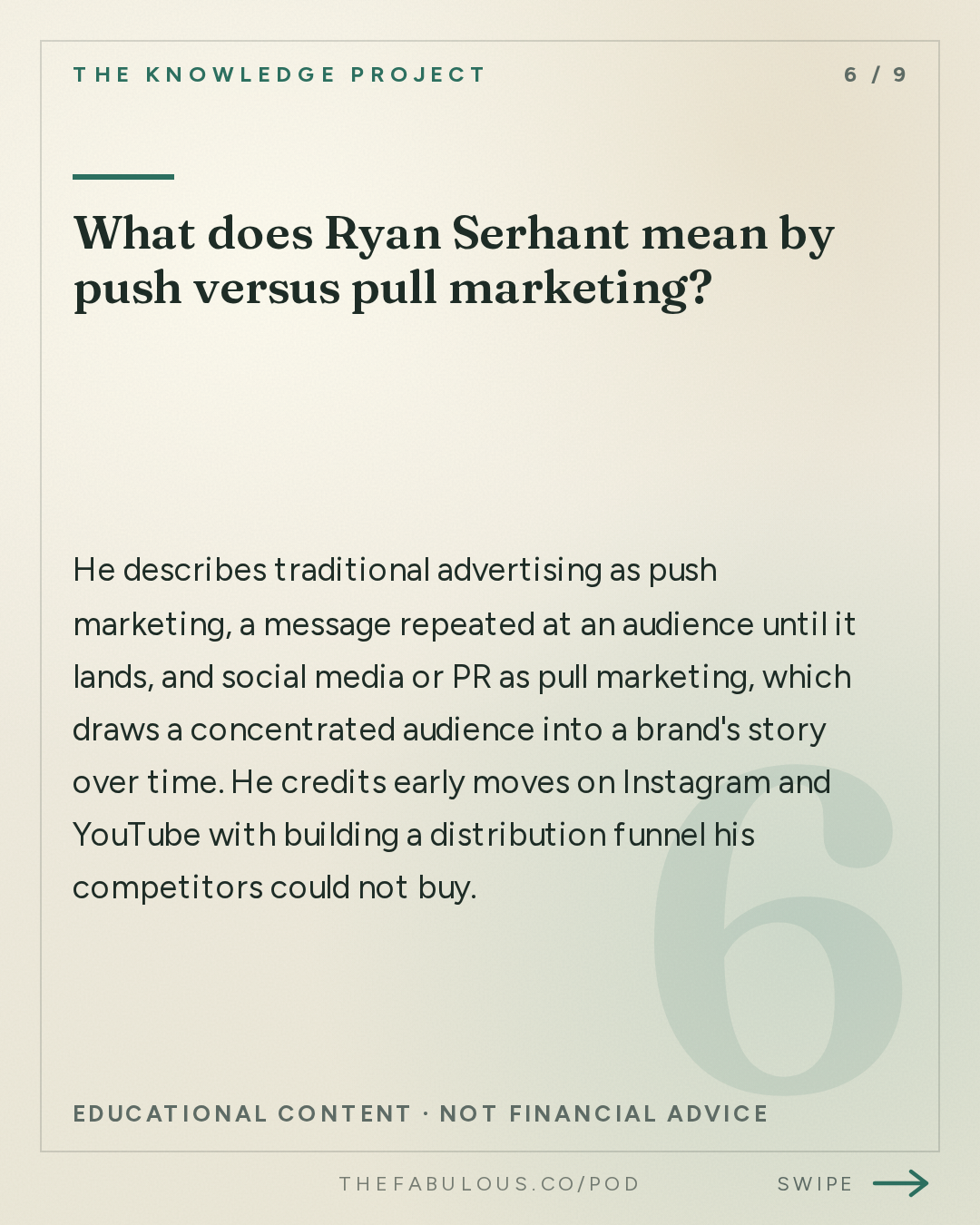
What does Ryan Serhant mean by push versus pull marketing?
He describes traditional advertising as push marketing, a message repeated at an audience until it lands, and social media or PR as pull marketing, which draws a concentrated audience into a brand's story over time (42:23). He credits early moves on Instagram and YouTube with building a distribution funnel his competitors could not buy.
What is Ryan Serhant's three Fs of follow-up?
Follow up, follow through, and follow back: keep contacting a prospect with no expectation of a reply, do everything promised once someone becomes a client, and stay in touch with everyone who chooses to work with him (21:01). He says most people fail at sales simply because they give up on follow-up too soon (22:30).
The full read, in cards
Go deeper
- The Art of War — Referenced for the idea that surprising someone makes them double down their focus on you
Mentioned
Ryan Serhant · Shane Parrish · Million Dollar Listing · Bravo · Netflix · Serhant · sellit.com · Google Alerts · The Art of War · Owning Manhattan
More from this show and category

Charlie Munger's Lessons from Henry Singleton
In a 2022 conversation, Charlie Munger tells Todd Combs that investing success rests on finding rare talent, choosing solvable problems, and smart positioning. The through-line is positioning: arranging affairs so circumstances never force bad decisions, as Munger explains using Rockefeller, Teledyne founder Henry Singleton, and the 1974 market crash.

Bill Ackman on Lucy's Recovery and the Brain Institute
Bill Ackman recounts his daughter Lucy's brain hemorrhage and the brain rehabilitation institute he built in response. He also details Pershing Square's investment checklist, its move away from short selling, and the plan to turn Howard Hughes into an insurance-driven holding company modeled on Berkshire Hathaway.

Tobi Lütke: How Shopify Runs on AI Agents
Shopify CEO Tobi Lütke says AI agents like River now draft up to half the company's pull requests. But he argues machines can never take responsibility, so taste, judgment, and disciplined pruning, not raw AI output, still decide what actually gets built.

Roblox CEO's Decision-Making Framework
Roblox CEO David Baszucki says his son's bipolar disorder eased within weeks of starting a ketogenic diet, after five medications and repeated hospitalizations failed. He ties his own metabolic state, tracked with a continuous glucose monitor, to decision quality, and describes destroying bureaucracy, shipping unfinished products for real feedback, and holding Robux near one cent for twenty years.
