
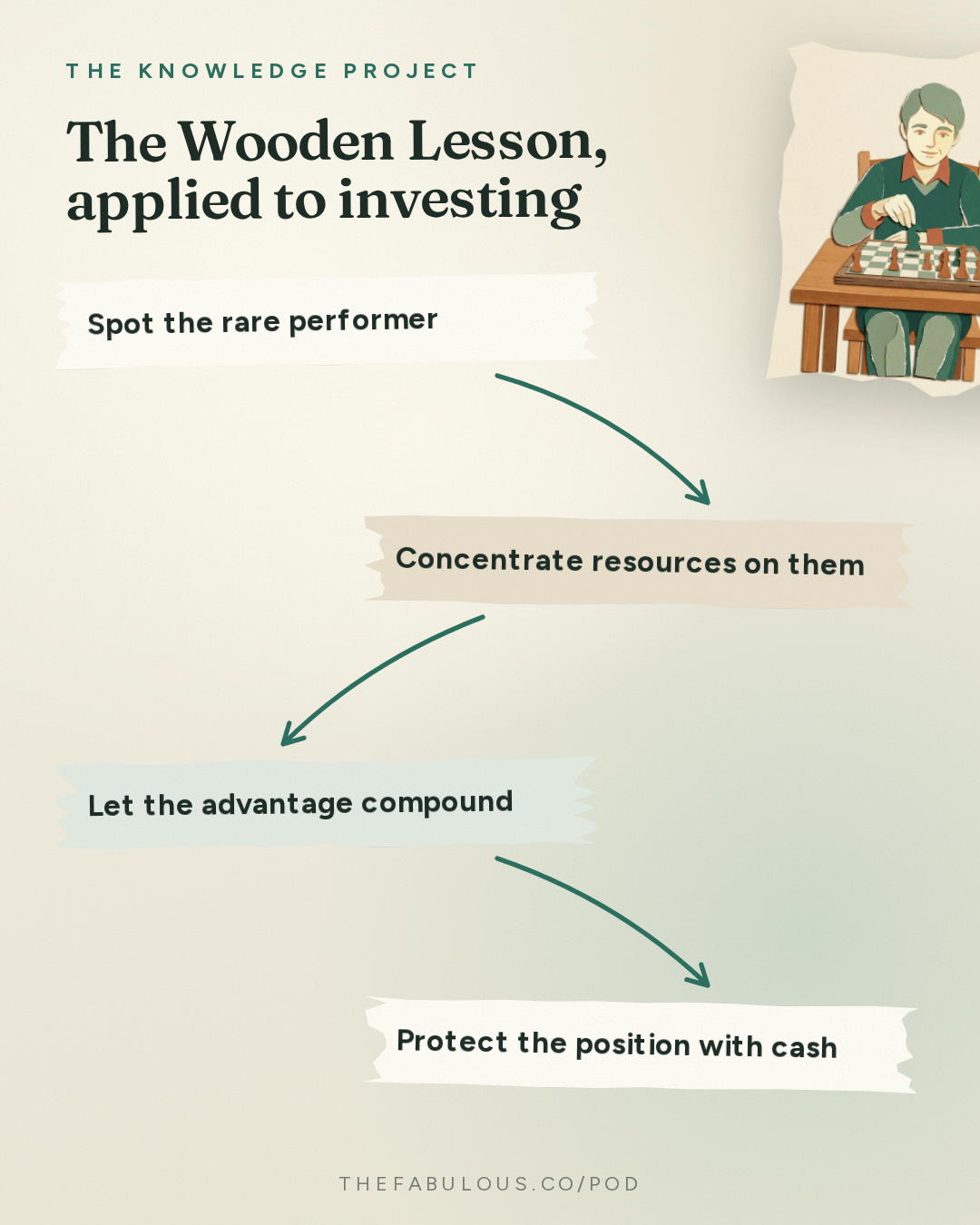
Charlie Munger's Lessons from Henry Singleton
Charlie Munger's Interview with Todd Combs
▶ Listen to the full episode More from The Knowledge Project
The brief
In a 2022 conversation, Charlie Munger tells Todd Combs that investing success rests on finding rare talent, choosing solvable problems, and smart positioning. The through-line is positioning: arranging affairs so circumstances never force bad decisions, as Munger explains using Rockefeller, Teledyne founder Henry Singleton, and the 1974 market crash.
Charlie Munger once described Henry Singleton, the founder of the conglomerate Teledyne, as a man who wears size 16 shoes and has webbed feet, competing against ordinary people (01:42). It is a strange image, and that is the point. Singleton was not simply smarter than everyone else in the room. He was built differently, Munger suggests, in a way that made the normal rules of competition irrelevant. This conversation, recorded in 2022 as part of the Singleton Prize for CEO Excellence and released publicly for the first time, is Munger's attempt to explain what that difference actually looks like, and why so few people ever possess it.
The interviewer is Todd Combs, one of Berkshire Hathaway's investment managers, and the two of them move across basketball, dormitory design, Jack Welch's General Electric, and John D. Rockefeller's oil empire without ever losing the thread. The thread is this: rare people deserve concentrated trust, problems should be chosen for their solvability, and the people who last longest are the ones who never let the world force their hand.
Start with Singleton. What made him unusual, in Munger's telling, was not intelligence alone but a total indifference to convention (02:01). When Singleton bought back Teledyne stock, he did it because the stock was cheap, full stop. Today, corporate buybacks are routine, often used to prop up a stock price regardless of its value. Singleton's logic ran the other way. Munger extends the same admiration to Tom Murphy, the broadcasting executive who built Capital Cities, whose entire management philosophy Munger compresses into one line: "What Tom did was he delegated enormously, and if it was really important, he went and did it himself" (03:15). Delegation without judgment is just abdication. The judgment is the hard part.
That judgment, Munger says, comes from something he calls the fiduciary gene, a term he uses for leaders who treat power as a trust rather than a prize. His example is George Washington, who left the presidency voluntarily and set a precedent that American term limits later formalized (04:52). Munger contrasts this with rulers who cling to power and corrupt the systems meant to check them. The fiduciary gene is not a talent. It is a disposition, and Munger clearly believes it is rarer than raw ability.
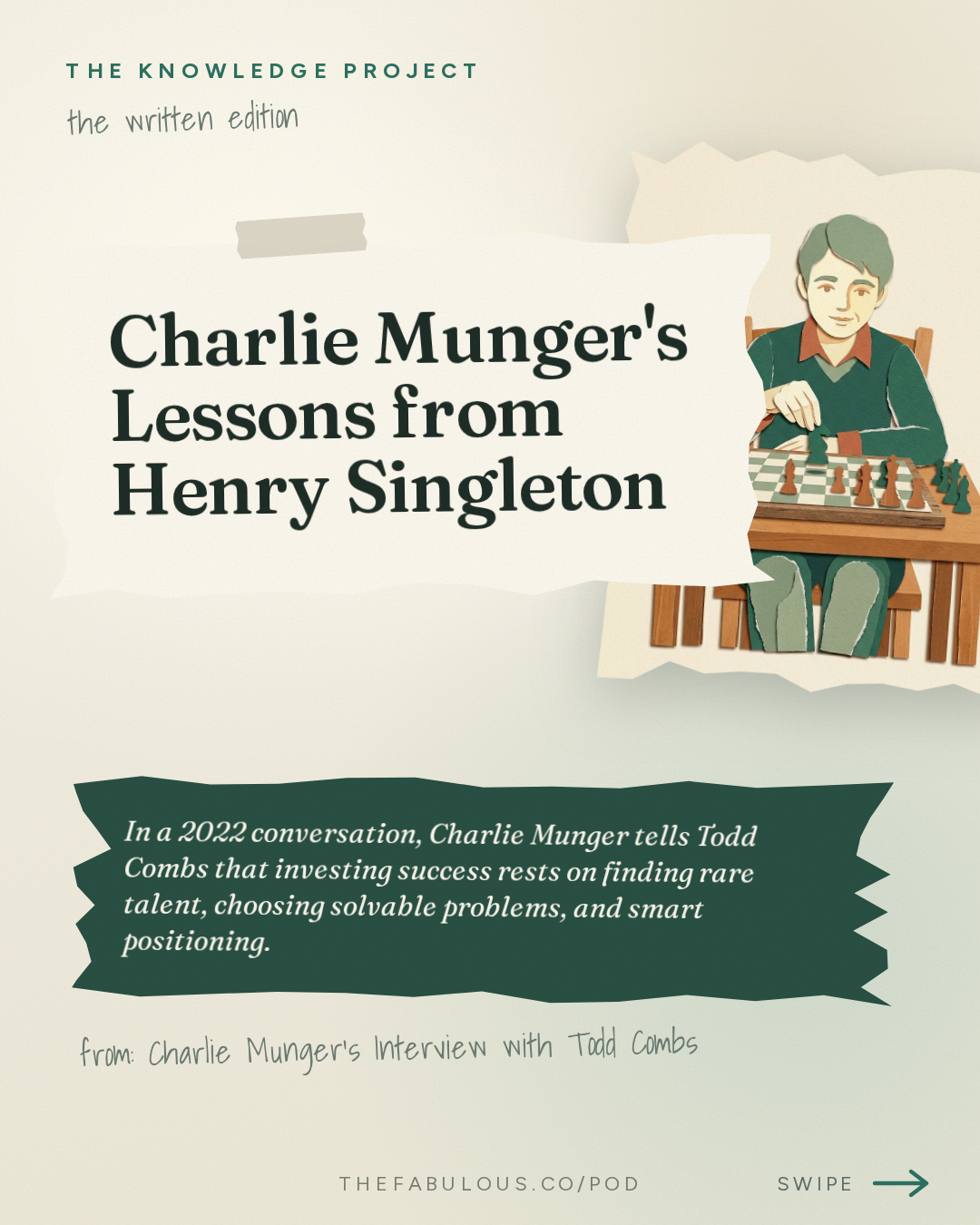
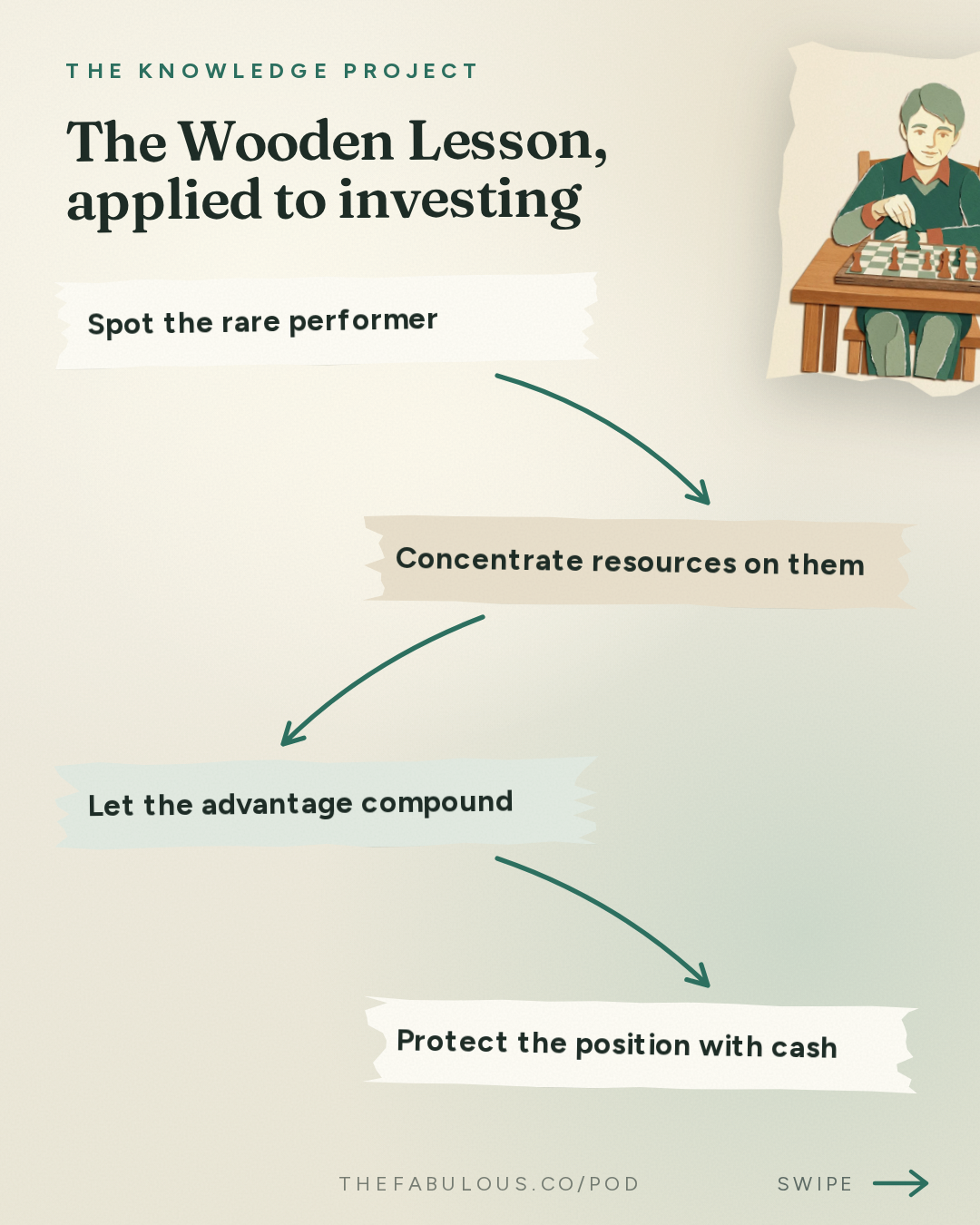
The clearest expression of how to use rare talent once it is found comes from basketball. Munger calls it the Wooden Lesson, after UCLA coach John Wooden, who built the best win record in the sport's history by giving almost 100 percent of playing time to his top seven players (04:07). Those players got better because they played more, and the gap between them and everyone else widened. Munger's advice for investors is the same: find a mini Wooden, a mini Singleton, a mini Warren Buffett, and then give that person or that business an outsized share of your attention and capital. Concentration, not diversification, is what compounds.
The Obsession That Knows Where to Stop
Munger is often asked to explain his own mind, and his answer is disarmingly plain:
"What I am is a guy who has been able to take moderate obsession and a long attention span and turn them into pretty good results." — Charlie Munger [06:09]
The word moderate is doing real work there. Munger was not obsessive about everything. He was selective about where he aimed his attention, and the selection rule was simple: avoid problems that cannot be fixed.
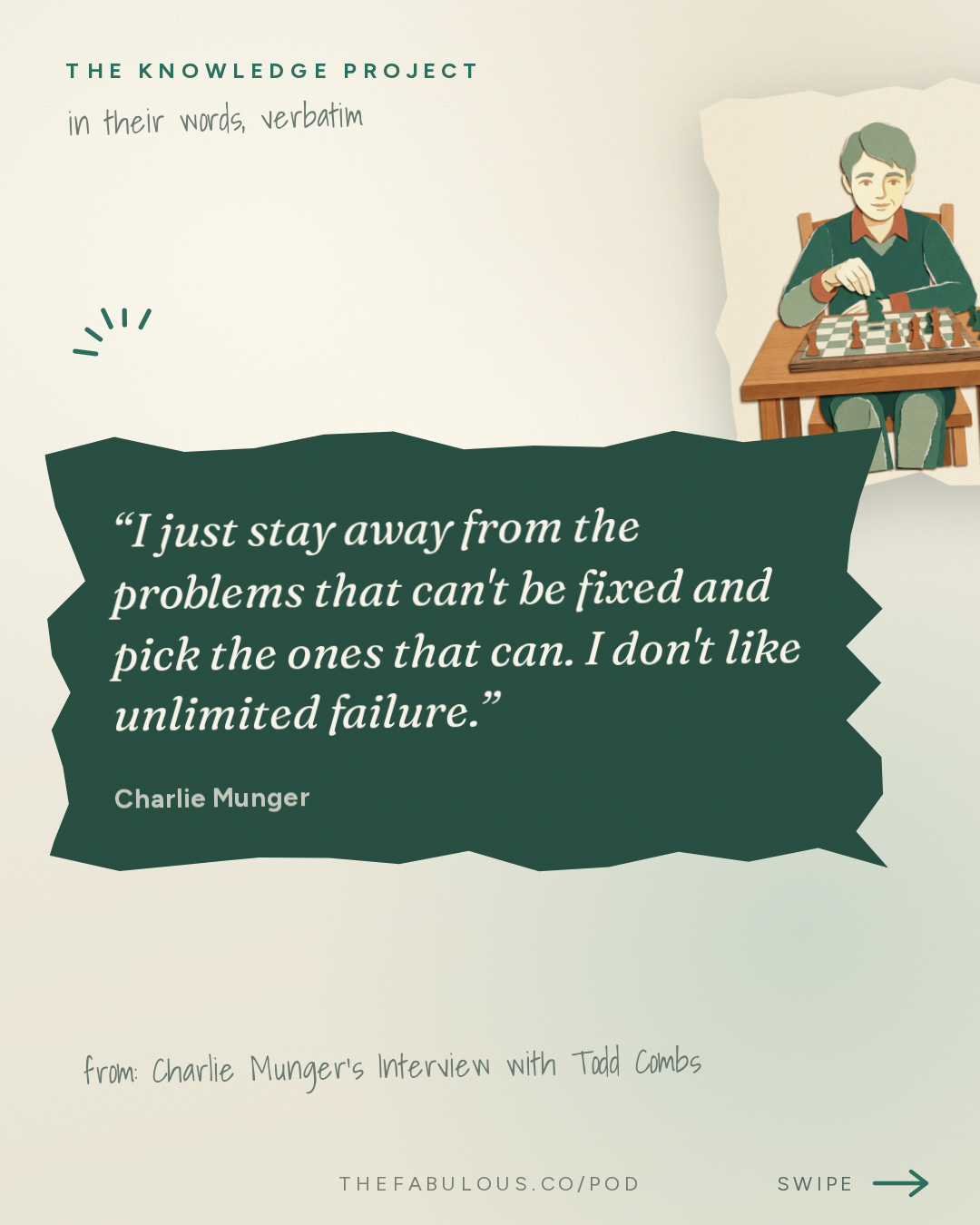
"I just stay away from the problems that can't be fixed and pick the ones that can. I don't like unlimited failure." — Charlie Munger [06:32]
This is a filter, not a formula. It does not tell someone what to work on. It tells them what to walk away from, which turns out to be most of the available problems in the world. Munger's own problem-solving habits show what staying with a solvable problem looks like in practice. When he was designing a college dormitory with windowless rooms, a choice that drew real criticism, he solved it by studying cruise ships, which face the identical problem in their interior staterooms and solve it with artificial windows that simulate daylight (07:23). He then noticed that Disney had gone further, charging more for rooms with artificial windows than for rooms with real ones, because the fake window could do things a real one could not, like project a scene for children (08:17). A weakness became a premium feature. Munger's point is not really about architecture. It is that a coolly logical mind will look anywhere for an answer, including places that seem to have nothing to do with the problem at hand.
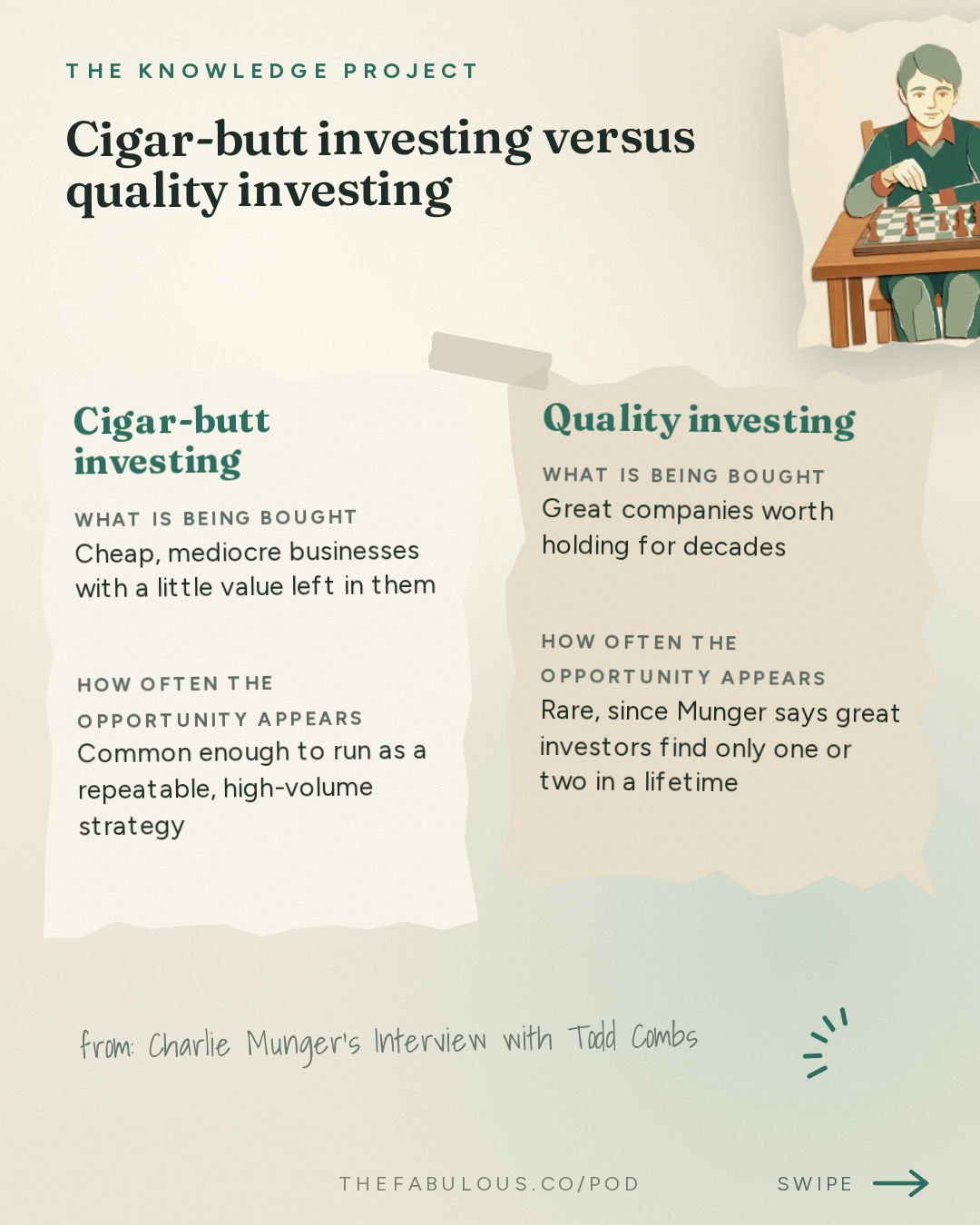
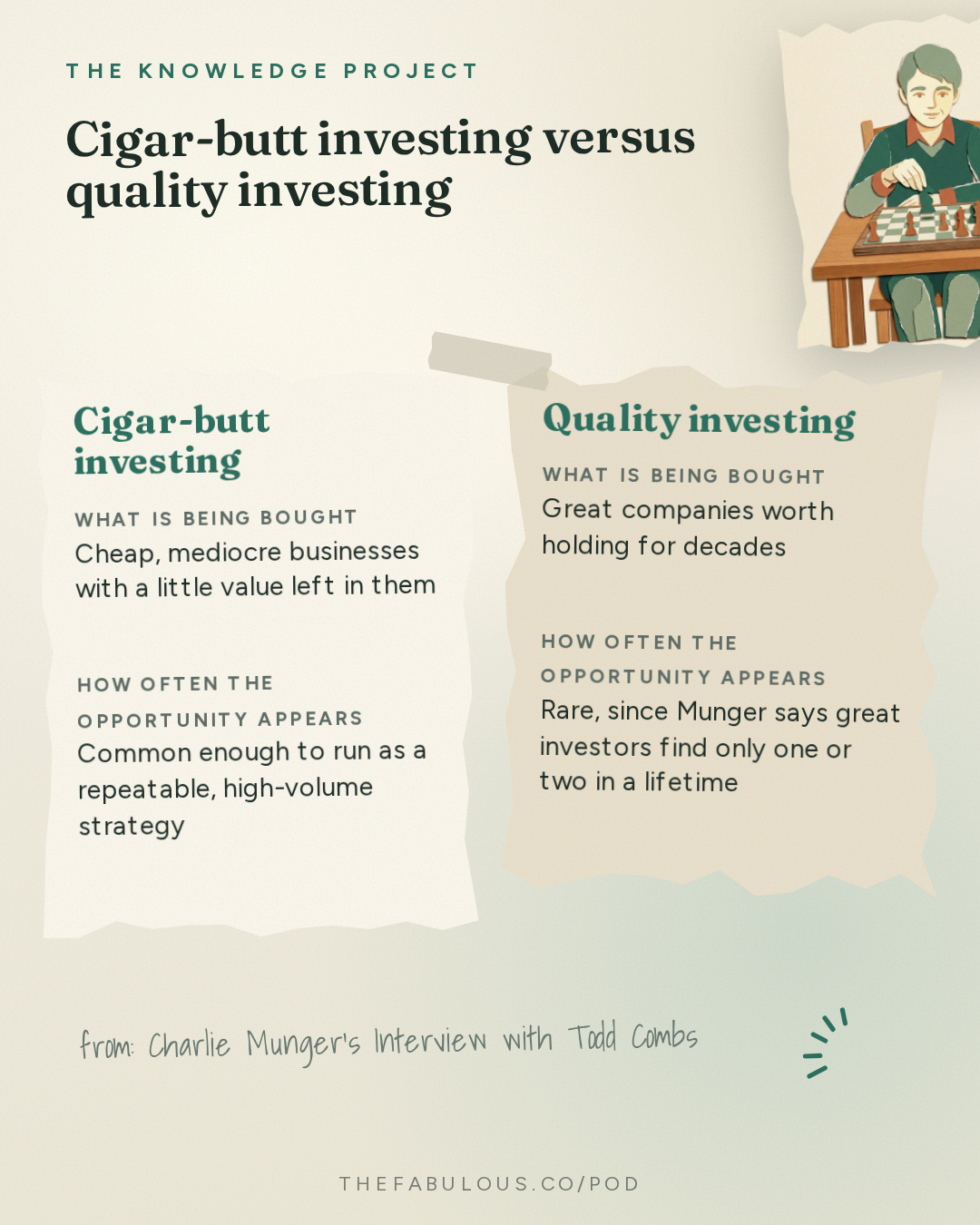
That same logic shaped how Munger thought about investing itself. Early in his career, he and Buffett bought what Munger calls cigar butts, cheap and mediocre businesses with one good puff of value left in them (09:22). Over time, both men shifted toward buying great businesses and holding them, which Munger calls the easiest and biggest money available, with a caveat: everyone eventually tries this, which bids up the price of anything that looks great, which makes the strategy far harder to execute than it sounds (09:48). The investors who do it well, Munger says, do not find ten or twenty exceptional businesses in a career. They find one or two (10:12). This is the same arithmetic behind Buffett's twenty-slot punch card idea, a thought experiment in which every investor gets only twenty lifetime investment decisions, forcing enormous selectivity.
Munger is less patient with the opposite instinct, the pull toward constant action that modern markets reward. He compares the gambling urge to heroin, a habit that a certain percentage of people cannot moderate once they start (10:56), and he describes computer-driven trading as capitalism's casino wing becoming more efficient at extracting money without producing anything of value (11:18). Booms and busts, he says, behave like autocatalysis in chemistry, a reaction that speeds itself up once it begins (12:03). Confidence breeds more buying, fear breeds more selling, and both directions feed themselves. The only defense against being swept into that cycle, Munger argues, is reason, applied patiently and without regard to what the crowd is doing at the moment.
Positioning Over Prediction
The idea that ties the whole conversation together is one Munger never names directly but circles constantly: positioning. The underappreciated secret of Berkshire Hathaway's success, Munger has said elsewhere, is that the firm was never forced by circumstance into a bad decision (14:10). Positioning is what makes that possible. It means arranging finances and holdings so that no external event, a market crash, a credit freeze, a forced sale, can dictate what happens next.
Cash is the clearest tool for this. Munger recalls the market crash of 1974 and 1975 as the worst crunch in fifty years, and Berkshire had money on hand when it hit (13:45). Singleton's insurance subsidiary at Teledyne entered that same crash holding bonds and cash rather than stocks, then deployed that cash to buy businesses at deep discounts once prices collapsed (15:15). Munger's own stock in Berkshire Hathaway has fallen 50 percent three separate times in his life, and each time the firm simply rode it out because it was never forced to sell (15:39). The lesson is not that crashes do not hurt. It is that preparation determines whether a crash is a catastrophe or an opportunity.
Rockefeller's history offers a longer version of the same idea. His fortune was built on kerosene for lighting, a market that Thomas Edison's electric light effectively destroyed. But Rockefeller's company already owned the oil fields, and when the automobile created a new and larger market for oil as gasoline, those same assets simply pivoted (16:09). Munger frames this as partly luck, since no one foresaw the automobile boom from inside the kerosene business, but the luck only mattered because the assets and the staying power were already there to catch it.
Few companies get that kind of second act. Munger is blunt that corporate mortality is the norm: almost every dominant company eventually dies or becomes irrelevant, and size offers no protection, as General Motors demonstrated when it collapsed and wiped out shareholders and pensions alike (17:21). General Electric is the example Munger takes most personally, because he knew its former chief executive Jack Welch directly. He describes Welch as likable and intelligent but so competitive that the drive to keep winning eventually led to misrepresenting the company's results (17:46). Munger recommends the book Lights Out, which documents GE's decline, as required reading in business schools, adding dryly that it will not become required reading because it would offend too many people (18:09).
This is where the fiduciary gene returns. Intelligence and ambition, on their own, are not a safeguard. They can just as easily produce a Jack Welch as a George Washington. What Munger and Buffett have tried to hire for, in his telling, is the combination of intelligence, energy, and integrity together, because the first two without the third eventually turn into a liability (18:35). A conversation that begins with a man in size 16 shoes ends, in effect, as a argument for humility: find the rare people who deserve trust, pick the problems that can actually be solved, and build a position sturdy enough that the world's panics and booms never get to choose for you.
Ask this episode anything
Pod's AI answers from the episode itself, with the minute mark so you can hear it yourself.
Or start with one of these
Ask this episode
Pod's AI listens to the whole episode to answer, and points you to the minute it comes from.
The rest of this answer, and any question after it
Answers come from the episode itself, never from a summary of it.
ContinueKey takeaways
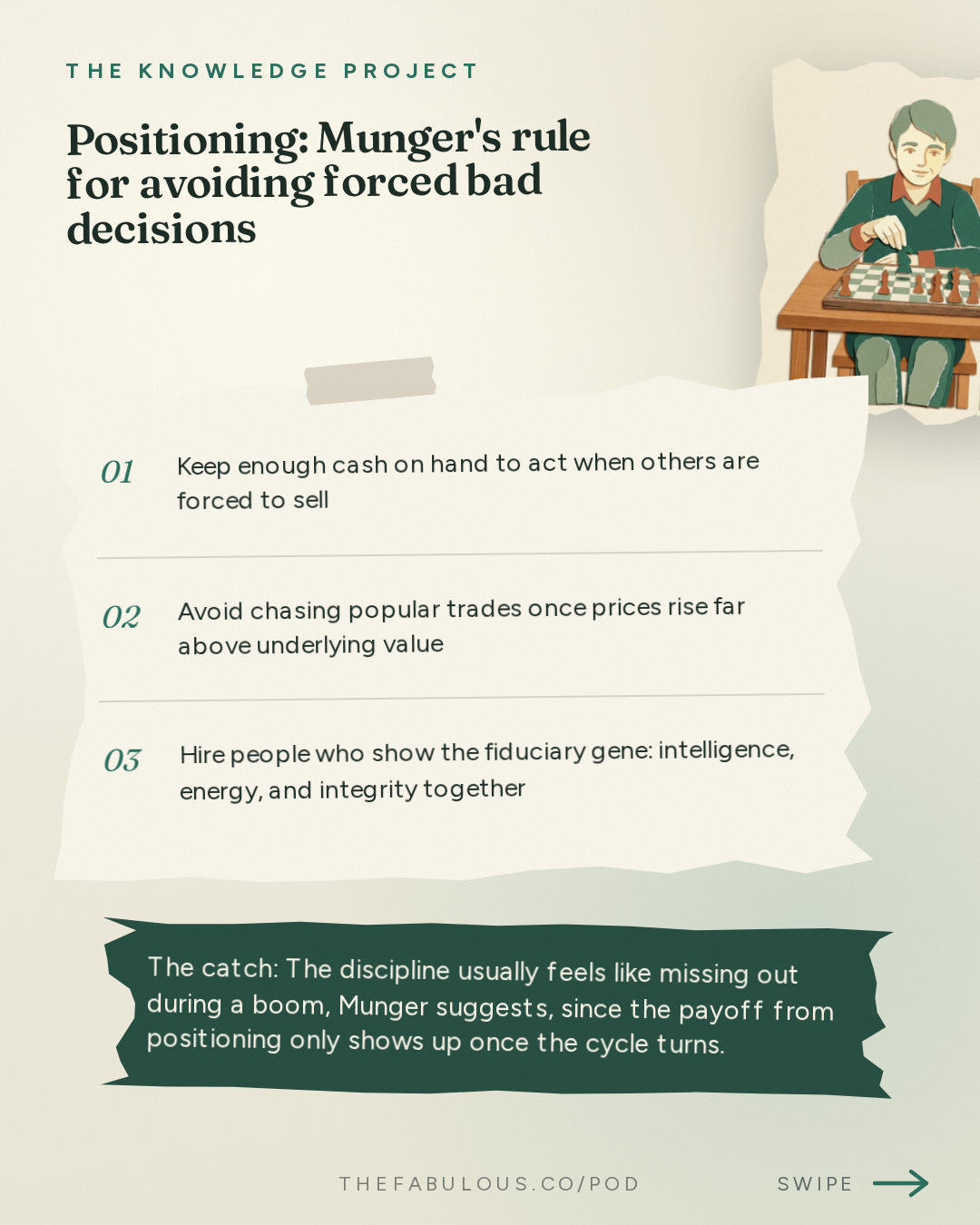
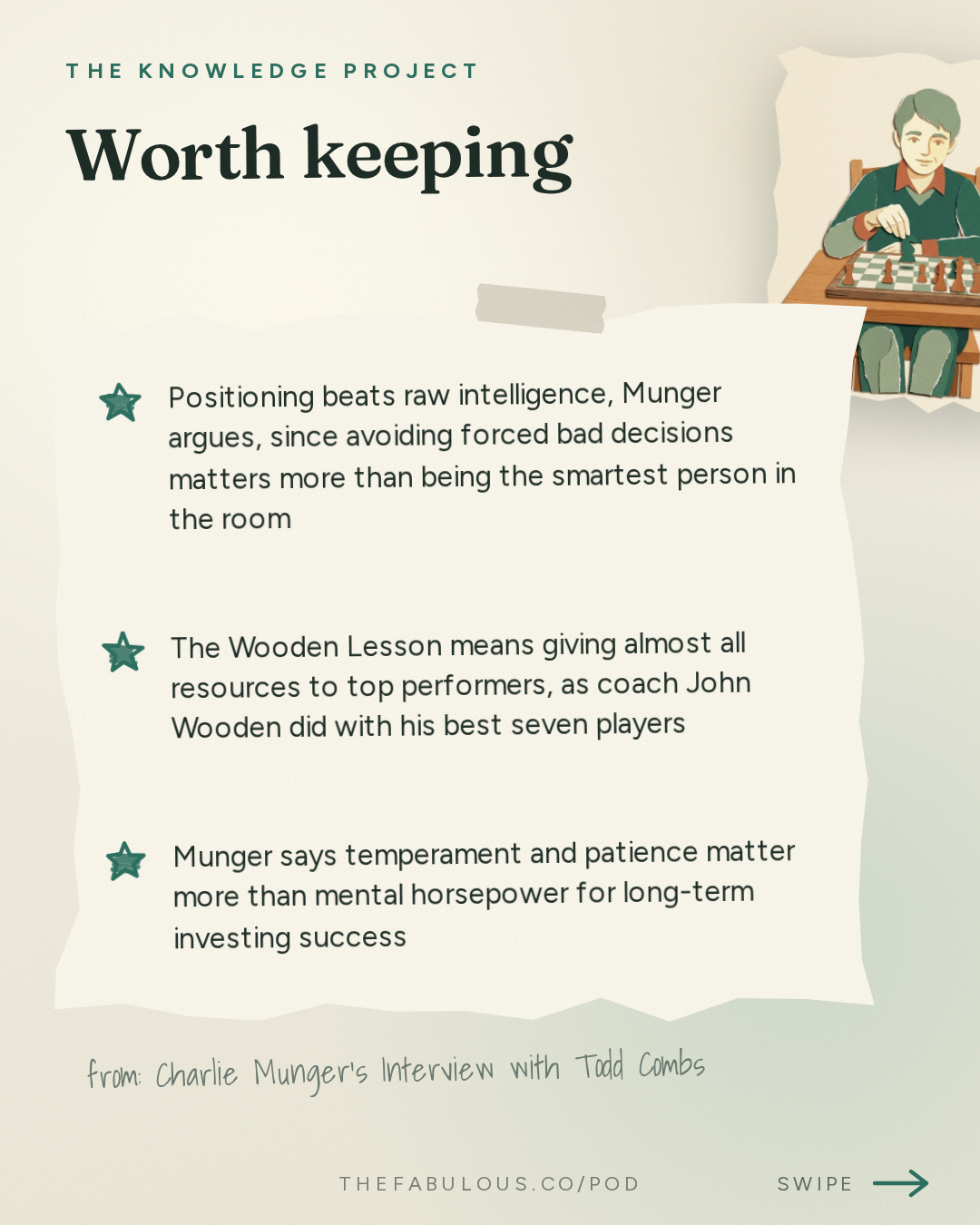
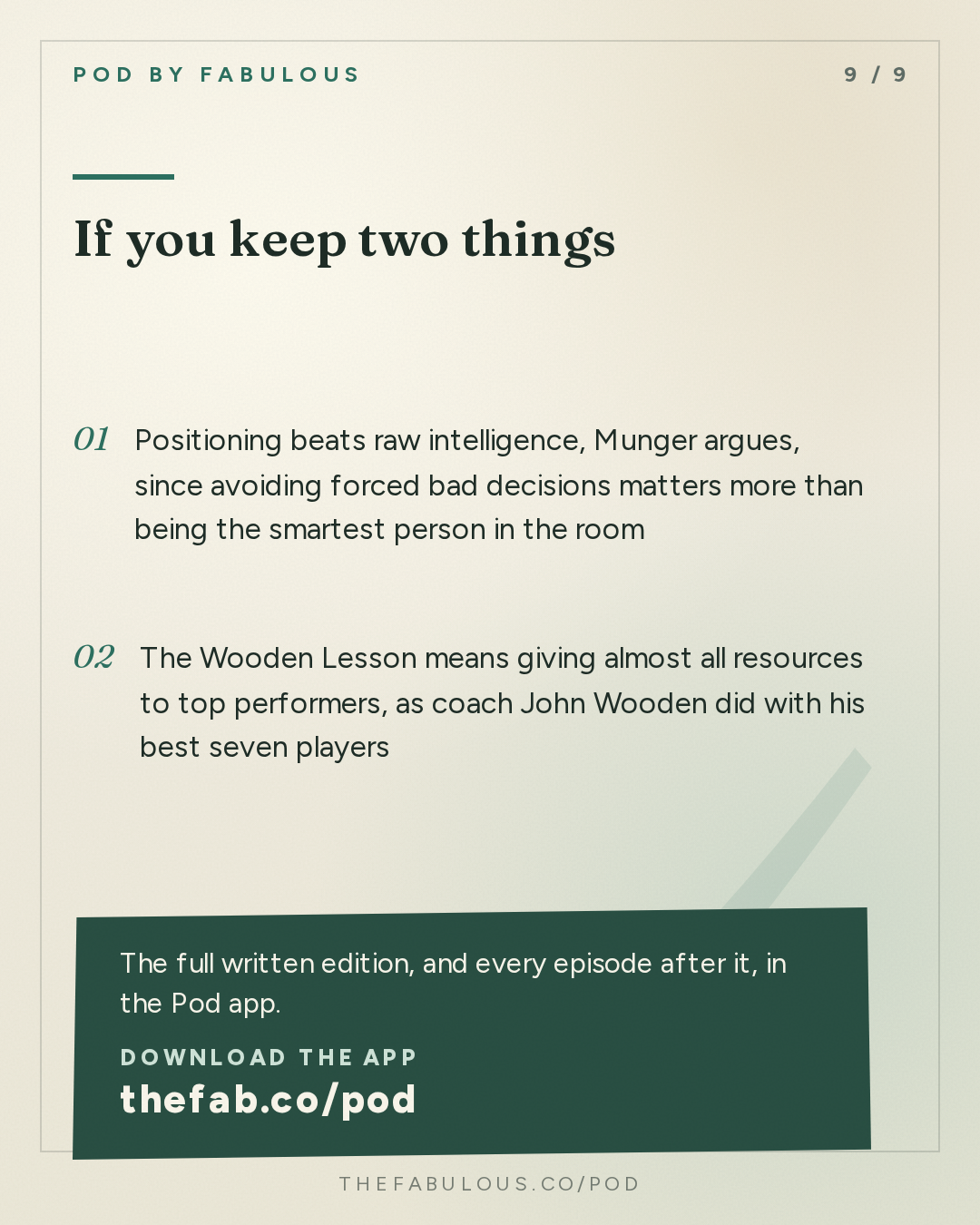
- Positioning beats raw intelligence, Munger argues, since avoiding forced bad decisions matters more than being the smartest person in the room
- The Wooden Lesson means giving almost all resources to top performers, as coach John Wooden did with his best seven players
- Munger says temperament and patience matter more than mental horsepower for long-term investing success
- The fiduciary gene describes leaders who give up power voluntarily, like George Washington, rather than cling to it
- Corporate mortality is high, Munger says, since even giants like General Electric and General Motors eventually decline or vanish
The episode in cards
By the numbers
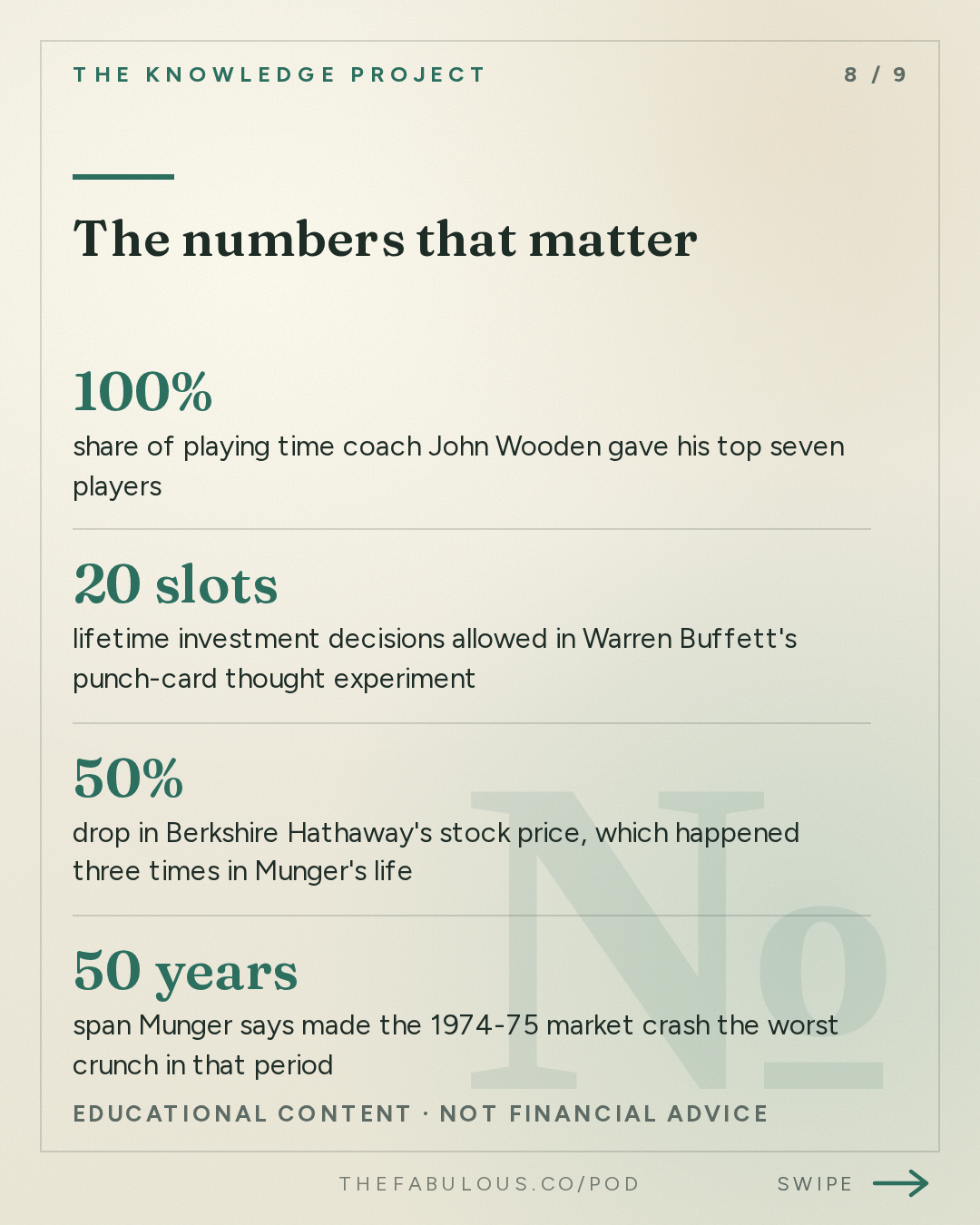
- 100% percent share of playing time coach John Wooden gave his top seven players
- 20 slots lifetime investment decisions allowed in Warren Buffett's punch-card thought experiment
- 50% percent drop in Berkshire Hathaway's stock price, which happened three times in Munger's life
- 50 years span Munger says made the 1974-75 market crash the worst crunch in that period
In their words
“What I am is a guy who has been able to take moderate obsession and a long attention span and turn them into pretty good results.”
“I just stay away from the problems that can't be fixed and pick the ones that can. I don't like unlimited failure.”
“It's the sowing when you're almost sure of the wind is almost funner than the reaping.”
“I almost worship reason.”
“"GE is one of the worst cases at all because I knew Jack Welch. He was likable, and he was intelligent, but he went a little crazy trying to do well in the system”
Protocols
-
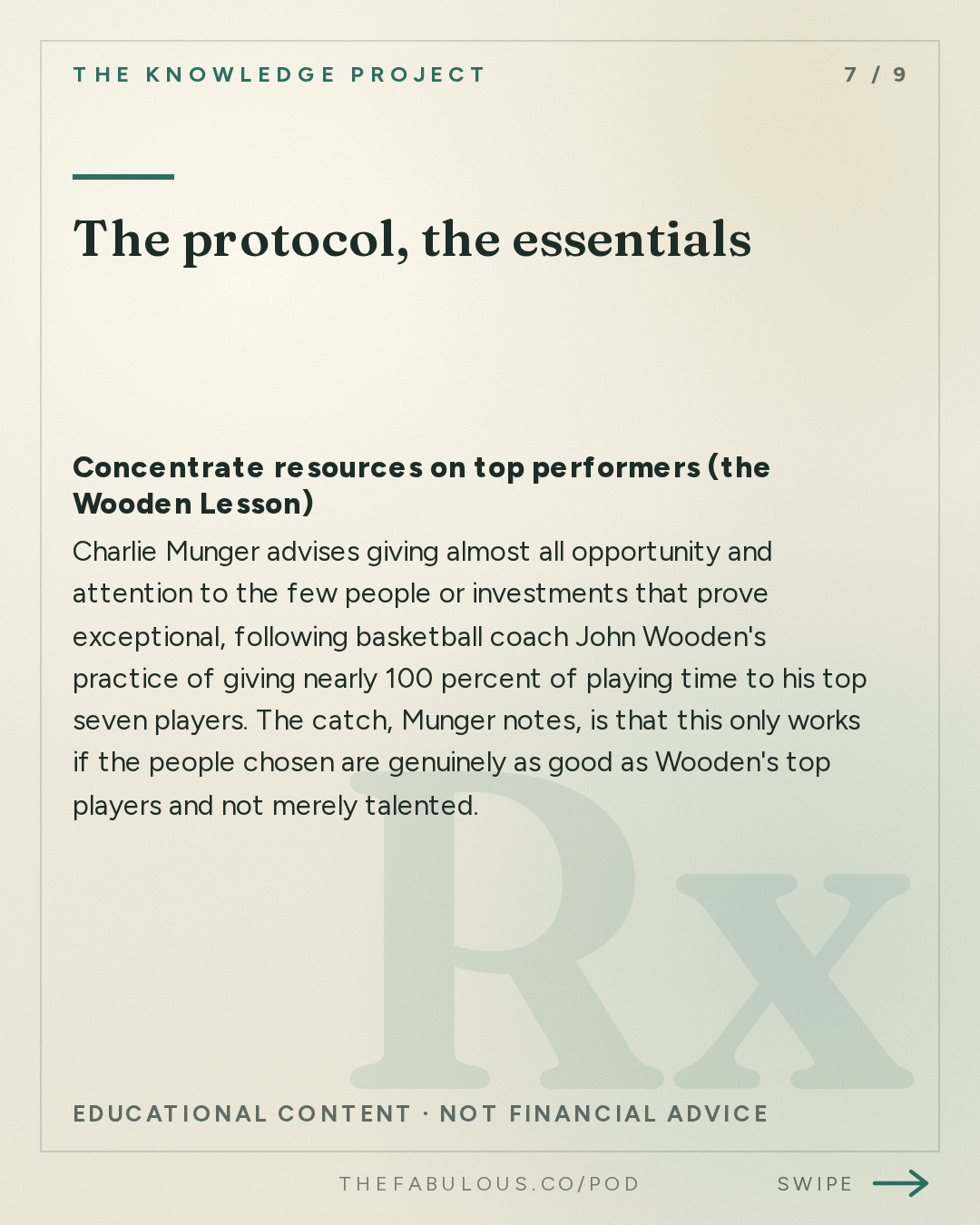
Concentrate resources on top performers (the Wooden Lesson)
Charlie Munger advises giving almost all opportunity and attention to the few people or investments that prove exceptional, following basketball coach John Wooden's practice of giving nearly 100 percent of playing time to his top seven players. The catch, Munger notes, is that this only works if the people chosen are genuinely as good as Wooden's top players and not merely talented.
Applied whenever a standout performer or opportunity emerges
-
Avoid problems that cannot be fixed
Charlie Munger says to stay away from problems with unlimited downside and instead pick ones that can actually be solved, since moderate obsession paired with a long attention span only pays off when effort can lead to an answer. The catch is that avoiding unsolvable problems requires the discipline to walk away before sunk cost pulls someone in further.
An ongoing filter for choosing which problems to work on
-
Hold cash to maintain positioning
Charlie Munger recommends keeping enough cash on hand to avoid being forced into bad decisions by external circumstances, which is what let Berkshire Hathaway and Henry Singleton's Teledyne buy businesses cheaply during the 1974-75 crash while other investors were forced to sell. The catch is that holding cash feels unproductive during a boom and only pays off once the cycle turns.
Maintained continuously, not only during downturns
-
Hire for the fiduciary gene
Charlie Munger says to hire people who combine intelligence, energy, and integrity, a trait he calls the fiduciary gene, modeled on leaders like George Washington who voluntarily gave up power. The catch is that intelligence and ambition without integrity can turn into a liability once winning matters more than telling the truth, which Munger says happened at General Electric under Jack Welch.
Applied at every hiring and leadership decision
Questions this episode answers
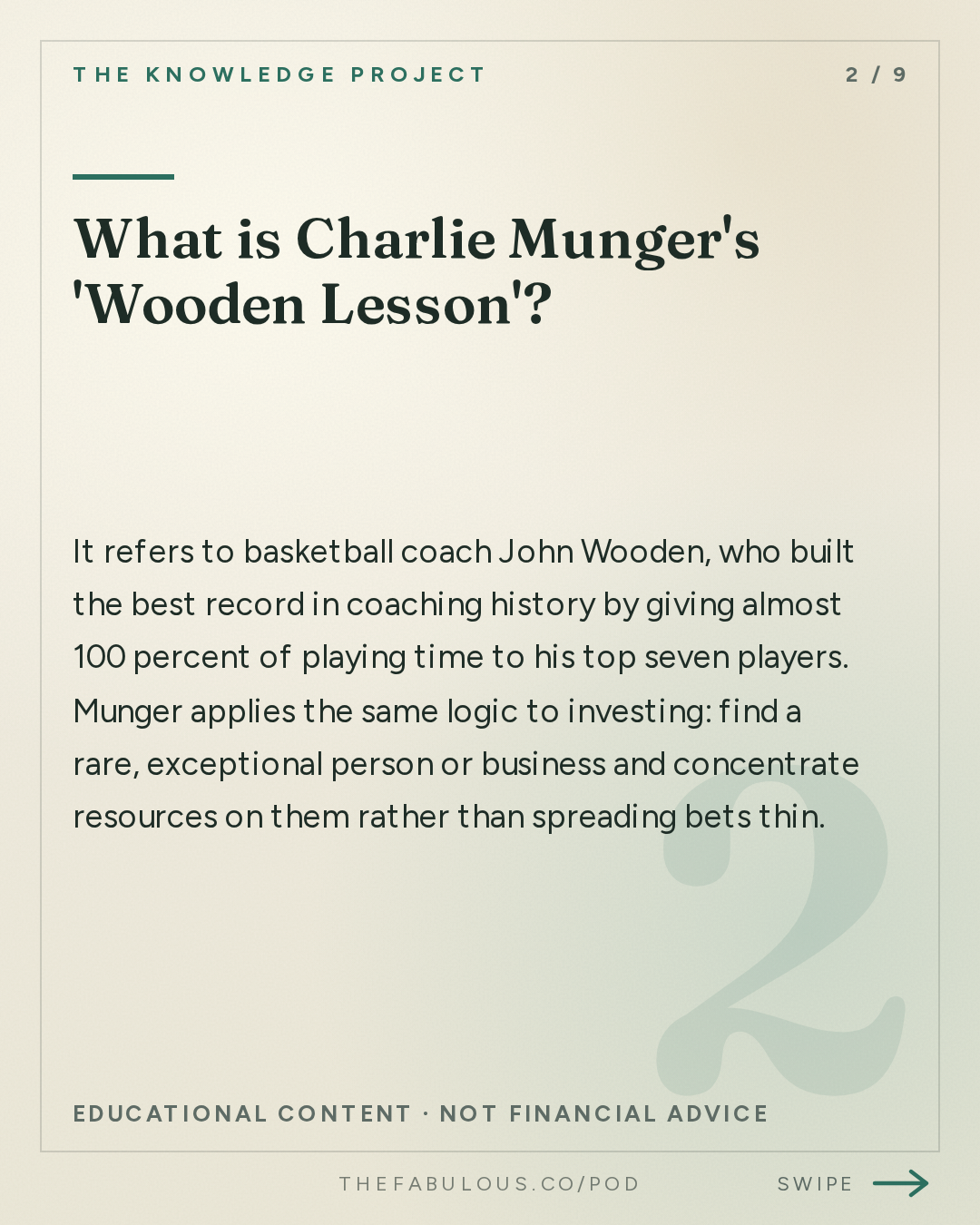
What is Charlie Munger's 'Wooden Lesson'?
It refers to basketball coach John Wooden, who built the best record in coaching history by giving almost 100 percent of playing time to his top seven players (04:07). Munger applies the same logic to investing: find a rare, exceptional person or business and concentrate resources on them rather than spreading bets thin.
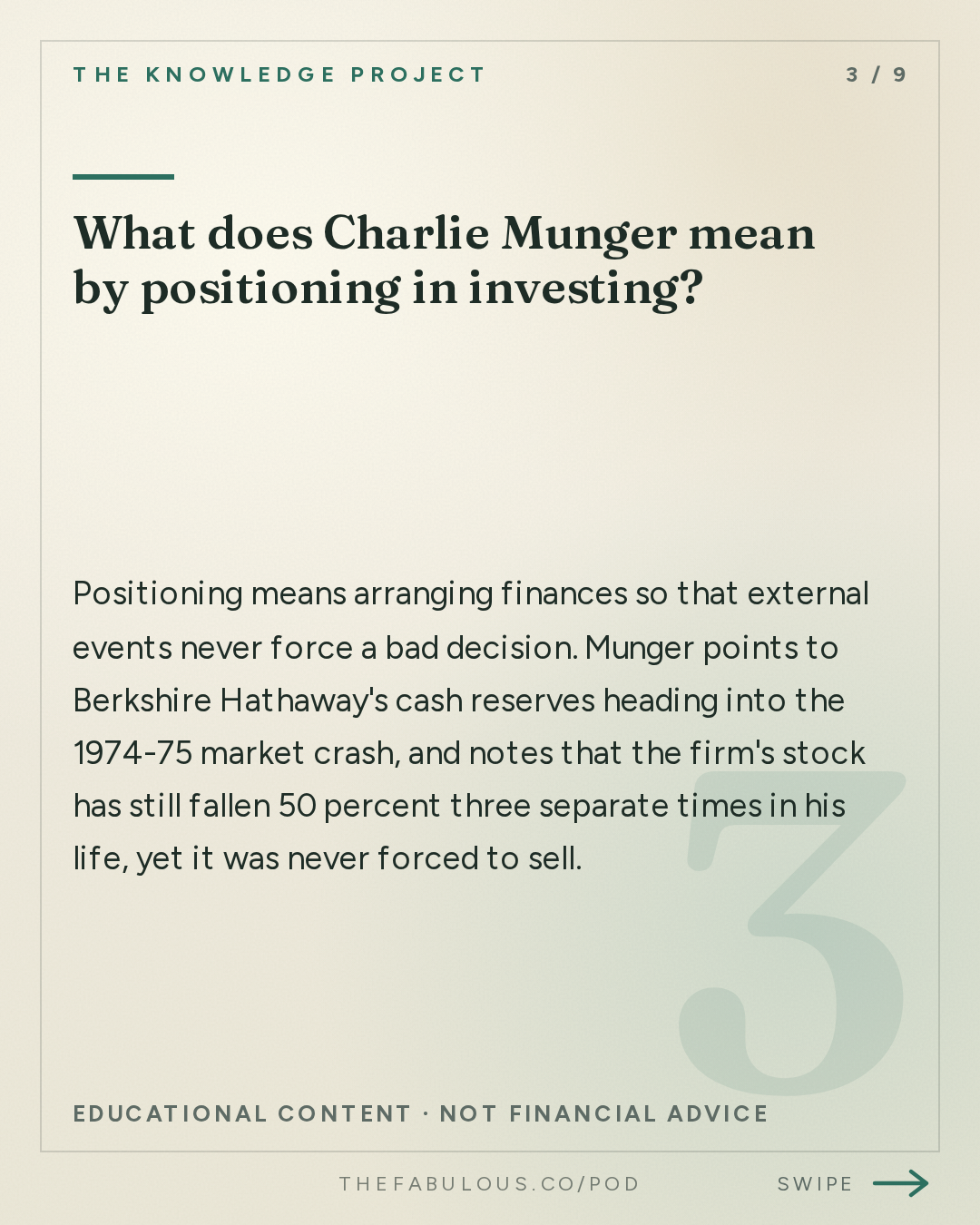
What does Charlie Munger mean by positioning in investing?
Positioning means arranging finances so that external events never force a bad decision (14:31). Munger points to Berkshire Hathaway's cash reserves heading into the 1974-75 market crash, and notes that the firm's stock has still fallen 50 percent three separate times in his life, yet it was never forced to sell (15:39).
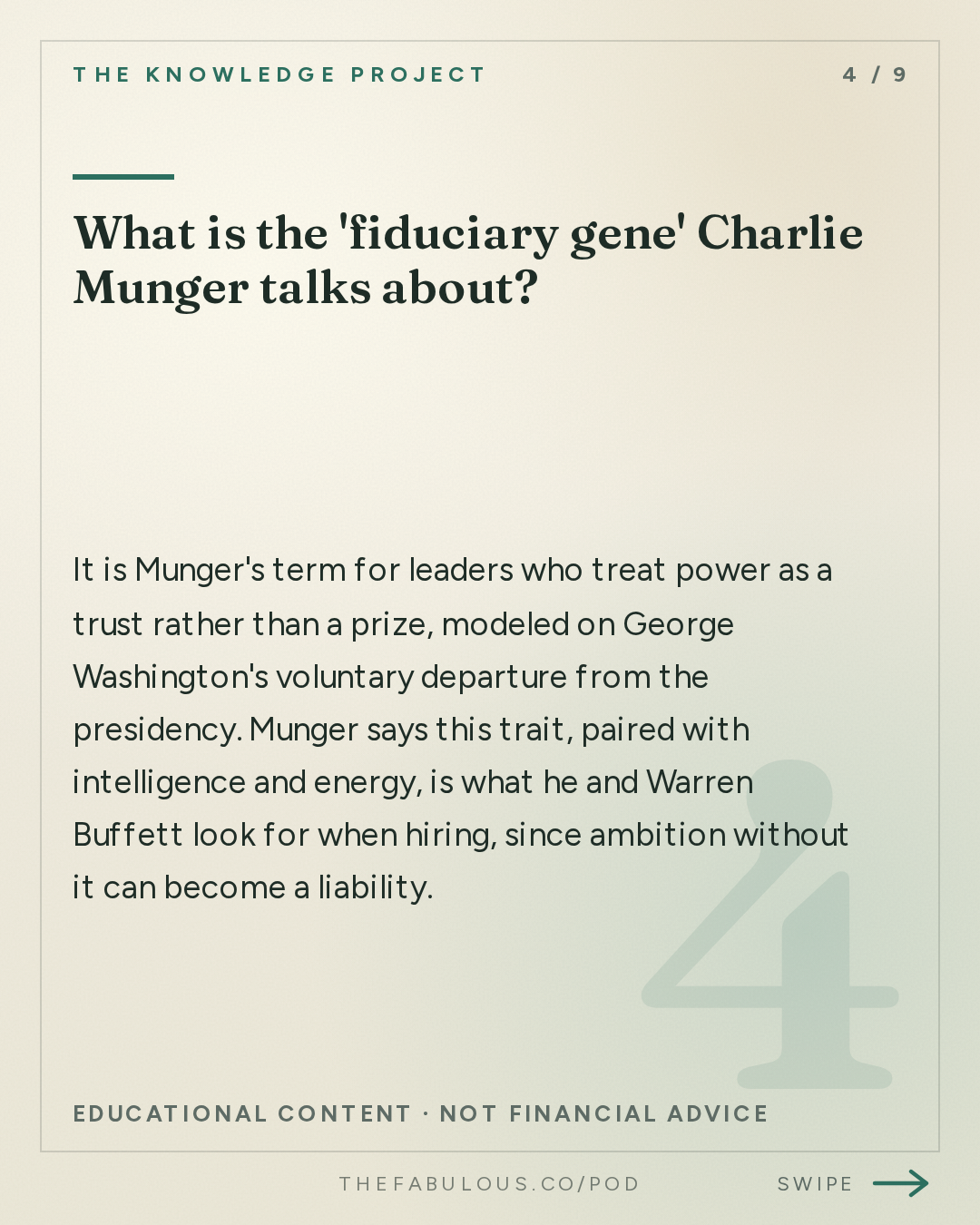
What is the 'fiduciary gene' Charlie Munger talks about?
It is Munger's term for leaders who treat power as a trust rather than a prize, modeled on George Washington's voluntary departure from the presidency (04:52). Munger says this trait, paired with intelligence and energy, is what he and Warren Buffett look for when hiring, since ambition without it can become a liability (18:35).
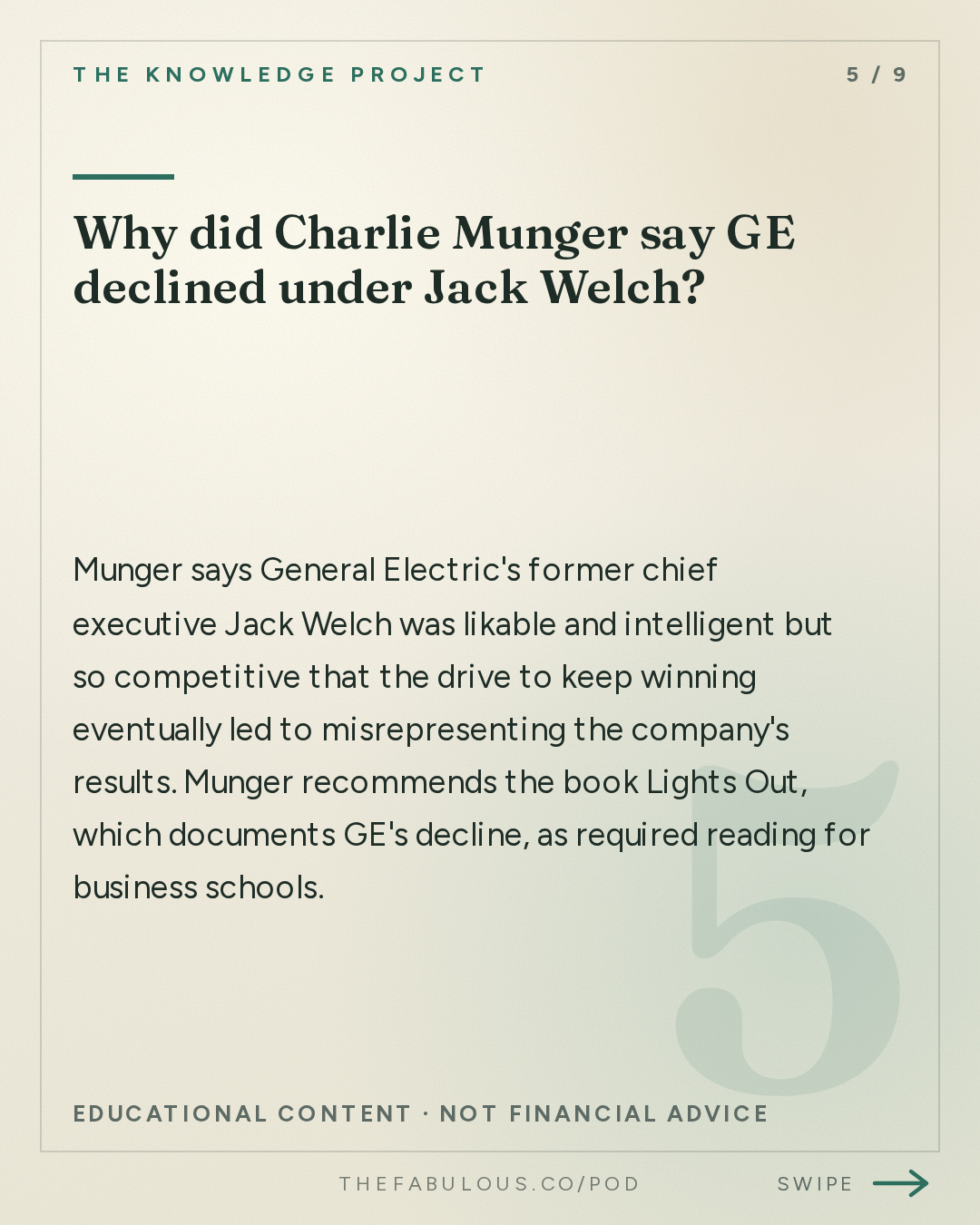
Why did Charlie Munger say GE declined under Jack Welch?
Munger says General Electric's former chief executive Jack Welch was likable and intelligent but so competitive that the drive to keep winning eventually led to misrepresenting the company's results (17:46). Munger recommends the book Lights Out, which documents GE's decline, as required reading for business schools (18:09).
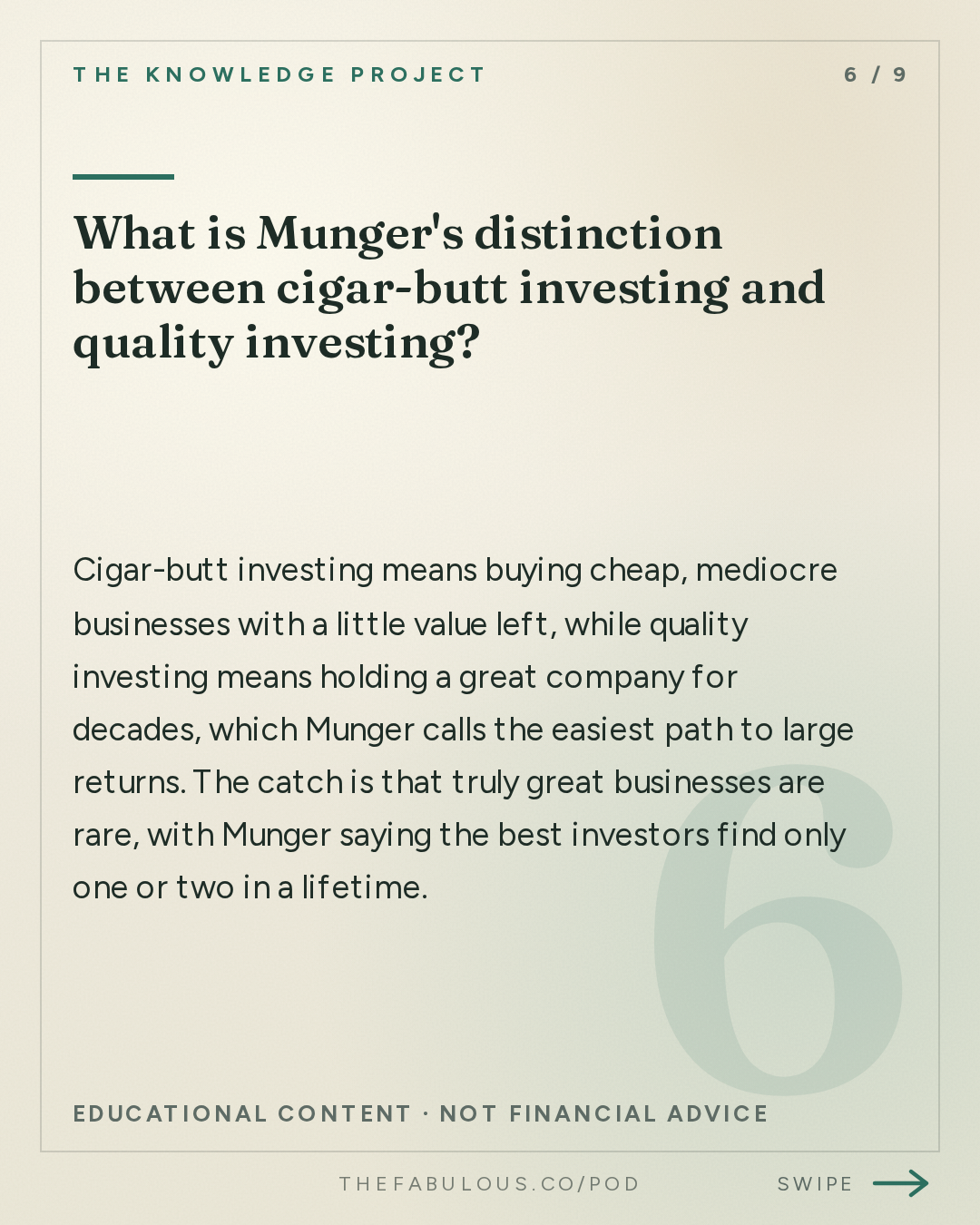
What is Munger's distinction between cigar-butt investing and quality investing?
Cigar-butt investing means buying cheap, mediocre businesses with a little value left, while quality investing means holding a great company for decades, which Munger calls the easiest path to large returns (09:22). The catch is that truly great businesses are rare, with Munger saying the best investors find only one or two in a lifetime (10:12).
The full read, in cards
Go deeper
- Lights Out — chronicles General Electric's decline under chief executive Jack Welch
Mentioned
Charlie Munger · Todd Combs · Henry Singleton · John Wooden · Warren Buffett · Jack Welch · John D. Rockefeller · George Washington · Tom Murphy · Berkshire Hathaway · General Electric · Teledyne · General Motors · Singleton Foundation
More from this show and category

Bill Ackman on Lucy's Recovery and the Brain Institute
Bill Ackman recounts his daughter Lucy's brain hemorrhage and the brain rehabilitation institute he built in response. He also details Pershing Square's investment checklist, its move away from short selling, and the plan to turn Howard Hughes into an insurance-driven holding company modeled on Berkshire Hathaway.

Tobi Lütke: How Shopify Runs on AI Agents
Shopify CEO Tobi Lütke says AI agents like River now draft up to half the company's pull requests. But he argues machines can never take responsibility, so taste, judgment, and disciplined pruning, not raw AI output, still decide what actually gets built.
Roblox CEO's Decision-Making Framework
Roblox CEO David Baszucki says his son's bipolar disorder eased within weeks of starting a ketogenic diet, after five medications and repeated hospitalizations failed. He ties his own metabolic state, tracked with a continuous glucose monitor, to decision quality, and describes destroying bureaucracy, shipping unfinished products for real feedback, and holding Robux near one cent for twenty years.

Steve Jobs' Wilderness Years: NeXT and Pixar
Steve Jobs spent twelve years outside Apple, from 1985 to 1997, nearly going bankrupt at NeXT before learning to delegate and compromise. NeXT's software, built on object-oriented programming, became the base for the iPhone, while Pixar taught him to step back, and Bill Gates' $150 million rescued Apple when Jobs finally returned.
