
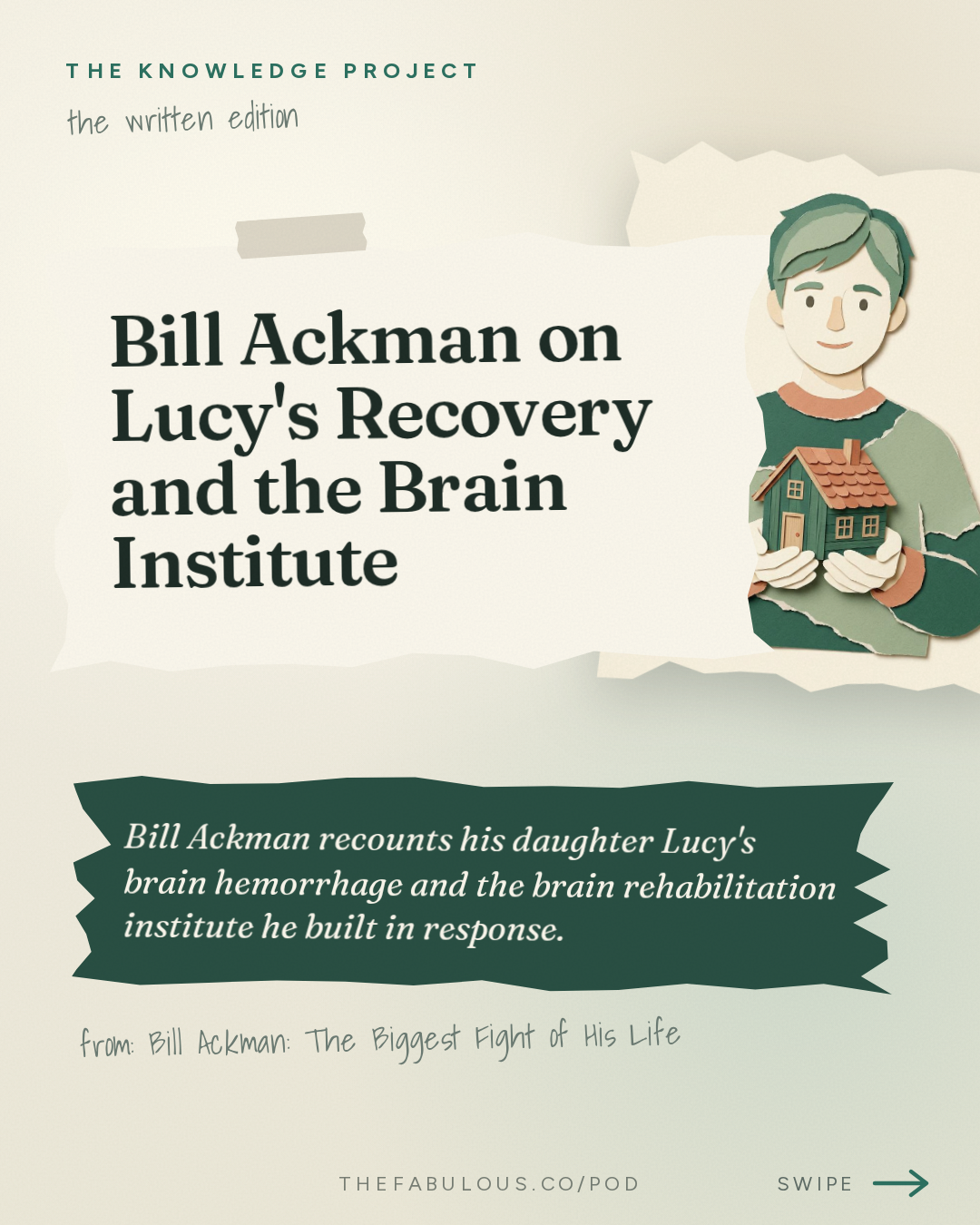
Bill Ackman on Lucy's Recovery and the Brain Institute
Bill Ackman: The Biggest Fight of His Life
▶ Listen to the full episode More from The Knowledge Project
The brief
Bill Ackman recounts his daughter Lucy's brain hemorrhage and the brain rehabilitation institute he built in response. He also details Pershing Square's investment checklist, its move away from short selling, and the plan to turn Howard Hughes into an insurance-driven holding company modeled on Berkshire Hathaway.
An Oura ring caught the spike before anyone else did. Around nine in the morning, the pulse of a healthy twenty-something jumped, then fell off in a pattern that should have told someone something was wrong. Instead it sat unread for hours. That gap, the space between a device noticing a crisis and a family learning about it, is where Bill Ackman's story starts, and it is also, in a roundabout way, where his theory of investing starts too.
The ring belonged to Lucy Ackman, Bill Ackman's daughter. She had an arteriovenous malformation, a tangle of blood vessels where an artery connects straight to a vein instead of slowing down through capillaries first. Under too much pressure, one of those veins burst, filling her brain with blood inside a skull that cannot expand. Ackman describes it plainly: the pressure has nowhere to go but down, onto the midbrain, which controls breathing and heartbeat (00:37). She was found face down on her apartment floor by her older sister, barely breathing, roughly fifteen hours after the bleed began (01:42). Surgeons removed about forty percent of her skull to let the swelling brain expand outward instead of crushing inward (03:05). Ackman later learned that doctors typically assume brain death after five hours of sustained pressure. Lucy had gone nearly four times that long (04:23).
She survived, and by the time of this conversation she had regained her cognition and her sense of humor, though her walking, speech, and vision were still returning in pieces (04:23). Ackman calls what followed his own theory of adversity.
The what does not kill you makes you stronger thing is, is definitely true. (09:32)
That is not a throwaway line. It is close to how he explains his own career, and it is the hinge this whole episode turns on: a catastrophe in one part of his life reorganizing how he thinks about risk, teams, and time everywhere else.
A Father's Crisis Becomes an Institute
Within three months of Lucy's collapse, Ackman and his wife, architect Neri Oxman, had bought a vacant biotechnology building ten blocks from his office and begun turning it into what they call the Ackman Oxman Institute, on a 3.4-acre site (06:02). The motivation was not abstract philanthropy. It came out of a specific, repeated conversation with doctors about how badly the American system treats brain injury once the emergency phase ends. The head of rehabilitation at Massachusetts General Hospital told Ackman that most patients who suffer what Lucy suffered never get surgery at all, and those who do often end up in a nursing home and die of pneumonia within months, because the level of home and family care Lucy received is simply unaffordable for most families (13:23). Insurance, Ackman says, typically covers only about six weeks of rehabilitation, after which patients go home to environments that are not built for recovery (12:42). A single hour with a top speech therapist can cost 500 dollars, a fee insurance will only subsidize briefly (14:01).
Ackman's answer is to treat recovery itself as a design problem, the way he would underwrite a business. He talks about wearable cameras that could restore a form of vision by feeding images directly to the visual cortex, and cites Elon Musk's estimate that Neuralink-adjacent technology could deliver bionic vision within five years (07:12). He wants the institute to fold nutrition into recovery too, pointing out that hospitals serve pancakes and syrup to cardiac patients the morning after a heart attack (14:40). None of this is proven science yet. It is a wealthy, motivated father applying an investor's instinct, throw resources at the highest-leverage problem, to a system he considers structurally under-resourced.
The Discipline Behind the Money
The same instinct for structure shows up when Ackman describes how Pershing Square, his investment firm, actually runs. The investment team has been stable for nine years (18:11), which he treats as a competitive advantage in an industry with constant turnover: when people stay together that long, he says, he stops needing to second-guess whether they are telling him the full truth about a deal's risks (18:11). He owns about 45 percent of the management company himself, with the rest split between employees and public investors (20:54), an alignment structure he credits for the firm's low drama.
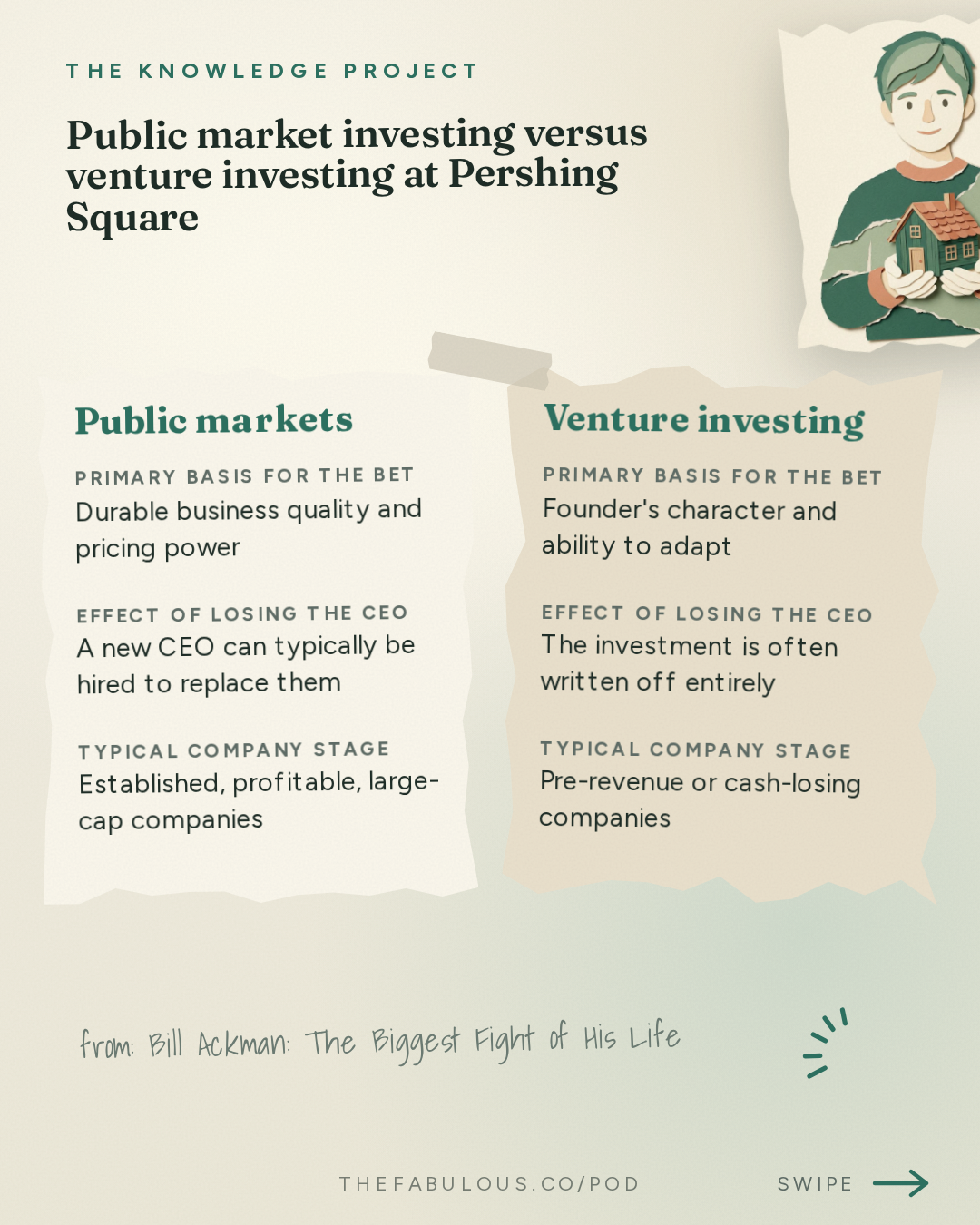
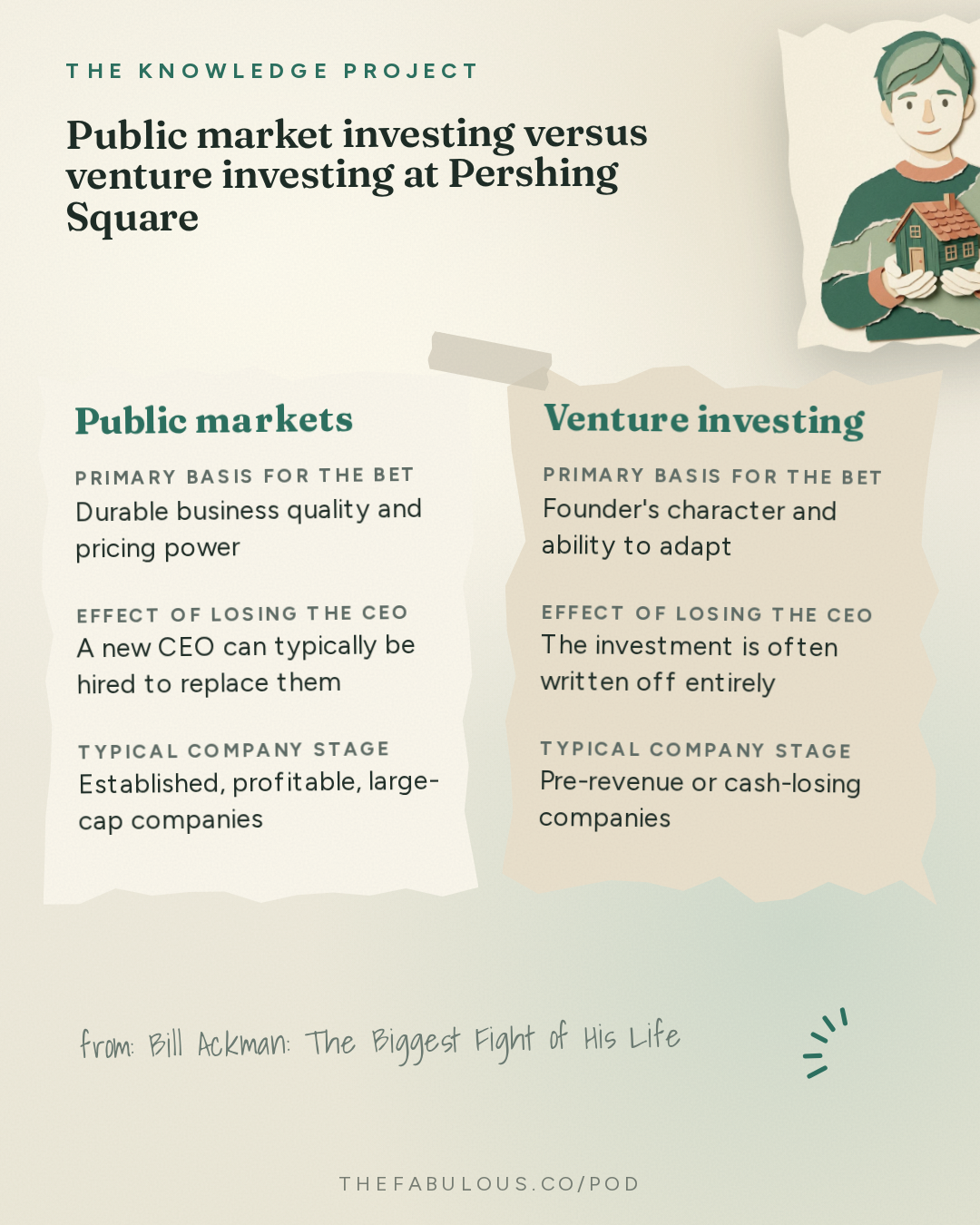
Ackman draws a sharp line between how he invests in public markets and how he invests in venture capital. In public markets, Pershing Square looks for what he calls super durable businesses, profitable, dominant, hard to disrupt, on the theory that if the CEO fails, a better one can be hired. Venture is different.
In venture, you're really betting on the person and more than the business plan. (28:37)
His favorite example is Coupang, an early bet on founder Bom Kim, whose original pitch, a Korean clone of Groupon, Ackman actually disliked. Kim ended up building something closer to the Amazon of South Korea instead (29:22). The lesson he draws is that founders who can absorb a wrong idea and pivot are worth more than the idea itself (29:01).
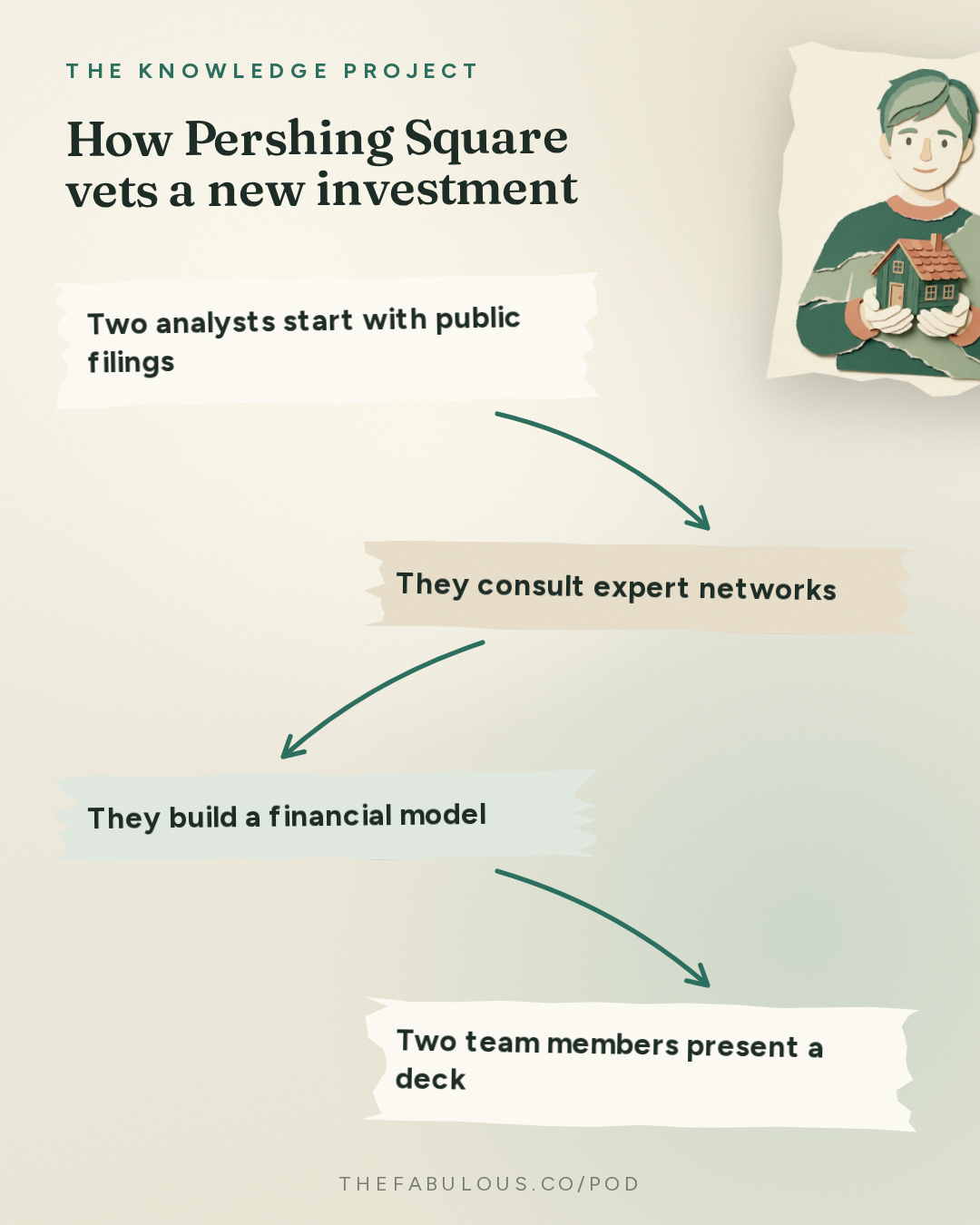
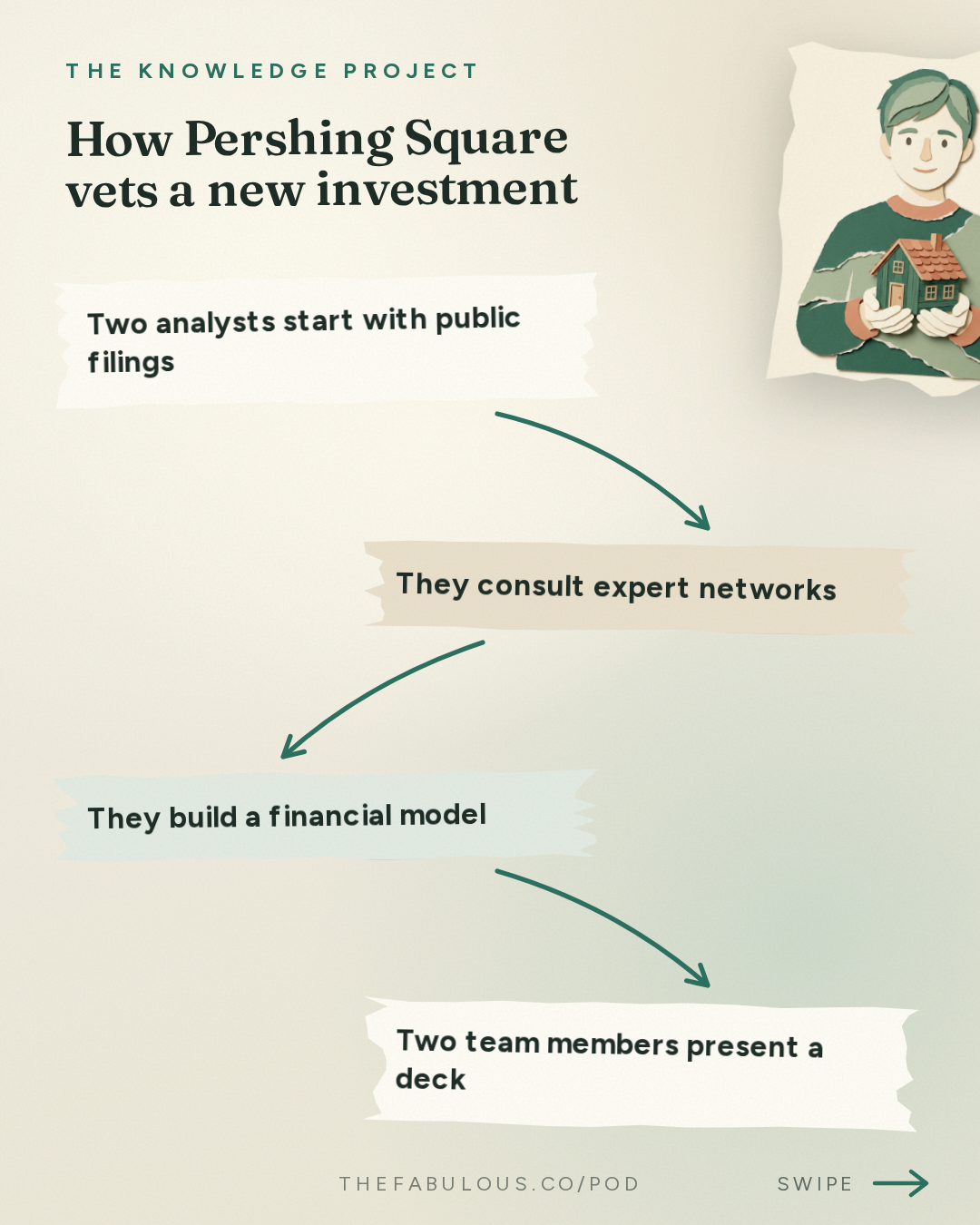
The firm's aversion to short selling comes from the same logic in reverse. A short position can lose an unlimited amount while the maximum gain is capped at 100 percent, an asymmetry Ackman calls a bad trade on its face (40:15). After a costly short campaign against a company he calls a fraudulent pyramid scheme, which drew hedge funds who squeezed his position rather than engaging with his thesis, Pershing Square wrote its investment principles down and, in Ackman's words, engraved them on a stone tablet: simple, predictable, cash-generative businesses, run by strong management, sized to large, liquid public companies, with an explicit aversion to shorting (39:11).
The largest structural bet in the portfolio right now is Howard Hughes, a real estate company Pershing Square spun out of a bankruptcy restructuring more than a decade ago. Pershing Square now owns 47 percent of it (57:34) and is converting it, deliberately, into what Ackman calls a modern-day Berkshire Hathaway: an insurance holding company where premiums collected up front (float) are invested for long-term compounding, the way Warren Buffett built Berkshire. Ackman argues that combining insurance float with underwriting profit, what he calls negative-cost liabilities, can produce a 20 percent or higher annual return over time (59:14). The real estate business, which includes master-planned communities in Texas, Nevada, and Hawaii, will keep generating cash (including 4 billion dollars of Hawaii condominiums currently under contract) that gets redirected into the insurance operation rather than reinvested in more land (59:57).
What ties the Lucy story to the Howard Hughes story is not sentiment, it is method. Ackman treats both as long-horizon capital allocation problems: identify where the system underinvests, secure enough control to act without being second-guessed, and let time and compounding do the rest. Asked what success means to him, having just turned sixty, he starts with the returns he wants for Pershing Square investors, then turns to something larger.
I wanna have the greatest beneficent impact on the largest number of people. (76:53)
It is a large claim from a man whose public reputation was built on short campaigns and Twitter fights. But listening to him describe a hospital hallway turned into a trading floor, two IPOs run from a room on the eleventh floor of Mount Sinai while his daughter recovered down the hall, it is hard not to take the claim as sincere, even if its scale is still unproven.
Ask this episode anything
Pod's AI answers from the episode itself, with the minute mark so you can hear it yourself.
Or start with one of these
Ask this episode
Pod's AI listens to the whole episode to answer, and points you to the minute it comes from.
The rest of this answer, and any question after it
Answers come from the episode itself, never from a summary of it.
ContinueKey takeaways
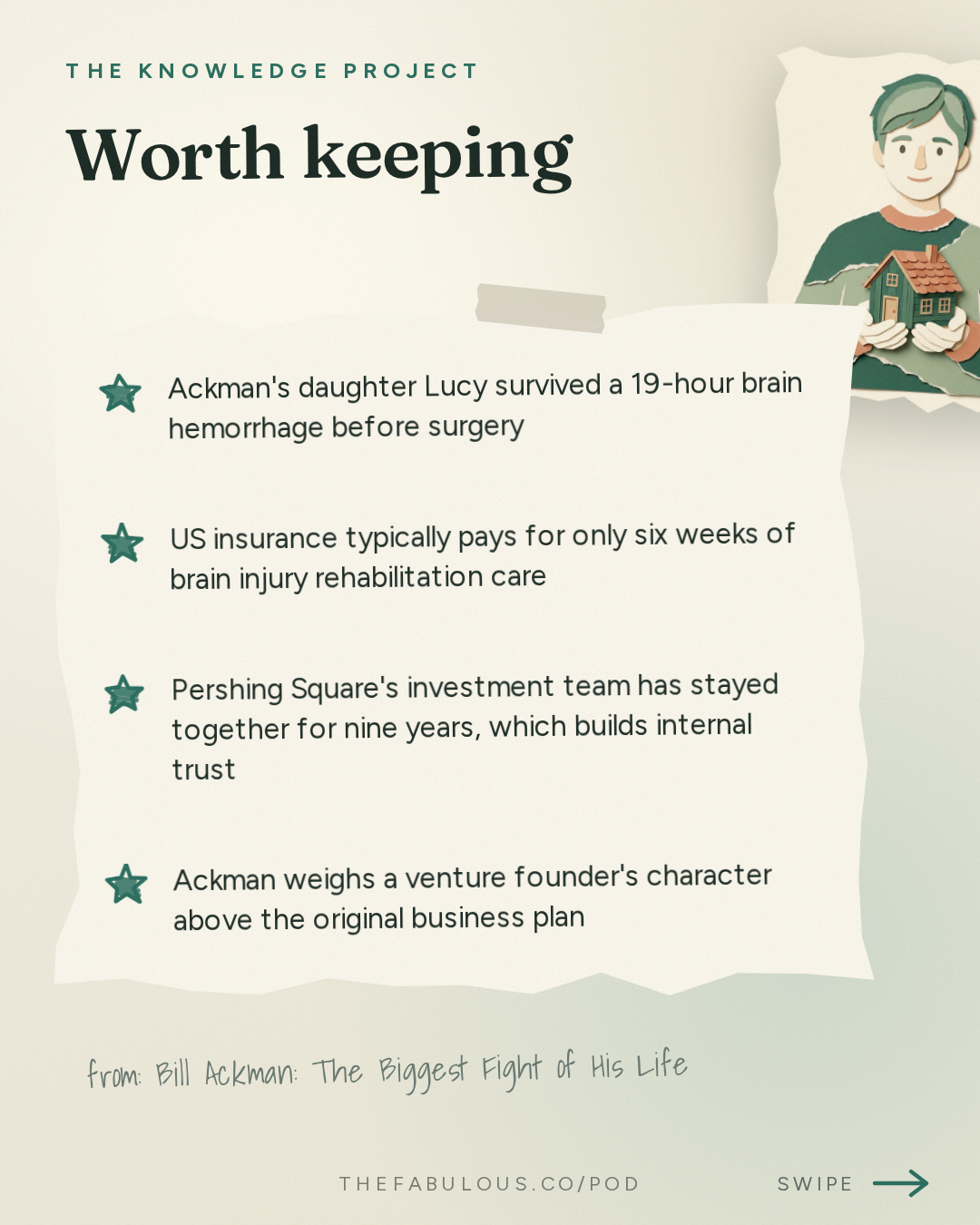
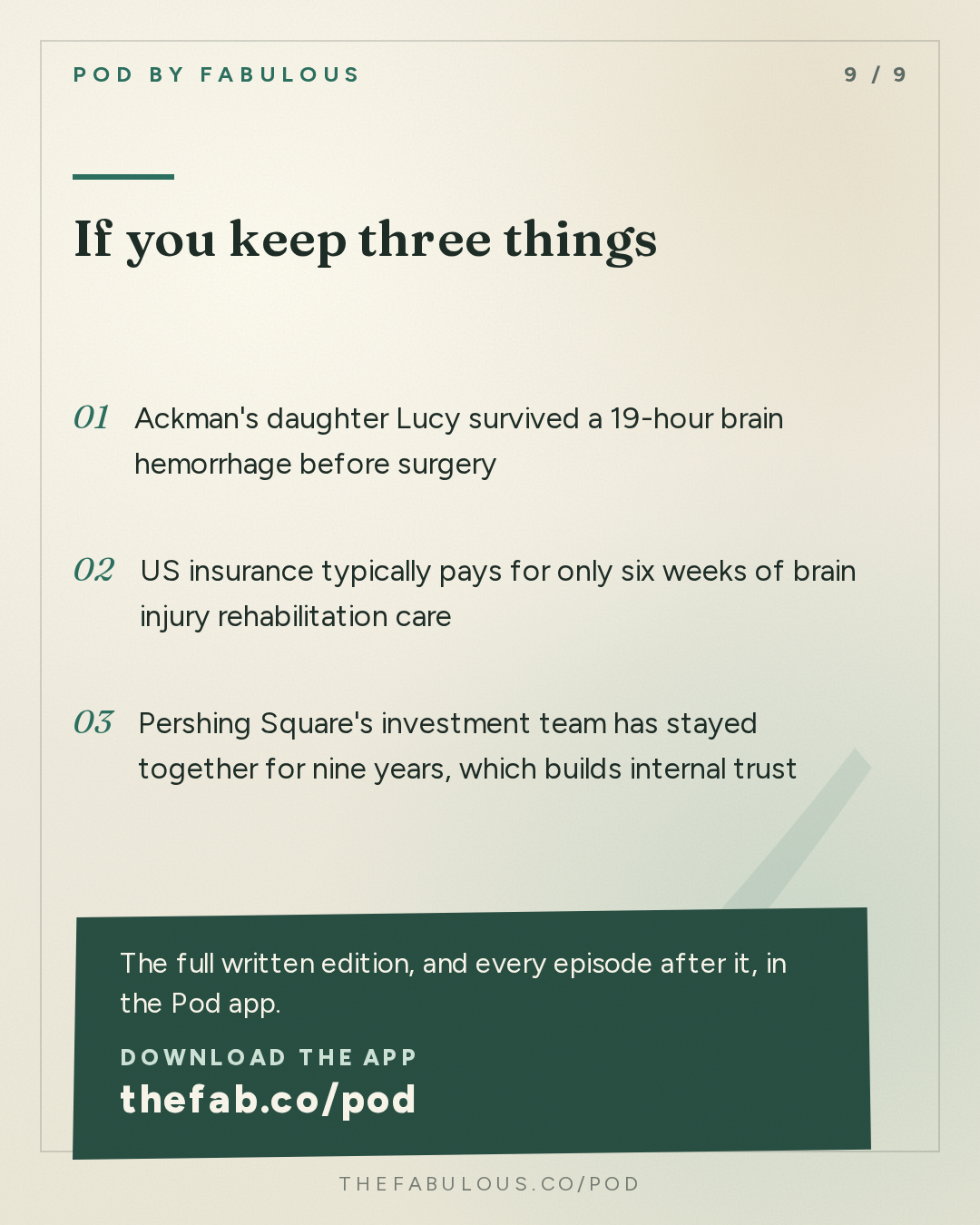
- Ackman's daughter Lucy survived a 19-hour brain hemorrhage before surgery
- US insurance typically pays for only six weeks of brain injury rehabilitation care
- Pershing Square's investment team has stayed together for nine years, which builds internal trust
- Ackman weighs a venture founder's character above the original business plan
- Howard Hughes, 47 percent owned by Pershing Square, is being rebuilt as an insurance holding company
The episode in cards
By the numbers
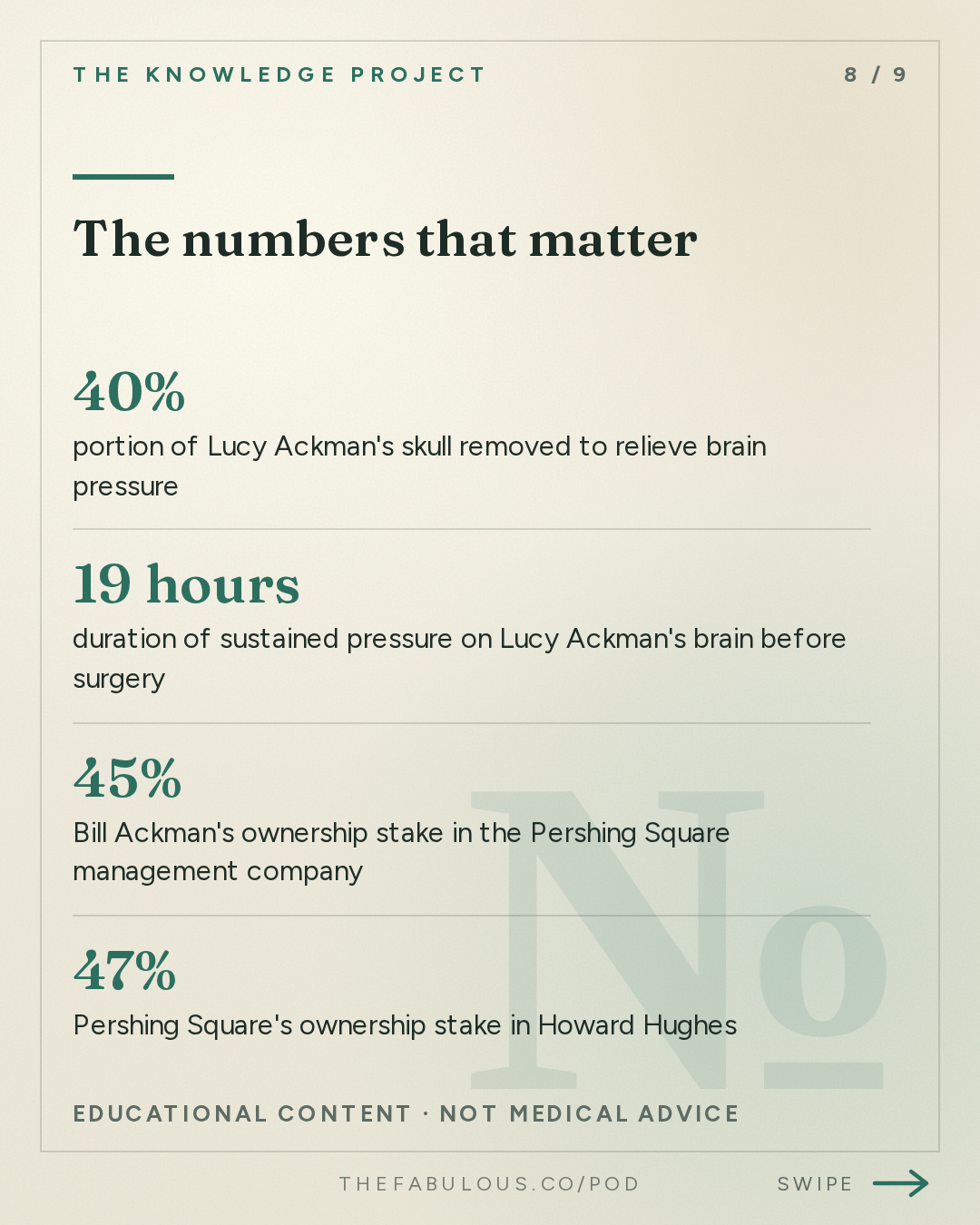
- 40% percent portion of Lucy Ackman's skull removed to relieve brain pressure
- 19 hours duration of sustained pressure on Lucy Ackman's brain before surgery
- 45% percent Bill Ackman's ownership stake in the Pershing Square management company
- 47% percent Pershing Square's ownership stake in Howard Hughes
In their words
“The what does not kill you makes you stronger thing is, is definitely true.”
“In venture, you're really betting on the person and more than the business plan.”
“A closed mouth gathers no foot.”
“I don't think you run a proxy contest against someone with, you know, three million Twitter followers.”
Protocols
-
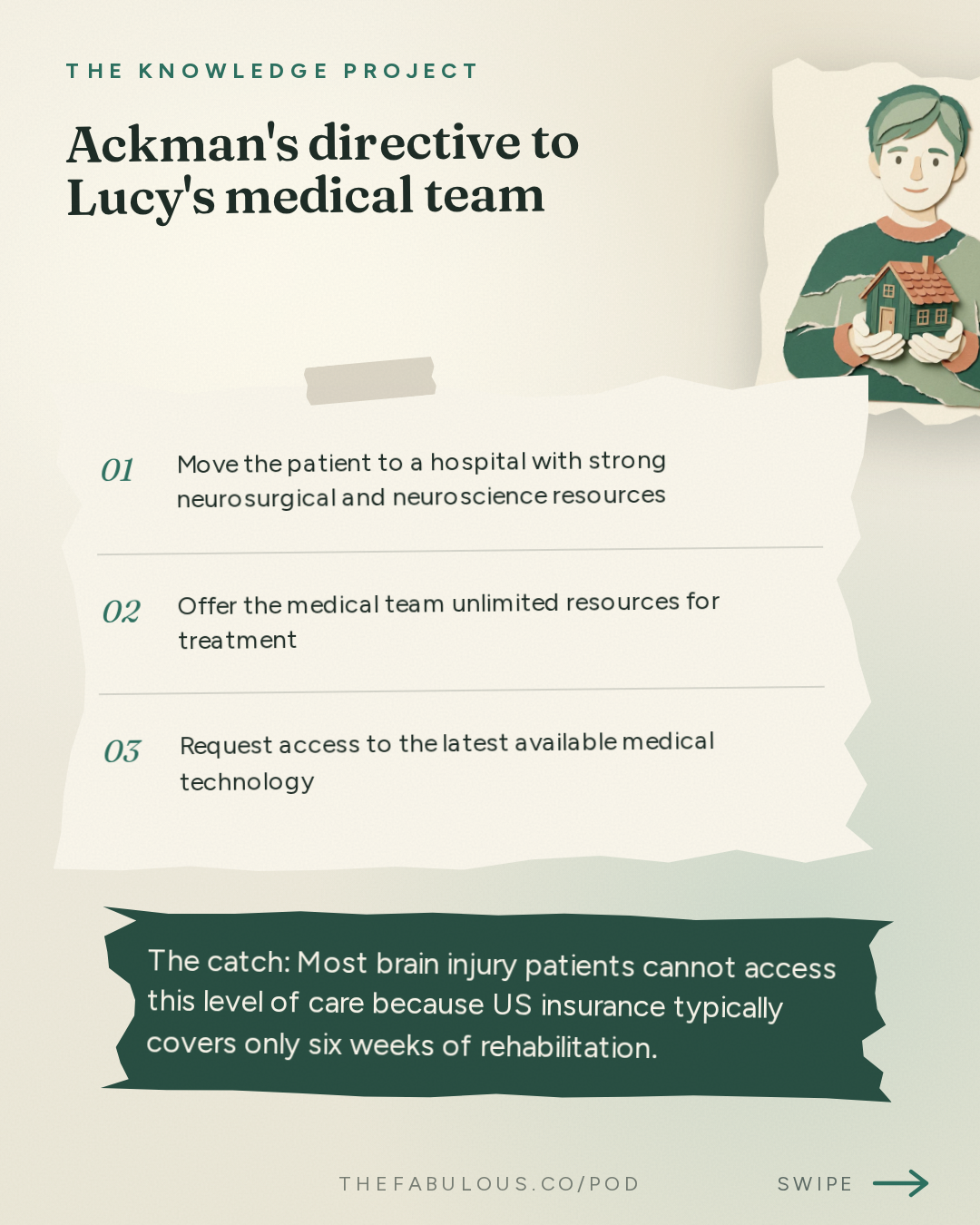
Ackman's directive to Lucy's medical team
Bill Ackman told Lucy's doctors to use unlimited resources and the newest available technology because cost was not a constraint for his family. The catch, he says, is that a typical brain injury patient gets only six weeks of insurance-covered rehabilitation and often ends up in a nursing home instead.
One-time directive at the start of acute treatment
-
Pershing Square's investment checklist
Bill Ackman says Pershing Square only invests in simple, predictable, free-cash-flow-generating businesses run by top management, sized to large-cap liquid public companies, with an explicit aversion to short selling. The catch is that the firm only wrote these rules down after a large loss in 2015 and 2016 forced them to formalize discipline that had previously been informal.
Applied to every new investment decision
-
Ackman's advice for founders raising capital in a bubble
Bill Ackman advises founders to treat every dollar raised as if it were their own money and to keep years of runway rather than spend as though funding will always be available. The catch, he says, is that companies forced to raise again within three months of a market reset are usually the ones that disappear.
Ongoing discipline through a fundraising cycle
Questions this episode answers
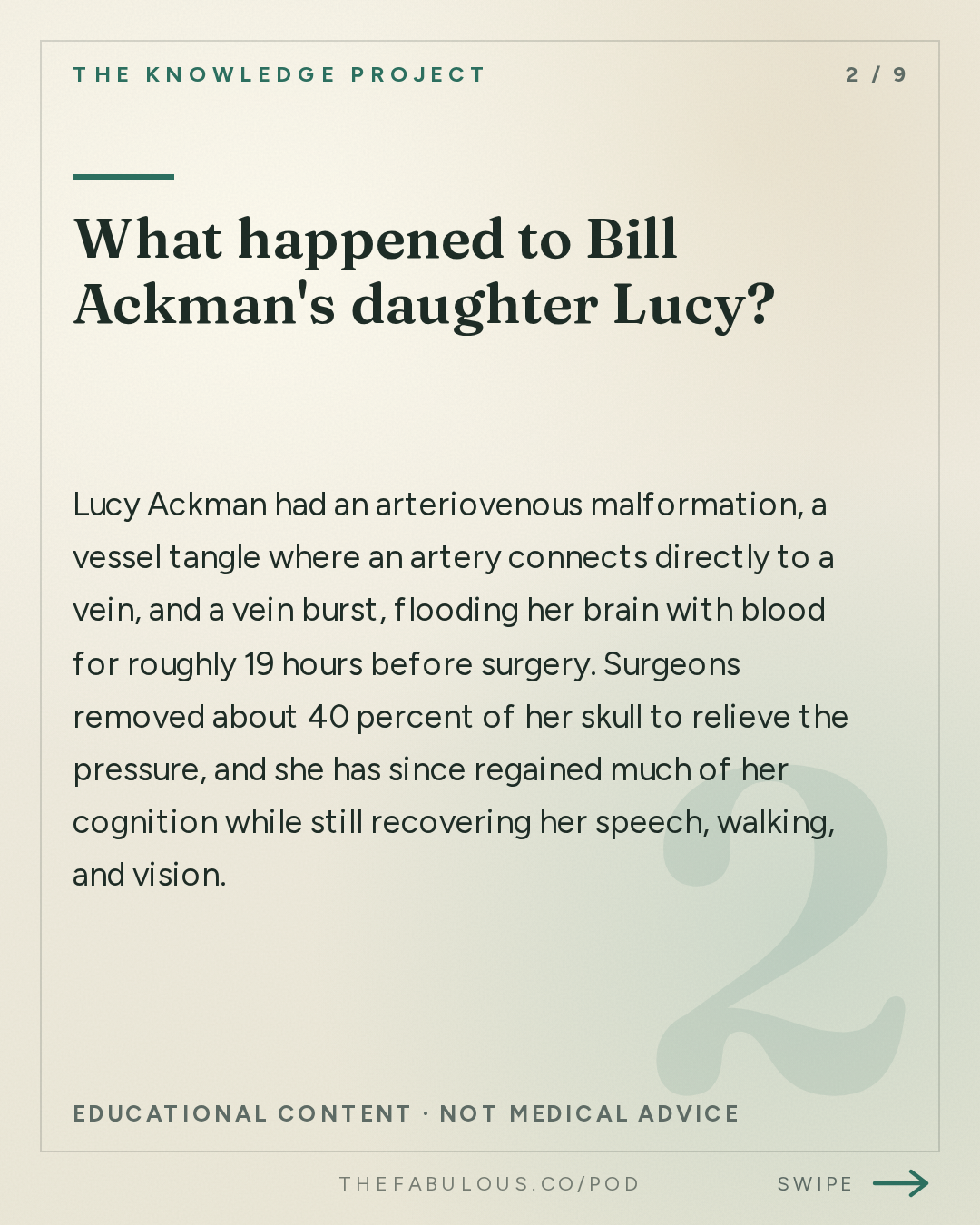
What happened to Bill Ackman's daughter Lucy?
Lucy Ackman had an arteriovenous malformation, a vessel tangle where an artery connects directly to a vein, and a vein burst, flooding her brain with blood for roughly 19 hours before surgery (04:23). Surgeons removed about 40 percent of her skull to relieve the pressure (03:05), and she has since regained much of her cognition while still recovering her speech, walking, and vision.
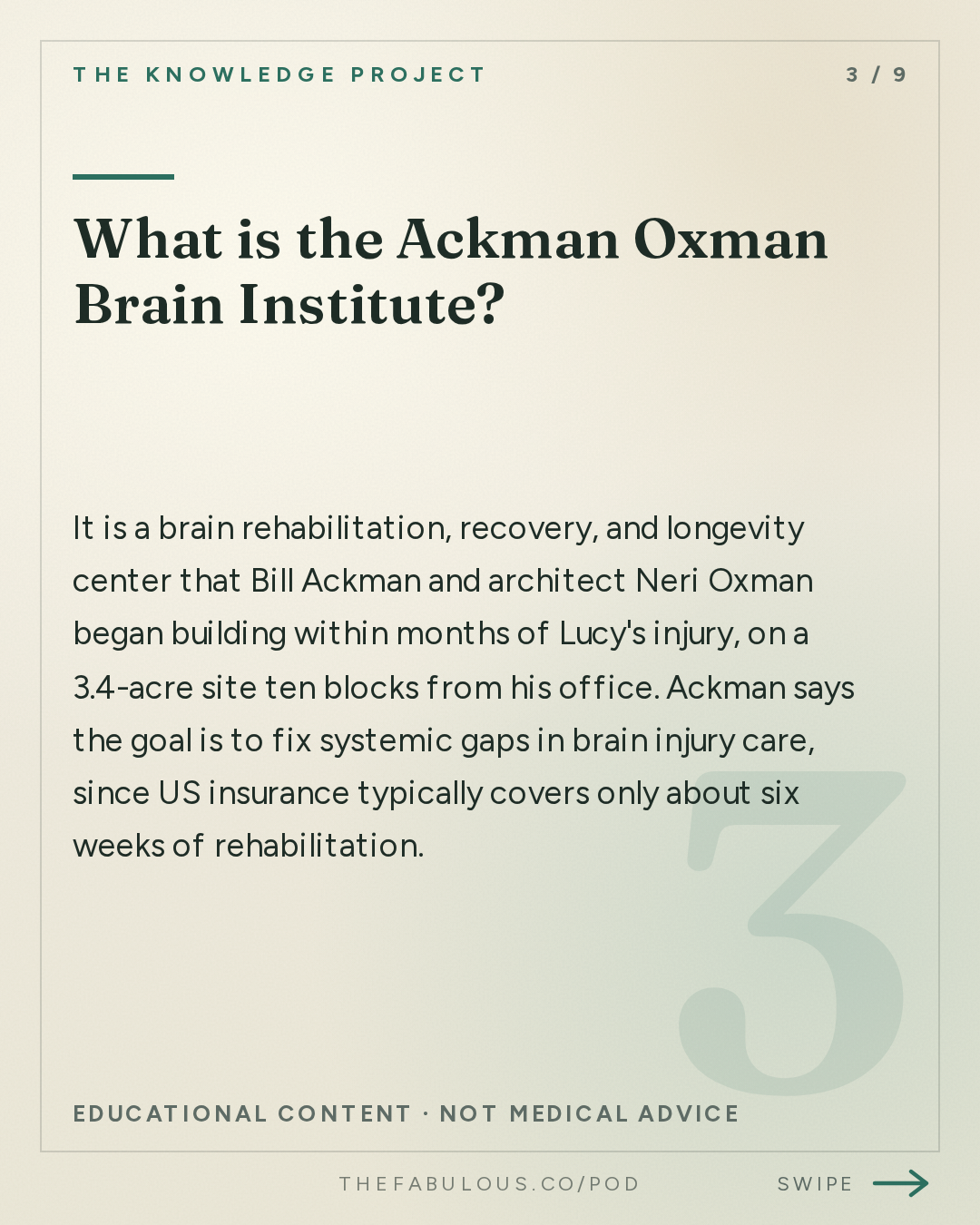
What is the Ackman Oxman Brain Institute?
It is a brain rehabilitation, recovery, and longevity center that Bill Ackman and architect Neri Oxman began building within months of Lucy's injury, on a 3.4-acre site ten blocks from his office (06:02). Ackman says the goal is to fix systemic gaps in brain injury care, since US insurance typically covers only about six weeks of rehabilitation (12:42).
Why did Bill Ackman stop short selling stocks?
Ackman says short selling is structurally disadvantageous because losses can be unlimited while gains are capped at 100 percent (40:15). A costly short campaign against a company he calls a fraudulent pyramid scheme, in which other hedge funds squeezed his position, pushed Pershing Square to formally exclude shorting from its investment checklist after 2015 and 2016 (39:11).
How is Howard Hughes becoming a modern-day Berkshire Hathaway?
Pershing Square, which owns 47 percent of Howard Hughes (57:34), is shifting the real estate company toward an insurance holding model like Warren Buffett's Berkshire Hathaway, using insurance float and underwriting profit to fund long-term stock investments. Ackman says combining float with profitable underwriting can produce a 20 percent or higher annual return over time (59:14).
How does Bill Ackman evaluate AI as an investment risk?
Ackman says AI has massively increased the risk that seemingly dominant businesses could be disrupted, making moat analysis the hardest problem an investor faces right now (30:32). He is not fearful of AI itself, but says every investor, including legends like Warren Buffett with the internet, is likely to misjudge at least one business's exposure to disruption (30:52).
What does Bill Ackman look for in a venture investment?
Ackman weighs the founder's character and adaptability more heavily than the original business plan, since the idea that gets funded is often not the one that succeeds (29:01). His example is Coupang founder Bom Kim, whose original Groupon-style pitch Ackman disliked, but who went on to build what Ackman calls the Amazon of South Korea (29:22).
The full read, in cards
Go deeper
- Barron's article on internet company cash runway — Tracked how many months of cash dot-com companies had left just before the 2000 market crash
Mentioned
Bill Ackman · Lucy Ackman · Mount Sinai · Neuralink · Pershing Square · Warren Buffett · Howard Hughes · Bremont · Davide Cerrato · Oura Ring · Vantage Holdings · Netflix
More from this show and category

Tobi Lütke: How Shopify Runs on AI Agents
Shopify CEO Tobi Lütke says AI agents like River now draft up to half the company's pull requests. But he argues machines can never take responsibility, so taste, judgment, and disciplined pruning, not raw AI output, still decide what actually gets built.
Roblox CEO's Decision-Making Framework
Roblox CEO David Baszucki says his son's bipolar disorder eased within weeks of starting a ketogenic diet, after five medications and repeated hospitalizations failed. He ties his own metabolic state, tracked with a continuous glucose monitor, to decision quality, and describes destroying bureaucracy, shipping unfinished products for real feedback, and holding Robux near one cent for twenty years.

Steve Jobs' Wilderness Years: NeXT and Pixar
Steve Jobs spent twelve years outside Apple, from 1985 to 1997, nearly going bankrupt at NeXT before learning to delegate and compromise. NeXT's software, built on object-oriented programming, became the base for the iPhone, while Pixar taught him to step back, and Bill Gates' $150 million rescued Apple when Jobs finally returned.

Jordan Neely, Daniel Penny, and a Divided America
A six-minute subway encounter between Jordan Neely, a homeless man in mental crisis, and Daniel Penny, a former Marine, became a national Rorschach test. Journalist Anand Giridharadas argues both sides share the same wound: a feeling of being abandoned by every system meant to help them.
