
Luke Burgis on Mimetic Desire and AI
Luke Burgis on Mimetic Desire, Catholicism, and the Age of Social Contagion
▶ Listen to the full episode More from Conversations with Tyler
The brief
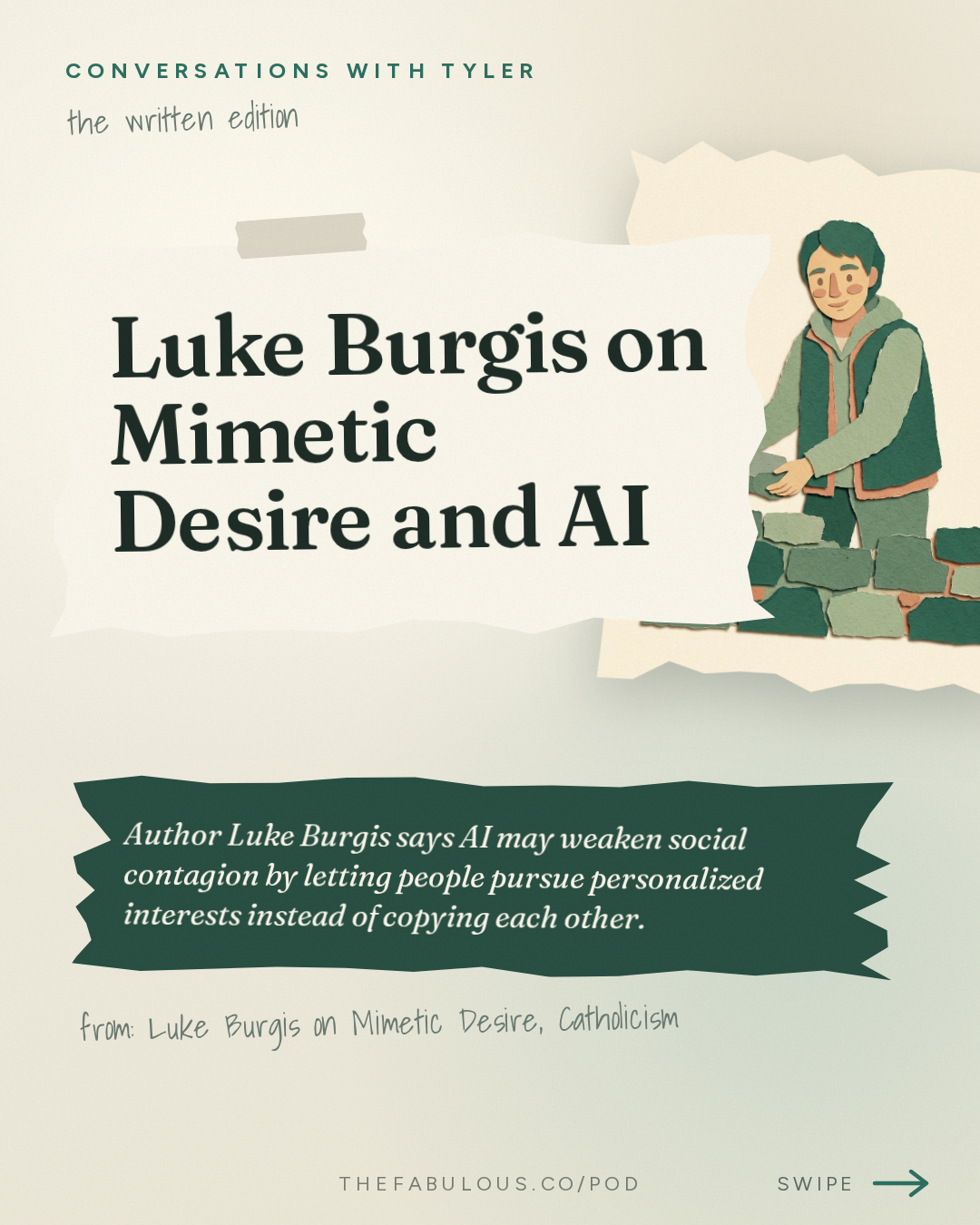
Author Luke Burgis says AI may weaken social contagion by letting people pursue personalized interests instead of copying each other. He also critiques effective altruism's materialism, names confession frequency as his test for a thriving Catholic parish, and describes building the Cluny Institute as a modern echo of medieval Cluny's networked monasteries.
In his second year studying theology in Rome, Luke Burgis was walking to a class on fundamental theology when he noticed a hand-lettered sign: a Pixar storyboard artist named Matthew Luhn was giving a masterclass on storytelling, that same day, at the pontifical university where he studied (27:31). The venue Luhn had booked had fallen through over a maintenance dispute, so the workshop got rerouted to the pontifical university where Burgis, then thirty-one years old and living in a dormitory of 250 men, was discerning whether to become a priest (26:24). He talked his way in, skipped class, and came out lit up by something theology hadn't given him. "It ruined theology for me for the rest of the year," he says (28:20). He never became a priest.
That small, almost farcical accident sits near the center of Burgis's larger project, which is to explain why people want what they want, and why they so rarely notice that the wanting was borrowed. Burgis is the author of the bestseller Wanting and, more recently, The One and the 99: Forging Identity in the Age of Social Contagion. He directs the Cluny Institute and teaches at the Catholic University of America. His intellectual scaffolding comes from the French thinker Rene Girard, whose mimetic theory holds that human desire is not self-generated but copied from other people, models we imitate without quite admitting it. Applied to markets, politics, or a Catholic seminary dormitory, the theory explains a great deal. Applied too aggressively, Burgis warns, it explains everything, which is its own trap: "once a novelist reads the work of Rene Girard and understands mimetic theory and mimetic desire, it will ruin them as a novelist, because now they don't think that they have any original ideas" (05:56). The cure, he says, is to think about the theory less, not more, and to return to the concrete particulars of an actual life.
A theory that eats its own tail
Burgis's most counterintuitive claim concerns artificial intelligence. Most cultural pessimists worry that AI will homogenize taste and accelerate herd behavior. Burgis bets the opposite: that AI will make social contagion weaker, not stronger, because it lets an autodidact follow a private curiosity to its end instead of being funneled toward whatever everyone else is reading (06:43). "That is not a mimetic process," he says. "It's not a social contagion process. That is using the AI to kind of follow your own intellectual interest" (07:08). He frames this as a kind of via negativa, the old theological method of approaching truth by ruling out what something is not, applied now to the human person: AI helps people discover who they are by repeatedly showing them what they are not.
"AI is performing a kind of via negativa on the human person, maybe even the human soul, and helping us discover who we are." — Luke Burgis (01:56)
That optimism sits oddly next to his account of nearly advising Anthropic, the AI company behind the chatbot Claude, on its "constitution," the written set of values meant to guide the model's behavior. Anthropic invited roughly fourteen or fifteen people, mostly Christians interested in virtue ethics, to spend a couple of days commenting on the document (08:06). Burgis says the company had, without quite realizing it, rediscovered discernment techniques the Jesuit religious order worked out five hundred years earlier (08:47). He declined further involvement, not because the invitation was illegitimate, but because it was pitched to him as a moral imperative, a framing he found manipulative rather than persuasive. His broader complaint about effective altruism, the philosophy that tries to do the most measurable good per dollar or hour, is structural: "the things that can be measured usually with effective altruism are often not the things that I think are most important in life" (10:12), a list that for him includes the depth and quality of relationships.
Burgis extends the same suspicion of over-individualism to the culture around him. The title of his new book names the tension directly: the one who wanders off from the group, versus the ninety-nine who stay. He worries the American imagination has swung too far toward celebrating the one, the rugged contrarian, at the expense of asking what makes the ninety-nine, meaning ordinary communal life, worth staying in (13:27). Asked what single policy he would impose if given dictatorial power, he doesn't propose a tax reform or an AI regulation. He wants government money for jazz clubs, one in every city, run by local musicians with an entrepreneurial streak, on the theory that America has lost the intermediary institutions, the clubs, guilds, and third places, that once stood between the isolated individual and the impersonal state (14:05). It is a strange answer, and he knows it: a public campaign to promote such clubs, he admits, would probably backfire, because a state-endorsed jazz club stops being an organic third place and becomes just another mimetic prescription.
What monks understood about building
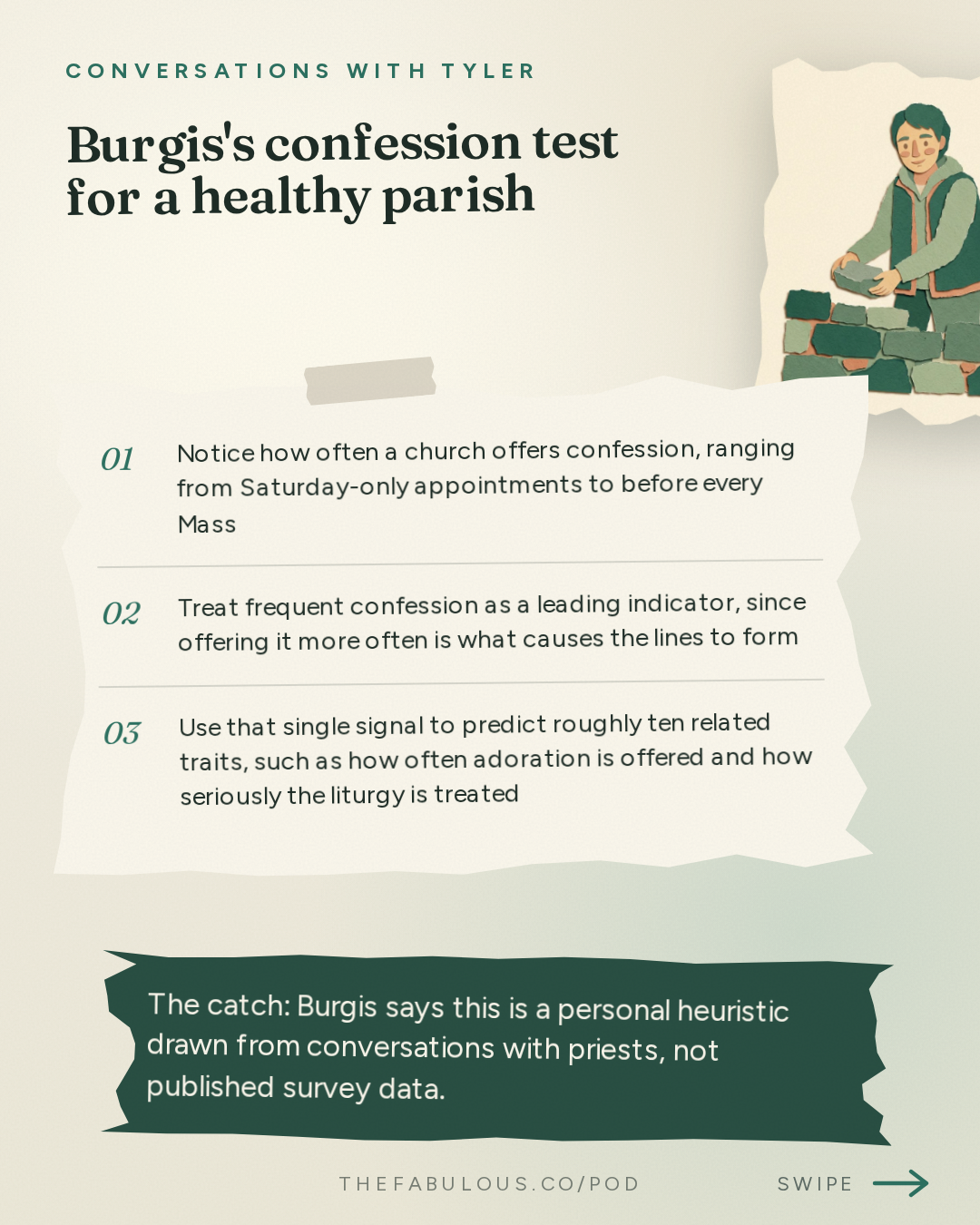
Burgis's Catholicism is not abstract for him; it has a diagnostic method. Walk into any Catholic church, he says, and the first thing he checks is how often confession, the sacrament in which a Catholic privately confesses sins to a priest, is offered. A parish offering it only by appointment on Saturdays is a different animal from one offering it before every Mass, and from that single fact he claims he can predict roughly ten other things about the parish's health, from attendance at adoration to the seriousness of its liturgy.
"The first thing I notice about any Catholic church is how many times they offer confession. I look at it right away." — Luke Burgis (23:44)
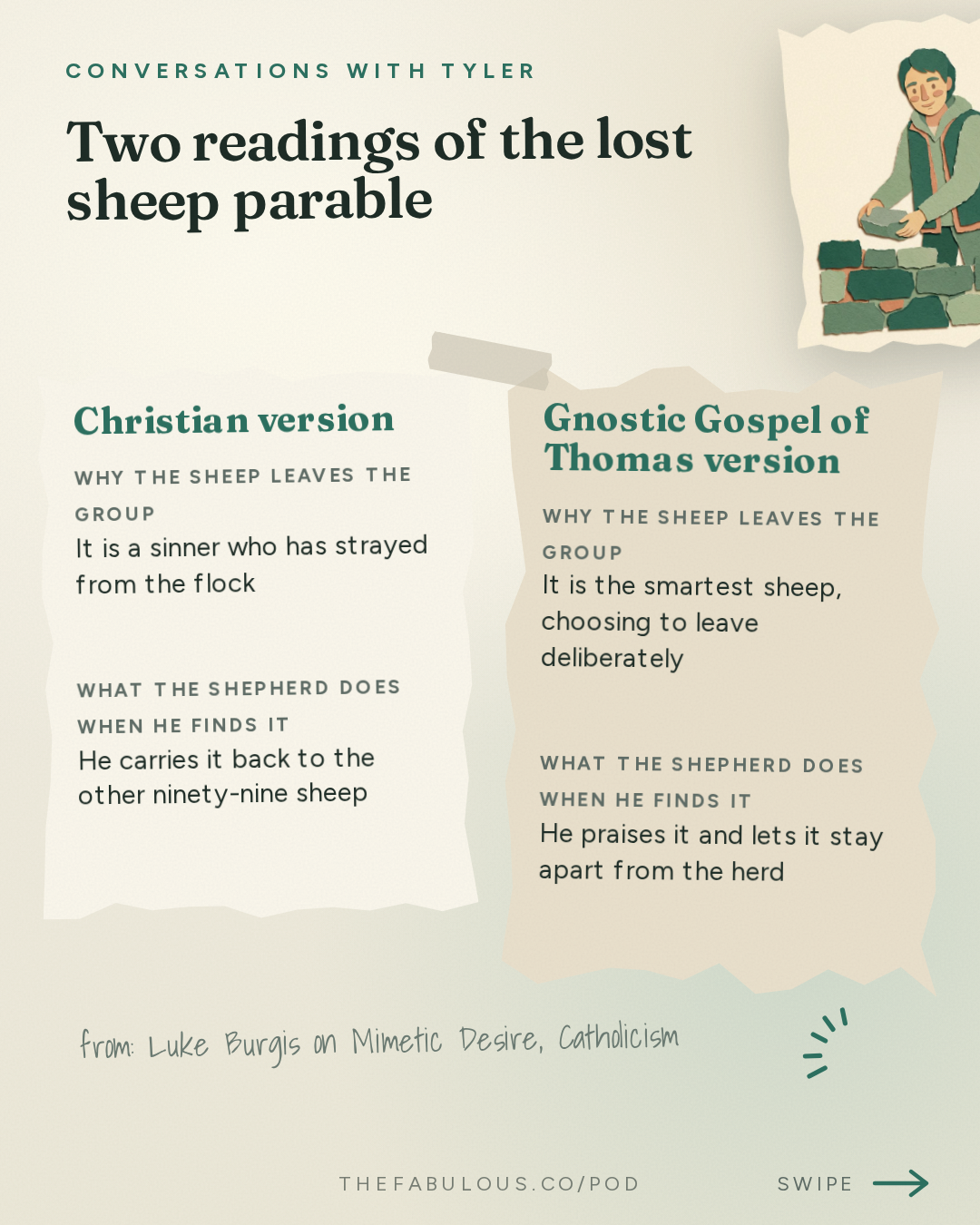
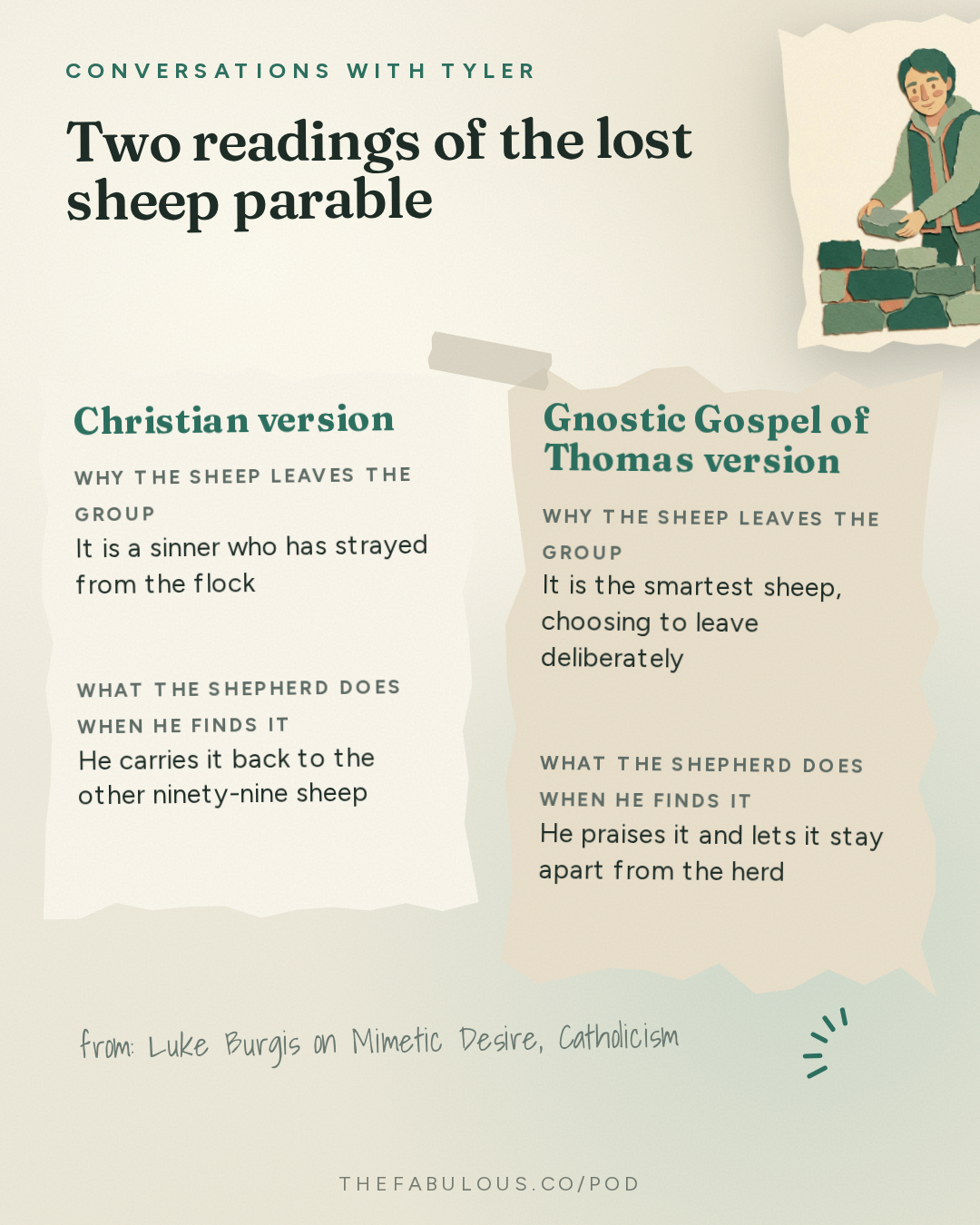
He's careful about the causal arrow: parishes don't offer frequent confession because demand already exists. Priests offer it more often, and the lines simply form (24:03). Supply, in other words, creates its own mimetic demand, the same mechanism that makes contagion contagion. He applies a similarly close reading to scripture. The parable of the lost sheep, in which a shepherd with a hundred sheep leaves the ninety-nine to retrieve the one that wandered off, has a rival version in the Gnostic Gospel of Thomas, an early text the mainstream Church rejected. In that telling, the wandering sheep isn't a sinner being rescued; it's the smartest sheep, and the shepherd doesn't bring it home. He praises it for having the sense to leave the dumb herd behind (37:36). Burgis thinks the contemporary world would find the Gnostic version more congenial than the traditional one, which he takes as a symptom of how thoroughly modern culture has learned to romanticize the breakaway individual over the community that holds him.
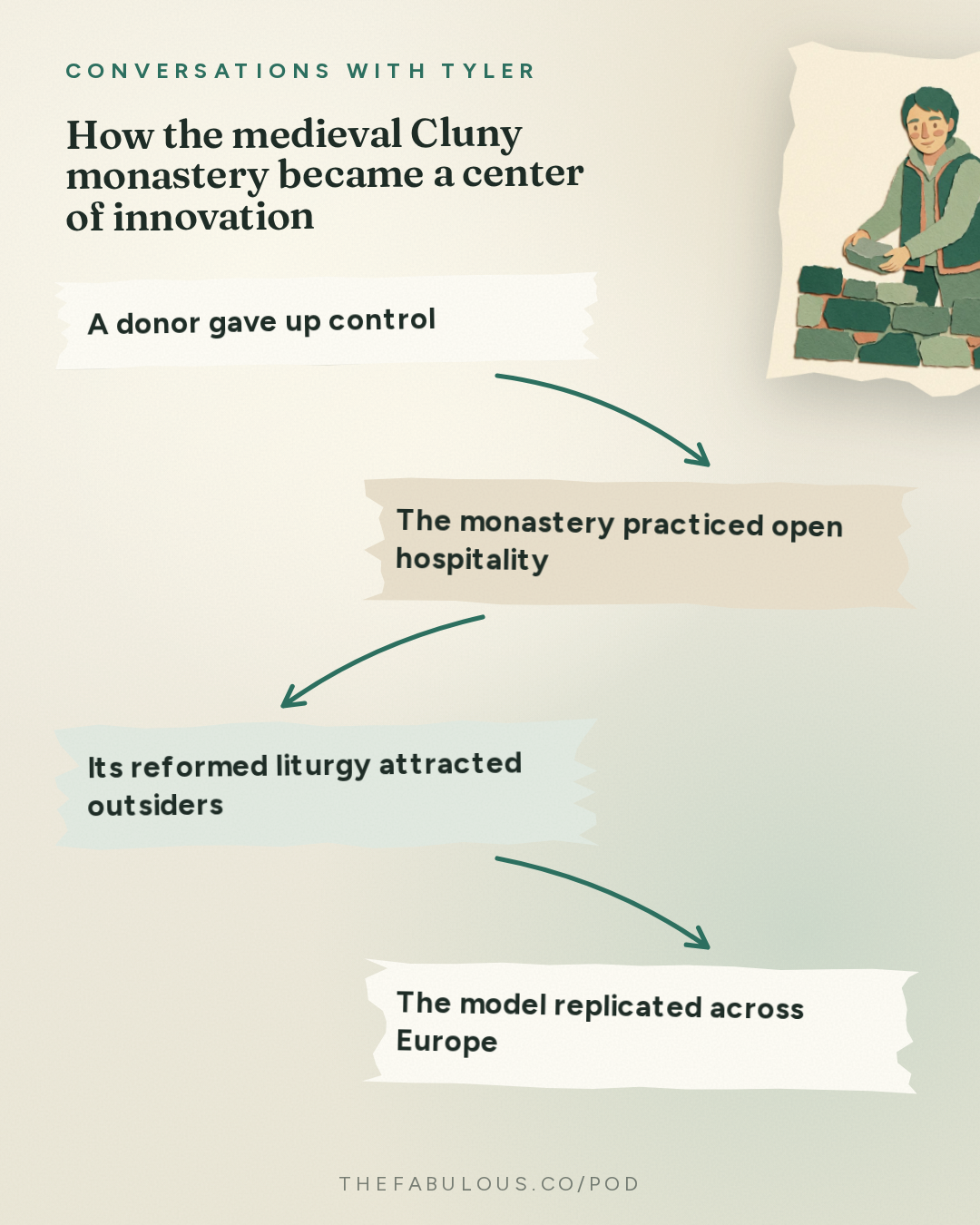
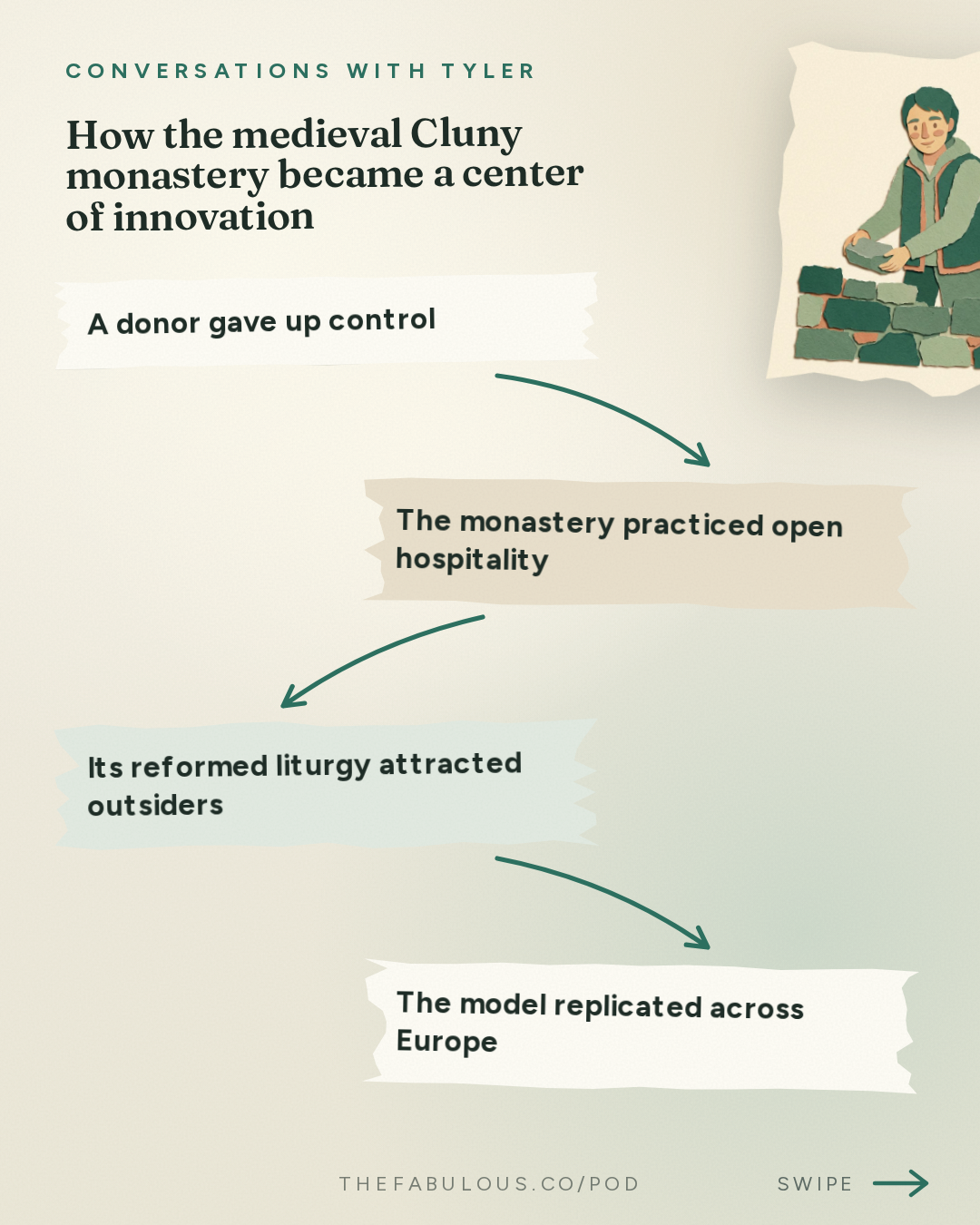
His own project, the Cluny Institute, is an attempt to build the opposite kind of thing: a talent network for people drawn to religious ideas who also want to build real things, positioned at what he calls the intersection of Athens, Jerusalem, and Silicon Valley (46:15). The name is not incidental. The original Cluny was a Benedictine monastery in medieval France whose founding charter did something legally unusual for its era: the donor who funded it gave up all rights to direct how it would be run (47:04). Freed from patronage strings, Cluny grew into a network of more than 1,200 affiliated monasteries and was, by Burgis's account, the largest church in the world for three hundred years, a center of European innovation in architecture, agriculture, and winemaking, built on a simple rule of hospitality: anyone sick, poor, or traveling could knock and be let in (47:51). Burgis wants his institute to be a lay, twenty-first-century version of that same hospitality-driven network, one he believes Silicon Valley needs, given what he sees as its allergy to religious thinking (46:15).
The conversation ends where monastic tradition has always insisted people should occasionally sit: with death. Burgis keeps a small, brightly painted Mexican skull on his desk, a memento mori, a physical reminder of mortality that Benedictine monks are taught to meditate on daily (49:22). He invokes the writer C.S. Lewis's idea that one should die before dying, meaning die a series of small deaths to the ego well before the final one arrives, and cites former U.S. Senator Ben Sasse's public illness as a model for facing that prospect with composure (48:55). It is a fitting close for a thinker whose whole method is to notice what a culture has stopped looking at directly, whether that is a fresco walked past without a glance, a parable's darker reading, or the fact of one's own ending, and to insist that looking again, carefully and without borrowing anyone else's fear or enthusiasm, is most of the work.
Ask this episode anything
Pod's AI answers from the episode itself, with the minute mark so you can hear it yourself.
Or start with one of these
Ask this episode
Pod's AI listens to the whole episode to answer, and points you to the minute it comes from.
The rest of this answer, and any question after it
Answers come from the episode itself, never from a summary of it.
ContinueKey takeaways
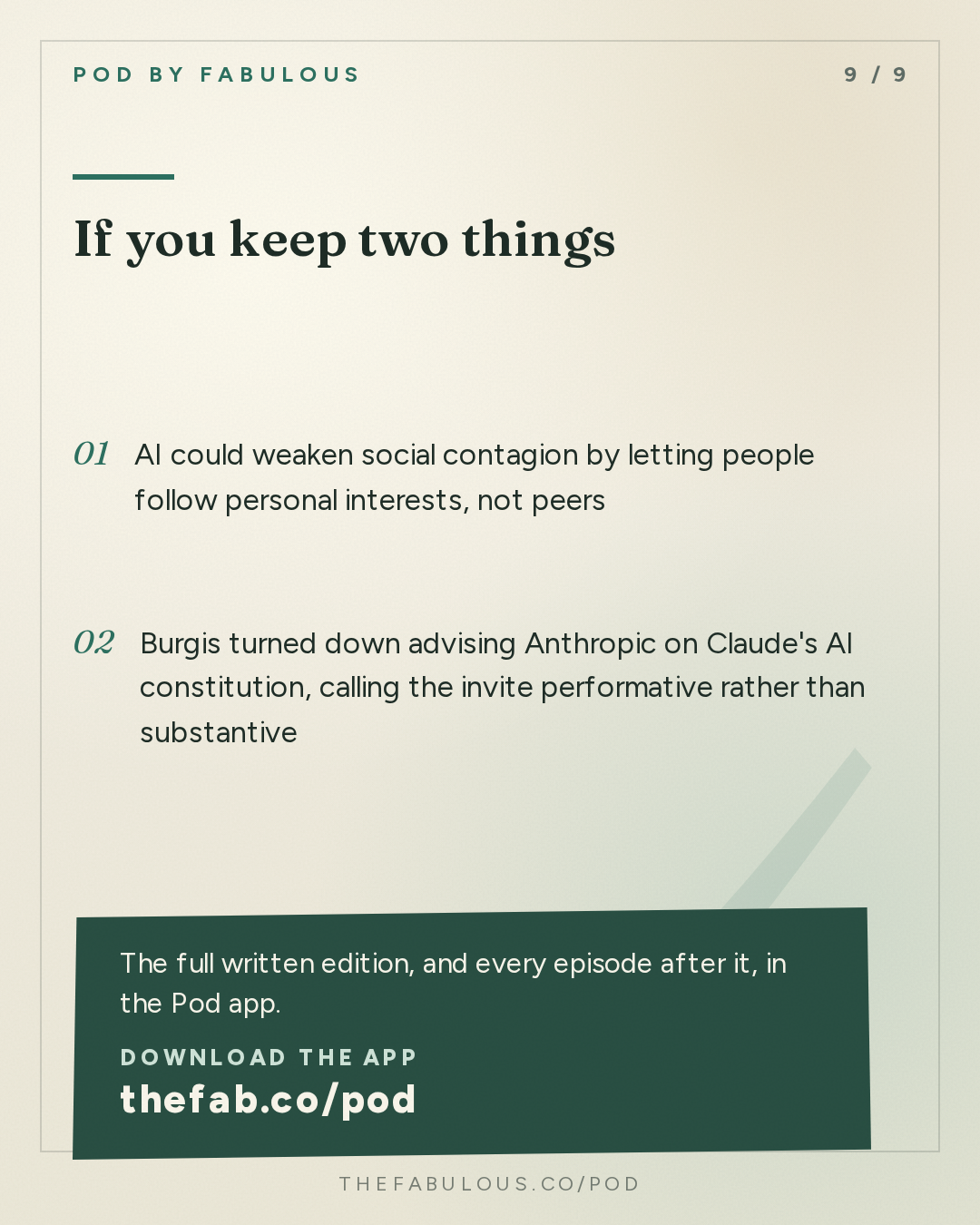
- AI could weaken social contagion by letting people follow personal interests, not peers
- Burgis turned down advising Anthropic on Claude's AI constitution, calling the invite performative rather than substantive
- Burgis judges a Catholic parish's health by how often confession is offered, not by attendance figures
- Effective altruism's focus on measurable outcomes ignores relationship quality and cultural depth, Burgis argues
- The medieval Cluny monastery network of over 1,200 houses shows hospitality driving innovation, Burgis says
The episode in cards
By the numbers
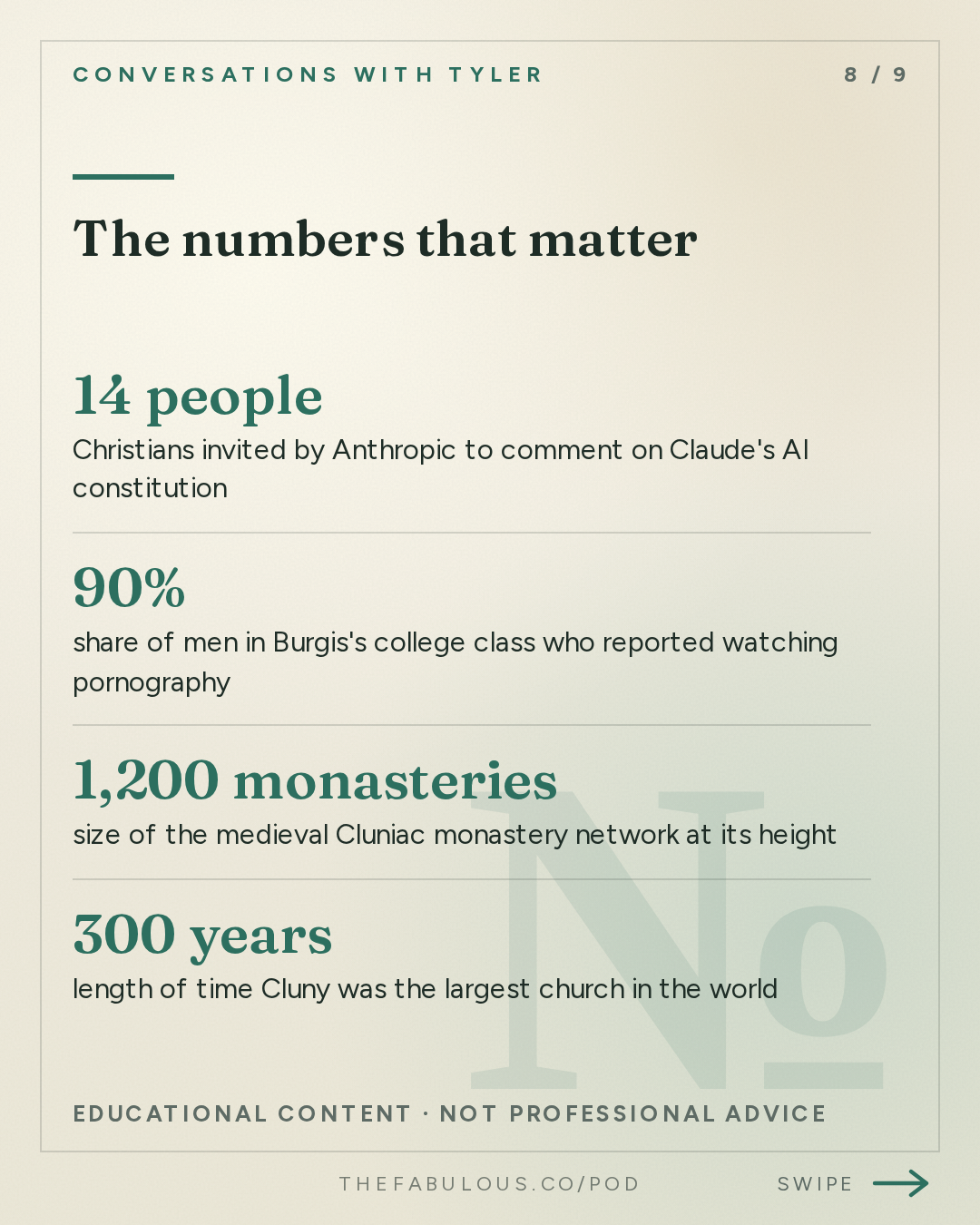
- 14 people Christians invited by Anthropic to comment on Claude's AI constitution
- 90% share of men in Burgis's college class who reported watching pornography
- 1,200 monasteries size of the medieval Cluniac monastery network at its height
- 300 years length of time Cluny was the largest church in the world
In their words
“AI is performing a kind of via negativa on the human person, maybe even the human soul, and helping us discover who we are.”
“The things that can be measured usually with effective altruism are often not the things that I think are most important in life.”
“The first thing I notice about any Catholic church is how many times they offer confession. I look at it right away”
“He pats him on the head and praises him for not being like all of the other sheep, for being smart enough to forge his own way.”
Protocols
-
Add friction to pornography access
Luke Burgis recommends introducing structural friction, such as device filters or household agreements, so pornography is not encountered by accident, especially by children; he notes there is no single fix because every family's situation differs.
ongoing, applied at home
-
Meditate daily on death
Following Benedictine monastic tradition, Burgis keeps a painted skull on his desk and reflects on mortality every day, treating the practice as a series of small deliberate deaths to the ego rather than a one-time exercise.
daily
Questions this episode answers
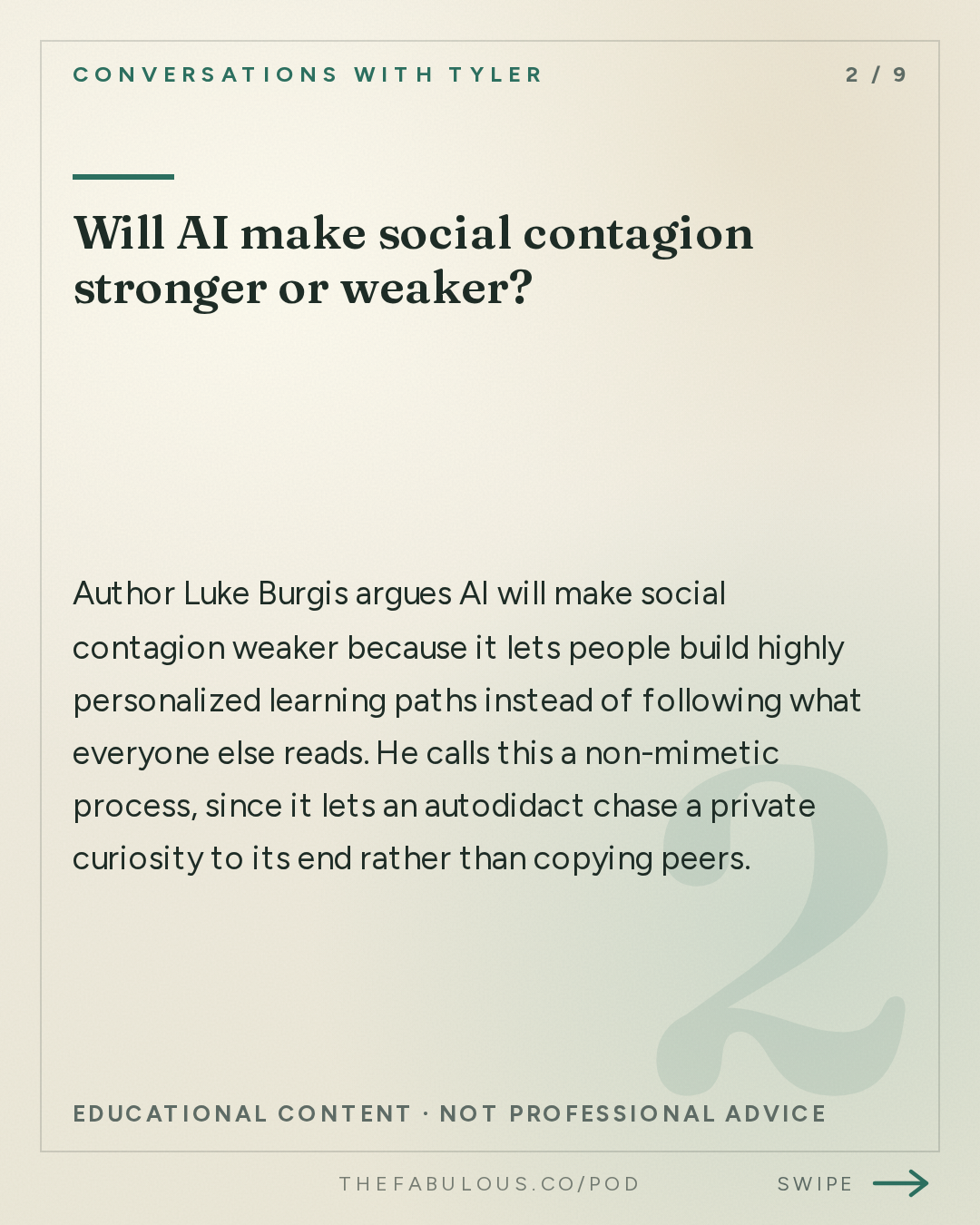
Will AI make social contagion stronger or weaker?
Author Luke Burgis argues AI will make social contagion weaker because it lets people build highly personalized learning paths instead of following what everyone else reads (06:43). He calls this a non-mimetic process, since it lets an autodidact chase a private curiosity to its end rather than copying peers (07:08).
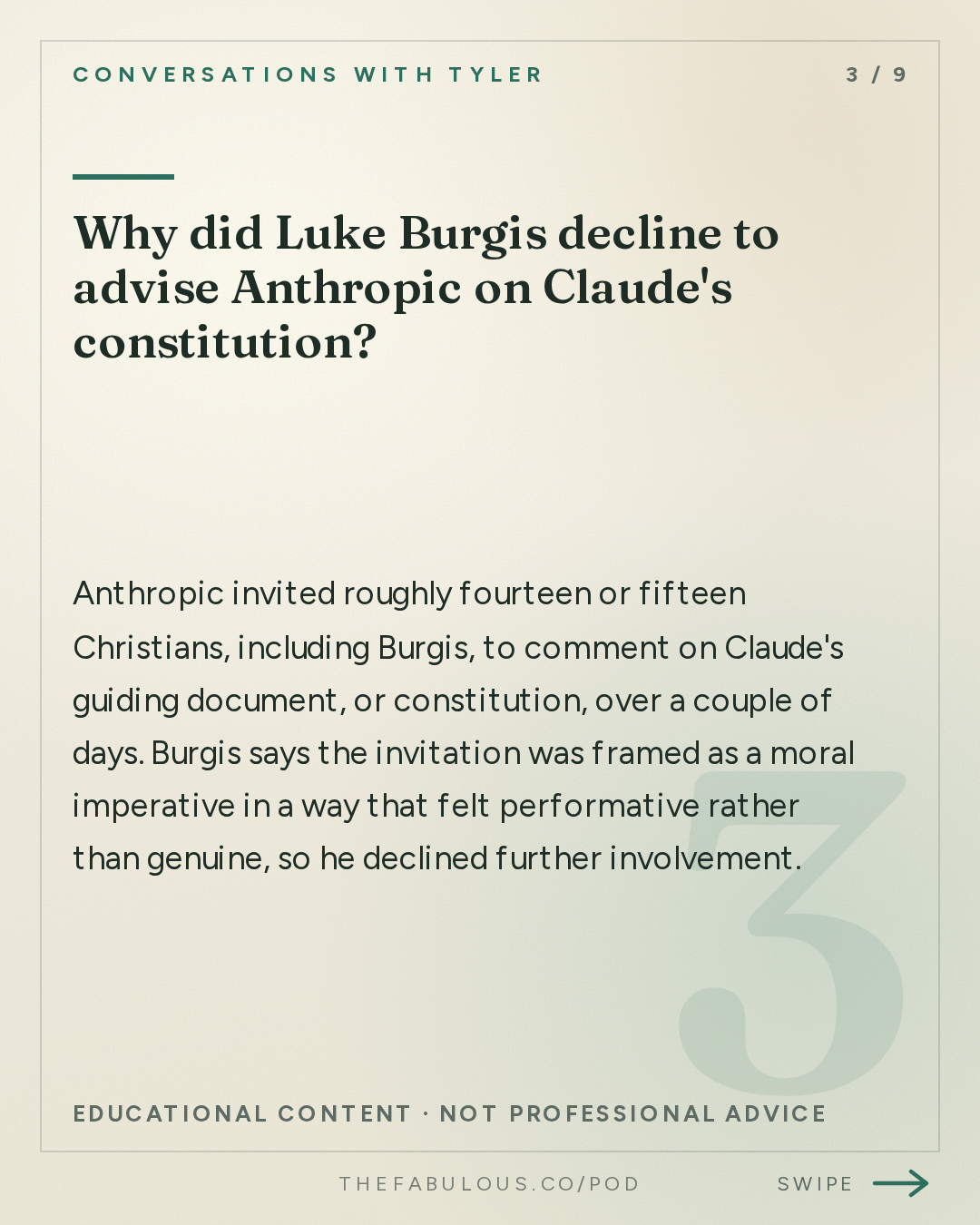
Why did Luke Burgis decline to advise Anthropic on Claude's constitution?
Anthropic invited roughly fourteen or fifteen Christians, including Burgis, to comment on Claude's guiding document, or constitution, over a couple of days (08:06). Burgis says the invitation was framed as a moral imperative in a way that felt performative rather than genuine, so he declined further involvement (09:05).
What is Luke Burgis's test for whether a Catholic parish is thriving?
Burgis says the first thing he checks in any Catholic church is how often confession is offered, ranging from Saturday-only appointments to before every Mass (23:44). He treats frequent confession as a signal of parish health because offering it more often is what causes demand, in the form of lines, to appear (24:03).
What is the Gnostic version of the lost sheep parable?
In the mainstream Christian parable, a shepherd with a hundred sheep leaves the other ninety-nine to rescue the one that strayed and brings it home (37:36). In the Gnostic Gospel of Thomas version that Burgis describes, the stray sheep is the smartest one, and the shepherd praises it for leaving the herd rather than bringing it back (37:59).
What is the Cluny Institute and why is it named after a monastery?
The Cluny Institute is Luke Burgis's talent network for people interested in religious ideas who also want to build things, positioned at what he calls the intersection of Athens, Jerusalem, and Silicon Valley (45:28). It is named after the medieval Cluny monastery, whose founding charter freed it from donor control and whose network grew to more than 1,200 monasteries built on open hospitality (47:04, 47:51).
What does Luke Burgis think is wrong with effective altruism?
Burgis argues effective altruism is fundamentally materialistic because it optimizes for outcomes that are easy to measure while ignoring things like relationship quality and cultural depth (10:12). He says this same measurable-outcomes mindset shaped parts of AI development, including the process Anthropic ran with him (09:44).
The full read, in cards
Go deeper
- Wanting — Burgis's earlier bestseller applying Rene Girard's mimetic theory to desire and culture
- The One and the 99: Forging Identity in the Age of Social Contagion — Burgis's new book on the tension between the individual and the group under social contagion
- The Burnout Society — Byung-Chul Han's diagnosis of the achievement subject as a driver of Western unhappiness
- The Italians — Luigi Barzini's account of regional differences in Italian temperament and status display
- Demons — Dostoevsky's novel used by Burgis to describe the psychic effects of runaway social contagion
Mentioned
Luke Burgis · The One and the 99 · Wanting · Rene Girard · The Burnout Society · Byung-Chul Han · Anthropic · Cluny Institute · Matthew Luhn · Pixar · Genoa · Ross Douthat · Ben Sasse · Brian Johnson
More from this show and category

The Panic of 1873 and Its 20-Year Political Toll
Historian Liaquat Ahamed argues the Panic of 1873 did not collapse the world economy, it poisoned its politics for twenty years. Growth held near 2.5% through a long deflation (02:10), but the fallout helped end Reconstruction (07:06), fueled Gladstone's Egyptian bond windfall (09:44), and let Bismarck wreck bimetallism (14:16).

Luis Garicano on AI, Messy Jobs, and Spain
Economist Luis Garicano says Spain's aging society blocks growth, and AI will spare messy jobs but eliminate clean ones. He also faults EU institutions, where unanimity rules and party discipline reward loyalty over competence, for chronic policy paralysis in Brussels and Madrid alike.

Gita Gopinath on Trade, Currencies, and China
Former IMF chief economist Gita Gopinath explains why currencies rarely move the way trade theory predicts. She covers why 90% of China's US exports are priced in dollars, Argentina's disinflation from 150% to 30%, and why AI-driven growth might not save the US debt trajectory.

Annie Lowrey on America's Time Tax
Journalist Annie Lowrey says America's hidden "time tax" of paperwork and waiting falls hardest on the poor, not the rich. She contrasts Social Security's under-1% overhead with TANF's $16.5 billion in yearly costs, estimates 50 hours a year in bureaucratic time per person, and predicts AI agents could ease the burden within five years.
