
The Panic of 1873 and Its 20-Year Political Toll
Liaquat Ahamed on Financial Crises, Gold, and the Lessons of 1873
▶ Listen to the full episode More from Conversations with Tyler
The brief
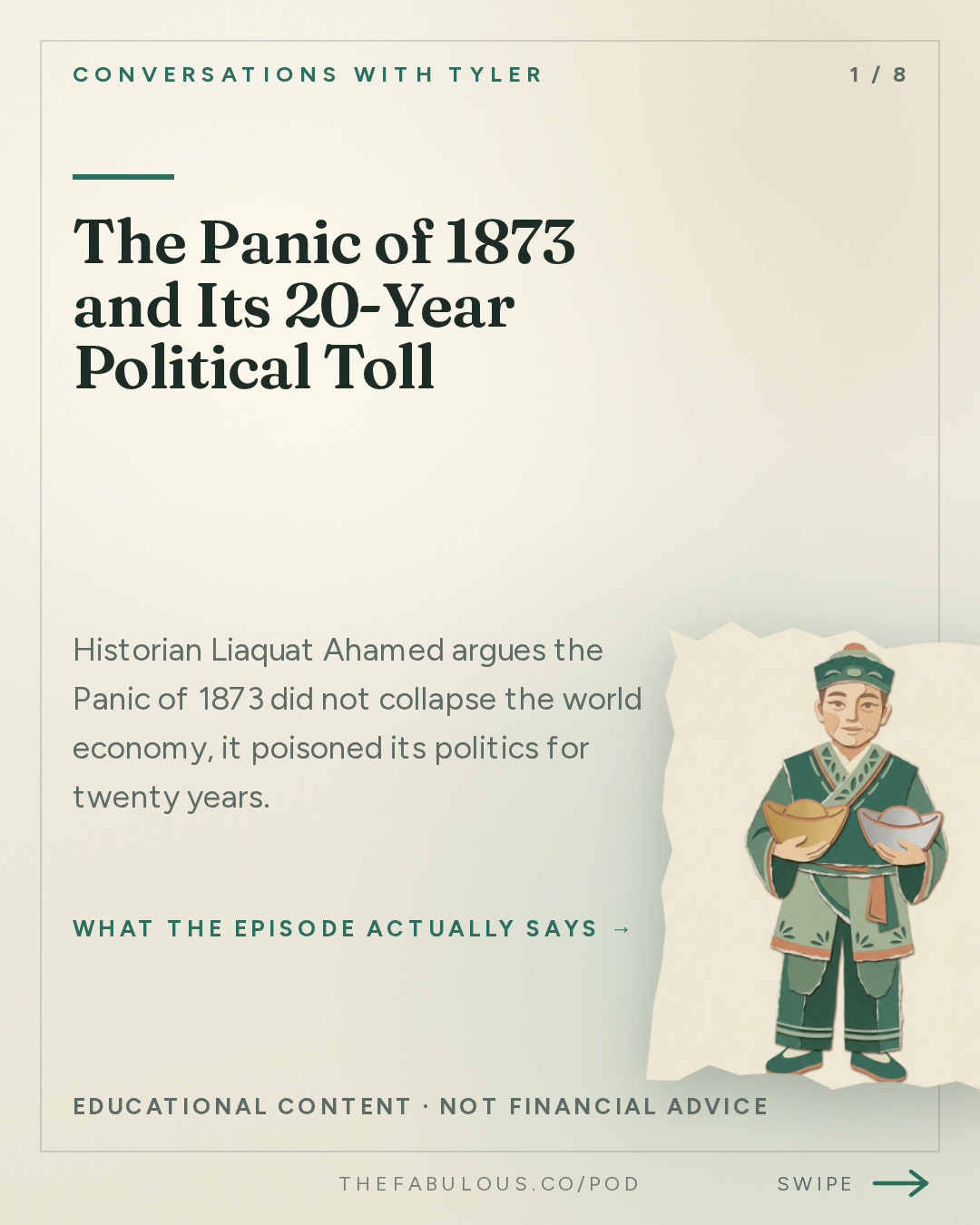
Historian Liaquat Ahamed argues the Panic of 1873 did not collapse the world economy, it poisoned its politics for twenty years. Growth held near 2.5% through a long deflation (02:10), but the fallout helped end Reconstruction (07:06), fueled Gladstone's Egyptian bond windfall (09:44), and let Bismarck wreck bimetallism (14:16).
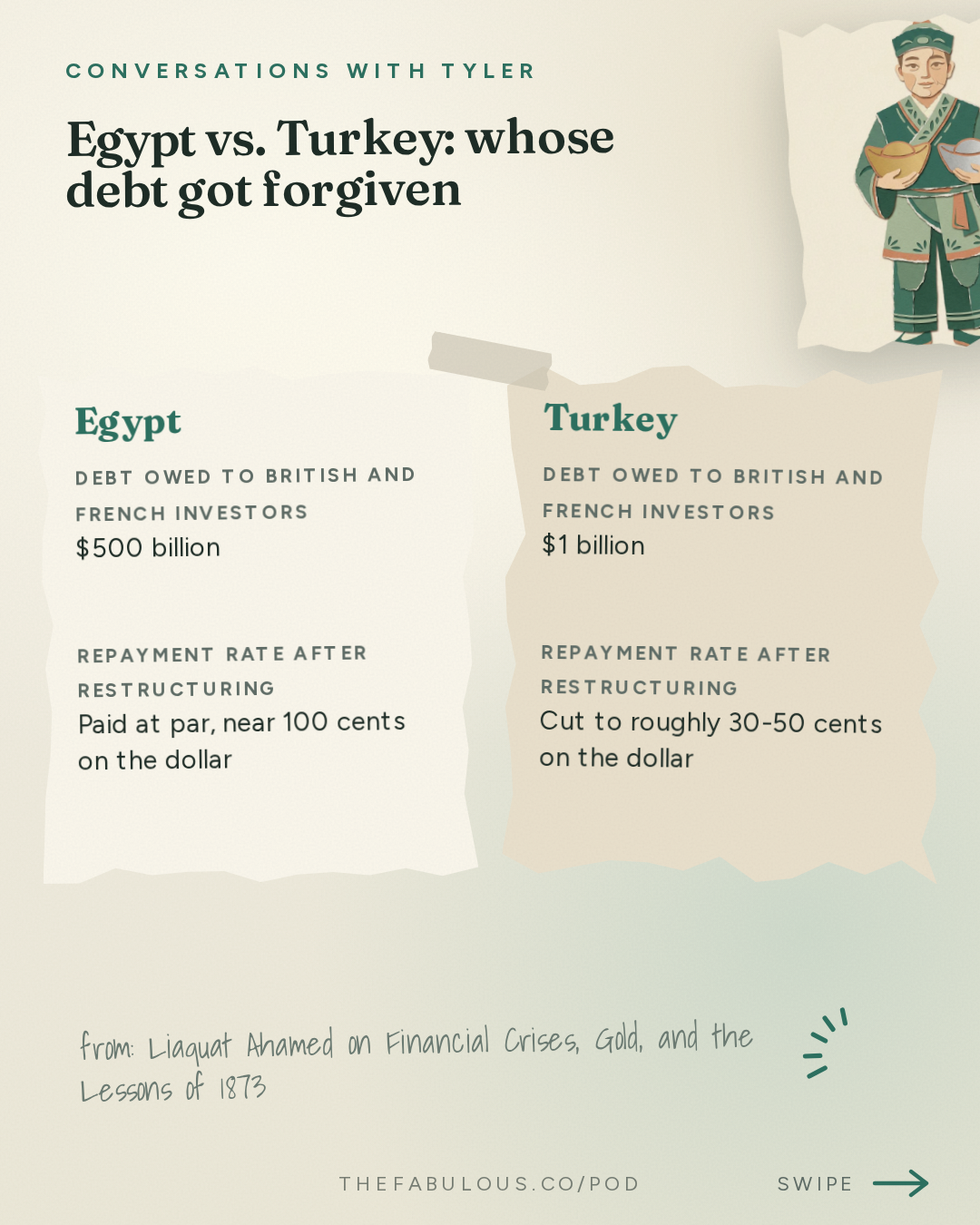
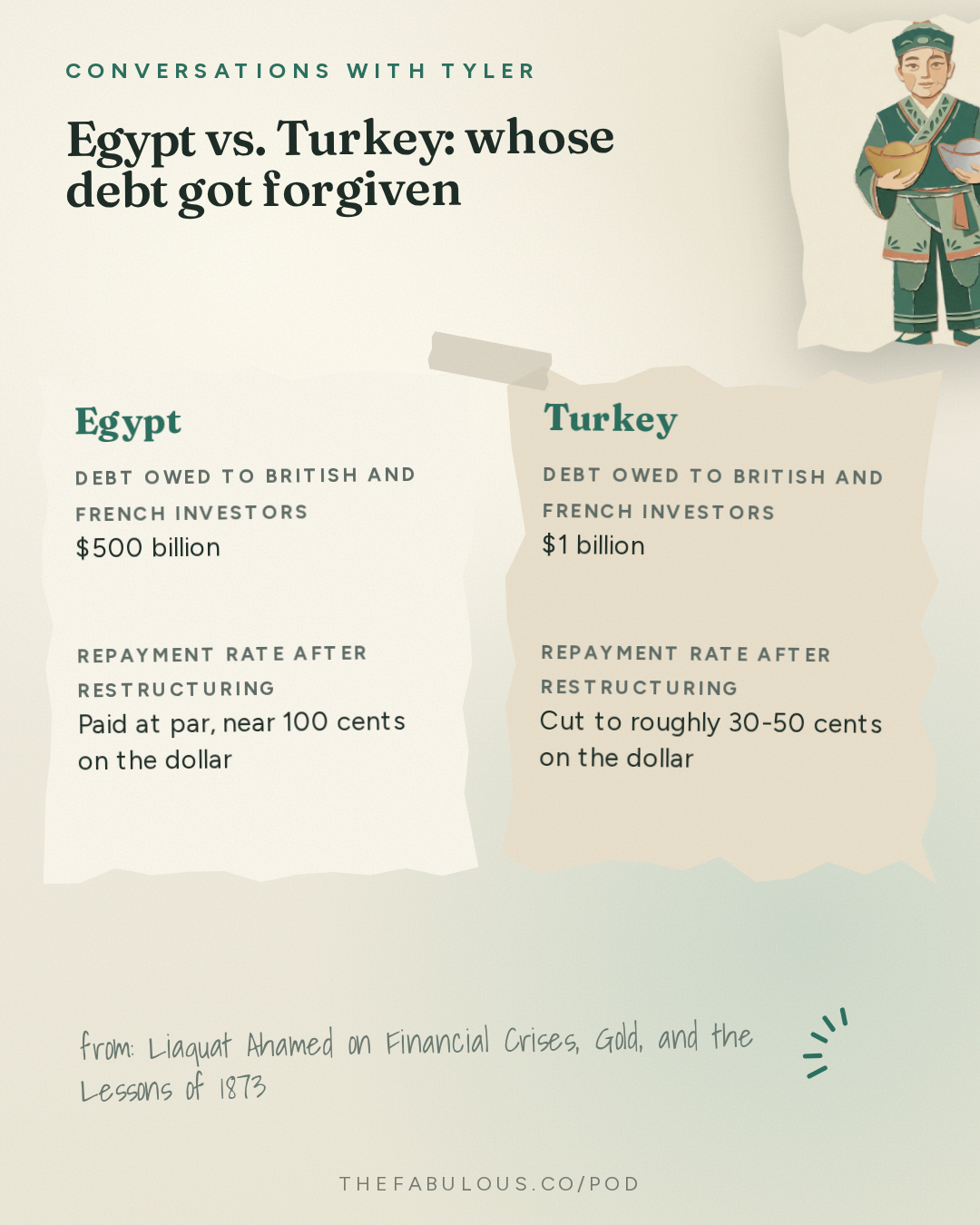
There is a version of investing wisdom that says the best returns come from information nobody else has. William Gladstone, four-time British prime minister, seems to have proven it by accident. In the early 1880s he quietly put 40 percent of his net worth into Egyptian government bonds, which were paying 12 to 14 percent interest (09:44). Then Britain invaded Egypt. Then Britain insisted Egypt repay its foreign creditors in full, at par. Gladstone's bonds, bought at a discount reflecting real default risk, turned into one of the great trades of the Victorian age. Whether he engineered this or simply believed, with total sincerity, that debts are debts and must be paid, is a question the historian Liaquat Ahamed cannot fully answer. "I'm sure he thought that it was the moral thing for Egypt to pay its debts," he tells Tyler Cowen (11:59), before adding the harder part: if Gladstone could have forced the same terms on Turkey, which also owed European bondholders, he would have. He couldn't, because Turkey mattered more. Egypt owed roughly 500 billion dollars to British and French investors and paid close to full value; Turkey owed about a billion and settled for something like 30 to 50 cents on the dollar (10:59). The difference was not the size of the debt. It was geopolitics. Britain needed the Ottoman Empire intact as a check on Russia, and needed Egypt as nothing more than a ledger entry.
Ahamed's new book is called 1873, after the panic that supplies its title, and his conversation with Cowen keeps circling back to a single, almost architectural idea: a financial crisis can leave the economy standing while it quietly rearranges the politics around it. His earlier book, Lords of Finance, won a Pulitzer Prize for showing how the 1929 crash produced the Great Depression. The new one argues that the Panic of 1873, despite giving its name to what contemporaries called the Long Depression, did remarkably little damage to output. By one measure, the major economies grew at 2.5 percent a year for two decades after 1873, even as prices fell (02:10). "A better title would have been The First Great Deflation," Ahamed says, noting that wages and prices in that era were flexible enough to absorb the shock in a way later economies, with their sticky nominal wages, could not.
"A better title would have been The First Great Deflation." — Liaquat Ahamed [02:10]
If the economy adjusted, the political system did not. Ahamed traces a line from the 1873 crisis to the collapse of the Republican Party's postwar dominance in the United States, the contested 1876 election, and the backroom bargain that ended Reconstruction (06:32). What followed, he argues bluntly, was Jim Crow.
"The 1873 depression... was the end of Reconstruction. It's not hard to trace a line from there to Jim Crow." — Liaquat Ahamed [07:06]
This is the pattern that interests Ahamed more than GDP charts: deflation does not just lower prices, it redistributes power, and the losers in that redistribution do not stay quiet. In Europe the same decades brought a revival of protectionism, a retreat from the liberal confidence of the mid-Victorian years, and new imperial appetites, including Britain's invasion of Egypt. Cowen pushes back gently, noting that imperial land grabs were hardly new to nineteenth-century Britain. Ahamed's answer is that 1873 marked "a sort of second wind to imperialism" (03:44), reviving a project that had briefly seemed to be losing momentum.
The Villain of the Piece
Ask Ahamed who the heroes of this story are and he resists the frame; mostly, he says, the people running the global monetary system in the 1870s and 1880s had no real idea how it worked (20:58). Ask him who the villain is, though, and he does not hesitate.
"The biggest villain in my whole book is Bismarck." — Liaquat Ahamed [14:16]
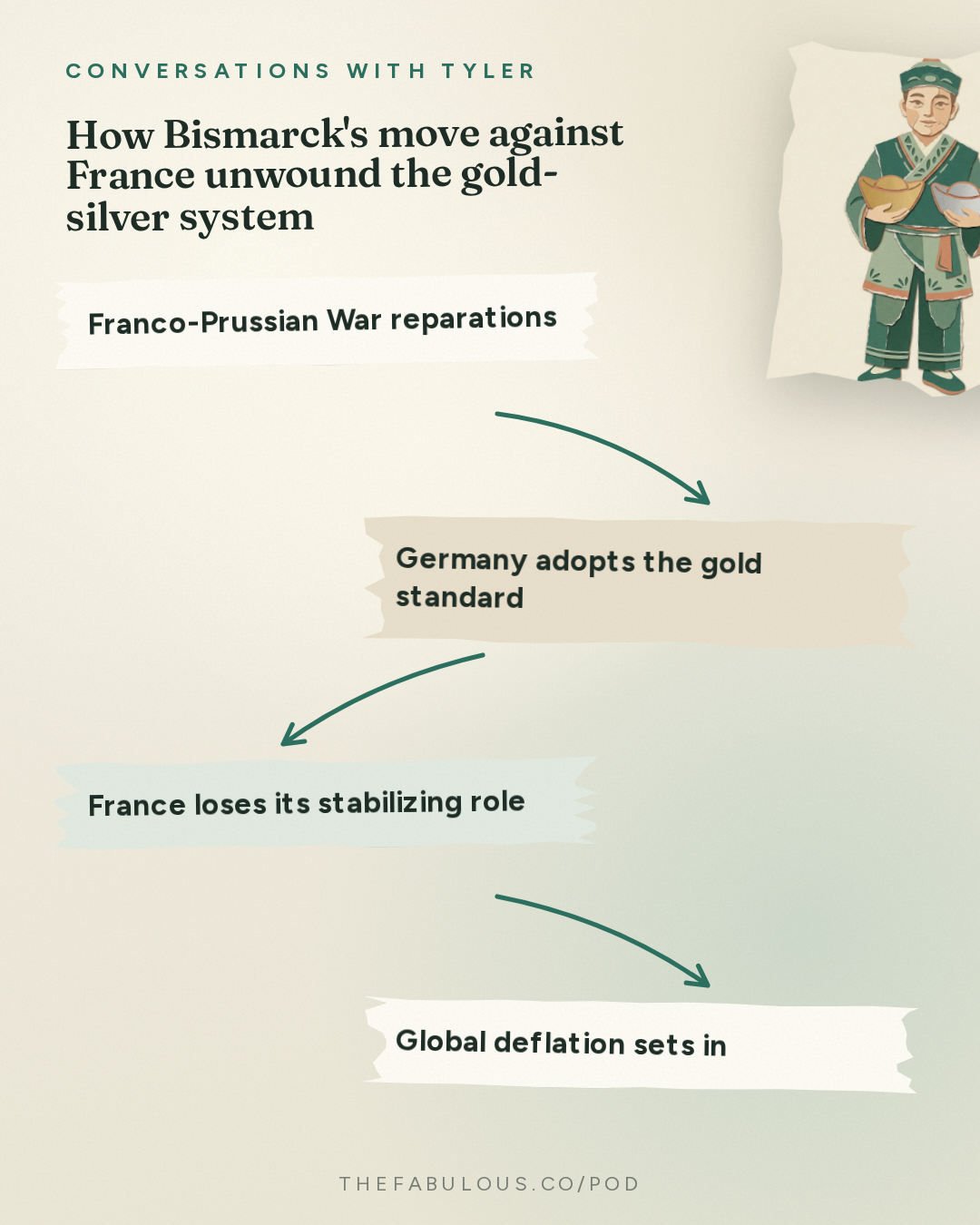
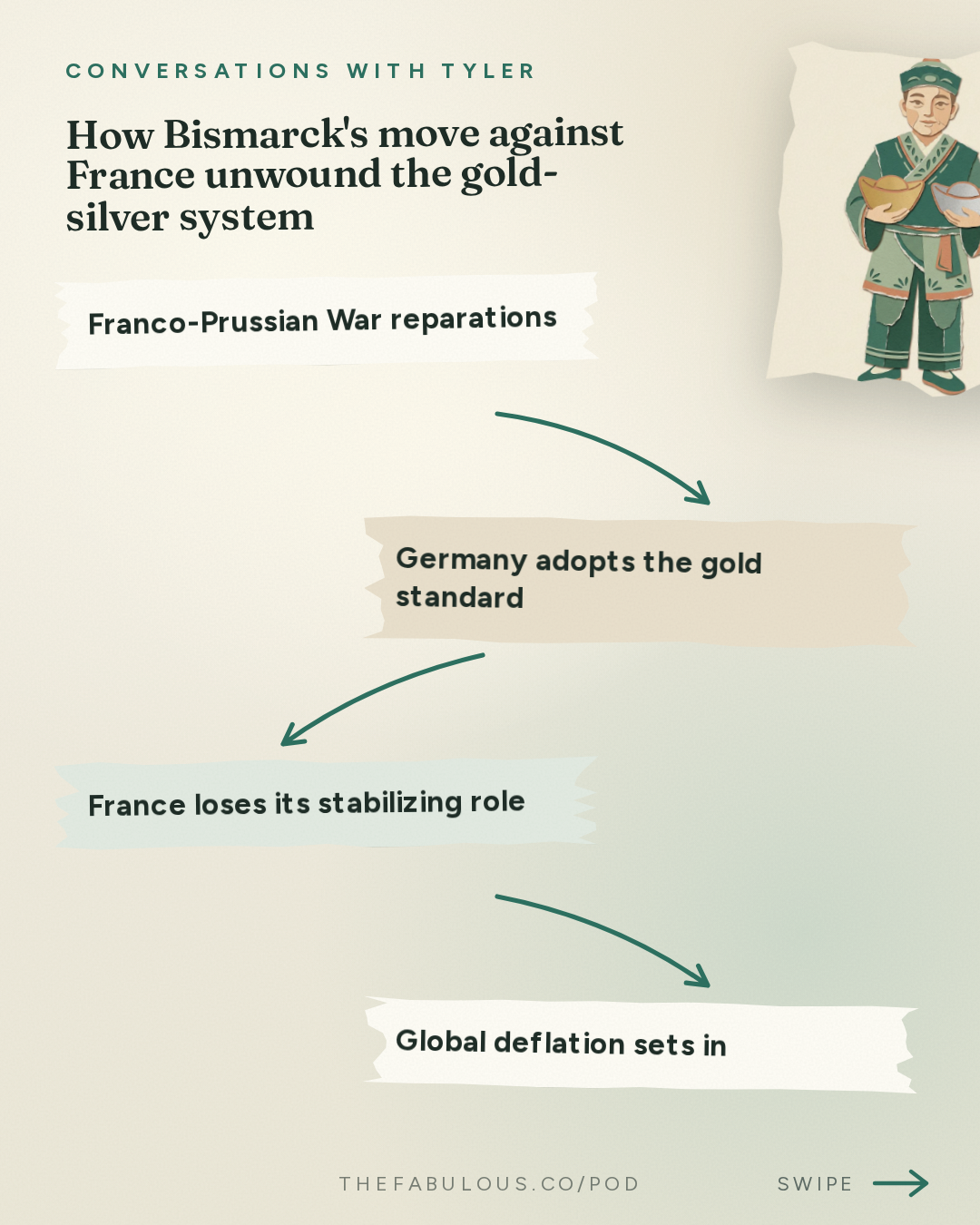
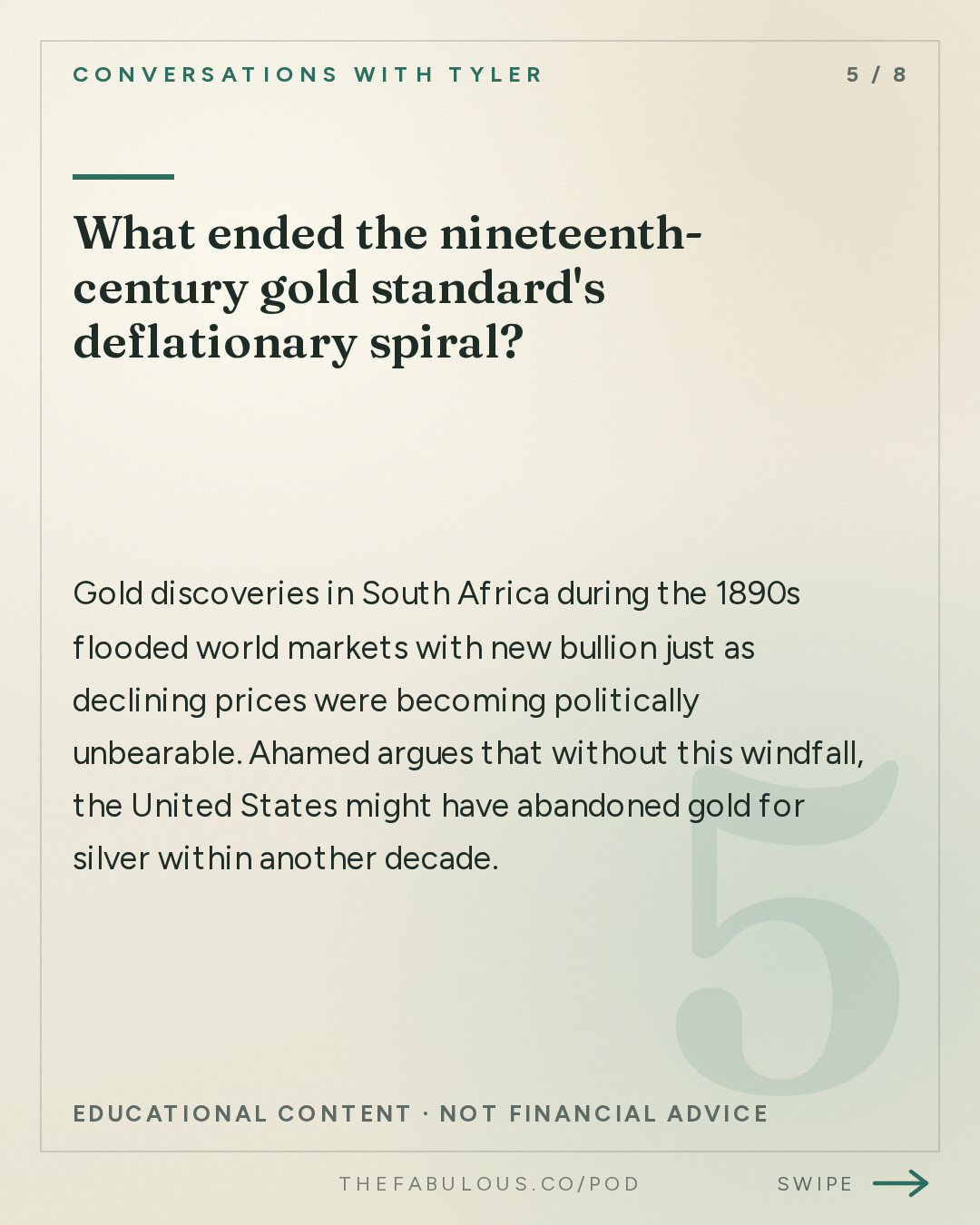
German chancellor Otto von Bismarck, flush with victory after the Franco-Prussian War, imposed a punishing reparations bill on France and, in Ahamed's telling, went further by dismantling bimetallism, the system under which currencies were backed by both gold and silver at a fixed ratio. France had been the linchpin of that system, holding the largest reserves of precious metal and successfully stabilizing the relative price of gold and silver for decades (14:53). When Germany abandoned bimetallism for a pure gold standard, the system France had anchored came apart, and with it went the cushion that had kept global prices steady. Ahamed believes the resulting deflation, not some natural law of monetary history, set off the distributional damage of the next quarter century (15:34). Cowen presses him on whether any currency peg can really survive for long, and Ahamed concedes the obvious limit: a system backed by two metals collapses once one metal's supply swings wildly relative to the other. What saved the gold standard from exactly that fate, almost by accident, was geology. The gold discoveries in South Africa in the 1890s flooded the world with new bullion just as deflationary pressure was becoming unbearable.
"I think the South African gold discoveries essentially saved the gold standard." — Liaquat Ahamed [17:38]
Without that windfall, Ahamed thinks the United States might well have abandoned gold for silver within another decade (17:38), a counterfactual that would have rewritten twentieth-century finance before it began.
Who Pays the Bill
The conversation jumps forward half a century to Germany's hyperinflation of the 1920s, when the currency collapsed so completely that people reportedly used wheelbarrows to carry cash to market. Ahamed offers a reading that is more cynical than the textbook story of simple monetary mismanagement: he suspects the inflation may have been, in part, a deliberate strategy to convince Germany's creditors that war reparations could never be collected (24:54). The policy worked in one narrow sense. Central bank governor Hjalmar Schacht later stabilized the currency and is credited with presiding over what Ahamed calls two separate German economic miracles, the recovery of the mid-1920s and, more troublingly, the rearmament boom of the 1930s under Hitler, built on empty reserves and tight import controls (26:20).
From here the thread runs forward to Ahamed's own years working with the World Bank and his book on the International Monetary Fund. His verdict on that institution is pointed: the United States, he says, has repeatedly used the IMF as an arm of its own foreign policy, pushing money into countries whose debts are not sustainable (32:26). The deeper failure, in his view, both in the Eurozone crisis and in the run-up to 2008, was the absence of any clean mechanism for restructuring debt that cannot be repaid. Someone has to decide who eats the loss, and Europe, lacking a single fiscal authority willing to play that role, let the question fester (32:56).
"I would not respond to pressure from the US to put money into unsustainable countries." — Liaquat Ahamed [32:26]
Asked why Britain, with an educational system that keeps producing the inventors behind modern artificial intelligence, has seen almost no real wage or productivity growth since the 2008 financial crisis, Ahamed admits he does not know (34:20). It is a small, honest gap in an otherwise confident account, and it matters, because it is the same puzzle that runs through the whole conversation: good institutions and smart people do not automatically produce good outcomes. Systems need something to hold them steady, the way France's reserves once held gold and silver in balance.
That idea resurfaces, unexpectedly, at the end of the interview, when Cowen asks about Ismaili Islam, the branch of Shia Islam to which Ahamed belongs by birth though he describes himself as non-practicing. Ismailis, he explains, follow a living spiritual leader, the Aga Khan, regarded as a direct descendant of the Prophet Muhammad, whose authority over a community of two to three million people worldwide is centralized and continuously updated (40:44). If the Aga Khan says move to Africa, Ahamed notes, large parts of the community will do it. It is, structurally, the opposite of the chaos Ahamed has spent the whole conversation describing: one trusted authority, able to adjust course in real time, rather than a system of rigid pegs waiting to snap.
Near the close, Cowen asks what Ahamed is optimizing for, since he left a successful private-sector career, declined to finish a Harvard doctorate, and has now written three books he did not need for income. The answer is almost offhand but it is the clearest statement of method in the whole hour.
"When you want to find out about something, writing a book about it is a remarkably good way of learning it." — Liaquat Ahamed [37:10]
That is as good a description as any of what this conversation delivers: not a tidy theory of financial crises, but the record of someone thinking his way through 150 years of them, out loud, in real time, still revising as he goes.
Ask this episode anything
Pod's AI answers from the episode itself, with the minute mark so you can hear it yourself.
Or start with one of these
Ask this episode
Pod's AI listens to the whole episode to answer, and points you to the minute it comes from.
The rest of this answer, and any question after it
Answers come from the episode itself, never from a summary of it.
ContinueKey takeaways
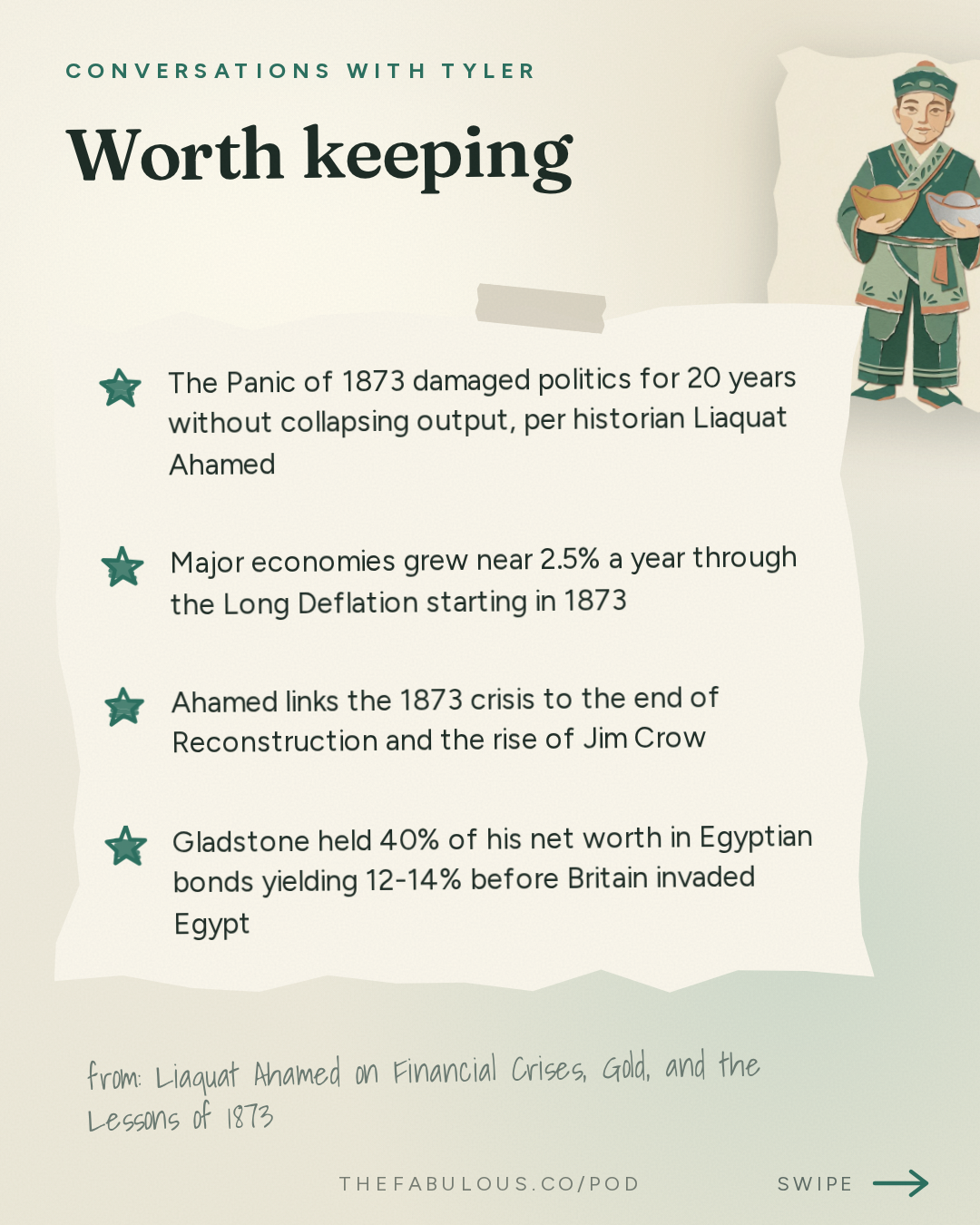
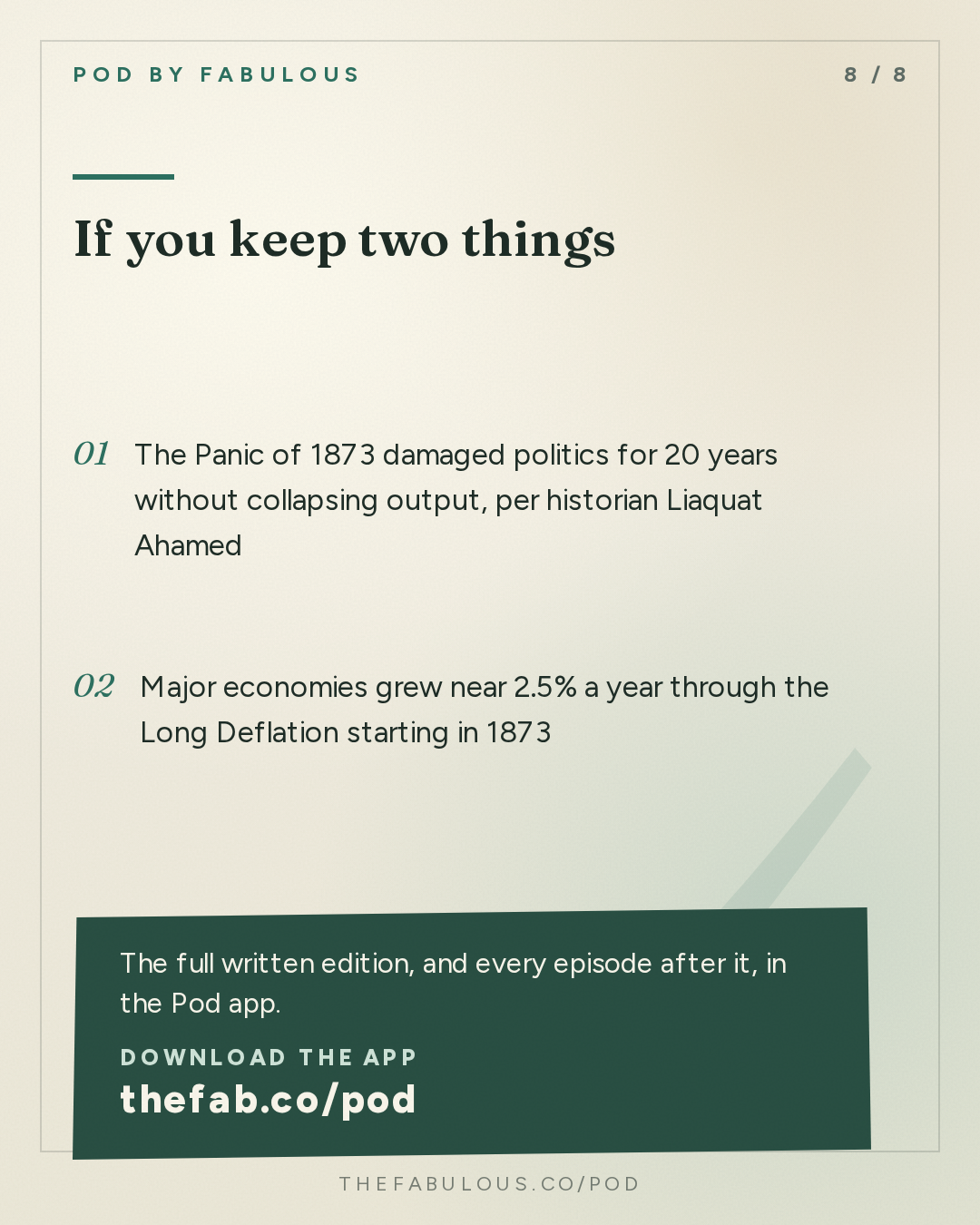
- The Panic of 1873 damaged politics for 20 years without collapsing output, per historian Liaquat Ahamed
- Major economies grew near 2.5% a year through the Long Deflation starting in 1873 (02:10)
- Ahamed links the 1873 crisis to the end of Reconstruction and the rise of Jim Crow (07:06)
- Gladstone held 40% of his net worth in Egyptian bonds yielding 12-14% before Britain invaded Egypt (09:44)
- Ahamed calls Bismarck the villain of the era for destroying the stable bimetallic monetary system (14:16)
The episode in cards

By the numbers
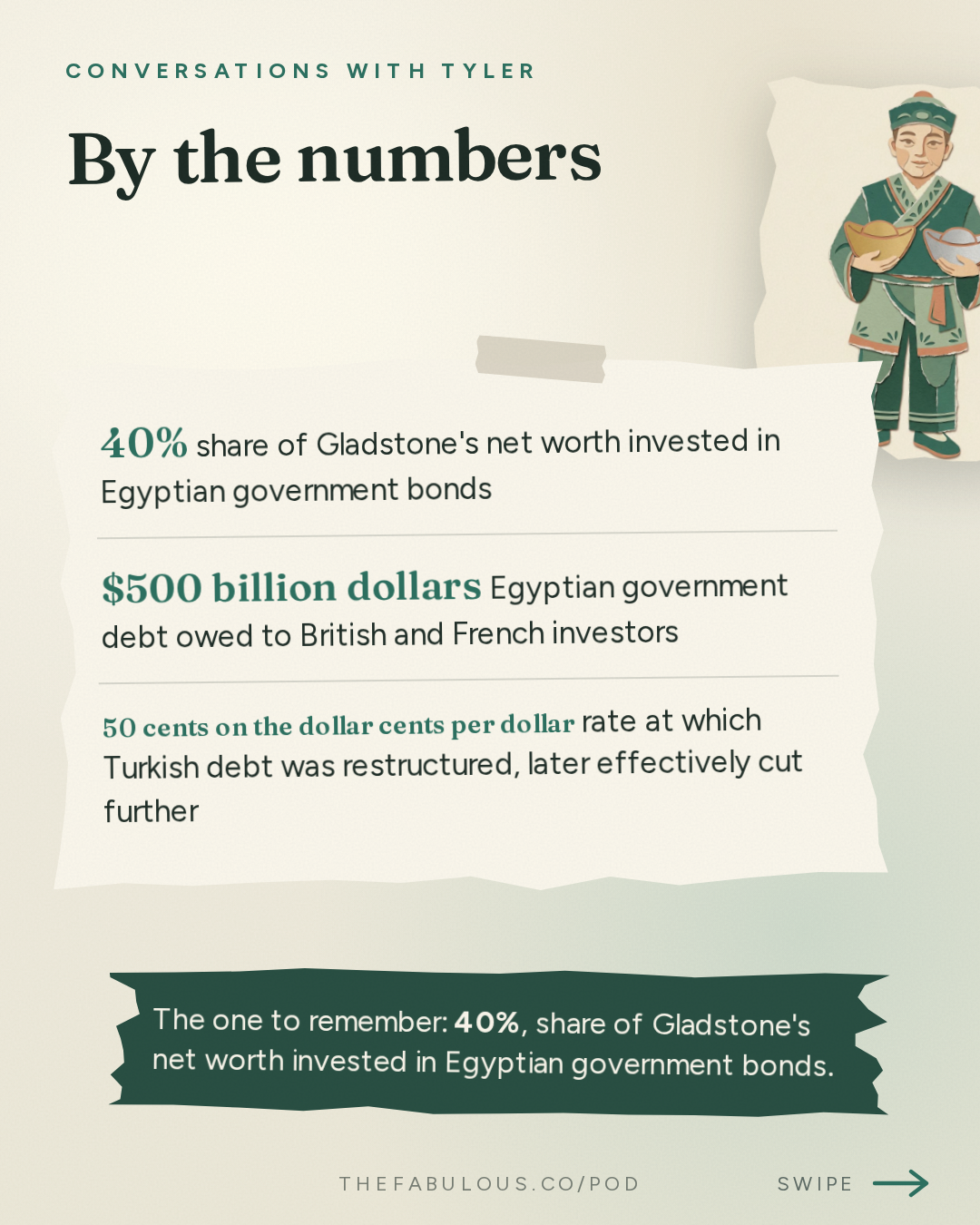
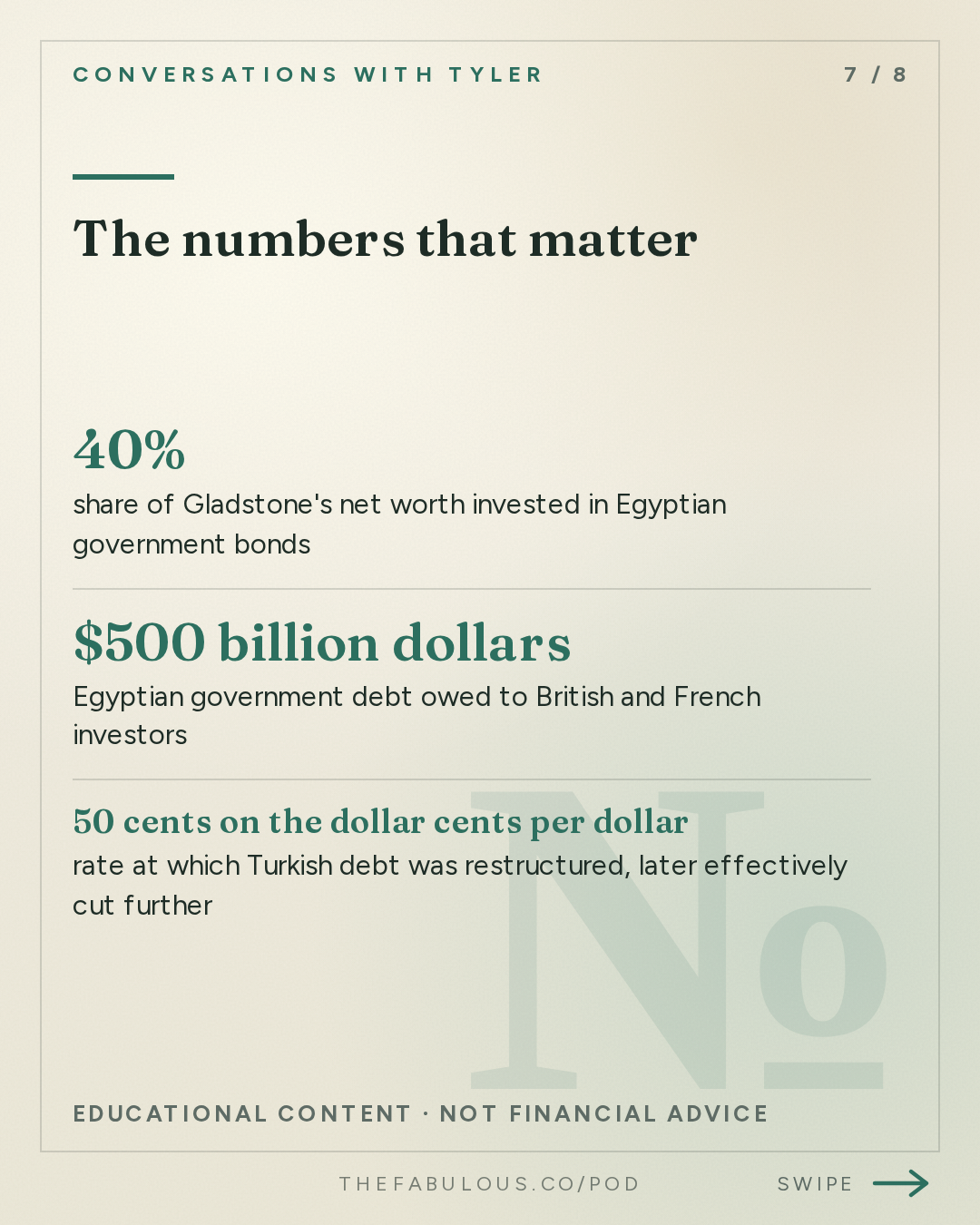
- 40% percent share of Gladstone's net worth invested in Egyptian government bonds
- $500 billion dollars Egyptian government debt owed to British and French investors
- 50 cents on the dollar cents per dollar rate at which Turkish debt was restructured, later effectively cut further
In their words
“A better title would have been The First Great Deflation.”
“Back Reconstruction. That was the end of Reconstruction. It's not hard to trace a line from there to Jim Crow”
“The biggest villain in my whole book is Bismarck.”
“I would not respond to pressure from the US to put money into unsustainable countries.”
“When you want to find out about something, writing a book about it is a remarkably good way of learning it.”
Questions this episode answers
Did the Panic of 1873 cause a Great Depression?
Historian Liaquat Ahamed argues it did not collapse output: major economies grew near 2.5% a year through the following two decades despite sustained deflation (02:10). The real damage was political, including the end of US Reconstruction and the rise of Jim Crow, which Ahamed traces to the crisis (07:06).
Why did Bismarck destroy bimetallism?
Ahamed says German chancellor Otto von Bismarck, after defeating France in the Franco-Prussian War, imposed heavy reparations and then abandoned the gold-silver bimetallic system that France had anchored for decades (14:16). Ahamed calls this decision the central villainous act of the whole 1873 story, since it removed the stabilizing mechanism behind global prices (15:34).
Why did William Gladstone insist Egypt repay its debt in full?
Gladstone had put 40% of his net worth into Egyptian bonds yielding 12 to 14%, and after Britain invaded Egypt in the 1880s it insisted Egypt repay creditors at full value (09:44). Ahamed believes Gladstone likely held a genuine moral conviction that debts must be paid, not pure self-interest, since he would have applied the same standard to Turkey if Britain had the power to enforce it there (11:59).
What ended the nineteenth-century gold standard's deflationary spiral?
Gold discoveries in South Africa during the 1890s flooded world markets with new bullion just as declining prices were becoming politically unbearable (17:38). Ahamed argues that without this windfall, the United States might have abandoned gold for silver within another decade.
Why are Ismaili Muslims seen as more progressive than much of the Muslim world?
Liaquat Ahamed, who was raised Ismaili though he describes himself as non-practicing, attributes it to the centralized leadership of the Aga Khan, regarded by Ismailis as a direct descendant of the Prophet Muhammad, who sets an evolving agenda for a global community of 2 to 3 million people (40:44).
The full read, in cards

Go deeper
- 1873: The Rothschilds, the First Great Depression, and the Making of the Modern World — Ahamed's argument that the 1873 panic damaged politics for two decades without collapsing economic output
- Lords of Finance: The Bankers Who Broke the World — Ahamed's Pulitzer Prize winning account of how the 1929 crash produced the Great Depression
- The Best and the Brightest — David Halberstam's book that Ahamed credits with teaching him how the US political system works
Mentioned
Liaquat Ahamed · Otto von Bismarck · William Gladstone · Hjalmar Schacht · Aga Khan · Montagu Norman · Gustav Stresemann · Katja Hoyer · David Halberstam · IMF · World Bank · Lords of Finance · 1873: The Rothschilds, the First Great Depression, and the Making of the Modern World · The Best and the Brightest
More from this show and category

Luis Garicano on AI, Messy Jobs, and Spain
Economist Luis Garicano says Spain's aging society blocks growth, and AI will spare messy jobs but eliminate clean ones. He also faults EU institutions, where unanimity rules and party discipline reward loyalty over competence, for chronic policy paralysis in Brussels and Madrid alike.

Gita Gopinath on Trade, Currencies, and China
Former IMF chief economist Gita Gopinath explains why currencies rarely move the way trade theory predicts. She covers why 90% of China's US exports are priced in dollars, Argentina's disinflation from 150% to 30%, and why AI-driven growth might not save the US debt trajectory.

Annie Lowrey on America's Time Tax
Journalist Annie Lowrey says America's hidden "time tax" of paperwork and waiting falls hardest on the poor, not the rich. She contrasts Social Security's under-1% overhead with TANF's $16.5 billion in yearly costs, estimates 50 hours a year in bureaucratic time per person, and predicts AI agents could ease the burden within five years.

Jared Diamond: Why No Leader Is Irreplaceable
Geographer Jared Diamond argues no leader in history has been truly irreplaceable, since long-run trends erase individual impact. His new book, Prophets, Profits, Coaches, and Kings, finds partial exceptions in business and sports, citing Jeff Bezos's customer-first Amazon and Genghis Khan's rise during the wettest steppe period in two thousand years.
