
Jared Diamond: Why No Leader Is Irreplaceable
Jared Diamond on Leaders, Luck, and Irreplaceability
▶ Listen to the full episode More from Conversations with Tyler
The brief
Geographer Jared Diamond argues no leader in history has been truly irreplaceable, since long-run trends erase individual impact. His new book, Prophets, Profits, Coaches, and Kings, finds partial exceptions in business and sports, citing Jeff Bezos's customer-first Amazon and Genghis Khan's rise during the wettest steppe period in two thousand years.
Ask most historians who mattered most and you get a list of names. Ask Jared Diamond, the UCLA geographer who spent sixty years studying New Guinea and wrote Guns, Germs, and Steel, and you get a stranger answer: nobody, not permanently. Diamond, who turns 89 next month (50:19), opens his new book, Prophets, Profits, Coaches, and Kings: When Do Leaders Matter?, with the boldest possible claim about leadership. Given enough time, he says, individual leaders wash out of the historical record entirely.
"There has been no unreplaceable leader in human history because over a long time, things wash out." (Jared Diamond, 01:25)
His test case is Jesus Christ. Half a dozen other prophets were active in the Roman Empire at the same time (01:25). Diamond's reasoning: had Christ died in childbirth, one of the others likely would have started a comparable movement, since a new religion needs only three roles, filled by one person or several. It needs a charismatic founder, an organizer, and often a general, because new faiths tend to face armed opposition (02:25). Saint Paul organized what Christ founded. The Mahdi of nineteenth-century Sudan played all three roles himself. So did Muhammad. Diamond admits he cannot say how replaceable Muhammad really was, because nobody has reconstructed seventh-century Arabian rainfall, and rainfall, he argues, drove the plant growth that fed both babies and armies (03:16). Genghis Khan is the case where the data exist, and they are unsettling. The wettest period on the Asian steppes in the last two thousand years arrived right around Genghis Khan's birth (04:09). Move his birthplace two hundred miles or his birth year by twenty, Diamond says, and the world never hears of him.
Geography's Long Reach, and Its Limits
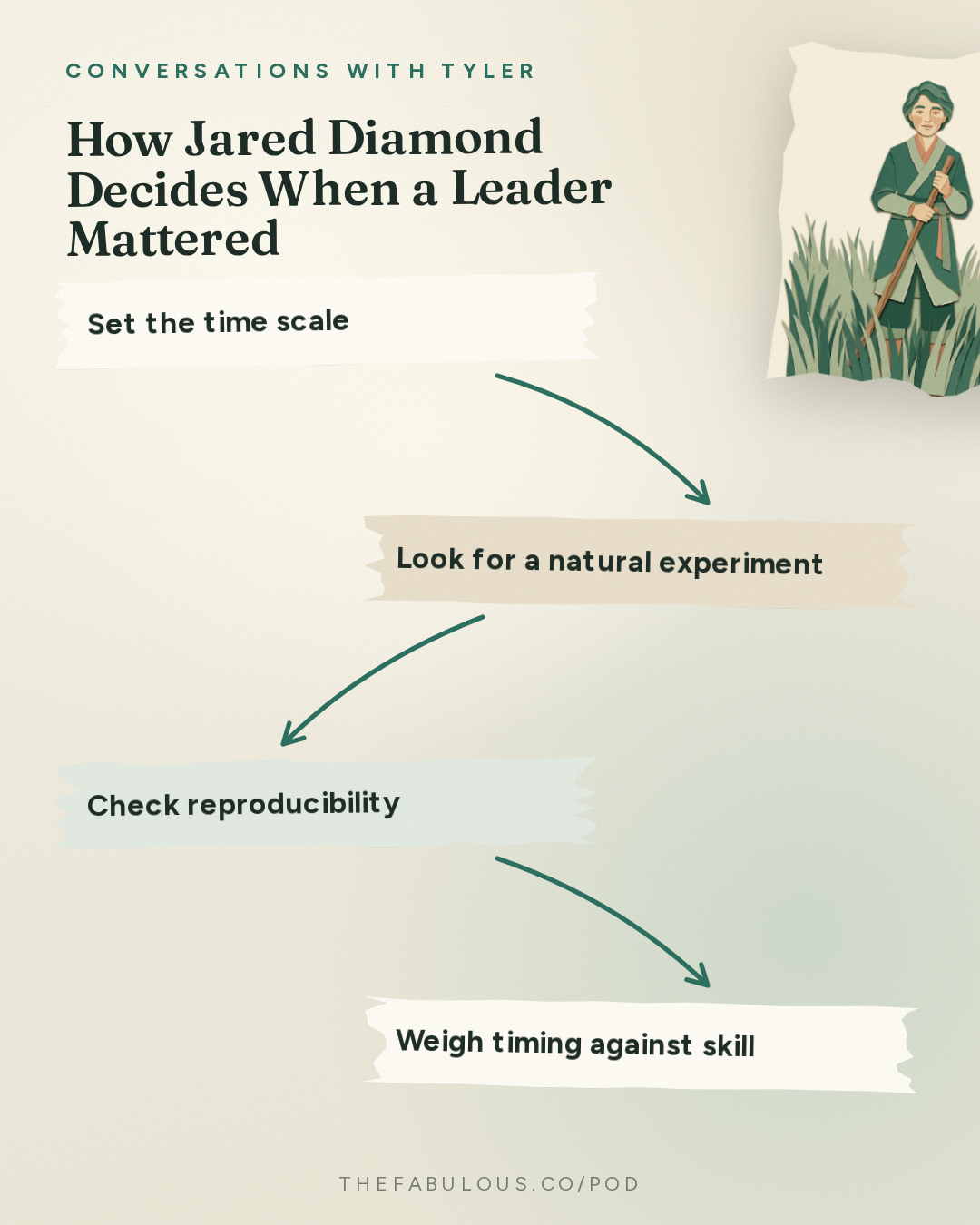
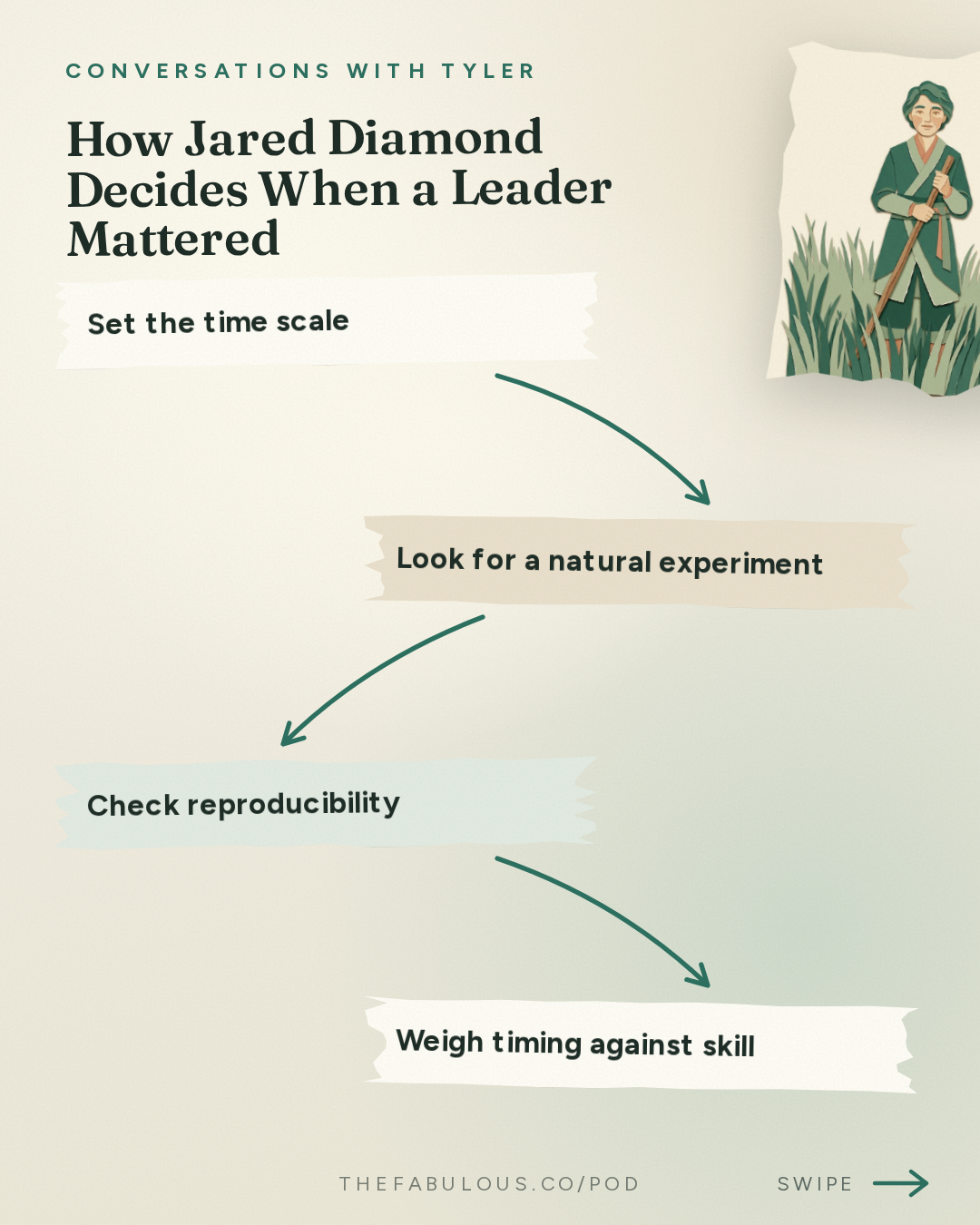
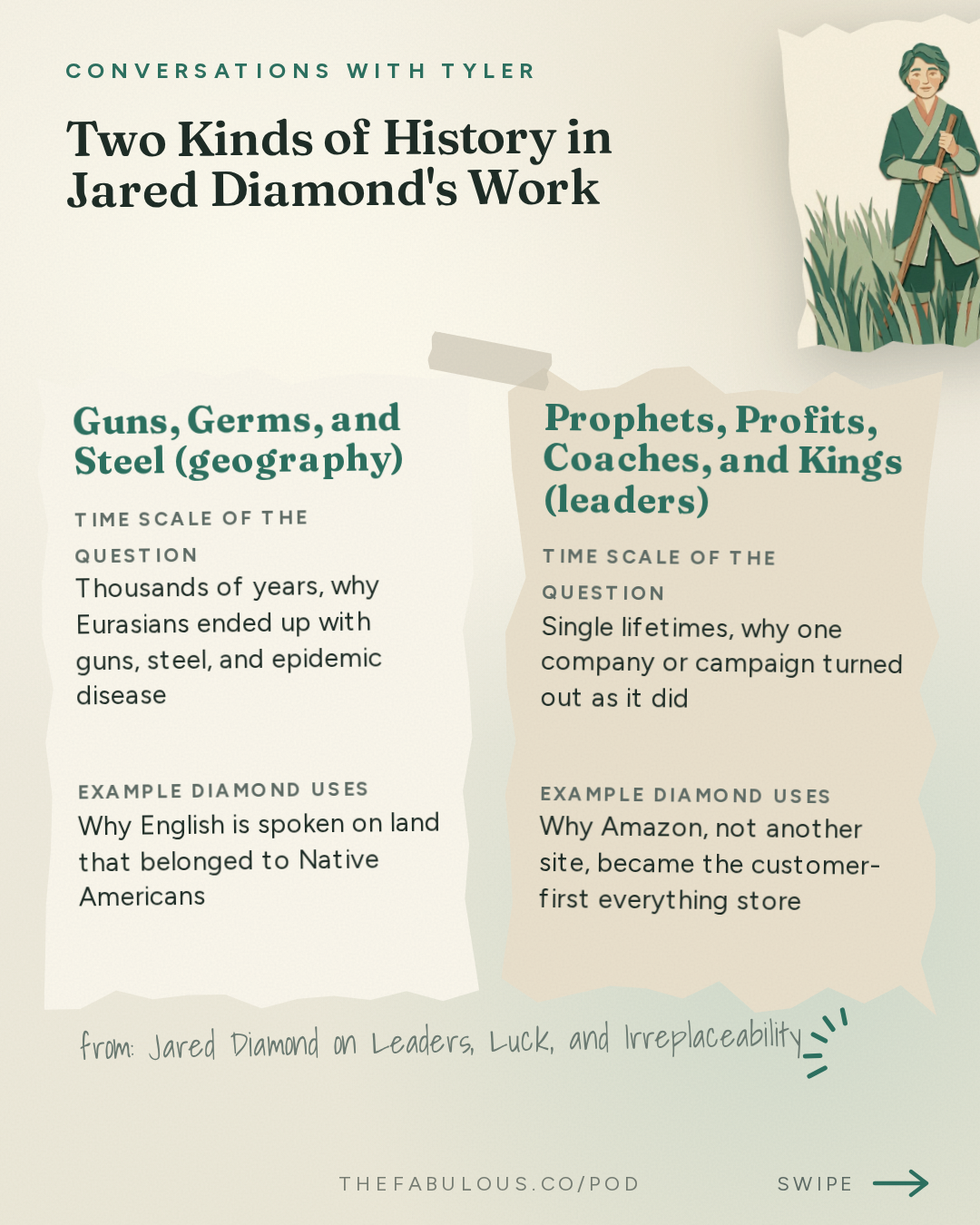
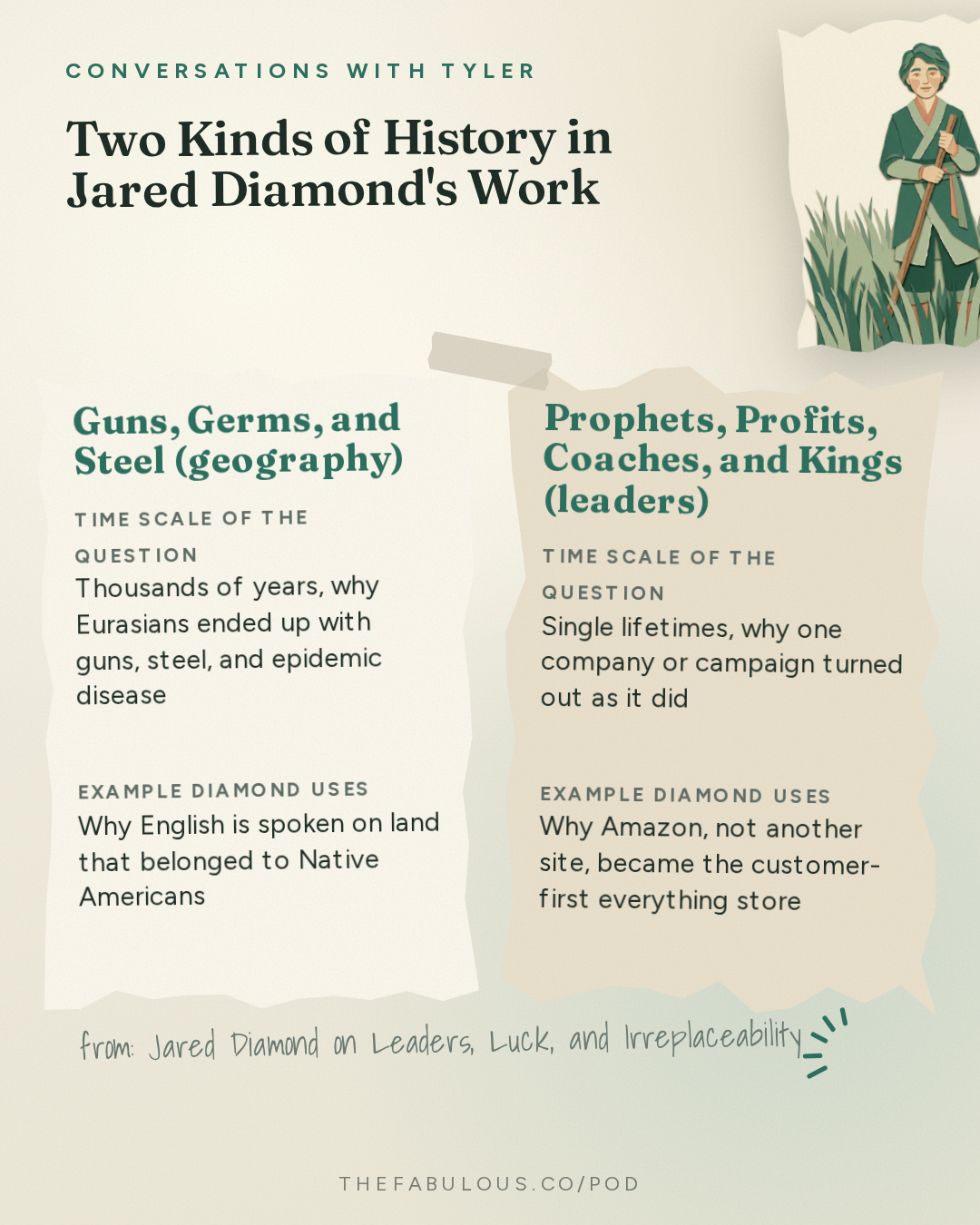
This is the logic of Guns, Germs, and Steel turned into a stopwatch. That book asked why Eurasians, not Native Americans, ended up with guns, steel, and epidemic diseases, and answered with plants, animals, and the shape of continents rather than persons (04:59). Diamond insists the new book does not contradict the old one. It just changes the time scale. Ask why history split as it did across ten thousand years and geography wins. Ask why one company, not another, became the store that swallowed retail and Diamond points instead to a single person. Amazon's insistence on serving customers over paying dividends, he says, is Jeff Bezos, full stop (05:23). Diamond also notes an odd fact about the leadership research itself: much of what business schools know about coaching comes from studying sports, not companies.
"In sports, there's a game every week. All the teams play by the same rules." (Jared Diamond, 06:44)
Sports produce a fresh, comparable data point every week under identical rules. Business does not. That is why researchers test their models on quarterbacks and point guards before applying them to CEOs.
Adolf Hitler gets the grimmest chapter. Diamond, born in 1937 (07:37), calls him the destructive leader who moved history the most in the twentieth century, not because Nazi ideology was unique but because Hitler was an unusually skilled deceiver who fooled his own generals, and an unusual risk-taker who was convinced he would die young and therefore refused to wait (08:09). Some gambles paid off, like the invasion of France. Others, like refusing to pull troops back from Stalingrad, did not. Diamond pairs this with a category he thinks gets undervalued: leaders who prevent things. Winston Churchill both acted and prevented, blocking a German conquest of Britain. John F. Kennedy's handling of the 1962 Cuban Missile Crisis gets Diamond's vote for the most consequential act of preventative leadership on record, a week in which a Soviet submarine officer very nearly launched a nuclear missile before his own crewmates stopped him (11:16).
When One Person Actually Bends the Curve
The book's more interesting cases sit below the level of nations. Rachel Carson's 1962 book Silent Spring warned that pesticides were poisoning the food chain. Diamond argues it jumpstarted the environmental movement roughly a decade before it would have arrived on its own (12:33), partly for a reason that has nothing to do with the science: in the 1950s, professional scientists believed that writing for the public meant a career was over.
"In those days, the belief among scientists, professional scientists, was that if you write for the public, it's because you're washed up as a scientist, you're prostituting yourself." (Jared Diamond, 14:15)
Carson had no university post to lose, wrote with the ear of a poet, and stayed calm on television while a chemical-company spokesman lost his composure arguing against her. The first male scientists to achieve similar public fame, Paul Ehrlich and Carl Sagan, did not manage it until twenty years later.
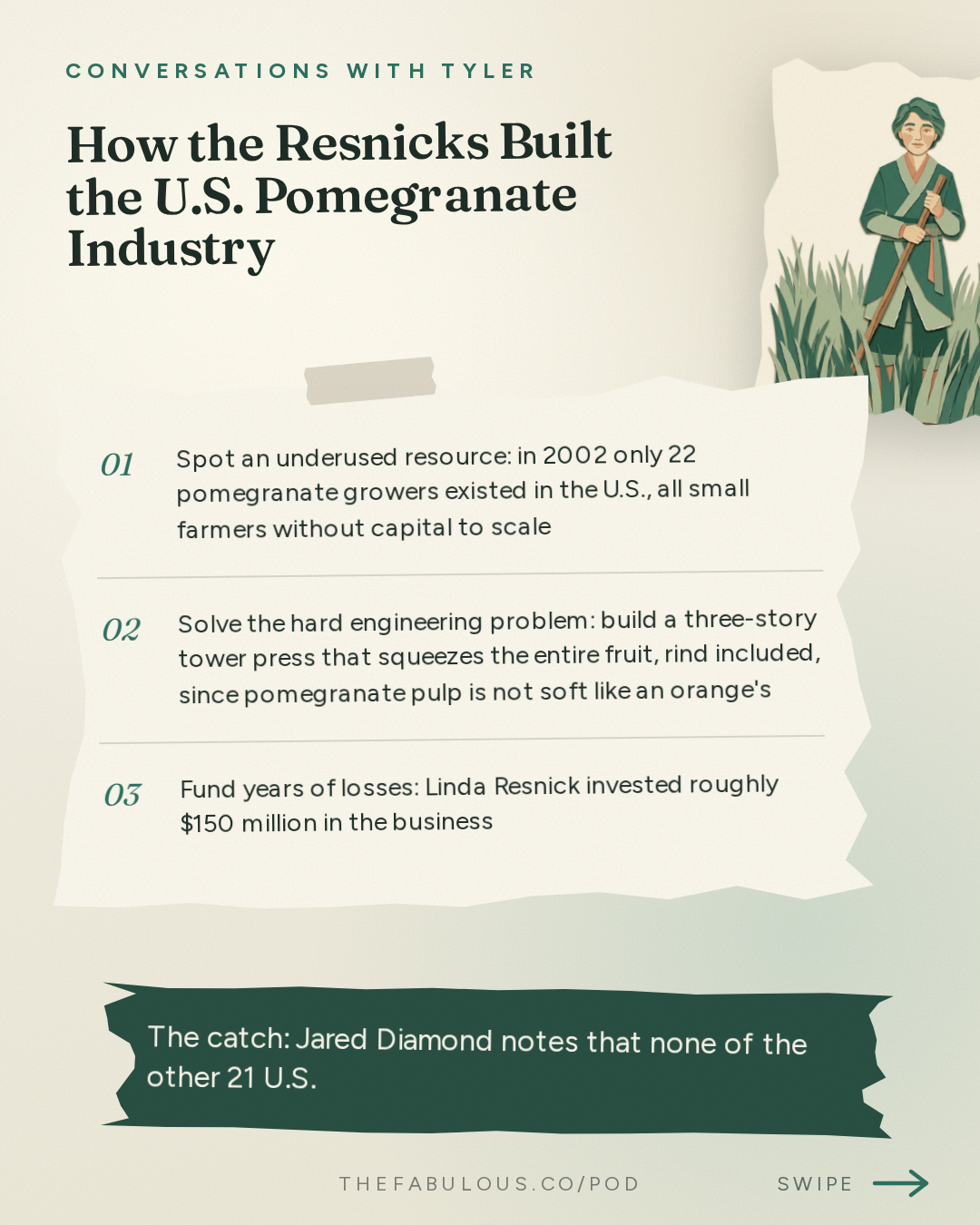
A similar story shows up in the produce aisle. Pomegranates have been domesticated for roughly six thousand years, yet in 2002 the United States had exactly 22 growers, all small farmers without the capital to do anything ambitious with the fruit (17:03). Businesswoman Linda Resnick spent a couple hundred million dollars and waited 18 years before her pomegranate juice brand turned a profit (17:27), a bet Diamond says none of the other growers, and no public company like Coca-Cola, would have made. And in sports, Diamond credits UCLA basketball coach John Wooden with a small, specific fix that mattered more than star recruiting: after a mediocre season, Wooden realized he had been practicing players in fixed groups of five, so substitutes never synced with teammates. He switched to groups of seven (21:06), and his players, including Bill Walton, remembered him less as a coach than as a person who shaped their lives.
Diamond widens the lens twice more before the conversation ends. He argues that constant indirect communication, phones, then the internet, is visibly eroding face-to-face social skill, a decline he first noticed by contrast with New Guinea villagers who out-negotiated international oil-company lawyers because their entire culture ran on in-person bargaining (25:30, 26:04). He goes further and suggests New Guineans are, on average, more curious and quicker than Westerners, a claim he says reliably angers audiences, and grounds it in natural selection: European survival for ten thousand years hinged on resisting infectious disease, while New Guinean survival hinged on navigating a brutal environment and near-constant tribal warfare (29:25). On the old debate between geography and institutions, economists Daron Acemoglu and James Robinson shared a Nobel Prize for arguing that inclusive institutions, not geography, explain national wealth. Diamond says Robinson taught him the power of natural experiments, comparing similar cases that differ in one variable, the same method he used comparing New Guinea mountains with and without a rival bird species (35:50). He just weights geography more heavily than his friends do.
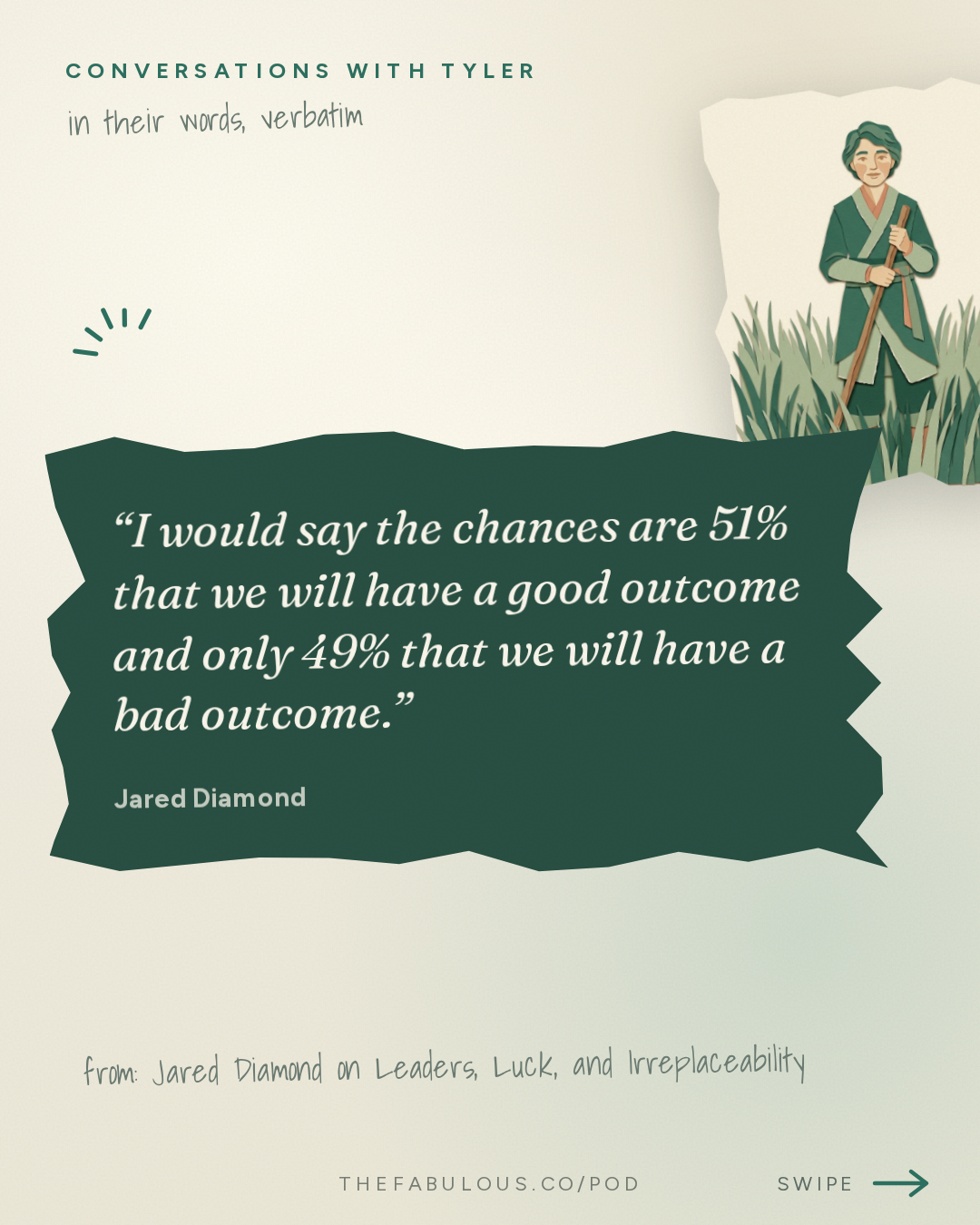
On the environment, Diamond has grown more hopeful, not less, in the past twenty years, mostly because large companies like Walmart and Unilever now treat sustainability as core business rather than nuisance, and because younger generations engage with the issue far more than his own did. He puts the odds at 51 percent for a good global outcome and 49 percent for a bad one (38:32), odds he clearly finds worth living for. Asked what he wants to learn next, at 89, he mentions two things: finishing all 200 of Bach's cantatas, one a week, currently at number 57 (46:02), and finally synthesizing sixty years of birdwatching across New Guinea's ten outlying mountain ranges, some of which no one else has ever surveyed.
"Once you've been to New Guinea, the rest of the world is boring." (Jared Diamond, 43:49)
It is a strange note to end on for a man who has spent a career proving that no single place, and no single person, is ever truly irreplaceable. But New Guinea, for Diamond, is less an exception to that rule than its best illustration: a landmass with 700 languages and no leader who ever unified it (09:34), shaped almost entirely by geography, and somehow still the place he finds most alive.
Ask this episode anything
Pod's AI answers from the episode itself, with the minute mark so you can hear it yourself.
Or start with one of these
Ask this episode
Pod's AI listens to the whole episode to answer, and points you to the minute it comes from.
The rest of this answer, and any question after it
Answers come from the episode itself, never from a summary of it.
ContinueKey takeaways
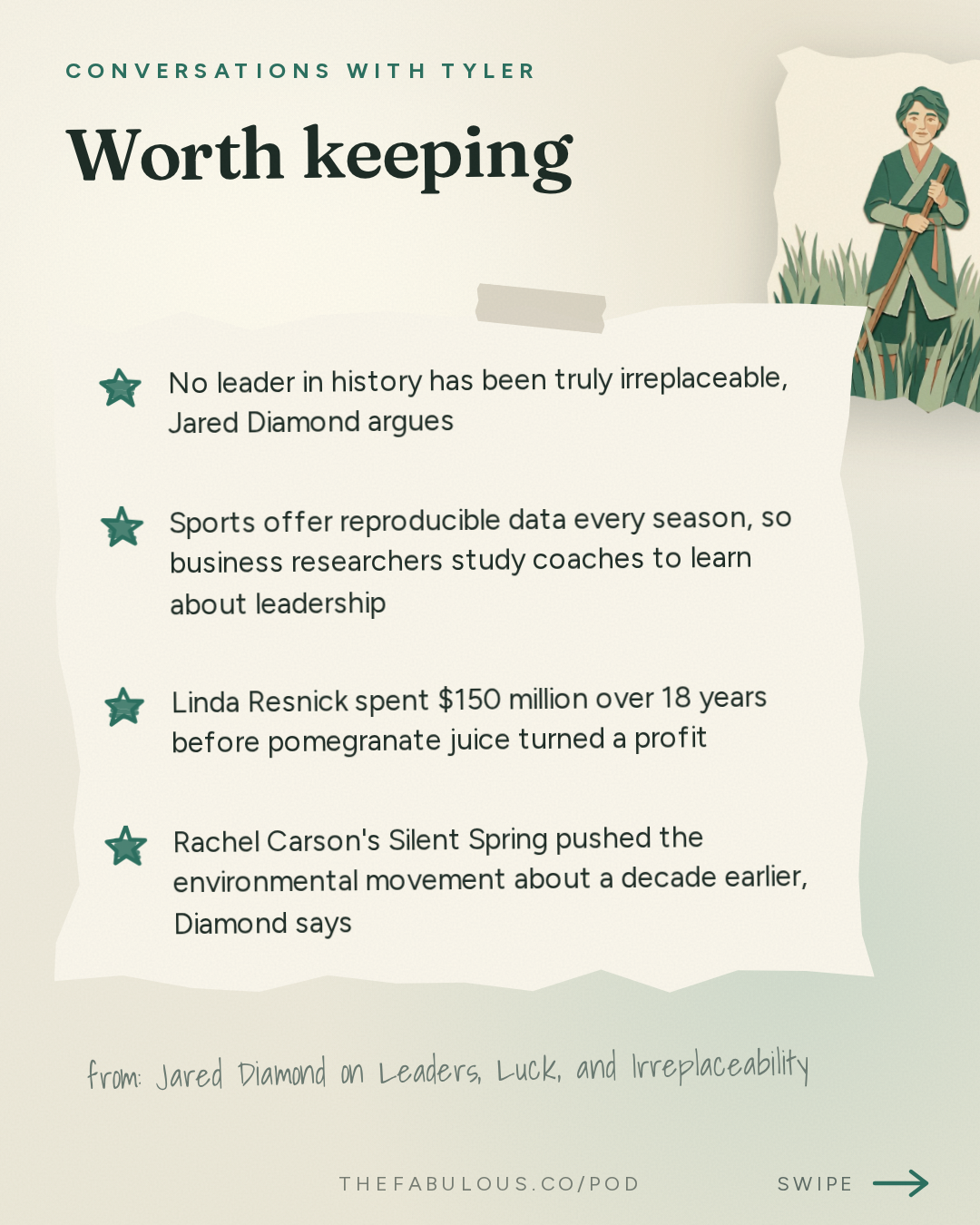
- No leader in history has been truly irreplaceable, Jared Diamond argues
- Sports offer reproducible data every season, so business researchers study coaches to learn about leadership (06:44)
- Linda Resnick spent $150 million over 18 years before pomegranate juice turned a profit (17:27)
- Rachel Carson's Silent Spring pushed the environmental movement about a decade earlier, Diamond says (12:33)
- Diamond estimates 51% odds of a good global environmental outcome versus 49% for a bad one (38:32)
The episode in cards

By the numbers
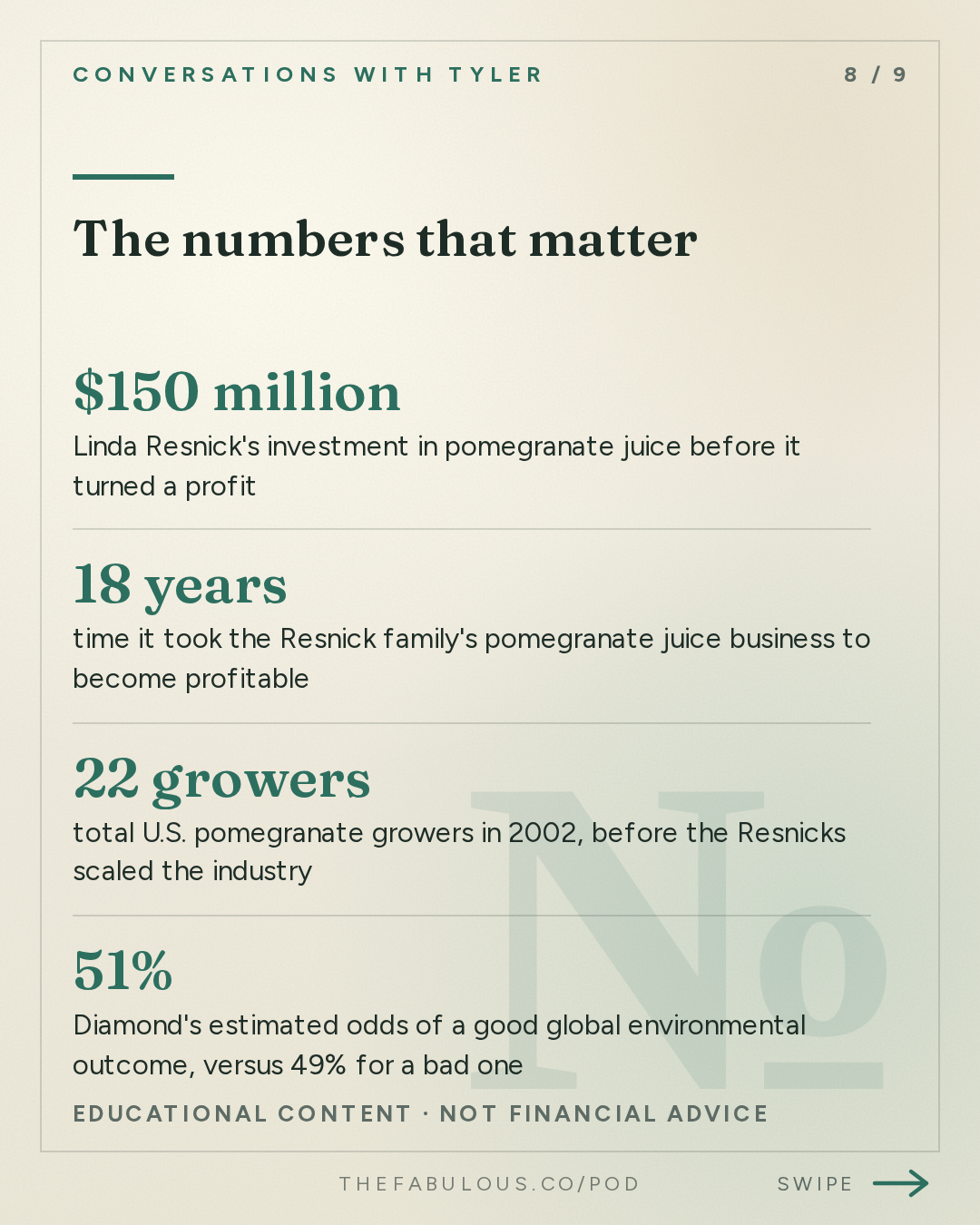
- $150 million Linda Resnick's investment in pomegranate juice before it turned a profit
- 18 years time it took the Resnick family's pomegranate juice business to become profitable
- 22 growers total U.S. pomegranate growers in 2002, before the Resnicks scaled the industry
- 51% Diamond's estimated odds of a good global environmental outcome, versus 49% for a bad one
In their words
“There has been no unreplaceable leader in human history because over a long time, things wash out.”
“In those days, the belief among scientists, professional scientists, was that if you write for the public, it's because you're washed up as a scientist, you're prostituting yourself.”
“Once you've been to New Guinea, the rest of the world is boring.”
“I would say the chances are 51% that we will have a good outcome and only 49% that we will have a bad outcome.”
Protocols
-
Build career leverage through face-to-face skill
Jared Diamond tells ambitious young people to learn to talk to others face to face and set aside indirect tools like text and social media. He points to New Guinea villagers, who out-negotiated international oil-company lawyers because their entire culture runs on in-person bargaining, as evidence that this skill compounds over a lifetime.
ongoing practice, not a one-time step
-
Restructure practice groups to build team cohesion
Jared Diamond reports that UCLA basketball coach John Wooden found that practicing players in fixed groups of five meant a substitute never synced with the rest of the unit. Wooden fixed this by training players in overlapping groups of seven, so any player called off the bench had already practiced with more of his teammates.
structural change applied across practices
Questions this episode answers
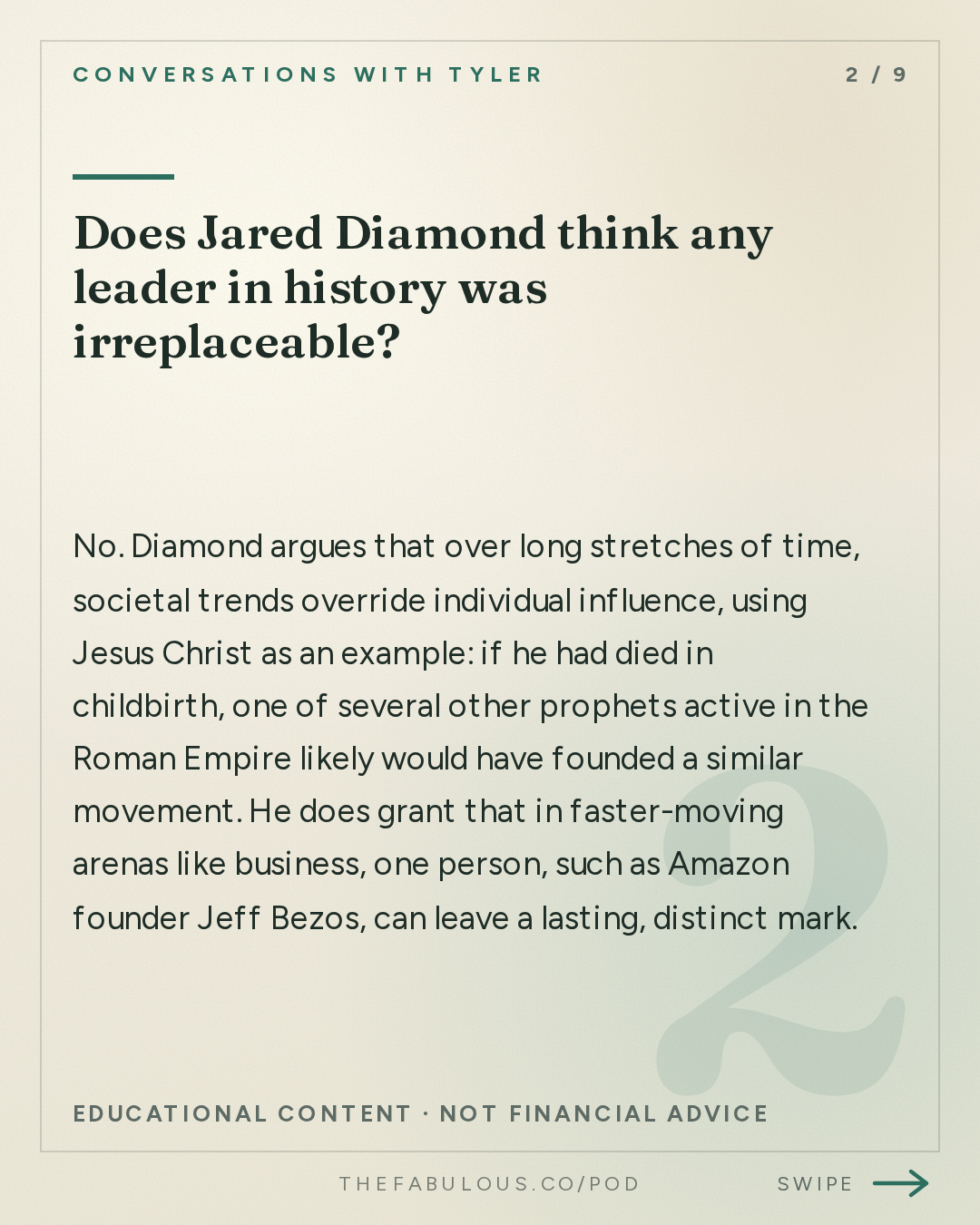
Does Jared Diamond think any leader in history was irreplaceable?
No. Diamond argues that over long stretches of time, societal trends override individual influence, using Jesus Christ as an example: if he had died in childbirth, one of several other prophets active in the Roman Empire likely would have founded a similar movement (01:25). He does grant that in faster-moving arenas like business, one person, such as Amazon founder Jeff Bezos, can leave a lasting, distinct mark (05:23).
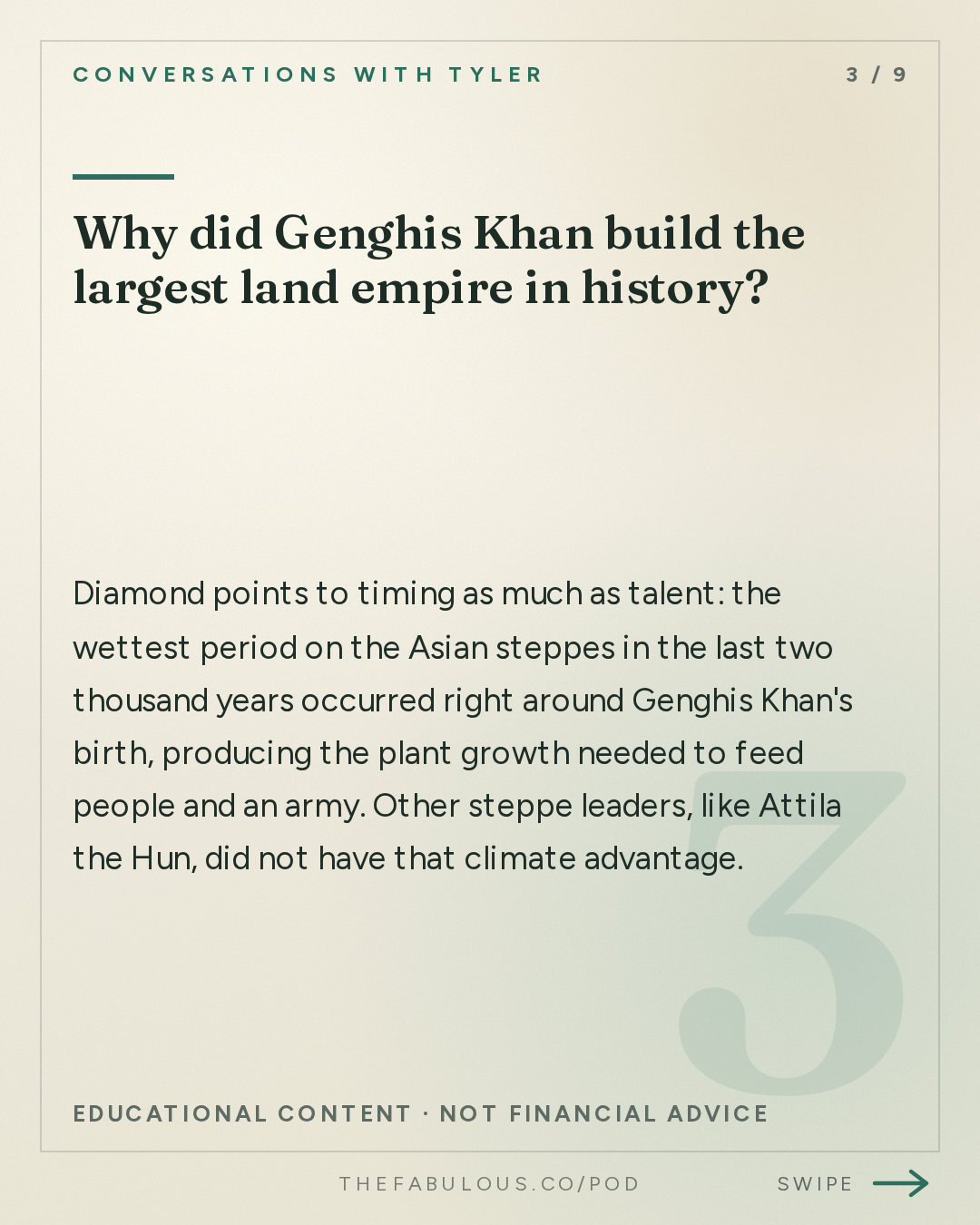
Why did Genghis Khan build the largest land empire in history?
Diamond points to timing as much as talent: the wettest period on the Asian steppes in the last two thousand years occurred right around Genghis Khan's birth, producing the plant growth needed to feed people and an army (04:09). Other steppe leaders, like Attila the Hun, did not have that climate advantage.
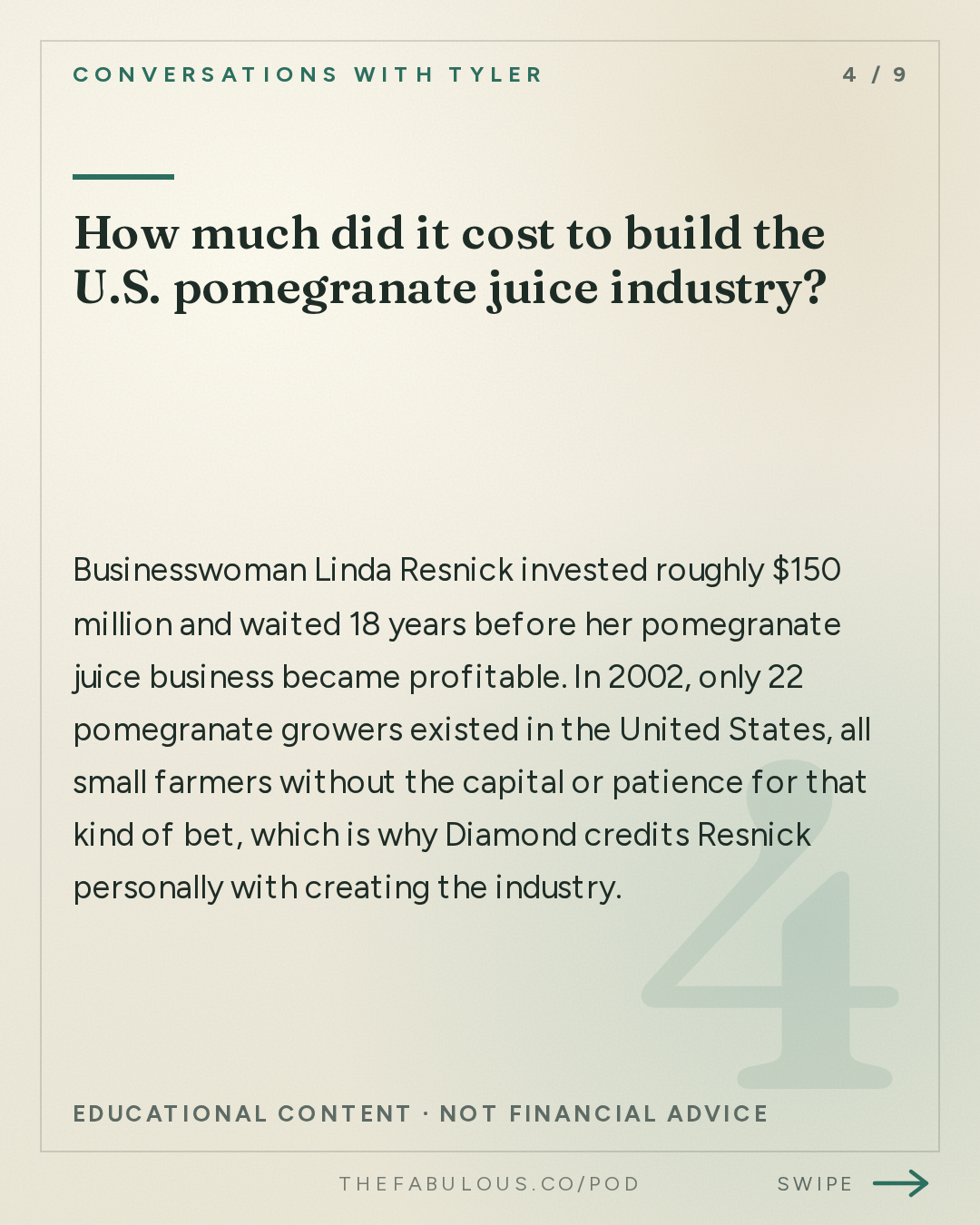
How much did it cost to build the U.S. pomegranate juice industry?
Businesswoman Linda Resnick invested roughly $150 million and waited 18 years before her pomegranate juice business became profitable (17:27). In 2002, only 22 pomegranate growers existed in the United States, all small farmers without the capital or patience for that kind of bet, which is why Diamond credits Resnick personally with creating the industry (17:03).
Did Rachel Carson really start the environmental movement?
Diamond says Carson's 1962 book Silent Spring jumpstarted the environmental movement about a decade earlier than it otherwise would have appeared. As a respected scientist and gifted writer who held no university post, she could publish for the public without being accused of having sold out, unlike the male academics who followed her lead two decades later (12:33, 14:15).
Why does Jared Diamond think New Guineans are smarter than Westerners?
Diamond argues natural selection in Papua New Guinea has favored curiosity and problem-solving, since survival there has depended on a difficult environment and near-constant tribal warfare, while survival in Europe depended more on resisting infectious diseases like smallpox and tuberculosis (29:25). He notes the claim provokes strong pushback from Western audiences.
Is Jared Diamond optimistic about the environment?
Diamond says he is more optimistic now than 20 years ago, putting the odds of a good global outcome at 51 percent versus 49 percent for a bad one. He credits greater environmental engagement from large companies like Walmart and Unilever and from young people (38:32).
The full read, in cards
Go deeper
- Silent Spring — Rachel Carson's 1962 book on pesticide harm that Diamond says jumpstarted the environmental movement about a decade early
- Guns, Germs, and Steel — Diamond's earlier book explaining Eurasian societal advantage through geography and domesticable species rather than leaders
- Prophets, Profits, Coaches, and Kings: When Do Leaders Matter? — Diamond's new book examining when individual leaders in religion, business, sports, and politics actually change outcomes
- Nature paper on West Eurasian genetic selection — Cited by Tyler Cowen as evidence West Eurasians grew genetically smarter since the Stone Age; Diamond says it shows change over time, not superiority
Mentioned
Jared Diamond · Tyler Cowen · Genghis Khan · Jeff Bezos · Rachel Carson · Linda Resnick · John Wooden · Daron Acemoglu · James Robinson · Adolf Hitler · Winston Churchill · John F. Kennedy · Johann Sebastian Bach · UCLA
More from this show and category

The Panic of 1873 and Its 20-Year Political Toll
Historian Liaquat Ahamed argues the Panic of 1873 did not collapse the world economy, it poisoned its politics for twenty years. Growth held near 2.5% through a long deflation (02:10), but the fallout helped end Reconstruction (07:06), fueled Gladstone's Egyptian bond windfall (09:44), and let Bismarck wreck bimetallism (14:16).

Luis Garicano on AI, Messy Jobs, and Spain
Economist Luis Garicano says Spain's aging society blocks growth, and AI will spare messy jobs but eliminate clean ones. He also faults EU institutions, where unanimity rules and party discipline reward loyalty over competence, for chronic policy paralysis in Brussels and Madrid alike.

Gita Gopinath on Trade, Currencies, and China
Former IMF chief economist Gita Gopinath explains why currencies rarely move the way trade theory predicts. She covers why 90% of China's US exports are priced in dollars, Argentina's disinflation from 150% to 30%, and why AI-driven growth might not save the US debt trajectory.

Annie Lowrey on America's Time Tax
Journalist Annie Lowrey says America's hidden "time tax" of paperwork and waiting falls hardest on the poor, not the rich. She contrasts Social Security's under-1% overhead with TANF's $16.5 billion in yearly costs, estimates 50 hours a year in bureaucratic time per person, and predicts AI agents could ease the burden within five years.
