
Luis Garicano on AI, Messy Jobs, and Spain
Luis Garicano on Spain, Europe, and the Future of Work
▶ Listen to the full episode More from Conversations with Tyler
The brief
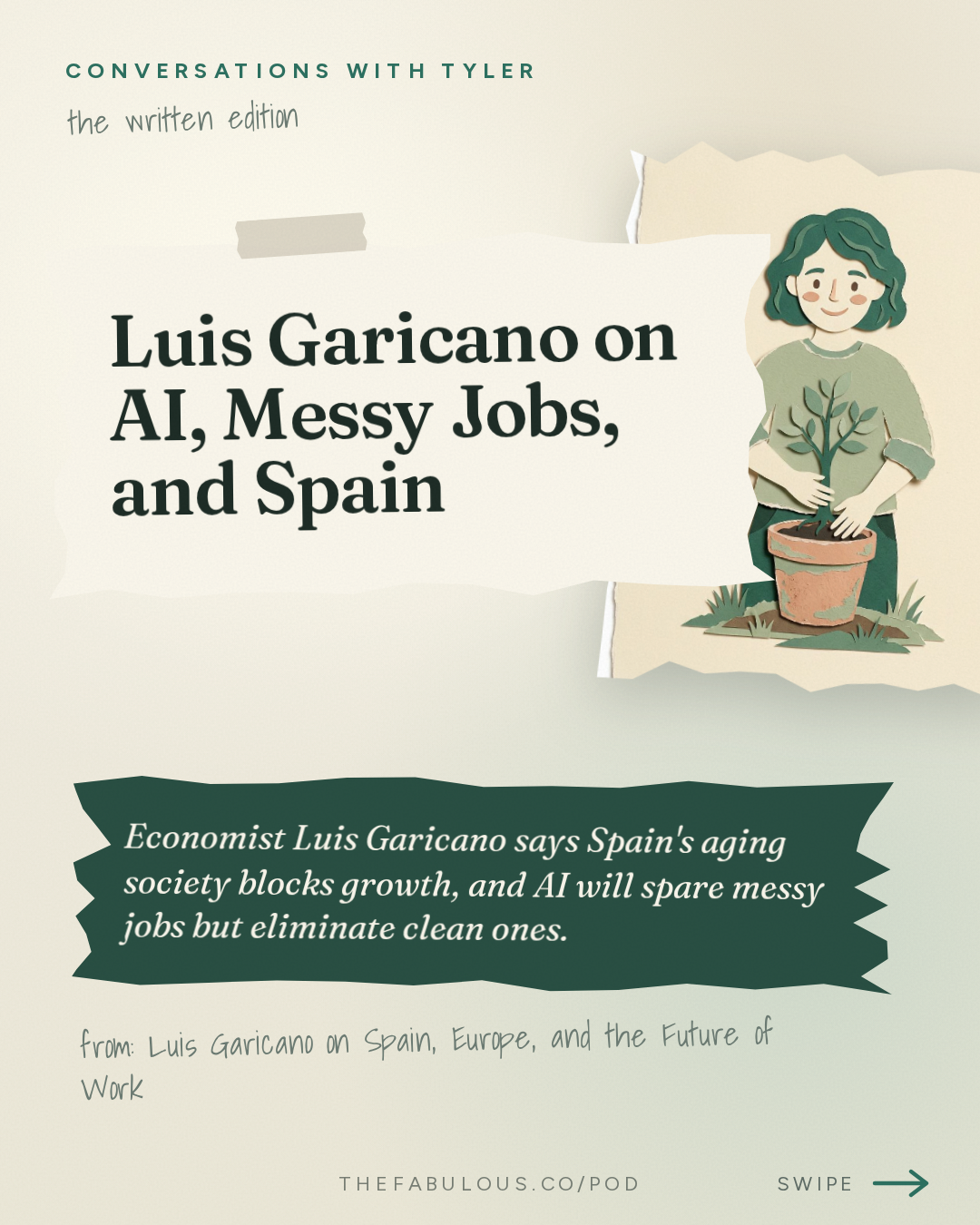
Economist Luis Garicano says Spain's aging society blocks growth, and AI will spare messy jobs but eliminate clean ones. He also faults EU institutions, where unanimity rules and party discipline reward loyalty over competence, for chronic policy paralysis in Brussels and Madrid alike.
Spain has the sun of Texas, the coastline of Florida, and a life expectancy that ranks fifth highest in the world. It also has the fifth lowest fertility rate on the planet and a science Nobel Prize drought stretching back to 1905 (12:58). Ask Luis Garicano, a Spanish economist who taught at the University of Chicago, served in the European Parliament, and has spent his career tracing how institutions bend incentives, and he explains the paradox less through talent or luck than through a simple question: who gets to vote, and who does the system actually serve.
Start with housing. Before the 2008 financial crisis, Spain built up to 800,000 houses a year (01:22), an extraordinary pace for a country its size. The boom turned into a bubble, and the bubble turned into a scandal that tied local politicians, developers, and savings banks together in corruption. The public drew a lesson from that, but arguably the wrong one. Instead of blaming weak oversight, many Spaniards came to associate building itself with graft.
"People identified easy building with corruption and people identify easy building with high prices." Luis Garicano, [02:09]
So the country passed rules stripping municipalities of much of their power over land use, on the theory that less discretion means less corruption (02:47). The result is a housing supply that barely moves. Spain now builds under 100,000 houses a year while absorbing hundreds of thousands of immigrants annually (02:47). Drive through the country and much of it sits empty, ringed by biodiversity rules and a green belt around Madrid that recalls London's. Barcelona residents insist their city is full even though the land around its airport sits fallow. Garicano's shorthand is that an anti-corruption reform aimed at politicians ended up disempowering the very people who could unblock supply.
The demographic math compounds the problem. Spain has gone three decades without meaningful productivity growth (04:37), while its population skews old, with the fifth lowest fertility rate and the fifth highest life expectancy in the world (05:04). As Garicano puts it, essentially all of the country's GDP growth since 2008 has gone to pensioners (05:04). High-speed rail lines and highways built in better decades now go without the maintenance they need (05:28), not because Spain lacks money but because the money has a prior claim. A country can have cheap solar and wind power, empty land for nuclear plants, and excellent weather, and still stall, because the voters who show up are old, comfortable, and unthreatened by the status quo. Cowen calls it a kind of resource curse, and Garicano agrees: a place with almost nothing wrong day to day has almost no appetite for the disruption that fixing anything requires. Real reform in Spain, he notes, has historically arrived only through crisis, in 1959, in the early 1980s, and again in 2012 (07:05).
A domestic version of the same dynamic plays out between Madrid and its regions. Because the Basque Country once had a violent independence movement, it won the right to collect its own taxes and negotiate its contribution to the national budget directly with Madrid, a deal Catalonia now wants too, though extending it to a region as large as Catalonia would break the national budget (17:44). Garicano's point is not about grievance. It is that the deal was cut under threat, and threats, unlike need, tend to get rewarded. The same logic scales up to Brussels. The European Union requires unanimous agreement on anything touching the core functions of a state, taxation, defense, and foreign policy, and majority rule almost everywhere else. In practice, one country's veto can block a shared defense procurement system, so European militaries end up building slightly different tanks and incompatible artillery shells rather than sharing one design. Garicano, who served as a member of the European Parliament, also noticed something about the kind of politician the system rewards: parties promote the most loyal candidate, not the sharpest one, because a candidate whose entire career depends on the party has no incentive to break ranks (20:57). That is one reason, he argues, the presidency of the European Commission has gone repeatedly to people chosen precisely because national leaders did not want someone in Brussels capable of overshadowing them (21:20).
What survives the machine
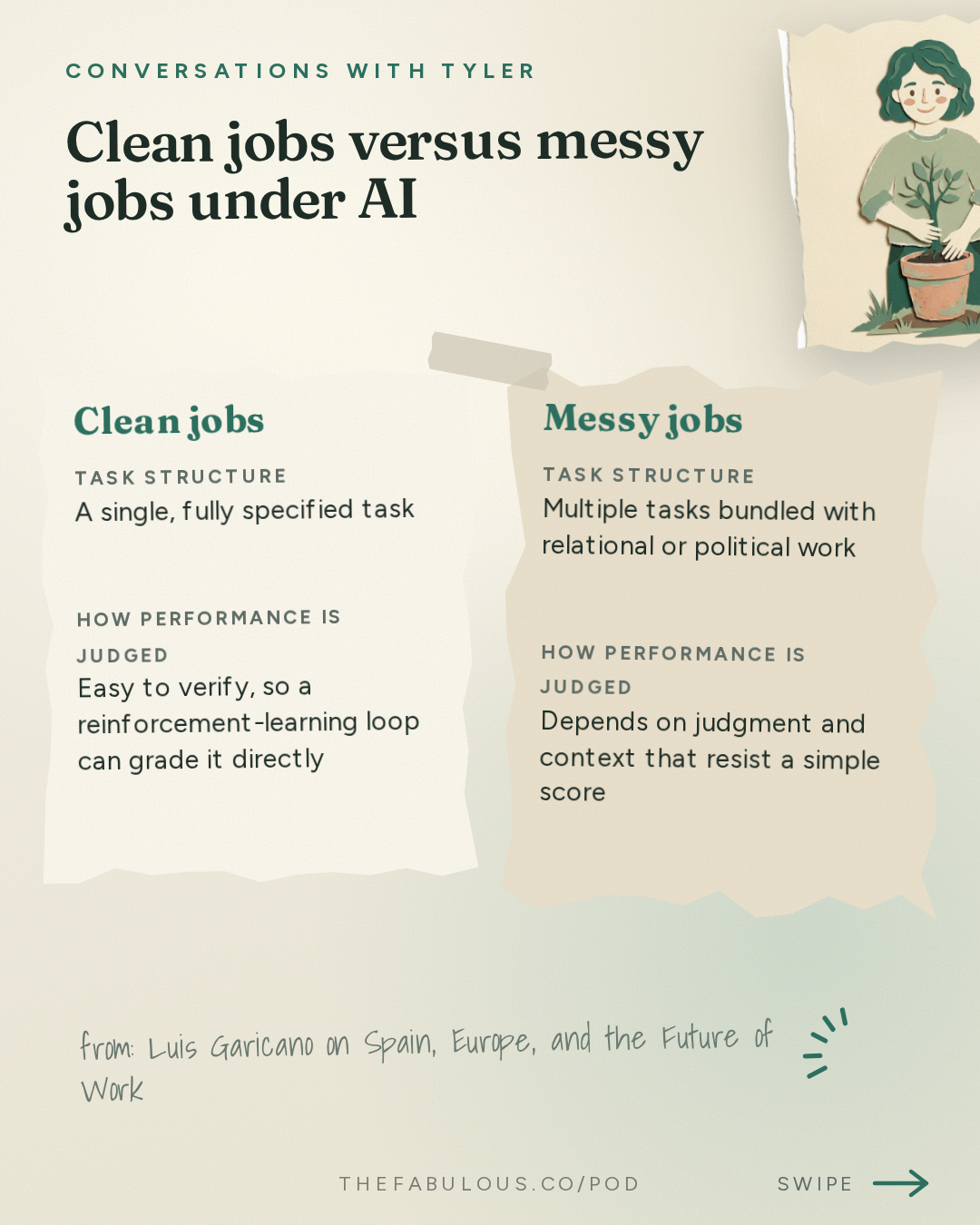
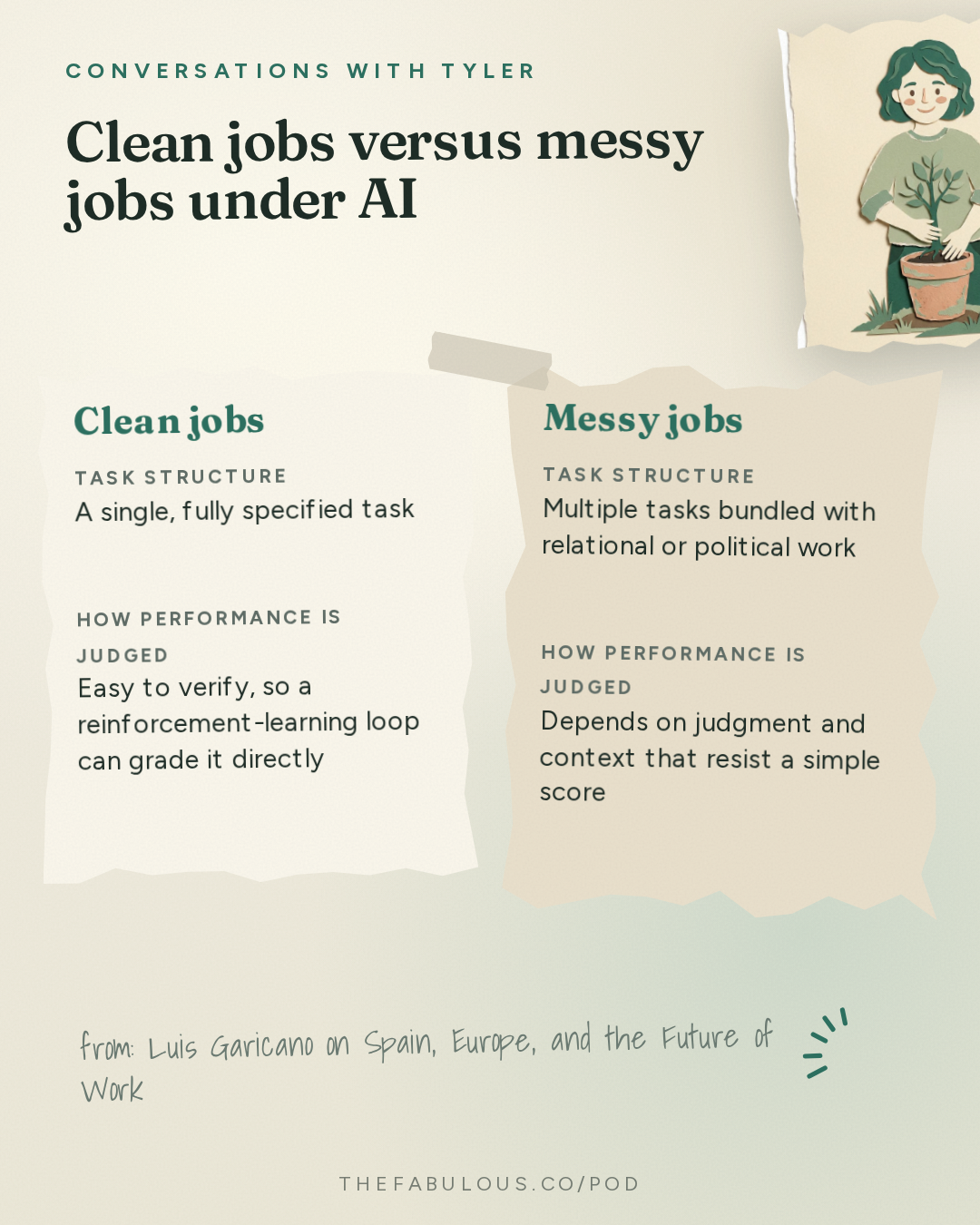
Garicano's new book, Messy Jobs, co-written with Jim Li and Yanhui Wu, turns the same institutional eye on a different question: what happens to work when artificial intelligence gets cheap. His answer cuts against both the doom and the reassurance usually on offer. Look, he says, at what happened during the 2000s offshoring boom, when companies shipped call-center and back-office work to India. The jobs that moved were the ones a manager could specify completely: a single task, a clear procedure, an output that is easy to check. Those are exactly the jobs most exposed to AI today, because a task that is easy to verify is also one a reinforcement-learning system, a method that improves an AI by scoring its output against a target, can be trained to grade and refine (36:35). What survives is messier work: jobs that bundle several tasks together, that involve reading a room or making a judgment call nobody wrote down in a manual. A relationship manager at a bank can use AI to prepare for a client meeting, pulling balance sheets and flagging products to pitch, but still has to sit across from the client and manage the relationship (40:51). The AI enters the bundle. It does not replace it.
That protection carries a cost. Retraining, in Garicano's account, mostly does not work, and not for purely technical reasons. A doctor whose diagnostic work gets automated cannot simply become a plumber, not because plumbing is unlearnable but because a job is bound up with identity, with who a person understands themselves to be (37:57).
"The way we retrain ourselves, as Kuhn said, talking about scientists, is by dying, and the new generations do new things." Luis Garicano, [38:21]
It is a grim line, but consistent with his skepticism about formal retraining programs. What he finds more promising is narrower: teaching people not new careers but new use cases, like giving a bank's relationship managers a short list of questions an AI can help answer before a client meeting (39:10). His own 84 year old mother, he notes, has picked up ChatGPT for long conversations with no formal training at all (38:43). Increasingly, the barrier is not technical skill but knowing what the tools can actually do.
Europe's second-mover bet
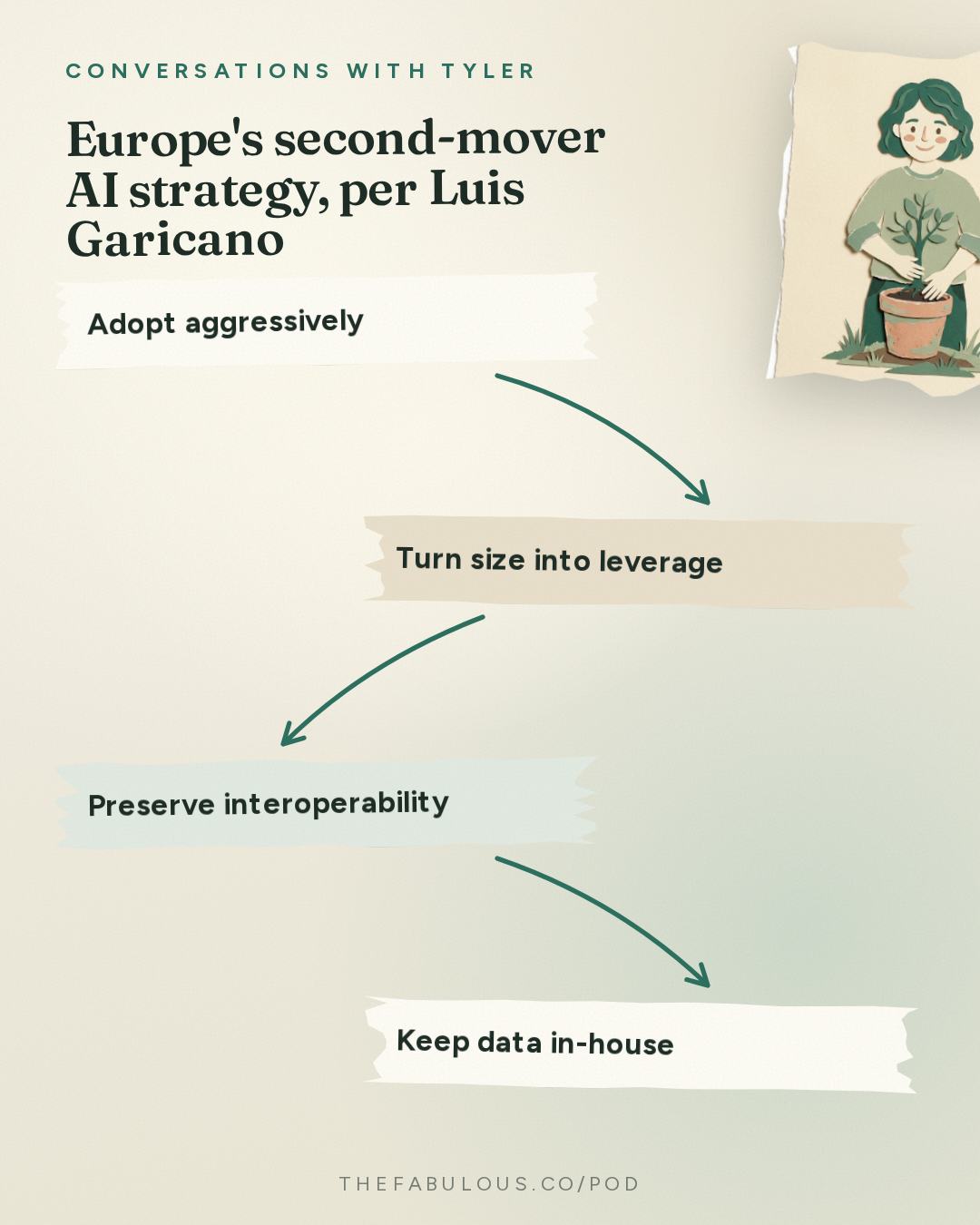
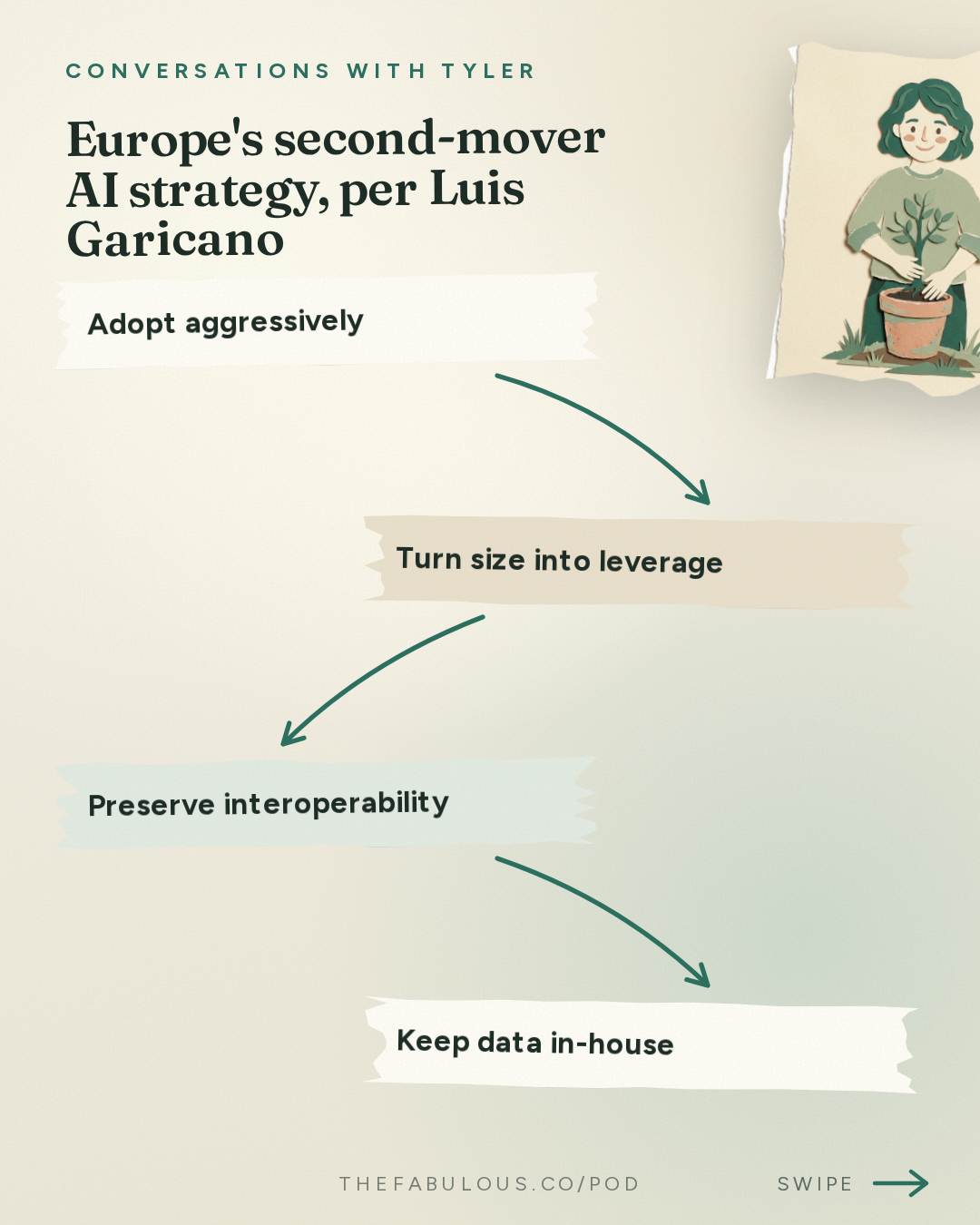
Given how far behind Europe sits on computing hardware, on frontier language models, and on data centers, with the Dutch chip-equipment maker ASML as close to an exception, Garicano does not think AI sovereignty, meaning control of the entire technology stack from chips to models, is a realistic goal for Spain or for the continent (45:16). His prescription is a second-mover strategy: adopt AI aggressively, become a large enough customer that vendors lobby their own governments to keep selling to you the way China did with the chipmaker Nvidia, and insist that models stay interoperable so switching providers is as simple as changing an API call (46:39). The advantage of open-weight models, AI systems whose underlying parameters are published rather than kept secret, is that a company or country can run them locally and keep its own data and know-how in-house, even while trailing the technical frontier by a few months (48:05).
The through-line across housing, pensions, party lists, and AI is not that Garicano is a pessimist. It is that he keeps finding the same mechanism: whoever already holds power, whether pensioners, party leaders, or legacy carmakers, tends to capture the rules meant to fix the system, so the fix ends up protecting insiders instead of solving the problem. What makes his messy jobs argument notable is that it locates a kind of protection that does not depend on anyone lobbying for it. Messiness, the tangled, relational, hard-to-specify part of work, shields ordinary people the way incumbency shields politicians, except nobody had to arrange it that way.
Ask this episode anything
Pod's AI answers from the episode itself, with the minute mark so you can hear it yourself.
Or start with one of these
Ask this episode
Pod's AI listens to the whole episode to answer, and points you to the minute it comes from.
The rest of this answer, and any question after it
Answers come from the episode itself, never from a summary of it.
ContinueKey takeaways
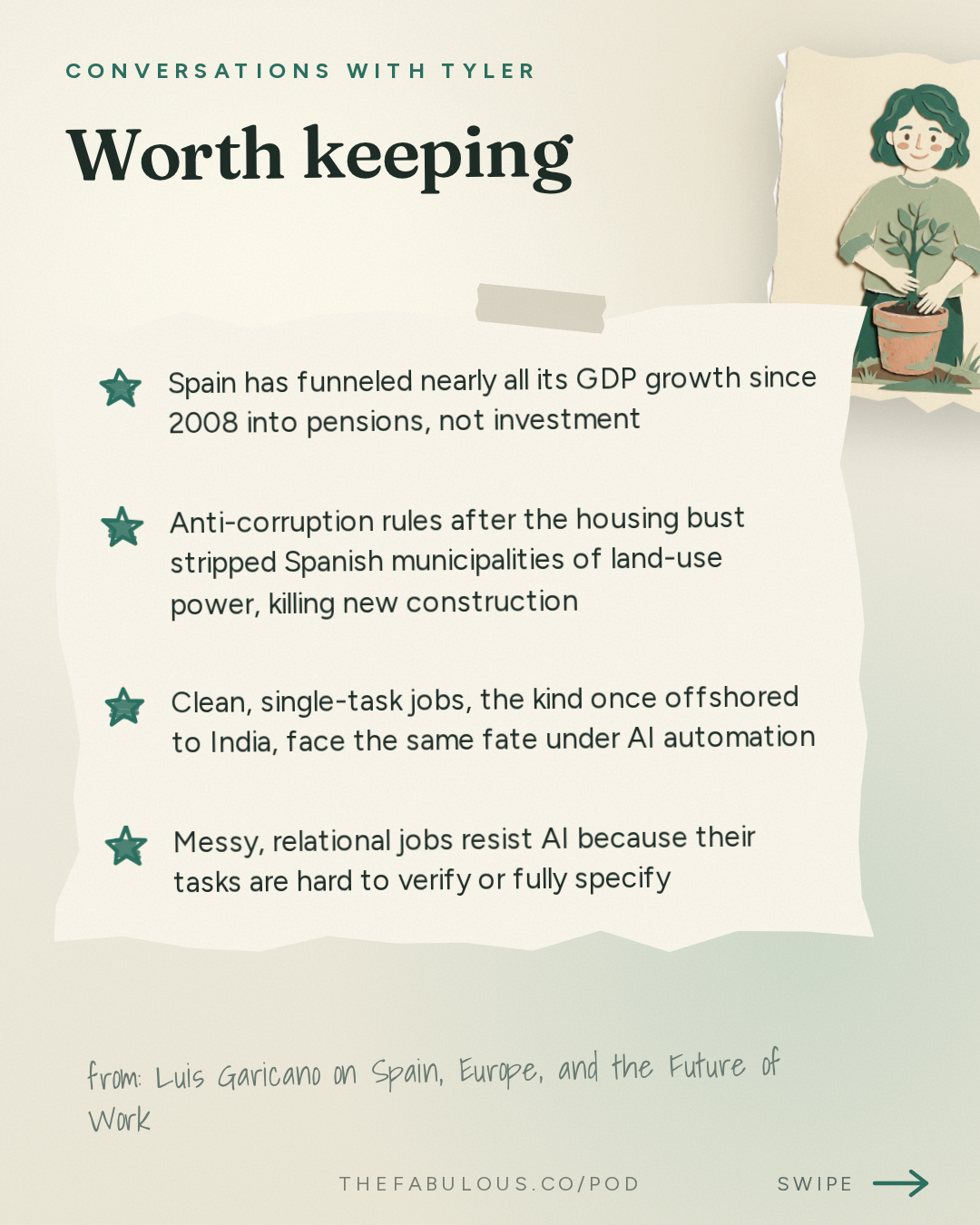
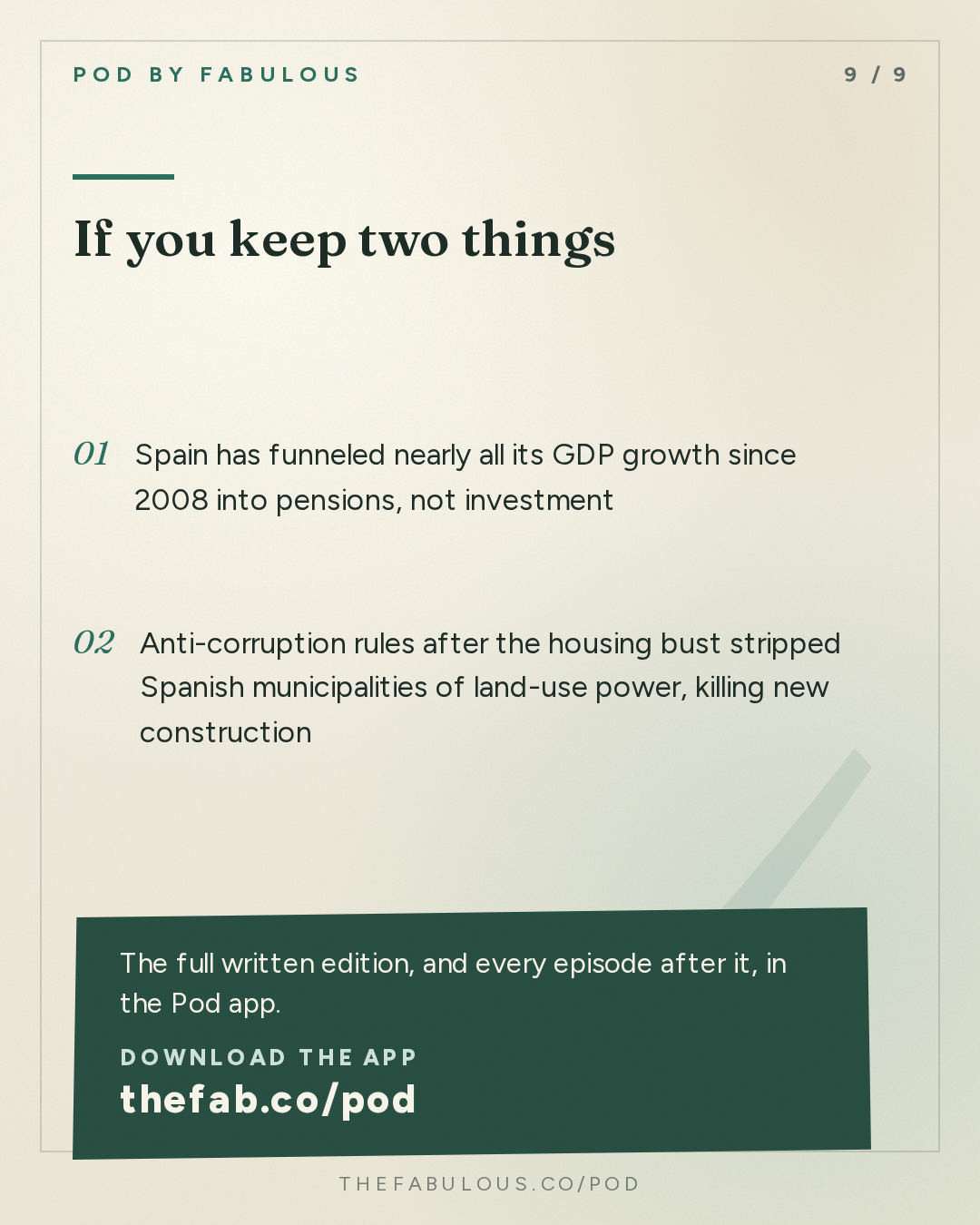
- Spain has funneled nearly all its GDP growth since 2008 into pensions, not investment
- Anti-corruption rules after the housing bust stripped Spanish municipalities of land-use power, killing new construction
- Clean, single-task jobs, the kind once offshored to India, face the same fate under AI automation
- Messy, relational jobs resist AI because their tasks are hard to verify or fully specify
- EU parties promote candidates with zero outside options over the most competent leaders
The episode in cards
By the numbers
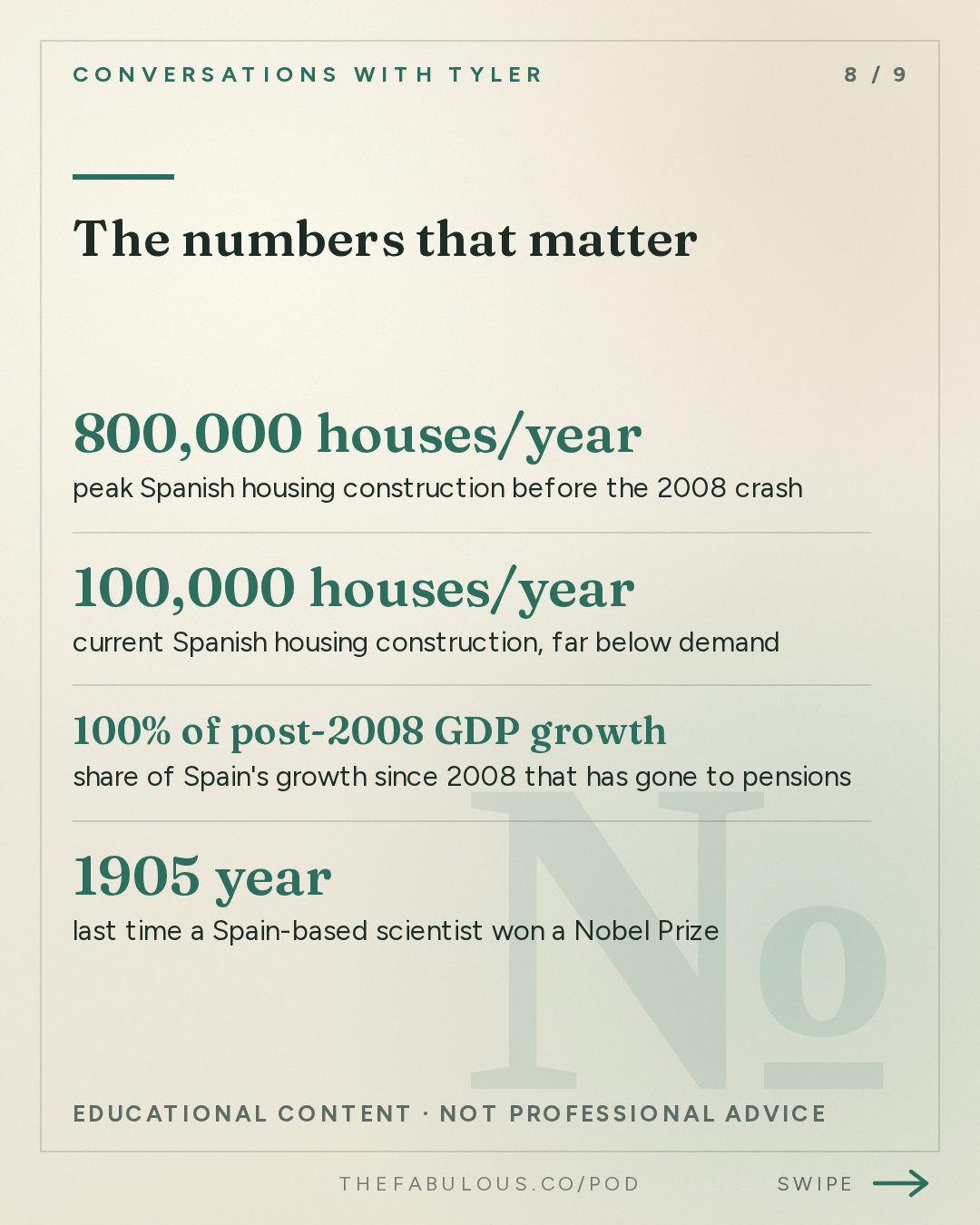
- 800,000 houses/year peak Spanish housing construction before the 2008 crash
- 100,000 houses/year current Spanish housing construction, far below demand
- 100% of post-2008 GDP growth share of Spain's growth since 2008 that has gone to pensions
- 1905 year last time a Spain-based scientist won a Nobel Prize
In their words
“People identified easy building with corruption and people identify easy building with high prices.”
“Essentially, 100% of the GDP growth we had since 2008 has gone to pensions, to the pensioners.”
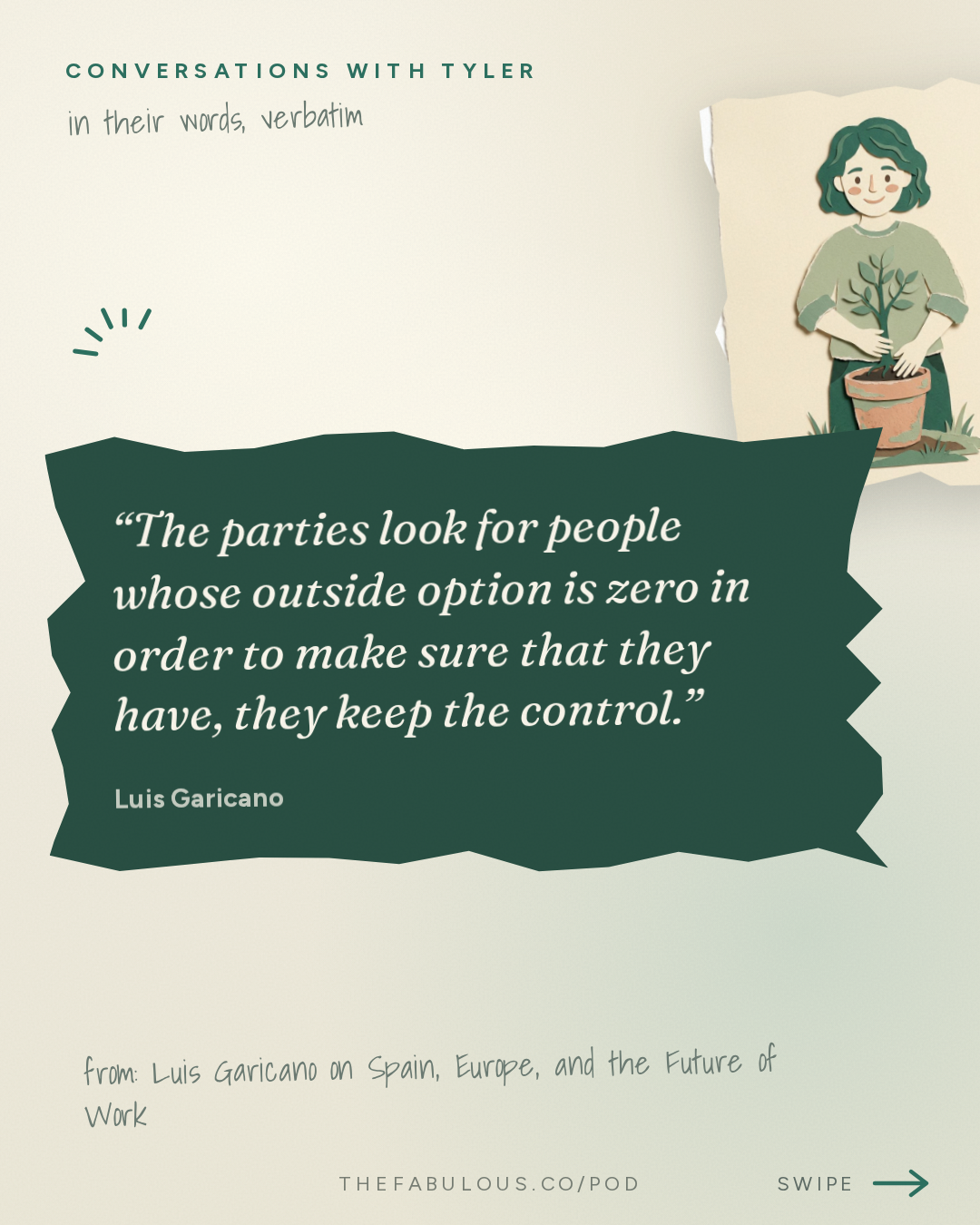
“The parties look for people whose outside option is zero in order to make sure that they have, they keep the control.”
“The way we retrain ourselves, as Kuhn said, talking about scientists, is by dying, and the new generations do new things.”
“The open weights model allows you to keep proprietary your own data and your own knowhow.”
Protocols
-
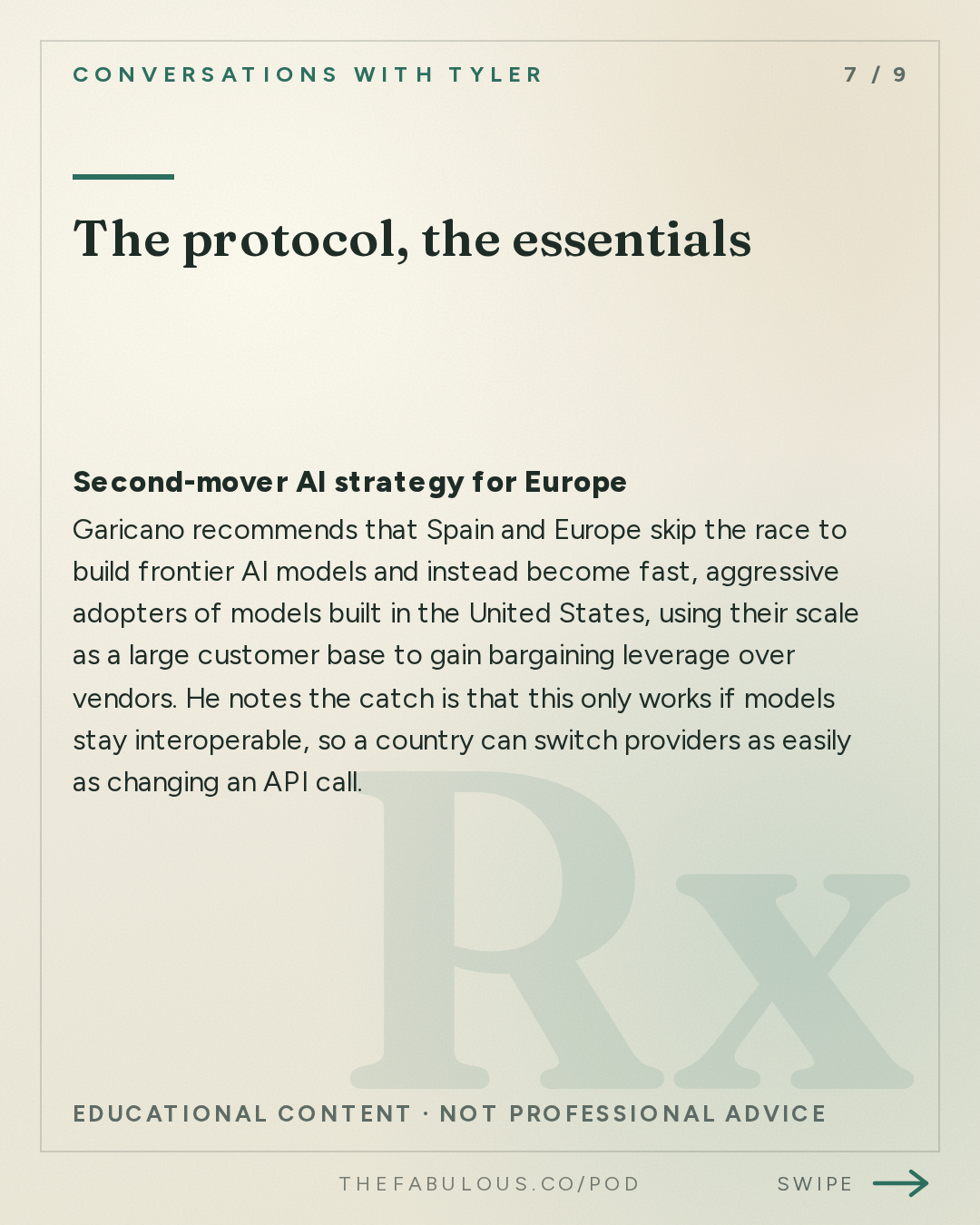
Second-mover AI strategy for Europe
Garicano recommends that Spain and Europe skip the race to build frontier AI models and instead become fast, aggressive adopters of models built in the United States, using their scale as a large customer base to gain bargaining leverage over vendors. He notes the catch is that this only works if models stay interoperable, so a country can switch providers as easily as changing an API call.
Ongoing, as new frontier models arrive roughly every one to two months
-
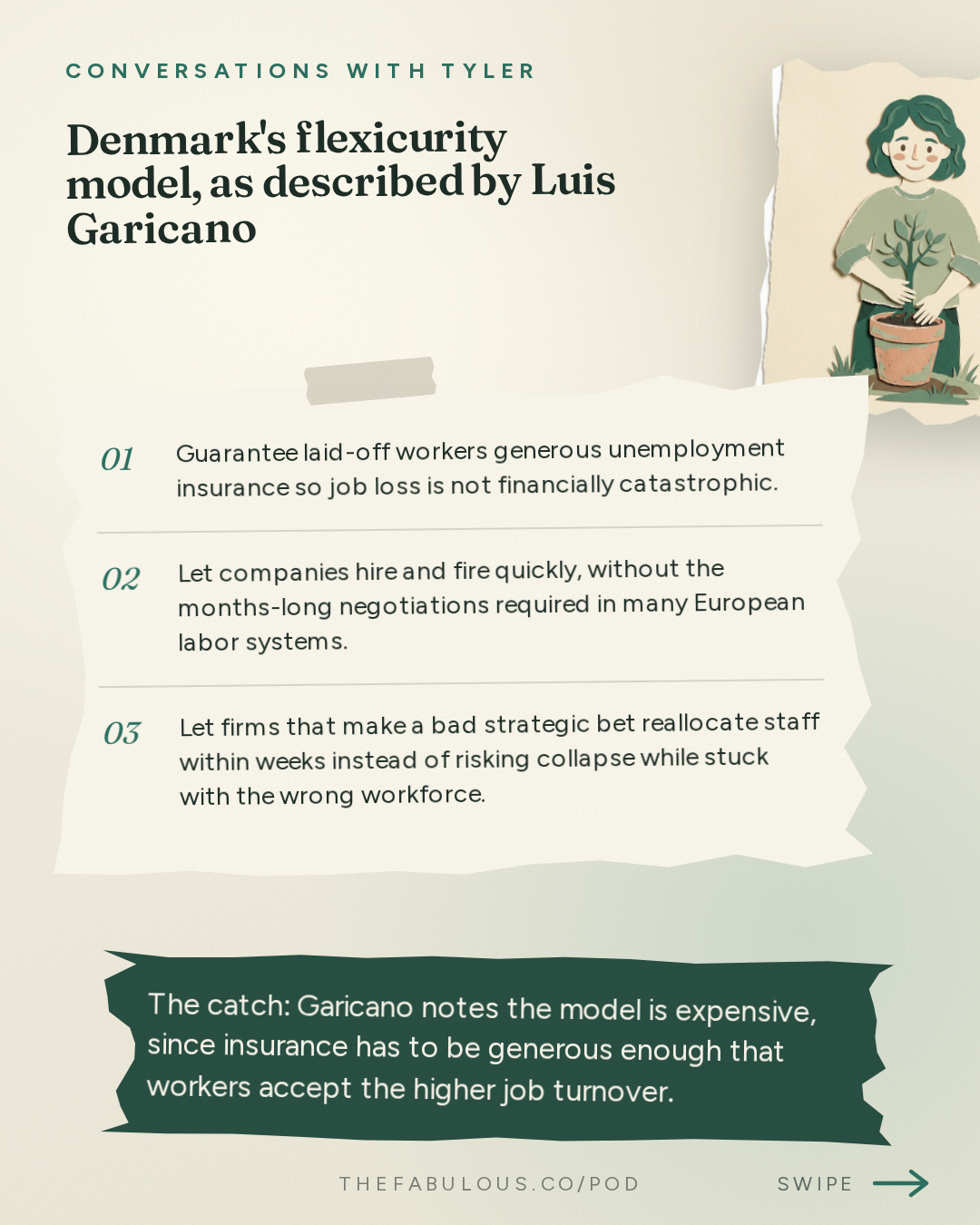
Danish flexicurity for labor markets
Garicano recommends that European governments adopt Denmark's flexicurity model, pairing generous unemployment insurance with easy hiring and firing rules, so firms can correct a bad strategic bet within weeks rather than months. He adds that the catch is cost, since insurance has to be generous enough that workers accept the higher job turnover.
Structural policy, not time-based
Questions this episode answers
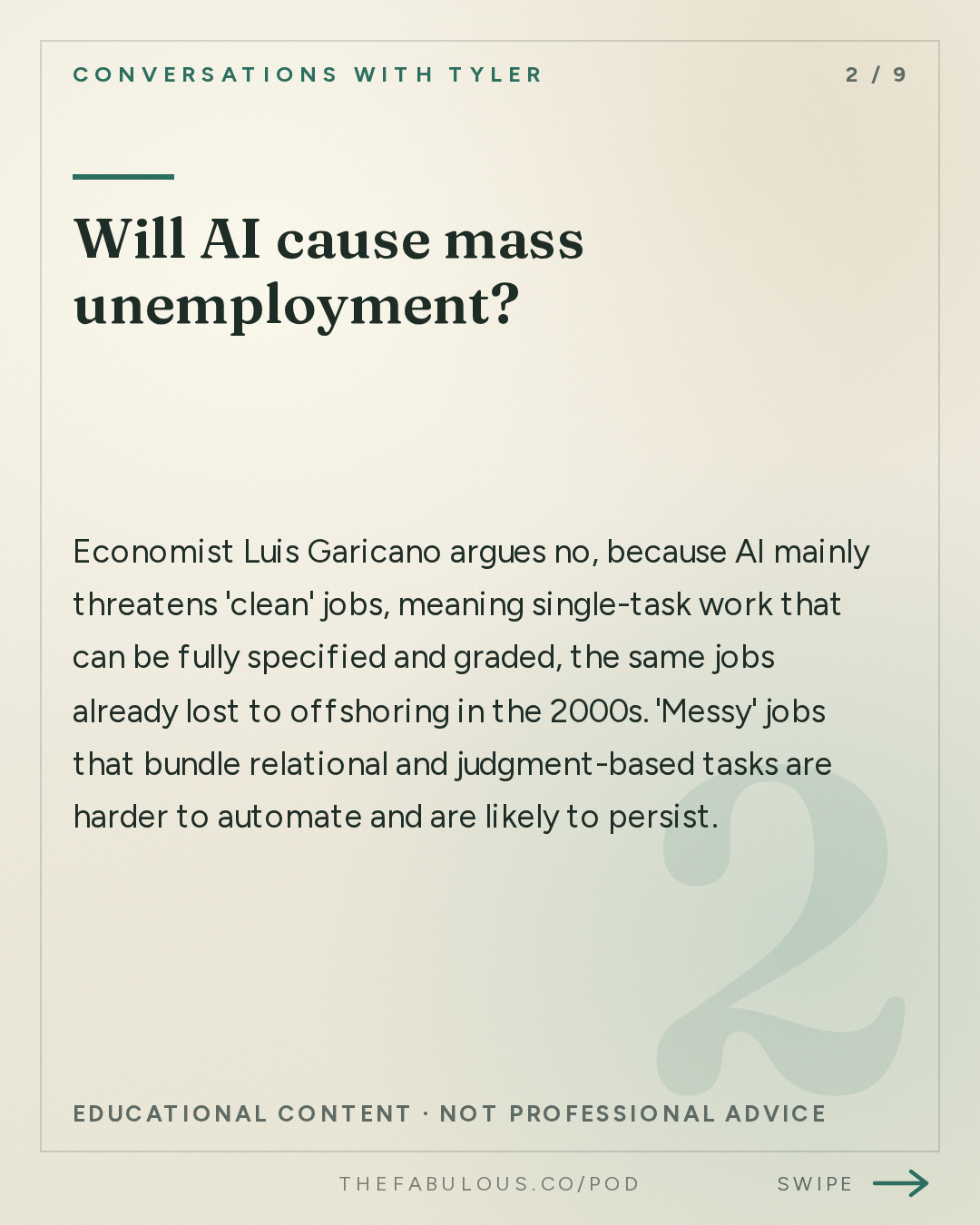
Will AI cause mass unemployment?
Economist Luis Garicano argues no, because AI mainly threatens 'clean' jobs, meaning single-task work that can be fully specified and graded, the same jobs already lost to offshoring in the 2000s (36:15). 'Messy' jobs that bundle relational and judgment-based tasks are harder to automate and are likely to persist (35:22).
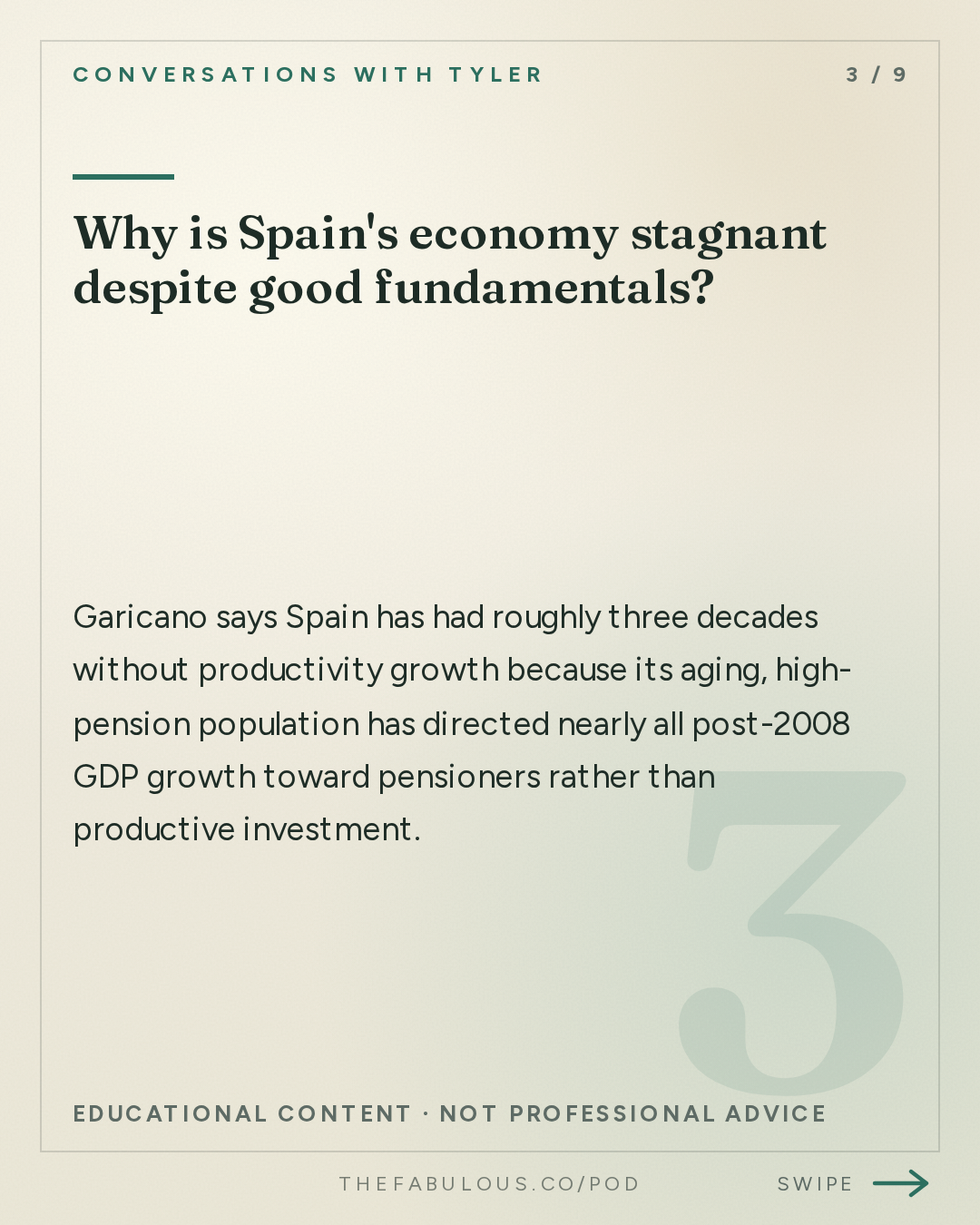
Why is Spain's economy stagnant despite good fundamentals?
Garicano says Spain has had roughly three decades without productivity growth because its aging, high-pension population has directed nearly all post-2008 GDP growth toward pensioners rather than productive investment (04:37, 05:04).
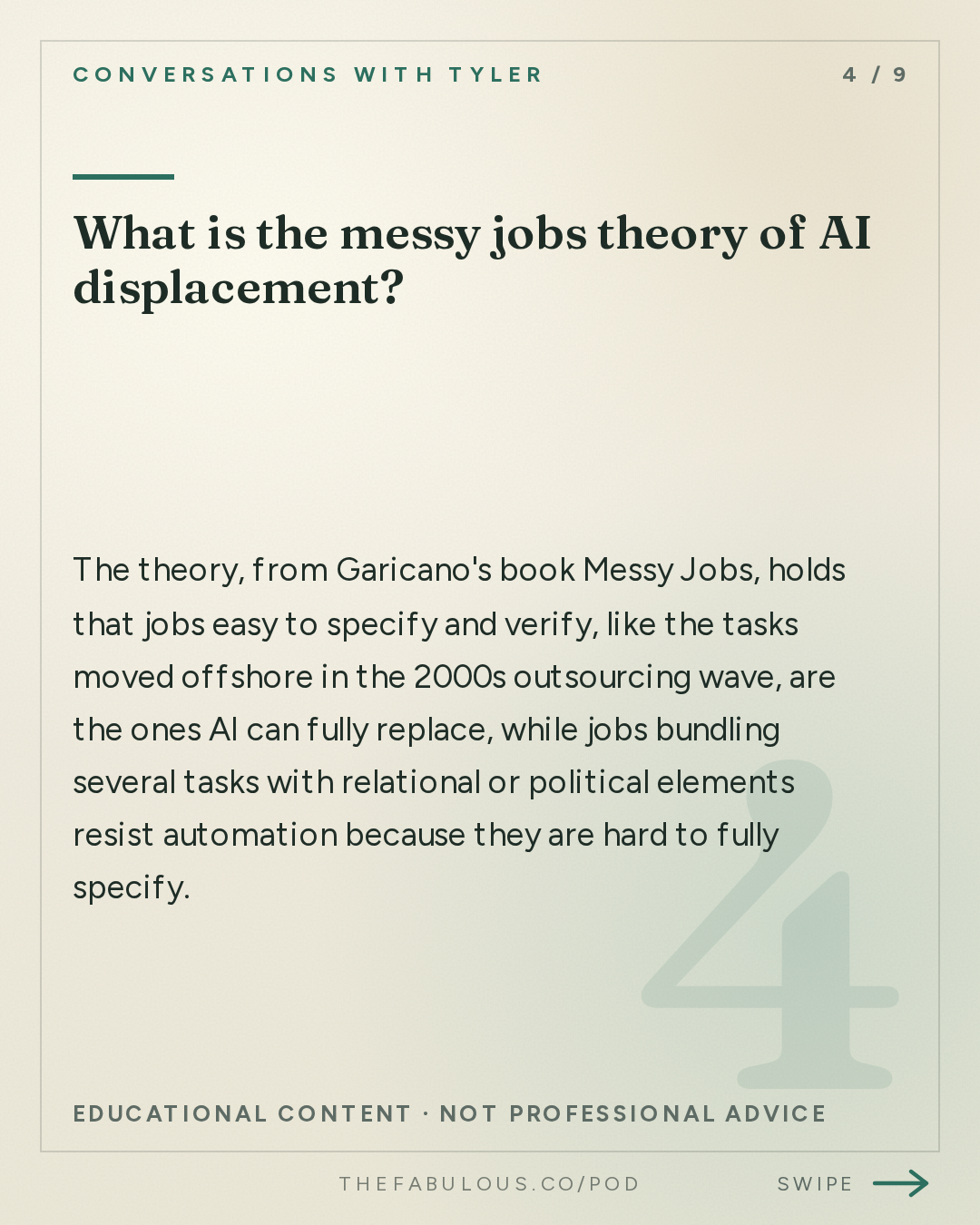
What is the messy jobs theory of AI displacement?
The theory, from Garicano's book Messy Jobs, holds that jobs easy to specify and verify, like the tasks moved offshore in the 2000s outsourcing wave, are the ones AI can fully replace, while jobs bundling several tasks with relational or political elements resist automation because they are hard to fully specify (36:35, 37:57).
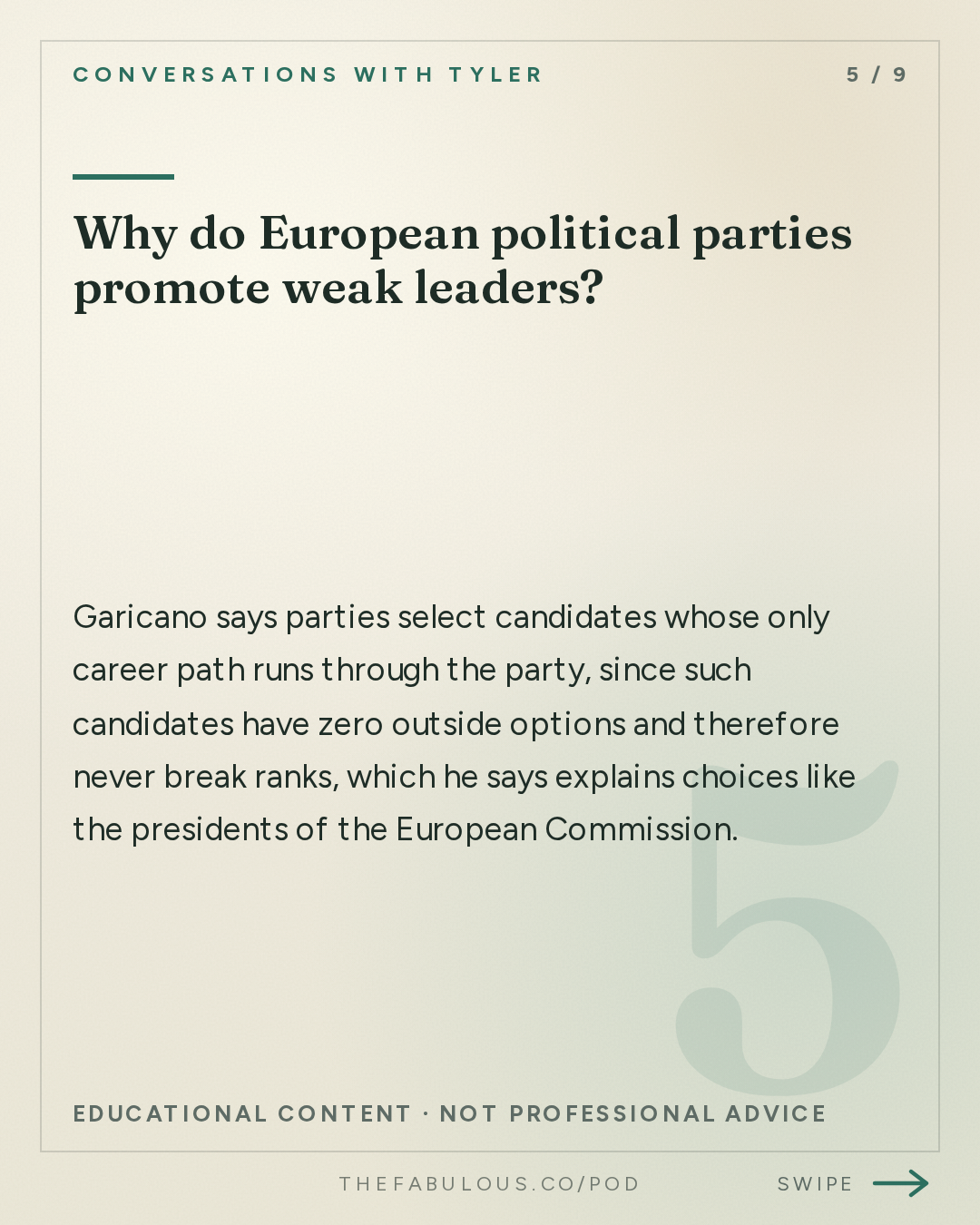
Why do European political parties promote weak leaders?
Garicano says parties select candidates whose only career path runs through the party, since such candidates have zero outside options and therefore never break ranks, which he says explains choices like the presidents of the European Commission (20:57, 21:20).
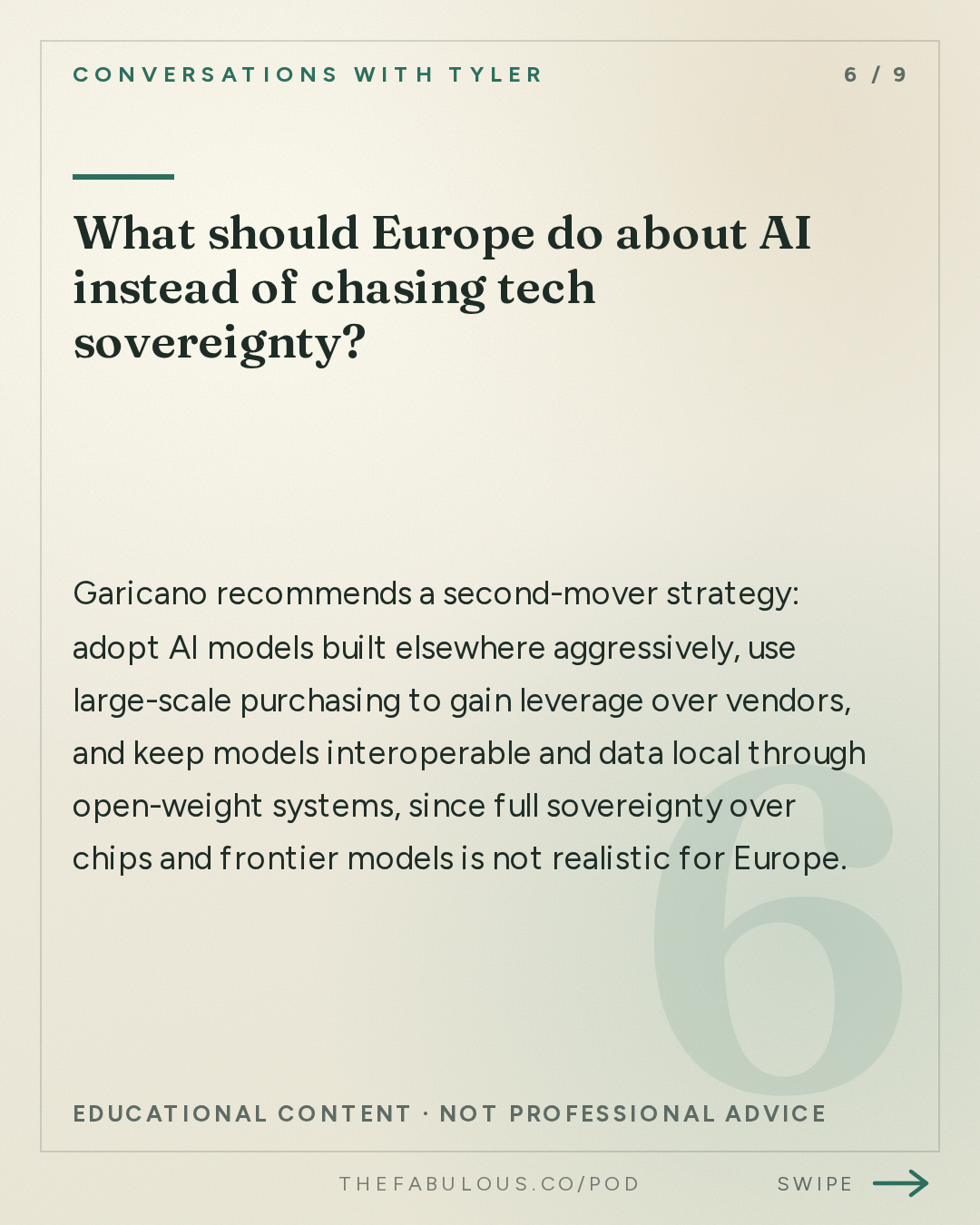
What should Europe do about AI instead of chasing tech sovereignty?
Garicano recommends a second-mover strategy: adopt AI models built elsewhere aggressively, use large-scale purchasing to gain leverage over vendors, and keep models interoperable and data local through open-weight systems, since full sovereignty over chips and frontier models is not realistic for Europe (45:16, 46:39, 48:05).
The full read, in cards
Go deeper
- Messy Jobs — argues clean, single-task jobs are most exposed to AI while messy, relational jobs persist
- Journal of Economic Perspectives article on Southern European reform — found that pre-euro reform momentum in Southern Europe disappeared once the euro removed the sense of urgency
- The Myth of the Rational Voter — argues voter inattention to politics is rational, not a failure
- Dani Rodrik industrial policy review — finds industrial policy succeeds only when governments can let losing firms fail and set clear goals
- NBER Summer Institute paper on AI medical scribes — found near-universal doctor adoption of AI scribes freed time from bureaucratic paperwork
Mentioned
Luis Garicano · Messy Jobs · ASML · Mistral · ChatGPT · WHOOP · Javier Marías · Cervantes · Per Strömberg · European Parliament · Bryan Caplan · Dani Rodrik
More from this show and category

Gita Gopinath on Trade, Currencies, and China
Former IMF chief economist Gita Gopinath explains why currencies rarely move the way trade theory predicts. She covers why 90% of China's US exports are priced in dollars, Argentina's disinflation from 150% to 30%, and why AI-driven growth might not save the US debt trajectory.

Annie Lowrey on America's Time Tax
Journalist Annie Lowrey says America's hidden "time tax" of paperwork and waiting falls hardest on the poor, not the rich. She contrasts Social Security's under-1% overhead with TANF's $16.5 billion in yearly costs, estimates 50 hours a year in bureaucratic time per person, and predicts AI agents could ease the burden within five years.

Jared Diamond: Why No Leader Is Irreplaceable
Geographer Jared Diamond argues no leader in history has been truly irreplaceable, since long-run trends erase individual impact. His new book, Prophets, Profits, Coaches, and Kings, finds partial exceptions in business and sports, citing Jeff Bezos's customer-first Amazon and Genghis Khan's rise during the wettest steppe period in two thousand years.

Luke Burgis on Mimetic Desire and AI
Author Luke Burgis says AI may weaken social contagion by letting people pursue personalized interests instead of copying each other. He also critiques effective altruism's materialism, names confession frequency as his test for a thriving Catholic parish, and describes building the Cluny Institute as a modern echo of medieval Cluny's networked monasteries.
