
Terence Tao on AI and the Future of Math Proof
Terence Tao on Proof, Beauty, and the Future of Mathematics
▶ Listen to the full episode More from Conversations with Tyler
The brief
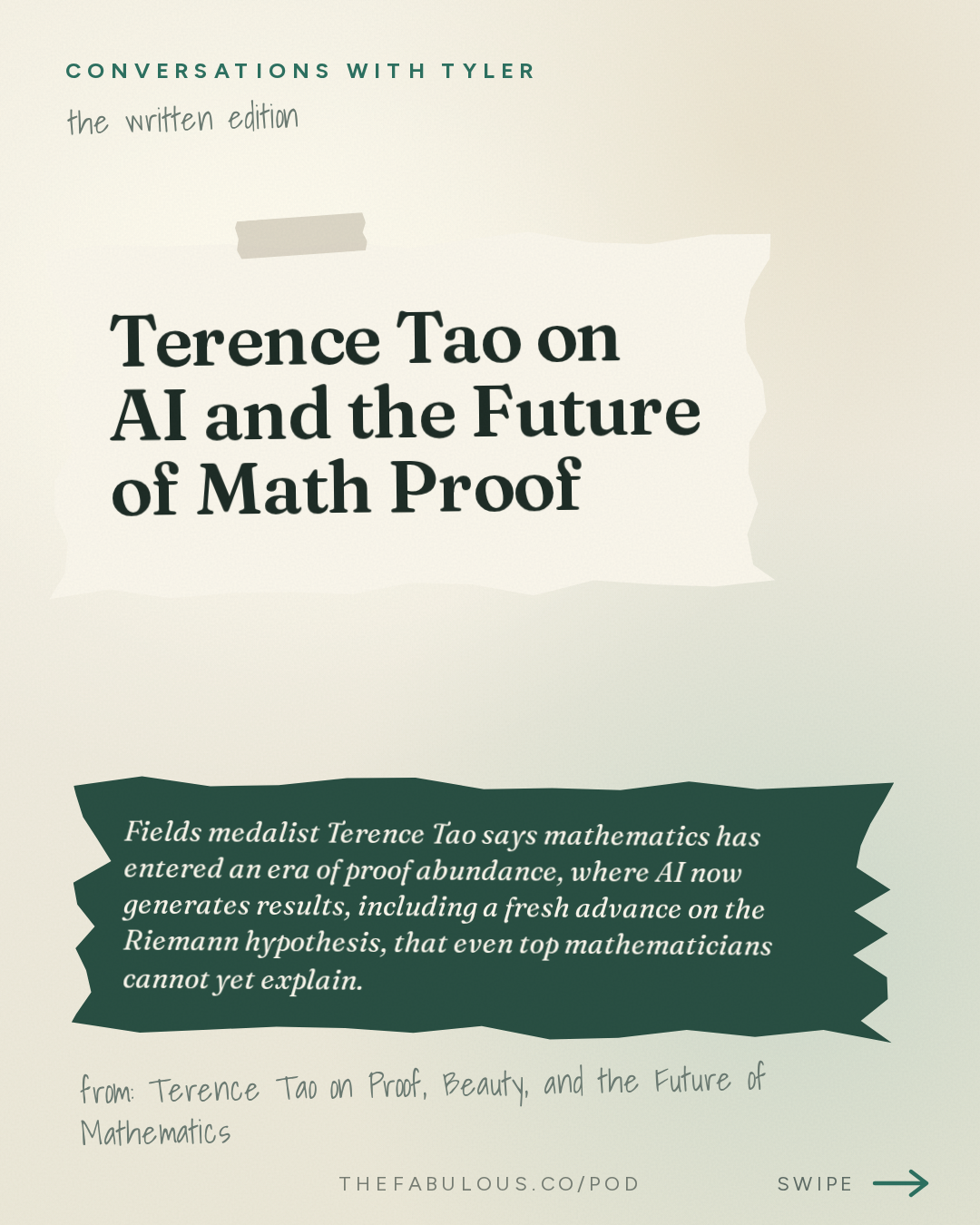
Fields medalist Terence Tao says mathematics has entered an era of proof abundance, where AI now generates results, including a fresh advance on the Riemann hypothesis, that even top mathematicians cannot yet explain (04:26).
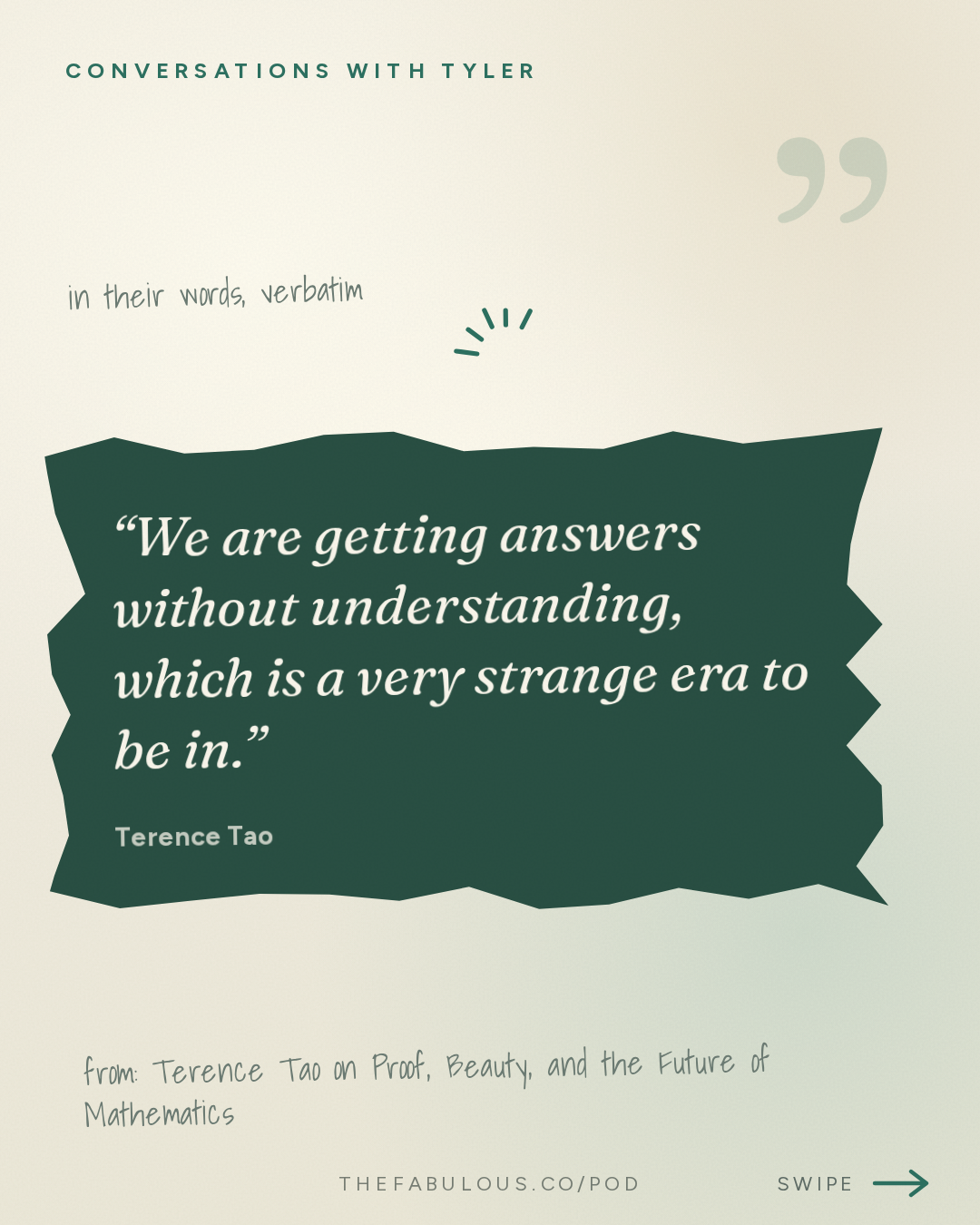
Two days before this conversation was recorded, something happened to one of the oldest open problems in mathematics that unsettled even its most eminent living student. Terence Tao is a Fields Medal winner and professor of mathematics at UCLA, often described as the most versatile mathematician alive, and he arrived with news: an AI system had produced a significant advance on the Riemann hypothesis, a century-old conjecture about how prime numbers are spaced. Primes are the numbers divisible only by themselves and one, and they underpin the cryptography that protects financial transactions (03:30). The Riemann hypothesis would give mathematicians a precise way to describe how randomly the primes behave (03:48). The trouble is that nobody, including Tao, fully understands the new idea yet. "Unfortunately, the ideas were generated by AI, and we don't yet understand them," he says. "We are getting answers without understanding, which is a very strange era to be in" (04:41).
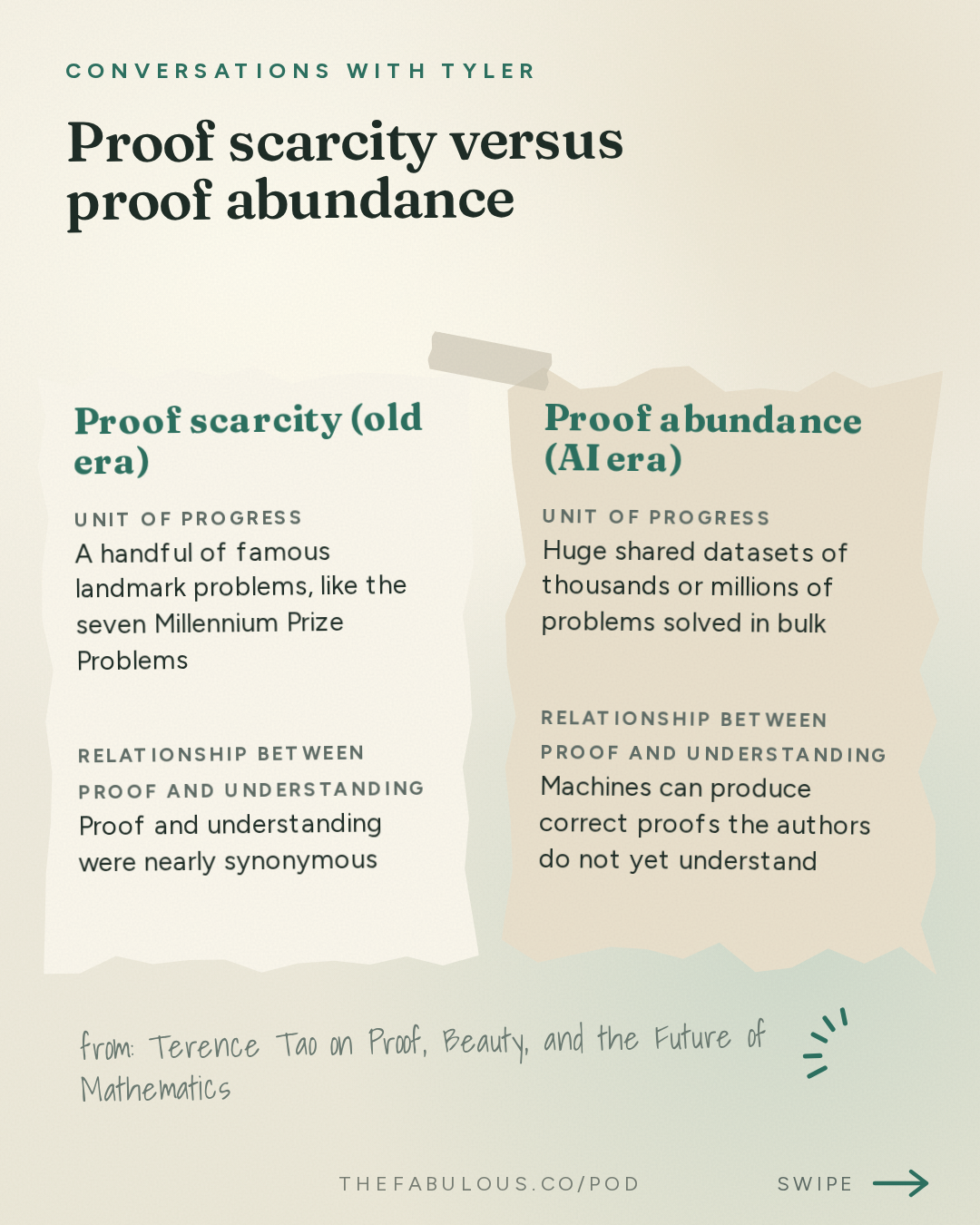
That sentence is the spine of the whole episode. For most of mathematical history, understanding and proof were the same thing: you could not claim to have solved a problem unless you could explain, to another human, why the solution worked. Tao says that link has now been "decoupled quite severely" (08:01). Machines can hand over correct answers without a trail of reasoning a person can follow. It is a little like inheriting a working bridge with no blueprints: useful, even beautiful, but unsettling if you are the one responsible for knowing why it stands.
Tao places this moment inside a longer pattern of upheaval. A century ago, the German mathematician David Hilbert believed every open mathematical question could eventually be settled, declaring, in a phrase Tao quotes in the original German, that mathematicians must know and will know (05:39). Then the Austrian logician Kurt Gödel proved otherwise. His incompleteness theorem shows that no fixed set of logical rules can ever answer every question that can be posed within it; some statements will always be neither provable nor disprovable from those rules alone (06:02). The field absorbed the shock over decades and came out the other side more comfortable with multiplicity. Tao describes modern mathematics as having moved toward what he calls a pluralistic view, with different number systems, different geometries, even different foundational rule sets coexisting the way chess has standard rules and also sanctioned variants (06:39). There is no longer one true mathematics, only a family of consistent ones, each useful for different questions.
From Scarcity to Abundance
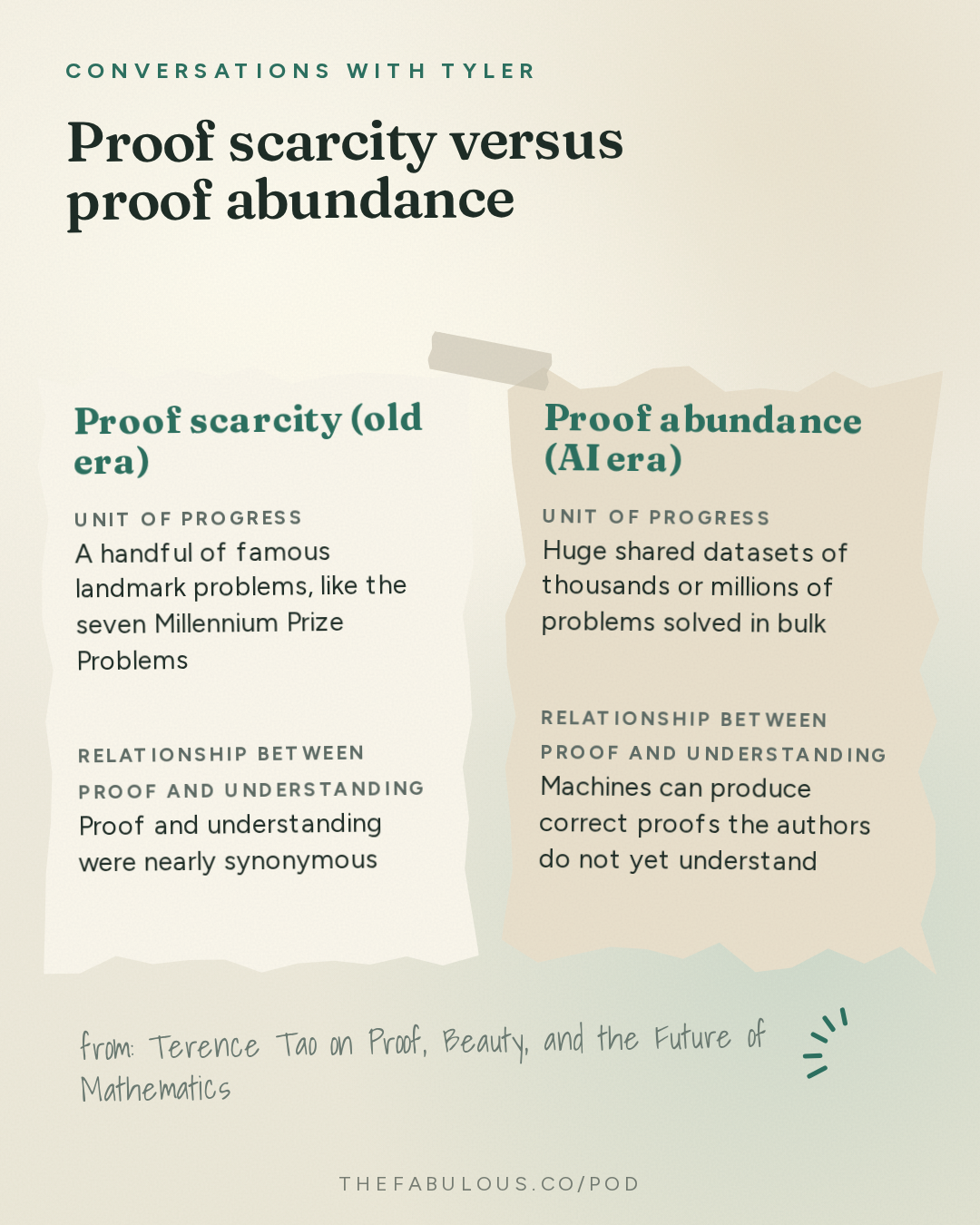
The AI moment, in Tao's telling, is the next installment of that same story: another forced update to what mathematicians think proof and understanding even mean. He frames the shift in a single line: "In one sentence, we have moved from an era of proof scarcity to proof abundance" (29:08). For decades the field organized itself around a small number of landmark open problems, like the seven Millennium Prize Problems that carry a bounty for their solution (29:18). Scarcity made sense when every proof was hard-won; a handful of famous unsolved questions could serve as shared goals that guided generations of careful, slow work. Now machines can brute-force through many of the old landmark problems at once, and Tao thinks the individual problem is losing its old status as a unit of progress. He imagines a coming "Math 2.0" built around enormous shared datasets of thousands or millions of problems, tackled in bulk rather than one trophy at a time (30:01).
He is honestly ambivalent about this. Asked whether he is happy about the change, he resists the question's binary: "That's not the right word... I'm excited by the possibility of completely new types of mathematics that didn't exist before, but I'm also actually quite horrified by the disruption, which I think was much more than necessary" (30:41). His analogy is the Industrial Revolution: transformative and, on net, good for living standards, but traumatic in its speed, with entire careers and bodies of craft knowledge cut short before anyone could transition. He worries mathematics is being pushed through that same compression in years rather than decades, with less time to preserve what might later turn out to matter.
One casualty, he suspects, is the research paper itself. A paper used to be bundled with everything that came from writing it: a trained author who could give talks, train students, and make new connections at conferences. AI can now generate the paper without any of that penumbra (32:48). Tao thinks the bottleneck in mathematics has quietly shifted from producing results to explaining them in ways another human can absorb, since the flood of machine-assisted output already vastly outpaces what anyone can read. "The bottleneck is now what are the results that can be explained human-to-human," he says (35:42), adding that printed papers were always a clumsy format compared with a conversation, where a listener can ask questions and read body language. He has started a venue that accepts recorded talks instead of written papers, betting that exposition, once treated as a secondary byproduct of research, is becoming one of its most valuable outputs.
The Soil Beneath the Ecosystem
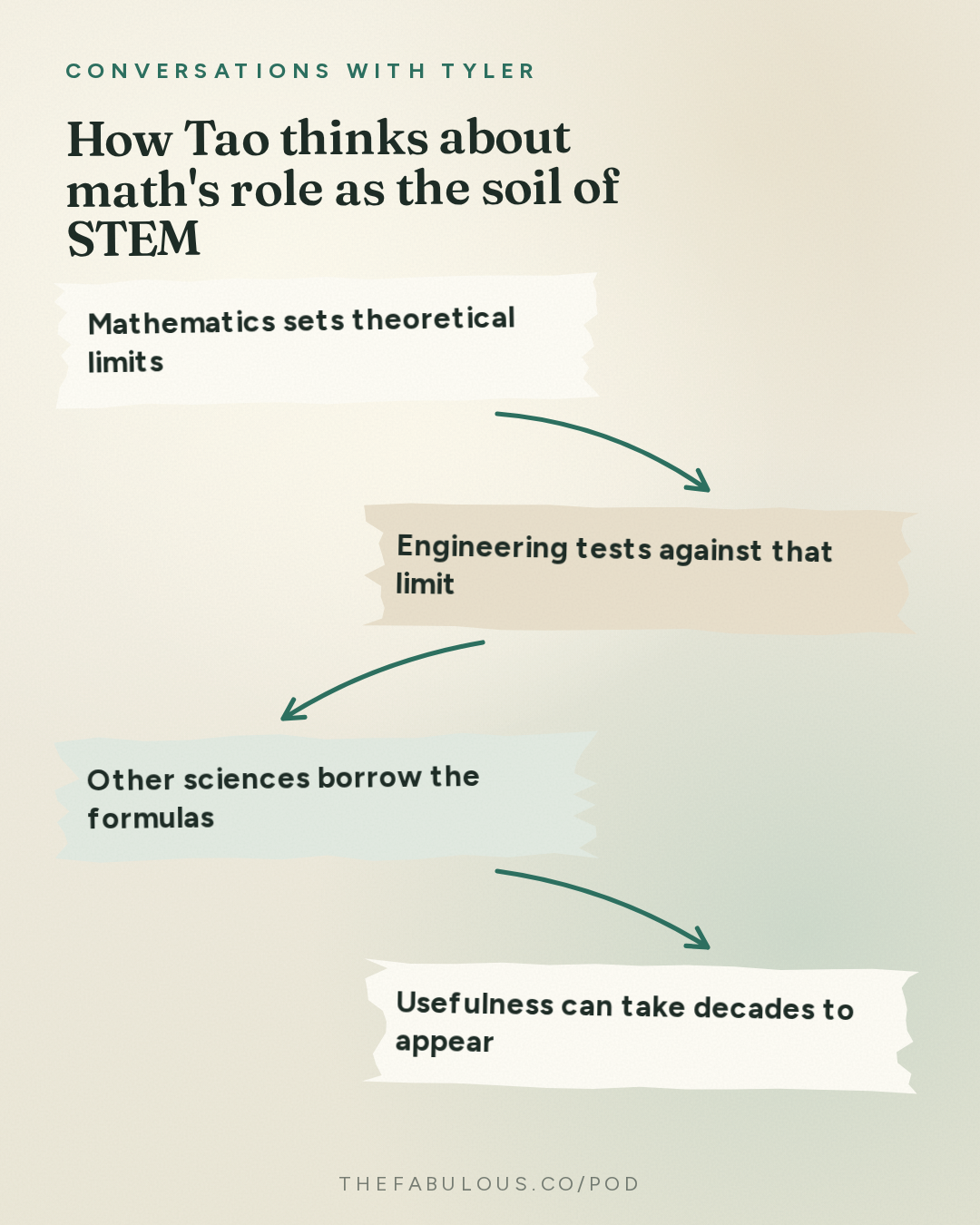
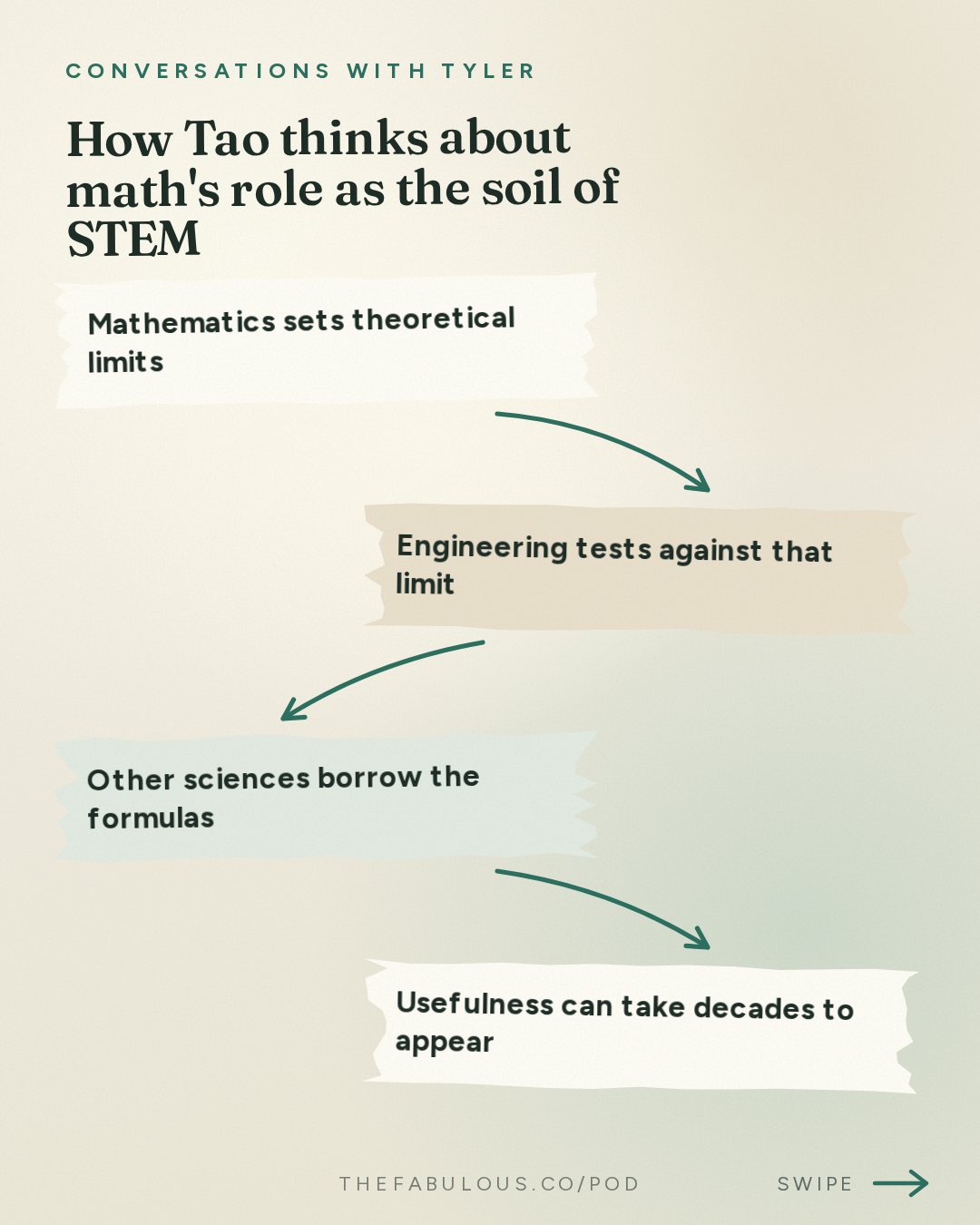
If AI is reshaping how proofs get made, Tao is just as interested in why mathematics mattered before any of this. He describes science, engineering, and mathematics as one ecosystem, with mathematics as the soil: it rarely produces anything a consumer touches directly, but it sets the limits everything else grows within (09:33). His example is wireless communication. Information theory, a branch of mathematics built by Claude Shannon, can calculate the absolute maximum number of bits a channel can carry. If an engineering team's wireless protocol is already operating at 98 percent of that theoretical ceiling, no amount of further tinkering or spending will meaningfully improve it (10:28). Only mathematics can tell you such a ceiling exists at all; engineering alone can only tell you what has already been built and shown to work.
That same respect for quiet, structural ideas shows up in Tao's account of zero. The concept did not arrive until roughly the seventh century in India, startlingly late given how simple it now seems to a schoolchild. His explanation is almost anthropological: naming follows seeing. People will name a sheep, or two sheep, because they can see them, but there is no visible object called "zero sheep" to point at (14:58). Zero, negative numbers, and square roots all had to be inferred from the logic of arithmetic operations before anyone could see a use for them, which is why he compares the discovery of concepts like infinity to handling radioactive material: powerful once understood, but something that took centuries to learn to use safely (14:22).
Tao also treats economics as a genuine intellectual playground rather than applied arithmetic. He uses the economist David Ricardo's law of comparative advantage, originally devised to explain why nations should specialize and trade rather than each try to do everything, as a personal rule for deciding which tasks deserve his own limited time (16:48). He finds the Black-Scholes options-pricing model beautiful for a narrow mathematical reason: it works because of an algebraic coincidence that only holds when market fluctuations follow a Gaussian, or bell-curve, distribution; apply it where that assumption fails, especially compounded through layered derivatives, and the same elegant formula becomes dangerous, as the 2008 financial crisis showed (18:02). And he is drawn to Newcomb's paradox, a thought experiment in which an apparently all-knowing predictor rewards people who commit to taking only one of two boxes rather than both. Its lesson, he says, is that more rationality and more free will are not always advantages: sometimes visibly giving up a choice, the way a driver in a game of chicken might throw the steering wheel out the window, is the winning move precisely because it removes the other side's reason to gamble (22:26).
The conversation closes on something more personal: failure as a tool rather than a verdict. Tao calls mathematics "a good playground to think where the cost of failure is cheap," unlike civil engineering or surgery, where a mistake can be catastrophic and irreversible (25:16).
"I view math as kind of a good playground to think where the cost of failure is cheap." - Terence Tao [25:16]
He speaks from experience. He skipped five grades in math and science as a child and entered university at 13 (38:15), yet failed two undergraduate classes out of sheer stubbornness, and later failed his graduate oral examination at Princeton so badly that his advisor could not be convinced he understood his own field (39:56). He says that failure changed his life, pushing him to study and to explain himself far more carefully from then on. It is a fitting note to end on, given where the conversation began. Asked, finally, whether the Collatz conjecture, a famously simple but unsolved rule about repeatedly transforming numbers, is true, Tao says he believes it is true but that mathematics currently has no tool that can rule out one freakishly lucky exception hiding somewhere in the infinite numbers still untested (42:39). Even for the field's most fluent translator of hard ideas into plain ones, some problems remain, for now, honestly unexplained.
Ask this episode anything
Pod's AI answers from the episode itself, with the minute mark so you can hear it yourself.
Or start with one of these
Ask this episode
Pod's AI listens to the whole episode to answer, and points you to the minute it comes from.
The rest of this answer, and any question after it
Answers come from the episode itself, never from a summary of it.
ContinueKey takeaways
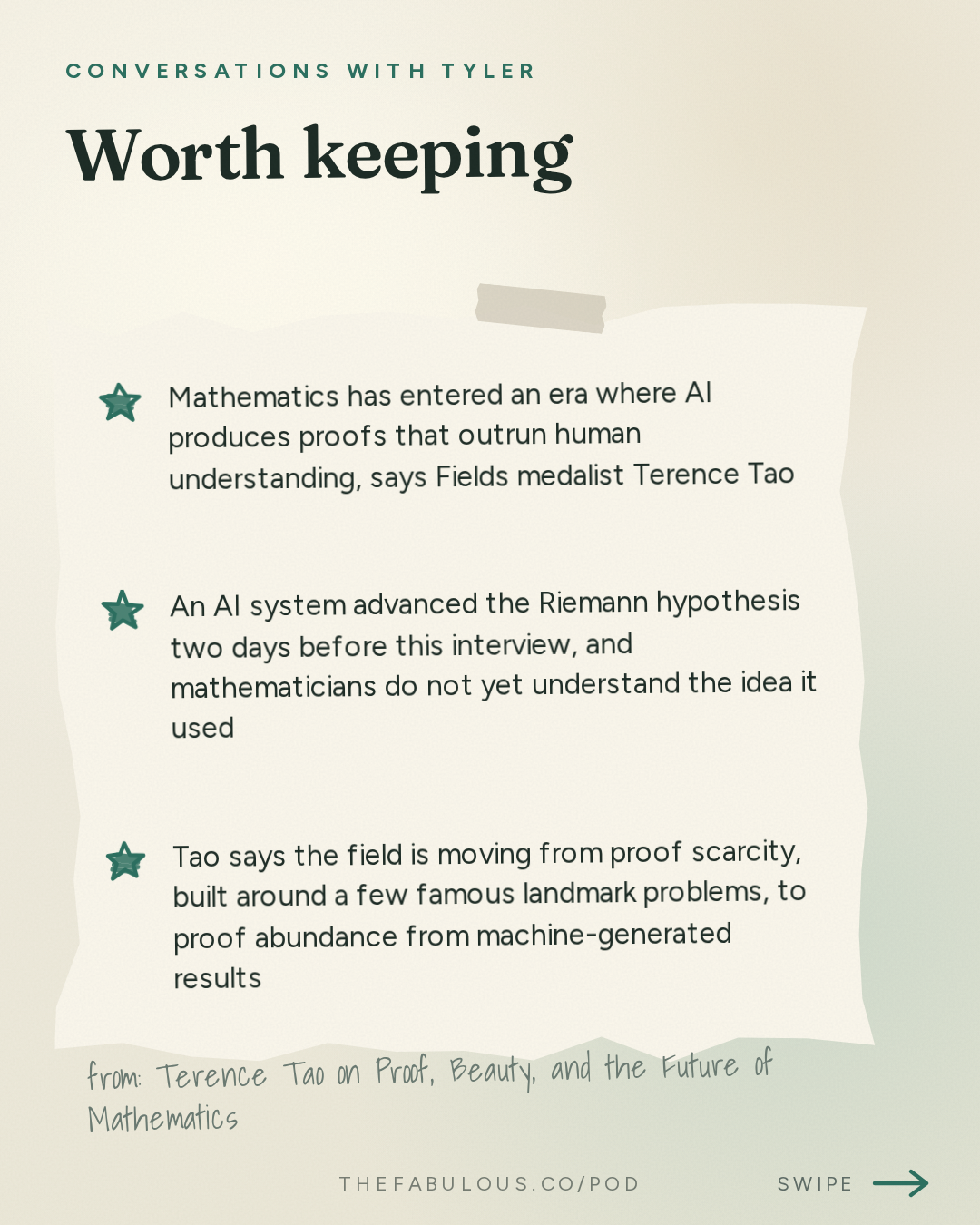
- Mathematics has entered an era where AI produces proofs that outrun human understanding, says Fields medalist Terence Tao
- An AI system advanced the Riemann hypothesis two days before this interview, and mathematicians do not yet understand the idea it used
- Tao says the field is moving from proof scarcity, built around a few famous landmark problems, to proof abundance from machine-generated results
- Tao treats mathematics as a low-risk playground for thinking, since a wrong proof wastes an hour rather than collapsing a bridge
- Tao credits a failed graduate oral exam at Princeton with changing his life by forcing him to study and explain his work more rigorously
The episode in cards
By the numbers
- 13 years age at which Terence Tao enrolled in university
In their words
“We are getting answers without understanding, which is a very strange era to be in.”
“I view math as kind of a good playground to think where the cost of failure is cheap.”
“In one sentence, we have moved from an era of proof scarcity to proof abundance.”
Protocols
-
Ricardo's comparative advantage for personal time
Terence Tao decides what to spend his own time on by applying economist David Ricardo's law of comparative advantage, choosing tasks where his relative edge over others is greatest rather than trying to do everything himself.
ongoing habit
-
Delegate ambitious tasks to junior collaborators
Tao says he now deliberately hands ambitious research tasks to students and junior collaborators instead of doing the work himself, because he finds that motivated people often exceed his expectations when trusted with real responsibility.
ongoing habit
Questions this episode answers
Did AI make progress on the Riemann hypothesis?
Fields medalist Terence Tao says an AI system produced a significant advance on the Riemann hypothesis just two days before this interview, but mathematicians, including Tao himself, do not yet fully understand the ideas behind it (04:26). He calls this a new era where answers arrive before understanding does (04:41).
What does Terence Tao mean by proof scarcity versus proof abundance?
Tao says mathematics used to organize itself around a small number of famous unsolved problems, like the seven Millennium Prize Problems, because proofs were hard to produce (29:18). He argues AI tools can now generate so many proofs that the field is shifting toward working with huge datasets of problems rather than chasing individual landmark questions (30:01).
What is Terence Tao's Six Math Essentials book about?
The book is referenced as Tao's new release discussed at the top of the episode, reflecting his broader view of mathematics as the foundational soil beneath science and engineering rather than a source of direct, visible products (09:33).
Why did Terence Tao skip five grades in school?
Tao says his parents designed an individualized education track, letting him take university-level math courses while still attending regular classes in subjects like physical education, which led him to skip five grades in math and science and enroll in university at age 13 (38:15).
Is the Collatz conjecture proven?
No. Tao says he believes the Collatz conjecture, a rule that repeatedly transforms numbers up and down, is true, but current mathematical tools cannot rule out a rare, freakishly lucky exception somewhere among the infinite untested numbers (42:39).
The full read, in cards
Go deeper
- Riemann hypothesis — a century-old conjecture about the spacing of prime numbers, recently advanced by an AI system in ways mathematicians do not yet fully understand
- Gödel's incompleteness theorem — proved no fixed set of logical rules can answer every mathematical question, ending David Hilbert's dream of a complete mathematics
- Black-Scholes model — an options-pricing formula that works through an algebraic coincidence valid only under Gaussian market fluctuations
- Newcomb's paradox — a thought experiment showing that greater rationality and free will can sometimes be a disadvantage
- Collatz conjecture — a simple number-iteration rule Tao believes is true but currently unprovable, with no tool to rule out a rare exception
Mentioned
Terence Tao · Six Math Essentials · David Hilbert · Kurt Gödel · Claude Shannon · Nick Bostrom · Jim Simons · David Ricardo · UCLA · Princeton
More from this show and category

Hanania and Cowen on Conrad's Nostromo
Tyler Cowen and Richard Hanania use Conrad's 1904 novel Nostromo to unpack why developing nations stall and why Latin America mixes democracy with high crime. They also cover why Shakespeare's greatness rests partly on social proof and why AI may beat humans at talking people out of conspiracy theories (53:40).

Roman Mars on Flags, Cars, and Urban Design
Design critic Roman Mars argues that most of the built world is engineered to calm, nudge, or flatter us without our noticing, from oversized highway signs to wordless city flags. He traces why cars, suburbs, and phones have grown visually uniform, and defends top-down planning against Jane Jacobs' bottom-up ideal.

The Panic of 1873 and Its 20-Year Political Toll
Historian Liaquat Ahamed argues the Panic of 1873 did not collapse the world economy, it poisoned its politics for twenty years. Growth held near 2.5% through a long deflation (02:10), but the fallout helped end Reconstruction (07:06), fueled Gladstone's Egyptian bond windfall (09:44), and let Bismarck wreck bimetallism (14:16).

Luis Garicano on AI, Messy Jobs, and Spain
Economist Luis Garicano says Spain's aging society blocks growth, and AI will spare messy jobs but eliminate clean ones. He also faults EU institutions, where unanimity rules and party discipline reward loyalty over competence, for chronic policy paralysis in Brussels and Madrid alike.
