
Roman Mars on Flags, Cars, and Urban Design
Roman Mars on Flags, Phones, and the Design of Everyday Life
▶ Listen to the full episode More from Conversations with Tyler
The brief
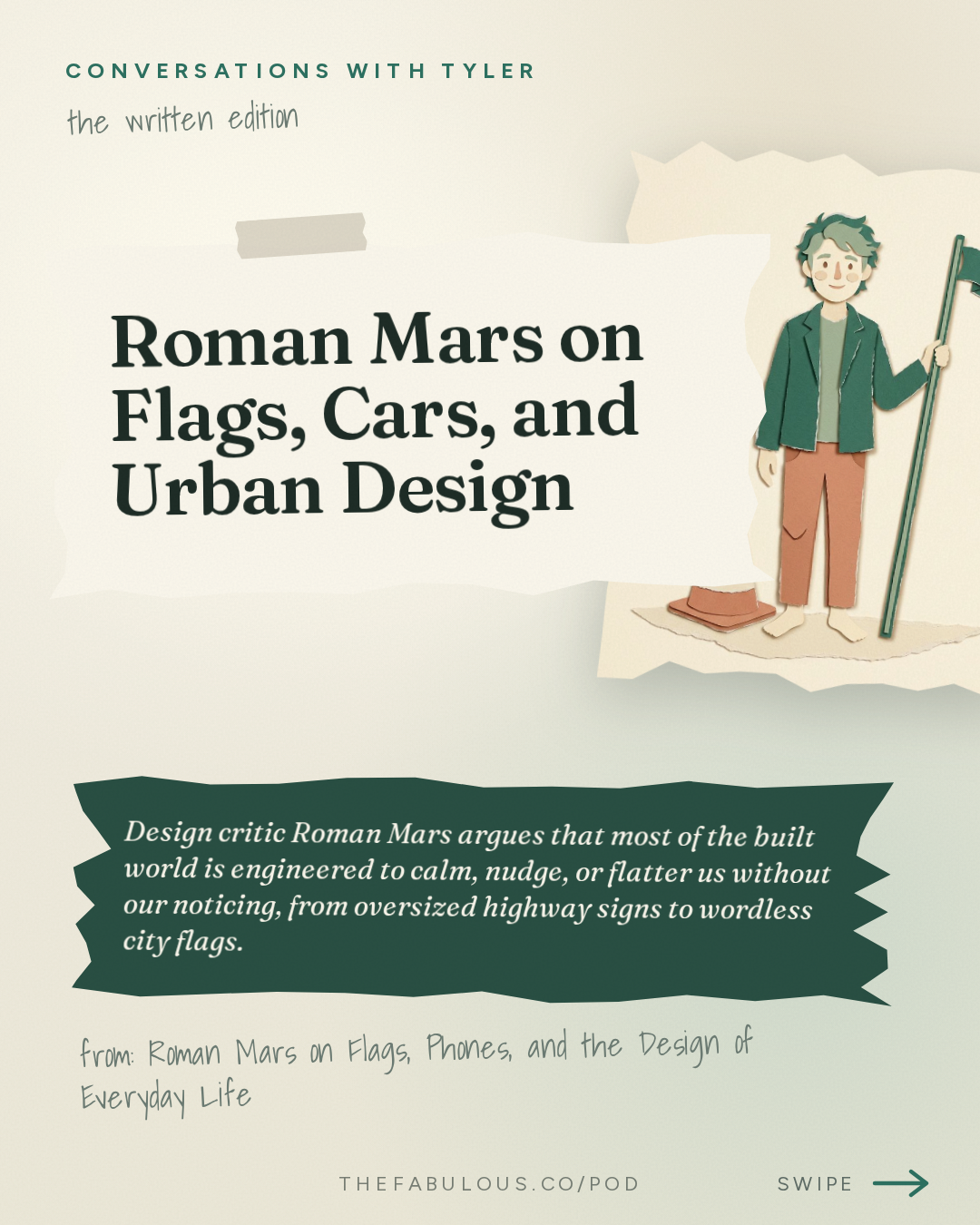
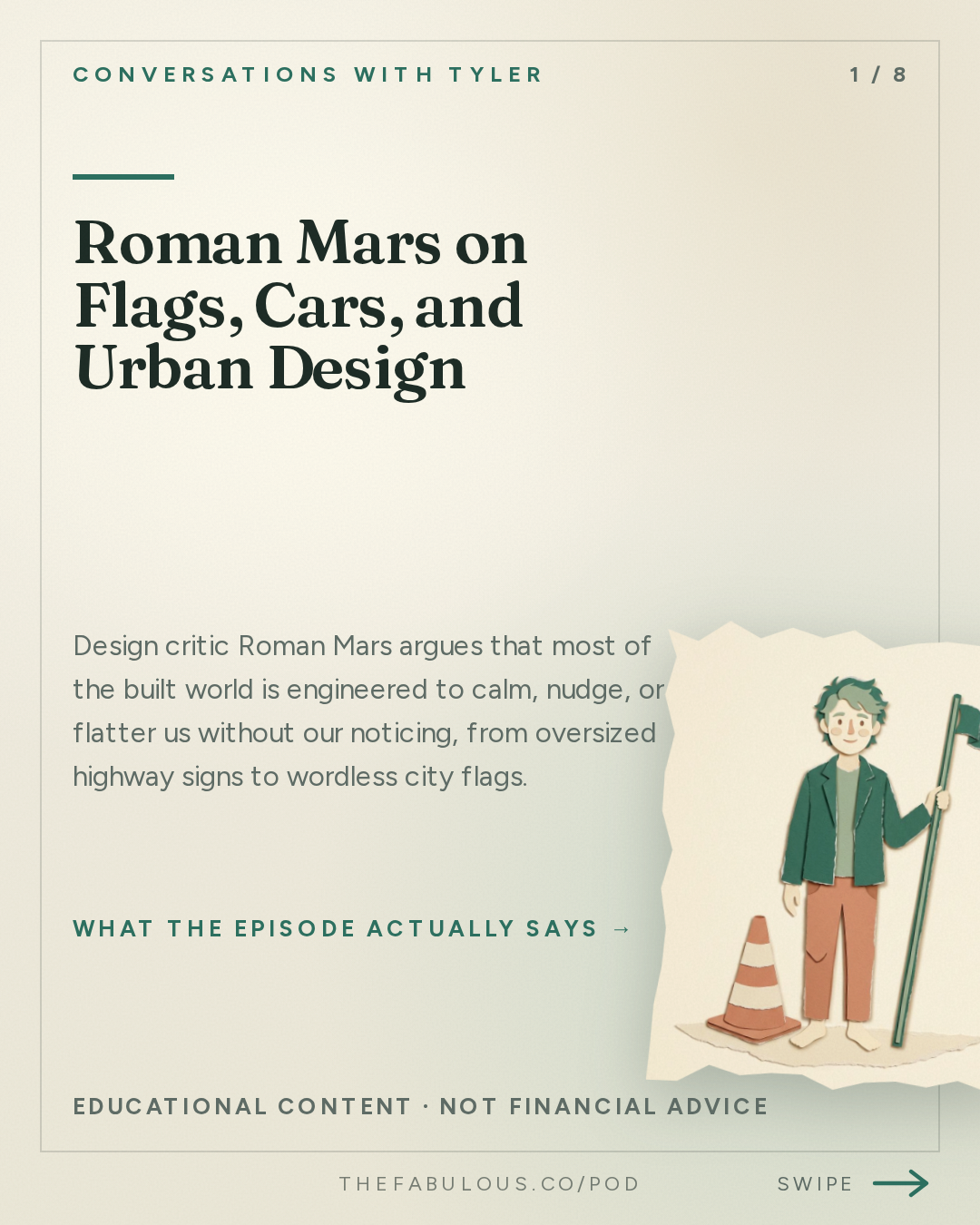
Design critic Roman Mars argues that most of the built world is engineered to calm, nudge, or flatter us without our noticing, from oversized highway signs to wordless city flags. He traces why cars, suburbs, and phones have grown visually uniform, and defends top-down planning against Jane Jacobs' bottom-up ideal.
Stand on a street corner in an unfamiliar city and look for the sign that tells you where you are. Chances are it was not put there for you. It was put there for the driver approaching the intersection, half a block back, going thirty miles an hour. Pedestrians get the leftovers: a sign mounted a few feet past where a walker would actually need it. Roman Mars, the host of the design podcast 99% Invisible and co-author of The 99% Invisible City, has spent nearly two decades noticing details like this. His gift is not finding hidden beauty. It is finding hidden intention, the decisions baked into curbs, currency, and car bumpers that nobody announces out loud.
That habit of noticing runs through his conversation with economist Tyler Cowen, which moves from street signs to jug handles to atomic waste warnings without ever losing its central question: who was this thing actually designed for, and what does that choice cost everyone else? Mars admits he does not have a favorite street sign. Cowen likes Switzerland's spare, color-coded system and Los Angeles's oversized ones, built big because they are built for drivers (02:43). But his answer is less interesting than his method: judge the design by who it serves, then ask who it leaves out.
Cars are the clearest case. Mars grew up in an era when you could identify a car's make and model from its silhouette alone. Today, he says, that game is basically unplayable (03:56). Part of the reason is mundane: older cars got ten miles to the gallon and carried unsafe amounts of ornamental steel, built during what Mars calls an extractive era of manufacturing that did not price in fuel costs or crash safety (04:14). Once safety regulation and efficiency standards tightened, the bold shapes got sanded down. The rest of the reason is social: manufacturers chase a statistical mean, a shape that offends the fewest buyers, and the result drifts toward sameness (04:27). When something does break the mold, like Tesla's Cybertruck, Mars is not impressed. He calls it a horrible-looking vehicle whose utility was sacrificed for a shape nobody had seen before (04:52). Distinctiveness, in his telling, is not automatically a virtue. It is a trade-off, and this one did not pay off.
The same logic explains why he is unmoved by claims that global design is making every coffee shop in Bangkok, Tokyo, and Buenos Aires look the same. He does not deny the flattening. He just thinks attentive travelers can still find the local seams in it, the strange item on a foreign McDonald's menu, the regional detail a careless eye would miss (21:22).
The Argument With Jane Jacobs
Cowen pushes Mars on a bigger question: why do almost no post-World War II American neighborhoods look as good as prewar ones, or as good as new construction in Copenhagen or Helsinki? Mars's answer is about distance and pressure. When buildings sit close together, in a dense old neighborhood, people notice each other's choices, and a kind of local accountability builds up over time. Spread buildings out, add industrial pressure to make housing cheaper and more modular, and that accountability disappears (13:09). Mars says he actually wants construction to stay a little inefficient, so individual decisions and local labor survive the squeeze toward cookie-cutter sameness.
"I don't want building to get more efficient. I want it to be inefficient in ways, because I want people to make individual decisions." — Roman Mars (13:59)
This tension between top-down control and bottom-up texture is also where Mars locates the limits of urbanist Jane Jacobs, whose writing championed neighborhoods built from the ground up, from what she called the sidewalk ballet of everyday street life. Mars calls her observations astute (17:36), but argues her worldview, taken to its extreme, leaves no room for top-down planning that actually works, and can curdle into a kind of historic-preservationist NIMBYism, opposition to new building dressed up as neighborhood protection (18:22). A functioning city, he says, needs both modes talking to each other: the close-grained local knowledge Jacobs prized, and the large coordinated moves, like Central Park, that only top-down power can pull off. Mars calls Central Park a near miracle, a stretch of the most valuable real estate on earth that New York chose, long ago, not to develop (16:27).
Reputational reversals run through the episode. The Chrysler Building, with its stainless-steel eagles and hubcap flourishes, was dismissed by modernist critics in its own era as silly filigree, arriving just as architecture was falling in love with sleekness (14:33). Decades later, it is beloved. Brutalism, the raw-concrete style that modernists favored next, inspires Mars in the abstract but worries him in practice, because the aggregate in the concrete cracks and weathers badly, turning buildings that could feel human into ones that feel oppressive, though he cites London's Barbican complex as an example that still feels extremely human and lovely (15:19). The lesson Mars draws is patient: buildings get reassessed over and over, so judgment should wait.
That same reassessment explains his read on the iPhone. The device that looked stunning on release day now looks boring to plenty of its early buyers, Cowen included. Mars says taste simply moves on, the way it did when ornament-heavy buildings gave way to sleek modern towers that people loved partly because function finally matched form.
"When you grow up in a world in which ornamentation is reserved for the lucky few and everyone else gets nothing, all of a sudden ornamentation seems offensive." — Roman Mars (22:39)
He adds a sharper observation about phones specifically: as pocket computers absorb more functions, being an actual telephone has become almost incidental to what a phone is for (23:54), which is why a minority of users are now buying deliberately "dumb" phones built to do one thing well.
What a Flag Is For
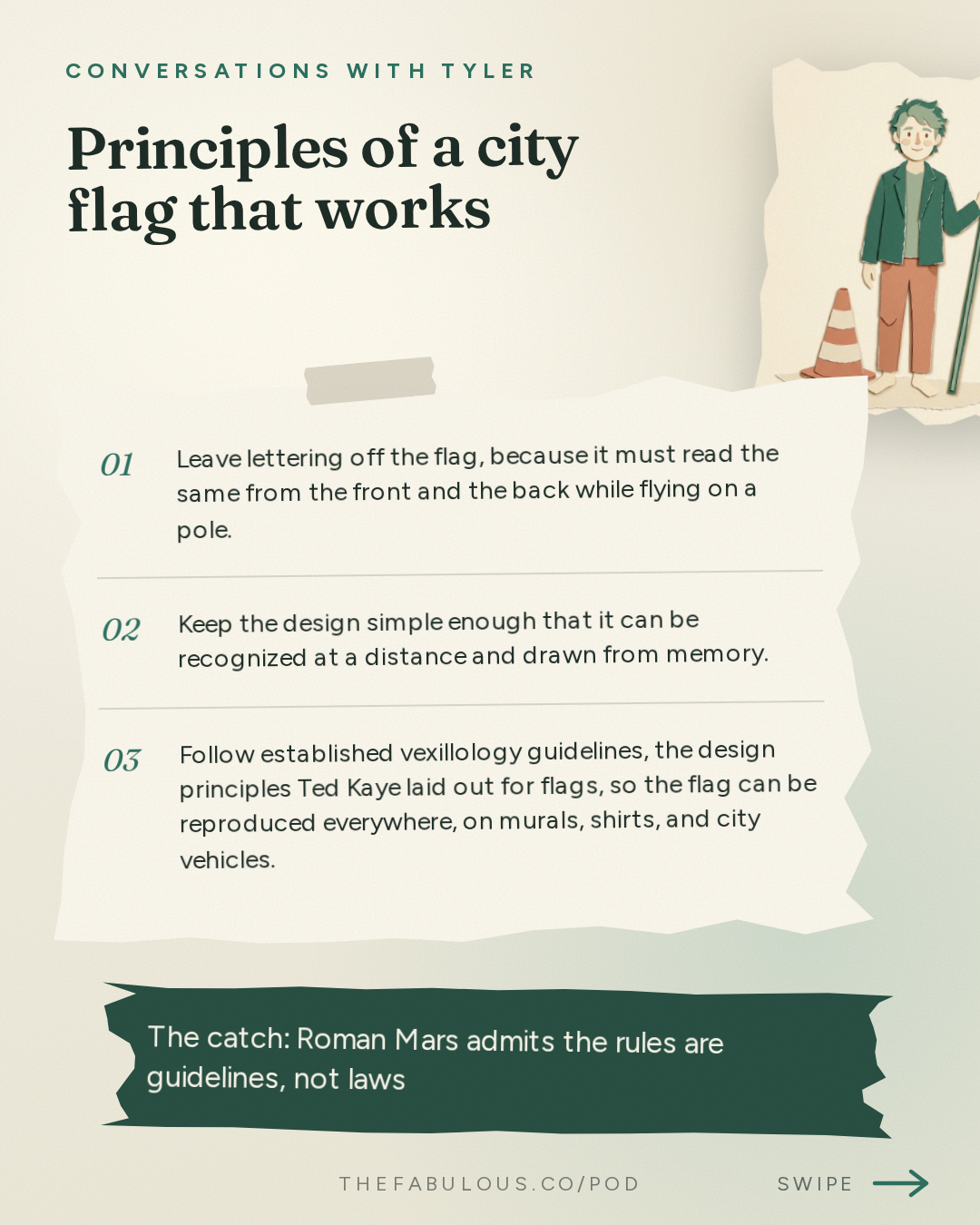
Mars is best known outside podcasting circles for a TED talk on vexillology, the study of flags, and the conversation's most concrete design advice lives here. A city flag, he argues, should carry no lettering, because a flag flies on a pole and must read the same from the front and the back; words just mirror into nonsense from one side (34:43). Chicago is his proof of concept: its four-star flag shows up on t-shirts, murals, and city vehicles, reinforcing civic pride in what Mars calls a positive feedback loop (36:03). He is less dogmatic than his talk's reputation suggests. Maryland's busy, heraldic flag and Brazil's lettered one both break his rules and still work, because they are, in his word, gorgeous enough to embrace anyway (37:32). Since the TED talk aired, something like 250 to 300 American municipalities have redesigned their flags (40:10), including Pocatello, Idaho, which Mars once called out as having the nation's worst flag and which later thanked him for the push.
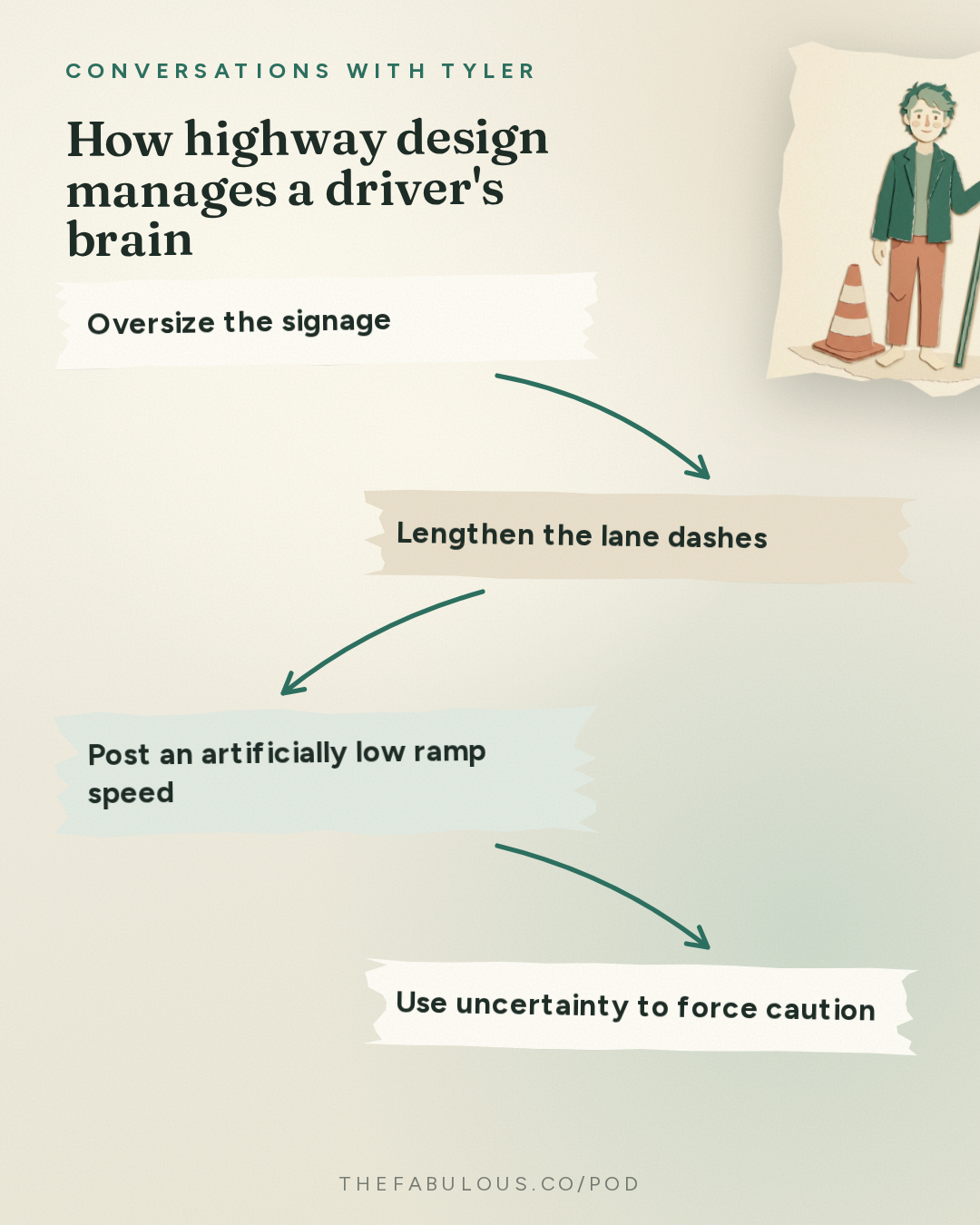
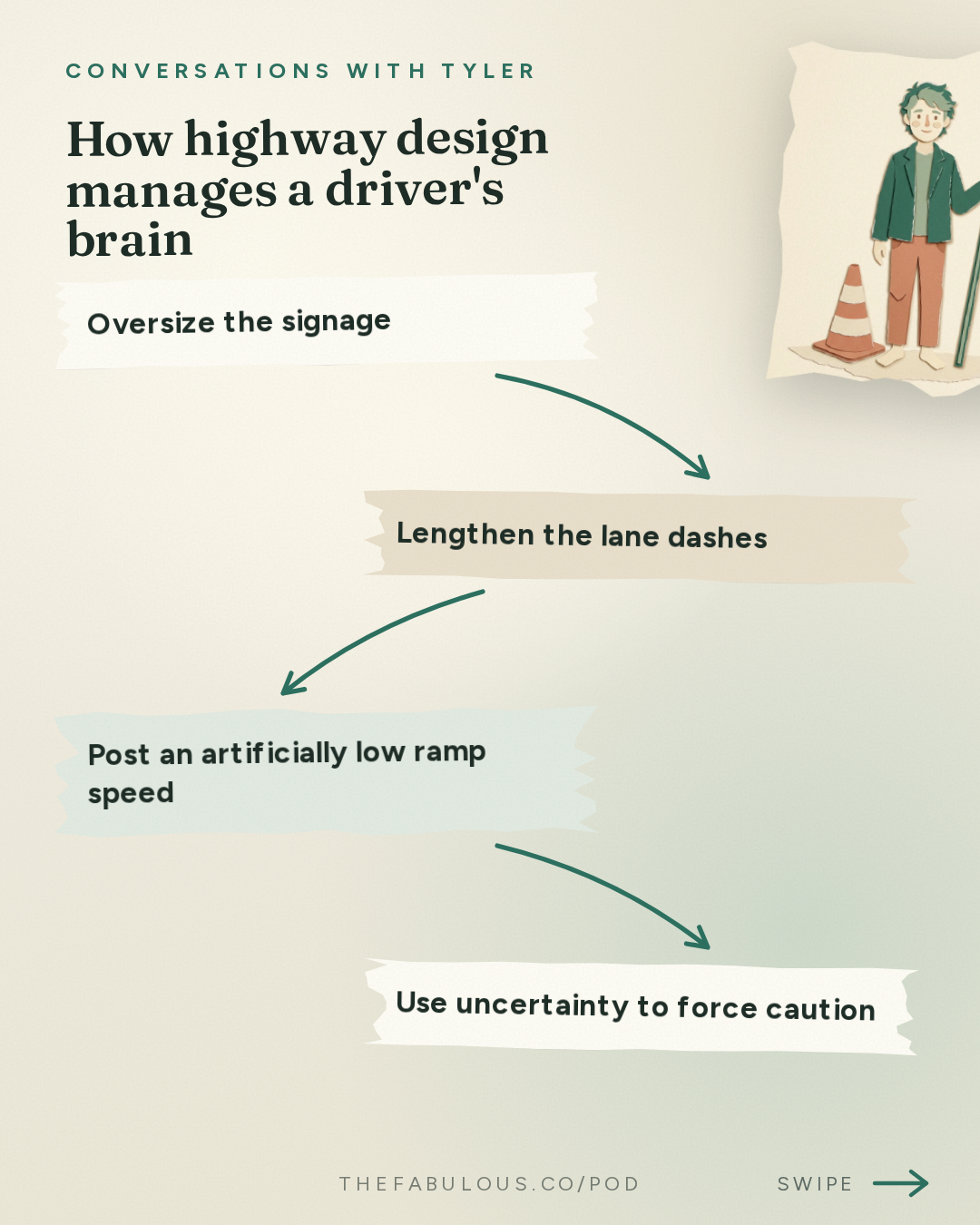
The flag material connects to a bigger theme: design that works on the nervous system rather than the conscious mind. Highway signage is built oversized, Mars says, specifically to calm a brain that never evolved to process information at highway speed (33:37). Most drivers, when surveyed, guess that the dashed lines dividing highway lanes are about two feet long; they are actually ten to fifteen feet (33:51, 34:00). Ramp speed limits are often posted lower than the truly safe speed, a small deception meant to jolt drivers out of highway hypnosis before a sharper turn (32:44). Speed bumps and traffic circles work the same way in reverse, using uncertainty rather than information to force caution (29:36). Even warning signs for nuclear waste sites run into this problem at civilizational scale: planners behind one long-term nuclear waste marker project worried that no symbol, not even a simple before-and-after pictogram of a person getting sick, could reliably warn people thousands of years from now, partly because a left-to-right reading order might mean nothing to them (30:39). Proposed fixes included folk songs and genetically engineered cats that would glow near radioactive material, passing the warning down as a story rather than a sign.
Mars ends on his own management style, which turns out to rest on the same instinct that drives his design criticism: pay attention to who is actually affected by a choice. He credits his career's durability less to any single creative talent than to treating every part of running a show, funding, scheduling, editing, as equally worth his attention, and to leading the people who work for him, including longtime senior editor Delaney Hall, with deliberate kindness.
"I try to lead with kindness first... I think it's really, really important to making a thing because we make a thing that's an expression of art." — Roman Mars (44:31)
It is a fitting close for someone who has built a career convincing people to notice what was in front of them the whole time. The street sign, the dollar bill, the flag on the pole: none of it was invisible. It was just never explained.
Ask this episode anything
Pod's AI answers from the episode itself, with the minute mark so you can hear it yourself.
Or start with one of these
Ask this episode
Pod's AI listens to the whole episode to answer, and points you to the minute it comes from.
The rest of this answer, and any question after it
Answers come from the episode itself, never from a summary of it.
ContinueKey takeaways
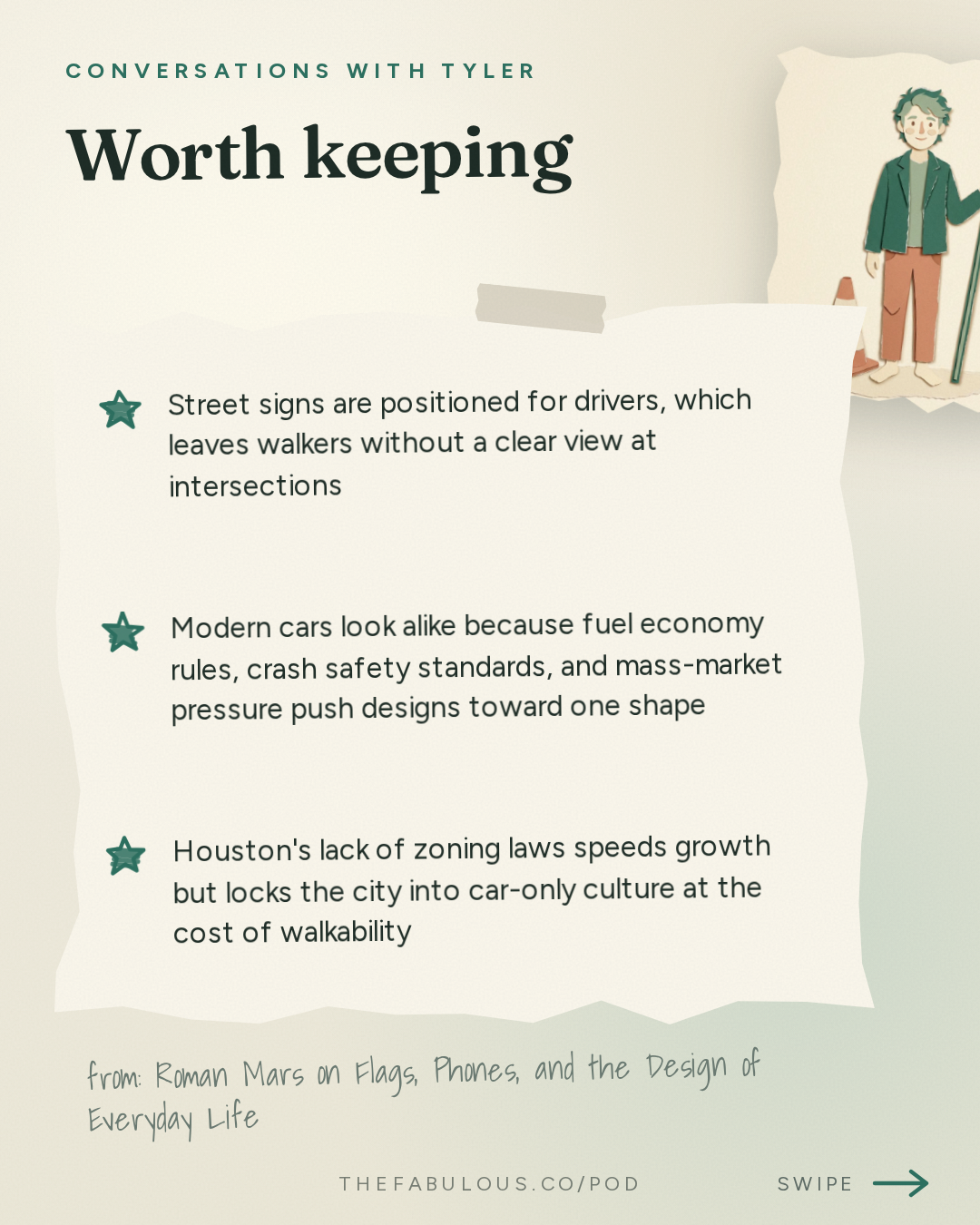
- Street signs are positioned for drivers, which leaves walkers without a clear view at intersections
- Modern cars look alike because fuel economy rules, crash safety standards, and mass-market pressure push designs toward one shape
- Houston's lack of zoning laws speeds growth but locks the city into car-only culture at the cost of walkability
- A working city flag like Chicago's avoids lettering so it reads the same from both sides while flying on a pole
- Highway signs and lane dashes are built oversized because drivers underestimate their true size, which calms the brain at high speed
The episode in cards
By the numbers
- 10 mpg fuel economy of older, heavier cars from the extractive manufacturing era
In their words
“The most beautiful street signs are the ones I can see the best.”
“I don't want building to get more efficient. I want it to be inefficient in ways, because I want people to make individual decisions.”
“When you grow up in a world in which ornamentation is reserved for the lucky few and everyone else gets nothing, like, all of a sudden ornamentation seems”
Protocols
-
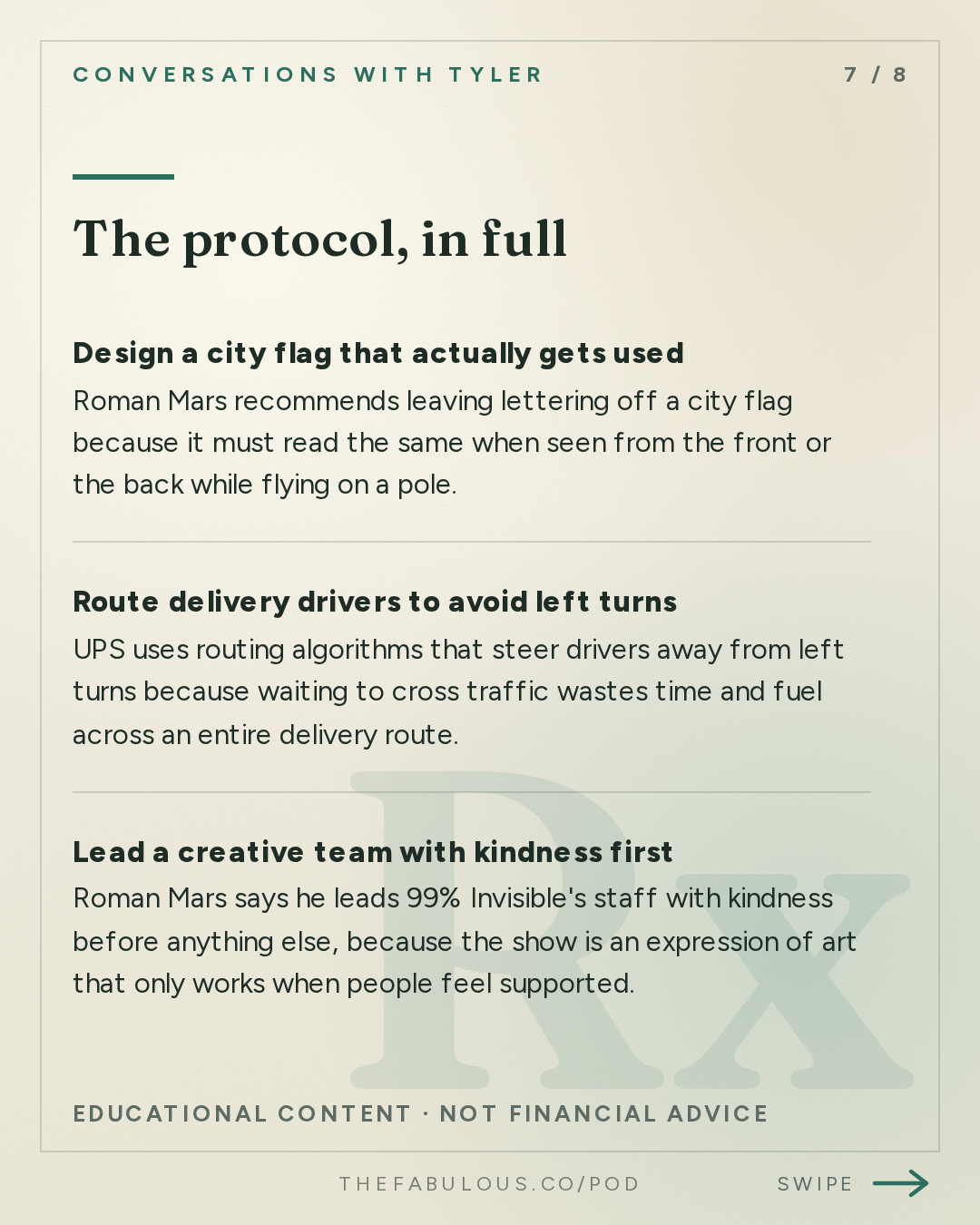
Design a city flag that actually gets used
Roman Mars recommends leaving lettering off a city flag because it must read the same when seen from the front or the back while flying on a pole.
applies to any new or redesigned municipal flag
-
Route delivery drivers to avoid left turns
UPS uses routing algorithms that steer drivers away from left turns because waiting to cross traffic wastes time and fuel across an entire delivery route.
every route, continuously
-
Lead a creative team with kindness first
Roman Mars says he leads 99% Invisible's staff with kindness before anything else, because the show is an expression of art that only works when people feel supported.
ongoing management practice
Questions this episode answers
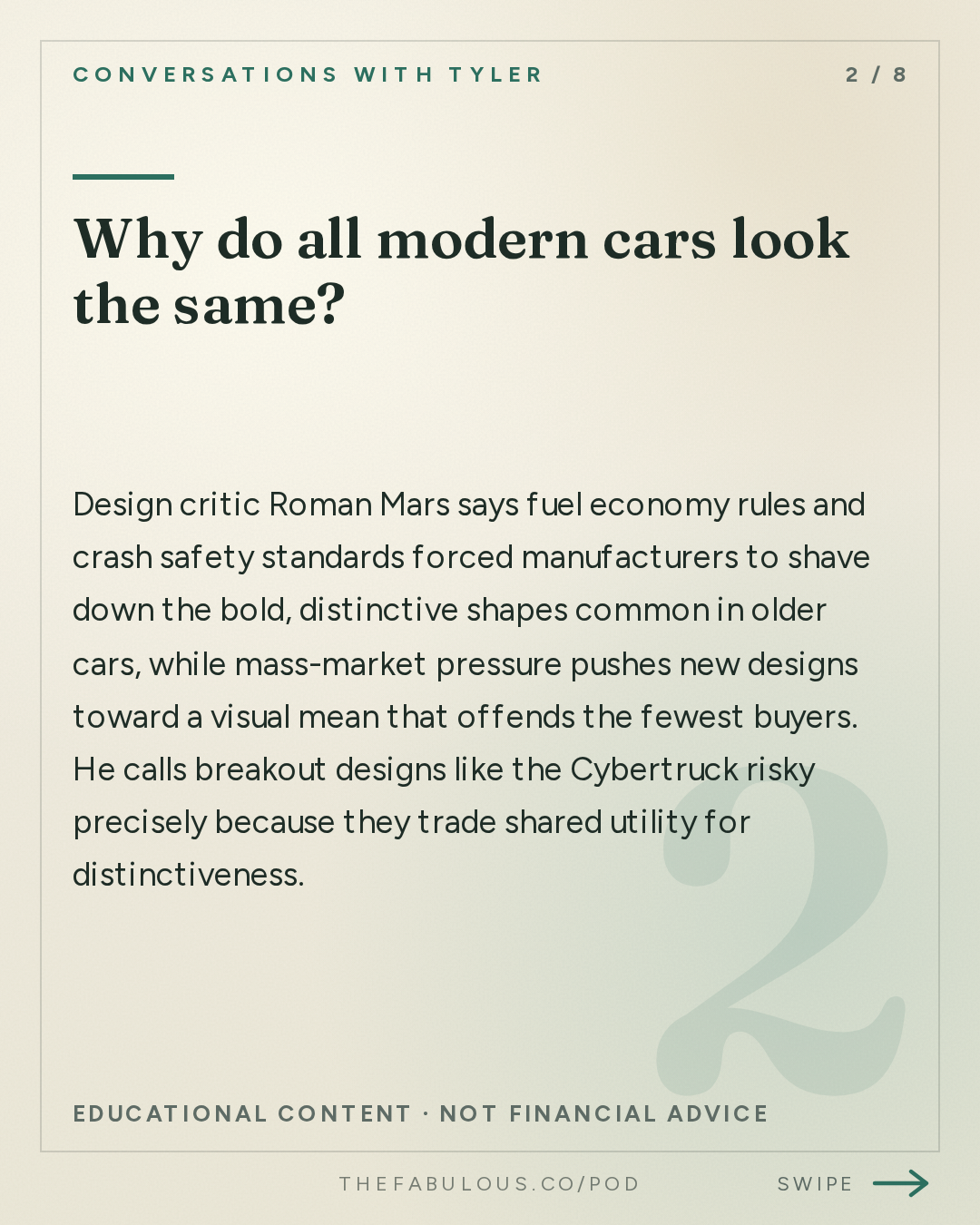
Why do all modern cars look the same?
Design critic Roman Mars says fuel economy rules and crash safety standards forced manufacturers to shave down the bold, distinctive shapes common in older cars, while mass-market pressure pushes new designs toward a visual mean that offends the fewest buyers (04:27). He calls breakout designs like the Cybertruck risky precisely because they trade shared utility for distinctiveness (04:52).
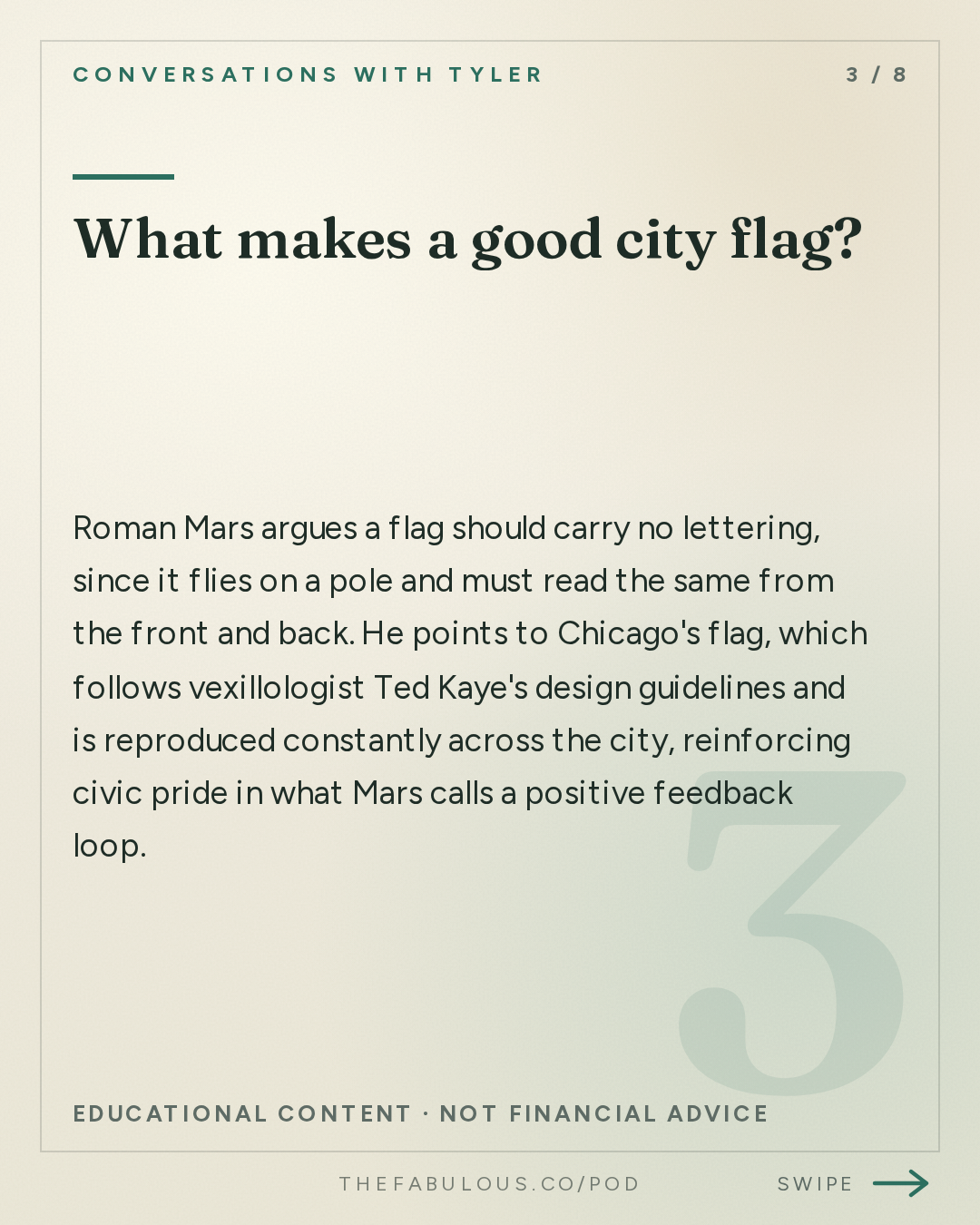
What makes a good city flag?
Roman Mars argues a flag should carry no lettering, since it flies on a pole and must read the same from the front and back (34:43). He points to Chicago's flag, which follows vexillologist Ted Kaye's design guidelines and is reproduced constantly across the city, reinforcing civic pride in what Mars calls a positive feedback loop (36:03).
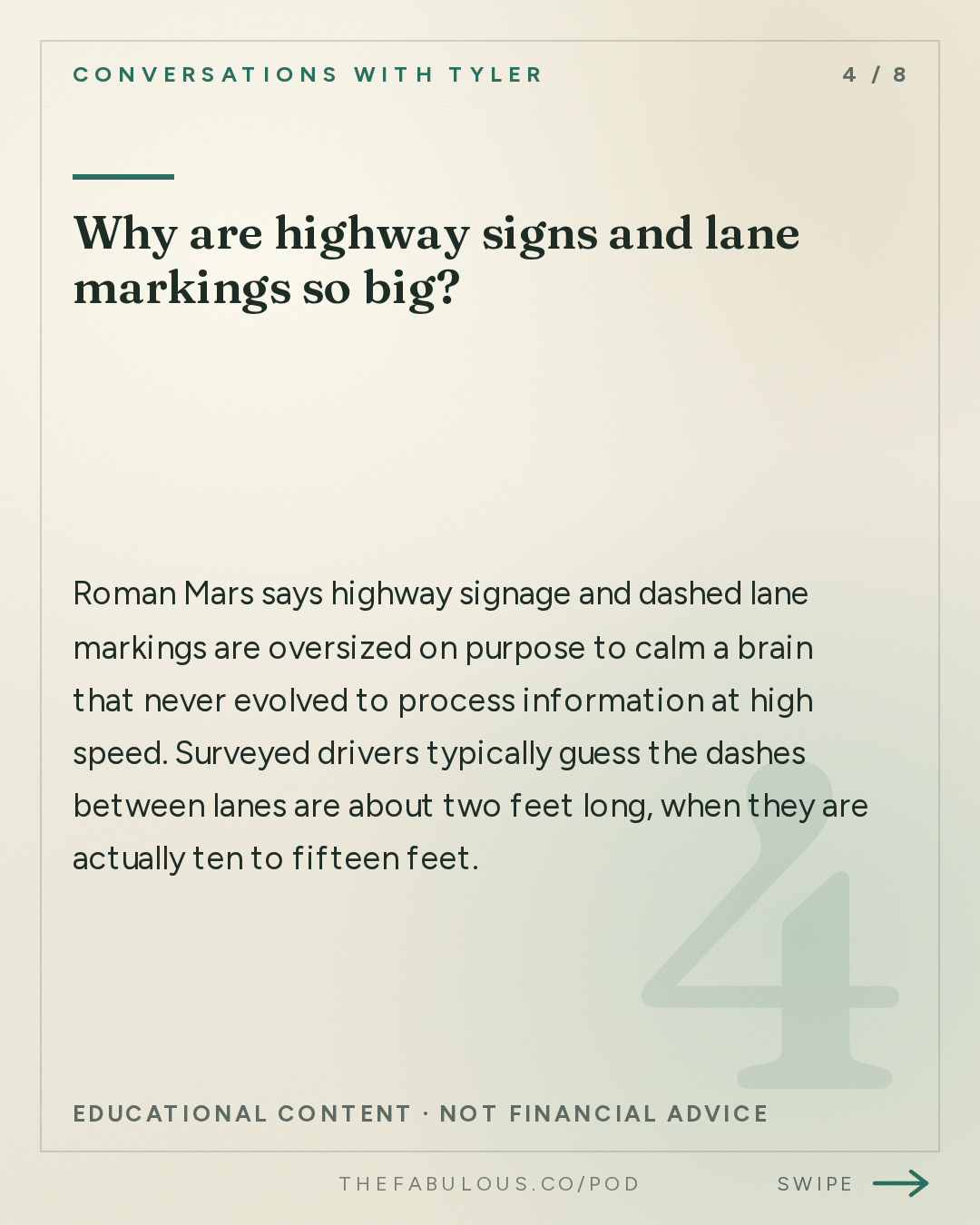
Why are highway signs and lane markings so big?
Roman Mars says highway signage and dashed lane markings are oversized on purpose to calm a brain that never evolved to process information at high speed (33:45). Surveyed drivers typically guess the dashes between lanes are about two feet long, when they are actually ten to fifteen feet (34:00).
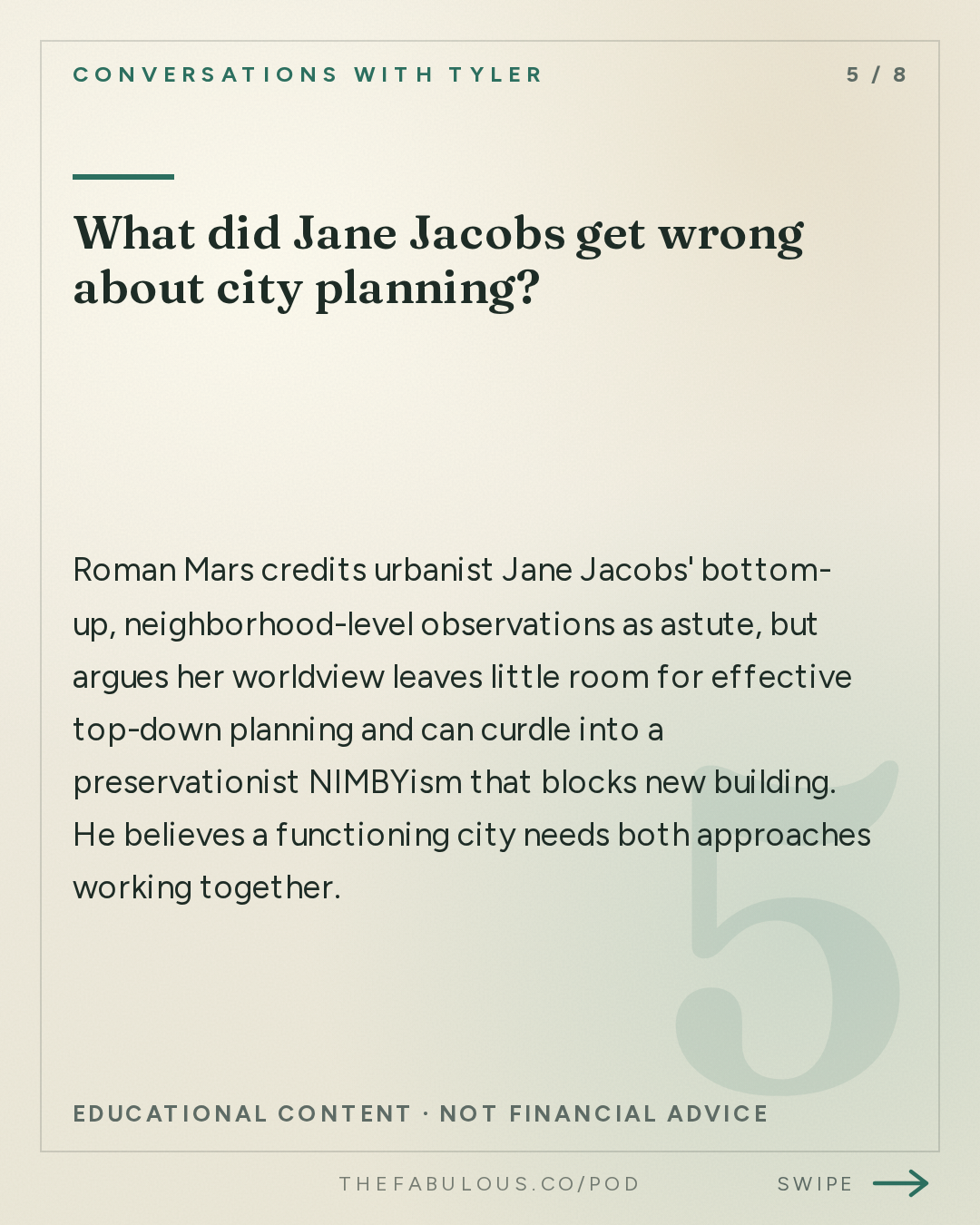
What did Jane Jacobs get wrong about city planning?
Roman Mars credits urbanist Jane Jacobs' bottom-up, neighborhood-level observations as astute, but argues her worldview leaves little room for effective top-down planning and can curdle into a preservationist NIMBYism that blocks new building (18:22). He believes a functioning city needs both approaches working together (18:10).
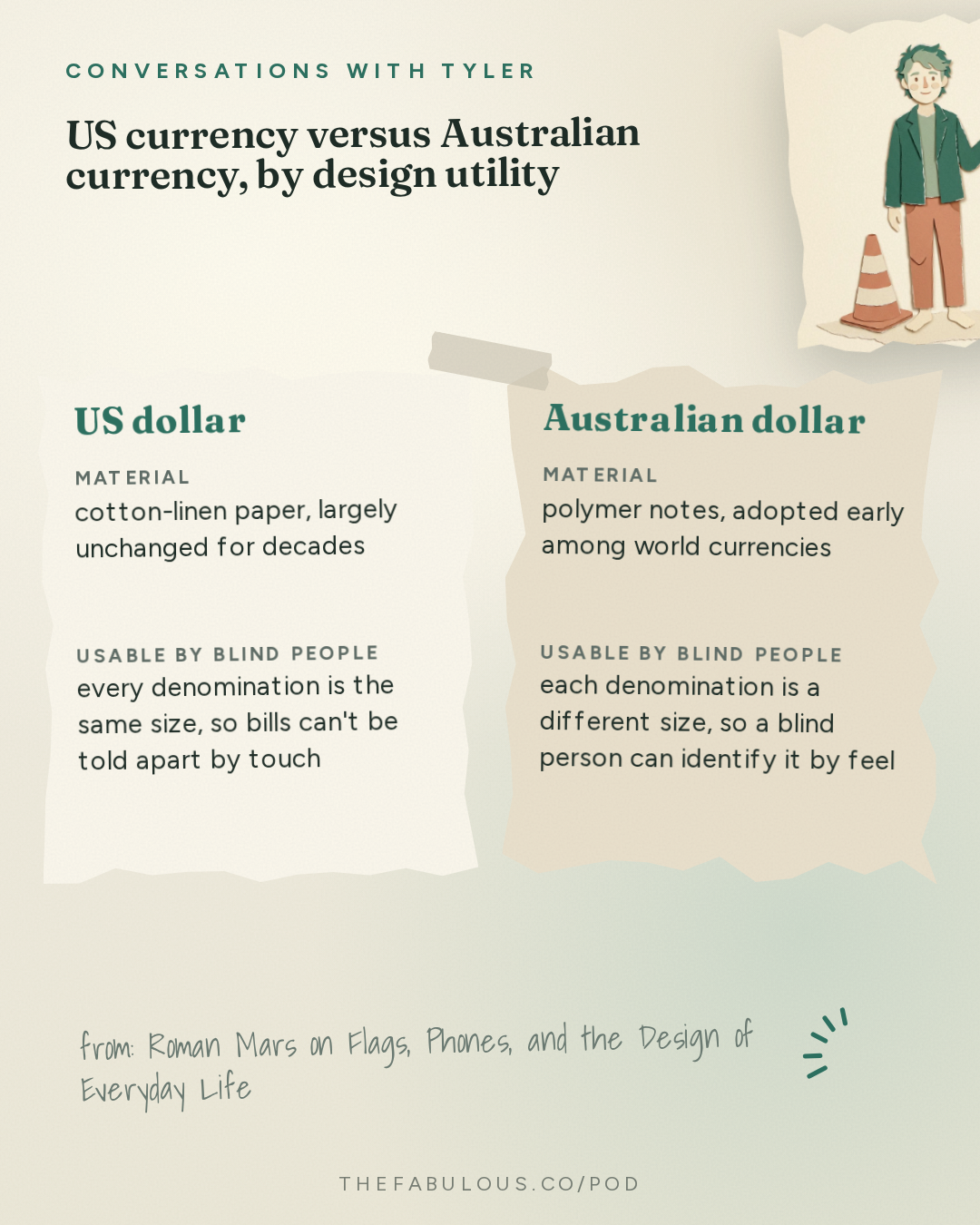
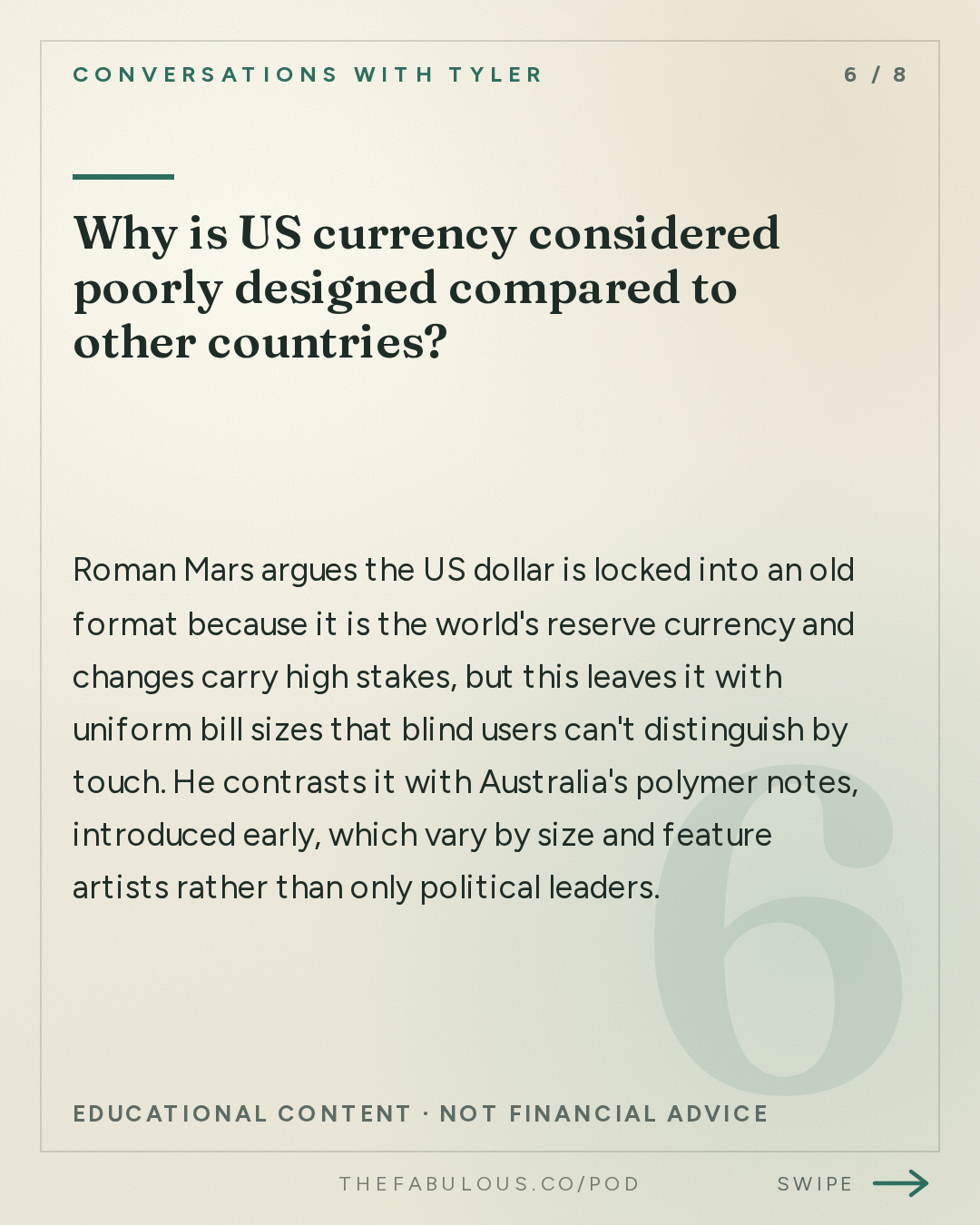
Why is US currency considered poorly designed compared to other countries?
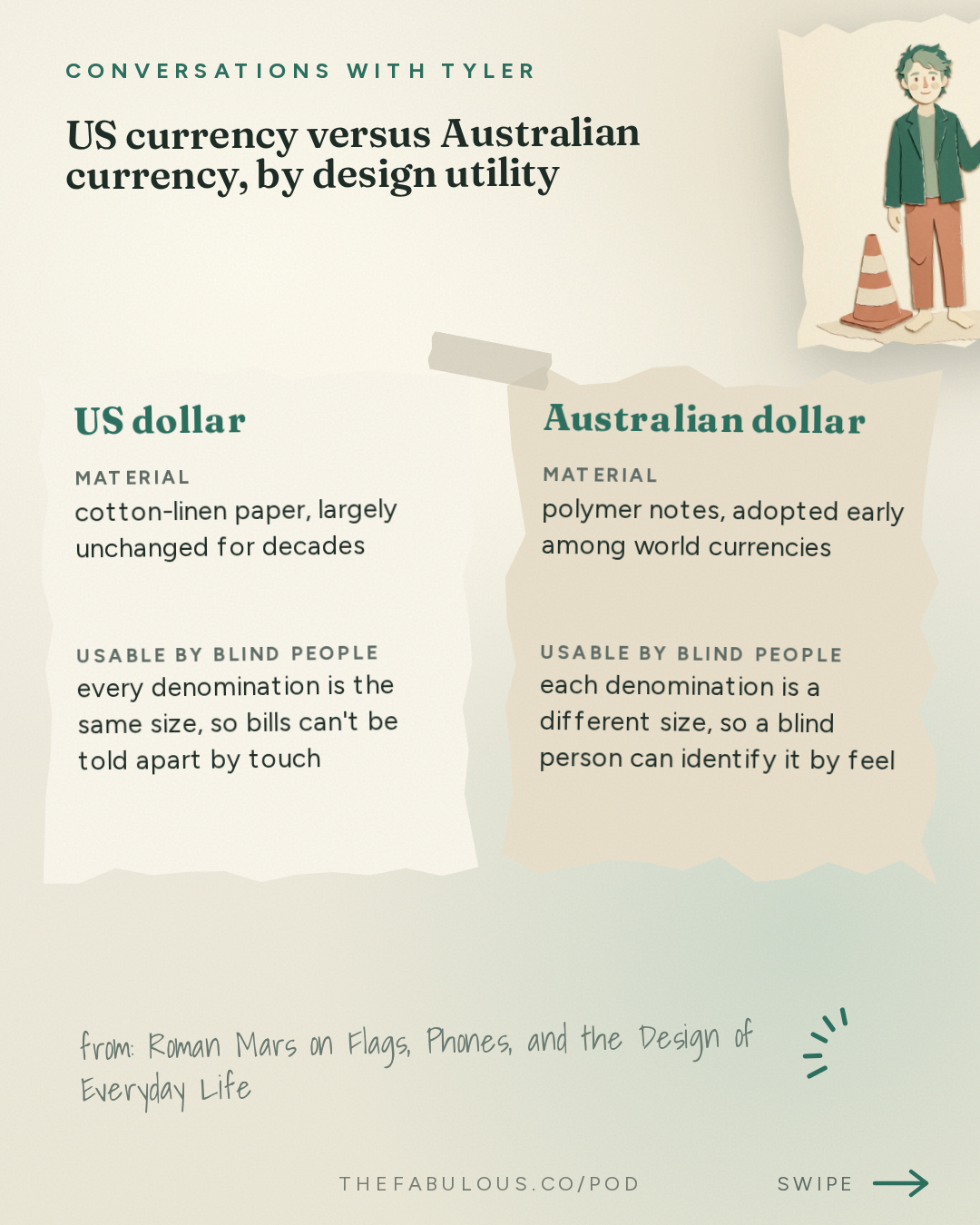
Roman Mars argues the US dollar is locked into an old format because it is the world's reserve currency and changes carry high stakes, but this leaves it with uniform bill sizes that blind users can't distinguish by touch (27:47). He contrasts it with Australia's polymer notes, introduced early, which vary by size and feature artists rather than only political leaders (26:36).
How do you warn people thousands of years in the future about nuclear waste?
A nuclear waste marker project Roman Mars describes struggled because no symbol or language is guaranteed to survive comprehensible across millennia, since even a before-and-after pictogram assumes a left-to-right reading order that may not exist in the future (30:39). Proposed solutions included folk songs and genetically engineered cats that would glow near radioactive material, passing the warning down as cultural story rather than signage.
The full read, in cards
Go deeper
- The 99% Invisible City: A Field Guide to the Hidden World of Everyday Design — co-written with Kurt Kohlstedt, catalogs the overlooked design decisions behind everyday infrastructure
- Ted Kaye's vexillology guidelines — the flag-design principles Roman Mars cites as the basis for what makes a city flag work
- WIPP nuclear waste warning project — an effort to design warning markers that could communicate danger across thousands of years, including proposals for folk songs and radiation-sensitive animals
Mentioned
Roman Mars · Kurt Kohlstedt · Jane Jacobs · Robert Moses · Ted Kaye · Delaney Hall · Chrysler Building · Central Park · Olmsted · Barbican · Pocatello, Idaho · Cybertruck · Waymo
More from this show and category

The Panic of 1873 and Its 20-Year Political Toll
Historian Liaquat Ahamed argues the Panic of 1873 did not collapse the world economy, it poisoned its politics for twenty years. Growth held near 2.5% through a long deflation (02:10), but the fallout helped end Reconstruction (07:06), fueled Gladstone's Egyptian bond windfall (09:44), and let Bismarck wreck bimetallism (14:16).

Luis Garicano on AI, Messy Jobs, and Spain
Economist Luis Garicano says Spain's aging society blocks growth, and AI will spare messy jobs but eliminate clean ones. He also faults EU institutions, where unanimity rules and party discipline reward loyalty over competence, for chronic policy paralysis in Brussels and Madrid alike.

Gita Gopinath on Trade, Currencies, and China
Former IMF chief economist Gita Gopinath explains why currencies rarely move the way trade theory predicts. She covers why 90% of China's US exports are priced in dollars, Argentina's disinflation from 150% to 30%, and why AI-driven growth might not save the US debt trajectory.

Annie Lowrey on America's Time Tax
Journalist Annie Lowrey says America's hidden "time tax" of paperwork and waiting falls hardest on the poor, not the rich. She contrasts Social Security's under-1% overhead with TANF's $16.5 billion in yearly costs, estimates 50 hours a year in bureaucratic time per person, and predicts AI agents could ease the burden within five years.
