
Hanania and Cowen on Conrad's Nostromo
Richard Hanania on Conrad's Nostromo, Latin American Crime, and Populism
▶ Listen to the full episode More from Conversations with Tyler
The brief
Tyler Cowen and Richard Hanania use Conrad's 1904 novel Nostromo to unpack why developing nations stall and why Latin America mixes democracy with high crime. They also cover why Shakespeare's greatness rests partly on social proof and why AI may beat humans at talking people out of conspiracy theories (53:40).
Joseph Conrad never set foot in Latin America. He sailed past its coast once, on a cargo run, and never went ashore. Yet he spent two years inventing Costaguana, a country that does not exist, and the result is a novel so recognizable that the critic Fredric Jameson once claimed no Latin American author could have written it himself, because he would have been too close to love it or hate it cleanly. Conrad had the advantage of distance. That paradox, that the outsider sometimes sees the structure more clearly than the native, runs under the whole conversation between Tyler Cowen and writer Richard Hanania, author of the new book Kakistocracy: Why Populism Ends in Disaster, as they use Nostromo (published in 1904) to talk about development, honor, crime, and what is left of honest argument in 2026.
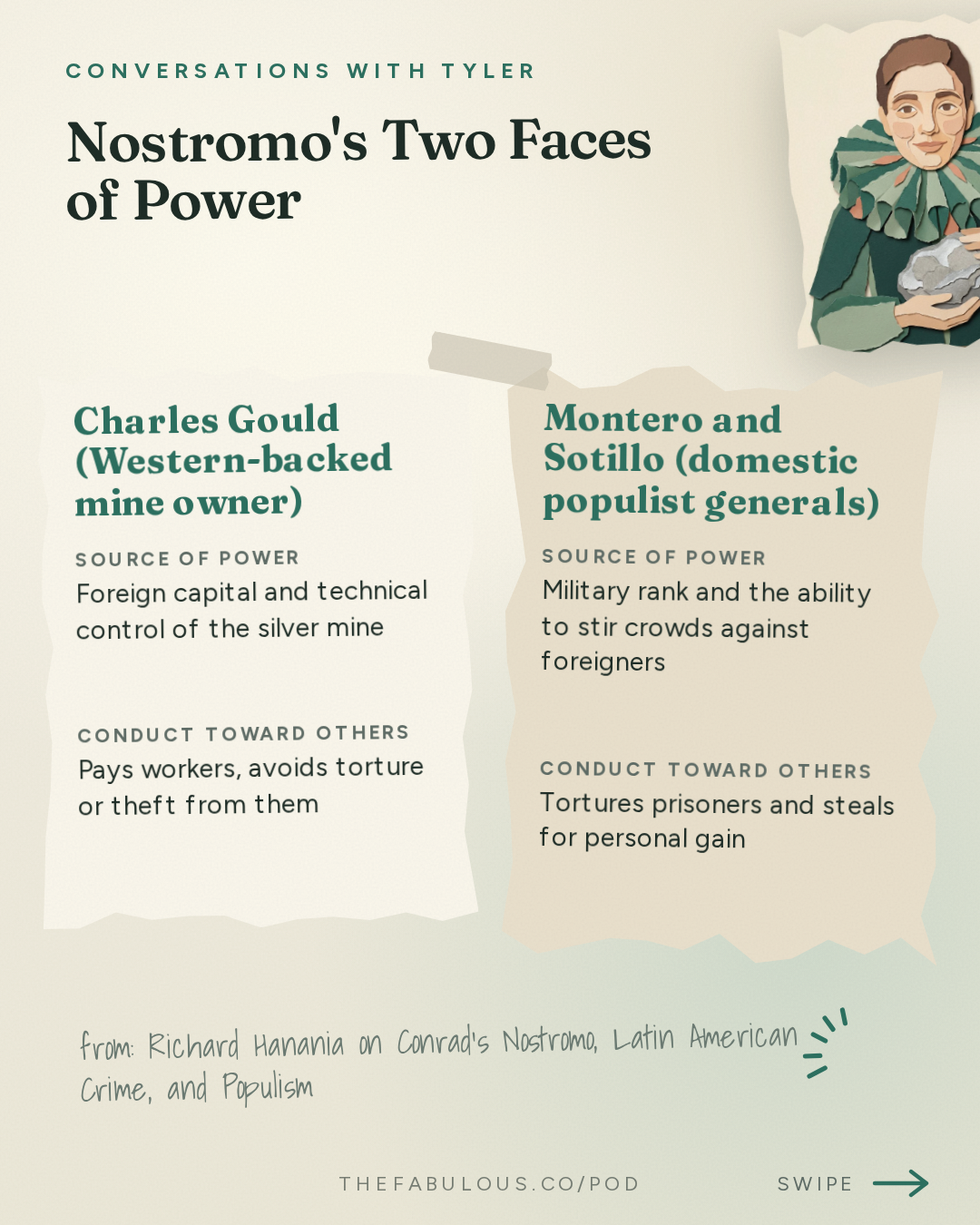
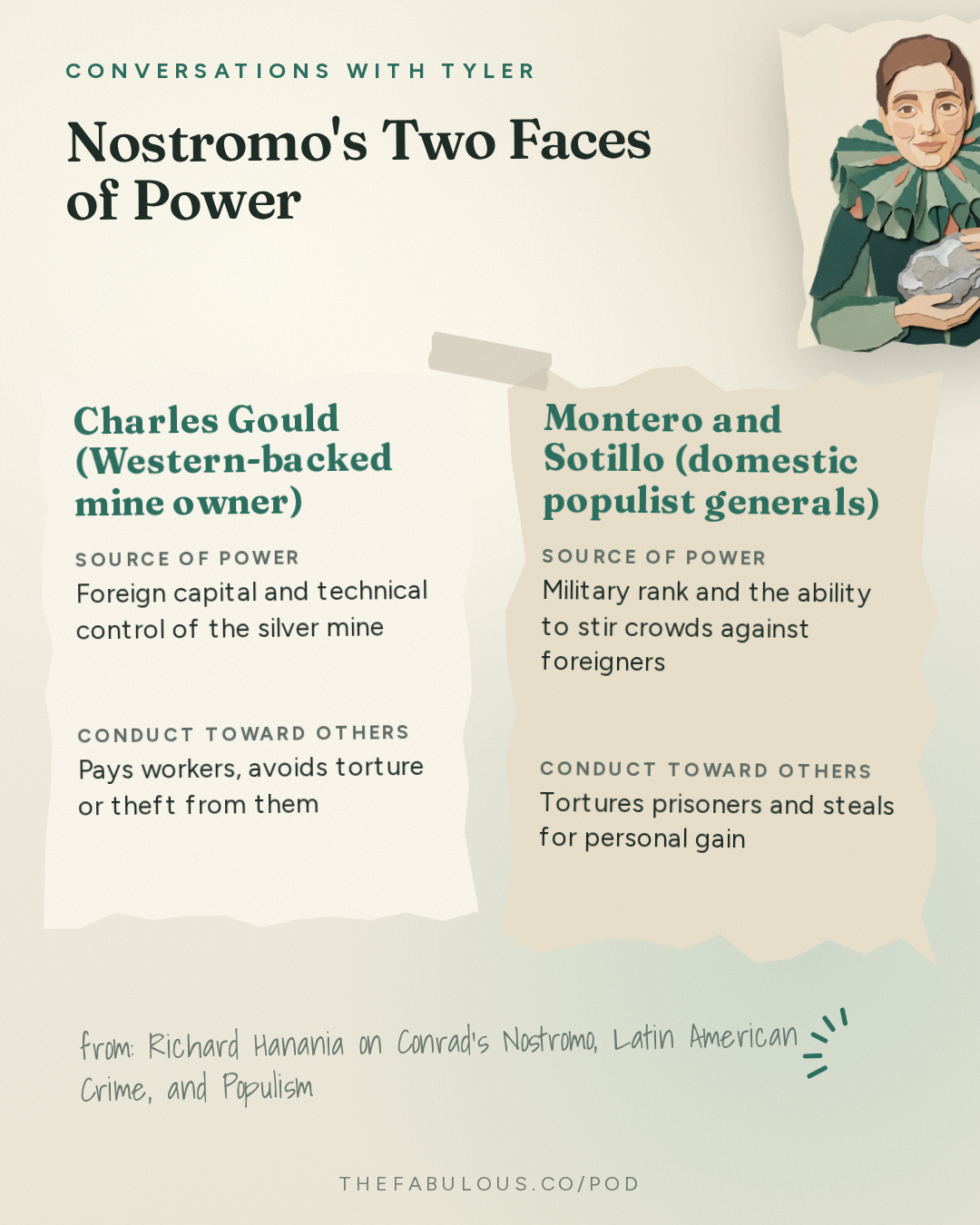
Nostromo opens in a fictional Occidental Province, a stand-in for a slice of Colombia, Argentina, Venezuela, and Mexico, where an Englishman named Charles Gould runs a silver mine with the backing of Western money (01:26). Hanania reads the book as strikingly contemporary even though the word socialism barely appears in it: "Conrad, he's clearly not a socialist, but he views socialism as more of a symptom than a cause" (04:56). The country is already trapped, by rent-seeking, corruption, and what Hanania calls a dead hand of history, before any ideology arrives to name the trap. Hanania pushes the point further: developing countries need Western capital and expertise, but a bunch of rich foreigners running a mine is, in his words, politically easy to demagogue (05:35). The mine brings real development. The politics around it treats that development as theft.
Where the two disagree, productively, is on how cynical Conrad actually is about liberal ideas themselves. Cowen reads the novel as a quiet critique of classical liberalism, not just of socialism: liberty and democracy get invoked by everyone in Costaguana, and for Conrad, he argues, that talk is close to fraud (06:46). Hanania pushes back by pointing to Jose Avellanos, a classical liberal elder statesman he calls the book's conscience, who is naive about newspapers but not corrupt. Cowen counters with the actual text, a passage where Conrad mocks the elites who worry about what they call "Negro liberalism" by having them respond with nothing but a newspaper named Porvenir, Spanish for "the future." The irony, Cowen says, cuts at the liberals too. Hanania's reply is comparative: whatever the liberals' delusions, the alternative on display, the generals Montero and Sotillo, is worse in every way that matters, cowardly, vain, and without a single virtue (20:34). Cowen's response names the deeper disagreement: Conrad, he argues, is not a comparativist. He is closer to Shakespeare, less interested in ranking rulers than in showing a tragic structure that holds regardless of who is in charge.
That tragic structure gets its bluntest statement from the novel's own businessman. Cowen reads a line from Gould aloud:
"Liberty, democracy, patriotism, government, all of them have a flavor of folly and murder." (Tyler Cowen, quoting Charles Gould) [17:25]
Cowen takes this as Conrad's own view, smuggled into a character's mouth: a writer who wanted to believe in liberal principles, who left Russian-ruled Poland for England and preferred it, but who traveled enough of the world to watch those same principles curdle into something closer to murder. Which gets at another thread in the conversation: Cowen's claim that Conrad treats travel and geography as the most basic form of political knowledge, more basic than theory (28:58).
"I think he sees travel and geography as the most fundamental forms of knowledge including political knowledge." (Tyler Cowen) [28:58]
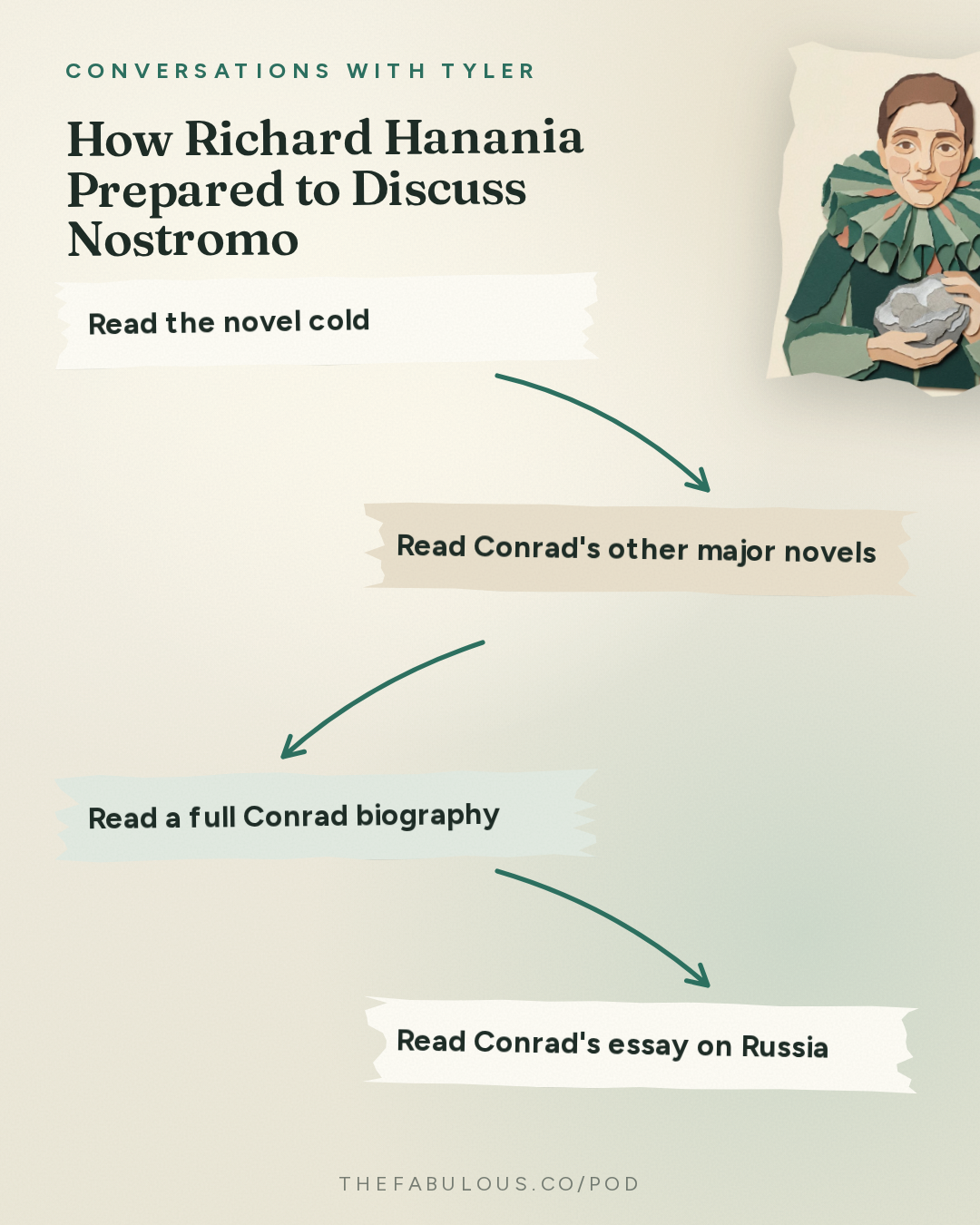
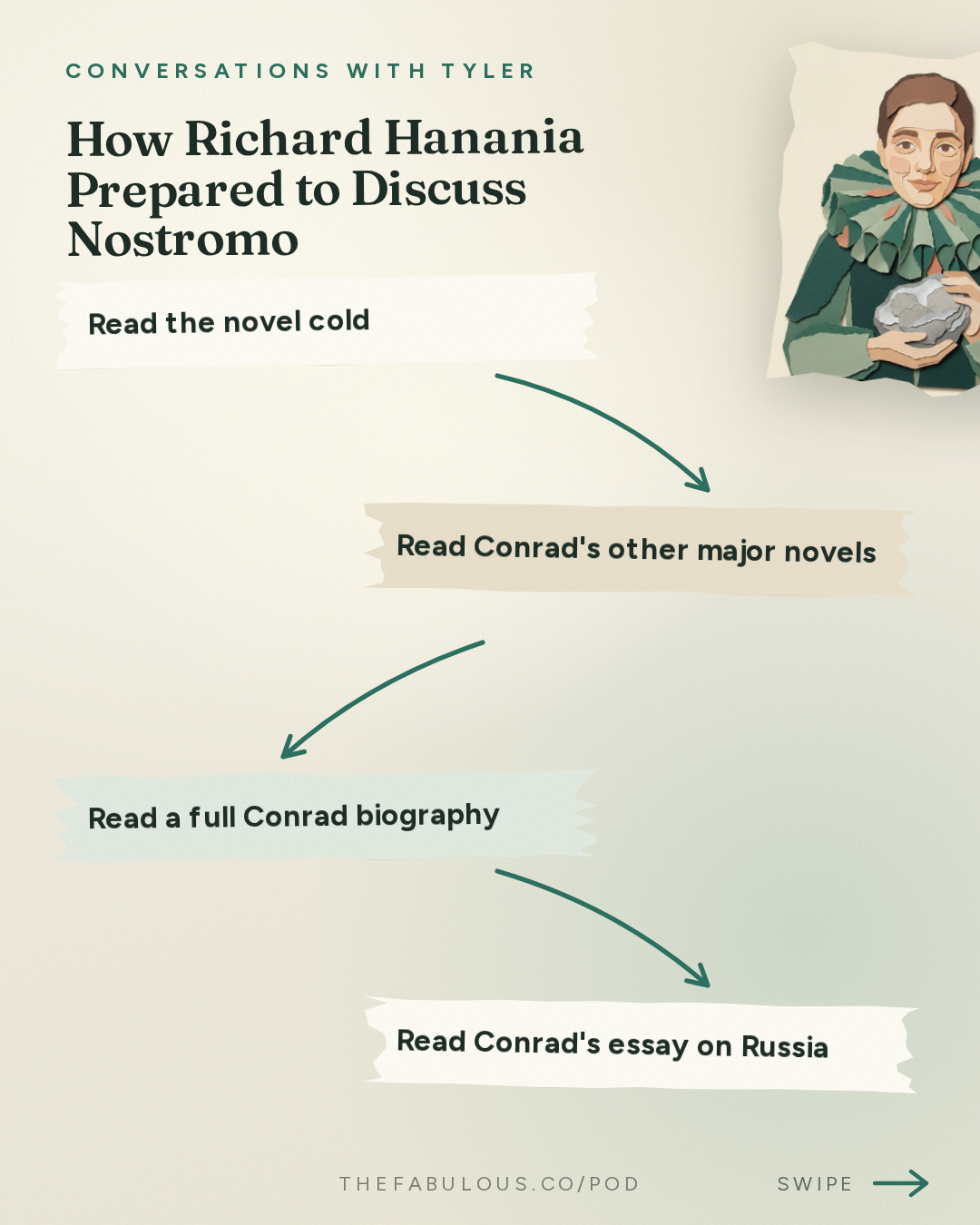
Hanania's own research process for the episode takes that idea seriously. Rather than reading criticism first, he read the novel cold, then Conrad's other major books (Heart of Darkness, The Secret Agent, Lord Jim), then a full biography by historian Maya Jasanoff, pausing partway through to read whichever Conrad novel the biography was currently summarizing (34:46). Cowen pulled the first twenty essays on Nostromo from the academic database JSTOR and found most of them useless, keeping only two, an essay by journalist Robert D. Kaplan on the novel and the Third World and one by Claire Rosenfeld on its mythic structure (35:19). Hanania also watched BBC documentaries of the actual Congo River to understand the geography behind Heart of Darkness. Cowen noted that the region grew for about 20 years, into the 1960s, becoming one of the wealthier parts of Africa, before losing almost all of it (37:13). The explanation usually offered is corruption, Cowen says, but that just restates the question, since plenty of African countries did better over the same stretch (37:45).
A Combination That Does Not Work
The conversation's hardest real-world claim concerns crime. Hanania's puzzle is that Latin American cartel leaders sometimes run operations from inside prison, something he calls unthinkable in, say, the Middle East (40:14). His explanation is structural, not cultural:
"It seems that they have this combination of democracy and civil liberties, but low state capacity, and that seems to be a bad combination." (Richard Hanania) [40:37]
Countries that are outliers for violence relative to their wealth, he argues, are almost always countries with high democracy scores, and a disproportionate share sit in Latin America (40:37). Very poor, tightly bound rural communities, by contrast, often have little daily crime, because everyone knows everyone and exile from the group is a real threat (41:16). Cowen adds a Colombia-specific variant: incomplete nation-building plus rapid urbanization, where drug markets and export routes are worth fighting over and no single authority controls the roads (41:56). Against that backdrop, both treat Panama as the rare success story, a country that kept reasonably stable governance after splitting from Colombia in 1903 with American backing, and that today is one of the wealthier, safer nations in the region (33:19). Cowen admits he did not expect it: in 1980, he says, it was not obvious Panama would turn out this way at all (33:19).
Prestige, Negativity, and the Case for AI
Midway through, the conversation turns from Costaguana to the present-day marketplace of ideas, and the thread connecting the two is social proof. Hanania revisits an old controversy over crypto executive Sam Bankman-Fried's claim that Shakespeare's reputation owes more to the size of history's audience than to objective merit. Hanania's version is softer but related: "I believe the way we appreciate art, the way we consume it, is based too much on prestige signals" (45:37). He is not arguing Shakespeare is bad, only that greatness, once established, becomes self-confirming, the way a disputed painting needs forensic analysis because viewers cannot actually tell a fake by eye (45:37).
The same skepticism about inherited authority shows up in his read of the media. Hanania has previously defended mainstream journalism against its online critics, and he still rates it, comparatively, ahead of the decentralized alternative on Twitter or podcasts, if only because the alternative has no real fact-checking layer (49:34). But he is markedly less impressed than he once was, pointing to a strong negativity bias in coverage of technology and artificial intelligence, where, he says, it is not a conspiracy so much as a market that rewards alarm (50:45). Cowen, who puts his own media sympathies at roughly the 90th percentile among people on the right (50:22), agrees the tech coverage specifically has gotten worse.
The more surprising claim is about what might fix some of this. Hanania points to research suggesting artificial intelligence chatbots can be more effective than human beings at talking people out of conspiracy theories, because a chatbot like xAI's Grok will patiently take apart a conspiracy theorist's ten cited studies one by one without getting frustrated or condescending, something most humans cannot sustain (53:40). He floats the idea that after three decades of communication technology, cable news, talk radio, social media, making public discourse worse, AI might be the first technology in that stretch to push in the other direction (54:16). His sharpest line, though, is about bias generally: "When you are biased in the direction of my side is right on the political spectrum, it's you're abdicating being an intellectual" (55:44). He applies this to his own side of the aisle too, arguing right-wing populism beats its left-wing counterpart mainly because it still carries some libertarian economic instincts (56:58), while treating the open personal corruption on display in Trump-era cabinet meetings, where a New York Times analysis reportedly found roughly one sentence in five devoted to praising Trump or attacking his enemies (57:35), as a real cost even if the economy does fine.
The episode ends where Conrad might have approved: with Hanania admitting he has no settled view of where he goes next, mentioning a plan to spend a few months studying quantum physics purely because he suspects it carries philosophical implications he cannot yet name (62:14). It is a fittingly contingent close to a conversation organized around contingency, the idea, borrowed from a 560-page novel about a country that never existed, that history rarely hands down verdicts in a straight line. Mostly it hands down a jumble, and the best anyone can do is go look at it directly.
Ask this episode anything
Pod's AI answers from the episode itself, with the minute mark so you can hear it yourself.
Or start with one of these
Ask this episode
Pod's AI listens to the whole episode to answer, and points you to the minute it comes from.
The rest of this answer, and any question after it
Answers come from the episode itself, never from a summary of it.
ContinueKey takeaways
- Nostromo treats socialism as a symptom, not a cause, of dysfunction
- Writer Richard Hanania says Latin America's mix of democracy and weak state capacity fuels its crime
- Panama is held up as Latin America's rare success story after its 1903 split from Colombia
- Hanania argues Shakespeare's reputation rests partly on prestige and social proof, not pure merit
- Cowen and Hanania say AI chatbots may beat humans at talking people out of conspiracy theories
The episode in cards
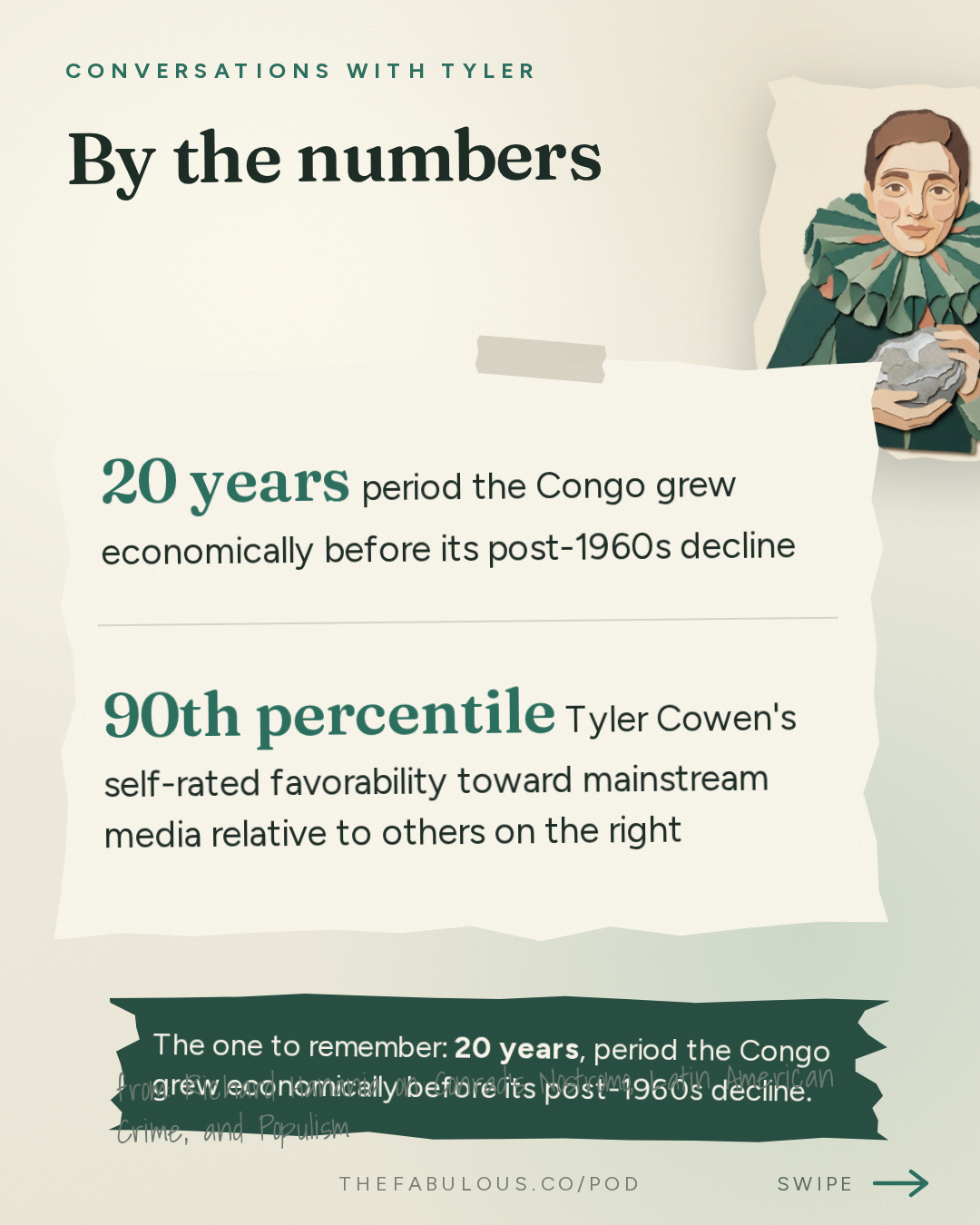
By the numbers
- 20 years period the Congo grew economically before its post-1960s decline
- 90th percentile percentile Tyler Cowen's self-rated favorability toward mainstream media relative to others on the right
In their words
“Liberty, democracy, patriotism, government, all of them have a flavor of folly and murder.”
“I think he sees travel and geography as the most fundamental forms of knowledge- Mm. including political knowledge”
“It seems that they have this combination of democracy and civil liberties, but low state capacity, and that seems to be a bad combination.”
“When you are biased in the direction of my side is right on the political spectrum, it's you're abdicating being an intellectual.”
Questions this episode answers
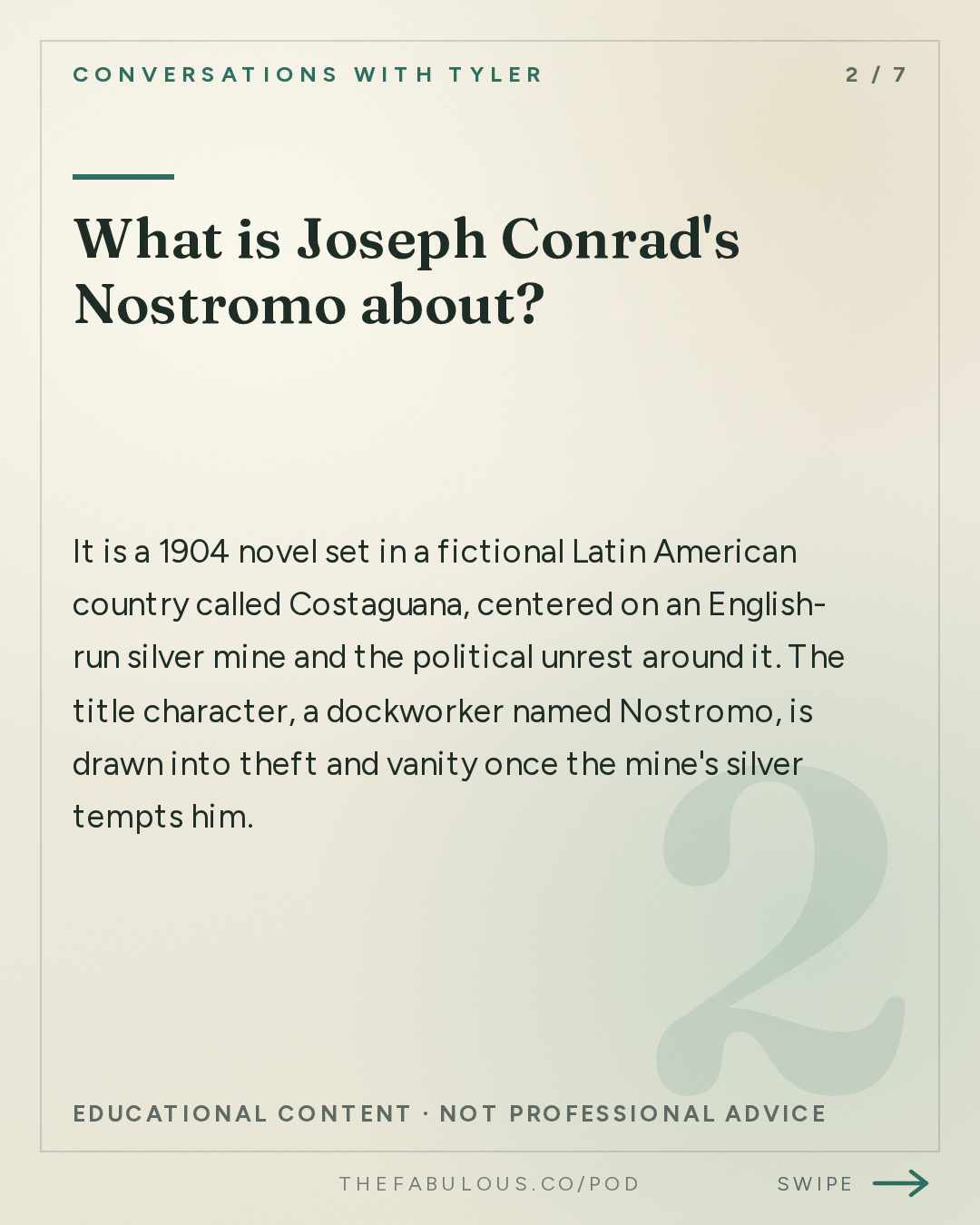
What is Joseph Conrad's Nostromo about?
It is a 1904 novel set in a fictional Latin American country called Costaguana, centered on an English-run silver mine and the political unrest around it (01:26). The title character, a dockworker named Nostromo, is drawn into theft and vanity once the mine's silver tempts him (11:33).
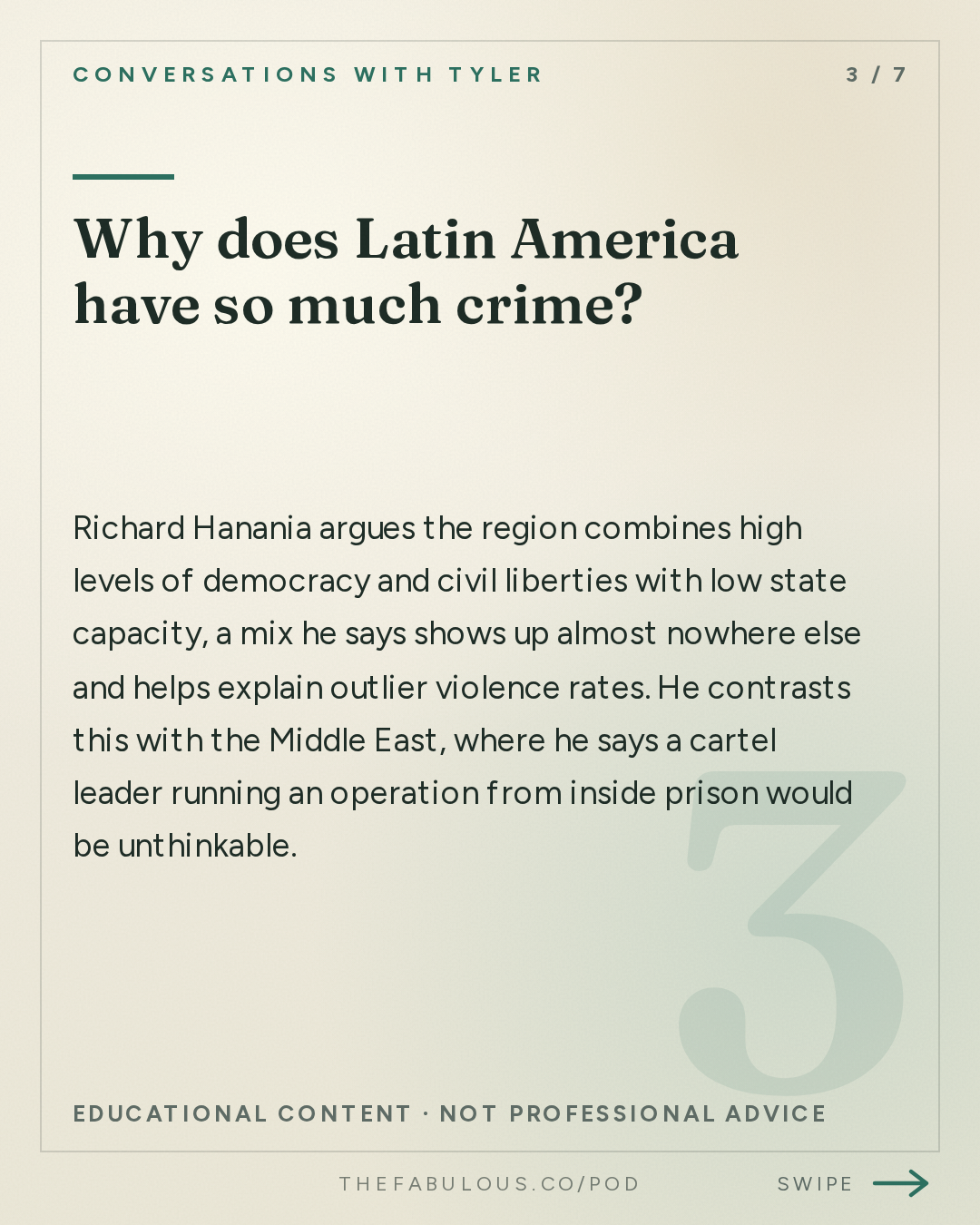
Why does Latin America have so much crime?
Richard Hanania argues the region combines high levels of democracy and civil liberties with low state capacity, a mix he says shows up almost nowhere else and helps explain outlier violence rates (40:37). He contrasts this with the Middle East, where he says a cartel leader running an operation from inside prison would be unthinkable (40:14).
Is Panama considered a success story in Latin America?
Yes. Both speakers call it a relative success because it kept reasonably stable governance after the United States backed its 1903 split from Colombia, and it is now one of the wealthier, safer countries in the region (33:19). Tyler Cowen notes he expected it to fail as recently as 1980 (33:19).
Can AI help fight conspiracy theories?
Richard Hanania cites research suggesting AI chatbots can be more effective than humans at talking people out of conspiracy theories, because a chatbot can patiently address a person's cited sources one by one without frustration or condescension (53:40). He points to people already asking tools like Grok to check claims in real time (53:21).
Does Richard Hanania think Shakespeare is overrated?
Not exactly. Hanania argues that artistic greatness, including Shakespeare's, rests partly on prestige and social proof rather than something an outside observer could objectively verify (45:37). He still names Shakespeare as his pick for the one author he would take to a desert island (46:39).
The full read, in cards
Go deeper
- Nostromo — Conrad's 1904 novel about a fictional Latin American country, the episode's central text for discussing development and political tragedy
- Autocracy and War — Conrad's essay on Russia and the Russo-Japanese War, which Hanania calls remarkably prescient about future conflict
- Conrad's Nostromo and the Third World — essay by journalist Robert D. Kaplan, one of two secondary sources Hanania found worth reading
- Joseph Conrad: A Biography — biography by historian Maya Jasanoff that Hanania read alongside the novels
Mentioned
Joseph Conrad · Nostromo · Charles Gould · Ayn Rand · Costaguana · F. R. Leavis · Heart of Darkness · Panama · Steve Sailer · Thomas North · Grok · ChatGPT · Maya Jasanoff · Robert D. Kaplan
More from this show and category

Roman Mars on Flags, Cars, and Urban Design
Design critic Roman Mars argues that most of the built world is engineered to calm, nudge, or flatter us without our noticing, from oversized highway signs to wordless city flags. He traces why cars, suburbs, and phones have grown visually uniform, and defends top-down planning against Jane Jacobs' bottom-up ideal.

The Panic of 1873 and Its 20-Year Political Toll
Historian Liaquat Ahamed argues the Panic of 1873 did not collapse the world economy, it poisoned its politics for twenty years. Growth held near 2.5% through a long deflation (02:10), but the fallout helped end Reconstruction (07:06), fueled Gladstone's Egyptian bond windfall (09:44), and let Bismarck wreck bimetallism (14:16).

Luis Garicano on AI, Messy Jobs, and Spain
Economist Luis Garicano says Spain's aging society blocks growth, and AI will spare messy jobs but eliminate clean ones. He also faults EU institutions, where unanimity rules and party discipline reward loyalty over competence, for chronic policy paralysis in Brussels and Madrid alike.

Gita Gopinath on Trade, Currencies, and China
Former IMF chief economist Gita Gopinath explains why currencies rarely move the way trade theory predicts. She covers why 90% of China's US exports are priced in dollars, Argentina's disinflation from 150% to 30%, and why AI-driven growth might not save the US debt trajectory.
