
Michael Moritz: Tyler Cowen Interview Takeaways
Michael Moritz on Origin Stories, Exile, and Obsessive Curiosity
▶ Listen to the full episode More from Conversations with Tyler
The brief
Michael Moritz, the Sequoia investor turned memoirist, says close observation, not technical skill, built his career and his book on family exile. He traces his family's escape from Nazi Germany, argues great entrepreneurs are obsessives, and says the lesson of researching his memoir Ausländer is that a person can never have enough passports.
In a gas chamber at Dachau, the ovens had been scrubbed clean. Michael Moritz stood inside it last summer while a group of high school students scrolled through their phones nearby, AirPods in, bored. He closed his eyes and tried to imagine the heat, the smell, the sound. He could not really get there. The room was too spotless, the distance too complete (21:12). That gap between memory and evidence is, in a way, the subject of Moritz's new book, Ausländer (German for foreigner), and it turns out to be close to the same gap he has spent decades trying to close as a journalist and a venture capitalist: the distance between what a person or a company looks like from outside and what is actually happening inside.
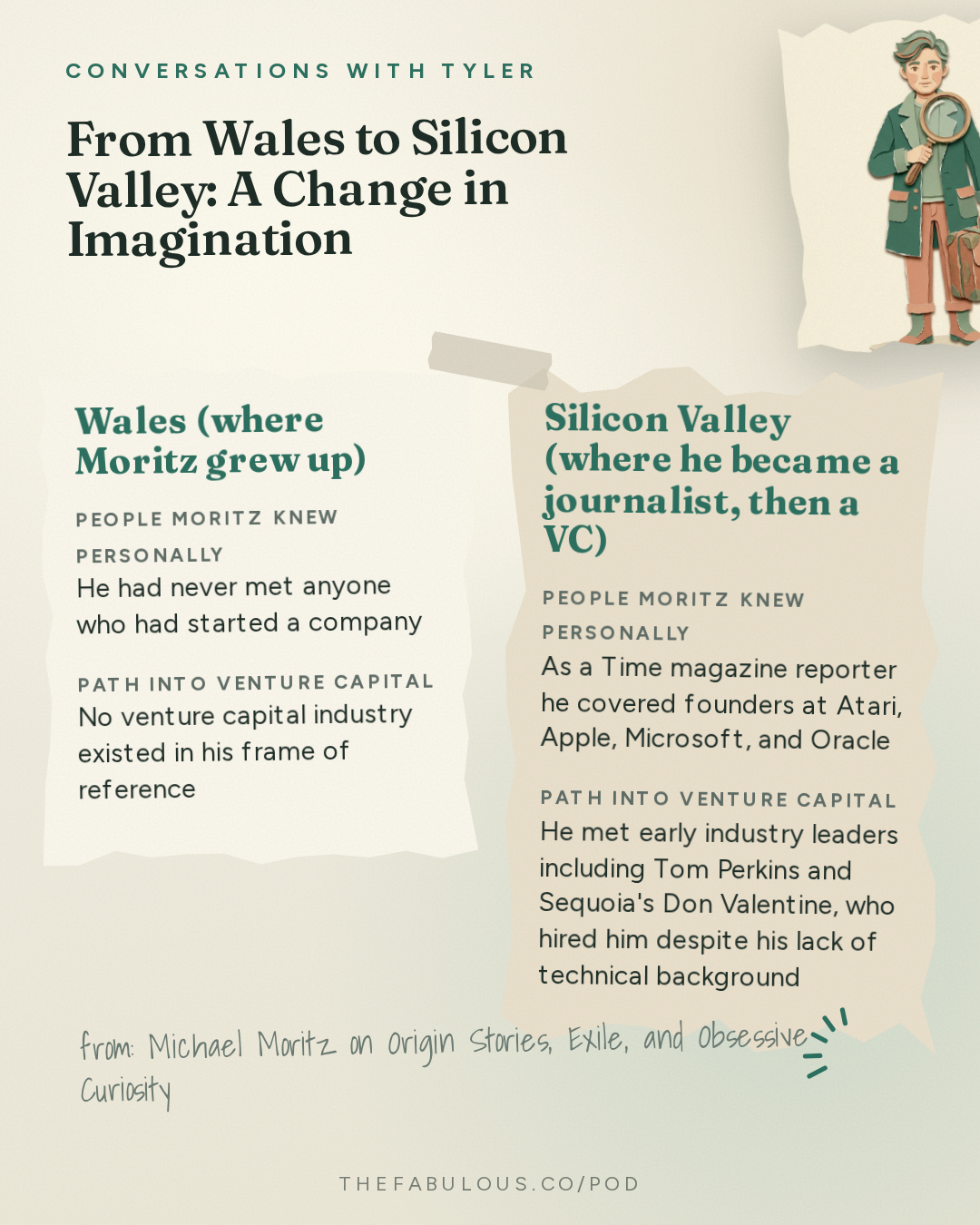
Moritz's parents were teenagers, both around 14, when they escaped Nazi Germany for Britain, one of the few countries that took in Jewish refugees, even with quotas (02:34). He grew up in Wales, in a Jewish community that had shrunk to a few hundred families by the 1960s. He describes Welsh and English prejudice as roughly interchangeable, both symptoms of a country that, at the time, treated almost anyone unfamiliar as an outsider (03:07). He left for university at 18 and never really went back.
What he took with him was a habit of close looking, learned first from his mother, who left school at 15 and loved museums despite feeling, in his words, inferior to people with more schooling. She took him to Wales's National Museum, where a small collection of Impressionists, and oddly, Francis Bacon, caught his eye. He bought his first picture at 13 (06:10) and still owns it. Decades later he told Tyler Cowen that looking hard at demanding paintings, the kind other people find ugly or hard to live with, sharpened the same skill he uses to size up founders: watching carefully and listening carefully before deciding whether to trust someone with money (09:35).
He got a similar education, by accident, from novelist Philip Roth, who taught a seminar Moritz took at the University of Pennsylvania. Roth assigned short Eastern European novels rather than six hundred page classics, so students had time to actually absorb what they read, not just finish it (11:02). Roth later wrote Moritz a recommendation for a job at Time magazine, and, years afterward, the two shared Thanksgiving dinners in New York until Roth's death.
The Ledger of Exile
The instinct to look past the surface also sent Moritz back into his family's history for Ausländer. He traces German anti-Jewish law back centuries before the more familiar horror of the 1930s: Jews were barred from most professions and tolerated mainly as peddlers, cattle dealers, and merchants, with an occasional court Jew allowed close to a monarch to help finance wars (16:58). The resurgence people usually date to the late 19th century, he argues, actually intensified after the First World War, fed partly by refugees fleeing pogroms in the East (16:08). He resists the idea that any of this is unique to Germany. Prejudice against Jews, he says, is a condition of the human race that flares up whenever people feel left behind by their economy or their government, a description he thinks applies as easily to current politics as to 1920s Munich (18:17).
What he actually learned from years of research into his grandparents Max and Minnie, killed in the Holocaust, was less a grand theory than a practical rule.
"The one lesson that I took from working on my book was you can never have enough passports." Michael Moritz, [23:04]
He was not being dramatic. Moritz has since added German citizenship to his British status, not because he expects to be forced out of San Francisco, he says, but because Germany, in his account, is the one country that genuinely teaches its own population the history of the 1930s and the Holocaust, unlike Britain, France, or the United States (23:04).
Obsession as a Method
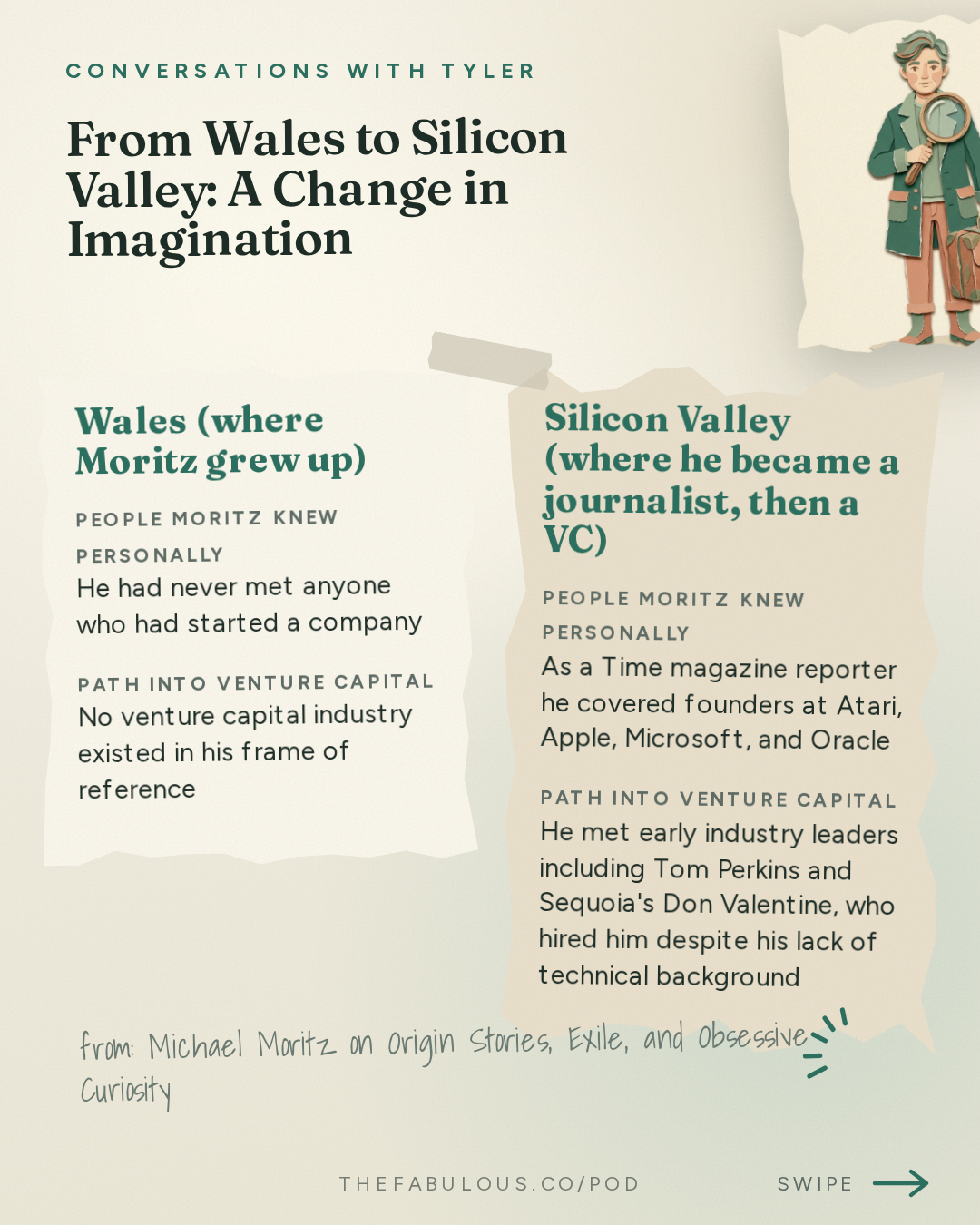
The same appetite for looking closely explains, in a roundabout way, how a classics professor's son with no engineering background ended up running one of Silicon Valley's most successful venture firms. Moritz moved to San Francisco in the early 1980s to cover technology for Time, at a moment when Apple, newly public, was selling only 100,000 to 150,000 computers a year (26:11), a volume that today would barely register. He had never met anyone who started a company, let alone one founded by someone 18 or 20 years old, an idea that simply did not exist in the Wales he grew up in (26:39). Covering Atari, Apple, Microsoft, and Oracle as a reporter led him to the small circle of people who financed them, including Sequoia's Don Valentine, who eventually hired him despite Moritz having, in his words, not an ounce of technical background (28:01).
Asked what people get wrong about Steve Jobs, whom he got to know fairly well as a journalist for Time magazine, Moritz points to something less flattering than the usual visionary story: Jobs's stoicism, and the way he fused the temperament of an artist with that of a capitalist, especially during the years he was pushed out of Apple and had to rebuild (28:20). He places Jobs alongside Bill Gates and Elon Musk, entrepreneurs he considers obsessives above all else. The purest version of that obsession, though, belonged to the painter Frank Auerbach, a friend of Moritz's whose work he collects. Auerbach painted every day of the year except Christmas, when he allowed himself a trip to Brighton Pier, until he decided even that single day was stealing time from the studio, and stopped going (30:27).
Moritz applies the same close observation to countries. He and his colleagues at Sequoia began visiting mainland China in the early 2000s and found something that upended their assumptions: for all the talk of Communist Party control, China had a thinner social safety net than the West, so people succeeded or failed by their education and their wits. That, Moritz argues, made early 2000s Chinese capitalism more intense than anything happening in the United States at the time, and it shaped nearly two decades of Sequoia's investing there before conditions tightened in recent years (31:35).
He turns the same lens on Britain and finds decline rather than intensity. A country that once controlled the world's reserve currency and its largest navy has never, in his view, recovered from losing that position to what he calls an entrepreneurial country, and has cycled since between governments that treat the state as the answer and governments that treat it as the problem. His verdict is blunt: Britain suffers from the residue of imperial arrogance and, now, from too much government (38:59).
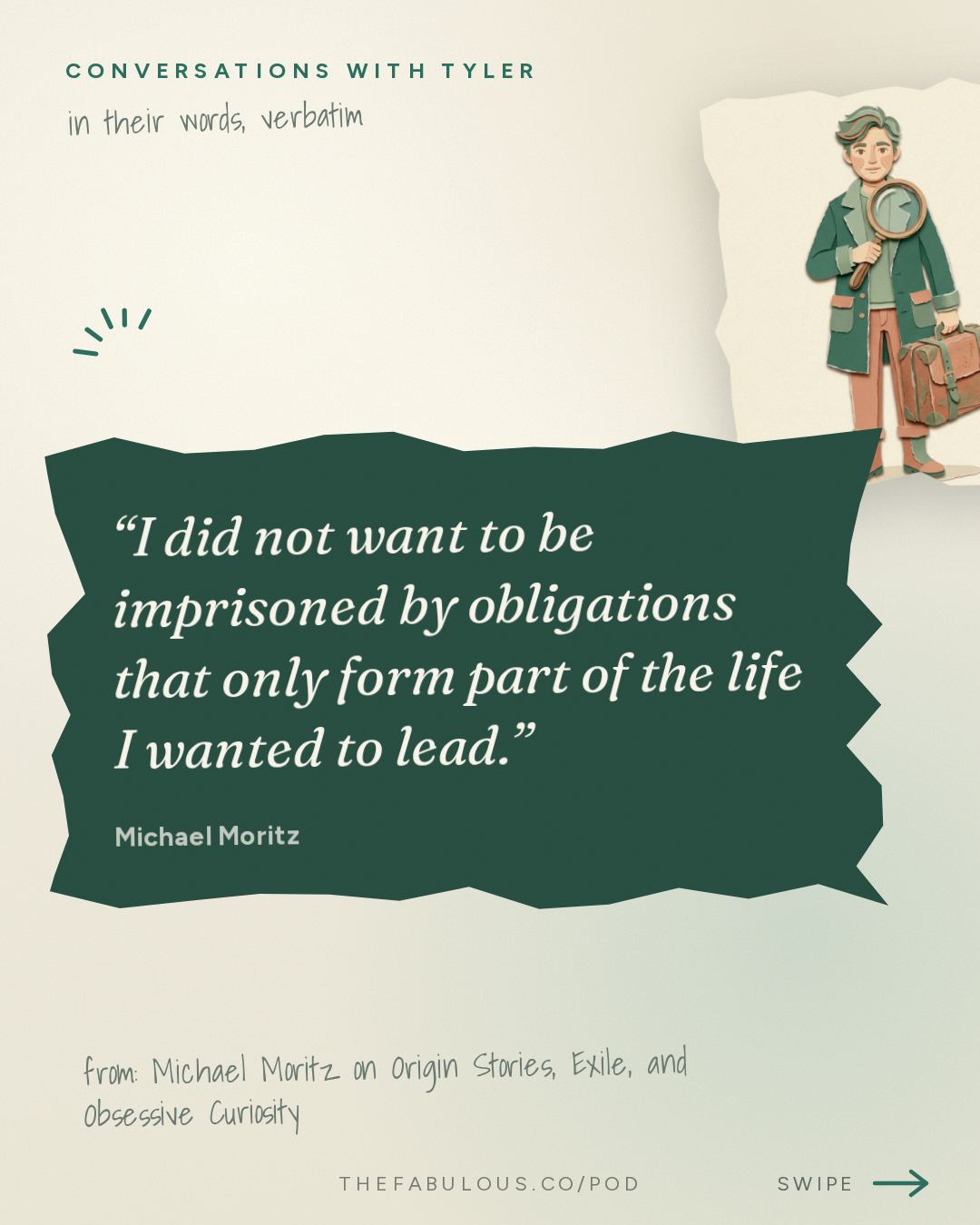
Moritz's own arrangements changed after he was diagnosed, about 20 years ago, with an incurable blood cancer. The diagnosis did not make him more efficient, he says; if anything it made him less efficient. But it did make him determined to control his own calendar, rather than let obligations that were not part of the life he wanted crowd it out.
"I did not want to be imprisoned by obligations that only form part of the life I wanted to lead." Michael Moritz, [37:45]
That same instinct, guarding the calendar so curiosity has room, runs through everything else he described: the paintings he collects because they reward years of looking, the Booker Prize submissions he reads even though he has no say in the judging, the housing shortage he now calls the single biggest problem facing California (36:55). Asked what he wants to learn about next, he did not hesitate: Iran, not the country in the news today, but Iran of the constitutional era around 1908 to 1911, and the decades leading into the 1950s, a period he thinks still explains a great deal of what the region confronts now (40:26). It is the same move he made with his own family: pick an unfamiliar country's most difficult decade, and go looking for what actually happened inside it.
Ask this episode anything
Pod's AI answers from the episode itself, with the minute mark so you can hear it yourself.
Or start with one of these
Ask this episode
Pod's AI listens to the whole episode to answer, and points you to the minute it comes from.
The rest of this answer, and any question after it
Answers come from the episode itself, never from a summary of it.
ContinueKey takeaways
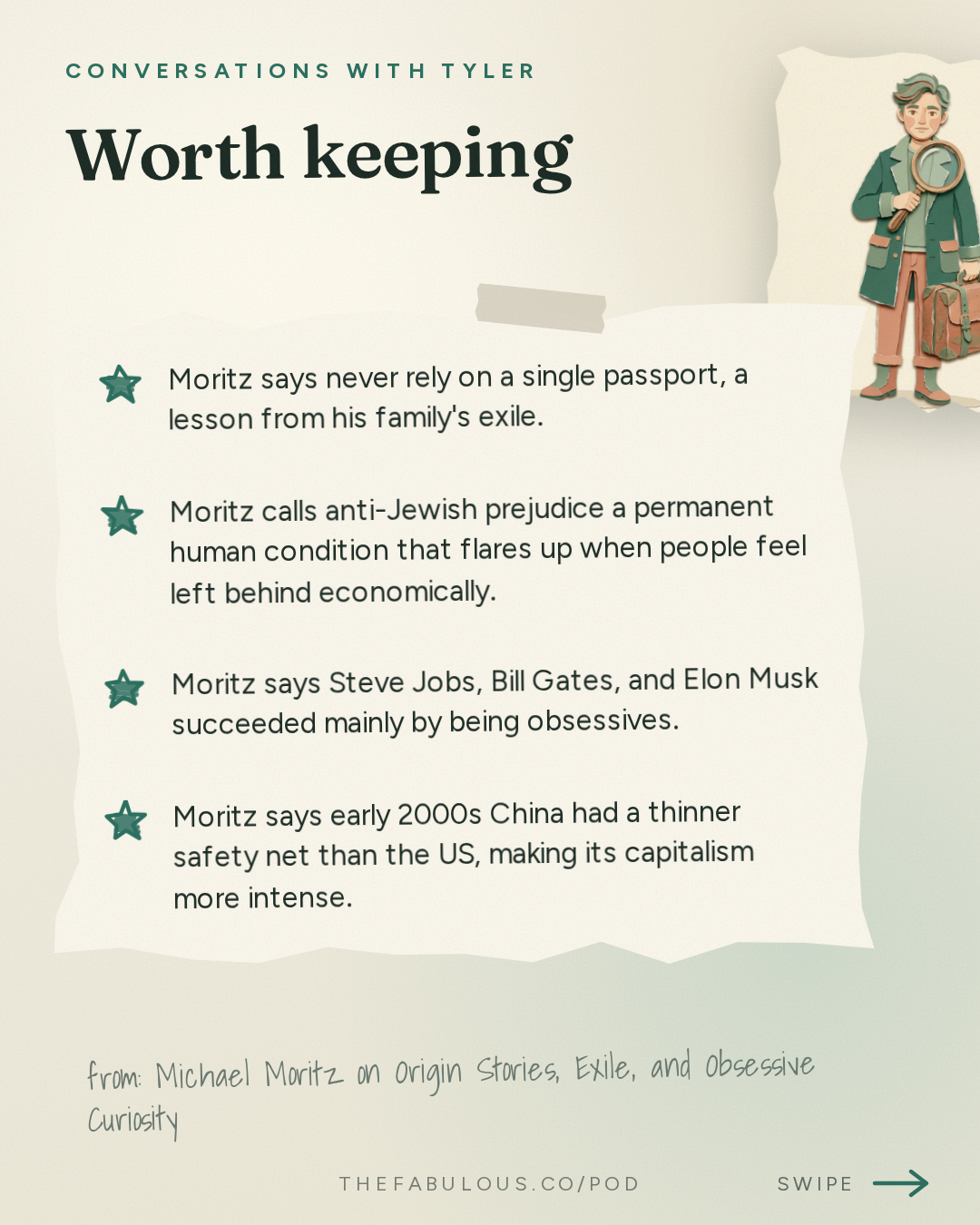
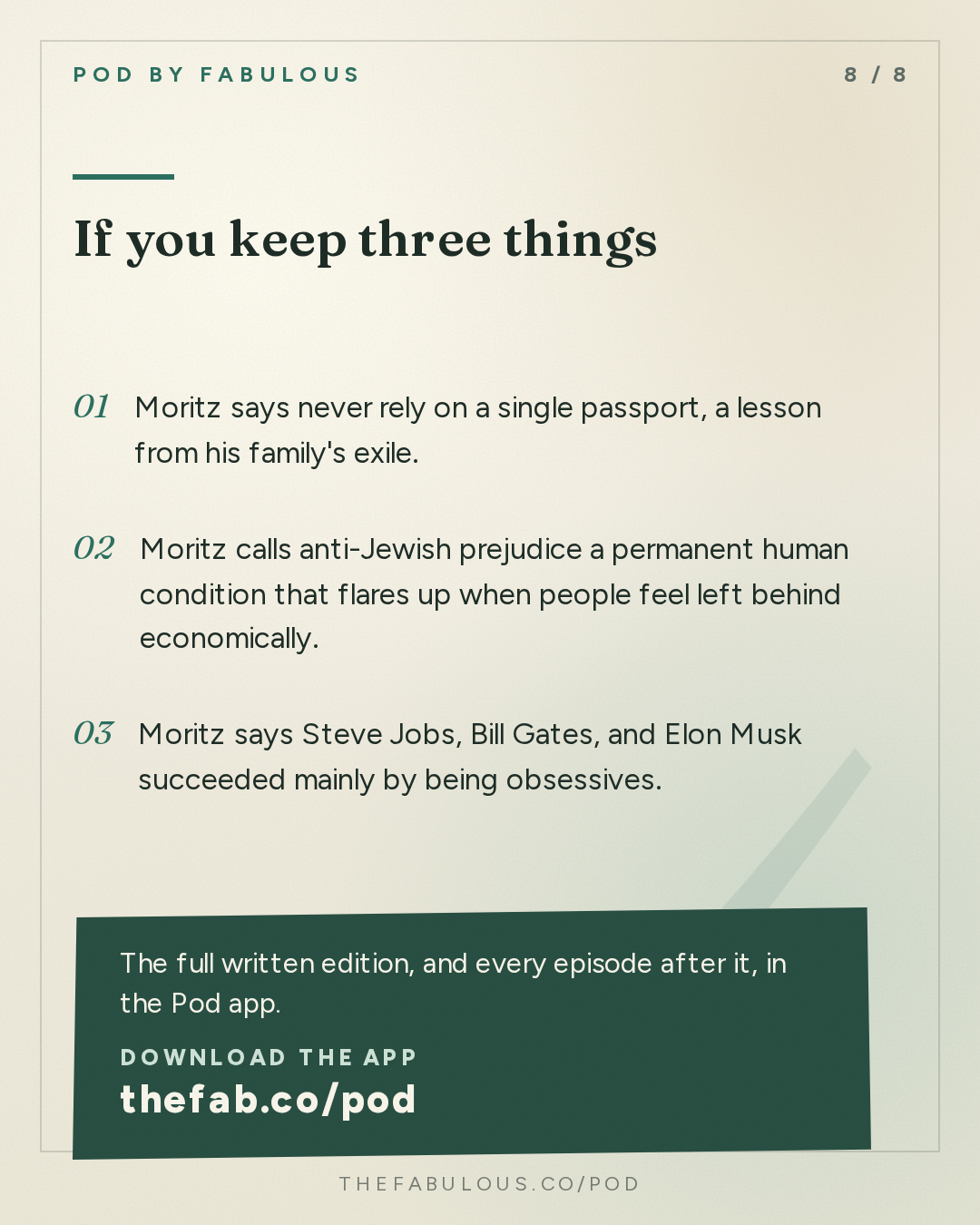
- Moritz says never rely on a single passport, a lesson from his family's exile.
- Moritz calls anti-Jewish prejudice a permanent human condition that flares up when people feel left behind economically.
- Moritz says Steve Jobs, Bill Gates, and Elon Musk succeeded mainly by being obsessives.
- Moritz says early 2000s China had a thinner safety net than the US, making its capitalism more intense.
- A cancer diagnosis 20 years ago made Michael Moritz prioritize controlling his own calendar over efficiency.
The episode in cards


By the numbers
- 20 years time since Michael Moritz was diagnosed with an incurable blood cancer
In their words
“The one lesson that I took from working on my book was you can never have enough passports.”
“I did not want to be imprisoned by obligations that only form part of the life I wanted to lead.”
“I'd never met anybody in Wales. I'd never conceived of the idea that anyone would start a company, let alone anybody who was eighteen or twenty years old.”
“Life is made richer by having a challenge that you're not sure whether you're up to, up”
Protocols
-
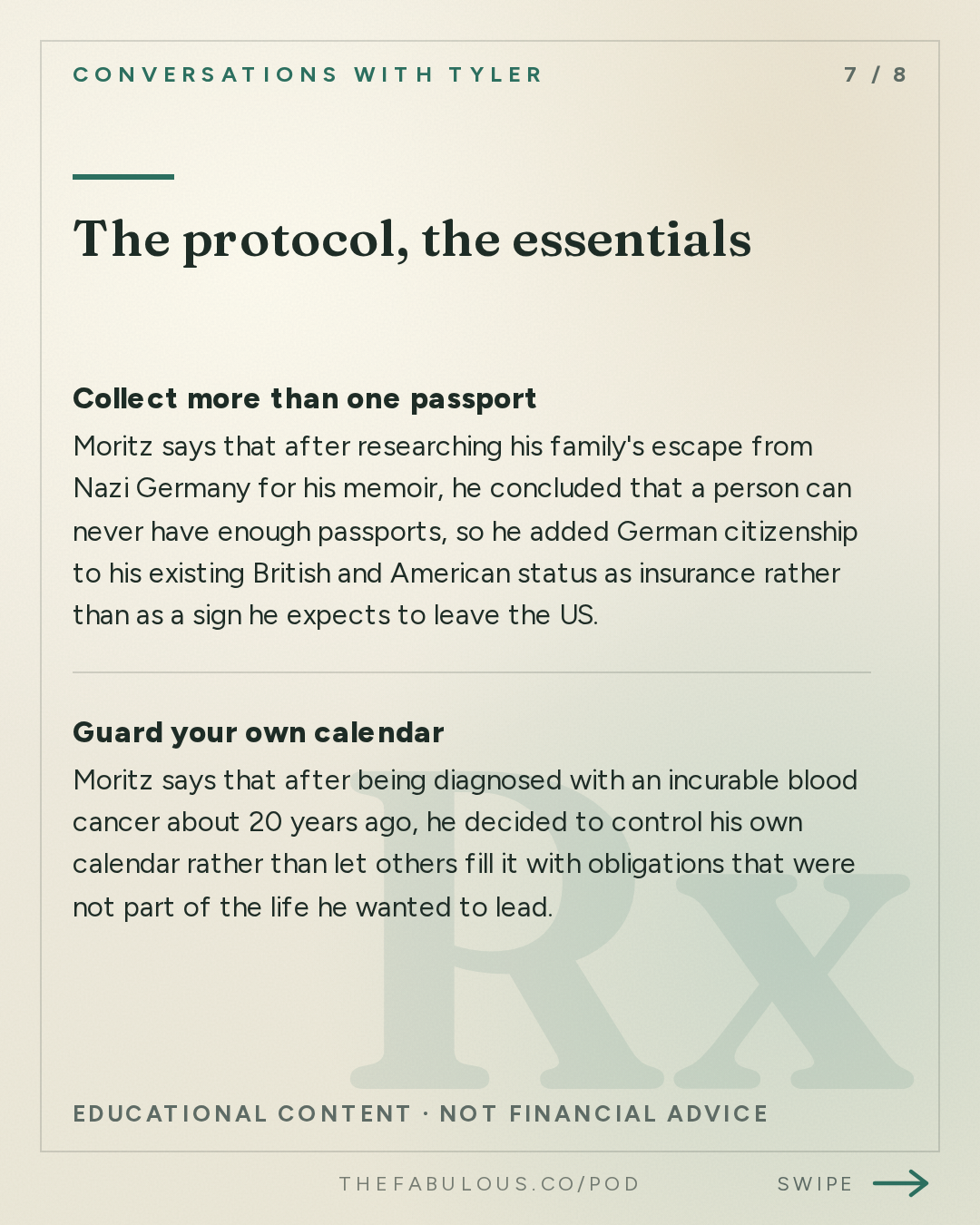
Collect more than one passport
Moritz says that after researching his family's escape from Nazi Germany for his memoir, he concluded that a person can never have enough passports, so he added German citizenship to his existing British and American status as insurance rather than as a sign he expects to leave the US.
once, when eligible
-
Guard your own calendar
Moritz says that after being diagnosed with an incurable blood cancer about 20 years ago, he decided to control his own calendar rather than let others fill it with obligations that were not part of the life he wanted to lead.
ongoing
-
Look intently at demanding art
Moritz says that looking closely at difficult paintings, the kind many people find too harsh to hang on a wall, trained him to watch and listen carefully when deciding whether to trust a founder with money.
ongoing habit
Questions this episode answers
What is Michael Moritz's book Ausländer about?
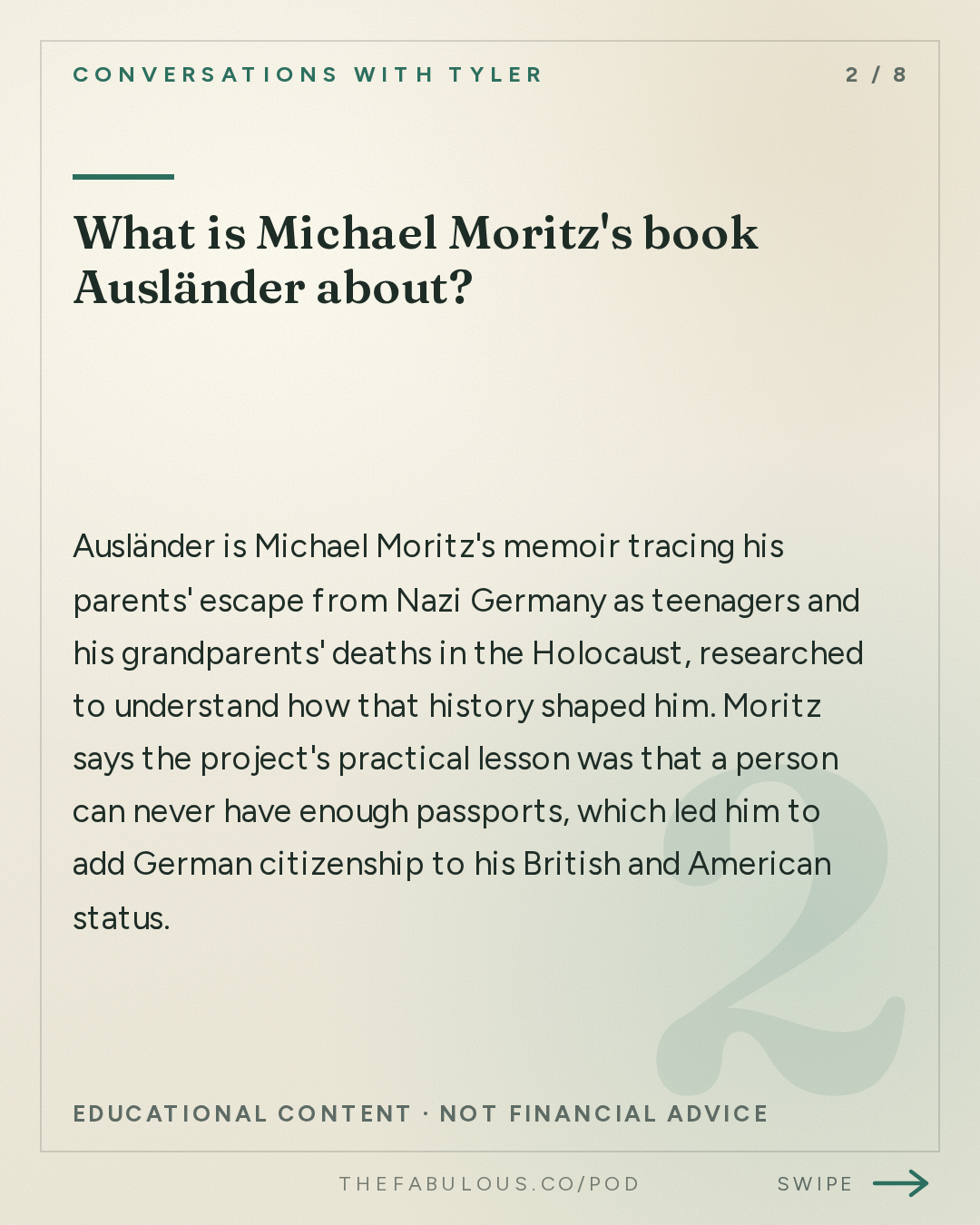
Ausländer is Michael Moritz's memoir tracing his parents' escape from Nazi Germany as teenagers and his grandparents' deaths in the Holocaust, researched to understand how that history shaped him (24:29). Moritz says the project's practical lesson was that a person can never have enough passports, which led him to add German citizenship to his British and American status (23:04).
Why does Michael Moritz think China's capitalism was 'ablaze' in the early 2000s?
Moritz says China had a thinner social safety net than the United States at the time, so people succeeded or failed based on education and personal resourcefulness rather than a government backstop (32:09). He argues this made Chinese entrepreneurship more intense than anything happening in the US then, shaping nearly two decades of Sequoia's investing there (31:35).
What does Michael Moritz say made Steve Jobs great?
Moritz, who worked with Jobs as a Sequoia investor, points to Jobs's stoicism and his rare combination of artist and capitalist instincts, not just technical vision (28:20). He also credits the years Jobs spent away from Apple after being pushed out as an underappreciated part of his education (28:20).
How does Michael Moritz explain Britain's economic stagnation?
Moritz calls it the residue of imperial arrogance: Britain once held the world's reserve currency and its largest navy, and has cycled since between governments that treat the state as the solution and governments that treat it as the problem (38:59). His verdict is that the country now suffers mainly from too much government (40:01).
Why did Michael Moritz apply for German citizenship?
Moritz says he applied because Germany, in his account, is the one country that genuinely teaches its population the history of the 1930s and the Holocaust, unlike Britain, France, or the United States (23:04). He does not expect to be forced to leave the US or to actually live in Germany; he says he simply believes a person can never have enough passports (22:41).
The full read, in cards
Go deeper
- Ausländer: One Family's Story of Escape and Exile — Michael Moritz's memoir researching his parents' and grandparents' escape from and death in Nazi Germany, which led him to conclude he could never have enough passports
- Moritz's book on Alex Ferguson — Moritz's book on the Manchester United manager, discussed as an exploration of leadership, irascibility, and organizational sustainability
Mentioned
Sequoia · Crankstart · Ausländer · Philip Roth · Steve Jobs · Frank Auerbach · Don Valentine · Booker Prize · Otto Dix · San Francisco Standard
More from this show and category

The Panic of 1873 and Its 20-Year Political Toll
Historian Liaquat Ahamed argues the Panic of 1873 did not collapse the world economy, it poisoned its politics for twenty years. Growth held near 2.5% through a long deflation (02:10), but the fallout helped end Reconstruction (07:06), fueled Gladstone's Egyptian bond windfall (09:44), and let Bismarck wreck bimetallism (14:16).

Luis Garicano on AI, Messy Jobs, and Spain
Economist Luis Garicano says Spain's aging society blocks growth, and AI will spare messy jobs but eliminate clean ones. He also faults EU institutions, where unanimity rules and party discipline reward loyalty over competence, for chronic policy paralysis in Brussels and Madrid alike.

Gita Gopinath on Trade, Currencies, and China
Former IMF chief economist Gita Gopinath explains why currencies rarely move the way trade theory predicts. She covers why 90% of China's US exports are priced in dollars, Argentina's disinflation from 150% to 30%, and why AI-driven growth might not save the US debt trajectory.

Annie Lowrey on America's Time Tax
Journalist Annie Lowrey says America's hidden "time tax" of paperwork and waiting falls hardest on the poor, not the rich. She contrasts Social Security's under-1% overhead with TANF's $16.5 billion in yearly costs, estimates 50 hours a year in bureaucratic time per person, and predicts AI agents could ease the burden within five years.
