
K.C. Irving's Business Empire Explained
K.C. Irving: Competing with Giants
▶ Listen to the full episode More from The Knowledge Project
The brief
K.C. Irving turned a single New Brunswick gas station into a 300-company empire by owning every link in his supply chain. He expanded hardest during the Great Depression, fought a government railway by buying his own tanker, and left Canada in 1971 rather than let new taxes break up the business he built for his sons.
On a winter Sunday sometime in the 1960s, a man named Mulrooney called a stranger's house in Saint John, New Brunswick, to complain that his furnace had run dry and nobody at the oil company seemed to care (00:27). The man who answered the phone apologized, called the oil yard, and then called Mulrooney back twice: once to say a truck was coming, and again, half an hour later, to confirm the oil had actually arrived (01:24). Mulrooney had no idea he had reached the owner of roughly 300 companies, a man whose refinery today still supplies nearly a fifth of the gasoline America imports (02:12). That second phone call, the one nobody asked for, is the whole story of K.C. Irving in miniature. He did not simply want problems solved. He needed to know, personally, that they were.
Irving grew up in Buctouche, a lumber town on New Brunswick's tidal coast, where his father ran a sawmill and a general store that extended credit to farmers who could not pay in cash (03:07). By fourteen he was running a bottle-salvage operation with two older boys working under him. His cousin Lee Stevenson later put it simply: he got more than both of them combined, but nobody minded, because, as Stevenson explained,
He owned the pull cart, and he ran the show. [05:15] — Lee Stevenson, K.C. Irving's cousin
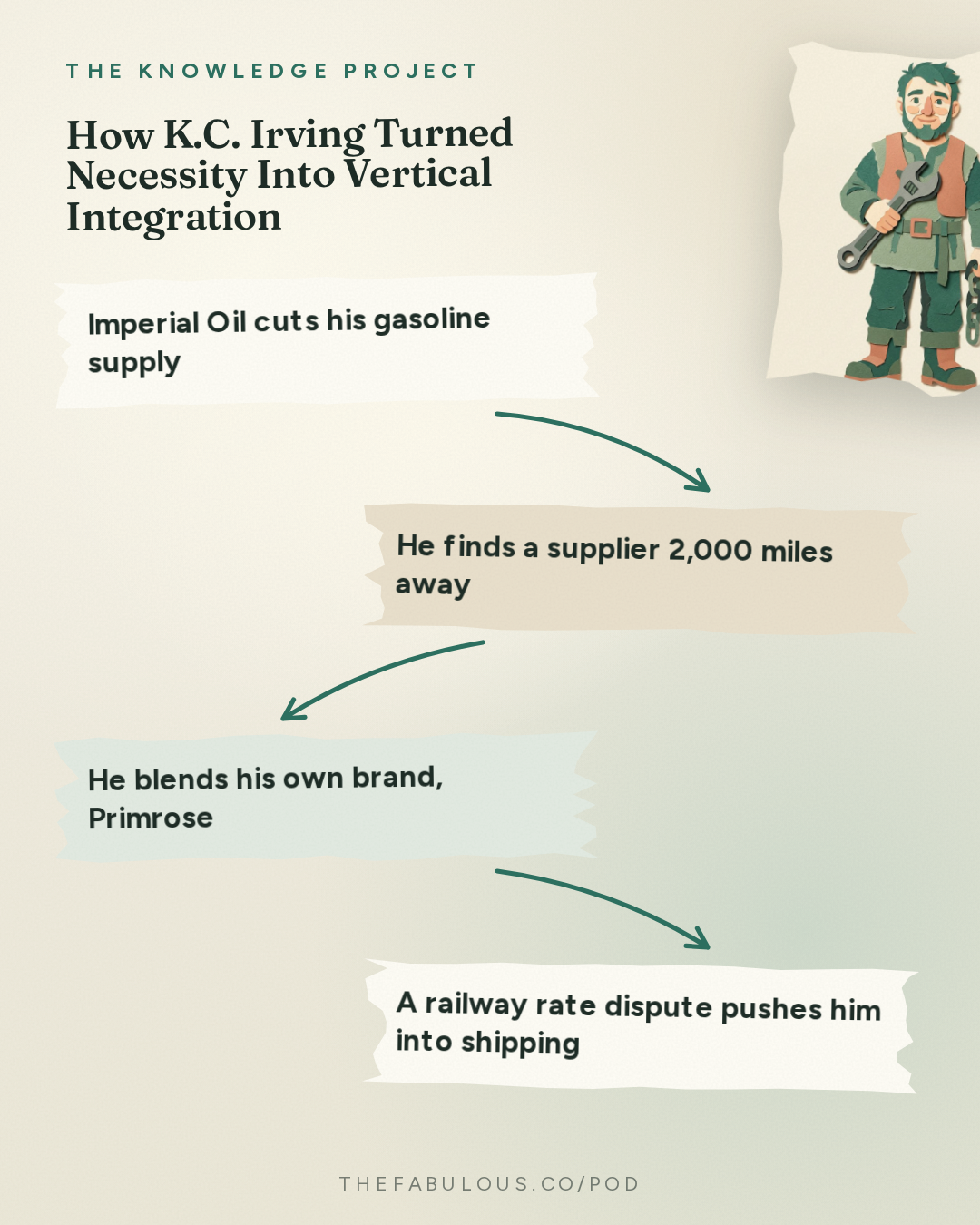
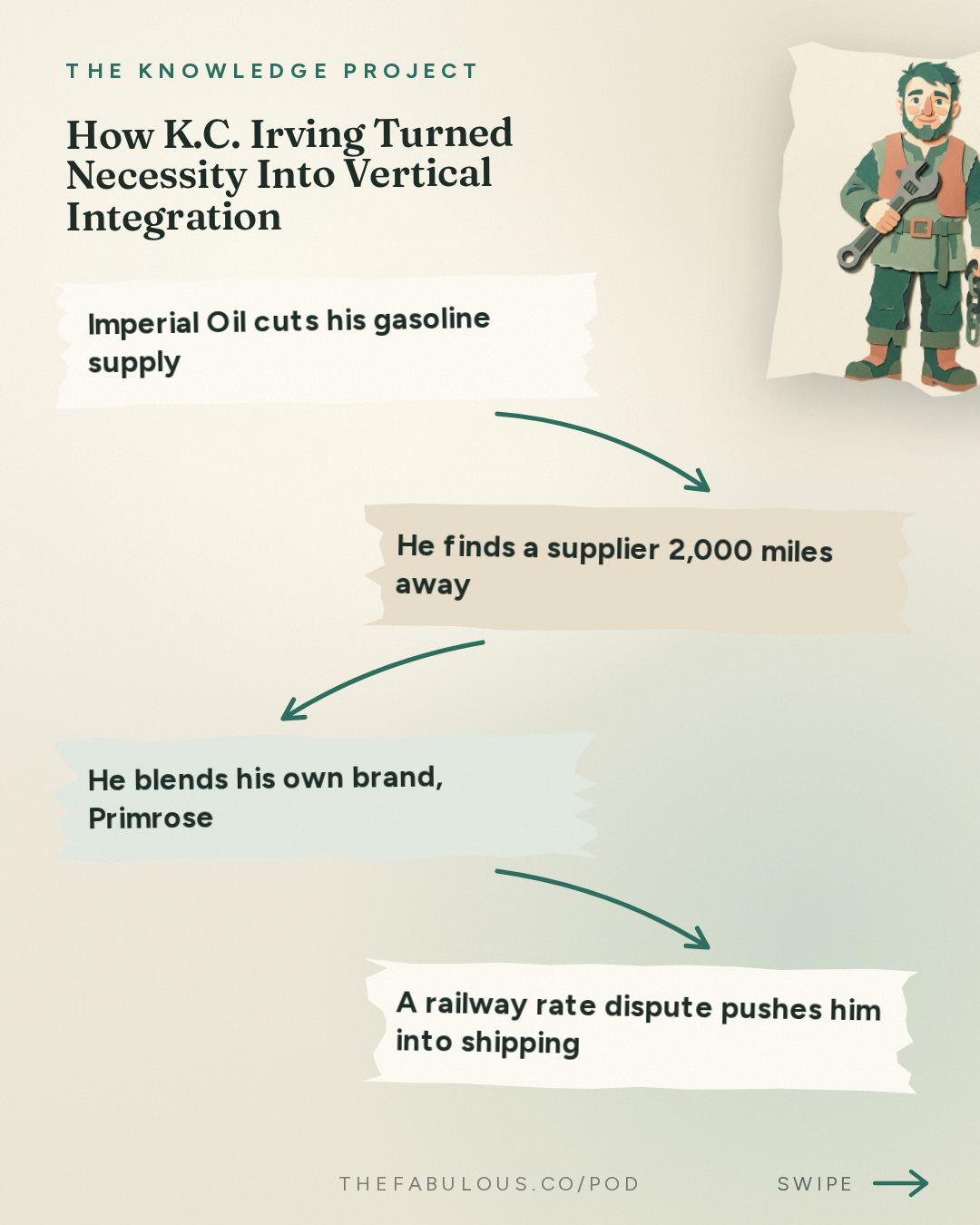
That sentence described his next nine decades. Irving sold cars to farmers who had never owned one, taking horses and cattle as payment when cash ran short (13:46). He built a gasoline tank behind his father's store without asking permission. And when Imperial Oil, then Canada's largest oil company, cut off his supply because rival merchants complained he was undercutting them, Irving did not fold (15:50). He found a supplier two thousand miles away in Tulsa, Oklahoma, blended his own cold-weather gasoline, and named it Primrose, a mash-up of two competitors' brands, Premier and White Rose (19:05). Asked decades later whether Imperial had effectively created Irving Oil by cutting him loose, he waved the idea away: it was, he said, just a matter of time before he went into business for himself.
Owning Every Link
The habit that defined Irving's career is called vertical integration: owning every stage of a business, from the raw material to the thing a customer finally buys, so that no outside supplier can set your price or your terms. For Irving, it began almost by accident and ended as doctrine. In 1932, the government-owned Canadian National Railway raised his shipping rates while leaving his rival, Imperial Oil, untouched. The reason, he was told, was that Imperial owned a refinery and he did not (32:21). Irving argued with the railway for two years, then bought a coastal tanker and built his own wharf a mile from its headquarters. The tanker's maiden voyage ran aground in the mud in front of a crowd he had invited to watch him win; he spent the night shoveling beside his crew until the tide freed the ship (34:54). It was not a stunt that worked on the first try. It worked because he refused to let it fail.
The same instinct carried him through the Depression, when he did the opposite of what every rational competitor was doing. While rivals cut back, Irving bought. "There was less competition," he said. "You had to use your head and your ingenuity. You couldn't sit around sucking your thumb" (28:27). Two years into the crash, he bought an eleven-thousand-dollar Cadillac, not for comfort but as a public bet on the future (29:34). His son Arthur later distilled the logic into a single rule.
Never be worried, but be concerned. If you're concerned, you can do something about it. [30:19] — Arthur Irving, K.C. Irving's son
Irving also kept timber crews cutting for six straight years during the Depression, selling the wood in only three of them, stockpiling the rest while a bank, pressured by competitors, called in a two-million-dollar loan and demanded it back immediately (39:34). He found another lender and kept cutting. When lumber prices finally recovered in 1939, he was sitting on six years of inventory bought at Depression prices, worth a fortune.
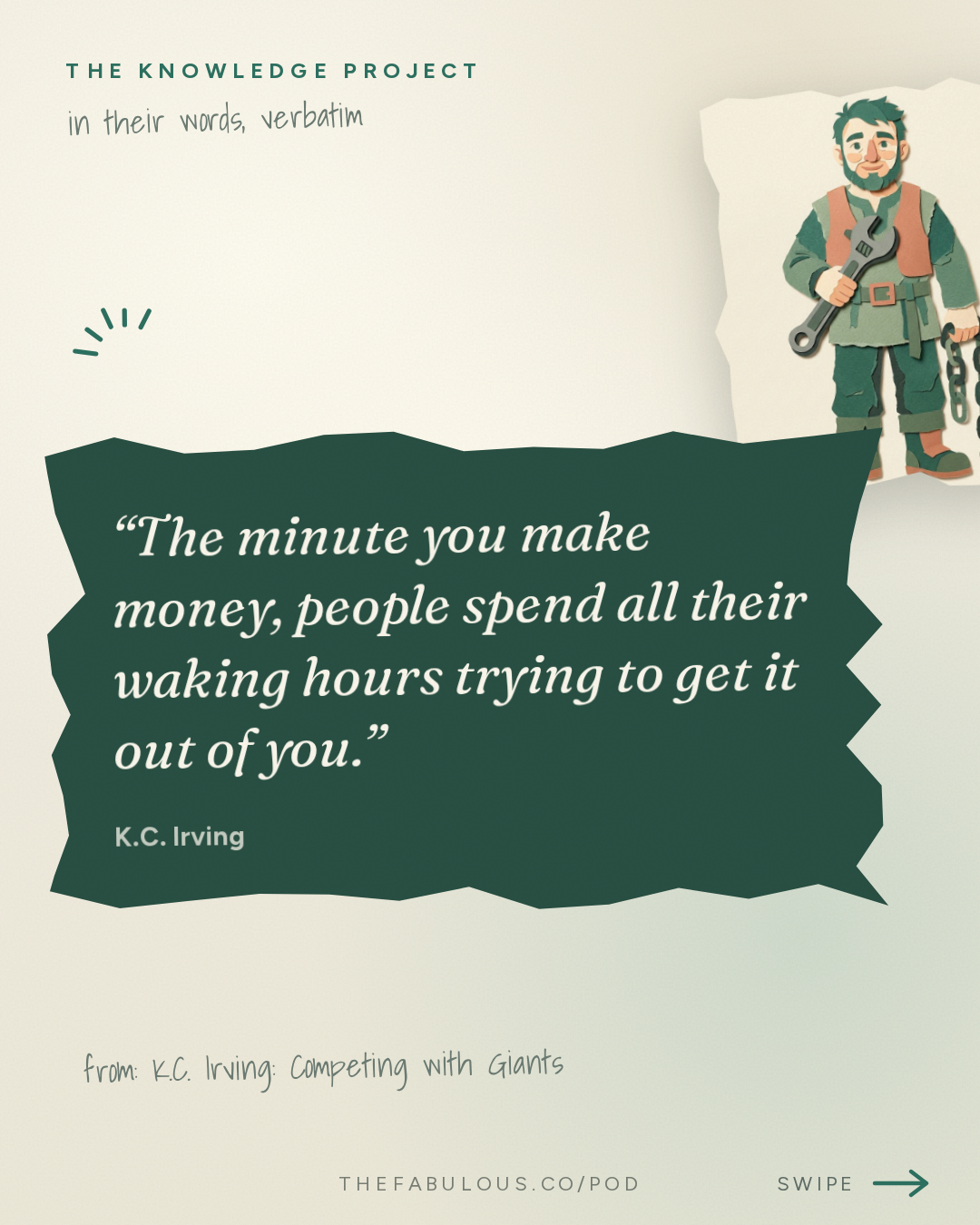
None of this scaled without money, and Irving had a firm view about what money required. "The minute you make money," he said, "people spend all their waking hours trying to get it out of you" (25:31). He sold shares once, early on, then bought them all back, and he never took his companies public again. Private ownership meant he never had to explain a decision to a board. "You can take a calculated risk," he said, "if you only have to account to yourself" (75:36).
What the Province Owed Him, and He Owed It
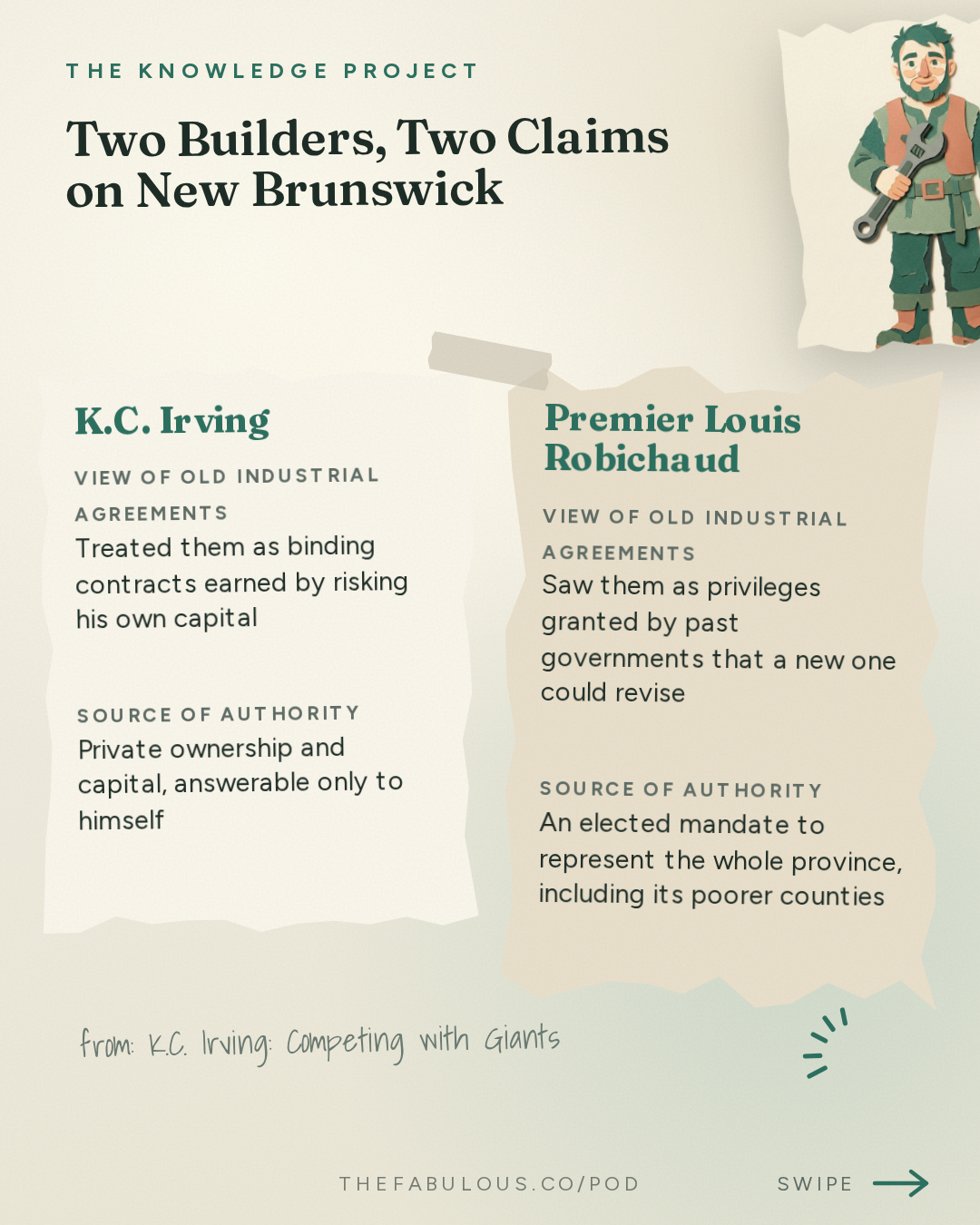
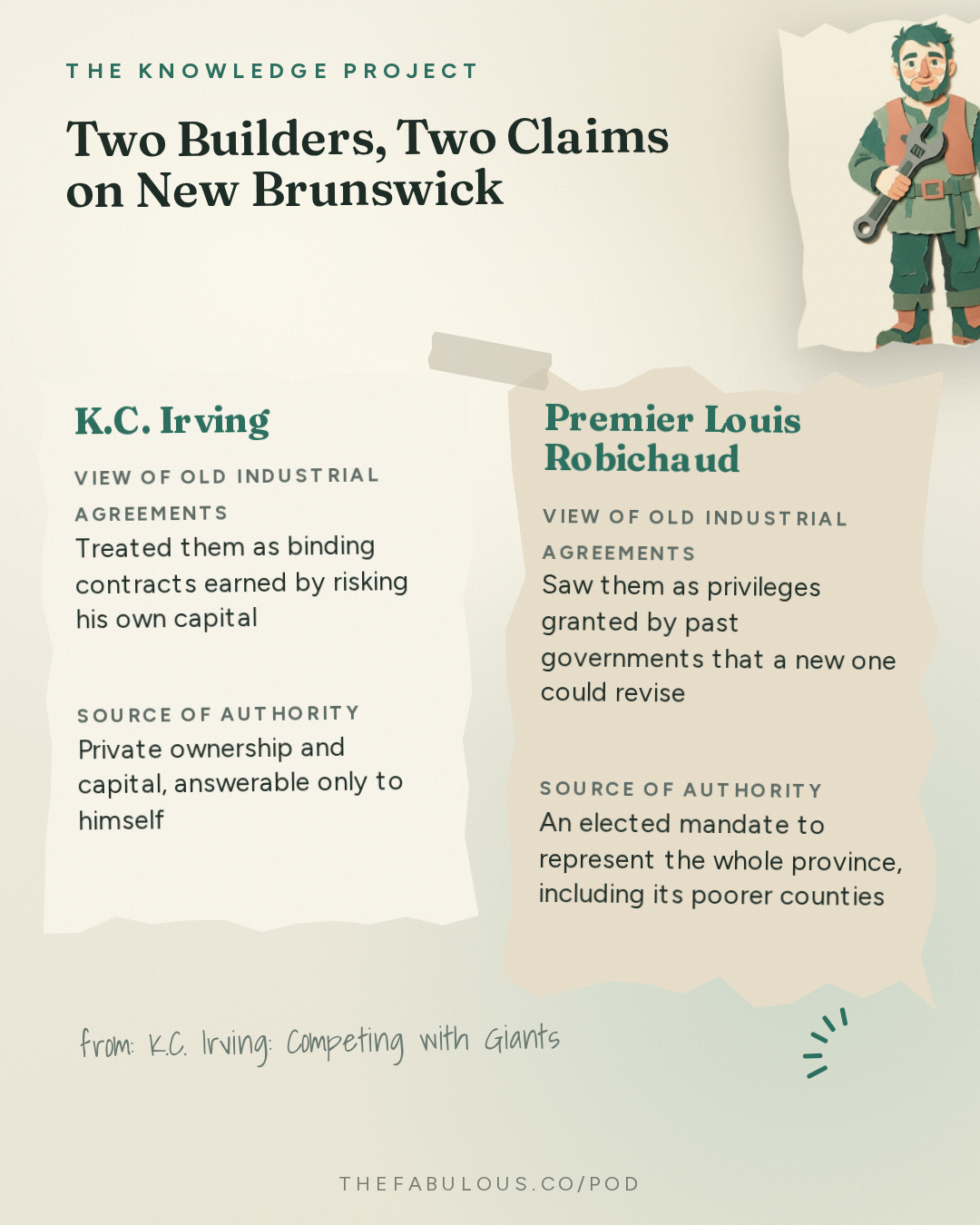
By the 1960s Irving's companies supplied much of the region's gasoline, cut enormous volumes of its timber, and employed something close to thirteen thousand people in a small, poor province (79:35). He also owned every English-language daily newspaper in New Brunswick by 1968 (95:44). That concentration eventually put him in direct conflict with Premier Louis Robichaud, a reform-minded leader who wanted to rebuild the province's tax system under a program he called Equal Opportunity. Buried in that legislation was a provision allowing the government to cancel old industrial agreements, the kind of tax and cost guarantees Irving had relied on to justify his investments, without compensation (84:02). Irving called it a breach of faith. Robichaud saw it as correcting privileges that past politicians had handed out too freely. Both men were right about something, and neither would concede the other's version.
That fight, and a separate dispute over a money-losing fertilizer plant Irving had warned against and was later proven right about, hardened into a long war over whether one private citizen had become too powerful for an elected government to govern around (90:20). A federal Senate committee eventually summoned Irving to Ottawa, where a senator asked him directly whether anything that hurt New Brunswick also hurt his interests. He said yes. Asked whether the reverse was also true, that anything hurting his interests hurt the province, he said yes again (102:02). It was the plainest admission he ever made: he had spent forty years making himself indispensable, and the province had become dependent on the very thing it now feared.
Then the tax code changed. New federal capital gains rules set to take effect in 1972 threatened to hit his family with an estate tax bill payable in cash, on an empire held entirely in private companies with no public shares to sell (106:18). Rather than risk forcing his sons to dismantle the business to pay it, Irving and his wife, Harriet, flew to Bermuda two days before Christmas in 1971 and never moved back (108:01). He kept building anyway. At 58 he had already planted spruce seedlings on a ridge experts said was too poor to grow trees, with one forestry professor so certain he offered to eat his textbooks if the seedlings survived (67:05). They did. By 2017, the program had planted over one billion trees (119:59). Irving never lived to see most of them, which seems to have been the point all along: some bets are worth making even when you will not be there to collect.
Ask this episode anything
Pod's AI answers from the episode itself, with the minute mark so you can hear it yourself.
Or start with one of these
Ask this episode
Pod's AI listens to the whole episode to answer, and points you to the minute it comes from.
The rest of this answer, and any question after it
Answers come from the episode itself, never from a summary of it.
ContinueKey takeaways
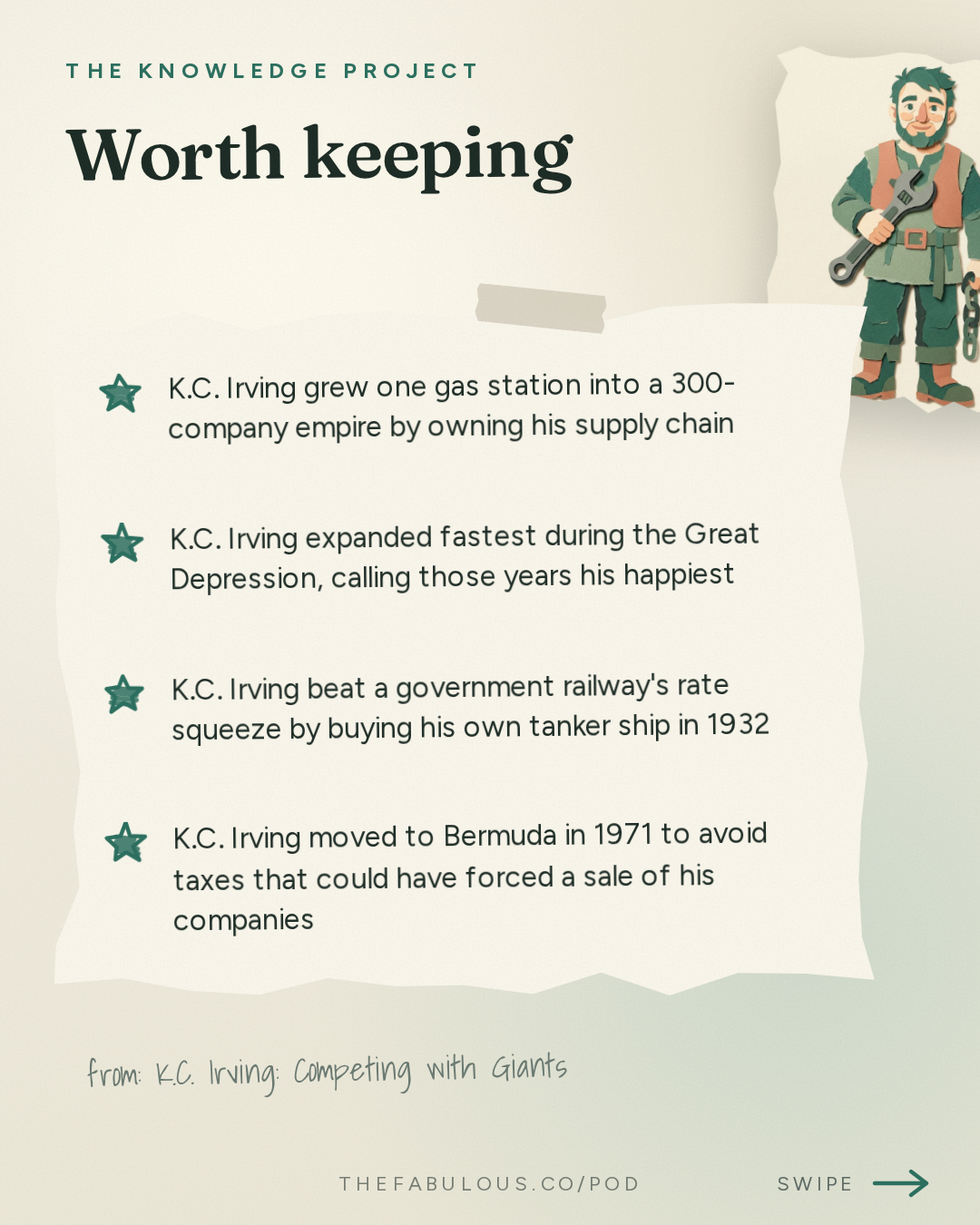
- K.C. Irving grew one gas station into a 300-company empire by owning his supply chain
- K.C. Irving expanded fastest during the Great Depression, calling those years his happiest
- K.C. Irving beat a government railway's rate squeeze by buying his own tanker ship in 1932
- K.C. Irving moved to Bermuda in 1971 to avoid taxes that could have forced a sale of his companies
- K.C. Irving's reforestation program, started in 1957, had planted over one billion trees by 2017
The episode in cards
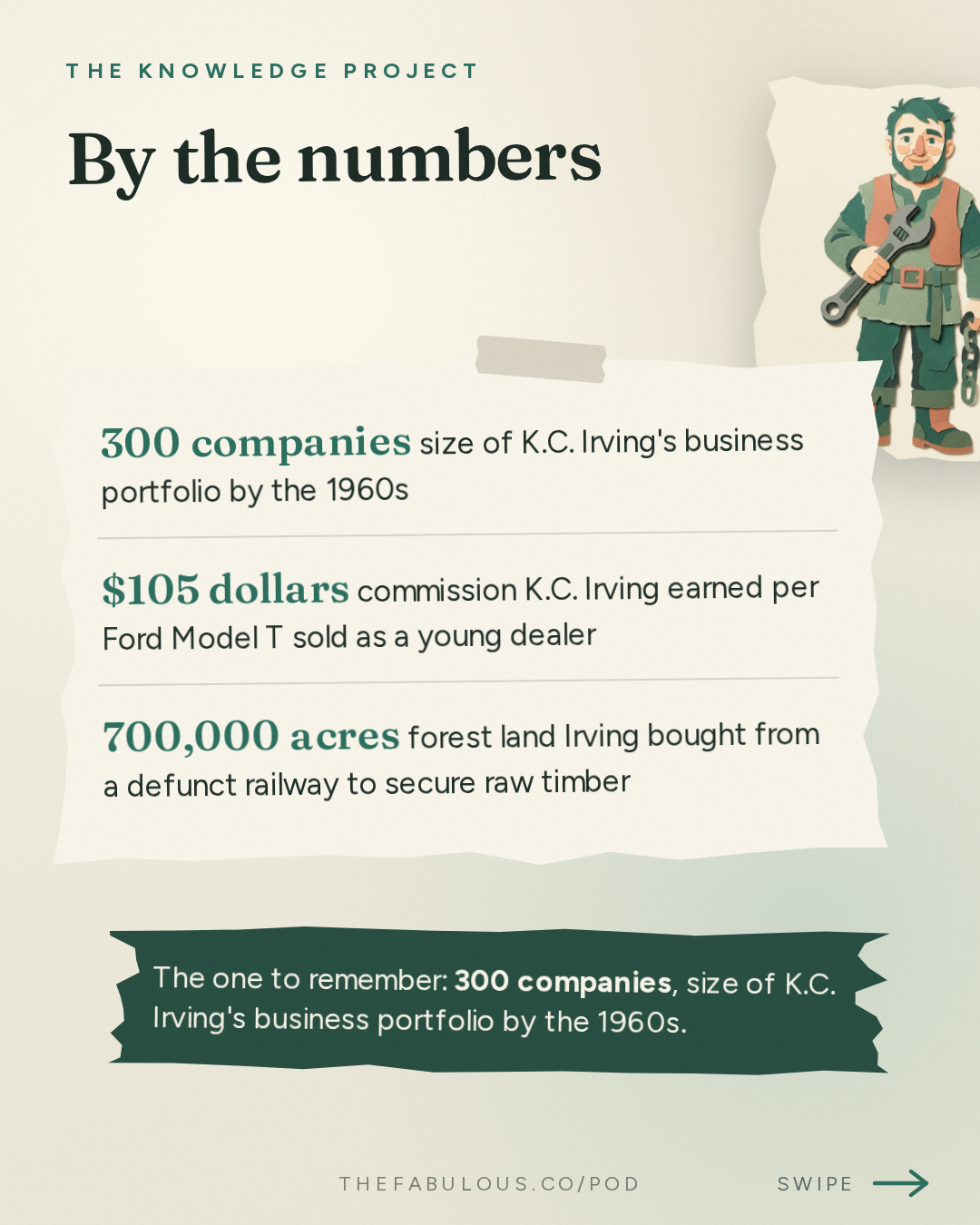
By the numbers
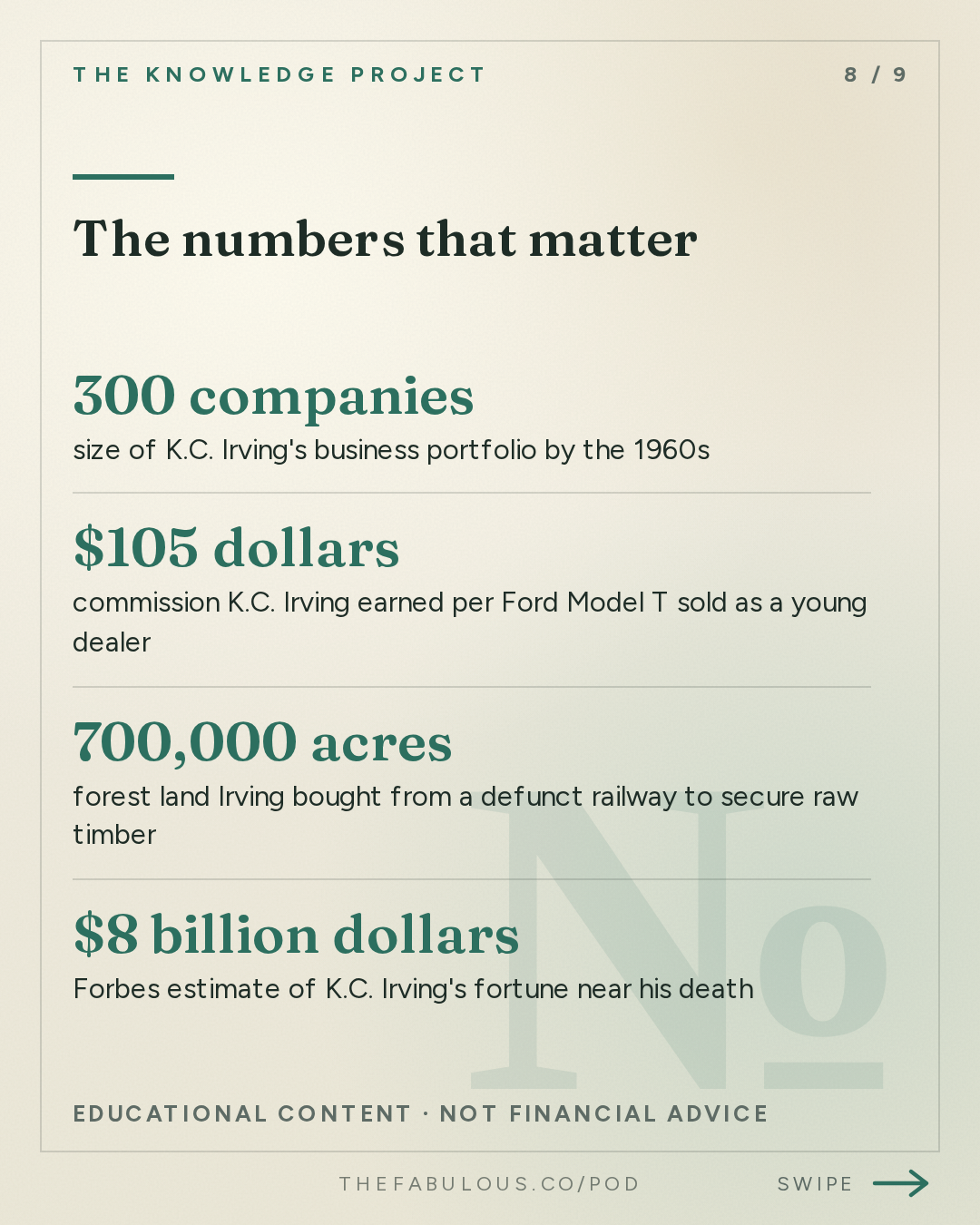
- 300 companies size of K.C. Irving's business portfolio by the 1960s
- $105 dollars commission K.C. Irving earned per Ford Model T sold as a young dealer
- 700,000 acres forest land Irving bought from a defunct railway to secure raw timber
- $8 billion dollars Forbes estimate of K.C. Irving's fortune near his death
- 1 billion trees cumulative trees planted by Irving's reforestation program since 1957
In their words
“He owned the pull cart, and he ran the show.”
“The minute you make money, people spend all their waking hours trying to get it out of you.”
“Never be worried, but be concerned. If you're concerned, you can do something about it.”
“"You can take a calculated risk," he explained, "if you only have to account to”
Protocols
-
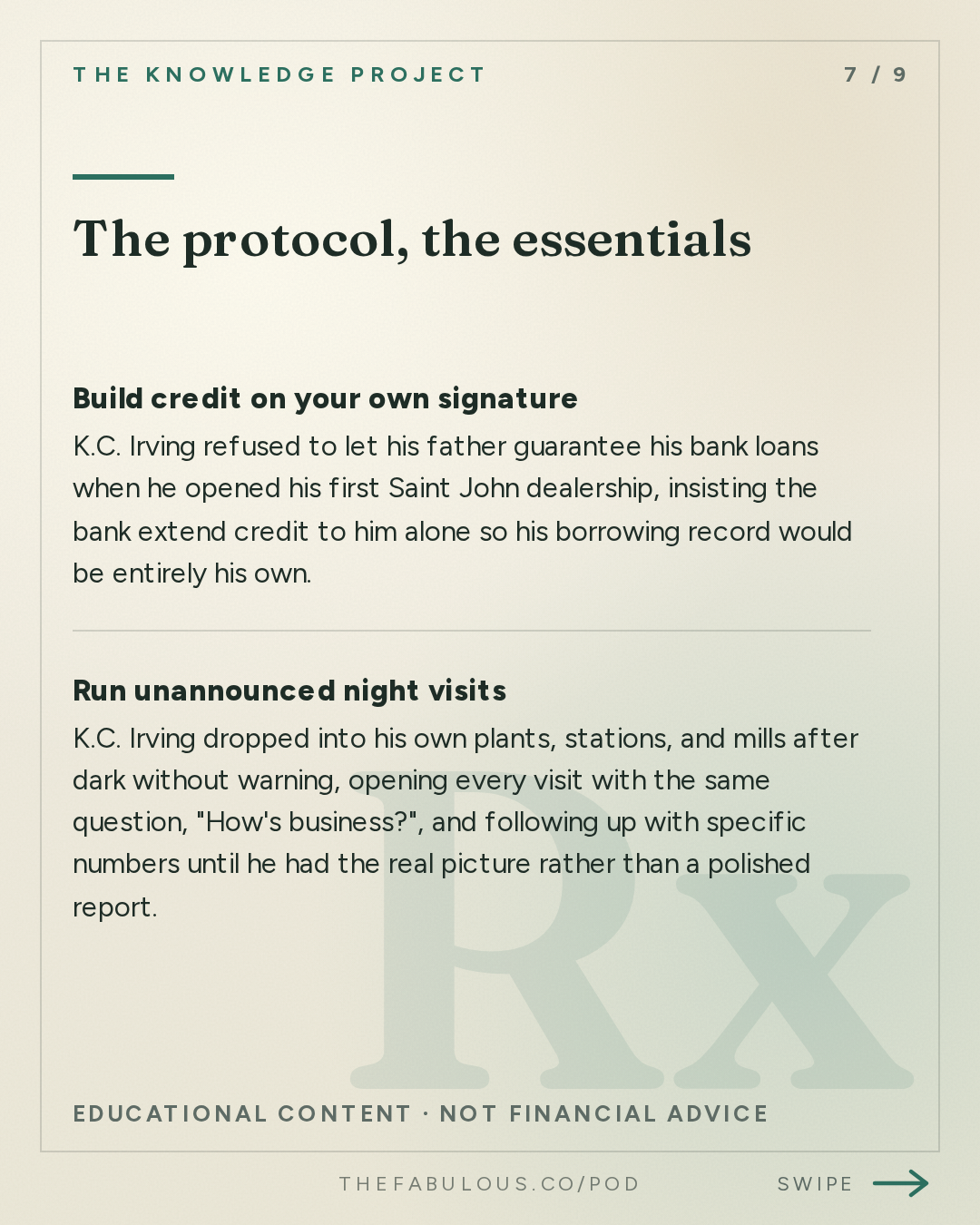
Build credit on your own signature
K.C. Irving refused to let his father guarantee his bank loans when he opened his first Saint John dealership, insisting the bank extend credit to him alone so his borrowing record would be entirely his own.
One-time decision at the start of his Saint John expansion in 1921
-
Run unannounced night visits
K.C. Irving dropped into his own plants, stations, and mills after dark without warning, opening every visit with the same question, "How's business?", and following up with specific numbers until he had the real picture rather than a polished report.
Ongoing practice across six decades of running his companies
-
Put stations where traffic already exists
K.C. Irving directed his site scouts to build new gas stations near post offices and churches, because those locations already drew repeat visits every week and did not require creating new demand.
Applied to every new town Irving Oil entered
Questions this episode answers
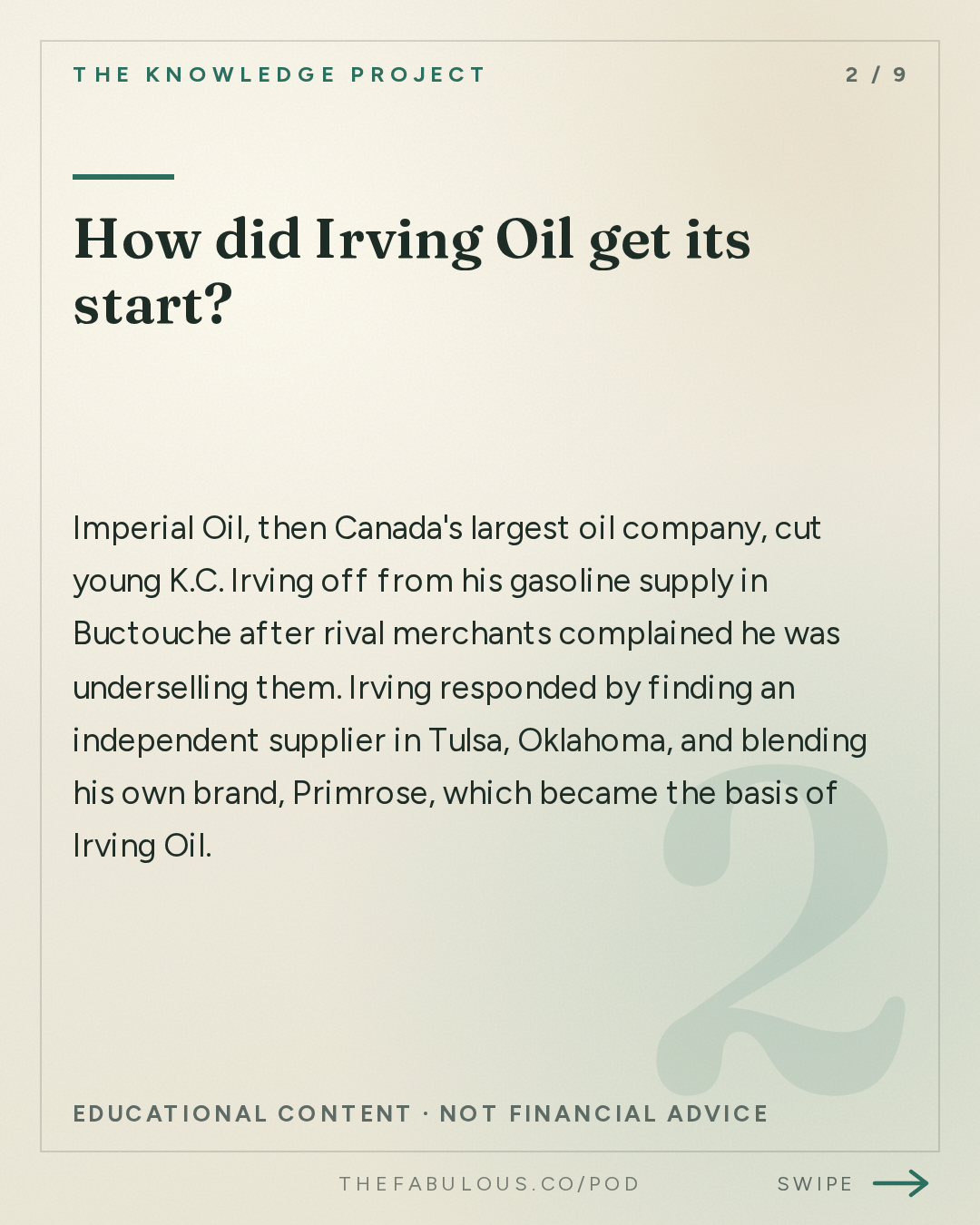
How did Irving Oil get its start?
Imperial Oil, then Canada's largest oil company, cut young K.C. Irving off from his gasoline supply in Buctouche after rival merchants complained he was underselling them. Irving responded by finding an independent supplier in Tulsa, Oklahoma, and blending his own brand, Primrose, which became the basis of Irving Oil (19:49).
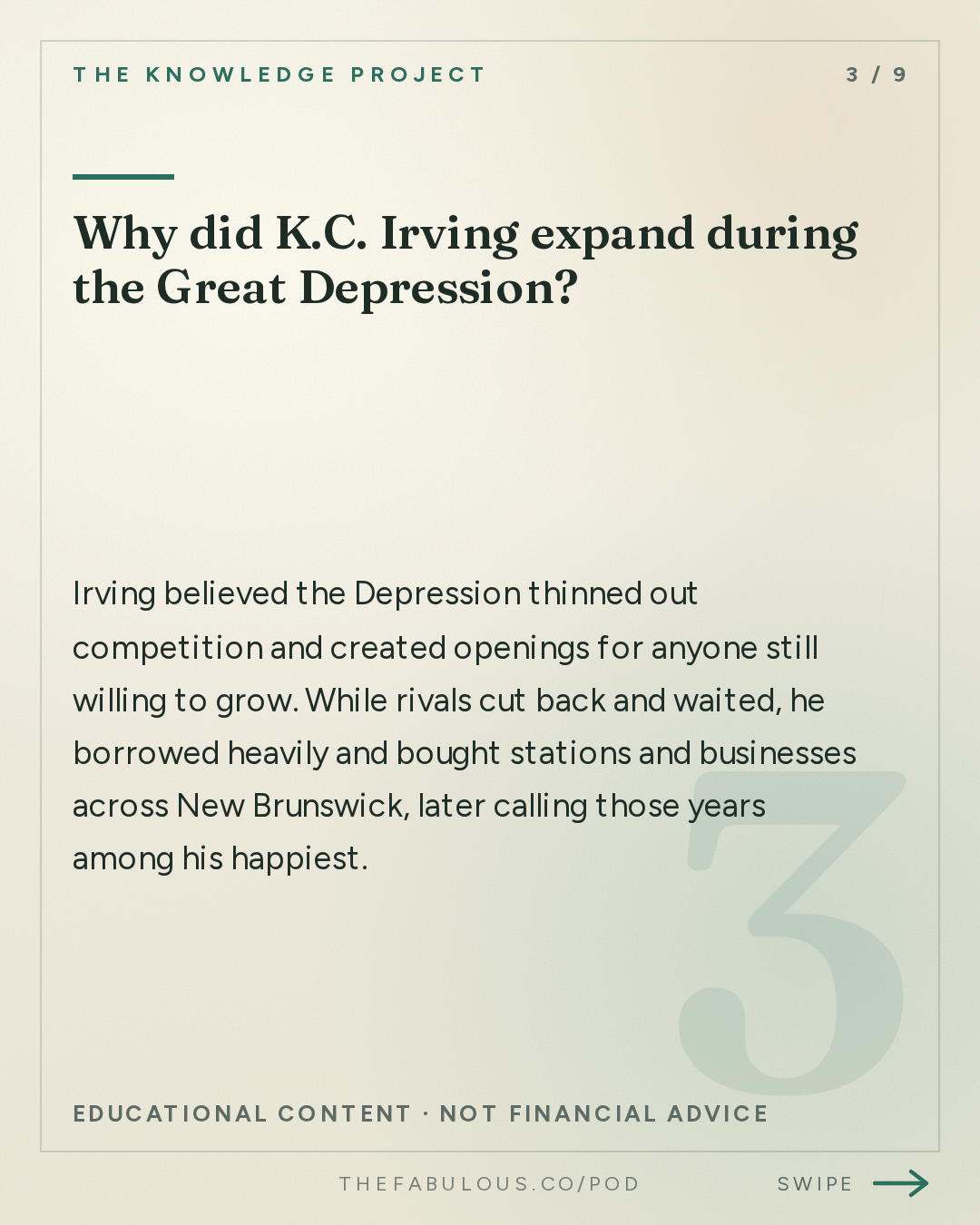
Why did K.C. Irving expand during the Great Depression?
Irving believed the Depression thinned out competition and created openings for anyone still willing to grow. While rivals cut back and waited, he borrowed heavily and bought stations and businesses across New Brunswick, later calling those years among his happiest (28:27).
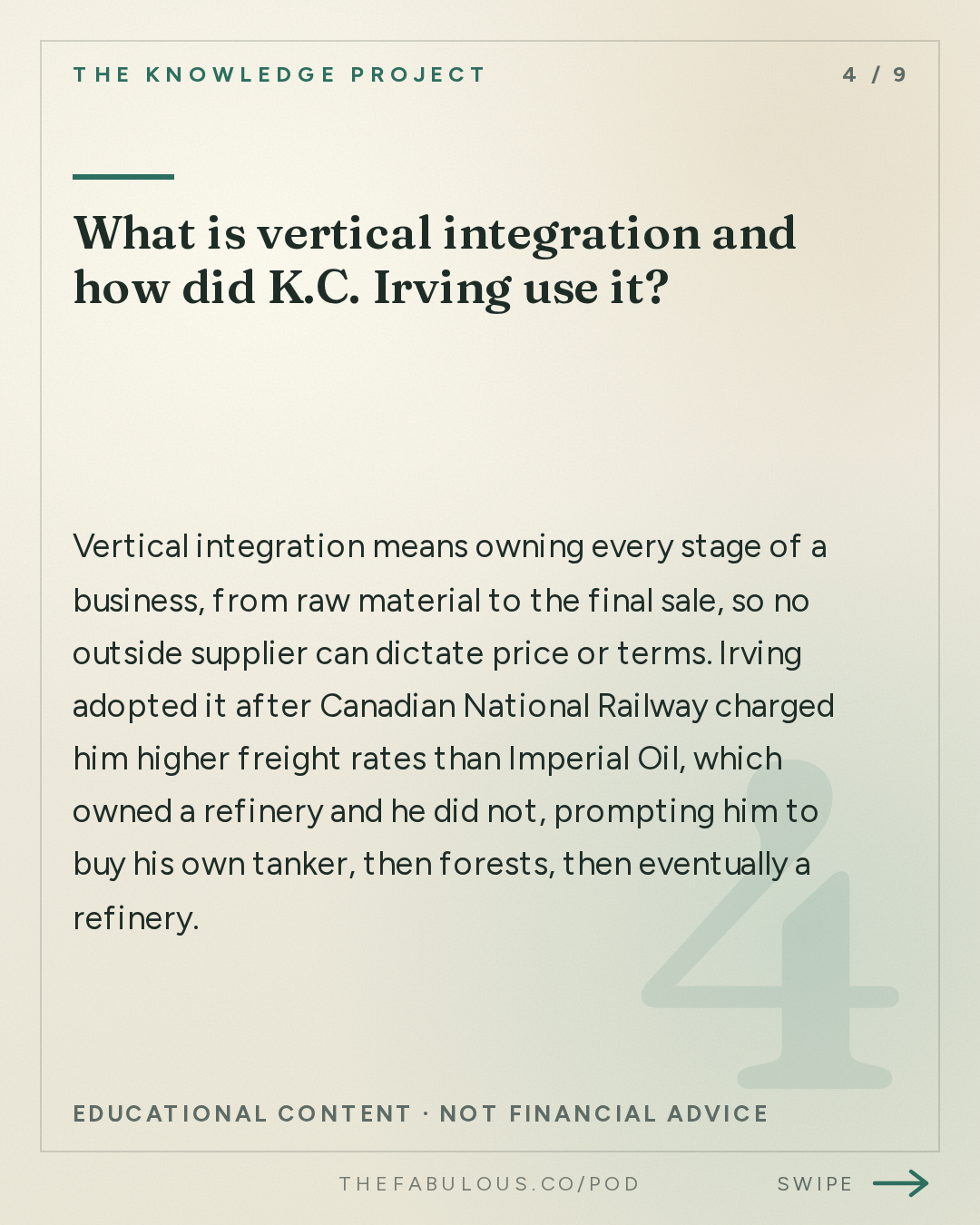
What is vertical integration and how did K.C. Irving use it?
Vertical integration means owning every stage of a business, from raw material to the final sale, so no outside supplier can dictate price or terms. Irving adopted it after Canadian National Railway charged him higher freight rates than Imperial Oil, which owned a refinery and he did not, prompting him to buy his own tanker, then forests, then eventually a refinery (32:21).
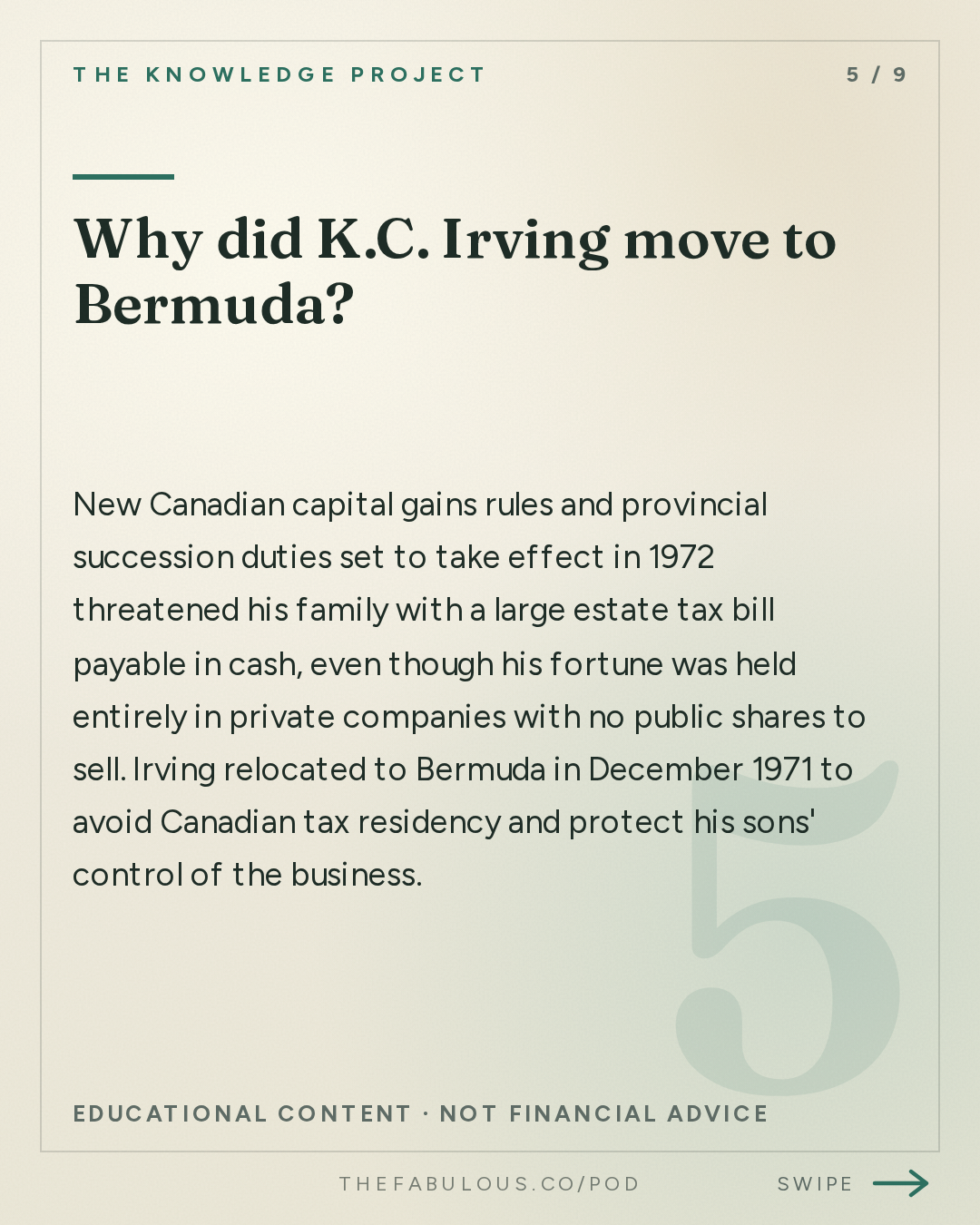
Why did K.C. Irving move to Bermuda?
New Canadian capital gains rules and provincial succession duties set to take effect in 1972 threatened his family with a large estate tax bill payable in cash, even though his fortune was held entirely in private companies with no public shares to sell. Irving relocated to Bermuda in December 1971 to avoid Canadian tax residency and protect his sons' control of the business (108:01).
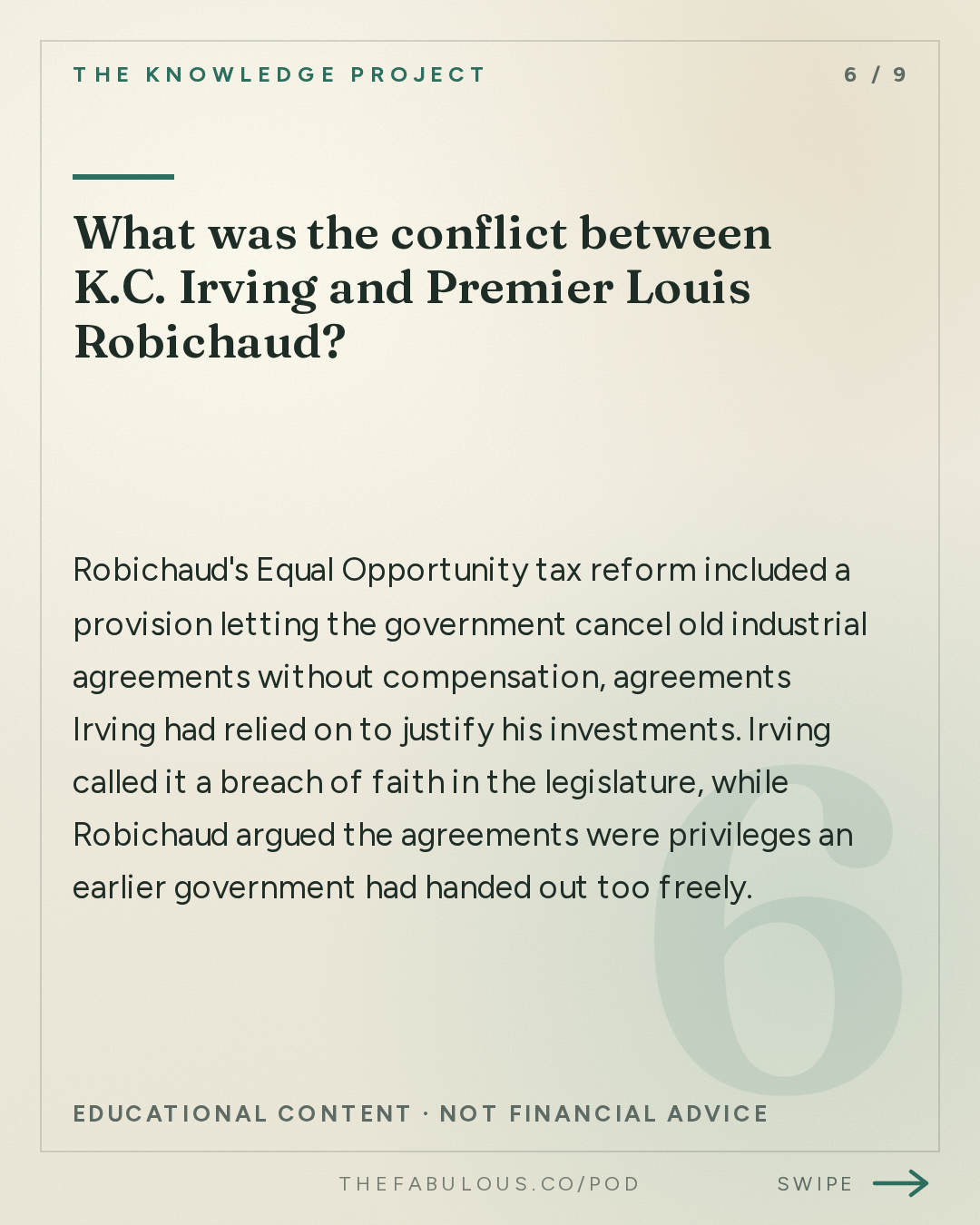
What was the conflict between K.C. Irving and Premier Louis Robichaud?
Robichaud's Equal Opportunity tax reform included a provision letting the government cancel old industrial agreements without compensation, agreements Irving had relied on to justify his investments. Irving called it a breach of faith in the legislature, while Robichaud argued the agreements were privileges an earlier government had handed out too freely (81:16).
How many trees did K.C. Irving's reforestation program plant?
Irving started planting spruce seedlings in 1957, at age 58, on land experts said was too poor to support forest. By 2017, six decades later, the program had planted more than one billion trees (119:59).
The full read, in cards
Go deeper
- Canadian Business magazine cover story (1948) — Estimated K.C. Irving's fortune at about 100 million dollars and noted how hard it was to find a photo of him
- Maclean's magazine profile by journalist Ralph Allan (1964) — Documented how deeply Irving companies had woven into daily life across New Brunswick
- Forbes fortune estimate — Valued K.C. Irving's wealth near his death at about 8 billion dollars
Mentioned
K.C. Irving · Harriet Irving · Arthur Irving · Jim Irving · Jack Irving · Harrison McCain · Louis Robichaud · Imperial Oil · Canadian National Railway · Standard Oil of California · Ford Motor Company · British Petroleum · Noranda · New Brunswick · Bermuda
More from this show and category

Steven Kotler's Guide to Flow State Triggers
Flow, the total-absorption state Mihaly Csikszentmihalyi named decades ago, is trainable biology rather than mood, says flow researcher Steven Kotler. He maps the triggers: a four percent challenge-skill gap, 90 to 110 minute focus cycles, a protected primary flow activity, and reframed tasks that let people learn up to 230 percent faster and recover from burnout.

Charlie Munger's Todd Combs Interview: Key Lessons
Charlie Munger told Berkshire Hathaway manager Todd Combs in a 2022 interview that temperament, not raw intelligence, decides who wins at investing and leadership. He explains the "fiduciary gene," the Wooden Lesson of concentrating resources behind rare talent, and why positioning, holding cash and options before a crisis hits, beats trying to predict crashes like 1974's.

Ryan Serhant's Sales and Productivity Tactics
Real estate broker Ryan Serhant says willingness to be embarrassed is what separates top earners from everyone else. He built his career on a future-me identity he manifests over 12 to 24 months, a daily budget of 1,000 productive minutes, and follow-ups that sometimes took five years before closing multimillion-dollar deals.
Ryan Serhant's Sales and Productivity Secrets
Ryan Serhant, star of Million Dollar Listing and founder of real estate firm Serhant, says comfort with embarrassment separates top earners from everyone else. He outlines his 1,000 minutes rule for guarding daily time, a hook-help-ask sales framework, and why distribution matters more than product quality.
