
Charlie Munger's Todd Combs Interview: Key Lessons
Charlie Munger's Interview with Todd Combs
▶ Listen to the full episode More from The Knowledge Project
The brief
Charlie Munger told Berkshire Hathaway manager Todd Combs in a 2022 interview that temperament, not raw intelligence, decides who wins at investing and leadership. He explains the "fiduciary gene," the Wooden Lesson of concentrating resources behind rare talent, and why positioning, holding cash and options before a crisis hits, beats trying to predict crashes like 1974's.
Charlie Munger once described a rival investor by his shoe size. Henry Singleton, the founder of the conglomerate Teledyne, was "a guy who wears size 16 shoes and webbed feet competing with a bunch of ordinary people," Munger said, "so he was fun to watch because he was so cool and rational" (01:27). It's an odd image, but it points to the real subject of a 2022 conversation between Munger and Todd Combs, a Berkshire Hathaway investment manager: what actually separates rare performers from everyone else, and how to arrange your affairs so you can recognize and back them.
The interview, recorded for the Singleton Prize for CEO Excellence, sat unreleased for two years before Todd Combs and the Singleton Foundation agreed to share it. Across roughly twenty minutes, Munger moves from basketball to dormitory design to the 2008 financial crisis, but he keeps returning to the same small number of ideas: find the few people worth trusting, pick problems that can actually be solved, and never let circumstances force your hand.
The Wooden Lesson
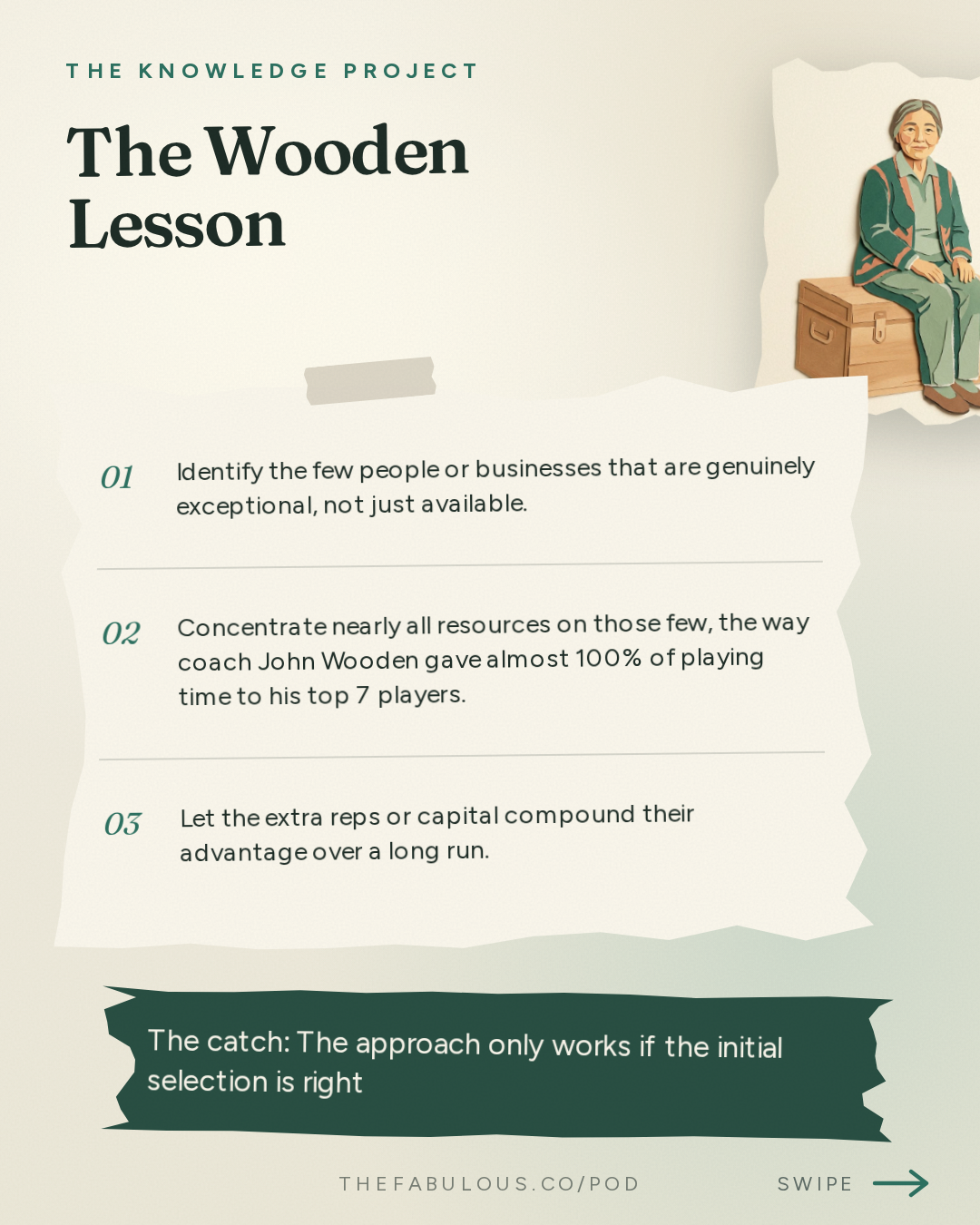
Munger's favorite case study wasn't an investor at all. It was John Wooden, the UCLA basketball coach with the best record in the sport's history. Wooden's method, Munger said, was to concentrate "almost 100% of the playing time on his top seven players," so that those players kept improving while the bench barely played at all (04:00). Munger called this the Wooden Lesson, and he applied it directly to money management: once an investor finds a rare operator, the right move is to give that person as much capital and room as possible and then get out of the way.
The hard part isn't the concentrating. It's the choosing. Munger's heroes, Singapore's founding leader Lee Kuan Yew, German chancellor Otto von Bismarck, and American general George Marshall among them, shared something he called a fiduciary gene: a sense of duty that runs deeper than ambition. Before naming it, Combs had already brought up a simpler case, the broadcasting executive Tom Murphy, who ran Capital Cities.
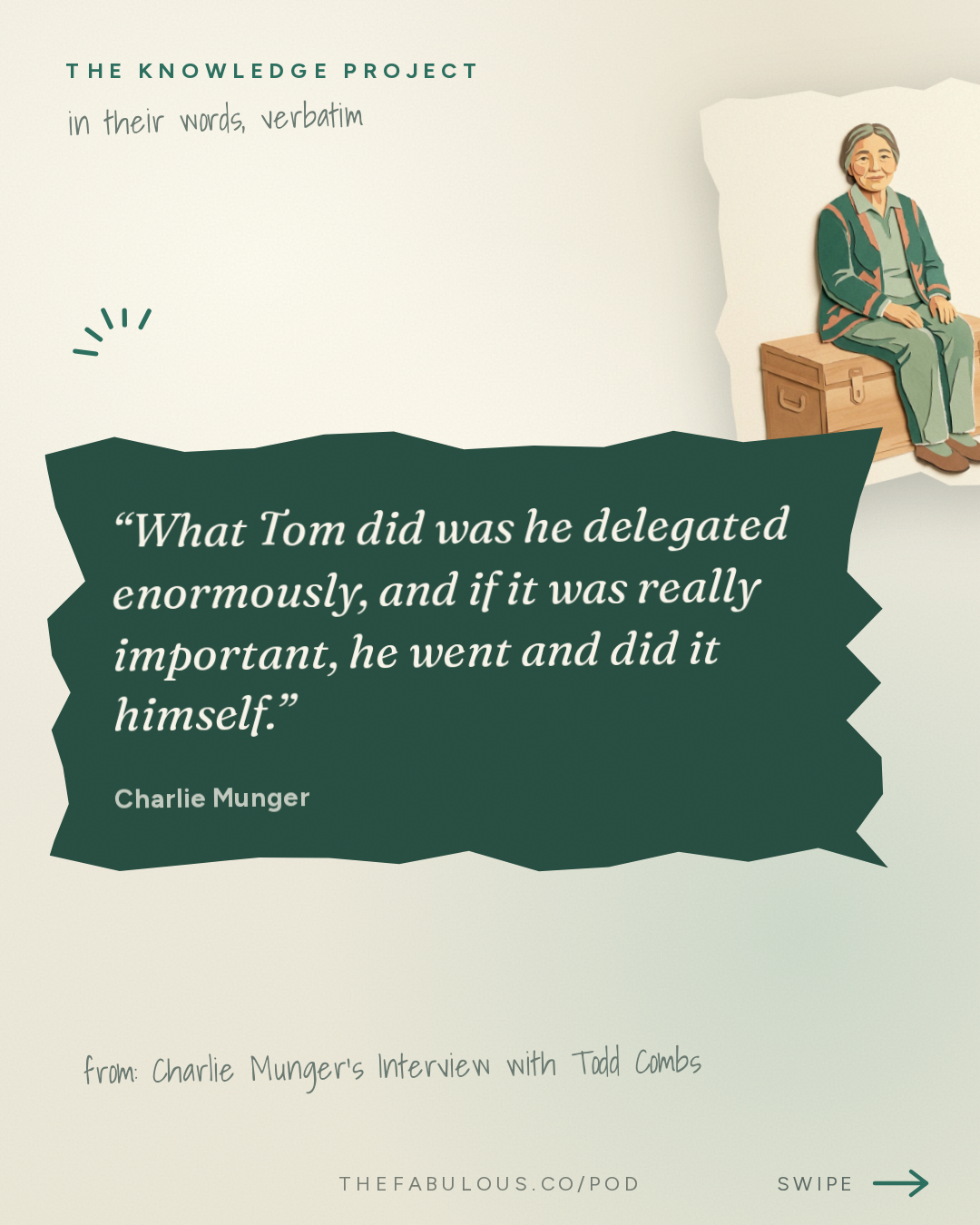
"What Tom did was he delegated enormously, and if it was really important, he went and did it himself." - Charlie Munger [03:15]
A fiduciary, in the legal sense, is someone entrusted to act in another person's interest rather than their own. Munger argued the best leaders behave that way even when no law forces them to.
"Think of the difference between someone like George Washington who voluntarily left power, setting an example, and those paranoid rulers who came into power and start killing people to stay in power, trying to subvert the systems and so forth." - Charlie Munger [04:52]
George Washington gave up the presidency after two terms when he could have kept it. That restraint, Munger argued, predicts long-term success better than intelligence or charisma. It also explains something he said about his own temperament. He wasn't claiming genius. "What I am is a guy who has been able to take moderate obsession and a long attention span and turn them into pretty good results," he said (00:27). The obsession needed limits, though. "I just stay away from the problems that can't be fixed and pick the ones that can," he told Combs. "I don't like unlimited failure, and I don't want to fish forever and never catch a fish" (06:35). Stubbornness aimed at a solvable problem, kept up long enough, tends to produce an answer. Aimed at an unsolvable one, it just produces exhaustion.
This habit of borrowing logic from unrelated fields shows up in a strange place: Munger's own real estate projects. When he designed student dormitories without enough exterior wall space for real windows, he copied cruise ships, which solve the same problem with artificial windows that simulate light and air for interior staterooms (07:23). He also noticed that Disney had gone further, charging more for rooms with artificial windows than real ones, because the fake version could do something the real one couldn't: "wink at your children and create this magical memory and experience" (08:17). A constraint, handled well, can become a selling point rather than an apology.
Positioning Before the Decision
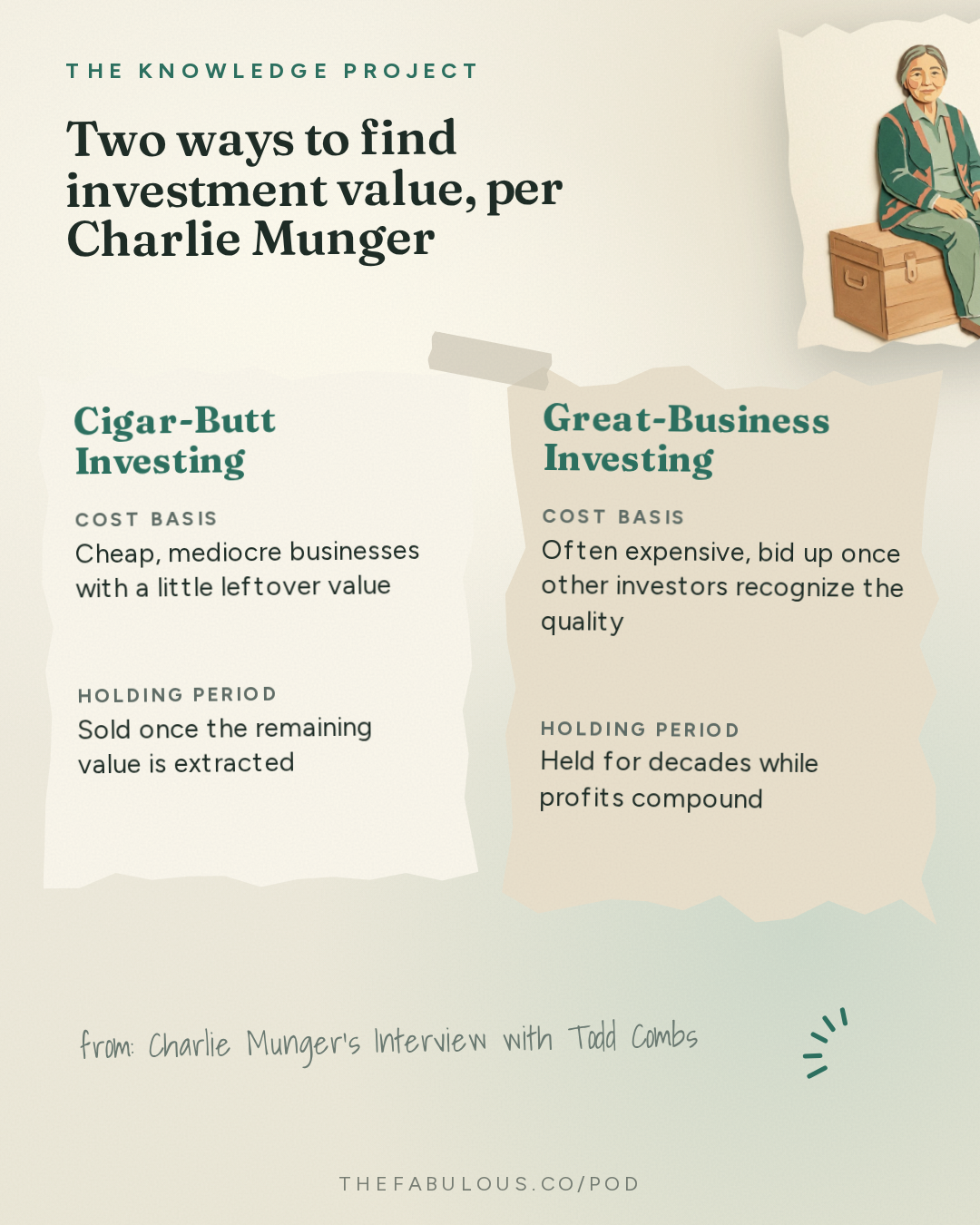
Munger and Combs spent real time on how investing style should change as an investor matures. Early value investing meant buying "cigar butts": cheap, mediocre businesses with one free puff of value left in them. The harder, better strategy is buying a genuinely great business and holding it for decades while it compounds. "If you can get into a great company, stay in it for a long time, that's the easiest, biggest money you'll possibly make," Munger said, "but it's so hard to do because they bid the great companies up so high that it makes that strategy not work" (09:44). His advice was narrow by design: don't expect to find ten or twenty great businesses in a lifetime. Find one or two, and that is enough (10:12).
That scarcity is the logic behind an idea Munger borrowed from his partner Warren Buffett: a punch card with only 20 slots for a lifetime of investment decisions. Once all 20 are used, no further investment is allowed under the rule. The limit is fictional, but treating it as real forces patience, which cuts against markets that make constant trading effortless. Munger was blunt about what that ease has done. "The gambling instinct is really strong," he said. "It's like taking heroin. A certain percentage of people, when they start, just overdo it" (10:55). He extended the warning to the system itself, describing how the 2008 financial crisis nearly tipped into something closer to the Great Depression because booms and busts feed on themselves, a process he compared to autocatalysis, a chemical reaction that speeds itself up once it starts (12:03).
Reason, for Munger, was the counterweight to that feedback loop. "I almost worship reason," he said. "The people I know that are good, they feel you have a duty to become as wise as you can by constantly studying and thinking about it" (12:56). But reason alone doesn't help if an investor is out of options when a crisis hits. That is where Shane Parrish's idea of positioning comes in, and it may be the most practical thread in the whole conversation. Positioning is what happens before the decision, not during it. Holding cash before the 1973 to 1975 bear market, the worst in fifty years by Munger's account (13:45), meant Berkshire could buy while everyone else was forced to sell. "We've been in it for a long time," Munger said. "My Berkshire Hathaway stock has gone down 50% three times in my life" (15:39). The stock dropping wasn't the strategy. Being positioned to survive the drop, and to buy more while it lasted, was.
Munger extended the same lens to John D. Rockefeller, whose Standard Oil dominated the kerosene market for lighting until electricity made that business obsolete. Rockefeller didn't predict that the automobile would need gasoline and rescue the company. He simply held onto the oil fields long enough for a better use to arrive. "They were just damn lucky that they were forced out of one business and God gave them a better business," Munger said (16:35). Luck mattered, but so did the holding. Most companies don't get that second act. "They all die or become insignificant," Munger said of big businesses generally, citing General Motors as an example of a company that once looked unbeatable and eventually wiped out its own shareholders (17:21).
The closest thing to a counter-example in the conversation is General Electric under Jack Welch, a leader Munger knew personally and described as "likable" and "intelligent" but ultimately undone by competitiveness. "He wanted to win at golf. He wanted to win at business all over," Munger said. "In the end, he was lying about what had been accomplished" (17:46). Munger recommended the book Lights Out, which documents GE's decline, as required reading for business schools, not because Welch lacked talent, but because talent without the fiduciary gene eventually curdles into something closer to fraud.
By the end of the conversation, what looks like a tour through basketball, dormitories, oil fields, and stock crashes resolves into a short list. Find the rare people worth trusting. Choose problems that can actually be solved. Keep studying so reason stays sharper than fear or greed. And arrange affairs, mostly by holding cash and avoiding debt that can be called at the worst moment, so a crisis never gets to make the decision instead. None of it requires being the smartest person in the room. It requires, as Munger kept insisting about himself, a long attention span and the discipline to wait for the few moments actually worth acting on.
Ask this episode anything
Pod's AI answers from the episode itself, with the minute mark so you can hear it yourself.
Or start with one of these
Ask this episode
Pod's AI listens to the whole episode to answer, and points you to the minute it comes from.
The rest of this answer, and any question after it
Answers come from the episode itself, never from a summary of it.
ContinueKey takeaways
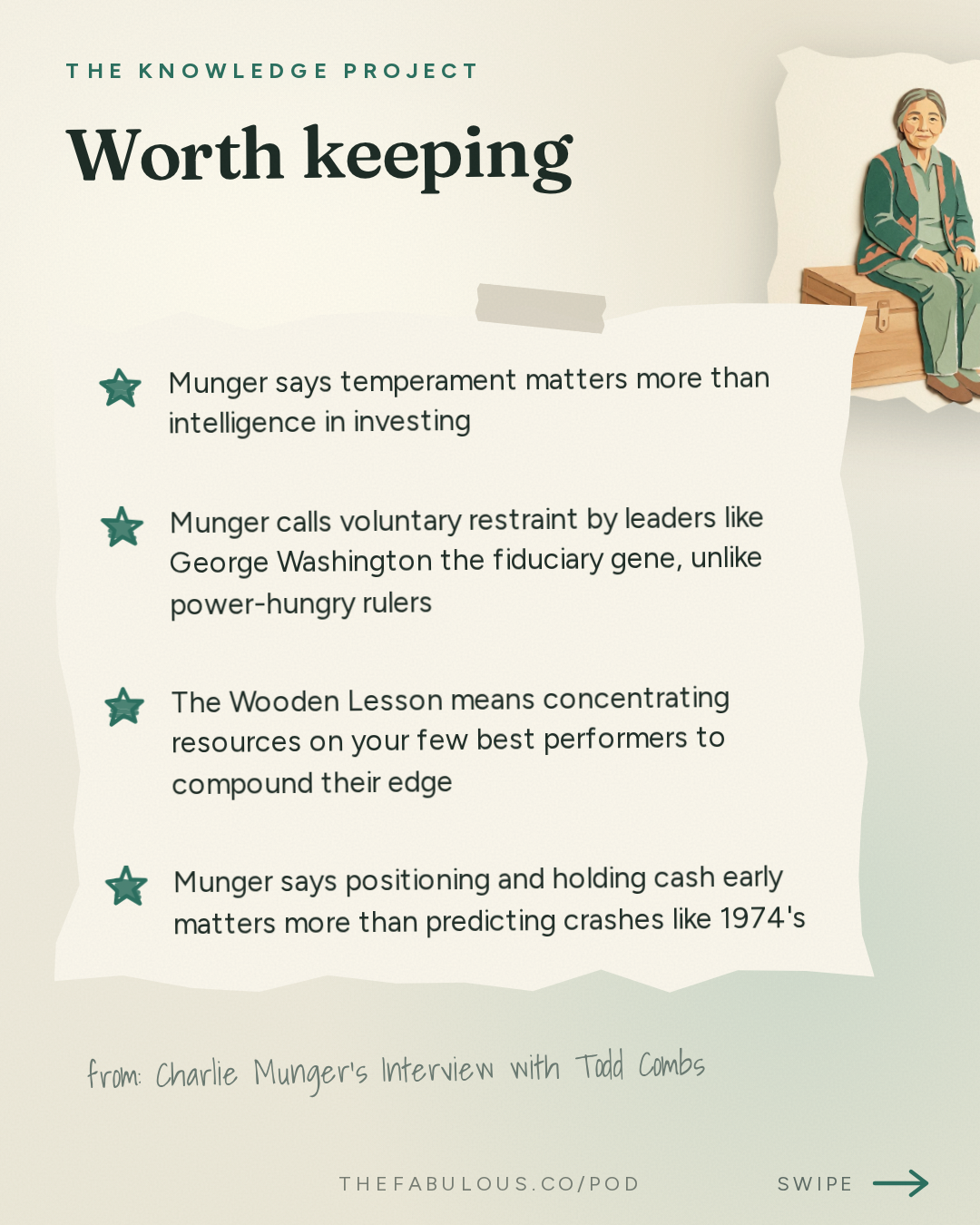
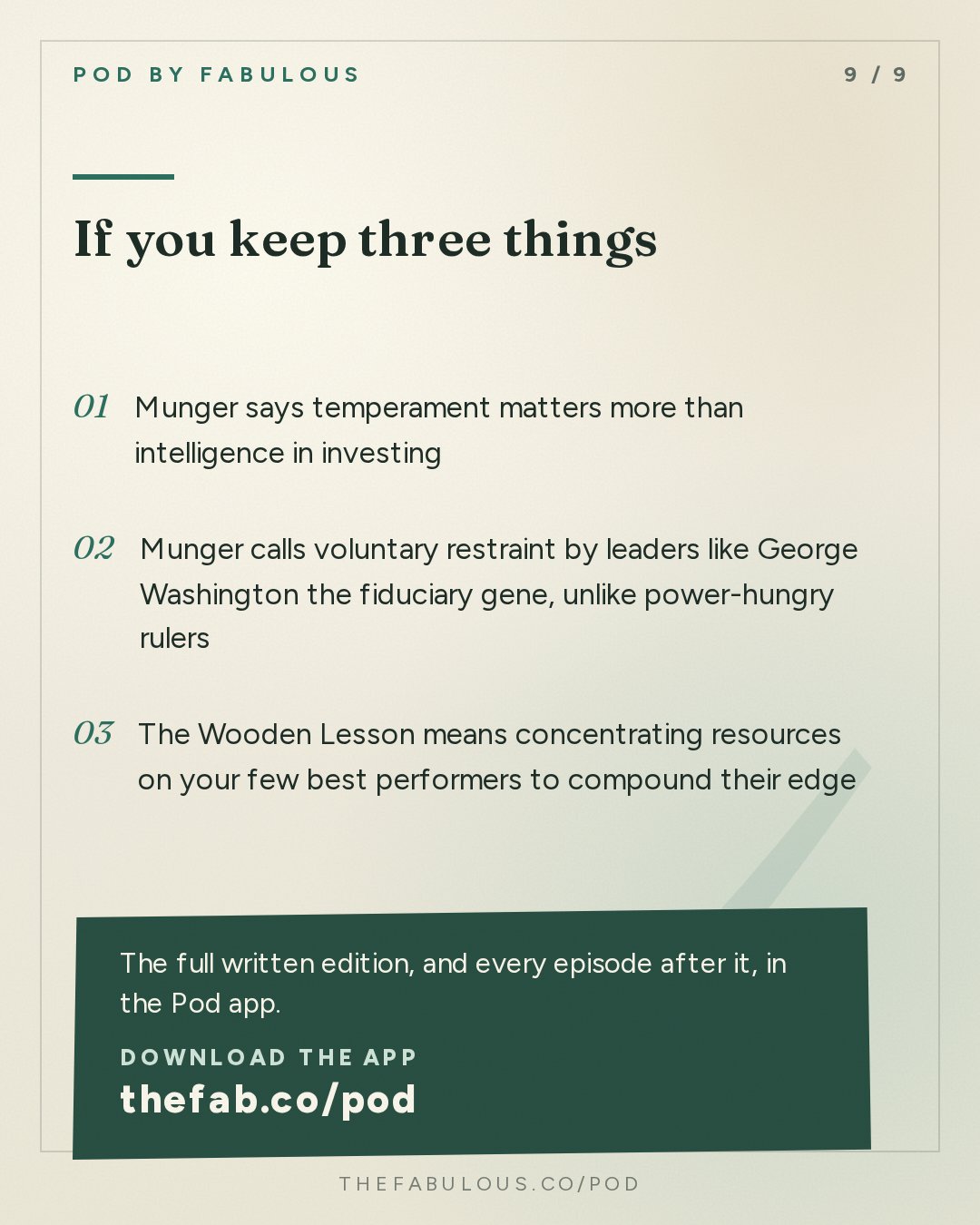
- Munger says temperament matters more than intelligence in investing
- Munger calls voluntary restraint by leaders like George Washington the fiduciary gene, unlike power-hungry rulers
- The Wooden Lesson means concentrating resources on your few best performers to compound their edge
- Munger says positioning and holding cash early matters more than predicting crashes like 1974's
- Buffett's 20-slot punch card forces investors to act only on rare, high-conviction opportunities
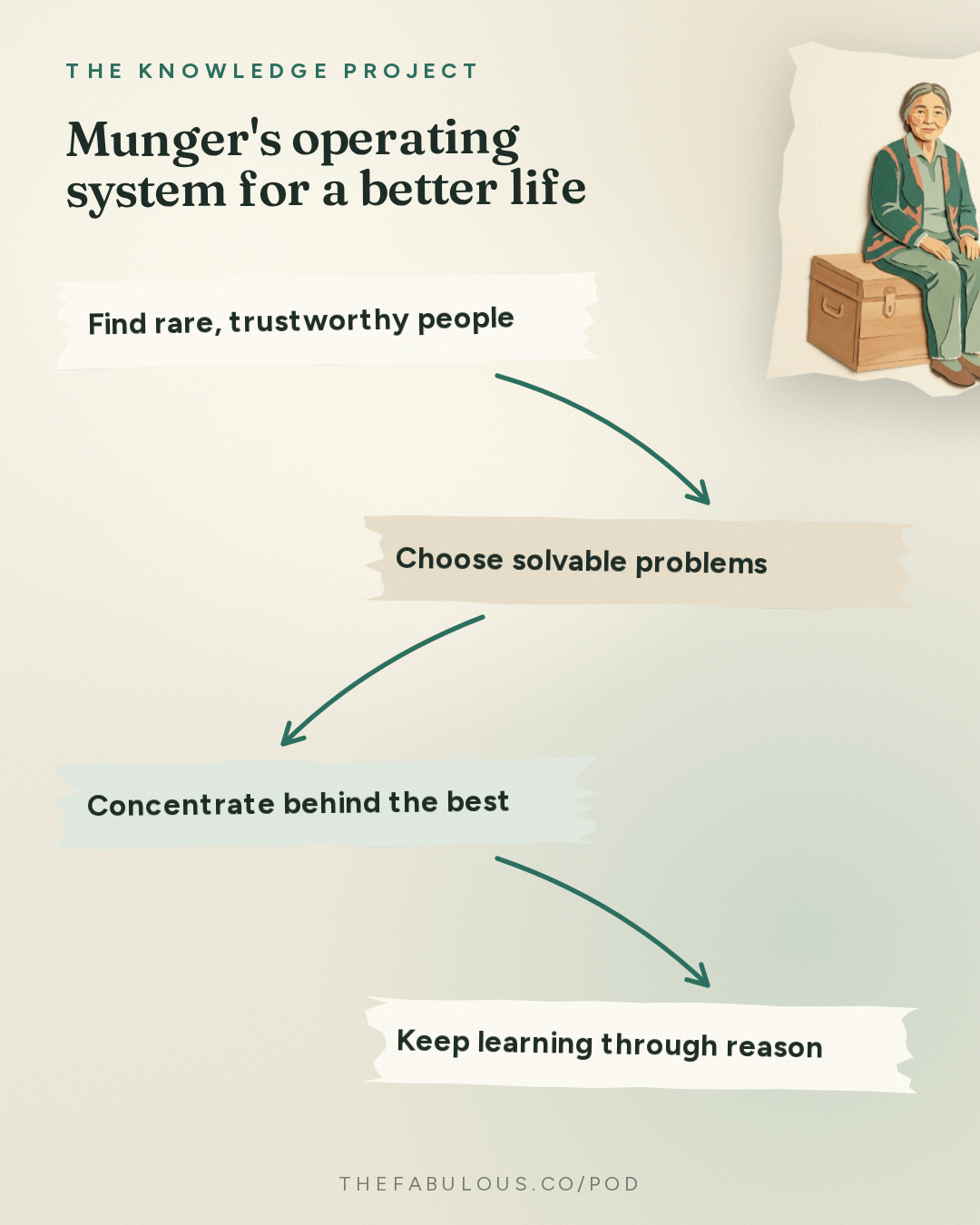
The episode in cards
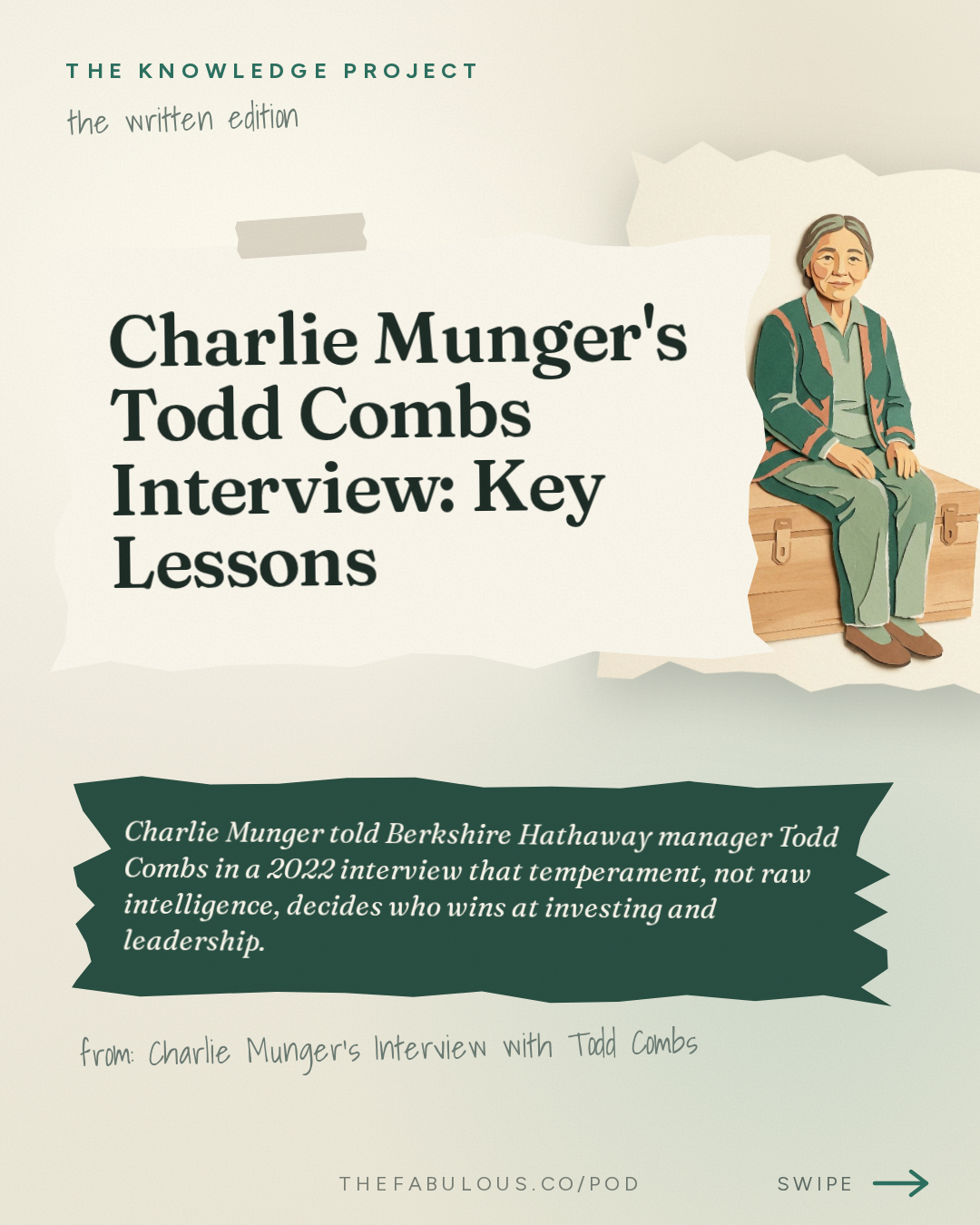
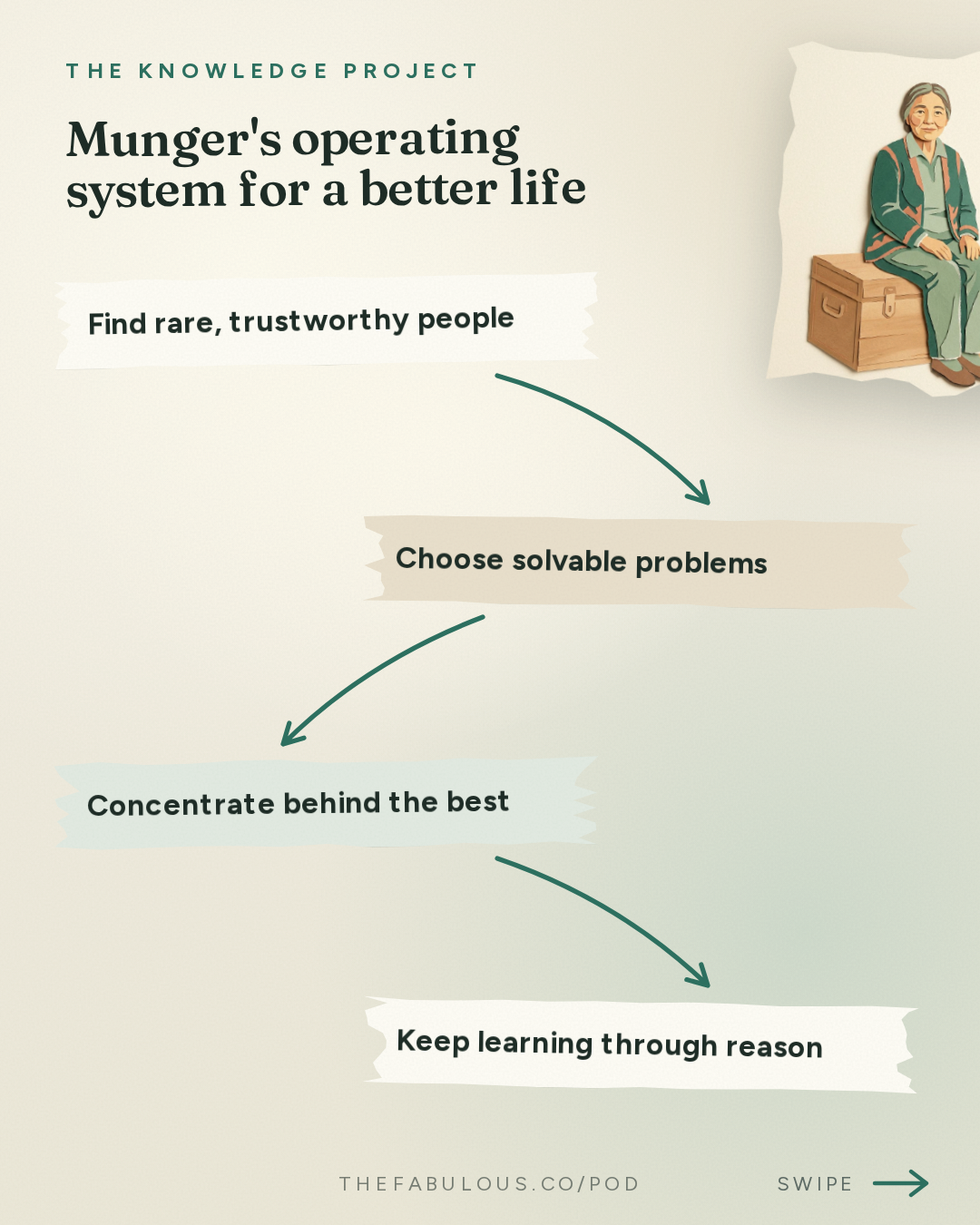
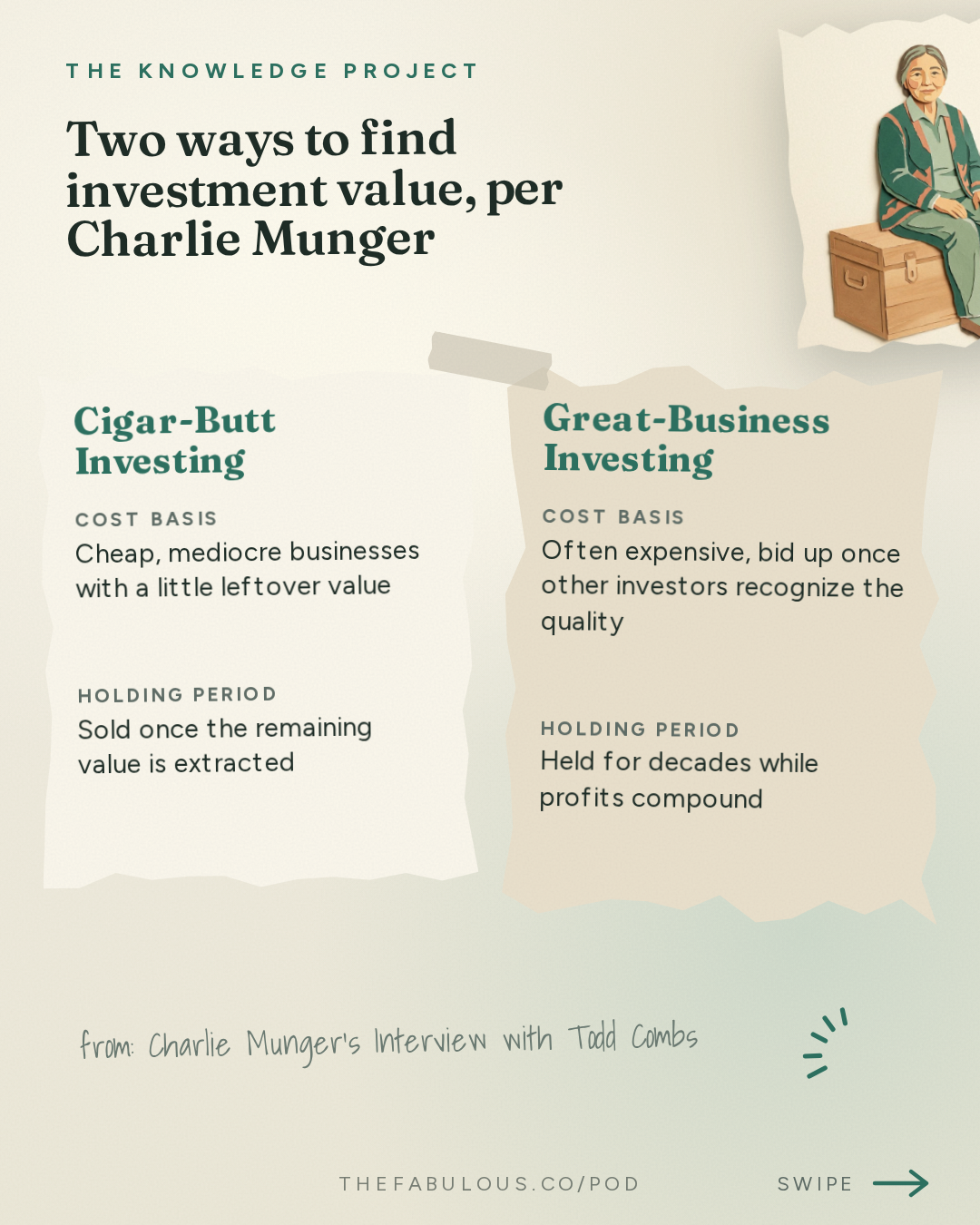
By the numbers
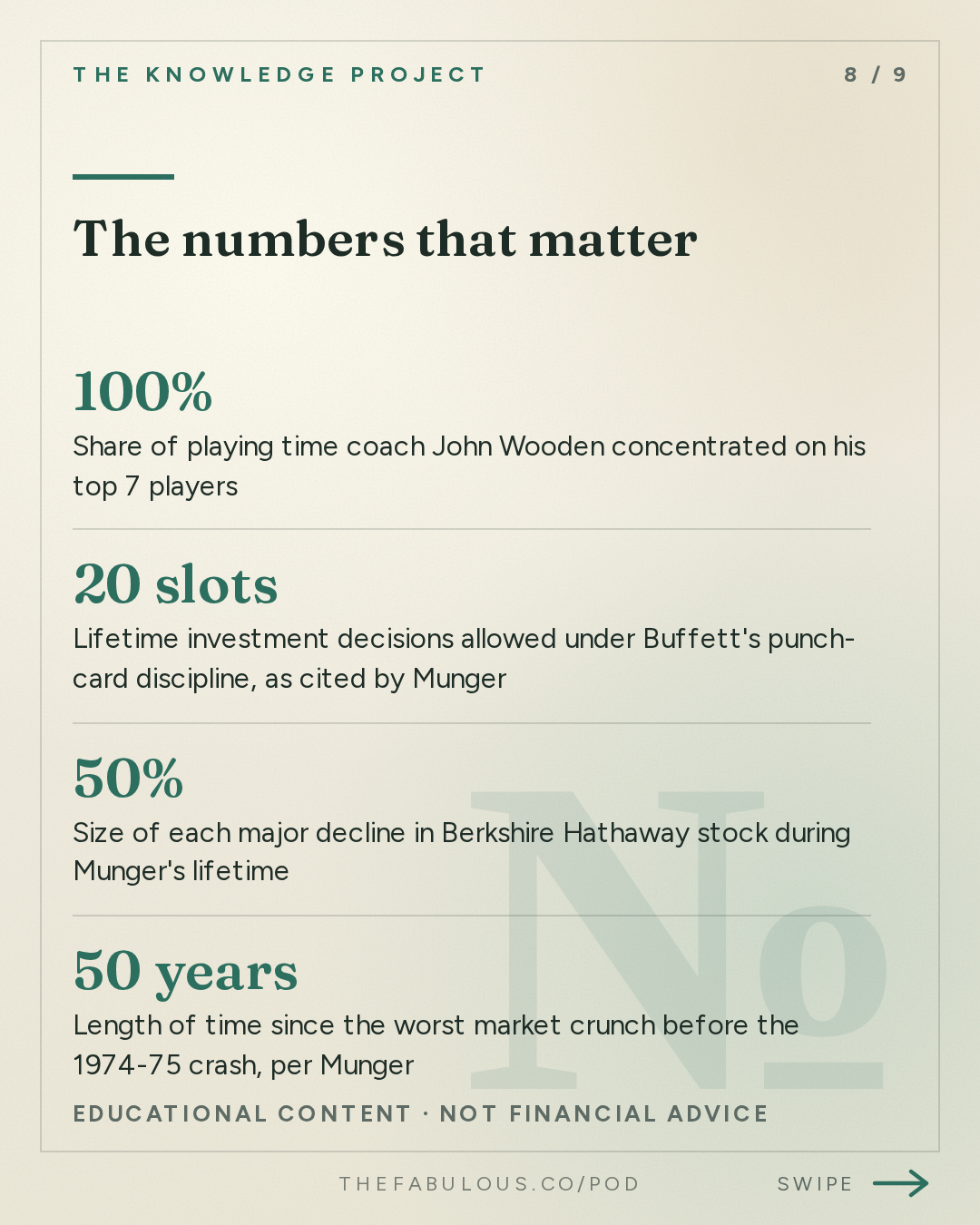
- 100% percent Share of playing time coach John Wooden concentrated on his top 7 players
- 20 slots Lifetime investment decisions allowed under Buffett's punch-card discipline, as cited by Munger
- 50% percent Size of each major decline in Berkshire Hathaway stock during Munger's lifetime
- 50 years Length of time since the worst market crunch before the 1974-75 crash, per Munger
In their words
“What Tom did was he delegated enormously, and if it was really important, he went and did it himself.”
“Think of the difference between someone like George Washington who voluntarily left power, setting an example, and those paranoid rulers who came into power and start killing people to stay in power, trying to subvert the systems and so forth.”
“I just stay away from the problems that can't be fixed and pick the ones that can.”
“I almost worship reason.”
Protocols
-
Concentrate resources on your best performers
Munger says investors should find a rare operator, a 'mini Wooden' or 'mini Buffett,' and direct capital toward that person the way coach John Wooden gave almost 100% of playing time to his top 7 players so they improved fastest; the catch is that this only works if the person chosen is genuinely exceptional, since concentrating resources on the wrong pick compounds failure just as fast as success.
Applied whenever evaluating where to place trust or capital
-
Limit yourself to a lifetime punch card of investments
Munger describes Warren Buffett's discipline of imagining a card with only 20 punches for a lifetime of investment decisions, which forces an investor to wait, study deeply, and act only when an opportunity is worth using one of those scarce slots; the catch is that modern markets make constant trading effortless, which pulls most investors toward the opposite habit.
A standing rule applied across an entire investing career
Questions this episode answers
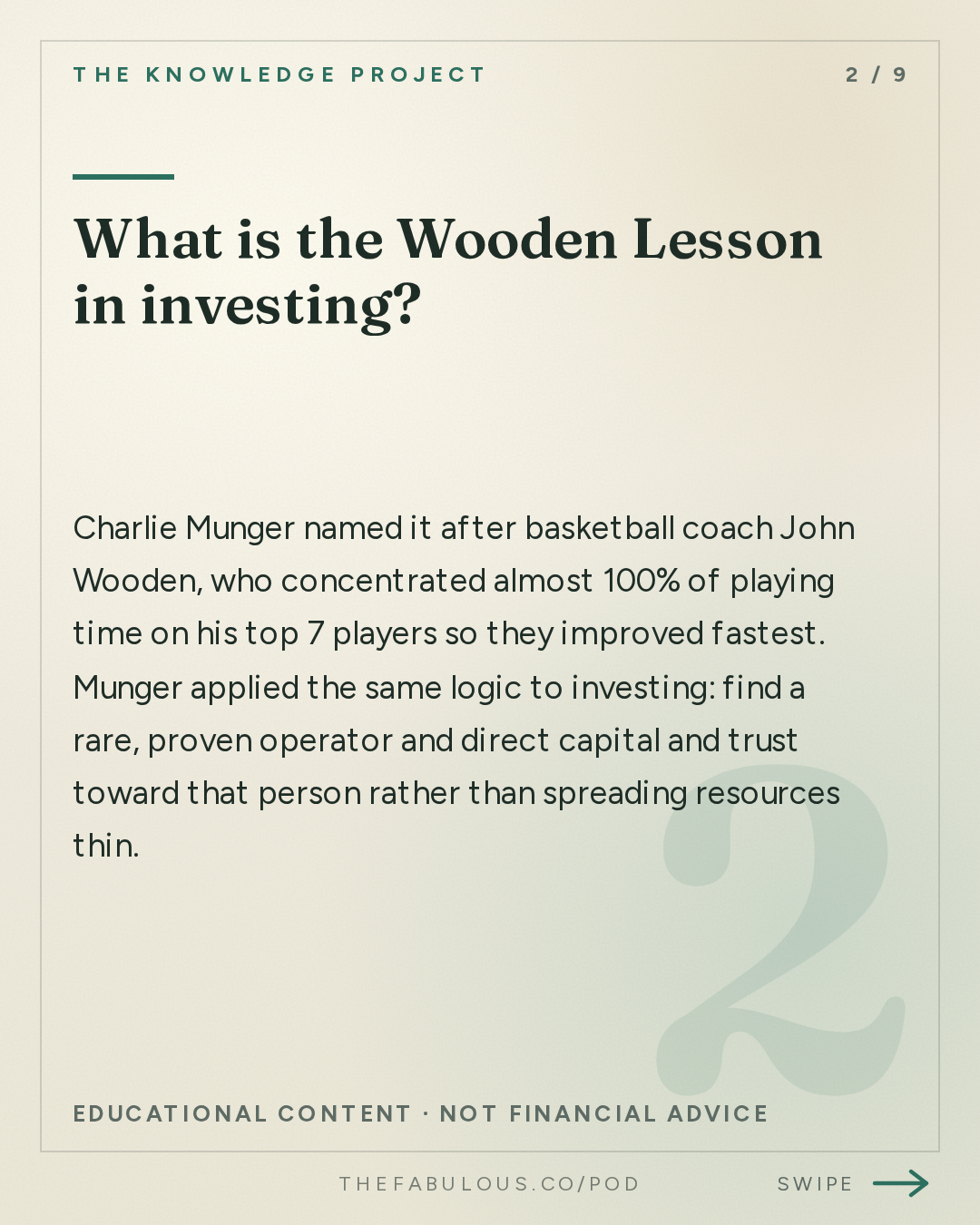
What is the Wooden Lesson in investing?
Charlie Munger named it after basketball coach John Wooden, who concentrated almost 100% of playing time on his top 7 players so they improved fastest (04:00). Munger applied the same logic to investing: find a rare, proven operator and direct capital and trust toward that person rather than spreading resources thin.
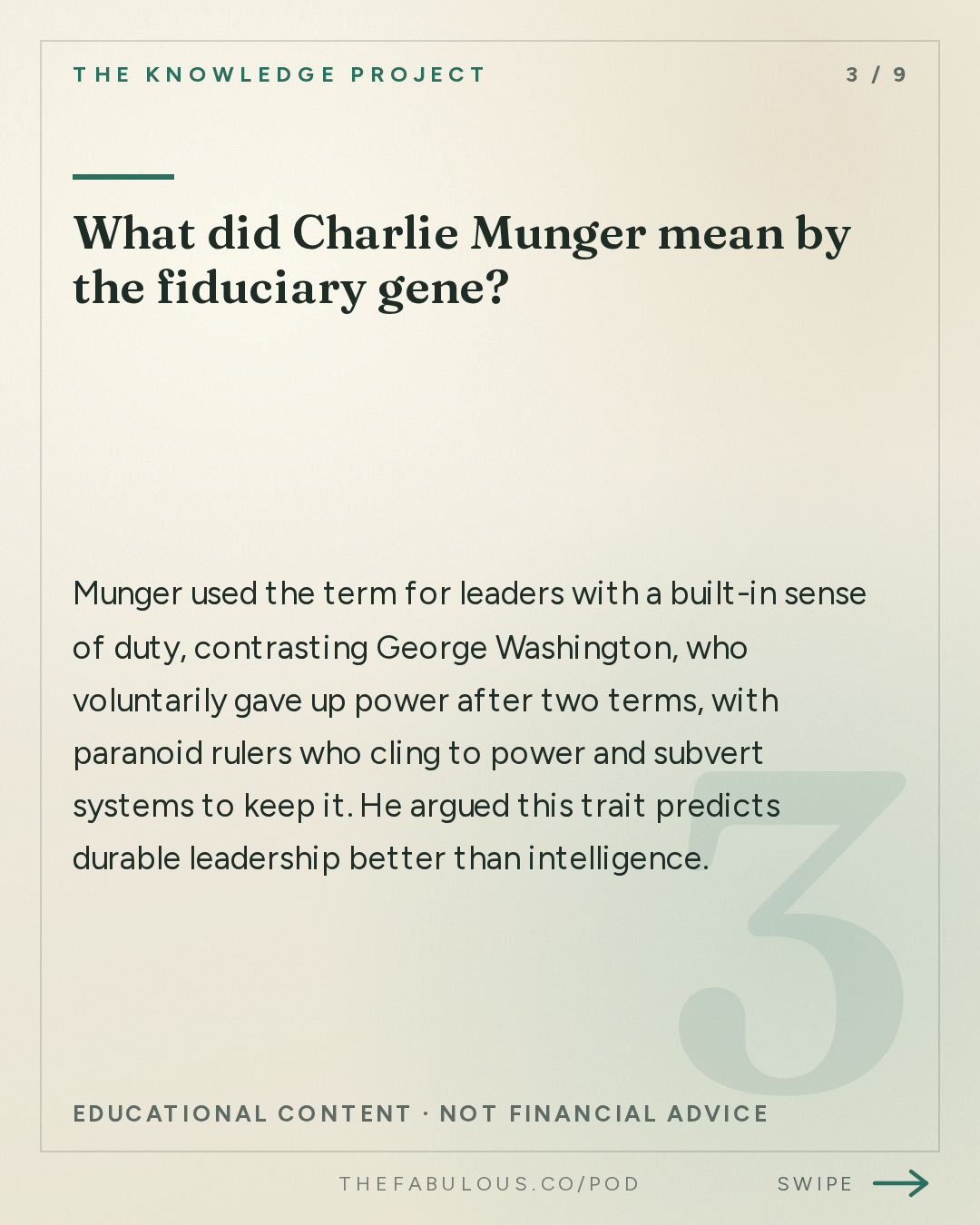
What did Charlie Munger mean by the fiduciary gene?
Munger used the term for leaders with a built-in sense of duty, contrasting George Washington, who voluntarily gave up power after two terms, with paranoid rulers who cling to power and subvert systems to keep it (04:52). He argued this trait predicts durable leadership better than intelligence.
How did Henry Singleton's stock buyback strategy work?
Henry Singleton, founder of the conglomerate Teledyne, bought back his company's stock because it was cheap, not because buybacks were fashionable, which Munger said was unusual at the time (02:01). Munger contrasted this with companies today that buy back stock regardless of whether it is undervalued.
What does Charlie Munger mean by positioning versus decision making?
Munger argued that positioning happens earlier than the decision itself and determines which options are even available when a hard call has to be made (14:10, 14:31). Holding cash before the 1973-75 bear market, for example, let Berkshire Hathaway buy while others were forced to sell, rather than needing to predict the crash itself.
Is the book Lights Out about GE worth reading?
Charlie Munger, who knew former General Electric CEO Jack Welch personally, said the book Lights Out, which chronicles GE's decline, should be required reading in every business school (18:09). In his view it illustrates how competitiveness without the 'fiduciary gene' can lead a leader to misrepresent results.
The full read, in cards
Go deeper
- Lights Out — Chronicles General Electric's decline under CEO Jack Welch; Munger says it should be required reading in business schools
Mentioned
Charlie Munger · Todd Combs · Henry Singleton · Tom Murphy · John Wooden · Warren Buffett · Lee Kuan Yew · Otto von Bismarck · George Marshall · George Washington · Rockefeller · Jack Welch · General Electric · Disney · MIT · Lights Out
More from this show and category

Ryan Serhant's Sales and Productivity Tactics
Real estate broker Ryan Serhant says willingness to be embarrassed is what separates top earners from everyone else. He built his career on a future-me identity he manifests over 12 to 24 months, a daily budget of 1,000 productive minutes, and follow-ups that sometimes took five years before closing multimillion-dollar deals.
Ryan Serhant's Sales and Productivity Secrets
Ryan Serhant, star of Million Dollar Listing and founder of real estate firm Serhant, says comfort with embarrassment separates top earners from everyone else. He outlines his 1,000 minutes rule for guarding daily time, a hook-help-ask sales framework, and why distribution matters more than product quality.
Charlie Munger's Lessons from Henry Singleton
In a 2022 conversation, Charlie Munger tells Todd Combs that investing success rests on finding rare talent, choosing solvable problems, and smart positioning. The through-line is positioning: arranging affairs so circumstances never force bad decisions, as Munger explains using Rockefeller, Teledyne founder Henry Singleton, and the 1974 market crash.

Bill Ackman on Lucy's Recovery and the Brain Institute
Bill Ackman recounts his daughter Lucy's brain hemorrhage and the brain rehabilitation institute he built in response. He also details Pershing Square's investment checklist, its move away from short selling, and the plan to turn Howard Hughes into an insurance-driven holding company modeled on Berkshire Hathaway.
