
Ryan Serhant's Sales and Productivity Tactics
How to Get People to Say Yes | Ryan Serhant
▶ Listen to the full episode More from The Knowledge Project
The brief
Real estate broker Ryan Serhant says willingness to be embarrassed is what separates top earners from everyone else. He built his career on a future-me identity he manifests over 12 to 24 months, a daily budget of 1,000 productive minutes, and follow-ups that sometimes took five years before closing multimillion-dollar deals.
Ryan Serhant opens this conversation by handing his host a watch and announcing a new rule: no podcast should start without a gift. It is a small stunt, but stunts are how Serhant, the broker who became the face of Bravo's Million Dollar Listing and later built his own agency, Serhant Media Group, built a career. The real rule sits underneath the joke. "If you're willing to embarrass yourself, you make more money every time," he says (00:08). That line is the thesis of everything that follows: sales, time, and attention all reward the person willing to look foolish first.
Serhant does not call this fake it till you make it. He finds that phrase dishonest, since it implies lying, and lying, he argues, is the one unforgivable sin for anyone who has to sell something to someone else. Instead he calls it being "future me." The idea is simple: decide who you will be in twelve to twenty four months, then act like that person today, not the person you used to be (02:35). It is not pretending. It is rehearsal for a self he believes he will actually become.
He tested the idea in 2010, eighteen months into a real estate career he started only to cover rent after getting his license the day Lehman Brothers filed for bankruptcy (03:22). His original goal was modest: two thousand dollars a month (03:39). When Bravo opened a casting call for a New York version of Million Dollar Listing, three thousand agents showed up. Serhant made it into the final sixteen, who would each be filmed for half a day. He knew that showing a Bravo crew his real life, a studio apartment and the subway, would end his shot. So he staged the life of the agent he intended to become: a borrowed Range Rover, a 5 a.m. call time timed to exhaust an LA-based crew still running on West Coast hours (04:40), and a friend posing as a wealthy client. When a real showing forced him to cut the day short, he improvised an exit modeled on a bad date he once had, walking out mid-scene instead of explaining himself (07:05). It worked. He got a callback, then a decade on the show, three spinoffs, and eventually a Netflix series.
The Bank of a Thousand Minutes
Independent contractors have no boss and no structure handed to them, which Serhant says is the hardest problem to solve when starting out. His fix was to treat time like cash. A day holds 1,440 minutes (12:34), but Serhant figures a working person realistically has about 1,000 productive ones (13:01). He asks people to spend those minutes the way they would spend a thousand dollars in their pocket, not the way most people spend time, letting a bad five-minute phone call bleed into the rest of the day.
"You have to treat those 1,000 minutes like money. It's the only way you won't waste it." Ryan Serhant, [13:01]
The practical result, he says, was turning hour-long meetings into fifteen-minute ones, not by cutting out small talk but by cutting out talk that goes nowhere (14:52). He credits that discipline, more than connections or talent, for a 2018 season in which his team closed 800 million dollars in New York sales (15:48), outselling the next-highest team by roughly 350 million dollars (15:48), almost a million dollars a day.
That same discipline shapes how he sells. He describes a closing method he calls CODO, short for close on day one, built around what he calls the two Cs: find something genuinely in common with a client, and give an honest compliment, both aimed at making the other person comfortable before any pitch begins (16:07). The rule underneath it is to never ask a question someone can easily answer no to, and to let the other person talk, because, in his words, people hate being sold but love shopping. He also insists on selling the feeling before the object: "A lot of people who are terrible at sales are trying to sell me the bed... you sell the dream first, bed second" (17:58).
The Long Game
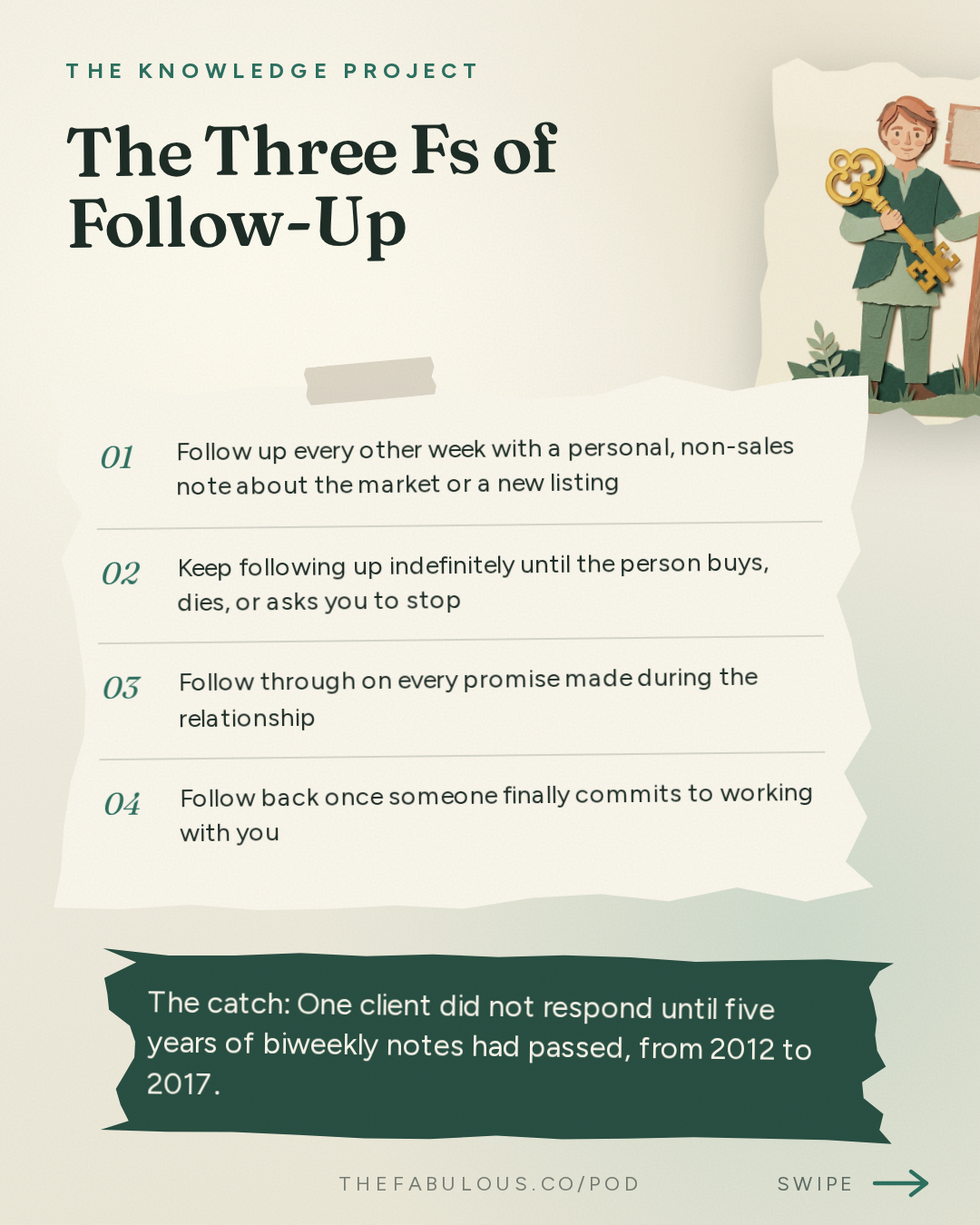
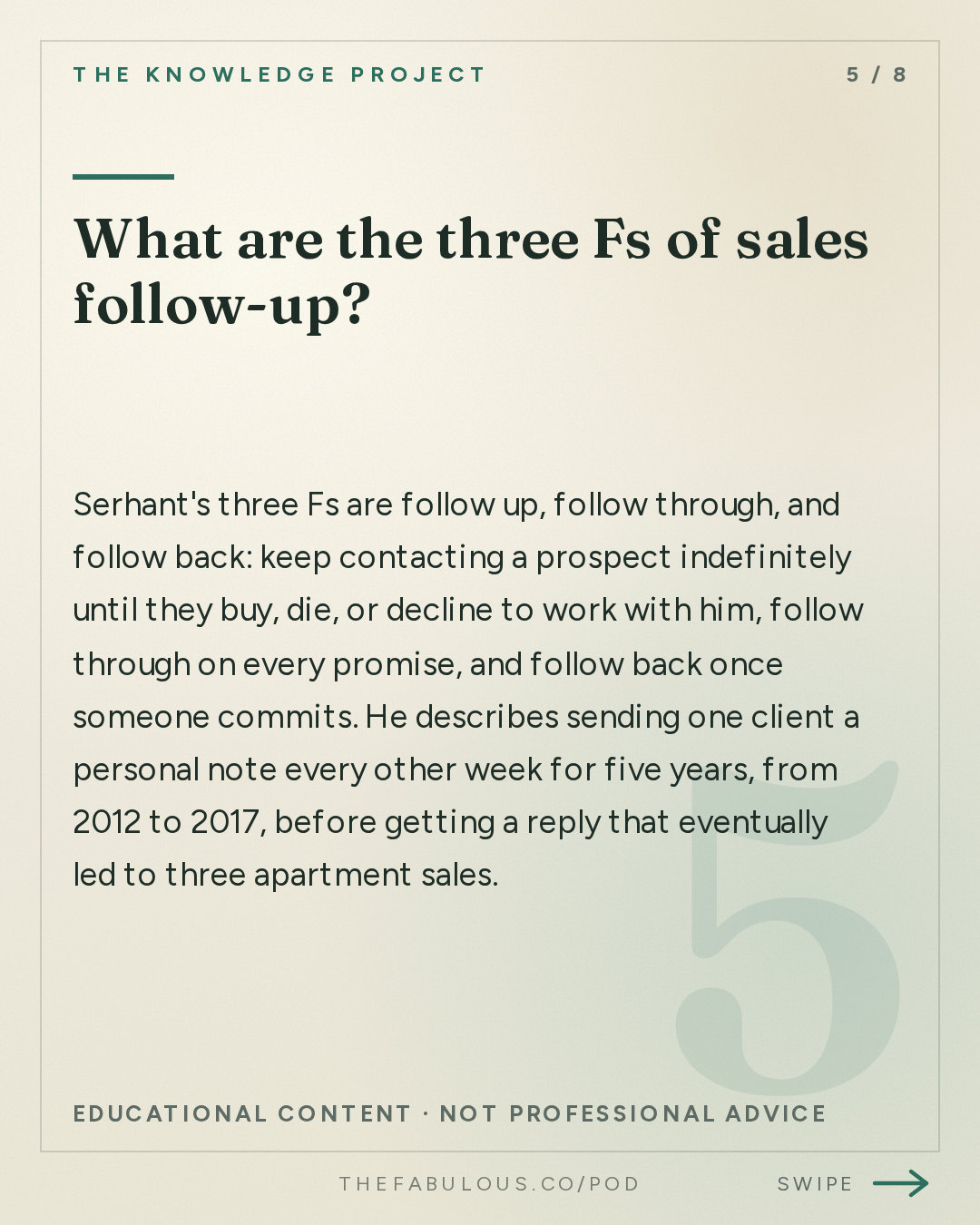
Where Serhant gets most specific is persistence. He frames follow-up around what he calls the three Fs: follow up, follow through, and follow back. Follow up never stops, he says, until people buy, die, or decide they do not want to work with him (20:36). Follow through means doing everything promised. Follow back means closing the loop once someone commits. He describes sending one client a personal note every other week, built around real market news rather than a sales pitch, for five straight years before the man responded at the end of 2017 (21:19). The relationship eventually produced three sales, worth sixteen million, seventy three million, and thirty three million dollars (22:10).
The strangest version of that persistence involves an 8.3 million dollar apartment sale on Manhattan's Upper West Side in 2011 (23:58). A buyer offered to pay cash over the phone, with no in-person meeting and no qualifying questions, then vanished. Months later, a lawyer called to say an 830,000 dollar wire had arrived from an account tied to a country flagged for scrutiny. Industry contacts told Serhant he had likely been used in a laundering scheme, where a buyer runs money through a real deal's escrow account and lets it sit before collecting it back if the sale collapses. Rather than drop it, Serhant tracked the buyer to a property record in Paris, flew there on a hunch, and eventually closed the deal in New York after the buyer turned out to be real, worth roughly a billion dollars a year, and simply slow. "One night I was drunk and I was on the internet, and then you didn't leave me alone, and I just felt bad for you," the buyer told him (28:40). Serhant notes the sale would equal roughly 100 million dollars in today's money by comparison (24:25).
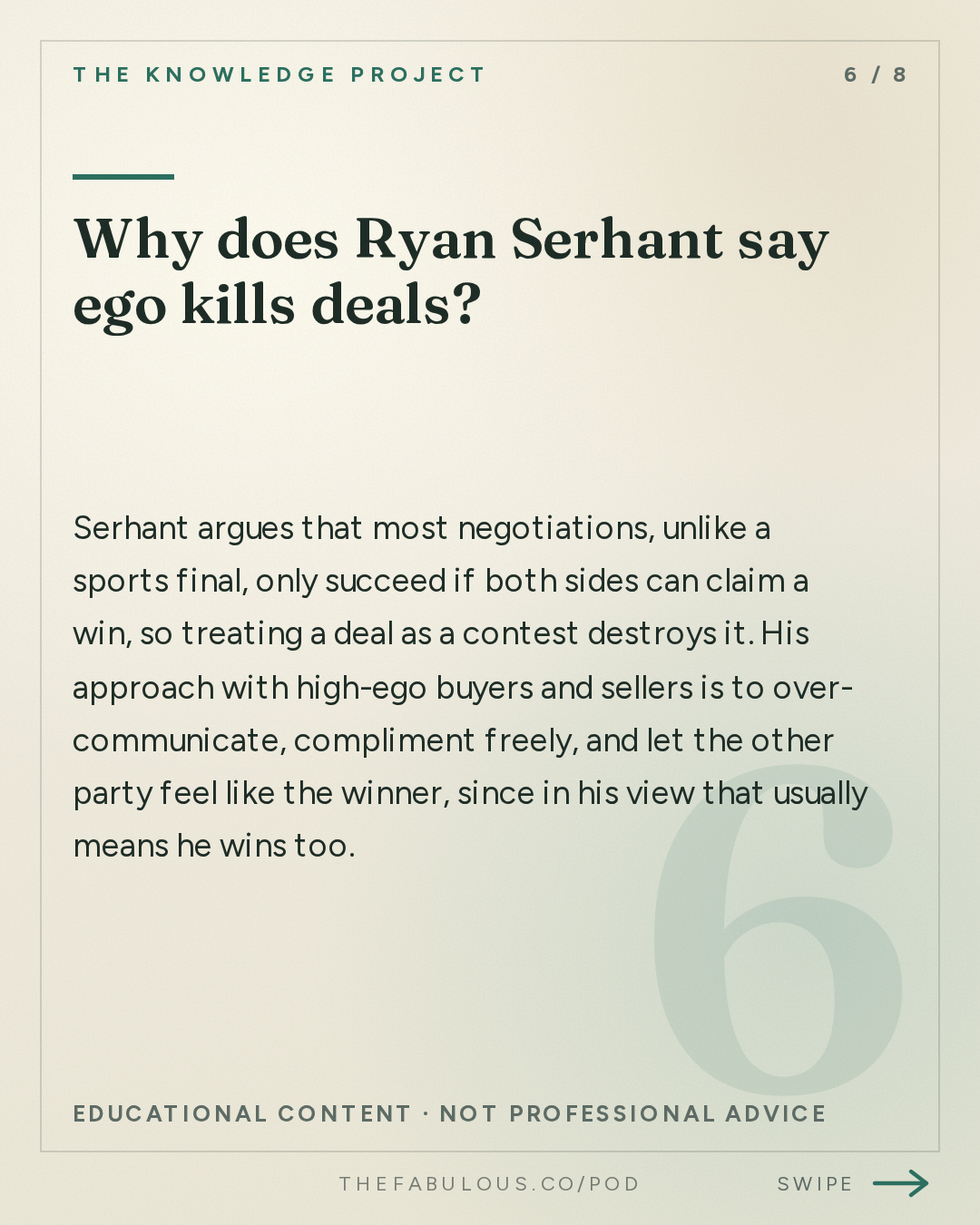
Serhant is just as direct about what kills deals: ego. "Ego kills more deals than anything. Ego kills more careers... more relationships," he says (31:17), arguing that most negotiations, unlike a basketball final, only work if both sides can claim a win. His approach to a room full of large egos, buyers, sellers, and agents, is to over-communicate, flatter everyone involved, and let the other side feel like the winner, since in most deals that means he wins too.
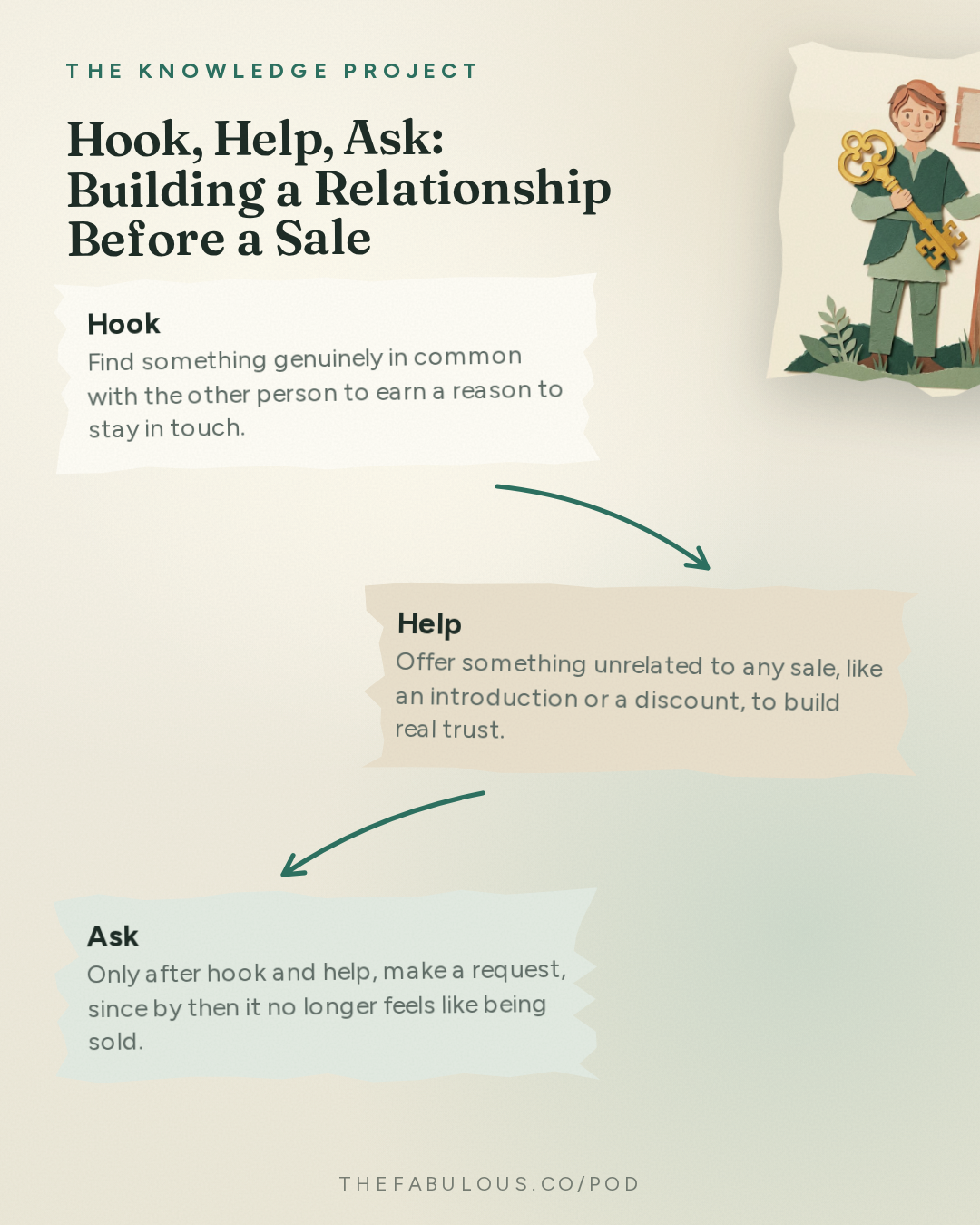
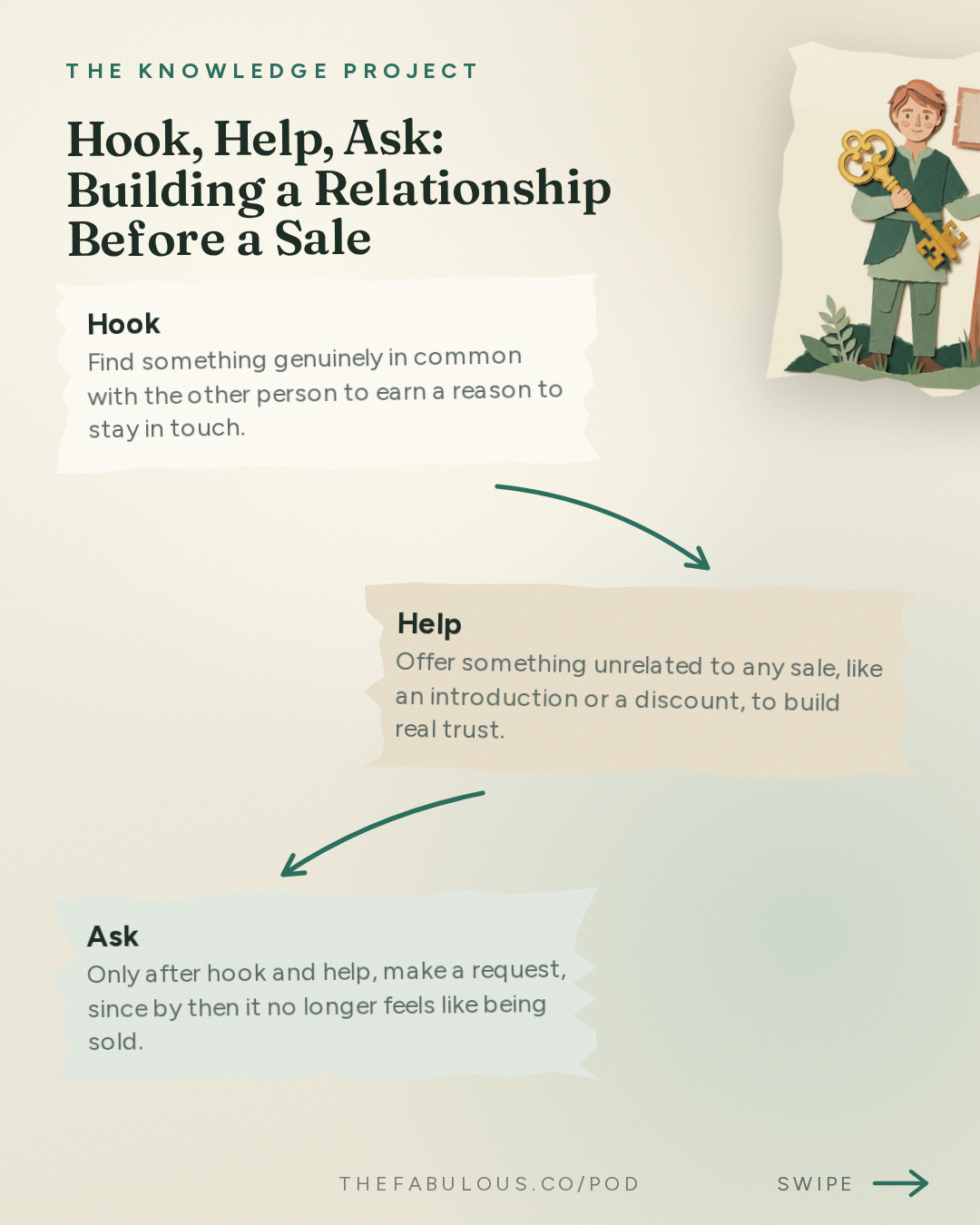
That same instinct for other people's attention explains why Serhant calls distribution, not the product itself, the most valuable asset any business owns (41:15). He traces this back to realizing, after Million Dollar Listing aired, that fame alone generated no phone calls, but content did. He built a personal following on early Instagram and YouTube years before competitors took either platform seriously, eventually writing clauses into listing agreements that let him post video tours of properties in exchange for exclusive access. The company that grew out of that content operation now trains salespeople through a platform called sellit.com, which Serhant says reaches more than 60,000 people across 133 countries (44:53). The relationship framework he teaches there he calls hook, help, ask: find something genuinely in common with a stranger, help them with something unrelated to any sale, and only then make a request (44:53).
By 2019, working purely as an agent, Serhant's team had crossed one billion dollars in annual sales, earning him about 22 million dollars in commission that year (48:50). Rather than stay there, he started a company from scratch in 2020, in the middle of the pandemic, while building a house with a nine month old at home, against his own parents' advice to wait. The decision to walk away from a proven ceiling, he says, came from the same place as everything else in the conversation: a refusal to let comfort or past hardship set the terms. "Your past explains you, but it does not excuse you," he says of his own chubby, picked-last-for-teams childhood (51:25), a line he applies equally to rude clients and to himself. Success, in his final accounting, is not ambition at all. It is what he calls pure, brutal responsibility to the people who win when he wins (53:52).
Ask this episode anything
Pod's AI answers from the episode itself, with the minute mark so you can hear it yourself.
Or start with one of these
Ask this episode
Pod's AI listens to the whole episode to answer, and points you to the minute it comes from.
The rest of this answer, and any question after it
Answers come from the episode itself, never from a summary of it.
ContinueKey takeaways
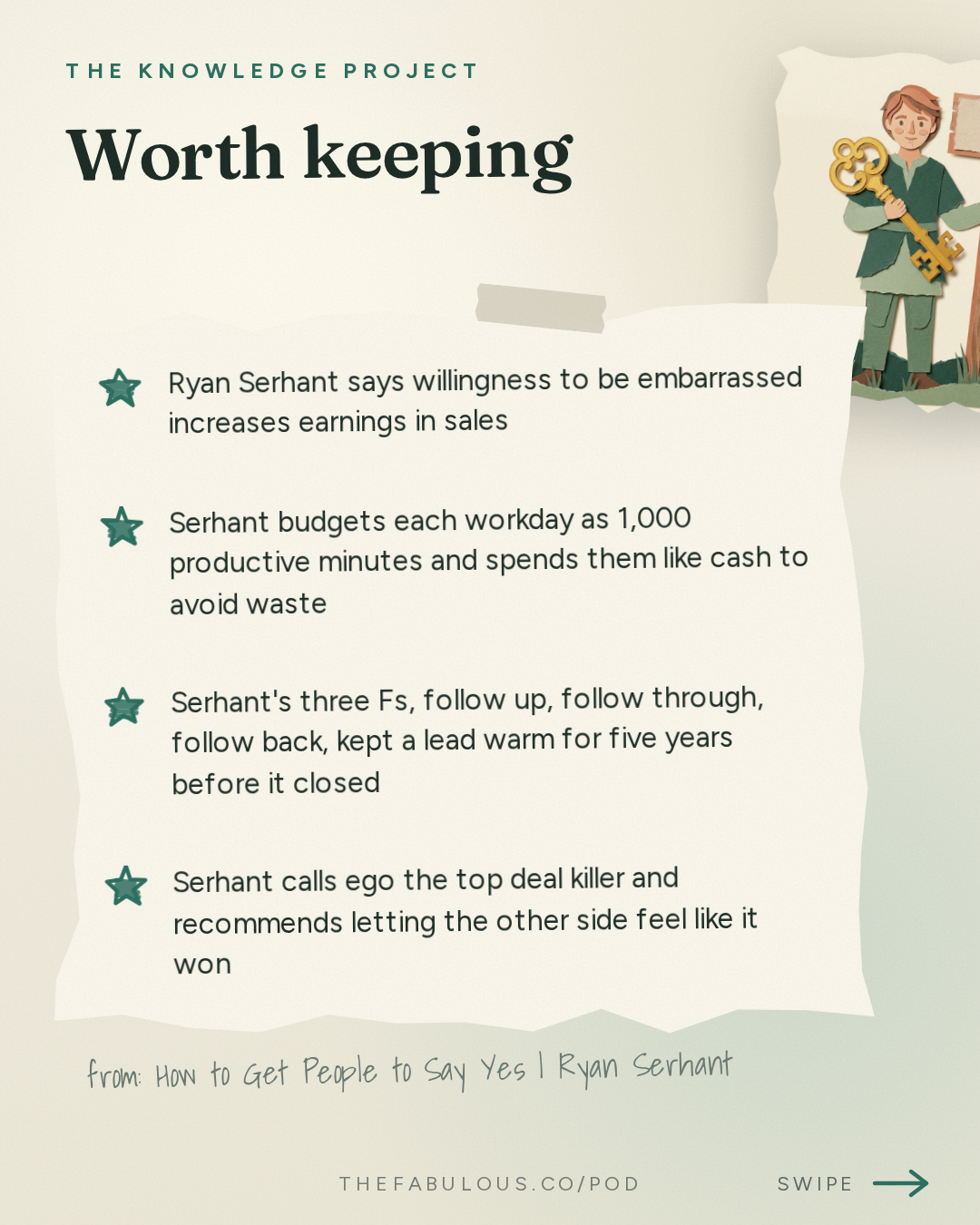
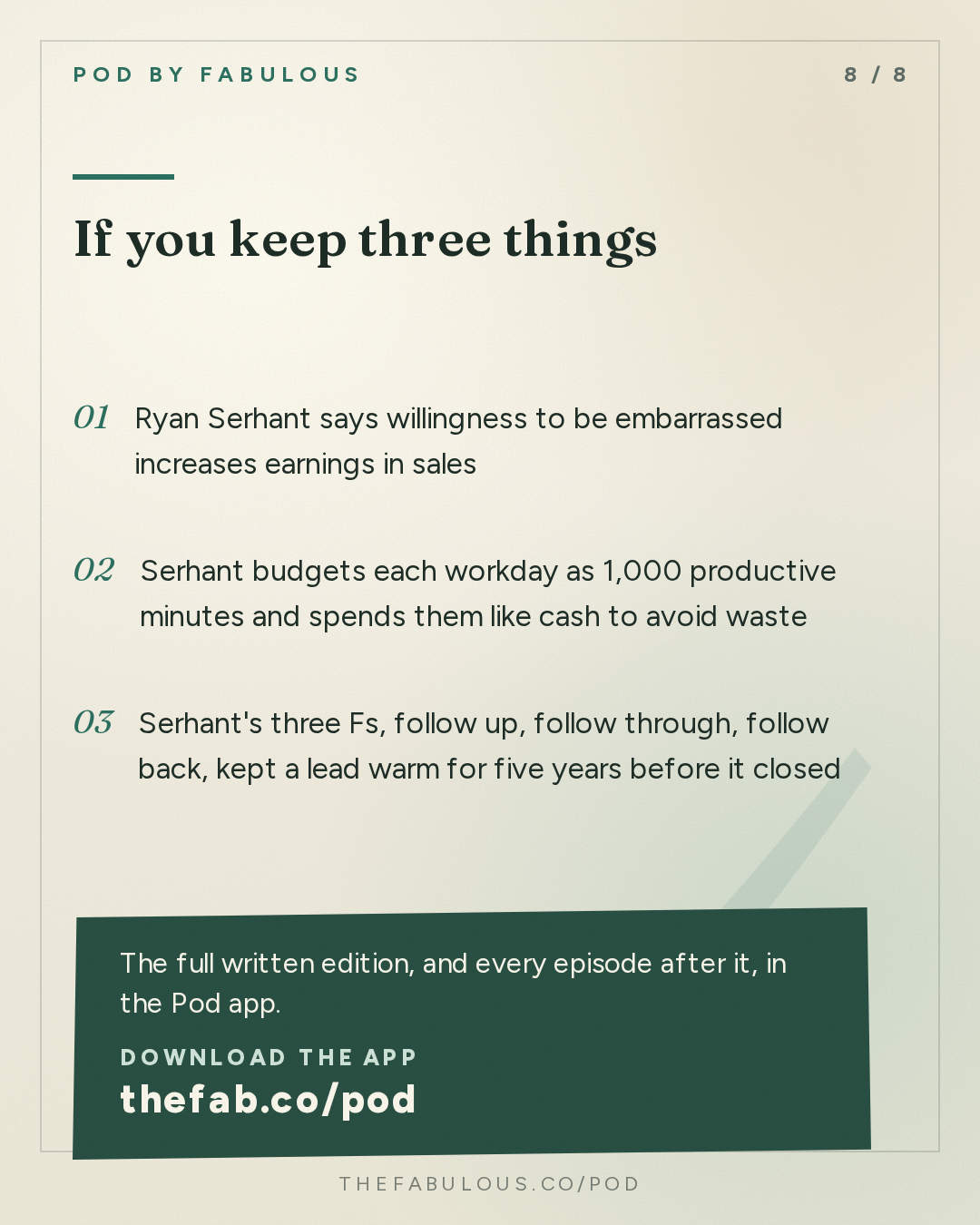
- Ryan Serhant says willingness to be embarrassed increases earnings in sales
- Serhant budgets each workday as 1,000 productive minutes and spends them like cash to avoid waste
- Serhant's three Fs, follow up, follow through, follow back, kept a lead warm for five years before it closed
- Serhant calls ego the top deal killer and recommends letting the other side feel like it won
- Serhant says distribution, not product quality, is the most valuable asset in a modern business
The episode in cards

By the numbers
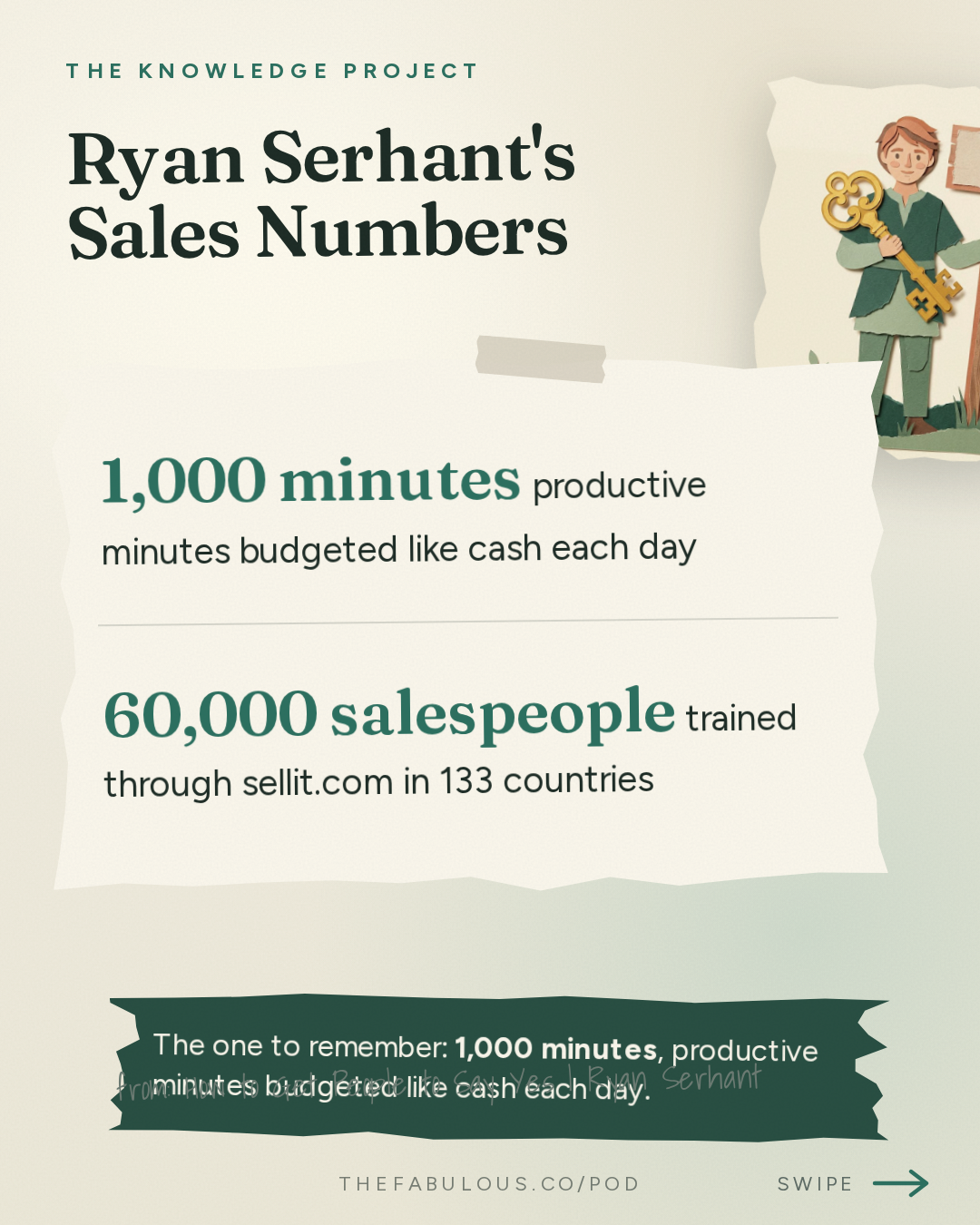
- 1,000 minutes productive minutes Ryan Serhant budgets like cash each day
- 60,000 salespeople people trained through Serhant's platform sellit.com across 133 countries
In their words
“If you're willing to embarrass yourself, you make more money every time.”
“The world is attracted to confidence and competence. And so if you can be competent, um, while being humbly confident, people will give you the things that you want”
“You have to treat those 1,000 minutes like money. Mm-hmm. It's the only way you won't waste”
“The best sale is no sale. The art of the sale is that nothing is for sale and I'm not selling you anything.”
“Your past explains you, but it does not excuse you.”
Protocols
-
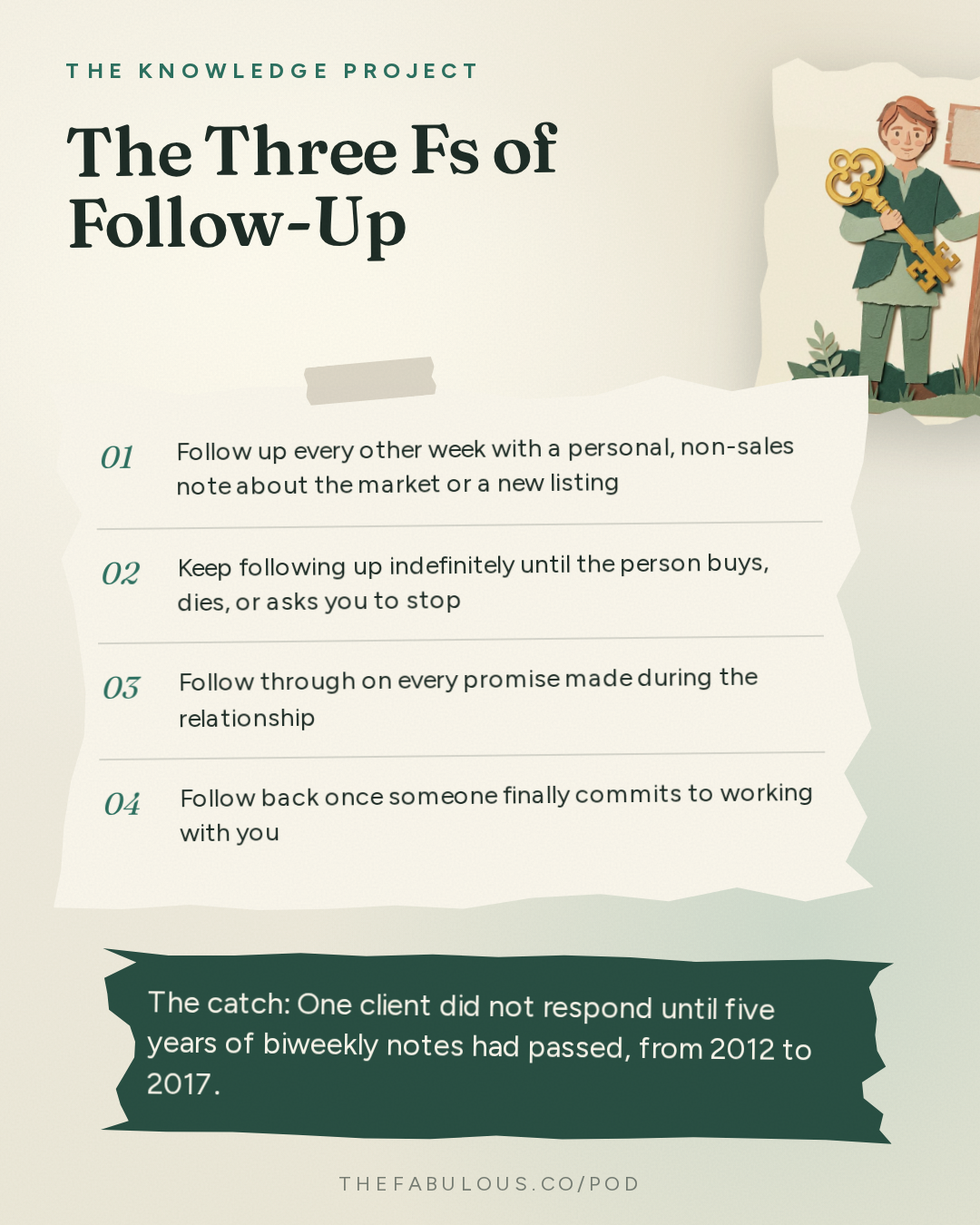
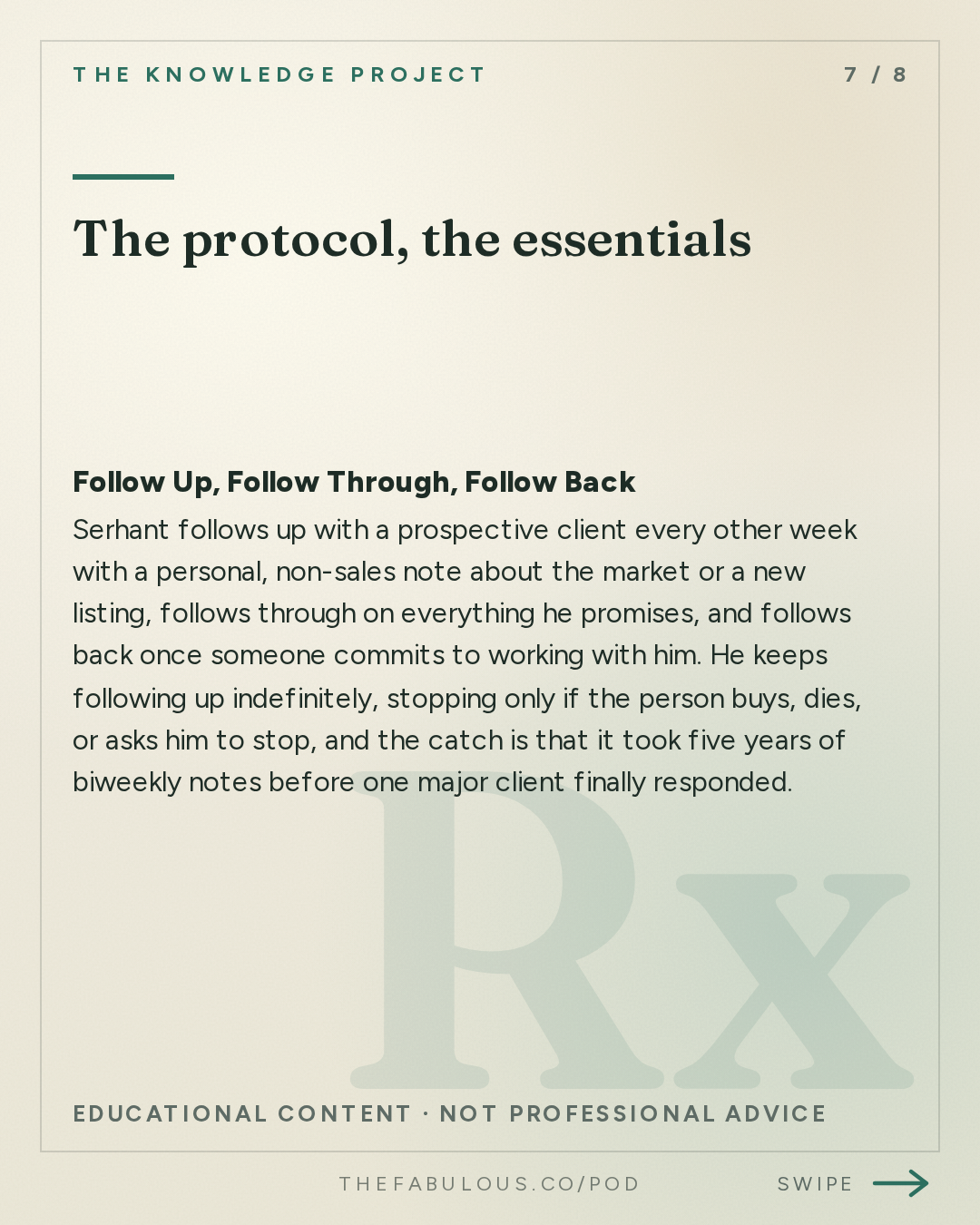
Follow Up, Follow Through, Follow Back
Serhant follows up with a prospective client every other week with a personal, non-sales note about the market or a new listing, follows through on everything he promises, and follows back once someone commits to working with him. He keeps following up indefinitely, stopping only if the person buys, dies, or asks him to stop, and the catch is that it took five years of biweekly notes before one major client finally responded.
every two weeks, indefinitely
-
The Two Cs and the CODO Close
Before making any ask, Serhant opens with the two Cs: he finds something genuinely in common with the other person and gives them an honest compliment to lower their guard. He then asks only questions the person cannot easily answer no to, lets them talk, and lays out next steps on day one under what he calls the CODO method, short for close on day one, with the catch that it only works on products and price points where a fast decision is realistic.
at first meeting
-
Budget the Day Like 1,000 Dollars
Serhant starts each day by treating roughly 1,000 of his 1,440 available minutes as cash, refusing to let a bad five-minute call or unnecessary small talk drain the rest of the day the way a person would never hand a stranger the remaining bills in their wallet. The catch, he says, is that this only works if applied with humility, since announcing time limits to colleagues out loud reads as rude rather than disciplined.
daily
-
Hook, Help, Ask
Serhant builds new relationships in three steps: hook a stranger by finding real common ground, help them with something unrelated to any sale, such as an introduction or a discount, and only then make an ask. The catch is that skipping straight to the ask before trust is built reads as selling, which most people instinctively resist.
per new relationship
Questions this episode answers
What is Ryan Serhant's 1,000 minutes rule?
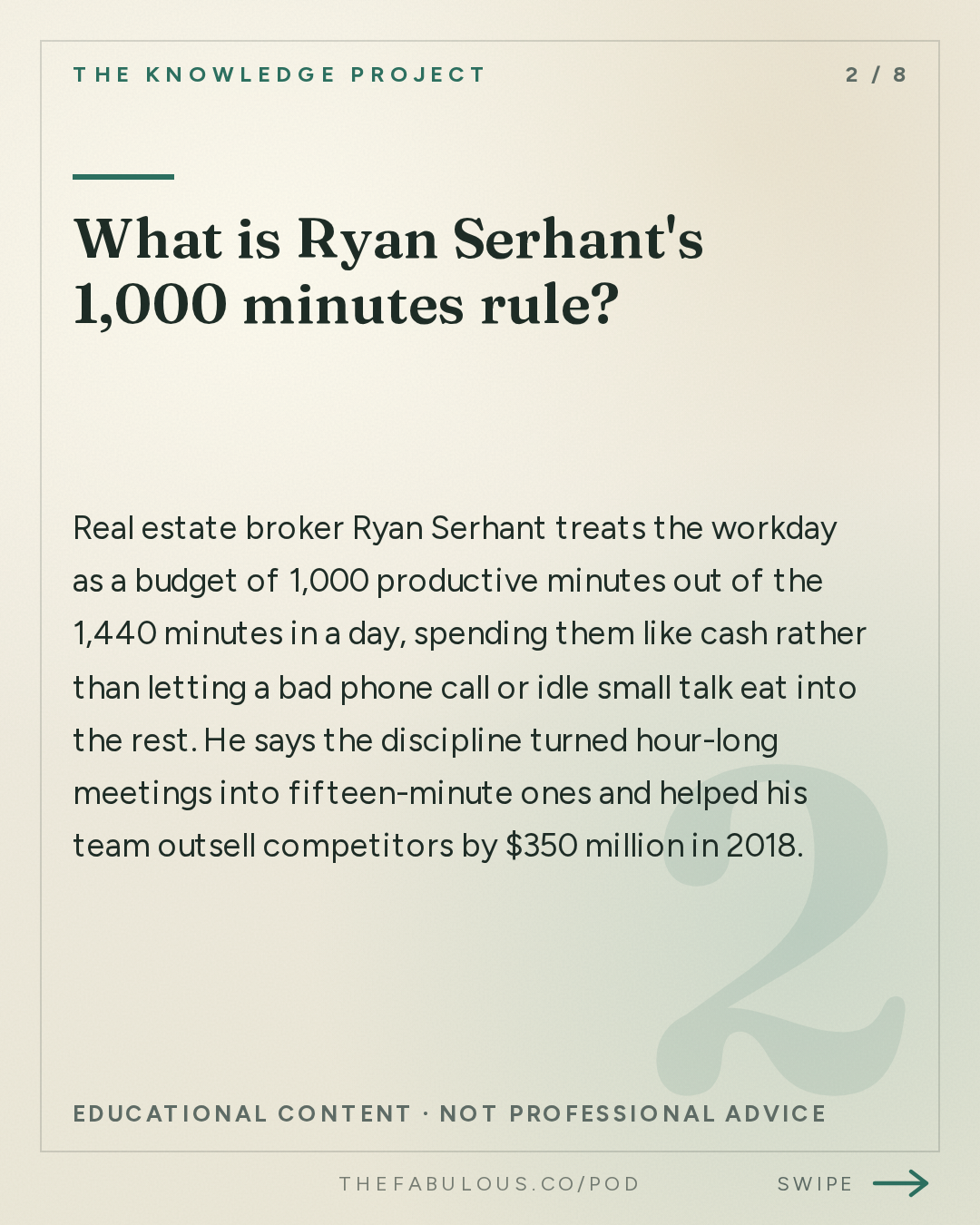
Real estate broker Ryan Serhant treats the workday as a budget of 1,000 productive minutes out of the 1,440 minutes in a day, spending them like cash rather than letting a bad phone call or idle small talk eat into the rest (13:01). He says the discipline turned hour-long meetings into fifteen-minute ones and helped his team outsell competitors by $350 million in 2018 (15:48).
What is the Hook, Help, Ask framework?
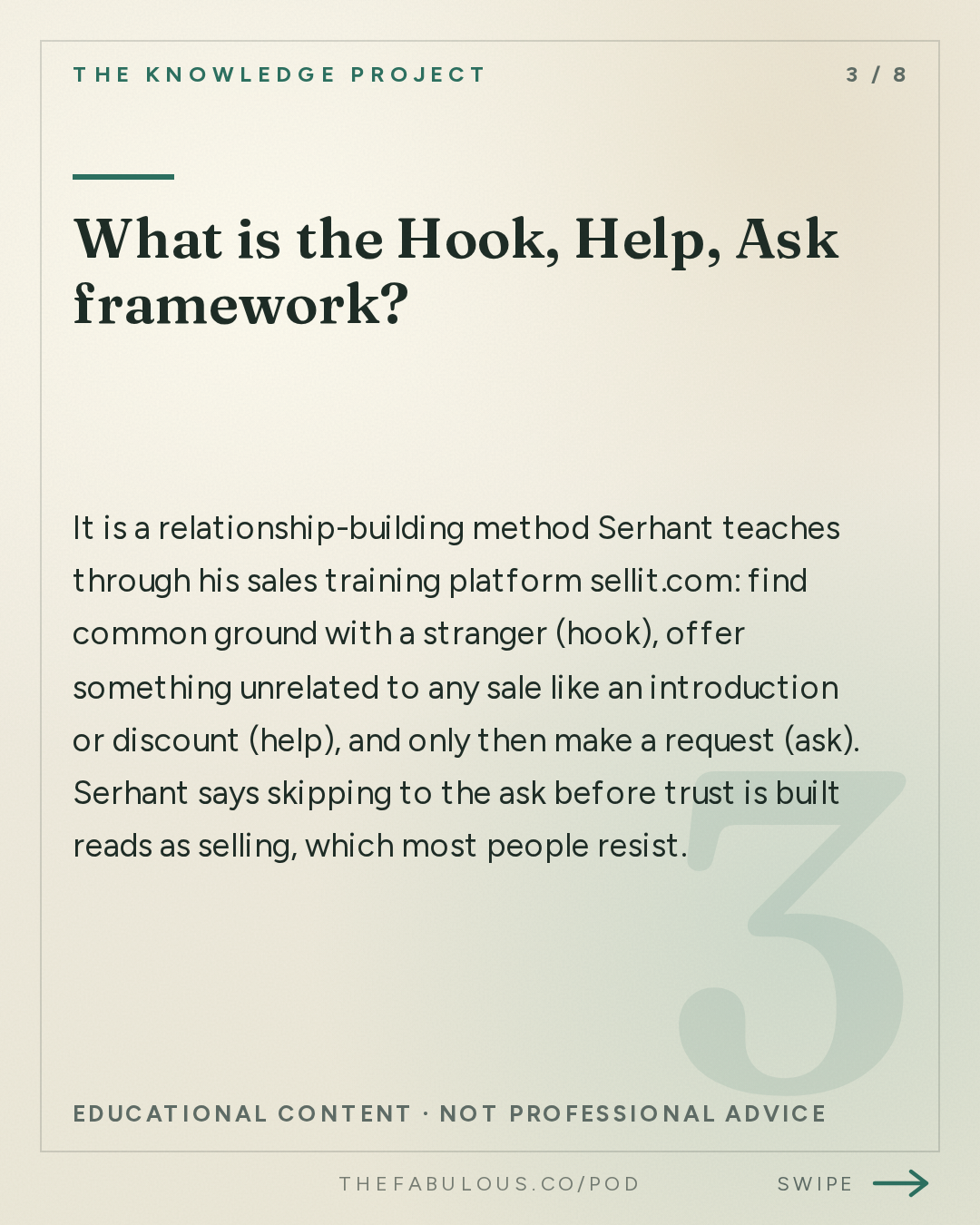
It is a relationship-building method Serhant teaches through his sales training platform sellit.com: find common ground with a stranger (hook), offer something unrelated to any sale like an introduction or discount (help), and only then make a request (ask) (44:53). Serhant says skipping to the ask before trust is built reads as selling, which most people resist.
How did Ryan Serhant get cast on Million Dollar Listing?
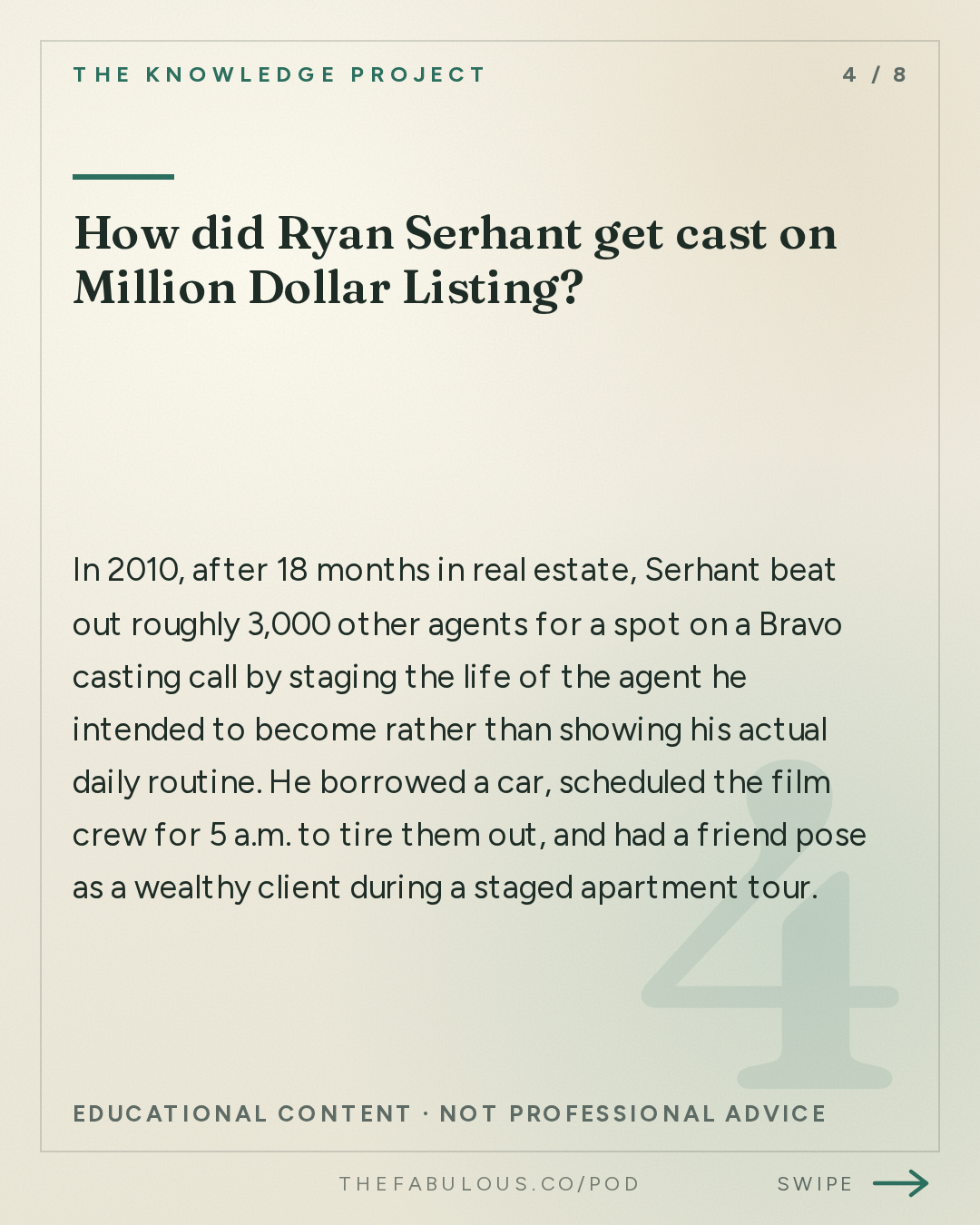
In 2010, after 18 months in real estate, Serhant beat out roughly 3,000 other agents for a spot on a Bravo casting call by staging the life of the agent he intended to become rather than showing his actual daily routine (03:04). He borrowed a car, scheduled the film crew for 5 a.m. to tire them out, and had a friend pose as a wealthy client during a staged apartment tour (04:40).
What are the three Fs of sales follow-up?
Serhant's three Fs are follow up, follow through, and follow back: keep contacting a prospect indefinitely until they buy, die, or decline to work with him, follow through on every promise, and follow back once someone commits (20:36). He describes sending one client a personal note every other week for five years, from 2012 to 2017, before getting a reply that eventually led to three apartment sales (22:10).
Why does Ryan Serhant say ego kills deals?
Serhant argues that most negotiations, unlike a sports final, only succeed if both sides can claim a win, so treating a deal as a contest destroys it (31:17). His approach with high-ego buyers and sellers is to over-communicate, compliment freely, and let the other party feel like the winner, since in his view that usually means he wins too.
What does Ryan Serhant mean by future me?
Serhant's future me idea means deciding who he intends to become in the next 12 to 24 months and acting like that person today instead of pretending or lying about his current situation (02:35). He applied it in 2010 by presenting a Bravo casting crew with the life of a top-tier agent he had not yet become, which helped him land a spot on Million Dollar Listing (04:40).
The full read, in cards
Mentioned
Ryan Serhant · Bremont · Million Dollar Listing · Bravo · Lehman Brothers · sellit.com · Serhant Media Group · Netflix · Owning Manhattan
More from this show and category

Charlie Munger's Todd Combs Interview: Key Lessons
Charlie Munger told Berkshire Hathaway manager Todd Combs in a 2022 interview that temperament, not raw intelligence, decides who wins at investing and leadership. He explains the "fiduciary gene," the Wooden Lesson of concentrating resources behind rare talent, and why positioning, holding cash and options before a crisis hits, beats trying to predict crashes like 1974's.
Ryan Serhant's Sales and Productivity Secrets
Ryan Serhant, star of Million Dollar Listing and founder of real estate firm Serhant, says comfort with embarrassment separates top earners from everyone else. He outlines his 1,000 minutes rule for guarding daily time, a hook-help-ask sales framework, and why distribution matters more than product quality.
Charlie Munger's Lessons from Henry Singleton
In a 2022 conversation, Charlie Munger tells Todd Combs that investing success rests on finding rare talent, choosing solvable problems, and smart positioning. The through-line is positioning: arranging affairs so circumstances never force bad decisions, as Munger explains using Rockefeller, Teledyne founder Henry Singleton, and the 1974 market crash.

Bill Ackman on Lucy's Recovery and the Brain Institute
Bill Ackman recounts his daughter Lucy's brain hemorrhage and the brain rehabilitation institute he built in response. He also details Pershing Square's investment checklist, its move away from short selling, and the plan to turn Howard Hughes into an insurance-driven holding company modeled on Berkshire Hathaway.
